Patients › Rehabilitation
Fracture ng Olecranon (ORIF)
Paggaling pagkatapos ng surgical fixation ng isang olecranon (tulis ng siko) fracture, pagprotekta sa repair ng triceps habang ibinabalik ang paggalaw, gamit ang isang simpleng sling at isang staged return ng active extension.
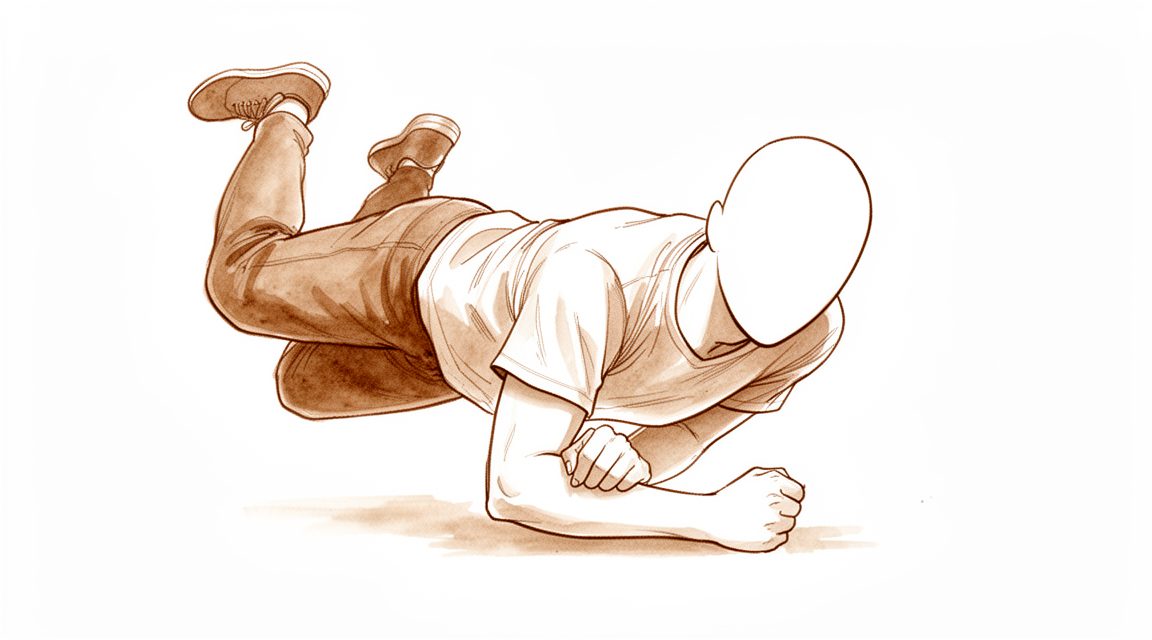
Ang protocol na ito ay nagsisilbing gabay sa iyong paggaling pagkatapos ng surgical fixation ng fracture ng olecranon (ang matulis na bahagi ng buto sa iyong siko) gamit ang open reduction and internal fixation (ORIF), na isinagawa ni Dr Kieran Hirpara sa Mater Private Hospital Rockhampton. Nagsisimula ito sa iyong home exercise program, na sinusundan ng structured clinical protocol na isinulat para sa iyong physiotherapist o hand therapist. Dalhin ang pahinang ito o ang PDF nito sa iyong unang therapy visit upang manatiling coordinated ang iyong rehabilitasyon. Maaaring i-adjust ng iyong therapist ang plano depende sa pag-unlad ng iyong paggaling.
Kung mayroon kang anumang alalahanin tungkol sa iyong sugat pagkatapos ng operasyon, makipag-ugnayan sa mga rooms. Madalas na nakatutulong ang pagkuha ng larawan ng sugat at pag-email nito para masuri.
Ano ang dapat asahan
Ang olecranon ay ang matulis na bahagi ng buto sa iyong siko. Ang malaking kalamnan ng triceps sa likod ng iyong braso ay nakakabit dito, at bumubuo ito ng bahagi ng hinge joint sa loob ng siko. Kapag nabali ang olecranon, ang hila ng triceps ay may tendensiyang humila palayo sa nabaling piraso, kaya ang bali ay inaayos sa pamamagitan ng operasyon, maaaring gamit ang wire-and-pin "tension band" (para sa malinis at tuwid na bali) o gamit ang plate at screws (para sa mas nadurog o may anggulong bali). Ang fixation ay ginawa upang pagdikitin ang buto nang sapat na matatag upang maaari mo nang simulan ang paggalaw ng siko nang maaga.
Ang buong layunin ng rehabilitasyong ito ay isang balancing act. Ang siko na nananatiling hindi gumagalaw nang masyadong matagal ay mabilis na tumitigas, kaya nais naming mapagalaw ito nang maaga. Ngunit ang parehong kalamnan ng triceps na humihila sa bali ay ang kalamnan na nagtutuwid ng iyong siko, kaya sa unang anim na linggo, pinoprotektahan namin ang repair sa pamamagitan ng pag-iwas sa active straightening, habang malayang ginagawa ang pagbaluktot ng siko at pag-ikot ng forearm. Kapag nagkaroon na ng oras ang buto na maghilom, ang pagtutuwid ay unti-unting ibabalik: una ay gamit lamang ang bigat ng iyong braso, at sa kalaunan lamang laban sa resistance.
Para sa pamamahala ng sugat, pamamaga, at peklat, tingnan ang gabay ng practice sa wound care.
Mahalagang malaman mula sa simula na kahit pagkatapos ng isang maayos na fixation ng olecranon fracture, karamihan sa mga tao ay naiiwang may maliit at permanenteng pagkawala ng huling 10–15 degrees ng full straightening. Ito ay normal, bihirang mapansin sa pang-araw-araw na buhay, at hindi senyales na may anumang nagkamali.
Mga pag-iingat at limitasyon
Gawin
- Isuot ang iyong simple sling para sa ginhawa at suporta, at tanggalin ito para sa iyong mga ehersisyo. Hindi mo kailangan ng rigid splint o brace.
- Simulan nang maaga ang pagbaluktot (bending) ng siko at pag-ikot (rotating) ng forearm (palad na nakaharap sa itaas / palad na nakaharap sa ibaba), sa loob ng mga limitasyong komportable.
- Panatilihing malayang gumagalaw ang iyong kamay, pulso, at balikat, at pumiga ng bola upang mapanatiling malakas ang iyong grip.
Huwag gawin
- Huwag aktibong ituwid (actively straighten) ang iyong siko gamit ang sariling lakas ng kalamnan sa unang 6 na linggo; hayaan itong tumuwid sa pamamagitan lamang ng gravity. Ang aktibong pagtutuwid ay humihila sa triceps at maaaring magdulot ng paghihiwalay (distract) ng fracture.
- Huwag gumawa ng anumang resisted o weighted straightening hanggang sa humigit-kumulang 3 buwan, kapag pinayagan na ito ng iyong therapist.
- Huwag magbuhat, magtulak, o humila gamit ang inooperahang braso, at huwag itong gamitin sa pagdadala ng bigat (bear weight), sa mga unang linggo.
Ito ang mga ehersisyo mula sa iyong handout, para sa pagbawi ng paggalaw ng iyong siko at forearm. Tanggalin ang iyong sling para sa iyong mga ehersisyo. Simulan ang mga ito ayon sa gabay ni Dr Hirpara at ng iyong therapist.
Iyong mga ehersisyo
Kieran Hirpara 4.0
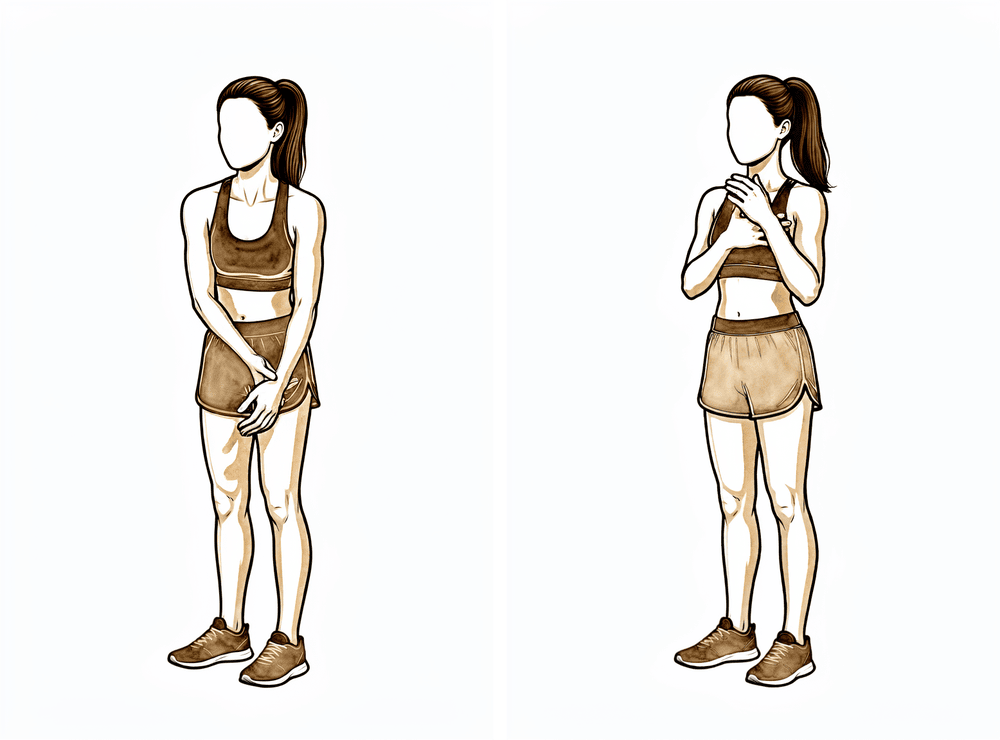
Pasibong pleksyon ng siko
Ipahinga ang iyong inoperahang braso nang nakaharap pataas ang palad. Gamitin ang iyong kabilang kamay upang dahan-dahang itiklop ang inoperahang siko hanggang sa kung saan ito komportable, tulungan itong gumalaw sa halip na gamitin ang sariling mga kalamnan ng inoperahang braso. Panatilihin ito nang ilang segundo sa dulo ng komportableng range, pagkatapos ay dahan-dahang hayaan itong bumalik sa pagtuwid. Binubuo nito ang iyong pagtiklop (flexion) nang hindi binibigatan ang repair.
10 beses, 3–4 beses sa isang araw
Kieran Hirpara 4.0
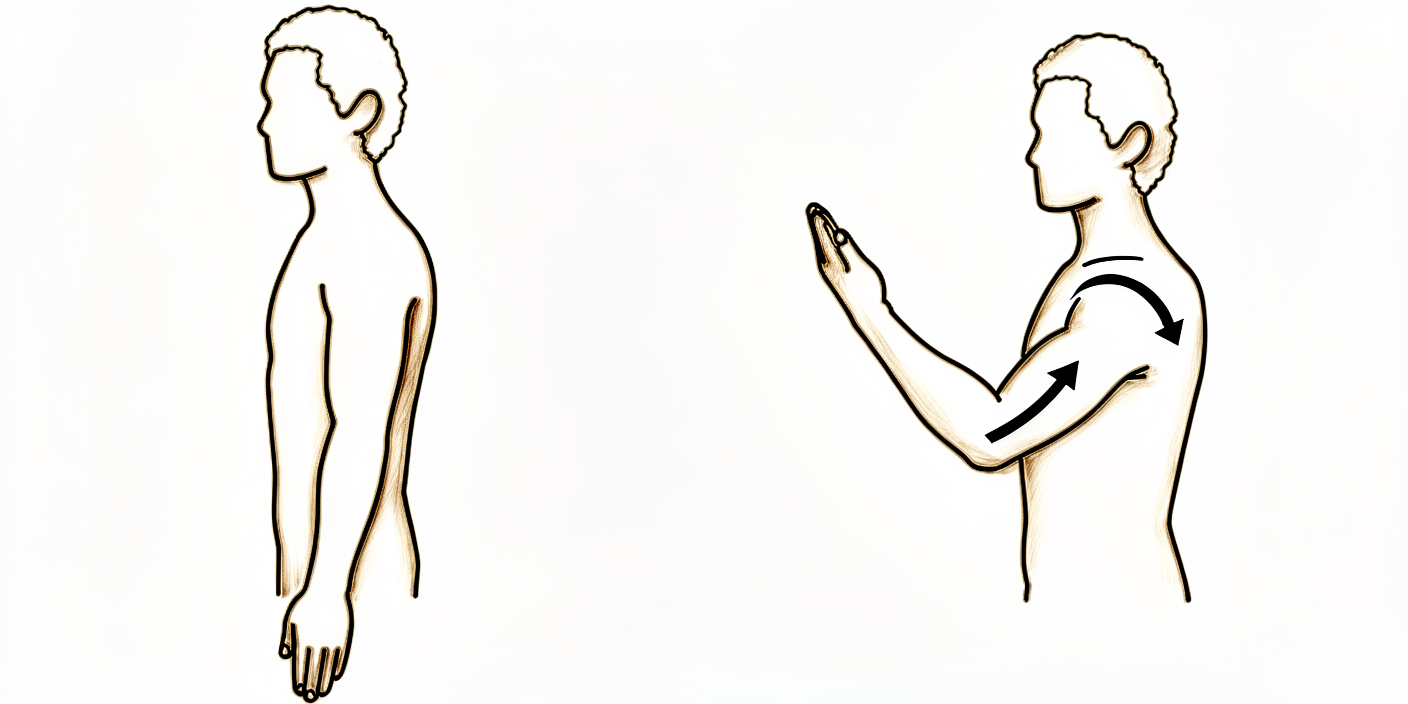
Aktibong pagbaluktot ng siko
Habang nakaharap pataas ang iyong palad at ang iyong itaas na braso ay nakadikit sa iyong gilid, dahan-dahang itiklop ang iyong siko hangga't kaya mo, pagkatapos ay hayaan itong bumalik sa tuwid nang may kontrol. Sa unang anim na linggo, hayaang tumuwid ang siko gamit ang grabidad — HUWAG itong itulak nang tuwid gamit ang sarili mong mga kalamnan.
10–15 beses, 3–4 beses sa isang araw
Kieran Hirpara 4.0
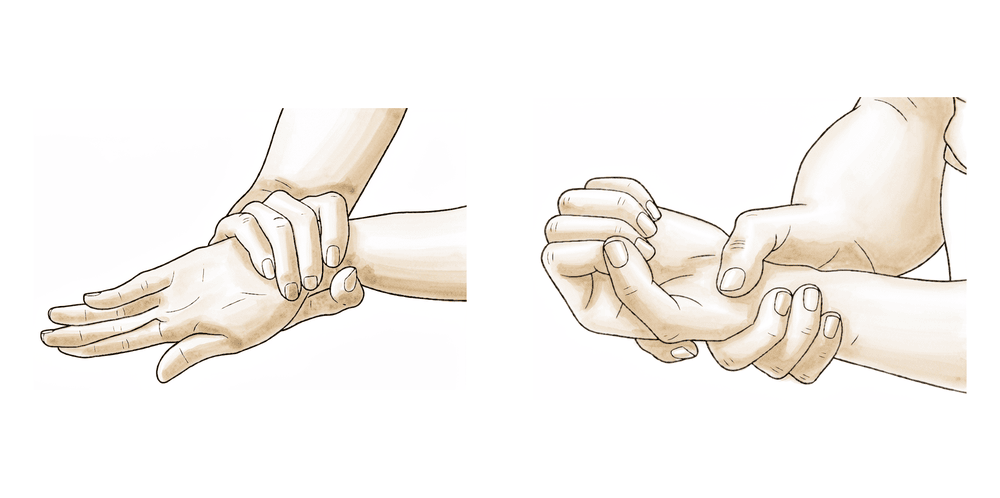
Rotasyon ng forearm
Panatilihing nakadikit ang iyong siko sa iyong tagiliran at nakabaluktot nang halos right angle. Dahan-dahang ituon ang iyong palad paitaas sa kisame, manatili sa posisyong ito nang 3–5 segundo, pagkatapos ay ituon ito paibaba sa sahig. Panatilihing hindi gumagalaw ang siko at nakadikit sa iyong katawan sa buong proseso. Maaari mong dahan-dahang tulungan ang paggalaw gamit ang iyong kabilang kamay.
10 beses sa bawat direksyon, 3–4 beses sa isang araw
Kieran Hirpara 4.0
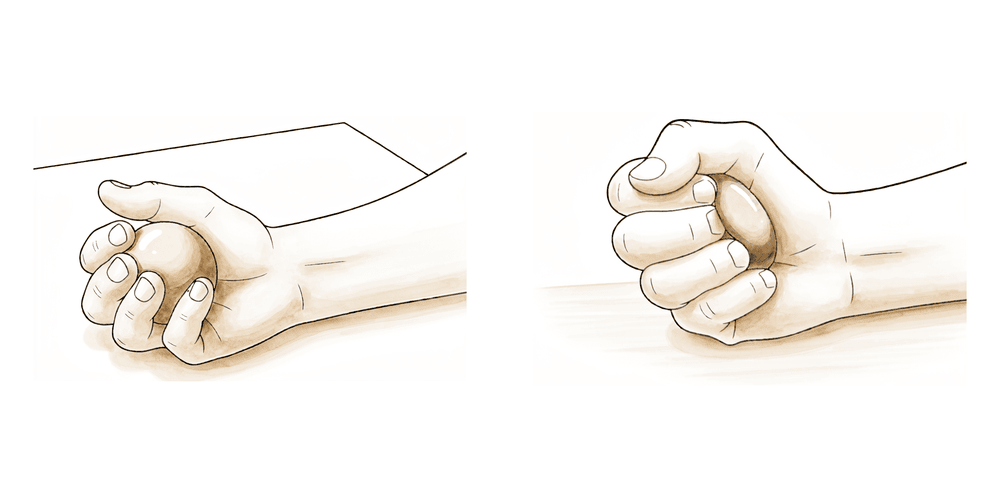
Pagpapalakas ng grip (kapit)
Pisilin ang isang malambot na bola o isang roll ng putty sa iyong kamay, hawakan nang ilang segundo, pagkatapos ay bitawan. Pinapanatili nitong malakas ang iyong kamay at forearm habang protektado ang iyong siko. Hindi nito binibigatan ang repair sa siko.
10–15 piga, 2–3 beses sa isang araw
Kieran Hirpara 4.0
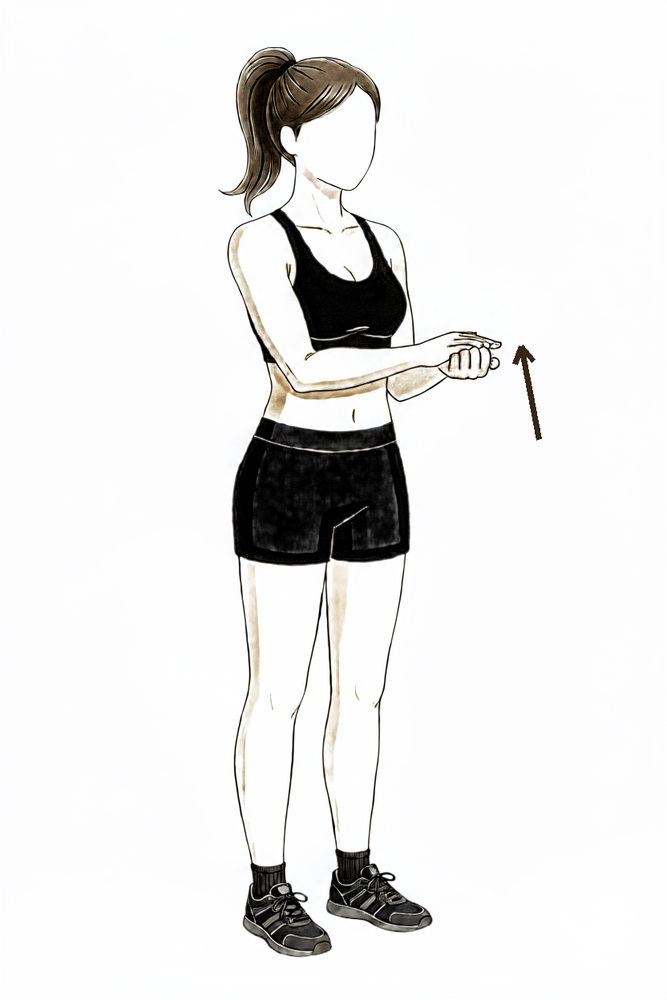
Isometric elbow-bend hold
Habang nakabaluktot ang iyong siko at nakaharap pataas ang iyong palad, ilagay ang iyong kabilang kamay sa ilalim ng iyong forearm. Dahan-dahang subukang itiklop pa lalo ang siko habang pinapanatili itong hindi gumagalaw ng iyong kabilang kamay, upang gumana ang kalamnan ngunit hindi gumagalaw ang braso. Hawakan nang dahan-dahan, pagkatapos ay i-relax. Ito ay isang muscle-activation (isometric) drill — pinapagana nito ang mga bending muscles lamang at HINDI binibigatan ang triceps o ang repair.
Hawakan nang 5 segundo, 5–10 beses, 2–3 beses sa isang araw
Kieran Hirpara 4.0
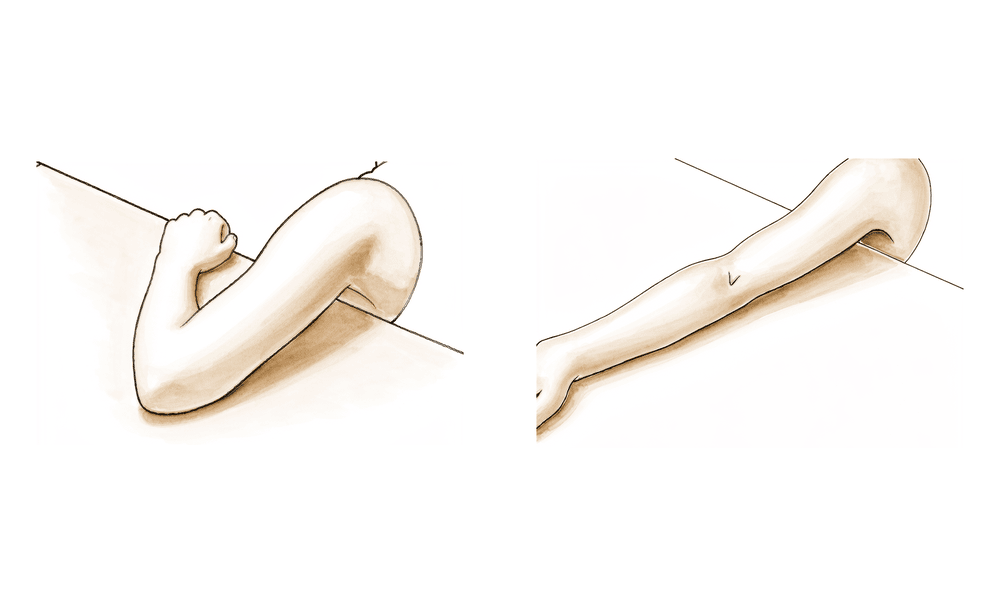
Aktibong extension ng siko (laban sa grabidad)
Simulan lamang ito kapag pinayagan na ng iyong surgeon o therapist, karaniwan ay mula anim na linggo. Habang suportado ang iyong itaas na bahagi ng braso, dahan-dahang ituwid ang iyong siko gamit ang sarili mong lakas ng kalamnan, pagkatapos ay itiklop itong muli nang may kontrol. Gumalaw laban sa grabidad lamang — HUWAG magdagdag ng anumang bigat o resistance hanggang sa payagan ka ng iyong therapist (karaniwan ay bandang tatlong buwan).
10 beses, 2–3 beses sa isang araw — mula linggo 6 lamang
Kieran Hirpara 4.0
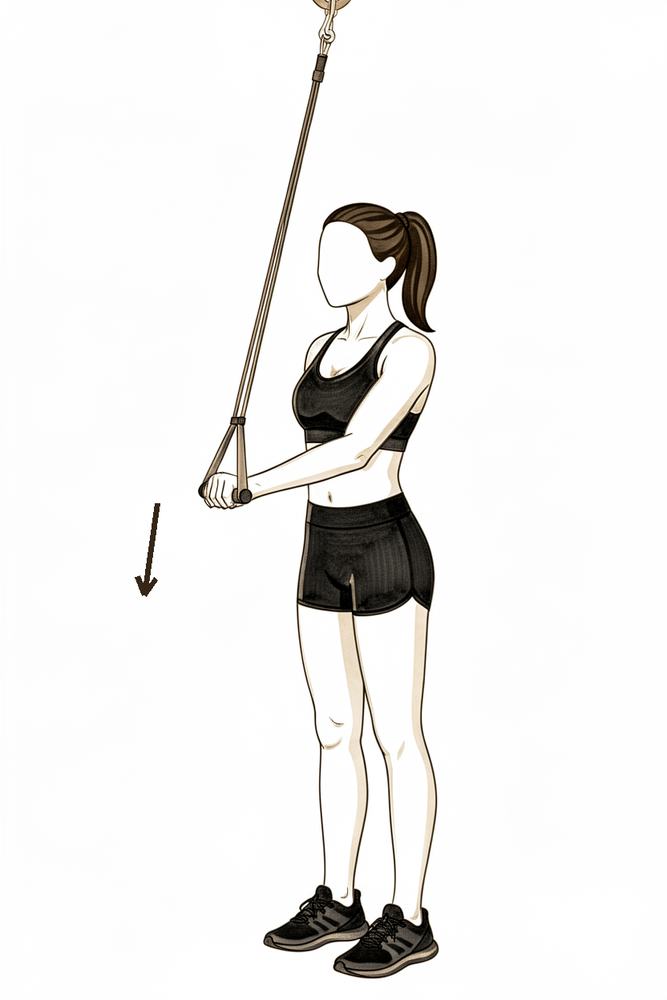
Resisted band extension
Ito ay isang exercise para sa huling yugto, na sisimulan lamang pagkalipas ng humigit-kumulang tatlong buwan kapag pinayagan na ito ng iyong therapist. I-angkla ang isang light resistance band at ituwid ang iyong siko laban sa hila nito, pagkatapos ay dahan-dahang ibalik. Magsimula sa pinakamagaang band at mag-progress sa light weights (humigit-kumulang 0.5–2 kg) ayon lamang sa gabay. Ang resisted straightening ay direktang nagbibigay ng load sa triceps at sa repair, kung kaya't ito ay ipinagpaliban.
10–15 beses, 3 beses sa isang linggo — mula ~3 buwan lamang
Simulan lamang ang mga ehersisyo sa ibaba ayon sa gabay ni Dr Hirpara at ng iyong hand therapist, at manatili sa anumang range at limitasyong ibinigay sa iyo. Sadyang dalawang ehersisyo lamang ang narito. Passive at active na pagbaluktot (bending) ang kailangan ng siko sa simula — mas madali itong tumitigas sa extension kaysa sa mawalan ng flexion — habang pinoprotektahan ang triceps repair. Huwag magbuhat, tumulak o humila gamit ang inoperahang braso, at huwag itong gamitin sa pagdadala ng bigat sa mga unang linggo; ang hila ng triceps ay eksaktong puwersa na pinoprotektahan ng fixation. Panatilihing malayang gumagalaw ang iyong kamay, pulso at balikat sa pagitan ng mga session. Itigil ang anumang nagdudulot ng matalas na sakit sa bahagi ng siko.
Ang iyong clinical protocol
Ang natitirang bahagi ng pahinang ito ay ang clinical protocol para sa isang olecranon fracture na ginamot sa pamamagitan ng open reduction and internal fixation. Ang seksyong ito ay ibibigay sa iyong physiotherapist o hand therapist, at ang bawat phase sa ibaba ay nagsisimula sa isang paliwanag sa simpleng Ingles tungkol sa nangyayari. Ang pinakamahalagang panuntunan na nagpapaiba sa protocol na ito mula sa isang generic na elbow fracture ay ang triceps protection: ang active extension ay ipinagpapaliban hanggang ~6 na linggo at ang resisted extension hanggang ~3 buwan, dahil ang triceps ay nakakabit sa olecranon at nagbibigay ng load sa fixation.
Bago ang paggamot, suriin ang x-ray ng pasyente, operation report at medical history, at makipag-ugnayan sa treating surgeon tungkol sa fixation construct (tension-band wiring vs plate), ang stability nito, at ang inaasahang prognosis.
Mga Linggo 0–1: immobilisation
Sa unang linggo, ang pokus ay ang pagpapahinga ng mga soft tissue, pagpapababa ng pamamaga, at pagpapanatiling gumagalaw ng lahat ng iba pa. Ang siko ay nakapahinga sa isang simple sling sa anggulong humigit-kumulang 90°, na tinatanggal para sa mga ehersisyo. Walang rigid posterior splint o brace.
Para sa iyong physiotherapist:
- Immobilisation: simple sling, siko sa ~90°, tinatanggal para sa mga ehersisyo (KH override: walang posterior splint o brace).
- Mga Layunin: pagpapahinga ng soft-tissue; kontrol sa oedema (elevation, gentle compression, cold).
- Mga Ehersisyo: active range of motion ng kamay, pulso (wrist) at balikat; ang gentle active range of motion ng siko at forearm ay maaaring magsimula mula sa araw 2–3 kung stable ang construct.
- Mga Pag-iingat: non-weight-bearing na upper limb; bawal ang pagbuhat, pagtulak o paghila; bawal ang active elbow extension.
- Mga Pamantayan para mag-progress: paghilom ng sugat at pagbaba ng pamamaga.
Mga Linggo 1–6: protektadong paggalaw (limitado ang extension)
Ito ang phase para sa proteksyon ng triceps. Ang pagbaluktot (bending) ay unti-unting pinauunlad habang ang pagtuwid (straightening) ay ginagawa nang passive o sa pamamagitan lamang ng gravity, hinding-hindi gamit ang sariling lakas sa pagtuwid ng siko. Ang sling ay unti-unting inaalis simula sa ika-4 na linggo.
Para sa iyong physiotherapist:
- ROM ceiling: ang flexion ay pinauunlad ng humigit-kumulang 10° bawat linggo sa loob ng tension-free range; ang layunin ay full passive extension, tension-free flexion hanggang 120°, at full forearm rotation sa ika-6 na linggo. Passive extension lamang: WALANG active extension.
- Mga Ehersisyo: active at active-assisted flexion kasama ang pronation/supination; ang passive range of motion ay maaaring magsimula sa ~ika-4 na linggo. Cuff, periscapular at forearm isometrics lamang, hindi elbow extension.
- Orthosis: unti-unting alisin ang sling sa ika-4 na linggo (isusuot sa labas ng bahay at sa gabi pagkatapos nito para sa ginhawa).
- Pamantayan para sa pag-usad: full passive extension, flexion hanggang ~120°, full rotation; pain ≤3/10.
Mga Linggo 6–12: ipinakilala ang active extension
Kapag ang buto ay nagkaroon na ng anim na linggo upang maghilom, muling ipinapakilala ang active straightening, laban sa gravity lamang at walang idinagdag na bigat. Ang pagbaluktot (bending) ay isinasulong tungo sa isang full arc, at ang weight-bearing sa pamamagitan ng braso ay unti-unting pinauunlad.
Para sa iyong physiotherapist:
- Mga Layunin: kumpletuhin ang motion arc; ipakilala ang gentle active extension.
- Mga Ehersisyo: active elbow extension laban sa gravity lamang mula linggo 6; isulong ang flexion hanggang maging full (layunin ang full tension-free arc sa bandang linggo 9). Isulong ang weight-bearing mula tabletop → wall → quadruped ayon sa kakayahan. Maaaring magsimula ang progressive resistive exercise sa flexion/rotation, ngunit NO resisted extension pa rin: ito ay pinapanatili hanggang 3 buwan.
- Pamantayan para sa pag-unlad: full active arc; walang paglala ng extension lag; radiographic union.
3–6 buwan: resisted extension at pagbabalik
Ang resisted straightening (ang hakbang na direktang naglalagay ng load sa triceps at sa repair) ay magsisimula lamang ngayon, kapag naghilom na ang fracture.
Para sa iyong physiotherapist:
- Ang resisted elbow extension ay magsisimula sa ~3 buwan (mga band na mag-pro-progress sa light weights, ~0.5–2 kg / 1–5 lb, 3×/linggo).
- Mga exercise na specific sa sport at trabaho mula ~4.5 buwan.
- Ang pagbubuhat at mabigat na paggawa ay babalik kapag nakamit na ang full strength at union, karaniwan ay sa loob ng 6 na buwan.
- Karaniwan ang hardware removal pagkatapos ng olecranon fixation (lalo na ang tension-band wires, ang pinakamadalas tanggaling implant sa katawan) at karaniwang ginagawa pagkatapos ng union, para sa relief ng prominent o irritating hardware, hindi bilang isang routine step.
Pagbabalik sa trabaho at aktibidad
Ang magaan na paggamit ng braso para sa pag-aalaga sa sarili (hands-on-lap) ay maaring gawin nang maaga basta't sinusunod ang mga pag-iingat sa itaas, ngunit anumang bagay na nagbibigay ng bigat o load sa siko ay dapat munang ipagpaliban. Ang pagbaluktot at pag-ikot ng forearm ay karaniwang komportable na pagdating ng mga anim na linggo; ang aktibong pagtuwid ay bumabalik mula anim na linggo at unti-unting bumubuti sa mga sumunod na linggo.
Ang mga mas mabibigat na gawain ay dadaan sa mga yugto: walang resisted o weighted na pagtuwid hanggang sa humigit-kumulang tatlong buwan, sport- at job-specific na pagsasanay mula sa humigit-kumulang apat at kalahating buwan, at pagbabalik sa pagbubuhat at mabibigat na manwal na trabaho karaniwan ay sa loob ng anim na buwan, kapag pinahintulutan na ito ng iyong lakas at ng paghilom ng buto. Ang mga desk-based at magagaan na tungkulin ay karaniwang maaaring ituloy nang mas maaga; talakayin ang timing nito kay Dr Hirpara sa iyong review, dahil nakadepende ito sa iyong trabaho at kung aling braso ang na-operahan. Ang pagmamaneho ay maaaring ituloy kapag wala ka na sa sling at ligtas nang makokontrol ang sasakyan gamit ang parehong braso, gaya ng kumpirmasyon sa iyong review.
Tandaan na asahan ang maliit at permanenteng pagkawala ng huling 10–15 degrees ng pagtuwid; ito ay normal at karaniwang walang epekto sa pang-araw-araw na function.
Pagkatapos ng iyong protocol
Ang protocol na ito ay kasabay ng pangkalahatang payo sa paggaling ng klinika: tingnan ang pamamahala ng sakit pagkatapos ng operasyon at pag-aalaga ng sugat. Para sa mismong pinsala, tingnan ang olecranon fracture. Ang phased plan sa itaas ay naaayon sa mga nailathalang rehabilitation protocol pagkatapos ng olecranon ORIF, at ang iyong patuloy na paggaling ay ginagabayan nang indibidwal ng iyong physiotherapist o hand therapist ayon sa pag-unlad ng iyong siko.
Evidence & references
This is the clinical evidence summary written for health professionals. It is technical, and it lists the research this page was built from. You do not need to read it to understand your treatment or to make a decision about it.
Olecranon Fracture — Open Reduction Internal Fixation (ORIF) — Post-operative Rehabilitation
Topic scope: Post-operative rehabilitation after ORIF of a displaced olecranon fracture — tension-band wiring (TBW) for simple transverse patterns, or plate-and-screw fixation for comminuted / oblique / Monteggia-type / proximal-ulna patterns. The olecranon fracture is an intra-articular fracture of the extensor mechanism: the fixation construct must resist the triceps pull that distracts the fragment, and the rehabilitation is built around protecting that construct while preventing the stiffness to which the elbow is highly prone.
Defining principle (the inverse of an arthrolysis): unlike a stiff-elbow release, here there is a fixation construct to protect, and the deforming force is the triceps. So active and resisted elbow EXTENSION — and lifting / pushing — are restricted early, while flexion and forearm rotation are advanced relatively freely to prevent stiffness. Dr Hirpara's practice override: the operated elbow is rested in a simple sling, not a posterior splint or brace; active extension is withheld for 0–6 weeks (protecting the tension band / triceps insertion), resisted extension is delayed to ~3 months, flexion is advanced ~10°/week, and the patient is counselled to expect a permanent 10–15° loss of terminal extension.
Evidence-strength flag: MODERATE-to-STRONG. Two concordant institutional physiotherapy protocols (Brigham & Women's Hospital; The Christ Hospital / Rao) give explicit phase timelines, and the biomechanical rationale — anatomic reduction plus stable fixation to permit early motion of an intra-articular fracture — is universally agreed. Consensus is strong on early protected motion + delayed active / resisted extension and triceps loading. The evidence is weaker (equipoise-level) on TBW vs plate, and on operative vs non-operative management in the elderly.
Phased rehabilitation timeline
| Phase | Window | Sling / immobilisation | ROM / use | Strengthening | Criteria to progress |
|---|---|---|---|---|---|
| I — Immobilisation | Weeks 0–1 | Simple sling at ~90° (KH — no posterior splint/brace), off for exercises | Active hand/wrist/shoulder ROM; gentle active elbow + forearm ROM from day 2–3 if stable; NO active extension | — (oedema control) | Wound and swelling settling |
| II — Protected motion, extension restricted | Weeks 1–6 | Wean sling at week 4 (out-of-house + night thereafter) | Flexion advanced ~10°/week in a tension-free zone; passive extension only; PROM may begin ~wk 4; goal full passive extension + flexion to 120° + full rotation by 6 wk | Cuff / periscapular / forearm isometrics only | Full passive extension, flexion ~120°, full rotation; pain ≤3/10 |
| III — Active extension introduced | Weeks 6–12 | Discontinued | Active extension against gravity only from wk 6; advance flexion to full (full tension-free arc by ~wk 9); progress weight-bearing tabletop → wall → quadruped | PRE to flexion/rotation; still NO resisted extension | Full active arc; no worsening extension lag; radiographic union |
| IV — Resisted extension + return | 3–6 months | — | Return to lifting/loading staged | Resisted extension from ~3 months (bands → light weights 1–5 lb, 3×/wk); sport/job-specific ~4.5 mo | Full strength + union; lifting/heavy labour ~6 mo |
Evidence by theme
The triceps-pull rule (the rehab-defining constraint) — Consensus, strong biomechanical rationale
The triceps inserts on the olecranon; active and resisted extension distract the fracture and load the tension band. Active extension against gravity is therefore deferred to ~6 weeks and resisted extension to ~3 months. This is the single most important rule distinguishing olecranon ORIF from a generic elbow-fracture rehabilitation, and both published protocols enforce it (The Christ Hospital / Rao explicitly prohibit active extension for the first six weeks).
Early protected motion to prevent stiffness — Strong consensus
There is universal agreement that an intra-articular extensor-mechanism fracture needs early motion to prevent stiffness; how early depends on construct stability and surgeon confidence. Brigham permits active ROM from day 2–3; the more conservative Christ / Rao protocol protects the first weeks with no active extension. The tension throughout is "prevent stiffness" versus "protect the triceps repair," resolved by advancing flexion and rotation freely while restricting extension.
Construct choice — TBW vs plate — Moderate / equipoise
Both constructs aim to be stable enough for early motion. TBW is simpler and adequate for simple transverse fractures but carries the highest symptomatic-hardware / removal rate and can lose compression in comminuted or osteoporotic bone. Plate fixation better controls comminution, oblique and diaphyseal-extension patterns; Hume & Wiss's randomized study favoured plate over TBW for comminuted patterns, while Anderson et al. reported a mean ~13.5° flexion contracture after plating. Rehabilitation phases are broadly the same — a more stable construct simply allows the surgeon to liberalise motion sooner.
Operative vs non-operative in the elderly — Moderate (RCT, equipoise)
A prospective RCT of displaced olecranon fractures in elderly patients was stopped early for a high operative complication rate, with comparable patient-reported outcomes — shifting practice toward non-operative management and earlier free mobilisation in low-demand older patients. Geriatric locking plates reduce fixation failure in osteoporotic bone but still carry meaningful complication and implant-failure rates.
Expected residual deficit — Moderate (corpus, observational)
Even with stable fixation and early motion, isolated olecranon fractures lose ~10–15° of terminal extension on average. Patients should be counselled that this is the expected norm, not a complication.
Hardware removal — Moderate (observational)
Olecranon hardware — especially TBW K-wires / wires — is the most commonly removed implant in the body; prominent subcutaneous hardware drives a high secondary-removal rate (up to roughly half of TBW cases in some series). Removal is typically performed after union (often ≥4–6 months) and largely for symptom relief, not as a routine staged step. Plate fixation has fewer wire-irritation issues but a non-trivial removal rate.
Evidence strength flags (summary)
- STRONG / CONSENSUS: early protected motion to prevent stiffness; the triceps-pull rule deferring active extension to ~6 weeks and resisted extension to ~3 months (biomechanical rationale
- two concordant institutional protocols).
- MODERATE: TBW vs plate construct choice (Hume & Wiss; Anderson ~13.5° contracture after plating); operative vs non-operative in the elderly (RCT stopped early for operative complications); expected 10–15° terminal-extension loss; high TBW hardware-removal rate.
- CONSENSUS / EXPERT: the precise phase timings (drawn from surgeon patient-guidance protocols rather than a rehabilitation RCT); the simple-sling immobilisation (KH practice override).
CITATIONS
RAG corpus (180,000+ Orthopaedic articles)
- Chalidis BE, Sachinis NC, Samoladas EP, Dimitriou CG, Pournaras JD. Is tension band wiring technique the "gold standard" for the treatment of olecranon fractures? A long-term functional outcome study. J Orthop Surg Res. 2008;3:9. DOI: 10.1186/1749-799X-3-9
- Hume MC, Wiss DA. Olecranon fractures: a clinical and radiographic comparison of tension band wiring and plate fixation (randomized comparison; plate favoured for comminuted patterns). (Cited in retrieved corpus text.)
- Anderson et al. — mean ~13.5° flexion contracture after olecranon plate fixation (retrieved corpus text).
- Prospective RCT, operative vs non-operative management of displaced olecranon fractures in the elderly — stopped early for a high rate of complications in the operative group, comparable patient-reported outcomes (retrieved corpus text).
- Geriatric olecranon locking-plate case series — major/minor complication and implant-failure rates (J Shoulder Elbow Surg, retrieved corpus text).
- Retrieved corpus text: isolated olecranon fractures lose an average of ~10–15° of terminal extension despite stable fixation and early ROM; anatomic reduction and early range of motion to restore functional elbow motion and strength; high re-operation / hardware-removal rate after TBW.
Published rehabilitation protocols (URLs)
- The Christ Hospital / Rao — "Olecranon ORIF Physical Therapy Protocol." https://www.thechristhospital.com/landingpages/Documents/Rao%20PT%20Protocols/Operative/Elbow/Rao%20Olecranon%20ORIF%20r1.pdf
- Brigham & Women's Hospital, Department of Rehabilitation Services — "Elbow Fracture Post-Op (Radial Head / Olecranon ORIF) Hand Therapy Guideline" (2021). https://www.brighamandwomens.org/assets/BWH/patients-and-families/rehabilitation-services/pdfs/elbow-fracture-orif-hand-therapy-protocol.pdf
- Physiopedia — "Olecranon Fracture" (general background). https://www.physio-pedia.com/Olecranon_Fracture