Patients › Rehabilitation
Pagpapalit ng MCP Joint
Isang recovery plan na pinamumunuan ng hand-therapy pagkatapos ng silicone (Swanson) knuckle-joint replacement, na nakabase sa isang dynamic extension splint na nagpapanatiling diretso at bahagyang radial ng mga knuckle habang maagang ibinabaluktot ang mga ito — muling hinuhubog ang mga joint sa isang corrected position at binabaligtad ang ulnar drift.
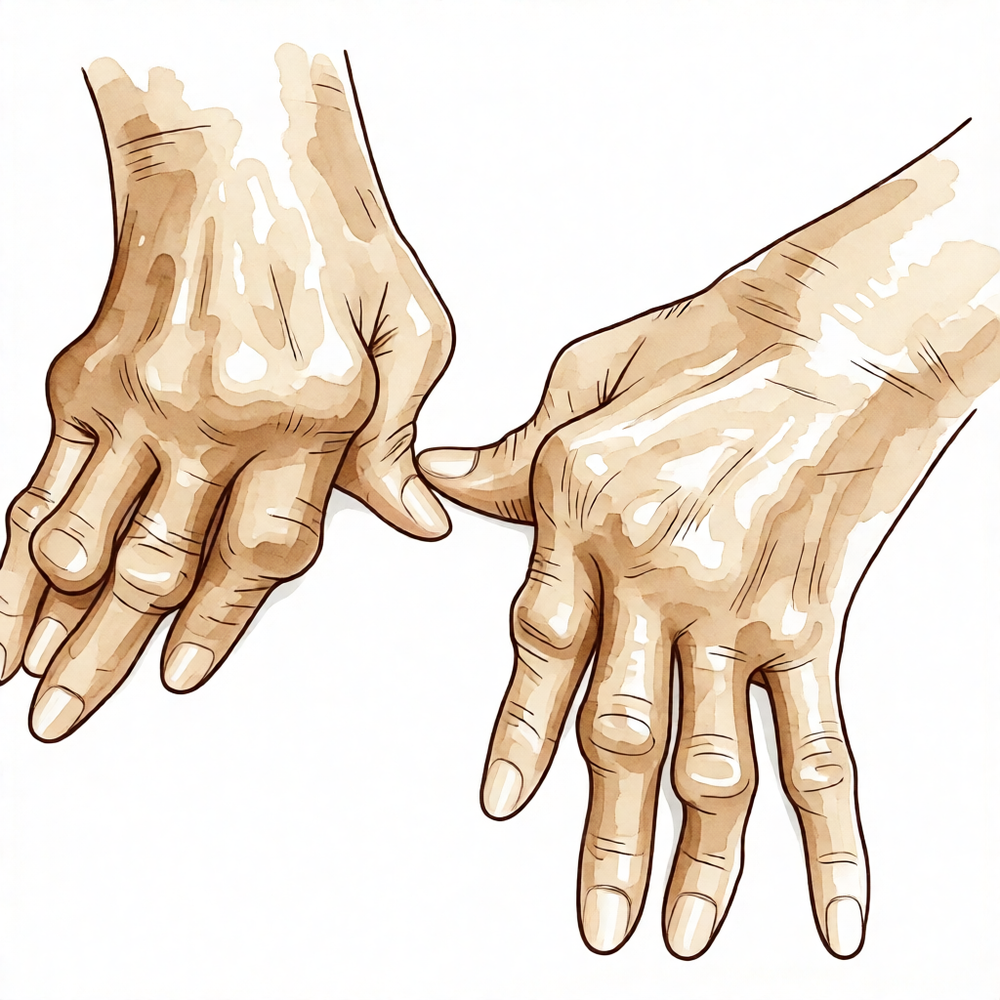
Ang protocol na ito ay nagsisilbing gabay sa iyong paggaling pagkatapos ng silicone (Swanson) replacement ng mga knuckle joint (ang mga metacarpophalangeal o "MCP" joint) kasama si Dr Kieran Hirpara sa Mater Private Hospital Rockhampton. Nagsisimula ito sa iyong home exercise program, na sinusundan ng structured clinical protocol na isinulat para sa iyong hand therapist: dalhin ang pahinang ito o ang PDF nito sa iyong unang therapy visit upang manatiling coordinated ang iyong rehabilitasyon. Maaaring i-adjust ng iyong hand therapist ang plano depende sa pag-unlad ng iyong paggaling.
Ito ay isang recovery na nakatuon sa hand therapy at paggamit ng splint. Ang dynamic splint at ang iyong mga pang-araw-araw na ehersisyo ay hindi optional: ito ang paraan upang mahubog ang mga bagong joint sa isang corrected at tuwid na posisyon. Ang iyong resulta ay lubos na nakadepende sa tapat na pagsasagawa ng splinting at paggalaw.
Kung mayroon kang anumang alalahanin tungkol sa iyong sugat pagkatapos ng operasyon, makipag-ugnayan sa mga room. Madalas na nakatutulong ang pagkuha ng larawan ng sugat at pag-email nito para masuri.
Ano ang dapat asahan
Ang mga knuckle joint ay maaaring mapudpod, sumakit at magkaroon ng malalang deformidad, madalas sa rheumatoid arthritis, kung saan ang mga daliri ay tumatagilid patungo sa panig ng kalingkingan (ulnar drift) at ang mga base ng mga daliri ay dumudulas pababa patungo sa palad (volar subluxation); maaari rin itong mapudpod dahil sa osteoarthritis. Sa operasyong ito, ang pudpod na knuckle joint ay tinatanggal at pinapalitan ng isang flexible silicone spacer (ang klasikong Swanson implant). Ang mga layunin ay upang maibsan ang sakit, maitama ang drift at ang mga nakalaylay na knuckle (extensor lag), at maibalik ang kapaki-pakinabang na arc ng pagbaluktot.
Ang implant ay hindi isang matigas na hinge. Gumagana ito bilang isang flexible spacer habang isang bagong lining (isang "capsule") ang nabubuo sa paligid nito sa loob ng mga unang linggo, at ang buong punto ng rehabilitasyon ay upang mabuo ang capsule na iyon habang ang iyong mga daliri ay pinapanatiling diretso at itinuwid, hindi nakatagilid. Iyan ang dahilan kung bakit napakahalaga ng splint at ng maagang paggalaw.
Ang paggaling ay nakabase kaya sa isang dynamic extension outrigger splint, na karaniwang ikinakabit sa loob ng mga unang araw:
- Kapag nakapahinga, pinapanatili ng splint na diretso ang iyong mga knuckle at dahan-dahang hinihila patungo sa panig ng hinlalaki (radial deviation), na direktang sumasalungat sa lumang ulnar drift.
- Sa loob ng splint, nagsasagawa ka ng maagang kontroladong active bending ng mga knuckle laban sa mga malalambot na elastic loop, na bumabalik sa mga daliri upang maging diretso. Ang maagang paggalaw (ngunit sa protektado at itinuwid na posisyong ito lamang) ay humuhubog sa bagong capsule nang tama at pinipigilan ang mga joint sa paninigas.
Isusuot mo ang dynamic splint nang halos tuloy-tuloy sa loob ng humigit-kumulang anim na linggo, pagkatapos ay unti-unting lilipat sa isang resting / night splint, na may idaragdag na graded strengthening kalaunan. Ang magaan na function ng kamay ay bumabalik sa mga unang linggo; karamihan sa mga tao ay nakakabalik na sa karamihan ng mga pang-araw-araw na aktibidad sa loob ng humigit-kumulang tatlong buwan, habang ang pinal na resulta ay patuloy na nag-aadjust sa loob ng ilan pang mga buwan.
Mga pag-iingat at limitasyon
- Isuot ang iyong dynamic extension splint ayon sa itinuro: araw at gabi sa loob ng humigit-kumulang unang anim na linggo. Pinapanatili nito ang koreksyon; ang madalas na pagtatanggal nito ay nagpapahintulot sa drift na bumalik.
- HUWAG hayaang bumalik ang drift ng iyong mga daliri patungo sa panig ng kalingkingan. Ang bawat ehersisyo ay ginagabay sila sa kabilang direksyon, patungo sa hinlalaki.
- HUWAG gumawa ng anumang malakas na paghawak (gripping), pag-pinch, o mabigat na pagbuhat sa simula: ang mahigpit na paghawak ay nagtutulak sa mga daliri patungo sa ulnar drift at nagbibigay ng stress sa mga bagong joint bago sila maging stable. Ang pagpapalakas (strengthening) ay maghihintay hanggang sa payagan ito ng iyong hand therapist.
- Panatilihing gumagalaw ang iyong hinlalaki, pulso, at ang mga dulo ng iyong mga daliri mula sa simula, at gamitin ang kamay para sa mga magagaan na pang-araw-araw na gawain hangga't komportable.
- Bantayan ang sugat para sa mga palatandaan ng impeksyon (nadaragdagan na pamumula, init, pamamaga, o discharge) at makipag-ugnayan sa klinika kung ikaw ay nababahala; ang impeksyon sa paligid ng isang implant ay hindi karaniwan ngunit mahalagang matukoy nang maaga.
Para sa pamamahala ng sugat, pamamaga, at peklat, tingnan ang gabay sa wound care ng klinika.
Iyong mga ehersisyo
Kieran Hirpara 4.0
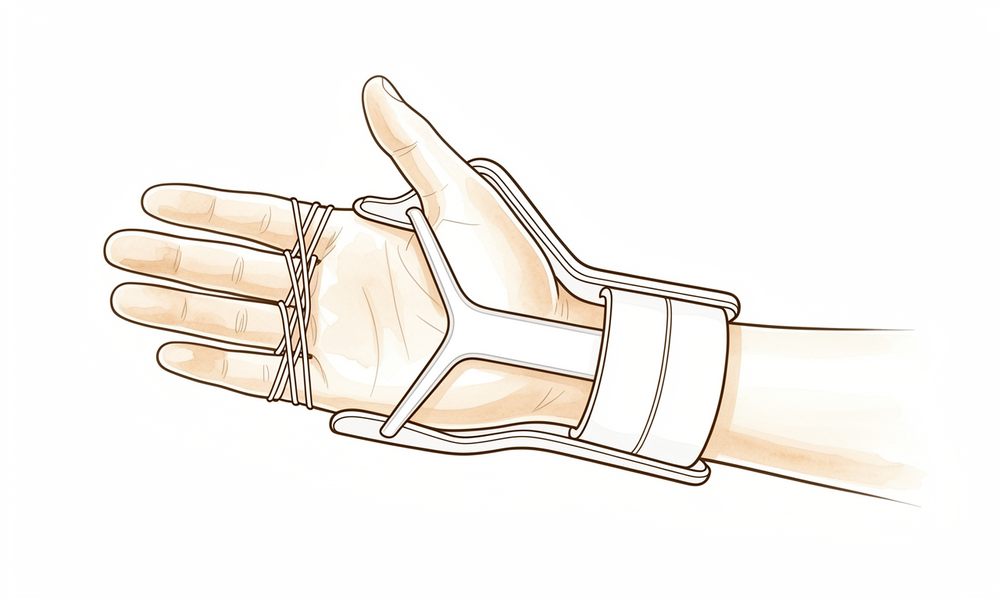
Pagsusuot ng iyong dynamic splint
Ang iyong dynamic extension splint ang gumagawa ng proteksyon para sa iyo: kapag nakapahinga, pinapanatili nitong diretso ang iyong mga knuckles at dahan-dahang hinihila patungo sa panig ng hinlalaki (radial), upang itama ang lumang drift. Isuot ito ayon sa itinuro — araw at gabi sa loob ng humigit-kumulang unang anim na linggo — at tanggalin lamang para sa paghuhugas at para sa mga ehersisyong pinapayagan ng iyong hand therapist na gawin nang wala ang splint. Ang mga loop sa iyong mga daliri ay dapat komportableng nakalapat; sabihan ang iyong therapist kung may anumang kumikiskis o kumukurot.
Isusuot nang tuloy-tuloy sa loob ng ~6 na linggo, pagkatapos ay tuwing gabi/pahinga ayon sa gabay
Kieran Hirpara 4.0
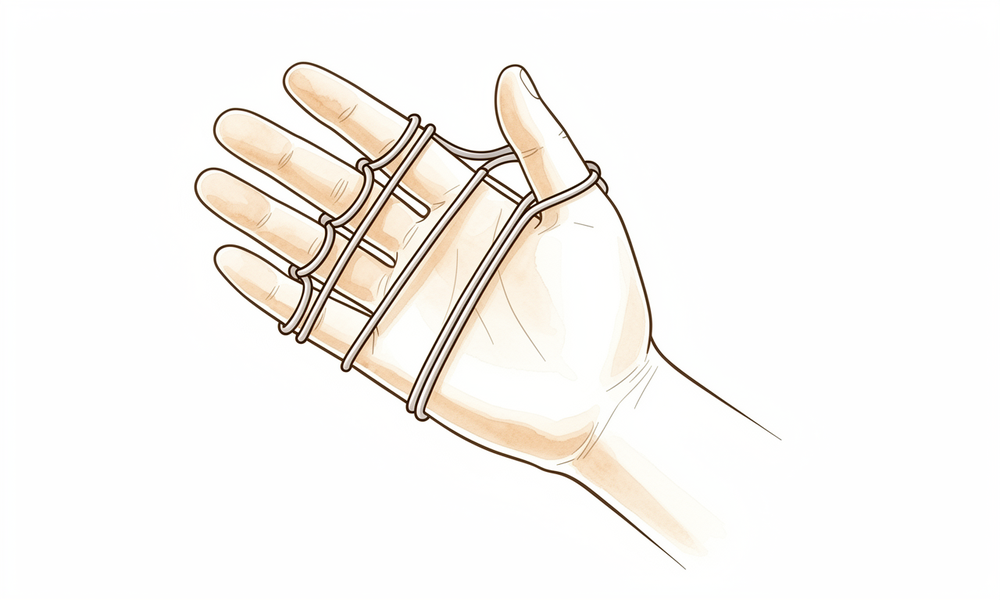
Kontroladong pagbaluktot ng knuckle sa splint
Habang suot ang splint, dahan-dahang itiklop ang iyong mga daliri pababa sa mga knuckles, hila laban sa mga elastic loop, pagkatapos ay i-relax at hayaang ibalik ng splint ang mga ito nang diretso. Ang maagang kontroladong paggalaw na ito ang humuhubog sa naghihilom na capsule sa paligid ng mga bagong joint sa isang magandang posisyon. Gumalaw nang swabe at huminto bago sumakit — ginagabayan mo ang joint, hindi pinupuwersa.
10 bends bawat oras na gising ka, sa loob ng splint, ayon sa gabay
Kieran Hirpara 4.0
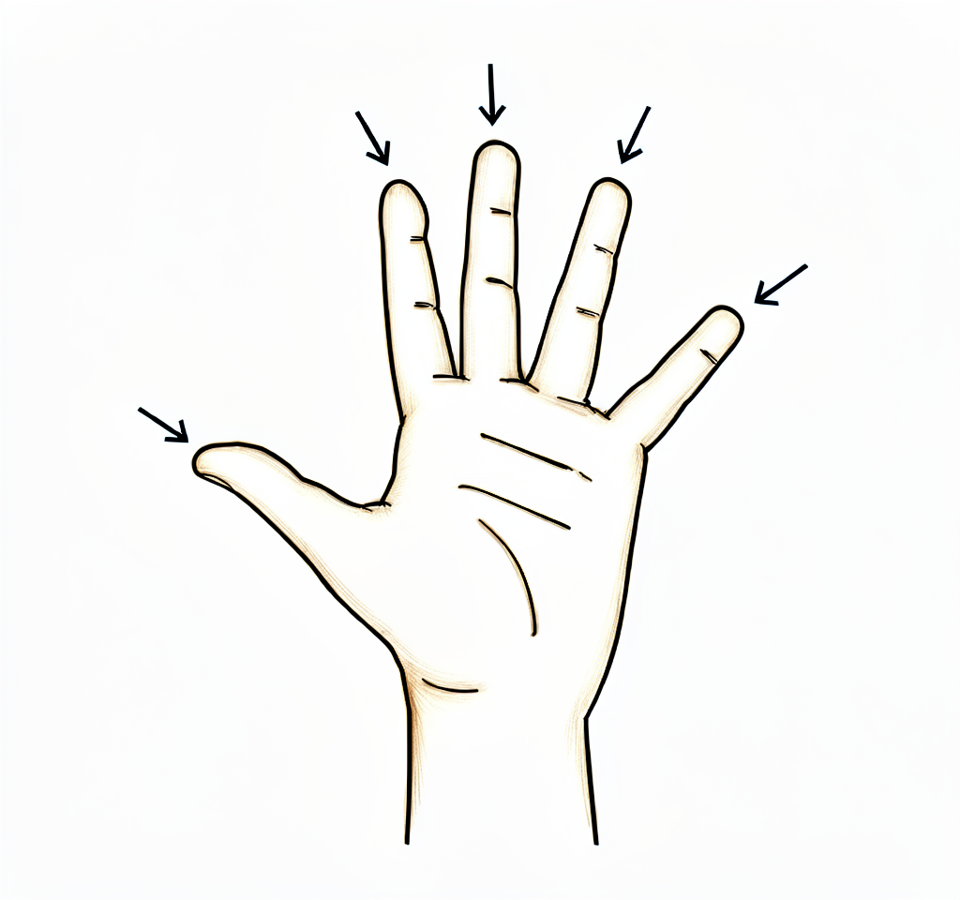
Aktibong pagtuwid (pag-angat ng mga knuckles)
Magtrabaho sa ganap na pagtuwid ng iyong mga knuckles gamit ang sarili mong lakas — itaas ang mga daliri nang pantay. Pagkatapos ng operasyon, ang mga knuckles ay maaaring may tendensiyang lumaylay (isang extensor lag), kaya ang aktibong pag-angat sa mga ito ay nagpapanatili sa pagdausdos ng mga straightening tendons at tumutulong sa pagpapanatili ng koreksyon. Sisimulan ito ng iyong therapist sa loob ng splint, pagkatapos ay itutuloy ito sa labas ng splint.
10 lifts, ilang beses sa isang araw, ayon sa gabay
Kieran Hirpara 4.0
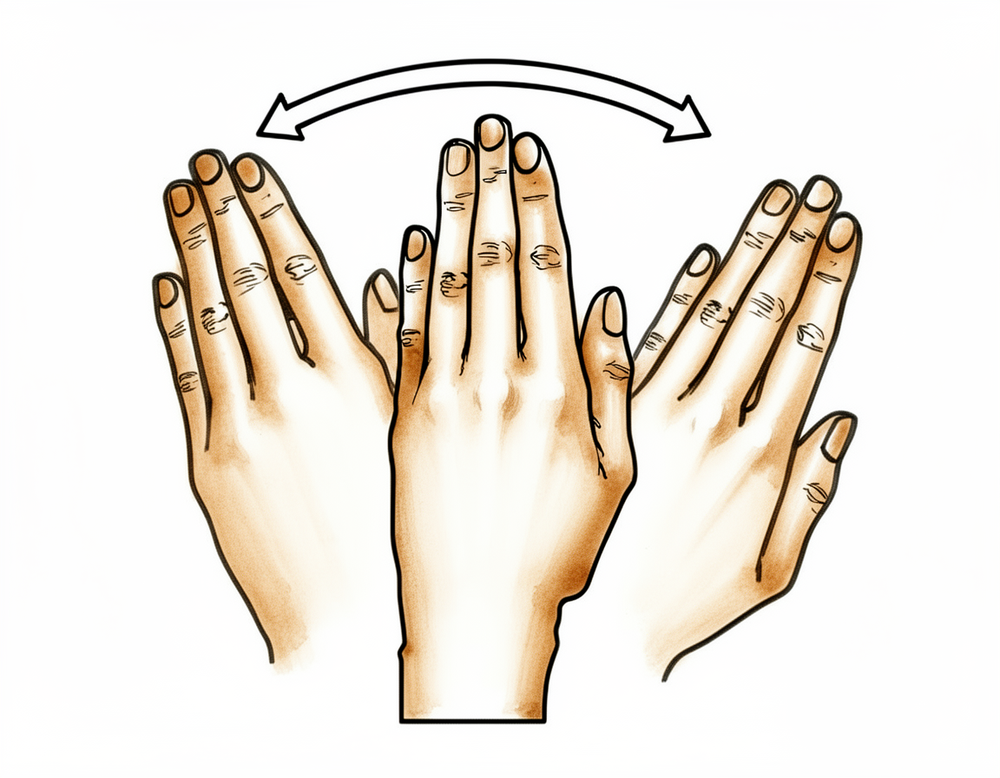
Paggalaw ng daliri patungo sa hinlalaki (radial)
Dahan-dahang igiya ang iyong mga daliri patungo sa iyong hinlalaki (ang radial direction) — ang kabaligtaran ng dating drift. Maaari mong tulungan gamit ang iyong kabilang kamay o i-slide ang mga dulo ng daliri sa ibabaw ng mesa patungo sa hinlalaki. Muli nitong sinasanay ang mga daliri na pumila nang diretso at ito ang pangunahing koreksyon kung saan nakabatay ang buong protocol na ito. Huwag hayaang bumalik ang mga ito sa kabilang direksyon.
10 beses, ilang beses sa isang araw, ayon sa gabay
Kieran Hirpara 4.0
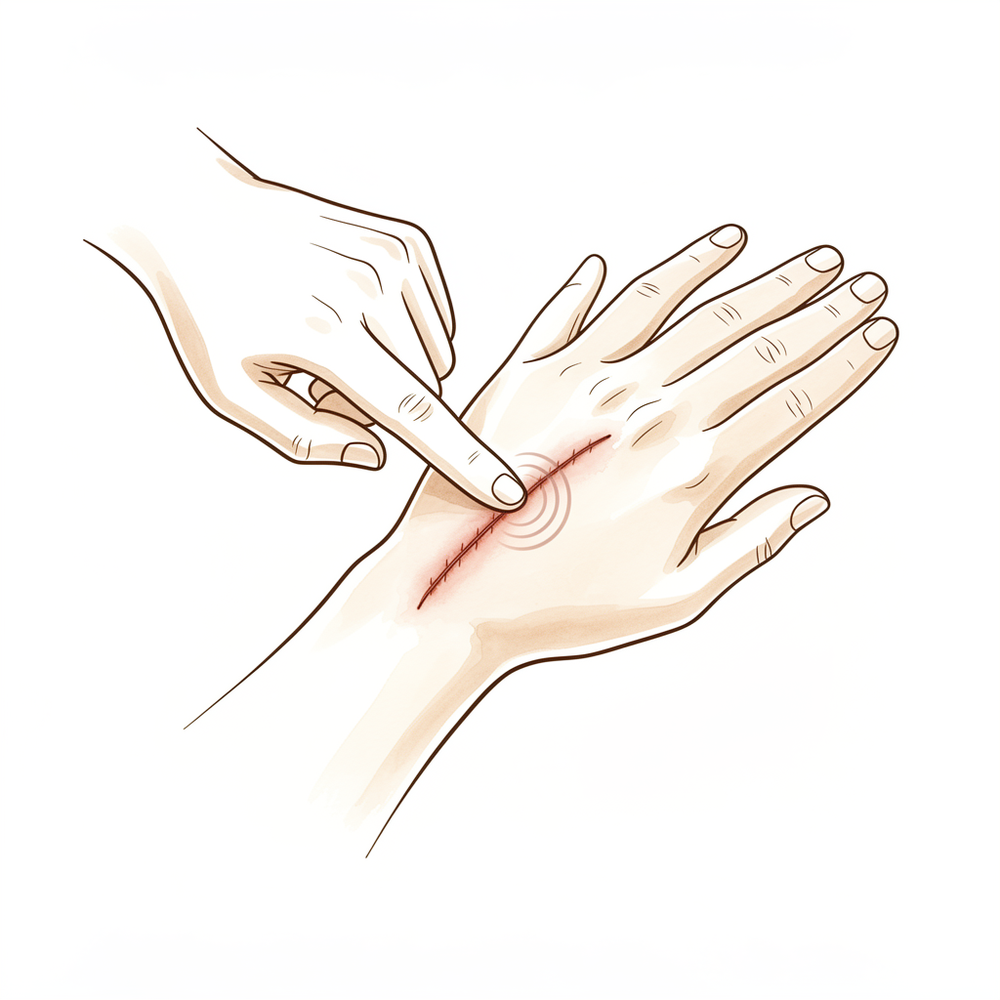
Pag-aalaga sa peklat
Kapag ganap nang magaling ang iyong mga sugat at sinabi ng iyong therapist na ligtas na, imasahe ang mga peklat sa likod ng iyong kamay gamit ang kaunting plain cream, sa pamamagitan ng paggawa ng maliliit at matitigas na pabilog na galaw sa loob ng ilang minuto. Pinapanatili nitong malambot ang mga peklat at pinipigilan ang pagdidikit ng balat sa mga tendon, upang mas malayang makagalaw ang mga knuckles.
Ilang minuto, 2-3 beses sa isang araw, kapag magaling na
Kieran Hirpara 4.0
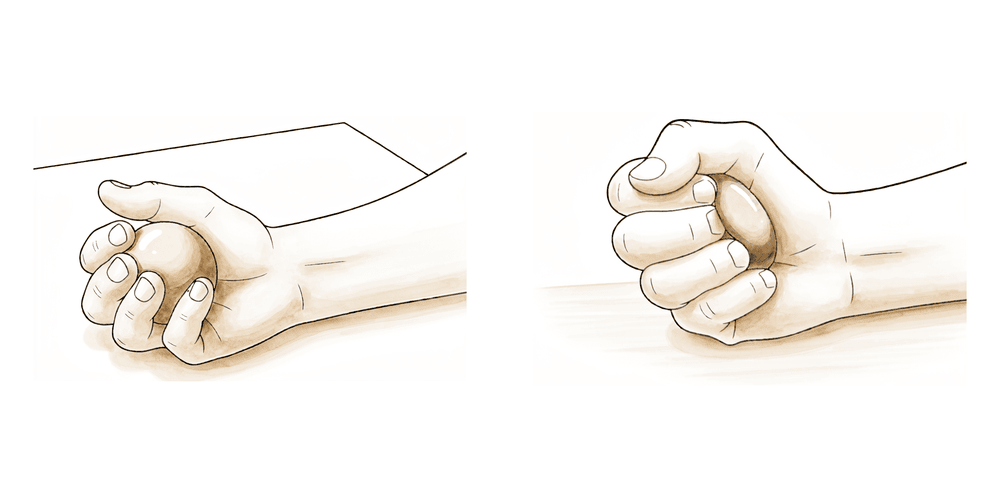
Pagpapalakas ng grip (mamaya)
Isang ehersisyo sa HULING bahagi — kapag pinayagan na lamang ng iyong hand therapist ang strengthening, karaniwan mula humigit-kumulang labindalawang linggo. Dahan-dahang pisilin ang isang soft ball o therapy putty, pagkatapos ay bitawan. Dagdagan ito nang dahan-dahan. Ipinagpapaliban ito sa simula dahil ang malakas na pagkapit ay nagtutulak sa mga daliri patungo sa ulnar drift at nagbibigay-diin sa mga bagong joint bago pa tumibay ang capsule — kaya ito ang laging huling sinisimulan.
Ayon sa gabay ng iyong hand therapist (mula ~12 linggo lamang)
Ito ang mga ehersisyo mula sa iyong handout. Simulan lamang ang mga ito ayon sa gabay ni Dr Hirpara at ng iyong hand therapist, at manatili sa anumang range at limitasyong ibinigay sa iyo. Ang mga unang gawain ay ginagawa lahat habang suot ang dynamic splint: kontroladong pagbaluktot laban sa mga loop, aktibong pagtuwid, at dahan-dahang paggalaw ng mga daliri patungo sa hinlalaki upang mapanatili ang koreksyon. Ang pag-aalaga sa peklat ay nagsisimula kapag gumaling na ang mga sugat, at ang pagpapalakas ng grip ay kabilang sa huling bahagi at hindi dapat simulan hangga't hindi ka partikular na pinapayagan. Itigil ang anumang nagdudulot ng matalas na sakit sa mga knuckles.
Ang iyong clinical protocol
Ang natitirang bahagi ng pahinang ito ay ang staged clinical protocol para sa rehabilitasyon pagkatapos ng silicone (Swanson) MCP joint arthroplasty. Ang seksyong ito ay ibibigay sa iyong hand therapist, at ang bawat phase ay nagsisimula sa isang paliwanag sa simpleng Ingles tungkol sa kung ano ang nangyayari. Ang pangunahing prinsipyo ay ang bagong MCP capsule ay nag-remodel sa paligid ng implant sa anumang posisyon kung saan ito pinapanatili, kaya ang splint at mga ehersisyo ay pinapanatili ang mga joint sa extension na may bahagyang radial deviation habang pinapayagan ang maagang kontroladong active flexion, upang muling hubugin ang mga joint sa isang itinamang posisyon at baligtarin ang ulnar drift.
Bago ang paggamot, suriin ang operation report ng pasyente at ang nakaraang medical history, at makipag-ugnayan sa treating surgeon tungkol sa diagnosis (rheumatoid vs osteoarthritis), ang isinagawang soft-tissue reconstruction (radial collateral ligament reefing, ulnar intrinsic release, extensor centralisation / crossed-intrinsic transfer), at ang nakamit na intra-operative correction at arc. Ang rheumatoid hand ay mas madaling mag-drift at bumalik ang kondisyon kaysa sa osteoarthritic hand at nangangailangan ng partikular na masigasig na radial-deviation splinting. Ang protocol sa ibaba ay nagpapalagay ng standard dynamic-extension-outrigger regime.
Phase I — dynamic extension splint na may maagang kontroladong paggalaw (linggo 0 hanggang ~6)
Ang unang anim na linggo ang mapagpasyang window: nabubuo ang capsule sa paligid ng implant ngayon, at ang dynamic splint ang nagtatakda ng posisyon kung saan ito mabubuo. Magkabit ng isang forearm-based dynamic MCP extension outrigger splint, karaniwan sa loob ng unang 3-5 araw. Kapag nakapahinga, pinapanatili nito ang MCPs sa full extension na may proximal phalanges na hinila patungo sa bahagyang radial deviation (itinatama ang lumang ulnar drift); ang mga outrigger sling ay nakapatong sa mga proximal phalanges at ang elastic tension ay nagpapahintulot ng kontroladong active flexion, pagkatapos ay ibinabalik ang mga daliri sa extension. Ang pasyente ay nagsasagawa ng maagang kontroladong active MCP flexion sa loob ng splint sa bawat oras na gising. Ang wrist at mga IP joint ay hinahayaang malaya.
Para sa iyong hand therapist:
Edukasyon at mga pag-iingat - I-fit at i-tension ang dynamic extension outrigger splint: ang mga MCP ay pinapanatili sa extension + bahagyang radial deviation, ang mga sling ay nasa proximal phalanges, radial pull upang labanan ang ulnar drift - Isusuot nang tuloy-tuloy (araw at gabi) sa loob ng ~6 na linggo, tatanggalin lamang para sa hygiene at supervised exercise - Bawal ang malakas na grip, pinch o lateral (ulnar-directed) loading: muling nililikha ng mga ito ang mga deforming force - Protektahan ang anumang soft-tissue reconstruction (radial collateral / intrinsic balancing): iwasan ang forced ulnar-deviating stress sa lahat ng oras - Panatilihing mobile ang thumb, wrist at mga IP joint; light unloaded hand use lamang
Pamamahala - Sugat: surgical dressings ayon sa itinuro; i-monitor para sa impeksyon (may implant) - Oedema: elevation, gentle retrograde massage, light compression ayon sa tolerance - Mga ehersisyo: kontroladong active MCP flexion sa loob ng splint laban sa mga loop, na naglalayong bumuo ng isang kapaki-pakinabang na flexion arc (target ang intra-operative arc ng surgeon, karaniwan hanggang ~70 degrees sa index-to-little MCPs) na may full passive return sa extension sa pamamagitan ng outrigger; active MCP extension (itama ang extensor lag); radial-deviation re-education (igiya ang mga daliri patungo sa thumb); free IP at wrist ROM
Mga kraytirya para mag-progress - Hilom na ang sugat; humuhupa ang oedema; lumilitaw na active flexion arc na may napanatiling extension at itinamang (radial) alignment sa loob ng humigit-kumulang anim na linggo
Phase II — pagbabawas sa paggamit ng splint at pagpapatatag ng koreksyon (linggo ~6 hanggang ~12)
Mula sa ika-anim na linggo, ang capsule ay nagiging mature na at ang dynamic splint ay binabawasan patungo sa isang resting / night extension splint (madalas na ipinagpapatuloy hanggang ~12 linggo, at mas matagal sa gabi para sa mga rheumatoid hands na prone sa recurrence). Ang active motion kapag wala ang splint ay unti-unting pinapaunlad, na laging nakatuon sa extension at radial alignment. Pinapalawak ang light functional use; nananatiling ipinagbabawal ang heavy grip at pinch.
Para sa iyong hand therapist:
Mga Assessment - Active at passive MCP flexion/extension arc; extensor lag; ulnar-deviation (ihambing sa intra-operative correction); sakit at pamamaga; pagsusuri sa sugat/peklat
Edukasyon at mga pag-iingat - Bawasan ang paggamit ng dynamic splint; ipagpatuloy ang night / resting extension splint hanggang ~12 linggo (mas matagal sa gabi para sa mga rheumatoid patients) - Patuloy na iwasan ang malakas na grip/pinch at anumang ulnar-deviating load - Maging mapagmatyag sa pagpapanatili ng radial correction; ang recurrence ng drift ang pangunahing late failure
Pamamahala - Mga Ehersisyo: paunlarin ang active at gentle active-assisted MCP flexion/extension kapag wala ang splint; patuloy na extensor-lag work at radial-deviation re-education; simulan ang scar management kapag magaling na; light functional tasks sa loob ng comfort level, iwasan ang mga ulnar-deviating patterns
Mga Kraytirya para sa pag-unlad - Stable na koreksyon (minimal na recurrent ulnar deviation, acceptable na extensor lag) sa isang maturing capsule; comfortable na functional arc; humuhupa na ang sakit
Phase III — pagpapalakas at pagbabalik (mga linggo ~12 at higit pa)
Kapag matatag na ang capsule at nananatili ang alignment (bandang labindalawang linggo), ipinapakilala ang graded strengthening, nang huli at may pag-iingat, dahil ang grip ay nagtutulak ng ulnar drift. Ang lakas at ang pinal na functional result ay patuloy na bumubuti sa loob ng ilang pang buwan.
Para sa iyong hand therapist:
Mga Assessment - Grip/pinch kumpara sa kabilang panig at kumpara sa pre-operative; napanatiling arc, extension at alignment sa ilalim ng load; functional at task-specific testing
Edukasyon at mga pag-iingat - Simulan ang graded grip/strengthening mula bandang 12 linggo lamang, unti-unting dinadagdagan ang load - Turuan ng mga grip pattern na hindi nagtutulak ng ulnar deviation; patuloy na night splinting ayon sa indikasyon, lalo na sa mga kamay na may rheumatoid - Magtakda ng mga makatotohanang ekspektasyon: ang layunin ay paginhawa sa sakit, itinamang posisyon at isang functional arc sa halip na isang normal o malakas na kamay
Pamamahala - Mga ehersisyo: progressive putty/ball grip at pinch, isometric MCP control, functional strengthening; ipagpatuloy ang mobility at anumang natitirang extensor-lag/alignment work - Isaalang-alang ang discharge kapag stable na ang correction, nakamit na ang isang useful arc at nakakayanan na ng pasyente ang daily function; magbigay ng long-term night-splint at joint-protection plan - I-refer muli sa treating doctor kung lumalala ang alignment, nawawala ang arc, o pinaghihinalaang may mga problema sa implant
Mga kraytirya para sa discharge - Stable na corrected alignment, functional at pain-free na arc, sapat na functional grip, maayos na joint-protection at night-splint routine
Pagbabalik sa trabaho at aktibidad
Hinihikayat ang magaan na pang-araw-araw na paggamit ng kamay (pagkain, pagsusulat, magaan na pag-aalaga sa sarili) mula sa simula hangga't komportable, basta't iniiwasan ang malakas na paghawak, pag-pinch, at anumang sideways (ulnar) na stress sa mga daliri. Planuhin na ang dynamic splint ay nakasuot halos sa lahat ng oras para sa unang anim na linggo, na naglilimita sa mga gawaing nangangailangan ng dalawang kamay at mabibigat na gawain; mag-ayos ng tulong nang naaayon. Ang pagmamaneho ay muling sisimulan kapag ligtas mo nang makokontrol ang kotse at wala na sa dynamic splint para sa pagmamaneho (karaniwan ay bandang anim na linggo), gaya ng kumpirmasyon sa iyong review.
Ang pagpapalakas at mas mabigat na paggamit ng kamay ay maghihintay hanggang bandang labindalawang linggo at pagkatapos ay unti-unting itataas sa ilalim ng gabay ng iyong hand therapist. Karamihan sa mga tao ay nagbabalik sa karamihan ng mga pang-araw-araw na aktibidad sa loob ng humigit-kumulang tatlong buwan, habang ang pinal na resulta (komportable, alignment, at isang kapaki-pakinabang na arc) ay patuloy na nag-aayos sa loob ng ilan pang mga buwan. Ang pag-unlad ay hinuhusgahan ni Dr Hirpara at ng iyong hand therapist batay sa kung paano nagtutuwid at gumagana ang iyong kamay, hindi sa kalendaryo lamang. Ang mas mabigat o paulit-ulit na manwal na trabaho ay sumusunod sa parehong criterion-based na pag-unlad, kasama ang payo sa proteksyon ng kasukasuan upang mapanatili ang pagtutuwid sa pangmatagalan.
Pagkatapos ng iyong protocol
Ang protocol na ito ay kasabay ng pangkalahatang payo sa paggaling ng klinika: tingnan ang pamamahala ng sakit pagkatapos ng operasyon, pag-aalaga ng sugat at pamamahala ng peklat. Ang phased plan sa itaas ay sumasalamin sa matagal nang Swanson-style rehabilitation regime pagkatapos ng silicone MCP arthroplasty, at ang iyong patuloy na paggaling ay ginagabayan nang indibidwal ni Dr Hirpara at ng iyong hand therapist ayon sa kung paano nagwawasto at umuunlad ang iyong kamay.
Evidence & references
This is the clinical evidence summary written for health professionals. It is technical, and it lists the research this page was built from. You do not need to read it to understand your treatment or to make a decision about it.
Silicone (Swanson) MCP Joint Arthroplasty — Procedure Outcomes & Post-operative Rehabilitation
Topic scope: post-operative rehabilitation after silicone (Swanson) replacement of the metacarpophalangeal (MCP) joints — flexible silicone-elastomer spacer arthroplasty of the knuckle joints, most often for the rheumatoid hand with ulnar drift and volar subluxation, and less commonly for MCP osteoarthritis. This is a resection-replacement with soft-tissue rebalancing, not a simple decompression: the deforming forces that destroyed the joint (ulnar drift, extensor subluxation, intrinsic tightness) are still present, so the rehabilitation is an active, splint-driven re-shaping programme, not a rest-and-protect pathway.
Defining principle of the rehab here: a silicone MCP implant is a flexible spacer around which a new fibrous capsule ("encapsulation") forms over the first weeks — and that capsule remodels in whatever position the hand is held. The classic post-operative regime therefore uses a dynamic extension outrigger splint that holds the MCPs in extension with slight radial deviation (opposing the ulnar drift) while permitting early controlled active flexion against elastic loops. Move early, but only in the corrected position: this is what reverses the drift and builds a functional flexion arc. The single biggest branch point is the diagnosis — the rheumatoid hand drifts and recurs far more readily than the osteoarthritic hand and warrants more diligent, more prolonged radial-deviation splinting.
A. PROCEDURE OUTCOMES (rheumatoid and osteoarthritis)
Silicone MCP arthroplasty is a deformity-correcting, pain-relieving operation rather than a motion- or strength-restoring one. Its great strength is reliable correction of alignment and relief of pain; its accepted limitations are a modest final arc, gradual implant fracture over years, and—in rheumatoid hands—a tendency to recurrent drift.
- In rheumatoid arthritis it produces durable improvement in deformity, appearance and patient-reported function. The multicentre prospective SARA (Silicone Arthroplasty in Rheumatoid Arthritis) cohort compared 70 surgical with 93 non-surgical RA patients with severe MCP deformity: the surgical group showed significant, sustained gains in the Michigan Hand Outcomes Questionnaire and in ulnar deviation, extensor lag and arc of motion, maintained at 1 year, at long-term (3-year) follow-up, and out to 7 years, whereas the non-surgical cohort did not improve [Chung 2009; Chung 2012; Chung 2017]. Moderate–strong (prospective comparative cohort; not randomised).
- Correction of ulnar drift and extensor lag is the headline result; arc and grip gains are modest. Series consistently report large reductions in ulnar deviation and extensor lag with a re-centred, more functional arc (commonly a final arc on the order of ~40–50° centred nearer extension), with grip strength only modestly changed. The operation buys alignment, pain relief and hand appearance/function, not power [Goldfarb & Dovan 2006; Rizzo 2011; Kirschenbaum 1993]. Moderate.
- For MCP osteoarthritis, long-term results are favourable and durable. A long-term series of silicone MCP arthroplasty for OA reported lasting pain relief and satisfactory function, with better-preserved bone stock and less recurrent deforming force than the rheumatoid hand [Morrell & Weiss 2018]. Moderate.
- Implant fracture accrues with time but is often clinically silent. Long-term radiographic follow-up shows implant fracture rates rising over the years, yet many fractured implants remain asymptomatic and revision is driven by symptoms/instability rather than radiographic fracture alone [Koenuma 2024; Kirschenbaum 1993]. Moderate.
- Revision is uncommon but defined, most often for recurrent deformity, implant fracture/instability or infection; revision MCP arthroplasty is feasible but technically demanding with poorer results than primary surgery [Wagner 2019; Carlson Strother 2023]. Moderate.
B. REHABILITATION / THERAPY EVIDENCE
The central rehab questions are (1) which splint regime, and (2) does adding continuous passive motion or particular splint variants change the outcome. The evidence base is dominated by a strong heritage regime (Swanson-style dynamic extension splinting) supported mostly by expert consensus and low-level studies, with the few controlled comparisons failing to show benefit from add-ons. The rehabilitation is nonetheless indispensable — it is integral to the operation, not an optional adjunct.
- The standard regime is a dynamic extension outrigger splint with early controlled motion. Fitted within the first few days, it holds the MCPs in extension and slight radial deviation at rest and permits active flexion against finger slings, worn essentially continuously for ~6 weeks then weaned to night/rest splinting. The shared aim across published regimes is to encourage MCP flexion and extension without recurrence of flexion contracture or ulnar deviation while the capsule encapsulates the implant in a corrected position [Goldfarb & Dovan 2006; Massy-Westropp Cochrane 2008]. Consensus / heritage — widely practised, low-level evidence.
- Adding continuous passive motion (CPM) to dynamic splinting does not help. The Cochrane review identified a single small controlled trial (22 participants) comparing dynamic splinting ± CPM and concluded CPM is not effective at increasing motion or strength after MCP arthroplasty (controls actually gained more motion); it rated the evidence "silver level" and called for well-designed RCTs given wide practice variation [Massy-Westropp Cochrane 2008]. Moderate (Cochrane SR of low-certainty primary evidence).
- A static-splint alternative achieves comparable correction in small studies. A prospective series using alternating static flexion/extension splints (rather than a dynamic outrigger) reported improved total active arc (21.6°→47.2°) and corrected ulnar deviation (30.4°→9.7°), suggesting the position held and active motion matter more than the specific splint mechanism [Burr/Massy-Westropp J Hand Ther 2002]. Weak (small prospective cohort).
- The specific dynamic-splint protocol has not been shown superior to simpler regimes in controlled comparison. A randomised study found no clear added value of dynamic splinting over a simpler post-operative regime for MCP replacement, reinforcing that the dynamic outrigger is a sound, traditional default rather than a proven optimum [Delaney 2003]. Weak–moderate (small RCT).
Recovery trajectory (expected, evidence-anchored)
| Phase | Window | Splint / position | Hand-therapist focus | Strength / load | Notes |
|---|---|---|---|---|---|
| I — Dynamic extension splint + early controlled motion | Week 0–~6 | Dynamic extension outrigger worn day & night; MCPs in extension + slight radial deviation | Controlled active MCP flexion within the splint (toward the surgeon's arc, often up to ~70°); active extension (correct extensor lag); radial-deviation re-education; free IP/wrist; oedema control | Light unloaded use only; no grip/pinch, no ulnar load | Capsule forms now — position held = position kept. Rheumatoid hands need the most diligent radial pull |
| II — Wean to night/rest splint, consolidate correction | Week ~6–12 | Wean dynamic splint → night/resting extension splint (longer at night in RA) | Progress active/active-assisted flexion–extension out of splint, biased to extension + radial; scar massage once healed; preserve correction | Still no strong grip/pinch; light functional tasks | Recurrent ulnar drift is the main late failure — guard alignment |
| III — Strengthening & return | Week ~12+ | Night splint as indicated (esp. RA) | Graded putty/ball grip and pinch, isometric MCP control, functional/task strengthening | Begin grip strengthening ~8–12 wk, build gradually; coach non-ulnar-deviating grip | Most everyday activity by ~3 months; alignment/comfort/arc settle over several more months |
(Phase windows mirror the patient protocol; they are typical, heritage-based guides — not trial-derived deadlines.)
C. KEY CONTROVERSIES / EVIDENCE QUALITY
- Heritage regime, modest evidence. The Swanson-style dynamic extension outrigger with early controlled motion is deeply established and near-universally taught, but its supporting evidence is largely expert consensus and small/low-level studies. The defensible position is to follow the heritage regime faithfully while acknowledging its evidence tier [Goldfarb & Dovan 2006; Massy-Westropp Cochrane 2008]. Consensus.
- Which splint? Dynamic outrigger vs alternating static splints vs simpler regimes give broadly similar correction in small studies; CPM adds nothing. What matters is holding the MCPs in extension + radial deviation while moving early — the mechanism of the splint is secondary [Massy-Westropp Cochrane 2008; Burr 2002; Delaney 2003]. Weak–moderate.
- Rheumatoid vs osteoarthritis. The rheumatoid hand has ongoing deforming forces (tendon subluxation, intrinsic tightness, soft-tissue laxity) and recurs, demanding more prolonged radial-deviation/night splinting and joint protection; the osteoarthritic hand has better bone and soft tissue and a more durable correction [Morrell & Weiss 2018; Rizzo 2011]. Moderate.
- Realistic goals. The operation reliably delivers pain relief, corrected alignment and a functional arc, not a normal or powerful hand. Mis-set expectations (large grip gains) are a common source of dissatisfaction [Chung patient-expectations 2015; SARA cohort]. Moderate.
- Implant fracture ≠ failure. Radiographic implant fracture accrues over years but is frequently asymptomatic; revision is symptom-driven. Counsel accordingly rather than revising on imaging alone [Koenuma 2024; Wagner 2019]. Moderate.
D. EVIDENCE STRENGTH FLAGS (summary)
- MODERATE–STRONG: silicone MCP arthroplasty improves deformity, alignment (ulnar deviation, extensor lag), MHQ and arc versus non-surgical care in severe rheumatoid MCP disease, durable to 7 years (SARA prospective cohort — comparative, not randomised).
- MODERATE: correction-over-power outcome profile; favourable long-term OA results; time-related implant fracture (often asymptomatic); defined but uncommon revision rate; greater recurrence in rheumatoid than osteoarthritic hands.
- WEAK / CONSENSUS / HERITAGE: the specific dynamic-extension-outrigger + early-controlled- flexion + radial-deviation rehabilitation programme (strong heritage, low-level evidence; CPM shown unhelpful; dynamic vs static vs simpler regimes not clearly differentiated); exact phase timings (typical, not trial-derived).
CITATIONS
RAG corpus (180,000+ Orthopaedic articles)
- Kirschenbaum D, Schneider LH, Adams DC, et al. Arthroplasty of the metacarpophalangeal joints with use of silicone-rubber implants in patients who have rheumatoid arthritis. Long-term results. J Bone Joint Surg Am. 1993;75(1):3-12. DOI: 10.2106/00004623-199301000-00002
- Goldfarb CA, Dovan TT. Rheumatoid arthritis: silicone metacarpophalangeal joint arthroplasty indications, technique, and outcomes. Hand Clin. 2006;22(2):177-188. DOI: 10.1016/j.hcl.2006.02.001
- Rizzo M. Metacarpophalangeal joint arthritis. J Hand Surg Am. 2011;36(2):345-353. DOI: 10.1016/j.jhsa.2010.11.035
- Morrell NT, Weiss AC. Silicone metacarpophalangeal arthroplasty for osteoarthritis: long-term results. J Hand Surg Am. 2018;43(3):229-233. DOI: 10.1016/j.jhsa.2017.10.010
- Koenuma N, Ikari K, Oh K, et al. Long-term implant fracture rates following silicone metacarpophalangeal joint arthroplasty in rheumatoid arthritis. J Hand Surg Am. 2024. DOI: 10.1016/j.jhsa.2024.01.009
- Wagner ER, Houdek MT, Packard B, et al. Revision metacarpophalangeal arthroplasty: a longitudinal study of 128 cases. J Am Acad Orthop Surg. 2019. DOI: 10.5435/JAAOS-D-17-00042
- Carlson Strother CR, Moran SL, Rizzo M. Small joint arthroplasty of the hand: an update on indications, outcomes, and complications. J Am Acad Orthop Surg. 2023;31(15):e739-e749. DOI: 10.5435/JAAOS-D-23-00034
- Blazar PE, Gancarczyk SM, Simmons BP. Rheumatoid hand and wrist surgery: soft tissue principles and management of digital pathology. J Am Acad Orthop Surg. 2019;27(21):e924-e933. DOI: 10.5435/JAAOS-D-17-00608
- Naniwa S, Nishida K, Nasu Y, et al. A comparative study of short-term outcomes between INTEGRA and AVANTA silicone implants for metacarpophalangeal joints in patients with rheumatoid arthritis. J Hand Surg Am. 2026. DOI: 10.1016/j.jhsa.2026.04.003
MCP arthroplasty outcomes & rehabilitation literature (URLs)
- Chung KC, Burns PB, Wilgis EFS, et al. A multicenter clinical trial in rheumatoid arthritis comparing silicone metacarpophalangeal joint arthroplasty with medical treatment. J Hand Surg Am. 2009;34(5):815-823. DOI: 10.1016/j.jhsa.2009.01.018 — https://pmc.ncbi.nlm.nih.gov/articles/PMC4381953/
- Chung KC, Burns PB, Kim HM, et al. Long-term followup for rheumatoid arthritis patients in a multicenter outcomes study of silicone metacarpophalangeal joint arthroplasty. Arthritis Care Res (Hoboken). 2012;64(9):1292-1300. DOI: 10.1002/acr.21705 — https://pubmed.ncbi.nlm.nih.gov/22511483/
- Burns PB, Zhong L, Chung KC. Seven-year outcomes of the Silicone Arthroplasty in Rheumatoid Arthritis (SARA) prospective cohort study. Arthritis Care Res (Hoboken). 2017. DOI: 10.1002/acr.23105 — https://pmc.ncbi.nlm.nih.gov/articles/PMC5376377/
- Chung KC, Burns PB, et al. Patient expectations and long-term outcomes in rheumatoid arthritis patients: results from the SARA study. Clin Rheumatol. 2015;34(4):641-651. DOI: 10.1007/s10067-014-2775-z — https://pubmed.ncbi.nlm.nih.gov/25267562/
- Massy-Westropp N, Johnston RV, Hill C. Post-operative therapy for metacarpophalangeal arthroplasty. Cochrane Database Syst Rev. 2008;(1):CD003522. DOI: 10.1002/14651858.CD003522.pub2 — https://pmc.ncbi.nlm.nih.gov/articles/PMC8715905/
- Burr N, Pratt AL, Stott D. An alternative splinting and rehabilitation protocol for metacarpophalangeal joint arthroplasty in patients with rheumatoid arthritis. J Hand Ther. 2002;15(1):41-47. DOI: 10.1053/hanthe.2002.v15.01541 — https://pubmed.ncbi.nlm.nih.gov/11866351/
- Delaney R, Trail IA, Nuttall D. Value of dynamic splinting after replacement of the metacarpophalangeal joint in patients with rheumatoid arthritis. Scand J Plast Reconstr Surg Hand Surg. 2003;37(4):232-233. DOI: 10.1080/02844310310005658 — https://pubmed.ncbi.nlm.nih.gov/12755512/