Patients › Rehabilitation
Scaphoid Fixation
Isang protektadong plano ng paggaling pagkatapos ng surgical fixation ng isang scaphoid fracture gamit ang isang buried headless compression screw, unti-unting ibinabalik ang paggalaw ng pulso nang maaga sa ilalim ng proteksyon ng screw habang naghihilom ang buto na mabagal mag-unite, pagkatapos ay pagpapalakas ng grip at strength, kung saan ang loading at contact sport ay ipinagbabawal hanggang sa makumpirma ang union.
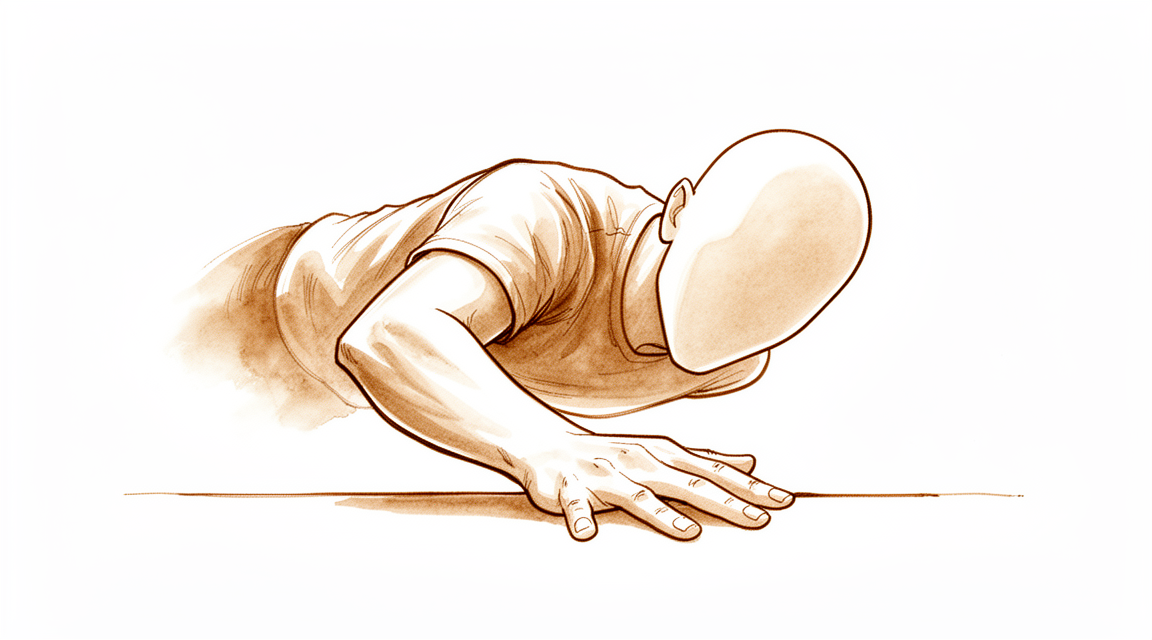
Ang protocol na ito ay nagsisilbing gabay sa iyong paggaling pagkatapos ng surgical fixation ng isang scaphoid fracture (isang bali sa maliit at hugis-bangkang buto sa loob ng pulso, na pinagdugtong gamit ang isang nakabaon na headless compression screw) kasama si Dr Kieran Hirpara sa Mater Private Hospital Rockhampton. Nagsisimula ito sa iyong home exercise program, na sinusundan ng structured clinical protocol na isinulat para sa iyong hand therapist. Dalhin ang pahinang ito o ang PDF nito sa iyong unang therapy visit upang manatiling coordinated ang iyong rehabilitasyon. Maaaring i-adjust ng iyong hand therapist ang plano depende sa iyong fracture, sa iyong fixation, at kung paano ang pag-unlad ng iyong paggaling.
Kung mayroon kang anumang alalahanin tungkol sa iyong sugat pagkatapos ng operasyon, makipag-ugnayan sa mga rooms. Madalas na nakatutulong ang pagkuha ng larawan ng sugat at pag-email nito para masuri.
Ano ang dapat asahan
Ang scaphoid ay isang maliit na buto sa floor ng wrist na nag-uugnay sa dalawang row ng mga buto sa wrist. Mayroon itong hindi pangkaraniwan at fragile na blood supply na dumadaloy dito nang pabalik, mula sa isang dulo patungo sa isa pa, kung kaya't ang scaphoid fracture ay mabagal gumaling at, kung pababayaan, ay maaaring hindi magdugtong (isang nonunion). Ang scaphoid fixation ay pinapanatiling magkadikit nang mahigpit ang dalawang piraso ng buto gamit ang isang headless compression screw na nakabaon nang lubos sa loob ng buto; wala itong mararamdaman o kailangang tanggalin. Pinipiga ng screw ang fracture upang magdikit, na tumutulong sa paggaling nito at nagbibigay-daan upang mas maagang maigalaw ang wrist kaysa sa fracture na ginamot lamang ng plaster cast. Kung ang fracture ay luma na o hindi nagdugtong, maaaring magdagdag ng maliit na piraso ng bone graft (na madalas kinukuha mula sa kalapit na buto ng forearm) upang hikayatin ang paggaling; maaari nitong gawing mas maingat ang unang plano.
Ang pangunahing ideya ng recovery na ito ay ang screw ang humahawak habang dahan-dahang naghihilom ang buto. Dahil mabagal gumaling ang scaphoid, ang mga milestone sa planong ito ay nakabase sa kung paano gumagaling ang buto, at hindi sa kalendaryo lamang. Karaniwang kinukumpirma ng iyong surgeon na nagdugtong na ang fracture ("union") sa pamamagitan ng X-ray, at madalas ay CT scan, bago ka payagan para sa mas mabigat na loading at sport. Ang bilis ng iyong pag-unlad ay depende sa uri at posisyon ng fracture (ang bali malapit sa mabagal gumaling na itaas, o "proximal pole", at ang nakaraang nonunion ay nangangailangan ng higit na pag-iingat) at kung gaano katatag ang fixation.
Ang paggalaw ay binubuksan sa mga maingat na yugto: paggalaw ng mga daliri at thumb agad-agad; banayad na paggalaw ng wrist kapag pinayagan na ng iyong hand therapist; pagkatapos ay grip at strengthening pagkatapos lamang na magdugtong ang buto; at ang pagbabalik sa loaded o contact sport ang pinakahuli sa lahat. Dahil ang repair ay patuloy na nag-ma-mature sa loob ng maraming buwan, ang mas mabigat na loading at sport ay unti-unting ibinabalik sa halip na biglaan.
Mga pag-iingat at limitasyon
- Isuot ang iyong splint o cast ayon sa itinuro at panatilihin itong tuyo. Sasabihin sa iyo ni Dr Hirpara at ng iyong hand therapist kung kailan ito dapat tanggalin para sa mga ehersisyo at kung kailan ito maaaring iwanang nakatanggal.
- HUWAG humawak nang mahigpit, magbuhat, magdala o tumulak gamit ang pulso hanggang sa masabihan kang naghilom na ang bali; ang pagpisil at paglalagay ng bigat ay nagbibigay ng strain sa scaphoid at sa screw habang naghihilom pa ang buto.
- Iwasan ang pagpilit sa pulso na bumalik sa full backward bend (extension) at iwasan ang mga extremes ng paggalaw sa simula; dahan-dahang ibalik ang range, huwag pilitin ang dulo nito.
- HUWAG bumalik sa contact, collision o load-bearing sport (o sa gym/weights, push-ups, racquet o stick sports) hanggang sa kumpirmahin ng iyong surgeon na nagdugtong na ang buto at binigyan ka ng clearance; ito ay karaniwang inaabot ng mga buwan, hindi linggo.
- Panatilihing gumagalaw ang iyong mga daliri, hinlalaki, siko at balikat mula sa simula upang hindi sila manigas, at gamitin ang kamay para sa mga magagaan na pang-araw-araw na gawain sa loob ng iyong comfort level, basta't hindi ito kinapapalooban ng paghawak nang mahigpit, pagbuhat o pagpilit sa pulso.
- Kung ang iyong fixation ay gumamit din ng bone graft para sa isang nonunion, asahan ang isang mas maingat na timeline; sundin ang partikular na planong ibinigay sa iyo ng iyong surgeon at hand therapist.
Para sa pamamahala ng sugat, pamamaga at peklat, tingnan ang gabay ng practice sa wound care.
Iyong mga ehersisyo
Kieran Hirpara 4.0
Paggalaw ng mga daliri at hinlalaki
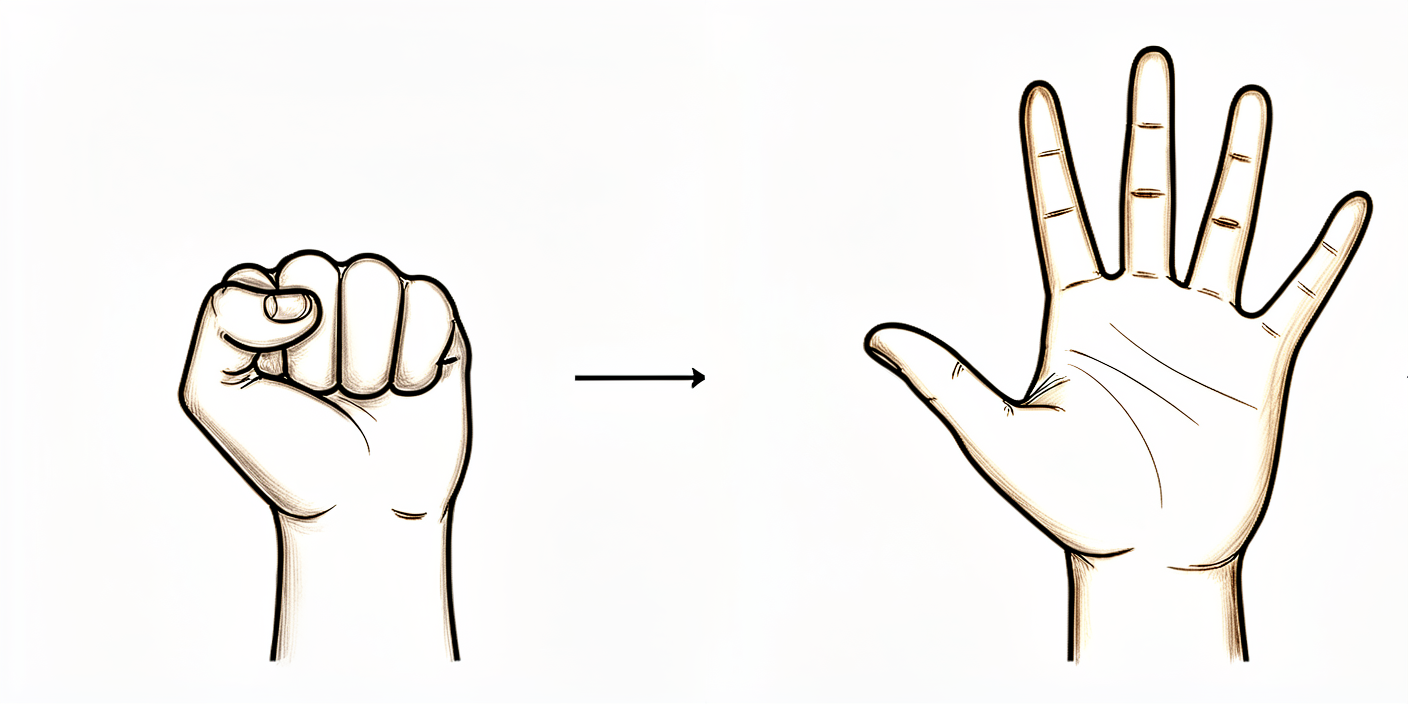
Mula sa mga unang araw pa lamang, panatilihing gumagalaw ang iyong mga daliri at hinlalaki upang hindi sila manigas. Gumawa ng banayad na buong kamao, pagkatapos ay ituwid nang husto ang mga daliri, at idikit ang iyong hinlalaki sa dulo ng bawat daliri nang sunod-sunod. Panatilihing hindi gumagalaw ang mismong pulso sa loob ng splint o cast habang ginagawa ito. Ligtas itong gawin agad — pinapanatili nito ang lambot ng kamay nang hindi naaabala ang paggaling ng scaphoid.
10 beses bawat isa, ilang beses sa isang araw, mula unang araw
Kieran Hirpara 4.0
Paggalaw ng pulso (kapag pinapayagan)
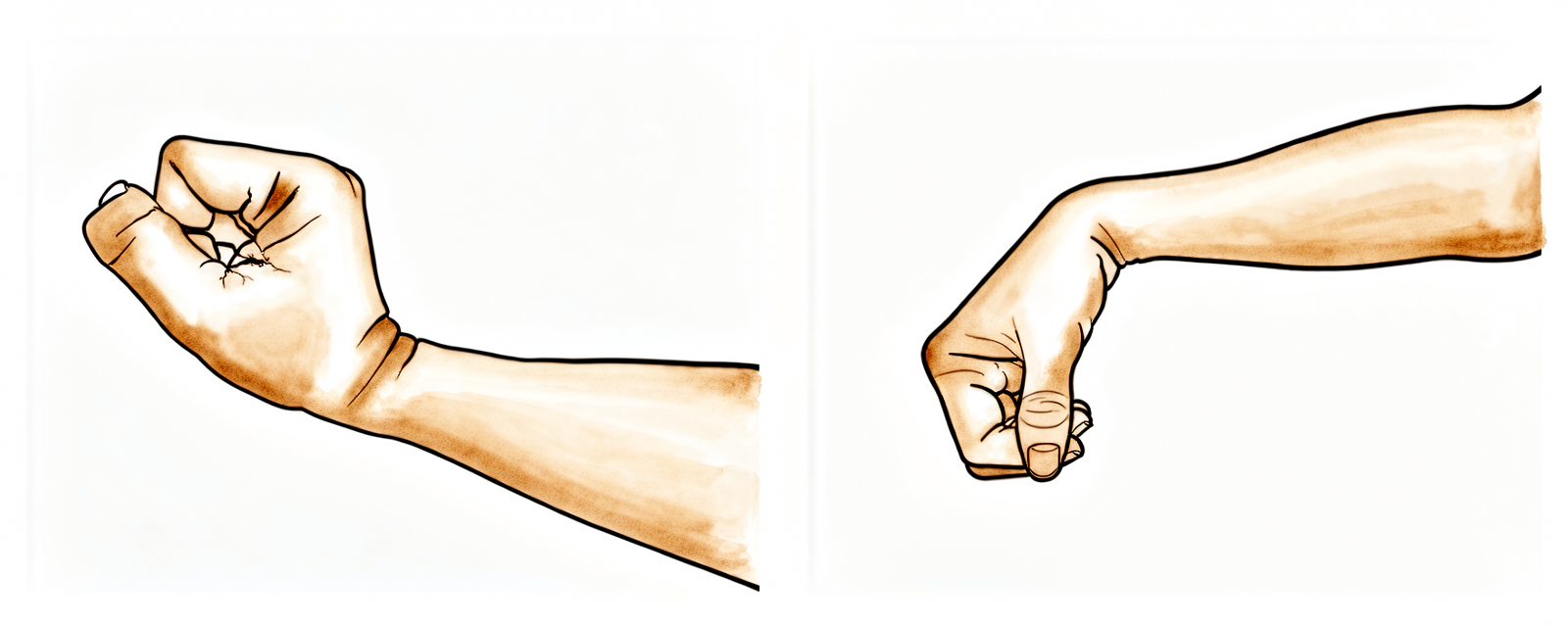
Kapag pinayagan na ito ng iyong hand therapist — madalas ay ilang linggo lamang pagkatapos ng operasyon, depende sa iyong bali at fixation — simulan ang dahan-dahang paggalaw ng pulso: itiklop ito pataas at pababa, pagkatapos ay itagilid ito nang kaliwa at kanan, panatilihing mabagal at sa loob ng komportable at walang sakit na range. HUWAG pilitin ang dulo ng paggalaw at HUWAG itulak sa full backward bend (extension) nang maaga. Sasabihin sa iyo ng iyong therapist kung kailan magsisimula at kung hanggang saan ang dapat na galaw.
10 beses sa bawat direksyon, 2-3 beses sa isang araw, kapag pinayagan na lamang
Kieran Hirpara 4.0
Rotasyon ng forearm (palad paitaas / palad paibaba)
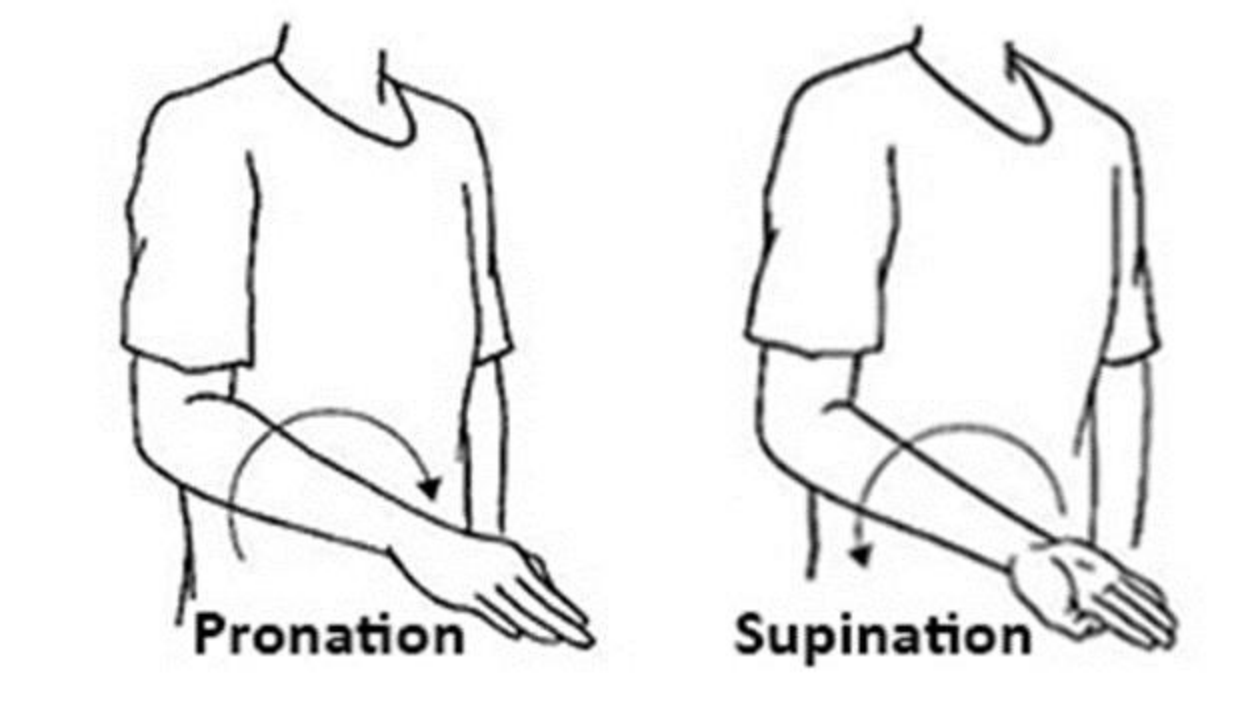
Habang ang iyong siko ay nakadikit sa iyong gilid at nakabaluktot sa isang right angle, dahan-dahang iharap ang iyong palad paitaas sa kisame, pagkatapos ay paibaba sa sahig. Panatilihin itong mabagal at madali. Pinapanatili nito ang pagiging supple ng forearm at hindi binibigatan ang scaphoid, kaya karaniwan itong maaaring simulan nang maaga — sundin ang gabay ng iyong hand therapist.
10 beses sa bawat direksyon, 2-3 beses sa isang araw
Kieran Hirpara 4.0
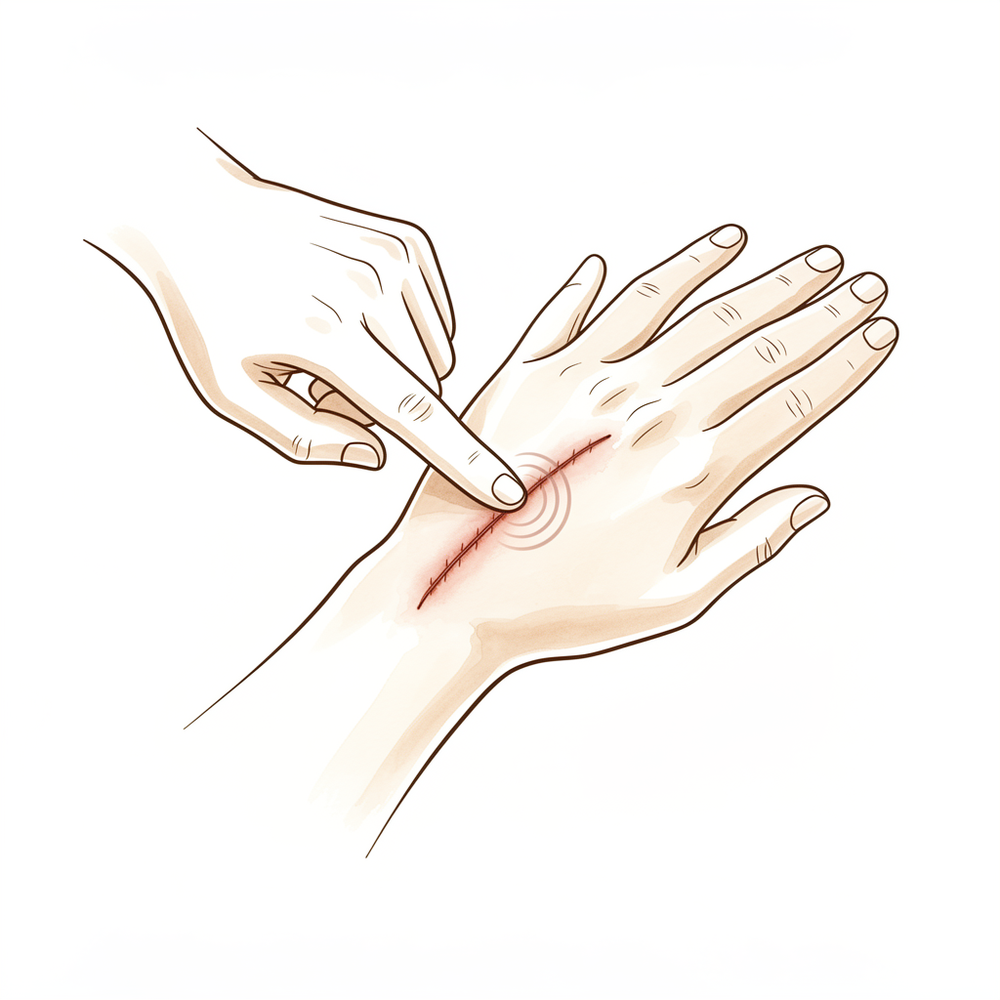
Pag-aalaga sa peklat
Kapag ganap nang magaling ang sugat at wala na itong mga langib, imasahe ang peklat sa loob ng isa o dalawang minuto gamit ang kaunting unscented moisturizer, sa pamamagitan ng paggawa ng maliliit at madiing pabilog na galaw. Pinapanatili nitong malambot ang peklat at hindi gaanong sensitibo. Kung ang iyong screw ay inilagay sa pamamagitan ng isang maliit na keyhole cut, maliit lamang ang peklat ngunit makakatulong pa rin ang parehong pag-iingat.
1-2 minuto, dalawang beses sa isang araw, kapag magaling na ang sugat
Kieran Hirpara 4.0
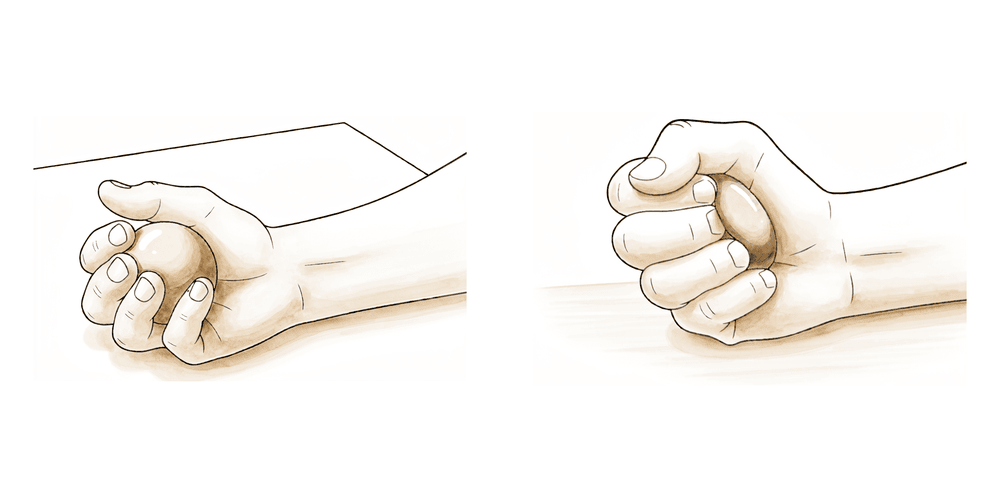
Pagpapalakas ng grip (pagkatapos ng union)
Isang ehersisyo sa HULING bahagi — kapag naghilom na lamang ang iyong fracture at nagsimula na ang iyong hand therapist sa strengthening (karaniwang hindi bago ang humigit-kumulang 8 hanggang 12 linggo, at nakumpirma sa imaging). Pisilin ang isang soft ball o therapy putty, hawakan nang sandali, pagkatapos ay i-relax. Unti-unting dagdagan ang tindi. Pinipigilan muna ang grip hanggang sa maging matigas na ang buto dahil ang malakas na pagpisil ay nagbibigay ng load sa scaphoid at sa screw, at ang scaphoid ay mabagal gumaling.
Ayon sa gabay ng iyong hand therapist (pagkatapos lamang makumpirma ang union)
Ito ang mga ehersisyo mula sa iyong handout. Simulan lamang ang mga ito ayon sa gabay ni Dr Hirpara at ng iyong hand therapist, at manatili sa anumang range at limitasyong ibinigay sa iyo. Pinapanatili ng mga maagang ehersisyo na gumagalaw ang mga daliri, hinlalaki, at forearm nang hindi naaabala ang naghihilom na scaphoid, at ang banayad na paggalaw ng wrist ay idinaragdag kapag pinayagan na lamang ng iyong therapist. Ang grip strengthening ay kabilang sa huling phase at hindi dapat simulan hangga't hindi sinasabi sa iyo na nag-unite na ang buto. Itigil ang anumang nagdudulot ng matalas na sakit sa wrist, at ipaalam ito sa iyong therapist.
Ang iyong clinical protocol
Ang natitirang bahagi ng pahinang ito ay ang staged clinical protocol para sa rehabilitasyon pagkatapos ng scaphoid fixation gamit ang isang headless compression screw. Ang seksyong ito ay ibibigay sa hand therapist ng pasyente, at ang bawat phase ay nagsisimula sa isang paliwanag sa simpleng Ingles tungkol sa kung ano ang nangyayari. Mabagal gumaling ang scaphoid dahil sa tenuous retrograde blood supply nito, kaya ang progression ay union-gated at fixation- and fracture-dependent: ang rigid screw fixation ng isang stable acute waist fracture ay nagpapahintulot ng mas maagang protected wrist motion, habang ang mga proximal-pole fracture, nonunion at mga kasong may bone-graft ay nangangailangan ng mas conservative na kurso.
Bago ang paggamot, suriin ang operation report at past medical history, at makipag-ugnayan sa treating surgeon tungkol sa fracture pattern (waist vs proximal pole), kung ang fracture ay acute o isang nonunion, kung gumamit ng bone graft, ang stability ng fixation, at ang nakaplano na imaging milestone para kumpirmahin ang union. Sinusunod ng hand therapist ang plano para sa indibidwal na fracture at fixation. Ang mga timing sa ibaba ay mga tipikal na gabay para sa isang stable, screw-fixed acute waist fracture; mas maingat na progression ang ginagamit para sa mga proximal-pole, nonunion at bone-grafted fixations.
Phase I - protektadong maagang paggalaw (linggo 0 hanggang 2)
Ang unang ilang linggo ay para protektahan ang sugat at ang fixation habang pinapanatiling mobile ang kamay. Ang wrist ay nakapahinga sa isang splint o short cast; ang mga daliri, thumb at forearm ay malayang gumagalaw mula unang araw. Ang wound review ay karaniwang ginagawa sa loob ng humigit-kumulang dalawang linggo, kung kailan magsisimula ang pormal na therapy.
Para sa iyong hand therapist:
Edukasyon at mga pag-iingat - I-immobilise sa isang wrist splint o short cast ayon sa direktiba ng surgeon; panatilihing tuyo; tatanggalin lamang kung pinayagan na - Buo at agarang active ROM ng daliri, thumb, siko at balikat upang maiwasan ang paninigas - Bawal ang paghawak nang mahigpit (gripping), pagbuhat, weight-bearing o pagtulak gamit ang wrist - Iwasan ang forced/end-range wrist extension
Pamamahala - Sugat: surgical dressings ayon sa direktiba; i-monitor para sa impeksyon; wound review ~2 linggo - Oedema: elevation, gentle hand pump, ice kung kinakailangan - Mga ehersisyo: active finger/thumb composite flexion-extension; thumb opposition; gentle forearm pronation-supination; shoulder at elbow ROM
Mga kraytirya para mag-progress - Sugat ay magaling na/naghihilom; humuhupa ang sakit; clearance mula sa surgeon upang simulan ang wrist motion
Phase II - protektadong mobilisasyon ng pulso (ika-2 hanggang ika-8 linggo, union-gated)
Mula sa humigit-kumulang dalawang linggo (para sa isang stable, screw-fixed acute waist fracture), ipinapakilala ang banayad na active wrist motion sa loob ng isang komportable at walang sakit na range sa ilalim ng proteksyon ng screw. Ang range ay unti-unting pinauunlad; ang end-range extension at anumang loading ay pinananatiling hindi ginagawa. Ang mga proximal-pole, nonunion at bone-grafted fixations ay pinananatili sa protective immobilisation nang mas matagal at imobilisasyon nang mas huli, base sa gabay ng surgeon.
Para sa iyong hand therapist:
Mga Assessment - Active wrist ROM, sakit, pamamaga; pagsusuri ng sugat/peklat; makipag-ugnayan sa surgeon tungkol sa imaging at union status
Edukasyon at mga pag-iingat - Simulan ang banayad na active wrist flexion-extension at radial-ulnar deviation sa isang pain-free range; unti-unting paunlarin ang range - Iwasan ang end-range/forced wrist extension at iwasan ang loading - Walang grip strengthening, walang weight-bearing, walang resisted work hanggang sa makumpirma ang union - Ipagpatuloy ang full digital at forearm ROM; simulan ang scar management kapag magaling na
Pamamahala - Mga ehersisyo: active at active-assisted wrist ROM sa loob ng comfort; ipagpatuloy ang finger/thumb/forearm ROM; pamamahala ng oedema at peklat - Mag-splint sa pagitan ng mga ehersisyo sa simula ng phase na ito kung ipinayo; ang pag-alis ng immobilisation ay ididirekta ng surgeon
Mga kraytirya para sa pag-unlad - Radiographic (madalas na CT-confirmed) union na kinumpirma ng surgeon; komportable at kontroladong wrist ROM; minimal na sakit. Kinakailangan ang lahat ng kraytirya bago magsimula ang anumang strengthening.
Phase III - pagpapalakas at pagbabalik (pagkatapos makumpirma ang union)
Kapag nakumpirma ng surgeon na nag-union na ang fracture (karaniwan ay bandang 8 hanggang 12 linggo para sa isang acute waist fracture, at mas huli para sa mga proximal-pole fracture at nonunion), magsisimula ang pagpapalakas at unti-unting itataas: grip at putty work muna, pagkatapos ay progressive resisted wrist at forearm strengthening, at pagkatapos ay loaded at sport-specific work. Ang pagbabalik sa contact, collision at load-bearing sport ay criterion-based at union-gated, karaniwang hindi bago ang humigit-kumulang tatlo hanggang apat na buwan at madalas ay mas huli para sa mga higher-risk fracture.
Para sa iyong hand therapist:
Mga Assessment - Grip at pinch strength kumpara sa kabilang panig; wrist ROM; tugon ng pain/swelling sa loading; functional at sport-/work-specific testing kung naaangkop
Edukasyon at mga pag-iingat - Simulan ang grip at putty strengthening lamang pagkatapos ng surgeon-confirmed union; unti-unting itaas ang load - Idagdag ang progressive resisted wrist at forearm strengthening; pagkatapos ay graded loaded at closed-chain work - Ang pagbabalik sa contact/collision/load-bearing sport ay union-gated at criterion-based, karaniwang hindi bago ang ~3-4 buwan at mas huli para sa proximal-pole/nonunion; maaaring gumamit ng protective splint o cast para sa maagang supervised return sa mga atleta ayon sa direktiba ng surgeon
Pamamahala - Mga ehersisyo: graded grip/putty → resisted wrist at forearm strengthening (band → light weights) → loaded at sport-specific drills; ituloy ang anumang residual mobility work - Isaalang-alang ang discharge kapag ang lakas ay near-symmetrical na at nakamit na ang angkop na pagbabalik ng function - I-refer muli sa treating surgeon kung ang recovery ay nag-plateau, nananatili ang sakit, o may pagdududa sa union (isaalang-alang ang delayed union/nonunion o AVN)
Mga kraytirya para sa pagbabalik sa sport - Surgeon-confirmed union; full painless ROM; near-symmetrical grip strength; pain-free sport-specific loading at control
Pagbabalik sa trabaho at aktibidad
Hinihikayat ang magaan na pang-araw-araw na paggamit ng kamay (pagkain, pagsusulat, pagbibihis, magaan na pag-aalaga sa sarili) mula sa simula, hangga't komportable, basta't hindi ito kinapapalooban ng paghawak nang mahigpit (gripping), pagbuhat, o pagpilit sa pulso. Ang trabaho sa opisina at iba pang magaan, hindi manwal na trabaho ay madalas na posible nang maaga, kung minsan sa loob ng unang isang o dalawang linggo sa binagong mga tungkulin (modified duties); ang mas mabigat na manwal na trabaho na nagbibigay ng load sa pulso ay hihintayin hanggang sa magdugtong (united) na ang bali at pagkatapos ay unti-unting itataas.
Dahil dapat mong makontrol ang kotse nang ligtas, huwag magmaneho habang ikaw ay nasa cast o splint na humahadlang sa ligtas na pagkontrol ng manibela, o habang ang pulso ay hindi ligtas na makapag-steer at makahawak. Ang pagmamaneho ay magpapatuloy kapag wala ka na sa restrictive cast at kaya mo nang kontrolin ang kotse nang may kumpiyansa at ligtas, gaya ng kumpirmasyon sa iyong review. Magplano para sa tulong sa transportasyon sa mga unang linggo.
Ang paglalagay ng load sa pulso (mahigpit na paghawak, pagbuhat, pagtulak, pagdiin at paghila) ay hihintayin hanggang sa kumpirmahin ng iyong surgeon na nagdugtong na ang buto, at pagkatapos ay unti-unting itataas. Ang pagbabalik sa contact, collision at load-bearing sport ay union-gated, karaniwang hindi bago ang humigit-kumulang tatlo hanggang apat na buwan at madalas ay mas huli para sa mga proximal-pole fracture at nonunion. Ito ay nakabase sa kumpirmadong paggaling kasama ang pagbawi ng buong pain-free movement at sapat, simetrikong grip strength, na huhusgahan ni Dr Hirpara at ng iyong hand therapist, hindi base sa kalendaryo lamang.
Pagkatapos ng iyong protocol
Ang protocol na ito ay kasabay ng pangkalahatang payo sa paggaling ng klinika: tingnan ang pamamahala ng sakit pagkatapos ng operasyon, pag-aalaga ng sugat at pamamahala ng peklat. Ang phased plan sa itaas ay sumasalamin sa nailathalang gabay sa rehabilitasyon pagkatapos ng scaphoid fixation, at ang iyong patuloy na paggaling ay ginagabayan nang indibidwal ni Dr Hirpara at ng iyong hand therapist ayon sa iyong fracture, iyong fixation at kung paano gumagaling ang iyong pulso.
Evidence & references
This is the clinical evidence summary written for health professionals. It is technical, and it lists the research this page was built from. You do not need to read it to understand your treatment or to make a decision about it.
Scaphoid Fixation — Fracture Fixation Outcomes & Post-operative Rehabilitation (Headless Compression Screw ± Bone Graft)
Topic scope: post-operative rehabilitation after internal fixation of a scaphoid fracture with a buried headless compression screw — percutaneous or open, for an acute fracture or for a nonunion (the latter usually with bone graft, e.g. distal-radius cancellous or vascularised graft). This is a fixation of a slow-healing bone, not a soft-tissue repair: rehabilitation is paced by bone union rather than by tendon/ligament healing windows, and the central tension is between the early-motion advantage that rigid screw fixation buys and the scaphoid's biological tendency to heal slowly and, when neglected, to fail to unite.
Defining principle of the rehab here: the scaphoid has a tenuous retrograde blood supply (it fills from distal to proximal), so it heals slowly and the proximal pole is at risk of delayed union, nonunion and avascular necrosis. A headless compression screw compresses and stabilises the fracture, which is what permits earlier protected wrist motion than a cast alone and earlier return to work/sport in suitable fractures. But the construct does not change the bone's biology: grip, loading and contact sport remain union-gated — held back until the surgeon confirms healing, commonly on CT. Progression is therefore fixation- and fracture-dependent: a stable, screw-fixed acute waist fracture mobilises early; a proximal-pole fracture, a nonunion, or a bone-grafted case is treated more cautiously. The hand therapist follows the plan for the specific fracture and fixation.
A. FIXATION OUTCOMES (acute fixation, and nonunion fixation with graft)
Headless compression screw fixation is a reliable operation with high union rates; the principal debates are who should be fixed acutely (vs cast) and how aggressively to mobilise, not whether the screw works.
- Headless compression screws give high union rates and earlier mobilisation. Internal fixation of scaphoid fractures with headless compression screws achieves high union in both non-displaced and displaced fractures, with the added benefits of earlier mobilisation and earlier return to work and sport compared with cast treatment [Fowler & Ilyas, Hand Clin 2010; Fowler & Hughes, Clin Sports Med 2015]. Moderate (narrative/technique reviews + cohort).
- Percutaneous screw fixation unites faster than cast for acute waist fractures. A randomised trial of 60 acute scaphoid-waist fractures found percutaneous Acutrak screw fixation reached union significantly faster than cast immobilisation (~9.2 vs ~13.9 weeks), with a trend to fewer nonunions [Bond et al., J Bone Joint Surg Br 2008]. Moderate–strong (RCT, single-centre).
- But surgery vs cast for minimally displaced waist fractures gives equivalent long-term function at the cost of more complications. The pragmatic multicentre SWIFFT RCT (bicortical, ≤2 mm displaced waist fractures) found no meaningful difference in wrist function between early surgical fixation and cast immobilisation (with fixation reserved for the cast fractures that failed to unite), while surgery carried more complications. Systematic reviews/meta-analyses concur: surgery favours union but raises complication risk, with ROM, grip and arthritis rates not significantly different [Dias et al., SWIFFT, Lancet 2020; Alshryda et al., The Surgeon 2012; Modi et al., Injury 2009; Rhemrev et al., Injury 2009]. Strong (RCT + SRs).
- Nonunion fixation with bone graft restores union in most cases but heals slower. Scaphoid nonunions treated with screw fixation and bone grafting (non-vascularised distal-radius, vascularised distal-radius, or two-screw constructs) achieve union in the large majority, with proximal-pole and avascular cases the hardest. Acute fixation unites ~100% vs chronic/nonunion ~87% in pooled experience [Garcia et al., J Hand Surg Am 2014; Ribak et al., Int Orthop 2009; Kim et al., Orthop Traumatol Surg Res 2018; Wu et al., Bone Joint J 2022; Simonian & Trumble, JAAOS 1994]. Moderate (cohort/SR).
- The elite/competitive athlete is a distinct decision. Early screw fixation is often favoured in athletes to compress the fracture, shorten immobilisation and enable earlier (often splinted) return to play, accepting the surgical risk for the time advantage [Belsky et al., Hand Clin 2012; Fowler & Hughes, Clin Sports Med 2015]. Moderate (expert/cohort).
B. REHABILITATION / THERAPY EVIDENCE
The rehab questions are (1) how soon to mobilise the wrist after rigid fixation, (2) when to permit loading/grip, and (3) when to confirm union and clear sport. The evidence supports early protected motion under the screw but keeps strengthening and sport union-gated, with proximal-pole/nonunion cases handled more conservatively.
- Rigid screw fixation permits earlier protected wrist motion than cast-alone. The mechanical rationale is that compression across the fracture confers stability, allowing the wrist to begin gentle motion while the bone unites; reported acute-fixation pathways start gentle mobilisation early with a ~2-week wound/therapy review and ~6-week radiographic check [Fowler & Ilyas, Hand Clin 2010; Fowler & Hughes, Clin Sports Med 2015]. Moderate (technique/expert).
- Union is the gate for loading — and it is slow and imaging-confirmed. Reported time to union ranges ~7–16 weeks depending on healing criteria, fracture site and population (athletes vs general), and CT is frequently used to confirm union before clearing loading and sport because plain films overestimate healing [Ecker, Hand Clin 2017 (scaphoid union); Fowler & Hughes, Clin Sports Med 2015]. Moderate.
- Proximal-pole fractures, nonunions and grafted cases progress more slowly. The proximal pole's poor vascularity means later union and a more cautious return; arthroscopic and open grafting series for nonunion report union but over longer timeframes [Wu et al., Bone Joint J 2022; Shih et al., J Orthop Surg Res 2023; Garcia et al., J Hand Surg Am 2014]. Moderate (cohort).
- Percutaneous/antegrade technique is a safe route that supports the early-motion pathway. The percutaneous antegrade approach minimises soft-tissue insult and supports the earlier-mobilisation rationale in suitable fractures [Weinberg et al., Injury 2009]. Moderate (cohort).
Recovery trajectory (expected, evidence-anchored)
| Phase | Window | Restraint | Hand use / therapy focus | Strength / load | Notes |
|---|---|---|---|---|---|
| I — Protected early motion | Week 0–2 | Wrist splint/short cast; no wrist loading | Immediate active finger/thumb/elbow/shoulder ROM; oedema control; wound review ~2 wk | None through the wrist | Hand kept supple; scaphoid undisturbed |
| II — Protected wrist mobilisation | Week 2–8 (union-gated) | No grip/loading; avoid end-range/forced extension | Gentle active wrist flexion-extension and deviation in pain-free range; gradual progression; forearm rotation; scar massage once healed | No resisted/grip work | For stable, screw-fixed acute waist fractures. Proximal-pole/nonunion/grafted: immobilise longer, mobilise later |
| III — Strengthening & return | After confirmed union (commonly ~8–12 wk acute waist; later for proximal pole/nonunion) | Restrictions lifted on union | Grip/putty → progressive resisted wrist/forearm → loaded & sport-specific | Graded to symmetrical grip | Contact/load sport union-gated, typically not before ~3–4 months, later for high-risk fractures; CT often confirms union |
(Phase windows are typical guides for a stable screw-fixed acute waist fracture, not trial-derived deadlines; proximal-pole, nonunion and bone-grafted fixations are paced more conservatively by the surgeon and hand therapist.)
C. KEY CONTROVERSIES / EVIDENCE QUALITY
- Screw fixation vs cast for the acute minimally displaced waist fracture. Fixation unites faster (Bond RCT: ~9 vs ~14 weeks) and returns athletes/workers sooner, but SWIFFT and meta-analyses show equivalent long-term wrist function with more complications from surgery for minimally displaced waist fractures. The defensible position is selective fixation (displacement, proximal pole, high-demand athlete/worker, patient preference) rather than routine surgery for every undisplaced waist fracture [Dias SWIFFT Lancet 2020; Bond JBJS Br 2008; Alshryda Surgeon 2012; Modi/Rhemrev Injury 2009]. Strong evidence of functional equivalence; moderate on the complication trade-off.
- Early motion vs continued immobilisation after fixation. Rigid compression is the rationale for earlier protected wrist motion than cast-alone, and reported pathways mobilise early — but there is no high-certainty trial defining the optimal mobilisation schedule, so timing is surgeon/ therapist protocol and fracture-dependent. Weak–moderate (mechanism strong, scheduling consensus).
- When is it united — and what confirms it. Time to union is wide (~7–16 weeks) and plain radiographs overestimate healing; CT is commonly used to confirm union before clearing loading and sport, which is the true gate for progression [Ecker Hand Clin 2017]. Moderate.
- Return-to-sport timing. Union-gated and fracture-dependent; competitive athletes may return earlier in a protective splint/cast at surgeon discretion, accepting risk, whereas proximal-pole and nonunion cases return later. Reported real-world return is typically months, not weeks [Belsky Hand Clin 2012; Fowler & Hughes Clin Sports Med 2015]. Moderate (expert/cohort).
- Nonunion and proximal-pole biology. The retrograde blood supply drives delayed union, nonunion and AVN risk; grafting (cancellous, corticocancellous, or vascularised) addresses biology but lengthens the timeline. Persistent pain or doubtful union warrants reassessment rather than more loading [Garcia JHS Am 2014; Ribak Int Orthop 2009; Kim OTSR 2018; Wu BJJ 2022; Simonian & Trumble JAAOS 1994]. Moderate.
D. EVIDENCE STRENGTH FLAGS (summary)
- STRONG (RCT / SR): equivalent long-term wrist function from surgery vs cast for minimally displaced acute waist fractures, with more complications from surgery (SWIFFT + meta-analyses); faster union with percutaneous screw fixation than cast (Bond RCT, ~9 vs ~14 weeks).
- MODERATE: high union rates and earlier mobilisation/return with headless compression screws; nonunion union rates with screw + bone graft (acute ~100% vs chronic ~87%); wide ~7–16-week union window and CT confirmation of union; athlete-specific early/splinted return.
- WEAK / CONSENSUS: the specific early protected-motion, union-gated phase schedule (mechanistically rationalised by rigid compression; exact timings are surgeon/hand-therapist protocol and fracture-dependent, not trial-derived); precise return-to-sport months.
CITATIONS
RAG corpus (180,000+ Orthopaedic articles)
- Fowler JR, Ilyas AM. Headless compression screw fixation of scaphoid fractures. Hand Clin. 2010. PMID: 20670800. DOI: 10.1016/j.hcl.2010.04.005
- Fowler JR, Hughes TB. Scaphoid fractures. Clin Sports Med. 2015. PMID: 25455395. DOI: 10.1016/j.csm.2014.09.011
- Belsky MR, Leibman MI, Ruchelsman DE. Scaphoid fracture in the elite athlete. Hand Clin. 2012. PMID: 22883862. DOI: 10.1016/j.hcl.2012.05.005
- Ecker J. Scaphoid union. Hand Clin. 2017. PMID: 28991580. DOI: 10.1016/j.hcl.2017.07.001
- Bond CD, Shin AY, McBride MT, Dao KD. Percutaneous screw fixation versus conservative treatment for fractures of the waist of the scaphoid: a prospective randomised study. J Bone Joint Surg Br. 2008. PMID: 18160502. DOI: 10.1302/0301-620X.90B1.19767
- Alshryda S, Shah A, Odak S, et al. Acute fractures of the scaphoid bone: systematic review and meta-analysis. The Surgeon. 2012. PMID: 22595773. DOI: 10.1016/j.surge.2012.03.004
- Modi CS, Nancoo T, Powers D, et al. Operative versus nonoperative treatment of acute undisplaced and minimally displaced scaphoid waist fractures — a systematic review. Injury. 2009. PMID: 19195652. DOI: 10.1016/j.injury.2008.07.030
- Rhemrev SJ, van Leerdam RH, Ootes D, et al. Non-operative treatment of non-displaced scaphoid fractures may be preferred. Injury. 2009. PMID: 19324359. DOI: 10.1016/j.injury.2008.10.028
- Weinberg AM, Pichler W, Grechenig S, et al. The percutaneous antegrade scaphoid fracture fixation — a safe method? Injury. 2009. PMID: 19380132. DOI: 10.1016/j.injury.2008.12.016
- Garcia RM, Leversedge FJ, Aldridge JM, et al. Scaphoid nonunions treated with 2 headless compression screws and bone grafting. J Hand Surg Am. 2014;39(7). PMID: 24793227. DOI: 10.1016/j.jhsa.2014.02.030
- Ribak S, Medina CEG, Mattar R, et al. Treatment of scaphoid nonunion with vascularised and nonvascularised dorsal bone grafting from the distal radius. Int Orthop. 2009. PMID: 19730861. DOI: 10.1007/s00264-009-0862-6
- Kim J, Yoon J, Baek H. Corticocancellous bone graft vs cancellous bone graft for the management of unstable scaphoid nonunion. Orthop Traumatol Surg Res. 2018. PMID: 29258960. DOI: 10.1016/j.otsr.2017.11.011
- Wu F, Zhang Y, Liu B. Arthroscopic bone graft and fixation for proximal scaphoid nonunions. Bone Joint J. 2022. PMID: 35909374. DOI: 10.1302/0301-620X.104B8.BJJ-2022-0198.R1
- Shih Y, Wu C, Shih J. Arthroscopic treatment of stable nonunion, unstable nonunion, or nonunion of the scaphoid with early degenerative radioscaphoid arthritis. J Orthop Surg Res. 2023. PMID: 36804865. DOI: 10.1186/s13018-023-03609-8
- Simonian PT, Trumble TE. Scaphoid nonunion. J Am Acad Orthop Surg. 1994. PMID: 10709008. DOI: 10.5435/00124635-199407000-00001
Scaphoid fixation / rehabilitation literature (URLs)
- Dias JJ, Brealey SD, Fairhurst C, et al. Surgery versus cast immobilisation for adults with a bicortical fracture of the scaphoid waist (SWIFFT): a pragmatic, multicentre, open-label, randomised superiority trial. Lancet. 2020. DOI: 10.1016/S0140-6736(20)30931-4. https://doi.org/10.1016/S0140-6736(20)30931-4
- SWIFFT protocol — Scaphoid Waist Internal Fixation for Fractures Trial. PMC. https://www.ncbi.nlm.nih.gov/pmc/articles/PMC4893284/
- Bond CD, Shin AY, McBride MT, Dao KD. Percutaneous screw fixation versus conservative treatment for fractures of the waist of the scaphoid. J Bone Joint Surg Br. 2008. PubMed. https://pubmed.ncbi.nlm.nih.gov/18160502/
- The headless compression screw — technical challenges in scaphoid fracture fixation. PMC. https://pmc.ncbi.nlm.nih.gov/articles/PMC4796528/
- Arthroscopic-assisted screw fixation of scaphoid waist fractures vs conservative treatment — randomised trial, minimum 4-year follow-up. PubMed. https://pubmed.ncbi.nlm.nih.gov/25913660/
- Non-operative treatment versus percutaneous fixation for minimally displaced scaphoid waist fractures in high-demand young manual workers. PMC. https://pmc.ncbi.nlm.nih.gov/articles/PMC4244556/