Patients › Rehabilitation
Pagpapalit ng Radial Head
Isang protektadong plano ng paggaling pagkatapos ng pagpapalit ng radial head sa siko gamit ang isang metal implant, na nakatuon sa maagang protektadong paggalaw ng siko at forearm upang maiwasan ang paninigas, kung saan ang forearm ay nakaposisyon upang protektahan ang anumang kinumpuning mga ligament at ang siko ay nakapahinga sa isang simpleng sling para sa ginhawa.
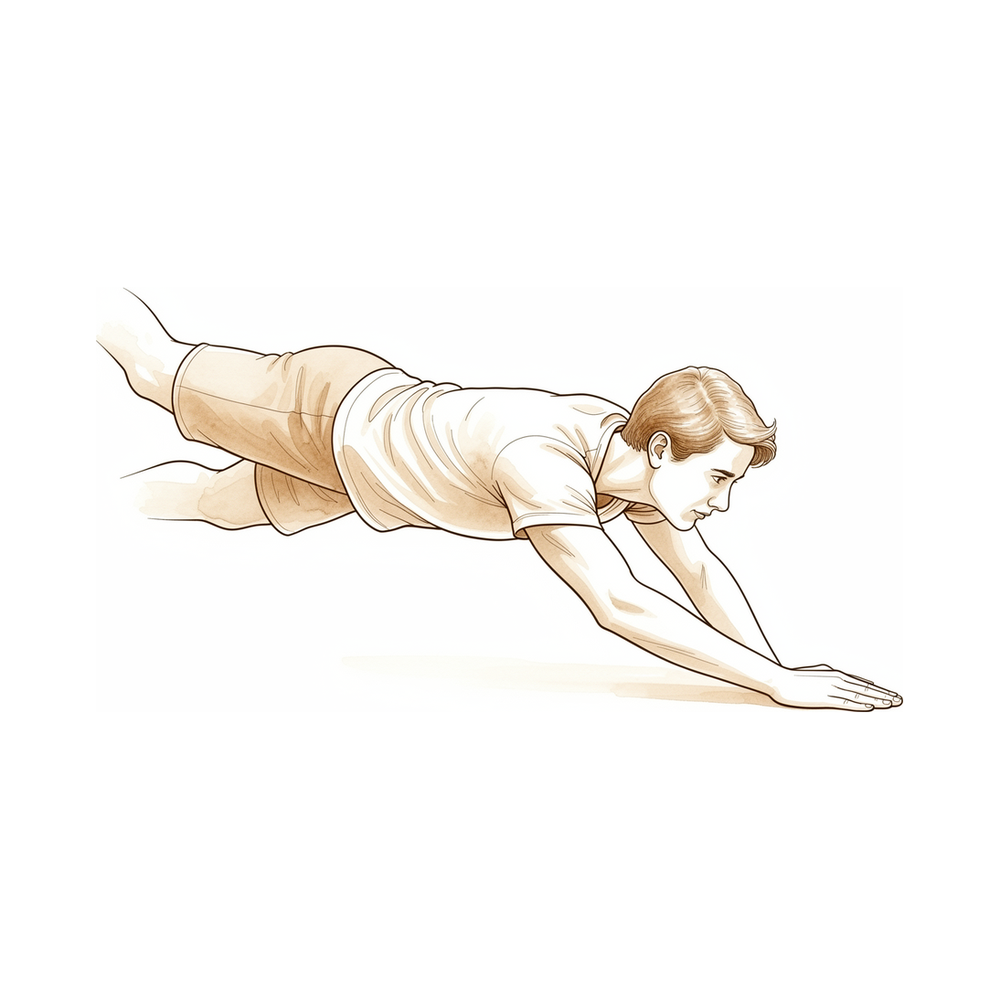
Ang protocol na ito ay nagsisilbing gabay sa iyong paggaling pagkatapos ng radial head replacement sa siko (kung saan ang nadurog na radial head ay pinapalitan ng isang maliit na metal implant) kasama si Dr Kieran Hirpara sa Mater Private Hospital Rockhampton. Nagsisimula ito sa iyong home exercise program, na sinusundan ng structured clinical protocol na isinulat para sa iyong hand therapist; dalhin ang pahinang ito o ang PDF nito sa iyong unang therapy visit upang manatiling coordinated ang iyong rehabilitasyon. Maaaring i-adjust ng iyong therapist ang plano depende sa pag-unlad ng iyong paggaling at sa eksaktong bahagi na kinumpuni noong iyong operasyon.
Kung mayroon kang anumang alalahanin tungkol sa iyong sugat pagkatapos ng operasyon, makipag-ugnayan sa mga rooms. Madalas na nakatutulong ang pagkuha ng larawan ng sugat at pag-email nito para masuri.
Ano ang dapat asahan
Ang radial head ay ang bilog na itaas na bahagi ng isa sa dalawang buto ng forearm, kung saan ito nakikipagdugtong sa siko. Kapag ito ay nabali sa masyadong maraming piraso upang maayos, pinapalitan ito ng isang maliit na metal implant na nagbabalik ng isang stable, congruent na siko at isang smooth na rotation axis ng forearm. Madalas itong ginagawa bilang bahagi ng pag-aayos ng isang mas komplikadong pinsala, isang fracture-dislocation na kung minsan ay tinatawag na "terrible triad", kung saan ang radial head, isang bahagi ng coronoid, at ang mga ligament sa gilid ng siko ay sabay-sabay na napinsala.
Dahil ibinabalik ng implant ang stability, ang prayoridad ng iyong rehabilitasyon ay maagang protected movement upang maiwasan ang paninigas; ang mga siko ay napaka-prone na manigas pagkatapos ng ganitong uri ng pinsala, at ang pinakamahusay na proteksyon laban dito ay ang pagsisimulang gumalaw nang maaga. Ang iyong siko ay pinapahinga sa isang simple sling para sa comfort sa pagitan ng mga ehersisyo (hindi hinged brace), at tinatanggal ang sling para sa iyong mga ehersisyo at para sa paghuhugas.
Dalawang bagay ang nagtatakda kung gaano kabilis at gaano kalayo ang iyong paggalaw:
- Kailangang protektahan ang anumang mga ligament na inayos. Kung ang ligament sa labas ng siko (ang lateral collateral ligament) ay inayos, ang forearm ay pinapanatili at ine-ehersisyo na nakaharap ang palad pababa (pronated) sa simula; kung ang ligament sa loob (ang medial collateral ligament) ang inayos, ito ay pinapanatiling nakaharap ang palad pataas (supinated); kung pareho, sa isang neutral mid-position. Sasabihin sa iyo ng iyong therapist kung alin ang naaangkop sa iyo.
- Ang siko ay dapat protektahan mula sa sideways (varus) stress at, sa simula, mula sa full straightening kung ang siko ay unstable. Ito ang dahilan kung bakit ang paggalaw ay binubuksan sa mga yugto sa halip na isang bagsakan.
Ang paggalaw ay unti-unting pinauunlad, kung saan ang strengthening ay karaniwang nagsisimula mula sa humigit-kumulang anim na linggo at ang pagbabalik sa full activity ay sa loob ng tatlong buwan. Ang implant at ang paggaling ay patuloy na nag-se-settle sa loob ng ilang buwan, kaya naman ang mas mabigat na loading ay unti-unting ibinabalik.
Mga pag-iingat at limitasyon
- Isuot ang simple sling para sa ginhawa ayon sa itinuro; hindi ito isang hinged brace, at tinatanggal para sa mga ehersisyo at paghuhugas.
- Panatilihin ang forearm sa posisyong ibinigay ng iyong therapist habang nasa maagang mga ehersisyo (nakaharap ang palad pababa kung ang panlabas na ligament ang kinumpuni, nakaharap ang palad pataas kung ang panloob ang kinumpuni, neutral kung pareho), na nagpoprotekta sa kumpuni.
- HUWAG maglagay ng sideways (varus) stress sa siko; iwasang sumandal sa siko o hayaang nakabitin ang braso nang walang suporta patawid sa iyong katawan sa simula.
- HUWAG piliting ituwid nang husto sa simula kung sinabihan kang hindi stable ang siko; ituwid lamang sa loob ng iyong pinapayagang range.
- HUWAG magbuhat, magtulak, humila o magdala ng bigat gamit ang inoperahang braso hanggang sa payagan (karaniwan ay bandang anim na linggo); panatilihing magaan ang paggamit ng kamay sa simula.
- Panatilihing gumagalaw ang iyong balikat, pulso at mga daliri mula sa simula, at HUWAG magmaneho habang ang iyong braso ay nasa sling o hindi ligtas na makokontrol ang manibela.
Para sa pamamahala ng sugat, pamamaga at peklat, tingnan ang gabay ng practice sa wound care.
Iyong mga ehersisyo
Kieran Hirpara 4.0
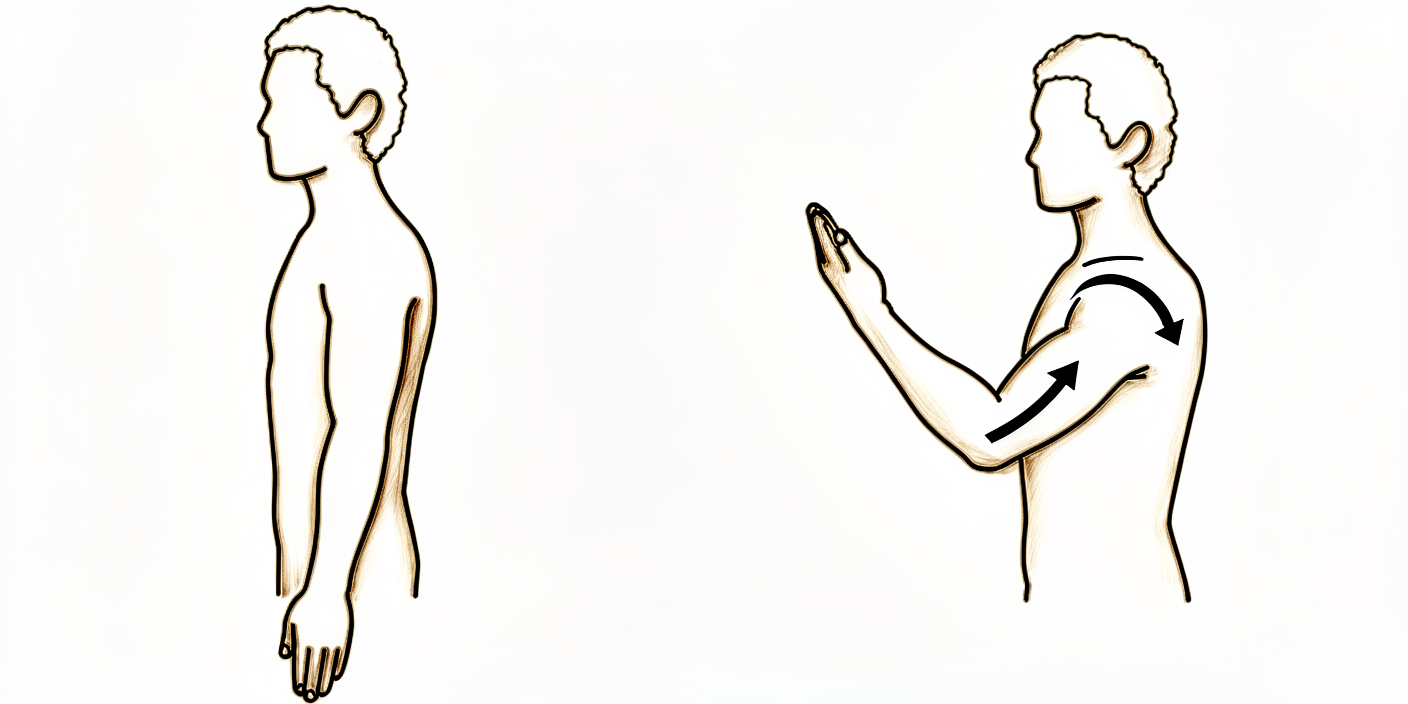
Pagbaluktot at pagtuwid ng siko (active-assisted)
Alisin sa sling, dahan-dahang itiklop at ituwid ang inoperahang siko sa loob ng range na ibinigay sa iyo, gamit ang iyong kabilang kamay upang tulungan itong gumabay para hindi kailangang magtrabaho nang mabigat ng braso. Ang maagang paggalaw ang pinakamahalagang bagay dito — ibinalik ng metal implant ang katatagan ng siko kaya ligtas itong igalaw, at ang maagang paggalaw ang pumipigil sa siko na tumigas. Manatili sa anumang limitasyon sa ganap na pagtutuwid kung mayroon kang ibinigay.
10 beses, 3–4 beses sa isang araw, sa loob ng iyong pinapayagang range
Kieran Hirpara 4.0
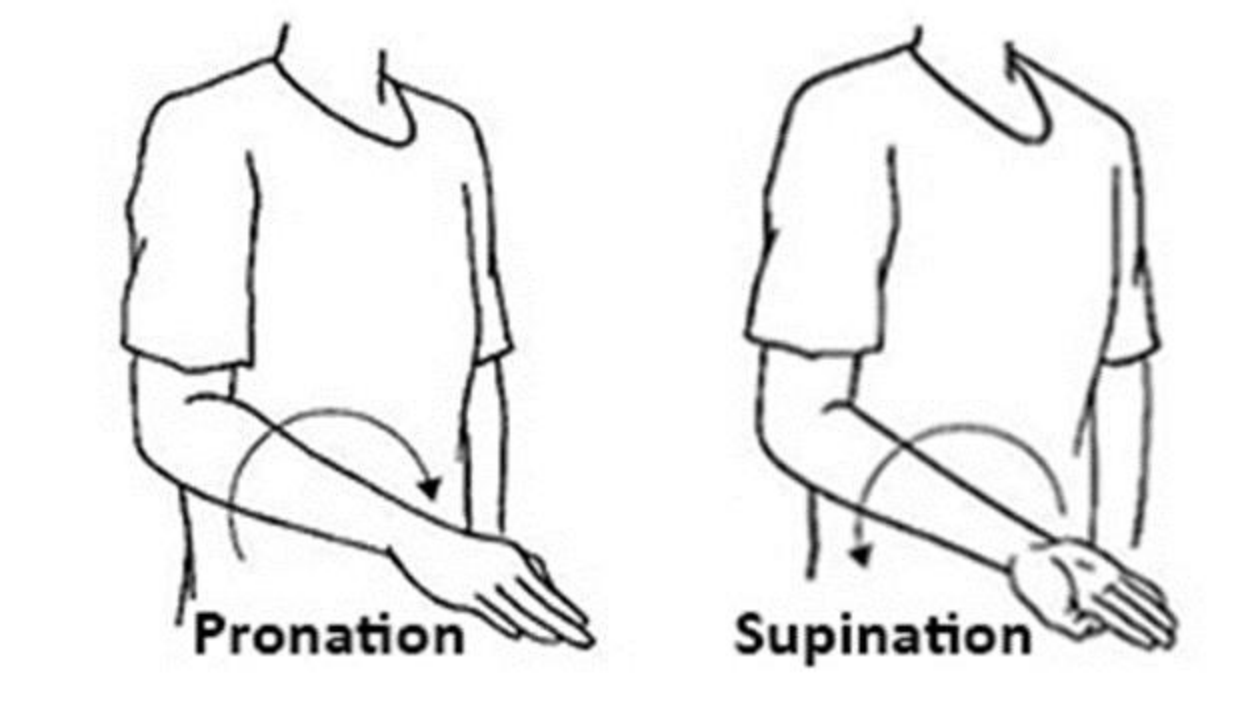
Rotasyon ng forearm (palad paitaas / palad paibaba)
Habang ang iyong siko ay nakadikit sa iyong gilid at nakabaluktot sa isang right angle, dahan-dahang iharap ang iyong palad paitaas sa kisame, pagkatapos ay paibaba sa sahig. Panatilihing hindi gumagalaw ang siko at hayaang ang forearm lamang ang umikot. Sa simula, maaaring hilingin sa iyo na paboran ang isang direksyon (palad na nakababa, o palad na nakataas) upang protektahan ang kinumpuning ligament — sundin ang direksyong ibibigay ng iyong therapist. Pinapanatili nito na supple ang forearm, na isa sa mga unang galaw na tumitigas pagkatapos ng pinsalang ito.
10 beses sa bawat pinapayagang direksyon, 3–4 beses sa isang araw
Kieran Hirpara 4.0
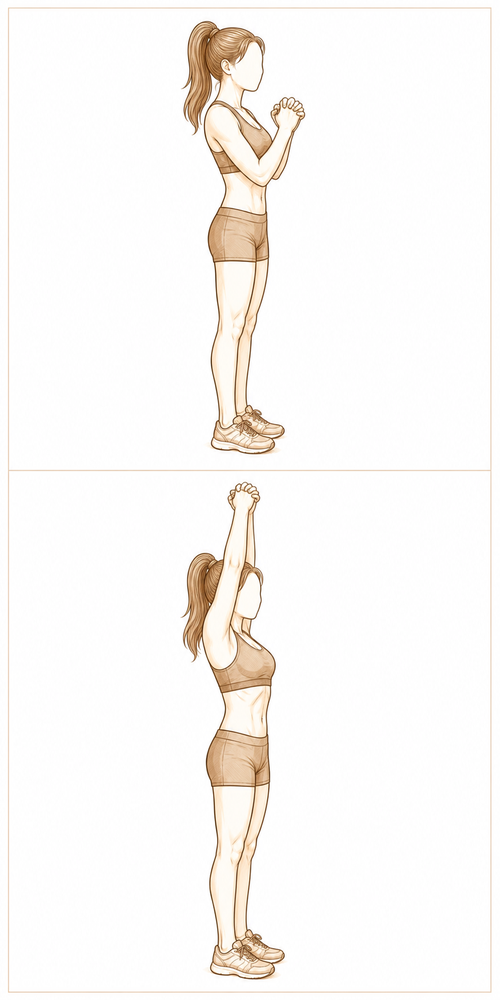
Paggalaw ng balikat at kamay
Panatilihing malayang gumagalaw ang iyong balikat, pulso, at mga daliri mula sa unang araw upang hindi sila manigas habang nagpapagaling ang siko. Itikom nang husto ang kamao at iunat ang mga daliri, i-circle ang pulso, at igalaw nang dahan-dahan ang balikat. Gamitin ang kamay para sa mga magagaan na pang-araw-araw na gawain hangga't komportable. Wala sa mga ito ang nagbibigay ng load sa repair ng siko.
10 beses bawat isa, ilang beses sa isang araw
Kieran Hirpara 4.0
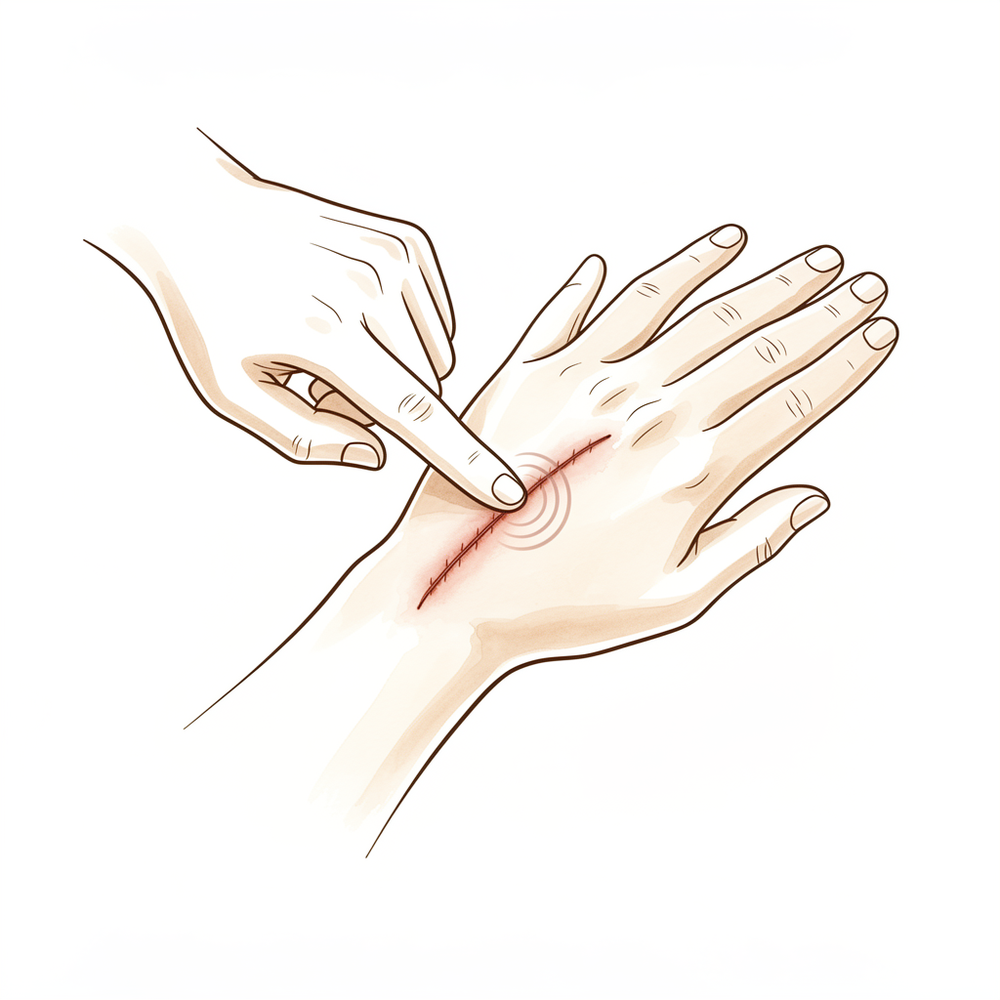
Pag-aalaga sa peklat
Kapag ganap nang magaling ang sugat at binigyan na ng pahintulot ng surgeon o therapist, i-massage ang peklat gamit ang kaunting moisturizer sa pamamagitan ng paggawa ng maliliit na bilog sa loob ng ilang minuto. Pinapanatili nito na malambot ang peklat at hindi gaanong sensitibo. Huwag simulan hangga't hindi pa lubos na sarado ang sugat.
Ilang minuto, 2–3 beses sa isang araw, kapag magaling na
Kieran Hirpara 4.0
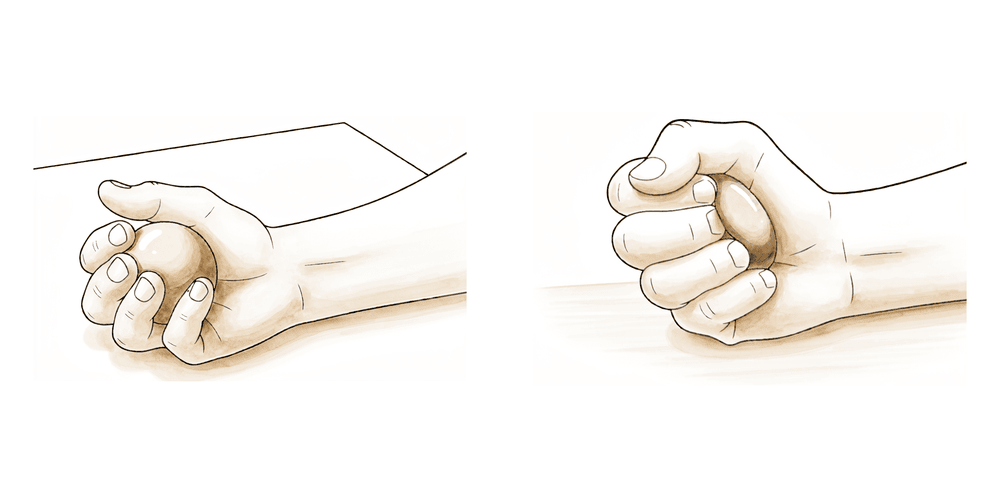
Pagpapalakas mula 6 na linggo
Isang ehersisyo sa HULING bahagi — kapag pinayagan na lamang, karaniwan ay mula sa ika-anim na linggo. Simulan ang banayad na pagpapalakas ng siko, forearm at grip — halimbawa, pagpiga ng malambot na bola, pagkatapos ay magaan na resisted bending at straightening — at unti-unting dagdagan ang pagsisikap sa mga sumunod na linggo. Huwag madaliin ang mas mabigat na loading; ang siko ay patuloy pang naghihilom sa loob ng ilang buwan.
Ayon sa gabay ng iyong hand therapist (mula ~6 na linggo lamang)
Ito ang mga ehersisyo mula sa iyong handout. Simulan lamang ang mga ito ayon sa gabay ni Dr Hirpara at ng iyong hand therapist, at manatili sa anumang range at posisyon ng forearm na ibinigay sa iyo. Ang mga maagang ehersisyo ay pinapanatiling gumagalaw ang siko at forearm upang maiwasan ang paninigas nang hindi binibigyang-diin ang anumang repair: active-assisted na pagbaluktot at pagtuwid ng siko, banayad na rotation ng forearm sa iyong pinapayagang direksyon, at pagpapanatiling malaya ng balikat at kamay. Ang pagpapalakas (strengthening) at pag-aalaga sa peklat (scar care) ay kabilang sa mga huling phase at hindi dapat simulan hangga't hindi ka partikular na binibigyan ng clearance. Itigil ang anumang nagdudulot ng matalas na sakit o pakiramdam na bumibigay ang siko.
Ang iyong clinical protocol
Ang natitirang bahagi ng pahinang ito ay ang staged clinical protocol para sa rehabilitasyon pagkatapos ng radial head replacement (radial head arthroplasty), na pinakamadalas isinasagawa para sa isang unreconstructable comminuted radial head fracture, madalas bilang bahagi ng isang terrible-triad fracture-dislocation. Ang seksyong ito ay ibibigay sa hand therapist, at ang bawat phase ay nagsisimula sa isang plain-English na paliwanag ng kung ano ang nangyayari. Ibinabalik ng implant ang isang stable, congruent radiocapitellar articulation, kaya ang guiding principle ay maagang protected motion upang maiwasan ang stiffness na madalas mangyari sa mga siko na ito, kung saan ang arc at forearm rotation ay nakadepende sa integridad ng anumang collateral-ligament at coronoid repairs.
Bago ang paggamot, suriin ang operation report ng pasyente at ang examination-under-anaesthesia stability assessment, at makipag-ugnayan sa treating surgeon tungkol sa: kung aling mga collateral ligament at/o coronoid ang na-repair, ang stable arc na naipakita intra-operatively, at ang protective forearm rotation. Pinapahinga ni Dr Hirpara ang siko sa isang simple sling para sa comfort (walang hinged brace) at pabor sa isang accelerated, early-motion approach kung saan pinapayagan ng stability. Forearm-position rule: LCL repair → exercise/rest in pronation; MCL repair → supination; pareho → neutral mid-position; iwasan ang varus stress at, kung saan ang siko ay unstable, ang terminal extension sa simula.
Phase I — maagang protektadong paggalaw (linggo 0 hanggang 2)
Sa unang dalawang linggo, simulan ang banayad na protektadong paggalaw sa sandaling payagan na ng katatagan ng sugat (madalas sa loob ng unang linggo) upang maiwasan ang paninigas. Ang braso ay nakapahinga sa isang simpleng sling para sa ginhawa, at tinatanggal para sa mga ehersisyo at kalinisan. Ang siko ay gumagalaw sa ligtas na arc nito habang ang forearm ay pinapanatili sa protektadong rotation para sa kung alinmang ligament ang kinumpuni.
Para sa iyong hand therapist:
Edukasyon at mga pag-iingat - I-immobilise sa isang simpleng sling para sa ginhawa (walang hinged brace); tanggalin para sa mga ehersisyo at paghuhugas - Simulan ang active-assisted/active elbow flexion–extension sa loob ng stable arc na ipinakita habang nasa operasyon; iwasan ang terminal extension kung hindi stable ang siko - Rotation ng forearm sa protektadong posisyon: pronation kung LCL ang kinumpuni, supination kung MCL ang kinumpuni, neutral mid-range kung pareho - Walang varus stress sa anumang oras; isagawa ang mga overhead exercise nang nakahiga (supine) kung hindi stable upang i-neutralise ang varus at gamitin ang gravity upang i-coapt ang joint - Walang weight-bearing o pagtulak gamit ang inoperahang braso
Pamamahala - Sugat: surgical dressings ayon sa itinuro; kumpirmahin ang katatagan ng sugat bago simulan ang paggalaw - Oedema: elevation, banayad na hand pump, ice kung kinakailangan - Mga ehersisyo: AAROM/active elbow flexion–extension sa loob ng stable arc; forearm pro/sup sa protektadong direksyon habang ang siko ay nasa 90°; full active shoulder, wrist, hand at grip ROM
Mga kraytirya para mag-progress - Paghilom ng sugat; komportable at kontroladong paggalaw sa loob ng protektadong arc
Phase II — pagpapalawak ng arc at rotasyon ng forearm (linggo 2 hanggang 6)
Mula humigit-kumulang dalawa hanggang anim na linggo, ang protected arc ay unti-unting pinalalawak patungo sa full extension at ang rotasyon ng forearm ay binubuksan sa parehong direksyon, na may layuning makamit ang full pronation/supination sa loob ng humigit-kumulang walong linggo. Ang strengthening at loading ay hindi pa rin pinapayagan.
Para sa iyong hand therapist:
Assessments - Active at passive elbow flexion–extension at rotasyon ng forearm; sakit at pamamaga; pagsusuri ng sugat/peklat; mga sintomas ng instability
Education at precautions - Mag-progress patungo sa full extension ayon sa pinahihintulutan ng stability (unti-unting alisin ang anumang early extension block) - I-progress ang rotasyon ng forearm sa parehong direksyon patungo sa full, habang isinasaalang-alang pa rin ang repaired ligament sa simula ng phase na ito - Patuloy na iwasan ang varus stress at anumang loading sa braso
Management - Mga ehersisyo: palawakin ang elbow flexion–extension arc hanggang maging full; i-progress ang pro/sup patungo sa full ROM (target na full sa ~8 linggo); simulan ang scar management kapag hila na ang sugat; ituloy ang shoulder/wrist/hand ROM - Ang isang overhead (supine) motion programme ay nananatiling kapaki-pakinabang kung may alalahanin tungkol sa residual instability
Criteria para mag-progress - Papalapit sa full painless ROM; walang mga sintomas ng instability; sakit ≤3/10
Phase III — pagpapalakas at pagbabalik (ika-6 hanggang ika-12 linggo at higit pa)
Kapag naibalik na ang paggalaw at itinuring nang secure ang mga repair (karaniwan ay sa ika-anim na linggo), magsisimula ang pagpapalakas at unti-unting itataas (grip muna, pagkatapos ay resisted elbow at forearm work), na magpapatuloy sa mga sumunod na linggo. Ang pagbabalik sa mas mabibigat na aktibidad ay nakabase sa criteria, karaniwan ay sa loob ng tatlong buwan.
Para sa iyong hand therapist:
Mga Assessment - Lakas ng siko at forearm kumpara sa kabilang panig; tugon ng sakit/pamamaga sa loading; functional at work-/sport-specific na testing kung naaangkop
Edukasyon at mga pag-iingat - Simulan ang gentle resisted strengthening (grip → resisted elbow flexion–extension at pro/sup) mula sa ika-anim na linggo; unti-unting itaas ang load - Mag-progress sa functional at work-specific loading ayon sa tolerance; iwasan ang biglaang mabigat o impact loading sa simula
Pamamahala - Mga ehersisyo: progressive resisted elbow/forearm strengthening (band → light weights); grip strengthening; graded functional loading; ituloy ang anumang residual mobility work - Bantayan at iulat ang nananatili o lumalalang sakit, mechanical symptoms o pagkawala ng motion (posibleng implant overstuffing/loosening o capitellar wear), at i-refer muli sa treating doctor kung nag-plateau ang recovery o may poor outcome - Isaalang-alang ang discharge kapag ang motion ay functional na at ang lakas ay near-symmetrical
Mga Criteria para sa pagbabalik sa full activity - Functional pain-free ROM; near-symmetrical na lakas; kumpyansa at stable na siko sa ilalim ng load
Pagbabalik sa trabaho at aktibidad
Hinihikayat ang magaan na pang-araw-araw na paggamit ng kamay (pagkain, pagsusulat, magaan na pag-aalaga sa sarili) mula sa simula, hangga't komportable, basta't hindi ito kinapapalooban ng pagtulak, pagbuhat o pagdadala ng bigat gamit ang siko. Dahil hindi ka dapat magmaneho habang ang braso ay nasa sling o hindi ligtas na nakokontrol ang manibela, magplano para sa tulong sa transportasyon sa mga unang linggo; ang pagmamaneho ay muling sisimulan kapag wala ka na sa sling at kaya mo nang kontrolin ang kotse, gaya ng kumpirmasyon sa iyong review.
Ang pagpapalakas (strengthening) ay karaniwang nagsisimula mula sa humigit-kumulang anim na linggo at unti-unting pinatataas. Ang pagbabalik sa mas mabigat na trabaho, pagbuhat at sports ay karaniwang nasa loob ng tatlong buwan, at nakabase sa pagbawi ng buong paggalaw na walang sakit at sapat, simetrikong lakas na may matatag na siko, na huhusgahan ni Dr Hirpara at ng iyong hand therapist sa halip na sa kalendaryo lamang. Ang mas mabigat na manwal na trabaho at contact sport ay sumusunod sa parehong criterion-based progression.
Pagkatapos ng iyong protocol
Ang protocol na ito ay kasabay ng pangkalahatang payo sa paggaling ng klinika; tingnan ang pamamahala ng sakit pagkatapos ng operasyon, pag-aalaga ng sugat at pamamahala ng peklat. Ang phased plan sa itaas ay sumasalamin sa nailathalang gabay sa rehabilitasyon pagkatapos ng radial head arthroplasty at terrible-triad reconstruction, at ang iyong patuloy na paggaling ay ginagabayan nang indibidwal ni Dr Hirpara at ng iyong hand therapist ayon sa pag-unlad ng iyong siko at kung ano ang eksaktong kinumpuni.
Evidence & references
This is the clinical evidence summary written for health professionals. It is technical, and it lists the research this page was built from. You do not need to read it to understand your treatment or to make a decision about it.
Radial Head Replacement — Procedure Outcomes & Post-operative Rehabilitation (Radial Head Arthroplasty for Unreconstructable Fracture / Terrible Triad)
Topic scope: post-operative rehabilitation after radial head arthroplasty (RHA) — replacement of an unreconstructable comminuted radial head with a metallic implant — performed either in isolation or, more commonly, as one component of reconstructing a fracture-dislocation (the "terrible triad": radial head + coronoid + lateral collateral ligament ± medial collateral ligament). The radial head is a key secondary stabiliser of the elbow against valgus and axial (posterolateral rotatory) load, so the implant exists to restore a stable, congruent radiocapitellar articulation and forearm axis — not merely to fill a defect.
Defining principle of the rehab here: the implant restores stability, so the dominant clinical enemy is stiffness, to which these elbows are strongly predisposed. The rehab is therefore an early protected-motion pathway — start moving within days to a week — explicitly gated by the integrity of the collateral-ligament and coronoid repairs done at the same operation. The two deliberate restraints are (1) the forearm rotation position that offloads the repaired ligament (pronation protects a repaired LCL; supination protects a repaired MCL; neutral mid-range when both), and (2) avoidance of varus stress and, where the elbow was unstable, early terminal extension. A simple sling is worn for comfort — not a hinged brace. The single biggest branch point is how much residual instability was demonstrated on examination under anaesthesia, which determines how fast the arc and forearm rotation are released.
A. PROCEDURE OUTCOMES (radial head arthroplasty; repair-vs-replace context)
Metallic RHA is a reliable reconstruction for the unreconstructable radial head, and — critically for rehab — it restores enough stability to permit early motion even in the setting of associated dislocation, provided the ligaments and coronoid are addressed.
- RHA restores elbow stability and kinematics when the native head is unreconstructable, but ligament repair is required to fully restore stability. Cadaveric work shows radial head excision alters kinematics and stability, arthroplasty restores them in the ligament-intact elbow, and in the ligament-disrupted elbow arthroplasty plus LCL repair is needed to correct varus–valgus laxity [Beingessner et al., J Bone Joint Surg Am 2004, DOI 10.2106/00004623-200408000-00018]. Strong (mechanistic/biomechanical).
- RHA gives functional, durable ROM in unstable elbow injuries equivalent to stable injuries. A 15-year single-surgeon series (68 patients) found patients with unstable radial head fractures plus dislocation achieved flexion and rotational arcs similar to stable injuries, with no difference in complication rate or implant survivorship — though supination loss was ~10° greater in the unstable group [Lott et al., J Shoulder Elbow Surg 2018, DOI 10.1016/j.jse.2017.10.011]. Moderate (Level II cohort).
- Long-term monopolar implant survival is good, with stiffness/sizing the main failure modes. A 15-year follow-up of the Acumed anatomical (press-fit, monopolar) implant for Mason III–IV fractures confirms durable function and survival, with the principal complications being joint stiffness, malpositioning and improper sizing [Tarallo et al., J Shoulder Elbow Surg 2026, DOI 10.1016/j.jse.2025.05.038]. Moderate (long-term cohort).
- Implant failure/revision risk is real, especially with associated instability. In a young active (military) cohort, RHA carried higher implant-failure rates than ORIF (20% vs 2.9%), and dislocation, coronoid fracture and concomitant ligament repair each predicted complications — underscoring that the injury complex, not just the implant, drives outcome [Kusnezov et al., HAND 2017, DOI 10.1177/1558944717715136]. Moderate.
- Terrible-triad reconstruction aims explicitly to restore stability sufficient for early motion. Comprehensive reviews frame the entire surgical sequence (LCL repair, radial head fix/replace, ± coronoid, ± MCL/fixator) as a means to permit early ROM and pre-empt stiffness, posttraumatic arthrosis and instability [Fahs et al., J Am Acad Orthop Surg 2024, DOI 10.5435/jaaos-d-24-00310]. Moderate–strong (narrative review).
B. REHABILITATION / THERAPY EVIDENCE
The rehab evidence base is built on biomechanics + surgical-series protocols rather than RCTs: there is strong agreement on early protected motion and on forearm-position-based ligament protection, but the exact arc and timing are individualised to intra-operative stability.
- Early motion is the consensus priority to prevent stiffness. Across operative series and textbook protocols, formal active and active-assisted ROM is begun within the first week once wound stability is confirmed, with splinting between sessions usually discontinued by 2–3 weeks and strengthening from ~6 weeks [Monica & Mudgal, Hand Clin 2010, DOI 10.1016/j.hcl.2010.04.008; Duckworth et al., Clin Orthop Relat Res 2014, DOI 10.1007/s11999-014-3516-y]. Moderate (consensus/series).
- Motion is gated by stability, with varus stress avoided at all times. Where instability is a concern, an overhead (supine) rehabilitation protocol begun ~10–14 days post-op achieves early motion while gravity coapts the joint and neutralises varus; "a stiff stable elbow is preferred over a loose incongruous one" [Rockwood and Green's Fractures in Adults, 2019]. Moderate (textbook consensus).
- Forearm rotation is positioned to protect the repaired ligament. Published RHA protocols position and exercise the forearm in pronation when the LCL was repaired, supination when the MCL was repaired, and neutral mid-range when both were repaired, progressing to full rotation as the repair consolidates [single-centre RHA protocol & narrative review, ResearchGate 2018; UVA / Christ Hospital RHA PT protocols — see URLs]. Weak–moderate (protocol consensus).
- A coronoid fracture treated without fixation does not preclude early motion in selected triads. Where the LCL and radial head are addressed and intra-operative fluoroscopic stability is confirmed, type I–II coronoid fractures can be left unfixed and still rehabilitated with early motion to good ROM and DASH scores [Papatheodorou et al., Clin Orthop Relat Res 2014, DOI 10.1007/s11999-014-3471-7]. Moderate (Level IV series).
- Restoring radiocapitellar contact (by replacement) is what permits the early-motion pathway in the unstable elbow; conservative or excision pathways are reserved for stable patterns and depend on the same early-mobilisation principle [Charalambous et al., J Shoulder Elbow Surg 2011, DOI 10.1016/j.jse.2011.02.013]. Moderate.
Recovery trajectory (expected, evidence-anchored)
| Phase | Window | Restraint | Therapy focus | Strength / load | Notes |
|---|---|---|---|---|---|
| I — Early protected motion | Week 0–2 (often start <1 wk) | Simple sling for comfort (no hinged brace); stable-arc only; forearm in ligament-protective rotation; no varus stress | Active/active-assisted elbow flexion–extension within the intra-operative stable arc; forearm pro/sup in the protected direction; full shoulder/wrist/hand ROM; supine overhead programme if unstable | None | Wound stability confirmed before motion; "stiff-stable > loose-incongruous" |
| II — Arc & rotation progression | Week 2–6 | Release extension block / forearm rotation gradually as stability allows | Progress elbow arc to full extension; open forearm rotation both directions; scar management once healed | None | Aim full pronation/supination by ~8 weeks; supination is the slowest to recover (~10° residual loss common) |
| III — Strengthening & return | Week 6–12+ | Restrictions lifted as repairs consolidate | Grip → resisted elbow/forearm strengthening; graded functional and work-specific loading | Begin ~6 wk, build gradually | Return to heavier work/sport criterion-based ~3 months; watch for overstuffing/loosening/capitellar wear |
(Phase windows mirror the precautions in the patient protocol; they are typical, stability-gated guides, not trial-derived deadlines.)
C. KEY CONTROVERSIES / EVIDENCE QUALITY
- Repair (ORIF) vs replace (RHA) the radial head. For reconstructable heads, ORIF is generally preferred and no prosthesis equals the native head biomechanically; for unreconstructable comminution (Mason III–IV) or in the unstable/dislocated elbow, RHA is the more reliable option because fixation constructs fail under the higher stresses [Kusnezov et al. 2017; Charalambous et al. 2011; Leigh & Ball, J Shoulder Elbow Surg 2012, DOI 10.1016/j.jse.2012.03.005]. Moderate; selection-dependent.
- Terrible-triad early motion vs protected immobilisation. Modern practice favours restoring enough stability (LCL ± radial head ± coronoid ± MCL/fixator) to permit early motion and avoid stiffness; the supine/overhead protocol exists precisely to reconcile early motion with residual instability. The trade-off ("stiff-stable preferred over loose-incongruous") is consensus, not RCT-settled [Rockwood and Green 2019; Fahs et al. 2024]. Moderate (consensus).
- Monopolar vs bipolar implants. Both are used; bipolar designs were intended to self-align and tolerate sizing imperfection, while monopolar anatomical implants show good long-term survival. No clear superiority is established, and overstuffing/sizing error harms either design more than the bearing type does [Tarallo et al. 2026; Doornberg et al., J Bone Joint Surg 2007, DOI 10.2106/jbjs.e.01340]. Weak (no head-to-head superiority).
- Implant-related complications. Overstuffing the radiocapitellar joint, malsizing and stem loosening cause capitellar erosion/osteopenia, pain and stiffness; capitellar erosion is reported from metal-on-cartilage articulation, and accurate head height/diameter is the key technical guard [Van Riet et al., J Bone Joint Surg 2004, DOI 10.2106/00004623-200405000-00028; Monica & Mudgal 2010]. Rehab cannot fix a malsized implant — persistent loading pain/stiffness warrants surgical review. Moderate.
- Supination is the laggard. Across series, forearm supination is the motion most likely to remain mildly deficient (≈10° loss), partly from scarring and partly from MCL-protective early positioning; patients should be counselled accordingly [Lott et al. 2018]. Moderate natural-history.
D. EVIDENCE STRENGTH FLAGS (summary)
- STRONG (biomechanical / mechanistic): RHA restores elbow stability and kinematics only in concert with collateral-ligament repair (varus–valgus laxity corrected by RHA + LCL repair, not RHA alone).
- MODERATE: functional ROM after RHA in unstable injuries equivalent to stable injuries with good implant survivorship (Level II–IV cohorts); long-term monopolar implant survival with stiffness/sizing as main failure modes; early-motion-to-prevent-stiffness as the governing rehab principle; supine/overhead protocol for the unstable elbow; supination as the slowest-recovering arc.
- WEAK / CONSENSUS: the specific forearm-position-by-repaired-ligament rehab rule (pronation for LCL, supination for MCL, neutral for both) and the exact phase timings (protocol-derived, stability-gated, not RCT-validated); monopolar-vs-bipolar bearing choice (no proven superiority).
CITATIONS
RAG corpus (180,000+ Orthopaedic articles)
- The Effect of Radial Head Excision and Arthroplasty on Elbow Kinematics and Stability. J Bone Joint Surg Am. 2004. DOI: 10.2106/00004623-200408000-00018
- Radial Head Arthroplasty. Hand Clin. 2010. DOI: 10.1016/j.hcl.2010.04.008
- Results after radial head arthroplasty in unstable fractures. J Shoulder Elbow Surg. 2018. DOI: 10.1016/j.jse.2017.10.011
- Long-term survival of Acumed anatomical radial head implant for Mason type III-IV fractures: a 15-year follow-up. J Shoulder Elbow Surg. 2026. DOI: 10.1016/j.jse.2025.05.038
- Operative Management of Unstable Radial Head Fractures in a Young Active Population. HAND. 2017. DOI: 10.1177/1558944717715136
- Management of Elbow Terrible Triad Injuries: A Comprehensive Review and Update. J Am Acad Orthop Surg. 2024. DOI: 10.5435/jaaos-d-24-00310
- Terrible Triad Injuries of the Elbow: Does the Coronoid Always Need to Be Fixed? Clin Orthop Relat Res. 2014. DOI: 10.1007/s11999-014-3471-7
- Radial Head Replacement for Acute Complex Fractures: What Are the Rate and Risk Factors for Revision or Removal? Clin Orthop Relat Res. 2014. DOI: 10.1007/s11999-014-3516-y
- Radial head reconstruction versus replacement in the treatment of terrible triad injuries of the elbow. J Shoulder Elbow Surg. 2012. DOI: 10.1016/j.jse.2012.03.005
- Comminuted radial head fractures: aspects of current management. J Shoulder Elbow Surg. 2011. DOI: 10.1016/j.jse.2011.02.013
- Radial Head Arthroplasty with a Modular Metal Spacer to Treat Acute Traumatic Elbow Instability. J Bone Joint Surg Am. 2007. DOI: 10.2106/jbjs.e.01340
- Capitellar Erosion Caused by a Metal Radial Head Prosthesis. J Bone Joint Surg Am. 2004. DOI: 10.2106/00004623-200405000-00028
- Comparative study of radial head resection and prosthetic replacement in surgical release of stiff elbows. Int Orthop. 2014. DOI: 10.1007/s00264-014-2594-5
- Rockwood and Green's Fractures in Adults (terrible-triad surgical pitfalls; overhead/early-motion protocol; "stiff-stable preferred"). Wolters Kluwer, 2019.
Radial head replacement rehabilitation literature (URLs)
- Rehabilitation protocol after radial head arthroplasty — a single-centre experience and narrative review of the literature. ResearchGate (2018). https://www.researchgate.net/publication/326168570
- University of Virginia, Department of Orthopaedic Surgery — Radial Head Replacement Rehabilitation Guidelines (forearm-position-by-ligament; arc progression). https://med.virginia.edu/orthopaedic-surgery/wp-content/uploads/sites/242/2024/09/Radial-head-replacement.pdf
- The Christ Hospital — Radial Head Replacement Physical Therapy Protocol (Rao). https://www.thechristhospital.com/landingpages/Documents/Rao%20PT%20Protocols/Operative/Elbow/Rao%20Radial%20Head%20Replacement%20r1.pdf
- Cheshire Arm Clinic — Physiotherapy Protocol for Radial Head Replacement. https://cheshirearmclinic.co.uk/wp-content/uploads/2021/09/Radial-Head-Replacement.pdf
- Denver Shoulder — Rehabilitation Protocol: Radial Head Replacement. https://www.denvershouldersurgeon.com/pdf/radial-head-replacement-protocol.pdf