Patients › Rehabilitation
Elbow Instability
Rehabilitation after surgery for elbow instability, covering both lateral (terrible triad / LCL) injuries and throwing (medial UCL) injuries, built around protected early movement rather than immobilisation.
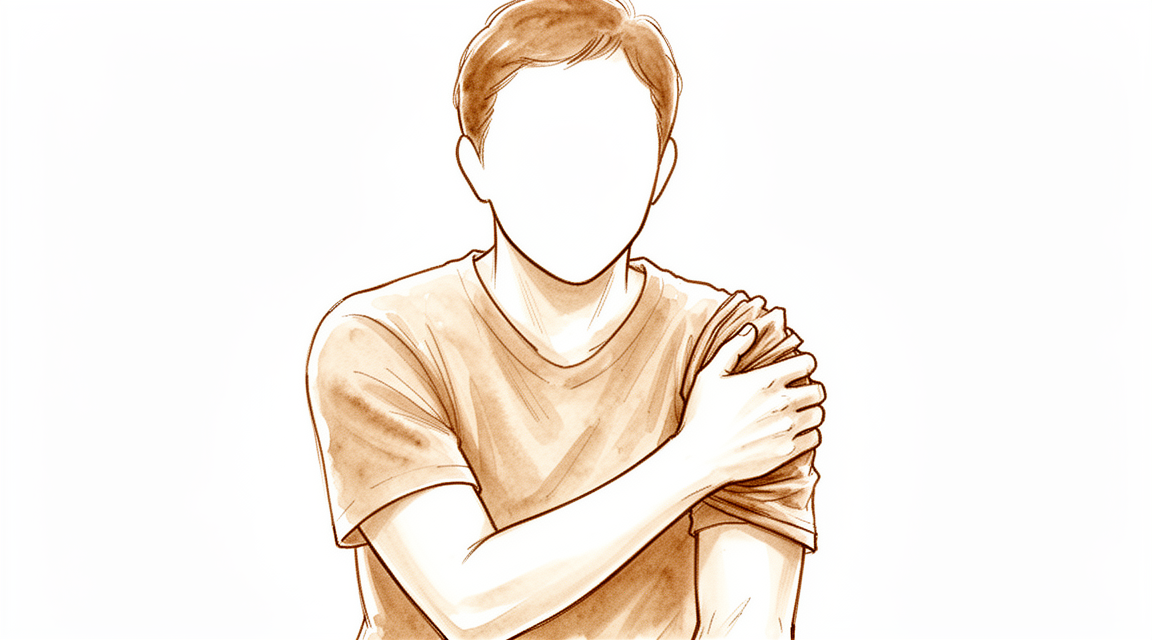
This protocol guides your recovery after surgery for elbow instability with Dr Kieran Hirpara at Mater Private Hospital Rockhampton. It covers two different kinds of instability, and your surgeon will tell you which applies to you:
- (A) A lateral (outer-side) injury: such as a "terrible triad" injury, a fracture-dislocation, or a repair of the lateral collateral ligament (LCL). These injuries are stabilised so the elbow no longer slips or pivots out of place.
- (B) A throwing (medial, inner-side) injury: a repair or reconstruction of the ulnar collateral ligament (UCL), usually in overhead athletes.
The whole plan is built on one idea: protected early movement, not immobilisation. Long spells in a cast or splint are the main cause of a permanently stiff elbow, so the goal is to start moving safely and soon. Bring this page or its PDF to your first therapy visit so your rehabilitation stays coordinated. Your therapist may adjust the plan depending on how your recovery progresses.
If you have any concerns about your wound after surgery, get in touch with the rooms. It is often helpful to take a photo of the wound and email it for review.
What to expect
The elbow is held in place by ligaments on the inner and outer sides of the joint. When these are injured (by a dislocation, a fracture-dislocation, or repeated throwing), the joint can become unstable. Surgery repairs or reconstructs the damaged structures so the joint sits properly again.
Dr Hirpara's approach avoids a bulky external hinged brace. If the repair is stable through its full range at the time of surgery, you will simply wear a light sling for comfort and begin moving the elbow early, within safe positions. If the stability needs more protection, an internal joint stabiliser can be fitted at the time of surgery: a small internal hinge that holds the elbow correctly reduced from the inside while still letting you bend and straighten it early. Because the protection is internal, you still avoid an external arc-limiting brace. If used, this internal device is usually removed once the ligaments have healed, at around four to six months.
For wound, swelling and scar management, see the practice's wound care guidance.
The single most important habit in this recovery is to keep moving within your safe range while respecting the positions your surgeon asks you to avoid. The exercises below are your starting point.
Precautions and limitations
The positions to protect depend on which injury you have. Your surgeon and therapist will confirm yours.
For a lateral (outer-side) injury (terrible triad / LCL):
- Do keep your forearm turned palm-down (pronated) for movement; this seats the joint and protects the outer repair.
- Do exercise with your arm in front of your body, or lying down with the arm reaching toward the ceiling if asked, so gravity helps hold the joint together.
- Do not let the arm fall out to the side (avoid shoulder abduction) or take weight through it early; gravity then pulls the repair apart.
- Do not combine fully straightening the elbow with a palm-up (supinated) forearm until your surgeon clears it (around 16 weeks); this is the position that can make the joint slip again.
- Do not push or stretch the elbow into pain, and avoid weight-bearing and contact loading for the first few months.
For a throwing (medial, inner-side) injury (UCL):
- Do keep your forearm biased palm-up (supinated) or neutral, as directed.
- Do not load the shoulder into outward (external) rotation early; this stresses the inner repair. This is usually avoided until about 6 weeks.
Your exercises
Kieran Hirpara 4.0
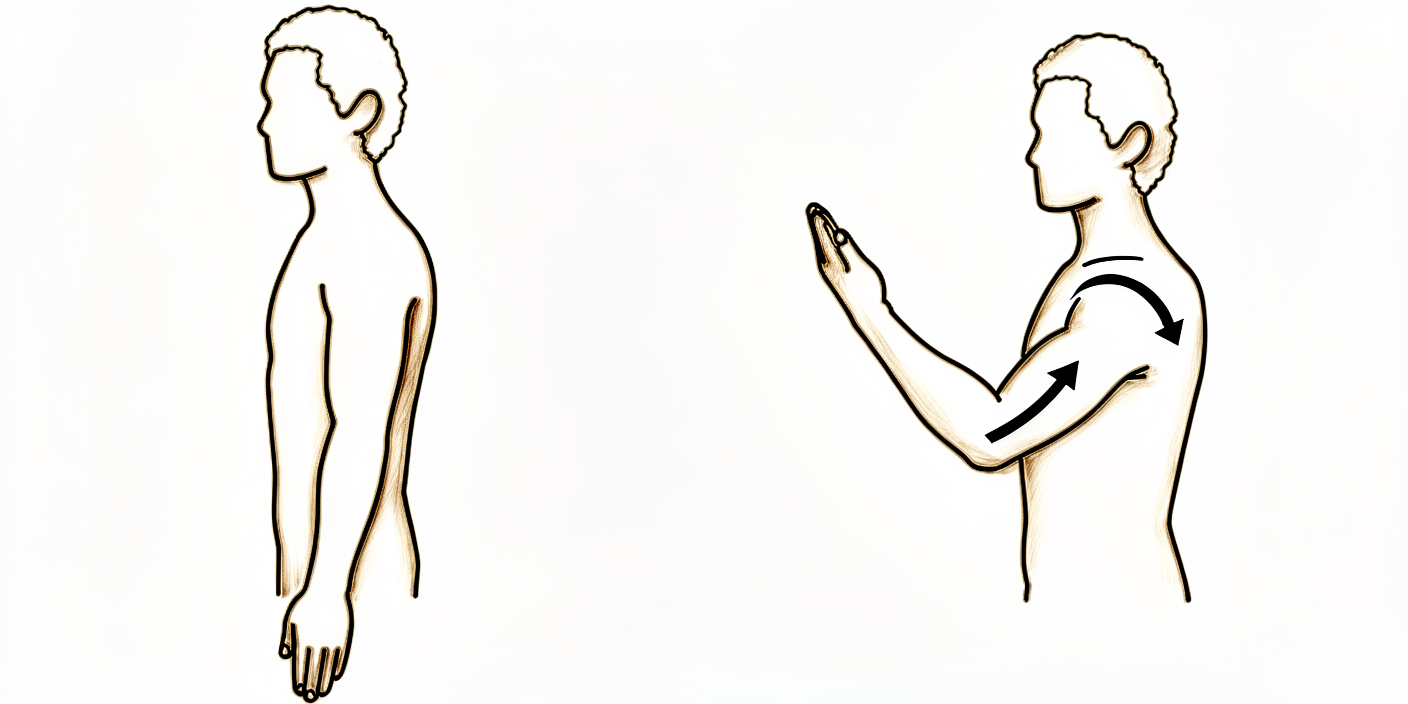
Active elbow bends
Gently bend your elbow as far as is comfortable, then straighten it again to the point your surgeon and therapist allow. Keep your forearm turned the way you have been instructed — for a lateral (outer-side) injury this usually means palm-down (pronated). Move only your own muscles; do not force the joint.
10–15 times, several times a day
Kieran Hirpara 4.0
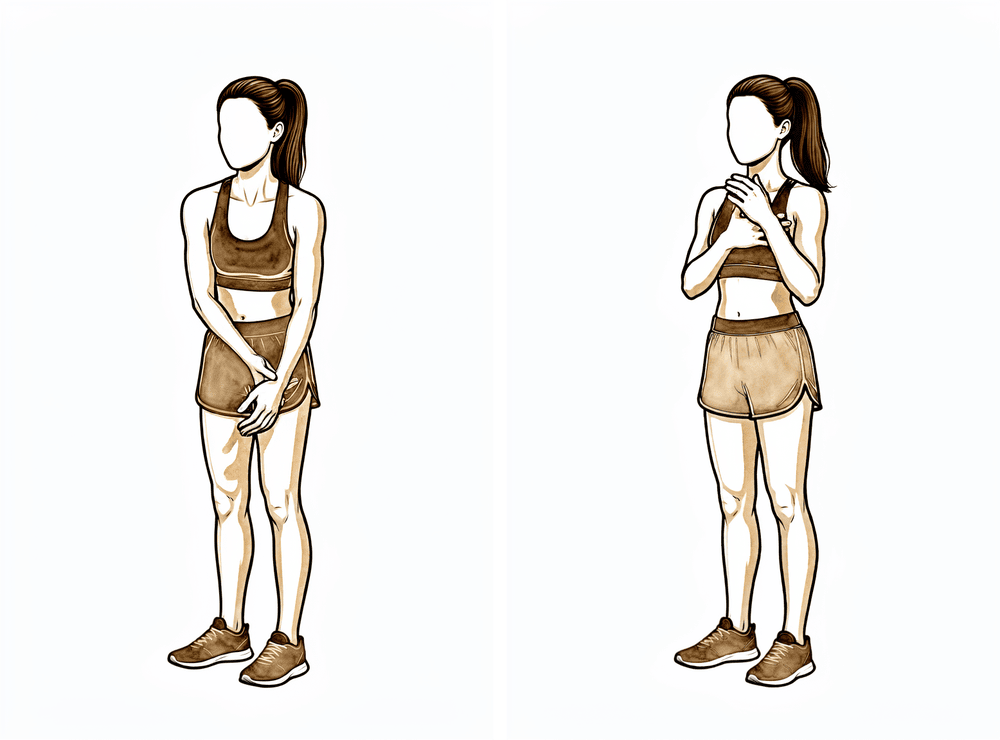
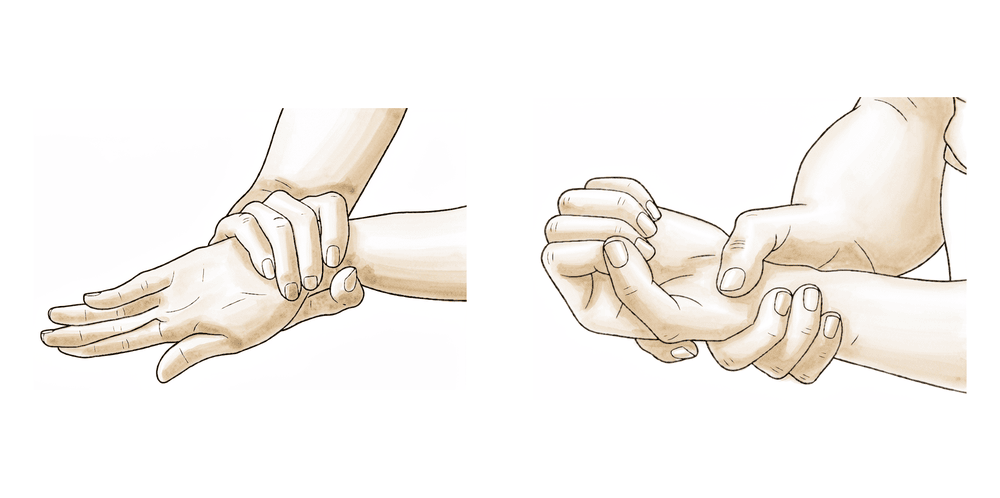
Assisted elbow flexion
When your therapist allows, use your other hand to gently help your elbow bend a little further than it moves on its own. Take it to a comfortable stretch only — never to pain — and ease off slowly.
Hold 10–15 seconds, 5–10 times, as directed
Kieran Hirpara 4.0
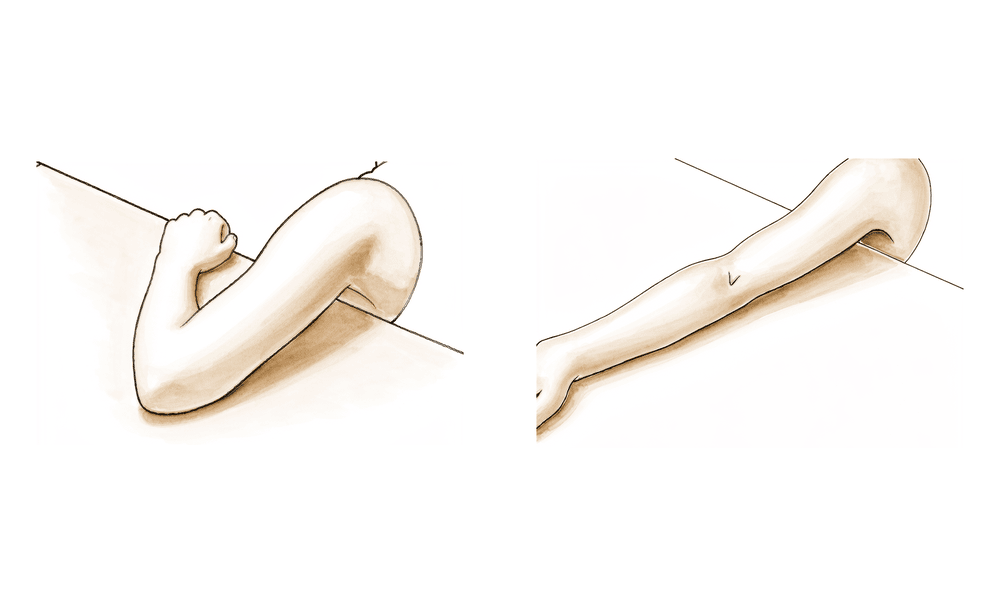
Elbow straightening (extension to comfort)
Straighten your elbow as far as is comfortable within the range your surgeon has set. For a lateral injury, keep your palm turned down as you straighten. Do not push into full straightening combined with palm-up rotation until your surgeon clears it.
10–15 times, several times a day
Kieran Hirpara 4.0
Forearm rotation (palm up / palm down)
With your elbow tucked at your side and bent to about 90°, gently turn your palm up, then palm down, within the range you have been given. Your safe direction depends on your injury — a lateral injury favours palm-down (pronation); a medial throwing injury favours palm-up (supination). Follow the direction your surgeon and therapist set.
10 times each allowed direction, several times a day
Kieran Hirpara 4.0
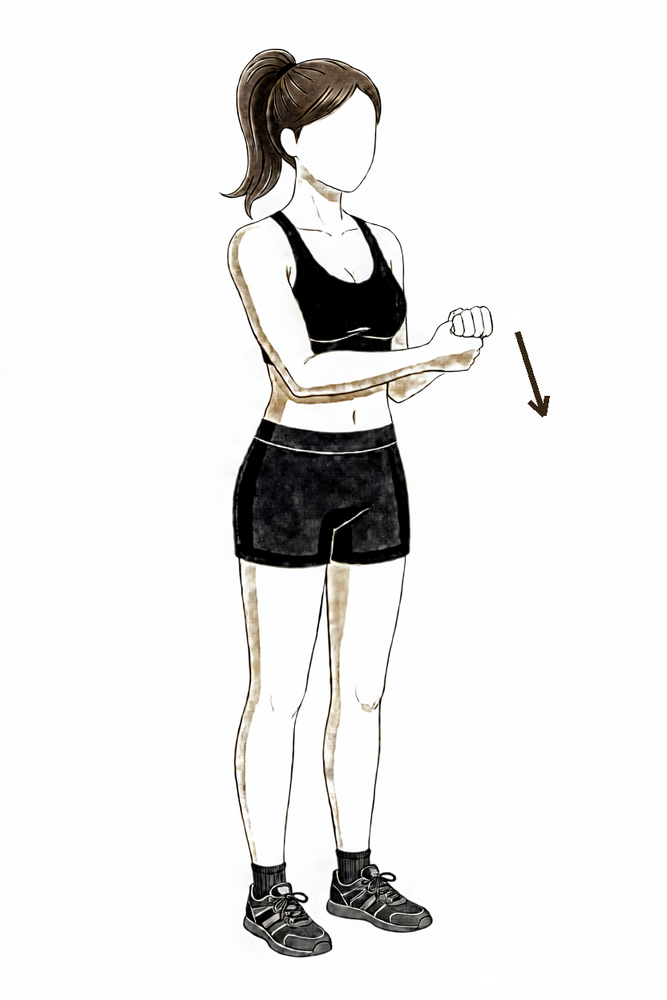
Elbow muscle holds — straightening (isometric)
With your elbow held still, gently press as if to straighten it against your other hand or a fixed surface. The elbow should not actually move. This wakes the muscles up without loading the healing ligaments.
Hold 5 seconds, 10 times, once or twice daily — only when cleared
Kieran Hirpara 4.0
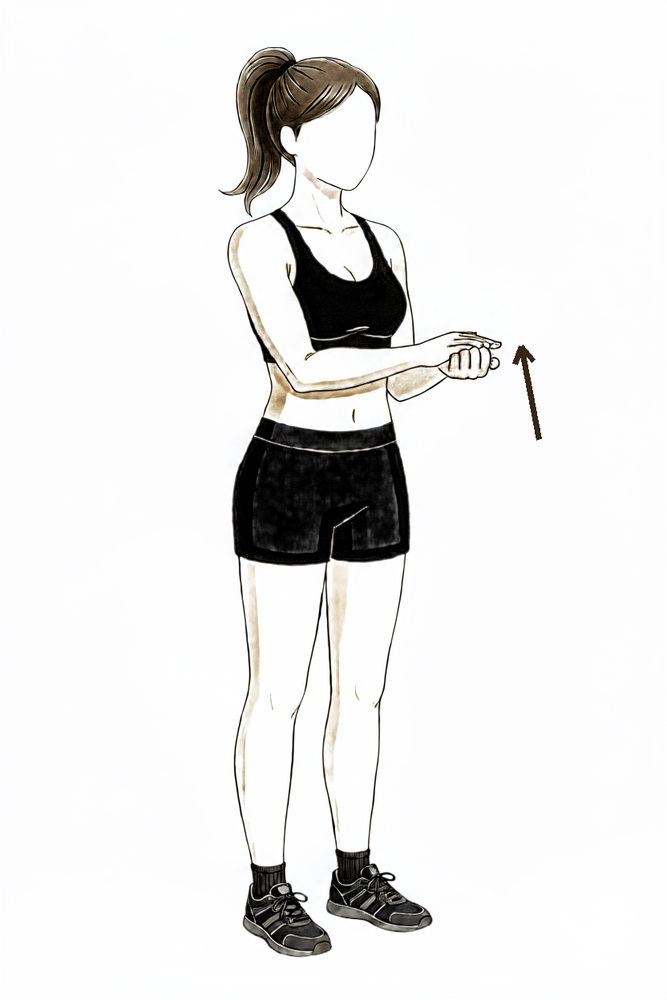
Elbow muscle holds — bending (isometric)
With your elbow held still, gently press as if to bend it against your other hand. The elbow should not move. Keep the effort comfortable — this is muscle activation, not a workout.
Hold 5 seconds, 10 times, once or twice daily — only when cleared
Kieran Hirpara 4.0
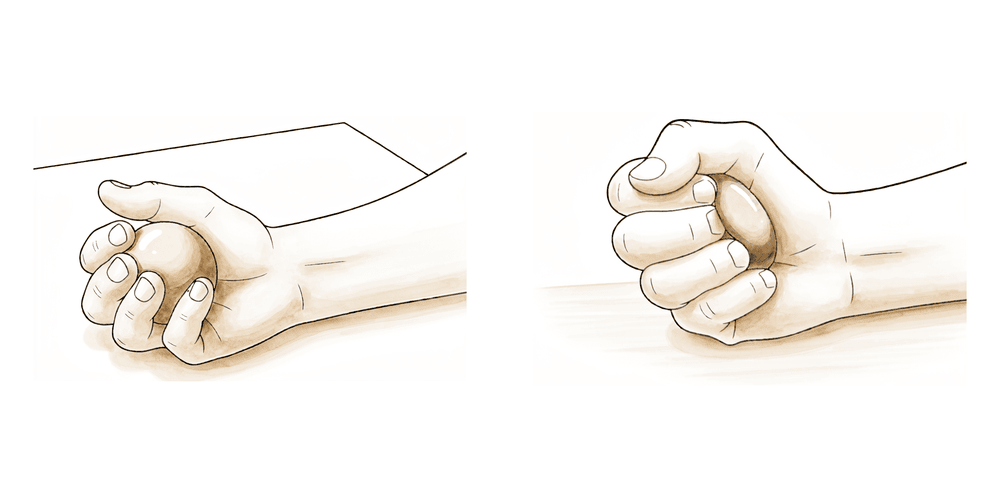
Grip strengthening
Squeeze a soft ball or therapy putty in your hand and hold briefly, then release. This keeps your hand and forearm strong while your elbow is protected.
10–15 squeezes, 2–3 times a day
These are the exercises from your handout, for regaining safe movement and keeping your hand, forearm and shoulder working while the elbow is protected. Start them, and progress them, only as guided by Dr Hirpara and your therapist; the safe forearm position and range depend on your specific injury.
Your clinical protocol
The rest of this page is the clinical protocol for your physiotherapist or hand therapist. It is written in two tracks because the two injuries are protected differently. Each phase is criteria-gated: progress when the milestones are met, not simply by the calendar.
Prior to treatment, check the patient's x-ray, operation report and past medical history, and liaise with the treating surgeon regarding the stability achieved at surgery, the safe arc and forearm rotation, and whether an internal joint stabiliser was implanted. Dr Hirpara does not use an external hinged brace: a through-range stable repair is managed in a simple sling with early motion to comfort; where stability needs protecting, an internal joint stabiliser holds the reduction internally while permitting extension to comfort.
Track A — Terrible triad / fracture-dislocation / LCL (LUCL) repair
Aim: A stable, concentrically reduced elbow that moves early; prevent posterolateral rotatory re-subluxation.
Key precautions throughout the early phase:
- Keep the forearm pronated for an isolated lateral injury (tightens the lateral structures and seats the radiocapitellar joint). If both columns were repaired, hold the forearm neutral; supination is permitted only with the elbow flexed to ~90°.
- Avoid varus stress and shoulder abduction: gravity imposes a varus load on the lateral repair. Perform active range of motion with the arm in front of the body, or supine-overhead (gravity-reduced) if the repair is tenuous.
- No full-extension-with-supination until ~16 weeks (reproduces the pivot-shift).
- No weight-bearing / closed-chain loading for 8–16 weeks.
Weeks 0–2: Early motion. Simple sling for comfort. Begin digit, wrist and shoulder active range of motion immediately. Begin elbow active and active-assisted range of motion to comfort from day 2–3, forearm pronated, arm supported in front of the body (or supine-overhead if the repair is tenuous, so gravity compresses the joint). Where an internal joint stabiliser is in place, progress to full comfortable extension early; the device protects the reduction; no external brace is used.
Weeks 2–6: Restore the arc. Progress to full comfortable flexion and extension (extension to comfort throughout; an internal stabiliser, if present, permits this). Maintain the pronation bias; avoid varus loading. Criteria to progress: full passive arc regained, no re-subluxation on examination or x-ray, pain ≤3/10.
Weeks 6–12: Strengthening. Once clinically and radiographically healed (~week 6), begin progressive strengthening; introduce a static-progressive splint if a contracture is developing. Continue to avoid varus load. An internal stabiliser, if used, is usually retained until ligament healing.
Weeks 12–20+: Advanced / return. Progressive resistance; return to heavy labour. Contact and overhead sport at approximately 6–9 months (and after any internal-stabiliser removal). Continue to avoid varus-loaded strengthening.
Track B — Throwing (medial) UCL repair / reconstruction
This is a chronic-overload medial problem. Dr Hirpara's preference is no external hinged brace: a suture-tape internal-brace augmentation (repair) or the tendon graft (reconstruction) provides the protection, and rehabilitation is throwing-specific. The forearm is biased to supination/neutral; resisted shoulder external rotation is avoided until ~week 6, as it valgus-loads the graft.
Internal-brace–augmented repair (accelerated, matching the no-external-brace approach):
- Early protected motion to comfort, weeks 0–4 (full arc by ~week 6).
- Thrower's Ten program from ~week 3; plyometrics from ~week 6.
- Interval throwing program from ~week 11; return to sport at ~5–7 months.
Reconstruction (graft) track, if used (slower):
- Full arc by ~week 6; interval throwing at weeks 14–16; throwing from a mound not before 6 months; competitive return to sport typically 9–16 months.
Getting back to work and activity
How quickly you return depends on which injury you had and on the demands of your job or sport.
- Lateral injury (terrible triad / LCL): light desk and self-care tasks resume early, within your safe positions. Strengthening generally begins around 6 weeks once the elbow has healed clinically and on x-ray. Contact and overhead sport are usually delayed to about 6–9 months, and after removal of an internal joint stabiliser if one was fitted. Avoid taking weight through the arm or loading it out to the side until your surgeon clears it.
- Throwing injury (UCL): with an internal-brace-augmented repair, a structured interval throwing program typically begins around 11 weeks, with return to sport at about 5–7 months. After a reconstruction, return to competitive throwing is slower, commonly 9–16 months.
Driving is resumed once you have comfortable, safe control of the arm out of the sling and your surgeon has confirmed it is appropriate at review. Your therapist will progress your strengthening and sport- or work-specific drills toward your individual goals.
After your protocol
This protocol works alongside the practice's general recovery advice; see managing post-operative pain and wound care. Your ongoing recovery is guided individually by your physiotherapist or hand therapist according to how your elbow progresses and which injury you had. The clinician-facing evidence summary for this protocol is kept alongside this page.
Evidence & references
This is the clinical evidence summary written for health professionals. It is technical, and it lists the research this page was built from. You do not need to read it to understand your treatment or to make a decision about it.
Elbow Instability — Rehabilitation Evidence (Lateral / Terrible Triad / LCL and Throwing / UCL)
Topic scope: Post-operative rehabilitation after surgery for elbow instability, in two distinct tracks: (A) complex lateral instability — "terrible triad" / fracture-dislocation and lateral (ulnar) collateral ligament [LCL/LUCL] repair & reconstruction for posterolateral rotatory instability (PLRI); and (B) overhead-throwing ulnar (medial) collateral ligament [UCL] reconstruction & repair ("Tommy John").
Defining principle: the crux of every track is protected motion, not immobilisation. Restore enough stability to permit early range of motion (within ~1 week), because prolonged immobilisation is the dominant cause of disabling flexion contracture and stiffness. Dr Hirpara's stance: he does not use an external hinged brace. A repair that is stable through-range at surgery is managed with a simple sling for comfort plus early motion to comfort within positional precautions. Where stability needs protecting, he implants an internal joint stabiliser (an internal hinge) that holds the elbow reduced from the inside while permitting full flexion and extension to comfort — so the patient still moves early without an external arc-limiting brace. The device is typically removed once the ligaments have healed (~4–6 months). The published external-hinged-brace extension-block arcs below are retained as reference for what they represent biomechanically, not as Dr Hirpara's management.
(A) Terrible triad / complex fracture-dislocation / LCL (LUCL) repair & reconstruction
Forearm-rotation rule (the key precaution)
- Lateral-sided (LCL/LUCL) injury → keep the forearm PRONATED. Pronation tightens the lateral structures and seats the radiocapitellar joint, protecting the lateral repair. Terminal extension is performed pronated; supination near full extension reproduces the pivot-shift and is avoided.
- Medial-sided (MCL/UCL) injury → keep the forearm SUPINATED (Rockwood & Green; Green's Operative Hand Surgery).
- If both columns are repaired (many terrible triads), the forearm is held neutral.
- Early supination, when allowed, is done only with the elbow flexed to ~90° (flexion stabilises the ulnohumeral joint and protects the lateral reconstruction).
Phased timeline
- Week 0–2 — Immediate post-op / early motion. Posterior splint at ~90° flexion in injury-appropriate forearm rotation for 7–14 days in the published protocols; the practical aim is early motion. Begin digit/wrist/shoulder AROM immediately and gentle elbow AROM/AAROM in the surgeon-defined stable arc within days (Brigham fracture-dislocation guideline starts elbow/forearm AROM at day 2–3). A supine/overhead protocol is an option where the lateral repair is tenuous — gravity compresses and stabilises the ulnohumeral joint (Green's; Lee 2013).
- Week 2–6 — Protected motion / restore the arc. Published external-hinged-brace protocols open an extension block ~10°/week, forearm pronated (Denver/Eichinger: 30° at wk2 → 20° wk3 → 10° wk4 → 0° wk5), reaching full extension by ~week 5–6. Dr Hirpara replaces this external brace with a simple sling (through-range stable repair) or an internal joint stabiliser permitting extension to comfort. Precautions: avoid varus stress and shoulder abduction; avoid combined full-extension-with-supination for up to ~16 weeks; no weight-bearing/closed-chain for 8–16 weeks.
- Week 6–12 — Intermediate / strengthening. Full PROM, joint mobilisations. Strengthening starts ~week 6 once clinical and radiographic healing is confirmed (Brigham PRE 6–8 wk; Rockwood & Green). Static-progressive splinting if a contracture is developing (Müller 2013).
- Week 12–20+ — Advanced / return. Progressive resistance; avoid varus-loaded strengthening. Contact/overhead sport often delayed to ~6–9 months for reconstruction (Green's: unrestricted use ≥6 months for graft incorporation; Eichinger: up to 9 months).
Nonoperative (stable terrible triad) caveat: if the joint is concentrically reduced with a stable arc to ≥30° of extension (no radial-head block, small coronoid), nonoperative early-motion management is reasonable (Rockwood & Green / Chan criteria; Najd Mazhar 2017).
(B) UCL reconstruction / repair — throwing athlete ("Tommy John")
Rehabilitation is uniformly described in 4 phases (Brotzman-Wilk lineage; ASMI/Andrews; Mass General). The forearm is biased toward supination/neutral (medial-sided injury); no shoulder external-rotation loading early (it valgus-loads the graft).
- Phase I — Week 0–3. Posterior splint at 90° week 1, then progressive ROM. Wrist AROM, gripping, submax shoulder isometrics (no ER), submax biceps isometrics from week 1–2.
- Phase II — Week 4–6/8. Progress to full ROM by ~week 6. Light wrist/forearm strengthening, rotator-cuff isotonics; resisted shoulder ER avoided until ~week 6 to protect the graft.
- Phase III — Week 6/9–12/13. Progressive elbow/forearm strengthening, eccentrics from ~wk9, Thrower's Ten, plyometrics ~wk9 if appropriate.
- Phase IV — Week 14–26+. Interval throwing program ~week 14–16; long-toss ramp 45→60 ft, +30 ft increments to 180 ft; mound throwing ≥6 months; return to competitive throwing ~6 months for return-to-throw, but full competitive RTS typically 9–16 months (≥12 months a common criterion). ~83–97% RTS in throwers.
Internal-brace–augmented UCL REPAIR (accelerated track) — the recent shift
For acute/avulsion tears with good tissue, UCL repair with internal brace allows a markedly accelerated protocol (Dugas/ASMI; SLU/JOSPT 2019):
- Mobilise early to comfort; full/unrestricted ROM by ~wk4, brace off by wk6.
- Thrower's Ten from ~wk3; plyometrics from ~wk6.
- Interval throwing as early as ~wk11; return to sport ~5–7 months (vs ≥9–12+ for reconstruction). Dugas 2025 (AJSM) head-to-head: repair ~2–3 weeks accelerated for ROM/strengthening and ~5–9 weeks accelerated for starting the interval throwing program, with comparable outcomes in appropriately selected athletes.
Phased-timeline summary
| Phase / window | Track A — lateral (terrible triad / LCL) | Track B — throwing (UCL, internal-brace repair) |
|---|---|---|
| Weeks 0–2 | Sling for comfort; elbow AROM/AAROM to comfort from day 2–3, forearm pronated, arm supported in front / supine-overhead | Early protected motion to comfort; submax shoulder (no ER) + biceps isometrics; grip/wrist work |
| Weeks 2–6 | Restore full comfortable arc; extension to comfort (internal stabiliser permits); maintain pronation, avoid varus | Progress to full arc by ~wk6; Thrower's Ten from ~wk3 |
| Weeks 6–12 | Strengthening once healed (~wk6); static-progressive splint if contracture | Plyometrics from ~wk6; progressive strengthening |
| Weeks 12–20+ | Progressive resistance; contact/overhead sport ~6–9 mo | Interval throwing ~wk11; RTS ~5–7 mo (reconstruction: 9–16 mo) |
Key controversies
- Early vs protected motion (complex instability). Strong consensus favours early motion (≤7 days), BUT the two 2024 systematic reviews (Ahmed Kamel, JSES; Larwa, Shoulder & Elbow) found no RCT and high heterogeneity (immobilisation 1–76 days, weighted mean ~42–47). "Early" is biomechanically favoured, not Level-I proven; over-aggressive motion risks re-subluxation in a marginally stable repair.
- Brace necessity & utility. A hinged orthosis is the published standard, but Manocha/King (JHS 2018) showed it adds little stability with the arm overhead (gravity already compresses the joint), supporting overhead/supine rehab over brace reliance for lateral injuries (Lee 2013). This underpins Dr Hirpara's no-external-brace approach.
- Forearm-rotation dogma. Pronation-for-lateral / supination-for-medial is biomechanically grounded and widely taught, but Selley 2025 found forearm rotation at graft tensioning did not change postoperative medial gapping — questioning how rigidly rotation must be controlled in UCL cases.
- Accelerated vs conservative UCL return-to-throw. Time-to-RTS varies 4–16 months with no consensus threshold; Erickson 2017 found earlier RTS did not raise revision risk in MLB pitchers, undercutting strict "wait ≥12 months" dogma.
- Internal brace enabling faster rehab. The biggest recent shift: suture-tape/internal-brace augmentation gives superior time-zero biomechanics and supports repair (not reconstruction) in selected throwers with a 5–9-week-faster throwing timeline. Durability in elite pitchers and mid-substance tears is still maturing (Level III–IV).
Evidence strength flags
- (A) Complex instability / LCL: LOW–MODERATE. No RCTs; guidance is biomechanical + expert-consensus + Level III/IV case series and two 2024 systematic reviews. Internal-joint-stabiliser data (Orbay/Mighell lineage; Dunning/Morrey biomechanics) are device-specific case series — Consensus / Moderate.
- (B) UCL throwing: MODERATE. Large case series, multiple systematic reviews, and concordant institution-standard protocols (Brigham/Brotzman-Wilk, Mass General, ASMI/Andrews) for the phased arc and interval-throwing timeline. Internal-brace augmentation is newer (Level III–IV, growing).
- Rehabilitation protocols themselves: CONSENSUS / WEAK — phase timings derive from published institutional protocols, not rehab RCTs.
Citations
RAG corpus (180,000+ Orthopaedic articles)
- Szekeres M, Chinchalkar SJ, King GJ. Optimizing Elbow Rehabilitation After Instability. Hand Clin. 2008.
- Wilk KE, Arrigo CA. Rehabilitation of Elbow Injuries. Clin Sports Med. 2020.
- Ahmed Kamel S, Shepherd J, Al-Shahwani A, et al. Postoperative mobilization after terrible triad injury: systematic review and single-arm meta-analysis. J Shoulder Elbow Surg. 2024;33(3):e116–e125.
- Larwa J, Buchanan TR, Janke RL, et al. Characteristics of rehabilitation protocols following operative treatment of terrible triad elbow injuries and the influence of early motion: systematic review and meta-analysis. Shoulder Elbow. 2024.
- Najd Mazhar F, Jafari D, Mirzaei A. Evaluation of functional outcome after nonsurgical management of terrible triad injuries of the elbow. J Shoulder Elbow Surg. 2017;26(8):1342–1347.
- Manocha RH, King GJ, Johnson JA. In Vitro Kinematic Assessment of a Hinged Elbow Orthosis Following Lateral Collateral Ligament Injury. J Hand Surg Am. 2018.
- Lee AT, Schrumpf MA, Choi D, et al. The influence of gravity on the unstable elbow. J Shoulder Elbow Surg. 2013;22(1).
- Dunning CE, et al. (Morrey lineage). Ligamentous Repair and Reconstruction for Posterolateral Rotatory Instability of the Elbow. 2006. (LCL/LUCL stabiliser biomechanics.)
- Müller AM, Sadoghi P, Lucas R, et al. Effectiveness of bracing in the treatment of nonosseous restriction of elbow mobility: systematic review/meta-analysis of 13 studies. J Shoulder Elbow Surg. 2013. (Static-progressive stretch for stiffness.)
- Selley RS, Lawton CD, Owusu-Akyaw K, et al. Forearm Rotation at the Time of Elbow UCL Reconstruction Graft Tensioning Does Not Affect Postoperative Medial Elbow Joint Gapping. Orthop J Sports Med. 2025.
- Erickson BJ, Cvetanovich GL, Frank RM, et al. Do Clinical Results and RTS Rates After UCL Reconstruction Differ Based on Graft Choice and Surgical Technique? Orthop J Sports Med. 2016.
- Erickson BJ, Chalmers PN, Bach BR, et al. Length of time between surgery and RTS after UCL reconstruction in MLB pitchers does not predict need for revision. J Shoulder Elbow Surg. 2017.
- Kemler BR, Rao S, Willier DP, et al. Rehabilitation and Return to Sport Criteria Following UCL Reconstruction: A Systematic Review. Am J Sports Med. 2021.
- Griffith R, Bolia IK, Fretes N, et al. RTS Criteria After Upper Extremity Surgery, Part 2: UCL of the Elbow. Orthop J Sports Med. 2021.
- Dugas JR, Froom RJ, Mussell EA, et al. Clinical Outcomes of UCL Repair With Internal Brace Versus UCL Reconstruction in Competitive Athletes. Am J Sports Med. 2025.
- Dugas JR, Looze CA, Capogna B, et al. UCL Repair With Collagen-Dipped FiberTape Augmentation in Overhead-Throwing Athletes. Am J Sports Med. 2019;47(5).
- Jackson GR, Opara O, Tuthill T, et al. Suture Augmentation in Orthopaedic Surgery Offers Improved Time-Zero Biomechanics and Promising Short-Term Clinical Outcomes. Arthroscopy. 2023.
- Cain EL, Dugas JR, Wolf RS, et al. Elbow Injuries in Throwing Athletes: A Current Concepts Review. Am J Sports Med. 2003.
- Erickson BJ, Bach BR, Verma NN, et al. Treatment of Ulnar Collateral Ligament Tears of the Elbow. Orthop J Sports Med. 2017.
- Rockwood and Green's Fractures in Adults. 2019. — long-arm splint 7–10 d; lateral injury → forearm pronated, medial → supinated; avoid shoulder abduction/varus for lateral injury; strengthening ~6 wk.
- Green's Operative Hand Surgery. 2021. — supination only with elbow maximally flexed; overhead/supine protocol option; isometric strengthening 8–10 wk; unrestricted use ≥6 mo.
Published protocols (literature URLs)
- Brigham & Women's Hospital — Elbow Fracture/Dislocation Post-Op ORIF Hand Therapy Guideline (2021). https://www.brighamandwomens.org/assets/BWH/patients-and-families/rehabilitation-services/pdfs/elbow-fracture-orif-hand-therapy-protocol.pdf
- Brigham & Women's Hospital — UCL of the Elbow Reconstruction Using Autogenous Graft Protocol (Brotzman-Wilk modification). https://www.brighamandwomens.org/assets/BWH/patients-and-families/rehabilitation-services/pdfs/elbow-ulnar-collateral-ligament-reconstruction-protocol-bwh.pdf
- Massachusetts General Hospital Sports Medicine — Rehabilitation Protocol for UCL Reconstruction (rev. Nov 2018). https://www.massgeneral.org/assets/MGH/pdf/orthopaedics/sports-medicine/physical-therapy/rehabilitation-protocol-for-UCL.pdf
- Saint Louis University Sports Medicine / JOSPT 2019 — Rehabilitation s/p UCL Repair with Internal Brace. https://www.slu.edu/medicine/orthopaedic-surgery/sports-medicine/-pdf/ucl-repair-guidelines-final.pdf
- Eichinger MD — Rehabilitation Guidelines for Elbow Lateral Collateral Ligament Repair (2018). https://www.josefeichingermd.com/pdf/rehab-for-lateral-collateral-ligament-repair-3-4-18.pdf
- Denver Shoulder — Rehabilitation Protocol: Lateral Collateral Ligament Repair (extension block 30°→20°→10°→0° wk2–5, forearm pronated; supination only at 90° flexion). https://www.denvershouldersurgeon.com/pdf/lcl-repair-protocol.pdf
- Orthopaedic Medical Group of Tampa Bay — Elbow Dislocation Rehab Protocol. https://www.omgtb.com/wp-content/uploads/pdfs/elbow-dislocation-rehab.pdf