Patients › Elbow
Đứt gân cơ nhị đầu đoạn xa
Distal biceps rupture causes sudden elbow pain, bruising, and weakness—often needing surgical repair.
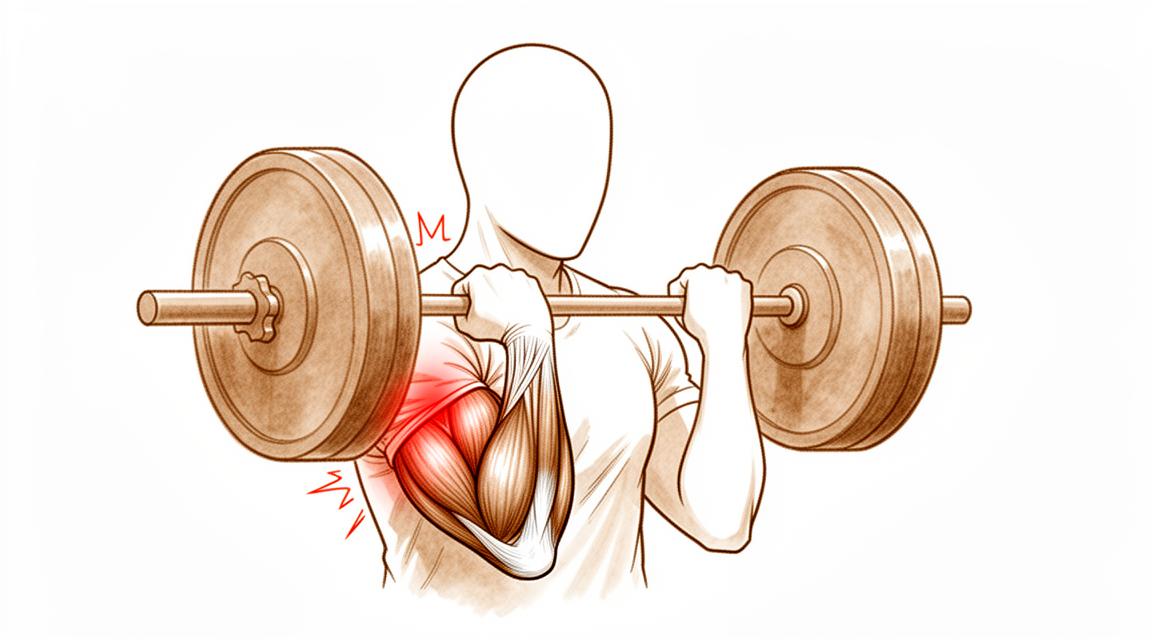
Những cảm giác bạn sẽ trải qua
Tình trạng đứt gân cơ nhị đầu đoạn xa xảy ra trong một khoảnh khắc, chứ không phải diễn ra từ từ qua nhiều tháng. Nó thường do một lực đột ngột, bất ngờ kéo duỗi thẳng cánh tay đang gập ở góc 90 độ, chẳng hạn như khi bạn đỡ lấy một vật nặng đang rơi xuống hoặc nắm chặt một vật trong khi cánh tay bị kéo thẳng ra. Nhiều người cảm thấy hoặc nghe thấy tiếng “bụp” ở phía trước khuỷu tay khi chấn thương xảy ra. Gân thường bị giật đứt khỏi điểm neo của nó trên một trong hai xương cẳng tay. Bạn có thể nhận thấy hình dạng của cơ thay đổi, vì cơ bị co rút lên trên cánh tay và dồn lại gần giữa cánh tay.
Ngay sau đó, phía trước khuỷu tay của bạn có khả năng sẽ bị đau và sưng. Bầm tím là phổ biến và có thể xuất hiện quanh khuỷu tay và cẳng tay trong một hai ngày sau đó. Việc gập và xoay cánh tay gây đau, vì vậy bạn có thể thấy mình tránh nhấc ấm siêu tốc, vặn tay nắm cửa hoặc nắm chặt vô lăng. Xoay lòng bàn tay ngửa lên khi có lực cản, như khi vặn tuốc-nơ-vít, thường là động tác khó nhất. Một số người vẫn có thể gập khuỷu tay vì có các cơ khác hỗ trợ động tác đó, điều này có thể khiến chấn thương có vẻ nhẹ hơn so với thực tế.
Trong những ngày và tuần đầu, cơn đau thường nặng hơn khi cử động và có thể gây đau nhức vào ban đêm. Cơn đau dịu dần khi cơ thể bắt đầu lành lại quanh phần gân bị đứt. Tình trạng sưng và bầm tím giảm dần trong vài tuần, nhưng tình trạng mất sức mạnh không tự phục hồi, vì gân đã bong ra khỏi xương và không thể tự gắn lại đúng vị trí của nó.
Một vài dấu hiệu cảnh báo cần được xử lý nhanh chóng. Hãy đến khoa cấp cứu ngay trong ngày nếu bàn tay hoặc các ngón tay của bạn trở nên nhợt nhạt, lạnh, trắng bệch hoặc tím tái, hoặc nếu bạn đột ngột mất cảm giác hay mất khả năng cử động ở bàn tay sau chấn thương. Hãy đến gặp bác sĩ đa khoa hoặc yêu cầu được chuyên gia thăm khám nếu cơn đau không thuyên giảm, ngày càng nặng hơn qua nhiều tuần, hoặc khiến bạn thức giấc vào ban đêm.
Chuyện gì đang xảy ra thực sự
Cơ nhị đầu chạy dọc phía trước cánh tay và chuyển thành một sợi dây chắc, tức là gân, ngay phía trên khuỷu tay. Gân đó neo vào một chỗ lồi nhỏ trên một trong hai xương cẳng tay, là xương quay. Nhiệm vụ của nó là xoay cẳng tay để lòng bàn tay ngửa lên trên, và hỗ trợ gập khuỷu tay.
Khi gân bị đứt, nó bong ra khỏi chỗ lồi đó trên xương và co rút lên phía trên cánh tay. Cơ vẫn khỏe mạnh, nhưng không còn nối với xương mà nó làm chuyển động, nên lực kéo của cơ không còn tác dụng. Động tác xoay lòng bàn tay ngửa lên bị ảnh hưởng nhiều nhất, vì không có cơ nào khác có thể đảm nhận nhiệm vụ đó. Động tác gập khuỷu tay thường phục hồi tốt hơn, vì có một cơ thứ hai nằm bên dưới cơ nhị đầu hỗ trợ động tác này.
Hãy hình dung một sợi dây thừng được neo vào một chiếc tời. Nếu sợi dây bị đứt khỏi trống tời, động cơ tời vẫn chạy, nhưng không có gì quay cả. Sợi dây không tự trôi về và buộc lại. Nó cần được gắn lại.
Nếu để nguyên, đầu gân bị đứt không tự liền trở lại vào xương ở đúng vị trí của nó. Thay vào đó, khoảng trống được lấp đầy bằng mô sẹo, giúp giữ các cấu trúc lại với nhau nhưng không phục hồi được sức mạnh. Phẫu thuật gắn đầu gân trở lại điểm neo ban đầu để chỗ nối có thể lành lại chắc chắn.
Chấn thương này thường xảy ra ở cánh tay thuận của nam giới trong độ tuổi từ bốn mươi đến sáu mươi, phần lớn trong một lần gắng sức nặng khi cánh tay đang gập và lòng bàn tay ngửa lên, chẳng hạn như khi nâng tạ. Gân hầu như luôn bị giật đứt hẳn khỏi xương chứ không bị tách dọc theo chiều dài của nó, mặc dù cũng có thể xảy ra rách một phần, khi vẫn còn một phần gân bám vào xương.
Những giải pháp chúng tôi có thể áp dụng
Bác sĩ Kieran Hirpara – bác sĩ phẫu thuật chi trên tại Bệnh viện Mater Private Rockhampton – sẽ lựa chọn phương pháp điều trị phù hợp với chấn thương cụ thể của bạn. Một số trường hợp rách gân cơ nhị đầu đoạn xa có thể được điều trị mà không cần phẫu thuật, trong khi những trường hợp khác cần phẫu thuật sớm sau khi chấn thương xảy ra, vì vậy việc được thăm khám kịp thời là rất quan trọng. Thông thường, bệnh nhân được bác sĩ đa khoa giới thiệu đến phòng khám chúng tôi; nếu nhà vật lý trị liệu khuyên bạn nên đến gặp chúng tôi, bạn vẫn cần có giấy giới thiệu từ bác sĩ đa khoa để được hưởng mức hoàn trả chi phí từ Medicare. Tại phòng khám, chúng tôi sẽ hỏi về tiền sử bệnh, khám cả hai khuỷu tay và chỉ định chụp chiếu khi điều đó có ích. Chụp X-quang thường là bước kiểm tra đầu tiên, và chụp MRI có thể xác định gân có bị đứt hay không và mức độ nặng ra sao.
Phẫu thuật được khuyến nghị ngay từ đầu đối với trường hợp đứt hoàn toàn, khi gân đã bong ra hoàn toàn khỏi xương. Đây thường là lựa chọn đúng đắn cho những người mà công việc hoặc môn thể thao đòi hỏi động tác xoay cẳng tay mạnh, chẳng hạn như người lao động chân tay và vận động viên. Ca phẫu thuật gắn gân trở lại điểm neo ban đầu để sức mạnh và chức năng có thể phục hồi. Khâu nối bằng một nút cố định nhỏ giúp phục hồi sức mạnh và chức năng gần như bình thường, và phẫu thuật có tỷ lệ biến chứng nghiêm trọng thấp. Hầu hết các vấn đề nhỏ sau khâu nối là những vùng bị tê sẽ tự hồi phục theo thời gian. Việc khâu nối đạt hiệu quả tốt nhất khi được thực hiện sớm sau chấn thương, lý tưởng nhất là trong vòng khoảng 3 tuần, vì gân co rút lên phía trên cánh tay và vị trí ban đầu của nó bị sẹo hóa. Đôi khi vẫn có thể khâu nối muộn, nhưng việc này khó khăn hơn nhiều và có thể cần đến mảnh ghép gân để phục hồi chiều dài.
Đối với trường hợp rách một phần, khi vẫn còn một phần gân bám vào xương, điều trị không phẫu thuật đôi khi là một lựa chọn hợp lý. Phương pháp này bao gồm cho cánh tay nghỉ ngơi trong đai treo hoặc nẹp, bảo vệ chỗ rách trong khi nó lành lại, và lấy lại cử động theo từng giai đoạn cùng với chuyên viên trị liệu bàn tay của bạn. Lựa chọn này đánh đổi một phần sức mạnh để tránh phẫu thuật, và sự đánh đổi đó là một quyết định thực sự do bạn và chúng tôi cùng đưa ra. Nếu tình trạng yếu khi xoay lòng bàn tay ngửa lên là không thể chấp nhận được đối với công việc hoặc cuộc sống hằng ngày của bạn, phẫu thuật có thể phù hợp với bạn hơn.
Dù bạn chọn hướng điều trị nào, những tuần đầu đều có chung những điều cơ bản: kiểm soát cơn đau, bảo vệ cánh tay trong khi nó lành lại, và trị liệu bàn tay vào đúng giai đoạn. Sau phẫu thuật, chuyên viên trị liệu bàn tay sẽ hướng dẫn quá trình hồi phục của bạn và làm bất kỳ loại nẹp nào bạn cần; việc phục hồi chức năng với chuyên viên Ruby Doolan tại Extend Rehabilitation bắt đầu ngay sau ca phẫu thuật, và việc cử động nhẹ nhàng từ sớm được dung nạp tốt.
Những điều có thể xảy ra
Việc lành lại sau khi đứt gân cơ nhị đầu đoạn xa là một quá trình tiến triển chậm, không phải một giải pháp nhanh chóng. Gân cần thời gian để liền trở lại vào xương, và sức mạnh phục hồi dần dần trong nhiều tháng chứ không phải trong vài ngày. Trong những tuần đầu, trọng tâm là bảo vệ cánh tay trong khi nó lành lại, với cơn đau và tình trạng sưng giảm dần giống như trong những ngày đầu sau chấn thương.
Nếu bạn được phẫu thuật, phần lớn mọi người trở lại làm việc mà không cần thay đổi nhiệm vụ, và thời gian trung bình để trở lại làm việc là khoảng 14 tuần. Việc trở lại chơi thể thao mất nhiều thời gian hơn. Khoảng 95% vận động viên trở lại chơi thể thao, và 82% đạt lại mức độ thi đấu như trước khi bị chấn thương, sau khoảng 40 tuần tùy theo môn thể thao. Sức mạnh khi gập và xoay cánh tay có thể phục hồi đến mức gần bình thường. Một số người nhận thấy có một chút khác biệt so với cánh tay trước khi bị chấn thương, đặc biệt khi xoay lặp đi lặp lại.
Nếu tình trạng rách của bạn được điều trị không phẫu thuật, cánh tay sẽ được cho nghỉ ngơi trong đai treo hoặc nẹp trong khi lành lại, và bạn sẽ lấy lại cử động theo từng giai đoạn cùng với chuyên viên trị liệu bàn tay. Hướng điều trị này để lại một mức yếu lâu dài khi xoay lòng bàn tay ngửa lên, đó chính là sự đánh đổi đã được đề cập ở phần trước của trang này.
Hầu hết mọi người hồi phục tốt, nhưng bạn cũng nên biết một cách trung thực những gì có thể xảy ra không như mong muốn. Các rủi ro chính sau khâu nối là tổn thương thần kinh, thường gặp nhất là một vùng bị tê sẽ tự hồi phục theo thời gian, cứng khớp khuỷu tay, và gân đã khâu bị rách lại. Khả năng gân đã khâu bị rách lại thấp, ở mức 1,5%, và khi xảy ra thì thường là trong vòng 3 tuần sau phẫu thuật. Đôi khi xương mới có thể hình thành bắc ngang cẳng tay và hạn chế động tác xoay, mặc dù sức mạnh vẫn có thể được duy trì mà không có sự khác biệt đo được khi điều này xảy ra.
Một vài dấu hiệu cần được xử lý nhanh chóng. Hãy đến khoa cấp cứu ngay trong ngày nếu bàn tay hoặc các ngón tay của bạn trở nên nhợt nhạt, lạnh, trắng bệch hoặc tím tái, hoặc nếu bạn đột ngột mất cảm giác hay mất khả năng cử động ở bàn tay sau chấn thương. Hãy đến gặp bác sĩ đa khoa hoặc yêu cầu được chuyên gia thăm khám nếu cơn đau hoặc tình trạng cứng khớp không thuyên giảm, ngày càng nặng hơn qua nhiều tuần, hoặc khiến bạn không thể sử dụng cánh tay.
Khi nào nên gặp bác sĩ
Hãy tìm kiếm chăm sóc y tế khẩn cấp nếu cánh tay của bạn bị biến dạng rõ rệt, nếu có vết thương hở trên vùng bị chấn thương, hoặc nếu bạn hoàn toàn không thể sử dụng chi đó. Hãy đến khoa cấp cứu ngay trong ngày nếu bàn tay hoặc các ngón tay của bạn trở nên nhợt nhạt, lạnh, trắng bệch hoặc tím tái, hoặc nếu bạn đột ngột mất cảm giác hay mất khả năng cử động ở bàn tay sau chấn thương. Những dấu hiệu này đã được đề cập ở phần trước của trang này.
Đối với mọi trường hợp khác, hãy bắt đầu bằng việc đến gặp bác sĩ đa khoa. Hãy đến gặp bác sĩ đa khoa hoặc yêu cầu được chuyên gia thăm khám nếu cơn đau không thuyên giảm, hoặc nếu tình trạng sưng, khả năng cử động hay sức mạnh không cải thiện theo từng tuần khi quá trình lành tiến triển. Một tiếng “bụp” đột ngột ở phía trước khuỷu tay kèm theo sự thay đổi hình dạng của cơ cần được kiểm tra kịp thời, vì việc khâu nối đạt hiệu quả tốt nhất trong vòng khoảng 3 tuần sau chấn thương.
Phân tích chi tiết hơn
Advanced reading: the deeper science (optional)
Phần này đi sâu hơn mức cần thiết để bạn có thể tự đưa ra quyết định điều trị. Chấn thương đứt gân cơ nhị đầu đoạn xa xứng đáng được đọc kỹ vì đây là một trong số ít các chấn thương trên trang web này mà phẫu thuật thực sự giúp phục hồi những chức năng mà việc chữa lành tự nhiên không thể đạt được; điều này khiến sự cân nhắc giữa các phương án điều trị trở nên rất cụ thể, và các số liệu về biến chứng cũng trở nên hết sức có ý nghĩa.
Trong trường hợp này, phẫu thuật thực sự làm thay đổi chức năng
Hầu hết các so sánh trên trang web này đều cho kết quả “không có sự khác biệt đáng kể”. Trường hợp này thì không vậy. Kết quả tổng hợp từ 2.481 bệnh nhân cho thấy phương pháp điều trị phẫu thuật mang lại sức mạnh và sức bền của khuỷu tay, cẳng tay tốt hơn, đồng thời các chỉ số DASH và Mayo Elbow Performance cũng cao hơn so với phương pháp điều trị không phẫu thuật [1].
Lý do nằm ở yếu tố giải phẫu chứ không phải thống kê. Cơ nhị đầu đoạn xa là cơ ngửa chính của cẳng tay, tức là cơ xoay lòng bàn tay ngửa lên trên khi có lực cản. Khi gân cơ này tách ra khỏi xương quay, nó sẽ co rút lên phía trên cánh tay; lúc đó cơ không còn khả năng tạo ra chuyển động xoay đó nữa, dù các mô khác xung quanh có lành lại đi nữa. Động tác gập khuỷu tay phần nào được cơ cánh tay thay thế, nên khả năng gập khuỷu tay vẫn phục hồi khá tốt; tuy nhiên không có cơ nào tương tự có thể thay thế chức năng ngửa cẳng tay.
Chính vì vậy mà sự suy giảm chức năng thể hiện rõ nhất ở khả năng sức bền chứ không phải ở một lần vận động tối đa duy nhất. Những hoạt động đòi hỏi phải xoay cẳng tay liên tục – như vặn vít, xoay tay nắm cửa, hoặc cầm vô lăng trong suốt một chuyến đi dài – mới là nơi người bệnh cảm nhận rõ sự khác biệt.
Tỷ lệ biến chứng là nửa còn lại của quyết định
Một ca phẫu thuật có khả năng phục hồi sức mạnh một cách đáng tin cậy vẫn là một ca phẫu thuật; ca phẫu thuật này cũng có những đặc điểm biến chứng đã được xác định rõ. Trong nghiên cứu quy mô lớn nhất, bao gồm 3.091 bệnh nhân, tỷ lệ biến chứng lớn là 4,6% [2].
Hầu hết các biến chứng đều nhẹ và chỉ xảy ra tạm thời; tình trạng tê ở mặt sau cẳng tay do tác động lên một dây thần kinh cảm giác nhỏ là biến chứng phổ biến nhất và thường tự hồi phục. Những biến chứng lớn mới là yếu tố định hình kỹ thuật phẫu thuật: tổn thương thần kinh vĩnh viễn, hiện tượng tạo xương dị vị (xương mới hình thành bắc ngang cẳng tay gây hạn chế động tác xoay), và tình trạng tái rách.
Hai đường mổ, và sự đánh đổi là có thật
Việc phẫu thuật có thể được thực hiện qua một đường rạch duy nhất ở phía trước khuỷu tay, hoặc qua hai đường rạch nhỏ hơn ở phía trước và phía sau. Cả hai phương pháp đều tiếp cận được cùng một xương nhưng từ các hướng khác nhau; mỗi phương pháp lại giúp tránh được một loại rủi ro riêng.
Trên 2.622 bệnh nhân, không có sự khác biệt đáng kể nào về các chỉ số chức năng. Phương pháp rạch một đường cho biên độ gập khuỷu và sấp cẳng tay lớn hơn, đồng thời giảm nguy cơ tạo xương dị vị và phải phẫu thuật lại; ngược lại, phương pháp rạch hai đường lại có lợi thế ở những khía cạnh khác [3]. Một phân tích tổng hợp năm 2025 trên 2.833 bệnh nhân cũng cho kết quả tương tự: phương pháp rạch một đường liên quan đến chức năng khách quan tốt hơn và ít biến chứng cấu trúc hơn; phương pháp rạch hai đường thì giảm nguy cơ tổn thương một số dây thần kinh cảm giác [4].
Nhìn chung, việc lựa chọn phương pháp phẫu thuật là sự cân nhắc giữa việc bảo vệ dây thần kinh ở phía trước hay bảo vệ xương ở phía sau. Cả hai phương pháp đều hợp lý; các tác giả của cả hai nghiên cứu đều kêu gọi cần có thêm các thử nghiệm ngẫu nhiên có chất lượng cao hơn trước khi có thể khẳng định phương pháp nào là tối ưu.
Tại sao yếu tố thời gian lại quan trọng hơn so với các trường hợp khác
Do gân có xu hướng co lại và vùng mà nó chiếm giữ bị sẹo hóa, việc trì hoãn điều trị sẽ khiến việc nối lại gân trở nên khó khăn hơn; khi việc khâu nối trực tiếp không còn khả thi, người ta buộc phải tiến hành tái tạo bằng mảnh ghép. Đây là lý do thực tiễn khiến các trường hợp đứt gân cơ nhị đầu cánh tay cần được điều trị gấp hơn so với hầu hết các chấn thương gân khác. Cũng vì vậy, khi đột ngột có tiếng bật kèm đau ở phía trước khuỷu tay, cùng với sự thay đổi rõ rệt về hình dạng cơ, cần phải được đánh giá ngay lập tức thay vì chỉ theo dõi trong một thời gian.
Việc điều trị không phẫu thuật vẫn là một lựa chọn hợp lý, đặc biệt đối với những người ít phải vận động mạnh hoặc không cần thực hiện động tác ngửa cẳng tay mạnh và lặp đi lặp lại. Đây là quyết định có chủ đích nhằm chấp nhận một mức suy giảm chức năng nhất định, chứ không phải là một phiên bản kém hơn của cùng một kết quả.
Tài liệu tham khảo
[1] Looney AM, Day J, Bodendorfer BM, Wang D, Fryar CM, Murphy JP, và cộng sự. Điều trị phẫu thuật so với điều trị không phẫu thuật các trường hợp đứt gân cơ nhị đầu cánh tay: một tổng quan có hệ thống và phân tích tổng hợp. J Shoulder Elbow Surg. 2022;31(4):e169-e189. https://doi.org/10.1016/j.jse.2021.12.001
[2] Amarasooriya M, Bain GI, Roper T, Bryant K, Iqbal K, Phadnis J. Các biến chứng sau phẫu thuật khâu nối gân cơ nhị đầu cánh tay: một tổng quan có hệ thống. Am J Sports Med. 2020;48(12):3103-11. https://doi.org/10.1177/0363546519899933
[3] Castioni D, Mercurio M, Fanelli D, Cosentino O, Gasparini G, Galasso O. Kỹ thuật mổ một vết rạch so với hai vết rạch trong điều trị đứt gân cơ nhị đầu cánh tay: một tổng quan có hệ thống và phân tích tổng hợp các nghiên cứu so sánh. Bone Joint J. 2020;102-B(12):1608-17. https://doi.org/10.1302/0301-620X.102B12.BJJ-2020-0822.R2
[4] Awad G, Boutros M, Hajj Youssef M, Elhassan B. So sánh kỹ thuật mổ một vết rạch và hai vết rạch trong phẫu thuật khâu nối gân cơ nhị đầu cánh tay: một tổng quan có hệ thống và phân tích tổng hợp. Shoulder Elbow. 2025. https://doi.org/10.1177/17585732251399838
Evidence & references
This is the clinical evidence summary written for health professionals. It is technical, and it lists the research this page was built from. You do not need to read it to understand your treatment or to make a decision about it.
Overview
- Distal biceps tendon injuries typically occur in middle-aged, higher-demand patients who often require surgical reconstruction to optimize outcome and performance [24].
- Surgical repair of distal biceps tendon ruptures has an overall low rate of serious complications regardless of approach or technique [8, 9, 11, 12].
- Distal biceps repair is associated with a 7.5% major complication rate and a 4.5% reoperation rate [7].
- A systematic review indicates a major complication rate of 4.6% after distal biceps repair [31].
- Patients should be counseled that 1 in 5 patients will have a minor complication and 1 in 20 patients will have a major complication after surgery on the distal biceps tendon [14].
- The overall frequency of reported complications is higher for single-incision distal biceps repair than for double-incision repair [1].
- Nerve injury is the most common complication following distal biceps tendon repair [38].
- The early complication rate following partial distal biceps tendon repair was 20.5% [23].
- Surgical treatment of chronic distal biceps injuries yields favorable objective and subjective outcomes [3].
- Although there may be a slightly higher immediate complication rate for chronic distal biceps ruptures, functional outcomes remain comparable with those seen in the patient population with acute distal biceps [6].
- Patients who underwent distal biceps reconstruction with a graft had similar failure rates, reoperation rates, and final range of motion compared to primary repair [18].
- Even in the setting of a distal biceps reconstruction with graft augmentation, patients can expect low complications and good functional results [10].
- Surgical repair of the distal biceps insertion reliably regains both supination and flexion strength in appropriate patients [55].
- Athletes sustaining distal biceps tendon rupture have a high postoperative return to sport rate, independently of selected surgical technique or rehabilitation program [50].
- Surgical management of distal biceps tears was a predictor of improved patient-reported outcomes only for patients with complete tears [16].
Anatomy & Pathophysiology
Anatomy
- The biceps brachii is the primary supinator and a secondary flexor of the elbow [52].
- The short head of the biceps muscle arises from the coracoid process of the scapula [52].
- The long head of the biceps originates from the supraglenoid tubercle of the scapula and the glenoid labrum [52].
- The long head merges with the short head to form the distal biceps tendon and its medial extension, the lacertus fibrosus [52].
- The distal biceps tendon rotates 90 degrees such that the medial side of the tendon attaches to the distal portion of the radial tuberosity [52].
- The distal biceps tendon is a paratenon-covered extrasynovial tendon with three zones of blood supply [120].
- Zone 1 of the distal biceps tendon blood supply receives vessels from the brachial artery via branches extending past the musculotendinous junction to supply the bulk of the tendon [120].
- Zone 3 of the distal biceps tendon blood supply receives contributions from the posterior interosseous recurrent artery and is limited to the tendon enthesis on the radial tuberosity [120].
- Zone 2 of the distal biceps tendon is covered in a significantly thinner paratenon and receives vessels from both Zone 1 and Zone 3 sources through its extratendinous paratenon cover [120].
- The junction among the three zones of blood supply in the distal biceps tendon may be a transition area where tendon repair mechanisms are limited [120].
- The narrow passage between the lateral ulnar border and the radial tuberosity decreases by roughly 50% in pronation as compared with supination [120].
- The brachialis tendon is an intramuscular tendon at the level of the antecubital fossa and cannot be hooked away from an underlying muscle belly [37].
- The normal lacertus fibrosus often remains intact even with biceps rupture and must be discriminated from the biceps tendon during examination [34].
Pathophysiology
- Distal biceps injuries frequently occur in middle-aged males after an eccentric load to the elbow in flexion [17].
- Distal biceps tendon ruptures typically occur in the dominant arm of males during the fifth to sixth decade of life [37].
- The incidence of distal biceps tendon ruptures is 1.2 per 100,000 persons per year [37].
- Distal biceps tendon ruptures are associated with a traumatic event causing a sudden, eccentric load to a flexed and supinated forearm [37].
- Common risk factors for distal biceps tendon rupture include anabolic steroid use, body building, and smoking [37].
- Distal biceps tendon ruptures were most commonly observed in weightlifting with a slightly flexed or isometrically extended elbow and forearm supination [98].
- In a series of competitive strength athletes, the most common strength sport activities leading to distal biceps tendon rupture were deadlifting (20%) and biceps curls (13%) [119].
- Outside of sporting activities, the most common mechanisms of injury for distal biceps tendon rupture were lifting (34%) or carrying (11%) a heavy object and falling onto the outstretched arm (13%) [119].
- A hypovascular zone near the tendon insertion on the tuberosity can limit repair mechanisms in this area [52].
- A 50% narrowing of the space available for the tendon between the radius and ulna occurs in pronation as opposed to supination [52].
- Preexisting inflammatory or degenerative changes involving the distal biceps tendon predispose to rupture from the radial tuberosity [120].
- The junction among the three zones of blood supply in the distal biceps tendon is more prone to attritional injury and rupture [120].
- Rupture of the distal insertion of the biceps tendon necessarily completely eliminates the function of the muscle [52].
- Distal biceps tendon rupture has been found to result in a 30–50% decrease in supination endurance and strength [52].
- Distal biceps tendon rupture has been found to result in an approximate 20% decrease in flexion strength [52].
- Partial distal biceps tendon tears encompass a spectrum of disease from tendinopathic micro-tears to near-full-thickness rupture from the radial tuberosity [2].
- The mechanism of full-thickness distal biceps tendon tears is well reported with a defined episode of injury, deformity, pain, and weakness [2].
- Partial distal biceps tendon tears may have a variable presentation with either an insidious or acute traumatic history, pain, mechanical symptoms, and subtle examination findings [2].
- The condition of partial distal biceps tendon tears may remain undiagnosed or mismanaged, leading to a delay in treatment [2].
- The insertion site of the distal biceps tendon on the radial tuberosity undergoes degenerative changes that begin with partial tearing of the tendon [40].
- Degenerative changes at the distal biceps insertion can be painful but also clearly can be asymptomatic [40].
- Patients with distal biceps ruptures often show signs of significant chronic degeneration with partial tearing before the acute rupture [40].
- Many patients with distal biceps ruptures deny having any symptoms referable to their distal biceps insertion before the acute event that caused them to present for treatment [40].
- Partial biceps tendon tears may result from an acute event or tearing in conjunction with chronic degeneration [40].
Classification
- Partial distal biceps tendon tears encompass a spectrum of disease ranging from tendinopathic micro-tears to near-full-thickness rupture from the radial tuberosity [2].
- Full-thickness distal biceps tendon tear patients tend to present acutely [2].
- Recommended management algorithms for partial distal biceps tendon tears typically focus on patient factors and a tear percentage of 50% as a guide for conservative treatment versus repair [2].
- The '50%-rule' on a 2-dimensional MRI measurement is likely an over-simplified parameter for a complex three-dimensional structure with known anatomical variants [2].
- Isolated short head ruptures are a rare and distinct form of distal biceps tear that present with consistent clinical findings that can aid in diagnosis [19].
- The incidence of women sustaining a distal biceps tendon tear is 3.2% [20].
- Partial tears are statistically more common than complete ruptures in women sustaining a distal biceps tendon tear [20].
- Injury to the distal biceps typically occurs in middle aged, higher demand patients who often require surgical reconstruction to optimize outcome and performance [24].
- Distal biceps tendon ruptures occur at a rate of 1.2 ruptures per 100,000 persons per year [47].
- Distal biceps tendon ruptures account for approximately 3% of all biceps tendon injuries [47].
- Distal biceps tendon ruptures remain a predominately male injury, possibly due to the larger cross-sectional area of biceps in men [47].
- Distal biceps tendon injuries are most likely traumatic events arising when sudden extension load is applied to a flexed, supinated arm [47].
- The aetiology of biceps tendon ruptures is most likely multifactorial, involving a variety of mechanical, degenerative and hypovascular factors [47].
- Seiler et al. discovered three vascular zones in the tendon and reported an approximately 2 cm zone of hypovascularity between the proximal and distal zones [47].
- A more than 50% decrease in the cross sectional area available for the tendon from full supination to full pronation leads to an increased risk for rupture [47].
- Kannus and colleagues reported degenerative tendinopathy in ruptured tendons, based on histopathologic findings [47].
- Smokers have a 7.5 times higher risk of a total rupture compared with non smokers [47].
- Smoking along with anabolic steroids may be related to tendon degeneration and rupture [47].
- There was a 7-fold increase in the incidence of distal biceps tendon rupture surgery in Finnish men during 1997 to 2016 [25].
- There was a 28-fold increase in the incidence of distal biceps tendon rupture surgery in Swedish men during 1997 to 2016 [25].
Clinical Presentation
Epidemiology and Risk Factors
- Distal biceps tendon ruptures typically occur in the dominant arm of males during the fifth to sixth decade of life at a rate of 1.2 per 100,000 persons per year [37].
- The vast majority of complete distal biceps tendon ruptures occurs in men between 40 and 60 years of age [46].
- The dominant limb is involved in 52% of complete distal biceps tendon rupture cases [46].
- An 8% cumulative incidence of bilateral biceps tendon ruptures has been reported [46].
- The incidence of women sustaining a distal biceps tendon tear is 3.2%, with partial tears being statistically more common than complete ruptures in women [20].
- In women, distal biceps tendon ruptures are described as having a more gradual onset of symptoms and a higher incidence of partial tears [46].
- There was a 7-fold increase in the incidence of distal biceps tendon rupture surgery in Finnish men between 1997 and 2016 [25].
- There was a 28-fold increase in the incidence of distal biceps tendon rupture surgery in Swedish men between 1997 and 2016 [25].
History and Mechanism
- Patients with full-thickness distal biceps tendon tears tend to present acutely [2].
- Distal biceps tendon ruptures are associated with a traumatic event which causes a sudden, eccentric load to a flexed and supinated forearm [37].
- A patient typically relates a history of lifting an object or a forced extension of a flexed and loaded forearm [40].
- The patient may recall an audible pop over the anterior elbow [37].
- Patients with chronic and slowly degenerative partial tears often complain of nonspecific elbow pain that is worsened with daily activities [40].
Physical Examination Findings
- A patient with biceps pathologic conditions exhibits pain and weakness in flexion and supination [34].
- Ecchymoses in the antecubital fossa may be present in patients with biceps pathologic conditions [34].
- An abnormal muscle contour of the biceps may be observed in patients with biceps pathologic conditions [34].
- Inspection of the soft tissues tends to demonstrate swelling of the soft tissues in the antecubital fossa [37].
- Retraction of the muscle belly with a visible bulge, known as a reverse Popeye deformity, is a clinical finding supporting the diagnosis of distal biceps rupture [37].
- Weakness in flexion and supination is a clinical finding supporting the diagnosis of distal biceps rupture [37].
- Bruising is a clinical finding supporting the diagnosis of distal biceps rupture [37].
- If seen a few days after the injury episode, ecchymosis is commonly present over the elbow and proximal forearm [40].
- Patients often point out the asymmetry and the "Pop-eye" deformity in the biceps muscle belly [40].
- In partial tears, the biceps may still be palpable [40].
- Patients with chronic partial tears often point to the anterior middle aspect of the antecubital fossa but do not specifically point to the posterolateral aspect of the elbow or the area of the radial tuberosity [40].
- Pain elicited by deep palpation of the radial tuberosity from the posterolateral aspect while passively pronating the forearm is a good indication of tendinopathy involving the insertion of the distal biceps [40].
- Isolated short head ruptures present with consistent clinical findings that can aid in diagnosis [19].
Diagnostic Tests
- The hook test involves having the patient's elbow in 90° of flexion and full supination, then hooking a finger around the lateral edge of the distal biceps tendon as it spans the antecubital fossa [37].
- The hook test has proven 100% sensitivity and specificity for making a prompt diagnosis of distal biceps rupture [37].
- The hook test allows for the distinction between complete avulsion, which results in an abnormal hook test, and partial avulsion, which yields a painful hook test [37].
- O'Driscoll hook test sensitivity is not 100% but remains a useful clinical test to assess patients with suspected distal biceps tendon tears [81].
- A negative O'Driscoll hook test does not exclude rupture [81].
- The evidence-based diagnostic algorithm using the combination of the Flexion Initiation Test (FIT) and hook test demonstrates high accuracy for the diagnosis of both complete and high-grade partial distal biceps tendon tears [33].
- Missed injuries have been attributed to the examiner palpating an intact brachialis tendon, which is an intramuscular tendon at the level of the antecubital fossa and cannot be hooked away from an underlying muscle belly [37].
- Occasionally, some fibers or a fascial sleeve may remain intact, giving an appearance of an intact tendon [34].
- The examiner must discriminate between the normal lacertus fibrosus, which often remains intact even with biceps rupture, and the biceps tendon [34].
Imaging
- Plain film radiographs are most commonly normal and do not show pathologic changes in distal biceps ruptures [34].
- Biceps ruptures typically do not involve bony ruptures, and minimal changes are seen on standard radiographs of the elbow [34].
- MRI may show rupture but is unnecessary in most cases and occasionally may be read as falsely negative [34].
- Some authors suggest a 100% correlation between MRI findings and intraoperative findings for distal biceps ruptures [34].
- MRI did not affect the operative plan in the setting of rupture of a previously repaired ruptured distal biceps tendon [34].
- MRI is useful to exclude alternative diagnoses and to evaluate the extent of suspected partial rupture [34].
- MRI is useful in cases where the history suggests a biceps rupture but the clinical examination is unclear [34].
- MRI tells the surgeon the expected location of the distal tendon end and whether it has retracted proximally [34].
- MRI findings suggestive of complete rupture include absence of the tendon insertion or a fluid-filled sheath [34].
- Partial ruptures on MRI are typically seen as high signal intensity, fluid within the tendon sheath, or thinning or thickening of the tendon distally [34].
- The FABS view (shoulder abducted over the head, elbow in 90 degrees of flexion, forearm in supination) has been suggested to improve visualization of the distal biceps insertion into the radial tuberosity [34].
- Ultrasound is a lower-cost diagnostic tool that is usually unnecessary but has been shown to be accurate in the diagnosis of complete or partial tears [34].
- Ultrasound findings suggestive of complete rupture include tendon absence, fluid, and mass in the antecubital fossa [34].
- Incomplete rupture on ultrasound may be represented by a focal hypoechogenic area or thinning of the tendon [34].
- Advanced imaging with MRI or ultrasonography is helpful in cases of partial avulsions as it can assess the biceps insertion [37].
- The finding that distal biceps MRI signal changes consistent with tendinopathy are common even in asymptomatic elbows reduces the probability that symptoms correlate with pathology on imaging [42].
- The prevalence of distal biceps tendon signal changes on MRI in asymptomatic patients is very low [43].
Investigations
Clinical Examination
- The hook test has proven 100% sensitivity and specificity for making a prompt diagnosis of distal biceps tendon rupture [37].
- Missed injuries have been attributed to the examiner palpating an intact brachialis tendon, which is an intramuscular tendon at the level of the antecubital fossa and cannot be hooked away from an underlying muscle belly as in the case of an intact distal biceps tendon [37].
- On clinical examination, a patient with biceps pathologic conditions exhibits pain and weakness in flexion and supination and sometimes ecchymoses in the antecubital fossa or an abnormal muscle contour of the biceps [34].
- With the elbow at 90 degrees of flexion, the examiner may ask the patient to rotate the pronated forearm into supination; normally, the examiner can hook the tip of his or her thumb around the biceps tendon in the cubital fossa, but with distal avulsion of the tendon, this may be impossible [34].
- Deep palpation of the radial tuberosity from the posterolateral aspect while passively pronating the forearm sometimes elicits pain, which is a very good indication of tendinopathy involving the insertion of the distal biceps [40].
Imaging
- Plain film radiographs should be obtained but are most commonly normal and do not show pathologic changes, as biceps ruptures typically do not involve bony ruptures [34].
- MRI may show rupture, but it is unnecessary in most cases and occasionally may be read as falsely negative [34].
- Some authors suggest a 100% correlation between MRI findings and intraoperative findings for distal biceps rupture [34].
- If obtained, the surgeon should view the MRI images themselves, as the radiologic interpretation is just an interpretation [34].
- In the setting of rupture of a previously repaired ruptured distal biceps tendon, MRI did not affect the operative plan [34].
- MRI may be useful to exclude alternative diagnoses and to evaluate the extent of suspected partial rupture [34].
- MRI may be useful in cases in which the history suggests a biceps rupture but the clinical examination is unclear [34].
- Positioning the prone patient with the shoulder abducted over the head and the elbow in 90 degrees of flexion and the forearm in supination (the FABS view) has been suggested to improve visualization of the distal biceps insertion into the radial tuberosity [34].
- Obtaining an MRI view of the elbow during flexion, abduction, and supination allows for optimal evaluation of the tendon along its long axis and minimizes error by reducing volume averaging [37].
Treatment
Non-Operative Management
- Nonoperative management of complete distal biceps tendon ruptures does not restore function to the elbow [45].
- Conservative treatment is a viable option for very low-demand patients who have concerns about problems connected to surgery [86].
- For partial distal biceps tears, nonoperative treatment is recommended initially if less than 50% of the tendon is involved [86].
- Patients with partial distal biceps tears should be treated nonoperatively for the first 3 to 6 months [87].
- Patients with partial distal biceps tears are encouraged to avoid heavy lifting and use the arm primarily for activities of daily living only [87].
- Strengthening exercises and physical therapy are unnecessary for patients with partial biceps tendon ruptures [87].
- In a cohort study, 82% of participants with partial distal biceps tears had failed non-surgical treatment [86].
- In a study by Bauer et al., 55.7% of patients who tried a nonoperative course for partial distal biceps tears ultimately underwent surgery [36].
- High-need patients, as defined by occupation, were more likely to report ideal recovery if they underwent surgery compared to those who did not [36].
- An MRI-diagnosed tear of greater than 50% was a predictor of needing surgery for partial distal biceps tears [36].
- A meta-analysis showed the superiority of surgical management over the nonoperative approach for distal biceps tendon detachment, with superior flexion and supination strength and better patient-reported outcomes [73].
- In two case reports of nonoperative management for distal biceps tendon rupture, flexion and supination strength returned to normal limits when compared with the opposite upper extremity [22].
Operative Management
- Surgical reinsertion of the biceps tendon to the radial tuberosity is considered the treatment of choice for most complete ruptures [112].
- Although there may be a slightly higher immediate complication rate for chronic distal biceps repairs, functional outcomes remain comparable with those seen in the patient population with acute distal biceps [6].
- Patients undergoing distal biceps reconstruction with a graft had similar failure rates, reoperation rates, and final range of motion compared to primary repair [18].
- Patients can be consulted that direct repair in the acute setting is preferred; however, even in the setting of a distal biceps reconstruction with graft augmentation, they can expect low complications and good functional results [10].
- Distal biceps tendon repair surgery can be safely and successfully executed with either a single- or double-incision approach [48].
- Single anterior incision with suture anchor repair may be utilized for repair of ruptures of the distal biceps tendon with good clinical and functional outcomes and minimal loss of range of motion and strength [80].
- Bioabsorbable interference screw fixation of distal biceps ruptures through a single anterior incision is a safe and successful technique [15].
- Anatomic reattachment of the distal biceps tendon is a successful operative treatment option [29].
- In chronic biceps tendon rupture, anatomical reinsertion is the desired surgical approach due to a high unsatisfactory results rate of 40% in non-anatomical insertion [86].
- Morrey et al. suggest performing primary distal biceps tendon repairs in up to 90 degrees of flexion [86].
- Operative treatment for significant partial distal biceps tears that do not improve after 6 months of nonoperative treatment involves taking down the remaining fibers of the distal biceps and repair to the insertion site [87].
- Operative management for significant partial distal biceps tears has been found to be satisfactory with restoration of function and resolution of symptoms through a single posterior incision [87].
- Patients who present with a classic history of a “pop” in the arm with resisted motion and sudden onset of pain should be treated as having complete biceps tears regardless of MRI findings suggestive of “partial tear” [87].
- The average time to surgery for the operative group in a study of distal biceps tendon ruptures was 9 days, ranging from 3 days to 4 weeks [69].
Complications and Outcomes
- Complication rates after distal biceps repair are low [5].
- Distal biceps repair is associated with a 7.5% major complication rate and 4.5% reoperation rate [7].
- Workers' compensation patients who underwent distal biceps tendon repair took longer to return to work and had worse DASH scores than non-workers' compensation patients [56].
Complications
- The short-term clinical influence of biceps complications on shoulder outcome is very limited [4].
- Although there may be a slightly higher immediate complication rate, the functional outcomes remain comparable with those seen in the patient population with acute distal biceps [6].
- The study examined clinical and surgical outcomes for distal biceps tendon repairs in a large cohort, finding that anterior single incision techniques were used in the majority of cases with varying fixation methods [13].
- This is a safe and successful technique for the management of distal biceps tendon ruptures [15].
- Patients that underwent distal biceps reconstruction with a graft had similar failure rates, reoperation rates, and final range of motion compared to primary repair [18].
- Minor complications were common after distal biceps tendon repair; however, most were sensory nerve injuries that resolved with time [26].
- This is the largest analysis of complications after distal biceps repair, indicating a major complication rate of 4.6% [31].
- Complication rates after distal biceps tendon repair performed by newly trained surgeons were similar to those previously reported in large cohort studies, with nerve injury as the most common complication [38].
Complication Rates and Outcomes
Specific Complications and Risk Factors
- Timing significantly impacts surgical technique selection in distal biceps tendon ruptures, with direct repair favored for acute injuries and high flexion angle repair or allograft reconstruction for chronic cases [39].
Functional Recovery and Strength
- Distal biceps repair/reconstruction can restore near-normal flexion and supination strength [108].
Key Evidence
- [L1] The overall frequency of reported complications is higher for single-incision distal biceps repair than for double-incision repair. [1] (10.1177/2325967116668137)
- [L5] [2] (10.1177/17585732241245054)
- [L1] Surgical treatment of chronic distal biceps injuries yields favorable objective and subjective outcomes. [3] (10.1016/j.xrrt.2022.02.007)
- [L3] Nevertheless, the short-term clinical influence of biceps complications on shoulder outcome is very limited. [4] (10.1177/2325967121s00362)
- [L3] Complication rates after distal biceps repair are low. [5] (10.5397/cise.2021.00472)
- [L4] Although there may be a slightly higher immediate complication rate, the functional outcomes remain comparable with those seen in the patient population with acute distal biceps. [6] (10.1177/23259671211065772)
- [L3] Distal biceps repair is associated with a 7.5% major complication rate and 4.5% reoperation rate. [7] (10.1016/j.jse.2018.06.028)
- [L3] Surgical repair of distal biceps tendon ruptures has an overall low rate of serious complications regardless of approach or technique. [8] (10.1016/j.jse.2017.06.021)
- [L3] Surgical repair of distal biceps tendon ruptures has an overall low rate of serious complications regardless of approach or technique. [9] (10.1016/j.jse.2017.06.020)
- [L3] Patients can be consulted that direct repair in the acute setting is preferred; however, even in the setting of a distal biceps reconstruction with graft augmentation, they can expect low complications and good functional results. [10] (10.1016/j.jseint.2020.10.023)
- [L3] The surgical repair of distal biceps tendon ruptures has an overall low rate of serious complications, regardless of approach or technique. [11] (10.1177/0363546517720200)
- [L3] The surgical repair of distal biceps tendon ruptures has an overall low rate of serious complications, regardless of approach or technique. [12] (10.1016/j.arthro.2017.08.065)
- [L3] The study examined clinical and surgical outcomes for distal biceps tendon repairs in a large cohort, finding that anterior single incision techniques were used in the majority of cases with varying fixation methods. [13] (10.1016/j.jse.2016.12.053)
- [L4] Patients should be counseled that 1 in 5 patients will have a minor complication and 1 in 20 patients will have a major complication after surgery on the distal biceps tendon. [14] (10.1016/j.jse.2016.02.032)
- [Paper] This is a safe and successful technique for the management of distal biceps tendon ruptures. [15] (10.1007/s00402-009-0974-x)
- [L2] Surgical management of distal biceps tears was a predictor of improved patient-reported outcomes only for patients with complete tears. [16] (10.1016/j.jhsa.2025.12.027)
- [Paper] Distal biceps injuries frequently occur in middle-aged males after an eccentric load to the elbow in flexion. [17] (10.1016/j.injury.2025.112556)
- [L3] Patients that underwent distal biceps reconstruction with a graft had similar failure rates, reoperation rates, and final range of motion compared to primary repair. [18] (10.1016/j.jse.2020.01.062)
- [L4] Isolated short head ruptures are a rare and distinct form of distal biceps tear that present with consistent clinical findings that can aid in diagnosis. [19] (10.1016/j.jse.2020.04.038)
- [L4] The incidence of women sustaining a distal biceps tendon tear is 3.2%, with partial tears being statistically more common than complete ruptures. [20] (10.1016/j.jse.2014.02.006)
- [L5] In both patients, flexion and supination strength returned to normal limits when compared with the opposite upper extremity. [22] (10.1016/j.jht.2020.03.013)
- [L4] The early complication rate following partial distal biceps tendon repair was 20.5%. [23] (10.1016/j.jhsa.2025.04.012)
- [Paper] Injury to the distal biceps typically occurs in middle aged, higher demand patients who often require surgical reconstruction to optimize outcome and performance. [24] (10.1016/j.csm.2020.02.004)
- [L4] There was a 7-fold and a 28-fold increase in the incidence of distal biceps tendon rupture surgery in Finnish and Swedish men during 1997 to 2016. [25] (10.1016/j.jhsa.2020.07.024)
- [L4] Minor complications were common after distal biceps tendon repair; however, most were sensory nerve injuries that resolved with time. [26] (10.1016/j.jhsa.2012.06.022)
- [Case_report] Anatomic reattachment of the distal biceps tendon is a successful operative treatment option. [29] (10.1186/s12891-020-03304-3)
- [L2] This is the largest analysis of complications after distal biceps repair, indicating a major complication rate of 4.6%. [31] (10.1177/0363546519899933)
- [L4] The evidence-based diagnostic algorithm using the combination of the FIT and hook test demonstrates high accuracy for the diagnosis of both complete and high-grade partial distal biceps tendon tears. [33] (10.1016/j.asmr.2021.01.010)
- [L4] [36] (10.1016/j.jse.2017.12.010)
- [L4] Complication rates after distal biceps tendon repair performed by newly trained surgeons were similar to those previously reported in large cohort studies, with nerve injury as the most common complication. [38] (10.1016/j.jse.2022.09.014)
- [L3] Timing significantly impacts surgical technique selection in distal biceps tendon ruptures, with direct repair favored for acute injuries and high flexion angle repair or allograft reconstruction for chronic cases. [39] (10.1016/j.jse.2025.07.027)
- [L4] The finding that distal biceps MRI signal changes consistent with tendinopathy are common even in asymptomatic elbows reduces the probability that symptoms correlate with pathology on imaging. [42] (10.5397/cise.2023.00164)
- [L3] The prevalence of distal biceps tendon signal changes on MRI in asymptomatic patients is very low. [43] (10.1016/j.jhsa.2022.01.020)
- [L5] Nonoperative management does not restore function to the elbow. [45] (10.1007/s11552-013-9551-4)
- [L4] [46] (10.1302/2058-5241.6.200145)
- [Paper] [47] (10.1016/j.injury.2013.01.003)
- [L4] Distal biceps tendon repair surgery can be safely and successfully executed with either a single- or double-incision approach. [48] (10.1016/j.jse.2010.11.009)
- [L4] Athletes sustaining distal biceps tendon rupture have a high postoperative return to sport rate, independently of selected surgical technique or rehabilitation program. [50] (10.1016/j.jse.2022.02.027)
- [L4] [52] (10.1097/00130911-199812000-00005)
- [L4] Surgical repair of the distal biceps insertion reliably regains both supination and flexion strength in appropriate patients. [55] (10.5435/00124635-201003000-00003)
- [L3] WC patients who underwent distal biceps tendon repair took longer to return to work and had worse DASH scores than non-WC patients. [56] (10.1016/j.jse.2012.11.011)
- [L4] [69] (10.1016/s1058-2746(00)90059-4)
- [L1] The results of this meta-analysis showed the superiority of surgical management over the nonoperative approach for distal biceps tendon detachment, with superior flexion and supination strength and better patient-reported outcomes. [73] (10.1177/23259671211037311)
- [L4] Single anterior incision with suture anchor repair may be utilized for repair of ruptures of the distal biceps tendon with good clinical and functional outcomes and minimal loss of range of motion and strength. [80] (10.1097/bco.0000000000000529)
- [L3] O'Driscoll hook test sensitivity is not 100% but remains a useful clinical test to assess patients with suspected distal biceps tendon tears; a negative test does not exclude rupture. [81] (10.1177/1758573219847146)
- [L5] [86] (10.1530/eor-23-0035)
- [L4] Distal biceps tendon ruptures were most commonly observed in weightlifting with a slightly flexed or isometrically extended elbow and forearm supination. [98] (10.1016/j.jse.2023.02.061)
- [L5] Distal biceps repair/reconstruction can restore near-normal flexion and supination strength. [108] (10.1016/j.jhsa.2019.09.014)
- [Paper] Surgical reinsertion of the biceps tendon to the radial tuberosity is considered the treatment of choice for most complete ruptures. [112] (10.1097/bte.0000000000000011)
- [L4] [119] (10.1177/23259671251322700)
- [L5] [120] (10.1016/s1058-2746(05)80044-8)
References
[1] Complications of Distal Biceps Tendon Repair. Orthopaedic Journal of Sports Medicine. 2016. DOI: 10.1177/2325967116668137
[2] Current concepts in the aetiology, assessment and management of partial distal biceps tendon tears. Shoulder & Elbow. 2024. DOI: 10.1177/17585732241245054
[3] Outcomes and complications after different surgical techniques for the treatment of chronic distal biceps tendon ruptures: a systematic review and quantitative synthesis. JSES Reviews, Reports, and Techniques. 2022. DOI: 10.1016/j.xrrt.2022.02.007
[4] Biceps-related complications after tenotomy associated with arthroscopic rotator cuff repair: risk factors and clinical impact. Orthopaedic Journal of Sports Medicine. 2022. DOI: 10.1177/2325967121s00362
[5] Determining the incidence and risk factors for short-term complications following distal biceps tendon repair. Clinics in Shoulder and Elbow. 2022. DOI: 10.5397/cise.2021.00472
[6] Surgical Results of Chronic Distal Biceps Ruptures: A Systematic Review. Orthopaedic Journal of Sports Medicine. 2022. DOI: 10.1177/23259671211065772
[7] Major complications after distal biceps tendon repairs: retrospective cohort analysis of 970 cases. Journal of Shoulder and Elbow Surgery. 2018. DOI: 10.1016/j.jse.2018.06.028
[8] Analysis of 784 surgically treated distal biceps tendon ruptures. Journal of Shoulder and Elbow Surgery. 2017. DOI: 10.1016/j.jse.2017.06.021
[9] The distal biceps deficient arm, “the short arc syndrome”. Journal of Shoulder and Elbow Surgery. 2017. DOI: 10.1016/j.jse.2017.06.020
[10] Outcomes of chronic distal biceps reconstruction with tendon grafting: a matched comparison with primary repair. JSES International. 2021. DOI: 10.1016/j.jseint.2020.10.023
[11] Surgical Treatment of Distal Biceps Tendon Ruptures: An Analysis of Complications in 784 Surgical Repairs. The American Journal of Sports Medicine. 2017. DOI: 10.1177/0363546517720200
[12] Paper #76: All‐Endoscopic Distal Biceps Repair: Cadaveric Portal Safety Analysis and Technical Feasibility Using 2 Fixation Techniques. Arthroscopy. 2017. DOI: 10.1016/j.arthro.2017.08.065
[13] The distal biceps deficient arm, “the short arc syndrome”. Journal of Shoulder and Elbow Surgery. 2017. DOI: 10.1016/j.jse.2016.12.053
[14] Factors associated with adverse events after distal biceps tendon repair or reconstruction. Journal of Shoulder and Elbow Surgery. 2016. DOI: 10.1016/j.jse.2016.02.032
[15] Bioabsorbable interference screw fixation of distal biceps ruptures through a single anterior incision: a single-surgeon case series and review of the literature. Archives of Orthopaedic and Trauma Surgery. 2009. DOI: 10.1007/s00402-009-0974-x
[16] Thirty-Six Percent Conversion to Surgery Rate for Nonsurgical Treatment of Complete and Partial Distal Biceps Tears. The Journal of Hand Surgery. 2026. DOI: 10.1016/j.jhsa.2025.12.027
[17] Distal biceps injuries: an overview. Injury. 2025. DOI: 10.1016/j.injury.2025.112556
[18] Chronic Distal Biceps Repair with Tendon Grafting: A Matched Comparison to Primary Repair. Journal of Shoulder and Elbow Surgery. 2020. DOI: 10.1016/j.jse.2020.01.062
[19] Distal biceps short head tears: repair, reconstruction, and systematic review. Journal of Shoulder and Elbow Surgery. 2020. DOI: 10.1016/j.jse.2020.04.038
[20] Re-rupture rate of primarily repaired distal biceps tendon injuries. Journal of Shoulder and Elbow Surgery. 2014. DOI: 10.1016/j.jse.2014.02.006
[22] Distal biceps tendon rupture: Is surgery the best course of treatment? Two case reports. Journal of Hand Therapy. 2021. DOI: 10.1016/j.jht.2020.03.013
[23] Early Postoperative Complications Following Partial Distal Biceps Tendon Surgical Repair. The Journal of Hand Surgery. 2026. DOI: 10.1016/j.jhsa.2025.04.012
[24] Distal Biceps Injuries. Clinics in Sports Medicine. 2020. DOI: 10.1016/j.csm.2020.02.004
[25] Distal Biceps Tendon Rupture Surgery: Changing Incidence in Finnish and Swedish Men Between 1997 and 2016. The Journal of Hand Surgery. 2020. DOI: 10.1016/j.jhsa.2020.07.024
[26] Complications Following Distal Biceps Repair. The Journal of Hand Surgery. 2012. DOI: 10.1016/j.jhsa.2012.06.022
[29] No functional differences in anatomic reconstruction with one vs. two suture anchors after non-simultaneous bilateral distal biceps brachii tendon rupture: a case report and review of the literature. BMC Musculoskeletal Disorders. 2020. DOI: 10.1186/s12891-020-03304-3
[31] Complications After Distal Biceps Tendon Repair: A Systematic Review. The American Journal of Sports Medicine. 2020. DOI: 10.1177/0363546519899933
[33] The Flexion Initiation Test and an Evidence‐Based Diagnostic Algorithm for Distal Biceps Tendon Tears. Arthroscopy, Sports Medicine, and Rehabilitation. 2021. DOI: 10.1016/j.asmr.2021.01.010
[34] Green S Operative Hand Surgery. DISTAL BICEPS RUPTURE > Diagnosis.
[36] Is nonoperative management of partial distal biceps tears really successful?. Journal of Shoulder and Elbow Surgery. 2018. DOI: 10.1016/j.jse.2017.12.010
[37] Orthopaedic Knowledge Update 13 Ebook Without Multimedia. Tendinopathy, Elbow Ligament Reconstruction, and Throwing Injuries > Tendinopathy > Distal Biceps Injury.
[38] Trends and complications of distal biceps tendon repair among American Board of Orthopaedic Surgery part II oral examination candidates. Journal of Shoulder and Elbow Surgery. 2023. DOI: 10.1016/j.jse.2022.09.014
[39] Effect of time from injury to surgery on surgical technique and complication rate in distal biceps tendon repair. Journal of Shoulder and Elbow Surgery. 2026. DOI: 10.1016/j.jse.2025.07.027
[40] Green S Operative Hand Surgery. DISTAL BICEPS RUPTURE.
[42] Prevalence of incidental distal biceps signal changes on magnetic resonance imaging. Clinics in Shoulder and Elbow. 2023. DOI: 10.5397/cise.2023.00164
[43] Evaluation of MRI Signal Changes of the Distal Biceps Tendon in Asymptomatic Patients. The Journal of Hand Surgery. 2022. DOI: 10.1016/j.jhsa.2022.01.020
[45] Treatment of Chronic Biceps Tendon Ruptures. HAND. 2013. DOI: 10.1007/s11552-013-9551-4
[46] Acute complete and partial distal biceps tendon ruptures: what have we learned? A review. EFORT Open Reviews. 2021. DOI: 10.1302/2058-5241.6.200145
[47] Distal biceps and triceps ruptures. Injury. 2013. DOI: 10.1016/j.injury.2013.01.003
[48] Controversies in the surgical treatment of distal biceps tendon ruptures: single versus double-incision repairs. Journal of Shoulder and Elbow Surgery. 2011. DOI: 10.1016/j.jse.2010.11.009
[50] Systematic review of distal biceps tendon rupture in athletes: treatment and rehabilitation. Journal of Shoulder and Elbow Surgery. 2022. DOI: 10.1016/j.jse.2022.02.027
[52] Single Incision Repair of Distal Biceps Tendon Rupture. Techniques in Hand & Upper Extremity Surgery. 1998. DOI: 10.1097/00130911-199812000-00005
[55] Surgical Treatment of Distal Biceps Rupture. American Academy of Orthopaedic Surgeon. 2010. DOI: 10.5435/00124635-201003000-00003
[56] Outcomes after distal biceps repair in patients with workers' compensation claims. Journal of Shoulder and Elbow Surgery. 2013. DOI: 10.1016/j.jse.2012.11.011
[69] Repair of distal biceps brachii tendon ruptures. Journal of Shoulder and Elbow Surgery. 2000. DOI: 10.1016/s1058-2746(00)90059-4
[73] Operative Versus Nonoperative Management for Distal Biceps Brachii Tendon Lesions: A Systematic Review and Meta-analysis. Orthopaedic Journal of Sports Medicine. 2021. DOI: 10.1177/23259671211037311
[80] Clinical outcomes of single-incision suture anchor repair of distal biceps tendon rupture. Current Orthopaedic Practice. 2017. DOI: 10.1097/bco.0000000000000529
[81] Distal biceps hook test – Sensitivity in acute and chronic tears and ability to predict the need for graft reconstruction. Shoulder & Elbow. 2019. DOI: 10.1177/1758573219847146
[86] Distal biceps tendon rupture: a comprehensive overview. EFORT Open Reviews. 2023. DOI: 10.1530/eor-23-0035
[87] Green S Operative Hand Surgery. AUTHORS’ PREFERRED METHOD OF TREATMENT: PARTIAL BICEPS TEARS.
[98] Distal Biceps Tendon Ruptures Occur With The Almost Extended Elbow And Supinated Forearm – An Online Video Analytic Study. Journal of Shoulder and Elbow Surgery. 2023. DOI: 10.1016/j.jse.2023.02.061
[108] Distal Biceps Tendon Repair and Reconstruction. The Journal of Hand Surgery. 2020. DOI: 10.1016/j.jhsa.2019.09.014
[112] Repair and Rehabilitation of Distal Biceps Ruptures. Techniques in Shoulder & Elbow Surgery. 2014. DOI: 10.1097/bte.0000000000000011
[119] Distal Biceps Tendon Repair in Competitive Strength Athletes: A Retrospective Series of 183 Athletes. Orthopaedic Journal of Sports Medicine. 2025. DOI: 10.1177/23259671251322700
[120] The distal biceps tendon. Journal of Shoulder and Elbow Surgery. 1995. DOI: 10.1016/s1058-2746(05)80044-8