Patients › Elbow
Viêm màng hoạt dịch mỏm khuỷu
Olecranon bursitis — causes, symptoms, and when to seek urgent medical attention for infection.
Những triệu chứng bạn đang gặp phải
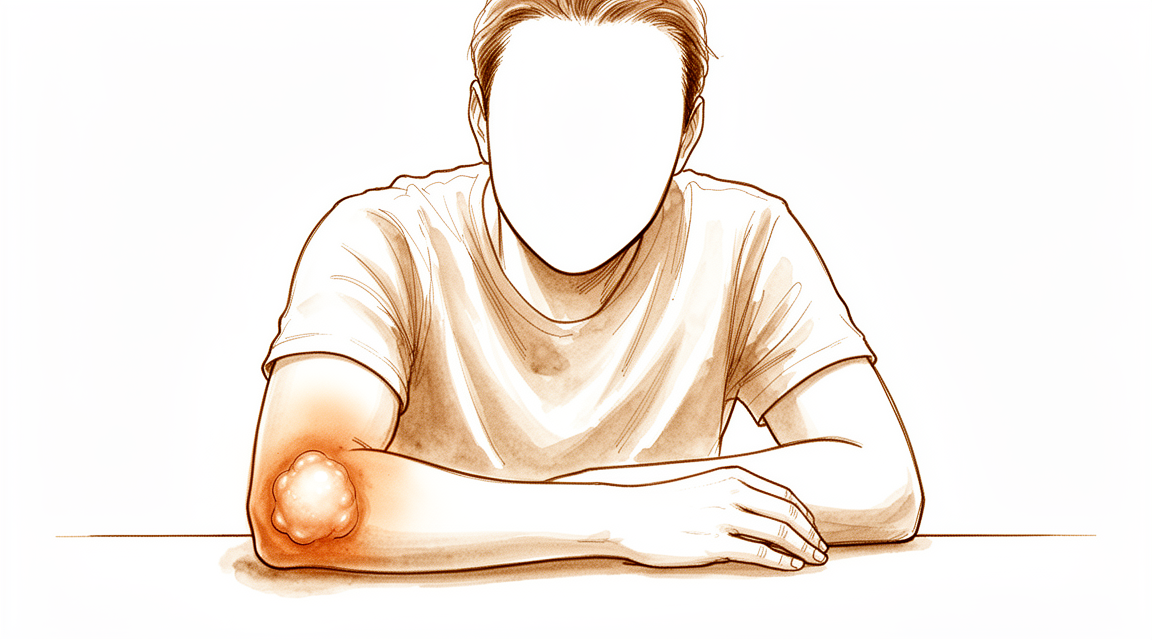
Viêm màng hoạt dịch mỏm khuỷu là tình trạng túi đệm nhỏ nằm ở đầu khuỷu tay bị sưng lên. Túi này, gọi là màng hoạt dịch, thường giúp da trượt nhẹ nhàng trên xương. Khi bị viêm, bạn sẽ thấy một khối mềm, đôi khi hơi đau ngay tại đầu khuỷu tay.
Thông thường, hiện tượng sưng là dấu hiệu đầu tiên bạn nhận thấy. Sưng có thể xuất hiện nhanh trong vòng một hoặc hai ngày, hoặc từ từ trong vài tuần. Việc dựa khuỷu tay xuống bề mặt nào đó sẽ làm tình trạng tệ hơn; vì vậy các hoạt động như làm việc văn phòng, tựa tay lên tay vịn ghế, hoặc ngủ với khuỷu tay gập lại đều có thể làm trầm trọng thêm tình trạng này. Nhiều người cảm thấy đau nhức vào ban đêm, nhất là khi nằm nghiêng về phía đó. Việc duỗi thẳng tay và giảm áp lực lên đầu khuỷu tay thường giúp giảm sưng.
Các hoạt động thường ngày đòi hỏi phải gập khuỷu tay chống lại sức cản hoặc tác động lực lên đầu khuỷu cũng trở nên khó khăn. Việc đứng dậy từ ghế thấp, xếp đồ vào máy rửa chén, mang túi đồ mua sắm bằng cánh tay, hoặc tựa khuỷu tay lên bàn khi đọc sách đều có thể gây khó chịu. Việc vươn tay lên cao cũng có thể làm căng vùng bị sưng.
Tình trạng sưng này không phải lúc nào cũng do đơn thuần là sự hao mòn cơ học. Đôi khi nó là hậu quả của nhiễm trùng ở màng hoạt dịch; tình trạng này thường khiến da vùng khuỷu tay đỏ lên, nóng và đau hơn. Đôi khi sưng là do sự tích tụ tinh thể trong khớp – tình trạng gọi là bệnh gút – đặc biệt nếu bạn đã từng bị các cơn đau tương tự trước đây hoặc cả khuỷu tay bên kia cũng bị ảnh hưởng. Sưng ở đây cũng có thể liên quan đến các bệnh viêm khớp như viêm khớp dạng thấp, vốn thường ảnh hưởng đồng thời đến nhiều khớp ở cả hai bên cơ thể.
Vì các nguyên nhân này có biểu hiện tương tự nhau, nên việc phân biệt chúng chỉ qua quan sát bên ngoài không phải lúc nào cũng dễ dàng. Nếu khuỷu tay của bạn nóng, đỏ hoặc đau dữ dội, hoặc nếu tình trạng sưng kéo dài nhiều tuần mà không thuyên giảm, bạn nên đi khám để được chẩn đoán chính xác và điều trị thích hợp.
Điều gì đang thực sự xảy ra
Ở đầu khớp khuỷu tay có một túi chứa dịch nhỏ gọi là màng hoạt dịch. Hãy hình dung nó như một lớp đệm mỏng, giống như túi mềm nằm giữa da và xương. Chức năng của nó là giúp da trượt nhẹ nhàng trên xương mỗi khi bạn gập hoặc duỗi tay.
Trong trường hợp viêm màng hoạt dịch khuỷu tay, lớp đệm này bị viêm và sưng lên do tích tụ thêm dịch. Tình trạng này thường xuất hiện sau những chấn thương nhỏ lặp đi lặp lại hoặc do áp lực liên tục lên vùng đầu khuỷu tay – ví dụ như việc tựa khuỷu tay lên các bề mặt cứng hàng ngày. Túi dịch này cũng có thể phình to dần do ma sát theo thời gian. Cái cục sưng mà bạn nhìn thấy và sờ thấy chính là túi màng hoạt dịch bị sưng; cảm giác đau nhức là do mô xung quanh bị viêm.
Đôi khi tình trạng sưng không chỉ đơn thuần là viêm. Túi dịch có thể bị nhiễm trùng; vì vậy màng hoạt dịch nhiễm trùng thường nóng, đỏ và đau hơn so với trường hợp chỉ bị viêm thông thường. Các tinh thể gây bệnh gút cũng có thể lắng đọng trong túi dịch; các bệnh lý viêm như viêm khớp dạng thấp cũng gây sưng và xuất hiện những cục cứng nhỏ tại vùng này. Do các nguyên nhân này có biểu hiện bên ngoài rất giống nhau, việc phân biệt chúng đòi hỏi phải có khám lâm sàng kỹ lưỡng.
Xương ở đầu khuỷu tay, gọi là mỏm khuỷu (olecranon), nằm ngay dưới da mà hầu như không có lớp đệm nào bảo vệ. Chính vị trí lộ thiên này khiến nó dễ bị va chạm, và khiến màng hoạt dịch phía trên phải chịu nhiều áp lực. Mỏm khuỷu cũng là điểm bám của gân cơ nằm phía sau cánh tay – cơ có chức năng duỗi khuỷu tay; do đó các vấn đề tại vùng nhỏ này có thể ảnh hưởng đến cảm giác và khả năng vận động của toàn bộ khớp khuỷu.
Những biện pháp chúng tôi có thể áp dụng
Bác sĩ Kieran Hirpara, bác sĩ phẫu thuật chi trên tại Bệnh viện tư nhân Mater Rockhampton, sẽ bắt đầu bằng các phương pháp ít xâm lấn nhất phù hợp với tình trạng của bạn. Thông thường, bệnh nhân được bác sĩ đa khoa giới thiệu đến phòng khám chúng tôi; nếu nhà vật lý trị liệu khuyên bạn nên gặp chúng tôi, bạn vẫn cần có giấy giới thiệu từ bác sĩ đa khoa để được hưởng mức hoàn trả từ Medicare. Trong lần khám đầu tiên, chúng tôi sẽ hỏi bệnh sử, khám khuỷu tay và chỉ định các phương pháp chẩn đoán hình ảnh như siêu âm hoặc chụp MRI nếu cần thiết. Chụp MRI sử dụng từ trường để tạo ra những hình ảnh chi tiết về các mô mềm; phương pháp này rất hữu ích trong việc xác định mức độ sưng của túi dịch và lượng dịch tích tụ bên trong. Các phương pháp chẩn đoán hình ảnh cũng giúp phát hiện những vấn đề khác ẩn sau tình trạng sưng, điều này rất quan trọng vì mỗi nguyên nhân gây bệnh lại cần phương pháp điều trị khác nhau.
Đối với hầu hết các trường hợp kéo dài lâu ngày, chúng tôi bắt đầu bằng các biện pháp hỗ trợ đơn giản. Các biện pháp này bao gồm chườm đá, băng ép bằng băng gạc hoặc ống băng, dùng đệm bảo vệ vùng khuỷu tay, đồng thời thay đổi những hoạt động gây kích ứng khu vực này. Việc giảm áp lực lên đỉnh khuỷu tay thường là thay đổi hữu ích nhất mà bạn có thể thực hiện. Vật lý trị liệu nhằm làm dịu tình trạng viêm và khôi phục khả năng vận động mà không làm tình trạng sưng trở nên tồi tệ hơn. Chúng tôi sẽ cho phương pháp này cơ hội thử nghiệm đầy đủ trước khi cân nhắc các biện pháp khác, vì các phương pháp điều trị không phẫu thuật thường mang lại hiệu quả tốt cho đa số bệnh nhân và tránh được những rủi ro liên quan đến tiêm thuốc hay phẫu thuật.
Nếu túi dịch bị nhiễm trùng, chúng tôi sẽ điều trị trực tiếp tình trạng nhiễm trùng đó. Trong hầu hết các trường hợp nhiễm trùng đơn giản, chỉ cần dùng thuốc là có thể khắc phục được mà không cần phải cắt bỏ túi dịch. Chúng tôi cũng theo dõi sát sao những bệnh nhân mắc viêm khớp dạng thấp, vì đôi khi khớp khuỷu tay cũng bị ảnh hưởng cùng lúc với túi dịch, và điều này ảnh hưởng đến phương pháp điều trị.
Phẫu thuật không phải là lựa chọn đầu tiên đối với tình trạng này. Hầu hết các bác sĩ phẫu thuật đều trì hoãn việc mổ sớm, vì vết thương ở vùng xương nổi bật này thường hồi phục chậm và đôi khi để lại đường rò nhỏ liên tục chảy dịch. Khi các phương pháp điều trị không phẫu thuật không mang lại cải thiện đáng kể và tình trạng sưng vẫn tái diễn, chúng tôi sẽ cân nhắc việc cắt bỏ túi dịch bị viêm – ca phẫu thuật này gọi là nạo túi dịch. Trong những trường hợp thích hợp, chúng tôi có thể thực hiện ca mổ qua vài vết rạch nhỏ bằng cách sử dụng camera siêu nhỏ; phương pháp này gọi là phẫu thuật nội soi, giúp tránh để lại vết mổ dài ngay trên vùng khuỷu tay nhạy cảm. Việc quyết định có nên phẫu thuật hay không là kết quả của sự thỏa thuận giữa chúng tôi và bạn, dựa trên mong muốn của bạn về mức độ phục hồi chức năng so với những rủi ro và đặc điểm của từng phương pháp điều trị.
Những điều có thể xảy ra
Đối với hầu hết mọi người, tình trạng sưng này sẽ giảm dần nhờ các biện pháp chăm sóc đơn giản. Việc giảm áp lực lên vùng khuỷu tay, bảo vệ khu vực này bằng đệm và hạn chế các hoạt động gây kích ứng sẽ giúp túi dịch dần bình thường trở lại. Đối với tình trạng này, phương pháp điều trị không phẫu thuật thường hiệu quả và an toàn hơn phẫu thuật; hầu hết mọi người không cần phải phẫu thuật. Nếu túi dịch bị nhiễm trùng nhưng tình trạng nhiễm trùng không phức tạp, chỉ cần dùng thuốc là thường đủ để điều trị; tình trạng sưng cũng có thể được kiểm soát mà không cần dẫn lưu dịch hay cắt bỏ túi dịch.
Nếu không thực hiện các biện pháp chăm sóc trên, hoặc nếu vùng khuỷu tay vẫn chịu áp lực liên tục, tình trạng sưng sẽ kéo dài hoặc tái phát. Một số người thấy tình trạng sưng kéo dài hàng tuần mà không thuyên giảm. Nếu khuỷu tay vẫn sưng trong thời gian dài, bạn nên đi khám lại, vì tình trạng sưng không hết đôi khi là dấu hiệu của nguyên nhân hiếm gặp cần điều trị riêng.
Khi các biện pháp chăm sóc không phẫu thuật đã được áp dụng đầy đủ mà tình trạng sưng vẫn tái diễn, việc phẫu thuật cắt bỏ túi dịch viêm mới được xem xét. Đây là quyết định không hề dễ dàng; thông thường chỉ được thực hiện sau khi các phương pháp đơn giản hơn thất bại. Đối với những trường hợp sưng dai dẳng này, hầu hết bệnh nhân đều cảm nhận được sự cải thiện rõ rệt về cảm giác và chức năng của khuỷu tay sau phẫu thuật. Việc cắt bỏ túi dịch qua vài vết rạch nhỏ kết hợp với việc sử dụng camera siêu nhỏ thường giúp giảm đau sau mổ và hồi phục nhanh; theo các báo cáo, không có trường hợp nào bị tái phát hay gặp biến chứng vết thương đòi hỏi phải mổ lại. Tuy nhiên, phẫu thuật cũng không đảm bảo 100% thành công: khoảng 11,5% bệnh nhân sau khi cắt bỏ túi dịch vẫn cần phải phẫu thuật thêm; nguy cơ sưng tái phát ngay cả sau phẫu thuật cũng vẫn tồn tại.
Quá trình hồi phục sau phẫu thuật thường diễn ra thuận lợi; tuy nhiên vết thương ở vùng xương khuỷu tay có thể lành chậm, đó là lý do các bác sĩ phẫu thuật thường tránh thực hiện ca mổ sớm. Hầu hết mọi người có thể sử dụng khuỷu tay bình thường trong sinh hoạt hàng ngày chỉ sau vài tuần, chứ không phải vài tháng. Bác sĩ phẫu thuật sẽ giải thích cụ thể về quá trình hồi phục nếu sau này bạn phải tiến hành phẫu thuật.
Khi nào nên đi khám bác sĩ
Hầu hết các trường hợp sưng phù ở vùng khuỷu tay sẽ thuyên giảm khi nghỉ ngơi và chăm sóc đúng cách. Hãy đến gặp bác sĩ đa khoa nếu khối sưng tiếp tục lớn dần, hoặc nếu sau vài tuần giảm áp lực lên khuỷu tay mà tình trạng sưng vẫn không cải thiện.
Một số nguyên nhân cần được xử lý ngay lập tức. Hãy đến phòng cấp cứu nếu da vùng khuỷu tay nóng, đỏ và đau dữ dội; điều này có thể là dấu hiệu túi dịch bị nhiễm trùng và cần được đánh giá ngay trong ngày. Bạn cũng nên nhờ bác sĩ chuyên khoa thăm khám nếu đã từng bị cơn gút, nếu khuỷu tay bên kia cũng bị sưng, hoặc nếu nhiều khớp ở cả hai bên cơ thể cũng bị ảnh hưởng; những dấu hiệu này cho thấy nguyên nhân có thể là gút hoặc bệnh viêm khớp như viêm khớp dạng thấp chứ không đơn thuần là tình trạng kích ứng thông thường. Việc phân biệt nhiễm trùng với cơn gút chỉ qua quan sát bên ngoài là rất khó, vì vậy đừng cố tự chẩn đoán cho mình.
Phân tích chi tiết hơn
Advanced reading: the deeper science (optional)
Phần này đi sâu hơn mức cần thiết để bạn có thể tự đưa ra quyết định điều trị. Viêm màng hoạt dịch khuỷu tay là một chủ đề đáng để tìm hiểu thêm; bởi có hai biện pháp thường được áp dụng một cách tự nhiên nhất là chọc hút dịch bằng kim tiêm và tiêm steroid vào vùng sưng, nhưng các bằng chứng y khoa lại cho thấy những phương pháp này không hiệu quả.
Việc chọc hút dịch lại có thể là nguyên nhân gây ra vấn đề
Trực giác cho chúng ta thấy: có dịch tích tụ, vậy thì hãy hút dịch ra. Tuy nhiên, dữ liệu nghiên cứu lại chỉ ra điều ngược lại. Trong một nghiên cứu so sánh các phương pháp điều trị viêm màng hoạt dịch khuỷu tay do nhiễm trùng mà không có biến chứng, việc điều trị theo kinh nghiệm mà không chọc hút dịch đã cho kết quả hiệu quả; không có bệnh nhân nào cần phải phẫu thuật cắt bỏ màng hoạt dịch. Ngược lại, trong nhóm được chọc hút dịch theo phương pháp truyền thống, 8 trên tổng số 11 bệnh nhân cuối cùng phải trải qua phẫu thuật cắt bỏ màng hoạt dịch [1].
Đây là sự khác biệt rõ rệt giữa các nhóm bệnh nhân, và cần được đánh giá một cách thận trọng. Tuy nhiên, cơ chế gây ra hiện tượng này không hề phức tạp. Màng hoạt dịch nằm ngay dưới lớp da mỏng, phía trên một điểm xương dễ bị va chạm khi chúng ta ngồi làm việc. Việc đâm kim qua lớp da này tạo ra một đường rò; đường rò này nằm ở vị trí chịu áp lực nên khó lành lại và có thể tiếp tục rò dịch ra ngoài.
Các tài liệu tổng quan y khoa đều thống nhất về xu hướng này. Dựa chủ yếu trên các bằng chứng cấp độ IV, phương pháp điều trị không phẫu thuật hiệu quả và an toàn hơn đáng kể so với phương pháp phẫu thuật [2].
Tiêm steroid có thể gây rủi ro mà không cải thiện kết quả điều trị
Điều này được nêu ra một cách khá thẳng thắn trong các tài liệu y khoa. Đối với trường hợp viêm màng hoạt dịch vô khuẩn, việc tiêm corticosteroid đi kèm nhiều rủi ro đáng kể mà không giúp cải thiện kết quả điều trị [2].
Những rủi ro này phụ thuộc vào vị trí tiêm: teo da và mất sắc tố da tại vùng có xương nhô ra dưới da; đồng thời có nguy cơ gây nhiễm trùng tại những vùng khó làm sạch. Ở các vị trí khác trên chi trên, việc tiêm steroid vẫn là một biện pháp hợp lý khi các phương pháp đơn giản hơn không mang lại hiệu quả. Tuy nhiên, đối với trường hợp này, các bằng chứng y khoa không ủng hộ việc tiêm steroid; việc hiểu rõ sự khác biệt này là rất quan trọng nếu có chỉ định tiêm.
Phẫu thuật chỉ nên là giải pháp cuối cùng, và có tỷ lệ thất bại có thể đo lường được
Ngay cả khi tiến hành cắt bỏ màng hoạt dịch, kết quả cũng không luôn khả quan. Tỷ lệ phải phẫu thuật lại sau khi cắt bỏ màng hoạt dịch là 11,5%. Tình trạng này xảy ra thường hơn ở những bệnh nhân mắc viêm khớp dạng thấp, tiểu đường, có tiền sử viêm màng hoạt dịch ở bất kỳ khớp khuỷu nào, và ở phụ nữ [3].
Các yếu tố nguy cơ này cho thấy những trường hợp mà màng hoạt dịch có khả năng tái hình thành: đó là khi có yếu tố gây viêm hoặc rối loạn chuyển hóa mà phẫu thuật không thể loại bỏ, hoặc khi mô của bệnh nhân có xu hướng tạo ra vấn đề này. Đối với các ca tái phát, phương pháp tiêm doxycycline vào trong màng hoạt dịch nhằm gây sẹo và làm kín khoang màng hoạt dịch thay vì cắt bỏ nó đã được đề xuất như một giải pháp thay thế; phương pháp này đã được áp dụng cho 45 khớp khuỷu trong một nghiên cứu [4].
Điều thực sự giúp chứng bệnh thuyên giảm
Câu trả lời không mấy hấp dẫn là việc bảo vệ vùng bị tổn thương và kiên trì chờ đợi. Do túi thanh dịch bị kích thích do áp lực lên vùng khuỷu tay, phương pháp điều trị hiệu quả nhất là loại bỏ nguồn áp lực đó: sử dụng đệm lót và thay đổi thói quen tựa khuỷu tay xuống mặt phẳng, và phải thực hiện điều này trong thời gian dài hơn mức cần thiết. Hầu hết các trường hợp đều khỏi bệnh [5]; các biện pháp can thiệp nêu trên chủ yếu nhằm rút ngắn quá trình hồi phục vốn vẫn sẽ diễn ra tự nhiên. Đây cũng là lý do vì sao những can thiệp có kèm theo rủi ro riêng phải đáp ứng những tiêu chuẩn rất khắt khe mới được áp dụng.
Tài liệu tham khảo
[1] Deal JB, Vaslow AS, Bickley RJ, Verwiebe EG, Ryan PM. Điều trị thực nghiệm viêm màng hoạt dịch khuỷu tay nhiễm trùng không có biến chứng mà không cần chọc hút. J Hand Surg Am. 2020;45(1):20-5. https://doi.org/10.1016/j.jhsa.2019.06.012
[2] Sayegh ET, Strauch RJ. Điều trị viêm màng hoạt dịch khuỷu tay: một tổng quan có hệ thống. Arch Orthop Trauma Surg. 2014;134(11):1517-36. https://doi.org/10.1007/s00402-014-2088-3
[3] Germawi L, Westenberg RF, Wang F, Schep NW, Chen NC, Eberlin KR. Các yếu tố liên quan đến việc phải phẫu thuật lại do viêm màng hoạt dịch khuỷu tay sau khi cắt bỏ màng hoạt dịch. J Shoulder Elbow Surg. 2021;30(5):1135-41. https://doi.org/10.1016/j.jse.2020.09.033
[4] McDermott D, Wakefield D, Kowalsky M, Sethi P, Vitale MA, Morrey BF. Sử dụng doxycycline tiêm trực tiếp vào màng hoạt dịch để điều trị viêm màng hoạt dịch khuỷu tay tái phát. J Hand Surg Glob Online. 2024;6(4):504-9. https://doi.org/10.1016/j.jhsg.2024.03.006
[5] Nchinda NN, Wolf JM. Các phương pháp điều trị lâm sàng viêm màng hoạt dịch khuỷu tay: một tổng quan. J Hand Surg Am. 2021;46(6):501-6. https://doi.org/10.1016/j.jhsa.2021.02.006
Evidence & references
This is the clinical evidence summary written for health professionals. It is technical, and it lists the research this page was built from. You do not need to read it to understand your treatment or to make a decision about it.
Overview
- Surgical resection of a chronic olecranon bursitis should not be considered lightly [1].
- The revision rate after bursectomy for olecranon bursitis was 11.5% [2].
- The operation appears to give satisfactory results for chronic olecranon bursitis [3].
- Based primarily on level IV evidence, nonsurgical management of olecranon bursitis is significantly more effective and safer than surgical management [4].
- Nontuberculous mycobacterial olecranon bursitis should be considered in any patient with a swollen bursa and protracted course, regardless of immune status [5].
- Patients who underwent endoscopic olecranon bursectomy experienced no recurrences or wound-healing complications necessitating return to the operating room [6].
- Empirical management of uncomplicated septic olecranon bursitis was found to be effective with no patients requiring bursectomy [7].
- In the traditional aspiration group for uncomplicated septic olecranon bursitis, 8 of 11 patients required bursectomy [7].
- Intrabursal doxycycline sclerotherapy may be an effective alternative to surgical bursectomy for patients with recurrent olecranon bursitis refractory to conservative management [8].
- Patients with refractory olecranon bursitis, particularly if aseptic, tend to gain significant physical health benefits from open bursectomy [9].
- Endoscopic bursectomies are a useful treatment option for patients with recalcitrant olecranon bursitis [10].
- Bursal suture repair is a viable alternative to bursectomy in selected patients with chronic traumatic olecranon bursitis [11].
- Bursal suture repair combines functional and cosmetic benefits in selected patients with chronic traumatic olecranon bursitis [11].
- Deferring aspiration in uncomplicated septic olecranon bursitis is a reasonable treatment option [16].
Anatomy & Pathophysiology
Bony Anatomy
- The olecranon and the coronoid process form the greater sigmoid notch, which articulates with the trochlea of the distal humerus [19].
- The intrinsic anatomy of the greater sigmoid notch allows flexion/extension movement of the elbow joint and provides stability for the elbow [19].
- The olecranon serves as the insertion for the triceps tendon, which blends with the periosteum of the proximal ulna [19].
- The exposed position of the olecranon renders it vulnerable to direct trauma and violent muscular contractions from the triceps [19].
- In children, the olecranon is predominantly cartilage, particularly in younger children, which reduces the chance of fracture occurring with a direct blow [20].
- The thick periosteum and relatively thin metaphyseal cortex of the olecranon in children predispose it to minimally displaced greenstick fractures [20].
Pathophysiology
- Olecranon bursitis is a condition where the bursal cavity, superficial to the olecranon, becomes inflamed [13].
- Olecranon bursitis can occur with or without infection [13].
- Olecranon bursitis is often predisposed by repeated minor trauma from external pressure [13].
- The olecranon bursa sometimes becomes enlarged as a result of pressure or friction [27].
- When the olecranon bursa is painful, the cause is more likely to be infection, gout, or rheumatoid arthritis [27].
- Gout is suspected in olecranon bursitis if there is a history of previous attacks, if the condition is bilateral, if there are tophi, or if X-ray shows calcification in the bursa [27].
- Rheumatoid arthritis causes both swelling and nodularity over the olecranon [27].
- In almost all cases of rheumatoid arthritis affecting the olecranon, it is associated with a typical symmetrical polyarthritis [27].
- In the late stages of rheumatoid arthritis, erosion of the elbow joint may cause marked instability [27].
Classification
- Olecranon bursitis has been given pseudonyms relating to the repeated minor trauma from external pressure that often predisposes [13].
- Traumatic lesions of the olecranon bursa are common injuries associated with a high risk of complications [14].
Clinical Presentation
- Olecranon bursitis is a common condition where the bursal cavity, superficial to the olecranon, becomes inflamed [13].
- Olecranon bursitis can occur either with or without infection [13].
- Due to multiple aetiologies, olecranon bursitis can present to any medical specialty with reasonable frequency [13].
- When the olecranon bursa is also painful, the cause is more likely to be infection, gout, or rheumatoid arthritis [27].
- Gout is suspected if there is a history of previous attacks, if the condition is bilateral, if there are tophi, or if X-ray shows calcification in the bursa [27].
- In almost all cases of rheumatoid arthritis-associated olecranon bursitis, the condition is associated with a typical symmetrical polyarthritis [27].
- Pyoderma gangrenosum must be considered in the differential diagnosis whenever a patient presents with ulcerative cutaneous lesions that resemble an infectious process such as olecranon bursitis [38].
Investigations
- MR imaging is probably the method of choice for determining both the development of the bursae and their fluid content [44].
Treatment
Non-Operative Management
- The first treatment line for olecranon bursitis is conservative, including ice, rest, anti-inflammatory and analgesic drugs and, occasionally, bursal fluid aspiration [25].
- More recent literature demonstrates adverse effects of intrabursal injections and surgery compared with noninvasive management for initial treatment of nonseptic olecranon bursitis [18].
- Hydrothermal ablation at temperatures between 50C and 52C is a safe treatment option for recurrent or chronic olecranon bursitis [34].
- Hydrothermal ablation for recurrent or chronic olecranon bursitis has fewer complications than open bursectomy and comparable efficacy [34].
Operative Management
- Open bursectomy appears to give satisfactory results for chronic olecranon bursitis [3].
- Endoscopic olecranon bursectomy provides a satisfactory view with less morbidity than the open method while avoiding a wound over the sensitive point of the olecranon [15].
- Bursal suture repair is a viable alternative to bursectomy in selected patients with chronic traumatic olecranon bursitis, combining functional and cosmetic benefits [11].
- Excision has been curative for all lesions of the olecranon bursa, whereas multiple medications have been tried for cutaneous and systemic infections without clear-cut success [17].
Surgical Complications and Outcomes
- More recent literature demonstrates adverse effects of surgery compared with noninvasive management for initial treatment of nonseptic olecranon bursitis [18].
- Surgeons are reluctant to perform surgical excision as first-line treatment for chronic olecranon bursitis due to the fear of causing a chronic draining sinus or infection [45].
Infection and Atypical Etiologies
Recovery
- Nonsurgical management of olecranon bursitis is significantly more effective and safer than surgical management [4].
- 8 of 11 patients in the traditional aspiration group required bursectomy [7].
- Bursal suture repair combines functional and cosmetic benefits [11].
- The extrabursal endoscopic approach provides a satisfactory view with less morbidity than the open method [15].
- The extrabursal endoscopic approach avoids a wound over the sensitive point of the olecranon [15].
- Excision has been curative for all lesions of the olecranon bursa [17].
- Multiple medications have been tried for cutaneous and systemic infections without clear-cut success [17].
Key Evidence
- [L3] The revision rate after bursectomy for olecranon bursitis was 11.5%. [2] (10.1016/j.jse.2020.09.033)
- [L4] The operation appears to give satisfactory results for chronic olecranon bursitis. [3] (10.1016/s0020-1383(77)80050-8)
- [L4] Based primarily on level IV evidence, nonsurgical management of olecranon bursitis is significantly more effective and safer than surgical management. [4] (10.1007/s00402-014-2088-3)
- [L4] Nontuberculous mycobacterial olecranon bursitis should be considered in any patient with a swollen bursa and protracted course, regardless of immune status. [5] (10.1016/j.jse.2008.07.009)
- [L4] In this population, patients who underwent endoscopic olecranon bursectomy experienced no recurrences or wound-healing complications necessitating return to the operating room. [6] (10.1016/j.asmr.2023.100832)
- [L4] Empirical management of uncomplicated septic olecranon bursitis was found to be effective with no patients requiring bursectomy, whereas 8 of 11 patients in the traditional aspiration group required bursectomy. [7] (10.1016/j.jhsa.2019.06.012)
- [L4] This may be an effective alternative to surgical bursectomy for patients with recurrent olecranon bursitis refractory to conservative management. [8] (10.1016/j.jhsg.2024.03.006)
- [L4] Patients with refractory olecranon bursitis, particularly if aseptic, tend to gain significant physical health benefits from open bursectomy. [9] (10.7759/cureus.43696)
- [L5] Endoscopic bursectomies are a useful treatment option for patients with recalcitrant olecranon bursitis. [10] (10.1016/j.eats.2023.09.004)
- [L5] Bursal suture repair is a viable alternative to bursectomy in selected patients with chronic traumatic olecranon bursitis, combining functional and cosmetic benefits. [11] (10.1016/j.xrrt.2025.100597)
- [L4] [13] (10.1177/1758573214532787)
- [Paper] Traumatic lesions of the olecranon bursa or prepatellar bursa are common injuries associated with a high risk of complications. [14] (10.1007/s00402-017-2690-2)
- [L4] This approach provides a satisfactory view with less morbidity than the open method while avoiding a wound over the sensitive point of the olecranon. [15] (10.1097/bth.0b013e31829c0535)
- [L4] Deferring aspiration in uncomplicated septic olecranon bursitis is a reasonable treatment option. [16] (10.1016/j.jhsa.2018.06.059)
- [Case_report] Excision has been curative for all lesions of the olecranon bursa, whereas multiple medications have been tried for cutaneous and systemic infections without clear-cut success. [17] (10.2106/00004623-198062050-00024)
- [L5] Older studies showed resolution with injections and surgery, but more recent literature demonstrates adverse effects of intrabursal injections and surgery compared with noninvasive management for initial treatment of nonseptic olecranon bursitis. [18] (10.1016/j.jhsa.2021.02.006)
- [L4] The first treatment line for olecranon bursitis is conservative, including ice, rest, anti-inflammatory and analgesic drugs and, occasionally, bursal fluid aspiration. [25] (10.1016/j.surge.2012.02.002)
- [L4] Hydrothermal ablation at temperatures between 50C and 52C is a safe treatment option for recurrent or chronic olecranon bursitis with fewer complications than open bursectomy and a comparable efficacy. [34] (10.1016/j.jse.2024.03.021)
- [Case_report] PG must be considered in the differential diagnosis whenever a patient presents with ulcerative cutaneous lesions that resemble an infectious process such as olecranon bursitis. [38] (10.1016/j.jse.2014.06.032)
- [L4] MR imaging is probably the method of choice for determining both the development of the bursae and their fluid content. [44] (10.1007/s002560050117)
- [L3] [45] (10.1016/j.jhsa.2010.12.030)
References
[1] Complications following resection of the olecranon bursa. Acta Orthopaedica Belgica. 2006.
[2] Factors associated with revision surgery for olecranon bursitis after bursectomy. Journal of Shoulder and Elbow Surgery. 2021. DOI: 10.1016/j.jse.2020.09.033
[3] A useful procedure in the treatment of chronic olecranon bursitis. Injury. 1977. DOI: 10.1016/s0020-1383(77)80050-8
[4] Treatment of olecranon bursitis: a systematic review. Archives of Orthopaedic and Trauma Surgery. 2014. DOI: 10.1007/s00402-014-2088-3
[5] Nontuberculous mycobacterial olecranon bursitis: Case reports and literature review. Journal of Shoulder and Elbow Surgery. 2009. DOI: 10.1016/j.jse.2008.07.009
[6] No Wound Healing Complications or Recurrences Were Seen and a High Level of Satisfaction Was Reported in Patients Who Underwent Endoscopic Olecranon Bursectomy for Recalcitrant Olecranon Bursitis. Arthroscopy, Sports Medicine, and Rehabilitation. 2024. DOI: 10.1016/j.asmr.2023.100832
[7] Empirical Treatment of Uncomplicated Septic Olecranon Bursitis Without Aspiration. The Journal of Hand Surgery. 2020. DOI: 10.1016/j.jhsa.2019.06.012
[8] Intrabursal Doxycycline Sclerotherapy for Recurrent Olecranon Bursitis of the Elbow: A Case Control Study. Journal of Hand Surgery Global Online. 2024. DOI: 10.1016/j.jhsg.2024.03.006
[9] Clinical Outcomes Following Open Olecranon Bursa Excision for Septic and Aseptic Olecranon Bursitis: An Observational Study. Cureus. 2023. DOI: 10.7759/cureus.43696
[10] Endoscopic Olecranon Bursectomy in the Treatment of Recalcitrant Olecranon Bursitis: Patient Selection and Operative Technique. Arthroscopy Techniques. 2023. DOI: 10.1016/j.eats.2023.09.004
[11] Olecranon bursal repair for chronic traumatic bursitis: a surgical technique. JSES Reviews, Reports, and Techniques. 2026. DOI: 10.1016/j.xrrt.2025.100597
[13] Olecranon bursitis: a systematic overview. Shoulder & Elbow. 2014. DOI: 10.1177/1758573214532787
[14] Treatment and outcome with traumatic lesions of the olecranon and prepatellar bursa: a literature review apropos a retrospective analysis including 552 cases. Archives of Orthopaedic and Trauma Surgery. 2017. DOI: 10.1007/s00402-017-2690-2
[15] Olecranon Extrabursal Endoscopic Bursectomy. Techniques in Hand & Upper Extremity Surgery. 2013. DOI: 10.1097/bth.0b013e31829c0535
[16] Empiric Treatment of Uncomplicated Septic Olecranon Bursitis Without Aspiration. The Journal of Hand Surgery. 2018. DOI: 10.1016/j.jhsa.2018.06.059
[17] Protothecal olecranon bursitis. A case report and review of the literature.. The Journal of Bone & Joint Surgery. 1980. DOI: 10.2106/00004623-198062050-00024
[18] Clinical Management of Olecranon Bursitis: A Review. The Journal of Hand Surgery. 2021. DOI: 10.1016/j.jhsa.2021.02.006
[19] Aaos Comprehensive Orthopaedic Review 3. Fractures of the Elbow > II. Olecranon Fractures.
[20] Tachdjian S Pediatric Orthopaedics From The Texas Scottish Rite Hospital For Children E Book. Pigmented Villonodular Synovitis and Giant Cell Tumor of the Tendon Sheath > Olecranon Fractures.
[25] Diagnosis and management of olecranon bursitis. The Surgeon. 2012. DOI: 10.1016/j.surge.2012.02.002
[27] Apley And Solomon S Concise System Of Orthopaedics And Trauma. OLECRANON BURSITIS.
[34] Hydrothermal ablation in recurrent or chronic olecranon bursitis: a prospective study. Journal of Shoulder and Elbow Surgery. 2024. DOI: 10.1016/j.jse.2024.03.021
[38] Case report: misdiagnosed olecranon bursitis: pyoderma gangrenosum. Journal of Shoulder and Elbow Surgery. 2014. DOI: 10.1016/j.jse.2014.06.032
[44] The US,CT and MR findings of cubital bursitis: a report of five cases. Skeletal Radiology. 1996. DOI: 10.1007/s002560050117
[45] Chronic Olecranon Bursitis. The Journal of Hand Surgery. 2011. DOI: 10.1016/j.jhsa.2010.12.030