Patients › Rehabilitation
Thay khớp MCP
Kế hoạch phục hồi do chuyên viên trị liệu bàn tay hướng dẫn sau phẫu thuật thay khớp ngón tay bằng silicone (theo phương pháp Swanson); kế hoạch này dựa trên việc sử dụng nẹp duỗi động để giữ các khớp ngón tay thẳng và hơi hướng ra phía ngoài khi bệnh nhân bắt đầu vận động sớm — nhờ đó các khớp được định hình lại ở vị trí đúng và tình trạng lệch trục về phía trụ được khắc phục.
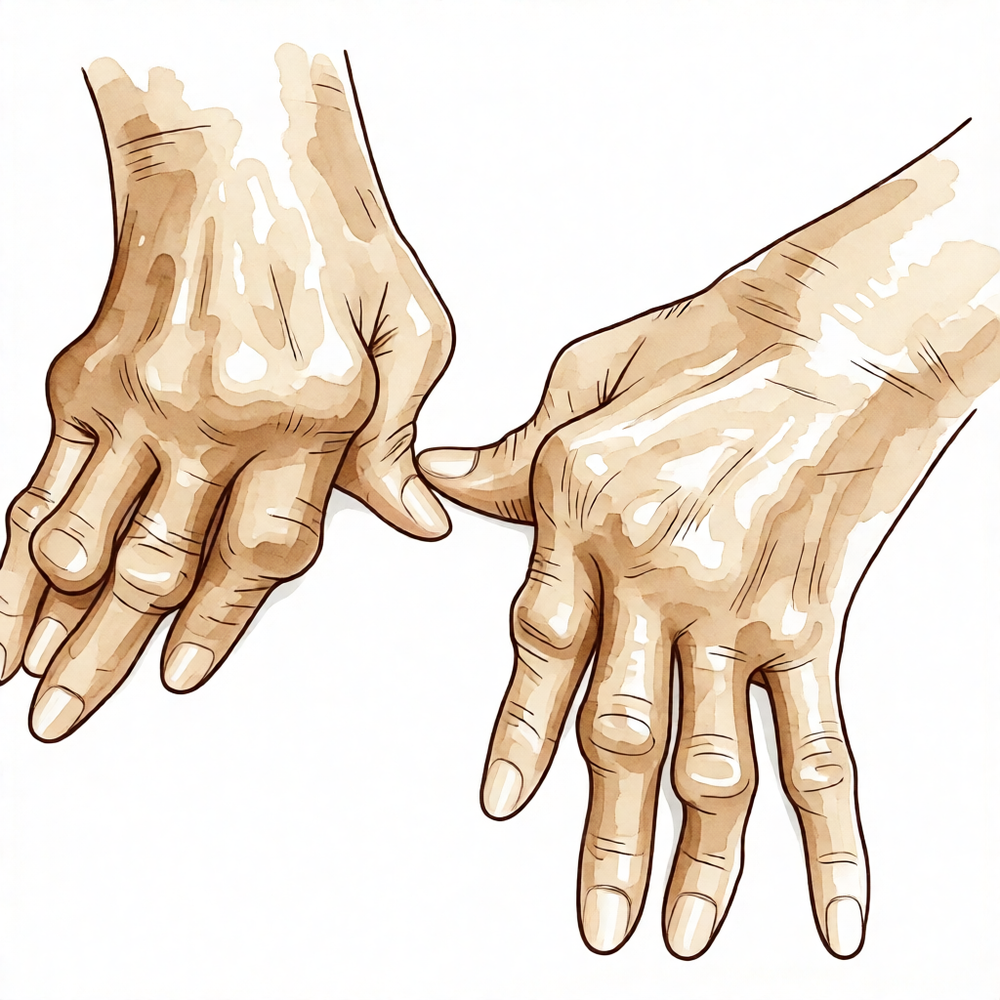
Quy trình này hướng dẫn quá trình hồi phục của bạn sau ca phẫu thuật thay khớp ngón tay bằng chất liệu silicone (Swanson) do bác sĩ Kieran Hirpara thực hiện tại Bệnh viện tư nhân Mater Rockhampton. Quy trình bắt đầu với chương trình tập luyện tại nhà; tiếp theo là quy trình điều trị lâm sàng được soạn thảo dành riêng cho chuyên viên trị liệu tay của bạn: hãy mang theo trang này hoặc bản PDF tương ứng trong lần trị liệu đầu tiên để việc phục hồi diễn ra một cách đồng bộ. Chuyên viên trị liệu tay có thể điều chỉnh kế hoạch này tùy theo tiến triển hồi phục của bạn.
Đây là quá trình hồi phục đòi hỏi sự tham gia tích cực của chuyên viên trị liệu tay và việc sử dụng nẹp cố định. Việc đeo nẹp động và thực hiện các bài tập hàng ngày không phải là những yếu tố phụ: chúng chính là phương pháp giúp các khớp mới được định hình vào vị trí thẳng và đúng chuẩn. Kết quả cuối cùng phụ thuộc rất nhiều vào việc bạn tuân thủ nghiêm ngặt các bước sử dụng nẹp và vận động.
Nếu bạn có bất kỳ thắc mắc nào về vết mổ sau phẫu thuật, hãy liên hệ với phòng khám. Việc chụp ảnh vết mổ rồi gửi qua email để được đánh giá cũng là một cách hữu ích.
Những điều bạn có thể mong đợi
Các khớp ngón tay có thể bị mòn, gây đau đớn và biến dạng nghiêm trọng; tình trạng này thường gặp trong bệnh viêm khớp dạng thấp, khi các ngón tay có xu hướng dịch chuyển về phía ngón út (hiện tượng dịch chuyển về phía ulna) và các khớp gốc ngón tay bị trượt xuống phía lòng bàn tay (trật khớp về phía lòng bàn tay); ngoài ra tình trạng mòn khớp còn có thể do viêm khớp thoái hóa. Trong ca phẫu thuật này, khớp ngón tay bị mòn sẽ được thay thế bằng một miếng đệm silicon mềm dẻo (loại implant Swanson điển hình). Mục đích của phẫu thuật là giảm đau, điều chỉnh lại sự dịch chuyển của các ngón tay và tình trạng ngón tay bị gập xuống (hiện tượng giảm khả năng duỗi thẳng – extensor lag), đồng thời khôi phục lại phạm vi cử động linh hoạt của các ngón tay.
Implant này không phải là khớp nối cứng. Nó đóng vai trò như một miếng đệm mềm dẻo; trong vài tuần đầu sau phẫu thuật, một lớp màng mới (gọi là “nang khớp”) sẽ hình thành quanh implant. Mục tiêu của quá trình phục hồi chức năng là giúp lớp nang này hình thành khi các ngón tay được giữ ở tư thế thẳng và đúng hướng, chứ không bị dịch chuyển sang phía khác. Đó là lý do tại sao việc đeo nẹp và vận động sớm lại quan trọng đến vậy.
Quá trình hồi phục chủ yếu dựa vào việc sử dụng nẹp duỗi động; nẹp này thường được đeo ngay trong vài ngày đầu sau phẫu thuật:
- Khi nghỉ ngơi, nẹp giúp giữ các khớp ngón tay thẳng và nhẹ nhàng kéo chúng về phía ngón cái (hướng radial deviation), từ đó khắc phục tình trạng dịch chuyển về phía ulna trước đó.
- Bên trong nẹp, bệnh nhân thực hiện các động tác duỗi ngón tay có kiểm soát, chống lại lực đàn hồi của các vòng cao su mềm; lực này giúp các ngón tay trở lại tư thế thẳng. Việc vận động sớm (nhưng chỉ trong tư thế được bảo vệ và điều chỉnh này) giúp hình thành lớp nang khớp mới một cách đúng đắn và ngăn ngừa tình trạng cứng khớp.
Bệnh nhân phải đeo nẹp duỗi động gần như liên tục trong khoảng sáu tuần; sau đó sẽ chuyển sang đeo nẹp nghỉ ngơi hoặc nẹp đêm, đồng thời bắt đầu các bài tập tăng cường sức mạnh dần dần. Khả năng vận động của bàn tay sẽ dần hồi phục trong vài tuần đầu; hầu hết mọi người có thể trở lại các hoạt động sinh hoạt hàng ngày sau khoảng ba tháng, và kết quả cuối cùng vẫn tiếp tục cải thiện trong vài tháng tiếp theo.
Các biện pháp phòng ngừa và hạn chế
- Hãy đeo nẹp kéo giãn động theo hướng dẫn: cả ngày lẫn đêm trong khoảng sáu tuần đầu tiên. Nẹp này giúp duy trì hiệu quả điều trị; nếu tháo ra quá nhiều lần, các ngón tay có thể lại bị lệch về phía út.
- Tuyệt đối không để các ngón tay lệch ngược về phía ngón út. Mọi bài tập đều nhằm hướng các ngón tay theo chiều ngược lại, về phía ngón cái.
- Không thực hiện các động tác nắm chặt, kẹp mạnh hay nâng vật nặng trong giai đoạn đầu: việc nắm quá mạnh sẽ khiến các ngón tay bị lệch về phía út và gây áp lực lên các khớp mới hình thành trước khi chúng ổn định. Việc tăng cường sức mạnh chỉ được thực hiện sau khi chuyên viên trị liệu tay cho phép.
- Ngay từ đầu, hãy vận động ngón cái, cổ tay và đầu ngón tay; đồng thời có thể sử dụng tay để thực hiện các công việc thường ngày nhẹ nhàng nếu cảm thấy thoải mái.
- Theo dõi vết thương để phát hiện các dấu hiệu nhiễm trùng (đỏ tấy, nóng rát, sưng phù hoặc tiết dịch); nếu lo ngại, hãy liên hệ với phòng khám. Tình trạng nhiễm trùng quanh bộ cấy ghép tuy hiếm gặp nhưng cần phát hiện sớm.
Để biết cách chăm sóc vết thương, giảm sưng và hình thành sẹo, vui lòng tham khảo hướng dẫn chăm sóc vết thương của phòng khám.
Các bài tập của bạn
Kieran Hirpara 4.0
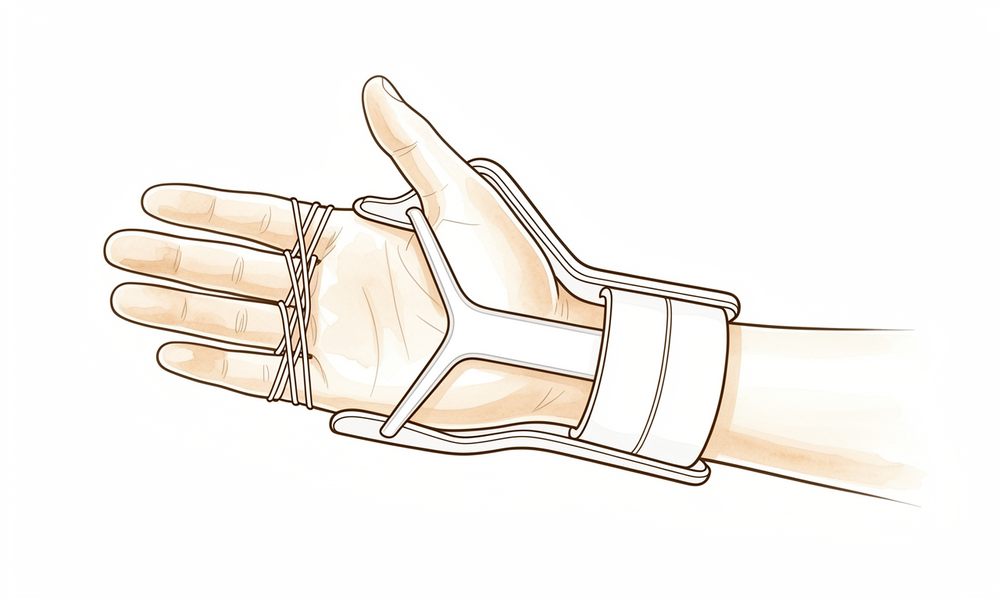
Việc đeo nẹp động lực học
Nẹp duỗi động này sẽ giúp bảo vệ tay bạn: khi nghỉ ngơi, nó giữ các khớp ngón tay thẳng và nhẹ nhàng kéo chúng về phía ngón cái (phía quay), từ đó điều chỉnh lại tình trạng lệch lạc đã tồn tại từ trước. Hãy đeo nẹp theo hướng dẫn — cả ngày lẫn đêm trong khoảng sáu tuần đầu — chỉ tháo ra khi rửa tay hoặc khi thực hiện các bài tập mà chuyên viên trị liệu chỉ định ngoài nẹp. Các vòng đeo quanh ngón tay phải vừa vặn, thoải mái; nếu có chỗ nào gây cọ xát hoặc khó chịu, hãy báo ngay cho chuyên viên trị liệu.
Đeo liên tục trong khoảng 6 tuần, sau đó chỉ đeo vào ban đêm hoặc khi nghỉ ngơi theo hướng dẫn.
Kieran Hirpara 4.0
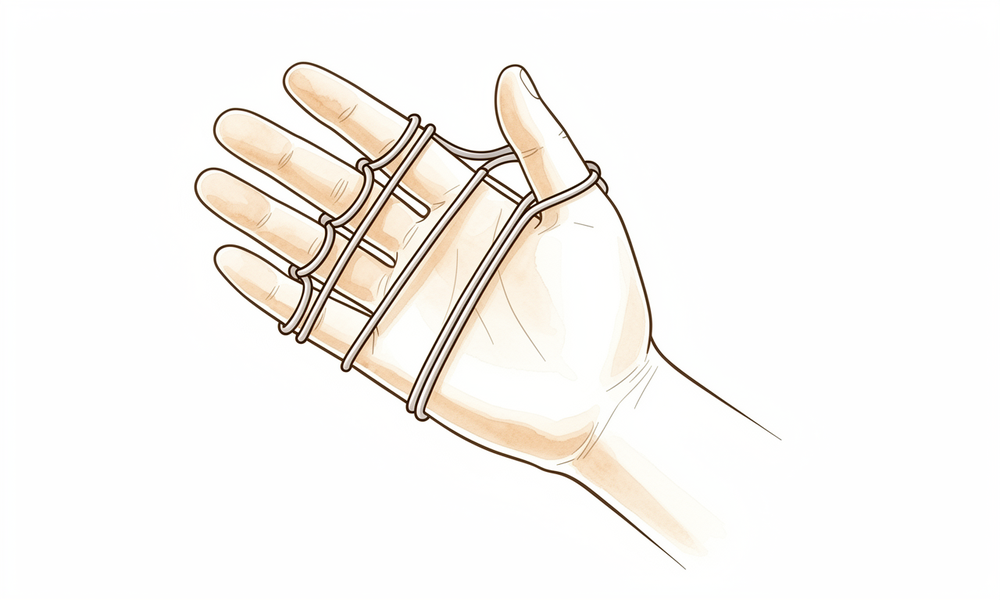
Việc điều chỉnh độ gập của các khớp ngón tay trong nẹp chỉnh hình
Khi đeo nẹp, hãy nhẹ nhàng gập các ngón tay xuống tại khớp ngón tay, kéo căng các vòng cao su, sau đó thả lỏng để nẹp đàn hồi đưa các ngón tay trở lại tư thế thẳng. Những chuyển động có kiểm soát từ sớm này sẽ giúp mô sẹo hình thành quanh các khớp mới ở vị trí thích hợp. Hãy thực hiện chuyển động một cách mượt mà và dừng lại ngay khi cảm thấy hơi đau; bạn đang hướng dẫn khớp cử động chứ không phải ép buộc nó.
Mỗi giờ khi còn thức, hãy thực hiện 10 lần gập ngón tay trong khi đeo nẹp, theo hướng dẫn.
Kieran Hirpara 4.0
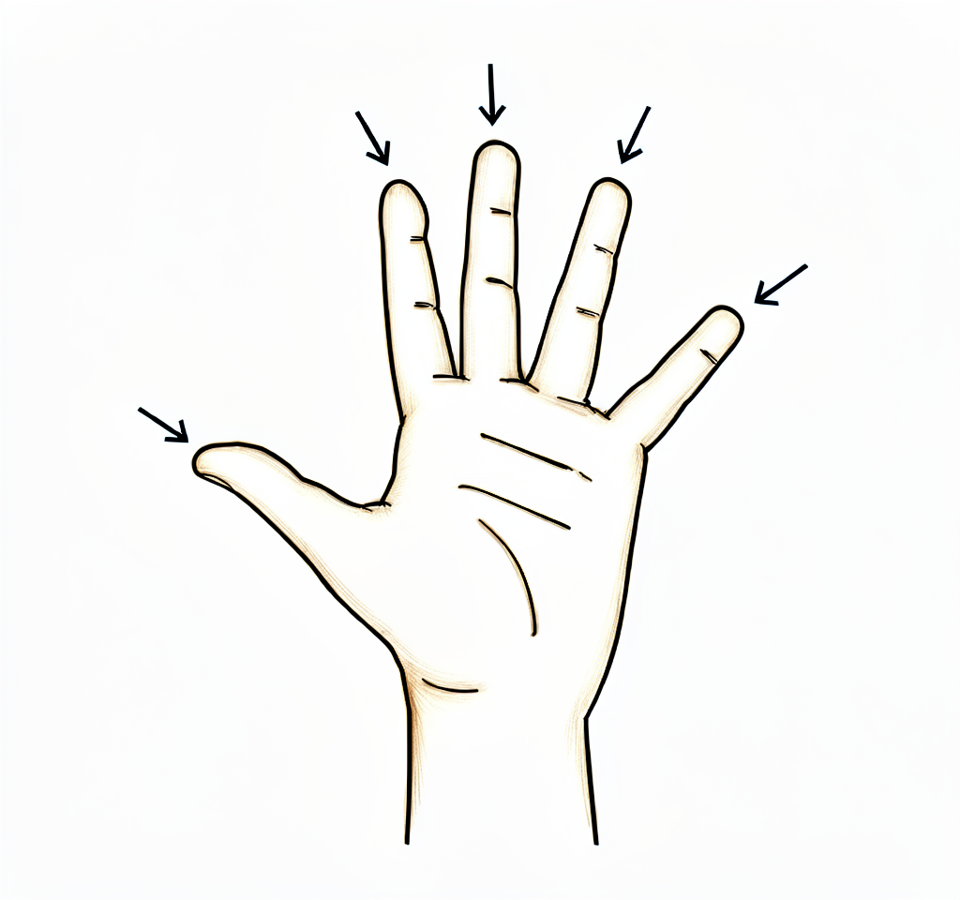
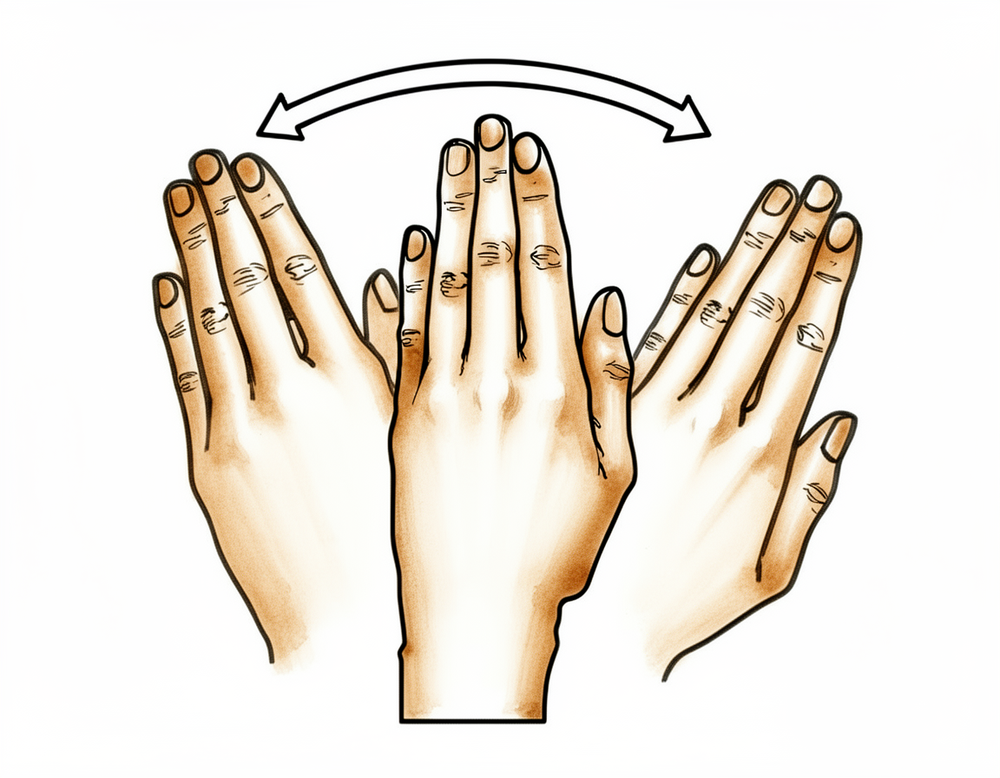
Cử động duỗi thẳng chủ động (nâng các khớp ngón tay lên)
Hãy cố gắng duỗi thẳng các khớp ngón tay bằng sức của mình — hãy nâng các ngón tay lên ngang bằng nhau. Sau phẫu thuật, các khớp ngón tay có xu hướng bị hạ thấp (hiện tượng giảm chức năng cơ duỗi), vì vậy việc chủ động nâng chúng lên sẽ giúp các gân duỗi hoạt động trơn tru và duy trì hiệu quả chỉnh sửa. Nhân viên trị liệu sẽ hướng dẫn bạn thực hiện động tác này khi còn đeo nẹp, sau đó sẽ dần chuyển sang thực hiện ngoài nẹp.
10 lần nâng, vài lần mỗi ngày, theo hướng dẫn.
Kieran Hirpara 4.0
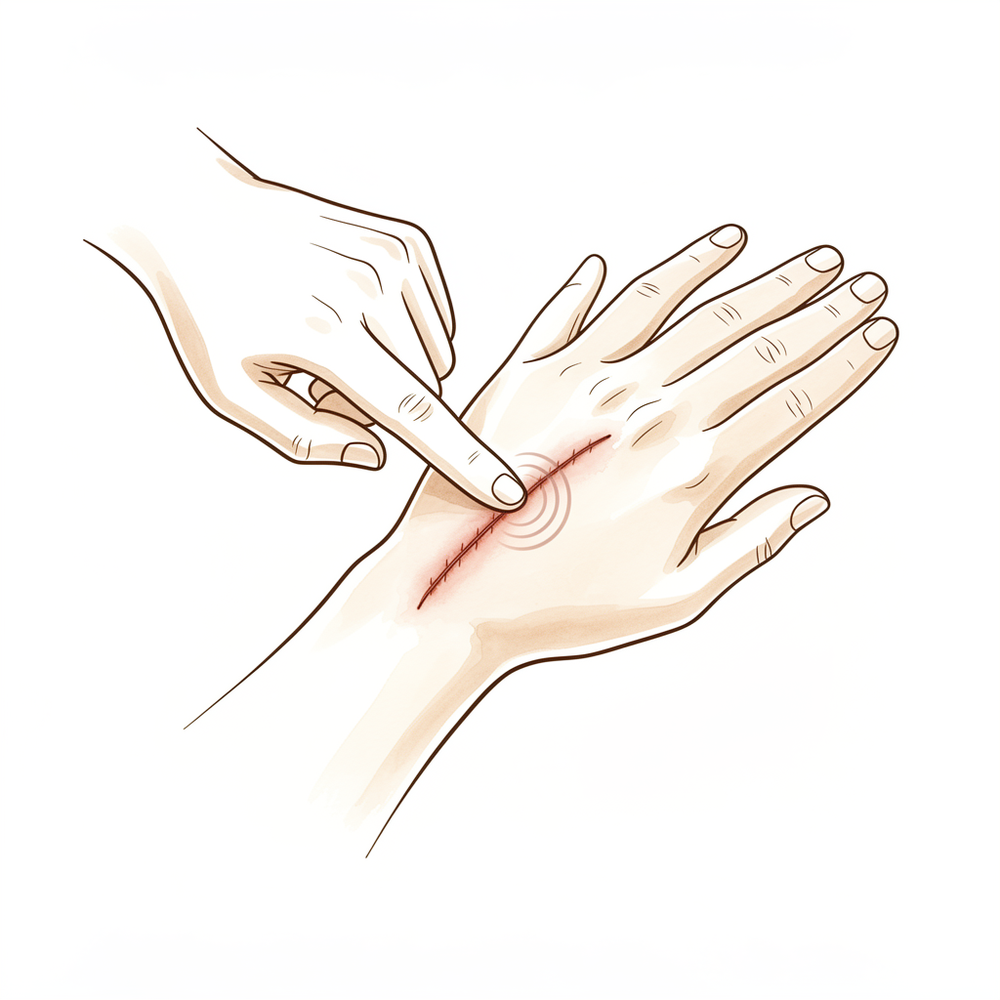
Chuyển động ngón tay hướng về phía ngón cái (phía quay)
Nhẹ nhàng di chuyển các ngón tay về phía ngón cái (phía quay) — ngược lại với hướng lệch cũ. Bạn có thể dùng tay kia để hỗ trợ hoặc dẫn các đầu ngón tay di chuyển dọc theo mặt bàn về phía ngón cái. Cách này giúp các ngón tay học lại cách xếp thẳng hàng, và đây là yếu tố điều chỉnh quan trọng nhất trong toàn bộ quy trình trị liệu này. Tuyệt đối không để các ngón tay lệch trở lại hướng cũ.
10 lần, vài lần mỗi ngày, theo hướng dẫn.
Kieran Hirpara 4.0
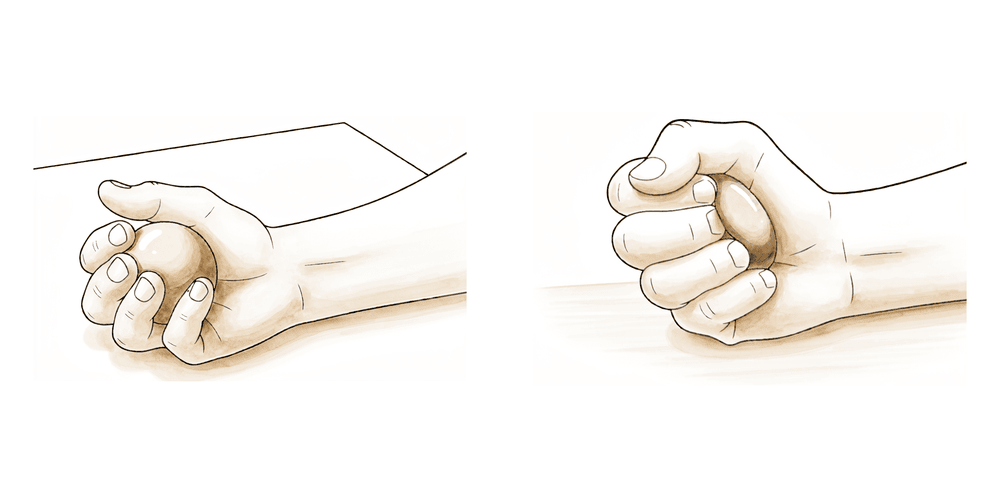
Chăm sóc vết sẹo
Khi các vết thương đã lành hẳn và chuyên viên trị liệu xác nhận là an toàn, hãy thoa một chút kem dưỡng da lên các vết sẹo ở mặt sau bàn tay, rồi xoa nhẹ theo những vòng tròn nhỏ và chắc trong vài phút. Việc này giúp các vết sẹo mềm ra, ngăn da dính chặt vào các gân, nhờ đó các khớp ngón tay có thể cử động dễ dàng hơn.
Chỉ vài phút thôi, 2-3 lần mỗi ngày, sau khi vết thương lành hẳn.
Kieran Hirpara 4.0
Tăng cường sức mạnh nắm tay (sẽ thực hiện sau)
Một bài tập GIAI ĐOẠN SAU — chỉ thực hiện khi chuyên viên trị liệu tay cho phép tập tăng cường sức mạnh, thường là từ khoảng tuần thứ mười hai. Nhẹ nhàng bóp một quả bóng mềm hoặc đất nặn trị liệu, sau đó thả ra. Tăng dần mức độ một cách từ từ. Bài tập này được hoãn lại trong giai đoạn đầu vì việc nắm mạnh sẽ đẩy các ngón tay lệch về phía trụ (phía ngón út) và gây áp lực lên các khớp mới trước khi bao khớp đủ chắc — vì vậy đây luôn là bài tập được bắt đầu sau cùng.
Theo hướng dẫn của chuyên viên trị liệu tay (chỉ từ khoảng tuần thứ 12 trở đi).
Đây là những bài tập có trong tờ hướng dẫn của bạn. Chỉ bắt đầu thực hiện chúng khi có sự hướng dẫn của Bác sĩ Hirpara và chuyên viên trị liệu vận động; đồng thời tuân thủ mọi phạm vi chuyển động và giới hạn đã được chỉ định. Các bài tập ban đầu đều phải thực hiện khi đeo nẹp động: uốn cong có kiểm soát theo các vòng nẹp, duỗi thẳng chủ động, và nhẹ nhàng đưa các ngón tay về phía ngón cái để duy trì hiệu quả chỉnh sửa. Việc chăm sóc vết sẹo chỉ bắt đầu sau khi vết thương đã lành; còn việc tăng cường sức mạnh nắm tay là giai đoạn sau và chỉ được thực hiện khi có sự cho phép cụ thể từ bác sĩ. Hãy ngừng ngay mọi bài tập gây đau dữ dội ở các khớp ngón tay.
Quy trình điều trị lâm sàng của bạn
Phần còn lại của trang này là quy trình điều trị phục hồi chức năng sau phẫu thuật thay khớp MCP bằng silicone (phương pháp Swanson). Phần này cần được cung cấp cho chuyên viên trị liệu tay; mỗi giai đoạn đều bắt đầu bằng lời giải thích bằng ngôn ngữ thông thường về những gì đang diễn ra. Nguyên tắc cốt lõi là bao khớp MCP mới sẽ dần hình thành quanh bộ cấy ghép ở bất kỳ tư thế nào mà bạn giữ; vì vậy nẹp chỉnh và các bài tập sẽ giúp giữ các khớp ở trạng thái duỗi thẳng kèm chút lệch hướng về phía quay, đồng thời cho phép vận động gập khớp chủ động một cách có kiểm soát ngay từ sớm, nhằm định hình lại khớp ở tư thế đúng và khắc phục tình trạng lệch hướng về phía trụ.
Trước khi điều trị, hãy kiểm tra báo cáo phẫu thuật và tiền sử bệnh của bệnh nhân; đồng thời trao đổi với bác sĩ phẫu thuật về chẩn đoán (viêm khớp dạng thấp hay viêm khớp thoái hóa), các kỹ thuật tái tạo mô mềm đã thực hiện (khâu lại dây chằng bên quay, giải phóng các cơ nội tại phía trụ, điều chỉnh vị trí gân duỗi trung tâm hoặc chuyển gân nội tại), cũng như mức độ chỉnh sửa và phạm vi vận động đạt được trong ca mổ. Bàn tay bị viêm khớp dạng thấp có xu hướng lệch hướng và tái phát nhanh hơn so với bàn tay bị viêm khớp thoái hóa; vì vậy cần đặc biệt chú trọng việc đeo nẹp giữ khớp hướng về phía quay. Quy trình dưới đây giả định việc áp dụng phương pháp nẹp duỗi động tiêu chuẩn.
Giai đoạn I — nẹp kéo giãn động lực học kết hợp vận động có kiểm soát sớm (từ tuần 0 đến khoảng tuần 6)
Sáu tuần đầu là giai đoạn quyết định: lúc này màng bao khớp bắt đầu hình thành quanh implant, và nẹp động lực học sẽ quy định tư thế hình thành của màng bao. Cần đeo nẹp kéo giãn khớp MCP động lực học dạng chân chống ngay trong vòng 3-5 ngày đầu tiên. Khi nghỉ ngơi, nẹp giữ các khớp MCP ở tư thế duỗi thẳng hoàn toàn, đồng thời kéo các đốt gần về phía lệch trục quay nhẹ về hướng quay (để điều chỉnh tình trạng lệch trục quay sang phía trụ cũ); các dây đeo của nẹp nằm trên các đốt gần, lực căng đàn hồi cho phép bệnh nhân thực hiện động tác gập khớp có kiểm soát, sau đó các ngón tay lại trở về tư thế duỗi thẳng. Bệnh nhân cần thực hiện động tác gập khớp MCP chủ động có kiểm soát trong nẹp mỗi giờ khi còn thức. Cổ tay và các khớp IP vẫn được để tự do vận động.
Dành cho chuyên viên trị liệu tay:
Giáo dục và các lưu ý cần tránh - Đeo và điều chỉnh độ căng của nẹp kéo giãn động lực học: giữ các khớp MCP ở tư thế duỗi thẳng kèm lệch trục nhẹ về phía quay; đặt các dây đeo lên các đốt gần; kéo về phía quay để chống lại xu hướng lệch trục sang phía trụ - Đeo nẹp liên tục (ngày và đêm) trong khoảng 6 tuần, chỉ tháo ra khi vệ sinh cơ thể hoặc thực hiện các bài tập dưới sự giám sát - Không được nắm chặt, kẹp mạnh hay chịu lực tác động sang phía trụ: những hành động này sẽ tạo ra các lực gây biến dạng khớp - Bảo vệ các mô mềm vừa được phẫu thuật tái tạo (dây chằng bên quay/ cân bằng cơ nội tại): tuyệt đối tránh tạo áp lực khiến ngón tay lệch sang phía trụ - Giữ cho ngón cái, cổ tay và các khớp IP luôn linh hoạt; chỉ được sử dụng tay một cách nhẹ nhàng, không chịu tải trọng
Cách theo dõi và xử trí - Vết mổ: thay băng theo hướng dẫn bác sĩ; theo dõi dấu hiệu nhiễm trùng (do có implant) - Phù nề: nâng cao chi, mát-xa nhẹ theo hướng ngược dòng, dùng băng ép nhẹ nếu bệnh nhân chịu được - Các bài tập: thực hiện động tác gập khớp MCP chủ động có kiểm soát trong nẹp, chống lại lực căng của các dây đeo, nhằm phát triển góc gập hữu ích (theo chỉ định của bác sĩ phẫu thuật, thường lên tới khoảng 70 độ ở các khớp MCP từ ngón trỏ đến ngón út); đồng thời thực hiện động tác duỗi khớp chủ động (để khắc phục tình trạng duỗi không hết) và điều chỉnh lại hướng lệch trục về phía quay (dẫn các ngón tay về phía ngón cái); duy trì vận động tự do cho các khớp IP và cổ tay
Tiêu chí để chuyển sang giai đoạn tiếp theo - Vết mổ đã lành; phù nề giảm dần; sau khoảng 6 tuần, bệnh nhân đã có thể gập khớp chủ động với góc mong muốn, vẫn giữ được tư thế duỗi thẳng và hướng lệch trục về phía quay như mong đợi
Giai đoạn II — giảm dần việc sử dụng nẹp và củng cố hiệu quả chỉnh trục (từ tuần thứ 6 đến khoảng tuần thứ 12)
Khoảng từ tuần thứ 6, màng khớp bắt đầu trưởng thành; lúc này nẹp động được giảm dần sử dụng, chuyển sang nẹp duỗi và nẹp nghỉ ban đêm (thường duy trì đến khoảng tuần thứ 12; đối với các bệnh nhân viêm khớp dạng thấp dễ tái phát thì vẫn tiếp tục dùng nẹp ban đêm lâu hơn nữa). Các bài tập vận động chủ động khi không đeo nẹp cũng được tăng dần, luôn ưu tiên hướng duỗi khớp và chỉnh trục về phía quay. Các hoạt động chức năng nhẹ có thể thực hiện; tuy nhiên vẫn phải tránh các động tác nắm chặt hay kẹp mạnh.
Dành cho chuyên viên trị liệu tay:
Đánh giá - Biên độ gập/duỗi khớp MCP chủ động và thụ động; mức độ suy giảm khả năng duỗi khớp; mức độ lệch trục về phía trụ (so sánh với kết quả chỉnh trục trong phẫu thuật); tình trạng đau và sưng; đánh giá vết thương và sẹo
Giáo dục và lưu ý - Giảm dần việc sử dụng nẹp động; tiếp tục dùng nẹp duỗi và nẹp nghỉ ban đêm đến khoảng tuần thứ 12 (đối với bệnh nhân viêm khớp dạng thấp thì dùng lâu hơn nữa vào ban đêm) - Tiếp tục tránh các động tác nắm chặt/kẹp mạnh cũng như bất kỳ lực tác động nào khiến khớp lệch về phía trụ - Cần chú ý duy trì chỉnh trục về phía quay; việc khớp lại lệch về phía trụ là nguyên nhân chính gây thất bại điều trị về sau
Xử trí - Bài tập: tăng dần mức độ vận động chủ động và vận động hỗ trợ nhẹ nhàng để gập/duỗi khớp MCP khi không đeo nẹp; tiếp tục các bài tập khắc phục suy giảm khả năng duỗi khớp và đào tạo lại khả năng chỉnh trục về phía quay; bắt đầu chăm sóc vùng sẹo sau khi vết thương lành; thực hiện các hoạt động chức năng nhẹ trong phạm vi chịu đựng, tránh các động tác khiến khớp lệch về phía trụ
Tiêu chí để chuyển sang giai đoạn tiếp theo - Hiệu quả chỉnh trục ổn định (mức độ lệch trục về phía trụ tái phát tối thiểu, khả năng duỗi khớp chấp nhận được) khi màng khớp đã trưởng thành; biên độ vận động chức năng thuận lợi; cơn đau giảm dần
Giai đoạn III – Tăng cường sức mạnh và hồi phục (từ tuần thứ 12 trở đi)
Khi bao khớp đã vững chắc và tư thế khớp được duy trì ổn định (khoảng tuần thứ 12), việc tăng cường sức mạnh mới được bắt đầu một cách từ từ và thận trọng; bởi việc nắm chặt tay có thể gây hiện tượng lệch trục về phía xương trụ. Sức mạnh cơ và kết quả chức năng cuối cùng sẽ tiếp tục cải thiện trong vài tháng sau đó.
Dành cho chuyên viên trị liệu tay:
Các đánh giá - So sánh khả năng nắm tay/kẹp ngón với bên đối diện và so với tình trạng trước phẫu thuật; kiểm tra góc vận động, khả năng duỗi thẳng và tư thế khớp khi chịu tải; thực hiện các bài kiểm tra chức năng và theo từng nhiệm vụ cụ thể
Giáo dục và các lưu ý cần tránh - Chỉ bắt đầu các bài tập nắm tay/tăng cường sức mạnh từ khoảng tuần thứ 12 trở đi, đồng thời tăng dần mức độ tải trọng - Hướng dẫn các kiểu nắm tay không gây lệch trục về phía xương trụ; tiếp tục sử dụng nẹp đeo ban đêm nếu cần thiết, đặc biệt đối với các trường hợp mắc viêm khớp dạng thấp - Đặt ra những kỳ vọng thực tế: mục tiêu là giảm đau, khôi phục tư thế khớp và đảm bảo góc vận động hữu ích, chứ không phải sở hữu bàn tay mạnh mẽ như bình thường
Cách quản lý - Các bài tập: dần dần thực hiện các bài nắm bột nặn/quả bóng và kẹp ngón, kiểm soát cơ bằng cách co cơ isometrically tại các khớp ngón tay, tăng cường sức mạnh theo chức năng; tiếp tục duy trì các bài tập vận động và khắc phục tình trạng duỗi thẳng không hết hoặc lệch trục khớp - Có thể cho bệnh nhân xuất viện khi tư thế khớp đã ổn định, góc vận động đạt mức hữu ích và bệnh nhân có thể thực hiện các hoạt động sinh hoạt hàng ngày; đồng thời hướng dẫn bệnh nhân sử dụng nẹp đeo ban đêm lâu dài và các biện pháp bảo vệ khớp - Chuyển bệnh nhân trở lại gặp bác sĩ điều trị nếu tư thế khớp bị thay đổi, mất đi góc vận động hữu ích hoặc nghi ngờ có vấn đề với vật liệu cấy ghép
Tiêu chí xuất viện - Tư thế khớp đã được điều chỉnh và ổn định, góc vận động hữu ích và không gây đau; khả năng nắm tay đủ để thực hiện các hoạt động sinh hoạt; tuân thủ tốt các biện pháp bảo vệ khớp và sử dụng nẹp đeo ban đêm
Trở lại với công việc và các hoạt động thường ngày
Ngay từ đầu, bạn nên thực hiện những hoạt động nhẹ nhàng với tay (ăn uống, viết lách, các công việc chăm sóc bản thân) miễn là cảm thấy thoải mái; tuy nhiên cần tránh việc nắm chặt, kẹp mạnh hoặc tạo áp lực sang bên (về phía xương quay) lên các ngón tay. Trong sáu tuần đầu, hãy đeo nẹp động lực học gần như suốt thời gian, điều này sẽ hạn chế khả năng sử dụng cả hai tay hoặc thực hiện các công việc nặng; vì vậy hãy sắp xếp sự hỗ trợ cần thiết. Bạn có thể lái xe trở lại khi đã có thể điều khiển xe một cách an toàn và đã tháo nẹp động lực học ra (thường là sau khoảng sáu tuần), theo xác nhận của bác sĩ tại buổi tái khám.
Việc tăng cường sức mạnh cơ tay và thực hiện các hoạt động nặng hơn chỉ được bắt đầu vào khoảng tuần thứ 12, và phải được thực hiện dần dần dưới sự hướng dẫn của chuyên viên trị liệu tay. Hầu hết mọi người có thể trở lại hầu hết các hoạt động thường ngày vào khoảng ba tháng sau phẫu thuật; kết quả cuối cùng về độ thoải mái, sự cân đối và phạm vi vận động của tay sẽ tiếp tục ổn định trong vài tháng nữa. Tiến độ hồi phục sẽ do Bác sĩ Hirpara và chuyên viên trị liệu tay đánh giá dựa trên tình trạng cải thiện và khả năng vận động của tay, chứ không chỉ dựa vào thời gian. Các công việc chân tay nặng nhọc hoặc đòi hỏi sự lặp đi lặp lại cũng tuân theo nguyên tắc tiến triển tương tự, kèm theo những lời khuyên bảo vệ khớp nhằm duy trì hiệu quả điều trị lâu dài.
Sau khi thực hiện theo phác đồ này
Phác đồ này được áp dụng song song với các hướng dẫn phục hồi chung của phòng khám: vui lòng tham khảo mục xử lý cơn đau sau phẫu thuật, chăm sóc vết thương và chăm sóc sẹo. Kế hoạch từng giai đoạn nêu trên dựa trên phương pháp phục hồi theo phong cách Swanson đã được áp dụng lâu năm sau phẫu thuật thay khớp MCP bằng silicone; quá trình hồi phục của bạn sẽ được Bác sĩ Hirpara và chuyên viên trị liệu tay theo dõi, điều chỉnh riêng biệt tùy theo diễn biến phục hồi của bàn tay.
Evidence & references
This is the clinical evidence summary written for health professionals. It is technical, and it lists the research this page was built from. You do not need to read it to understand your treatment or to make a decision about it.
Silicone (Swanson) MCP Joint Arthroplasty — Procedure Outcomes & Post-operative Rehabilitation
Topic scope: post-operative rehabilitation after silicone (Swanson) replacement of the metacarpophalangeal (MCP) joints — flexible silicone-elastomer spacer arthroplasty of the knuckle joints, most often for the rheumatoid hand with ulnar drift and volar subluxation, and less commonly for MCP osteoarthritis. This is a resection-replacement with soft-tissue rebalancing, not a simple decompression: the deforming forces that destroyed the joint (ulnar drift, extensor subluxation, intrinsic tightness) are still present, so the rehabilitation is an active, splint-driven re-shaping programme, not a rest-and-protect pathway.
Defining principle of the rehab here: a silicone MCP implant is a flexible spacer around which a new fibrous capsule ("encapsulation") forms over the first weeks — and that capsule remodels in whatever position the hand is held. The classic post-operative regime therefore uses a dynamic extension outrigger splint that holds the MCPs in extension with slight radial deviation (opposing the ulnar drift) while permitting early controlled active flexion against elastic loops. Move early, but only in the corrected position: this is what reverses the drift and builds a functional flexion arc. The single biggest branch point is the diagnosis — the rheumatoid hand drifts and recurs far more readily than the osteoarthritic hand and warrants more diligent, more prolonged radial-deviation splinting.
A. PROCEDURE OUTCOMES (rheumatoid and osteoarthritis)
Silicone MCP arthroplasty is a deformity-correcting, pain-relieving operation rather than a motion- or strength-restoring one. Its great strength is reliable correction of alignment and relief of pain; its accepted limitations are a modest final arc, gradual implant fracture over years, and—in rheumatoid hands—a tendency to recurrent drift.
- In rheumatoid arthritis it produces durable improvement in deformity, appearance and patient-reported function. The multicentre prospective SARA (Silicone Arthroplasty in Rheumatoid Arthritis) cohort compared 70 surgical with 93 non-surgical RA patients with severe MCP deformity: the surgical group showed significant, sustained gains in the Michigan Hand Outcomes Questionnaire and in ulnar deviation, extensor lag and arc of motion, maintained at 1 year, at long-term (3-year) follow-up, and out to 7 years, whereas the non-surgical cohort did not improve [Chung 2009; Chung 2012; Chung 2017]. Moderate–strong (prospective comparative cohort; not randomised).
- Correction of ulnar drift and extensor lag is the headline result; arc and grip gains are modest. Series consistently report large reductions in ulnar deviation and extensor lag with a re-centred, more functional arc (commonly a final arc on the order of ~40–50° centred nearer extension), with grip strength only modestly changed. The operation buys alignment, pain relief and hand appearance/function, not power [Goldfarb & Dovan 2006; Rizzo 2011; Kirschenbaum 1993]. Moderate.
- For MCP osteoarthritis, long-term results are favourable and durable. A long-term series of silicone MCP arthroplasty for OA reported lasting pain relief and satisfactory function, with better-preserved bone stock and less recurrent deforming force than the rheumatoid hand [Morrell & Weiss 2018]. Moderate.
- Implant fracture accrues with time but is often clinically silent. Long-term radiographic follow-up shows implant fracture rates rising over the years, yet many fractured implants remain asymptomatic and revision is driven by symptoms/instability rather than radiographic fracture alone [Koenuma 2024; Kirschenbaum 1993]. Moderate.
- Revision is uncommon but defined, most often for recurrent deformity, implant fracture/instability or infection; revision MCP arthroplasty is feasible but technically demanding with poorer results than primary surgery [Wagner 2019; Carlson Strother 2023]. Moderate.
B. REHABILITATION / THERAPY EVIDENCE
The central rehab questions are (1) which splint regime, and (2) does adding continuous passive motion or particular splint variants change the outcome. The evidence base is dominated by a strong heritage regime (Swanson-style dynamic extension splinting) supported mostly by expert consensus and low-level studies, with the few controlled comparisons failing to show benefit from add-ons. The rehabilitation is nonetheless indispensable — it is integral to the operation, not an optional adjunct.
- The standard regime is a dynamic extension outrigger splint with early controlled motion. Fitted within the first few days, it holds the MCPs in extension and slight radial deviation at rest and permits active flexion against finger slings, worn essentially continuously for ~6 weeks then weaned to night/rest splinting. The shared aim across published regimes is to encourage MCP flexion and extension without recurrence of flexion contracture or ulnar deviation while the capsule encapsulates the implant in a corrected position [Goldfarb & Dovan 2006; Massy-Westropp Cochrane 2008]. Consensus / heritage — widely practised, low-level evidence.
- Adding continuous passive motion (CPM) to dynamic splinting does not help. The Cochrane review identified a single small controlled trial (22 participants) comparing dynamic splinting ± CPM and concluded CPM is not effective at increasing motion or strength after MCP arthroplasty (controls actually gained more motion); it rated the evidence "silver level" and called for well-designed RCTs given wide practice variation [Massy-Westropp Cochrane 2008]. Moderate (Cochrane SR of low-certainty primary evidence).
- A static-splint alternative achieves comparable correction in small studies. A prospective series using alternating static flexion/extension splints (rather than a dynamic outrigger) reported improved total active arc (21.6°→47.2°) and corrected ulnar deviation (30.4°→9.7°), suggesting the position held and active motion matter more than the specific splint mechanism [Burr/Massy-Westropp J Hand Ther 2002]. Weak (small prospective cohort).
- The specific dynamic-splint protocol has not been shown superior to simpler regimes in controlled comparison. A randomised study found no clear added value of dynamic splinting over a simpler post-operative regime for MCP replacement, reinforcing that the dynamic outrigger is a sound, traditional default rather than a proven optimum [Delaney 2003]. Weak–moderate (small RCT).
Recovery trajectory (expected, evidence-anchored)
| Phase | Window | Splint / position | Hand-therapist focus | Strength / load | Notes |
|---|---|---|---|---|---|
| I — Dynamic extension splint + early controlled motion | Week 0–~6 | Dynamic extension outrigger worn day & night; MCPs in extension + slight radial deviation | Controlled active MCP flexion within the splint (toward the surgeon's arc, often up to ~70°); active extension (correct extensor lag); radial-deviation re-education; free IP/wrist; oedema control | Light unloaded use only; no grip/pinch, no ulnar load | Capsule forms now — position held = position kept. Rheumatoid hands need the most diligent radial pull |
| II — Wean to night/rest splint, consolidate correction | Week ~6–12 | Wean dynamic splint → night/resting extension splint (longer at night in RA) | Progress active/active-assisted flexion–extension out of splint, biased to extension + radial; scar massage once healed; preserve correction | Still no strong grip/pinch; light functional tasks | Recurrent ulnar drift is the main late failure — guard alignment |
| III — Strengthening & return | Week ~12+ | Night splint as indicated (esp. RA) | Graded putty/ball grip and pinch, isometric MCP control, functional/task strengthening | Begin grip strengthening ~8–12 wk, build gradually; coach non-ulnar-deviating grip | Most everyday activity by ~3 months; alignment/comfort/arc settle over several more months |
(Phase windows mirror the patient protocol; they are typical, heritage-based guides — not trial-derived deadlines.)
C. KEY CONTROVERSIES / EVIDENCE QUALITY
- Heritage regime, modest evidence. The Swanson-style dynamic extension outrigger with early controlled motion is deeply established and near-universally taught, but its supporting evidence is largely expert consensus and small/low-level studies. The defensible position is to follow the heritage regime faithfully while acknowledging its evidence tier [Goldfarb & Dovan 2006; Massy-Westropp Cochrane 2008]. Consensus.
- Which splint? Dynamic outrigger vs alternating static splints vs simpler regimes give broadly similar correction in small studies; CPM adds nothing. What matters is holding the MCPs in extension + radial deviation while moving early — the mechanism of the splint is secondary [Massy-Westropp Cochrane 2008; Burr 2002; Delaney 2003]. Weak–moderate.
- Rheumatoid vs osteoarthritis. The rheumatoid hand has ongoing deforming forces (tendon subluxation, intrinsic tightness, soft-tissue laxity) and recurs, demanding more prolonged radial-deviation/night splinting and joint protection; the osteoarthritic hand has better bone and soft tissue and a more durable correction [Morrell & Weiss 2018; Rizzo 2011]. Moderate.
- Realistic goals. The operation reliably delivers pain relief, corrected alignment and a functional arc, not a normal or powerful hand. Mis-set expectations (large grip gains) are a common source of dissatisfaction [Chung patient-expectations 2015; SARA cohort]. Moderate.
- Implant fracture ≠ failure. Radiographic implant fracture accrues over years but is frequently asymptomatic; revision is symptom-driven. Counsel accordingly rather than revising on imaging alone [Koenuma 2024; Wagner 2019]. Moderate.
D. EVIDENCE STRENGTH FLAGS (summary)
- MODERATE–STRONG: silicone MCP arthroplasty improves deformity, alignment (ulnar deviation, extensor lag), MHQ and arc versus non-surgical care in severe rheumatoid MCP disease, durable to 7 years (SARA prospective cohort — comparative, not randomised).
- MODERATE: correction-over-power outcome profile; favourable long-term OA results; time-related implant fracture (often asymptomatic); defined but uncommon revision rate; greater recurrence in rheumatoid than osteoarthritic hands.
- WEAK / CONSENSUS / HERITAGE: the specific dynamic-extension-outrigger + early-controlled- flexion + radial-deviation rehabilitation programme (strong heritage, low-level evidence; CPM shown unhelpful; dynamic vs static vs simpler regimes not clearly differentiated); exact phase timings (typical, not trial-derived).
CITATIONS
RAG corpus (180,000+ Orthopaedic articles)
- Kirschenbaum D, Schneider LH, Adams DC, et al. Arthroplasty of the metacarpophalangeal joints with use of silicone-rubber implants in patients who have rheumatoid arthritis. Long-term results. J Bone Joint Surg Am. 1993;75(1):3-12. DOI: 10.2106/00004623-199301000-00002
- Goldfarb CA, Dovan TT. Rheumatoid arthritis: silicone metacarpophalangeal joint arthroplasty indications, technique, and outcomes. Hand Clin. 2006;22(2):177-188. DOI: 10.1016/j.hcl.2006.02.001
- Rizzo M. Metacarpophalangeal joint arthritis. J Hand Surg Am. 2011;36(2):345-353. DOI: 10.1016/j.jhsa.2010.11.035
- Morrell NT, Weiss AC. Silicone metacarpophalangeal arthroplasty for osteoarthritis: long-term results. J Hand Surg Am. 2018;43(3):229-233. DOI: 10.1016/j.jhsa.2017.10.010
- Koenuma N, Ikari K, Oh K, et al. Long-term implant fracture rates following silicone metacarpophalangeal joint arthroplasty in rheumatoid arthritis. J Hand Surg Am. 2024. DOI: 10.1016/j.jhsa.2024.01.009
- Wagner ER, Houdek MT, Packard B, et al. Revision metacarpophalangeal arthroplasty: a longitudinal study of 128 cases. J Am Acad Orthop Surg. 2019. DOI: 10.5435/JAAOS-D-17-00042
- Carlson Strother CR, Moran SL, Rizzo M. Small joint arthroplasty of the hand: an update on indications, outcomes, and complications. J Am Acad Orthop Surg. 2023;31(15):e739-e749. DOI: 10.5435/JAAOS-D-23-00034
- Blazar PE, Gancarczyk SM, Simmons BP. Rheumatoid hand and wrist surgery: soft tissue principles and management of digital pathology. J Am Acad Orthop Surg. 2019;27(21):e924-e933. DOI: 10.5435/JAAOS-D-17-00608
- Naniwa S, Nishida K, Nasu Y, et al. A comparative study of short-term outcomes between INTEGRA and AVANTA silicone implants for metacarpophalangeal joints in patients with rheumatoid arthritis. J Hand Surg Am. 2026. DOI: 10.1016/j.jhsa.2026.04.003
MCP arthroplasty outcomes & rehabilitation literature (URLs)
- Chung KC, Burns PB, Wilgis EFS, et al. A multicenter clinical trial in rheumatoid arthritis comparing silicone metacarpophalangeal joint arthroplasty with medical treatment. J Hand Surg Am. 2009;34(5):815-823. DOI: 10.1016/j.jhsa.2009.01.018 — https://pmc.ncbi.nlm.nih.gov/articles/PMC4381953/
- Chung KC, Burns PB, Kim HM, et al. Long-term followup for rheumatoid arthritis patients in a multicenter outcomes study of silicone metacarpophalangeal joint arthroplasty. Arthritis Care Res (Hoboken). 2012;64(9):1292-1300. DOI: 10.1002/acr.21705 — https://pubmed.ncbi.nlm.nih.gov/22511483/
- Burns PB, Zhong L, Chung KC. Seven-year outcomes of the Silicone Arthroplasty in Rheumatoid Arthritis (SARA) prospective cohort study. Arthritis Care Res (Hoboken). 2017. DOI: 10.1002/acr.23105 — https://pmc.ncbi.nlm.nih.gov/articles/PMC5376377/
- Chung KC, Burns PB, et al. Patient expectations and long-term outcomes in rheumatoid arthritis patients: results from the SARA study. Clin Rheumatol. 2015;34(4):641-651. DOI: 10.1007/s10067-014-2775-z — https://pubmed.ncbi.nlm.nih.gov/25267562/
- Massy-Westropp N, Johnston RV, Hill C. Post-operative therapy for metacarpophalangeal arthroplasty. Cochrane Database Syst Rev. 2008;(1):CD003522. DOI: 10.1002/14651858.CD003522.pub2 — https://pmc.ncbi.nlm.nih.gov/articles/PMC8715905/
- Burr N, Pratt AL, Stott D. An alternative splinting and rehabilitation protocol for metacarpophalangeal joint arthroplasty in patients with rheumatoid arthritis. J Hand Ther. 2002;15(1):41-47. DOI: 10.1053/hanthe.2002.v15.01541 — https://pubmed.ncbi.nlm.nih.gov/11866351/
- Delaney R, Trail IA, Nuttall D. Value of dynamic splinting after replacement of the metacarpophalangeal joint in patients with rheumatoid arthritis. Scand J Plast Reconstr Surg Hand Surg. 2003;37(4):232-233. DOI: 10.1080/02844310310005658 — https://pubmed.ncbi.nlm.nih.gov/12755512/