Patients › Rehabilitation
Thay khớp vai cho gãy xương
Rehabilitation after hemiarthroplasty or reverse shoulder replacement for a proximal humerus fracture — slower than elective replacement while the tuberosities heal.
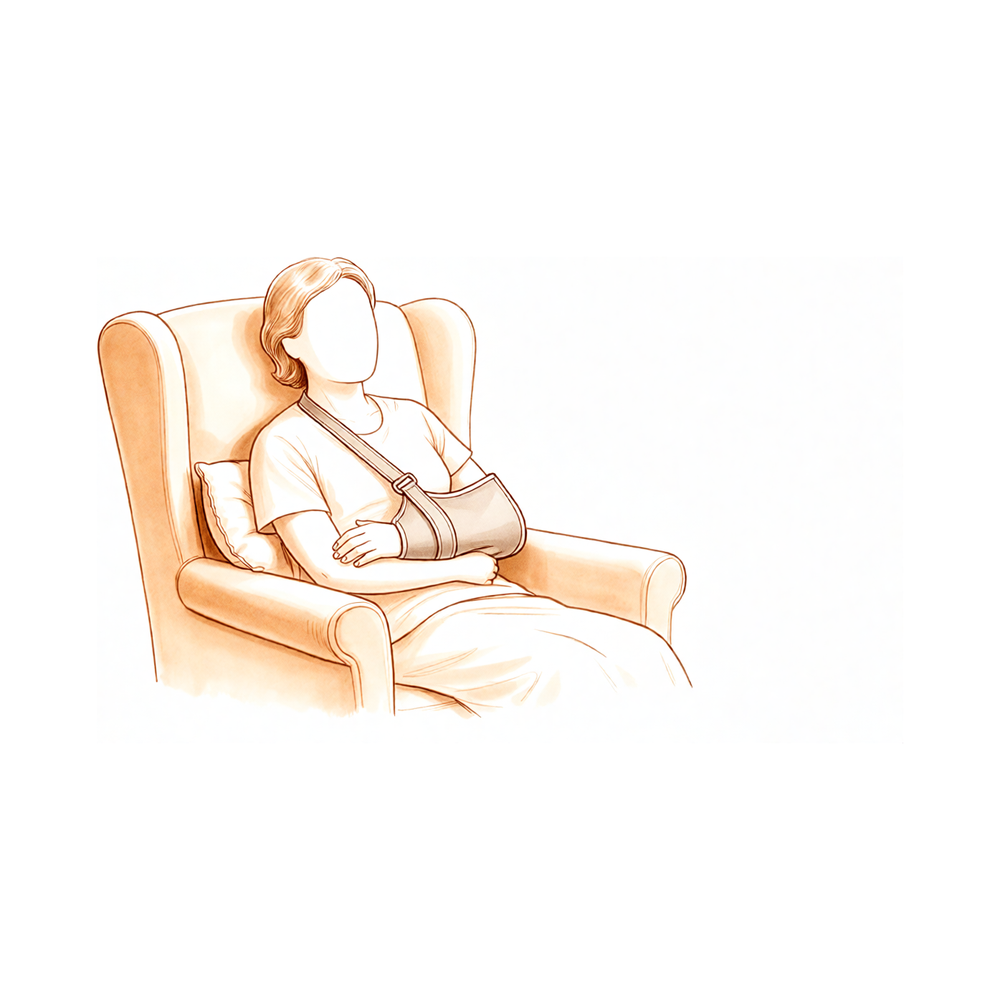
Hướng dẫn này sẽ hỗ trợ quá trình hồi phục của bạn sau khi phẫu thuật thay khớp vai do gãy xương vai (gãy xương cánh tay trên gần) với sự chỉ định của bác sĩ Kieran Hirpara tại Bệnh viện tư Mater Private Hospital Rockhampton. Tùy thuộc vào mức độ gãy xương, phẫu thuật thay khớp có thể là thay khớp vai ngược hoặc thay khớp bán phần (chỉ thay phần đầu xương của khớp). Hành trình phục hồi chức năng có cấu trúc tương tự nhau cho cả hai loại phẫu thuật, bởi vì yếu tố quyết định tốc độ phục hồi là quá trình lành xương của các mảnh xương gãy, chứ không phải loại implant được sử dụng. Mỗi giai đoạn dưới đây sẽ bắt đầu bằng phần giải thích bằng ngôn ngữ thông thường về những gì đang xảy ra và điều quan trọng nhất cần lưu ý, sau đó là phần hướng dẫn phục hồi chức năng được viết dành cho bác sĩ vật lý trị liệu của bạn: hãy mang theo trang này hoặc file PDF của nó đến buổi khám vật lý trị liệu đầu tiên để quá trình phục hồi chức năng của bạn được đồng bộ. Bác sĩ vật lý trị liệu của bạn có thể điều chỉnh kế hoạch tùy thuộc vào tiến trình hồi phục của bạn.
Nếu bạn có bất kỳ lo ngại nào về vết mổ sau phẫu thuật, hãy liên hệ với phòng khám. Thường thì việc chụp ảnh vết mổ và gửi email để bác sĩ xem xét sẽ rất hữu ích.
Tại sao quá trình hồi phục chậm hơn sau khi gãy xương
Khi khớp vai được thay thế một cách có kế hoạch do viêm khớp hoặc rách gân quay, xương xung quanh khớp mới vẫn nguyên vẹn, và quá trình phục hồi chức năng có thể diễn ra theo tốc độ lành mô mềm. Sau khi gãy xương, tình trạng lại khác. Hai mỏm xương ở đầu trên của xương cánh tay (gò lớn và gò nhỏ, nơi các cơ gân quay bám vào) thường bị tách rời, và trong quá trình phẫu thuật, chúng được khâu cố định trở lại vị trí xung quanh khớp nhân tạo. Những mảnh xương này giờ đây phải liền vào xương và khớp nhân tạo, giống như bất kỳ ca gãy xương nào khác, và điều này thường mất vài tuần đến vài tháng.
Các phác đồ phục hồi chức năng đã được công bố cho việc thay thế khớp vai do gãy xương đều nhất quán về điểm này: khả năng hoạt động của khớp vai sau đó phụ thuộc rất lớn vào việc các mỏm xương có liền đúng vị trí hay không, và việc vận động sớm hoặc mạnh (kể cả vận động thụ động) có thể gây kéo lên vết khâu và làm nguy cơ liền xương. Do đó, phác đồ tuân theo cùng một lộ trình như phác đồ thay thế khớp vai ngược. Sau khi gãy xương, hành trình này diễn ra chậm hơn vì các mảnh xương phải liền trước. Mỗi bước tiến trong quá trình phục hồi chức năng của bạn phụ thuộc vào hai yếu tố cùng lúc: đủ thời gian trôi qua và phim X-quang cho thấy xương đang liền, được xác nhận tại buổi tái khám với Bác sĩ Hirpara.
Những điều cần biết
Bạn sẽ có cánh tay bị tê khi tỉnh dậy, và cảm giác thường trở lại trong vòng 6 đến 12 giờ. Hiếm khi, một số tình trạng tê hoặc yếu có thể kéo dài từ 2 đến 3 ngày.
Khi tỉnh dậy sau phẫu thuật, bạn sẽ được đeo đai treo, với một miếng đệm lớn ở vai. Miếng đệm này sẽ được tháo bỏ trước khi xuất viện. Bên dưới là một lớp băng chống thấm nước che phủ một dải keo phẫu thuật, có thể để nguyên trong 2 tuần. Các mũi khâu của bạn là loại tự tiêu và không cần tháo bỏ, nhưng có thể có một số đoạn chỉ thừa ở hai đầu vết mổ có thể được cắt ngang bằng da sau 2 tuần. Bạn sẽ được hẹn gặp y tá của chúng tôi để kiểm tra vết mổ sau 1–2 tuần phẫu thuật. Nếu bạn không thể đến kiểm tra băng, bạn có thể tự tháo băng sau 2 tuần.
Thời gian ước tính để trở lại các hoạt động (chậm hơn sau khi thay thế chọn lọc, và luôn phụ thuộc vào quá trình lành xương của bạn):
- Lái xe: không lái xe trong ít nhất sáu tuần (áp dụng cho mọi ca phẫu thuật vai), và không lái xe khi bạn đang đeo đai treo. Hầu hết mọi người trở lại lái xe trong khoảng từ 6 đến 12 tuần, khi khả năng vận động và kiểm soát đã trở lại; thảo luận điều này trong buổi tái khám của bạn.
- Bơi lội: bơi ếch từ khoảng 4 tháng; bơi tự do sau đó, theo hướng dẫn trong buổi tái khám của bạn.
- Nâng vật: không nâng vật nặng hơn một tách cà phê cho đến khoảng 12 tuần; nâng vật nhẹ bắt đầu tăng dần từ 12 tuần; tránh nâng vật nặng trong 6 tháng.
- Công việc: công việc văn phòng: từ khoảng 6 tuần, tùy theo mức độ thoải mái; công việc chân tay: theo hướng dẫn của Bác sĩ Hirpara.
Cũng đáng để đặt ra kỳ vọng sớm: sau khi thay thế do gãy xương, vai thường không lấy lại được phạm vi vận động đầy đủ như vai không bị thương. Các kết quả công bố mô tả việc sử dụng cánh tay một cách thoải mái, kiểm soát đau ở mức độ eo và vai (và thường là trên đầu) là kết quả thông thường, với khả năng vận động và sức mạnh tiếp tục cải thiện trong 12–24 tháng sau phẫu thuật.
Đeo đai treo
Nạng đỡ tay (thiết bị bất động vai) của bạn hỗ trợ vai trong khi các mảnh xương đang lành. Các quy tắc rất đơn giản:
- Đeo trong 6 tuần, kể cả khi ngủ.
- Chỉ tháo ra khi tắm, khi tập các bài tập của bạn sau khi đã được hướng dẫn cách thực hiện, và khi nghỉ ngơi ở nhà với cánh tay được kê trên gối; bất cứ khi nào đai treo được tháo ra, hãy giữ cánh tay sát bên hông.
- Không lái xe trong sáu tuần, và không lái xe khi đang đeo đai treo.
- Sử dụng chườm đá nếu vai bị sưng hoặc đau, đặc biệt là sau khi tập luyện.
Chuyên viên vật lý trị liệu sẽ giúp bạn đeo đai treo vào lúc đầu và sẽ dạy bạn cách tự quản lý nó trước khi xuất viện. Việc điều chỉnh đai treo đúng cách là rất quan trọng: một chiếc đai treo quá rộng sẽ không hỗ trợ bạn đúng cách.
- Luôn đảm bảo rằng khi đeo đai treo, khuỷu tay của bạn được đặt trong góc của đai treo và được hỗ trợ chắc chắn.
- Đầu cuối của một chiếc đai treo vừa vặn nên nằm thoải mái ở khớp ngón tay út của bạn. Nếu bàn tay của bạn thò ra ngoài đai treo quá xa, nó sẽ không cung cấp cho bạn sự hỗ trợ đầy đủ.
- Nạng đỡ tay của bạn có hai dây dán Velcro: một dây quấn quanh cổ và một dây quấn quanh eo.
- Sau khi đã đặt khuỷu tay và cẳng tay của bạn vào đúng vị trí, hãy dùng cánh tay chưa phẫu thuật để quăng dây đeo trên qua vai và vòng quanh cổ ra phía trước, sau đó gắn nó vào vòng trên của đai treo.
- Sử dụng cùng phương pháp để gắn dây đeo dưới quanh eo, cố định nó vào vòng dưới của đai treo.
Trong thời gian đeo đai treo, hãy luôn chú ý đến tư thế của bạn và tránh để vai của bạn bị gù xuống. Để đạt được tư thế tốt, hãy cố gắng giữ tai, vai và hông thẳng hàng. Tư thế tốt rất quan trọng cho lưng của bạn và sẽ giúp ngăn ngừa cứng khớp vai. Một chiếc khăn cuộn nhỏ đặt ở vùng thắt lưng khi ngồi có thể đóng vai trò như một lời nhắc nhở thân thiện.
Những ngày đầu tiên của bạn tại bệnh viện
Trước khi xuất viện, các chuyên viên vật lý trị liệu của bệnh viện sẽ bắt đầu bạn thực hiện một chương trình đơn giản. Điều này giúp bạn hiểu ba thuật ngữ mà họ sẽ sử dụng. Kháng cự chủ động (Active) là chuyển động do chính bạn thực hiện, không cần hỗ trợ hay giúp đỡ. Kháng cự hỗ trợ chủ động (Active-assisted) là sử dụng cánh tay còn lại (hoặc một vật thể, chẳng hạn như gậy) để hỗ trợ di chuyển cánh tay. Kháng cự thụ động (Passive) là cánh tay hoàn toàn thư giãn trong khi cánh tay còn lại (hoặc người khác) thực hiện 100% công việc. Sau khi phẫu thuật thay thế do gãy xương, vai được phẫu thuật chỉ được di chuyển thụ động và chỉ trong giới hạn nhẹ nhàng, trong sáu tuần đầu tiên; các khớp mà bạn di chuyển chủ động là khuỷu tay, cổ tay và bàn tay.
Một số điểm thực tế cho những ngày đầu tiên này:
- Bạn cần ngủ trong đai treo.
- Sử dụng chườm đá để giảm đau nếu cần.
- Khi đeo đai treo, hãy thư giãn vai và để đai treo chịu trọng lượng của cánh tay.
- Uống thuốc giảm đau trước khi thực hiện các bài tập và trước các cuộc hẹn với chuyên viên vật lý trị liệu.
- Bạn được phép đưa cánh tay ra khỏi đai treo để tập các bài tập và tắm rửa.
- Bạn cần đeo đai treo trong 6 tuần, đặc biệt là khi ra khỏi nhà.
- Giữ cho bàn tay ở bên được phẫu thuật hoạt động nhẹ nhàng: viết, ăn và sử dụng điện thoại trong khi cánh tay nghỉ ngơi trong đai treo đều được khuyến khích.
- Trừ khi bạn đã tự sắp xếp vật lý trị liệu riêng, một cuộc hẹn đã được đặt cho bạn và chi tiết trong gói xuất viện của bạn.
- Nếu bạn gặp bất kỳ vấn đề nào, hãy liên hệ với văn phòng hoặc thông báo cho chuyên viên vật lý trị liệu của bạn.
Giai đoạn I — Bảo vệ trong quá trình xương lành (Tuần 0–6)
Kieran Hirpara 4.0
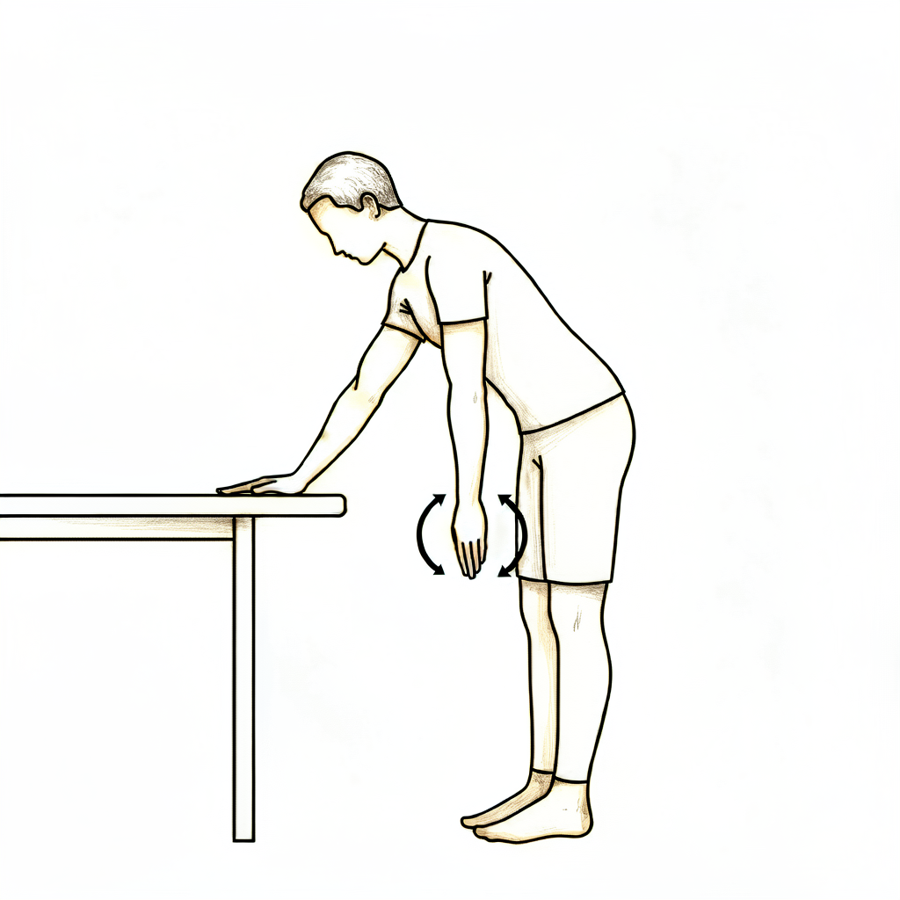
Bài tập con lắc (thả lỏng hoàn toàn)
Cúi người về phía trước, dùng tay còn lại chống lên bàn, để cánh tay vừa phẫu thuật buông thõng và thả lỏng hoàn toàn. Nhẹ nhàng đung đưa cơ thể để tạo thành những vòng tròn nhỏ — cánh tay đung đưa một cách thụ động và các cơ vai hoàn toàn không phải hoạt động. Nếu cánh tay không giữ được trạng thái thả lỏng, hãy dừng lại và nhờ chuyên viên vật lý trị liệu kiểm tra lại kỹ thuật của bạn.
Theo hướng dẫn của chuyên viên vật lý trị liệu của bạn.
Kieran Hirpara 4.0
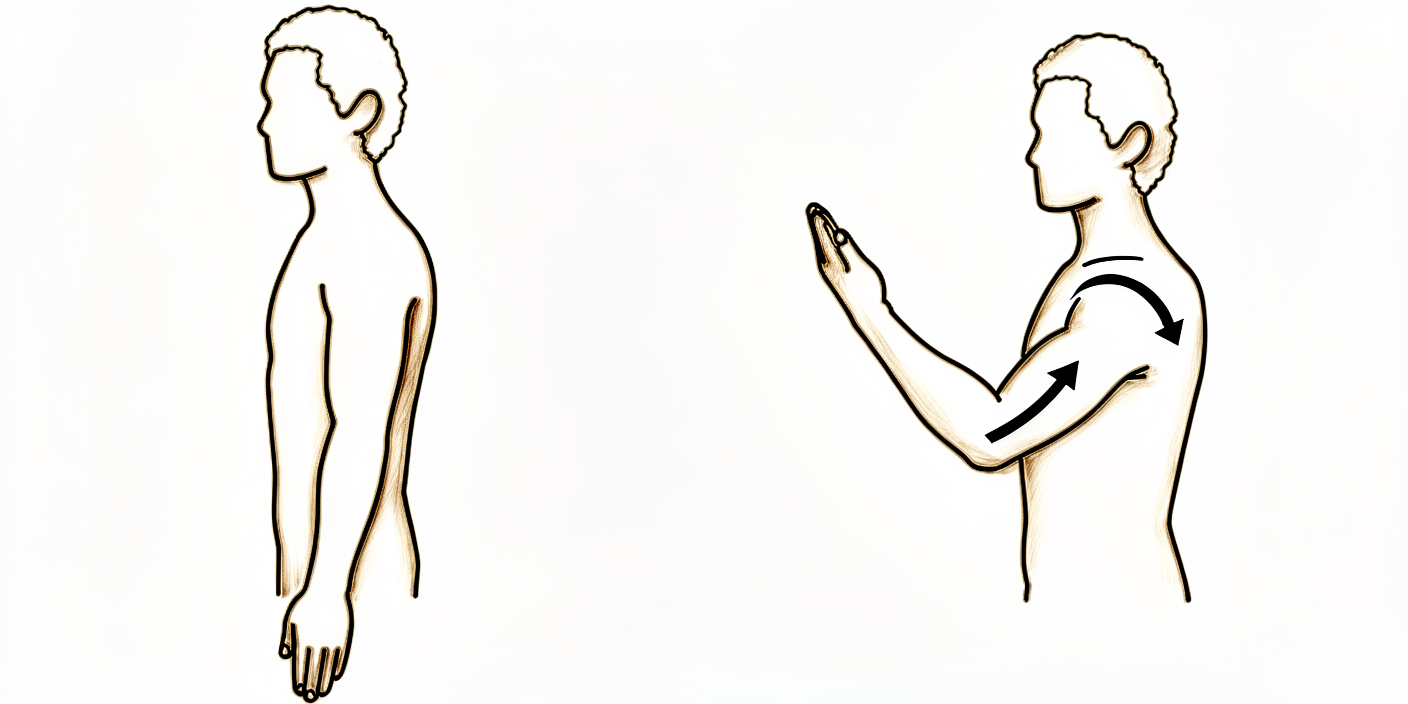
Các động tác gập khuỷu tay chủ động
Tháo cánh tay ra khỏi đai treo, để cánh tay trên đặt sát bên hông, gập khuỷu tay hết mức có thể trong giới hạn thoải mái, rồi duỗi thẳng hoàn toàn. Chỉ có khuỷu tay chuyển động — giữ vai yên và cánh tay sát bên hông.
Theo hướng dẫn của chuyên viên vật lý trị liệu của bạn.
Kieran Hirpara 4.0
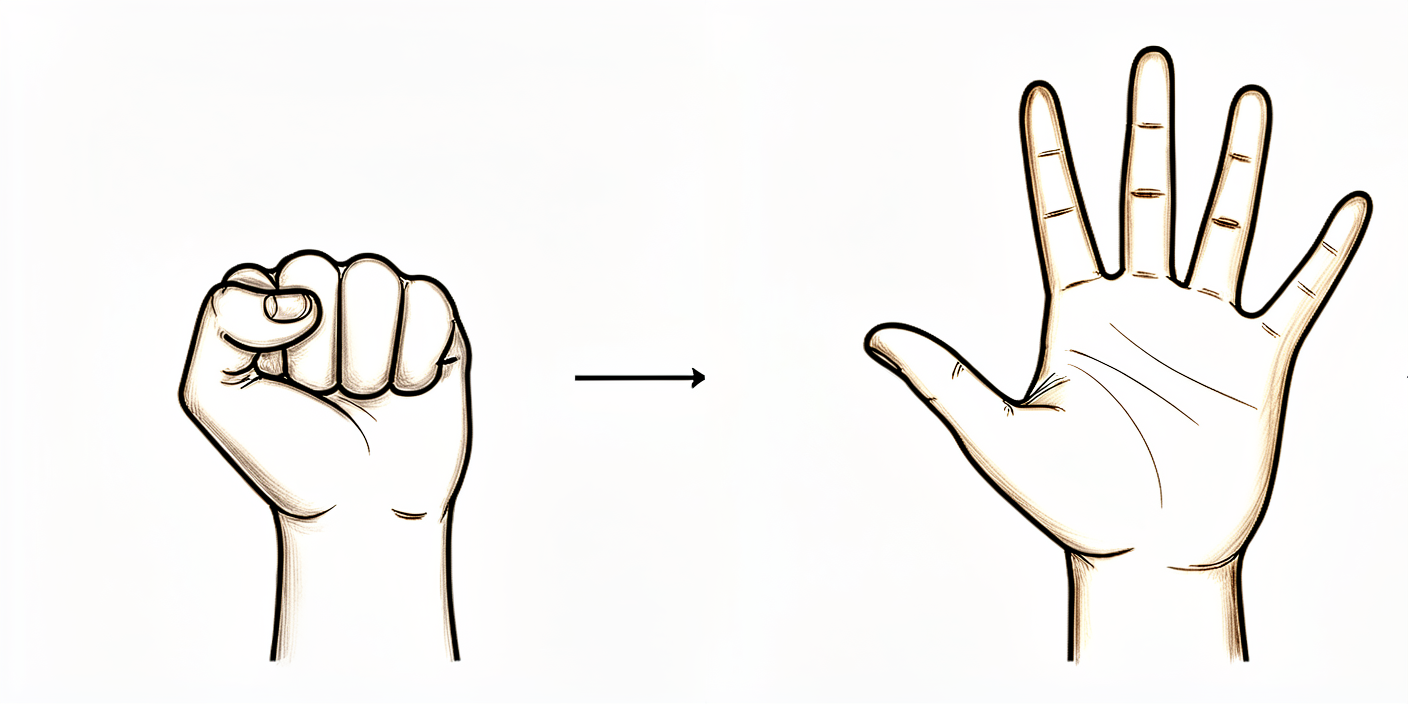
Mở và nắm tay
Nắm chặt bàn tay, sau đó mở bàn tay ra và xòe hết các ngón tay. Hãy giữ cho bàn tay hoạt động nhẹ nhàng suốt cả ngày — bạn được khuyến khích viết, ăn uống và sử dụng điện thoại trong khi cánh tay vẫn nằm trong đai treo.
Theo hướng dẫn của chuyên viên vật lý trị liệu của bạn.
Kieran Hirpara 4.0
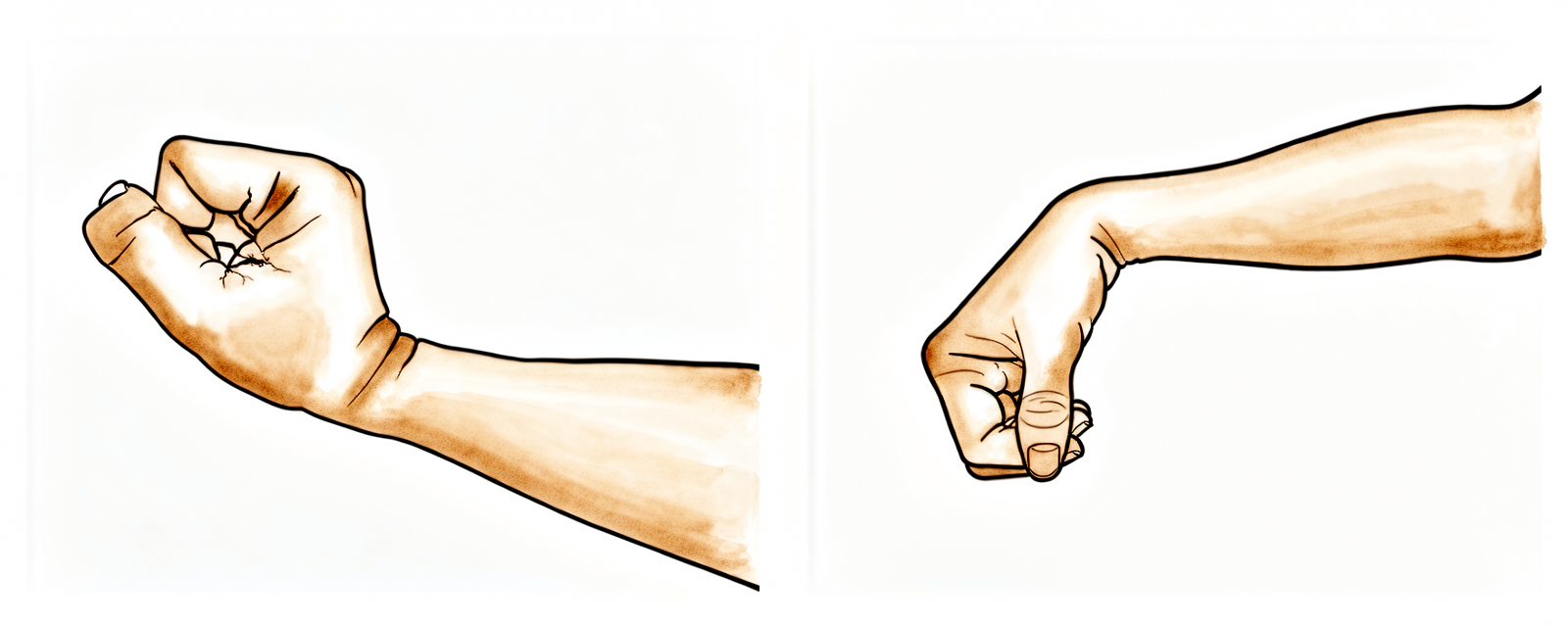
Chuyển động cổ tay
Tháo cánh tay ra khỏi đai treo và để sát bên hông, giữ cho cổ tay vận động bằng cách gập cổ tay về phía trước, về phía sau và nhẹ nhàng sang hai bên. Cũng như các bài tập cho khuỷu tay và bàn tay, động tác này giúp cẳng tay luôn mềm dẻo trong khi vai được bảo vệ.
Theo hướng dẫn của chuyên viên vật lý trị liệu của bạn.
Kieran Hirpara 4.0
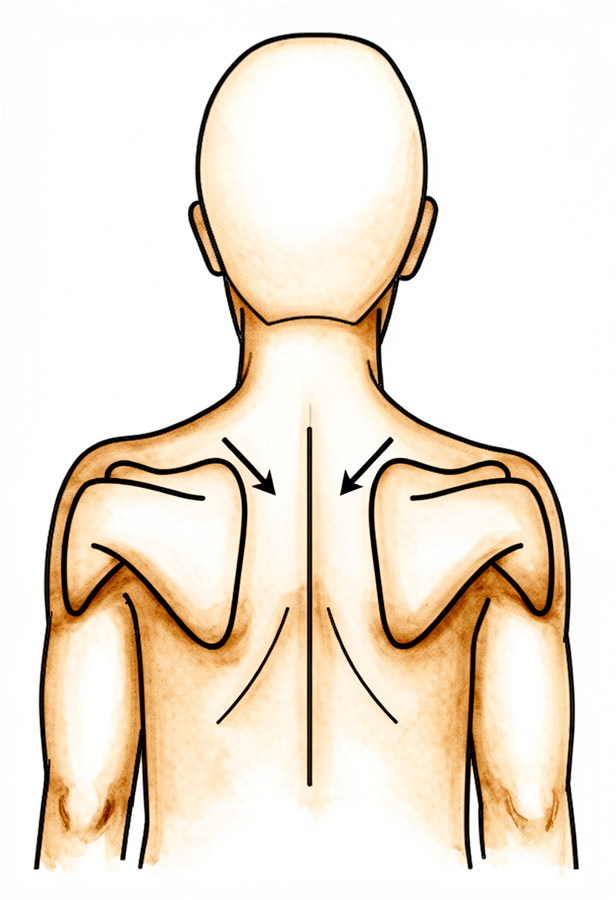
Định vị xương bả vai và nhún vai
Ngồi hoặc đứng thẳng lưng, nhẹ nhàng siết hai xương bả vai xuống dưới và lại gần nhau mà không ưỡn lưng, giữ vài giây rồi thả lỏng. Thêm động tác nhún vai nhẹ nhàng — nâng vai lên về phía tai rồi để vai hạ xuống. Duy trì tư thế đúng suốt cả ngày: tai, vai và hông thẳng hàng.
Theo hướng dẫn của chuyên viên vật lý trị liệu của bạn.
Sáu tuần đầu tiên chỉ tập trung vào một mục tiêu: để các mảnh xương củ lớn lành vào xương và vào chân giả, không bị xáo trộn. Bạn phải đeo đai treo (sling) cả ngày lẫn đêm, giữ cho khuỷu tay, cổ tay và bàn tay vận động, và chỉ để vai được vận động thụ động (nhẹ nhàng, bởi nhà vật lý trị liệu của bạn hoặc khi cánh tay hoàn toàn thả lỏng) trong các giới hạn dưới đây. Các quy tắc quan trọng nhất là: không vận động chủ động vai, không xoay cánh tay ra ngoài quá các giới hạn, không với tay ra sau lưng, không nâng bất kỳ vật gì, và không đẩy cơ thể lên qua hai bàn tay. Nếu bạn được thay khớp vai ngược, các quy tắc này cũng bảo vệ khớp mới khỏi bị trật trong khi các mô mềm lành. Khi nằm ngửa, hãy kê một chiếc gối nhỏ hoặc khăn cuộn dưới khuỷu tay để vai không bị kéo căng ra phía sau.
Dành cho nhà vật lý trị liệu của bạn:
Mục tiêu
- Bảo vệ quá trình sửa chữa xương củ lớn và chân giả
- Giảm sưng, giảm thiểu đau
- Duy trì tầm vận động chủ động (ROM) ở khuỷu tay, cổ tay và bàn tay
- Tầm vận động thụ động (PROM) nhẹ nhàng, bảo vệ ở vai trong vùng an toàn
- Duy trì ý thức về vị trí xương bả vai và tư thế
- Giáo dục bệnh nhân
Nạng cố định vai (Sling)
- 6 tuần, kể cả khi ngủ
- Chỉ tháo ra khi rửa và tập bài tập; cánh tay vẫn để bên hông khi không đeo đai treo
Quản lý
- Quản lý sưng: chườm đá, chườm nén
- Tầm vận động / khả năng vận động:
- Chỉ PROM, trong vùng an toàn: nâng vai trong mặt phẳng xương bả vai ≤ 90 độ; xoay ngoài (ER) về vị trí trung hòa (0 độ) trong 4 tuần đầu, sau đó ≤ 30 độ; không xoay trong (IR) ra sau lưng
- Bài tập con lắc, thực hiện hoàn toàn thả lỏng như một bài tập thụ động
- Tầm vận động hỗ trợ chủ động (AAROM): không dùng cho vai
- Tầm vận động chủ động (AROM): khuỷu tay, cổ tay, bàn tay và các ngón tay; cột sống cổ
- Định vị xương bả vai, nhún vai và điều chỉnh tư thế
- Khuyến khích sử dụng tay nhẹ nhàng trong khi đeo đai treo (viết, ăn, dùng điện thoại)
- Dùng thuốc giảm đau trước khi tập bài tập và các buổi vật lý trị liệu
Các biện pháp phòng ngừa
- Không vận động chủ động (AROM) hoặc hỗ trợ chủ động (AAROM) ở vai
- Không xoay ngoài thụ động hoặc chủ động quá các giới hạn nêu trên (quá trình sửa chữa xương củ lớn chịu tải trọng bởi xoay ngoài)
- Không xoay trong kháng lực (quá trình sửa chữa xương củ nhỏ/cơ dưới gai chịu tải trọng bởi xoay trong)
- Không với tay ra sau lưng; không kết hợp dạng vai, xoay trong và duỗi (tư thế trật khớp trong thay khớp vai ngược)
- Không nâng vật; không chịu trọng lượng cơ thể qua bàn tay (ví dụ: đẩy người lên từ ghế hoặc giường)
- Đặt một chiếc gối nhỏ hoặc cuộn khăn dưới khuỷu tay khi nằm ngửa, để vai không bị rơi vào tư thế duỗi quá mức
- Không ép bất kỳ chuyển động nào gây đau
Tiêu chí để chuyển giai đoạn
- Đã qua 6 tuần VÀ phim X-quang cho thấy xương củ lớn đang lành đúng vị trí, được xác nhận tại buổi tái khám với Bác sĩ Hirpara
- Đau được kiểm soát bằng thuốc giảm đau đường uống
- Không có vấn đề về vết mổ và không có dấu hiệu mất ổn định
Giai đoạn II — Khôi phục vận động (Tuần 6–12)
Kieran Hirpara 4.0
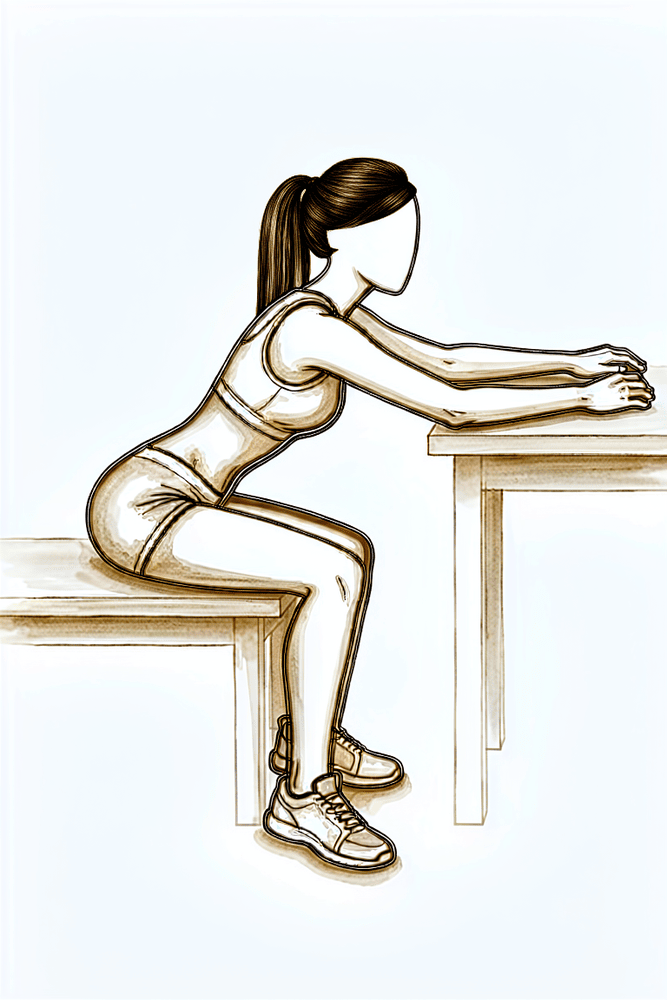
Trượt tay trên bàn
Ngồi cạnh bàn, đặt cẳng tay lên mặt bàn. Nhẹ nhàng cúi người về phía trước để bàn tay trượt dọc mặt bàn, để mặt bàn đỡ trọng lượng của cánh tay, rồi ngồi thẳng trở lại. Tăng dần trong giới hạn thoải mái — không cố tập khi thấy đau.
Theo hướng dẫn của chuyên viên vật lý trị liệu của bạn.
Kieran Hirpara 4.0
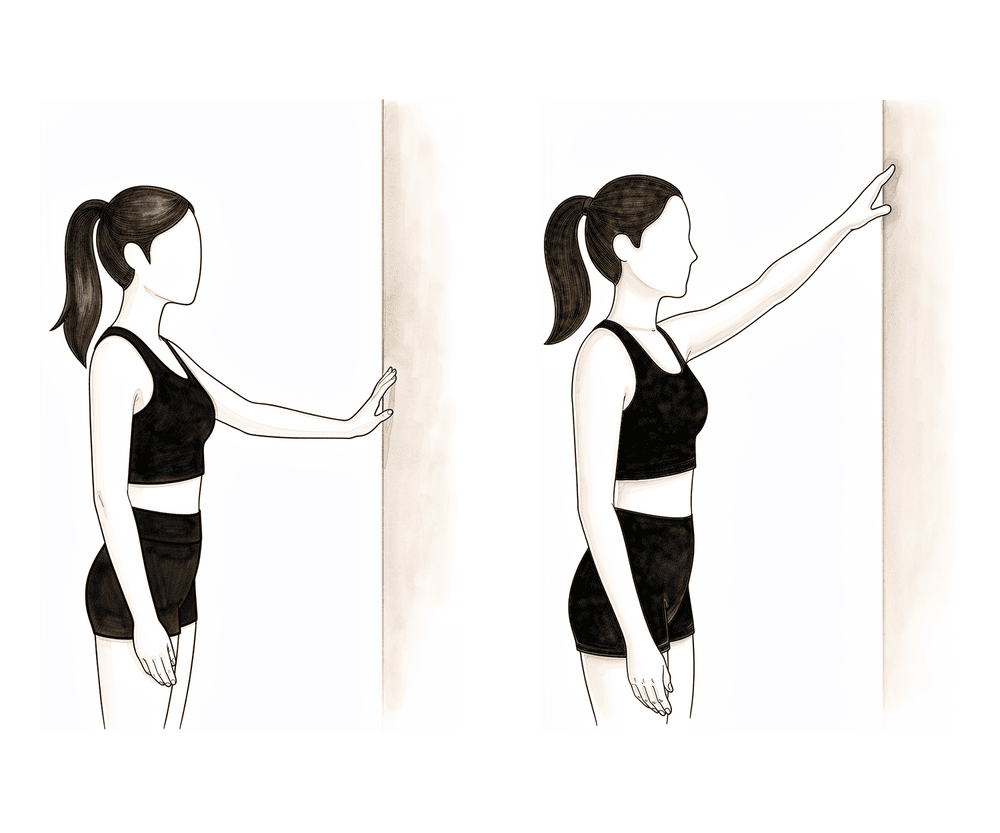
Leo tường (bước ngón tay)
Đứng quay mặt vào tường và từ từ “bước” các ngón tay lên tường, để bức tường đỡ trọng lượng của cánh tay, sau đó “bước” ngón tay xuống một cách có kiểm soát. Chỉ đưa tay lên cao đến mức còn thấy thoải mái, không nhún vai và không ưỡn lưng.
Theo hướng dẫn của chuyên viên vật lý trị liệu của bạn.
Kieran Hirpara 4.0
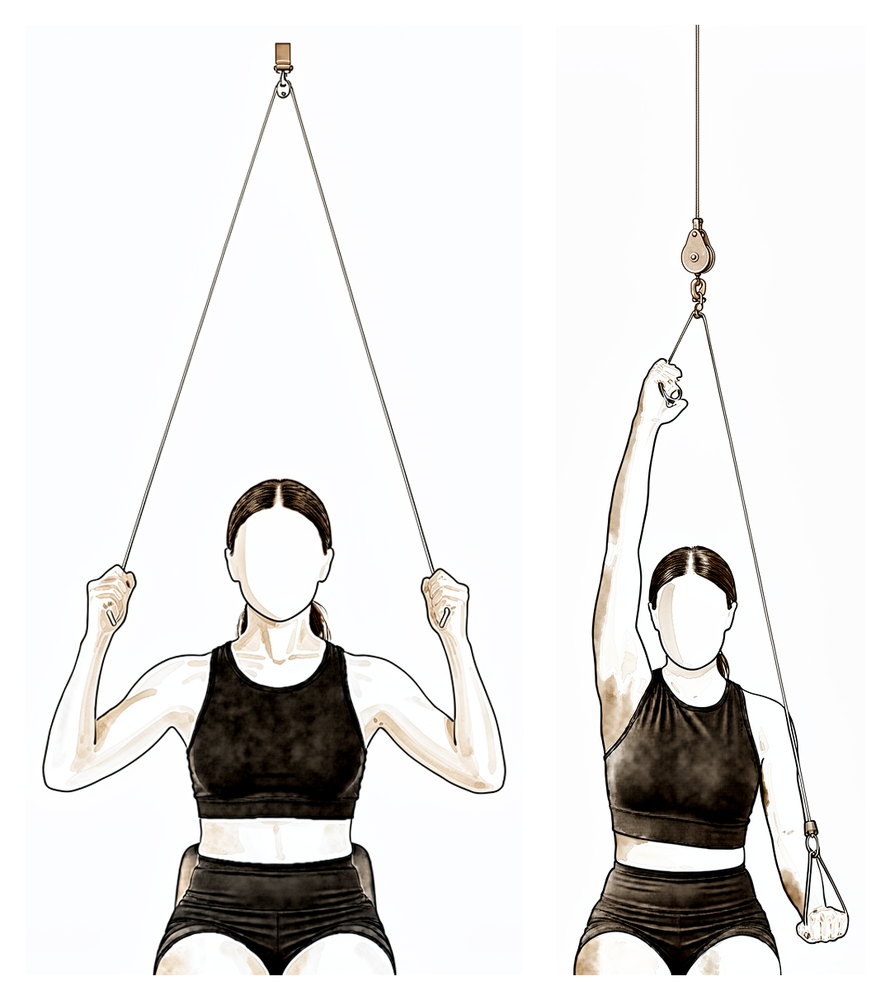
Nâng tay ra trước với sự hỗ trợ của ròng rọc
Ngồi bên dưới một ròng rọc treo trên cửa. Giữ cánh tay vừa phẫu thuật thả lỏng, dùng tay còn lại kéo dây xuống để dây nhẹ nhàng nâng cánh tay vừa phẫu thuật lên phía trước, rồi từ từ hạ xuống. Cánh tay lành thực hiện động tác — không cố ép biên độ vận động.
Theo hướng dẫn của chuyên viên vật lý trị liệu của bạn.
Kieran Hirpara 4.0
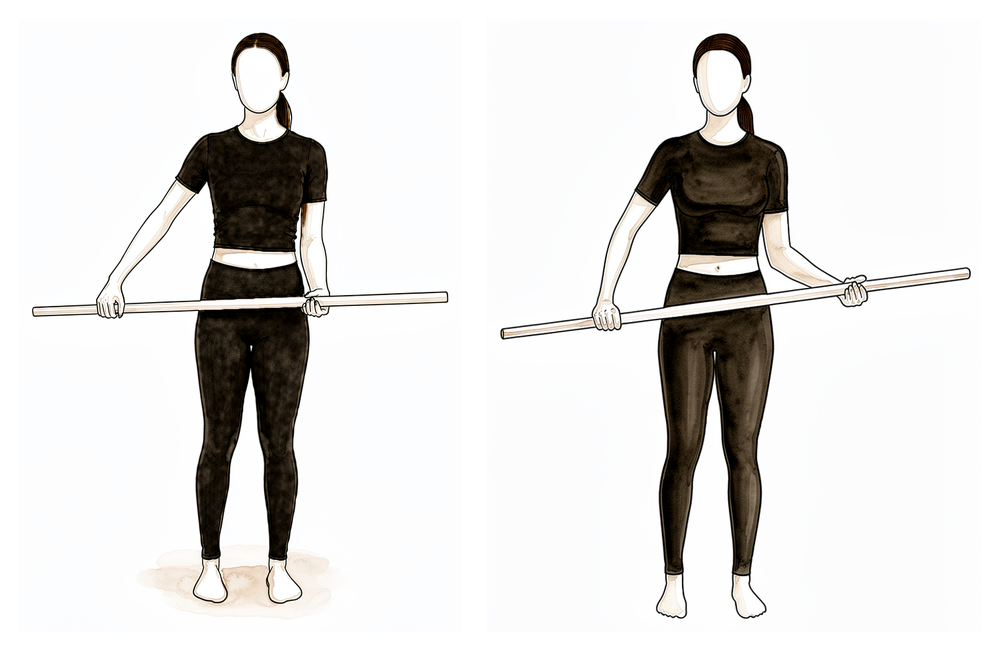
Xoay ngoài với sự hỗ trợ của gậy
Nằm ngửa, cầm một cây gậy bằng cả hai tay, khuỷu tay gập 90 độ và áp sát hai bên thân. Dùng cánh tay lành đẩy để cẳng tay vừa phẫu thuật xoay ra ngoài, trong giới hạn đã thống nhất tại buổi tái khám, rồi đưa trở lại. Cánh tay vừa phẫu thuật luôn thả lỏng — tuyệt đối không ép động tác.
Theo hướng dẫn của chuyên viên vật lý trị liệu của bạn.
Kieran Hirpara 4.0
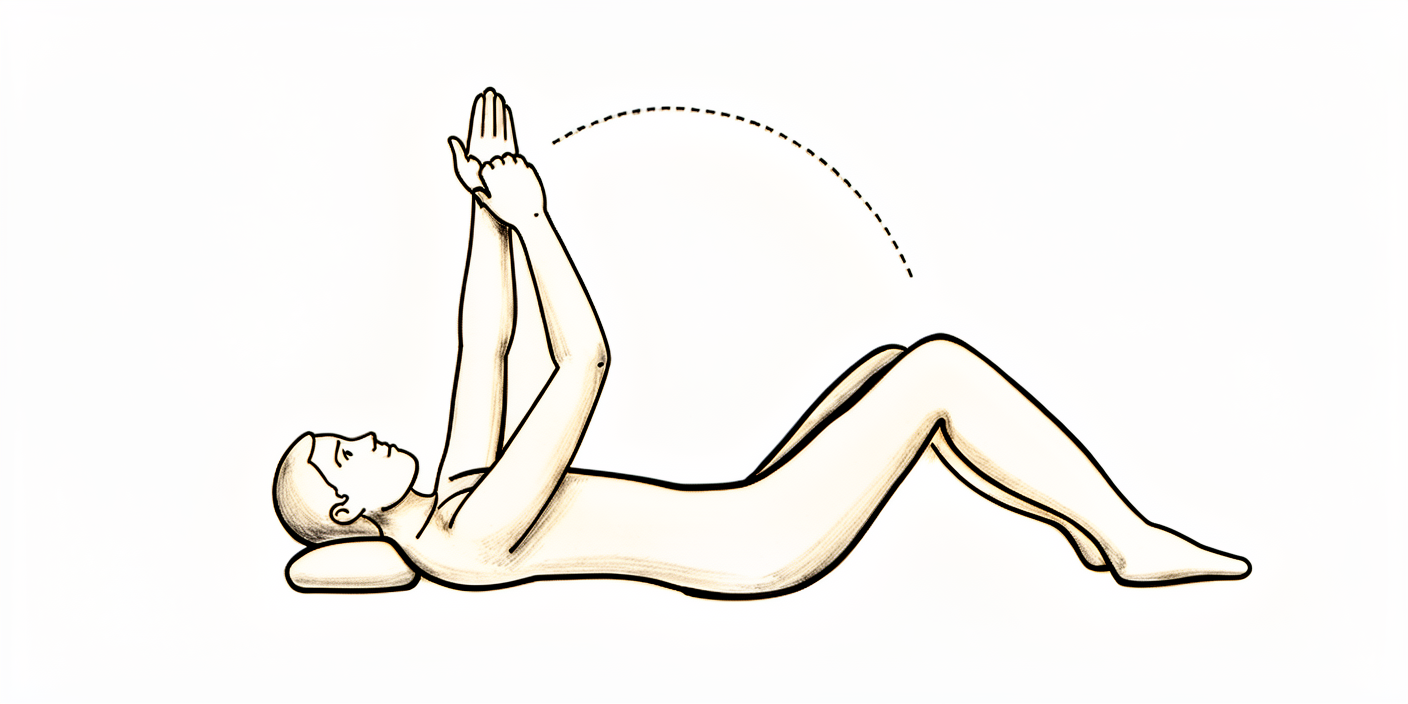
Nâng tay ra trước có hỗ trợ (tư thế nằm)
Nằm ngửa và dùng cánh tay lành — hoặc một cây gậy cầm bằng cả hai tay — để hỗ trợ nâng cánh tay vừa phẫu thuật lên phía trước, đến mức còn thấy thoải mái, rồi hạ xuống trong khi cánh tay lành vẫn hỗ trợ. Vai vừa phẫu thuật luôn thả lỏng và cánh tay lành thực hiện động tác, giúp phục hồi biên độ vận động mà không gây căng cho vết sửa chữa đang lành.
Theo hướng dẫn của chuyên viên vật lý trị liệu của bạn.
Kieran Hirpara 4.0
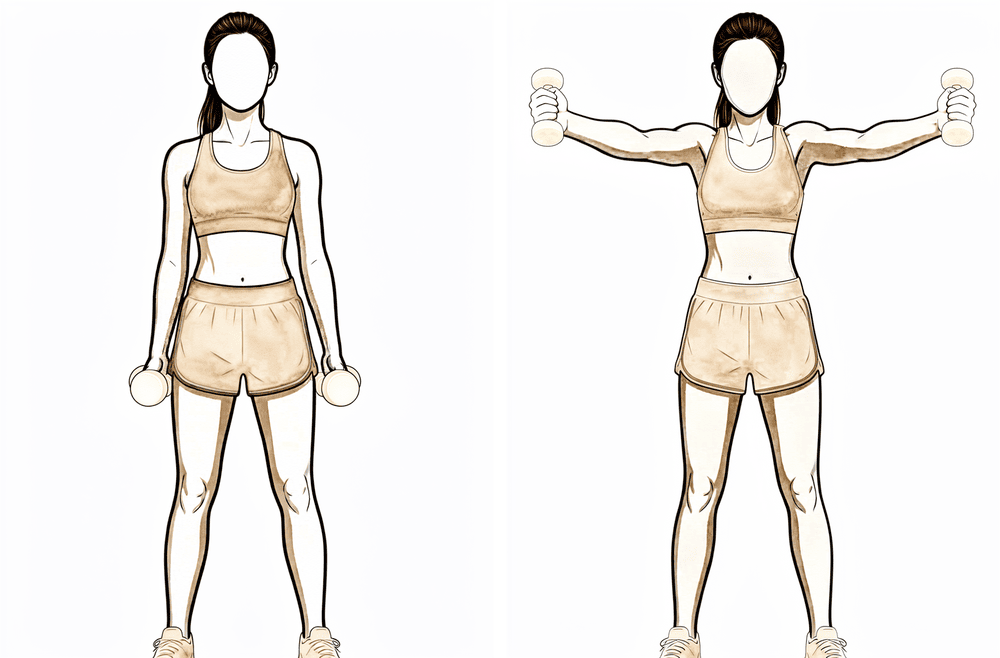
Nâng tay chủ động trong mặt phẳng xương bả vai (tư thế “lon đầy”)
Khi chuyên viên vật lý trị liệu đã cho phép vận động chủ động, hãy nâng cánh tay lên theo góc khoảng 45 độ giữa hướng phía trước và hướng sang bên, ngón cái hướng lên như đang cầm một lon nước đầy. Chỉ nâng lên đến mức bạn còn kiểm soát tốt, rồi từ từ hạ xuống. Bài tập này bắt đầu giai đoạn nâng tay chủ động khi các mấu động xương cánh tay đã bắt đầu lành — không bắt đầu sớm hơn.
Theo hướng dẫn của chuyên viên vật lý trị liệu của bạn.
Kieran Hirpara 4.0
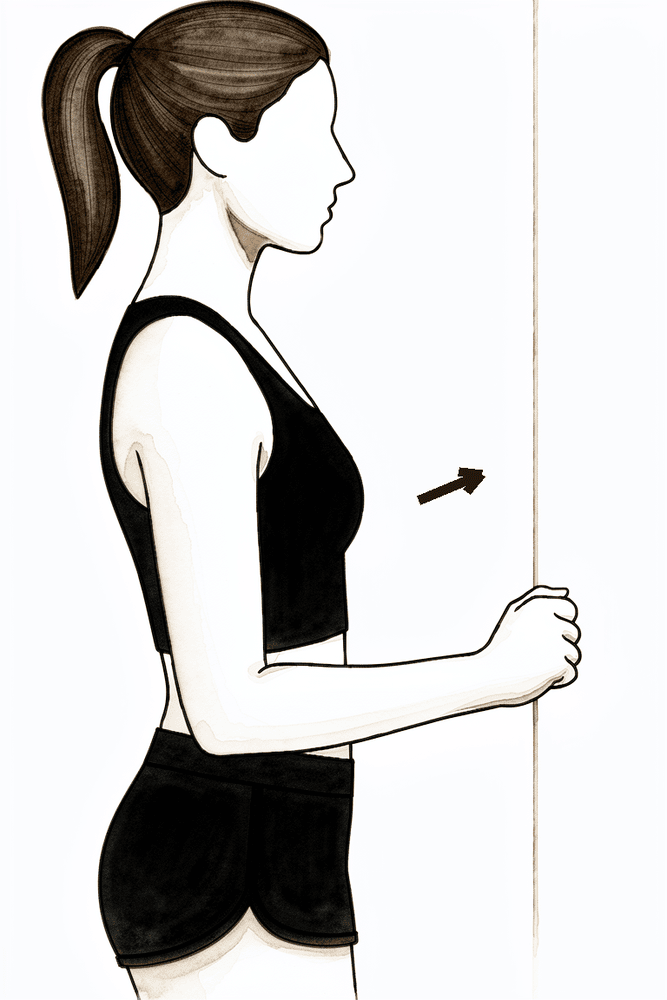
Ấn tĩnh về phía trước (cơ delta)
Đứng quay mặt vào tường, khuỷu tay gập, đặt một chiếc khăn gấp giữa nắm tay và tường. Nhẹ nhàng ấn nắm tay về phía trước vào tường mà không để cánh tay di chuyển, giữ vài giây rồi thả lỏng. Bài tập này kích hoạt cơ delta mà không cần cử động — chỉ bắt đầu vào cuối giai đoạn này, thực hiện nhẹ nhàng và không gây đau.
Theo hướng dẫn của chuyên viên vật lý trị liệu của bạn.
Kieran Hirpara 4.0
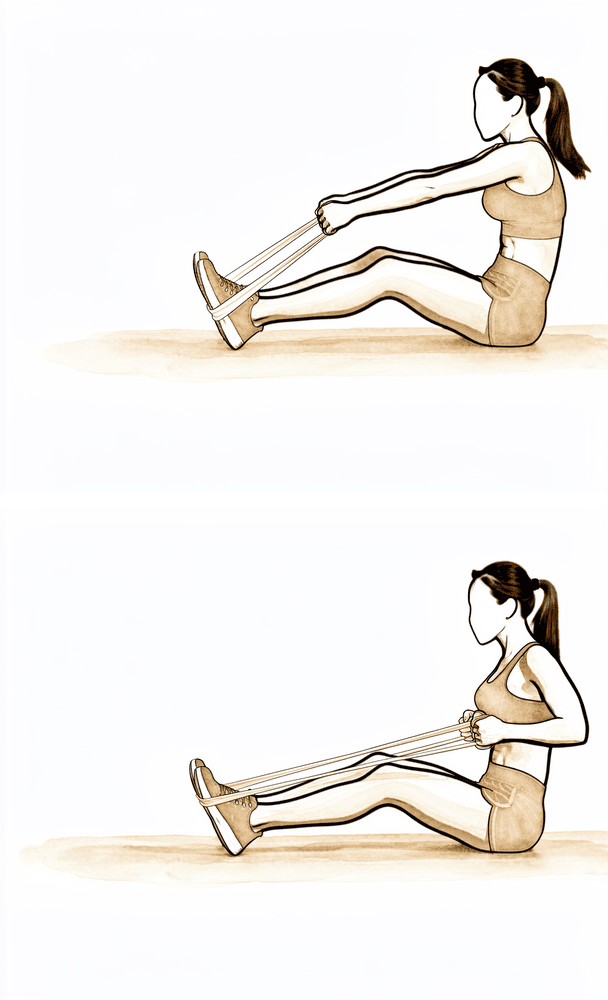
Tập kéo dây thấp
Ngồi hoặc đứng thẳng lưng, kéo khuỷu tay ra sau và xuống về phía hông, siết xương bả vai xuống dưới và ra sau, giữ một lúc rồi thả ra. Bài tập này kích hoạt các cơ quanh xương bả vai vốn nâng đỡ khớp vai — hãy tập nhẹ nhàng trong giai đoạn này.
Theo hướng dẫn của chuyên viên vật lý trị liệu của bạn.
Kieran Hirpara 4.0
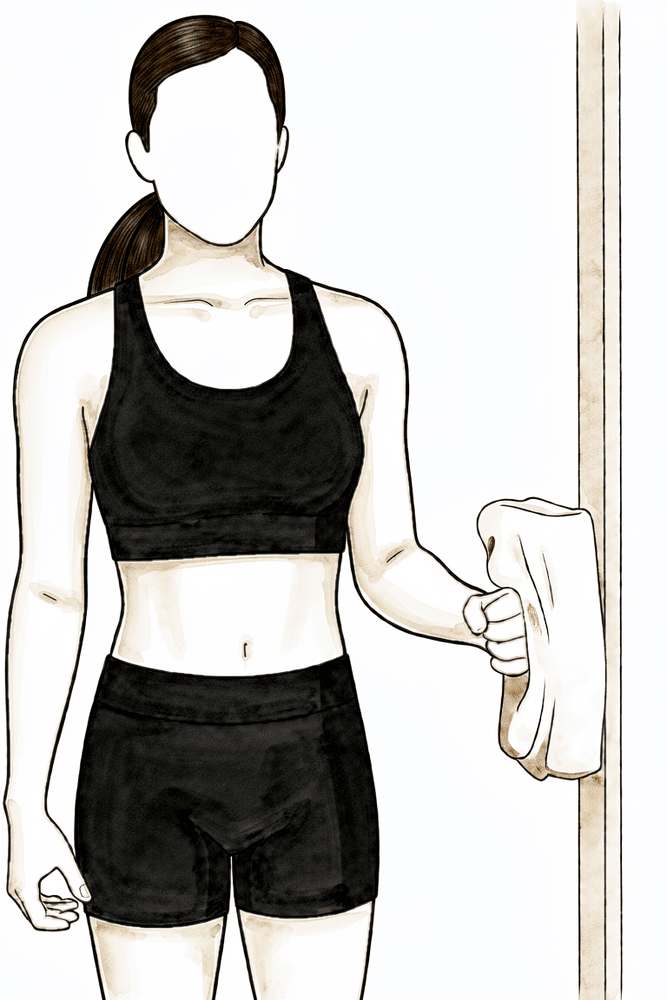
Xoay ngoài đẳng trường
Đứng thẳng, khuỷu tay áp sát vào hông và gập thành góc vuông; mu bàn tay chạm vào tường hoặc khung cửa. Nhẹ nhàng đẩy tay ra ngoài mà không để cánh tay di chuyển, giữ vài giây rồi thả lỏng. Chỉ bắt đầu bài tập này vào cuối giai đoạn, nhẹ nhàng và không gây đau, khi vết sửa chữa chóp xoay cho phép.
Theo hướng dẫn của chuyên viên vật lý trị liệu của bạn.
Kieran Hirpara 4.0
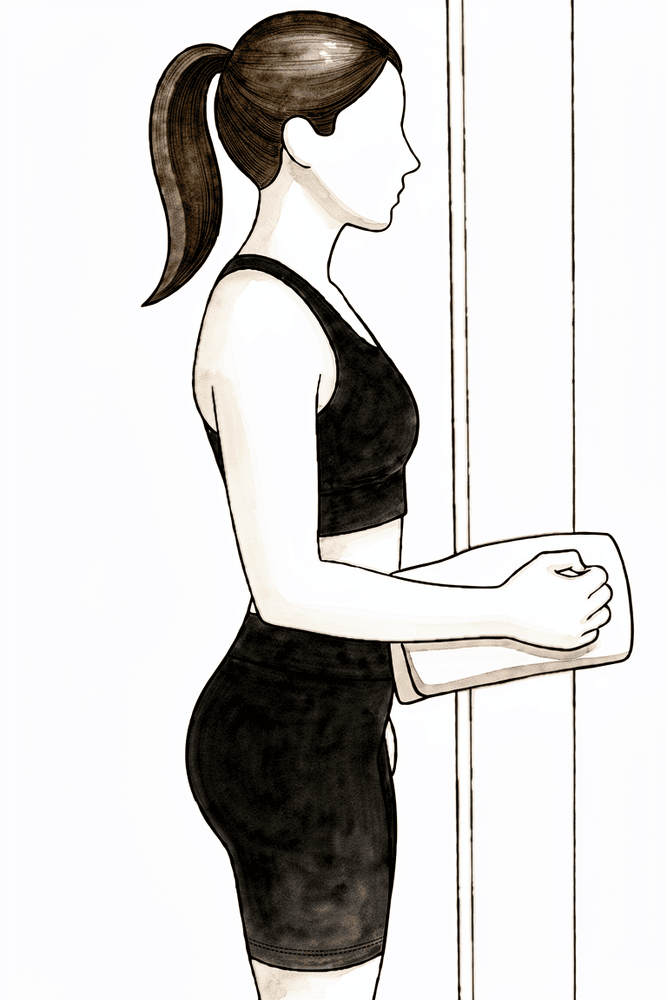
Xoay trong đẳng trường
Đứng thẳng, khuỷu tay áp sát vào hông và gập thành góc vuông; lòng bàn tay chạm vào khung cửa. Nhẹ nhàng ấn tay vào trong mà không để cánh tay di chuyển, giữ vài giây rồi thả lỏng. Chỉ bắt đầu khi đã được cho phép tại buổi tái khám — động tác xoay trong tạo lực lên vết sửa chữa mấu động bé, vì vậy bài tập này được để lại sau cùng.
Theo hướng dẫn của chuyên viên vật lý trị liệu của bạn.
Kieran Hirpara 4.0
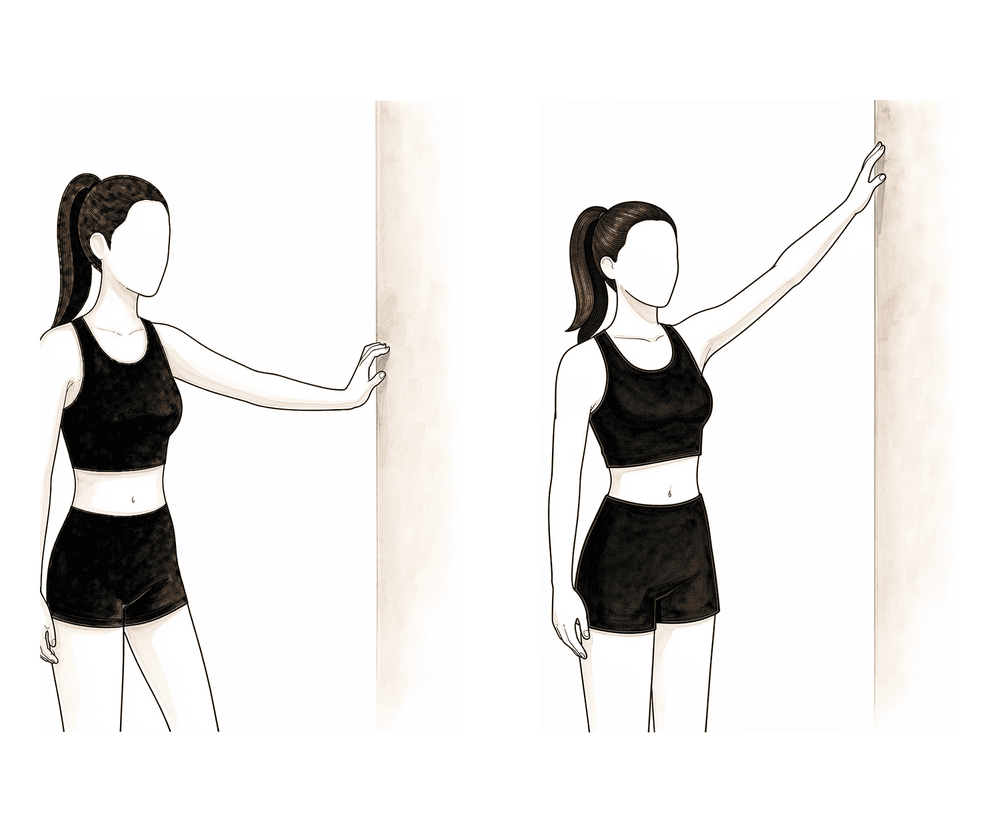
Di chuyển dọc theo tường sang phía bên
Đứng hướng ngang về phía tường, đặt đầu ngón tay lên bề mặt tường. Dùng các ngón tay di chuyển dần lên phía trên dọc theo tường sang bên hông, đồng thời nâng cánh tay lên mức thoải mái nhất; sau đó từ từ hạ cánh tay xuống lại một cách có kiểm soát. Bức tường sẽ giúp nâng đỡ cánh tay trong quá trình bạn khôi phục khả năng vận động sang bên hông.
Theo hướng dẫn của chuyên viên vật lý trị liệu của bạn.
Tại buổi tái khám vào tuần thứ 6, phim X-quang kiểm tra xem các mảnh xương có đang liền đúng vị trí hay không. Nếu có, đai treo sẽ được tháo bỏ và vai bắt đầu vận động chủ động, ban đầu được hỗ trợ bằng cánh tay lành, gậy hoặc ròng rọc, sau đó là vận động chủ động hoàn toàn. Phạm vi vận động thụ động (PROM) tiến triển dần tới mức đầy đủ trong các tuần này, và các hạn chế về xoay giảm bớt. Công tác kích hoạt cơ nhẹ nhàng đầu tiên bắt đầu cho cơ delta và các cơ quanh bả vai (periscapular). Những gì chưa bắt đầu ngay lúc này là tập tăng sức mạnh: vết mổ vẫn đang trong quá trình củng cố, nên quy tắc nâng vật vẫn giới hạn ở mức không nặng hơn một tách cà phê, và vẫn chưa được chống đẩy bằng tay.
Dành cho nhà vật lý trị liệu:
Mục tiêu
- Tạm ngưng sử dụng đai treo sau buổi tái khám tuần thứ 6
- Tiến triển phạm vi vận động thụ động (PROM) của vai tới mức đầy đủ khi bệnh nhân cho phép
- Bắt đầu phạm vi vận động chủ động hỗ trợ (AAROM) của vai, tiến triển tới phạm vi vận động chủ động (AROM)
- Bắt đầu kích hoạt nhẹ nhàng cơ delta và các cơ quanh bả vai
- Khôi phục khả năng sử dụng cánh tay cho các hoạt động sinh hoạt hàng ngày nhẹ nhàng ở mức thắt lưng và ngực
- Giáo dục bệnh nhân
Đai treo
- Ngừng sử dụng sau buổi tái khám tuần thứ 6; có thể đeo khi ra ngoài nhà để bảo vệ trong đám đông trong một hoặc hai tuần đầu tiên của giai đoạn ngưng đeo
Quản lý điều trị
- Tiếp tục các can thiệp của Giai đoạn I khi cần thiết
- Phạm vi vận động / khả năng di chuyển:
- PROM: tiến triển tới phạm vi đầy đủ ở mọi mặt phẳng vào khoảng tuần 8–10, tôn trọng mức độ đau
- AAROM: trượt trên bàn, leo tường, ròng rọc, hỗ trợ gậy để nâng vai và xoay ngoài, nằm ngửa tiến triển tới ngồi
- AROM: bắt đầu khi AAROM đã thoải mái và chất lượng vận động tốt, bắt đầu bằng nâng vai khi nằm ngửa tiến triển tới nâng vai khi đứng thẳng và nâng vai sang bên (scaption)
- XOAY NGOÀI (ER): tiến triển vượt quá 30 độ khi bệnh nhân cho phép sau khi đã xác nhận quá trình liền xương
- Giới thiệu nhẹ nhàng các tư thế chức năng đặt tay sau lưng và duỗi vào cuối giai đoạn này, khi được bác sĩ cho phép. Không kéo căng vào các tư thế này.
- Tăng sức mạnh:
- Chỉ đẳng trương dưới ngưỡng tối đa không đau: cơ delta ở mặt phẳng bả vai, co cơ quanh bả vai, chèo thuyền nhẹ, kéo bả vai lại
- Đẳng trương cơ vòng xoay (rotator cuff) nhẹ nhàng không đau vào cuối giai đoạn này; chỉ đưa vào xoay trong có kháng cự khi được cho phép tại buổi tái khám
- Kiểm soát vận động: nhấn mạnh kiểm soát bả vai và tránh các kiểu bù trừ như nhún vai hoặc các mô hình bù trừ khác
Các biện pháp phòng ngừa
- Không nâng vật nặng hơn một tách cà phê
- Không chịu trọng lượng cơ thể qua bàn tay
- Không thực hiện kháng cự hoặc tập tăng sức mạnh vượt quá đẳng trương nhẹ nhàng
- Tránh ép phạm vi vận động: chỉ kéo căng tới mức khó chịu chắc chắn, tuyệt đối không đau nhói
Tiêu chí để tiến triển giai đoạn
- Vận động chủ động thoải mái dưới mức vai với kiểm soát bả vai tốt và bù trừ tối thiểu
- Quá trình liền xương của các tuberosities tiếp tục trên phim X-quang, như được xác nhận tại buổi tái khám với Bác sĩ Hirpara
- Đau đã giảm đủ để bắt đầu công tác kháng cự
Giai đoạn III — Tăng cường sức mạnh (Tuần 12–24)
Kieran Hirpara 4.0
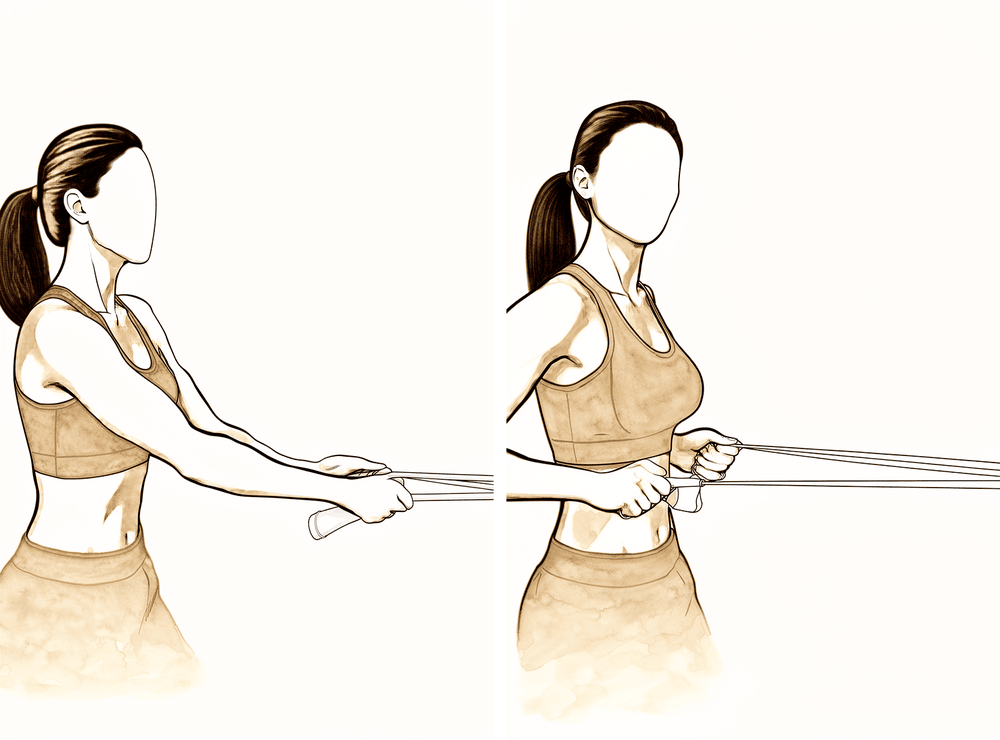
Kéo dây thun (chèo thuyền)
Cố định một dây thun phía trước bạn ở độ cao ngang eo. Đứng thẳng, kéo dây về phía mình, đồng thời kéo xương bả vai xuống dưới và ra sau, rồi thả ra một cách có kiểm soát. Bắt đầu với lực cản nhẹ — tải thấp và nhiều lần lặp, tăng dần theo hướng dẫn.
Theo hướng dẫn của chuyên viên vật lý trị liệu của bạn.
Kieran Hirpara 4.0
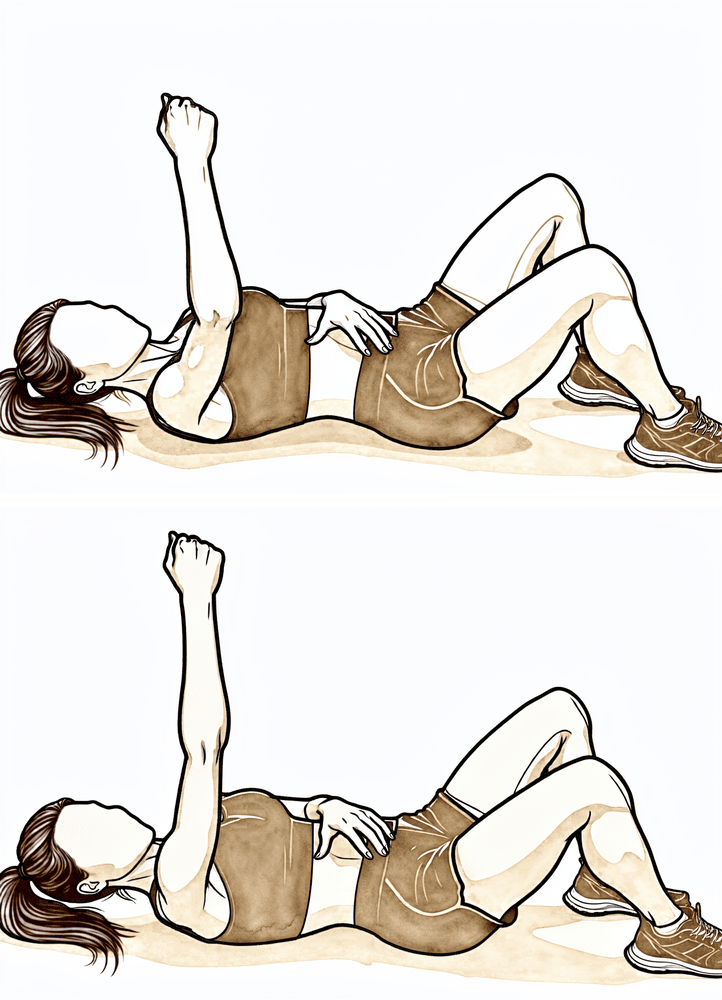
Đẩy tay tập cơ răng cưa
Nằm ngửa, cánh tay vừa phẫu thuật duỗi thẳng hướng lên trần nhà. Không gập khuỷu tay, đẩy bàn tay lên cao thêm một chút để xương bả vai nhấc khỏi sàn, rồi hạ trở lại. Bài tập này tăng cường sức mạnh cho cơ giữ xương bả vai áp vào lồng ngực.
Tải trọng thấp, số lần lặp lại nhiều hơn
Kieran Hirpara 4.0
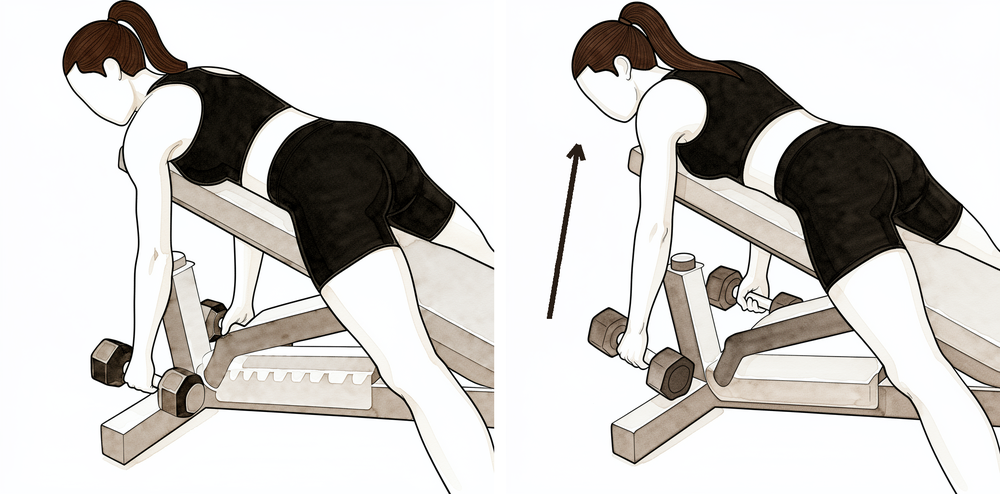
Khép xương bả vai với tạ
Gập người về phía trước từ hông, mỗi tay cầm một quả tạ nhẹ, kéo khuỷu tay ra sau và siết hai xương bả vai lại gần nhau, rồi hạ xuống một cách có kiểm soát. Bài tập này tăng cường các cơ quanh xương bả vai với lực cản — giữ mức tạ nhẹ và động tác nhịp nhàng.
Tải trọng thấp, số lần lặp lại nhiều hơn
Kieran Hirpara 4.0
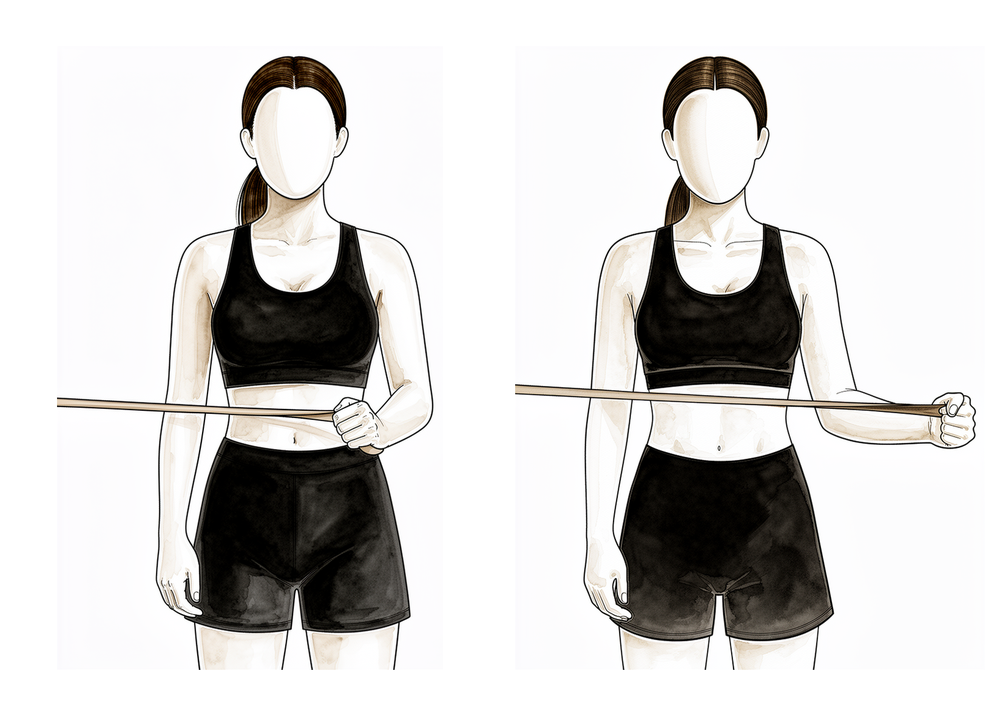
Xoay ngoài với dây thun
Đứng thẳng, khuỷu tay áp sát vào hông và gập thành góc vuông, cầm một dây thun được cố định ở độ cao ngang eo. Giữ khuỷu tay sát bên hông, xoay cẳng tay ra ngoài chống lại lực căng của dây thun, rồi từ từ đưa về. Tăng cường sức mạnh chóp xoay dần dần, trong mức các mấu động đã lành cho phép.
Tải trọng thấp, số lần lặp lại nhiều hơn
Kieran Hirpara 4.0
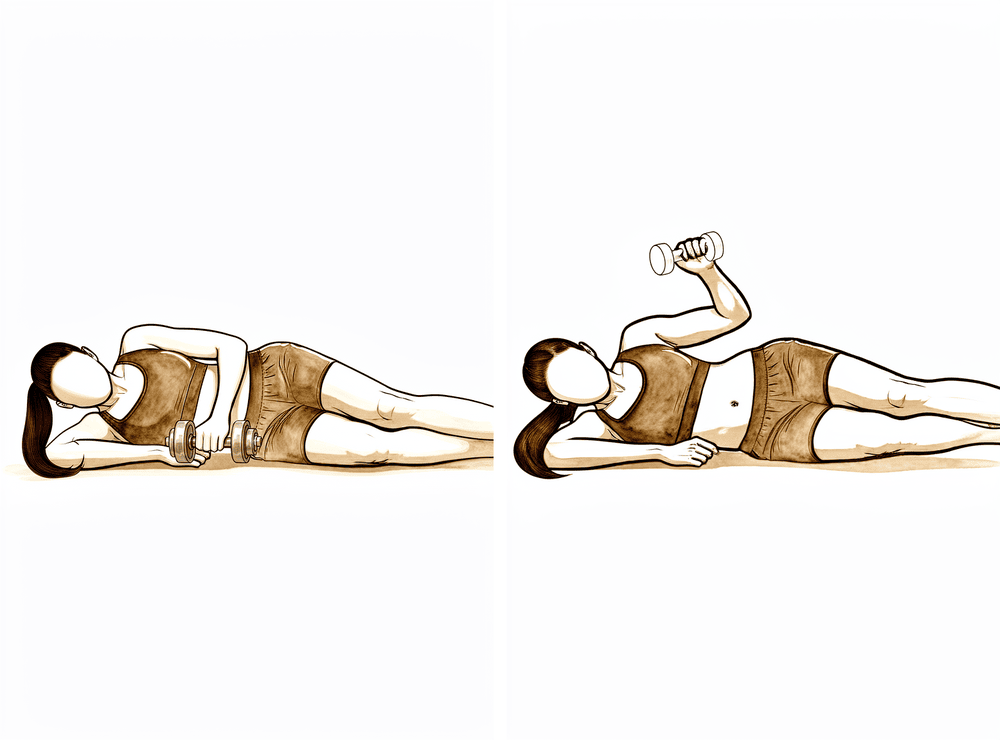
Tư thế nằm nghiêng, xoay ngoài cánh tay có tải trọng
Nằm nghiêng về phía không phẫu thuật, khuỷu tay vừa phẫu thuật gập thành góc vuông và áp sát vào thân mình. Cầm một quả tạ nhẹ, xoay cẳng tay hướng lên trần nhà rồi từ từ hạ xuống. Đây là một phần của chương trình tăng cường chóp xoay theo từng mức — hãy tiếp tục các bài tập vận động song song.
Tải trọng thấp, số lần lặp lại nhiều hơn
Kieran Hirpara 4.0
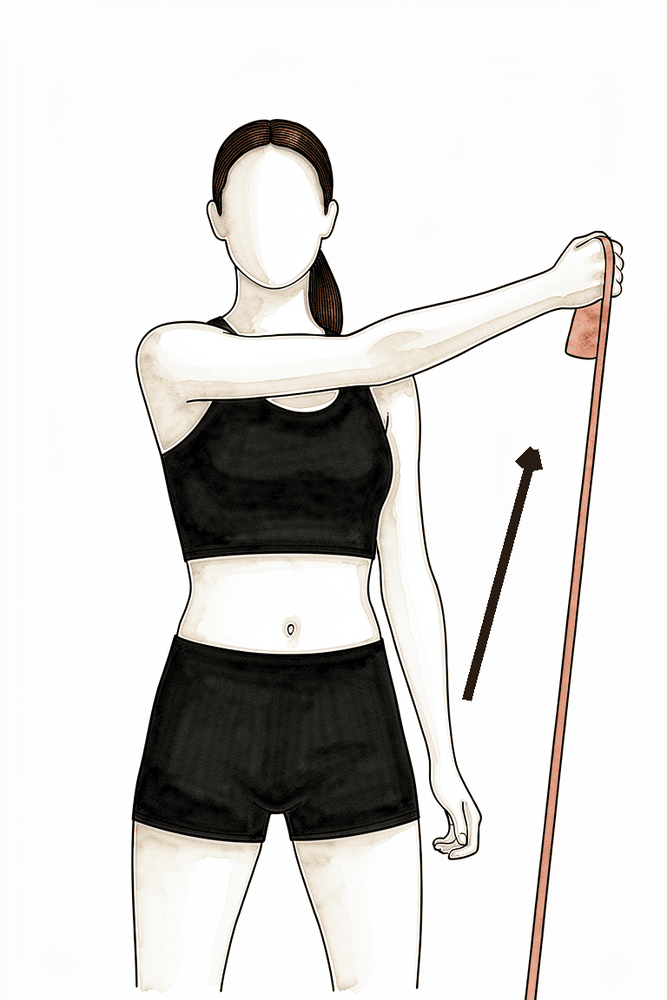
Động tác chéo PNF với dây thun (nâng lên)
Cố định một dây thun ở vị trí thấp, phía bên cánh tay vừa phẫu thuật. Kéo bàn tay theo đường chéo lên trên và băng qua cơ thể, từ gần hông bên đối diện hướng về phía vai, rồi từ từ đưa về. Các động tác chéo này rèn luyện vai hoạt động theo những hướng được dùng trong sinh hoạt hằng ngày.
Theo hướng dẫn của chuyên viên vật lý trị liệu của bạn.
Kieran Hirpara 4.0
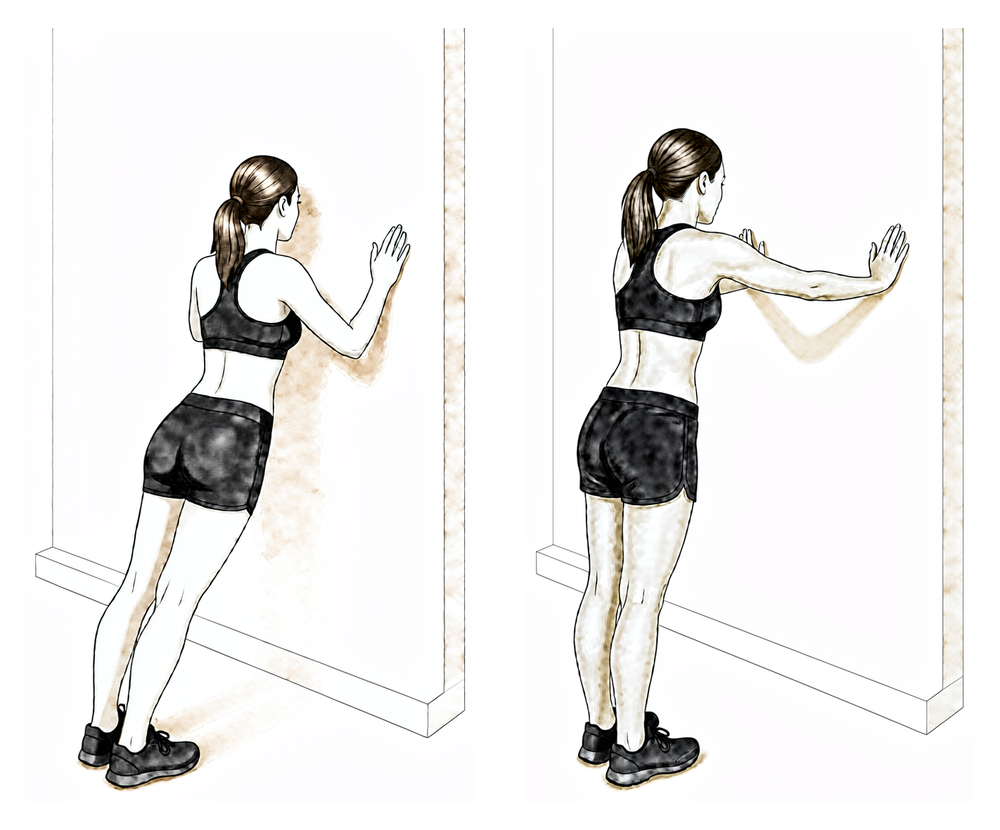
Chịu trọng lượng qua cánh tay
Đặt hai tay lên tường hoặc một chiếc ghế dài chắc chắn, nhẹ nhàng đẩy phần lưng trên ra xa để hai xương bả vai tách ra về phía trước, rồi trở về. Bài tập này giúp cánh tay chịu trọng lượng trở lại — chỉ bắt đầu khi đã được cho phép trong giai đoạn này và tăng dần từ từ.
Theo hướng dẫn của chuyên viên vật lý trị liệu của bạn.
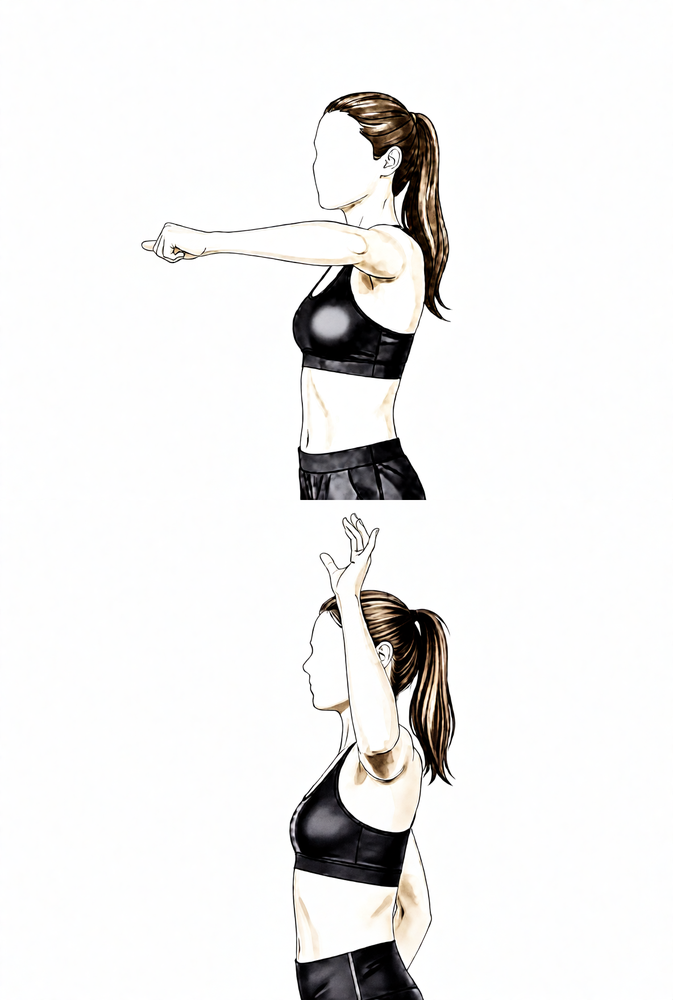
Kieran Hirpara 4.0
Xoay ngoài khi cánh tay được giơ lên.
Hãy giữ tay ra ngang ngang vai, khuỷu tay gập 90°, sau đó xoay cẳng tay lên trên và ra phía sau, rồi từ từ đưa trở lại vị trí ban đầu một cách có kiểm soát. Hãy thực hiện chuyển động một cách mượt mà và trong phạm vi thoải mái. Bài tập này giúp rèn luyện khả năng xoay ngoài của cẳng tay khi tay đang giơ lên.
Theo hướng dẫn của chuyên viên vật lý trị liệu: thực hiện một cách nhẹ nhàng và có kiểm soát.
Đến khoảng tuần thứ mười hai, các củ xương thường đang trong quá trình liền tốt, và buổi tái khám với Bác sĩ Hirpara sẽ xác nhận liệu khớp vai đã sẵn sàng để chịu tải hay chưa. Việc tăng cường sức mạnh sau đó bắt đầu một cách nhẹ nhàng, khởi đầu với dây đàn hồi và tạ nhẹ, tập trung vào cơ delta và các cơ xương bả vai điều khiển khớp vai (sau phẫu thuật thay khớp vai ngược, cơ delta đảm nhận phần lớn công việc mà chóp xoay từng thực hiện). Bản thân chóp xoay được tăng cường sức mạnh tùy theo mức độ liền của các củ xương. Việc nâng vật nhẹ được tăng dần trong giai đoạn này, các hoạt động hàng ngày ở tầm thắt lưng và tầm vai sẽ cảm thấy gần như bình thường, và việc lái xe thường được khôi phục trong giai đoạn này nếu trước đó chưa thực hiện lại.
Dành cho chuyên gia vật lý trị liệu:
Mục tiêu
- Duy trì PROM không đau và tiến triển AROM trên tất cả các mặt phẳng
- Phục hồi dần sức mạnh và sức bền: cơ delta, các cơ quanh xương bả vai, sau đó đến chóp xoay
- Cải thiện độ ổn định động, kiểm soát vận động và cảm thụ bản thể
- Quay trở lại hầu hết các hoạt động hàng ngày, bao gồm nâng vật nhẹ
Quản lý
- Tiếp tục các bài tập tầm vận động và vận động linh hoạt trên tất cả các mặt phẳng
- Tăng cường sức mạnh, tiến triển từ bài tập đẳng trường sang dây đàn hồi và sau đó là tạ nhẹ (tải trọng thấp, số lần lặp lại cao hơn):
- Quanh xương bả vai: chèo thuyền (rows), đấm răng cưa (serratus punches), thu xương bả vai có kháng lực
- Cơ delta: gập và giơ vai trong mặt phẳng xương bả vai (scaption) có kháng lực ở các vị trí chức năng, kết hợp hạ thấp ly tâm có kiểm soát
- Chóp xoay: xoay ngoài (ER) và xoay trong (IR) với kháng lực đàn hồi, xoay ngoài nằm nghiêng, tiến triển tùy theo mức độ liền của các củ xương
- Kiểm soát vận động: ổn định nhịp điệu, các mẫu chéo tạo thuận thần kinh cơ cảm thụ bản thể (PNF), bài tập ổn định với bóng
- Nâng vật tăng dần: từ khoảng 2 kg ở đầu giai đoạn lên khoảng 5 kg vào cuối giai đoạn, tùy theo khả năng kiểm soát
- Tái đưa vào dần việc chịu trọng lượng thông qua cánh tay (ví dụ: đẩy người đứng dậy từ ghế) trong giai đoạn này, khi được cho phép
Thận trọng
- Không nâng vật nặng; giữ tải trọng dưới khoảng 5 kg trong giai đoạn này
- Tránh kéo giãn mạnh ở cuối tầm vận động, và tránh kết hợp vận động dạng và xoay ngoài khi có tải trọng
- Việc tiến triển vẫn dựa trên triệu chứng: nếu đau hoặc sưng bùng phát, hãy lùi lại một cấp độ
Tiêu chí để tiến triển
- Xác nhận liền củ xương tại buổi tái khám với Bác sĩ Hirpara
- Các hoạt động sinh hoạt hàng ngày không gây đau, các bài tập tăng cường sức mạnh được dung nạp mà không gây bùng phát triệu chứng
- Chất lượng vận động tốt trong tầm vận động hiện có
Giai đoạn IV — Trở lại hoạt động bình thường (từ 6 tháng trở đi)
Giai đoạn cuối cùng là quá trình trở lại có kiểm soát với các công việc nặng hơn, lao động chân tay và các hoạt động giải trí, được dẫn dắt bởi sức mạnh và khả năng kiểm soát của bạn thay vì lịch trình thời gian. Các công việc nhà và làm vườn nặng hơn sẽ được quay trở lại một cách dần dần; lao động chân tay được chỉ định bởi Bác sĩ Hirpara; bơi lội và golf thường được phục hồi vào khoảng thời điểm từ bốn đến sáu tháng. Việc nâng vật nặng rất tốt nên được tránh né về lâu dài sau khi thay khớp vai; các phác đồ được công bố khuyến nghị duy trì việc nâng vật nặng thường xuyên dưới khoảng 10 kg. Khớp vai tiếp tục cải thiện tốt vượt xa giai đoạn này: hầu hết mọi người tiếp tục tăng phạm vi chuyển động, sức mạnh và sự tự tin trong vòng 12–24 tháng sau phẫu thuật, vì vậy việc duy trì chương trình bài tập tại nhà là điều đáng làm ngay cả sau khi vật lý trị liệu chính thức kết thúc.
Dành cho nhà vật lý trị liệu của bạn:
Mục tiêu
- Tối ưu hóa sức mạnh và sức bền chức năng để đáp ứng các nhu cầu hàng ngày của bệnh nhân
- Trở lại có kiểm soát với công việc, hoạt động giải trí và thể thao
- Giáo dục bảo vệ khớp về lâu dài và một chương trình bài tập tại nhà độc lập
Quản lý
- Tiếp tục các bài tập kháng lực tiến triển với trọng lượng nhẹ và số lần lặp lại cao, nhấn mạnh vào việc tăng cường cơ xoay vai và cơ quanh xương bả vai
- Huấn luyện thần kinh cơ và cảm giác sâu; các nhiệm vụ chức năng và đặc thù công việc khi cần thiết
- Lên kế hoạch cho việc trở lại bơi lội, golf và các hoạt động giải trí khác vào khoảng thời điểm từ bốn đến sáu tháng, khi được phê duyệt trong buổi đánh giá
- Chương trình bài tập tại nhà được cá nhân hóa để tiếp tục sau khi hoàn thành vật lý trị liệu chính thức
Các biện pháp phòng ngừa
- Tránh nâng vật nặng trong 6 tháng kể từ ngày phẫu thuật; duy trì việc nâng vật nặng thường xuyên dưới khoảng 10 kg về lâu dài
- Lao động chân tay và các môn thể thao tiếp xúc hoặc chịu tải chỉ được thực hiện khi được Bác sĩ Hirpara cho phép
Tiêu chí hoàn thành phác đồ
- Được phê duyệt trong buổi đánh giá với Bác sĩ Hirpara, với việc xác nhận xương đầu gai và xương mỏ gai đã liền
- Kiểm soát được cơn đau, phạm vi chuyển động chức năng đáp ứng các nhu cầu hàng ngày của bệnh nhân
- Độc lập với chương trình bài tập tại nhà về lâu dài
Sau giao thức của bạn
Các giai đoạn trên được điều chỉnh từ các giao thức phục hồi chức năng đã được công bố cho phẫu thuật thay khớp vai được thực hiện cho gãy xương đầu gần xương cánh tay (Texas Health Orthopedic Specialists, North Tees và Hartlepool NHS Foundation Trust cho thay khớp bán phần do chấn thương và thay khớp vai đảo chiều, và Bệnh viện Chỉnh hình Robert Jones và Agnes Hunt), với sự nhấn mạnh vào việc lành các mỏm gai được rút ra từ tài liệu phẫu thuật. Các khoảng thời gian theo tuần là điển hình chứ không cố định, và quá trình phục hồi chức năng của bạn được tiến triển cá nhân hóa bởi nhà vật lý trị liệu của bạn, làm việc cùng với phòng khám, dựa trên các cuộc đánh giá của bạn với Bác sĩ Hirpara. Trang này hoạt động song song với lời khuyên phục hồi chung của phòng khám; xem quản lý đau sau phẫu thuật và chăm sóc vết thương. Đối với chính cuộc phẫu thuật, xem thay khớp vai cho gãy xương; đối với phiên bản chọn lọc của hành trình này, xem giao thức thay khớp vai đảo chiều. Bằng chứng đằng sau giao thức này (tại sao việc lành các mỏm gai đặt ra nhịp độ, so sánh giữa thay khớp bán phần và thay khớp vai đảo chiều, và các hướng dẫn phục hồi chức năng đã được công bố) được tóm tắt trong phần bằng chứng, có sẵn dưới dạng PDF từ đầu trang này.
Evidence & references
This is the clinical evidence summary written for health professionals. It is technical, and it lists the research this page was built from. You do not need to read it to understand your treatment or to make a decision about it.
Shoulder Replacement for Proximal Humerus Fracture — Evidence Behind the Rehabilitation Protocol
Topic scope: The evidence underpinning rehabilitation after shoulder arthroplasty performed for an acute proximal humerus fracture — covering both the implant options used in this setting: reverse total shoulder arthroplasty (rTSA) for fracture and stemmed hemiarthroplasty for fracture. The defining feature of both, and the reason this is a slow, protected pathway, is that the greater and lesser tuberosities are broken free and stitched back around the prosthesis at operation — they must heal as fractures before the shoulder can be actively moved or loaded. This contrasts with elective arthroplasty (for arthritis or cuff arthropathy), where the bone is intact and rehabilitation can move at the pace of soft-tissue healing.
Defining principle of this rehab: Replacement-for-fracture is a PROTECT pathway driven by TUBEROSITY HEALING, not by implant type. At operation the greater tuberosity (with supraspinatus/infraspinatus) and lesser tuberosity (with subscapularis) are reattached around the stem. Until those bone fragments unite — typically the first 6 weeks, confirmed on X-ray — the shoulder is moved passively only and within a restricted arc: forward elevation kept low, external rotation limited (it loads the greater-tuberosity repair), resisted/active internal rotation avoided (it loads the lesser-tuberosity/subscapularis repair), and no reaching behind the back. Active range and strengthening are deferred, not just reduced. This is the opposite of an early-motion pathway such as capsular release (where immediate aggressive motion is the treatment) or calcific excision (early movement below shoulder height from day 1). The whole pace is set by the fractured tuberosities, not the new joint surface.
The operation, and why the tuberosities matter
A displaced three- or four-part proximal humerus fracture in an older patient may be unreconstructable with plate-and-screw fixation, and arthroplasty is then offered. Two implants are used:
- Hemiarthroplasty (HA) — replaces the ball (humeral head) only. It relies on the surgeon reconstructing the head–tuberosity–shaft relationship and, critically, on the tuberosities healing back in anatomical position so the rotator cuff can pull on them. Where the tuberosities fail to heal, function is poor.
- Reverse total shoulder arthroplasty (rTSA) — reverses the ball-and-socket so the deltoid, not the rotator cuff, drives elevation. This makes rTSA less dependent on tuberosity healing than HA, which is the main reason it has largely supplanted hemiarthroplasty for fracture in the elderly. Tuberosity healing still improves the result (it adds rotation), but a workable shoulder is achievable even when the greater tuberosity does not unite.
In both operations the surgeon repairs the tuberosities, and in both the rehabilitation protects that repair. That shared dependence — not the choice of implant — is why the protocol has one shape for both.
Evidence by theme
1. Tuberosity healing drives the functional result (the rationale for protection)
This is the best-supported principle in the topic, and the reason rehabilitation protects the repair for ~6 weeks.
- A large systematic review and meta-analysis of 21 studies (1,616 reverse arthroplasties) found a pooled greater-tuberosity non-healing rate of ~32% (anatomic healing in roughly two-thirds). Healed tuberosities had significantly better active abduction, anterior elevation and external rotation, and better functional scores, without any increase in pain — confirming that attempting and protecting the repair is worthwhile [meta-analysis, 2025; Schmalzl 2020].
- In the corpus, a dedicated study asked "can a healed tuberosity improve the functional outcomes?" after reverse arthroplasty for four-part fracture and answered yes — healing was associated with better rotation and outcome scores. DOI: 10.1016/j.jse.2016.11.034.
- For hemiarthroplasty, the dependence is even stronger: reported greater-tuberosity healing rates range widely (~30–91%), and tuberosity malunion/nonunion/migration is the dominant cause of a poor result. This is precisely why HA is now reserved and rTSA preferred in older patients [web review literature].
Strength: MODERATE–STRONG for "healing predicts outcome" (large pooled cohorts/meta-analysis); the link is consistent and direction-of-effect is not in dispute. It is observational, not randomised.
2. Hemiarthroplasty vs reverse arthroplasty for fracture
- A corpus multicentre randomised controlled trial (the SHeRPA trial) found superior functional outcome with reverse arthroplasty compared with hemiarthroplasty for displaced three- and four-part fractures in patients 65 and older. DOI: 10.1016/j.jse.2024.05.016.
- An earlier corpus comparative study (JBJS) likewise compared HA and rTSA for elderly proximal humeral fractures. DOI: 10.2106/jbjs.l.01637.
- Reverse-for-fracture does carry a caveat: one corpus study asked whether rTSA for fracture does worse than rTSA for elective indications, reflecting that the fracture setting (broken tuberosities, frailer patients) is more demanding than an elective replacement — the same reason this rehab runs more slowly than the elective pathway. DOI: 10.1016/j.jse.2020.03.053.
Strength: MODERATE–STRONG (an RCT plus comparative cohorts) that rTSA generally outperforms HA for fracture in the elderly. This is a surgeon's intra-operative decision, made per patient and per fracture pattern.
3. Early vs delayed motion, and the rehabilitation protocol itself
This is where the evidence is thinnest and least standardised — honestly, the phase timings below are consensus and protocol-derived, not RCT-derived.
- A JOSPT systematic review of proposed rehabilitation guidelines after anatomic and reverse arthroplasty found substantial heterogeneity between published protocols — sling use ranged from "comfort only" to a full 6 weeks; permitted motion ranged from none to precautionary limits; early external rotation was commonly capped (e.g. to ~30° in the scapular plane) to protect the repair. There is no single agreed regimen.
- A corpus randomised single-blinded trial of early rehabilitation vs immobilisation after reverse arthroplasty exists (DOI: 10.1016/j.jse.2019.10.005), and the 2025 Neer Award SHORT trial compared surgeon-directed home therapy with formal outpatient physiotherapy after rTSA (DOI: 10.1016/j.jse.2025.10.005) — but these are largely elective rTSA populations, where the tuberosities are not broken. They do not licence early active motion in the fracture setting, where the repair must be protected first.
- A corpus network meta-analysis explicitly examined the optimal combination of arthroplasty type, fixation method and post-operative rehabilitation protocol for complex proximal humerus fractures (DOI: 10.1016/j.jse.2024.03.040), and a corpus survey found that trauma and shoulder surgeons differ in their rehabilitation preferences (DOI: 10.1016/j.jse.2021.12.045) — both confirm that the protocol is an area of genuine, unresolved variation rather than settled science.
Strength: WEAK / CONSENSUS for the specific phase structure and week ranges. The principle "protect the tuberosity repair, defer active motion and load until union" is well grounded; the exact timings are typical, not trial-proven.
Phased post-op timeline (consistent with the patient protocol)
| Phase | Window | Sling | Shoulder ROM | Strengthening | What's healing / why |
|---|---|---|---|---|---|
| I — Protection | Weeks 0–6 | Full-time, including sleep | Passive only, within a safe zone: scapular-plane elevation ≤ 90°; external rotation to neutral (0°) for ~4 weeks then ≤ 30°; no internal rotation behind the back; pendulums (fully relaxed). Active elbow/wrist/hand. | None for the shoulder | Tuberosity fragments uniting onto bone + prosthesis; ER loads the greater-tuberosity repair, resisted IR loads the lesser-tuberosity (subscapularis) repair. In rTSA this window also protects against early dislocation. |
| II — Restoring movement | Weeks 6–12 | Wean after the 6-week X-ray review | Progress passive → active-assisted → active; ease the rotation limits as healing is confirmed | Gentle sub-maximal isometrics (deltoid, periscapular) late in phase; resisted IR only once cleared | Tuberosities consolidating; lifting still limited to ~a cup of coffee; no weight-bearing through the hands |
| III — Strengthening | Weeks 12–24 | Off | Maintain/progress active range in all planes | Banded → light weights; deltoid + periscapular first, rotator cuff as the healed tuberosities allow | Tuberosity union usually well advanced and confirmed at review before loading begins |
| IV — Return to activity | 6 months onwards | Off | Functional range for daily demands | Progressive, guided by control not the calendar; lifting kept moderate long-term | Strength/movement keep improving for 12–24 months; full uninjured-shoulder range is not expected |
The pacing is gated on two things together at each step: enough time, AND X-rays showing the tuberosities healing, confirmed at review with Dr Hirpara. Approximate functional milestones (subject to healing): driving ~6–12 weeks (never in the sling); breaststroke swimming ~4 months; nothing heavier than a cup of coffee until ~12 weeks; heavy lifting avoided for 6 months.
Key controversies / evidence quality
- Implant choice (HA vs reverse). An RCT and comparative cohorts favour reverse over hemiarthroplasty for displaced fractures in older patients, chiefly because rTSA is less hostage to tuberosity healing. This is a per-patient surgical decision — and either way the rehabilitation protects the tuberosity repair. Moderate–strong.
- Does the tuberosity actually need to heal? For hemiarthroplasty, effectively yes — non-union/malunion is the main failure mode. For reverse, healing is beneficial but not essential (the deltoid drives elevation), though healed tuberosities add rotation and reduce complications. The protection strategy is justified for both because attempting healing is worthwhile and forced early motion can disrupt it. Moderate.
- Early vs delayed motion / the protocol itself. The single weakest area. Published protocols vary widely (JOSPT review), the trials that test early motion are mostly in elective reverse populations, and surgeons genuinely disagree on the optimum. The conservative, tuberosity-led timeline used here reflects the fracture-specific protocols and the healing biology rather than a defining RCT. Weak / consensus.
Evidence-strength flags (summary)
- MODERATE–STRONG: tuberosity healing predicts better range/function after reverse arthroplasty for fracture (21-study meta-analysis, 1,616 cases; ~32% non-healing); reverse > hemiarthroplasty for elderly displaced fractures (SHeRPA RCT + comparative cohorts).
- MODERATE: hemiarthroplasty outcome is strongly tuberosity-dependent (healing ~30–91%; malunion the dominant failure mode); reverse-for-fracture more demanding than elective reverse.
- WEAK / CONSENSUS: the specific phased rehabilitation protocol and its week ranges — published guidelines are heterogeneous (JOSPT review); early-motion trials are mostly elective populations; the tuberosity-protective timeline is derived from fracture-specific protocols and healing biology, not a defining rehab RCT.
Citations
RAG corpus (180,000+ Orthopaedic articles) — real DOIs, returned by search
- Reverse shoulder arthroplasty for four-part proximal humerus fracture in elderly patients: can a healed tuberosity improve the functional outcomes? J Shoulder Elbow Surg. DOI: 10.1016/j.jse.2016.11.034
- Superior functional outcome following reverse shoulder arthroplasty compared to hemiarthroplasty for displaced three- and four-part fractures in patients 65 and older — the SHeRPA randomized controlled trial. J Shoulder Elbow Surg. 2024. DOI: 10.1016/j.jse.2024.05.016
- Comparison of Hemiarthroplasty and Reverse Shoulder Arthroplasty for the Treatment of Proximal Humeral Fractures in Elderly Patients. J Bone Joint Surg Am. DOI: 10.2106/jbjs.l.01637
- Does reverse total shoulder arthroplasty for proximal humeral fracture portend poorer outcomes than for elective indications? J Shoulder Elbow Surg. DOI: 10.1016/j.jse.2020.03.053
- A randomized single-blinded trial of early rehabilitation versus immobilization after reverse total shoulder arthroplasty. J Shoulder Elbow Surg. 2019. DOI: 10.1016/j.jse.2019.10.005
- Optimal combination of arthroplasty type, fixation method, and postoperative rehabilitation protocol for complex proximal humerus fractures in the elderly: a network meta-analysis. J Shoulder Elbow Surg. 2024. DOI: 10.1016/j.jse.2024.03.040
- Understanding postoperative rehabilitation preferences in operatively managed proximal humerus fractures: do trauma and shoulder surgeons differ? J Shoulder Elbow Surg. DOI: 10.1016/j.jse.2021.12.045
- 2025 Neer Award Part 1: The SHORT trial — surgeon-directed home therapy vs. outpatient rehabilitation after reverse total shoulder arthroplasty. J Shoulder Elbow Surg. 2025. DOI: 10.1016/j.jse.2025.10.005
- Acute versus delayed reverse total shoulder arthroplasty for proximal humeral fractures in the elderly: a systematic review and meta-analysis. J Shoulder Elbow Surg. DOI: 10.1016/j.jse.2018.10.004
- Ten-year follow-up of stemmed hemiarthroplasty for acute proximal humeral fractures. Bone Joint J. DOI: 10.1302/0301-620x.103b6.bjj-2020-1753.r1
Literature (URLs)
- Anatomic healing of greater tuberosity improves range of motion and functional outcomes after reverse total shoulder arthroplasty for proximal humerus fractures: an updated systematic review and meta-analysis on 21 studies (1,616 rTSAs; ~32% GT non-healing). PubMed. https://pubmed.ncbi.nlm.nih.gov/39914739/
- Schmalzl J, et al. Tuberosity healing improves functional outcome following primary reverse shoulder arthroplasty for proximal humeral fractures with a 135° prosthesis. Eur J Orthop Surg Traumatol. 2020. https://pubmed.ncbi.nlm.nih.gov/32162048/
- Tuberosity healing after reverse shoulder arthroplasty for proximal humerus fractures: is there clinical improvement? PubMed. https://pubmed.ncbi.nlm.nih.gov/33364654/
- Prosthesis designs and tuberosity fixation techniques in reverse total shoulder arthroplasty: influence on tuberosity healing in proximal humerus fractures. PMC. https://pmc.ncbi.nlm.nih.gov/articles/PMC8468418/
- A Systematic Review of Proposed Rehabilitation Guidelines Following Anatomic and Reverse Shoulder Arthroplasty. JOSPT 2019. https://www.jospt.org/doi/10.2519/jospt.2019.8616
Published rehab protocols (patient-guidance — basis for the phase structure)
- Frantz T. Proximal Humerus Fracture Rehabilitation Protocol (reverse shoulder arthroplasty). Texas Health Orthopedic Specialists. https://www.frantzorthopedics.com/pdf/proximal-humerus-fracture-reverse-shoulder-arthroplasty-updnew.pdf
- North Tees and Hartlepool NHS Foundation Trust. Shoulder Hemi-Arthroplasty (trauma) — post-operative protocol. Reviewed April 2023. https://www.nth.nhs.uk/resources/shoulder-hemi-arthroplasty-trauma/
- North Tees and Hartlepool NHS Foundation Trust. Reverse shoulder arthroplasty — post-operative protocol. Reviewed April 2023. https://www.nth.nhs.uk/resources/reverse-shoulder-arthroplasty/
- Maddocks C, Lloyd Evans J. Rehabilitation guide following reverse total shoulder replacement. Robert Jones and Agnes Hunt Orthopaedic Hospital NHS Foundation Trust. February 2024. https://www.rjah.nhs.uk/media/qctjsd1w/reverse-shoulder-replacement-guideline-2024.pdf