Patients › Rehabilitation
Giải ép ống cổ tay
Post-operative exercises and precautions after carpal tunnel release, including tendon and nerve glides.
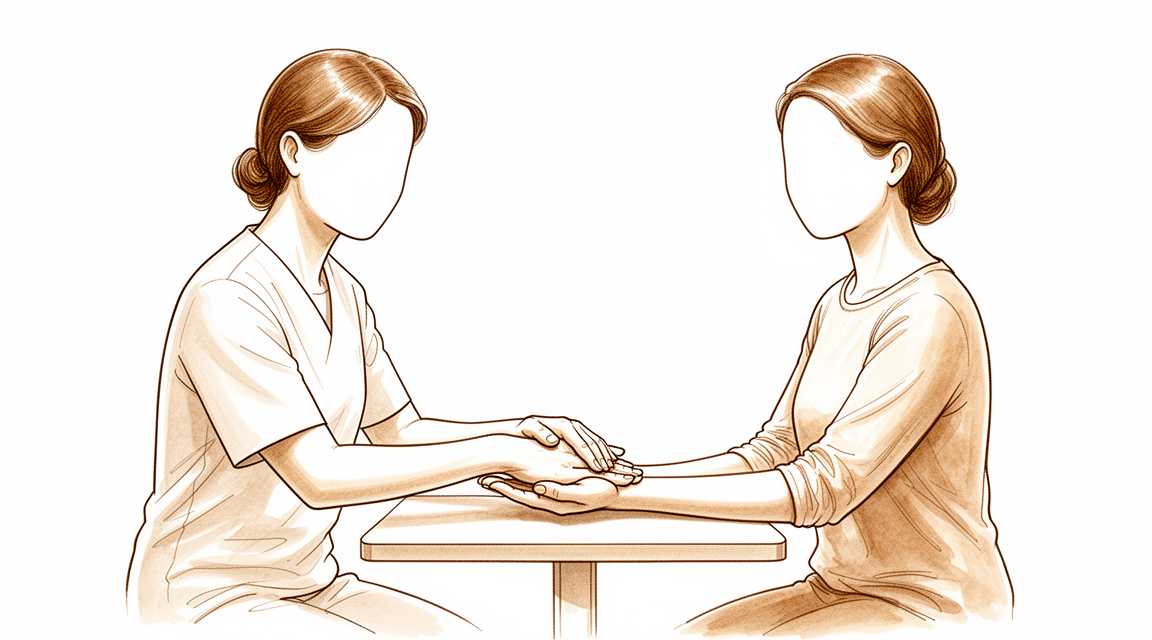
Quy trình này hướng dẫn quá trình hồi phục của bạn sau ca phẫu thuật giải ép ống cổ tay do bác sĩ Kieran Hirpara thực hiện tại Bệnh viện tư nhân Mater Rockhampton. Quy trình nêu rõ những gì sẽ xảy ra trong quá trình vết thương lành lại, các biện pháp phòng ngừa cần thực hiện trong những tuần đầu, cũng như chương trình tập luyện giúp các dây thần kinh và gân vận động trơn tru trong lúc cơ thể hồi phục. Vui lòng mang theo trang này hoặc bản PDF tương ứng đến gặp chuyên viên vật lý trị liệu hoặc chuyên gia trị liệu tay để quá trình phục hồi diễn ra đồng bộ.
Nếu bạn có bất kỳ thắc mắc nào liên quan đến vết thương sau phẫu thuật, hãy liên hệ với phòng khám. Việc chụp ảnh vết thương rồi gửi qua email để được đánh giá cũng là một cách hữu ích.
Những điều bạn có thể mong đợi
Việc chăm sóc vết thương được hướng dẫn chi tiết trong tài liệu chăm sóc vết thương của phòng khám. Tại cổ tay, các dây thần kinh và gân nằm rất gần nhau, ngay tại vùng vết mổ đang lành lại; vì vậy các bài tập trong trang này rất quan trọng: việc giúp các dây thần kinh và gân di chuyển trơn tru sẽ ngăn chúng dính vào mô đang hồi phục.
Các mép vết thương nơi dây chằng được cắt giải phóng vẫn còn mềm và nhạy cảm trong ít nhất bốn đến sáu tuần. Cảm giác đau nhức ở hai bên lòng bàn tay (nơi dây chằng gắn vào xương) cũng rất phổ biến; tình trạng này gọi là “đau kiểu cột trụ” và sẽ dần giảm dần theo thời gian. Bản thân dây chằng không cần phải nối lại: mô sẹo sẽ hình thành “dây chằng giả” đảm nhiệm chức năng tương tự; đó là lý do việc cắt giải phóng dây chằng giúp giải phóng dây thần kinh mà không làm cổ tay mất ổn định.
Các nghiên cứu theo dõi bệnh nhân sau phẫu thuật giải phóng ống cổ tay cho thấy mức độ giảm đau này diễn ra khá đều đặn: khoảng 40% người bệnh vẫn cảm thấy đau kiểu cột trụ sau một tháng phẫu thuật, khoảng 25% sau ba tháng, và đến 12 tháng thì hầu hết các trường hợp đều hết đau (Povlsen & Tegnell, 1996). Vì vậy, nếu hai bên lòng bàn tay vẫn còn nhạy cảm vài tuần sau phẫu thuật, đó là một phần bình thường của quá trình hồi phục, chứ không phải dấu hiệu có điều gì bất ổn.
Sức mạnh của bàn tay cũng tuân theo một quy luật phục hồi rõ ràng. Trong một nghiên cứu được trích dẫn nhiều, lực nắm chỉ đạt khoảng 25% mức trước phẫu thuật sau ba tuần, tăng lên 75% sau sáu tuần, trở lại mức ban đầu sau ba tháng và vượt mức đó sau sáu tháng; lực kẹp ngón tay thì phục hồi nhanh hơn, gần đạt mức cũ sau sáu tuần (Gellman et al., 1989). Do đó, việc sức nắm tạm thời giảm đi trong những tuần đầu là điều dễ hiểu; điều này phản ánh quá trình lành lại của dây chằng và lòng bàn tay chứ không phải do phẫu thuật gặp vấn đề; sức mạnh sẽ dần hồi phục khi cơn đau kiểu cột trụ giảm dần.
Việc vận động sớm là một phần có chủ đích trong phác đồ điều trị, và các bằng chứng lâm sàng cũng ủng hộ điều này. Theo hướng dẫn hiện hành, không cần phải cố định cổ tay bằng nẹp sau phẫu thuật giải phóng ống cổ tay (AAOS, 2024); các quy trình điều trị tại các trung tâm chuyên về tay đều khuyến khích vận động các ngón tay, ngón cái và cổ tay ngay lập tức để giúp gân và dây thần kinh giữa di chuyển trơn tru trong quá trình lành vết thương. Một phân tích tổng hợp của Cochrane về phục hồi chức năng sau phẫu thuật giải phóng ống cổ tay cho thấy quá trình hồi phục thường diễn ra thuận lợi và không có phương pháp điều trị bổ trợ nào được chứng minh là hiệu quả vượt trội; vì vậy chương trình tập luyện này được thiết kế đơn giản, và chuyên viên trị liệu sẽ điều chỉnh theo tiến triển phục hồi riêng của từng bệnh nhân (Peters et al., 2016).
Trong tuần đầu tiên, hãy giữ tay ở vị trí cao hơn mức tim càng nhiều càng tốt; việc giảm sưng sẽ giúp giảm đau và giúp dây thần kinh hoạt động dễ dàng hơn. Chuyên viên trị liệu cũng có thể sử dụng băng ép hoặc băng dính (Coban, Tubigrip hoặc băng kinesiotape) để kiểm soát sưng và hỗ trợ cấu trúc vòm lòng bàn tay.
Khi vết thương đã lành, hãy chườm nóng lên tay khoảng 20 phút trước khi thực hiện các bài tập. Sau khi tập xong, có thể chườm lạnh để ngăn ngừa viêm.
Đôi khi bàn tay hoặc vết thương trở nên nhạy cảm; điều này là bình thường và có thể phòng ngừa hoặc giảm nhẹ bằng cách thực hiện các bài mát-xa giảm nhạy cảm mỗi ngày: nhẹ nhàng vỗ và xoa quanh vết thương (hoặc vùng băng bó) và lòng bàn tay, ngay sau khi phẫu thuật. Phương pháp “phản hồi cảm giác” này giúp dây thần kinh dần quen với các kích thích chạm và kết cấu bề mặt. Các buổi mát-xa ngắn nhưng thường xuyên sẽ mang lại hiệu quả tốt nhất (ví dụ mỗi giờ 2–3 phút); chuyên viên trị liệu có thể cung cấp miếng đệm silicon hoặc găng tay để hỗ trợ giảm nhạy cảm và cải thiện mô sẹo.
Khi vết thương đã hoàn toàn lành, hãy bắt đầu mát-xa sẹo: dùng lực vừa phải để xoay tròn lên vùng vết mổ. Trang chăm sóc vết thương có thêm thông tin chi tiết về cách quản lý sẹo.
Quay trở lại làm việc và các hoạt động thường ngày
Hầu hết mọi người đều có thể quay lại làm việc trong vòng vài tuần sau khi phẫu thuật giải ép ống cổ tay; thời điểm cụ thể phụ thuộc chủ yếu vào yêu cầu công việc đối với bàn tay của bạn. Một phân tích tổng hợp gồm 56 nghiên cứu cho thấy những người làm công việc văn phòng hoặc không phải lao động chân tay thường quay lại làm việc sau phẫu thuật trung bình ba tuần (khoảng thời gian được ghi nhận là từ một đến sáu tuần); còn những người làm công việc lao động chân tay thì mất trung bình khoảng năm tuần rưỡi (khoảng thời gian từ ba đến mười bốn tuần). Nhiều người đã có thể quay lại làm việc sớm hơn với các nhiệm vụ được điều chỉnh hoặc nhẹ hơn trước khi trở lại thực hiện đầy đủ các công việc thường ngày (Newington và cộng sự, 2018). Hãy coi những con số này như những hướng dẫn tham khảo chứ không phải thời hạn cố định; thời điểm thích hợp cho bạn phụ thuộc vào tình trạng vết thương, mức độ thoải mái của bạn và các biện pháp phòng ngừa dưới đây.
Nhìn chung, bạn có thể bắt đầu thực hiện một công việc cụ thể khi đáp ứng đủ các điều kiện sau:
- Vết thương đã lành và có thể chịu được áp lực hoặc sự tiếp xúc phát sinh từ công việc đó;
- Bạn có thể sử dụng bàn tay một cách thoải mái để thực hiện các yêu cầu của công việc, trong khuôn khổ các biện pháp phòng ngừa dưới đây; và
- Những hoạt động đòi hỏi lực nắm mạnh, việc nâng vác vật nặng hoặc tiếp xúc với các công cụ gây rung động trong công việc phải được hoãn lại cho đến khi các biện pháp phòng ngừa không còn cần thiết nữa.
Nếu công việc của bạn đòi hỏi sức lực lớn, có tính lặp đi lặp lại hoặc liên quan đến các dụng cụ gây rung động, hãy trao đổi vấn đề này trong buổi tái khám sau phẫu thuật để cùng với nhà tuyển dụng lên kế hoạch về thời điểm quay lại làm việc và các nhiệm vụ điều chỉnh cần thực hiện trong thời gian chờ đợi.
Các biện pháp phòng ngừa và hạn chế
Bạn nên sử dụng tay một cách nhẹ nhàng cho các hoạt động sinh hoạt hàng ngày như chăm sóc bản thân, ăn uống, mặc quần áo, viết lách và đánh máy. Ngoài ra, trong những tuần đầu sau phẫu thuật cần tuân thủ các hạn chế sau:
- Không được nâng vật nặng, nắm chặt, chịu tải trọng hoặc sử dụng các thiết bị tạo rung động (ví dụ: dụng cụ điện, máy cắt cỏ) trong vòng 6 tuần sau phẫu thuật.
- Việc lái xe chỉ được phép sau 1–2 tuần đầu, hoặc cho đến khi bạn có thể nắm tay thành nắm đấm hoàn chỉnh.
Dành cho chuyên viên vật lý trị liệu:
Cách xử lý
- Chăm sóc vết thương theo hướng dẫn của phòng khám.
- Trong tuần đầu, nên nâng tay cao hơn mức tim càng nhiều càng tốt; sử dụng băng ép hoặc băng dính nén (Coban, Tubigrip, băng kinesiotape) để kiểm soát sưng và hỗ trợ vòm cổ tay khi cần thiết.
- Thực hiện các bài tập trượt gân và trượt dây thần kinh giữa theo hướng dẫn trong các thẻ bài tập dưới đây nhằm ngăn ngừa dính gân và dây thần kinh trong quá trình lành vết thương.
- Khi vết thương đã lành: hãy chườm nóng lên tay trong 20 phút trước khi tập; sau khi tập thì chườm lạnh để tránh viêm.
- Từ ngay sau phẫu thuật, cần thực hiện các động tác xoa nhẹ lên vết thương (cả phần băng bó) và lòng bàn tay nhằm giúp dây thần kinh quen dần với cảm giác chạm và kết cấu bề mặt.
- Khi vết thương đã hoàn toàn lành, hãy thực hiện massage sẹo bằng cách xoa tròn mạnh lên vết mổ.
Các biện pháp phòng ngừa
- Nên sử dụng tay một cách nhẹ nhàng cho các hoạt động sinh hoạt hàng ngày (chăm sóc bản thân, ăn uống, mặc quần áo, viết lách, đánh máy).
- Không được nâng vật nặng, nắm chặt, chịu tải trọng hoặc sử dụng các thiết bị tạo rung động (ví dụ: dụng cụ điện, máy cắt cỏ) trong vòng 6 tuần sau phẫu thuật.
- Việc lái xe chỉ được phép sau 1–2 tuần đầu, hoặc cho đến khi bạn có thể nắm tay thành nắm đấm hoàn chỉnh.
Ghi chú dựa trên bằng chứng khoa học
- Việc cố định tay: có bằng chứng vừa phải cho thấy không cần phải cố định tay thường quy sau phẫu thuật giải phóng ống cổ tay (AAOS CPG, 2024); các bài tập chủ động sớm theo thẻ hướng dẫn là phương pháp được khuyến nghị.
- Các phương pháp hỗ trợ phục hồi chức năng: nghiên cứu của Cochrane cho thấy bằng chứng còn hạn chế và độ tin cậy thấp đối với từng phương pháp phục hồi riêng lẻ sau phẫu thuật giải phóng ống cổ tay (Peters và cộng sự, 2016); cần điều chỉnh chương trình tập luyện phù hợp với từng bệnh nhân thay vì áp dụng theo khuôn mẫu cố định.
- Phục hồi sức mạnh: dự kiến sức mạnh nắm tay đạt khoảng 28% mức trước phẫu thuật sau 3 tuần, 73% sau 6 tuần; trở lại mức trước phẫu thuật sau 3 tháng và vượt mức đó sau 6 tháng; sức mạnh nắm kẹp phục hồi nhanh hơn (đạt khoảng 96% sau 6 tuần) (Gellman và cộng sự, 1989).
- Trở lại làm việc: thời gian trung bình để trở lại làm việc không cần dùng sức là 21 ngày (phạm vi 7–41), còn đối với công việc nặng thì mất 39 ngày (phạm vi 18–101); có thể thực hiện các công việc điều chỉnh sớm hơn (Newington và cộng sự, 2018).
- Đau vùng cột trụ: tỷ lệ gặp phải khoảng 41% sau 1 tháng, 25% sau 3 tháng và 6% sau 12 tháng sau phẫu thuật mở (Povlsen & Tegnell, 1996).
Đây là các bài tập được mô tả trong tờ hướng dẫn dành cho bạn; hãy thực hiện đúng theo chỉ dẫn trên từng thẻ bài tập. Chương trình tập luyện này được xây dựng với sự hợp tác của Sarah Farrell, BOccThy AHT (chuyên viên trị liệu nghề nghiệp và chuyên gia trị liệu tay được công nhận), cùng các hướng dẫn bổ sung sau phẫu thuật từ Ruby Doolan, Chuyên gia trị liệu tay được công nhận thuộc Extend Rehabilitation.
Các bài tập của bạn
Kieran Hirpara 4.0
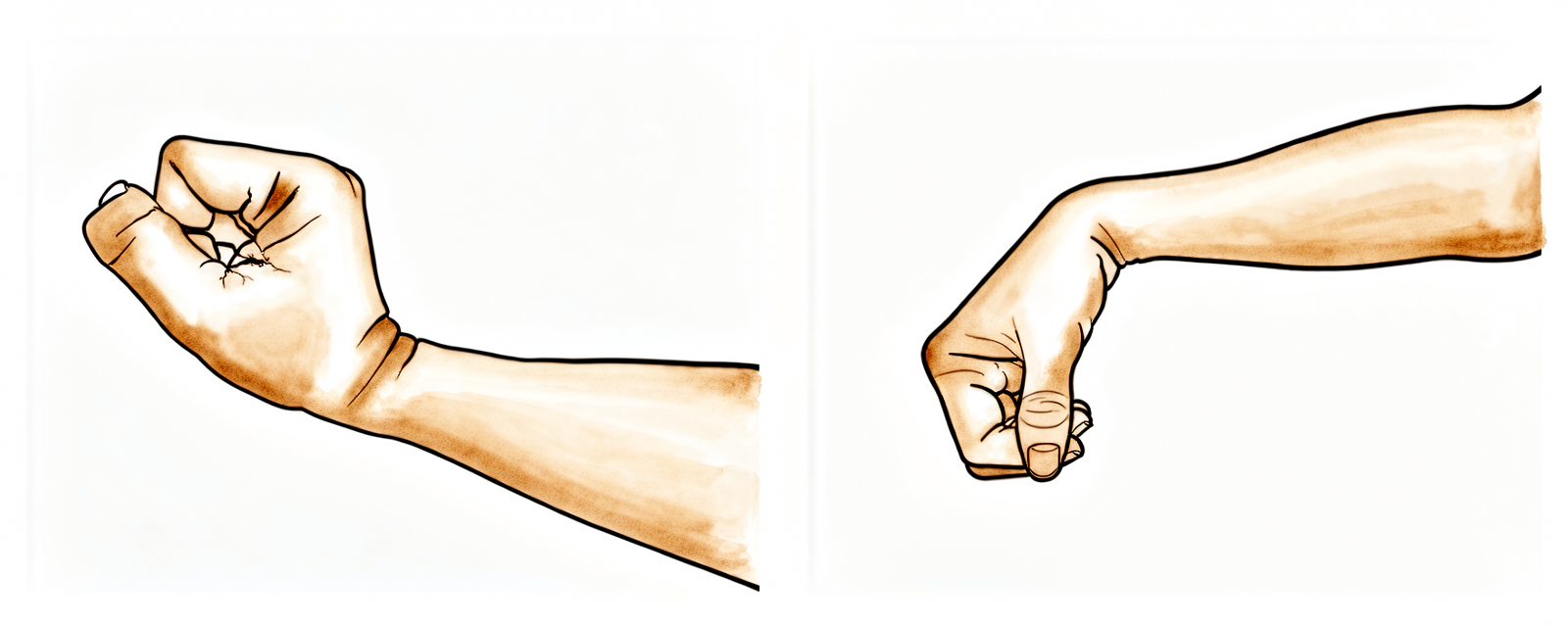
Bài tập kéo giãn cổ tay: gập và duỗi cổ tay
Đặt khuỷu tay lên bàn (hoặc đặt cổ tay lên mép bàn hay tay vịn ghế) rồi nhẹ nhàng đung đưa cổ tay qua lại. Khi đã cảm thấy thoải mái hơn, dùng tay kia nắm lấy lòng bàn tay và đẩy cổ tay ra phía sau (các ngón tay thả lỏng, hướng lên trần nhà) – giữ nguyên trong 15 giây; sau đó làm ngược lại (các ngón tay thả lỏng, hướng xuống sàn nhà) – giữ nguyên trong 15 giây. Lặp lại động tác này 5 lần theo mỗi hướng.
10 lần lặp lại (5 lần theo mỗi hướng, giữ nguyên tư thế 15 giây), 4–5 lần mỗi ngày.
Kieran Hirpara 4.0
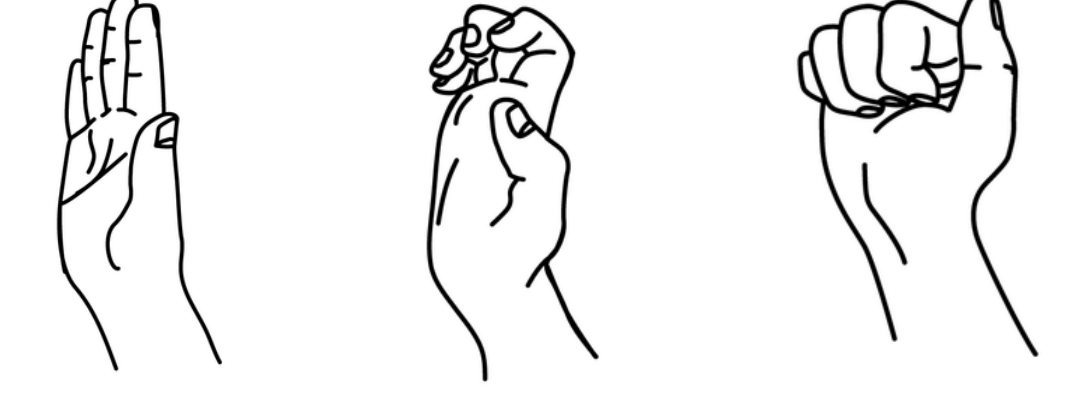
Các bài tập trượt gân — Loạt A
Hãy đặt tay ra trước mặt, giữ cổ tay thẳng; sau đó duỗi thẳng hết các ngón tay (1). Tiếp theo, gập đầu ngón tay lại thành tư thế “móc”, sao cho các khớp ngón hướng lên trên (2). Cuối cùng, nắm tay lại thật chặt, đặt ngón tay cái lên trên các ngón còn lại (3).
5–10 lần lặp lại, 2–3 lần mỗi ngày
Kieran Hirpara 4.0
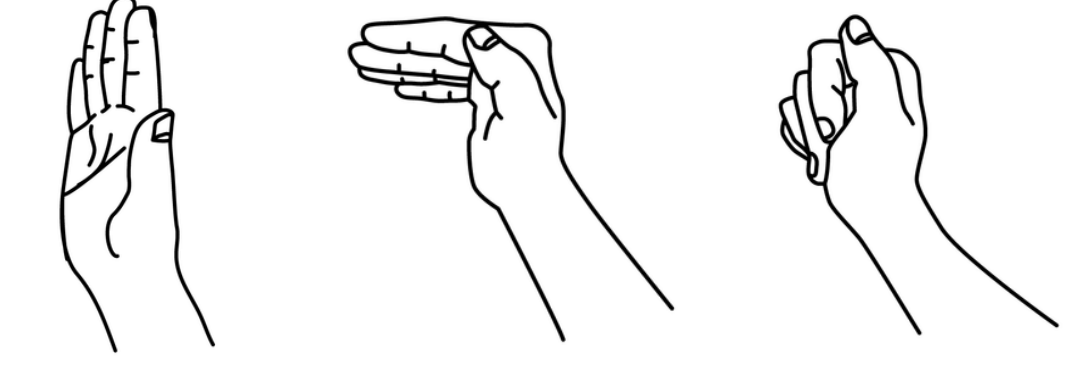
Các bài tập trượt gân — Loạt B
Hãy đặt tay ra trước mặt, giữ cổ tay thẳng; sau đó duỗi thẳng hết các ngón tay (1). Tiếp theo, hơi gập các ngón tay ở khớp đốt ngón tay gần lòng bàn tay để tạo thành hình “mặt bàn”, đồng thời vẫn giữ các ngón tay thẳng; chú ý không để cổ tay bị gập về phía trước (2). Cuối cùng, gập các ngón tay ở khớp giữa, đưa đầu ngón tay chạm vào lòng bàn tay (3).
5–10 lần lặp lại, 2–3 lần mỗi ngày
Kieran Hirpara 4.0
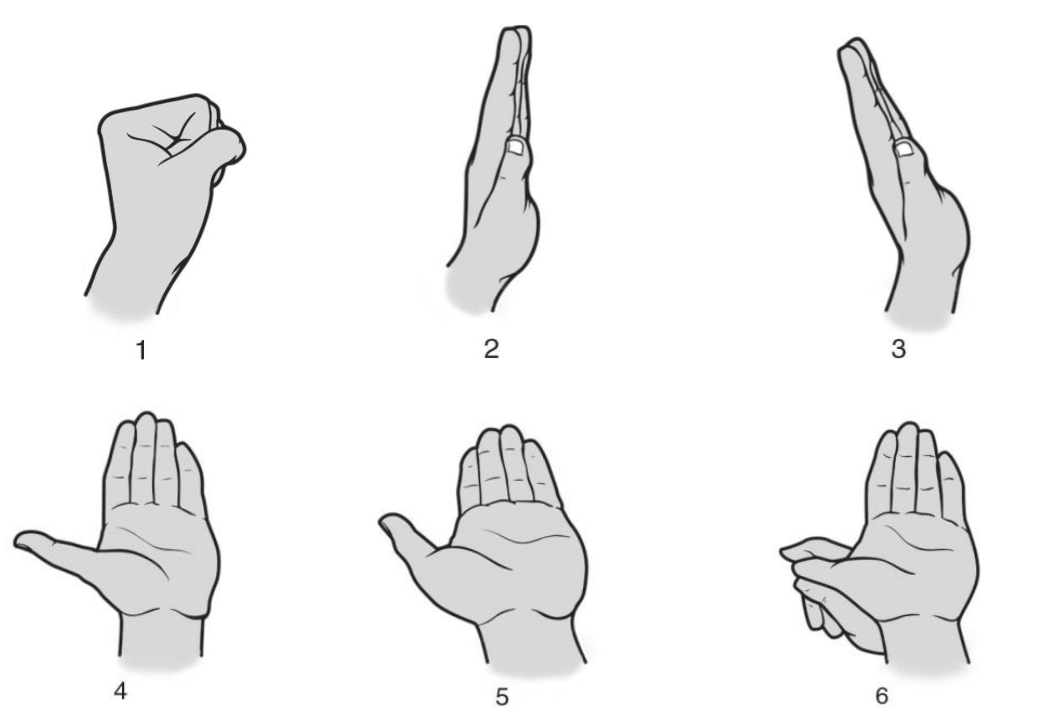
Các bài tập trượt dây thần kinh giữa
Di chuyển bàn tay lần lượt qua sáu tư thế như trong hình, giữ mỗi tư thế trong 3–7 giây. Không ấn quá mạnh lên ngón cái ở tư thế 6. Sau đó thêm động tác kéo giãn dây thần kinh: duỗi thẳng cánh tay ra phía trước, lòng bàn tay hướng lên trên, rồi gập cổ tay ra phía sau sao cho các ngón tay hướng xuống dưới. Dùng tay kia nhẹ nhàng kéo các ngón tay về phía sau cho đến khi bạn cảm thấy căng nhẹ dọc mặt lòng bàn tay của cẳng tay. Giữ trong 15 giây và lặp lại 5 lần. Hãy thực hiện nhẹ nhàng: giảm bớt lực nếu cảm giác ngứa ran tăng lên.
10–15 lần mỗi ngày, giữ mỗi tư thế trong 3–7 giây.
Kieran Hirpara 4.0
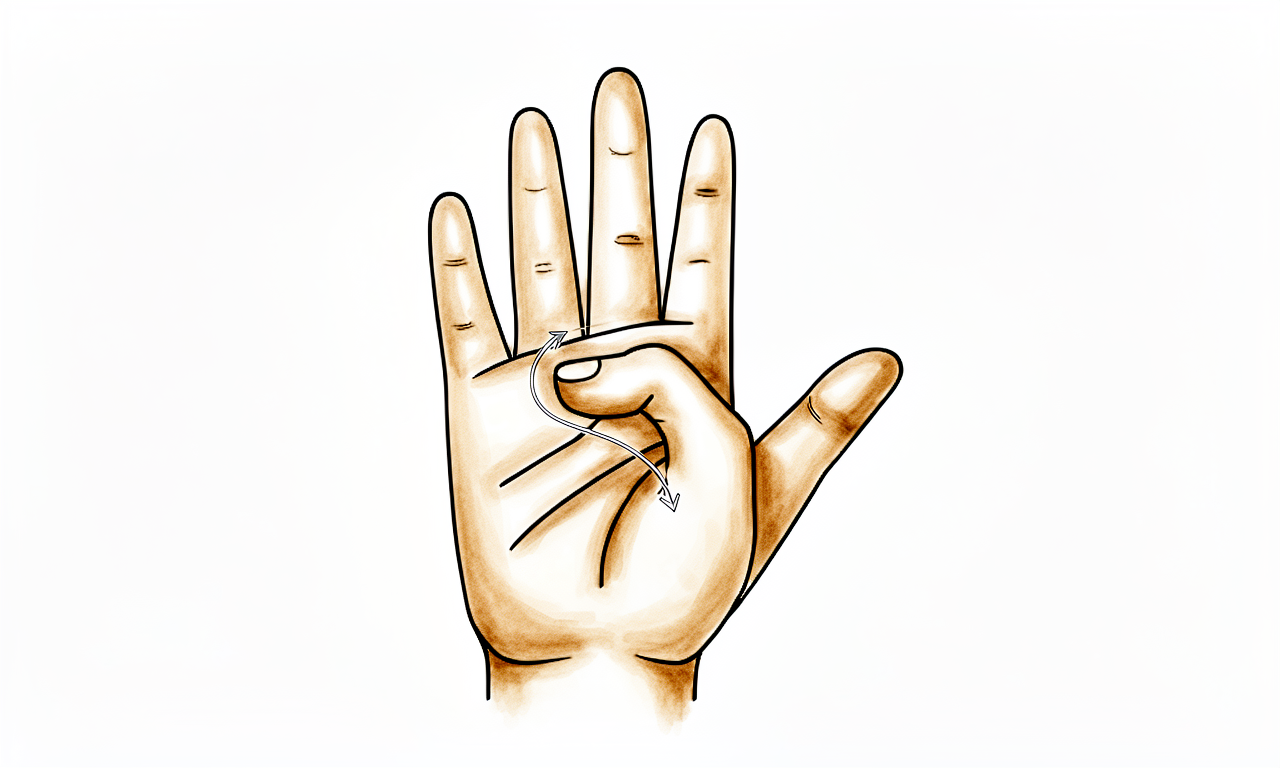
Đối chiếu ngón cái
Đưa ngón cái băng qua lòng bàn tay về phía gốc ngón út, sau đó duỗi thẳng ngón cái trở lại.
5–10 lần lặp, 2–3 lần mỗi ngày, thực hiện hàng ngày.
Chỉ bắt đầu thực hiện các bài tập dưới đây khi có sự hướng dẫn của Bác sĩ Hirpara và chuyên viên trị liệu vận động, đồng thời tuân thủ mọi phạm vi chuyển động và giới hạn đã được chỉ định. Bài tập kéo giãn cổ tay cùng hai chuỗi bài tập trượt gân giúp các gân và dây thần kinh vừa được giải phóng di chuyển một cách tự do, tránh bị dính vào mô sẹo đang hồi phục; những bài tập này nên bắt đầu sớm, miễn là không gây đau đớn. Các bài tập giúp dây thần kinh giữa di chuyển cũng được bổ sung nhằm ngăn dây thần kinh bị dính chặt tại chỗ; bài tập đối khớp ngón cái giúp phục hồi khả năng kẹp vật, vốn thường bị suy yếu trước đó. Trong vài tuần đầu, việc cảm thấy đau nhức ngay tại vùng sẹo ở lòng bàn tay là hiện tượng bình thường. Hãy ngừng ngay bất kỳ bài tập nào gây ra cơn đau dữ dội hoặc cảm giác như bị điện giật lan xuống các ngón tay.
Sau khi thực hiện theo quy trình này
Quy trình này được áp dụng song song với các hướng dẫn phục hồi chung của phòng khám: vui lòng tham khảo mục xử lý cơn đau sau phẫu thuật, chăm sóc vết thương và những điều cơ bản về vật lý trị liệu cho tay. Đối với chính ca phẫu thuật, hãy xem mục phẫu thuật giải ép ống cổ tay.
Tài liệu tham khảo
[1] Peters S, Page MJ, Coppieters MW, Ross M, Johnston V. Phục hồi chức năng sau phẫu thuật giải phóng ống cổ tay. Cochrane Database of Systematic Reviews. 2016;2:CD004158. https://pubmed.ncbi.nlm.nih.gov/26884379/ [2] Học viện Phẫu thuật Chỉnh hình Hoa Kỳ. Hướng dẫn thực hành lâm sàng dựa trên bằng chứng về điều trị hội chứng ống cổ tay. Bản cập nhật năm 2024. https://www.aaos.org/quality/quality-programs/upper-extremity-programs/carpal-tunnel-syndrome/ [3] Newington L, Stevens M, Warwick D, Adams J, Walker-Bone K. Thời gian nghỉ việc sau phẫu thuật giải phóng ống cổ tay: tổng quan có hệ thống các tài liệu nghiên cứu. Scand J Work Environ Health. 2018;44(6):557–567. https://pmc.ncbi.nlm.nih.gov/articles/PMC6215485/ [4] Gellman H, Kan D, Gee V, Kuschner SH, Botte MJ. Phân tích sức mạnh nắm và kẹp tay sau phẫu thuật giải phóng ống cổ tay. J Hand Surg Am. 1989;14(5):863–864. https://pubmed.ncbi.nlm.nih.gov/2794407/ [5] Bộ phận Dịch vụ Phục hồi Chức năng, Bệnh viện Brigham and Women’s. Tiêu chuẩn chăm sóc: Phẫu thuật giải phóng ống cổ tay. Năm 2007 (dữ liệu về diễn tiến tự nhiên của cơn đau được trích từ Povlsen & Tegnell, 1996). https://www.brighamandwomens.org/assets/BWH/patients-and-families/rehabilitation-services/pdfs/wrist-carpal-tunnel-release-pt.pdf
Evidence & references
This is the clinical evidence summary written for health professionals. It is technical, and it lists the research this page was built from. You do not need to read it to understand your treatment or to make a decision about it.
Carpal Tunnel Release — Procedure Outcomes & Post-operative Rehabilitation (Open / Endoscopic Decompression)
Topic scope: post-operative rehabilitation after surgical decompression of the median nerve at the wrist by division of the transverse carpal ligament — open or endoscopic carpal tunnel release. This is a decompression, not a reconstruction: nothing is repaired or tightened, so the rehab is an early-motion pathway built around oedema control, scar/desensitisation work, and tendon + median-nerve gliding rather than months of protected healing.
Defining principle of the rehab here: carpal tunnel release relieves nerve compression and does not create a construct that needs protection. The divided ligament is meant to stay divided — a scar "pseudo-ligament" reconstitutes the carpal arch without re-tethering the nerve. So (unlike a tendon or ligament repair) immediate, unrestricted light use is the default, and the only deliberate restraint is a short window of heavy-load/grip/vibration avoidance while the palm and ligament edges heal. The therapy programme exists to keep the median nerve and flexor tendons gliding through the healing surgical bed so they do not adhere — not to immobilise. The single branch point is whether a concurrent procedure (e.g. flexor tenosynovectomy, revision with a fat-pad flap) was performed, which can extend the protected/oedema phase.
A. PROCEDURE OUTCOMES (open vs endoscopic)
Carpal tunnel release is one of the most reliable operations in upper-limb surgery: the great majority of patients obtain durable symptom relief, and the principal debate is over access (open vs endoscopic), not whether to decompress.
- Both open and endoscopic release give equivalent long-term outcomes. Randomised comparisons and meta-analyses find no meaningful difference in symptom relief, function or patient satisfaction at long-term follow-up between open and single- or dual-portal endoscopic release. Endoscopic release offers a modestly faster early recovery and earlier return to work at the cost of a small increase in transient nerve-related events; by 5 years the two converge [HAND meta-analysis 2022; J Hand Surg 5-year RCT 2009; J Bone Joint Surg RCT 1994]. Strong (RCTs/SR).
- Symptom relief is high and durable. Night symptoms and paraesthesiae typically resolve early; numbness and thenar weakness recover more slowly and may be incomplete where compression was long-standing. Five-year and elderly-cohort series confirm sustained benefit, including in patients over 65 [J Hand Surg 5-yr follow-up; elderly cohorts]. Moderate–strong.
- Division of the transverse carpal ligament alters carpal-tunnel biomechanics (canal volume increases; the flexor tendons shift volarly), which is the anatomical basis for pillar pain and the transient grip-strength dip — both expected, self-limiting consequences of the decompression rather than complications [Clinical Biomechanics 2003]. Mechanistic.
B. REHABILITATION / THERAPY EVIDENCE
The central rehab questions are (1) should the wrist be immobilised afterwards, and (2) does routine formal hand therapy change the outcome. The evidence answers no to routine splinting and no to mandatory protocolised therapy — while supporting a simple, early-motion, glide-based home programme.
- Routine post-operative splinting is NOT recommended. Moderate-quality evidence (AAOS 2024 CPG; supporting systematic reviews) finds wrist immobilisation by sling/orthosis after release does not improve pain, grip or function and may delay recovery. Early active motion is the intended default. Moderate (CPG + SR).
- No single rehab adjunct has strong supporting evidence. The Cochrane review of rehabilitation following carpal tunnel release found only limited, low-certainty evidence for any individual add-on — orthoses, dressings, exercise, cold/ice, multimodal hand therapy, laser, electrotherapy, scar desensitisation or arnica. Recovery is usually straightforward; the implication is to keep the programme simple and individualise it rather than protocolise adjuncts [Peters et al., Cochrane 2016]. Moderate (Cochrane SR — of low-certainty primary evidence).
- Tendon- and nerve-gliding exercises are biologically and clinically rationalised. The rationale is that wrist/digit motion produces longitudinal excursion of the median nerve through the surgical bed, preventing adhesion of nerve to flexor tendons; ultrasound studies confirm measurable nerve excursion during gliding exercises, and comparative-effectiveness work supports tendon/nerve gliding and neural mobilisation as low-risk adjuncts [Am J Phys Med Rehabil 2011; J Hand Therapy 2008 (excursion; neural mobilisation)]. The benefit is modest and the adhesion-prevention purpose is mechanistic/consensus rather than proven by hard outcome trials. Weak–moderate (mechanism strong, outcome modest).
- Supervised therapy is not required for most patients. Outcome series using a standard protocol with a single hand-therapy visit and a home programme report good patient-reported outcomes, supporting selective rather than universal formal therapy. Moderate (cohort).
Recovery trajectory (expected, evidence-anchored)
| Phase | Window | Restraint | Hand use / therapy focus | Strength / load | Notes |
|---|---|---|---|---|---|
| I — Early motion & oedema control | Week 0–1 | None routine (no splint) | Elevate above heart level; immediate active finger/thumb/wrist motion; tendon + median-nerve glides; desensitisation from day 1; compressive dressing/taping for swelling | Light functional use only | Less swelling → freer nerve. Grip is expected to be low |
| II — Wound & ligament healing | Week 1–6 | Heavy-load avoidance | Continue glides; add scar massage once wound healed; heat before / ice after exercises | No lifting, gripping, weight-bearing or vibrating-tool use up to 6 weeks; driving from ~1–2 weeks (once a full fist is achievable) | Pillar tenderness peaks then settles; grip ≈¼ pre-op at 3 wk, ≈¾ by 6 wk |
| III — Return to load & work | Week 6–12+ | Restrictions lifted | Progress gripping, lifting and task-specific loading | Grip back to pre-op by ~3 months, exceeding it by ~6 months; pinch recovers sooner (≈ pre-op by 6 wk) | Non-manual work median ~3 wk; manual work median ~5–6 wk, earlier on modified duties |
(Phase windows mirror the precautions and recovery-curve figures in the patient protocol; they are typical guides, not trial-derived deadlines.)
C. KEY CONTROVERSIES / EVIDENCE QUALITY
- Open vs endoscopic. Equivalent long-term outcomes; endoscopic buys a faster early recovery for a small transient-complication trade-off. Choice is largely surgeon/patient preference and cost. Strong evidence of equivalence.
- To splint or not. Older practice favoured post-operative wrist splinting; current moderate-quality evidence and the AAOS 2024 CPG advise against routine immobilisation. This page's no-splint, early-motion default reflects the current guideline. Moderate.
- Does formal therapy change outcomes? No rehab adjunct has high-certainty benefit (Cochrane). Gliding exercises rest on a sound mechanistic (adhesion-prevention, nerve-excursion) rationale but modest outcome data. The defensible position is a simple home programme + selective therapy, not universal supervised rehab. Weak–moderate.
- Pillar pain & grip dip are expected, not failure. Both follow predictably from dividing the transverse carpal ligament and resolve on a well-described curve; mislabelling them as complications drives unnecessary anxiety. Strong natural-history data.
- Recurrence/revision is uncommon but real; persistent symptoms warrant assessment for incomplete release, the wrong diagnosis, or a second compression site rather than more of the same therapy [JAAOS recalcitrant-CTS review; revision-rate series]. Moderate.
D. EVIDENCE STRENGTH FLAGS (summary)
- STRONG (RCT / SR): equivalence of open vs endoscopic release at long-term follow-up (faster early recovery with endoscopic); high, durable symptom relief from decompression.
- MODERATE: AAOS 2024 CPG against routine post-operative splinting; Cochrane review (limited, low-certainty evidence for any single rehab adjunct → keep it simple); biomechanical basis of pillar pain / grip dip; uncommon but defined revision rate.
- WEAK / CONSENSUS: the specific early-motion, glide-based therapy programme (mechanistically rationalised, outcome benefit modest; surgeon/hand-therapist protocols); exact phase timings (typical, not trial-derived).
CITATIONS
RAG corpus (180,000+ Orthopaedic articles)
- Open versus single- or dual-portal endoscopic carpal tunnel release: a meta-analysis of randomized controlled trials. HAND. 2022. DOI: 10.1177/15589447221075665
- Open compared with 2-portal endoscopic carpal tunnel release: a 5-year follow-up of a randomized controlled trial. J Hand Surg Am. 2009. DOI: 10.1016/j.jhsa.2008.10.026
- Carpal tunnel release: a randomized comparison of three surgical methods. J Hand Surg (Eur Vol). 2013. DOI: 10.1177/1753193412475247
- Carpal tunnel release. A prospective, randomised assessment of open and endoscopic methods. J Bone Joint Surg. 1994. DOI: 10.2106/00004623-199408000-00020
- Five-year follow-up of carpal tunnel release in patients over age 65. J Hand Surg Am. 2010. DOI: 10.1016/j.jhsa.2009.10.020
- Carpal tunnel syndrome (clinical review). BMJ. 2014. DOI: 10.1136/bmj.g6437
- Biomechanical and anatomical consequences of carpal tunnel release. Clin Biomech. 2003. DOI: 10.1016/s0268-0033(03)00052-4
- The comparative effectiveness of tendon and nerve gliding exercises in patients with carpal tunnel syndrome. Am J Phys Med Rehabil. 2011. DOI: 10.1097/phm.0b013e318214eaaf
- The effects of neural mobilization in addition to standard care in persons with carpal tunnel syndrome. J Hand Ther. 2008. DOI: 10.1197/j.jht.2007.12.001
- The excursion of the median nerve during nerve gliding exercise: an observation with high-resolution ultrasonography. J Hand Ther. 2008. DOI: 10.1197/j.jht.2007.11.001
- Effective self-stretching of carpal ligament for the treatment of carpal tunnel syndrome: a double-blinded randomized controlled study. J Hand Ther. 2020. DOI: 10.1016/j.jht.2019.12.002
- Use of conservative therapy before and after surgery for carpal tunnel syndrome. BMC Musculoskelet Disord. 2021. DOI: 10.1186/s12891-021-04378-3
- Power grip, pinch grip, manual muscle testing or thenar atrophy — which should be assessed as a motor outcome after carpal tunnel decompression? A systematic review. BMC Musculoskelet Disord. 2007. DOI: 10.1186/1471-2474-8-114
- Management of recalcitrant carpal tunnel syndrome. J Am Acad Orthop Surg. 2019. DOI: 10.5435/jaaos-d-18-00004
- The rate and timing of revision carpal tunnel release with long-term follow-up. J Hand Surg Am. 2026. DOI: 10.1016/j.jhsa.2026.02.006
- Does aging matter? The efficacy of carpal tunnel release in the elderly. Arch Plast Surg. 2015. DOI: 10.5999/aps.2015.42.3.278
Carpal tunnel rehabilitation literature (URLs)
- Peters S, et al. Rehabilitation following carpal tunnel release. Cochrane Database Syst Rev. 2016;2:CD004158. https://www.cochranelibrary.com/cdsr/doi/10.1002/14651858.CD004158.pub3/full
- O'Connor D, et al. Rehabilitation treatments following carpal tunnel surgery (original Cochrane review). 2003. https://www.cochranelibrary.com/cdsr/doi/10.1002/14651858.CD004158/full
- American Academy of Orthopaedic Surgeons. Management of Carpal Tunnel Syndrome — Evidence-Based Clinical Practice Guideline (2024 update; moderate evidence against routine post-operative immobilisation). https://www.aaos.org/quality/quality-programs/upper-extremity-programs/carpal-tunnel-syndrome/
- Wrist immobilization after surgical decompression of the median nerve in carpal tunnel syndrome: a systematic review. PMC. 2024. https://www.ncbi.nlm.nih.gov/pmc/articles/PMC11374399/
- Sensory nerve conduction velocity predicts improvement of hand function with nerve gliding exercise following carpal tunnel release surgery. PMC. https://www.ncbi.nlm.nih.gov/pmc/articles/PMC8470096/
- Patient-reported outcomes after open carpal tunnel release using a standard protocol with 1 hand therapy visit. J Hand Ther / ScienceDirect. https://www.sciencedirect.com/science/article/abs/pii/S089411301630031X
Published rehab protocols (patient-guidance — basis for the early-motion phase structure)
- Bakker — Carpal Tunnel Release Post-op Protocol (Twin Cities Orthopedics). https://tcomn.com/wp-content/uploads/2017/11/Carpal-tunnel-release-protocol.pdf
- University of Virginia — Carpal Tunnel Release Open Protocol and Home Exercise Program. https://med.virginia.edu/orthopaedic-surgery/wp-content/uploads/sites/242/2015/11/copy_of_CTROPENProtocolandHEP.pdf
- Brigham and Women's Hospital, Department of Rehabilitation Services. Standard of Care: Carpal Tunnel Release (pillar-pain natural history after Povlsen & Tegnell 1996; grip-recovery after Gellman 1989). https://www.brighamandwomens.org/assets/BWH/patients-and-families/rehabilitation-services/pdfs/wrist-carpal-tunnel-release-pt.pdf