Patients › Elbow
Distal Biceps Rupture
Distal biceps rupture causes sudden elbow pain, bruising, and weakness—often needing surgical repair.
What you're feeling
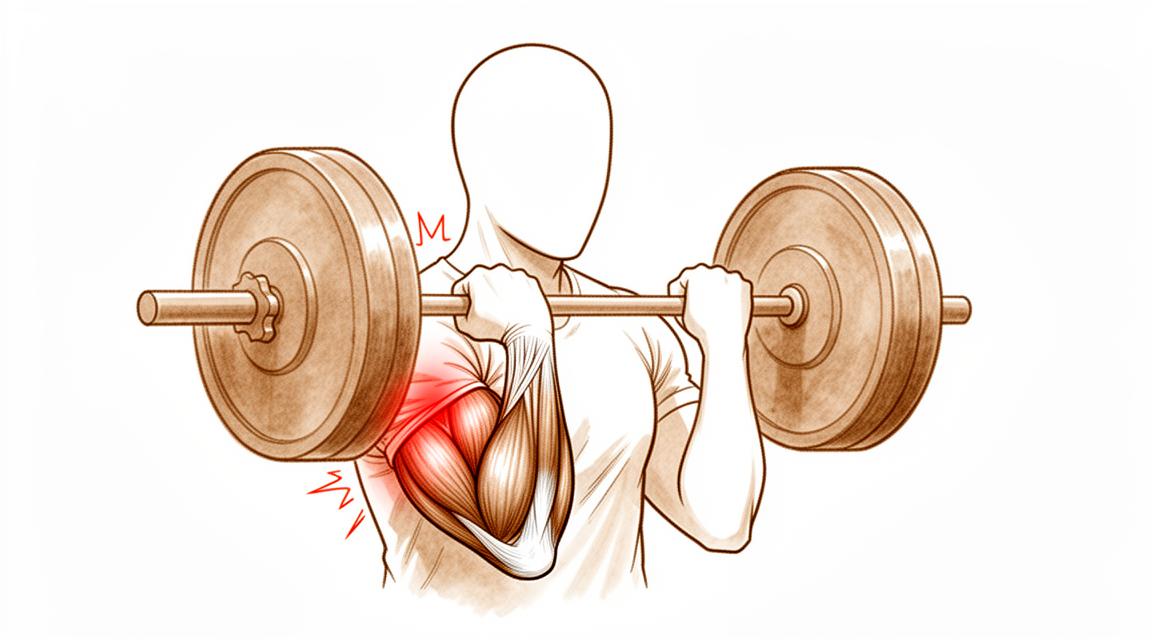
A distal biceps rupture happens in a single moment, not over months. It usually occurs when your straightened arm suddenly takes a heavy load or a sharp pull while your elbow is bent at a right angle. You might be catching something heavy, or bracing yourself with your arm as you slip or fall. Many people feel or hear a snap or pop in the front of the elbow at that moment.
Straight away, the front of your elbow is painful. Swelling and bruising often follow over the next day or so. The biceps muscle may bunch up towards the middle of your upper arm, because the tendon that anchors it near the elbow has torn away from the bone. You may be reluctant to use the arm, and everyday tasks that need you to twist your forearm, like turning a doorknob, using a screwdriver, or pouring from a kettle, feel weak or uncomfortable.
In the first days and weeks, the pain is often worse when you move the elbow, and it can disturb your sleep at night. Over the following weeks it gradually settles as the body starts to heal. The weakness with twisting and lifting tends to stay until the tendon is repaired and strengthened again.
This injury is far more common in men than in women, and it usually happens between the ages of about 40 and 60, most often in your dominant arm. Women make up a small share of cases, and when they do injure this tendon it is more often a partial tear, where only part of the tendon is damaged, rather than a complete rupture.
If the tear is partial, the symptoms can be milder and harder to pin down. Scans help here. An MRI scan gives a clear picture of a complete tear, and it is also good at ruling one out. For partial tears it is less reliable, so your surgeon will combine the scan with your story and examination to work out what has torn.
What's actually happening
Your biceps is the muscle at the front of your upper arm. A strong cord called a tendon anchors it to a small knob of bone near your elbow, on the inner side of your forearm bone. In a rupture, that tendon tears away from the bone. It usually pulls clean off the bone itself, though sometimes it tears within the tendon or higher up where tendon meets muscle.
The biceps has two main jobs: bending your elbow and twisting your forearm so your palm turns upwards, like turning a screwdriver or a door handle. Twisting is where it does its heaviest work. When the tendon is gone, the muscle has nothing to pull on. Think of a rope tied to a heavy gate: if the rope snaps at the post, pulling harder on the loose end will not move the gate. That is why twisting feels weak and the muscle bunches up in your arm, with no anchor holding it down near the elbow.
The tendon does not grow back to the bone on its own. Once it has pulled away, it retracts up the arm, and the gap will not close by itself. Left alone, the weakness with twisting tends to stay. That is why repair is often considered: surgery reattaches the tendon to the bone so it can heal in place and regain its pull.
A partial tear is different. Only part of the tendon has torn, so some of the anchor is still attached. The remaining fibres can become irritated where they rub against nearby bone, which is why partial tears sometimes cause ongoing discomfort rather than sudden weakness.
What we can do about it
Dr Kieran Hirpara, an upper-limb surgeon at Mater Private Hospital Rockhampton, matches the treatment to your specific injury. Patients are generally referred to our clinic by their GP; if a physiotherapist has suggested you see us, you will still need a referral from your GP in order to be eligible for the Medicare rebate. At that first visit we take your history, examine your elbow, and arrange scans where they will help.
Some tears are partial, meaning only part of the tendon is damaged. For these, we may suggest non-operative care first: a sling or splint to rest the arm, pain relief in the early weeks, and physiotherapy at the right stage to rebuild strength and movement. Non-operative treatment for partial tears works for about 47% of people, and injection therapy offers the quickest relief. If that has not given enough improvement, surgery remains a viable option for partial tears.
For a complete rupture, the tendon has pulled clean off the bone and will not reattach on its own. We usually recommend surgery from the outset, especially if you are active, do physical work, or want to return to sport. The operation reattaches the tendon to the bone so it can heal back in place and regain its pull. Repair is generally done within 2 weeks of the injury where possible, though repair after a delay beyond 21 days can still expect similar functional outcomes. The choice is genuinely shared: some people prefer to avoid an operation, and we will talk through what that means for your strength and daily tasks before deciding together.
Whichever path you take, the early weeks look similar. Pain relief keeps you comfortable while the body heals. You protect the arm and follow a staged return to movement with physiotherapy. After repair, early motion is well tolerated, and most people regain nearly full range of motion with a return of strength and function.
What to expect
Healing starts the moment the tendon is reattached, or, for some partial tears, once the arm is rested and protected. The early weeks are about comfort and protection: pain relief, a sling or splint, and gentle movement as your surgeon allows. After repair, early motion is well tolerated, and most people regain nearly full range of motion.
Work comes back before sport. Most people return to work, and 89% return fully without any change to their duties. That takes about 14 weeks on average. Sport takes longer. Around 95% of people get back to sport, and 82% return at the same level they played before the injury. That usually happens at about 40 weeks, depending on the sport.
Strength returns too. Repair restores near-normal strength for bending the elbow and twisting the forearm. If your repair is done after a delay beyond 21 days, you can still expect similar functional outcomes to those repaired early.
Surgery carries some risks worth knowing about. The most common is a nerve irritation near the elbow, which happens in about 3% of single-incision repairs and usually settles. The tendon can re-tear, which happens in 1.5% of repairs and almost always within the first 3 weeks, which is why you protect the arm carefully in that window. Some people develop stiffness and need further treatment to free the elbow up. Overall, about 5% of repairs have a major complication.
If you and your surgeon choose non-operative care for a partial tear, the aim is comfort and function while the remaining tendon fibres do the work. As covered earlier, this works for some people but not all, and surgery remains an option if it does not settle.
When to see someone
Seek urgent care if your arm looks out of shape or deformed, if there is an open wound, if you feel numbness or tingling, or if you cannot use the limb at all. These signs need checking straight away.
Otherwise, start with your GP. Ask for a specialist review if the pain is not settling, or if swelling, movement or everyday function are not improving week on week as the healing progresses. A tear that is not tracking the way it should is easier to sort out early, and your GP can arrange a referral and scans if they are needed.
In more depth
Advanced reading: the deeper science (optional)
This section goes further than you need for your own treatment decisions. Distal biceps rupture is worth the extra reading because it is one of the few injuries on this site where surgery demonstrably restores something that healing without it does not, which makes the trade-off unusually concrete, and the complication figures unusually relevant.
Here, the operation does change function
Most of the comparisons on this site end in "no significant difference". This one does not. Pooling 2,481 patients, operative treatment produced superior elbow and forearm strength and endurance, along with better DASH and Mayo Elbow Performance scores, than non-operative management [1].
The reason is anatomical rather than statistical. The distal biceps is the main supinator of the forearm, the muscle that turns the palm upwards against resistance. When the tendon detaches from the radius it retracts up the arm, and the muscle can no longer generate that rotation, whatever else heals around it. Elbow flexion is partly covered by brachialis, so bending the elbow recovers reasonably well; supination has no comparable understudy.
That is why the loss shows up most clearly in endurance rather than a single maximal effort. Repeated turning, a screwdriver, a door handle, a steering wheel over a long drive, is where the difference is felt.
The complication rate is the other half of the decision
An operation that reliably restores strength is still an operation, and this one has a well characterised profile. In the largest analysis, covering 3,091 patients, the major complication rate was 4.6% [2].
Most of what occurs is minor and temporary, numbness over the back of the forearm from traction on a small sensory nerve is the commonest, and usually recovers. The major complications are the ones that shape technique: permanent nerve injury, heterotopic ossification (new bone forming across the forearm and restricting rotation), and re-rupture.
Two approaches, and the trade-off is genuine
The repair is done either through a single incision at the front of the elbow or through two smaller ones, front and back. Both reach the same bone from different directions, and each avoids a different hazard.
Across 2,622 patients there were no significant differences in functional scores. The single-incision approach gave greater flexion and pronation range of motion and a lower risk of heterotopic ossification and reoperation, while the double-incision approach was more favourable on other measures [3]. A 2025 meta-analysis of 2,833 patients found the same shape: single incision associated with more favourable objective function and fewer structural complications, double incision with reduced risk of certain sensory nerve injuries [4].
Read together, the choice is between the nerve at the front and the bone at the back. Neither approach is wrong, and both sets of authors call for higher-quality randomised trials before the question is considered closed.
Why the timing matters more than it does elsewhere
Because the tendon retracts and the space it occupied scars, delay makes reattachment harder, and where direct repair is no longer possible, reconstruction with a graft becomes necessary. This is the practical reason a distal biceps rupture is treated with more urgency than most tendon injuries, and why a sudden painful pop at the front of the elbow, with visible change in the shape of the muscle, is worth prompt assessment rather than a period of watchful waiting.
Non-operative management remains a legitimate choice, particularly for lower-demand arms and for people who do not need forceful repeated supination. It is a decision to accept a measurable deficit, made deliberately, not a lesser version of the same result.
References for the advanced reading
- Looney AM, Day J, Bodendorfer BM, Wang D, Fryar CM, Murphy JP, et al. Operative vs. nonoperative treatment of distal biceps ruptures: a systematic review and meta-analysis. J Shoulder Elbow Surg. 2022;31(4):e169-e189.
- Amarasooriya M, Bain GI, Roper T, Bryant K, Iqbal K, Phadnis J. Complications after distal biceps tendon repair: a systematic review. Am J Sports Med. 2020;48(12):3103-11.
- Castioni D, Mercurio M, Fanelli D, Cosentino O, Gasparini G, Galasso O. Single- versus double-incision technique for the treatment of distal biceps tendon rupture: a systematic review and meta-analysis of comparative studies. Bone Joint J. 2020;102-B(12):1608-17.
- Awad G, Boutros M, Hajj Youssef M, Elhassan B. Comparing single-incision and double-incision techniques in distal biceps tendon repair: a systematic review and meta-analysis. Shoulder Elbow. 2025.
Evidence & references
This is the clinical evidence summary written for health professionals. It is technical, and it lists the research this page was built from. You do not need to read it to understand your treatment or to make a decision about it.
Overview
- Surgical treatment of chronic distal biceps injuries yields favorable objective and subjective outcomes [1].
- The overall frequency of reported complications is higher for single-incision distal biceps repair than for double-incision repair [2].
- The short-term clinical influence of biceps complications on shoulder outcome is very limited [4].
- Functional outcomes for chronic distal biceps ruptures remain comparable with those seen in the patient population with acute distal biceps, although there may be a slightly higher immediate complication rate [5].
- Surgical repair of distal biceps tendon ruptures has an overall low rate of serious complications regardless of approach or technique [6, 7, 13, 14].
- Bioabsorbable interference screw fixation of distal biceps ruptures through a single anterior incision is a safe and successful technique for the management of distal biceps tendon ruptures [9].
- Complication rates after distal biceps repair are low [10].
- Patients undergoing distal biceps reconstruction with graft augmentation can expect low complications and good functional results [11].
- Distal biceps repair is associated with a 7.5% major complication rate and 4.5% reoperation rate [12].
Anatomy & Pathophysiology
Epidemiology & Risk Factors
- Distal biceps tendon ruptures occur at a rate of 1.2 per 100,000 persons per year [21].
- Distal biceps tendon ruptures typically occur in the dominant arm of males during the fifth to sixth decade of life [21].
- Common risk factors for distal biceps tendon rupture include anabolic steroid use, body building, and smoking [21].
- The true prevalence of partial distal biceps tendon tears in the population is unknown [3].
Mechanism of Injury
- Distal biceps tendon ruptures are associated with a traumatic event that causes a sudden, eccentric load to a flexed and supinated forearm [21].
- Partial distal biceps tendon tears may present with either an insidious or acute traumatic history [3].
- Full-thickness distal biceps tendon tears are associated with a defined episode of injury, deformity, pain, and weakness [3].
Clinical Presentation & Examination
- Patients with distal biceps rupture may recall an audible pop over the anterior elbow [21].
- Inspection of the soft tissues in distal biceps rupture tends to demonstrate swelling in the antecubital fossa [21].
- Clinical findings supporting the diagnosis of distal biceps rupture include retraction of the muscle belly with a visible bulge (reverse Popeye deformity), weakness in flexion and supination, and bruising [21].
- The hook test has proven 100% sensitivity and specificity for making a prompt diagnosis of distal biceps rupture [21].
- Missed diagnoses of distal biceps rupture have been attributed to the examiner palpating an intact brachialis tendon, which is an intramuscular tendon at the level of the antecubital fossa and cannot be hooked away from an underlying muscle belly [21].
- The hook test allows for the distinction between complete avulsion, which results in an abnormal hook test, and partial avulsion, which yields a painful hook test [21].
- On clinical examination, a patient with biceps pathologic conditions exhibits pain and weakness in flexion and supination and sometimes ecchymoses in the antecubital fossa or an abnormal muscle contour of the biceps [17].
- With the elbow at 90 degrees of flexion, the examiner may ask the patient to rotate the pronated forearm into supination; normally, the examiner can hook the tip of his or her thumb around the biceps tendon in the cubital fossa [17].
- With distal avulsion of the tendon, it may be impossible to hook the thumb around the biceps tendon in the cubital fossa [17].
- Occasionally, some fibers or a fascial sleeve may remain intact in distal biceps rupture, giving an appearance of an intact tendon [17].
- The examiner must discriminate between the normal lacertus fibrosus, which often remains intact even with biceps rupture, and the biceps tendon [17].
Imaging & Diagnostic Findings
- Plain film radiographs are most commonly normal and do not show pathologic changes in distal biceps rupture [17].
- Biceps ruptures typically do not involve bony ruptures, and minimal changes are seen on standard radiographs of the elbow [17].
- MRI may be read as falsely negative in cases of distal biceps rupture [17].
- MRI findings suggestive of complete distal biceps rupture include absence of the tendon insertion or a fluid-filled sheath [17].
- Partial distal biceps ruptures are typically seen on MRI as high signal intensity, fluid within the tendon sheath, or thinning or thickening of the tendon distally [17].
- Positioning the prone patient with the shoulder abducted over the head and the elbow in 90 degrees of flexion and the forearm in supination (the FABS view) has been suggested to improve visualization of the distal biceps insertion into the radial tuberosity [17].
- Ultrasound findings suggestive of complete distal biceps rupture include tendon absence, fluid, and mass in the antecubital fossa [17].
- Incomplete distal biceps rupture may be represented on ultrasound by a focal hypoechogenic area or thinning of the tendon [17].
- Advanced imaging with MRI or ultrasonography is helpful in cases of partial distal biceps avulsions as it can assess the biceps insertion [21].
- Obtaining an MRI view of the elbow during flexion, abduction, and supination allows for optimal evaluation of the tendon along its long axis and minimizes error by reducing volume averaging [21].
Pathology & Natural History
- Partial distal biceps tendon tears encompass a spectrum of disease, from tendinopathic micro-tears to near-full-thickness rupture from the radial tuberosity [3].
- The pathology of partial distal biceps tendon tears has become increasingly recognized with magnetic resonance imaging [3].
- Nonoperative management does not restore function to the elbow in chronic biceps tendon ruptures [28].
Classification
- Partial distal biceps tendon tears encompass a spectrum of disease ranging from tendinopathic micro-tears to near-full-thickness rupture from the radial tuberosity [3].
- The mechanism of full-thickness distal biceps tendon tears is well reported with a defined episode of injury, deformity, pain, and weakness [3].
- Full-thickness distal biceps tendon tear patients tend to present acutely [3].
- Partial distal biceps tendon tears may have a variable presentation with either an insidious or acute traumatic history, pain, mechanical symptoms, and subtle examination findings [3].
- The condition of partial distal biceps tendon tears may remain undiagnosed or mismanaged, leading to a delay in treatment [3].
- Isolated short head ruptures are a rare and distinct form of distal biceps tear that present with consistent clinical findings that can aid in diagnosis [8].
- The incidence of women sustaining a distal biceps tendon tear is 3.2% [24].
- Partial tears are statistically more common than complete ruptures in the context of distal biceps tendon injuries [24].
Clinical Presentation
History and Demographics
- The incidence of distal biceps tendon ruptures is 1.2 per 100,000 persons per year [21].
- The mechanism of injury involves a sudden, eccentric load to a flexed and supinated forearm [21].
- Patients typically report a history of lifting an object or forced extension of a flexed and loaded forearm [32].
- Patients may recall an audible pop over the anterior elbow [21].
- Distal biceps pathologic conditions are exceedingly unusual in women [32].
- Partial distal biceps tendon tears may present with an insidious or acute traumatic history [3].
- Patients with chronic, slowly degenerative partial tears may complain of nonspecific elbow pain worsened by daily activities [32].
Physical Examination Findings
- Clinical examination findings include pain and weakness in flexion and supination [17].
- Ecchymosis in the antecubital fossa is a common clinical finding [17].
- An abnormal muscle contour of the biceps, described as a "Pop-eye" deformity or reverse Popeye deformity, may be present [17, 32].
- Swelling of the soft tissues in the antecubital fossa is observed on inspection [21].
- The hook test involves hooking a finger around the lateral edge of the distal biceps tendon with the elbow at 90° of flexion and full supination [21].
- A complete avulsion results in an abnormal hook test, whereas a partial avulsion yields a painful hook test [21].
- Missed diagnoses have been attributed to the examiner palpating an intact brachialis tendon instead of the biceps tendon [21].
- The Flexion Initiation Test (FIT) combined with the hook test demonstrates high accuracy for diagnosing complete and high-grade partial distal biceps tendon tears [16].
- Deep palpation of the radial tuberosity from the posterolateral aspect while passively pronating the forearm may elicit pain indicative of distal biceps tendinopathy [32].
- Isolated short head ruptures present with consistent clinical findings that can aid in diagnosis [8].
Imaging
- Plain film radiographs are most commonly normal and do not show pathologic changes in distal biceps ruptures [17].
- MRI is unnecessary in most cases of suspected distal biceps rupture [17].
- MRI may be read as falsely negative for distal biceps rupture [17].
- MRI is useful to exclude alternative diagnoses and evaluate the extent of suspected partial rupture [17].
- MRI findings suggestive of complete rupture include absence of the tendon insertion or a fluid-filled sheath [17].
- Partial ruptures on MRI are typically seen as high signal intensity, fluid within the tendon sheath, or thinning or thickening of the tendon distally [17].
- The FABS view (flexion, abduction, and supination) has been suggested to improve visualization of the distal biceps insertion into the radial tuberosity on MRI [17].
- Ultrasound is a lower-cost diagnostic tool that is usually unnecessary but accurate in diagnosing complete or partial tears [17].
- Ultrasound findings suggestive of complete rupture include tendon absence, fluid, and mass in the antecubital fossa [17].
- Incomplete rupture on ultrasound may be represented by a focal hypoechogenic area or thinning of the tendon [17].
- Distal biceps MRI signal changes consistent with tendinopathy are common even in asymptomatic elbows [25].
- The prevalence of distal biceps tendon signal changes on MRI in asymptomatic patients is very low [27].
Investigations
Clinical Examination
- The hook test has proven 100% sensitivity and specificity for making a prompt diagnosis of distal biceps tendon rupture [21].
- Missed injuries have been attributed to the examiner palpating an intact brachialis tendon, which is an intramuscular tendon at the level of the antecubital fossa and cannot be hooked away from an underlying muscle belly [21].
- The evidence-based diagnostic algorithm using the combination of the Flexion Initiation Test (FIT) and hook test demonstrates high accuracy for the diagnosis of both complete and high-grade partial distal biceps tendon tears [16].
- Pain noted with deep palpation over the radial tuberosity from the posterolateral aspect while passively pronating the forearm is a very good indication of tendinopathy involving the insertion of the distal biceps [32].
Imaging
- MRI is unnecessary in most cases of suspected distal biceps pathologic findings and occasionally may be read as falsely negative [17].
- MRI may be useful to exclude alternative diagnoses, evaluate the extent of suspected partial rupture, and in cases where the clinical examination is unclear [17].
- MRI findings suggestive of partial ruptures include high signal intensity, fluid within the tendon sheath, or thinning or thickening of the tendon distally [17].
- Positioning the patient with the shoulder abducted over the head and the elbow in 90 degrees of flexion and the forearm in supination (the FABS view) has been suggested to improve visualization of the distal biceps insertion into the radial tuberosity [17].
- Ultrasound is a lower-cost diagnostic tool that is usually unnecessary but has been shown to be accurate in the diagnosis of complete or partial tears [17].
- Ultrasound findings suggestive of incomplete rupture include a focal hypoechogenic area or thinning of the tendon [17].
- The finding that distal biceps MRI signal changes consistent with tendinopathy are common even in asymptomatic elbows reduces the probability that symptoms correlate with pathology on imaging [25].
Treatment
Non-Operative Management
- Nonoperative management of chronic distal biceps injuries does not restore function to the elbow [28].
- Nonoperative treatment is preferred for patients who are unfit for surgery and who have low functional demands [46].
- Partial distal biceps tears can be initially treated conservatively, with surgical intervention reserved only for refractory cases [46].
- For partial distal biceps tears, treatment should be nonoperative for the first 3 to 6 months [57].
- Patients with partial distal biceps tears are encouraged to avoid heavy lifting and use the arm primarily for activities of daily living only [57].
- Strengthening exercises and physical therapy are unnecessary for patients with partial distal biceps tears [57].
- In a cohort of 132 patients with partial distal biceps tears, 55.7% of those who tried a nonoperative course ultimately underwent surgery [31].
- An MRI-diagnosed tear of greater than 50% was a predictor of needing surgery for partial distal biceps tears [31].
- High-need patients, as defined by occupation, were more likely to report ideal recovery if they underwent surgery compared to those who did not [31].
- Surgical management of distal biceps tears was a predictor of improved patient-reported outcomes only for patients with complete tears [18].
- A meta-analysis showed the superiority of surgical management over the nonoperative approach for distal biceps tendon detachment, with superior flexion and supination strength and better patient-reported outcomes [65].
- Distal biceps ruptures result in a permanent loss of 30% to 50% of supination strength if treated nonsurgically [54].
- Nonoperative management of distal biceps injuries is associated with a 40% limitation of supination strength and an average of 30% loss of flexion strength [46].
Operative Management
- In acute distal biceps injuries, anatomic reattachment to the bicipital tuberosity is the treatment of choice in active individuals of all ages [46].
- Chronic distal biceps ruptures should be repaired with anatomic reinsertion of the tendon to the tuberosity with additional use of an auto or allograft [46].
- Non-anatomic reconstruction of the distal biceps tendon to the brachialis muscle is no longer recommended because of the loss of supination strength [46].
- Although there may be a slightly higher immediate complication rate, functional outcomes for chronic distal biceps repairs remain comparable with those seen in the patient population with acute distal biceps injuries [5].
- The early complication rate following partial distal biceps tendon repair was 20.5% [20].
- Bioabsorbable interference screw fixation of distal biceps ruptures through a single anterior incision is a safe and successful technique [9].
- Cortical button and suture anchor fixation for distal biceps tendon repair provide similar clinical outcomes and complication profiles [29].
- Workers' compensation patients who underwent distal biceps tendon repair took longer to return to work and had worse DASH scores than non-workers' compensation patients [70].
- Patients who present with a classic history of a “pop” in the arm with resisted motion and sudden onset of pain should be treated as having complete biceps tears regardless of MRI findings suggestive of “partial tear” [57].
- Operative treatment for significant partial distal biceps tears that do not improve after 6 months of nonoperative treatment involves taking down the remaining fibers of the distal biceps and repairing them to the insertion site [57].
Complications
- Although there may be a slightly higher immediate complication rate, the functional outcomes remain comparable with those seen in the patient population with acute distal biceps [5].
- Complication rates after distal biceps tendon repair performed by newly trained surgeons were similar to those previously reported in large cohort studies, with nerve injury as the most common complication [30].
- The largest analysis of complications after distal biceps repair indicates a major complication rate of 4.6% [49].
Recovery
- The average time to return to work after distal biceps repair in the literature was just beyond 14 weeks [73].
Key Evidence
- [L1] Surgical treatment of chronic distal biceps injuries yields favorable objective and subjective outcomes. [1] (10.1016/j.xrrt.2022.02.007)
- [L1] The overall frequency of reported complications is higher for single-incision distal biceps repair than for double-incision repair. [2] (10.1177/2325967116668137)
- [L5] [3] (10.1177/17585732241245054)
- [L3] Nevertheless, the short-term clinical influence of biceps complications on shoulder outcome is very limited. [4] (10.1177/2325967121s00362)
- [L4] Although there may be a slightly higher immediate complication rate, the functional outcomes remain comparable with those seen in the patient population with acute distal biceps. [5] (10.1177/23259671211065772)
- [L3] Surgical repair of distal biceps tendon ruptures has an overall low rate of serious complications regardless of approach or technique. [6] (10.1016/j.jse.2017.06.021)
- [L3] Surgical repair of distal biceps tendon ruptures has an overall low rate of serious complications regardless of approach or technique. [7] (10.1016/j.jse.2017.06.020)
- [L4] Isolated short head ruptures are a rare and distinct form of distal biceps tear that present with consistent clinical findings that can aid in diagnosis. [8] (10.1016/j.jse.2020.04.038)
- [Paper] This is a safe and successful technique for the management of distal biceps tendon ruptures. [9] (10.1007/s00402-009-0974-x)
- [L3] Complication rates after distal biceps repair are low. [10] (10.5397/cise.2021.00472)
- [L3] Patients can be consulted that direct repair in the acute setting is preferred; however, even in the setting of a distal biceps reconstruction with graft augmentation, they can expect low complications and good functional results. [11] (10.1016/j.jseint.2020.10.023)
- [L3] Distal biceps repair is associated with a 7.5% major complication rate and 4.5% reoperation rate. [12] (10.1016/j.jse.2018.06.028)
- [L3] The surgical repair of distal biceps tendon ruptures has an overall low rate of serious complications, regardless of approach or technique. [13] (10.1177/0363546517720200)
- [L3] The surgical repair of distal biceps tendon ruptures has an overall low rate of serious complications, regardless of approach or technique. [14] (10.1016/j.arthro.2017.08.065)
- [L4] The evidence-based diagnostic algorithm using the combination of the FIT and hook test demonstrates high accuracy for the diagnosis of both complete and high-grade partial distal biceps tendon tears. [16] (10.1016/j.asmr.2021.01.010)
- [L2] Surgical management of distal biceps tears was a predictor of improved patient-reported outcomes only for patients with complete tears. [18] (10.1016/j.jhsa.2025.12.027)
- [L4] The early complication rate following partial distal biceps tendon repair was 20.5%. [20] (10.1016/j.jhsa.2025.04.012)
- [L4] The incidence of women sustaining a distal biceps tendon tear is 3.2%, with partial tears being statistically more common than complete ruptures. [24] (10.1016/j.jse.2014.02.006)
- [L4] The finding that distal biceps MRI signal changes consistent with tendinopathy are common even in asymptomatic elbows reduces the probability that symptoms correlate with pathology on imaging. [25] (10.5397/cise.2023.00164)
- [L3] The prevalence of distal biceps tendon signal changes on MRI in asymptomatic patients is very low. [27] (10.1016/j.jhsa.2022.01.020)
- [L5] Nonoperative management does not restore function to the elbow. [28] (10.1007/s11552-013-9551-4)
- [L4] [29] (10.1016/j.jse.2026.07.033)
- [L4] Complication rates after distal biceps tendon repair performed by newly trained surgeons were similar to those previously reported in large cohort studies, with nerve injury as the most common complication. [30] (10.1016/j.jse.2022.09.014)
- [L4] [31] (10.1016/j.jse.2017.12.010)
- [Paper] [46] (10.1016/j.injury.2013.01.003)
- [L2] This is the largest analysis of complications after distal biceps repair, indicating a major complication rate of 4.6%. [49] (10.1177/0363546519899933)
- [L5] [54] (10.1016/j.jhsa.2012.02.008)
- [L1] The results of this meta-analysis showed the superiority of surgical management over the nonoperative approach for distal biceps tendon detachment, with superior flexion and supination strength and better patient-reported outcomes. [65] (10.1177/23259671211037311)
- [L3] WC patients who underwent distal biceps tendon repair took longer to return to work and had worse DASH scores than non-WC patients. [70] (10.1016/j.jse.2012.11.011)
- [L4] The average time to return to work after distal biceps repair in the literature was just beyond 14 weeks. [73] (10.1016/j.jse.2019.12.006)
References
[1] Outcomes and complications after different surgical techniques for the treatment of chronic distal biceps tendon ruptures: a systematic review and quantitative synthesis. JSES Reviews, Reports, and Techniques. 2022. DOI: 10.1016/j.xrrt.2022.02.007
[2] Complications of Distal Biceps Tendon Repair. Orthopaedic Journal of Sports Medicine. 2016. DOI: 10.1177/2325967116668137
[3] Current concepts in the aetiology, assessment and management of partial distal biceps tendon tears. Shoulder & Elbow. 2024. DOI: 10.1177/17585732241245054
[4] Biceps-related complications after tenotomy associated with arthroscopic rotator cuff repair: risk factors and clinical impact. Orthopaedic Journal of Sports Medicine. 2022. DOI: 10.1177/2325967121s00362
[5] Surgical Results of Chronic Distal Biceps Ruptures: A Systematic Review. Orthopaedic Journal of Sports Medicine. 2022. DOI: 10.1177/23259671211065772
[6] Analysis of 784 surgically treated distal biceps tendon ruptures. Journal of Shoulder and Elbow Surgery. 2017. DOI: 10.1016/j.jse.2017.06.021
[7] The distal biceps deficient arm, “the short arc syndrome”. Journal of Shoulder and Elbow Surgery. 2017. DOI: 10.1016/j.jse.2017.06.020
[8] Distal biceps short head tears: repair, reconstruction, and systematic review. Journal of Shoulder and Elbow Surgery. 2020. DOI: 10.1016/j.jse.2020.04.038
[9] Bioabsorbable interference screw fixation of distal biceps ruptures through a single anterior incision: a single-surgeon case series and review of the literature. Archives of Orthopaedic and Trauma Surgery. 2009. DOI: 10.1007/s00402-009-0974-x
[10] Determining the incidence and risk factors for short-term complications following distal biceps tendon repair. Clinics in Shoulder and Elbow. 2022. DOI: 10.5397/cise.2021.00472
[11] Outcomes of chronic distal biceps reconstruction with tendon grafting: a matched comparison with primary repair. JSES International. 2021. DOI: 10.1016/j.jseint.2020.10.023
[12] Major complications after distal biceps tendon repairs: retrospective cohort analysis of 970 cases. Journal of Shoulder and Elbow Surgery. 2018. DOI: 10.1016/j.jse.2018.06.028
[13] Surgical Treatment of Distal Biceps Tendon Ruptures: An Analysis of Complications in 784 Surgical Repairs. The American Journal of Sports Medicine. 2017. DOI: 10.1177/0363546517720200
[14] Paper #76: All‐Endoscopic Distal Biceps Repair: Cadaveric Portal Safety Analysis and Technical Feasibility Using 2 Fixation Techniques. Arthroscopy. 2017. DOI: 10.1016/j.arthro.2017.08.065
[16] The Flexion Initiation Test and an Evidence‐Based Diagnostic Algorithm for Distal Biceps Tendon Tears. Arthroscopy, Sports Medicine, and Rehabilitation. 2021. DOI: 10.1016/j.asmr.2021.01.010
[17] Green S Operative Hand Surgery. DISTAL BICEPS RUPTURE > Diagnosis.
[18] Thirty-Six Percent Conversion to Surgery Rate for Nonsurgical Treatment of Complete and Partial Distal Biceps Tears. The Journal of Hand Surgery. 2026. DOI: 10.1016/j.jhsa.2025.12.027
[20] Early Postoperative Complications Following Partial Distal Biceps Tendon Surgical Repair. The Journal of Hand Surgery. 2026. DOI: 10.1016/j.jhsa.2025.04.012
[21] Orthopaedic Knowledge Update 13 Ebook Without Multimedia. Tendinopathy, Elbow Ligament Reconstruction, and Throwing Injuries > Tendinopathy > Distal Biceps Injury.
[24] Re-rupture rate of primarily repaired distal biceps tendon injuries. Journal of Shoulder and Elbow Surgery. 2014. DOI: 10.1016/j.jse.2014.02.006
[25] Prevalence of incidental distal biceps signal changes on magnetic resonance imaging. Clinics in Shoulder and Elbow. 2023. DOI: 10.5397/cise.2023.00164
[27] Evaluation of MRI Signal Changes of the Distal Biceps Tendon in Asymptomatic Patients. The Journal of Hand Surgery. 2022. DOI: 10.1016/j.jhsa.2022.01.020
[28] Treatment of Chronic Biceps Tendon Ruptures. HAND. 2013. DOI: 10.1007/s11552-013-9551-4
[29] Cortical Button and Suture Anchor Fixation for Distal Biceps Tendon Repair Provide Similar Clinical Outcomes and Complication Profiles: A Systematic Review. Journal of Shoulder and Elbow Surgery. 2026. DOI: 10.1016/j.jse.2026.07.033
[30] Trends and complications of distal biceps tendon repair among American Board of Orthopaedic Surgery part II oral examination candidates. Journal of Shoulder and Elbow Surgery. 2023. DOI: 10.1016/j.jse.2022.09.014
[31] Is nonoperative management of partial distal biceps tears really successful?. Journal of Shoulder and Elbow Surgery. 2018. DOI: 10.1016/j.jse.2017.12.010
[32] Green S Operative Hand Surgery. DISTAL BICEPS RUPTURE.
[46] Distal biceps and triceps ruptures. Injury. 2013. DOI: 10.1016/j.injury.2013.01.003
[49] Complications After Distal Biceps Tendon Repair: A Systematic Review. The American Journal of Sports Medicine. 2020. DOI: 10.1177/0363546519899933
[54] Repair of Distal Biceps Ruptures. The Journal of Hand Surgery. 2012. DOI: 10.1016/j.jhsa.2012.02.008
[57] Green S Operative Hand Surgery. AUTHORS’ PREFERRED METHOD OF TREATMENT: PARTIAL BICEPS TEARS.
[65] Operative Versus Nonoperative Management for Distal Biceps Brachii Tendon Lesions: A Systematic Review and Meta-analysis. Orthopaedic Journal of Sports Medicine. 2021. DOI: 10.1177/23259671211037311
[70] Outcomes after distal biceps repair in patients with workers' compensation claims. Journal of Shoulder and Elbow Surgery. 2013. DOI: 10.1016/j.jse.2012.11.011
[73] Return to work following a distal biceps repair: a systematic review of the literature. Journal of Shoulder and Elbow Surgery. 2020. DOI: 10.1016/j.jse.2019.12.006