Patients › Hand
Chấn thương đầu ngón tay
Crush, laceration, nail-bed and amputation injuries of the fingertip and their management.
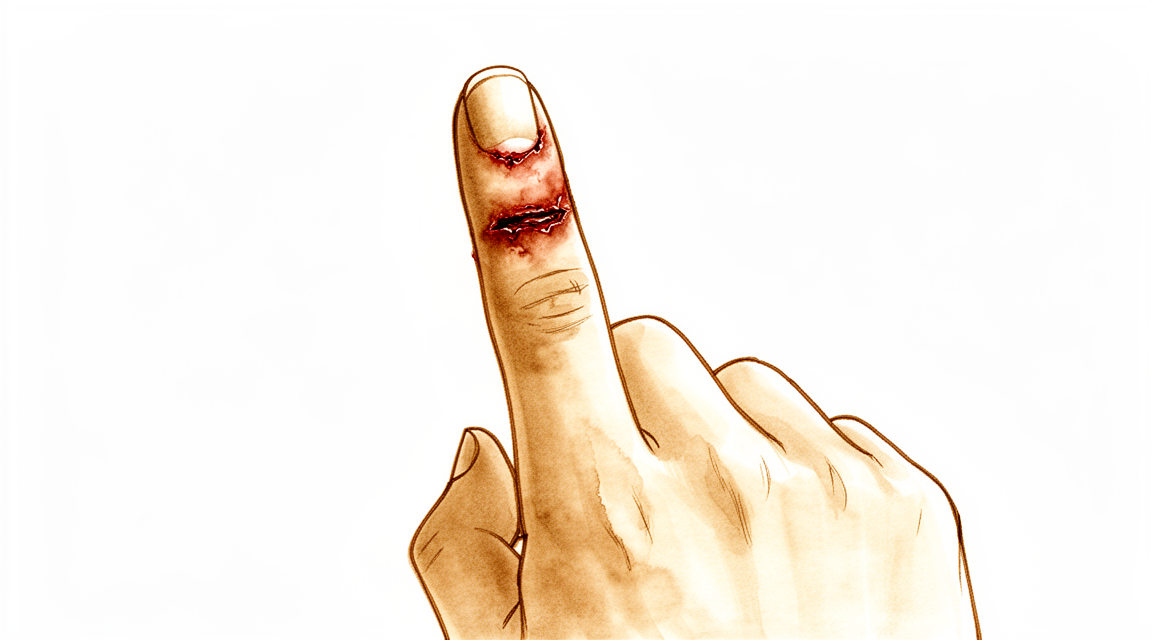
Những cảm giác bạn đang trải qua
Chấn thương đầu ngón tay thường gây đau ngay tại đầu ngón, nơi da, móng và xương nằm sát nhau. Cơn đau thường nhói hoặc giật theo nhịp, và có xu hướng tăng lên khi bạn va chạm ngón tay, nắm vật gì đó, hoặc ấn lên đầu ngón. Gõ bàn phím, cài cúc áo, nhặt đồng xu và xoay chìa khóa đều có thể trở nên khó khăn vì đầu ngón tay phải chịu lực.
Ngón tay có thể có cảm giác tê hoặc yếu, hoặc cả hai. Bạn có thể nhận thấy đầu ngón tay trở nên vụng về, hoặc không còn cảm nhận được bề mặt vật thể như trước. Sưng và đau khi chạm quanh móng là thường gặp, và bản thân móng cũng có thể bị tổn thương. Trong những ngày đầu, cơn đau thường khiến người bệnh thức giấc vào ban đêm, và có thể nặng hơn sau khi dùng tay.
Một số người thấy đầu ngón tay vẫn phản ứng với lạnh rất lâu sau khi vết thương đã lành. Không khí lạnh, nước lạnh hoặc một ngày trời lạnh có thể làm đầu ngón đau nhức hoặc trở nên quá nhạy cảm. Tình trạng này thường cải thiện theo thời gian.
Nếu một phần ngón tay bị cắt đứt, hãy đến phòng cấp cứu ngay lập tức và mang theo phần bị đứt. Quấn phần đó trong gạc ẩm hoặc một miếng vải sạch ẩm, cho vào túi nhựa kín, rồi đặt túi đó lên đá hoặc vào nước đá. Tuyệt đối không đặt phần bị đứt trực tiếp lên đá.
Hãy đến phòng cấp cứu ngay trong ngày nếu ngón tay trở nên nóng, đỏ, sưng và đau, đặc biệt là khi kèm theo sốt. Điều này cũng áp dụng nếu da bị rách ngay trên chỗ gãy xương hoặc trên khớp, nếu xương lộ ra, hoặc nếu ngón tay bị biến dạng rõ rệt. Ngón tay chuyển sang nhợt nhạt, lạnh, trắng hoặc xanh tím, hoặc đột ngột mất cảm giác hay mất vận động sau chấn thương, cũng cần được cấp cứu ngay trong ngày.
Hãy đi khám bác sĩ đa khoa hoặc yêu cầu được bác sĩ chuyên khoa đánh giá nếu các triệu chứng không thuyên giảm, nặng dần lên qua nhiều tuần, khiến bạn thức giấc vào ban đêm, hoặc khiến bạn không thể làm việc hay sử dụng bàn tay.
Chuyện gì đang xảy ra thực sự
Chấn thương đầu ngón tay là tổn thương ở phần tận cùng của ngón tay, nơi da, móng, xương và các đầu dây thần kinh nằm sát nhau. Đầu ngón tay là một trong những phần hoạt động nhiều nhất của bàn tay. Đó là bề mặt bạn dùng để cảm nhận, cầm nắm và thao tác với hầu hết mọi thứ, nên ngay cả một chấn thương nhỏ ở đó cũng dễ nhận thấy.
Đầu mỗi ngón tay chứa một mẩu xương nhỏ, lớp nền nơi móng mọc ra, và một mạng lưới dây thần kinh dày đặc giúp cảm nhận xúc giác và nhiệt độ. Khi đầu ngón tay bị đè nghiến, bị cắt hoặc bị kẹp, bất kỳ cấu trúc nào trong số này đều có thể bị tổn thương cùng lúc. Đó là lý do các triệu chứng bạn vừa đọc thường xuất hiện cùng nhau: đau ở nơi mọi thứ nằm sát nhau, tê do dây thần kinh bị tổn thương, và sưng quanh móng.
Vùng mô dưới móng quan trọng hơn so với kích thước của nó. Đó là một lớp mô mỏng nằm dưới tấm móng, giống như luống đất nơi cây mọc lên. Nếu lớp này bị rách và để lành không bằng phẳng, hoặc lành trên một mảnh xương đã bị di lệch, móng mọc ra sau đó có thể bị tách đôi, có rãnh hoặc bị cong khoằm. Đó là lý do một chấn thương trông có vẻ nhẹ vẫn được xem trọng khi có liên quan đến vùng mô dưới móng.
Nếu đầu ngón tay bị cắt đứt một phần hoặc hoàn toàn, chấn thương liên quan đến da, xương và các mạch máu nhỏ nuôi dưỡng vùng đó. Mức độ tổn thương của từng cấu trúc quyết định những gì có thể làm được, từ việc băng gạc để ngón tay tự lành từ mép vết thương vào trong, cho đến việc nối lại phần bị đứt. Đầu ngón tay cũng thực sự có khả năng tự lành khi có điều kiện thích hợp, đó là lý do việc điều trị được giữ đơn giản nhất mà chấn thương cho phép.
Chấn thương đầu ngón tay ở trẻ em rất hay xảy ra, chủ yếu tại nhà do bị kẹt ở cửa ra vào hoặc cửa sổ, và hầu hết đều có thể phòng tránh được.
Những gì chúng tôi có thể làm
Bác sĩ Kieran Hirpara, bác sĩ phẫu thuật chi trên tại Bệnh viện Mater Private Rockhampton, sẽ lựa chọn phương pháp điều trị phù hợp với chấn thương cụ thể của bạn. Một số chấn thương đầu ngón tay lành mà không cần phẫu thuật, còn một số khác cần phẫu thuật sớm, vì vậy việc được đánh giá kịp thời là quan trọng. Thông thường, bệnh nhân được bác sĩ đa khoa giới thiệu đến phòng khám chúng tôi; nếu nhà vật lý trị liệu khuyên bạn nên đến gặp chúng tôi, bạn vẫn cần có giấy giới thiệu từ bác sĩ đa khoa để được hưởng mức hoàn trả từ Medicare. Tại phòng khám, chúng tôi sẽ hỏi bệnh sử, khám ngón tay và chỉ định chụp hình ảnh khi cần thiết.
Nhiều chấn thương đầu ngón tay được điều trị mà không cần phẫu thuật. Loại băng giữ ẩm và bảo vệ vết thương giúp đầu ngón tay tự lành từ mép vết thương vào trong, và cách này vẫn có thể hiệu quả ngay cả khi có một mẩu xương nhỏ lộ ra. Đầu ngón tay thực sự có khả năng tự tái tạo lại hình dạng và cảm giác khi có điều kiện thích hợp. Loại băng cho không khí và hơi ẩm đi qua thường dễ chịu hơn khi thay, nhất là trong giai đoạn đầu, và thời gian lành có vẻ tốt hơn khi dùng loại băng này. Một số loại băng giúp tránh phải nằm viện hay vào phòng mổ. Cái giá chính của cách điều trị này là thời gian, cùng với việc thay băng thường xuyên, nhưng gánh nặng đó chỉ là tạm thời. Khi vết thương đã khép miệng, trị liệu tay giúp bạn lấy lại vận động và đưa ngón tay trở lại làm việc.
Phẫu thuật được cân nhắc khi bản thân chấn thương đòi hỏi, chứ không chỉ sau khi băng gạc không hiệu quả. Nếu một phần ngón tay đã bị cắt đứt, chúng tôi có thể nối lại, giúp phục hồi cả vẻ ngoài lẫn chức năng. Khi đầu ngón tay cần lớp da che phủ mới, có nhiều cách để chuyển mô đến che phủ, được lựa chọn tùy theo vị trí tổn thương và phần nào bị lộ ra. Nếu vùng mô dưới móng bị rách, chúng tôi sẽ khâu phục hồi cẩn thận, vì móng mọc từ một nền không bằng phẳng có thể bị tách đôi, có rãnh hoặc bị cong khoằm. Ca phẫu thuật có trang thông tin riêng, và những điều có thể xảy ra sau đó được trình bày trong phần tiếp theo.
Những điều có thể xảy ra
Hầu hết các chấn thương đầu ngón tay đều ổn định tốt nếu được điều trị đúng cách. Đầu ngón tay thực sự có khả năng tự lành, và việc điều trị cẩn thận da, vùng mô dưới móng và dây thần kinh nhìn chung có thể mang lại cho bạn một đầu ngón tay có hình dáng đẹp và hoạt động tốt. Nhiều chấn thương lành mà không cần phẫu thuật, và cái giá chính của cách điều trị đó là thời gian và việc thay băng thường xuyên, chứ không phải điều gì vĩnh viễn. Khi vết thương đã khép miệng, trị liệu tay giúp bạn lấy lại vận động và đưa ngón tay trở lại làm việc.
Hồi phục diễn ra từ từ chứ không tức thì. Cảm giác ở đầu ngón thường trở lại chậm, và có thể không hoàn toàn giống như trước. Một số người thấy đầu ngón tay vẫn phản ứng với lạnh rất lâu sau khi vết thương đã lành, và tình trạng này thường cải thiện theo thời gian. Tê, đau khi chạm và các thay đổi ở móng cũng có thể mất nhiều tuần đến nhiều tháng mới ổn định. Nếu một phần ngón tay đã được nối lại, ngón tay có thể không còn cảm giác hay hoạt động hoàn toàn như trước chấn thương, nhưng vẫn có thể mang lại cho bạn chức năng hữu ích, vẻ ngoài đẹp, và giúp bạn trở lại làm việc cũng như sinh hoạt hàng ngày.
Nếu chấn thương đầu ngón tay không được điều trị, hoặc vùng mô dưới móng không được khâu phục hồi cẩn thận, các vấn đề thường kéo dài thay vì tự ổn định. Móng mọc từ một nền không bằng phẳng có thể vẫn bị tách đôi, có rãnh hoặc bị cong khoằm. Tổn thương thần kinh không được xử trí có thể để lại tình trạng tê kéo dài hoặc đau dai dẳng. Một số người bị đau lâu dài ở đầu ngón tay sau khi vết thương đã lành, và khoảng một trong ba người bị cắt bỏ một phần ngón tay cho biết bị đau thần kinh kéo dài. Nhiễm trùng sau các chấn thương này ít gặp, ở mức 2.5%, nhưng nếu ngón tay trở nên nóng, đỏ, sưng và đau, đặc biệt là khi kèm theo sốt, hãy đến phòng cấp cứu ngay trong ngày.
Hãy theo dõi các dấu hiệu cảnh báo trong quá trình hồi phục. Hãy đến phòng cấp cứu ngay trong ngày nếu ngón tay chuyển sang nhợt nhạt, lạnh, trắng hoặc xanh tím, hoặc nếu bạn đột ngột mất cảm giác hay mất vận động ở ngón tay sau chấn thương. Hãy đi khám bác sĩ đa khoa hoặc yêu cầu được bác sĩ chuyên khoa đánh giá nếu các triệu chứng không thuyên giảm, nặng dần lên qua nhiều tuần, khiến bạn thức giấc vào ban đêm, hoặc khiến bạn không thể làm việc hay sử dụng bàn tay.
Khi nào nên đi khám bác sĩ
Hầu hết các chấn thương đầu ngón tay có thể chờ đến lần khám bác sĩ đa khoa hoặc một cuộc hẹn thông thường, nhưng một số thì không. Hãy đến phòng cấp cứu ngay lập tức nếu một phần ngón tay bị cắt đứt, và mang theo phần bị đứt. Hãy đi ngay trong ngày nếu ngón tay trở nên nóng, đỏ, sưng và đau, đặc biệt là khi kèm theo sốt, hoặc nếu ngón tay chuyển sang nhợt nhạt, lạnh, trắng hoặc xanh tím. Điều này cũng áp dụng nếu bạn đột ngột mất cảm giác hay mất vận động ở ngón tay sau chấn thương, hoặc nếu da bị rách ngay trên chỗ gãy xương hoặc trên khớp, xương lộ ra, hoặc ngón tay bị biến dạng rõ rệt. Nhẫn làm kẹt hoặc làm rách ngón tay có thể gây chấn thương nghiêm trọng cần được bác sĩ chuyên khoa chăm sóc. Hãy đi khám bác sĩ đa khoa hoặc yêu cầu được bác sĩ chuyên khoa đánh giá nếu các triệu chứng không thuyên giảm, nặng dần lên qua nhiều tuần, khiến bạn thức giấc vào ban đêm, hoặc khiến bạn không thể làm việc hay sử dụng bàn tay.
Phân tích sâu hơn
Advanced reading: the deeper science (optional)
Phần này đi sâu hơn mức cần thiết để bạn đưa ra các quyết định điều trị. Những chấn thương ở đầu ngón tay rất đáng để đọc kỹ, bởi phương pháp điều trị cho kết quả tốt nhất lại là phương pháp không cần phẫu thuật – một kết quả trái ngược hoàn toàn với xu hướng thông thường là phải khâu vết thương lại.
Để vết thương tự lành tốt hơn so với việc khâu kín
Khi đầu ngón tay bị cắt đứt, các phương pháp tái tạo gồm có dùng vạt da, ghép mô, hoặc chỉ dùng băng gạc và thời gian – tức là để vết thương tự liền lại theo cơ chế thứ phát, từ mép vết thương vào trong.
Qua việc xem xét 1.592 ca bệnh được điều trị bằng phương pháp để vết thương tự lành, việc chăm sóc bảo tồn với băng gạc và nẹp bảo vệ giúp bệnh nhân tránh được tình trạng phải bất động ngón tay cũng như các biến chứng tại vùng lấy mô, mang lại khả năng cảm giác gần như bình thường và mức độ nhạy cảm với lạnh rất thấp, đồng thời giúp họ sớm quay lại làm việc [1].
Phương pháp này có bốn ưu điểm riêng biệt; mỗi ưu điểm đều khắc phục một nhược điểm cụ thể của các phương pháp phẫu thuật khác. Việc dùng vạt da đòi hỏi phải lấy mô từ nơi khác trên cơ thể, tạo ra vết thương thứ hai và thường cần phải cố định ngón tay trong thời gian hồi phục. Vạt da này lại mang theo hệ thần kinh riêng, không phải của đầu ngón tay, nên cảm giác sau phẫu thuật sẽ khác đi. Tình trạng nhạy cảm với lạnh – một vấn đề lâu dài thường bị xem nhẹ sau chấn thương đầu ngón tay – được ghi nhận là rất ít gặp khi áp dụng phương pháp để vết thương tự lành.
Đầu ngón tay có khả năng đáng kinh ngạc trong việc tái tạo lại hình dạng và cảm giác nếu được tạo điều kiện thích hợp, đặc biệt là khi xương không bị lộ ra ngoài. Nhược điểm chính của phương pháp bảo tồn này là thời gian điều trị lâu hơn và việc thay băng thường xuyên; đây là gánh nặng thực tế nhưng chỉ mang tính tạm thời mà thôi.
Trong các trường hợp sử dụng mảnh ghép, tuổi tác là yếu tố dự báo khả năng tồn tại của mảnh ghép
Phương pháp ghép mảnh tổng hợp – tức là dùng mảnh ghép để thay thế phần chi bị cắt mất mà không cần nối lại các mạch máu – được đánh giá là khả thi và hiệu quả trong việc phục hồi chức năng cũng như hình dáng ngón tay ở 720 bệnh nhân. Hầu hết các mảnh ghép đều tồn tại tốt; đặc biệt là ở nhóm bệnh nhân trẻ tuổi thì tỷ lệ tồn tại của mảnh ghép càng cao [2].
Việc hiểu rõ mối liên hệ giữa tuổi tác và khả năng tồn tại của mảnh ghép là rất quan trọng trước khi đưa ra quyết định điều trị; bởi nếu mảnh ghép không tồn tại, vết thương sẽ phải tự lành theo phương pháp bảo tồn, khiến thời gian điều trị bị kéo dài.
Tái ghép chi: Những gì có thể và không thể phục hồi được
Trong trường hợp một ngón tay bị cắt đứt hoàn toàn, việc tái ghép chi giúp nối lại các mạch máu. Kết quả điều trị trên 619 bệnh nhân cho thấy rằng việc tái ghép ngón tay không thể khôi phục hoàn toàn chức năng tay như trước khi bị chấn thương, nhưng vẫn giúp tay hoạt động ở mức độ chấp nhận được; kỳ vọng này cần được xem xét khi đưa ra quyết định điều trị [3].
Các yếu tố ảnh hưởng đến tỷ lệ sống sót của ngón tay sau tái ghép cũng đã được xác định rõ hơn so với suy nghĩ thông thường. Trong 2,641 ca tái ghép, giới tính và thời gian thiếu máu không có ảnh hưởng đáng kể đến khả năng sống sót của ngón tay; ngược lại, tuổi tác, tay bị tổn thương, loại chấn thương, vùng tổn thương và phương pháp bảo quản phần ngón tay bị cắt đứt đều có ảnh hưởng [4].
Việc thời gian thiếu máu không ảnh hưởng đáng kể đến kết quả điều trị là điều khá bất ngờ, xét đến mức độ khẩn cấp của các ca chấn thương này. Điều này không có nghĩa là thời gian không quan trọng; có lẽ do các ngón tay được bảo quản đúng cách có khả năng chịu đựng sự chậm trễ lâu hơn dự kiến, và đó cũng là lý do phương pháp bảo quản có vai trò quyết định. Hướng dẫn thực hành cụ thể như sau: quấn phần ngón tay bị cắt đứt vào gạc ướt, cho vào túi kín rồi đặt lên đá; tuyệt đối không đặt trực tiếp phần ngón tay lên đá.
Vùng mô dưới móng là yếu tố quyết định vẻ ngoài của móng
Vẻ ngoài lâu dài của vùng đầu ngón tay sau chấn thương phụ thuộc rất nhiều vào vùng mô dưới móng nằm phía dưới móng. Việc khâu vá vết rách ở vùng mô dưới móng một cách chính xác thường giúp móng mọc trở lại bình thường; ngược lại, nếu vết thương không được điều trị hoặc lành lại trên một mảnh xương bị di lệch, móng sẽ bị nứt, có các rãnh hoặc cong vênh vĩnh viễn. Đó là lý do tại sao những chấn thương tưởng chừng nhẹ nhưng có liên quan đến vùng mô dưới móng lại cần được điều trị cẩn trọng hơn mức mà kích thước vết thương cho thấy.
Tài liệu tham khảo
[1] Krauss EM, Lalonde DH. Quá trình lành thương thứ phát sau cắt cụt đầu ngón tay: tổng quan. Hand (N Y). 2014;9(3):282-8. https://doi.org/10.1007/s11552-014-9663-5
[2] Elameen AM, Dahy AA, Abu-Elsoud A, Gad AA. Các yếu tố dự đoán khả năng sống sót của mảnh ghép hỗn hợp ở bệnh nhân bị cắt cụt đầu ngón tay: tổng quan có hệ thống và phân tích tổng hợp. J Orthop Surg Res. 2024;19(1). https://doi.org/10.1186/s13018-024-05230-9
[3] Shaterian A, Sayadi LR, Tiourin E, Gardner DJ, Evans GRD, Leis A. Các yếu tố dự đoán chức năng bàn tay sau khi nối lại ngón tay: tổng quan định lượng và phân tích tổng hợp. Hand (N Y). 2019;16(1):11-7. https://doi.org/10.1177/1558944719834658
[4] Ma Z, Guo F, Qi J, Xiang W, Zhang J. Ảnh hưởng của các yếu tố phi phẫu thuật đến tỷ lệ sống sót sau nối lại ngón tay: phân tích tổng hợp. J Hand Surg Eur Vol. 2015;41(2):157-63. https://doi.org/10.1177/1753193415594572
Evidence & references
This is the clinical evidence summary written for health professionals. It is technical, and it lists the research this page was built from. You do not need to read it to understand your treatment or to make a decision about it.
Overview
- Fingertip injuries in children are common and result in significant burden [1].
- Most fingertip injuries in children occur at home in a door or window [1].
- Fingertip injuries in children are mostly preventable [1].
- It is impossible to save fingers which were totally minced in severe mincer injuries [2].
- The Fingertip Injury Outcome Score (FIOS) is the most complete fingertip-specific outcome instrument [4].
- FIOS should be adopted as the primary standard for outcome reporting and long-term follow-up across fingertip injuries [4].
- A prospective study shows that the open method has a definite place in the treatment of certain fingertip injuries in adults [5].
- In a series of 74 patients with 96 injured fingers treated with a deepithelialized pedicle flap placed subcutaneously, the result was a well-contoured fingertip in all patients [6].
- When considering reconstructive options for fingertip injuries, the location of damage should be considered [7].
- The conservation of amputated finger-tips provides the hand surgeon with new possibilities for late reconstruction of an injured digit [8].
- The low incidence of infection (2.5%) and lack of a meaningful difference between groups call into question prophylactic antibiotic prescribing after distal fingertip injuries [9].
- The parallelogram flap is a better choice for reconstruction of fingertip injury with bone exposure compared to the homodigital island flap [10].
- Secondary procedures are often necessary following hand and digit replants [14].
- The purse-string suture technique is recommended to be applied to all fingertip injuries to preserve the nail [20].
- Donor finger morbidity in cross-finger flaps is a common occurrence and can produce a donor finger which is both stiff and cosmetically displeasing [32].
- Functional results of successfully replanted fingers were rated from fair to excellent, with better outcomes in younger patients [35].
- The superficialis finger operation has wider application than previously recognized [44].
- The best indication of the reversed digital artery island flap is the coverage of large defects of the dorsal aspects of the middle and third phalanx, not the treatment of fingertip injuries [45].
- The philosophy of digital replantation reflects the aim of ensuring not only the survival of a digit, but its functional use as well [50].
- Current data are inadequate to make comments regarding donor site morbidity for toe-to-thumb transfers [51].
- An evidence-based recommendation for the superiority of a specific type of toe-to-thumb transfer cannot be made due to inadequate data [51].
- There is insufficient evidence to determine the best treatment method for composite defects of the fingertips due to the lack of prospective randomized trials and disparate retrospective case series [56].
- Two new indications for the use of the first dorsal metacarpal artery (1st DMA) in reconstruction following severe hand injury are reported [68].
- Demographics play a significant role in the decision for finger replantation and its outcomes in addition to injury factors [118].
- Fingertip replantation represents a complex technical procedure for expert surgeons [119].
- In the absence of any means of identifying patients whose replants are likely to fail, economics dictate that replantation of amputations of the distal finger is not attempted or the cost of this small group of patients is borne [120].
Anatomy & Pathophysiology
Osseous and Skeletal Architecture
- The skeleton of the hand consists of 27 bones, of which 19 are long bones [43].
- The hand skeleton is divided into five rays, each forming a polyarticulated chain comprising metacarpals and phalanges [43].
- The thumb ray is the shortest, consisting of a metacarpal and two phalanges [43].
- The index metacarpal is the longest of the metacarpals [43].
- The proximal and middle phalanges of the middle and ring fingers are longer than those of the index finger [43].
- The epiphyseal plates are located at the proximal ends of the phalanges and the first metacarpal [43].
- The epiphyseal plates are located at the distal ends of the other metacarpals [43].
- The fingertip is defined as the portion of the finger distal to the insertion of the flexor and extensor tendons [33].
Musculotendinous Anatomy
- The extrinsic extensors run through six different fibroosseous retinacular compartments at the wrist level [42].
- The principal bony insertion of the extrinsic digital extensors is on the dorsal proximal aspect of the middle phalanx [42].
- Metacarpophalangeal joint extension is provided by extrinsic extensor force transmitted through the sagittal bands [42].
- Distal interphalangeal joint extension is achieved through conjoined lateral bands composed of tendinous slips from extrinsic and intrinsic tendons [42].
- The flexor digitorum profundus inserts on the proximal volar aspect of the distal phalanx [42].
- The flexor digitorum superficialis inserts via radial and ulnar slips into the proximal metaphysis of the middle phalanx [84].
- The fibroosseous tunnel of the digital flexor sheath extends distally to the proximal aspect of the distal phalanx [84].
- The A2 and A4 pulleys are the most essential in maintaining the mechanical advantage of the flexor tendons [84].
- The dorsal interossei are abductors, while the volar interossei are adductors [77].
- The middle finger has two dorsal interossei and no volar interossei because the central axis of the hand lies within it [77].
- The terminal tendon of the extensor mechanism inserts at the base of the distal phalanx to extend it [77].
Vascular and Neurovascular Anatomy
- The volar metacarpal vessels play an important part in the vascularity of the hand [60, 61].
- The "princeps pollicis" artery is the terminal branch of the radial artery that crosses the first intermetacarpal space [81].
- In the pulp segment of the thumb, the two arteries run through thick fatty subcutaneous padding and convert into the ends of the digital nerves at the median axis [81].
- The digital neurovascular structures are surrounded by a diffuse network of thin transverse oblique fibers [87].
- Fibers dorsal to the neurovascular bundle are collectively called Cleland ligament, and those palmar to the bundle are called Grayson ligament [87].
Cutaneous and Soft Tissue Anatomy
- The dorsal integument of the distal phalanx is characterized by the nail bed with its matrix [76].
- The dorsal skin possesses a normal pilosebaceous system, unlike the palm [86].
- The dorsal skin has loose connections with deeper planes, allowing free gliding and full flexion at the digital joints [86].
- Flexion of the fingers produces a significant lengthening of the dorsal skin, with an average increase of 3 cm in the middle finger from extension to full flexion [86].
- The palmar integument of the digits is subdivided into phalangeal units separated by digital flexion folds [76].
- When a digit is completely flexed, the integument of adjacent phalanges comes into contact in the zones of the flexion creases, forming diamond-shaped areas of cutaneous contact [76].
- The skin covering each finger is 7 cm by 10 cm on both the palmar and dorsal aspects [79].
Functional Pathophysiology and Injury Mechanisms
- The unique anatomy and specialized structure of the fingertip make it critical for functions such as sensation, fine handling, and gripping [33].
- Fingertip injuries in children are mostly preventable, with most injuries occurring at home in a door or window [1].
- In severe mincer injuries, it is impossible to save fingers which were totally minced [2].
- The nail plate protects the fingertip from injury, regulates circulation, provides counterforce for picking up small objects, and contributes to tactile sensation [172].
- Nail and fingertip injuries frequently occur together [25].
- Nail dystrophies are present in up to 60% of cases of nail and fingertip injuries, except for the most minor injuries involving less than one third of the distal nail bed [25].
- Extensor mechanism injuries in the digit are traumatized five times more frequently than flexor tendons [38].
- The proximity of the extensor mechanism to the underlying periosteum at a fracture site makes the likelihood of adhesion formation much greater than for flexor tendons [38].
- Healing times in isolated extensor injury are often up to 6-8 weeks following injury, which is lengthier than in flexor tendons [38].
- The measured force of the flexor tendons is almost three times greater than the extensor tendon [38].
- The dorsal extensor mechanism has much less excursion than the flexors, adding to the importance of preservation of tendon length [38].
- Fingertip injuries in athletes may arise from a myriad of causes on the field and may occur in virtually any sport [27].
- Two of the most common fingertip injuries in athletes are mallet and jersey fingers [27].
Classification
- Fingertip injuries in children are common, result in significant burden, and are mostly preventable, with most injuries occurring at home in a door or window [1].
- Fingertip injuries in children presenting with abuse are significantly more likely to occur during childhood compared with those without recorded abuse, suggesting these injuries may be ones of abuse or neglect [16].
- The Pulp Nail Bone (PNB) classification was evaluated for reliability in a study recruiting 100 patients with fingertip injuries between September 2003 and March 2005 [12].
- In the PNB classification study, the most frequently injured fingers were the index (33%) and the middle finger (32%), while the thumb (16%), ring finger (15%), and little finger (4%) were less frequently injured [12].
- The Fingertip Injury Outcome Score (FIOS) is the most complete fingertip-specific outcome instrument and should be adopted as the primary standard for outcome reporting and long-term follow-up across fingertip injuries [4].
- Nail and fingertip injuries frequently occur together, and nail injuries should be treated as a separate entity regardless of the treatment of associated lesions, as inadequate treatment may lead to severe disabling sequelae [25].
- Only half of the nail dystrophies associated with nail and fingertip injuries are disabling [25].
- The Urbaniak classification scheme for ring avulsion injuries defines Class III as the most severe type, including avulsion-amputation and complete degloving injuries [74].
- In Class III ring avulsion injuries, the complete degloving type usually leaves bone and tendon units intact but badly damages the skin envelope, with severe avulsion injury to the digital artery at its most distal portion usually precluding revascularization [74].
- The Urbaniak classification defines Class I ring avulsion injuries as having adequate circulation, where standard bone and soft tissue treatment is sufficient [156].
- The Urbaniak classification defines Class II ring avulsion injuries as having inadequate circulation, where vessel repair preserves viability and permits immediate or delayed repair of other tissues [156].
- The Urbaniak classification defines Class III ring avulsion injuries as complete degloving or amputation, where judgment is required since revascularization of a nonfunctional digit will result in a parasitic member [156].
- Class IIA ring avulsion injuries are defined as those in which only digital arteries are damaged but all other structures are intact and functional [156].
- Class IIA ring avulsion injuries are considered an absolute indication for microvascular repair because failure to operate results in digital loss [156].
- The Chaudakshetrin classification divides the fingertip from the distal interphalangeal (DIP) joint distally into Zone 1 (area from the joint line to the nail matrix), Zone 2 (germinal nail matrix distance), and Zone 3 (area distal to the nail matrix) [166].
- In the Chaudakshetrin classification, no arterial arches were recorded in Zone 1, while Zone 2 contained 47 arches (73.4%) and Zone 3 contained 17 arches (26.6%) [166].
- The precise management of a fingertip injury in adults depends on the degree of injury itself, and a number of operative and non-operative techniques may be successfully employed [11].
- Reconstructive options for hand injuries, when considering fingertip injuries, require consideration of the location of damage [7].
Clinical Presentation
Epidemiology and Demographics
- Fingertip injuries in children are common and result in significant burden, yet are mostly preventable, with most injuries occurring at home in a door or window [1].
- In a cohort of 100 patients with fingertip injuries, the average age was 38.3 years (range 18–79), with 85 men and 15 women [12].
- In the same cohort of 100 patients, the dominant hand was injured in 39 cases and the non-dominant hand in 61 cases [12].
- The most frequently injured fingers were the index (33%) and the middle finger (32%), while the thumb (16%), ring finger (15%), and little finger (4%) were less frequently injured [12].
- Hand injuries are common presentations in the emergency department [96].
- Injuries encountered in the US military range from subungual hematomas to finger amputations [106].
Mechanism and Etiology
- Fingertip injuries in athletes may arise secondary to a myriad of causes on the field and may occur in virtually any sport [27].
- Weakened rings allow avoiding complete finger avulsion but are the cause of severe and complex lesions that require specialized management [28].
- Patients presenting with abuse are significantly more likely to have fingertip injuries during childhood compared with those without recorded abuse, which suggests that these injuries may be ones of abuse or neglect [16].
Clinical Evaluation and History
- Assessment of patients with fingertip injuries should include a focused history including age, sex, handedness, mechanism of injury, occupation, smoking status, medical comorbidities, tetanus vaccination, and previous operations on the affected hand [19].
- The examiner should also elicit any subjective symptoms including numbness, weakness, or pain [19].
- Clinical evaluation of the injured or dysfunctional hand and wrist can be a daunting task because painless and full hand function requires seamless integration of joints, muscles, and nerves to complete even the most basic task [26].
- Patients often have difficulty accurately describing their symptoms and may incorrectly attribute pathology to a perceived deficit, whether real or imagined [26].
- The task of the astute clinician is to combine the patient history with a careful physical examination to pinpoint or at least narrow the scope of possible pathologic processes [26].
- Diagnostic tests such as imaging and serum laboratory studies are useful in this determination but can be expensive, time consuming, and often nonspecific [26].
- A careful physical examination is essential to direct care and future testing if indicated [26].
- With so many structures in such a small space, a systematic method to approaching the physical examination is essential [26].
- Some clinicians may prefer to organize their examination by anatomic location or region of the hand, while others may choose to proceed by organ system or pathology [26].
Associated Findings and Complications
- Although conservative treatment usually leads to good results for pulp injuries, nail dystrophies are always present (up to 60% of cases) except for the most minor injuries involving less than one third of the distal nail bed [25].
- Only half of nail dystrophies were disabling [25].
- Ectopic nail formation should be included within the differential diagnosis when evaluating distal finger masses, especially in cases of previous distal digital trauma [49].
- A correlation exists between experienced loss of function and an estimated diagnosis of major depression in patients with a fingertip injury [17].
Investigations
- FIOS is the most complete fingertip-specific outcome instrument and should be adopted as the primary standard for outcome reporting and long-term follow-up across fingertip injuries [4].
- A careful physical examination is essential to direct care and future testing if indicated, as diagnostic tests such as imaging and serum laboratory studies can be expensive, time-consuming, and often nonspecific [26].
Treatment
General Principles and Assessment
- The examiner should elicit any subjective symptoms including numbness, weakness, or pain during the assessment of fingertip injuries [19].
- The precise management of a fingertip injury in adults depends on the degree of injury itself [11].
- A number of operative and non-operative techniques may be successfully employed for the management of partial fingertip amputation in adults [11].
- The most significant guideline underlining the philosophy of digital replantation today reflects the aim of not only ensuring the survival of a digit, but its functional use as well [50].
- Age alone should not be an absolute contraindication to finger replantation [91].
- Radial-digit involvement and no prior tobacco use were associated with replantation success [39].
Non-Operative Management
- Conservative treatment with semiocclusive dressings has become more acceptable due to excellent results in restoring contour, sensibility, and aesthetics for fingertip and thumb tip injuries [148].
- A semipermeable dressing has been shown to cause less discomfort to patients on removal for changes of dressing in finger-tip injuries, particularly in the early stages of healing [126].
- Healing times appear enhanced by the use of a semipermeable dressing in fingertip injuries [126].
- The semiocclusive dressing is a suitable alternative in treating fingertip injuries [144].
- A protective distal finger splint allowed the patient to return to work successfully, without contraindications [97].
- Clinical outcomes indicate that remote and in-person hand therapy provide similar results for patients with flexor tendon repairs in zones 1 and 2 [102].
Operative Management: Replantation and Salvage
- The open method has a definite place in the treatment of certain fingertip injuries [5].
- Factors including mechanism of injury, preservation and condition of the amputated part, ischemia time, availability of a trained team at an institution, and adequacy of resources can substantially influence and even preclude the capability of performing a distal replantation [33].
- Of the 7 fingers treated with nonmicrosurgical replantation using a subcutaneous pocket, only one survived completely but became atrophic after 4 months, while three fingers developed total necrosis [15].
- All patients (regardless of age) treated with nonmicrosurgical replantation using a subcutaneous pocket developed flexion contractures, not only of the injured, but also of the uninjured, digits of the same hand [23].
- Other cases of finger replantation are more controversial because of the poor functional outcome, especially for the index finger, which is often functionally excluded [21].
- The damage to the hand from severe mincer injuries is severe and it is impossible to save fingers which were totally minced [2].
- Venous congestion after digital replantation or revascularization threatens digit survival in the immediate postoperative period [139].
- External bloodletting, including leech therapy, provides a central role in salvage of the congested finger following digital replantation or revascularization [139].
- Negative pressure wound therapy (NPWT) maintains wound homeostasis and reduces wound exudate and soft tissue edema [143].
- Use of NPWT on the amputation stump may shorten the delay from initial ectopic banking to a subsequent delayed replantation [143].
Operative Management: Flaps and Reconstruction
- Fingertip flap reconstruction becomes important when replantation of an amputated fingertip is not possible [33].
- The location of damage should be considered when selecting reconstructive options for fingertip injuries [7].
- A deepithelialized pedicle flap placed subcutaneously for fingertip reconstruction resulted in a well-contoured fingertip in all 74 patients with 96 injured fingers treated between 1976 and 1986 [6].
- The thenar flap provides good sensory function and appearance when fundamental technical principles (flap design, timing of division, and early mobilization) are respected [37].
- The free dorsal middle phalangeal finger flap provides excellent sensory and aesthetic recovery for severe fingertip injuries [36].
- The best indication of the reversed digital artery island flap is not the treatment of fingertip injuries, but rather the coverage of large defects of the dorsal aspects of the middle and third phalanx [45].
- A method for postoperative cooling after composite grafting of the fingertip splints the operated digit while leaving nonoperated fingers free to move without compromising cooling [160].
Nail Bed and Specific Injury Considerations
- Only half of nail dystrophies following injury were disabling [25].
- Nail injuries should be treated as a separate entity, whatever the treatment of associated lesions may be, as inadequate treatment may lead to severe disabling sequelae [25].
- Early treatment of nail injuries usually leads to good and excellent results [25].
- Recognition of injury to the nail bed and proper treatment will greatly reduce the number of reconstructions and secondary procedures that are necessary [133].
- Surgeons do not operate on nail deformities following injury for at least one year, since they will all improve over that time [133].
- The lump on the distal growing nail following trauma usually bothers patients, and it is consoling to them to be told that this is normal and will improve [133].
Complications
Infection and Antibiotic Prophylaxis
- The incidence of infection following distal fingertip amputation and crush injury is 2.5% [9].
- There is no meaningful difference in outcomes between groups regarding prophylactic antibiotic prescribing after distal fingertip injuries [9].
Replantation and Revascularization Complications
- Cold-induced vasospasm after digital replantation does not improve with time [147].
- The incidence of cold-induced vasospasm following replanted digital amputations has been reported to be as high as 100% [147].
- Patients with severe cold-induced vasospasm problems did not experience improvement over time [147].
- In a study of nonmicrosurgical replantation using a subcutaneous pocket, 3 of 7 treated fingers developed total necrosis [15].
- In a study of nonmicrosurgical replantation using a subcutaneous pocket, 1 of 7 treated fingers survived completely but became atrophic after 4 months [15].
- All patients in a study of nonmicrosurgical replantation using a subcutaneous pocket developed flexion contractures of the injured digits [23].
- All patients in a study of nonmicrosurgical replantation using a subcutaneous pocket developed flexion contractures of the uninjured digits of the same hand [23].
- In a study of fingertip replantation using a single volar arteriovenous anastomosis, partial necrosis occurred in 1 case [70].
- In a study of fingertip replantation using a single volar arteriovenous anastomosis, 3 cases resulted in complete survival of the replanted fingertip [70].
Donor Site Morbidity
- Donor finger morbidity is a common occurrence following cross-finger flaps [32].
- Donor finger morbidity from cross-finger flaps can result in a stiff and cosmetically displeasing donor finger [32].
Functional and Sensory Complications
- There is a correlation between experienced loss of function and an estimated diagnosis of major depression in patients with fingertip injuries [17].
- Phalangization for thumb reconstruction generally yielded poor results with repeated ulceration [72].
- Phalangization for thumb reconstruction did not increase span [72].
Reoperation and Secondary Procedures
- Patients with combined index finger injury treated with repair had a 44% rate of unplanned reoperation [161].
- Patients with combined index finger injury treated with immediate amputation had a 21% rate of unplanned reoperation [161].
- 6 patients (18%) underwent amputation after initial repair for combined index finger injury [161].
- Women were more likely to have an unplanned reoperation than men following combined index finger injury [161].
- Patients who had a reoperation for fingers other than the index finger were at risk for unplanned reoperation after repair of the index finger [161].
- Patients who had a ray amputation were at risk for unplanned reoperation after immediate amputation of the index finger [161].
Specific Injury Mechanisms and Outcomes
- Fingers that were totally minced in severe mincer injuries are impossible to save [2].
- Spontaneous amputation of the terminal phalanx of the index finger occurred in two patients with finger injuries from infant mittens [69].
- In a study of isolated finger injuries in children, damage to the fingers can be prevented or minimised by the use of safety measures [150].
Recovery
Assessment and Outcomes
- The examiner should elicit any subjective symptoms including numbness, weakness, or pain during the assessment of patients with fingertip injuries [19].
- Both functional outcomes and patient-reported outcomes together facilitate a comprehensive assessment of the benefits of replantation for amputation injuries in the hand [136].
- The functional outcome following complete ring finger avulsion depends on the condition of the proximal interphalangeal joint [140].
- A method for assessing hand function following loss of the long finger extensors in Zones 6 and 7 is described [24].
Replantation and Revascularization Outcomes
- In a series of 7 fingers treated with nonmicrosurgical replantation using a subcutaneous pocket, only one survived completely but became atrophic after 4 months, while three fingers developed total necrosis [15].
- All patients treated with nonmicrosurgical replantation using a subcutaneous pocket developed flexion contractures, not only of the injured, but also of the uninjured, digits of the same hand [23].
- In 3 cases of fingertip replantation using a single volar arteriovenous anastomosis and drainage with a transverse tip incision, the replanted fingertip survived completely; partial necrosis occurred in 1 case [70].
- In a series of cross-finger dermal pocketing to augment venous outflow for distal fingertip replantation, 3 digits survived and patients regained baseline active motion 6 weeks after the procedure [146].
- The results of delaying replantation of digits overnight give results comparable with those of immediate replantation in selected cases [152].
- Functional results of successfully replanted fingers following ring avulsion injuries were rated from fair to excellent, with better outcomes in younger patients [35].
- Amputations of the distal phalanx and the thumb, being male, and ischemia time of greater than 12 hours seem to have a somewhat worse prognosis for digit replantation [165].
- Long-term results of ring avulsion injuries managed with homodigital and heterodigital venous island conduit flaps reveal durable cover and satisfactory range of motion in the injured and donor digits [149].
Reconstruction and Salvage Outcomes
- From 1976 through 1986, 74 patients with 96 injured fingers treated with a deepithelialized pedicle flap placed subcutaneously for fingertip reconstruction resulted in a well-contoured fingertip in all patients [6].
- In all cases of V-Y advancement of the entire volar soft tissue of the thumb in distal reconstruction, a good functional, innervated thumb tip was achieved at a single operation without recourse to either vascular or nerve anastomosis and without any reduction in thumb length beyond that of the injury [41].
- The reconstructed finger following staged hand-foot flap reciprocity exhibited satisfactory sensation and functional scores during follow-up [59].
- Although recul unguéal reconstruction results in a shorter finger, good functioning and good immediate sensitivity are maintained [71].
- Phalangization for thumb reconstruction generally yielded poor results with repeated ulceration and no increase in span [72].
- The postoperative course for one-stage thumb reconstruction using a previously injured little finger from the contralateral hand was uneventful apart from some delayed healing of the right hand, and the patient was pleased with the early result [163].
- At 6 months following secondary flexor tendon surgery using a silicone perfusion tube in a resource-limited environment, very significant progress was observed with complete and total recovery of active flexion amplitudes of the proximal and distal interphalangeal joints of 4 long fingers [157].
Prosthetics and Long-term Function
- After 3 years, two-thirds of patients continued to use the artificial finger following digital prostheses and orthotics [174].
- The best results for shock absorbing finger caps were obtained when the cap was fitted within weeks rather than months of the finger-tip becoming painful, though a few long-standing cases were helped [31].
- Long-term follow-up in transient patient populations with pay phone receiver cord injuries to the hand was impossible, and anticipated hand function results are less than optimal [63].
Key Evidence
- [L4] Fingertip injuries in children are common and result in significant burden, yet are mostly preventable, with most injuries occurring at home in a door or window. [1] (10.1177/1558944716670139)
- [L4] The damage to the hand is severe and it is impossible to save fingers which were totally minced. [2] (10.1016/0266-7681(85)90045-2)
- [L3] FIOS is the most complete fingertip-specific outcome instrument and should be adopted as the primary standard for outcome reporting and long-term follow-up across fingertip injuries. [4] (10.2106/jbjs.rvw.25.00128)
- [L3] This prospective study shows that the open method has a definite place in the treatment of certain fingertip injuries. [5] (10.1016/s0363-5023(82)80042-7)
- [L4] From 1976 through 1986, 74 patients with 96 injured fingers were treated with this technique, and in all patients the result was a well-contoured fingertip. [6] (10.1016/0363-5023(92)90375-y)
- [L5] Reconstructive options for hand injuries, when considering fingertip injuries, the location of damage should be considered. [7] (10.1016/j.hcl.2020.09.002)
- [L4] The conservation of these finger-tips provides the hand surgeon with new possibilities for late reconstruction of an injured digit. [8] (10.1016/s0020-1383(73)80022-1)
- [L3] The low incidence of infection (2.5%) and lack of a meaningful difference between groups call into question prophylactic antibiotic prescribing after these distal fingertip injuries. [9] (10.1016/j.jhsg.2023.07.010)
- [L2] This method is a better choice for reconstruction of fingertip injury. [10] (10.1186/s13018-022-03214-1)
- [Paper] However, the precise management of a fingertip injury in adults depends on the degree of injury itself, and a number of operative and non-operative techniques may be successfully employed. [11] (10.1016/j.injury.2017.10.042)
- [L4] [12] (10.1016/j.jhsb.2006.11.015)
- [Paper] Secondary procedures are often necessary following hand and digit replants. [14] (10.1055/s-0039-1681981)
- [L4] Of the 7 fingers treated, only one survived completely but became atrophic after 4 months, while three fingers developed total necrosis. [15] (10.1016/j.jhsa.2004.10.013)
- [L3] Patients presenting with abuse are significantly more likely to have fingertip injuries during childhood compared with those without recorded abuse, which suggests that these injuries may be ones of abuse or neglect. [16] (10.1016/j.jhsg.2019.09.001)
- [L3] We have found a correlation between experienced loss of function and an estimated diagnosis of major depression in patients with a fingertip injury. [17] (10.1177/15589447211060456)
- [L5] [19] (10.5435/jaaos-d-24-00818)
- [L4] It is recommended that this technique be applied to all fingertip injuries to preserve the nail. [20] (10.1097/bth.0b013e3181f60dc0)
- [L5] Other cases are more controversial because of the poor functional outcome, especially for the index finger, which is often functionally excluded. [21] (10.1016/j.main.2013.04.012)
- [L4] All patients (regardless of age) developed flexion contractures, not only of the injured, but also of the uninjured, digits of the same hand. [23] (10.1016/j.jhsa.2005.09.005)
- [Paper] A method for assessing hand function following loss of the long finger extensors in Zones 6 and 7 is described. [24] (10.1016/0266-7681(88)90086-1)
- [Paper] [25] (10.1016/j.hansur.2016.07.005)
- [L5] [27] (10.1016/j.hcl.2020.09.012)
- [L4] Weakened rings allow avoiding complete finger avulsion but are the cause of severe and complex lesions that require specialized management. [28] (10.1016/j.main.2012.10.007)
- [L4] The best results were obtained when the cap was fitted within weeks rather than months of the finger-tip becoming painful, but there were exceptions to this in that a few long-standing cases were helped. [31] (10.1016/0266-7681(91)90122-5)
- [L4] We can confirm the anecdotal reports of donor finger morbidity and have shown that these are in fact a common occurrence, and at times produce a donor finger which is both stiff and cosmetically displeasing. [32] (10.1016/s0020-1383(99)00205-3)
- [L5] [33] (10.1016/j.jhsa.2015.02.010)
- [L4] Functional results of successfully replanted fingers were rated from fair to excellent, with better outcomes in younger patients. [35] (10.1016/j.main.2012.10.006)
- [L5] The free dorsal middle phalangeal finger flap provides excellent sensory and aesthetic recovery for severe fingertip injuries. [36] (10.1053/jhsu.2003.50064)
- [L4] It provides good sensory function and appearance when fundamental technical principles (flap design, timing of division, and early mobilization) are respected. [37] (10.1016/j.hansur.2021.04.003)
- [L5] [38] (10.1016/s0894-1130(89)80046-8)
- [L4] Radial-digit involvement and no prior tobacco use were associated with replantation success. [39] (10.2106/jbjs.l.01219)
- [L4] In all cases, a good functional, innervated thumb tip was achieved at a single operation without recourse to either vascular or nerve anastomosis and without any reduction in thumb length beyond that of the injury. [41] (10.1016/0266-7681(93)90073-o)
- [L4] The superficialis finger operation has wider application than previously recognized and guidelines are suggested for patient selection. [44] (10.1016/s0894-1130(89)80048-1)
- [L4] The best indication of the reversed digital artery island flap is not the treatment of fingertip injuries, but rather the coverage of large defects of the dorsal aspects of the middle and third phalanx. [45] (10.1016/0363-5023(94)90032-9)
- [L5] Ectopic nail formation should be included within the differential diagnosis when evaluating distal finger masses, especially in cases of previous distal digital trauma. [49] (10.1016/j.jhsa.2005.12.025)
- [L5] The most significant guideline underlining the philosophy of digital replantation today reflects the aim of not only ensuring the survival of a digit, but its functional use as well. [50] (10.1054/jhsb.2001.0595)
- [L2] The current data are inadequate to make any comments with regards to donor site morbidity, and an evidence-based recommendation for the superiority of a specific type of toe-to-thumb transfer cannot be made. [51] (10.1007/s11552-011-9340-x)
- [L5] There is insufficient evidence to determine the best treatment method for composite defects of the fingertips due to the lack of prospective randomized trials and disparate retrospective case series. [56] (10.1016/j.jhsa.2008.07.001)
- [L4] The reconstructed finger exhibited satisfactory sensation and functional scores during follow-up, while concurrently addressing the repair of the foot donor site. [59] (10.1016/j.injury.2025.112745)
- [L4] The volar metacarpal vessels play an important part in the vascularity of the hand. [60] (10.1016/0266-7681(88)90140-4)
- [L4] The volar metacarpal vessels play an important part in the vascularity of the hand. [61] (10.1016/0266-7681_88_90140-4)
- [L4] Long-term follow-up in this particular transient patient population was impossible, and anticipated hand function results are less than optimal. [63] (10.1016/s0363-5023(84)80078-7)
- [L5] Two new indications for the use of the first dorsal metacarpal artery (1st DMA) in reconstruction following severe hand injury are reported. [68] (10.1016/s0266-7681(05)80168-8)
- [L4] Spontaneous amputation of the terminal phalanx of the index finger occurred in two patients but in the other there was complete healing. [69] (10.1016/0020-1383(95)00216-2)
- [L4] In 3 cases the replanted fingertip survived completely; partial necrosis occurred in 1 case. [70] (10.1053/jhsu.2001.28939)
- [L4] Although this reconstruction method results in a shorter finger, good functioning and good immediate sensitivity are maintained. [71] (10.1016/s1297-3203(00)73494-9)
- [L4] The paper reviews 51 thumb reconstructions performed between 1972 and 1981, noting that phalangization generally yielded poor results with repeated ulceration and no increase in span. [72] (10.1016/0266-7681(84)90030-5)
- [L5] [74] (10.1016/0363-5023(92)90322-g)
- [L3] Age alone should not be an absolute contraindication to finger replantation. [91] (10.1016/j.jhsa.2011.01.031)
- [L4] [96] (10.1016/j.annemergmed.2004.10.012)
- [L5] This protective distal finger splint allowed the patient to return to work successfully, without contraindications. [97] (10.1016/s0894-1130(99)80032-5)
- [L3] Clinical outcomes indicate that remote and in-person hand therapy provide similar results for patients with flexor tendon repairs in zones 1 and 2. [102] (10.1177/15589447251339498)
- [Paper] Injuries encountered range from subungual hematomas to finger amputations. [106] (10.1016/j.hcl.2020.09.010)
- [L3] Our findings demonstrate that in addition to injury factors, demographics play a significant role in the decision for finger replantation and its outcomes. [118] (10.1177/1558944719873150)
- [L4] Fingertip replantation represents a complex technical procedure for expert surgeons. [119] (10.1016/j.main.2015.10.153)
- [L4] In the absence of any means of identification of patients whose replants are likely to fail, economics dictate that replantation of amputations of the distal finger is not attempted or the cost of this small group of patients is borne in order that those with successful replantations achieve the clinical benefits indicated by this and other studies. [120] (10.1016/s0266-7681(97)80282-3)
- [L1] A semipermeable dressing has been shown to cause less discomfort to patients on removal for changes of dressing in finger-tip injuries, particularly in the early stages of healing, and healing times appear enhanced by the use of such a dressing. [126] (10.1016/0266-7681(87)90077-5)
- [Paper] [133] (10.1016/s0894-1130(00)80018-6)
- [L4] Both functional outcomes and patient-reported outcomes together facilitate a comprehensive assessment of the benefits of replantation for amputation injuries in the hand. [136] (10.1016/j.hcl.2018.12.008)
- [L5] [139] (10.1016/j.jhsa.2020.03.026)
- [L4] The functional outcome depends on the condition of the proximal interphalangeal joint. [140] (10.1016/j.hansur.2018.03.003)
- [L4] [143] (10.1016/j.hcl.2019.01.002)
- [L4] The semiocclusive dressing is a suitable alternative in treating fingertip injuries. [144] (10.1177/1558944716660555da)
- [L4] In our series, 3 digits survived and patients regained baseline active motion 6 weeks after the procedure. [146] (10.1097/bth.0000000000000051)
- [L4] [147] (10.1016/s0266-7681(05)80059-2)
- [L5] The article provides an update on the most commonly used flaps and semiocclusive dressing treatments for fingertip and thumb tip injuries, noting that conservative treatment with semiocclusive dressings has become more acceptable due to excellent results in restoring contour, sensibility, and aesthetics. [148] (10.1016/j.jhsa.2017.01.022)
- [L4] Long-term results reveal durable cover and satisfactory range of motion in the injured and donor digits. [149] (10.1016/s0266-7681(98)80123-x)
- [L4] Both children and adults should be educated about the mechanism and causation, reiterating that damage to the fingers can be prevented or minimised by the use of safety measures. [150] (10.1016/s0020-1383(00)00052-8)
- [L4] The results of delaying replantation of digits overnight give results comparable with those of immediate replantation in selected cases. [152] (10.1016/j.jhsa.2018.03.047)
- [L4] [156] (10.1016/s0363-5023(84)80053-2)
- [L5] At 6 months, very significant progress was observed with complete and total recovery of active flexion amplitudes of the proximal and distal interphalangeal joints of 4 long fingers. [157] (10.1016/j.hansur.2018.10.074)
- [L5] The method splints the operated digit while leaving nonoperated fingers free to move without compromising cooling. [160] (10.1097/00130911-200606000-00012)
- [L4] [161] (10.1016/j.jhsa.2015.12.013)
- [L5] The postoperative course was uneventful apart from some delayed healing of the right hand, and the patient is pleased with the early result. [163] (10.1016/s0266-7681(85)80022-x)
- [L1] The amputations of the distal phalanx and the thumb, being male, and ischemia time of greater than 12 hours seem to have a somewhat worse prognosis. [165] (10.1097/01.bth.0000225005.64605.17)
- [L5] [166] (10.1016/s0363-5023(10)80114-5)
- [L5] [172] (10.1016/j.jhsa.2013.04.009)
- [L5] Both surveys reported that after 3 years two-thirds of the patients continued to use the artificial finger. [174] (10.1097/00130911-199712000-00006)
References
[1] Fingertip Injuries in Children: Epidemiology, Financial Burden, and Implications for Prevention. HAND. 2016. DOI: 10.1177/1558944716670139
[2] Severe mincer injuries. The Journal of Hand Surgery: Journal of the British Society for Surgery of the Hand. 1985. DOI: 10.1016/0266-7681(85)90045-2
[4] Outcome Scores for Fingertip Injuries. JBJS Reviews. 2025. DOI: 10.2106/jbjs.rvw.25.00128
[5] Open treatment of fingertip injuries in adults. The Journal of Hand Surgery. 1982. DOI: 10.1016/s0363-5023(82)80042-7
[6] Deepithelialized pedicle flap placed subcutaneously for fingertip reconstruction. The Journal of Hand Surgery. 1992. DOI: 10.1016/0363-5023(92)90375-y
[7] Microsurgical Free Tissue Options for Fingertip Reconstruction. Hand Clinics. 2021. DOI: 10.1016/j.hcl.2020.09.002
[8] Preservation of amputated finger-tips. Injury. 1973. DOI: 10.1016/s0020-1383(73)80022-1
[9] Antibiotic Prophylaxis in the Management of Distal Fingertip Amputation and Crush Injury. Journal of Hand Surgery Global Online. 2023. DOI: 10.1016/j.jhsg.2023.07.010
[10] Parallelogram flap versus homodigital island flap in the treatment of fingertip defects with bone exposure: a prospective controlled study. Journal of Orthopaedic Surgery and Research. 2022. DOI: 10.1186/s13018-022-03214-1
[11] Management of partial fingertip amputation in adults: Operative and non operative treatment. Injury. 2017. DOI: 10.1016/j.injury.2017.10.042
[12] Reliability of the Pulp Nail Bone (PNB) Classification for Fingertip Injuries. Journal of Hand Surgery (European Volume). 2007. DOI: 10.1016/j.jhsb.2006.11.015
[14] Characteristics of Secondary Procedures following Digit and Hand Replantation. Journal of Hand and Microsurgery. 2019. DOI: 10.1055/s-0039-1681981
[15] Nonmicrosurgical Replantation Using a Subcutaneous Pocket for Salvage of the Amputated Fingertip. The Journal of Hand Surgery. 2005. DOI: 10.1016/j.jhsa.2004.10.013
[16] Pediatric Fingertip Injuries: Association With Child Abuse. Journal of Hand Surgery Global Online. 2020. DOI: 10.1016/j.jhsg.2019.09.001
[17] A Threshold QuickDASH Score for Estimating a Diagnosis of Major Depression in Patients With Fingertip Injuries in the American and Dutch Population. HAND. 2021. DOI: 10.1177/15589447211060456
[19] Fingertip Injuries: A Review and Update on Management. Journal of the American Academy of Orthopaedic Surgeons. 2024. DOI: 10.5435/jaaos-d-24-00818
[20] Purse-string Suture as a Complementary Technique with Conventional Flaps in Repairing Fingertip Amputation. Techniques in Hand & Upper Extremity Surgery. 2011. DOI: 10.1097/bth.0b013e3181f60dc0
[21] Finger replantation: Surgical technique and indications. Chirurgie de la Main. 2013. DOI: 10.1016/j.main.2013.04.012
[23] Nonmicrosurgical Replantation Using a Subcutaneous Pocket for Salvage of the Amputated Fingertip. The Journal of Hand Surgery. 2006. DOI: 10.1016/j.jhsa.2005.09.005
[24] Functional deficit following loss of continuity of the long extensors of the fingers: A method of assessment. The Journal of Hand Surgery: Journal of the British Society for Surgery of the Hand. 1988. DOI: 10.1016/0266-7681(88)90086-1
[25] IFSSH scientific committee on skin coverage: 2015 report. Hand Surgery and Rehabilitation. 2016. DOI: 10.1016/j.hansur.2016.07.005
[26] Orthopaedic Knowledge Update 13 Ebook Without Multimedia. Anatomy, Evaluation, Clinical Examination, and Imaging > Evaluation and Clinical Examination: Current Concepts.
[27] Fingertip Injuries in Athletes, Musicians, and Other Special Cases. Hand Clinics. 2021. DOI: 10.1016/j.hcl.2020.09.012
[28] Doigts d’alliance partiels : description des lésions induites par des bagues fragilisées, à propos de huit cas cliniques. Chirurgie de la Main. 2012. DOI: 10.1016/j.main.2012.10.007
[31] Shock Absorbing Finger Cap. Journal of Hand Surgery. 1991. DOI: 10.1016/0266-7681(91)90122-5
[32] Donor finger morbidity in cross-finger flaps. Injury. 2000. DOI: 10.1016/s0020-1383(99)00205-3
[33] Reconstruction of Fingertip Injuries: Surgical Tips and Avoiding Complications. The Journal of Hand Surgery. 2015. DOI: 10.1016/j.jhsa.2015.02.010
[35] Avulsions digitales complètes par bague (Ring Finger stade 4), bilan d’un centre SOS mains sur 15 ans. Chirurgie de la Main. 2012. DOI: 10.1016/j.main.2012.10.006
[36] The pulp ring avulsion lesion as a new indication for the free dorsal middle phalangeal finger flap: A case report. The Journal of Hand Surgery. 2003. DOI: 10.1053/jhsu.2003.50064
[37] Fingertip injuries managed by a thenar flap: Follow-up and long-term outcomes of 32 cases. Hand Surgery and Rehabilitation. 2021. DOI: 10.1016/j.hansur.2021.04.003
[38] Early protective motion in digital revascularization and replantation. Journal of Hand Therapy. 1989. DOI: 10.1016/s0894-1130(89)80046-8
[39] Digit Replantation. The Journal of Bone & Joint Surgery. 2013. DOI: 10.2106/jbjs.l.01219
[41] V-Y Advancement of the Entire Volar Soft Tissue of the Thumb in Distal Reconstruction. Journal of Hand Surgery. 1993. DOI: 10.1016/0266-7681(93)90073-o
[42] A Lange Medical Book Current Diagnosis Treatment In Orthopedics Fifth Edition. 9Hand Surgery > Image DISORDERS OF THE MUSCULATURE OF THE HAND.
[43] Exam Of The Hand Wrist 2Ed. 1.1 SKELETON OF THE HAND > The osseous skeleton.
[44] Flexor tendon salvage and functional redemption using the hunter tendon implant and the superficialis finger operation. Journal of Hand Therapy. 1989. DOI: 10.1016/s0894-1130(89)80048-1
[45] A Reversed Digital Artery Island Flap for the Treatment of Fingertip Injuries. The Journal of Hand Surgery. 1994. DOI: 10.1016/0363-5023(94)90032-9
[49] Posttraumatic Ectopic Nail: Case Report. The Journal of Hand Surgery. 2006. DOI: 10.1016/j.jhsa.2005.12.025
[50] Indications and Selection for Digital Amputation and Replantation. Journal of Hand Surgery. 2001. DOI: 10.1054/jhsb.2001.0595
[51] A Systematic Review of Outcomes of Toe-to-Thumb Transfers for Isolated Traumatic Thumb Amputation. HAND. 2011. DOI: 10.1007/s11552-011-9340-x
[56] Fingertip Reconstruction. The Journal of Hand Surgery. 2008. DOI: 10.1016/j.jhsa.2008.07.001
[59] Staged hand-foot flap reciprocity: A microsurgical protocol utilizing great toenail flap for finger defect reconstruction. Injury. 2025. DOI: 10.1016/j.injury.2025.112745
[60] Transmetacarpal amputations and replantation: The importance of the normal vascular anatomy. The Journal of Hand Surgery: Journal of the British Society for Surgery of the Hand. 1988. DOI: 10.1016/0266-7681(88)90140-4
[61] Transmetacarpal Amputations and Replantation: The Importance of the Normal Vascular Anatomy. Journal of Hand Surgery. 1988. DOI: 10.1016/0266-7681_88_90140-4
[63] Pay phone receiver cord injuries to the hand. The Journal of Hand Surgery. 1984. DOI: 10.1016/s0363-5023(84)80078-7
[68] Two New Applications for the First Dorsal Metacarpal Artery Pedicle in the Treatment of Severe Hand Injuries. Journal of Hand Surgery. 1995. DOI: 10.1016/s0266-7681(05)80168-8
[69] Finger injuries from infant mittens; a continuing but preventable hazard. Injury. 1996. DOI: 10.1016/0020-1383(95)00216-2
[70] Fingertip replantation using a single volar arteriovenous anastomosis and drainage with a transverse tip incision. The Journal of Hand Surgery. 2001. DOI: 10.1053/jhsu.2001.28939
[71] Recul unguéal en urgence : nouvelle technique de prise en charge des amputations digitales distales. Chirurgie de la Main. 2000. DOI: 10.1016/s1297-3203(00)73494-9
[72] Experience with Thumb Reconstruction. Journal of Hand Surgery. 1984. DOI: 10.1016/0266-7681(84)90030-5
[74] Salvage in a case of ring avulsion injury with an immediate second-toe wrap-around flap. The Journal of Hand Surgery. 1992. DOI: 10.1016/0363-5023(92)90322-g
[76] Exam Of The Hand Wrist 2Ed. Functional cutaneous units.
[77] Green S Operative Hand Surgery. Interosseous and Hypothenar Muscles.
[79] Exam Of The Hand Wrist 2Ed. Planning skin cover of the hand and forearm.
[81] Exam Of The Hand Wrist 2Ed. Techniques of investigation of the arterial supply by J P Melki > Vascularization of the thumb > Palmar aspect.
[84] A Lange Medical Book Current Diagnosis Treatment In Orthopedics Fifth Edition. 9Hand Surgery > FLEXOR TENDON INJURY.
[86] Exam Of The Hand Wrist 2Ed. The dorsal skin.
[87] Green S Operative Hand Surgery. PERTINENT ANATOMY.
[91] Adverse Events Following Digital Replantation in the Elderly. The Journal of Hand Surgery. 2011. DOI: 10.1016/j.jhsa.2011.01.031
[96] Non–Work-Related Finger Amputations in the United States, 2001-2002. Annals of Emergency Medicine. 2005. DOI: 10.1016/j.annemergmed.2004.10.012
[97] Protective distal finger splint. Journal of Hand Therapy. 1999. DOI: 10.1016/s0894-1130(99)80032-5
[102] Telerehabilitation After Zone 1 and 2 Flexor Tendon Repairs: Comparison With In-Person Therapy. HAND. 2025. DOI: 10.1177/15589447251339498
[106] The Burden of Fingertip Trauma on the US Military. Hand Clinics. 2021. DOI: 10.1016/j.hcl.2020.09.010
[118] Pediatric Digit Replantation Following Traumatic Amputation: Nationwide Analysis of Patient Selection, Outcomes, and Cost. HAND. 2019. DOI: 10.1177/1558944719873150
[119] Fingertip replantation – obvious or debatable choice. Our experience. Chirurgie de la Main. 2015. DOI: 10.1016/j.main.2015.10.153
[120] A Comparison of Replantation and Terminalization after Distal Finger Amputation. Journal of Hand Surgery. 1997. DOI: 10.1016/s0266-7681(97)80282-3
[126] The use of semipermeable dressings in fingertip injuries. The Journal of Hand Surgery: Journal of the British Society for Surgery of the Hand. 1987. DOI: 10.1016/0266-7681(87)90077-5
[133] Understanding the perionychium. Journal of Hand Therapy. 2000. DOI: 10.1016/s0894-1130(00)80018-6
[136] Outcomes Following Replantation/Revascularization in the Hand. Hand Clinics. 2019. DOI: 10.1016/j.hcl.2018.12.008
[139] Leech Therapy Following Digital Replantation and Revascularization. The Journal of Hand Surgery. 2020. DOI: 10.1016/j.jhsa.2020.03.026
[140] Complete ring finger avulsion: Review of 16 years of cases at a Hand Emergency Unit. Hand Surgery and Rehabilitation. 2018. DOI: 10.1016/j.hansur.2018.03.003
[143] Revascularization and Replantation in the Hand. Hand Clinics. 2019. DOI: 10.1016/j.hcl.2019.01.002
[144] Therapy of Fingertip Injuries. HAND. 2016. DOI: 10.1177/1558944716660555da
[146] Cross-Finger Dermal Pocketing to Augment Venous Outflow for Distal Fingertip Replantation. Techniques in Hand & Upper Extremity Surgery. 2014. DOI: 10.1097/bth.0000000000000051
[147] Cold-Induced Vasospasm after Digital Replantation does not Improve with Time. Journal of Hand Surgery. 1995. DOI: 10.1016/s0266-7681(05)80059-2
[148] Fingertip and Thumb Tip Wounds: Changing Algorithms for Sensation, Aesthetics, and Function. The Journal of Hand Surgery. 2017. DOI: 10.1016/j.jhsa.2017.01.022
[149] Ring Avulsion Injuries Managed with Homodigital and Heterodigital Venous Island Conduit (VIC) Flaps. Journal of Hand Surgery. 1998. DOI: 10.1016/s0266-7681(98)80123-x
[150] Isolated finger injuries in children — incidence and aetiology. Injury. 2000. DOI: 10.1016/s0020-1383(00)00052-8
[152] Immediate Versus Overnight-Delayed Digital Replantation: Comparative Retrospective Cohort Study of Survival Outcomes. The Journal of Hand Surgery. 2018. DOI: 10.1016/j.jhsa.2018.03.047
[156] Class IIA ring avulsion injuries: An absolute indication for microvascular repair. The Journal of Hand Surgery. 1984. DOI: 10.1016/s0363-5023(84)80053-2
[157] Tubulure de perfusion siliconée en lieu et place de tiges de Hunter dans la chirurgie secondaire des tendons fléchisseurs en zone 2 dans un environnement chirurgical à ressources limitées. Hand Surgery and Rehabilitation. 2018. DOI: 10.1016/j.hansur.2018.10.074
[160] A Technique for Postoperative Cooling After Composite Grafting of the Fingertip. Techniques in Hand & Upper Extremity Surgery. 2006. DOI: 10.1097/00130911-200606000-00012
[161] Reoperation After Combined Injury of the Index Finger: Repair Versus Immediate Amputation. The Journal of Hand Surgery. 2016. DOI: 10.1016/j.jhsa.2015.12.013
[163] One Stage Thumb Reconstruction Using a Previously Injured Little Finger from the Contralateral Hand. Journal of Hand Surgery. 1985. DOI: 10.1016/s0266-7681(85)80022-x
[165] A Meta-analysis of Success Rates for Digit Replantation. Techniques in Hand & Upper Extremity Surgery. 2006. DOI: 10.1097/01.bth.0000225005.64605.17
[166] Artery anatomy and tortuosity in the distal finger. The Journal of Hand Surgery. 1991. DOI: 10.1016/s0363-5023(10)80114-5
[172] Controversies in the Treatment of Nail Bed Injuries. The Journal of Hand Surgery. 2013. DOI: 10.1016/j.jhsa.2013.04.009
[174] Digital Prostheses and Orthotics. Techniques in Hand & Upper Extremity Surgery. 1997. DOI: 10.1097/00130911-199712000-00006