Patients › Hand
Dị dạng ngón tay hình nút áo
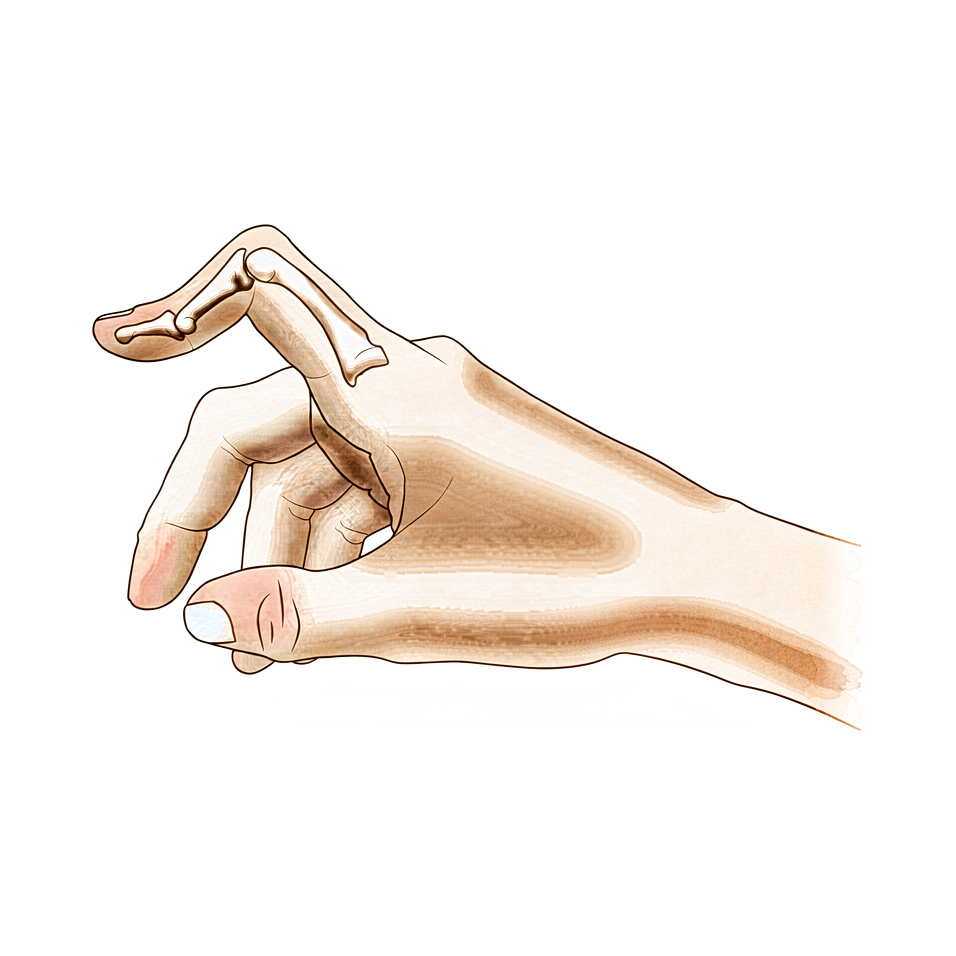
Extensor central-slip injury at the middle finger joint; early splinting prevents the zigzag deformity, established cases need surgery.
Những cảm giác bạn đang trải qua
Với dị dạng boutonnière, khớp giữa của ngón tay bạn gập xuống về phía lòng bàn tay, còn đầu ngón tay lại ưỡn ngược ra sau theo chiều ngược lại. Ngón tay có thể trông sưng ở vùng khớp giữa, và cũng có thể bị đau ở đó. Việc duỗi thẳng khớp giữa trở nên khó khăn, và bạn càng cố duỗi thì ngón tay dường như càng cưỡng lại.
Vấn đề thể hiện rõ nhất ở những việc cần ngón tay duỗi thẳng rồi lại gập xuống. Nhặt đồng xu, cầm cốc bằng quai, gõ bàn phím, cài cúc áo sơ mi hoặc xoay chìa khóa đều có thể trở nên lóng ngóng. Bản thân việc cầm nắm thường vẫn làm được, đó là lý do nhiều người chịu đựng ngón tay như vậy trong nhiều tuần trước khi tìm đến sự trợ giúp.
Nếu dị dạng xuất phát từ một chấn thương, khớp giữa có thể đau nhức sau khi bạn dùng tay, và tình trạng cứng có thể nặng hơn vào buổi sáng trước khi ngón tay mềm ra. Trong viêm khớp dạng thấp, tư thế cong tương tự hình thành từ từ khi lớp màng lót khớp bị viêm và sưng kéo dài qua nhiều tháng.
Một vài dấu hiệu cần được chăm sóc nhanh chóng. Nếu ngón tay hoặc bàn tay của bạn trở nên nóng, đỏ, sưng và đau, đặc biệt khi kèm theo sốt, hãy đến khoa cấp cứu ngay trong ngày. Điều tương tự cũng áp dụng nếu một ngón tay trở nên nhợt nhạt, lạnh, trắng bệch hoặc tím tái, hoặc nếu bạn đột ngột mất cảm giác hoặc mất khả năng cử động ngón tay đó sau một chấn thương. Còn nếu các triệu chứng không thuyên giảm, nặng dần lên trong nhiều tuần, làm bạn thức giấc vào ban đêm, hoặc khiến bạn không thể làm việc hay sử dụng bàn tay, hãy đến gặp bác sĩ đa khoa hoặc yêu cầu được bác sĩ chuyên khoa thăm khám.
Điều gì đang thực sự xảy ra
Dọc theo mặt sau của mỗi ngón tay có một hệ thống gân giúp duỗi thẳng các khớp. Hãy hình dung chúng như những sợi dây chạy bên dưới một lớp mũ trùm ở mặt sau ngón tay. Sợi dây duỗi thẳng khớp giữa được gọi là dải gân trung tâm, và nó bám vào nền của xương đốt giữa. Hai dải khác, gọi là các dải bên, chạy dọc hai bên dải gân trung tâm và giúp duỗi thẳng cả khớp giữa lẫn đầu ngón tay.
Với dị dạng boutonnière, dải gân trung tâm đã bị rách hoặc bị giãn bong khỏi xương đốt giữa. Khớp giữa không còn được kéo thẳng ra nữa, nên nó rơi vào tư thế gập. Hai dải bên sau đó trượt khỏi mặt trên của khớp và trượt xuống về phía lòng bàn tay. Một khi chúng nằm bên dưới trục xoay của khớp, chính những dải đó bắt đầu làm gập khớp giữa thay vì duỗi thẳng nó, và chúng kéo đầu ngón tay ngược ra sau theo chiều ngược lại. Đó là lý do ngón tay ổn định ở tư thế khớp giữa bị gập và đầu ngón ưỡn cong như mô tả ở trên, và là lý do mỗi lần bạn cố duỗi thẳng ngón tay, các dải này dường như càng kéo mạnh hơn ngược lại bạn.
Cần có nhiều hơn một cấu trúc bị tổn thương mới tạo ra tư thế này. Dải gân trung tâm, dây chằng nối hai dải bên với nhau ở mặt sau ngón tay, và các sợi của lớp mũ trùm giữ mọi thứ ở đúng vị trí đều phải bị tổn thương thì dị dạng mới hình thành. Chỉ riêng tổn thương rách dải gân trung tâm có thể khiến khớp giữa bị yếu mà không gây ra dị dạng hoàn toàn, đây là một lý do khiến việc điều trị sớm rất quan trọng: điều trị sớm có thể ngăn dị dạng hình thành hoàn toàn.
Cùng một kết quả cuối cùng có thể xuất phát từ những nguyên nhân ban đầu khác nhau. Một chấn thương như cú va đập vào ngón tay hoặc vết cắt ở mặt sau khớp có thể gây ra tình trạng này, và tình trạng viêm kéo dài của viêm khớp dạng thấp cũng vậy, khi nó từ từ làm mòn thủng chính những cấu trúc đó. Một ngón tay cũng có thể trông giống như vậy mà hoàn toàn không có tổn thương gân nào, khi vấn đề lại nằm ở mặt lòng bàn tay của khớp, và dạng này được điều trị theo cách khác, đó là lý do việc xác định bạn mắc dạng nào là bước đầu tiên.
Những biện pháp chúng tôi có thể áp dụng
Bác sĩ Kieran Hirpara, bác sĩ phẫu thuật chi trên tại Bệnh viện Mater Private Rockhampton, sẽ bắt đầu bằng các phương pháp ít xâm lấn nhất phù hợp với tình trạng của bạn. Thông thường, bệnh nhân được bác sĩ đa khoa giới thiệu đến phòng khám chúng tôi; nếu nhà vật lý trị liệu khuyên bạn đến gặp chúng tôi, bạn vẫn cần có giấy giới thiệu từ bác sĩ đa khoa để được hưởng mức hoàn trả chi phí từ Medicare. Tại phòng khám, chúng tôi sẽ hỏi bệnh sử, khám bàn tay và chỉ định chụp hình ảnh nếu cần thiết để xác định điều gì đang xảy ra. Vì dị dạng này có thể xuất phát từ nhiều nguyên nhân ban đầu khác nhau, việc xác định bạn mắc dạng nào được thực hiện trước bất kỳ phương pháp điều trị nào.
Bước đầu tiên thường là nẹp và trị liệu bàn tay. Đối với một chấn thương mới xảy ra, việc nẹp giữ khớp giữa ở tư thế thẳng có thể ngăn dị dạng hình thành hoàn toàn, và bắt đầu càng sớm càng tốt: những người được điều trị trong vòng sáu tuần sau chấn thương có kết quả tốt hơn những người được điều trị muộn hơn. Nẹp chỉ giữ thẳng khớp giữa. Đầu ngón tay, khớp gốc ngón tay và các ngón tay khác của bạn vẫn tiếp tục cử động, vì giữ bất động toàn bộ ngón tay sẽ khiến đầu ngón tay bị cứng. Đối với dị dạng đã tồn tại một thời gian, chúng tôi có thể bó bột để duỗi thẳng khớp giữa đến mức tối đa có thể, sau đó trong ba tháng dùng một loại nẹp cho phép bạn gập ngón tay trong khi nẹp phát huy tác dụng. Phương pháp này đáng được thử trước khi cân nhắc phẫu thuật.
Khi việc nẹp và trị liệu chưa mang lại đủ cải thiện, phẫu thuật có thể được cân nhắc. Ca phẫu thuật tái tạo gân duỗi thẳng khớp giữa, đôi khi sử dụng một đoạn gân nhỏ lấy từ chính cẳng tay của bạn làm mảnh ghép. Trong một số trường hợp, các gân đã trượt về phía lòng bàn tay được đặt lại vào đúng vị trí của chúng ở phía trên khớp. Mục tiêu trong mỗi trường hợp đều như nhau: giúp bạn duỗi thẳng khớp giữa trở lại và sử dụng ngón tay mà không bị vướng kẹt hay gập xuống. Ca phẫu thuật này có trang thông tin riêng, và chúng tôi sẽ trao đổi với bạn về những gì ca phẫu thuật bao gồm đối với ngón tay cụ thể của bạn trước khi đưa ra bất kỳ quyết định nào.
Những điều bạn có thể mong đợi
Tiên lượng phụ thuộc rất nhiều vào thời điểm. Nếu được phát hiện sớm, dị dạng boutonnière thường có thể được ngăn chặn trước khi trở nên cố định. Việc nẹp giữ khớp giữa ở tư thế thẳng ngay sau chấn thương có thể ngăn dị dạng hình thành hoàn toàn, và những người được điều trị trong vòng sáu tuần có kết quả tốt hơn những người được điều trị muộn hơn. Nếu không điều trị, dị dạng có xu hướng nặng dần lên chứ không giữ nguyên, vì các gân đã trượt khỏi vị trí tiếp tục kéo ngón tay cong thêm. Một chấn thương trông có vẻ nhẹ có thể dẫn đến một ngón tay cứng, biến dạng cố định vài tuần sau đó.
Đối với dị dạng đã tồn tại một thời gian, điều trị không phẫu thuật vẫn có vai trò thực sự. Bó bột để duỗi thẳng khớp giữa đến mức tối đa có thể, sau đó trong ba tháng dùng một loại nẹp cho phép bạn gập ngón tay khi sử dụng, có thể mang lại hiệu quả tốt. Ngón tay đáp ứng với phương pháp này khi việc bó bột có thể đưa khớp giữa đến gần tư thế thẳng và bạn chủ động sử dụng bàn tay khi mang nẹp trong suốt ba tháng đó, đồng thời khả năng gập ngón tay cũng hồi phục dần trong quá trình này. Đối với chấn thương ngón cái, việc nẹp giữ thẳng khớp gốc ngón cái có thể có ích nếu được bắt đầu trước khi dị dạng hình thành.
Phẫu thuật nhằm giúp bạn duỗi thẳng khớp giữa trở lại. Trong một nhóm 18 người được báo cáo đã phẫu thuật ghép gân để chỉnh sửa dị dạng lâu năm, 16 người có kết quả tốt hoặc rất tốt. Một kỹ thuật mới hơn, giúp ngón tay được cử động sớm, được báo cáo là có hiệu quả ở 11 trường hợp. Phẫu thuật cũng có thể giúp ích cho dạng bẩm sinh của dị dạng này, khi dị dạng đã có từ lúc sinh ra.
Cần thẳng thắn rằng không phải mọi ca chỉnh sửa đều duy trì được lâu dài. Đối với những ngón tay bị ảnh hưởng bởi viêm khớp dạng thấp, chỉ riêng phẫu thuật mô mềm có thể không duy trì được kết quả ở các giai đoạn muộn, và kết quả lâu dài khó dự đoán hơn. Khi dị dạng tái phát hoặc vẫn tồn tại, một phẫu thuật khác có thể là giải pháp tốt hơn. Dù nguyên nhân ban đầu là gì, mục tiêu thực tế là một ngón tay bạn có thể duỗi thẳng và sử dụng được, chứ không phải một lời hứa về một ngón tay hoàn toàn bình thường.
Khi nào nên đi khám bác sĩ
Dị dạng boutonnière được điều trị càng sớm càng có lợi, vì vậy bạn nên biết khi nào cần hành động. Nếu bạn bị chấn thương ngón tay và khớp giữa không duỗi thẳng được, hoặc ngón tay vẫn bị gập và sưng nhiều ngày sau chấn thương, hãy đến gặp bác sĩ đa khoa và yêu cầu được bác sĩ chuyên khoa thăm khám. Việc nẹp được bắt đầu càng sớm thì cơ hội ngăn chặn dị dạng trước khi nó trở nên cố định càng cao.
Một vài dấu hiệu cần được chăm sóc nhanh hơn. Hãy đến khoa cấp cứu ngay trong ngày nếu ngón tay hoặc bàn tay của bạn trở nên nóng, đỏ, sưng và đau, đặc biệt khi kèm theo sốt. Điều tương tự cũng áp dụng nếu một ngón tay trở nên nhợt nhạt, lạnh, trắng bệch hoặc tím tái, hoặc nếu bạn đột ngột mất cảm giác hoặc mất khả năng cử động ngón tay đó sau một chấn thương. Nếu có vết rách da ở trên một khớp bị chấn thương, hoặc ngón tay trông bị biến dạng rõ rệt, cũng hãy đến khoa cấp cứu.
Còn nếu các triệu chứng không thuyên giảm, nặng dần lên trong nhiều tuần, làm bạn thức giấc vào ban đêm, hoặc khiến bạn không thể làm việc hay sử dụng bàn tay, hãy đến gặp bác sĩ đa khoa hoặc yêu cầu được bác sĩ chuyên khoa thăm khám. Nếu bạn không thể liên lạc với phòng khám ngoài giờ làm việc hoặc vào cuối tuần, hãy đến khoa cấp cứu gần nhất.
Phân tích chi tiết hơn
Advanced reading: the deeper science (optional)
Phần này đi sâu hơn mức cần thiết để bạn tự đưa ra quyết định điều trị. Dị dạng Boutonnière là một chủ đề đáng để tìm hiểu thêm, bởi vì cách điều trị theo trực giác đối với ngón tay bị đau, sưng và cong – đó là để ngón tay nghỉ ngơi và giữ yên – lại chính là điều duy nhất mà các bằng chứng y khoa đặc biệt không ủng hộ.
Vận động sớm, chứ không phải bất động kéo dài
Một phân tích có hệ thống về các phương pháp điều trị chấn thương gân duỗi giữa cho thấy cơ sở bằng chứng còn hạn chế; vai trò của các phương pháp khác nhau đối với cả chấn thương hở và kín chưa được chứng minh rõ ràng [1]. Mặc dù vậy, các bằng chứng từ từng nghiên cứu riêng lẻ có xu hướng ủng hộ việc vận động sớm và không ủng hộ việc bất động kéo dài [1].
Điều này cần được nêu rõ vì nó trái ngược với thói quen thông thường. Sự khác biệt nằm ở chỗ: cần bảo vệ gân duỗi giữa đang hồi phục, nên phải giữ khớp giữa ở tư thế thẳng; còn việc bất động toàn bộ ngón tay lại khiến khớp đầu ngón cứng lại ở tư thế duỗi thẳng, khiến cả ngón tay trở nên cứng nhắc. Nẹp chỉ nhằm mục đích giữ cố định một khớp trong khi các khớp còn lại vẫn có thể vận động.
Tại sao dị tật ngày càng nặng thay vì giữ nguyên trạng thái
Dị tật Boutonnière là một dạng dị tật tiến triển; điều này khá hiếm gặp và cần được hiểu rõ. Gân chính nối với phần gốc của xương giữa và có chức năng duỗi thẳng khớp giữa ngón tay. Khi gân này bị tổn thương, khớp đó sẽ gập lại; đồng thời hai dải gân bên, vốn chạy phía trên trục khớp, sẽ dịch chuyển xuống phía dưới trục này.
Khi đã nằm dưới trục khớp, những gân vốn có chức năng duỗi thẳng khớp giữa lại bắt đầu gập khớp này lại, đồng thời kéo đầu ngón tay vào trạng thái quá duỗi. Do đó, dị tật này có xu hướng tự củng cố: mỗi lần cố gắng duỗi thẳng ngón tay lại khiến các cấu trúc đang giữ ngón tay ở trạng thái gập càng căng ra. Đây là lý do vì sao một chấn thương tưởng chừng nhẹ lại có thể dẫn đến dị tật cố định sau vài tuần; cũng vì lý do này mà việc sử dụng nẹp chỉ hiệu quả nếu thực hiện sớm.
Dị dạng không phải dạng boutonnière
Ngón tay có thể giữ nguyên tư thế như vậy mà hoàn toàn không có chấn thương ở dây chằng trung tâm; các phương pháp điều trị cũng hoàn toàn khác nhau. Dị dạng boutonnière và dị dạng pseudoboutonnière khác nhau về cơ chế bệnh sinh, chẩn đoán và cách xử trí [2]. Dạng pseudoboutonnière xuất hiện do chấn thương ở màng liên khớp mu bàn tay tại khớp giữa; lúc này khớp ngón tay cuối vẫn có khả năng gập bình thường thay vì bị kéo ra trạng thái gập quá mức.
Việc phân biệt hai dạng dị dạng này tại giường bệnh chủ yếu dựa vào đầu ngón tay. Ở dạng boutonnière thực sự, đầu ngón tay bị gập quá mức và khó uốn cong, đặc biệt khi khớp giữa được giữ thẳng; còn ở dạng pseudoboutonnière thì đầu ngón tay có thể gập tự do. Việc dùng nẹp để cố định ngón tay theo kiểu điều trị dành cho dạng boutonnière thực sự lại tác động sai vào khớp cần điều trị.
Chấn thương này thuộc nhóm các chấn thương được phân loại dựa trên vị trí đứt gãy của gân
Chấn thương Boutonnière cùng với chấn thương ngón tay móng vuốt và chấn thương dây chằng sagittal là ba dạng chấn thương cơ chế duỗi khớp kín, được phân loại theo vùng mà cơ chế này bị tổn thương [3]. Cả ba dạng chấn thương này đều có thể gây ra tình trạng ngón tay sưng phù và giữ nguyên tư thế bất thường chỉ vài ngày sau khi bị chấn thương; mỗi dạng lại yêu cầu mức độ nẹp cố định khác nhau. Đây là lý do thực tiễn khiến việc chẩn đoán chính xác là rất cần thiết trước khi áp dụng phương pháp nẹp cố định trong nhiều tuần liền.
Tài liệu tham khảo
[1] Geoghegan L, Wormald JCR, Adami RZ, Rodrigues JN. Chấn thương gân duỗi ở phần giữa ngón tay: tổng quan có hệ thống về các phương pháp điều trị. J Hand Surg Eur Vol. 2019;44(8):825-32. https://doi.org/10.1177/1753193419845311
[2] Hanson ZC, Thompson RG, Andrews JR, Lourie GM. Dị dạng Boutonniere so với dị dạng giả Boutonniere: giải phẫu bệnh, chẩn đoán và điều trị. J Hand Surg Am. 2023;48(5):489-97. https://doi.org/10.1016/j.jhsa.2022.10.019
[3] Lin JD, Strauch RJ. Chấn thương mô mềm ở cơ chế duỗi ngón tay (dạng ngón gõ, dị dạng Boutonniere và tổn thương dải cân ngang). J Hand Surg Am. 2014;39(5):1005-11. https://doi.org/10.1016/j.jhsa.2013.11.018
Evidence & references
This is the clinical evidence summary written for health professionals. It is technical, and it lists the research this page was built from. You do not need to read it to understand your treatment or to make a decision about it.
Overview
- A staged technique for the repair of traumatic boutonniere deformity allows the surgeon to divide the deformity into various categories and use the operative procedure indicated for each particular problem, often avoiding unnecessary surgery [1].
- Differentiating a true boutonniere deformity from a pseudoboutonniere injury is critical in determining clinical management [2].
- A retrospective study of fifty-four longstanding post-burn boutonnière deformities was carried out to evaluate the problems associated with the surgical procedures [3].
- An understanding of the anatomy, clinical presentation, treatment options, and expected outcomes is crucial for optimal treatment of posttraumatic boutonnière and swan neck deformities [4].
- Early treatment of central slip injuries can prevent the deformity [5].
- Transection of the terminal extensor tendon is a useful procedure for salvage of the boutonniere deformity [6].
- No boutonniere deformities were produced in a series of 20 patients who had chronic mallet finger deformity treated with central slip tenotomy [7].
- Reconstruction of the central slip by the transverse retinacular ligament is not indicated for boutonnière deformities with severe contracture of the lateral band [8].
- The best indication for reconstruction of the central slip by the transverse retinacular ligament is in cases in which the central slip is defective and conservative treatment is not effective [8].
- Similar results occurred for chronic boutonniere deformity using serial casting for adequate extension followed by 3 months of relative motion flexion (RMF) orthotic use, which should be attempted prior to surgical intervention [9].
- A new surgical technique with early mobilization is an effective and simplified treatment of Boutonniere deformity [10].
- The natural history of the boutonnière deformity in rheumatoid arthritis is outlined, and a simple method of repair is described [11].
- Chronic boutonniere deformity will respond to relative motion flexion splinting if serial casting can place the proximal interphalangeal joint in less than -20° extension, and the patient actively uses the hand in a relative motion flexion orthosis for 3 months, recovering flexion [12].
- The Y-shaped tendon graft can be a useful procedure for the correction of chronic boutonniere deformity [13].
- In a patient series of 18 patients, the Y-shaped tendon graft provided good or excellent results in 16 patients [13].
- Extension splinting of the metacarpophalangeal (MP) joint may be effective if traumatic thumb injuries are treated before development of a boutonnière deformity [14].
- Congenital boutonniere deformity is understood as various embryonic developmental failures [15].
- A reliable surgical option for congenital boutonniere deformity involves central slip reconstruction [15].
- Extensor tenotomy to correct a boutonnière deformity of long standing markedly lessened disability with restoration of flexion of the distal joint [16].
- In chronic boutonniere deformity, when the lateral bands are deficient or damaged, the cross-lateral band reconstruction technique using palmaris longus autograft is a treatment option with satisfactory results [17].
- Extension splinting may be effective if traumatic thumb injuries are treated before deformity development [18].
- Surgical treatment with advancement of the extensor pollicis brevis tendon and imbrication of the dorsoradial capsule is necessary once a traumatic thumb boutonnière deformity is established [18].
- The prevalence of boutonnière deformity without rheumatoid arthritis or trauma is approximately 13% [19].
- Current concepts relating to the presentation and treatment of closed soft tissue injuries of the extensor mechanism in zones I, III, and V, commonly known as mallet finger, boutonniere deformities, and sagittal band injuries, are summarized [20].
- Long-term results following soft tissue reconstruction for boutonniere finger deformity in rheumatoid arthritis are unreliable [24].
- Recurrent or persistent deformity in rheumatoid arthritis is best treated with a salvage procedure [24].
Anatomy & Pathophysiology
Extensor Mechanism Anatomy
- The extensor mechanism of the finger at the level of the proximal interphalangeal (PIP) joint consists of both intrinsic and extrinsic contributions [28].
- The extensor tendon entering the digit is the continuation of the extensor digitorum communis (EDC), with contributions from the extensor indicis proprius in the index finger and the extensor digiti quinti in the small finger [28].
- In 30% of cases, the EDC has a separate insertion into the base of the proximal phalanx, but extension of the metacarpophalangeal (MP) joint typically occurs through the pull of the sagittal bands [28].
- The principal bony insertion of the extrinsic digital extensors is on the dorsal proximal aspect of the middle phalanx [32].
- Metacarpophalangeal joint extension is provided by extrinsic extensor force transmitted through the sagittal bands [32].
- Distal interphalangeal joint extension is achieved through conjoined lateral bands composed of tendinous slips from both extrinsic and intrinsic tendons [32].
- The deep head of each dorsal interosseous muscle forms a lateral tendon, or lateral band, at the level of the MP joint [41].
- At the level of the middle of the proximal phalanx, transverse fibers arch dorsally from each lateral band to join over the dorsum of the finger, flexing the proximal phalanx [41].
- Oblique fibers (spiral fibers) from the lateral bands sweep over the distal third of the proximal phalanx to insert onto the lateral tubercles at the base of the middle phalanx, extending the middle phalanx [41].
- The lateral bands are joined by the lateral slips of the extensor tendon to form the conjoined lateral band [41].
- The two conjoined lateral bands to each finger unite at the distal third of the middle phalanx to form the terminal tendon, which inserts at the base of the distal phalanx to extend it [41].
- The volar interossei form the ulnar lateral band of the index finger and the radial lateral band of the ring and little fingers [41].
- The flexor digiti quinti brevis is structurally and functionally similar to the deep head of the dorsal interossei, forming the ulnar lateral band of the little finger [41].
Pathophysiology & Biomechanics
- A boutonniere deformity requires subluxation of the lateral bands volar to the axis of rotation of the PIP joint [22].
- Damage to the central slip alone does not cause a boutonniere deformity [22].
- A boutonniere deformity occurs only when the central slip, triangular ligament, and transverse and oblique fibers of the interosseous hood are all damaged [22].
- Detachment of the central slip from the middle phalanx produces a decrease in extension of the PIP joint [22].
- When the transverse and oblique fibers of the interosseous hood are divided in addition to the central slip, extension at the PIP joint is further decreased [22].
- Early treatment of central slip injuries can prevent the development of the deformity [5].
- The extensor mechanism is a complex structure that demands a delicate balance from intrinsic and extrinsic tendons of the hand [28].
- Injury to the extensor mechanism can disrupt this delicate balance, leading to significant sequelae [28].
- Understanding the anatomy, clinical presentation, treatment options, and expected outcomes is crucial for optimal treatment of posttraumatic boutonnière and swan neck deformities [4].
Classification
- A staged management plan allows the surgeon to divide traumatic boutonniere deformity into various categories and use the operative procedure indicated for each particular problem [1].
- The choice of surgical procedure for rheumatoid boutonniere deformity is dependent on accurate staging of the deformity, which is based on the flexibility of the proximal interphalangeal joint and the state of the articular cartilage [23].
- In a cadaveric model, damage to the central slip alone does not cause a boutonniere deformity [22].
- The boutonniere deformity requires subluxation of the lateral bands volar to the axis of rotation of the PIP joint [22].
- In a cadaveric model, the central slip, triangular ligament, and oblique fibers need to all be damaged to cause subluxation of the lateral bands which leads to an acute boutonniere deformity [29].
- Anterior dislocation of the proximal interphalangeal joint is associated with ruptures of the central slip of the extensor mechanism and results in boutonnière deformity unless repaired [27].
- The incidence of uncorrectable swan-neck and boutonniere deformities is estimated to be between 8% and 16% during the first 2 years after the onset of systemic disease in rheumatoid arthritis [23].
- The prevalence of boutonniere deformities in patients with established rheumatoid arthritis is approximately 36% [23].
Clinical Presentation
Diagnostic Differentiation and Classification
- The surgeon can divide the boutonniere deformity into various categories to use the operative procedure indicated for each particular problem, often avoiding unnecessary surgery [1].
Etiology and Pathomechanics
- The cause of boutonniere deformity in rheumatoid arthritis is chronic synovitis of the proximal interphalangeal joint [23].
- Combined injury of the central slip, triangular ligament, and transverse and oblique fibers of the interosseous hood causes a boutonniere deformity [22].
Prevalence and Natural History
- A swan-neck or boutonniere deformity occurs in approximately half of patients with rheumatoid arthritis [23].
- The incidence of uncorrectable swan-neck and boutonniere deformities is estimated to be between 8% and 16% during the first 2 years after the onset of systemic disease [23].
- The prevalence of finger deformities in patients with established rheumatoid arthritis is approximately 36% for boutonniere deformities [23].
- The natural history of the boutonnière deformity in rheumatoid arthritis is outlined in the literature [11].
Clinical Assessment and Testing
- The central slip tenodesis test detects disruption of the central slip before the boutonniere deformity becomes established [34].
- The central slip tenodesis test is applicable in uncooperative children and unconscious patients [34].
- Treating swan neck and boutonniere deformities of the PIP joint requires understanding the cause, biomechanical changes, and articular status [26].
Investigations
Clinical Examination and Diagnostic Tests
- A careful physical examination is essential to direct care and future testing if indicated [31].
- Diagnostic tests such as imaging and serum laboratory studies are useful in the determination of pathology but can be expensive, time consuming, and often nonspecific [31].
Biomechanical and Pathomechanical Assessment
Imaging and Advanced Modalities
- A computational 3D model validation reassures the reliability of research in understanding the pathomechanics of boutonniere deformity [21].
Treatment
Non-Operative
- Early treatment of central slip injuries can prevent the development of boutonniere deformity [5].
- Extension splinting of the metacarpophalangeal joint may be effective for traumatic thumb boutonniere deformity if treated before the deformity develops [14].
- Extension splinting may be effective for traumatic thumb boutonniere deformity if treated before deformity development [18].
- Chronic boutonniere deformity responds to relative motion flexion splinting if serial casting places the proximal interphalangeal joint in less than -20° extension and the patient actively uses a relative motion flexion orthosis for 3 months [12].
- Serial casting for adequate extension followed by 3 months of relative motion flexion orthotic use should be attempted prior to surgical intervention for chronic boutonniere deformity [9].
- The use of relative motion flexion orthoses is effective in increasing active distal interphalangeal joint flexion and improving proximal interphalangeal joint extension in patients with Burton stage 1 chronic boutonniere deformity [30].
- Conservative treatment of closed central slip injuries involves immobilization of the proximal interphalangeal, distal interphalangeal, and metacarpophalangeal joints in full extension for four weeks followed by a Capener spring splint for two further weeks [92].
- In a review of 115 central slip injuries, 17 of 24 patients treated conservatively achieved an outcome of less than a 20° extension deficit at the proximal interphalangeal joint and more than 80% return of proximal interphalangeal joint flexion [92].
- Patients treated for central slip injuries within six weeks of injury had better outcomes than those treated later [92].
Operative
- A staged technique allows the surgeon to divide traumatic boutonniere deformity into various categories and use the operative procedure indicated for each particular problem, often avoiding unnecessary surgery [1].
- Reconstruction of the central slip by the transverse retinacular ligament is best indicated in cases in which the central slip is defective and conservative treatment is not effective [8].
- A simple method of repair for the rheumatoid boutonnière deformity is described in the literature [11].
- In a patient series, the Y-shaped tendon graft provided good or excellent results in 16 of 18 patients with chronic boutonniere deformity [13].
- Surgical treatment with advancement of the extensor pollicis brevis tendon and imbrication of the dorsoradial capsule is necessary once a traumatic boutonnière deformity of the thumb is established [18].
- The cross-lateral band reconstruction technique using palmaris longus autograft is a treatment option with satisfactory results for chronic boutonniere deformity when the lateral bands are deficient or damaged [17].
- A reliable surgical option involving central slip reconstruction is suggested for the congenital form of boutonniere deformity [15].
- A simple staged procedure using a central slip facilitation device is a valid alternative in the management of severe Dupuytren's proximal interphalangeal joint contracture, demonstrating reliable, reproducible correction of the deformity and acceptable patient outcomes [38].
Complications
- In a patient series of 18 patients, the Y-shaped tendon graft provided good or excellent results in 16 of 18 patients for the correction of chronic boutonniere deformity [13].
- Extension splinting of the MP joint may be effective if traumatic thumb injuries are treated before development of a boutonnière deformity [14].
- The case extends understanding of congenital boutonniere deformity as various embryonic developmental failures and suggests a reliable surgical option involving central slip reconstruction [15].
- Surgical treatment with advancement of the extensor pollicis brevis tendon and imbrication of the dorsoradial capsule is necessary once a boutonnière deformity is established in the thumb [18].
- This article summarizes current concepts relating to the presentation and treatment of closed soft tissue injuries of the extensor mechanism in zones I, III, and V, commonly known as mallet finger, boutonniere deformities, and sagittal band injuries [20].
- This validation reassures the reliability of the research in understanding the pathomechanics of boutonniere deformity [21].
- In a cadaver model, detachment of the central slip from the middle phalanx produced a decrease in extension of the PIP joint [22].
- When the transverse and oblique fibers of the interosseous hood were also divided after central slip detachment, extension at the PIP joint was further decreased [22].
- A boutonniere deformity occurred only when all 3 structures (central slip, transverse and oblique fibers of the interosseous hood, and triangular ligament) were damaged [22].
- Division of the central slip leads to loss of extension at the PIP joint [22].
- The prevalence of finger deformities in patients with established rheumatoid arthritis is approximately 14% for swan-neck deformities and 36% for boutonniere deformities [23].
- In the later stages of both swan-neck and boutonniere deformities, soft-tissue procedures alone may not result in lasting operative correction [23].
- Long-term results following soft tissue reconstruction are unreliable [24].
- Recurrent or persistent deformity is best treated with a salvage procedure [24].
- Treating swan neck and boutonniere deformities of the PIP joint is a difficult challenge that requires understanding the cause, biomechanical changes, and articular status [26].
- Anterior dislocation of the proximal interphalangeal joint is associated with ruptures of the central slip of the extensor mechanism [27].
- Anterior dislocation of the proximal interphalangeal joint results in boutonnière deformity unless repaired [27].
Recovery
Non-Operative Management
- Serial casting for adequate extension followed by 3 months of relative motion flexion (RMF) orthotic use should be attempted prior to surgical intervention for chronic boutonniere deformity [9].
- Chronic boutonniere deformity responds to relative motion flexion splinting if serial casting places the proximal interphalangeal joint in less than -20° extension and the patient actively uses the hand in a relative motion flexion orthosis for 3 months, recovering flexion [12].
- Extension splinting of the metacarpophalangeal joint may be effective for traumatic thumb boutonniere injuries if treated before the development of a boutonnière deformity [14].
Operative Management
- A staged technique allows the surgeon to divide the traumatic boutonniere deformity into various categories and use the operative procedure indicated for each particular problem, often avoiding unnecessary surgery [1].
- The Y-shaped tendon graft provided good or excellent results in 16 of 18 patients for the correction of chronic boutonniere deformity [13].
- Reconstruction of the central slip by the transverse retinacular ligament is indicated in cases in which the central slip is defective and conservative treatment is not effective, but is not indicated for boutonnière deformities with severe contracture of the lateral band [8].
- A simple method of repair for the correction of the rheumatoid boutonnière deformity has been described [11].
- A new surgical technique with early mobilization for chronic boutonniere deformity was reported to be an effective and simplified treatment in 11 cases [10].
- Central slip reconstruction is a reliable surgical option for the congenital form of boutonniere deformity [15].
Outcomes and Prognosis
- Early treatment of central slip injuries can prevent the boutonniere deformity [5].
- Long-term results following soft tissue reconstruction for boutonniere finger deformity in rheumatoid arthritis are unreliable, and recurrent or persistent deformity is best treated with a salvage procedure [24].
- In the later stages of rheumatoid boutonniere deformities, soft-tissue procedures alone may not result in lasting operative correction [23].
- A patient with boutonniere deformity of the second toe after planter dislocation of the proximal interphalangeal joint reported neither deformity nor difficulty when last seen 22 months after the operation [95].
Key Evidence
- [L4] With this plan of management, the surgeon is able to divide the boutonniere deformity into various categories and then use the operative procedure indicated for each particular problem, often avoiding unnecessary surgery. [1] (10.1016/s0363-5023(83)80009-4)
- [L5] Differentiating a true boutonniere deformity from a pseudoboutonniere injury is critical in determining clinical management. [2] (10.1016/j.jhsa.2022.10.019)
- [L4] A retrospective study of fifty-four longstanding post-burn boutonnière deformities was carried out to evaluate the problems associated with the surgical procedures. [3] (10.1016/0266-7681(86)90006-9)
- [L5] An understanding of the anatomy, clinical presentation, treatment options, and expected outcomes is crucial for optimal treatment of posttraumatic boutonnière and swan neck deformities. [4] (10.5435/jaaos-d-14-00272)
- [L5] The paper outlines the anatomy, pathoanatomy, and treatment concepts for boutonniere deformity, emphasizing that early treatment of central slip injuries can prevent the deformity. [5] (10.1016/s0749-0712(21)00060-3)
- [L4] Transection of the terminal extensor tendon is a useful procedure for salvage of the boutonniere deformity. [6] (10.1016/s0749-0712(21)00065-2)
- [L4] No boutonniere deformities were produced in this series of 20 patients who had chronic mallet finger deformity. [7] (10.1016/s0363-5023(87)80205-8)
- [L4] This procedure is not indicated for boutonnière deformities with severe contracture of the lateral band; its best indication is in cases in which the central slip is defective and conservative treatment is not effective. [8] (10.1016/0266-7681(90)90080-n)
- [L4] Similar results occurred for chronic boutonniere deformity using serial casting for adequate extension followed by 3 months of RMF orthotic use, which should be attempted prior to surgical intervention. [9] (10.1016/j.jht.2023.02.005)
- [L4] Our technique is an effective and simplified treatment of Boutonniere deformity. [10] (10.1097/bth.0000000000000152)
- [L4] The natural history of the boutonnière deformity in rheumatoid arthritis is outlined, and a simple method of repair is described. [11] (10.2106/00004623-196951070-00009)
- [L4] Chronic boutonniere deformity will respond to relative motion flexion splinting if serial casting can place the proximal interphalangeal joint in less than -20° extension, and the patient actively uses the hand in a relative motion flexion orthosis for 3 months, recovering flexion. [12] (10.1097/sap.0000000000002307)
- [L4] The Y-shaped tendon graft can be a useful procedure for the correction of chronic boutonniere deformity; in our patient series, this provided good or excellent results in 16 of 18 patients. [13] (10.1016/j.jhsa.2021.01.003)
- [L4] Extension splinting of the MP joint may be effective if these injuries are treated before development of a boutonnière deformity. [14] (10.1016/s0266-7681(00)80024-8)
- [Case_report] The case extends understanding of congenital boutonniere deformity as various embryonic developmental failures and suggests a reliable surgical option involving central slip reconstruction. [15] (10.1016/j.jhsa.2014.05.030)
- [L4] In chronic boutonniere deformity, when the lateral bands are deficient or damaged, the cross-lateral band reconstruction technique using palmaris longus autograft is a treatment option with satisfactory results. [17] (10.1016/j.jhsa.2017.04.010)
- [L4] Extension splinting may be effective if treated before deformity development, but surgical treatment with advancement of the extensor pollicis brevis tendon and imbrication of the dorsoradial capsule is necessary once a boutonnière deformity is established. [18] (10.1054/jhsb.1999.0303)
- [L3] The prevalence of boutonnière deformity without rheumatoid arthritis or trauma is approximately 13%. [19] (10.1177/1753193417704610)
- [L5] This article summarizes current concepts relating to the presentation and treatment of closed soft tissue injuries of the extensor mechanism in zones I, III, and V, commonly known as mallet finger, boutonniere deformities, and sagittal band injuries. [20] (10.1016/j.jhsa.2013.11.018)
- [L5] This validation reassures the reliability of the research in understanding the pathomechanics of boutonniere deformity. [21] (10.1186/s13018-025-06329-3)
- [L5] [22] (10.1016/j.jhsa.2017.07.011)
- [L5] [23] (10.5435/00124635-199903000-00002)
- [L5] Long-term results following soft tissue reconstruction are unreliable, and recurrent or persistent deformity is best treated with a salvage procedure. [24] (10.1016/j.jhsa.2011.05.029)
- [L4] Treating swan neck and boutonniere deformities of the PIP joint is a difficult challenge that requires understanding the cause, biomechanical changes, and articular status. [26] (10.1016/j.hcl.2017.12.006)
- [Paper] [28] (10.1016/j.hcl.2012.05.044)
- [Paper] In a cadaveric model, the central slip, triangular ligament, and oblique fibers need to all be damaged to cause subluxation of the lateral bands which leads to an acute boutonniere deformity. [29] (10.1016/s0363-5023(12)60014-8)
- [L4] The use of RMFO is effective in increasing active distal interphalangeal joint flexion and improving PIP extension in patients with Burton stage 1 chronic boutonniere deformity. [30] (10.1016/j.jhsa.2022.08.007)
- [Paper] The test detects disruption of the central slip before the boutonniere deformity becomes established and is applicable in uncooperative children and unconscious patients. [34] (10.1016/0266-7681(94)90057-4)
- [L4] The simple staged procedure is a valid alternative in the management of severe Dupuytren's PIPJ contracture, demonstrating reliable, reproducible correction of the deformity and acceptable patient outcomes. [38] (10.1177/1753193412439673)
- [L4] [92] (10.1177/1758998318822663)
- [Case_report] The patient reported neither deformity nor difficulty when last seen 22 months after the operation. [95] (10.1007/s00402-009-0816-x)
References
[1] A staged technique for the repair of the traumatic boutonniere deformity. The Journal of Hand Surgery. 1983. DOI: 10.1016/s0363-5023(83)80009-4
[2] Boutonniere Versus Pseudoboutonniere Deformities: Pathoanatomy, Diagnosis, and Treatment. The Journal of Hand Surgery. 2023. DOI: 10.1016/j.jhsa.2022.10.019
[3] Reconstructive surgery of the post-burn boutonnière deformity. The Journal of Hand Surgery: Journal of the British Society for Surgery of the Hand. 1986. DOI: 10.1016/0266-7681(86)90006-9
[4] Posttraumatic Boutonnière and Swan Neck Deformities. Journal of the American Academy of Orthopaedic Surgeons. 2015. DOI: 10.5435/jaaos-d-14-00272
[5] BOUTONNIERE DEFORMITY. Hand Clinics. 1995. DOI: 10.1016/s0749-0712(21)00060-3
[6] TREATMENT OF THE CHRONIC BOUTONNIERE DEFORMITY BY EXTENSOR TENOTOMY. Hand Clinics. 1995. DOI: 10.1016/s0749-0712(21)00065-2
[7] Central slip tenotomy for chronic mallet finger deformity. The Journal of Hand Surgery. 1987. DOI: 10.1016/s0363-5023(87)80205-8
[8] Reconstruction of the Central Slip by the Transverse Retinacular Ligament for Boutonnière Deformity. Journal of Hand Surgery. 1990. DOI: 10.1016/0266-7681(90)90080-n
[9] The relative motion concept in acute and chronic boutonniere deformity: Invited commentary. Journal of Hand Therapy. 2023. DOI: 10.1016/j.jht.2023.02.005
[10] Chronic Boutonniere Deformities, Supple, or Stiff: A New Surgical Technique With Early Mobilization in 11 Cases. Techniques in Hand & Upper Extremity Surgery. 2017. DOI: 10.1097/bth.0000000000000152
[11] Correction of the Rheumatoid Boutonnière Deformity. The Journal of Bone & Joint Surgery. 1969. DOI: 10.2106/00004623-196951070-00009
[12] A Paradigm Shift in Managing Acute and Chronic Boutonniere Deformity. Annals of Plastic Surgery. 2020. DOI: 10.1097/sap.0000000000002307
[13] Y-Shaped Tendon Graft—A Technique in the Reconstruction of Posttraumatic Chronic Boutonniere Deformity. The Journal of Hand Surgery. 2021. DOI: 10.1016/j.jhsa.2021.01.003
[14] Traumatic Boutonnière Deformity of the Thumb. Journal of Hand Surgery. 2000. DOI: 10.1016/s0266-7681(00)80024-8
[15] Restoration of the Central Slip in Congenital Form of Boutonniere Deformity: Case Report. The Journal of Hand Surgery. 2014. DOI: 10.1016/j.jhsa.2014.05.030
[16] Extensor Tenotomy for Chronic Boutonniere Deformity of the Finger: REPORT OF TWO CASES.. The Journal of Bone and Joint Surgery. American Volume. 1965.
[17] Chronic Boutonniere Deformity: Cross-Lateral Band Technique Using Palmaris Longus Autograft. The Journal of Hand Surgery. 2017. DOI: 10.1016/j.jhsa.2017.04.010
[18] TRAUMATIC BOUTONNIÈRE DEFORMITY OF THE THUMB. The Journal of Hand Surgery: Journal of the British Society for Surgery of the Hand. 2000. DOI: 10.1054/jhsb.1999.0303
[19] Thumb boutonnière deformity without rheumatoid arthritis or trauma. Journal of Hand Surgery (European Volume). 2017. DOI: 10.1177/1753193417704610
[20] Closed Soft Tissue Extensor Mechanism Injuries (Mallet, Boutonniere, and Sagittal Band). The Journal of Hand Surgery. 2014. DOI: 10.1016/j.jhsa.2013.11.018
[21] Assessment of the ligamentous stress distribution in the pathomechanics of the boutonniere deformity through a computational 3D model. Journal of Orthopaedic Surgery and Research. 2025. DOI: 10.1186/s13018-025-06329-3
[22] Biomechanics of the Acute Boutonniere Deformity. The Journal of Hand Surgery. 2018. DOI: 10.1016/j.jhsa.2017.07.011
[23] Operative Correction of Swan-Neck and Boutonniere Deformities in the Rheumatoid Hand. Journal of the American Academy of Orthopaedic Surgeons. 1999. DOI: 10.5435/00124635-199903000-00002
[24] Treatment of Boutonniere Finger Deformity in Rheumatoid Arthritis. The Journal of Hand Surgery. 2011. DOI: 10.1016/j.jhsa.2011.05.029
[26] Treating the Proximal Interphalangeal Joint in Swan Neck and Boutonniere Deformities. Hand Clinics. 2018. DOI: 10.1016/j.hcl.2017.12.006
[27] Anterior dislocation of the proximal interphalangeal joint. A cause of rupture of the central slip of the extensor mechanism.. The Journal of bone and joint surgery. American volume. 1970.
[28] Boutonnière and Pulley Rupture in Elite Athletes. Hand Clinics. 2012. DOI: 10.1016/j.hcl.2012.05.044
[29] Biomechanics of the Acute Boutonniere Deformity. The Journal of Hand Surgery. 2012. DOI: 10.1016/s0363-5023(12)60014-8
[30] The Use of Relative Motion Flexion Orthoses for Chronic Boutonniere Deformity. The Journal of Hand Surgery. 2024. DOI: 10.1016/j.jhsa.2022.08.007
[31] Orthopaedic Knowledge Update 13 Ebook Without Multimedia. Anatomy, Evaluation, Clinical Examination, and Imaging > Evaluation and Clinical Examination: Current Concepts.
[32] A Lange Medical Book Current Diagnosis Treatment In Orthopedics Fifth Edition. 9Hand Surgery > Image DISORDERS OF THE MUSCULATURE OF THE HAND.
[34] The Central Slip Tenodesis Test for Early Diagnosis of Potential Boutonnière Deformities. Journal of Hand Surgery. 1994. DOI: 10.1016/0266-7681(94)90057-4
[38] Management of severe Dupuytren’s contracture of the proximal interphalangeal joint with use of a central slip facilitation device. Journal of Hand Surgery (European Volume). 2012. DOI: 10.1177/1753193412439673
[41] Green S Operative Hand Surgery. Interosseous and Hypothenar Muscles.
[92] Therapeutic management of closed central slip injuries: Outcome of a service evaluation. Hand Therapy. 2019. DOI: 10.1177/1758998318822663
[95] Boutonniere deformity of the second toe after planter dislocation of proximal interphalangeal joint: a case report. Archives of Orthopaedic and Trauma Surgery. 2009. DOI: 10.1007/s00402-009-0816-x