Patients › Rehabilitation
Viêm mỏm trên lồi cầu ngoài xương cánh tay (khuỷu tay quần vợt)
Chương trình phục hồi chức năng dựa trên việc tăng dần tải trọng cho khuỷu tay quần vợt — giảm đau trước rồi dần dần tăng cường sức mạnh cho gân — bao gồm cả điều trị không phẫu thuật và quá trình hồi phục sau phẫu thuật cắt lọc gân ECRB.
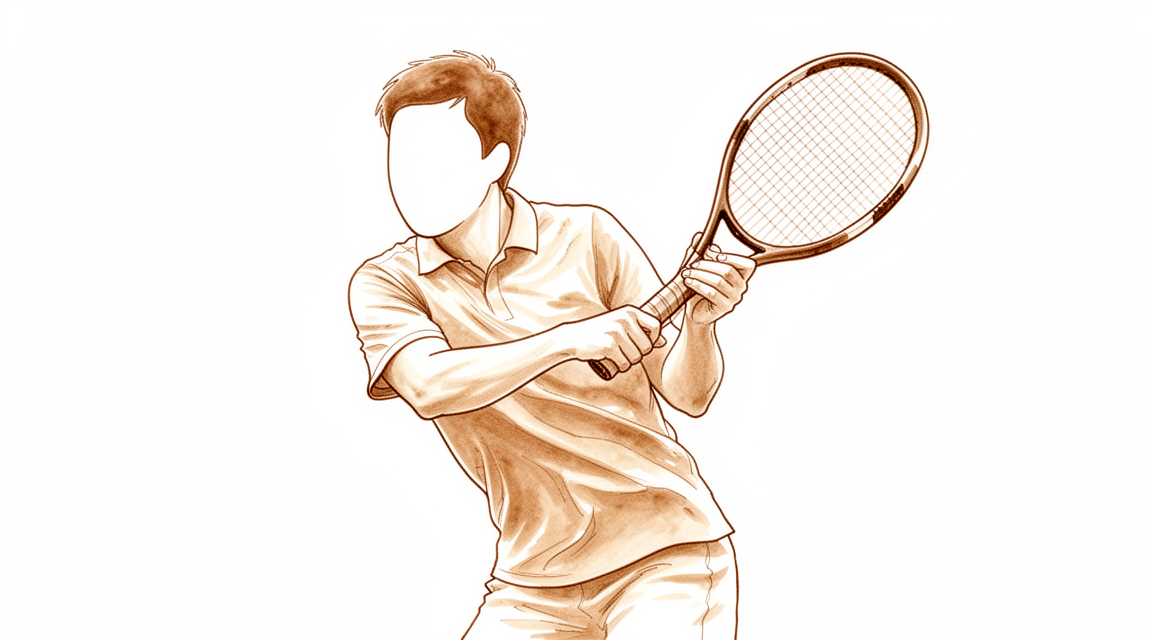
Trang này giải thích cách điều trị khuỷu tay quần vợt và phương pháp phục hồi chức năng, dù bạn đang điều trị không cần phẫu thuật (đây là trường hợp của hầu hết mọi người) hay đang hồi phục sau ca phẫu thuật làm sạch gân. Nội dung trang được giám sát bởi Bác sĩ Kieran Hirpara tại Bệnh viện tư nhân Mater Rockhampton. Trang bắt đầu với chương trình tập luyện tại nhà dành cho bạn; tiếp theo là quy trình điều trị chi tiết dành cho chuyên viên vật lý trị liệu hoặc chuyên gia trị liệu tay. Hãy mang theo trang này hoặc bản PDF tương ứng trong các buổi trị liệu để đảm bảo quá trình phục hồi được thực hiện đồng bộ. Chuyên viên trị liệu có thể điều chỉnh kế hoạch này tùy theo tiến triển hồi phục của bạn.
Những điều bạn có thể mong đợi
Khuỷu tay quần vợt (viêm mỏm trên lồi cầu ngoài xương cánh tay) là tình trạng tổn thương gân nằm ở phía ngoài khuỷu tay, cụ thể là gân duỗi chung và đặc biệt là một cơ nhỏ có tên ECRB. Dù trong tên gọi có chữ “-itis”, đây không phải là tình trạng viêm mà chỉ cần nghỉ ngơi là khỏi. Thực chất đây là sự thay đổi do hao mòn của gân (bệnh lý thoái hóa gân – tendinosis), khi các sợi gân trở nên rối loạn và không thể hồi phục đúng cách.
Điều này rất quan trọng vì nó ảnh hưởng trực tiếp đến phương pháp điều trị. Bạn sẽ không khỏi nếu chỉ nghỉ ngơi và hạn chế vận động khuỷu tay; ngược lại, việc nghỉ ngơi kéo dài còn khiến gân yếu đi và hồi phục chậm hơn. Cách điều trị hiệu quả là tăng dần mức tải lên gân để nó có thể tái cấu trúc và phục hồi khả năng chịu lực, chịu lực nắm. Quy trình điều trị gồm: trước hết làm giảm cơn đau, sau đó dần dần tăng cường sức mạnh gân, bắt đầu từ các bài tập giữ nguyên tư thế (tĩnh) rồi tiến dần đến các bài tập tăng cường chậm và có kiểm soát như bài tập xoay Tyler.
Tin vui là khuỷu tay quần vợt thường tự khỏi nếu áp dụng đúng chương trình tăng tải. Khoảng 80–90% người bệnh sẽ hồi phục trong vòng một năm; tuy nhiên đôi khi cần tới 12–18 tháng mới khỏi hoàn toàn. Phẫu thuật chỉ được cân nhắc sau khi đã thực hiện phục hồi chức năng đầy đủ, đều đặn trong ít nhất sáu tháng mà không có tiến triển, và chỉ có một tỷ lệ rất nhỏ (khoảng 4–11%) rơi vào trường hợp này.
Các biện pháp phòng ngừa và hạn chế
Nên làm:
- Tiếp tục sử dụng cánh tay: hãy vận động gân, đừng để nó nghỉ ngơi.
- Dùng mức độ đau làm thước đo: cảm giác đau nhẹ trong và sau khi tập luyện là bình thường và có thể chấp nhận được; nếu đau dữ dội hoặc ngày càng tăng thì nên giảm cường độ vận động.
- Khi nâng vật, hãy để lòng bàn tay hướng lên trên (giống như đang cầm một bát súp) để giảm tải cho gân đang bị đau.
- Khi thực hiện các động tác nắm và nâng vật, hãy đeo nẹp chống lực lên vùng cơ cẳng tay.
Không nên làm:
- Đừng cố định khuỷu tay bằng bó bột hoặc đai treo tay khi khuỷu tay quần vợt đang được điều trị không phẫu thuật; đó là phương pháp điều trị sai đối với bệnh lý thoái hóa gân. (Sau phẫu thuật thì khác: đai treo tay được dùng để tạo sự thoải mái trong tuần đầu tiên, như được nêu trong quy trình sau phẫu thuật bên dưới.)
- Đừng thực hiện các động tác nắm mạnh gây kích thích cơn đau khi khuỷu tay duỗi thẳng và cổ tay gập xuống (ví dụ: nâng vật nặng với lòng bàn tay hướng xuống dưới).
- Đừng vội tiêm steroid. Corticosteroid có thể giúp giảm đau trong vài tuần, nhưng các bằng chứng khoa học cho thấy nó dẫn đến kết quả điều trị tồi hơn và tỷ lệ tái phát cao hơn so với phương pháp vật lý trị liệu hoặc chỉ đơn giản là chờ đợi, sau 6–12 tháng. Đây không phải là phương pháp điều trị ưu tiên.
Các bài tập của bạn
Kieran Hirpara 4.0
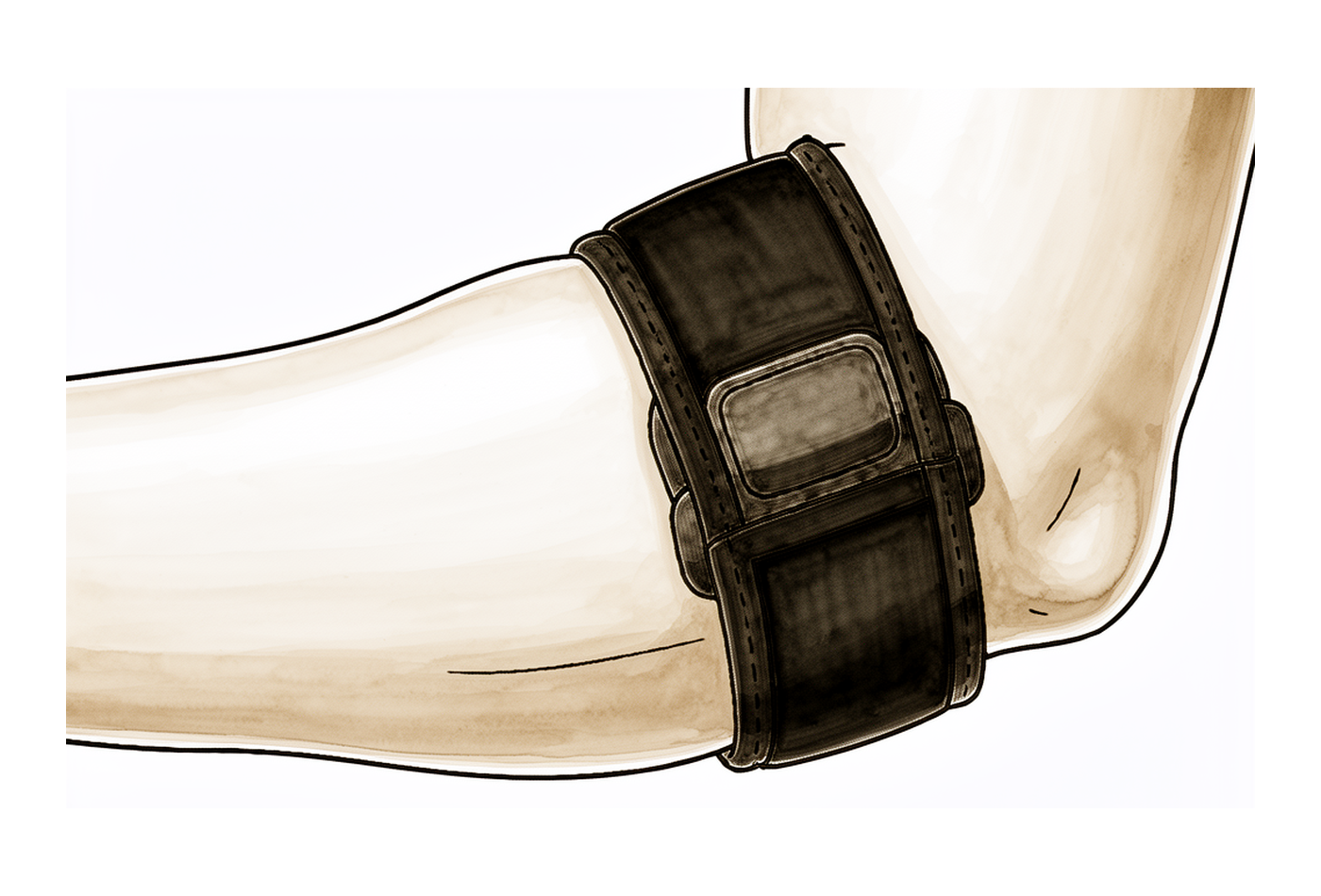
Nẹp chống lực
Đeo dây đai chống lực quanh cẳng tay, dưới khuỷu tay khoảng hai khoát ngón tay, đặt trên phần cơ dày nhất (không đặt lên chính mấu xương). Dây đai cần chắc nhưng không chặt đến mức làm bàn tay tê rần. Hãy dùng nó khi thực hiện các động tác cầm nắm và nâng vật để giảm tải cho gân đang bị đau; bạn không cần đeo khi nghỉ ngơi hoặc khi ngủ.
Trong các hoạt động làm đau tăng lên; nới lỏng ra nếu bàn tay bị tê rần.
Kieran Hirpara 4.0
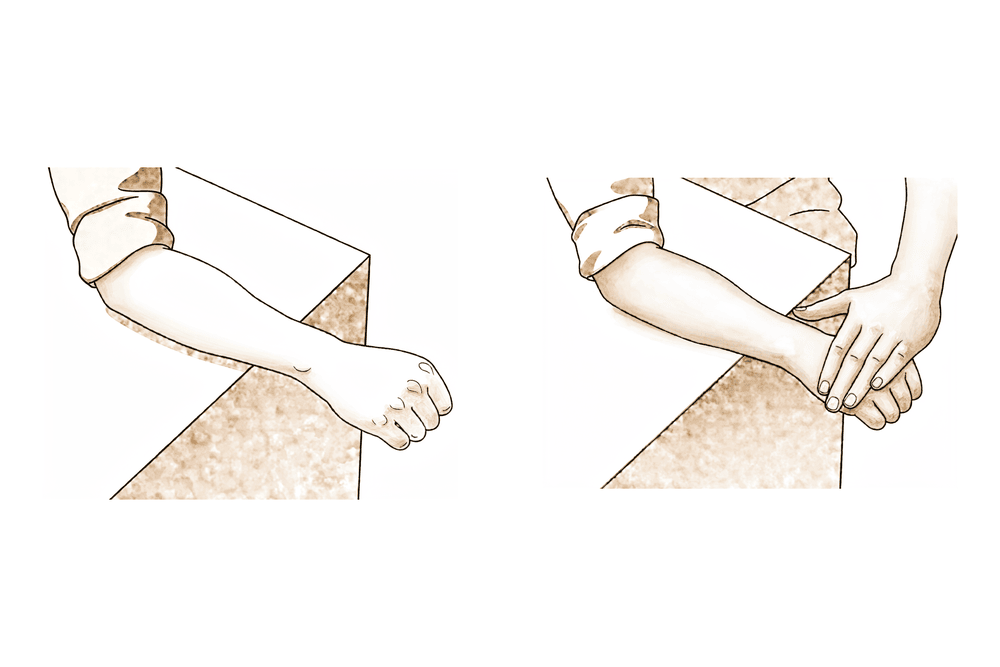
Duỗi cổ tay đẳng trường
Đặt cẳng tay lên bàn, lòng bàn tay úp xuống và bàn tay thò ra ngoài mép bàn. Đặt tay còn lại lên mu bàn tay bị đau. Cố gắng nâng mu bàn tay lên phía trần nhà trong khi tay kia giữ yên, để thực tế không có gì cử động – đây là bài tập giữ lực, đẩy chống lại lực cản. Bạn nên cảm thấy phải gắng sức vừa phải nhưng không được đau nhói. Giữ lực đẩy, rồi thả lỏng.
Giữ trong 30–45 giây, 5 lần, 1–2 lần mỗi ngày.
Kieran Hirpara 4.0
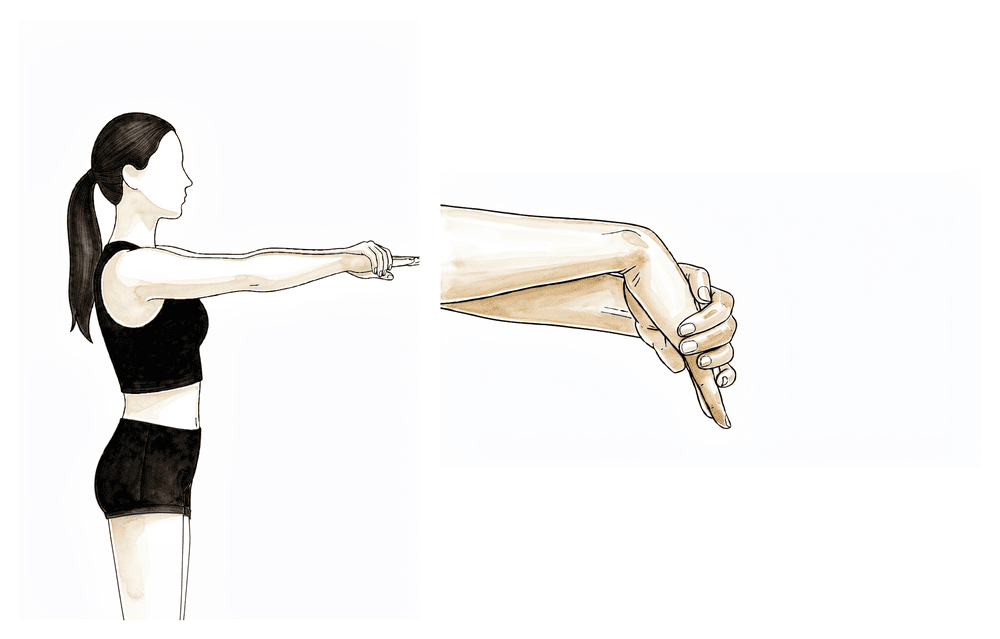
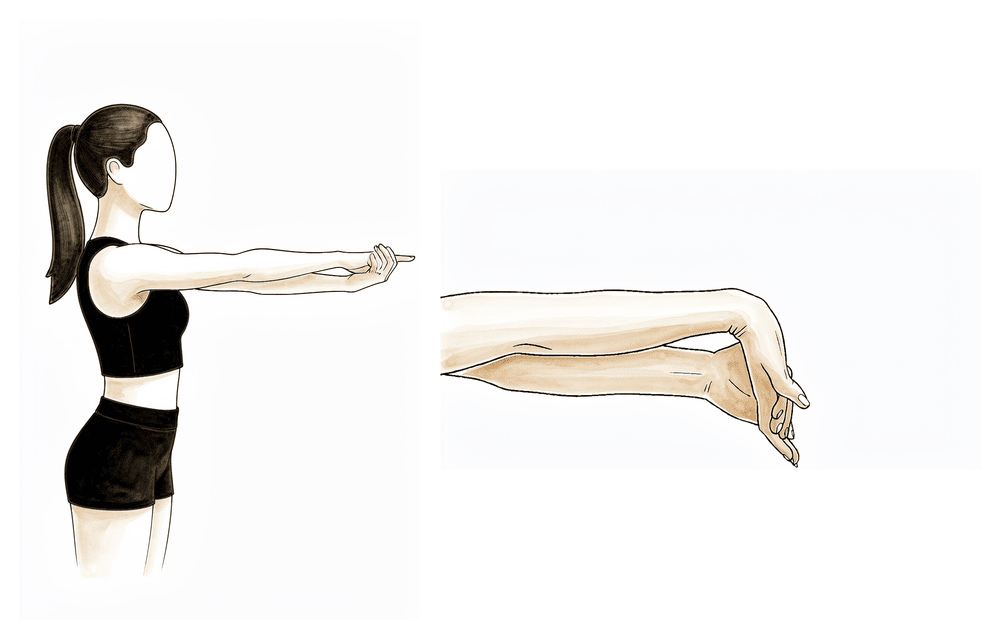
Bài tập kéo giãn cơ duỗi cổ tay
Duỗi cánh tay bị đau ra phía trước, khuỷu tay thẳng và lòng bàn tay úp xuống. Dùng tay còn lại nhẹ nhàng gập cổ tay xuống để các ngón tay chỉ về phía sàn nhà, cho đến khi bạn cảm thấy căng dễ chịu dọc mặt trên cẳng tay. Giữ khuỷu tay thẳng. Nếu duỗi thẳng khuỷu tay gây đau nhói, hãy bắt đầu với khuỷu tay hơi gập, rồi tiến dần đến duỗi thẳng hoàn toàn khi cơn đau dịu đi.
Giữ trong 30 giây, thực hiện 3 lần, 2–3 lần mỗi ngày.
Kieran Hirpara 4.0
Bài tập kéo giãn cơ gập cổ tay
Duỗi tay ra phía trước, giữ khuỷu tay thẳng và lòng bàn tay hướng lên trên. Dùng tay kia nhẹ nhàng kéo các ngón tay và cổ tay ra phía sau, xuống dưới cho đến khi bạn cảm nhận được lực kéo dễ chịu dọc theo mặt dưới cẳng tay. Giữ nguyên tư thế khuỷu tay thẳng.
Giữ trong 30 giây, thực hiện 3 lần, 2–3 lần mỗi ngày.
Kieran Hirpara 4.0
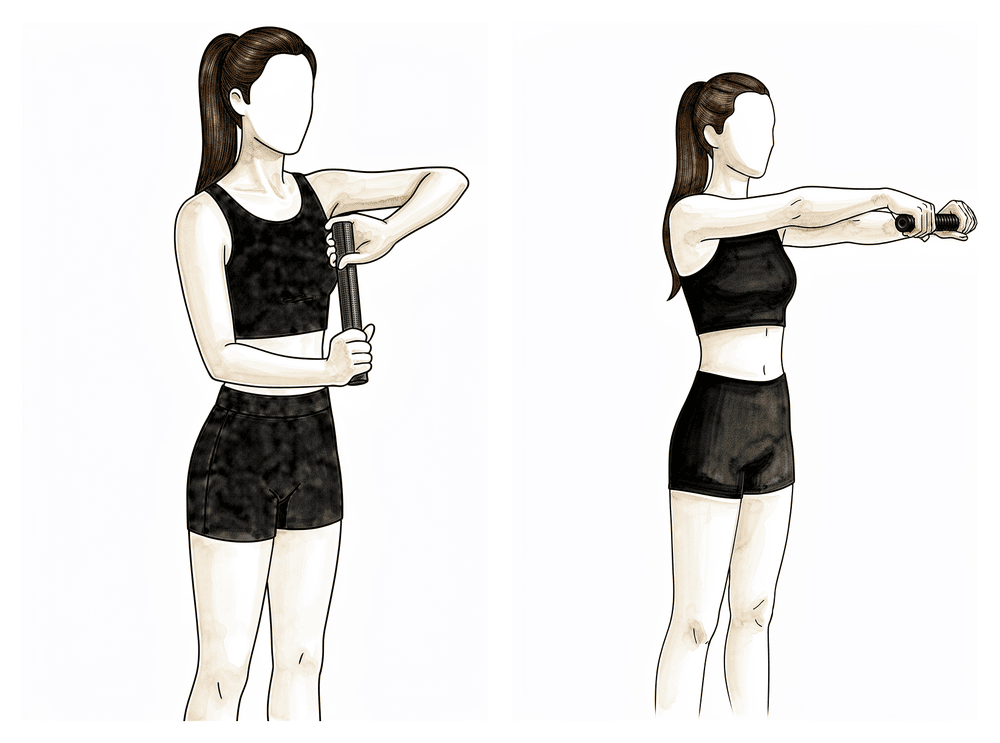
Xoay Tyler (duỗi cổ tay lệch tâm)
Cầm thanh cao su dẻo (FlexBar) thẳng đứng bằng tay bị đau, cổ tay gập ngược ra sau. Dùng tay còn lại nắm đầu trên của thanh và vặn xoắn nó. Sau đó đưa thanh ra trước mặt, vẫn giữ nguyên độ xoắn, rồi từ từ để cổ tay bị đau duỗi ra một cách có kiểm soát trong 3–4 giây – chính động tác hạ chậm, có kiểm soát này là phần giúp xây dựng lại gân. Động tác nhả xoắn nên tạo cảm giác gắng sức, nhưng không đau nhói. Đau âm ỉ nhẹ trong khi tập và một chút sau đó là điều bình thường và không sao.
3 hiệp, mỗi hiệp 15 lần, mỗi ngày một lần (bài tập tăng cường sức mạnh chủ đạo).
Kieran Hirpara 4.0
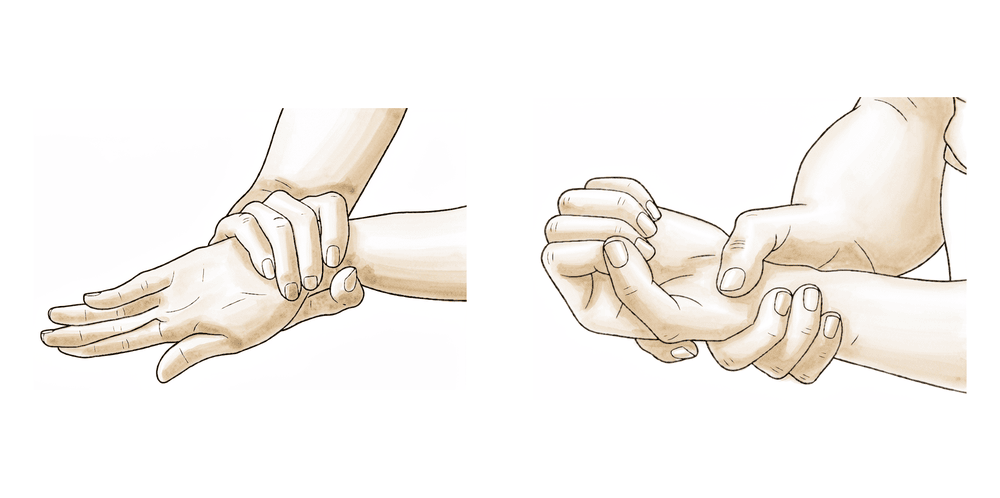
Chuyển động xoay cẳng tay
Khép khuỷu tay sát vào thân mình và gập khuỷu thành góc vuông. Từ từ xoay cẳng tay để lòng bàn tay ngửa lên, rồi xoay để lòng bàn tay úp xuống, vẫn giữ khuỷu tay sát thân. Khi bài tập dễ dần, hãy cầm một vật nhẹ như cây búa hoặc một lon đồ hộp để tăng tải.
10 lần mỗi hướng, 2–3 lần mỗi ngày; hãy thêm trọng lượng nhẹ khi có thể.
Kieran Hirpara 4.0
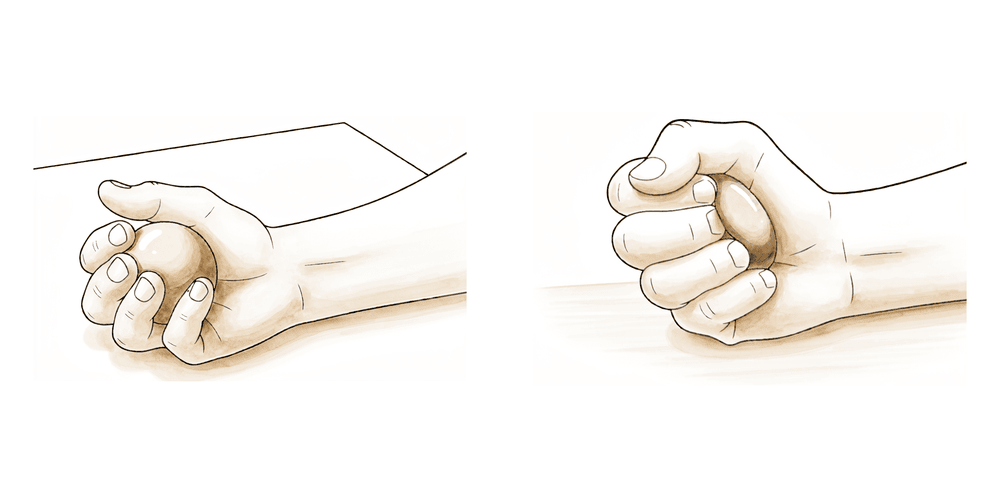
Tăng cường sức mạnh nắm tay
Bóp một quả bóng mềm hoặc đất nặn trị liệu trong lòng bàn tay, giữ lực bóp trong giây lát rồi thả lỏng. Tăng dần độ mạnh của lực bóp khi gân chịu được nhiều hơn. Nếu cầm nắm vẫn còn rất đau, hãy bắt đầu muộn hơn và nhẹ hơn – các bài tập cầm nắm thuộc giai đoạn tăng cường sức mạnh, sau khi tình trạng kích ứng ban đầu đã lắng xuống.
Bóp 10–15 lần, 2–3 lần mỗi ngày; tăng dần độ mạnh theo khả năng chịu đựng.
Đây là những bài tập có trong tờ hướng dẫn dành cho bạn. Các bài tập này được sắp xếp theo trình tự hồi phục: nẹp chống lực và các bài giữ nguyên tư thế giúp giảm đau ngay từ đầu; các bài kéo giãn giúp cẳng tay vẫn giữ được độ linh hoạt; còn bài xoay Tyler, xoay cẳng tay và các bài tập nắm tay thì giúp phục hồi sức mạnh cho gân. Hãy bắt đầu thực hiện theo hướng dẫn của Bác sĩ Hirpara và chuyên viên trị liệu; bạn không cần phải làm hết tất cả các bài ngay từ ngày đầu tiên. Chuyên viên trị liệu sẽ chỉ dẫn cho bạn bài nào nên bắt đầu làm trước và khi nào nên thêm các bài tập tăng cường sức mạnh vào chương trình tập luyện.
Quy trình điều trị lâm sàng của bạn
Phần còn lại của trang này là quy trình phục hồi chức năng dành cho bệnh viêm mỏm trên lồi cầu ngoài xương cánh tay (khuỷu tay quần vợt). Phần này cần được cung cấp cho chuyên viên vật lý trị liệu hoặc chuyên gia trị liệu tay của bạn; mỗi giai đoạn đều bắt đầu bằng lời giải thích bằng tiếng Việt đơn giản về những gì đang diễn ra.
Quy trình điều trị gồm hai hướng: phương pháp không phẫu thuật (được áp dụng làm phương pháp điều trị đầu tiên cho hầu hết mọi người) và phương pháp sau phẫu thuật dành cho số ít bệnh nhân phải tiến hành thủ thuật cắt lọc gân ECRB sau khi đã thực hiện các biện pháp điều trị bảo tồn chất lượng trong ít nhất sáu tháng mà không có tiến triển.
Phương pháp điều trị không phẫu thuật
Nguyên tắc cốt lõi là việc tăng dần mức độ tải trọng lên gân, dựa trên mức độ đau. Mục tiêu là rút ngắn thời gian xuất hiện triệu chứng và khôi phục khả năng chịu tải của gân, chứ không phải là để gân nghỉ ngơi.
Giai đoạn I — Kiểm soát cơn đau cấp tính (0–2 tuần)
Mục tiêu của giai đoạn này là làm giảm cơn đau và khôi phục khả năng vận động mà không chịu tải trọng. Không có việc cố định khớp; đây là hình thức nghỉ ngơi tương đối, chứ không phải bó bột.
Dành cho chuyên viên vật lý trị liệu:
- Mục tiêu: giảm đau; khôi phục toàn bộ biên độ vận động chủ động (AROM) mà không chịu tải trọng.
- Cách xử trí: điều chỉnh các hoạt động sinh hoạt, bảo vệ khớp và tư vấn về ergonomics. Có thể sử dụng nẹp chống lực đặt lên vùng cơ duỗi chung để giảm tải cho điểm bám của cơ ECRB khi thực hiện các động tác nắm; nẹp cổ tay dạng “cock-up” có thể được dùng nếu bệnh nhân bị đau dữ dội khi vận động duỗi cổ tay. Các biện pháp hỗ trợ giảm đau gồm: chườm đá, di động mô mềm / di động mô mềm có hỗ trợ dụng cụ (IASTM), các động tác AROM nhẹ nhàng không gây đau; có thể áp dụng châm khô và các bài tập trượt dây thần kinh.
- Tiêu chí chuyển sang giai đoạn tiếp theo: khôi phục hoàn toàn biên độ vận động chủ động mà không đau; bệnh nhân có thể tự thực hiện các bài tập tại nhà một cách độc lập.
Giai đoạn II — Giai đoạn bán cấp/giai đoạn tải trọng sớm (2–4 tuần)
Việc tải trọng lên gân được thực hiện một cách từ từ; đồng thời cần chú trọng đến các cơ ở vùng gần vai (xương bả vai và cơ chóp xoay), vì tình trạng yếu cơ ở vùng này sẽ gây quá tải cho khuỷu tay.
Dành cho chuyên viên vật lý trị liệu:
- Mục tiêu: bắt đầu tải trọng lên gân; cải thiện chức năng của chuỗi động tác vùng gần vai.
- Các bài tập: tải trọng đẳng trường lên cơ duỗi và cơ gập cổ tay (dùng tải nhẹ; các bài tập đẳng trường thường được dung nạp tốt và có tác dụng giảm đau trong bệnh lý gân giai đoạn phản ứng); việc kéo giãn dần dần các cơ gập/duỗi cổ tay khi khuỷu tay ở góc 90°; các bài tập vùng gần vai: cơ răng trước, cơ thang giữa/dưới, cơ chóp xoay và các cơ ổn định xương bả vai.
- Tiêu chí để chuyển sang giai đoạn tiếp theo: duy trì được biên độ vận động đầy đủ; bệnh nhân chịu được lực kéo giãn khi khuỷu tay gập 90°; lực nắm/sức mạnh đạt khoảng 70% so với bên đối diện.
Giai đoạn III — Tăng cường sức mạnh / hồi phục (4–6+ tuần, thường kéo dài tới 12 tuần)
Đây là giai đoạn gân được tái tạo và khả năng chịu tải khi làm việc hoặc vận động thể thao được phục hồi. Việc thực hiện các bài tập tải trọng dạng lệch tâm–đồng tâm là yếu tố then chốt trong điều trị.
Dành cho chuyên viên vật lý trị liệu:
- Mục tiêu: phục hồi khả năng chịu tải và khả năng tham gia các hoạt động thể thao/công việc.
- Các bài tập: thực hiện các bài tập tải trọng dạng lệch tâm–đồng tâm cho động tác duỗi cổ tay và xoay cẳng tay vào trong/ra ngoài; xoay Tyler (FlexBar) là dụng cụ tiêu biểu dùng tại nhà để thực hiện các bài tập lệch tâm. Tiến hành kéo giãn cổ tay ở tư thế khuỷu tay duỗi thẳng; áp dụng kỹ thuật di động hóa có vận động (Mulligan). Thực hiện các bài tập tăng cường sức mạnh nắm tay cùng các bài tập tải trọng phù hợp với từng nhiệm vụ/thể thao cụ thể; đối với vận động viên, cần thêm các bài tập plyometric (sức bật). Dần dần loại bỏ nẹp chống lực khi bệnh nhân không còn triệu chứng đau. Đối với vận động viên, cần điều chỉnh các thiết bị dùng để thi đấu (kích thước tay cầm, độ căng dây, kỹ thuật vận động).
- Tiêu chí để chuyển sang giai đoạn tiếp theo (trở lại thi đấu): sức mạnh cơ tương đương khoảng 90% so với bên đối diện, khả năng vận động không gây đau, và khả năng tự kiểm soát tình trạng sức khỏe.
Quy trình hồi phục sau phẫu thuật (cắt lọc gân ECRB ± giải phóng gân)
Phẫu thuật chỉ được chỉ định cho khoảng 4–11% bệnh nhân không đáp ứng với các biện pháp điều trị bảo tồn đúng cách trong ít nhất 6 tháng. Cả phương pháp cắt lọc mổ mở kiểu Nirschl và phương pháp cắt lọc gân ECRB qua nội soi đều cho kết quả tương đương nhau. Lộ trình hồi phục dưới đây tuân theo Tiêu chuẩn chăm sóc của Bệnh viện Brigham & Women’s dành cho các ca cắt lọc ở mỏm trên lồi cầu ngoài xương cánh tay.
Giai đoạn 1 — Bảo vệ (Ngày 1–7)
Trong tuần đầu tiên, đai treo tay chỉ được dùng để tạo sự thoải mái mà thôi.
Dành cho chuyên viên vật lý trị liệu:
- Dùng đai treo tay để tạo sự thoải mái; chườm đá 20 phút, 2–3 lần mỗi ngày; đeo miếng đệm khuỷu tay phủ lên vết mổ.
- Thực hiện các động tác vận động chủ động nhẹ nhàng ở tay, cổ tay và khuỷu tay mà không gây đau; vận động vai chủ động; tập các bài tập vùng quanh xương bả vai.
- Hạn chế các hoạt động sinh hoạt hàng ngày gây áp lực lên cơ chế duỗi (như nâng vật nặng, kết hợp duỗi khuỷu tay hết mức với gập cổ tay); nên nâng vật với lòng bàn tay hướng lên trên để giảm tải cho các cơ duỗi; có thể đeo nẹp cổ tay nếu cơn đau trở nên dữ dội.
Giai đoạn 2 — Vận động sớm (Tuần 2–4)
Dành cho chuyên viên vật lý trị liệu:
- Ngừng sử dụng đai treo tay. Bắt đầu vận động thụ động (PROM) và chủ động có trợ giúp trong giới hạn chịu đau.
- Tăng cường sức mạnh một cách nhẹ nhàng: thực hiện các động tác vận động chủ động và các bài tập co cơ đẳng trường dưới mức tối đa. Bắt đầu chăm sóc vết sẹo.
Giai đoạn 3 — Tăng cường sức mạnh (Tuần 5–7)
Dành cho chuyên viên vật lý trị liệu:
- Tăng cường sức mạnh bằng lực kháng (dùng tạ hoặc dây Theraband), chú trọng vào sức bền của các cơ duỗi cổ tay (dùng tải trọng nhẹ nhưng số lần lặp lại nhiều). Khôi phục lại phạm vi vận động chủ động và thụ động đầy đủ.
- Sử dụng nẹp chống lực cho gân cơ duỗi chung; hướng dẫn bệnh nhân tránh tình trạng chèn ép dây thần kinh; thực hiện mát-xa nhẹ theo hướng ngang thớ; bắt đầu các bài tập chuẩn bị chức năng.
Giai đoạn 4 — Phục hồi chức năng / trở lại sinh hoạt bình thường (Tuần 8–12)
Dành cho chuyên viên vật lý trị liệu:
- Huấn luyện chức năng theo từng nhiệm vụ cụ thể; giúp bệnh nhân trở lại làm việc ở mức độ cao hơn và tham gia các hoạt động giải trí.
- Tiếp tục sử dụng nẹp chống lực khi cần thiết để thực hiện các hoạt động sinh hoạt hàng ngày mà không gây đau và để tăng cường sức mạnh cơ.
Trở lại làm việc và các hoạt động thường ngày
Nếu bạn điều trị khuỷu tay quần vợt mà không cần phẫu thuật, thì không có khoảng thời gian “nghỉ làm” cố định nào cả; bạn vẫn có thể sử dụng cánh tay bình thường, chỉ cần điều chỉnh các hoạt động cần dùng lực nắm hoặc nâng vật nặng, đồng thời đeo nẹp chống lực để vượt qua những công việc đó. Kỳ vọng thực tế là khuỷu tay sẽ thuyên giảm trong vòng 6–12 tháng; phần lớn bệnh nhân (80–90%) khỏi trong vòng một năm. Đây là vấn đề liên quan đến gân nên tiến triển rất chậm; vì vậy cần theo dõi diễn biến qua từng tuần, từng tháng chứ không phải chỉ qua vài ngày. Việc kiên trì thực hiện chương trình tập luyện là yếu tố then chốt; những đợt tái phát nhẹ là điều bình thường và không coi là thất bại nếu cơn đau chỉ ở mức nhẹ và hết vào ngày hôm sau.
Trong trường hợp đã phẫu thuật, đai treo tay chỉ dùng để tạo sự thoải mái trong tuần đầu tiên rồi sẽ được tháo ra khi khuỷu tay dần ổn định. Các bài tập tăng cường sức mạnh được tăng dần trong các tuần 5–7; phần lớn bệnh nhân có thể trở lại làm việc và tham gia các hoạt động giải trí vào khoảng tuần thứ 8–12. Các hoạt động nặng hơn hoặc đặc thù cho từng môn thể thao sẽ được đưa vào dần dần trong khoảng thời gian này, tùy theo mức độ chịu tải của gân.
Việc trở lại tập luyện thể thao (đối với cả hai phương pháp điều trị) được xác định dựa trên việc sức mạnh cánh tay bị tổn thương đạt khoảng 90% so với cánh tay còn lại, cùng với khả năng vận động không đau và sự tự tin trong việc tự kiểm soát tình trạng sức khỏe; chứ không chỉ dựa vào thời gian theo lịch trình.
Sau khi thực hiện theo phác đồ
Phác đồ này được áp dụng song song với các hướng dẫn phục hồi chung của phòng khám; vui lòng tham khảo mục xử lý cơn đau sau phẫu thuật và, nếu bạn vừa trải qua phẫu thuật, mục chăm sóc vết thương cũng như những kiến thức cơ bản về vật lý trị liệu tay. Kế hoạch từng giai đoạn nêu trên dựa trên các bằng chứng y khoa mới nhất về khuỷu tay quần vợt (việc tăng dần mức độ tải trọng lên gân thay vì nghỉ ngơi hoàn toàn), và quá trình phục hồi của bạn sẽ được điều chỉnh riêng biệt bởi chuyên viên vật lý trị liệu hoặc chuyên gia trị liệu tay tùy theo tiến triển của khuỷu tay.
Evidence & references
This is the clinical evidence summary written for health professionals. It is technical, and it lists the research this page was built from. You do not need to read it to understand your treatment or to make a decision about it.
Lateral Epicondylitis (Tennis Elbow) — Non-operative & Post-operative Rehabilitation
Topic scope: (A) the natural history and stepped non-operative management of lateral epicondylitis (relative rest → progressive tendon loading: isometric → eccentric–concentric; counterforce bracing; controversies around corticosteroid and PRP injection), and (B) post-operative rehabilitation after open or arthroscopic ECRB debridement ± release, reserved for the minority who fail ≥6 months of quality conservative care.
Defining principle: despite the "-itis" suffix, lateral epicondylitis is a degenerative tendinopathy (tendinosis) of the extensor carpi radialis brevis (ECRB) origin, not an inflammatory condition. This reframes treatment away from rest and anti-inflammatory measures and toward progressive tendon loading — settle pain with isometrics, then rebuild load tolerance with eccentric–concentric loading (the Tyler twist / FlexBar). KH's stance: load the tendon, do not immobilise it; corticosteroid injection is avoided as first line because it is better short-term but worse at 6–12 months; surgery is a last resort after ≥6 months of genuine conservative care.
A. NATURAL HISTORY & NON-OPERATIVE MANAGEMENT
Natural history (self-limiting in most)
Lateral epicondylitis is self-limiting in the majority: roughly 80–90% resolve within about one year regardless of treatment, with the conservative literature ranging out to 12–18 months [Coonrad & Hooper 1973; Nirschl 1999]. This high spontaneous-resolution rate is the central methodological challenge of the field — any intervention must beat natural history, a high bar most fail to clear. The goal of therapy is therefore to shorten the symptomatic course and restore load tolerance, not to "cure" a condition that largely settles on its own.
Phased non-operative rehabilitation
First-line for essentially all comers. The therapeutic core is progressive tendon loading guided by pain.
Phase I — Acute / pain control (~0–2 weeks). Relative rest, NOT immobilisation — avoid full wrist/elbow casting (Nirschl). Activity modification, joint protection, ergonomics. Optional counterforce brace over the common extensor mass (offloads the ECRB origin during grip) ± a wrist cock-up splint if acutely painful. Adjuncts: ice, soft-tissue/IASTM, pain-free AROM, optional dry needling, nerve glides. Criterion to progress: full unloaded AROM without pain; independent with home program. Consensus / institutional protocol.
Phase II — Sub-acute / early loading (~2–4 weeks). Begin isometric wrist flexor/extensor loading (minimal load; isometrics are well tolerated and analgesic in reactive tendinopathy). Progressive stretching of wrist flexors/extensors with the elbow at 90°. Add proximal kinetic-chain work (serratus anterior, mid/lower trapezius, rotator cuff, scapular stabilisers — proximal deficits drive distal overload). Criteria to progress: full ROM maintained; tolerates stretch at 90° elbow flexion; ~70% contralateral grip/strength. Moderate (strengthening trials) / Consensus (timeline).
Phase III — Late / strengthening & return (~4–6+ weeks, often to 12 weeks). Eccentric–concentric loading of wrist extension and forearm pronation/supination is the core driver; the Tyler twist (FlexBar eccentric wrist-extension) is the prototypical home tool. Progress stretching to the elbow-extended position; add mobilisation-with-movement (Mulligan). Grip strengthening and task-/sport-specific loading; plyometrics for athletes. Gradually wean the counterforce brace as the patient becomes asymptomatic. Return-to-sport criteria: ~90% contralateral strength, pain-free function, self-management competence. Moderate–High (RCT/SR for exercise & loading) / Consensus (phase timings).
B. POST-OPERATIVE REHABILITATION (open or arthroscopic ECRB debridement ± release/repair)
Surgery is reserved for the ~4–11% who fail ≥6 months (commonly 6–12 months) of quality conservative care. Open Nirschl-type debridement and arthroscopic ECRB debridement give comparable complication and reoperation rates (national database, Arthroscopy 2022); arthroscopy additionally allows intra-articular inspection. The phased timeline below is the Brigham & Women's Standard of Care for lateral epicondyle debridement, cross-checked against community ECRB-release protocols.
| Phase | Window | Sling / support | Motion & strengthening | Notes |
|---|---|---|---|---|
| 1 — Protect | Days 1–7 | Sling for comfort; optional wrist splint if painful | Pain-free hand/wrist/elbow AROM; active shoulder ROM; periscapular work | Ice 20 min 2–3×/day; elbow pad over incision; lift palm-up to offload extensors |
| 2 — Early motion | Weeks 2–4 | Discontinue sling | PROM + active-assisted motion within pain tolerance; sub-maximal isometrics | Begin scar management |
| 3 — Strengthening | Weeks 5–7 | Introduce counterforce brace | Advance resistive strengthening (weights/Theraband); wrist-extensor endurance (light load, high rep); restore full A/PROM | Education to avoid nerve compression; cross-fibre massage |
| 4 — Functional / return | Weeks 8–12 | Counterforce brace as needed | Task-specific functional training; return to work/recreation | Functional return wk 8–12 |
Alternative published timelines (community ECRB-release protocols): wrist splint full-time 0–2 wk with no strengthening; full ROM goal by 4–6 wk; strengthening + transition to counterforce brace
6 wk; full activity ~8–10+ wk. Note: one comparative series found post-op bracing/immobilisation delayed symptom resolution versus PRP (mean time to full ROM 96 days surgery vs 42 days PRP) — reinforcing that early controlled motion, not protection, is the goal.
C. KEY CONTROVERSIES / EVIDENCE QUALITY
- Corticosteroid injection: better short-term, WORSE long-term. The Bisset/Smidt body of work (and the BMJ 2006 mobilisation-with-movement RCT) shows steroid gives early relief but higher recurrence and worse 6–12-month outcomes than physiotherapy or wait-and-see. Some authors now call it "always inadvisable" for lateral elbow (Orthop Trauma Surg Res 2019). Prior injection is associated with eventual surgery (a proxy for severity). Strong (Level-1 RCT).
- PRP / autologous blood: contested. Some Level-1 RCTs (Peerbooms 2010; Gosens 2-yr) show PRP superior to corticosteroid with ongoing 2-year benefit; others (Krogh 2013) found PRP ≈ glucocorticoid ≈ saline (no benefit over placebo). Meta-analyses are heterogeneous. Net: a reasonable second-line for refractory cases, but evidence is inconsistent. Conflicting (Level-1).
- Eccentric vs concentric vs isometric. Pure eccentric (Alfredson-style) is effective but not clearly superior; current view favours eccentric–concentric combined loading, with isometrics for early analgesia. Grip/isometric demands of the elbow differ from the Achilles, so blanket extrapolation of eccentric-only protocols is questioned. Moderate.
- Surgical indication/timing & technique. Reserve for failure of ≥6 months conservative care. Open vs arthroscopic debridement: no significant difference in complication or reoperation rates (national database, Arthroscopy 2022); choice is surgeon-/training-dependent. Repair after debridement vs debridement alone remains unsettled. Surgical incidence is declining, attributed to eccentric-exercise protocols and injections. Moderate.
- Self-limiting nature complicates all evidence: ~80–90% resolve within a year regardless of treatment, so any intervention must beat natural history. Strong (natural-history signal).
D. EVIDENCE STRENGTH FLAGS (summary)
- MODERATE–HIGH (RCT / SR): progressive loading (eccentric / eccentric–concentric) and exercise therapy for non-operative lateral epicondylitis; mobilisation-with-movement (BMJ 2006); the natural-history signal (~80–90% resolve within ~1 year).
- MODERATE (cohorts / database): post-operative ECRB debridement outcomes; equivalence of open vs arthroscopic debridement (no difference in complication/reoperation rates).
- CONSENSUS / institutional (Level-5): the phase timelines themselves derive from Standard-of-Care protocols (Brigham & Women's, Mass General Brigham, Campbell's/Nirschl) — broadly concordant across sources but not trial-derived.
- STRONG (against, Level-1): corticosteroid injection as first-line — better short-term, worse at 6–12 months.
CITATIONS
RAG corpus (180,000+ Orthopaedic articles)
- Bisset L et al. Mobilisation with movement and exercise, corticosteroid injection, or wait and see for tennis elbow: randomised trial. BMJ. 2006. DOI: 10.1136/bmj.38961.584653.AE
- Krogh TP et al. Treatment of lateral epicondylitis with platelet-rich plasma, glucocorticoid, or saline: a randomized, double-blind, placebo-controlled trial. Am J Sports Med. 2013. DOI: 10.1177/0363546512472975
- Peerbooms JC et al. Positive effect of an autologous platelet concentrate in lateral epicondylitis in a double-blind randomized controlled trial. Am J Sports Med. 2010. DOI: 10.1177/0363546509355445
- Gosens T et al. Ongoing positive effect of platelet-rich plasma versus corticosteroid injection in lateral epicondylitis: a double-blind randomized controlled trial with 2-year follow-up. Am J Sports Med. 2011. DOI: 10.1177/0363546510397173
- Ortega-Castillo M, Medina-Porqueres I. Effectiveness of the eccentric exercise therapy in physically active adults with symptomatic shoulder impingement or lateral epicondylar tendinopathy: a systematic review. J Sci Med Sport. 2016. DOI: 10.1016/j.jsams.2015.05.010
- Nirschl RP, Ashman ES. Elbow tendinopathy: tennis elbow. Clin Sports Med. 2003. (Current Concepts — Tendinosis of the Elbow, J Bone Joint Surg Am. 1999. DOI: 10.2106/00004623-199902000-00016)
- Coonrad RW, Hooper WR. Tennis elbow: its course, natural history, conservative and surgical management. J Bone Joint Surg Am. 1973. DOI: 10.2106/00004623-197355060-00002
- Lattermann C et al. Arthroscopic debridement of the extensor carpi radialis brevis for recalcitrant lateral epicondylitis. J Shoulder Elbow Surg. 2010. DOI: 10.1016/j.jse.2010.02.008
Lateral epicondylitis literature (URLs)
- Comparative efficacy and safety of nonsurgical treatment options for enthesopathy of the ECRB: a systematic review and meta-analysis of randomized trials. Am J Sports Med. 2018. https://pubmed.ncbi.nlm.nih.gov/29268037/
- Eccentric, eccentric–concentric, and eccentric–concentric + isometric training in lateral elbow tendinopathy. J Hand Ther. 2017. https://pubmed.ncbi.nlm.nih.gov/28732560/
- Role of strengthening during nonoperative treatment of lateral epicondyle tendinopathy. J Hand Ther. 2021. https://pubmed.ncbi.nlm.nih.gov/33041157/
- Chronic lateral elbow tendinopathy managed with a supervised graded exercise protocol. J Hand Ther. 2023. https://pubmed.ncbi.nlm.nih.gov/36127241/
- Management of lateral epicondylitis. Orthop Traumatol Surg Res. 2019. https://pubmed.ncbi.nlm.nih.gov/30414784/
- No difference in complication or reoperation rates between arthroscopic and open debridement for lateral epicondylitis: a national database study. Arthroscopy. 2022. https://pubmed.ncbi.nlm.nih.gov/34838651/
- Wang D et al. Trends in surgical practices for lateral epicondylitis among newly trained orthopaedic surgeons. Orthop J Sports Med. 2017. https://pubmed.ncbi.nlm.nih.gov/28840148/
- Factors associated with failure of nonoperative treatment in lateral epicondylitis. Am J Sports Med. 2015. https://pubmed.ncbi.nlm.nih.gov/26015443/
Published rehab protocols (patient-guidance — basis for the phase structure)
- Brigham & Women's Hospital — Post-Op Protocol for Lateral Epicondyle Debridement. https://www.brighamandwomens.org/assets/bwh/patients-and-families/rehabilitation-services/pdfs/elbow-lateral-epicondyle-debridement-postoperative-bwh.pdf
- Mass General Brigham Sports Medicine — Rehabilitation Protocol for Medial/Lateral Epicondylitis (non-operative), rev. April 2021. https://www.massgeneral.org/assets/MGH/pdf/orthopaedics/sports-medicine/physical-therapy/rehabilitation-protocol-for-medial-lateral-epicondylitis.pdf
- Beacon Orthopaedics — Lateral Epicondylitis ECRB Surgical Release Protocol. https://www.beaconortho.com/wp-content/uploads/Lateral-Epicondylitis-Release.pdf