Qué está sintiendo
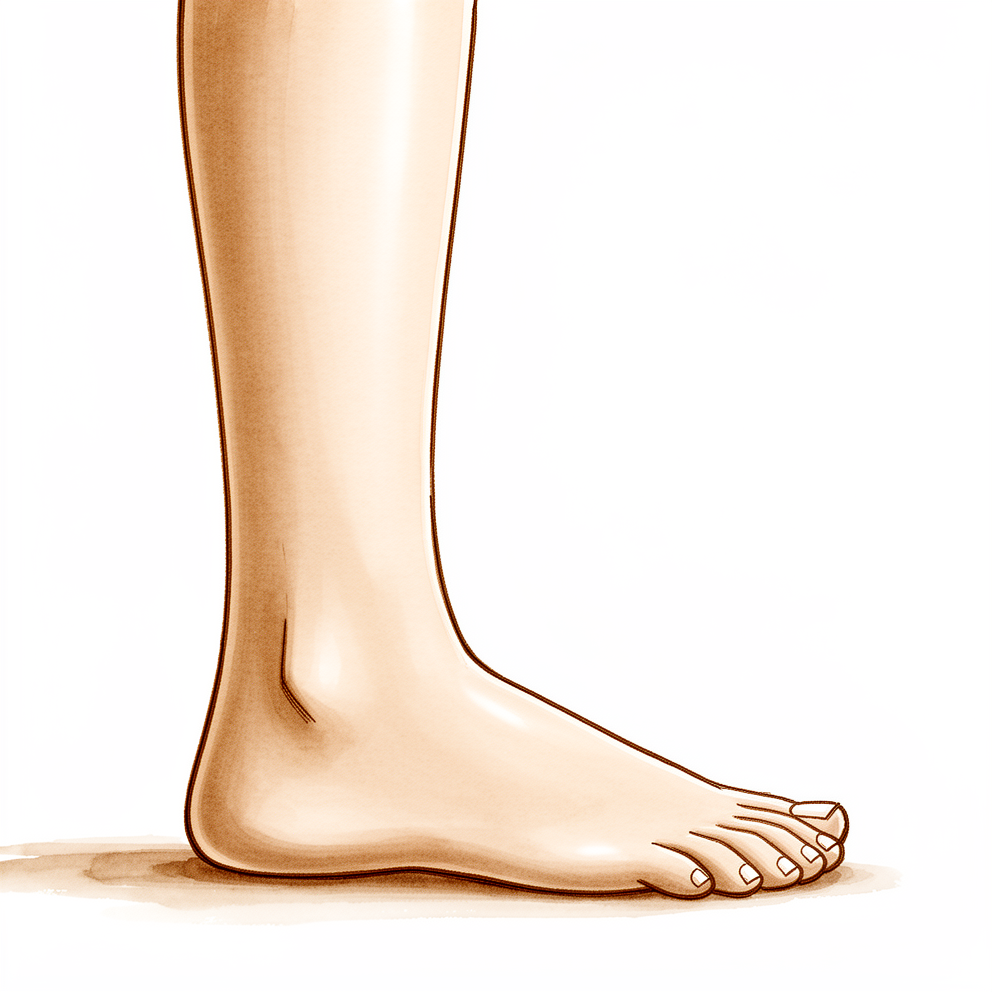
Una fractura del pilar tibial consiste en una rotura en el extremo inferior de la tibia, justo donde esta forma la articulación del tobillo. El dolor se localiza en lo profundo del tobillo y la parte inferior de la pierna; normalmente se siente en ambos lados de la articulación, no solo en un punto concreto. Dado que la propia superficie articular resulta afectada, el dolor suele extenderse por todo el tobillo en lugar de permanecer en un solo lugar.
Por lo general, el dolor empeora al estar de pie. Mantenerse en posición vertical, caminar o apoyar el peso en ese pie ejercen presión sobre la articulación lesionada; por eso, es normal que el dolor vaya en aumento a lo largo de un día de actividad. La hinchazón alrededor del tobillo es frecuente; esta hace que la piel se sienta tensa y sensible al tacto. El descanso con el pie elevado suele aliviar los síntomas. Muchas personas notan que el tobillo está rígido y dolorido al despertar, pero se vuelve un poco más flexible al moverse.
Las tareas cotidianas que requieren un tobillo estable y sin dolor se vuelven difíciles. Caminar hasta el buzón, permanecer de pie junto a la encimera de la cocina para cocinar, subir escaleras o ir al baño sin ayuda pueden resultar complicados. Si se trata del tobillo derecho, es posible que no pueda conducir durante un tiempo. Incluso ponerse los zapatos puede ser complicado cuando el tobillo está hinchado y rígido.
Esta lesión también puede afectarle de maneras que van más allá del aspecto físico. El dolor que limita sus actividades diarias durante meses, así como las dificultades para dormir a causa del tobillo, pueden influir en su estado de ánimo y bienestar general. Esto es una respuesta normal ante una lesión grave; si le ocurre a usted, merece la pena comentarlo con su equipo médico.
Un último dato importante: se trata de una lesión en la que los detalles son cruciales. La posición en la que quedan los fragmentos óseos tras el tratamiento influye realmente en el funcionamiento posterior del tobillo; por ello, los cirujanos planifican la intervención teniendo en cuenta los tejidos blandos y la hinchazón. Su cirujano le explicará el plan de tratamiento específico para su fractura.
¿Qué está ocurriendo realmente?
El tobillo está formado por tres huesos que crean una especie de “encaje”: el hueso de la espinilla en la parte superior, y dos huesos más pequeños a cada lado que lo sujetan como si fueran una abrazadera. El extremo del hueso de la espinilla que forma la parte superior de ese encaje se denomina “plafond”. En una fractura de pilon, ese “techo” se rompe. La fuerza suele actuar directamente desde abajo, a través del pie; por ejemplo, en una caída desde cierta altura o en un accidente de tráfico; el hueso del tobillo (astrágalo) empuja hacia arriba contra la espinilla, como un martillo que clava un clavo en la madera. La superficie articular se fragmenta en varios pedazos.
El daño no afecta únicamente al hueso. El encaje articular está recubierto por cartílago liso, esa superficie resbaladiza que permite el deslizamiento de la articulación. Cuando la fractura atraviesa dicha superficie, los fragmentos pueden quedar mal alineados, y el tobillo pierde su movimiento fluido. Por eso aparecen la hinchazón, el dolor intenso y la dificultad para soportar peso: la articulación en sí resulta dañada, no solo el hueso circundante.
El tobillo cuenta también con fuertes ligamentos que mantienen los huesos unidos; entre ellos, uno en la parte interna que evita que la articulación se abra demasiado. Una fuerza descendente intensa puede estirar o incluso desgarrar esos ligamentos. Antes de declarar que el tobillo está nuevamente alineado, los cirujanos verifican varios aspectos: los dos huesos laterales deben recuperar su longitud original, el hueso del tobillo (astrágalo) debe situarse perfectamente en el encaje sin inclinación alguna, el espacio en la zona interna debe volver a su anchura normal, y los dos huesos de la pierna no deben estar separados entre sí.
La hinchazón también es un factor clave. Puede ser muy pronunciada, por lo que a menudo se espera entre 5 y 14 días para que disminuya lo suficiente y sea posible cerrar la piel de forma segura tras la cirugía. Actuar de inmediato sobre una piel hinchada y con ampollas aumenta el riesgo de complicaciones en la herida; por eso este retraso forma parte planificada del tratamiento, no es un obstáculo innecesario.
¿Qué podemos hacer al respecto?
El primer paso suele ser el uso de un armazón externo temporal. Este armazón se coloca fuera de la pierna y mantiene el hueso estable mientras disminuye la hinchazón. Protege los tejidos blandos dañados, la piel y los músculos alrededor de la fractura, y nos da tiempo antes de proceder a cualquier intervención quirúrgica sobre el hueso. Esperar entre 5 y 14 días para que la hinchazón desaparezca forma parte del plan de tratamiento, no es un retraso innecesario.
Los estudios de imagen determinan el plan quirúrgico. Un escáner de tomografía computarizada genera una imagen detallada de los fragmentos óseos; planificar la operación a partir de esas imágenes facilita la reconstrucción de la superficie articular y reduce el riesgo de complicaciones en la cicatrización. Una vez que la piel está lista, el procedimiento habitual es la reducción abierta y fijación interna: abrimos el tobillo, reconstruimos la superficie articular fracturada y fijamos los fragmentos con una placa y tornillos. El abordaje quirúrgico varía según la ubicación exacta de la fractura; en algunos casos se realizan incisiones en la parte posterior o interna del tobillo.
En fracturas donde el hueso se ha fragmentado en demasias piezas para reconstruirlo, o cuando los tejidos blandos no permiten el uso de placas, existen otras opciones. En esos casos, el armazón externo puede ser el tratamiento principal, no solo temporal. Para un pequeño grupo de lesiones graves, la fusión del tobillo —unión del hueso de la espinilla con el hueso del tobillo (astrágalo) en un solo bloque sólido— puede ser la mejor opción. Otra alternativa para ciertos pacientes es la colocación de una barra desde el talón hasta la espinilla, lo cual permite cargar peso sobre el pie poco después de la cirugía.
En las fracturas abiertas, donde el hueso atraviesa la piel, se requiere un cuidado especial. Limpiamos la herida minuciosamente, administramos antibióticos y, con frecuencia, empezamos con un armazón externo antes de pasar a la siguiente fase del tratamiento. Los ejercicios de movilización temprana tras la cirugía favorecen la recuperación del tobillo y disminuyen las complicaciones; le guiaremos en su realización cuando llegue el momento.
Qué esperar
La fractura de pilon es una lesión grave; es justo decir que el camino hacia la recuperación puede ser largo. Más de tres años después de la lesión, algunas personas aún sienten sus efectos en su salud y bienestar. El desenlace depende en gran medida de la gravedad del daño óseo y de los tejidos blandos inicial, así como de cuán bien se reconstruya la superficie articular. Las lesiones más graves suelen tener peores resultados.
Esta lesión afecta la calidad de vida, independientemente del tratamiento elegido, debido a su propia gravedad. Eso no es motivo para desanimarse, pero es importante saberlo desde el principio. Lo más importante es una planificación cuidadosa antes de la cirugía, una técnica precisa y dar tiempo a que la hinchazón disminuya antes de operar. Cuando la superficie articular se reconstruye adecuadamente, el tobillo tiene buenas posibilidades de funcionar bien; si los fragmentos óseos no quedan alineados, el tobillo suele sufrir consecuencias posteriores.
Existen riesgos reales que hay que tener en cuenta. La infección profunda que requiere nuevas cirugías ocurre en un pequeño porcentaje de casos: alrededor del 6 % cuando el hueso se fija tempranamente en pacientes adecuados. Los problemas de la herida son la complicación más frecuente en esta lesión; por eso su cirujano planifica cuidadosamente y suele esperar a que la hinchazón desaparezca. Con el tiempo, algunas personas desarrollan artritis en el tobillo; además, el material de fijación ósea ocasionalmente puede romperse o aflojarse. Si padece otras enfermedades, como diabetes o problemas nerviosos en los pies, la cicatrización será más lenta y los resultados menos predecibles.
Dejar una fractura de pilon desplazada sin tratar no es una buena opción: la superficie articular permanece fragmentada y el tobillo se desgasta más rápidamente. Con un manejo adecuado, la mayoría de las personas vuelven a su vida cotidiana; sin embargo, algunas quedan con rigidez, dolor en climas fríos o un tobillo que nunca volverá a sentirse como antes. Su equipo médico lo vigilará durante al menos un año, ya que las infecciones suelen aparecer en ese período. No dude en hacer preguntas en cualquier momento: conocer lo que le espera facilitará el proceso de recuperación.
Cuándo consultar a un especialista
La fractura del pilon es una emergencia. Acuda a urgencias si ha sufrido una caída desde cierta altura u otro impacto fuerte y su tobillo presenta mucho dolor, hinchazón, o si no puede apoyar peso en él. Lo mismo aplica si el hueso ha atravesado la piel, o si la piel está tensa y presenta ampollas sobre un tobillo muy hinchado. Estas lesiones requieren evaluación inmediata, no una simple consulta con el médico de cabecera.
Tras el tratamiento, consulte a su médico de cabecera si nota enrojecimiento que se extiende, calor en la zona o secreción procedente de la herida; también si le aparece fiebre. La infección profunda es un riesgo conocido en este tipo de lesiones, y suele manifestarse durante el primer año. Solicite una evaluación por parte de un especialista si el dolor y la hinchazón no mejoran según lo esperado, o si su tobillo no muestra mejoría en los meses posteriores a la cirugía.
Evidence & references
This is the clinical evidence summary written for health professionals. It is technical, and it lists the research this page was built from. You do not need to read it to understand your treatment or to make a decision about it.
Anatomy & Pathophysiology
Bony Anatomy
- The ankle mortise is formed by the tibial plafond, medial malleolus, and lateral malleolus [3].
- The ankle mortise articulates with the dome of the talar body [3].
- The talar dome is wider anteriorly and narrower posteriorly [3].
- The ankle mortise widens 1 to 1.5 mm during motion from plantar flexion to dorsiflexion [3].
- Medial and superior clear spaces appear wider with the foot in plantar flexion [3].
- The distal fibula has a convex medial surface that articulates with the concave incisura fibularis of the distal lateral tibia [3].
- The fibula rotates approximately 2 degrees within the incisura during ankle motion and ambulation [3].
- Ankle dorsiflexion results in external rotation and proximal translation of the fibula [3].
- The primary functions of the foot and ankle are to provide weight-bearing support and forward ambulation [3].
Ligamentous Anatomy
- The lateral ankle ligaments function as restraints to varus and inversion forces at the ankle [3].
- The anterior talofibular ligament (ATFL) originates from the anteroinferior aspect of the lateral malleolus, 1 cm proximal to its tip, and extends to the lateral aspect of the talar neck [3].
- The calcaneofibular ligament (CFL) extends from the tip of the lateral malleolus to the lateral aspect of the calcaneus [3].
- The posterior talofibular ligament (PTFL) extends from the posterior lateral malleolus to the posterolateral talus [3].
- The ATFL is the weakest ankle ligament [3].
- The PTFL is the strongest ankle ligament [3].
- The distal tibiofibular joint (ankle syndesmosis) and fibula provide stability against lateral talar translation [3].
- The deltoid ligament complex is the primary ankle stabilizer during stance [3].
- The deep deltoid ligament extends from the apex of the medial malleolus to the medial talar body [3].
- The deep deltoid ligament functions primarily to resist lateral talar translation and external rotation [3].
- The posterior deep deltoid is the most important component of the deep deltoid ligament [3].
- The superficial deltoid ligament extends from the distal medial malleolus to the navicular bone, sustentaculum tali of calcaneus, medial talus, and spring ligament [3].
- The superficial deltoid ligament functions primarily to resist valgus and eversion ankle forces [3].
- The deltoid ligament consists of superficial and deep layers, with at most six bands, of which only the tibionavicular ligament, tibiospring ligament, and deep posterior tibiotalar ligament are constant [8].
- The tibiocalcaneal portion of the superficial deltoid ligament is the strongest component and resists eversion of the calcaneus [8].
- The deep portion of the deltoid ligament is organized into two short, thick, discrete bands: the anterior and posterior deep tibiotalar ligaments [8].
- The anterior and posterior deep tibiotalar ligaments are intra-articular but extrasynovial [8].
- The deep posterior band comprises the largest band of the deltoid complex [8].
- The deep deltoid ligament has the highest load to failure at 713.8 N ± 69.3 compared with the lateral collateral ligaments [8].
- The dominant mode of failure for the deep deltoid ligament is an intrasubstance rupture near its talar insertion [8].
- The dominant mode of failure for the superficial deltoid ligament is at its insertion on the anterior malleolus [8].
- Valgus tilting of the talus within the mortise requires complete rupture of both the superficial and deep deltoid ligaments [8].
Biomechanics & Motion
- The ankle joint is responsible for most sagittal plane motion of the foot and ankle [3].
- The range of motion for plantar flexion is 23 to 48 degrees [3].
- The range of motion for dorsiflexion is 10 to 23 degrees [3].
- The ankle joint also contributes to inversion, eversion, and rotation [3].
- A simplified model of the ankle joint has a horizontal axis from anteromedial to posterolateral [3].
- A simplified model of the ankle joint has a coronal axis from superomedial directed distally and laterally to the tip of the fibula [3].
Pathophysiology & Injury Patterns
- More than 75% of ankle ligament injuries involve the lateral ligament complex, particularly the ATFL and CFL [9].
- Medial ligament injuries are usually seen in association with a fracture or joint injury [9].
- Isolated rupture of the deltoid ligament without lateral ligamentous or fibular injury is rare [8].
- Syndesmotic injury, lateral ligamentous injury, and fibular fractures are common associated injuries with deltoid ligament injury [8].
- The Danis–Weber Type A classification describes a transverse fracture of the fibula below the tibiofibular syndesmosis, sometimes associated with an oblique or vertical fracture of the medial malleolus [7].
- The Danis–Weber Type B classification describes an oblique fracture of the fibula at the level of the syndesmosis, often accompanied by an avulsion injury on the medial side [7].
- The Danis–Weber Type C classification describes a fracture above the level of the syndesmosis, meaning the tibiofibular ligament and part of the interosseous membrane must have been torn [7].
- To achieve a reduced ankle, the fibula must be restored to its full length [7].
- To achieve a reduced ankle, the talus must sit squarely in the mortise with no tilt [7].
- To achieve a reduced ankle, the medial joint space must be restored to its normal width [7].
- To achieve a reduced ankle, there must be no tibiofibular diastasis [7].
- Syndesmotic malreduction risk is associated with incisura anatomy, where deep incisuras with the fibula not engaged are at risk of overcompression [11].
- Anteverted incisuras are at risk of anterior fibular translation in syndesmotic malreduction [11].
- Retroverted incisuras are at risk of posterior fibular translation in syndesmotic malreduction [11].
- Fixation of a syndesmotic injury with a single suture-button construct did not restore physiological fibular motion [11].
Investigations
Osteochondral Lesions
- Osteochondral lesions are seen in up to 70% of ankle sprains and 75% of ankle fractures [12, 13].
- The most common location for osteochondral lesions is the medial talar dome [12, 13].
- Modern data indicate that the most common location for medial talar dome lesions is central, contradicting historical beliefs that posterior locations were more common [12, 13].
- Medial talar dome lesions are larger and deeper than lateral lesions [12, 13].
- Lateral talar dome lesions are less common than medial lesions [12, 13].
- Lateral talar dome lesions are more often unstable, displaced, or symptomatic than medial lesions [12, 13].
- Lateral talar dome lesions are often refractory to conservative measures [12, 13].
- AP, mortise, and lateral weight-bearing ankle x-rays may not demonstrate subtle osteochondral lesions [12, 13].
- CT scans are helpful for determining the integrity of subchondral bone and identifying cysts in osteochondral lesions [12, 13].
- MRI is sensitive for all osteochondral lesions but the edema pattern frequently overestimates the severity of the injury [12, 13].
- Linear fluid signal deep to subchondral bone on MRI indicates an unstable osteochondral injury [12, 13].
- MRI has a sensitivity of 92% for predicting stable versus unstable osteochondral lesions [12, 13].
Ankle Fractures and Syndesmosis
- MRI lacks additional diagnostic value for stability assessment of the ankle mortise in supination-external rotation-type ankle fractures [16].
- Preoperative computed tomography scans play a role in operative planning for malleolar ankle fractures [16].
- Malreduction of the posterior malleolus is significantly more likely to lead to malreduction of the syndesmosis [16].
- Ultrasonographic examination can be used to evaluate the deltoid ligament in bimalleolar equivalent fractures [16].
General Imaging Principles
- Advanced imaging is often helpful in diagnosis when combined with a thorough clinical examination for foot and ankle injuries [15].
- MRI is used for the evaluation of anterolateral soft tissue impingement of the ankle [1, 17].
- MRI is used for the evaluation of osteochondral lesions of the talus [1].
- MRI is used for the pre-operative evaluation of the anterior talofibular ligament in chronic ankle instability [1].
- MRI is used for the diagnosis of plantar plate injury with reference to intraoperative findings [1].
- MRI is used for the evaluation of traumatic ligamentous injuries of the ankle and foot [1].
- CT and MR imaging are used for the evaluation of the postoperative ankle and foot [1].
- MRI is used for the evaluation of peroneal tendon abnormalities in routine foot and ankle imaging [14].
- MR imaging is used for the evaluation of entrapment neuropathies of the lower extremity, including the ankle and foot [18].
References
[1] Campbell S Operative Orthopaedics 4 Volume Set. REFERENCES > FOOT AND ANKLE.
[3] Miller S Review Of Orthopaedics. SECTION 16 PATELLAR TRACKING IN TOTAL KNEE ARTHROPLASTY > BIOMECHANICS OF THE FOOT AND ANKLE.
[7] Apley And Solomon S Concise System Of Orthopaedics And Trauma. Treatment.
[8] Orthopaedic Knowledge Update Sports Medicine 6. Ankle and Foot Injuries and Other Disorders > Ankle Sprains > Medial Ankle Injury.
[9] Apley And Solomon S Concise System Of Orthopaedics And Trauma. INJURIES OF THE ANKLE.
[11] Orthopaedic Knowledge Update 13 Ebook Without Multimedia. Foot and Ankle Anatomy and Biomechanics > Annotated References.
[12] Miller S Review Of Orthopaedics. SECTION 16 PATELLAR TRACKING IN TOTAL KNEE ARTHROPLASTY > OSTEOCHONDRAL LESIONS.
[13] Miller S Review Of Orthopaedics. OSTEOCHONDRAL LESIONS.
[14] Campbell S Operative Orthopaedics 4 Volume Set. MULTIPLE Z-PLASTY RELEASE OF A CONGENITAL RING > PERONEAL TENDONS.
[15] Orthopaedic Knowledge Update Sports Medicine 6. Ankle and Foot Injuries and Other Disorders > Summary.
[16] Orthopaedic Knowledge Update Trauma. Ankle Fractures > Annotated References.
[17] Campbell S Operative Orthopaedics 4 Volume Set. ARTHROSCOPIC EXAMINATION AND DEBRIDEMENT OF THE ANKLE JOINT > IMPINGEMENT.
[18] Campbell S Operative Orthopaedics 4 Volume Set. COMBINED HAMMER TOE AND MALLET TOE DEFORMITY WITH ASSOCIATED DOUBLE CORNS > REFERENCES > TARSAL TUNNEL SYNDROME.