¿Por qué se ha recomendado esta operación?
El Dr. Kieran Hirpara, cirujano de extremidades superiores en el Mater Private Hospital Rockhampton, adapta el tratamiento a su lesión específica. Por lo general, los pacientes son derivados a nuestra clínica por su médico de cabecera; si un fisioterapeuta le ha sugerido que nos consulte, igualmente necesitará una derivación de su médico de cabecera para poder acceder al reembolso de Medicare. En su consulta, tomamos su historia clínica, examinamos su mano y, si es necesario, solicitamos estudios de imagen para determinar qué ha ocurrido.
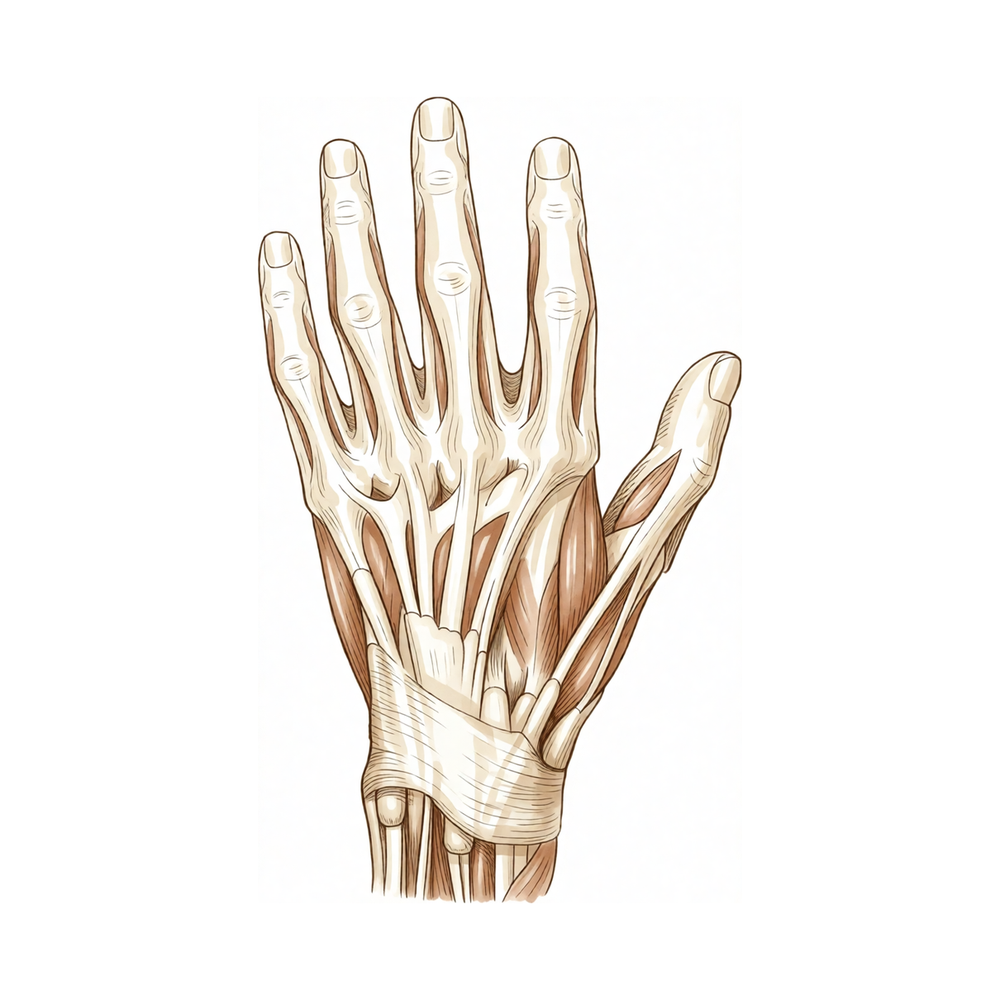
Los tendones extensores son las estructuras situadas en el dorso de la mano y los dedos que permiten su extensión. Pueden cortarse por una laceración, desgarrarse por una lesión por compresión o deportiva, o romperse tras una fractura. Muchas de estas lesiones, como el dedo en martillo, se tratan sin cirugía mediante el uso de férulas. Otras requieren reparación, especialmente los cortes abiertos, los desgarros de larga duración o las lesiones en las que el tendón ha sufrido daños graves. Consideramos la cirugía cuando el uso de férulas no ha producido mejoría suficiente, o de inmediato cuando la lesión es aguda y el tendón no sanará por sí solo. El objetivo es restaurar la longitud y la fuerza del tendón para que su dedo o pulgar puedan extenderse nuevamente, permitiéndole contar con una mano funcional y sin dolor.
Antes de la operación
Una vez que haya programado su operación, le daremos instrucciones claras que deberá seguir en los días previos. Deberá dejar de comer y beber siete horas antes de la cirugía. Pedimos que sea siete horas para poder adelantar su turno si la lista de cirugías avanza antes de lo previsto. Su cirujano le indicará qué medicamentos habituales debe suspender y cuáles debe seguir tomando; por eso, lleve una lista por escrito de todos los fármacos que consume, incluidos los anticoagulantes. Organice que alguien lo lleve a casa después de la operación, ya que no podrá conducir usted mismo. Use ropa holgada y cómoda, cuyas mangas se puedan quitar fácilmente. En la mayoría de los casos no se requiere ninguna otra preparación. Si padece otras enfermedades, es posible que necesite análisis de sangre o una consulta con el anestesista, el médico encargado de administrar la anestesia.
El día de la intervención
Acudirá a la unidad de admisiones quirúrgicas del hospital, donde se le registrará y preparará para la cirugía. Allí conocerá al anestesista. Esta operación se realiza bajo anestesia general. En ocasiones se añade un bloqueo nervioso regional para aliviar el dolor postoperatorio; el anestesista hablará con usted al respecto ese mismo día. A continuación, será llevado al quirófano, donde se realiza la intervención. Después, despertará en la sala de recuperación, donde las enfermeras le vigilarán mientras la anestesia va desapareciendo. Una vez que su estado sea estable, será trasladado a la planta de hospitalización o podrá volver a casa, según el tipo de procedimiento y su recuperación.
¿En qué consiste la operación?
Los pasos exactos dependen de dónde se encuentra el desgarro del tendón y de su gravedad. Los tendones extensores discurren justo debajo de la piel en el dorso de la mano y los dedos; por ello, el cirujano suele poder acceder a la lesión mediante una incisión en el dorso del dedo o de la mano afectados. Si la propia piel resultó dañada, primero se elimina el tejido lesionado y luego se cubre la zona con piel sana.
Una vez localizados los extremos del tendón, el cirujano los sutura. La reparación se realiza de forma lo suficientemente resistente para soportar los primeros movimientos que la mano realizará después de la intervención. Si falta una porción de tendón o está demasiado dañada para suturarse, se puede salvar la distancia entre los extremos mediante otros métodos: utilizando un fragmento de tendón extraído de un dedo que no se puede salvar, mediante un injerto o trasladando un tendón cercano para que asuma la función del tendón roto. El objetivo del cirujano es restaurar la longitud natural del tendón, pues si queda demasiado flojo o demasiado tenso, el dedo no se enderezará correctamente.
Finalmente, la incisión se cierra con puntos de sutura y se cubre con un vendaje. Se le entregarán instrucciones por escrito sobre cómo cuidar su mano antes de que se vaya a casa.
Lo que ocurra después es tan importante como la propia reparación. Algunas reparaciones requieren el uso de una férula que mantenga el dedo inmóvil, mientras que otras permiten iniciar movimientos controlados y protegidos desde las primeras semanas. Uno de los protocolos permite realizar 30 grados de movimiento activo durante las primeras dos semanas, aumentándolo a 40 grados en la tercera semana y a 50 grados en la cuarta. El cirujano adaptará el plan de rehabilitación a su lesión y le indicará con exactitud qué puede y qué no puede hacer.
Después de la operación
Despertará en la sala de recuperación, donde las enfermeras lo vigilarán mientras el efecto de la anestesia desaparece. Su mano estará vendada y, según la lesión, podría encontrarse en una férula. Se administran analgésicos antes de que abandone el quirófano; si siente dolor, puede informárselo a las enfermeras en cualquier momento. Alguien debe acompañarlo durante las primeras 24 horas. La mayoría de las personas vuelven a moverse con normalidad poco después de despertar; la operación se realizó en la mano, no en las piernas. Su equipo médico le indicará si podrá irse a casa el mismo día o si deberá permanecer una noche en el hospital. Dejamos el vendaje puesto durante unos 10 días; por favor, no lo retire antes de ese plazo a menos que se lo indiquemos. Lo cambiaremos o lo retiraremos cuando vengamos a verlo.
Recuperación
Durante los primeros días y semanas, su mano estará adolorida e hinchada. Esto es normal. Mantener la mano elevada sobre almohadas, incluso mientras duerme, ayuda a reducir la hinchazón. El alivio del dolor mediante los medicamentos indicados por su equipo médico suele disminuir la molestia.
El vendaje se mantiene durante unos 10 días. Según la lesión, es posible que deba usar una férula que mantenga el dedo inmóvil, o que se le indique comenzar con movimientos controlados desde el inicio. Si los movimientos tempranos forman parte de su plan de tratamiento, se le mostrará exactamente cuánto puede doblar y estirar el dedo, así como la frecuencia con que debe hacerlo. Al principio, los movimientos son pequeños y aumentan a medida que la reparación se fortalece. La rehabilitación corre a cargo de Ruby Doolan, terapeuta de mano en Extend Rehabilitation; ella le guiará en los ejercicios y le confeccionará cualquier férula que necesite.
En casa, podrá realizar la mayoría de las actividades cotidianas que no supongan esfuerzo para la mano. Deberá evitar levantar objetos, hacer agarres fuertes y cualquier actividad que pueda afectar la zona operada hasta que su terapeuta se lo autorice. Mantenga la mano limpia y seca hasta que revisemos la herida. A medida que la hinchazón disminuya y recupere el movimiento, los ejercicios resultarán más fáciles y el dedo empezará a enderezarse con mayor fluidez.
La recuperación varía de una persona a otra. Su cronograma personal puede ser distinto; su cirujano y terapeuta de mano le guiarán en cada revisión.
Qué puede salir mal
La mayoría de los pacientes evolucionan bien, pero en ocasiones pueden surgir problemas. Su cirujano y el equipo lo vigilarán de cerca para detectar cualquier anomalía a tiempo.
El problema más frecuente tras esta cirugía es la rigidez. Es posible que el dedo no se estire por completo ni se doble hasta formar un puño, y que la fuerza de agarre permanezca más débil que antes. Esto ocurre cuando el tendón forma cicatrices con el tejido circundante mientras la mano permanece inmóvil. Su terapeuta observará este aspecto en cada visita y ajustará los ejercicios según sea necesario. Si el movimiento se estanca o el dedo se siente cada vez más rígido, hágaselo saber en la siguiente revisión en lugar de esperar.
En algunos casos, aunque todo lo demás evolucione bien, se pierde un poco de capacidad para estirar el dedo. Puede notar que el dedo queda ligeramente más bajo que los demás al intentar estirarlo, o que no se dobla del todo hacia la palma. Esto se conoce como retraso en la extensión. Es útil saber que esto puede ocurrir, especialmente si la lesión era preexistente antes del tratamiento. Mencione este hecho en la revisión para que su terapeuta pueda trabajar en ello.
La propia reparación del tendón puede fallar. Si siente un “chasquido” repentino o si el dedo que antes se estiraba bien vuelve a doblarse, comuníquese con la clínica de inmediato. No espere a la próxima cita.
Las infecciones son poco frecuentes, pero requieren atención rápida. Esté atento a un dolor que empeore en lugar de mejorar, a enrojecimiento que se extienda desde la herida, a una hinchazón que aumente en vez de disminuir, o a cualquier secreción procedente de los puntos de sutura. La fiebre acompañada de dolor en la mano también es un signo de alerta. Si observa alguno de estos síntomas, llame a la clínica ese mismo día o acuda a urgencias si es fuera del horario laboral.
Si posteriormente fuera necesaria una cirugía para liberar un tendón cicatrizado, se denomina tenólisis. No forma parte del plan inicial, pero es una opción si la rigidez no responde a la terapia. Su cirujano solo lo comentará con usted si el rango de movimiento se estanca.
En la tabla de complicaciones de esta página se detallan las tasas típicas, por si desea conocer los datos exactos.
¿Cuándo deben llamarnos?
Es más fácil solucionar los problemas cuando se detectan a tiempo. Llámenos si el dolor empeora en lugar de mejorar, o si la piel alrededor de la herida se vuelve más roja, más caliente o comienza a exudar líquido. Llámenos si tienen fiebre, si los dedos o la mano se entumecen, o si no pueden mover un dedo en absoluto. Si observan hinchazón y dolor repentinos en la pantorrilla, o si les cuesta respirar, acudan a urgencias. Si el dedo que antes se enderezaba sin problemas de repente se dobla hacia abajo, o si sienten un “chasquido”, llámenos de inmediato.
Evidence & references
This is the clinical evidence summary written for health professionals. It is technical, and it lists the research this page was built from. You do not need to read it to understand your treatment or to make a decision about it.
Anatomy & Pathophysiology
General Hand Architecture
- The hand is composed of 19 bones, 17 articulations, and 19 muscles situated entirely within the hand [2].
- Approximately the same number of tendons activated by forearm muscles are present in the hand [2].
- The hand functions efficiently only if the proximal joints of the limb are stable and yet mobile [2].
- The dorsal aspect of the hand is convex, while the anterior, palmar, or volar aspect is concave [2].
- The palmar surface is the functional surface of the hand, while the dorsal surface is usually visible and aesthetically important [2].
- The thumb has a more proximal and lateral position than the four fingers, allowing movement inward and outward from the palm [2].
- When fingers are extended and separated, their tips lie on the circumference of a circle whose center is the head of the third metacarpal [2].
Metacarpal and Longitudinal Arch Anatomy
- The metacarpal arch possesses adaptability due to the mobility of the peripheral metacarpals [7].
- The index metacarpal is the most firmly fixed of the metacarpals [7].
- The ring metacarpal has approximately 10 degrees of mobility in flexion and extension [7].
- The fifth metacarpal has a range of flexion–extension of approximately 20 degrees [7].
- The second to fifth metacarpals are bound together by the deep transverse intermetacarpal ligament, also known as the interglenoid ligament [7].
- The interglenoid ligament ties together the anterior glenoid ligaments of the metacarpophalangeal articulations, known as volar plates [7].
- The metacarpophalangeal joints serve as the keystones of the longitudinal arches of the hand [7].
- The volar plates prevent hyperextension at the metacarpophalangeal joints [7].
- The sagittal bands of the extensor apparatus insert onto the volar plate [7].
- The first annular segment of the pulley of the flexor tendons inserts onto the volar plate [7].
Extensor Tendon and Intrinsic Muscle Anatomy
- There are seven interosseous muscles in the hand, consisting of four dorsal and three volar muscles [4].
- The dorsal interossei are abductors, while the volar interossei are adductors [4].
- The middle finger has two dorsal interossei and no volar interossei because the central axis of the hand lies within it [4].
- Each dorsal interosseous muscle, with the exception of the third, has two muscle heads: a superficial head and a deep head [4].
- The superficial head of the dorsal interosseous muscles abducts and weakly flexes the proximal phalanx [4].
- The deep head of the dorsal interosseous muscles forms the lateral band at the level of the metacarpophalangeal joint [4].
- The deep head of the dorsal interosseous muscles flexes and weakly abducts the proximal phalanx while extending the middle and distal phalanges [4].
- Transverse fibers arch dorsally from each lateral band to join over the dorsum of the finger, flexing the proximal phalanx [4].
- Oblique or spiral fibers from the lateral bands insert onto the lateral tubercles at the base of the middle phalanx to extend the middle phalanx [4].
- The lateral bands are joined by the lateral slips of the extensor tendon to form the conjoined lateral band [4].
- The two conjoined lateral bands unite at the distal third of the middle phalanx to form the terminal tendon [4].
- The terminal tendon inserts at the base of the distal phalanx to extend it [4].
- The volar interossei have only one muscle head and do not insert onto the proximal phalanx [4].
- The flexor digiti quinti brevis forms the ulnar lateral band of the little finger [4].
Cutaneous and Vascular Anatomy
- The dorsal cutaneous unit extends from the wrist to the proximal interphalangeal joints of the fingers and the interphalangeal joint of the thumb [3].
- The dorsal covering of the interphalangeal articulations forms a unique cutaneous unit characterized by considerable excess of skin when digits are in extension [3].
- The palmar integument is subdivided into two zones by the oppositional crease of the thumb [3].
- The skin of the radial portion of the palm covers the thenar eminence and is relatively well vascularized and mobile [3].
- The skin of the ulnar and distal portion of the palm covers the hypothenar eminence and has poor mobility [3].
- The central triangular part of the palm has fixed, poorly vascularized skin that covers the superficial palmar aponeurosis [3].
- Incisions made along the sides of the diamond-shaped cutaneous contact zones in flexed digits present a minimal chance of retraction [3].
- The princeps pollicis artery is the terminal branch of the radial artery that crosses the first intermetacarpal space [8].
- The princeps pollicis artery runs along the ulnar side of the first metacarpal bone and along the volar surface of the adductor muscle [8].
- The princeps pollicis artery divides into two terminal rami, the collateral palmar arteries of the thumb, at the level of the metacarpophalangeal joint flexion crease [8].
- Only 15% of anatomical dissections of the palmar arteries of the thumb fall into the classical "typical" category [8].
- In the second segment of the thumb, the ulnar collateral artery is often easier to dissect than the radial collateral artery [8].
- A subtendinous anastomosis at the level of the neck of the first phalanx acts as a moderator between the two collateral arteries [8].
- The dorsal arteries of the thumb originate from palmar arteries at the level of the first metacarpal and head distally on the side of the two distal phalanges [8].
Investigations
- Clinical evaluation of the injured or dysfunctional hand and wrist requires combining patient history with a careful physical examination to pinpoint or narrow the scope of possible pathologic processes [1].
- Diagnostic tests such as imaging and serum laboratory studies are useful in determining pathology but can be expensive, time consuming, and often nonspecific [1].
- A careful physical examination is essential to direct care and future testing if indicated [1].
- A systematic method to approaching the physical examination of the hand and wrist is essential due to the number of structures in a small space [1].
- An 8-MHz Doppler tone assessment may be used to identify superficially displaced neurovascular bundles when Dupuytren cords lie beneath soft fleshy prominences [11].
- False-negatives are possible with 8-MHz Doppler tone assessment for identifying neurovascular bundles [11].
- Doppler imaging is a promising improvement for identifying structures, but higher resolution imaging technology is needed [11].
- MR assessment of Dupuytren’s disease is hindered by the resolution of current equipment, orientation issues due to multiplanar deformities of the fingers, and lack of intraoperative availability [11].
- MRI is probably most useful in identifying additional pathology such as flexor tendon bowstringing [11].
- MRI may be helpful in providing a quantitative noninvasive measure of cellularity of affected areas, which is an index of biologic activity [11].
- The potential staging tool of MRI for measuring cellularity has not been investigated yet on a large scale [11].
References
[1] Orthopaedic Knowledge Update 13 Ebook Without Multimedia. Anatomy, Evaluation, Clinical Examination, and Imaging > Evaluation and Clinical Examination: Current Concepts.
[2] Exam Of The Hand Wrist 2Ed. INTRODUCTION.
[3] Exam Of The Hand Wrist 2Ed. Functional cutaneous units.
[4] Green S Operative Hand Surgery. Interosseous and Hypothenar Muscles.
[7] Exam Of The Hand Wrist 2Ed. The arches of the hand > The metacarpal arch.
[8] Exam Of The Hand Wrist 2Ed. Techniques of investigation of the arterial supply by J P Melki > Vascularization of the thumb > Palmar aspect.
[11] Dupuytren S Disease And Related Hyperproliferative Disorders. 54. The Future of Dupuytren’s Research and Treatment > 54.4 Mechanical Measurements and Procedures > 54.4.4 Imaging.