Patients › Rehabilitation
Reemplazo de la articulación MCP
Un plan de recuperación guiado por terapia de la mano tras el reemplazo de las articulaciones de los nudillos (metacarpofalángicas) mediante prótesis de silicona (Swanson); dicho plan se basa en una férula de extensión dinámica que mantiene los nudillos rectos y ligeramente en posición radial mientras se realizan movimientos tempranos de flexión. Esto permite remodelar las articulaciones en una posición correcta y corregir la desviación cubital.
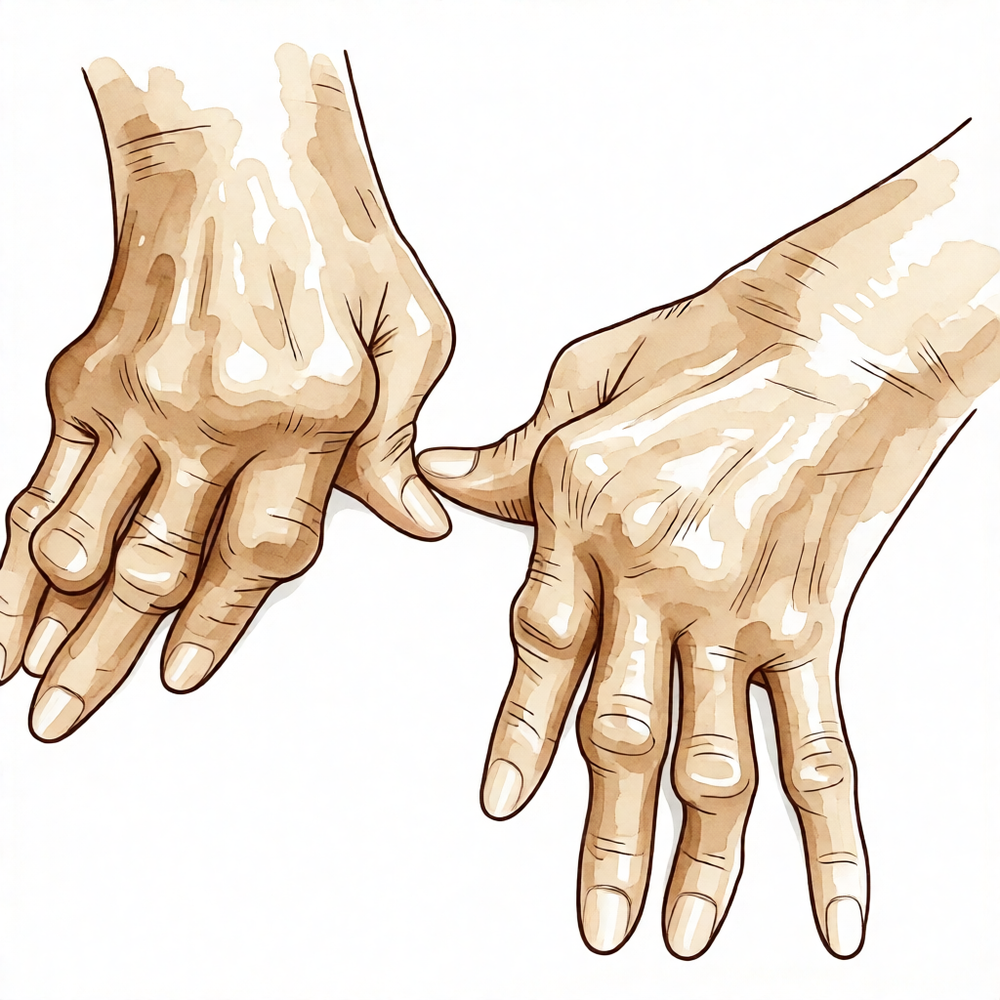
Este protocolo le servirá de guía para su recuperación tras el reemplazo de las articulaciones de los nudillos (las articulaciones metacarpofalángicas o “MCP”) mediante implantes de silicona (Swanson), realizado por el Dr. Kieran Hirpara en el Mater Private Hospital Rockhampton. Comienza con un programa de ejercicios para realizar en casa; posteriormente, siga el protocolo clínico estructurado redactado para su terapeuta de mano: lleve esta página o su versión en PDF a su primera sesión de terapia para garantizar que la rehabilitación se lleve a cabo de manera coordinada. Su terapeuta podrá modificar el plan según el progreso de su recuperación.
Se trata de una recuperación que requiere intensa terapia de mano y el uso de férulas. La férula dinámica y los ejercicios diarios no son opciones adicionales: son precisamente lo que permite que las nuevas articulaciones adopten una posición recta y correcta. El resultado final depende en gran medida de que cumpla fielmente con el uso de la férula y los ejercicios prescritos.
Si tiene alguna duda o inquietud respecto a la herida quirúrgica, no dude en contactar con el consultorio. A menudo resulta útil tomar una fotografía de la herida y enviarla por correo electrónico para su evaluación.
Qué esperar
Las articulaciones de los nudillos pueden desgastarse, volverse dolorosas y deformarse gravemente, sobre todo en casos de artritis reumatoide, en los que los dedos tienden a desviarse hacia el lado del meñique (desviación cubital) y la base de los dedos se desplaza hacia la palma de la mano (subluxación volar); también pueden desgastarse por artrosis. En esta intervención se extirpa la articulación dañada y se sustituye por un espaciador de silicona flexible (el clásico implante de Swanson). Los objetivos son aliviar el dolor, corregir la desviación y la flacidez de los nudillos (retraso en la extensión), así como recuperar un rango funcional de flexión.
El implante no es una bisagra rígida; actúa como un espaciador flexible mientras, durante las primeras semanas, se forma a su alrededor una nueva membrana o “cápsula”. El propósito fundamental de la rehabilitación es lograr que dicha cápsula se forme con los dedos en posición recta y corregida, no desviada. Por eso la férula y los movimientos tempranos son tan importantes.
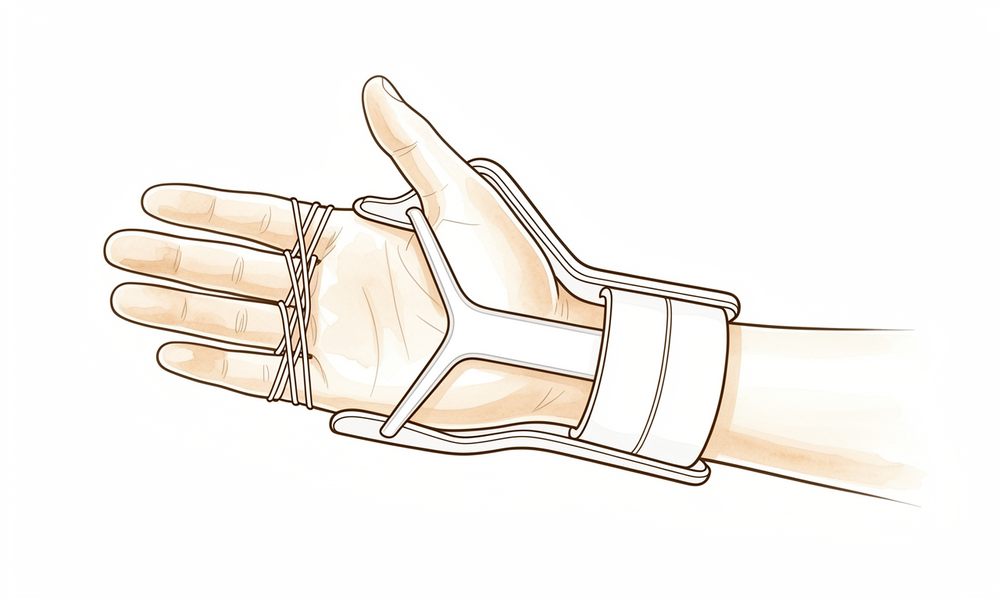
La recuperación se basa, por tanto, en el uso de una férula dinámica de extensión, que suele colocarse en los primeros días:
- En reposo, la férula mantiene los nudillos rectos y los tira suavemente hacia el lado del pulgar (desviación radial), contrarrestando así la antigua desviación cubital.
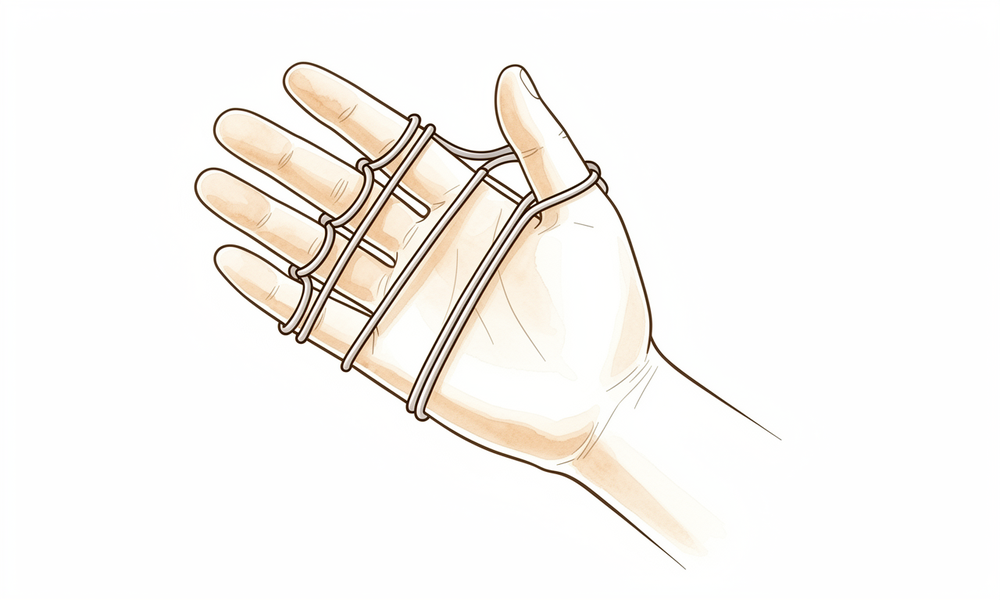
- Dentro de la férula se realizan movimientos activos controlados de flexión de los nudillos contra lares elásticos blandos, que devuelven los dedos a la posición recta. Ejecutar estos movimientos tempranamente (pero únicamente en esta posición protegida y corregida) favorece la formación adecuada de la nueva cápsula y evita la rigidez articular.
Se lleva la férula dinámica casi de forma continua durante unas seis semanas; después se sustituye por una férula de reposo o nocturna, añadiendo progresivamente ejercicios de fortalecimiento. La función manual ligera se recupera en las primeras semanas; la mayoría de los pacientes vuelven a realizar la mayor parte de sus actividades cotidianas al cabo de unos tres meses, mientras que el resultado final sigue mejorando durante varios meses más.
Precauciones y limitaciones
- Use su férula dinámica de extensión según las indicaciones: día y noche durante las primeras seis semanas aproximadamente. Esta férula mantiene la corrección; quitársela con demasiada frecuencia permite que los dedos vuelvan a desviarse.
- NO permita que sus dedos vuelvan a desviarse hacia el lado del meñique. Cada ejercicio los guía en la dirección opuesta, hacia el pulgar.
- NO realice agarres fuertes, pinzamientos ni levantamiento de pesos al principio: un agarre intenso empuja los dedos hacia la desviación cubital y somete a las nuevas articulaciones a un estrés excesivo antes de que estén estables. El fortalecimiento solo se permitirá cuando su terapeuta de mano lo autorice.
- Desde el inicio, mantenga en movimiento el pulgar, la muñeca y las puntas de los dedos; además, utilice la mano para tareas cotidianas ligeras siempre que se sienta cómodo.
- Vigile la herida en busca de signos de infección (enrojecimiento creciente, calor, hinchazón o secreción) y comuníquese con el consultorio si tiene alguna duda; las infecciones alrededor de un implante son poco frecuentes, pero es crucial detectarlas a tiempo.
Para el cuidado de la herida, la hinchazón y las cicatrices, consulte las pautas de cuidado de heridas del consultorio.
Sus ejercicios
Kieran Hirpara 4.0
Uso de su férula dinámica
Su férula de extensión dinámica se encarga de proteger su mano: en reposo, mantiene los nudillos rectos y los desplaza suavemente hacia el lado del pulgar (lado radial), corrigiendo así la desviación previa. Úsela tal como se indica: día y noche durante las primeras seis semanas aproximadamente; quítesela únicamente para lavarse y para realizar los ejercicios que su terapeuta le permita hacer fuera de la férula. Las lazadas en los dedos deben quedar cómodas; avise a su terapeuta si algo le roza o le molesta.
Se usa de forma continua durante unas 6 semanas; posteriormente, solo por las noches o en reposo, según las indicaciones.
Kieran Hirpara 4.0
Flexión controlada de los nudillos mediante la férula
Mientras lleva puesta la férula, doble suavemente los dedos hacia abajo por las articulaciones, tirando de los bucles elásticos; luego relájese y permita que la férula los devuelva a su posición recta. Este movimiento controlado y temprano es lo que permite que la cápsula de cicatrización se forme alrededor de las nuevas articulaciones en una posición adecuada. Realice los movimientos con suavidad y evite sentir dolor; su objetivo es guiar la articulación, no forzarla.
Realice 10 flexiones por hora mientras esté despierto, dentro de la férula, tal como se indica.
Kieran Hirpara 4.0
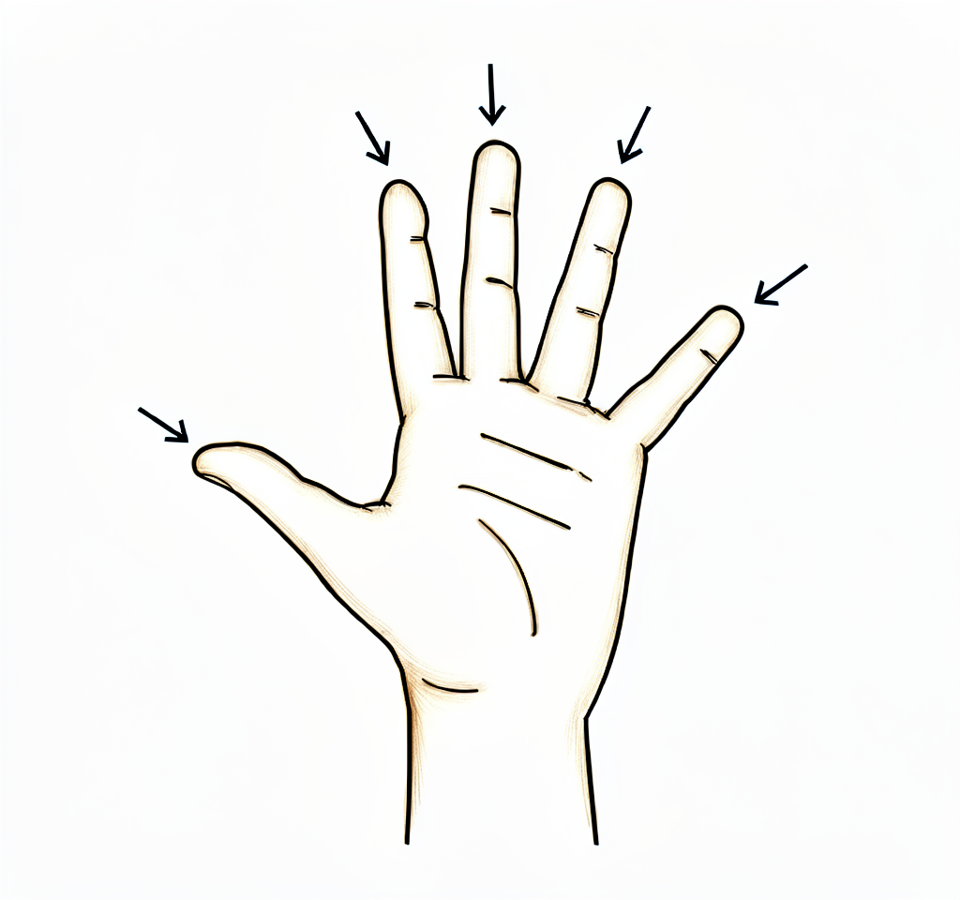
Enderezamiento activo (elevación de los nudillos)
Esfuércese por enderezar completamente sus nudillos por sí mismo: levante los dedos hasta que queden en línea horizontal. Después de la cirugía, los nudillos suelen tender a caer (lo que se conoce como retraso en la extensión); por eso, levantarlos activamente permite que los tendones de extensión se deslicen correctamente y ayuda a mantener la corrección lograda. Su terapeuta comenzará este ejercicio mientras usted lleve la férula, y posteriormente lo hará sin ella.
10 elevaciones, varias veces al día, según las indicaciones.
Kieran Hirpara 4.0
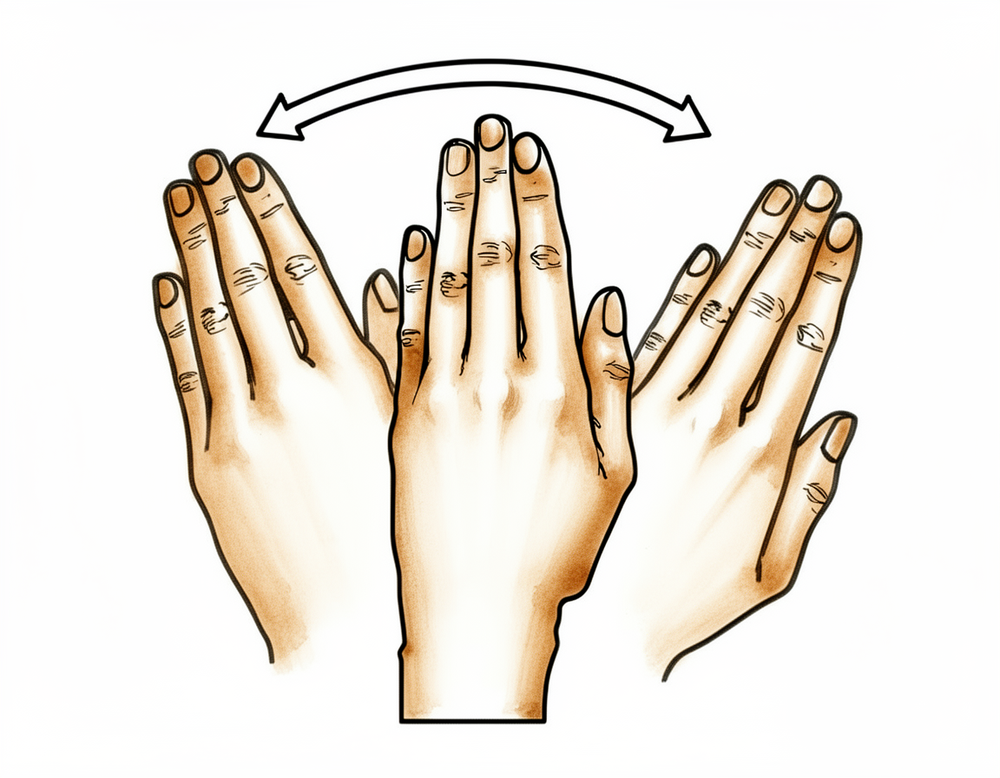
Desplazamiento del dedo hacia el pulgar (lado radial)
Guíe suavemente los dedos hacia el pulgar (en dirección radial), en sentido opuesto al desplazamiento anterior. Puede ayudarse con la otra mano o deslizar las yemas de los dedos sobre una mesa hacia el pulgar. Esto reentrena a los dedos para que se alineen en línea recta y constituye la corrección fundamental sobre la cual se basa todo este protocolo. Jamás permita que vuelvan a desplazarse en la dirección opuesta.
10 veces, varias veces al día, según las indicaciones.
Kieran Hirpara 4.0
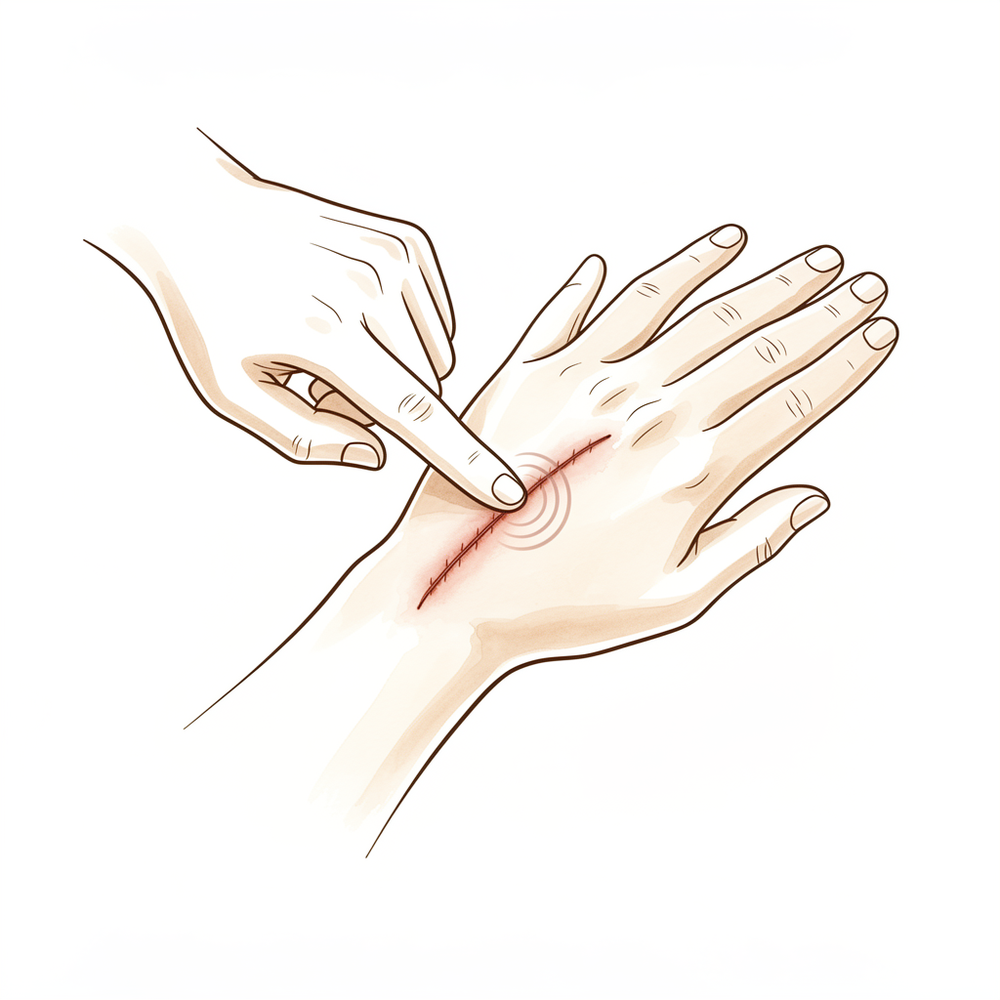
Cuidado de las cicatrices
Una vez que sus heridas hayan cicatrizado por completo y su terapeuta indique que es seguro, masajee las cicatrices en el dorso de la mano con un poco de crema neutra, realizando pequeños círculos firmes durante unos minutos. Esto mantiene las cicatrices suaves y evita que la piel se adhiera a los tendones, permitiendo así que los nudillos se muevan con mayor libertad.
Unos minutos, 2-3 veces al día, una vez curado.
Kieran Hirpara 4.0
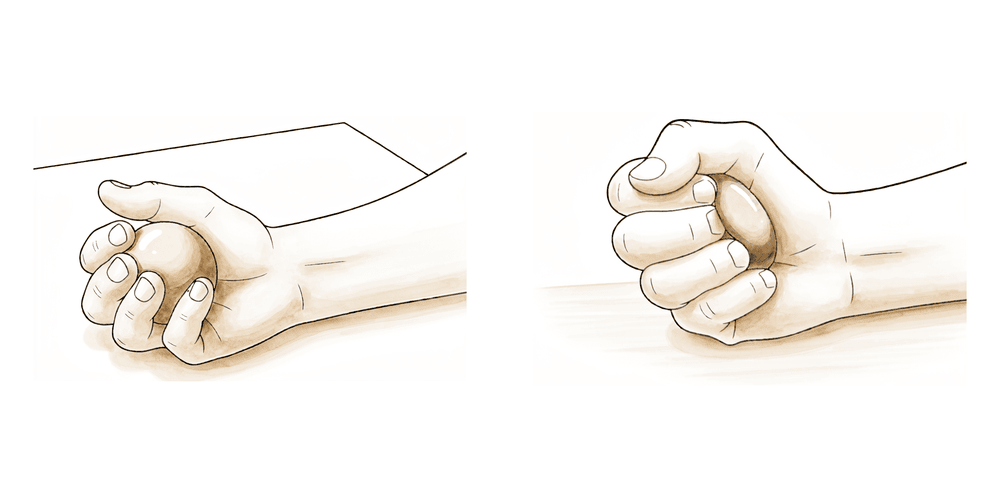
Fortalecimiento de la prensión (más adelante)
Un ejercicio posterior: solo cuando su terapeuta de mano autorice el fortalecimiento, normalmente a partir de las doce semanas aproximadamente. Apriete suavemente una pelota blanda o plastilina terapéutica y luego suéltela. Aumente la intensidad poco a poco. Se retrasa al principio porque apretar con fuerza empuja los dedos hacia la desviación cubital y somete a tensión las nuevas articulaciones antes de que la cápsula sea resistente; por eso siempre es lo último que se inicia.
Según las indicaciones de su terapeuta de mano (solo a partir de las ~12 semanas).
Estos son los ejercicios que aparecen en su folleto. Comience a realizarlos únicamente bajo la guía del Dr. Hirpara y de su terapeuta de mano, respetando siempre el rango de movimiento y las limitaciones que se le hayan indicado. Al principio, todos los ejercicios se realizan con el splint dinámico: flexión controlada contra los bucles, extensión activa y desplazamiento suave de los dedos hacia el pulgar para mantener la corrección. El cuidado de la cicatriz se inicia una vez que las heridas hayan sanado; el fortalecimiento de la prensión corresponde a una fase posterior y no debe comenzarse hasta que se le dé autorización específica. Interrumpa cualquier ejercicio que provoque dolor intenso en los nudillos.
Su protocolo clínico
El resto de esta página describe el protocolo clínico por fases para la rehabilitación tras una artroplastia de la articulación metacarpofalángica con implante de silicona (Swanson). Esta sección debe entregarse a su terapeuta de mano; cada fase comienza con una explicación sencilla en lenguaje coloquial sobre lo que ocurre. El principio fundamental es que la nueva cápsula articular se remodela alrededor del implante en la posición en que se mantengan las articulaciones; por ello, la férula y los ejercicios deben mantener las articulaciones en extensión con ligera desviación radial, permitiendo al mismo tiempo una flexión activa controlada desde las primeras etapas, de modo que las articulaciones se reconfiguren en una posición correcta y se invierta la desviación cubital.
Antes de iniciar el tratamiento, revise el informe quirúrgico del paciente y su historial médico previo; además, consulte con el cirujano responsable sobre el diagnóstico (artritis reumatoide frente a artrosis), la reconstrucción de tejidos blandos realizada (refuerzo del ligamento colateral radial, liberación de músculos intrínsecos cubitales, centralización del tendón extensor/transferencia cruzada de músculos intrínsecos) y la corrección y amplitud de movimiento logradas durante la intervención. La mano afectada por artritis reumatoide tiende a desviarse y a presentar recaídas con mayor facilidad que la mano con artrosis; por ello requiere un uso especialmente riguroso de férulas que favorezcan la desviación radial. El protocolo que sigue supone la aplicación del régimen estándar de extensión dinámica con soporte externo.
Fase I — férula dinámica de extensión con movimiento controlado temprano (semanas 0 a ~6)
Las primeras seis semanas constituyen el período decisivo: en este momento se forma la cápsula alrededor del implante, y la férula dinámica determina la posición en la que se forma dicha cápsula. Se debe colocar una férula dinámica de extensión para las articulaciones MCP basada en el antebrazo, generalmente dentro de los primeros 3-5 días. En reposo, esta férula mantiene las articulaciones MCP en extensión completa, con las falanges proximales ligeramente desviadas hacia radial (corrigiendo así la antigua desviación ulnar); las correas de la férula se sitúan sobre las falanges proximales, y la tensión elástica permite una flexión activa controlada para luego volver a llevar los dedos a la posición de extensión. El paciente debe realizar flexión activa controlada de las articulaciones MCP dentro de la férula cada hora durante el tiempo en que esté despierto. La muñeca y las articulaciones IP quedan libres de restricciones.
Para su terapeuta de mano:
Instrucciones y precauciones - Colocar y ajustar la férula dinámica de extensión: mantener las articulaciones MCP en extensión con ligera desviación radial; fijar las correas sobre las falanges proximales para ejercer tracción radial que contrarreste la desviación ulnar. - Usar la férula de forma continua (día y noche) durante ~6 semanas, quitándola únicamente para higiene y ejercicios supervisados. - Prohibido realizar agarres fuertes, pinzas o cargas laterales (en dirección ulnar): estos movimientos reproducen las fuerzas deformantes. - Proteger cualquier reconstrucción de tejidos blandos (ligamento colateral radial o equilibrio de músculos intrínsecos): evitar en todo momento cualquier estrés que provoque desviación ulnar forzada. - Mantener la movilidad del pulgar, la muñeca y las articulaciones IP; permitir únicamente uso ligero y sin carga de la mano.
Manejo clínico - Herida: aplicar vendajes quirúrgicos según indicaciones; vigilar posibles signos de infección (dado que hay implante presente). - Edema: elevar la extremidad, realizar masajes retrógrados suaves y aplicar compresión ligera según tolerancia. - Ejercicios: flexión activa controlada de las articulaciones MCP dentro de la férula, ejerciendo fuerza contra las correas, con el objetivo de desarrollar un arco de flexión útil (debe ajustarse al arco intraoperatorio indicado por el cirujano; habitualmente hasta ~70 grados en las articulaciones MCP del dedo índice al meñique); también practicar extensión activa de las articulaciones MCP (para corregir el retraso en la extensión) y reeducación de la desviación radial (guiar los dedos hacia el pulgar); mantener la amplitud de movimiento libre en las articulaciones IP y la muñeca.
Criterios para avanzar a la siguiente fase - La herida debe estar cicatrizada; el edema debe haber disminuido; alrededor de la sexta semana debe observarse un arco de flexión activa estable, manteniendo la extensión completa y una alineación correcta (hacia radial).
Fase II: retirada progresiva del splint y consolidación de la corrección (semanas ~6 a ~12)
A partir de las seis semanas aproximadamente, la cápsula articular madura y el splint dinámico se reemplaza por un splint de extensión para uso nocturno o de reposo (a menudo se mantiene hasta las ~12 semanas; en manos con artritis reumatoide, propensas a recaídas, se usa por la noche durante más tiempo). Se incrementa el movimiento activo fuera del splint, siempre priorizando la extensión y la alineación radial. Se permite un uso funcional ligero; sin embargo, se sigue evitando el agarre fuerte y la pinza.
Para su terapeuta de mano:
Evaluaciones - Rango de flexión/extensión activa y pasiva de las articulaciones metacarpofalángicas; retraso en la extensión; desviación cubital (comparar con la corrección obtenida durante la cirugía); dolor e inflamación; evaluación de la herida y la cicatriz.
Instrucciones y precauciones - Retirar progresivamente el splint dinámico; continuar usando un splint de extensión para uso nocturno o de reposo hasta las ~12 semanas (en pacientes con artritis reumatoide, incluso más tiempo por la noche). - Seguir evitando el agarre fuerte, la pinza y cualquier carga que provoque desviación cubital. - Mantener estrictamente la corrección radial; la recaída hacia la desviación cubital es la principal causa de fracaso a largo plazo.
Manejo - Ejercicios: aumentar progresivamente la flexión/extensión activa y asistida de las articulaciones metacarpofalángicas fuera del splint; continuar con ejercicios para corregir el retraso en la extensión y la reeducación de la desviación radial; iniciar el manejo de la cicatriz una vez curada. Se permiten tareas funcionales ligeras, siempre evitando patrones que induzcan desviación cubital.
Criterios para avanzar - Corrección estable (mínima desviación cubital recurrente, retraso en la extensión aceptable) en una cápsula articular en proceso de maduración; rango funcional cómodo; disminución del dolor.
Fase III — Fortalecimiento y recuperación (semanas ~12 en adelante)
Una vez que la cápsula se ha fortalecido y la alineación se mantiene (alrededor de las doce semanas), se introduce de forma gradual y con precaución el fortalecimiento, ya que el agarre puede provocar desviación cubital. La fuerza muscular y el resultado funcional final siguen mejorando durante varios meses más.
Para su terapeuta de mano:
Evaluaciones - Comparación del agarre y la pinza con el lado contralateral y con los valores preoperatorios; mantenimiento del arco de movimiento, de la extensión y de la alineación bajo carga; pruebas funcionales y específicas para cada tarea
Educación y precauciones - Iniciar el fortalecimiento gradual del agarre a partir de la semana 12 aproximadamente, aumentando la carga poco a poco. - Enseñar patrones de agarre que no provoquen desviación cubital; continuar con el uso de férulas nocturnas según sea necesario, especialmente en pacientes con artritis reumatoide. - Establecer expectativas realistas: el objetivo es el alivio del dolor, una posición correcta y un arco de movimiento funcional, no una mano completamente normal o de gran fuerza.
Manejo - Ejercicios: fortalecimiento progresivo mediante agarre con plastilina o pelotas y ejercicios de pinza, control isométrico de las articulaciones metacarpofalángicas, fortalecimiento funcional; continuar con ejercicios de movilidad y corrección de cualquier retraso en la extensión o desalineación residual. - Considerar el alta cuando la corrección sea estable, se haya logrado un arco de movimiento útil y el paciente pueda realizar sus actividades diarias; proporcionar una férula nocturna a largo plazo y un plan de protección articular. - Derivar nuevamente al médico tratante si se produce deterioro de la alineación, pérdida del arco de movimiento o se sospechan problemas con el implante.
Criterios para el alta - Alineación correcta y estable, arco de movimiento funcional sin dolor, fuerza de agarre adecuada, rutina sólida de protección articular y uso de férula nocturna.
Retorno al trabajo y a las actividades cotidianas
Se recomienda comenzar desde el principio con un uso ligero de la mano en actividades diarias (comer, escribir, cuidados personales básicos), siempre dentro de los límites de la comodidad, evitando el agarre fuerte, el pellizco y cualquier tipo de tensión lateral (ulnar) sobre los dedos. Durante las primeras seis semanas, la férula dinámica deberá usarse casi todo el tiempo, lo que limitará las tareas que requieran el uso de ambas manos o que sean pesadas; por ello, es conveniente organizar ayuda externa. Se podrá volver a conducir una vez que pueda controlar el vehículo de forma segura y ya no lleve puesta la férula dinámica para conducir (generalmente alrededor de las seis semanas), según lo confirmado en su consulta de seguimiento.
El fortalecimiento muscular y el uso más intenso de la mano se retrasarán hasta aproximadamente las doce semanas, momento en el cual se irán incrementando gradualmente bajo la supervisión de su terapeuta de mano. La mayoría de las personas recuperan la mayoría de sus actividades cotidianas al cabo de unos tres meses; sin embargo, el resultado final (confort, alineación y amplitud de movimiento útil) seguirá mejorando durante varios meses más. La evolución del proceso de recuperación será evaluada por el Dr. Hirpara y su terapeuta de mano en función de cómo se vaya corrigiendo y funcionando su mano, no únicamente en base al tiempo transcurrido. El regreso a trabajos manuales más pesados o repetitivos seguirá los mismos criterios de progresión, acompañados de recomendaciones para proteger las articulaciones y mantener los resultados obtenidos a largo plazo.
Después de seguir este protocolo
Este protocolo complementa las recomendaciones generales de recuperación de la clínica: consulte control del dolor postoperatorio, cuidado de la herida y manejo de las cicatrices. El plan por fases descrito anteriormente refleja el régimen de rehabilitación de estilo Swanson, utilizado desde hace tiempo tras la artroplastia de la articulación metacarpofalángica con silicona; su recuperación continua será guiada individualmente por el Dr. Hirpara y su terapeuta de mano, según la evolución y corrección de su mano.
Evidence & references
This is the clinical evidence summary written for health professionals. It is technical, and it lists the research this page was built from. You do not need to read it to understand your treatment or to make a decision about it.
Silicone (Swanson) MCP Joint Arthroplasty — Procedure Outcomes & Post-operative Rehabilitation
Topic scope: post-operative rehabilitation after silicone (Swanson) replacement of the metacarpophalangeal (MCP) joints — flexible silicone-elastomer spacer arthroplasty of the knuckle joints, most often for the rheumatoid hand with ulnar drift and volar subluxation, and less commonly for MCP osteoarthritis. This is a resection-replacement with soft-tissue rebalancing, not a simple decompression: the deforming forces that destroyed the joint (ulnar drift, extensor subluxation, intrinsic tightness) are still present, so the rehabilitation is an active, splint-driven re-shaping programme, not a rest-and-protect pathway.
Defining principle of the rehab here: a silicone MCP implant is a flexible spacer around which a new fibrous capsule ("encapsulation") forms over the first weeks — and that capsule remodels in whatever position the hand is held. The classic post-operative regime therefore uses a dynamic extension outrigger splint that holds the MCPs in extension with slight radial deviation (opposing the ulnar drift) while permitting early controlled active flexion against elastic loops. Move early, but only in the corrected position: this is what reverses the drift and builds a functional flexion arc. The single biggest branch point is the diagnosis — the rheumatoid hand drifts and recurs far more readily than the osteoarthritic hand and warrants more diligent, more prolonged radial-deviation splinting.
A. PROCEDURE OUTCOMES (rheumatoid and osteoarthritis)
Silicone MCP arthroplasty is a deformity-correcting, pain-relieving operation rather than a motion- or strength-restoring one. Its great strength is reliable correction of alignment and relief of pain; its accepted limitations are a modest final arc, gradual implant fracture over years, and—in rheumatoid hands—a tendency to recurrent drift.
- In rheumatoid arthritis it produces durable improvement in deformity, appearance and patient-reported function. The multicentre prospective SARA (Silicone Arthroplasty in Rheumatoid Arthritis) cohort compared 70 surgical with 93 non-surgical RA patients with severe MCP deformity: the surgical group showed significant, sustained gains in the Michigan Hand Outcomes Questionnaire and in ulnar deviation, extensor lag and arc of motion, maintained at 1 year, at long-term (3-year) follow-up, and out to 7 years, whereas the non-surgical cohort did not improve [Chung 2009; Chung 2012; Chung 2017]. Moderate–strong (prospective comparative cohort; not randomised).
- Correction of ulnar drift and extensor lag is the headline result; arc and grip gains are modest. Series consistently report large reductions in ulnar deviation and extensor lag with a re-centred, more functional arc (commonly a final arc on the order of ~40–50° centred nearer extension), with grip strength only modestly changed. The operation buys alignment, pain relief and hand appearance/function, not power [Goldfarb & Dovan 2006; Rizzo 2011; Kirschenbaum 1993]. Moderate.
- For MCP osteoarthritis, long-term results are favourable and durable. A long-term series of silicone MCP arthroplasty for OA reported lasting pain relief and satisfactory function, with better-preserved bone stock and less recurrent deforming force than the rheumatoid hand [Morrell & Weiss 2018]. Moderate.
- Implant fracture accrues with time but is often clinically silent. Long-term radiographic follow-up shows implant fracture rates rising over the years, yet many fractured implants remain asymptomatic and revision is driven by symptoms/instability rather than radiographic fracture alone [Koenuma 2024; Kirschenbaum 1993]. Moderate.
- Revision is uncommon but defined, most often for recurrent deformity, implant fracture/instability or infection; revision MCP arthroplasty is feasible but technically demanding with poorer results than primary surgery [Wagner 2019; Carlson Strother 2023]. Moderate.
B. REHABILITATION / THERAPY EVIDENCE
The central rehab questions are (1) which splint regime, and (2) does adding continuous passive motion or particular splint variants change the outcome. The evidence base is dominated by a strong heritage regime (Swanson-style dynamic extension splinting) supported mostly by expert consensus and low-level studies, with the few controlled comparisons failing to show benefit from add-ons. The rehabilitation is nonetheless indispensable — it is integral to the operation, not an optional adjunct.
- The standard regime is a dynamic extension outrigger splint with early controlled motion. Fitted within the first few days, it holds the MCPs in extension and slight radial deviation at rest and permits active flexion against finger slings, worn essentially continuously for ~6 weeks then weaned to night/rest splinting. The shared aim across published regimes is to encourage MCP flexion and extension without recurrence of flexion contracture or ulnar deviation while the capsule encapsulates the implant in a corrected position [Goldfarb & Dovan 2006; Massy-Westropp Cochrane 2008]. Consensus / heritage — widely practised, low-level evidence.
- Adding continuous passive motion (CPM) to dynamic splinting does not help. The Cochrane review identified a single small controlled trial (22 participants) comparing dynamic splinting ± CPM and concluded CPM is not effective at increasing motion or strength after MCP arthroplasty (controls actually gained more motion); it rated the evidence "silver level" and called for well-designed RCTs given wide practice variation [Massy-Westropp Cochrane 2008]. Moderate (Cochrane SR of low-certainty primary evidence).
- A static-splint alternative achieves comparable correction in small studies. A prospective series using alternating static flexion/extension splints (rather than a dynamic outrigger) reported improved total active arc (21.6°→47.2°) and corrected ulnar deviation (30.4°→9.7°), suggesting the position held and active motion matter more than the specific splint mechanism [Burr/Massy-Westropp J Hand Ther 2002]. Weak (small prospective cohort).
- The specific dynamic-splint protocol has not been shown superior to simpler regimes in controlled comparison. A randomised study found no clear added value of dynamic splinting over a simpler post-operative regime for MCP replacement, reinforcing that the dynamic outrigger is a sound, traditional default rather than a proven optimum [Delaney 2003]. Weak–moderate (small RCT).
Recovery trajectory (expected, evidence-anchored)
| Phase | Window | Splint / position | Hand-therapist focus | Strength / load | Notes |
|---|---|---|---|---|---|
| I — Dynamic extension splint + early controlled motion | Week 0–~6 | Dynamic extension outrigger worn day & night; MCPs in extension + slight radial deviation | Controlled active MCP flexion within the splint (toward the surgeon's arc, often up to ~70°); active extension (correct extensor lag); radial-deviation re-education; free IP/wrist; oedema control | Light unloaded use only; no grip/pinch, no ulnar load | Capsule forms now — position held = position kept. Rheumatoid hands need the most diligent radial pull |
| II — Wean to night/rest splint, consolidate correction | Week ~6–12 | Wean dynamic splint → night/resting extension splint (longer at night in RA) | Progress active/active-assisted flexion–extension out of splint, biased to extension + radial; scar massage once healed; preserve correction | Still no strong grip/pinch; light functional tasks | Recurrent ulnar drift is the main late failure — guard alignment |
| III — Strengthening & return | Week ~12+ | Night splint as indicated (esp. RA) | Graded putty/ball grip and pinch, isometric MCP control, functional/task strengthening | Begin grip strengthening ~8–12 wk, build gradually; coach non-ulnar-deviating grip | Most everyday activity by ~3 months; alignment/comfort/arc settle over several more months |
(Phase windows mirror the patient protocol; they are typical, heritage-based guides — not trial-derived deadlines.)
C. KEY CONTROVERSIES / EVIDENCE QUALITY
- Heritage regime, modest evidence. The Swanson-style dynamic extension outrigger with early controlled motion is deeply established and near-universally taught, but its supporting evidence is largely expert consensus and small/low-level studies. The defensible position is to follow the heritage regime faithfully while acknowledging its evidence tier [Goldfarb & Dovan 2006; Massy-Westropp Cochrane 2008]. Consensus.
- Which splint? Dynamic outrigger vs alternating static splints vs simpler regimes give broadly similar correction in small studies; CPM adds nothing. What matters is holding the MCPs in extension + radial deviation while moving early — the mechanism of the splint is secondary [Massy-Westropp Cochrane 2008; Burr 2002; Delaney 2003]. Weak–moderate.
- Rheumatoid vs osteoarthritis. The rheumatoid hand has ongoing deforming forces (tendon subluxation, intrinsic tightness, soft-tissue laxity) and recurs, demanding more prolonged radial-deviation/night splinting and joint protection; the osteoarthritic hand has better bone and soft tissue and a more durable correction [Morrell & Weiss 2018; Rizzo 2011]. Moderate.
- Realistic goals. The operation reliably delivers pain relief, corrected alignment and a functional arc, not a normal or powerful hand. Mis-set expectations (large grip gains) are a common source of dissatisfaction [Chung patient-expectations 2015; SARA cohort]. Moderate.
- Implant fracture ≠ failure. Radiographic implant fracture accrues over years but is frequently asymptomatic; revision is symptom-driven. Counsel accordingly rather than revising on imaging alone [Koenuma 2024; Wagner 2019]. Moderate.
D. EVIDENCE STRENGTH FLAGS (summary)
- MODERATE–STRONG: silicone MCP arthroplasty improves deformity, alignment (ulnar deviation, extensor lag), MHQ and arc versus non-surgical care in severe rheumatoid MCP disease, durable to 7 years (SARA prospective cohort — comparative, not randomised).
- MODERATE: correction-over-power outcome profile; favourable long-term OA results; time-related implant fracture (often asymptomatic); defined but uncommon revision rate; greater recurrence in rheumatoid than osteoarthritic hands.
- WEAK / CONSENSUS / HERITAGE: the specific dynamic-extension-outrigger + early-controlled- flexion + radial-deviation rehabilitation programme (strong heritage, low-level evidence; CPM shown unhelpful; dynamic vs static vs simpler regimes not clearly differentiated); exact phase timings (typical, not trial-derived).
CITATIONS
RAG corpus (180,000+ Orthopaedic articles)
- Kirschenbaum D, Schneider LH, Adams DC, et al. Arthroplasty of the metacarpophalangeal joints with use of silicone-rubber implants in patients who have rheumatoid arthritis. Long-term results. J Bone Joint Surg Am. 1993;75(1):3-12. DOI: 10.2106/00004623-199301000-00002
- Goldfarb CA, Dovan TT. Rheumatoid arthritis: silicone metacarpophalangeal joint arthroplasty indications, technique, and outcomes. Hand Clin. 2006;22(2):177-188. DOI: 10.1016/j.hcl.2006.02.001
- Rizzo M. Metacarpophalangeal joint arthritis. J Hand Surg Am. 2011;36(2):345-353. DOI: 10.1016/j.jhsa.2010.11.035
- Morrell NT, Weiss AC. Silicone metacarpophalangeal arthroplasty for osteoarthritis: long-term results. J Hand Surg Am. 2018;43(3):229-233. DOI: 10.1016/j.jhsa.2017.10.010
- Koenuma N, Ikari K, Oh K, et al. Long-term implant fracture rates following silicone metacarpophalangeal joint arthroplasty in rheumatoid arthritis. J Hand Surg Am. 2024. DOI: 10.1016/j.jhsa.2024.01.009
- Wagner ER, Houdek MT, Packard B, et al. Revision metacarpophalangeal arthroplasty: a longitudinal study of 128 cases. J Am Acad Orthop Surg. 2019. DOI: 10.5435/JAAOS-D-17-00042
- Carlson Strother CR, Moran SL, Rizzo M. Small joint arthroplasty of the hand: an update on indications, outcomes, and complications. J Am Acad Orthop Surg. 2023;31(15):e739-e749. DOI: 10.5435/JAAOS-D-23-00034
- Blazar PE, Gancarczyk SM, Simmons BP. Rheumatoid hand and wrist surgery: soft tissue principles and management of digital pathology. J Am Acad Orthop Surg. 2019;27(21):e924-e933. DOI: 10.5435/JAAOS-D-17-00608
- Naniwa S, Nishida K, Nasu Y, et al. A comparative study of short-term outcomes between INTEGRA and AVANTA silicone implants for metacarpophalangeal joints in patients with rheumatoid arthritis. J Hand Surg Am. 2026. DOI: 10.1016/j.jhsa.2026.04.003
MCP arthroplasty outcomes & rehabilitation literature (URLs)
- Chung KC, Burns PB, Wilgis EFS, et al. A multicenter clinical trial in rheumatoid arthritis comparing silicone metacarpophalangeal joint arthroplasty with medical treatment. J Hand Surg Am. 2009;34(5):815-823. DOI: 10.1016/j.jhsa.2009.01.018 — https://pmc.ncbi.nlm.nih.gov/articles/PMC4381953/
- Chung KC, Burns PB, Kim HM, et al. Long-term followup for rheumatoid arthritis patients in a multicenter outcomes study of silicone metacarpophalangeal joint arthroplasty. Arthritis Care Res (Hoboken). 2012;64(9):1292-1300. DOI: 10.1002/acr.21705 — https://pubmed.ncbi.nlm.nih.gov/22511483/
- Burns PB, Zhong L, Chung KC. Seven-year outcomes of the Silicone Arthroplasty in Rheumatoid Arthritis (SARA) prospective cohort study. Arthritis Care Res (Hoboken). 2017. DOI: 10.1002/acr.23105 — https://pmc.ncbi.nlm.nih.gov/articles/PMC5376377/
- Chung KC, Burns PB, et al. Patient expectations and long-term outcomes in rheumatoid arthritis patients: results from the SARA study. Clin Rheumatol. 2015;34(4):641-651. DOI: 10.1007/s10067-014-2775-z — https://pubmed.ncbi.nlm.nih.gov/25267562/
- Massy-Westropp N, Johnston RV, Hill C. Post-operative therapy for metacarpophalangeal arthroplasty. Cochrane Database Syst Rev. 2008;(1):CD003522. DOI: 10.1002/14651858.CD003522.pub2 — https://pmc.ncbi.nlm.nih.gov/articles/PMC8715905/
- Burr N, Pratt AL, Stott D. An alternative splinting and rehabilitation protocol for metacarpophalangeal joint arthroplasty in patients with rheumatoid arthritis. J Hand Ther. 2002;15(1):41-47. DOI: 10.1053/hanthe.2002.v15.01541 — https://pubmed.ncbi.nlm.nih.gov/11866351/
- Delaney R, Trail IA, Nuttall D. Value of dynamic splinting after replacement of the metacarpophalangeal joint in patients with rheumatoid arthritis. Scand J Plast Reconstr Surg Hand Surg. 2003;37(4):232-233. DOI: 10.1080/02844310310005658 — https://pubmed.ncbi.nlm.nih.gov/12755512/