Skip to content

Patients › Shoulder

Síndrome de salida torácica

PDF

Compression of the nerves and vessels at the base of the neck — the types, why diagnosis is tricky, and physio-first treatment.
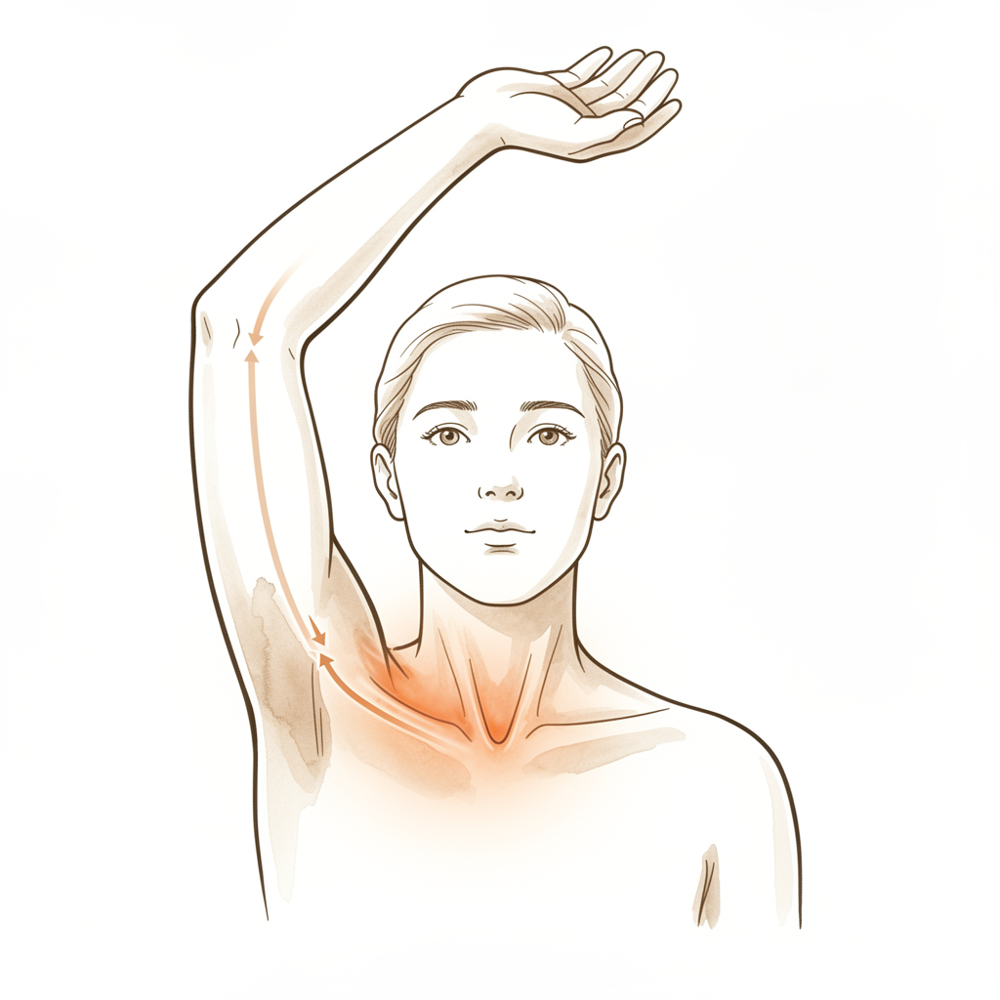
Brazo levantado con hormigueo que se irradia desde la base del cuello y el hombro.
En el síndrome de salida torácica, los nervios y vasos sanguíneos se comprimen en la base del cuello; esto suele empeorar cuando el brazo se eleva por encima de la cabeza. Kieran Hirpara 4.0

Esta página se tradujo automáticamente y todavía no la ha revisado un médico. La versión en inglés es la versión oficial.

Qué está sintiendo

El síndrome de la salida torácica suele manifestarse como una sensación de anomalía en el brazo. Es posible que note un dolor en el hombro, el lateral del cuello y a lo largo del brazo, además de entumecimiento, hormigueo o pins-and-needles, con frecuencia en el dedo anular y el meñique. El brazo puede sentirse pesado, débil o torpe; por eso se le caen cosas de las manos o su agarre se debilita rápidamente. Una señal muy característica es que los síntomas empeoran cuando el brazo está levantado o por encima de la cabeza (al tender ropa, al alcanzar algo en un estante alto, al conducir o al llevar un bolso al hombro) y mejoran al volver a dejar el brazo en posición normal. Algunas personas también experimentan dolores de cabeza en la parte posterior de la cabeza.

Con menos frecuencia, el problema afecta a los vasos sanguíneos en lugar de a los nervios. Si una vena queda comprimida, todo el brazo puede hincharse de repente, sentirse pesado y adquirir un tono azulado. Si se comprime una arteria (lo cual es poco común), la mano puede volverse pálida, fría y dolorosa. Estos cuadros vasculares son importantes, pues requieren una evaluación inmediata (véase la última sección).

¿Qué está ocurriendo realmente?

Para ir desde el cuello hasta el brazo, los nervios y los vasos sanguíneos deben pasar por un espacio estrecho en la base del cuello, entre la clavícula, la primera costilla y los músculos escalenos. Ese espacio se conoce como “salida torácica”. Cuando este espacio se vuelve demasiado estrecho, dichas estructuras quedan comprimidas, y esa presión es la que genera los síntomas.

Existen tres tipos, según qué estructura se vea afectada. El SOT neurogénico (compresión de los nervios, del plexo braquial) es, con diferencia, el más frecuente; representa la gran mayoría de los casos y se manifiesta mediante dolor, entumecimiento, hormigueo y debilidad. El SOT venoso afecta a la vena principal, provocando un brazo hinchado, pesado y de color azulado; a veces aparecen coágulos. El SOT arterial es poco común y afecta a la arteria, dando lugar a una mano pálida y fría.

Varias circunstancias hacen que este espacio se estreche aún más. Algunas personas nacen con una costilla cervical extra o con una banda fibrosa muy tensa. La postura también influye: los hombros redondeados y caídos reducen el espacio, al igual que los músculos del cuello y el pecho voluminosos o tensos; por eso esta afección es más frecuente en personas que realizan trabajos o deportes con movimientos repetitivos por encima de la cabeza. Una lesión previa en el cuello o en la clavícula también puede ser el desencadenante.

¿Qué podemos hacer al respecto?

En el Mater Private Hospital Rockhampton, el Dr. Kieran Hirpara dirige nuestro enfoque para tratar esta afección. Por lo general, los pacientes son derivados a nuestra clínica por su médico de cabecera; si un fisioterapeuta le ha recomendado que nos consulte, igualmente necesitará una derivación de su médico de cabecera para poder acceder al reembolso de Medicare y para iniciar una evaluación exhaustiva que confirme el diagnóstico. En casos de síntomas crónicos, normalmente empezamos con tratamiento no quirúrgico y solo consideramos la cirugía si este no aporta suficiente alivio.

La buena noticia es que, en el tipo neurogénico más común, el tratamiento de primera línea es la fisioterapia, no la cirugía. Un programa específico orientado a liberar el espacio del conducto torácico es clave: corregir la postura, fortalecer los músculos que mantienen el omóplato hacia atrás y abajo, relajar los músculos tensos del cuello y el pecho, y aprender a evitar las posiciones del brazo que generan compresión. Esto alivia los síntomas en la mayoría de las personas; por ello, merece la pena dedicarle un esfuerzo serio durante varios meses.

La cirugía se reserva para dos situaciones. La primera abarca los tipos vasculares (venosos o arteriales), en los cuales suele ser necesaria la descompresión, que constituye el tratamiento principal. La segunda es el SOT neurogénico que no ha mejorado tras un tratamiento fisioterapéutico adecuado y que realmente interfiere con la vida cotidiana. La operación consiste en descomprimir el conducto torácico, generalmente extirpando la primera costilla (y cualquier costilla cervical suplementaria) y liberando los músculos escalenos, para dar espacio a los nervios y vasos sanguíneos. Puede realizarse mediante una incisión axilar, por encima de la clavícula o con asistencia laparoscópica. En pacientes seleccionados, este procedimiento arroja buenos resultados.

Qué esperar

El SOT puede ser un diagnóstico complicado; no existe ninguna prueba única que lo confirme. El diagnóstico es mayormente clínico: se basa en su relato y en pruebas de examen en las que se coloca el brazo en posiciones que provocan los síntomas. Las imágenes por resonancia y los estudios nerviosos se utilizan tanto para descartar causas más comunes (como el síndrome del túnel carpiano en la muñeca, el síndrome del túnel cubital en el codo o problemas cervicales/discales) como para confirmar el SOT en sí. Por eso, parte del proceso consiste en determinar pacientemente cuál es la verdadera causa de sus síntomas; la respuesta no siempre es clara.

En el caso del tipo neurogénico, la mayoría de las personas mejoran con cambios posturales y fisioterapia, sin necesidad de cirugía; aunque esto puede llevar meses y requiere mantener esos hábitos. Cuando se trata de los tipos vasculares o de casos neurogénicos persistentes que sí requieren intervención quirúrgica, la descompresión alivia los síntomas en la mayoría de los pacientes seleccionados cuidadosamente; la recuperación suele tardar varias semanas. Dado que el SOT se produce en el punto más proximal de la vía nerviosa (más arriba que el túnel carpiano en la muñeca o el túnel cubital en el codo), a veces no es más que una parte del problema; por eso el plan de tratamiento se adapta a cada paciente.

Cuándo consultar a un especialista

  • Un brazo que de repente se hincha, pesa o adquiere un tono azulado: esto puede indicar una obstrucción o coágulo en una vena y requiere evaluación urgente, el mismo día.
  • Una mano pálida, fría y dolorosa, o dedos que cambian de color: podría tratarse de un problema arterial y es motivo para buscar atención urgente.
  • Entumecimiento, hormigueo, debilidad o torpeza en el brazo o la mano que persiste, empeora o interfiere con el trabajo, el sueño o las actividades cotidianas.
  • Atrofia (pérdida de masa muscular) en la mano, o síntomas que reaparecen a pesar de haber seguido un tratamiento adecuado de fisioterapia: merece la opinión de un especialista.
  • Si le han diagnosticado costilla cervical y presenta síntomas en el brazo, conviene que sea evaluado por un especialista.

En mayor profundidad

Esta sección va más allá de lo necesario para que usted tome sus propias decisiones de tratamiento. El síndrome de salida torácica merece una lectura adicional, ya que se divide en formas que podrían ser más distintas entre sí: una es objetivamente demostrable y, en ocasiones, supone un riesgo para el miembro afectado; la otra se diagnostica principalmente a partir del juicio clínico. Prácticamente toda la controversia gira en torno a esta segunda forma.

Tres afecciones que comparten un mismo nombre

El espacio torácico es el área estrecha situada entre la clavícula y la primera costilla por donde pasan los nervios del brazo, así como la arteria y la vena principales. La compresión en dicha zona da lugar a tres síndromes distintos.

El SOT venoso y el arterial son problemas vasculares. Son poco frecuentes, se pueden demostrar objetivamente mediante estudios de imagen, y pueden ser situaciones de urgencia: una trombosis de la vena subclavia provoca un brazo hinchado y de color azulado; la compresión arterial genera una mano fría y, en los casos más graves, la formación de émbolos. Nadie pone en duda su existencia ni la necesidad de tratarlos.

El SOT neurogénico representa la gran mayoría de los casos. En él, los nervios se comprimen, lo que genera dolor en el hombro y el brazo, entumecimiento, generalmente en la zona del dedo meñique, y los síntomas empeoran al mantener los brazos elevados por encima de la cabeza. El problema radica en que, en la mayoría de los casos, no existe ninguna prueba que lo confirme: los estudios de conducción nerviosa suelen ser normales y los estudios de imagen no revelan ninguna lesión.

Las revisiones recientes abordan este problema diferenciando las formas vasculares y las formas objetivamente verificables del SOT neurogénico del resto [1]; esto constituye una forma cuidadosa de reconocer que el diagnóstico del resto de casos depende del juicio clínico.

Por qué esa distinción lo determina todo

Cuando el diagnóstico puede demostrarse objetivamente, las decisiones terapéuticas siguen la lógica habitual. Cuando no es así, surgen dos tipos de errores: personas con compresión real pasan años sin diagnóstico porque sus exámenes resultan normales; y personas cuyo dolor en el brazo tiene otra causa se someten a una cirugía compleja que no les aporta beneficio alguno.

Ambos errores son bien conocidos; por eso el nivel de evidencia requerido antes de realizar la cirugía es más elevado en este caso que en la mayoría de las compresiones. Asimismo, antes de cualquier intervención para la forma neurogénica, se realiza un periodo prolongado de fisioterapia orientada a corregir la postura, los músculos escalenos y la mecánica del cinturón escapular.

¿Qué se extirpa y cuál es la evidencia al respecto?

La cirugía logra la descompresión al extirpar la primera costilla, dividir los músculos escalenos o ambos.

Al comparar distintos enfoques en 2,010 pacientes, se observó que las puntuaciones en las escalas Disabilities of the Arm, Shoulder and Hand y Derkash fueron significativamente mejores tras realizar una escalenectomía preservando la costilla; en cambio, se reportaron tasas de complicaciones más elevadas tras la resección de la primera costilla [2].

Por otro lado, estudios de mayor antigüedad abogan por la realización de la operación combinada. En 532 pacientes, se describió que la resección transaxilar de la primera costilla combinada con escalenectomía transcervical constituía la forma más completa de descompresión, con mejores resultados en cuanto a mejoría de síntomas y menor tasa de recurrencia [3]; además, se reportó una tasa de recurrencia de 5% a 10% cuando este procedimiento combinado se empleó como tratamiento principal [4].

Los datos publicados no permiten conciliar plenamente ambas posturas. El análisis comparativo más reciente favorece la realización de intervenciones menos extensas; en cambio, la vasta experiencia de un solo cirujano apoya la realización de procedimientos más completos, argumentando que la descompresión incompleta es la causa principal de la recurrencia. Lo que ambas posturas coinciden en afirmar es que el SOT recurrente constituye un problema mucho más complejo que la presentación inicial; por ello, tomar la decisión correcta en el tratamiento inicial resulta más importante que la elección de la técnica quirúrgica.

Implicaciones prácticas

Dado que el diagnóstico suele ser clínico, que el alcance óptimo de la intervención quirúrgica es objeto de controversia y que el problema de las recurrencias resulta difícil de resolver, se trata de una patología en la que resulta razonable buscar una segunda opinión antes de la cirugía, sin que ello implique confrontación; esto es especialmente válido en el caso de la forma neurogénica cuando no existe confirmación objetiva.

Referencias

[1] Panther EJ, Reintgen CD, Cueto RJ, Hao KA, Chim H, King JJ. Síndrome de la salida torácica: una revisión. J Shoulder Elbow Surg. 2022;31(11):e545-e561. https://doi.org/10.1016/j.jse.2022.06.026

[2] Blondin M, Garner GL, Hones KM, Nichols DS, Cox EA, Chim H. Consideraciones para el tratamiento quirúrgico del síndrome de la salida torácica neurogénico: un metaanálisis de los resultados reportados por los pacientes. J Hand Surg Am. 2023;48(6):585-94. https://doi.org/10.1016/j.jhsa.2023.03.005

[3] Atasoy E. Experiencia adicional de un cirujano de mano con el síndrome de compresión de la salida torácica. J Hand Surg Am. 2010;35(9):1528-38. https://doi.org/10.1016/j.jhsa.2010.06.025

[4] Atasoy E. Síndrome de la salida torácica recurrente. Hand Clin. 2004;20(1):99-105. https://doi.org/10.1016/S0749-0712(03)00085-4


Creative Commons BY-NC 4.0

CC Creative Commons licence
BY Attribution — you must credit the source
NC NonCommercial — not for commercial use

Attribution-NonCommercial 4.0 International


Creative Commons Corporation ("Creative Commons") is not a law firm and does not provide legal services or legal advice. Distribution of Creative Commons public licenses does not create a lawyer-client or other relationship. Creative Commons makes its licenses and related information available on an "as-is" basis. Creative Commons gives no warranties regarding its licenses, any material licensed under their terms and conditions, or any related information. Creative Commons disclaims all liability for damages resulting from their use to the fullest extent possible.

Using Creative Commons Public Licenses

Creative Commons public licenses provide a standard set of terms and conditions that creators and other rights holders may use to share original works of authorship and other material subject to copyright and certain other rights specified in the public license below. The following considerations are for informational purposes only, are not exhaustive, and do not form part of our licenses.

Considerations for licensors: Our public licenses are intended for use by those authorized to give the public permission to use material in ways otherwise restricted by copyright and certain other rights. Our licenses are irrevocable. Licensors should read and understand the terms and conditions of the license they choose before applying it. Licensors should also secure all rights necessary before applying our licenses so that the public can reuse the material as expected. Licensors should clearly mark any material not subject to the license. This includes other CC- licensed material, or material used under an exception or limitation to copyright. More considerations for licensors: wiki.creativecommons.org/Considerations_for_licensors

Considerations for the public: By using one of our public licenses, a licensor grants the public permission to use the licensed material under specified terms and conditions. If the licensor's permission is not necessary for any reason--for example, because of any applicable exception or limitation to copyright--then that use is not regulated by the license. Our licenses grant only permissions under copyright and certain other rights that a licensor has authority to grant. Use of the licensed material may still be restricted for other reasons, including because others have copyright or other rights in the material. A licensor may make special requests, such as asking that all changes be marked or described. Although not required by our licenses, you are encouraged to respect those requests where reasonable. More considerations for the public: wiki.creativecommons.org/Considerations_for_licensees


Creative Commons Attribution-NonCommercial 4.0 International Public License

By exercising the Licensed Rights (defined below), You accept and agree to be bound by the terms and conditions of this Creative Commons Attribution-NonCommercial 4.0 International Public License ("Public License"). To the extent this Public License may be interpreted as a contract, You are granted the Licensed Rights in consideration of Your acceptance of these terms and conditions, and the Licensor grants You such rights in consideration of benefits the Licensor receives from making the Licensed Material available under these terms and conditions.

Section 1 -- Definitions.

a. Adapted Material means material subject to Copyright and Similar Rights that is derived from or based upon the Licensed Material and in which the Licensed Material is translated, altered, arranged, transformed, or otherwise modified in a manner requiring permission under the Copyright and Similar Rights held by the Licensor. For purposes of this Public License, where the Licensed Material is a musical work, performance, or sound recording, Adapted Material is always produced where the Licensed Material is synched in timed relation with a moving image.

b. Adapter's License means the license You apply to Your Copyright and Similar Rights in Your contributions to Adapted Material in accordance with the terms and conditions of this Public License.

c. Copyright and Similar Rights means copyright and/or similar rights closely related to copyright including, without limitation, performance, broadcast, sound recording, and Sui Generis Database Rights, without regard to how the rights are labeled or categorized. For purposes of this Public License, the rights specified in Section 2(b)(1)-(2) are not Copyright and Similar Rights.

d. Effective Technological Measures means those measures that, in the absence of proper authority, may not be circumvented under laws fulfilling obligations under Article 11 of the WIPO Copyright Treaty adopted on December 20, 1996, and/or similar international agreements.

e. Exceptions and Limitations means fair use, fair dealing, and/or any other exception or limitation to Copyright and Similar Rights that applies to Your use of the Licensed Material.

f. Licensed Material means the artistic or literary work, database, or other material to which the Licensor applied this Public License.

g. Licensed Rights means the rights granted to You subject to the terms and conditions of this Public License, which are limited to all Copyright and Similar Rights that apply to Your use of the Licensed Material and that the Licensor has authority to license.

h. Licensor means the individual(s) or entity(ies) granting rights under this Public License.

i. NonCommercial means not primarily intended for or directed towards commercial advantage or monetary compensation. For purposes of this Public License, the exchange of the Licensed Material for other material subject to Copyright and Similar Rights by digital file-sharing or similar means is NonCommercial provided there is no payment of monetary compensation in connection with the exchange.

j. Share means to provide material to the public by any means or process that requires permission under the Licensed Rights, such as reproduction, public display, public performance, distribution, dissemination, communication, or importation, and to make material available to the public including in ways that members of the public may access the material from a place and at a time individually chosen by them.

k. Sui Generis Database Rights means rights other than copyright resulting from Directive 96/9/EC of the European Parliament and of the Council of 11 March 1996 on the legal protection of databases, as amended and/or succeeded, as well as other essentially equivalent rights anywhere in the world.

l. You means the individual or entity exercising the Licensed Rights under this Public License. Your has a corresponding meaning.

Section 2 -- Scope.

a. License grant.

1. Subject to the terms and conditions of this Public License, the Licensor hereby grants You a worldwide, royalty-free, non-sublicensable, non-exclusive, irrevocable license to exercise the Licensed Rights in the Licensed Material to:

a. reproduce and Share the Licensed Material, in whole or in part, for NonCommercial purposes only; and

b. produce, reproduce, and Share Adapted Material for NonCommercial purposes only.

2. Exceptions and Limitations. For the avoidance of doubt, where Exceptions and Limitations apply to Your use, this Public License does not apply, and You do not need to comply with its terms and conditions.

3. Term. The term of this Public License is specified in Section 6(a).

4. Media and formats; technical modifications allowed. The Licensor authorizes You to exercise the Licensed Rights in all media and formats whether now known or hereafter created, and to make technical modifications necessary to do so. The Licensor waives and/or agrees not to assert any right or authority to forbid You from making technical modifications necessary to exercise the Licensed Rights, including technical modifications necessary to circumvent Effective Technological Measures. For purposes of this Public License, simply making modifications authorized by this Section 2(a) (4) never produces Adapted Material.

5. Downstream recipients.

a. Offer from the Licensor -- Licensed Material. Every recipient of the Licensed Material automatically receives an offer from the Licensor to exercise the Licensed Rights under the terms and conditions of this Public License.

b. No downstream restrictions. You may not offer or impose any additional or different terms or conditions on, or apply any Effective Technological Measures to, the Licensed Material if doing so restricts exercise of the Licensed Rights by any recipient of the Licensed Material.

6. No endorsement. Nothing in this Public License constitutes or may be construed as permission to assert or imply that You are, or that Your use of the Licensed Material is, connected with, or sponsored, endorsed, or granted official status by, the Licensor or others designated to receive attribution as provided in Section 3(a)(1)(A)(i).

b. Other rights.

1. Moral rights, such as the right of integrity, are not licensed under this Public License, nor are publicity, privacy, and/or other similar personality rights; however, to the extent possible, the Licensor waives and/or agrees not to assert any such rights held by the Licensor to the limited extent necessary to allow You to exercise the Licensed Rights, but not otherwise.

2. Patent and trademark rights are not licensed under this Public License.

3. To the extent possible, the Licensor waives any right to collect royalties from You for the exercise of the Licensed Rights, whether directly or through a collecting society under any voluntary or waivable statutory or compulsory licensing scheme. In all other cases the Licensor expressly reserves any right to collect such royalties, including when the Licensed Material is used other than for NonCommercial purposes.

Section 3 -- License Conditions.

Your exercise of the Licensed Rights is expressly made subject to the following conditions.

a. Attribution.

1. If You Share the Licensed Material (including in modified form), You must:

a. retain the following if it is supplied by the Licensor with the Licensed Material:

i. identification of the creator(s) of the Licensed Material and any others designated to receive attribution, in any reasonable manner requested by the Licensor (including by pseudonym if designated);

ii. a copyright notice;

iii. a notice that refers to this Public License;

iv. a notice that refers to the disclaimer of warranties;

v. a URI or hyperlink to the Licensed Material to the extent reasonably practicable;

b. indicate if You modified the Licensed Material and retain an indication of any previous modifications; and

c. indicate the Licensed Material is licensed under this Public License, and include the text of, or the URI or hyperlink to, this Public License.

2. You may satisfy the conditions in Section 3(a)(1) in any reasonable manner based on the medium, means, and context in which You Share the Licensed Material. For example, it may be reasonable to satisfy the conditions by providing a URI or hyperlink to a resource that includes the required information.

3. If requested by the Licensor, You must remove any of the information required by Section 3(a)(1)(A) to the extent reasonably practicable.

4. If You Share Adapted Material You produce, the Adapter's License You apply must not prevent recipients of the Adapted Material from complying with this Public License.

Section 4 -- Sui Generis Database Rights.

Where the Licensed Rights include Sui Generis Database Rights that apply to Your use of the Licensed Material:

a. for the avoidance of doubt, Section 2(a)(1) grants You the right to extract, reuse, reproduce, and Share all or a substantial portion of the contents of the database for NonCommercial purposes only;

b. if You include all or a substantial portion of the database contents in a database in which You have Sui Generis Database Rights, then the database in which You have Sui Generis Database Rights (but not its individual contents) is Adapted Material; and

c. You must comply with the conditions in Section 3(a) if You Share all or a substantial portion of the contents of the database.

For the avoidance of doubt, this Section 4 supplements and does not replace Your obligations under this Public License where the Licensed Rights include other Copyright and Similar Rights.

Section 5 -- Disclaimer of Warranties and Limitation of Liability.

a. UNLESS OTHERWISE SEPARATELY UNDERTAKEN BY THE LICENSOR, TO THE EXTENT POSSIBLE, THE LICENSOR OFFERS THE LICENSED MATERIAL AS-IS AND AS-AVAILABLE, AND MAKES NO REPRESENTATIONS OR WARRANTIES OF ANY KIND CONCERNING THE LICENSED MATERIAL, WHETHER EXPRESS, IMPLIED, STATUTORY, OR OTHER. THIS INCLUDES, WITHOUT LIMITATION, WARRANTIES OF TITLE, MERCHANTABILITY, FITNESS FOR A PARTICULAR PURPOSE, NON-INFRINGEMENT, ABSENCE OF LATENT OR OTHER DEFECTS, ACCURACY, OR THE PRESENCE OR ABSENCE OF ERRORS, WHETHER OR NOT KNOWN OR DISCOVERABLE. WHERE DISCLAIMERS OF WARRANTIES ARE NOT ALLOWED IN FULL OR IN PART, THIS DISCLAIMER MAY NOT APPLY TO YOU.

b. TO THE EXTENT POSSIBLE, IN NO EVENT WILL THE LICENSOR BE LIABLE TO YOU ON ANY LEGAL THEORY (INCLUDING, WITHOUT LIMITATION, NEGLIGENCE) OR OTHERWISE FOR ANY DIRECT, SPECIAL, INDIRECT, INCIDENTAL, CONSEQUENTIAL, PUNITIVE, EXEMPLARY, OR OTHER LOSSES, COSTS, EXPENSES, OR DAMAGES ARISING OUT OF THIS PUBLIC LICENSE OR USE OF THE LICENSED MATERIAL, EVEN IF THE LICENSOR HAS BEEN ADVISED OF THE POSSIBILITY OF SUCH LOSSES, COSTS, EXPENSES, OR DAMAGES. WHERE A LIMITATION OF LIABILITY IS NOT ALLOWED IN FULL OR IN PART, THIS LIMITATION MAY NOT APPLY TO YOU.

c. The disclaimer of warranties and limitation of liability provided above shall be interpreted in a manner that, to the extent possible, most closely approximates an absolute disclaimer and waiver of all liability.

Section 6 -- Term and Termination.

a. This Public License applies for the term of the Copyright and Similar Rights licensed here. However, if You fail to comply with this Public License, then Your rights under this Public License terminate automatically.

b. Where Your right to use the Licensed Material has terminated under Section 6(a), it reinstates:

1. automatically as of the date the violation is cured, provided it is cured within 30 days of Your discovery of the violation; or

2. upon express reinstatement by the Licensor.

For the avoidance of doubt, this Section 6(b) does not affect any right the Licensor may have to seek remedies for Your violations of this Public License.

c. For the avoidance of doubt, the Licensor may also offer the Licensed Material under separate terms or conditions or stop distributing the Licensed Material at any time; however, doing so will not terminate this Public License.

d. Sections 1, 5, 6, 7, and 8 survive termination of this Public License.

Section 7 -- Other Terms and Conditions.

a. The Licensor shall not be bound by any additional or different terms or conditions communicated by You unless expressly agreed.

b. Any arrangements, understandings, or agreements regarding the Licensed Material not stated herein are separate from and independent of the terms and conditions of this Public License.

Section 8 -- Interpretation.

a. For the avoidance of doubt, this Public License does not, and shall not be interpreted to, reduce, limit, restrict, or impose conditions on any use of the Licensed Material that could lawfully be made without permission under this Public License.

b. To the extent possible, if any provision of this Public License is deemed unenforceable, it shall be automatically reformed to the minimum extent necessary to make it enforceable. If the provision cannot be reformed, it shall be severed from this Public License without affecting the enforceability of the remaining terms and conditions.

c. No term or condition of this Public License will be waived and no failure to comply consented to unless expressly agreed to by the Licensor.

d. Nothing in this Public License constitutes or may be interpreted as a limitation upon, or waiver of, any privileges and immunities that apply to the Licensor or You, including from the legal processes of any jurisdiction or authority.


Creative Commons is not a party to its public licenses. Notwithstanding, Creative Commons may elect to apply one of its public licenses to material it publishes and in those instances will be considered the “Licensor.” The text of the Creative Commons public licenses is dedicated to the public domain under the CC0 Public Domain Dedication. Except for the limited purpose of indicating that material is shared under a Creative Commons public license or as otherwise permitted by the Creative Commons policies published at creativecommons.org/policies, Creative Commons does not authorize the use of the trademark "Creative Commons" or any other trademark or logo of Creative Commons without its prior written consent including, without limitation, in connection with any unauthorized modifications to any of its public licenses or any other arrangements, understandings, or agreements concerning use of licensed material. For the avoidance of doubt, this paragraph does not form part of the public licenses.

Creative Commons may be contacted at creativecommons.org.