Patients › Rehabilitation
Fusión de la articulación PIP
Se trata de un plan de recuperación protegido tras la fusión (artrodesis) de la articulación media del dedo: se mantiene la articulación fusionada inmóvil mediante una férula, mientras que todas las demás articulaciones se mueven desde el primer día; posteriormente, una vez que el hueso se ha unido, se recupera la capacidad de agarre y de pinza.
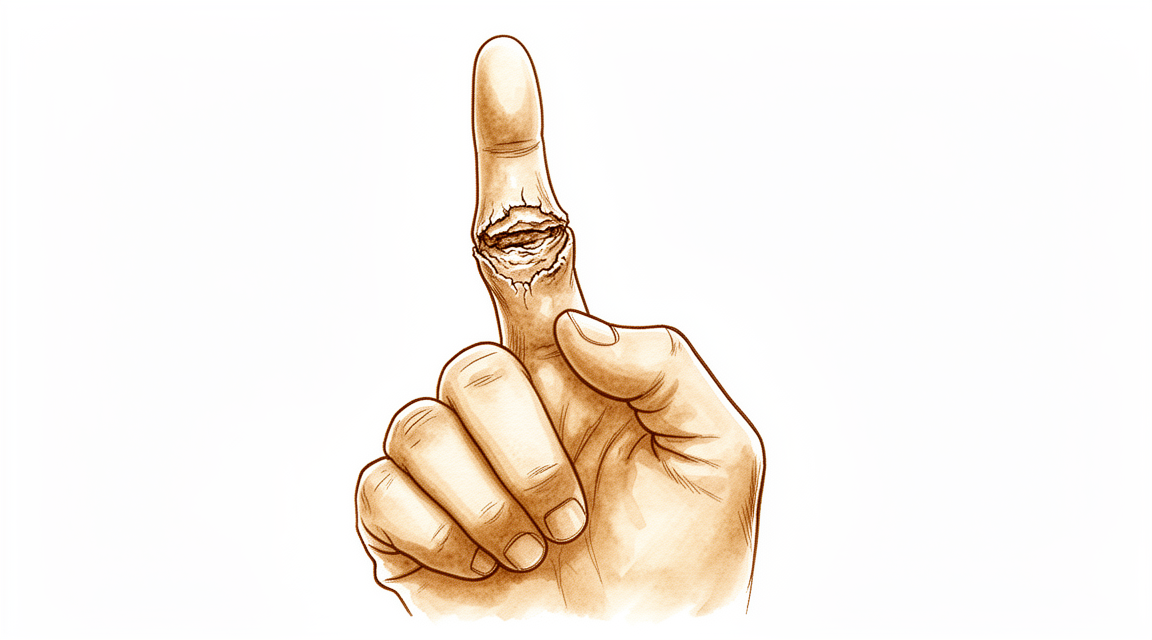
Este protocolo le servirá de guía para su recuperación tras la fusión (artrodesis) de la articulación PIP (la articulación central del dedo) realizada por el Dr. Kieran Hirpara en el Mater Private Hospital Rockhampton. Comienza con un programa de ejercicios para realizar en casa, seguido del protocolo clínico estructurado redactado para su terapeuta de mano: lleve esta página o su versión en PDF a su primera sesión de terapia para garantizar una rehabilitación coordinada. Su terapeuta de mano podrá modificar el plan según el progreso de su recuperación.
Si tiene alguna duda respecto a la herida quirúrgica, no dude en contactar con el consultorio. A menudo resulta útil tomar una fotografía de la herida y enviarla por correo electrónico para su evaluación.
Qué esperar
La artrodesis de la articulación PIP consiste en unir de forma sólida la articulación media de un dedo que esté desgastada o inestable, de modo que ya no se mueva. La articulación se fija en una posición funcional ligeramente flexionada, en lugar de quedar completamente recta: dicha flexión es suave en el índice y el dedo medio (aproximadamente 15–20°) y aumenta hacia el lado del meñique (alrededor de 25–40° en el anular y el meñique), siguiendo la disposición natural de los dedos al cerrarse. La articulación fusionada se mantiene en esa posición mediante un pequeño implante (un alambre de tensión, un tornillo sin cabeza, agujas K o una placa pequeña), que fija dicho ángulo hasta que el hueso se une por completo.
Esta intervención se elige con frecuencia para el índice y el dedo medio, donde una articulación estable para la pinza resulta más importante que la movilidad en dicha zona. Tras la operación, la articulación PIP debe quedar rígida; ese es precisamente el objetivo. Por ello, a diferencia de una reparación de tendón o ligamento, la recuperación no consiste en recuperar el movimiento en esa articulación, sino en proteger la fusión hasta que el hueso se una, mientras se permite el movimiento libre del resto de las articulaciones de la mano.
El plan de recuperación se basa en cuatro principios:
- Proteger la fusión hasta que el hueso se una. La consolidación ósea suele tardar unas seis semanas; en algunos casos, hasta nueve o doce semanas. Hasta entonces, la articulación fusionada se mantiene sujeta mediante una férula.
- Mantener el movimiento del resto de las articulaciones desde el primer día: la articulación distal, la del nudillo (metacarpofalángica), los dedos vecinos, el pulgar y la muñeca, para evitar que los tendones se adhieran y que el resto de la mano se vuelva rígida.
- Controlar la hinchazón y la cicatrización durante las primeras semanas.
- Recuperar la capacidad de agarre y de hacer la pinza una vez que la fusión haya finalizado. No fume: se sabe que el tabaquismo ralentiza la cicatrización ósea y retrasa la consolidación de la fusión.
Precauciones y limitaciones
- NO cargue peso, apriete ni pellizque con fuerza el dedo operado hasta que la fusión ósea se haya producido (normalmente en unas seis semanas, a veces más): cargar peso antes de que el hueso se una puede impedir la consolidación.
- Mantenga la articulación fusionada completamente inmóvil dentro de la férula según las indicaciones; no intente “probar” ni doblarla.
- Mueva todas las demás articulaciones desde los primeros días: la articulación distal del dedo, la del nudillo (metacarpofalángica), los demás dedos, el pulgar y la muñeca.
- Mantenga la férula limpia y seca, úsela según las indicaciones, y cuide la herida y cualquier sitio donde haya pinzas.
- NO conduzca mientras no pueda controlar el volante de forma segura; normalmente, esto ocurre hasta que se retire la férula, alrededor de las cuatro a seis semanas.
- No fume: retrasa la unión ósea.
Para el cuidado de la herida, la hinchazón y las cicatrices, consulte las pautas de cuidado de heridas de nuestra consulta.
Sus ejercicios
Kieran Hirpara 4.0
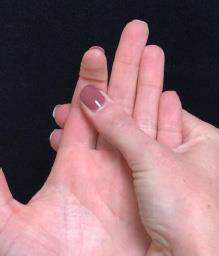
Movilidad de la articulación distal interfalángica del dedo operado
Con la autorización de su terapeuta de mano, doble y estire suavemente la última articulación (la de la punta del dedo) del dedo operado. Con la otra mano, sujete firmemente la parte central del dedo para que solo se mueva la punta. La articulación fusionada debe permanecer totalmente inmóvil; solo debe moverse la punta del dedo. Mantener este movimiento evita que los tendones se adhieran entre sí mientras se produce la consolidación de la fusión.
10 veces, 3 veces al día, únicamente en la articulación de la yema del dedo.
Kieran Hirpara 4.0
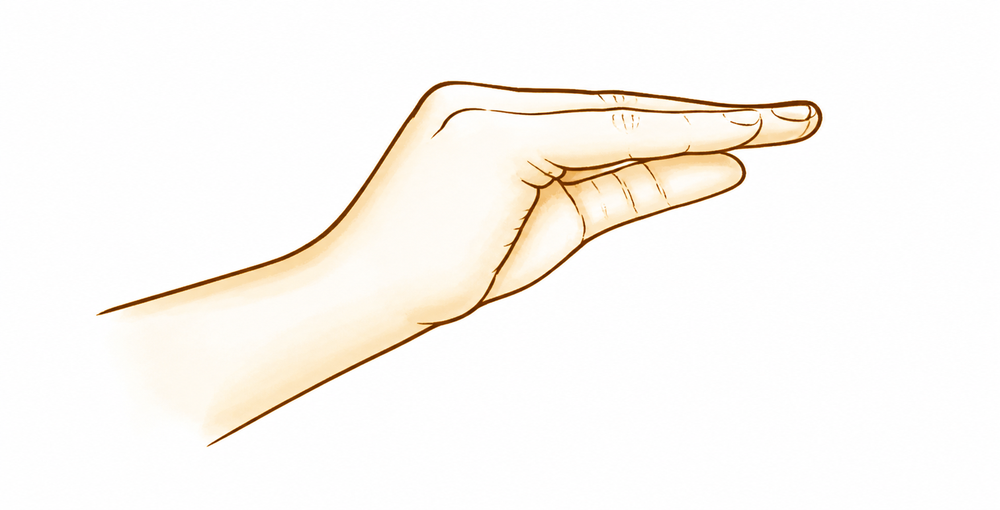
Movimiento de la articulación MCP del dedo operado
Doble y estire suavemente el nudillo grande (el lugar donde el dedo se une a la mano) del dedo operado. La articulación media fusionada permanece inmóvil en todo momento; solo se mueve el nudillo. Esto mantiene la flexibilidad del nudillo y evita que el dedo se vuelva rígido mientras se consolida la fusión.
10 veces, 3 veces al día, únicamente en la articulación de los nudillos.
Kieran Hirpara 4.0
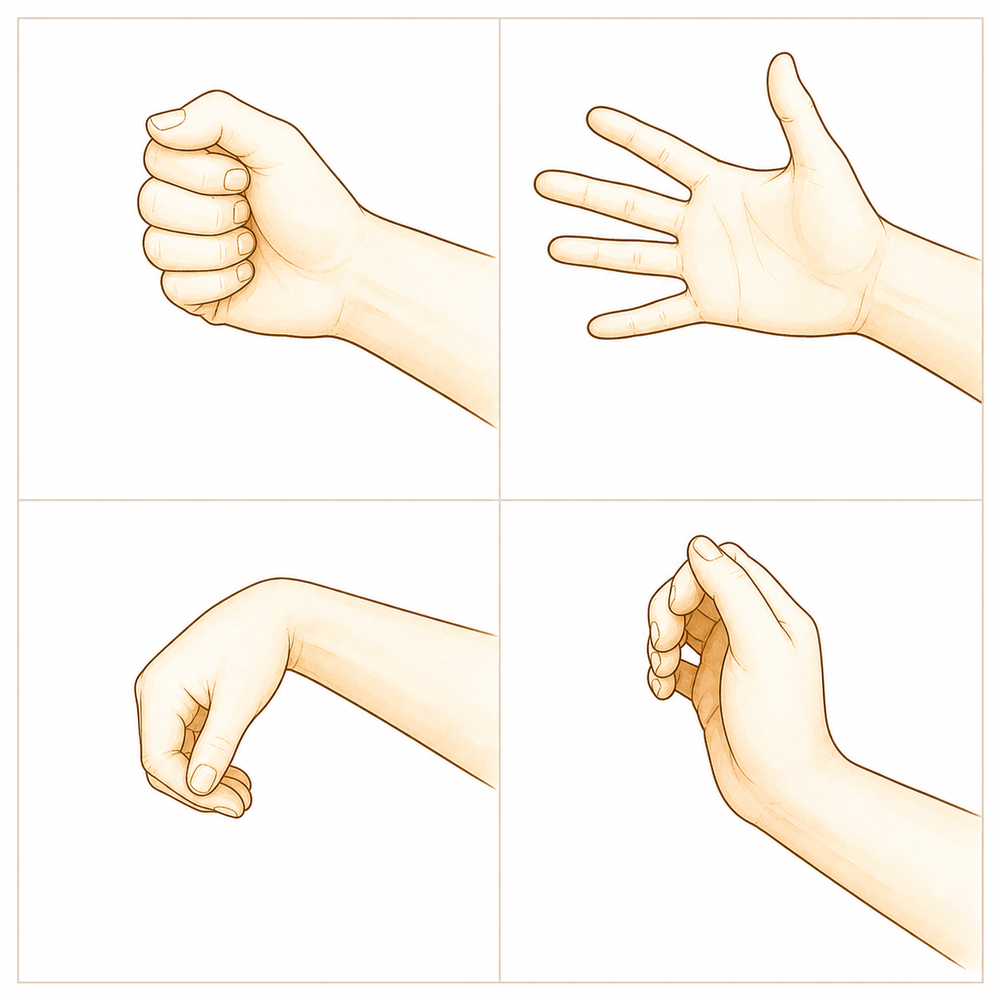
Mueva todos los demás dedos, el pulgar y la muñeca.
Desde los primeros días, asegúrese de mover libremente todas las articulaciones que NO fueron operadas: haga un puño completo y luego abra la mano con los demás dedos; mueva el pulgar en todas las direcciones; doble, estire y gire la muñeca. Esta es la medida más importante que puede tomar para mantener la flexibilidad de su mano y evitar la rigidez, mientras la articulación fusionada permanece protegida.
10 veces cada una, varias veces al día.
Kieran Hirpara 4.0
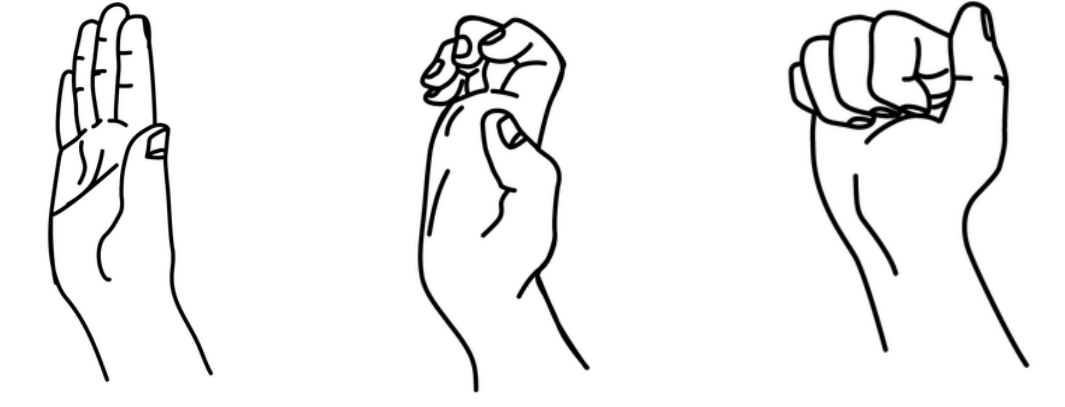
Deslizamientos tendinosos (con gancho, puño cerrado, recto)
Mueva la mano lentamente formando tres figuras para mantener el deslizamiento de los tendones: un gancho (doblando la punta y las articulaciones medias, manteniendo los nudillos rectos), un puño completo y, finalmente, la mano completamente extendida y recta. Haga esto con todos los dedos no operados; permita que el dedo operado se mueva únicamente hasta donde lo permitan las articulaciones libres (no fusionadas). De este modo, los tendones se deslizarán sin problemas y no se adherirán cerca de la zona de la cirugía.
5 de cada forma, 3 veces al día.
Kieran Hirpara 4.0
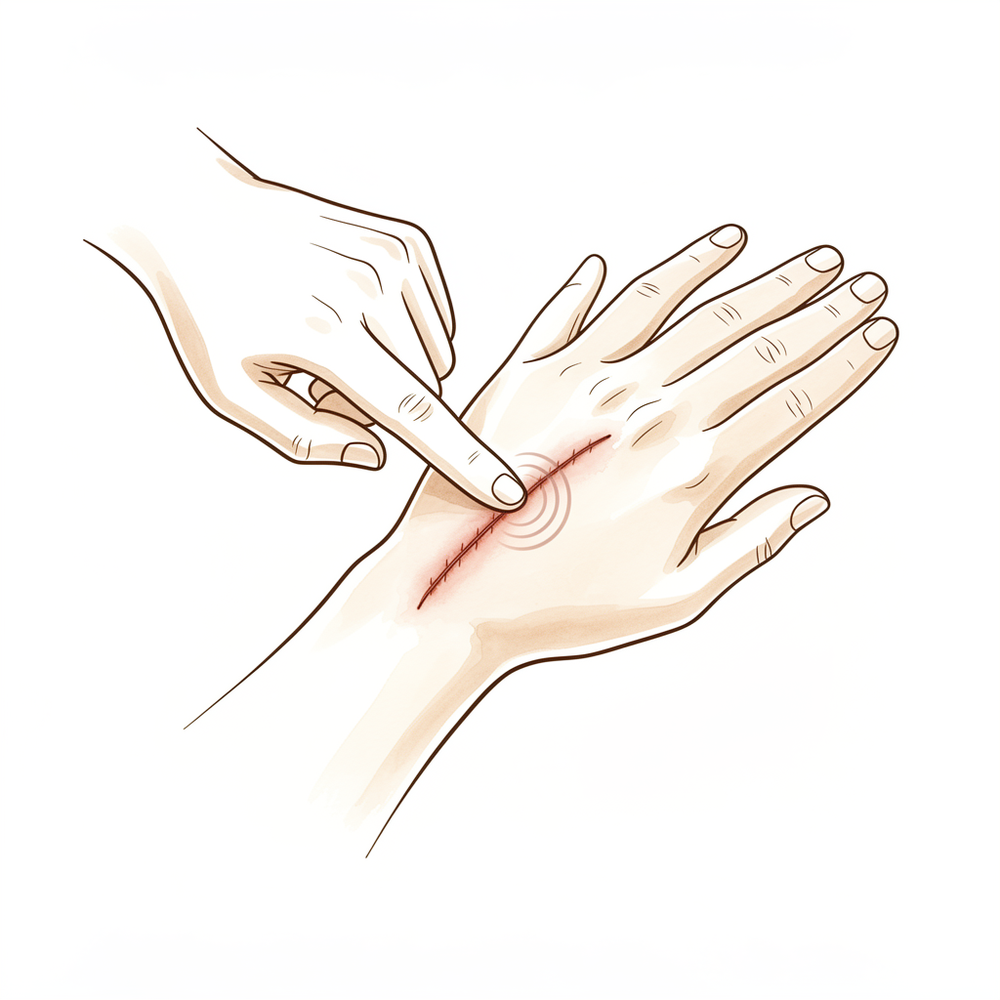
Masaje de la cicatriz
Una vez que la herida haya cicatrizado por completo y el terapeuta de la mano la haya revisado, aplique un poco de crema hidratante sobre la cicatriz realizando pequeños círculos firmes durante unos minutos. Esto ablanda la cicatriz, reduce la sensibilidad y evita que se adhiera a los tejidos subyacentes. No comience este proceso hasta que la piel esté totalmente cerrada.
2–3 minutos, 2–3 veces al día (después de que la herida haya cicatrizado)
Kieran Hirpara 4.0
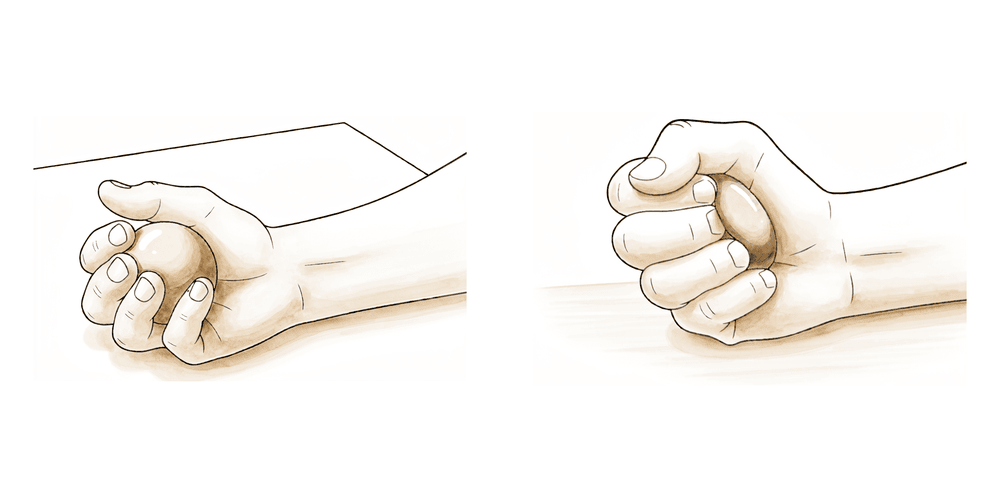
Fortalecimiento de la pinza y la prensión (después de la consolidación ósea)
Un ejercicio posterior: únicamente cuando la fusión ya se haya consolidado y su terapeuta de mano comience a trabajar en el fortalecimiento (normalmente después de unas seis semanas). Apriete una pelota blanda o plastilina para ejercitar el agarre, y pellizque un objeto pequeño entre el pulgar y el dedo operado para desarrollar el pellizco lateral cuya estabilidad se buscaba con la fusión. Aumente la intensidad del esfuerzo de forma gradual. No realice ningún tipo de agarre o pellizco resistido antes de recibir autorización; de lo contrario, se ejercería carga sobre la fusión antes de que el hueso se haya unido.
10 veces, 2–3 veces al día, según las indicaciones (solo después de la consolidación ósea).
Estos son los ejercicios que aparecen en su folleto. Comience a realizarlos únicamente bajo la guía del Dr. Hirpara y de su terapeuta de mano, respetando los límites que se le hayan indicado. Los ejercicios iniciales tienen como objetivo mantener en movimiento la articulación de la punta del dedo, la del nudillo (metacarpofalángica), así como todos los demás dedos, el pulgar y la muñeca, sin mover ni someter a carga la propia articulación fusionada, que debe permanecer inmóvil dentro del yeso. El masaje de la cicatriz se inicia una vez que la herida haya cicatrizado. El fortalecimiento de la pinza y el agarre corresponden a una fase posterior; no debe comenzarlos hasta que la fusión esté consolidada y se le haya dado autorización expresa. Interrumpa cualquier ejercicio que provoque dolor intenso en la articulación fusionada.
Su protocolo clínico
El resto de esta página describe el protocolo clínico por fases para la rehabilitación tras una artrodesis de la articulación PIP. Esta sección debe entregarse a su terapeuta de mano; cada fase comienza con una explicación sencilla en lenguaje coloquial sobre lo que ocurre. Es fundamental proteger la articulación fusionada de cualquier carga hasta lograr la unión ósea (normalmente alrededor de 6 semanas, hasta un máximo de 9–12 semanas). El principio rector es “proteger la articulación fusionada y movilizar todo lo demás”: desde el primer día se deben mover la articulación DIP, las articulaciones MCP, los dedos adyacentes, el pulgar y la muñeca para evitar adherencias tendinosas y rigidez. Asimismo, se debe controlar el edema y la cicatrización desde el inicio; la capacidad de agarre y de pinza se recuperará únicamente tras haberse logrado la unión ósea.
Antes de iniciar el tratamiento, revise el informe quirúrgico del paciente y su historial médico previo, y consulte con el cirujano responsable sobre el método de fijación empleado (alambre de tensión, tornillo intramedular sin cabeza, agujas K o placa), el ángulo de fusión establecido, y si las agujas K quedan incrustadas o deben retirarse. El Dr. Hirpara realiza la artrodesis PIP en una posición de flexión funcional cuyo ángulo aumenta hacia el lado cubital de la mano (aproximadamente 15–20° en el dedo índice y medio; 25–40° en el anular y meñique); esto se aplica sobre todo a dichos dedos, donde la estabilidad en la pinza lateral es más importante que el movimiento de la articulación PIP. La articulación fusionada se mantiene inmovilizada mediante férula hasta constatar la unión radiográfica. La base científica disponible es limitada (series de casos de nivel 4 y consenso de expertos), por lo que los tiempos de rehabilitación se individualizan y no siguen umbrales estandarizados.
Fase I — protección y control de la hinchazón (semanas 0 a 2)
Durante las dos primeras semanas, se protege la fusión ósea y se controla la hinchazón y la cicatrización de la herida, mientras que todas las demás articulaciones de la mano comienzan a moverse de inmediato.
Para su terapeuta de mano:
Inmovilización - Férula o yeso volar para dedos que cubra las articulaciones MCP y PIP, pero deje libre la articulación DIP - Mantener la articulación PIP fusionada en reposo; elevar la mano para reducir el edema
Educación y precauciones - Prohibido realizar agarres, pinzas o cargas con el dedo operado - Mantener la férula limpia y seca; proteger la herida y cualquier punto donde se hayan colocado clavos
Manejo - Herida: aplicar los vendajes quirúrgicos según indicaciones; vigilar posibles infecciones y el estado de los puntos de inserción de los clavos si se utilizaron - Edema: elevar la mano, realizar movimientos suaves con las articulaciones libres, aplicar hielo según sea necesario - Ejercicios: desde el primer día, realizar movimientos activos en todas las articulaciones no fusionadas: dedos adyacentes (flexión/extensión completa), pulgar y muñeca; iniciar movimientos activos de la articulación DIP del dedo operado en los primeros días; realizar deslizamientos tendinosos en los dedos vecinos; no mover ni cargar sobre la articulación PIP fusionada
Criterios para avanzar a la siguiente fase - La herida está cicatrizando; la hinchazón está controlada; listo para colocar una férula personalizada definitiva alrededor de la semana 2
Fase II: férula termoplástica personalizada y movimiento activo de las articulaciones libres (semanas 2 a 6)
A partir de las dos semanas aproximadamente, una férula termoplástica personalizada sostiene la articulación fusionada, permitiendo al mismo tiempo el movimiento activo de las articulaciones adyacentes. Las articulaciones DIP y MCP del dedo operado se ejercitan fuera de la férula; la articulación PIP fusionada permanece protegida. Por el momento, no se permite realizar agarres, pinzas ni ejercer carga con resistencia.
Para su terapeuta de mano:
Evaluaciones - Amplitud de movimiento de las articulaciones adyacentes, evaluación de edema, herida y cicatriz; confirmar que la fijación es estable según criterios clínicos y según indicaciones del cirujano.
Inmovilización - Transición a una férula termoplástica personalizada que sostenga la articulación PIP fusionada, dejando libres las articulaciones adyacentes; mantener la inmovilización protectora de forma continua hasta aproximadamente la semana 6.
Instrucciones y precauciones - Queda prohibido realizar agarres, pinzas o ejercer carga con resistencia en el dedo operado hasta que se produzca la unión ósea. - Los ejercicios solo se realizan fuera de la férula.
Manejo - Ejercicios: movimiento activo de las articulaciones DIP y MCP del dedo operado fuera de la férula (el movimiento DIP se inicia a los pocos días; el MCP se añade en esta fase); deslizamientos tendinosos en los dedos adyacentes; continuación del movimiento del pulgar, muñeca y dedos vecinos; iniciar el manejo de la cicatriz y el edema una vez curada la herida. - No se permite realizar agarres, pinzas ni ejercer carga con resistencia.
Criterios para avanzar - Unión ósea comprobada mediante radiografía (normalmente alrededor de la semana 6, hasta 9–12); la articulación fusionada debe ser estable tanto clínica como radiológicamente antes de permitir cualquier tipo de carga.
Fase III: retirar progresivamente la férula e iniciar un uso funcional ligero (a partir de las ~6 semanas, una vez consolidada la fusión)
Una vez que la fusión ósea se ha consolidado (normalmente alrededor de seis semanas), se retira y reduce progresivamente la férula, se introduce un uso funcional ligero, y se recuperan gradualmente la pinza, la oposición y la capacidad de agarre. Los alambres K, si se utilizaron, suelen retirarse alrededor de la sexta semana.
Para su terapeuta de mano:
Evaluaciones - Confirmar mediante radiografía la consolidación de la fusión con el cirujano; medir la fuerza de agarre y de pinza en comparación con la otra mano; evaluar el rango de movimiento de las articulaciones libres; examinar la cicatriz
Educación y precauciones - Retirar y reducir progresivamente la férula una vez confirmada la consolidación; extraer el alambre K alrededor de las 6 semanas si se empleó - Aumentar la carga de forma gradual: primero uso funcional ligero, luego ejercicios de pinza y agarre de intensidad progresiva
Manejo - Ejercicios: avanzar desde el uso funcional ligero hasta la recuperación de la pinza, oposición y capacidad de agarre; iniciar el fortalecimiento de la pinza y el agarre (con pelotas o plastilina, ejercicios de pinza lateral) y aumentar la intensidad gradualmente; continuar con el tratamiento de la cicatriz - Retirar la férula tras confirmarse radiográficamente la consolidación de la fusión
Criterios para avanzar - Fusión ósea consolidada que tolera carga ligera sin dolor; férula ya no se utiliza; paciente listo para un fortalecimiento progresivo
Fase IV — fortalecimiento progresivo y retorno (a partir de ~8–12 semanas)
Una vez consolidada la fusión y reanudado el uso ligero de la mano, se intensifica el fortalecimiento y la carga, y se va progresando hacia el retorno a actividades deportivas, pesadas o manuales. El resultado final se alcanza aproximadamente entre los nueve y doce meses.
Para su terapeuta de mano:
Evaluaciones - Fuerza de agarre y de pinzamiento en comparación con el lado contralateral; pruebas funcionales y específicas para el trabajo o el deporte, según corresponda
Educación y precauciones - Aumentar gradualmente la carga resistida; la articulación fusionada queda permanentemente rígida por diseño; concentrar el fortalecimiento en el agarre y el pinzamiento lateral
Manejo - Ejercicios: fortalecimiento y carga progresivos del agarre y el pinzamiento; retorno gradual a actividades deportivas, pesadas y manuales - Considerar el alta una vez que la fuerza sea funcional y casi simétrica; derivar nuevamente al médico tratante si la recuperación se estanca
Criterios para el retorno - Articulación fusionada estable y sin dolor bajo carga; fuerza de agarre/pinzamiento suficiente para la tarea, evaluada clínicamente y no en base al tiempo transcurrido; resultado final alcanzado a los 9–12 meses
Volver al trabajo y a las actividades cotidianas
Se recomienda, desde el principio, el uso ligero de la mano en las actividades diarias, siempre dentro de los límites del confort; la única restricción clave es no realizar agarres, pinzamientos ni aplicar carga a través del dedo operado hasta que la fusión ósea se haya producido. Dado que no debe conducir si no puede controlar el volante de forma segura, planifique contar con ayuda para el transporte durante las primeras semanas; normalmente se puede volver a conducir entre las cuatro y seis semanas, una vez retirada la férula y cuando pueda controlar el vehículo sin riesgos.
Tras la consolidación ósea (alrededor de las seis semanas), podrá iniciar el uso ligero y agarres suaves. El levantamiento de objetos, el agarre y el pinzamiento se irán incrementando a partir de las ocho semanas, y las actividades completas o deportivas podrán retomarse a partir de las doce semanas. La fusión ósea sigue estabilizándose durante varios meses, por lo que el resultado final y completamente estable se alcanza aproximadamente entre los nueve y doce meses. Estos plazos son guías basadas en el consenso de expertos de un único centro (valores típicos y personalizados, no umbrales estrictos); el progreso de cada paciente lo evalúan el Dr. Hirpara y su terapeuta de mano según la evolución de la fusión, no únicamente en función del calendario.
Después de seguir este protocolo
Este protocolo complementa las recomendaciones generales de recuperación del consultorio; consulte también control del dolor postoperatorio, cuidado de la herida y manejo de las cicatrices. El plan por fases descrito anteriormente se basa en las guías publicadas sobre la rehabilitación tras una artrodesis de la articulación interfalángica proximal; su recuperación continua será guiada individualmente por el Dr. Hirpara y su terapeuta de mano, según la evolución de la curación de su dedo.
Evidence & references
This is the clinical evidence summary written for health professionals. It is technical, and it lists the research this page was built from. You do not need to read it to understand your treatment or to make a decision about it.
PIP Joint Fusion — Procedure Outcomes & Post-operative Rehabilitation (Proximal Interphalangeal Arthrodesis)
Topic scope: post-operative rehabilitation after arthrodesis (fusion) of the proximal interphalangeal (PIP) joint of a finger — a worn, painful or unstable PIP joint is fused solid in a functional flexed position. This is a fusion, not a reconstruction or a motion- preserving procedure: the PIP is deliberately made stiff to trade motion for a stable, pain-free, load-bearing digit. The rehab is therefore not about regaining PIP motion but about protecting the construct until bony union while keeping every other joint of the hand moving, then restoring grip and pinch.
Defining principle of the rehab here: PIP arthrodesis eliminates motion at one joint by design to gain stability for pinch and grip. The fused joint is set in a functional flexed position that increases ulnar-ward across the hand (index/middle ≈ 15–20°, ring/little ≈ 25–40°, following the digital cascade) and held by internal fixation (tension-band wire, headless intramedullary screw, K-wires, or plate) until union. Because nothing here needs to move to heal — it needs to unite — the single governing rule is "protect the fused joint, mobilise everything else." DIP, MCP, adjacent digits, thumb and wrist move from day one to prevent tendon adhesion and stiffness; oedema and scar are managed early; grip and pinch are restored only after radiographic union (~6 weeks, up to 9–12). The branch point is the indication — primary degenerative/post-traumatic fusion versus salvage of a failed PIP arthroplasty, where union is slower and the construct more demanding.
A. PROCEDURE OUTCOMES (PIP arthrodesis)
PIP arthrodesis is a reliable, well-established salvage and reconstructive operation, but its evidence base is uniformly low-level — predominantly retrospective level-4 case series and expert opinion, with no randomised controlled trials. Outcomes are reported as union, complication and reoperation rates rather than from comparative trials.
- The evidence base is low-level and consensus-driven. A systematic review of PIP arthrodesis found the literature is overwhelmingly level-4 (~94%) with no RCTs; conclusions on fixation choice and outcomes rest on case series and expert consensus [EFORT Open Rev 2021, DOI 10.1530/eor-21-0102]. Low (level-4 SR, no RCTs).
- Fixation holds the angle to union; nonunion and reoperation are the principal concerns. Series reporting nonunion and reoperation identify patient factors (including smoking and comorbidity) as drivers of failure, underscoring that the rehab job is to protect the construct until the bone joins [HAND 2020, DOI 10.1177/1558944720939196]. Low–moderate (case series).
- The fusion angle is chosen for function, especially pinch. A biomechanical/kinematic study of index PIP fusion (simulated 30–50°) shows the set angle is a functional trade-off: fusing the index/middle PIP stabilises lateral (key) pinch at the cost of PIP motion, which is why these digits are common fusion sites [J Hand Surg Am 2011, DOI 10.1016/j.jhsa.2011.09.010]. Mechanistic / cadaveric.
- Arthrodesis is a dependable salvage for failed PIP arthroplasty, but union is slow. A series of arthrodesis for failed PIP joint replacement reported a mean time to union of 5.8 months, illustrating that salvage fusions unite more slowly than primary fusions and need correspondingly extended protection [J Hand Surg Am 2011, DOI 10.1016/j.jhsa.2010.10.030]. Low (case series).
- The biomechanics of digital loss/fusion frame the functional cost. Reviews of the biomechanics of digital amputation and fusion describe how eliminating an IP joint redistributes grip and pinch mechanics — the rationale for accepting a stiff joint when it buys stability [Hand Clin 2016, DOI 10.1016/j.hcl.2016.07.003]. Mechanistic / narrative.
B. REHABILITATION / THERAPY EVIDENCE
There are no trials of rehab regimens after PIP arthrodesis; the programme is built on sound surgical principle and expert consensus. The two evidence-anchored levers are the union timeline (which sets when load may be applied) and the modifiable risk factor of smoking (which delays union).
- Protect-until-union, mobilise-everything-else is the consensus regimen. The fused PIP is splinted continuously until radiographic union (~6 weeks, up to 9–12); from day one the DIP, MCP, adjacent digits, thumb and wrist are actively moved to prevent tendon adhesion and global hand stiffness. This is stable across sources (surgeon protocols, hand-therapy guidance and patient-education material) even though it is not trial-tested [Melbourne Arm Clinic protocol; OrthOracle PIPJ arthrodesis; OrthoInfo finger IP fusion]. Consensus / expert.
- Smoking is an evidence-supported delayed-union risk. A study of hand and wrist arthrodesis found smoking delays union, making smoking cessation the one rehab-adjacent intervention with direct supporting evidence in this setting [J Hand Surg Am 2022, DOI 10.1016/j.jhsa.2022.05.016]. Moderate (cohort, modifiable risk factor).
- Union timing governs progression — and is slower in salvage fusions. Primary fusions are typically protected to ~6 weeks; salvage of failed arthroplasty unites far more slowly (mean 5.8 months), so loading must be union-led rather than calendar-led [J Hand Surg Am 2011, DOI 10.1016/j.jhsa.2010.10.030]. Low (case series).
- The set fusion angle is the functional anchor of the rehab goal. Because the index/middle PIP is fused at ~15–20° (and ring/little at ~25–40°) specifically to stabilise lateral pinch, the Phase III–IV strengthening rightly targets pinch and grip rather than any attempt at PIP motion [J Hand Surg Am 2011, DOI 10.1016/j.jhsa.2011.09.010]. Mechanistic.
Recovery trajectory (expected, evidence-anchored)
| Phase | Window | Restraint | Hand use / therapy focus | Strength / load | Notes |
|---|---|---|---|---|---|
| I — Protect & settle | Week 0–2 | Volar finger splint/cast spanning MCP + PIP, DIP left free | Elevation, wound/pin-site care, oedema control; active DIP within days + full motion of all non-fused joints (adjacent digits, thumb, wrist) | No grip / pinch / loading | Fused PIP kept still; everything else mobilised from day one |
| II — Custom splint & free-joint motion | Week 2–6 | Custom thermoplastic splint supporting the fused PIP, freeing adjacent joints; continuous splinting to ~6 wk | Active DIP + MCP of operated finger out of splint; tendon glides of adjacent digits; scar/oedema once healed | No resisted grip / pinch / loading | Union typically at ~6 wk (up to 9–12); load only after radiographic union |
| III — Wean splint & light use | From ~6 wk (united) | Splint weaned/cut down after union; K-wire out ~6 wk if used | Progress light use → pinch, opposition, gripping; begin grip/pinch strengthening | Graded grip/pinch, build gradually | Restraints lifted only once union confirmed |
| IV — Strengthen & return | ~8–12 wk+ | Restrictions lifted | Progressive strengthening/loading; return to sport/heavy/manual work | Build load progressively; target lateral pinch | Final settled result 9–12 months |
(Phase windows mirror the precautions in the patient protocol; they are expert-consensus, single-clinic guides — typical and individualised, not graded or trial-derived thresholds. Return milestones: driving ~6 wk, light use/gentle grip ~6 wk after union, lifting/gripping/pinch ~8 wk, full activity/sport ~12 wk, final result 9–12 months.)
C. KEY CONTROVERSIES / EVIDENCE QUALITY
- Whole topic is low-level evidence. PIP arthrodesis rests on level-4 case series and expert consensus with no RCTs (~94% level-4 in systematic review). All outcome and timing figures should be read as typical guides, not trial-validated thresholds [EFORT 2021]. Low.
- Fixation choice is unsettled. Tension-band wire, headless intramedullary screw, K-wires and plate all achieve union; comparative data are weak and selection is largely surgeon preference and bone/soft-tissue quality [EFORT 2021; HAND 2020]. Low.
- Fusion angle is a functional trade-off, not a fixed number. The ~15–20° (index/middle) to ~25–40° (ring/little) cascade is consensus-stable but individualised to the digit and the demands of pinch [J Hand Surg Am 2011 kinematics]. Mechanistic / consensus.
- Union timing is variable and indication-dependent. Primary fusions ~6 weeks; salvage of failed arthroplasty far slower (mean 5.8 months). Loading must be union-led [J Hand Surg Am 2011 salvage series]. Low.
- Smoking and patient factors drive nonunion/reoperation. Smoking is an evidence-supported delayed-union risk and a modifiable target [J Hand Surg Am 2022; HAND 2020]. Moderate (for the smoking association).
D. EVIDENCE STRENGTH FLAGS (summary)
- STRONG (RCT / SR): none — there are no RCTs in PIP arthrodesis; the best synthesis is a level-4 systematic review (~94% level-4 studies).
- MODERATE: smoking as a delayed-union risk after hand/wrist arthrodesis; patient factors driving nonunion/reoperation; cadaveric/kinematic basis for the functional fusion angle and pinch rationale.
- WEAK / CONSENSUS: the protect-until-union, mobilise-everything-else rehab regimen (mechanistically sound, not trial-tested); the specific fusion angles (consensus-stable); exact timelines (single-clinic, expert-consensus guides — typical, not graded thresholds); fixation choice (surgeon preference).
CITATIONS
RAG corpus (180,000+ Orthopaedic articles)
- Proximal interphalangeal joint arthrodesis: a systematic review (predominantly level-4 evidence; no RCTs). EFORT Open Rev. 2021. DOI: 10.1530/eor-21-0102
- Nonunion and reoperation after proximal interphalangeal joint arthrodesis: patient factors and outcomes. HAND. 2020. DOI: 10.1177/1558944720939196
- Index finger proximal interphalangeal joint arthrodesis and pinch kinematics (simulated 30–50° fusion). J Hand Surg Am. 2011. DOI: 10.1016/j.jhsa.2011.09.010
- Arthrodesis as salvage for failed proximal interphalangeal joint arthroplasty (mean time to union 5.8 months). J Hand Surg Am. 2011. DOI: 10.1016/j.jhsa.2010.10.030
- Smoking delays union after hand and wrist arthrodesis. J Hand Surg Am. 2022. DOI: 10.1016/j.jhsa.2022.05.016
- Biomechanics of digital loss and fusion. Hand Clin. 2016. DOI: 10.1016/j.hcl.2016.07.003
PIP arthrodesis rehabilitation & procedure literature (URLs)
- Melbourne Arm Clinic. PIP / DIP arthrodesis rehabilitation protocol. https://melbournearmclinic.com.au/orthopaedic-rehabilitation/shoulder-rehabilitation/pip-dip-arthrodesis-protocol/
- OrthOracle. Proximal interphalangeal joint (PIPJ) arthrodesis in the hand using the Apex system (Extremity Medical). https://www.orthoracle.com/library/proximal-interphalangeal-joint-pipj-arthrodesis-in-the-hand-using-the-apex-system-extremity-medical/
- EFORT Open Reviews. Proximal interphalangeal joint review (PMC). https://pmc.ncbi.nlm.nih.gov/articles/PMC6598614/
- American Academy of Orthopaedic Surgeons (OrthoInfo). Finger (interphalangeal) joint fusion. https://orthoinfo.aaos.org/en/treatment/finger-ip-joint-fusion/