Patients › Rehabilitation
Procedimiento de Latarjet
Rehabilitation protocol after the Latarjet coracoid bone-block transfer for anterior shoulder instability — union-gated loading and subscapularis/graft precautions.
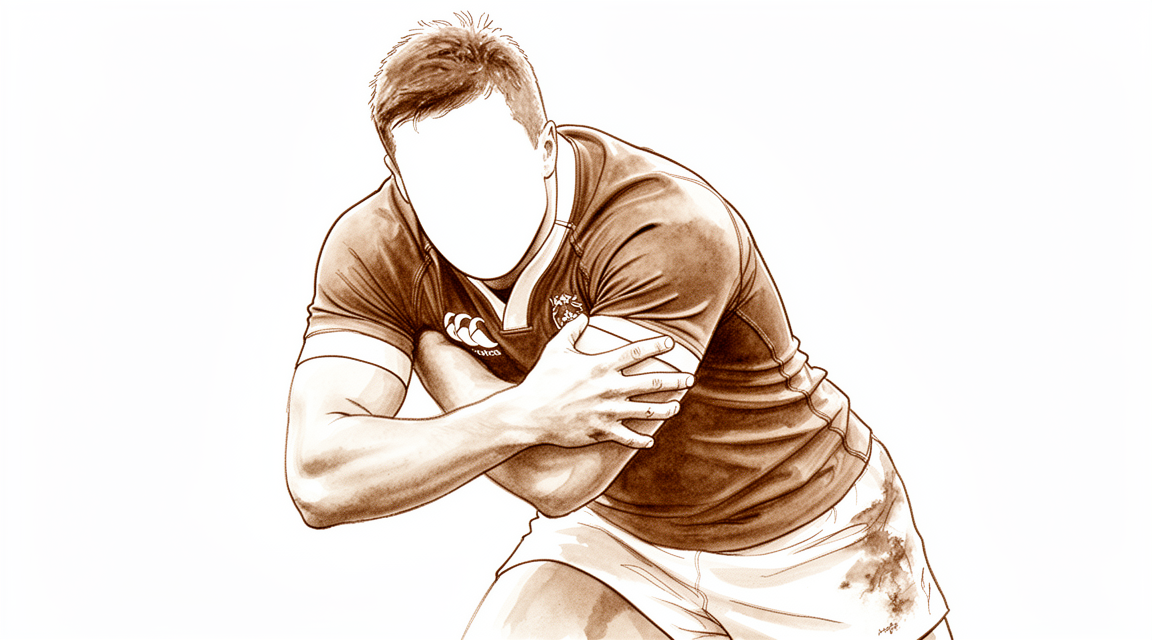
Este protocolo le servirá de guía para su recuperación tras someterse a un procedimiento de Latarjet con el Dr. Kieran Hirpara en el Mater Private Hospital Rockhampton. En él se incluye una explicación sencilla, en lenguaje comprensible, de cada fase del proceso, junto con un programa estructurado que podrá compartir con su fisioterapeuta. Lleve esta página o su versión en PDF a su primera consulta para garantizar una rehabilitación coordinada. Su fisioterapeuta podrá modificar el plan según el avance de su recuperación.
Si tiene alguna duda o inquietud respecto a la herida quirúrgica, no dude en contactar con el consultorio. A menudo resulta útil tomar una fotografía de la herida y enviarla por correo electrónico para su revisión.
Qué esperar
La intervención de Latarjet es una cirugía de bloque óseo indicada para hombros que se dislocan repetidamente hacia la parte delantera. Al emplear un fragmento óseo fijo con tornillos (en lugar de únicamente tejidos blandos suturados), la reparación resulta muy estable desde el principio, y la recuperación suele ser más rápida que en el caso de la estabilización mediante tejidos blandos (la reparación de Bankart). En promedio, los pacientes vuelven a practicar deportes alrededor de las 20 semanas, frente a unas 32 semanas tras una reparación de Bankart.
Sin embargo, “más rápido” no significa “puedes hacer lo que quieras”. El ritmo de su recuperación depende, por encima de todo, de un único factor: la consolidación ósea del fragmento trasplantado en la cavidad glenoidea. Esta unión ósea (denominada consolidación) suele tardar entre 6 y 8 semanas. Hasta que el cirujano confirme que se ha producido dicha unión, se limita cualquier carga sobre el hombro, por muy bien que se sienta el brazo. Además, en la técnica de Latarjet hay dos estructuras adicionales que proteger que no existen en la reparación de Bankart; por eso algunas de las restricciones iniciales que se detallan a continuación son específicas de esta intervención.
El procedimiento
En la cirugía de Latarjet, se traslada un pequeño fragmento óseo llamado coracoide (una protuberancia ósea en la parte delantera de la escápula) y se fija con tornillos al borde anterior de la cavidad glenoidea, donde falta hueso. De este modo se añade hueso en la zona deficiente y se crea un efecto “hamaca” en la parte delantera del hombro, que ayuda a evitar las luxaciones.
Para colocar ese hueso en su posición, el cirujano debe hacerlo pasar a través del subescapular (un músculo situado en la parte delantera del hombro); este músculo se divide o se separa parcialmente y posteriormente se repara. Por consiguiente, hay dos elementos que deben protegerse mientras cicatrizan:
- el fragmento óseo y sus tornillos, que deben unirse a la cavidad glenoidea (consolidación ósea, aproximadamente 6–8 semanas); y
- el músculo subescapular de la parte delantera, que se repara alrededor del hueso trasplantado.
En algunas personas queda una pequeña pérdida permanente de la amplitud de rotación externa (girar la mano hacia afuera) de unos 7–8 grados. Esto es esperado y no constituye una complicación; para la mayoría de las personas no supone ninguna diferencia en su vida cotidiana.
Uso del cabestrillo
Deberá usar un cabestrillo simple para el hombro, no un cojín de abducción ni un cabestrillo en forma de cuña. El Dr. Hirpara emplea un cabestrillo sencillo en las cirugías de estabilización, ya que la fijación ósea es muy sólida y la protección proviene principalmente de mantener el brazo en una posición segura, no de la forma del cabestrillo en sí.
- Use el cabestrillo durante unas 3 semanas para obtener soporte y comodidad durante el día (se irá retirando gradualmente a partir de la semana 3). En el caso de la reconstrucción ósea de Latarjet, el tiempo de uso del cabestrillo es más breve que en las reparaciones de tejidos blandos.
- No duerma con el cabestrillo puesto. Duerma sin él; mantenga el brazo en una posición segura mientras duerme: evite que quede caído hacia un lado o girado hacia afuera (la posición que la cirugía busca prevenir). Acostarse con el brazo apoyado en una almohada cruzada sobre el cuerpo o a un lado resulta cómodo y seguro.
- Quíteselo para ducharse y para hacer sus ejercicios (una vez que le hayan enseñado cómo hacerlos). Cada vez que no lleve el cabestrillo, mantenga el brazo relajado y junto al cuerpo.
- Aplique hielo si el hombro presenta hinchazón o dolor, especialmente después de hacer ejercicio.
Preste atención a su postura mientras usa el cabestrillo: mantenga las orejas, los hombros y las caderas alineados, y evite encorvarse.
Precauciones clave — NO hacer
Estas medidas protegen el bloque óseo, sus tornillos y el músculo anterior mientras cicatrizan.
- NO fuerce el brazo a realizar una rotación externa (girar la mano hacia afuera) en las primeras etapas. Durante las primeras 2 semanas, la rotación externa se mantiene en aproximadamente 25 grados en una posición apoyada, y solo se aumenta gradualmente después, siempre dentro del rango indicado por su cirujano.
- NO estire el brazo hacia atrás, detrás del cuerpo (extensión del hombro); además, evite combinar la rotación externa con el estiramiento hacia atrás. Esto ejerce tensión sobre el tendón unido al hueso transferido.
- NO realice ejercicios de fortalecimiento de rotación interna resistida en las primeras fases (presionar la mano firmemente hacia adentro contra resistencia). Estos ejercicios activan el músculo anterior en proceso de cicatrización (subescapular), por lo que deben evitarse hasta que el cirujano lo autorice.
- NO cargue peso a través del brazo o la mano, ni se impulse con el brazo para levantarse de una silla, ni levante, empuje o tire de objetos pesados hasta que el cirujano confirme que el hueso ya se ha unido (aproximadamente 6–8 semanas). Es el proceso de consolidación ósea, no el tiempo transcurrido, el que determina cuándo se puede aumentar la carga.
- NO realice ejercicios intensos para el pecho ni movimientos por encima de la cabeza en las primeras fases: nada de aperturas de pecho, press de banca con agarre ancho, press militar (por encima de la cabeza), poleas de tracción detrás del cuello ni fondos de tríceps hasta fases avanzadas de la recuperación.
- Evite cualquier movimiento brusco, agarre repentino o caída que afecte al brazo.
Fase I — Protección inmediata (semanas 0–2)
Kieran Hirpara 4.0
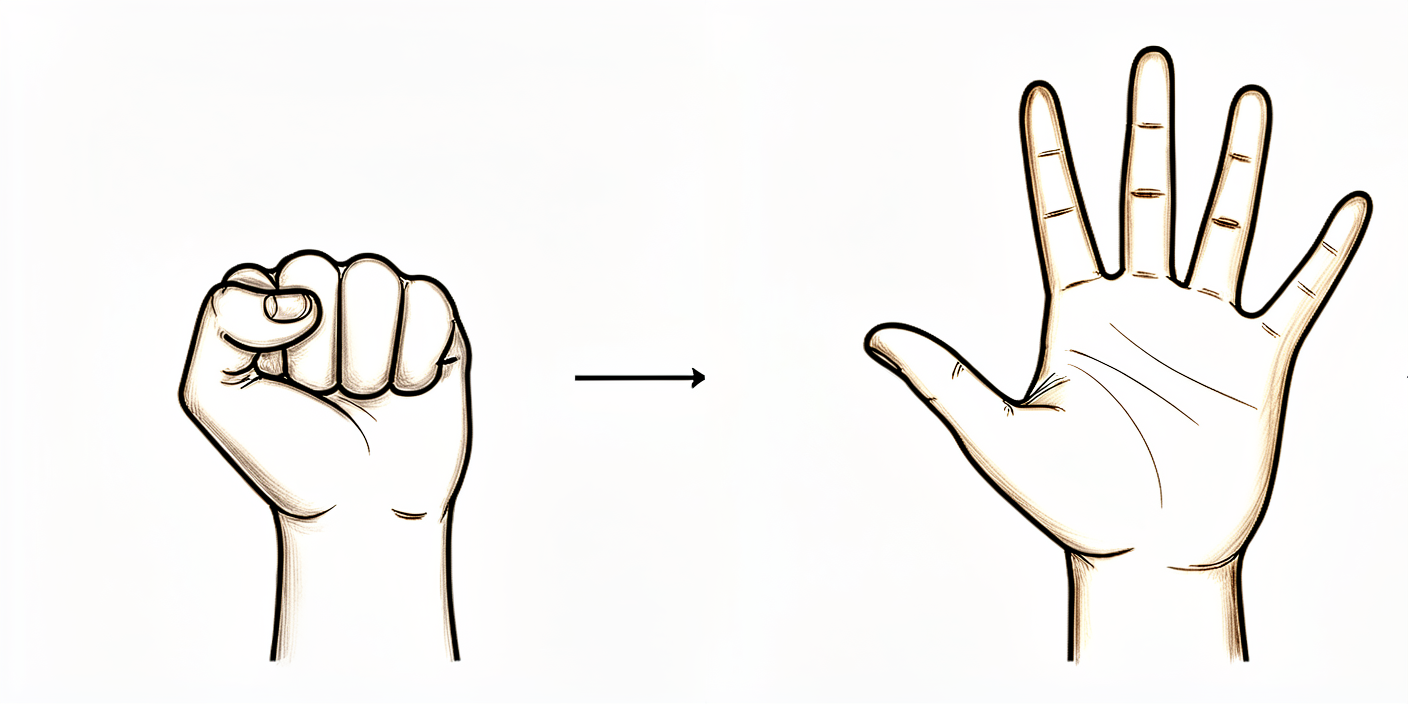
Abrir y cerrar la mano
Cierre el puño con la mano y luego ábralo por completo. Esto mantiene la movilidad de la mano y ayuda a prevenir la rigidez y la hinchazón.
10 veces por hora
Kieran Hirpara 4.0
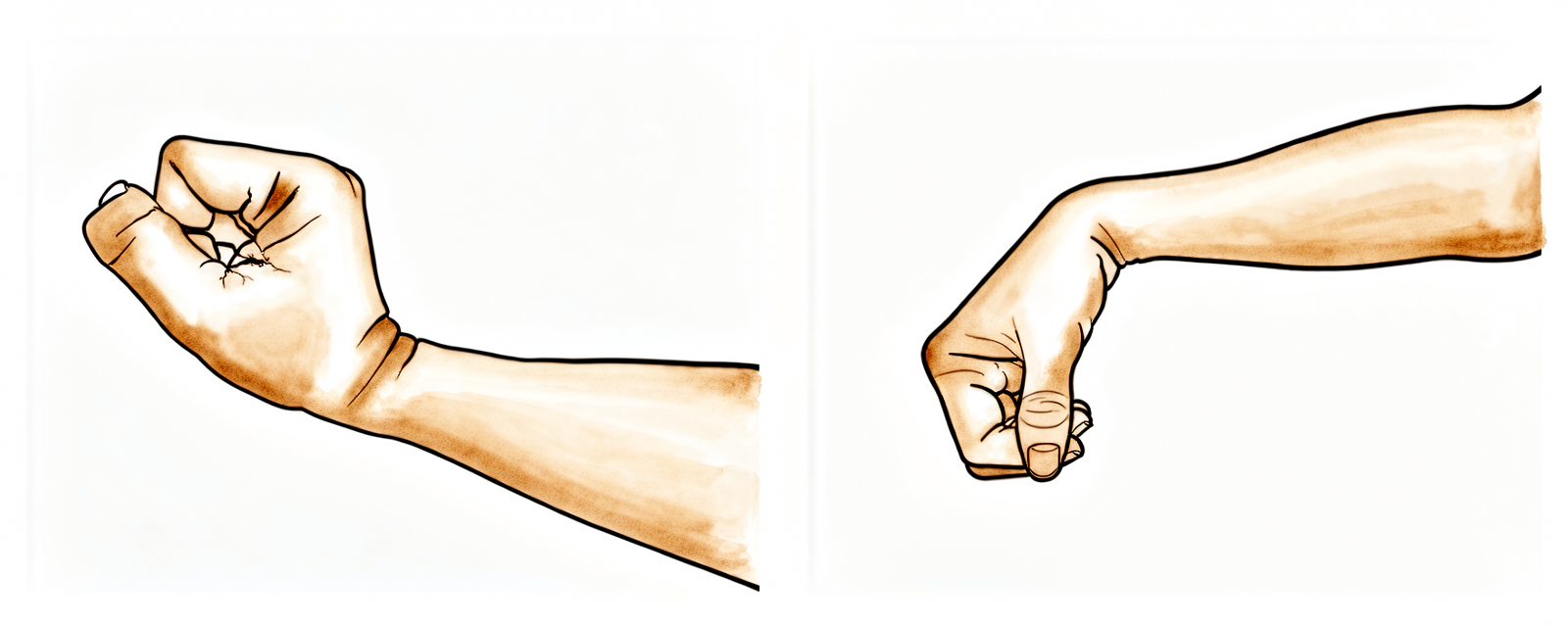
Flexiones activas de la muñeca
Doble su muñeca suavemente hacia adelante y luego hacia atrás, hasta donde le resulte cómodo.
10–15 veces por hora
Kieran Hirpara 4.0
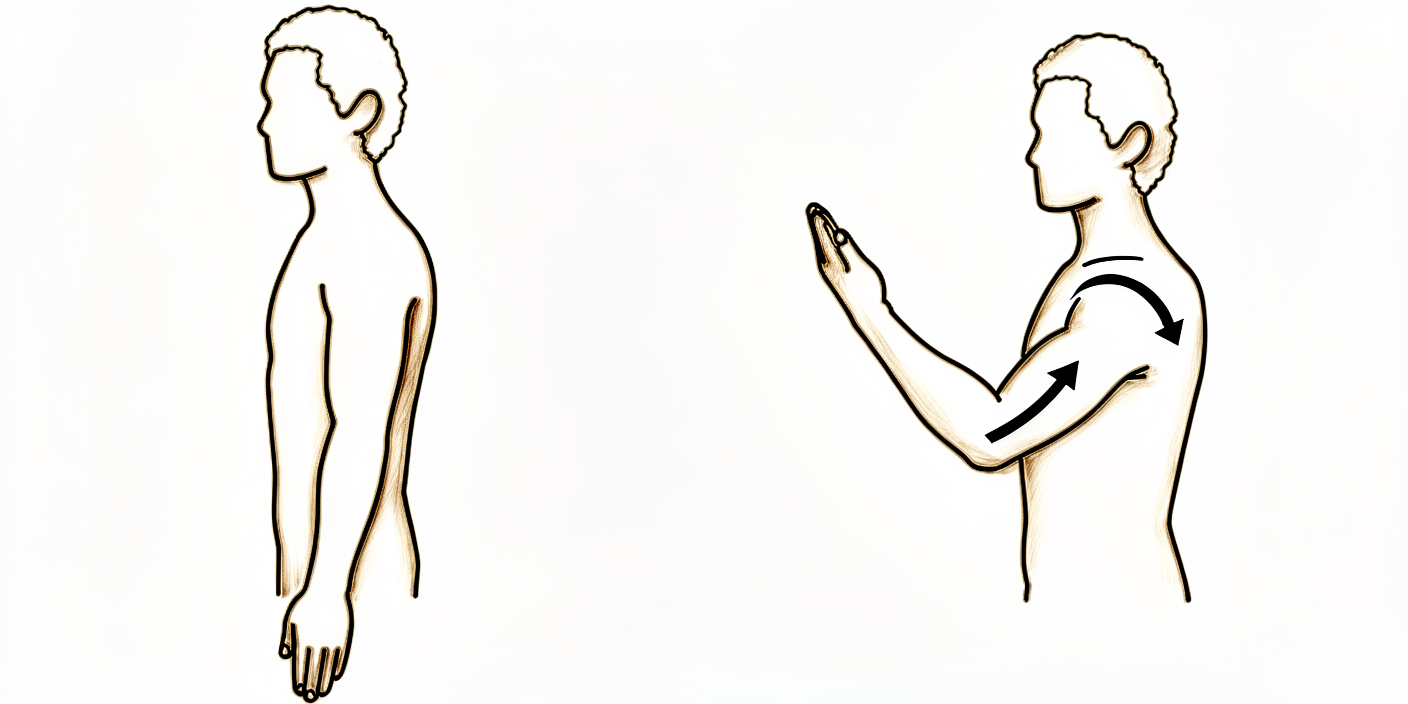
Flexiones activas de codo
Con la palma de la mano hacia arriba, doble su codo suavemente tanto como pueda y luego estire el brazo de nuevo. Mantenga el brazo superior pegado al costado. No permita que el brazo se balancee hacia atrás, por detrás del cuerpo.
10–15 veces, 2–3 veces al día
Kieran Hirpara 4.0
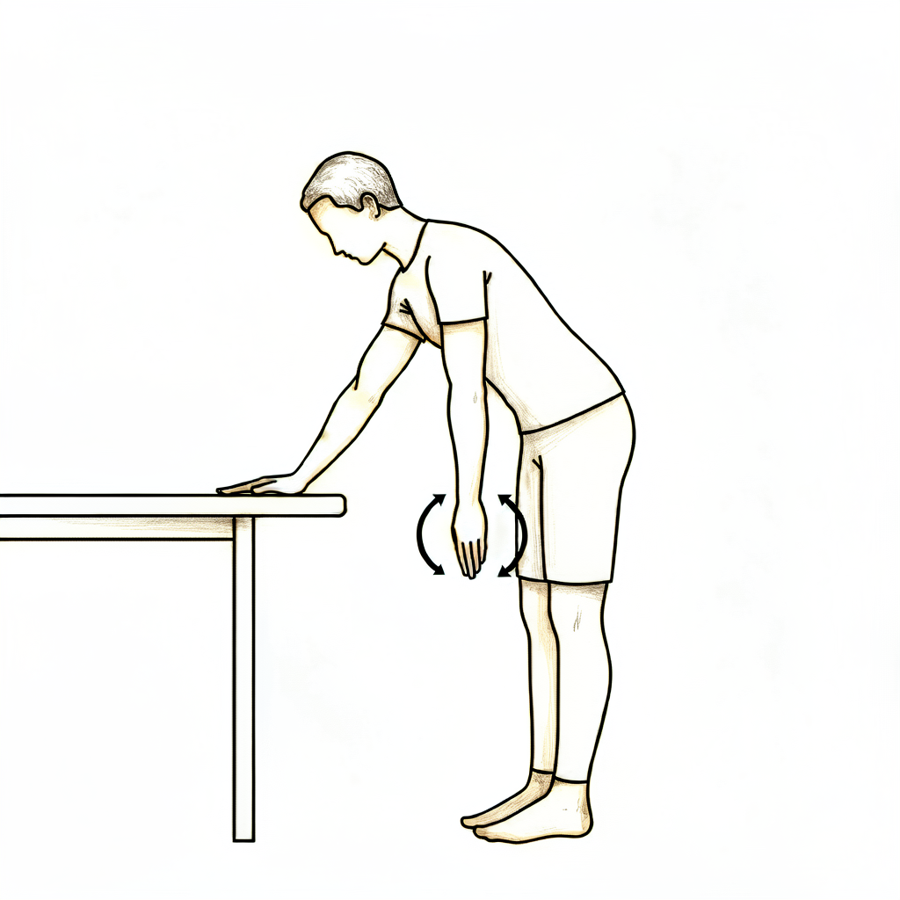
Oscilaciones pendulares
Incline el cuerpo hacia adelante y deje que el brazo operado cuelgue, totalmente relajado. Realice círculos pequeños: primero en sentido horario y luego al revés, balanceando el cuerpo, pero sin usar los músculos del hombro. Mantenga los círculos de tamaño reducido (menos de 20 cm aproximadamente). El brazo operado debe permanecer relajado en todo momento; no lo levante. No permita que el brazo se desplace hacia atrás, detrás del cuerpo.
10 en cada dirección, 2–3 veces al día
Kieran Hirpara 4.0
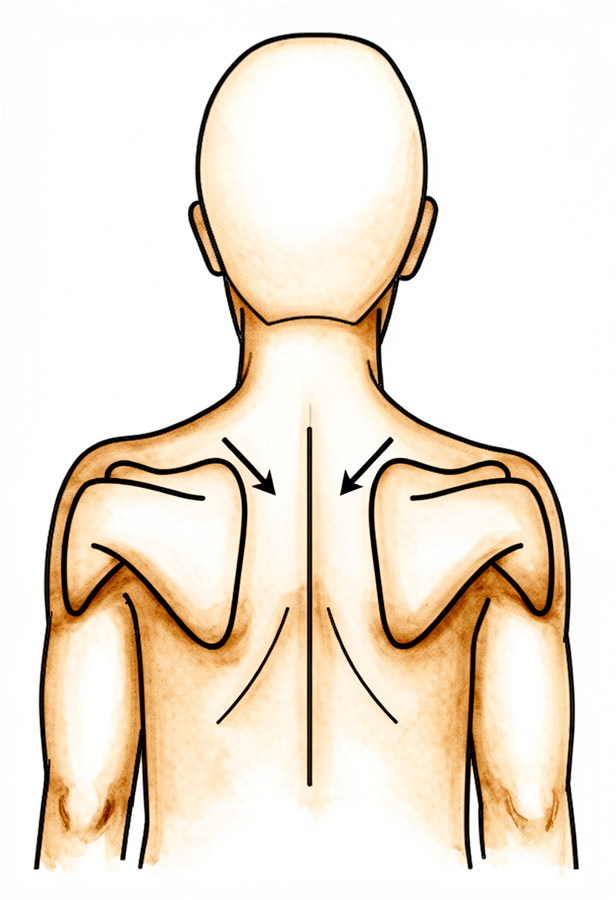
Posicionamiento de la escápula
Apriete suavemente los omóplatos hacia abajo y hacia adentro, mantenga la posición y luego relájese. Este es un ejercicio ligero de activación muscular; su brazo no se mueve.
Mantenga la posición durante 5 segundos, 5 veces; 2–3 veces al día.
Kieran Hirpara 4.0
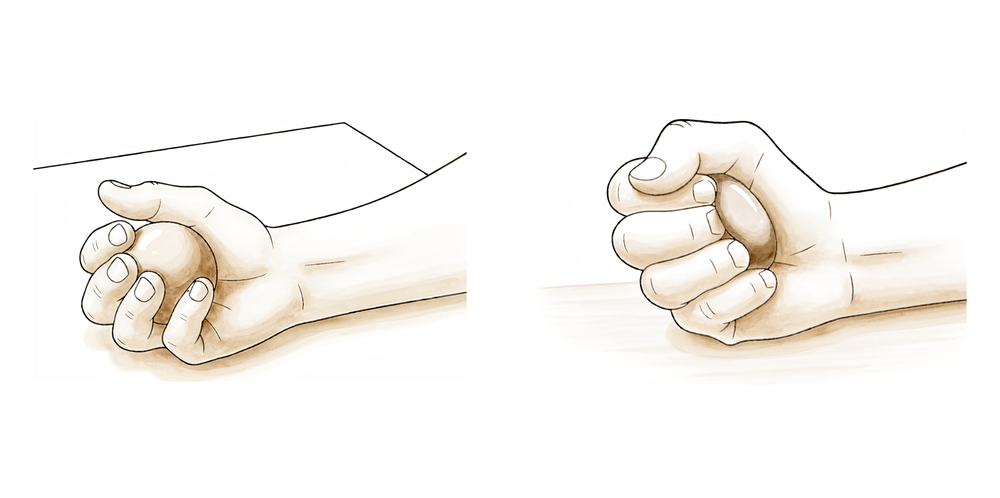
Apriete de pelota
Sostenga una pelota blanda o un calcetín enrollado en la mano y apriételo suavemente; luego relájese. Esto mantiene la mano y el antebrazo activos mientras el hombro descansa.
10 veces, 2–3 veces al día
Las dos primeras semanas consisten en proteger el bloque óseo recién trasplantado y el músculo frontal reparado mientras disminuye la hinchazón. Durante el día se utiliza un cabestrillo sencillo; por la noche se retira (manteniendo el brazo en una posición segura). Asimismo, se realizan ejercicios suaves para mantener en movimiento la mano, la muñeca y el codo, sin ejercer presión sobre el hombro. El hombro, por su parte, solo se mueve de forma suave y pasiva; aún no se levanta el brazo por propia fuerza.
- Cabestrillo: cabestrillo sencillo para apoyo y comodidad durante el día; se debe dormir SIN el cabestrillo, manteniendo el brazo en posición segura; se retira para los ejercicios y la higiene.
- Movimientos permitidos: únicamente movimientos asistidos y pasivos suaves; no se debe levantar el brazo mediante la fuerza del hombro. Se permite elevar el brazo hacia adelante y separarlo lateralmente hasta donde resulte cómodo; la rotación externa debe mantenerse en aproximadamente 25 grados en posición apoyada; no se debe llevar el brazo hacia atrás, detrás del cuerpo.
- Ejercicios: posicionamiento de la escápula; apretar una pelota; movimientos suaves de la mano, muñeca y codo; balanceos pendulares (con el brazo relajado, sin desplazarse hacia atrás).
Se está listo para pasar a la siguiente fase cuando: el dolor se haya reducido y se controle con analgésicos sencillos; la herida haya cicatrizado sin signos de complicaciones; el paciente se sienta cómodo sin el cabestrillo; y los movimientos suaves se mantengan dentro del rango seguro indicado por el cirujano.
Fase II — Restauración del movimiento (semanas 3–9)
Kieran Hirpara 4.0
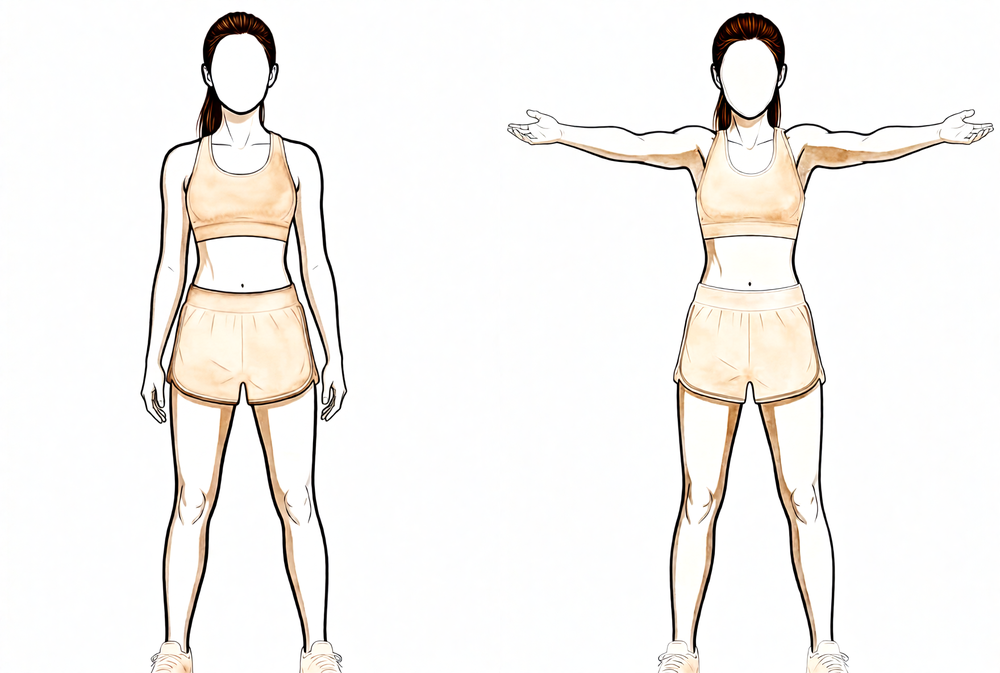
Elevación en “lata llena” hasta la altura del hombro
A partir de la semana 6 aproximadamente, una vez que pueda mover el brazo por sí mismo, levante el brazo hacia adelante y ligeramente hacia un lado, con el PULGAR APUNTANDO HACIA ARRIBA: esta es la posición de “lata llena”. Al principio, levante el brazo solo hasta aproximadamente la altura del hombro (90°), y luego bájelo de forma controlada. No utilice peso alguno o use uno muy ligero (aproximadamente 1–1.5 kg), y realice muchas repeticiones.
Según las indicaciones de su fisioterapeuta.
Kieran Hirpara 4.0
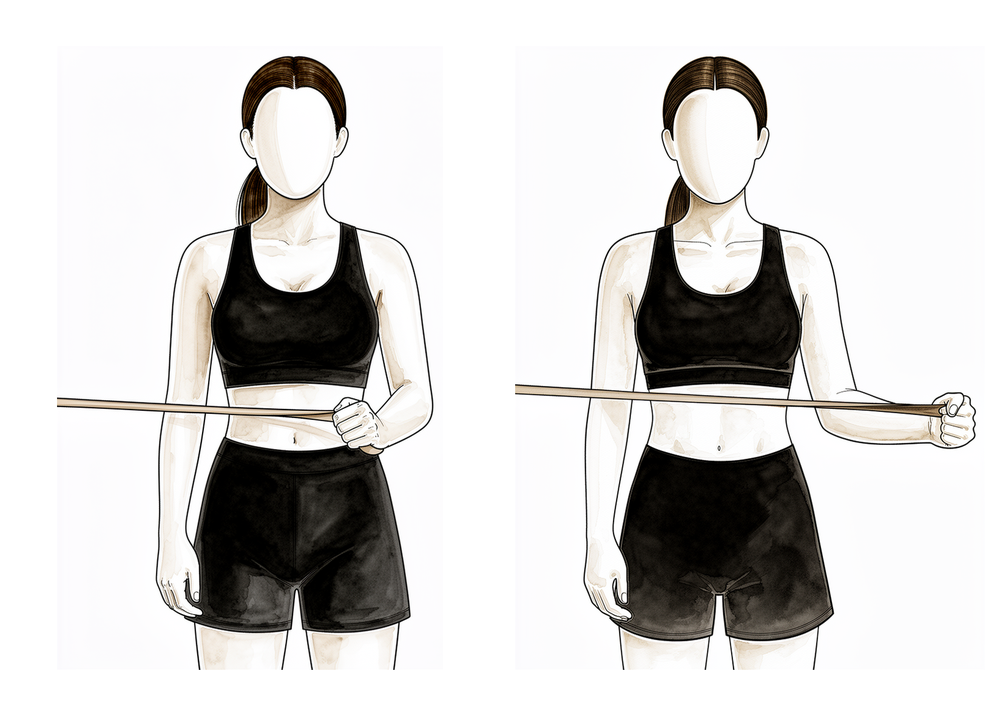
Rotación externa en el costado (banda)
A partir de la semana 6 aproximadamente, dentro del rango de rotación externa que su cirujano haya establecido. Pegue el codo al costado, colocando una toalla enrollada entre el codo y el cuerpo; el codo debe quedar flexionado a 90°. Gire suavemente el antebrazo hacia afuera contra una banda ligera y luego regrese a la posición inicial con control. Manténgase siempre dentro del rango seguro y nunca fuerce el movimiento. Utilice una banda ligera y realice muchas repeticiones, evitando resistencias excesivas.
Según las indicaciones de su fisioterapeuta.
Kieran Hirpara 4.0
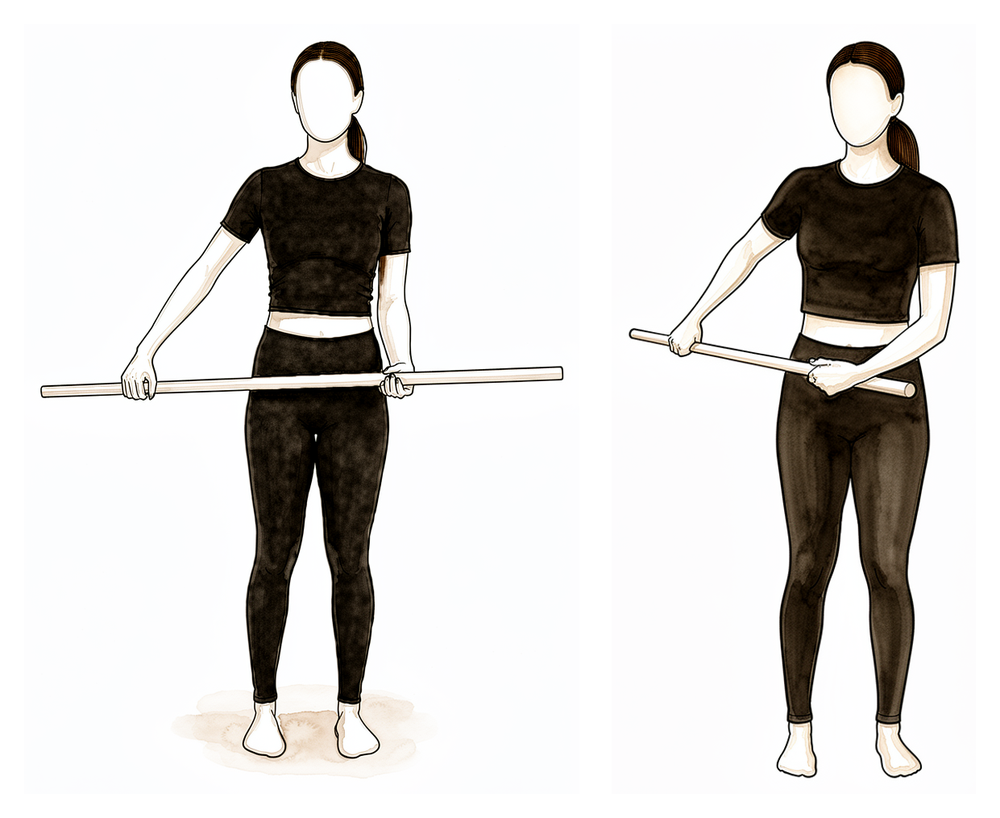
Rotación interna mediante un palo
A partir de la semana 6 aproximadamente, realice el movimiento con suavidad y únicamente siguiendo las indicaciones. Mantenga el codo pegado al costado y utilice un palo en la mano sana para girar suavemente el antebrazo operado hacia adentro, cruzándolo por delante del abdomen, y luego regréselo a su posición original. Este es un movimiento muy suave; NO aplique fuerza ni resistencia en esta fase, ya que la parte frontal del hombro (el músculo subescapular) aún se está recuperando.
Según las indicaciones de su fisioterapeuta.
Kieran Hirpara 4.0
Remo bajo (posicionamiento de los omóplatos)
A partir de la semana 6 aproximadamente. Con la mano apoyada en una superficie fija a su lado, presione hacia abajo y hacia atrás para bajar e interiorizar el omóplato, manteniendo la posición brevemente. Esto estabiliza el omóplato.
Según las indicaciones de su fisioterapeuta.
Kieran Hirpara 4.0
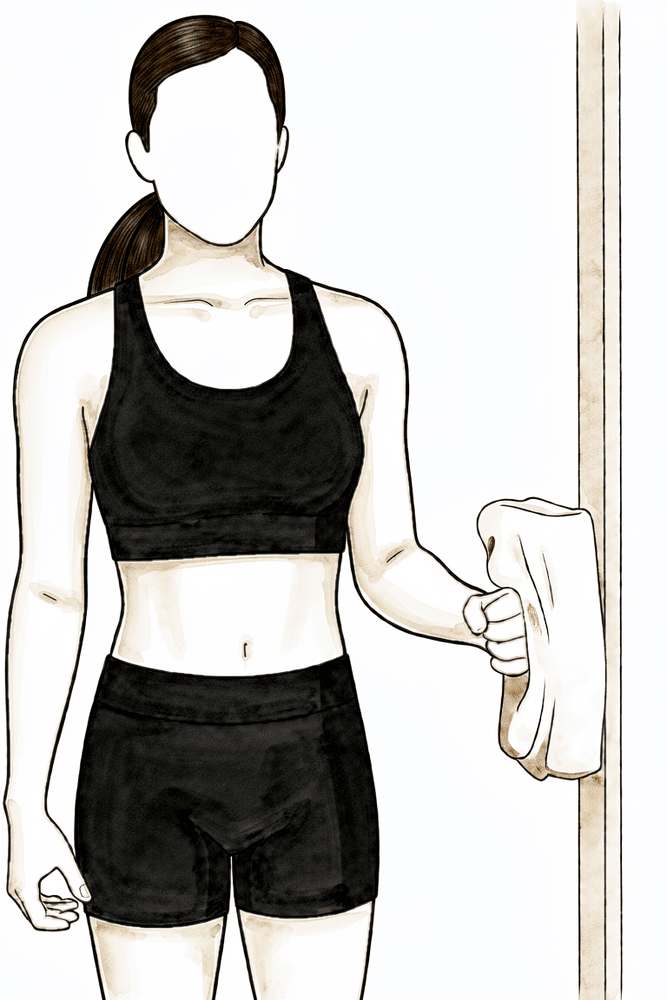
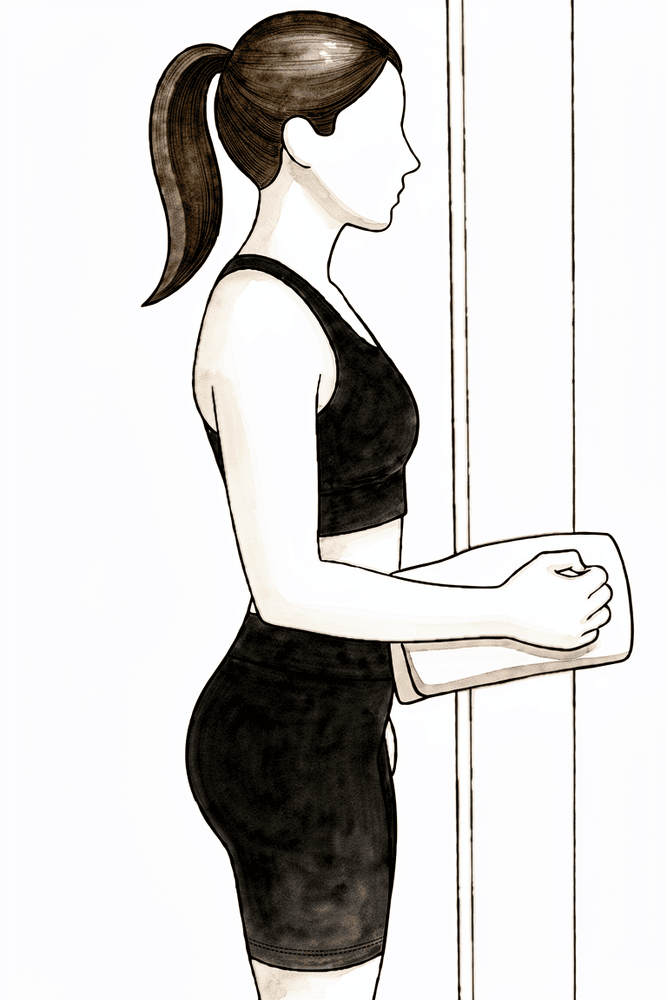
Rotación externa isométrica
A partir de la semana 6 aproximadamente, si su fisioterapeuta lo autoriza y siempre dentro de su rango de movimiento seguro: párese con el codo pegado al costado y flexionado a 90°, de modo que el dorso de la mano quede cerca de una pared o marco de puerta. Presione suavemente el dorso de la mano hacia afuera contra esa superficie, SIN mover el brazo; se trata de un esfuerzo suave, equivalente a aproximadamente un cuarto de su capacidad máxima, y no debe causar dolor. Mantenga esa posición y luego relájese.
Mantenga la posición durante ~5 segundos, con suavidad (~25% de esfuerzo), según las indicaciones de su fisioterapeuta.
Kieran Hirpara 4.0
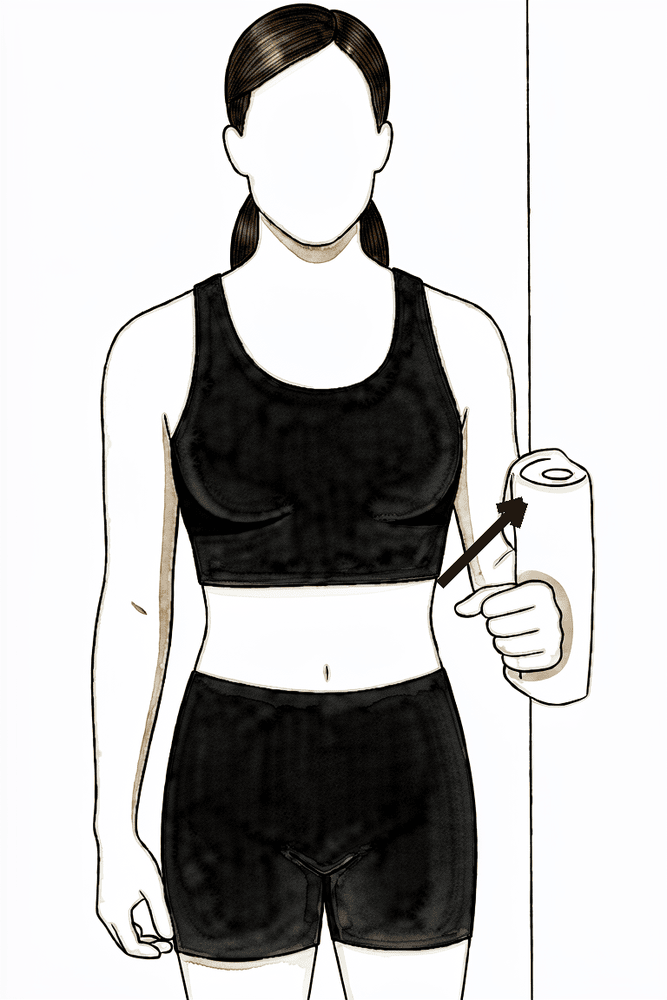
Rotación interna isométrica
Se pospone hasta más adelante (generalmente después de que el injerto se haya unido y el cirujano lo autorice), ya que la presión hacia el interior trabaja el músculo anterior que está cicatrizando (el subescapular). Una vez autorizado, párese con el codo pegado al costado, la palma de la mano contra una pared, y presione suavemente la palma hacia el interior SIN mover el brazo; use aproximadamente una cuarta parte de su fuerza y sin sentir dolor. Mantenga la presión y luego relájese.
Mantenga la posición durante ~5 segundos, con suavidad (~25% de esfuerzo), según las indicaciones de su fisioterapeuta.
Kieran Hirpara 4.0
Abducción isométrica
A partir de la semana 6 aproximadamente, si su fisioterapeuta lo considera adecuado. Párese de lado, con la parte externa del brazo cerca de una pared y el codo junto al cuerpo. Presione suavemente el brazo hacia afuera contra la pared SIN permitir que se mueva; use aproximadamente una cuarta parte de su fuerza y sin sentir dolor. Mantenga la posición y luego relájese.
Mantenga la posición durante ~5 segundos, con suavidad (~25% de esfuerzo), según las indicaciones de su fisioterapeuta.
Ahora el enfoque es el movimiento, no la fuerza. El cabestrillo se va retirando a partir de la semana 3. Se pasa de un movimiento asistido a mover el brazo por propia iniciativa; la rotación externa se va ampliando gradualmente: al principio hasta unos 45 grados en una posición apoyada, y luego hasta el límite tolerado aproximadamente a partir de la semana 6, siempre dentro de los límites indicados por el cirujano. Se incorporan ejercicios isométricos suaves de presión y retención, procurando que el esfuerzo en rotación interna sea leve para proteger el músculo anterior. La carga todavía debe esperar; durante esta fase el bloque óseo apenas está uniendo.
- Cabestrillo: se retira a partir de la semana 3.
- Movimientos permitidos: movimiento asistido que evoluciona hacia movimiento autónomo alrededor de la semana 6 (hacia unos 90–110° de elevación). La rotación externa se amplía gradualmente: al principio unos 45 grados con apoyo, luego hasta el límite tolerado, dentro del rango establecido por el cirujano. La rotación interna se realiza suavemente hasta unos 45 grados.
- Ejercicios: elevación en “lata llena” hasta la altura del hombro; ejercicios suaves de rotación externa con banda sobre un rodillo de toalla; rotación interna suave con un palo (sin aplicar fuerza); remo bajo; ejercicios isométricos suaves de presión y retención para rotación externa y abducción aproximadamente a partir de la semana 6 (los isométricos de rotación interna se posponen para más adelante). El fisioterapeuta también puede añadir suaves ejercicios rítmicos de estabilización (movimientos de mantenimiento de la posición en los que empuja ligeramente el brazo y usted ofrece resistencia) para recuperar el control; se trata de trabajo manual sin diagramas.
Se está listo para la siguiente fase cuando: el cirujano haya confirmado (normalmente en una revisión alrededor de las 6–8 semanas) que el bloque óseo ya se ha unido; usted pueda mover el brazo por propia iniciativa con buen control; sus movimientos asistidos y pasivos sean completos o casi completos y cómodos; y los ejercicios isométricos suaves no provoquen aumento del dolor posteriormente. El fortalecimiento no comienza hasta que se confirme la unión ósea: este paso depende de la consolidación ósea, verificada por el cirujano, no del calendario.
Fase III — Fortalecimiento (semanas 10–15)
Kieran Hirpara 4.0
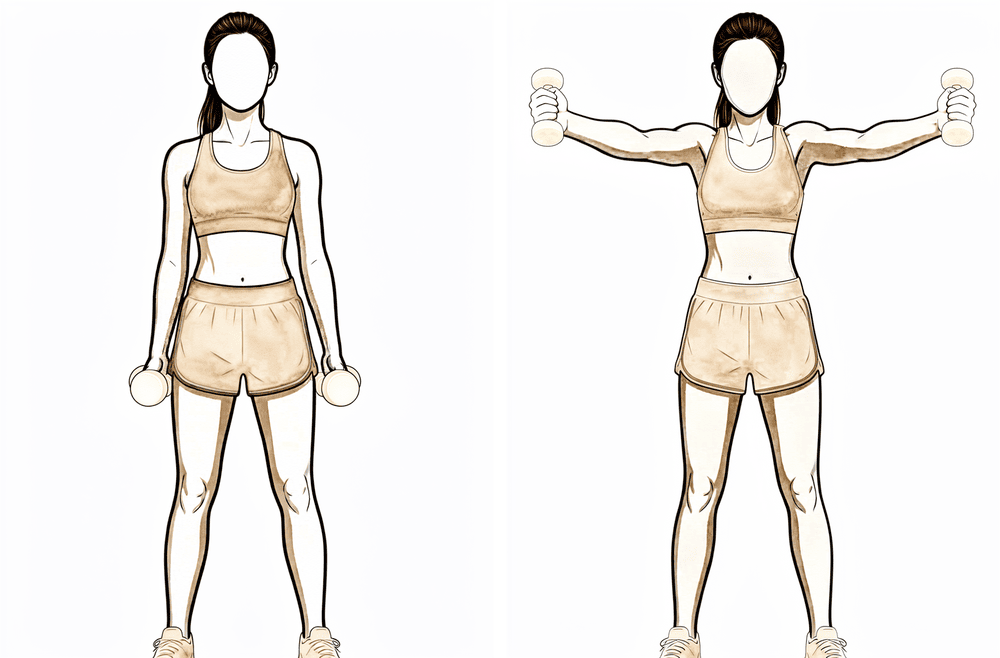
Elevación en “lata llena” con un peso ligero
A partir de la semana 10 aproximadamente, una vez que su cirujano haya confirmado que el bloque óseo se ha unido. Realice la elevación en “lata llena” como antes, ahora aumentando gradualmente la altura y añadiendo un peso ligero. Mantenga el PULGAR HACIA ARRIBA. Deténgase si el hombro le duele o si presenta hinchazón posteriormente.
Según las indicaciones de su fisioterapeuta.
Kieran Hirpara 4.0
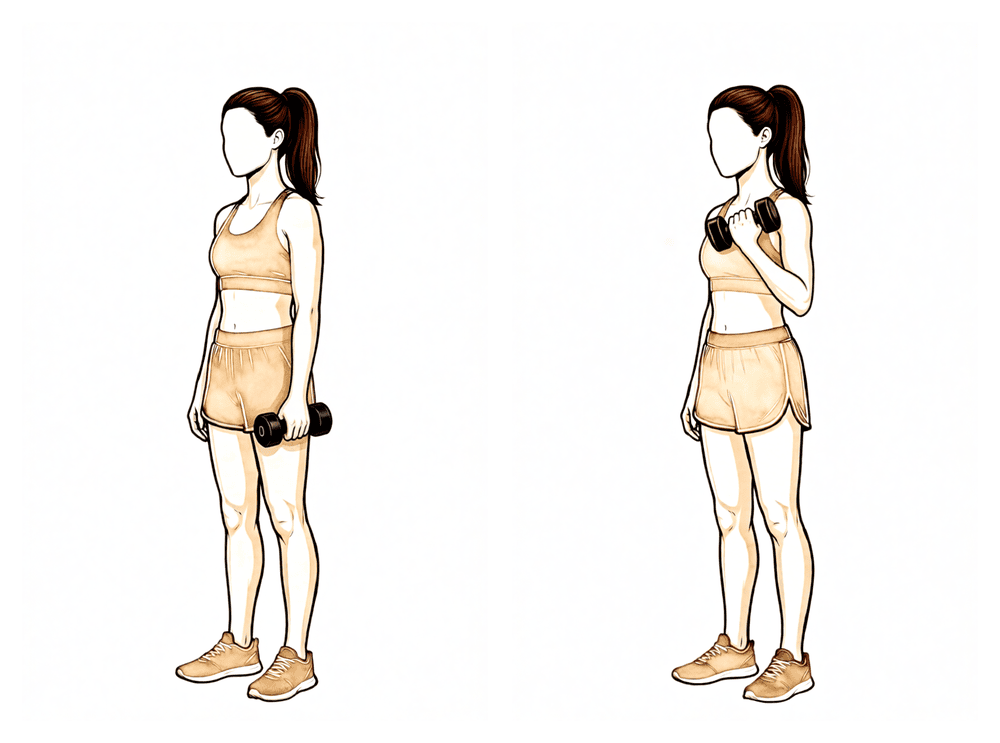
Flexiones ligeras de bíceps
A partir de la semana 10 aproximadamente, una vez confirmada la consolidación ósea. Con el brazo pegado al costado, flexione el codo para levantar una pesa ligera y luego bájela de forma controlada. Aumente el peso gradualmente. El tendón del bíceps se inserta muy cerca del bloque óseo; por eso, comience con un peso ligero y progrese despacio.
Según las indicaciones de su fisioterapeuta.
Kieran Hirpara 4.0
Rotación interna por la parte posterior, utilizando un palo (opción 1)
A partir de la semana 12 aproximadamente, una vez que su cirujano y fisioterapeuta consideren que el músculo anterior (subescapular) ha sanado, sostenga un palo detrás de la espalda y use la mano sana para llevar suavemente la mano operada hacia arriba por la espalda, y luego bájela con control. Asegúrese de que la actividad sea cómoda y se mantenga dentro de los límites indicados por su fisioterapeuta.
Según las indicaciones de su fisioterapeuta.
Kieran Hirpara 4.0
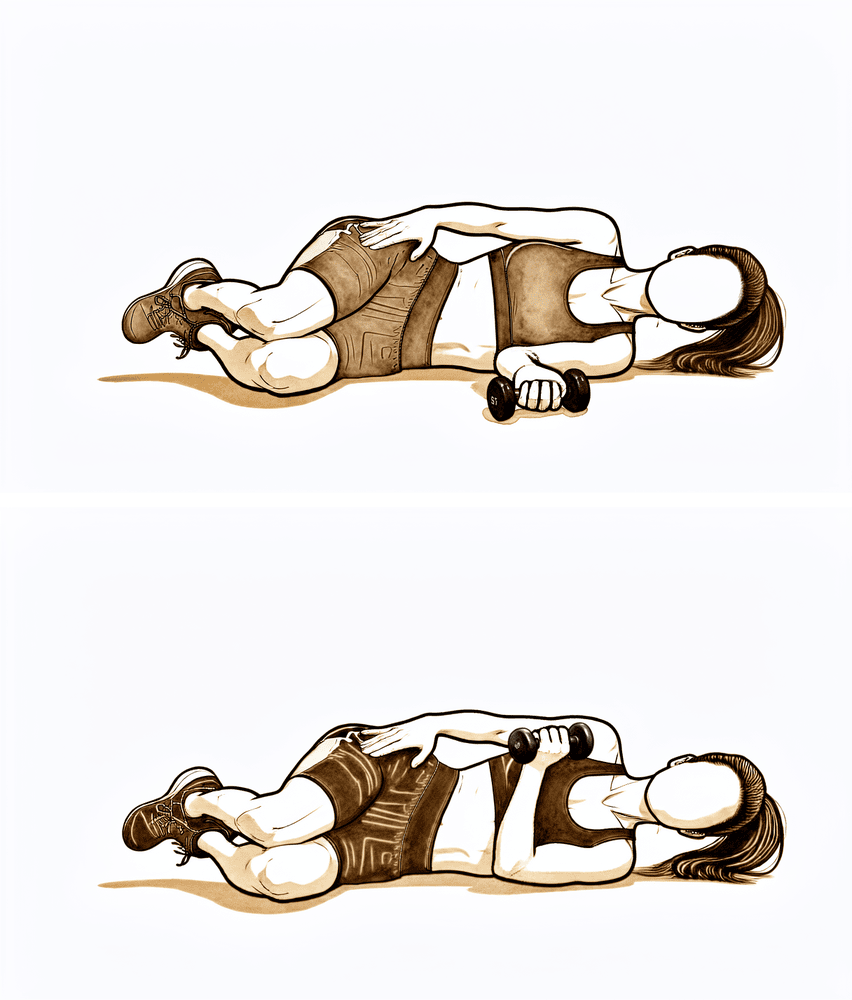
Rotación interna con un peso ligero, en posición lateral (opción 2)
Una alternativa a la versión con palo, con el mismo cronograma (aproximadamente a partir de la semana 12, una vez que el músculo anterior haya sanado). Acuéstese sobre el lado operado, con el codo pegado a la cintura y flexionado a 90°; gire el antebrazo de modo que la mano levante un peso ligero hacia el abdomen, y luego bájelo de forma controlada. Su fisioterapeuta elegirá la versión que mejor se adapte a usted; ambas fortalecen la misma capacidad de rotación interna.
Según las indicaciones de su fisioterapeuta.
Kieran Hirpara 4.0
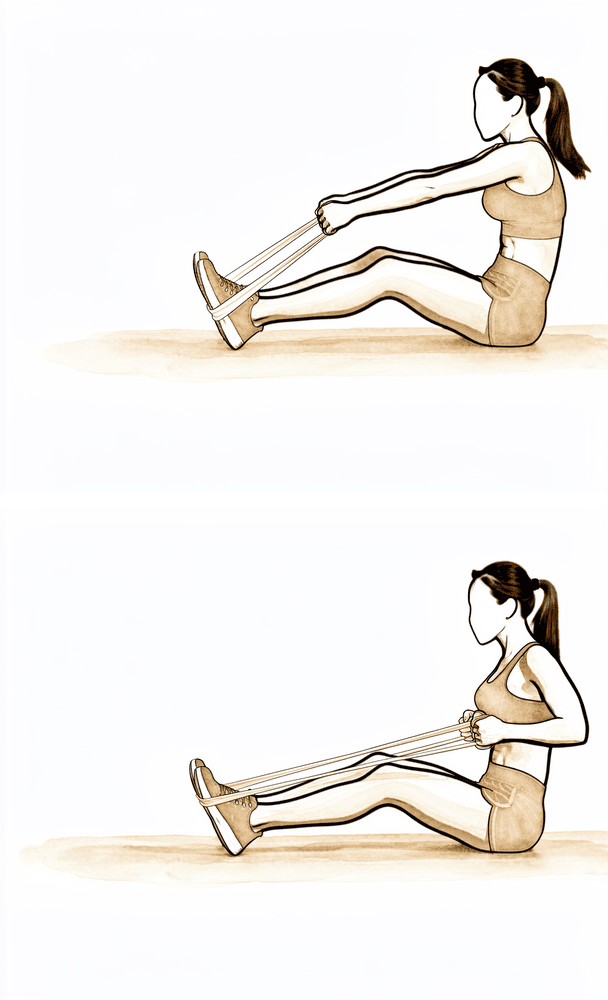
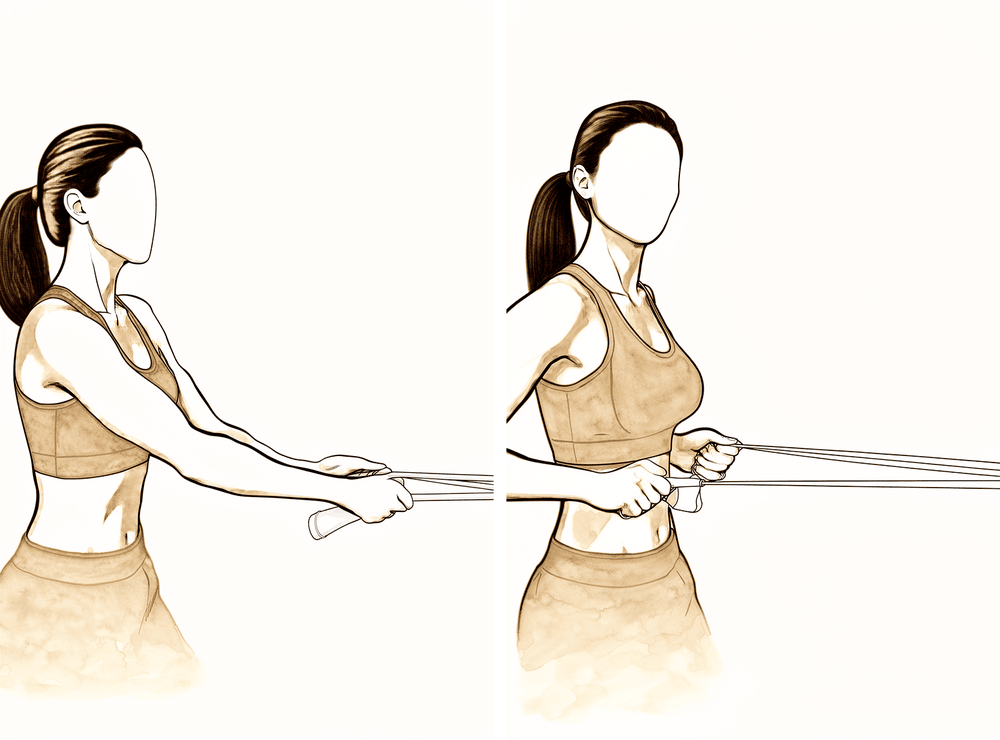
Remo con banda de resistencia
A partir de la semana 10 aproximadamente, una vez confirmada la consolidación ósea. Con una banda fijada delante de usted, tire de las asas hacia sí, llevando los codos hacia atrás y juntando los omóplatos; luego regrese a la posición inicial de forma controlada. Use una banda de baja resistencia y realice muchas repeticiones; deténgase si siente dolor en el hombro.
Según las indicaciones de su fisioterapeuta.
Kieran Hirpara 4.0
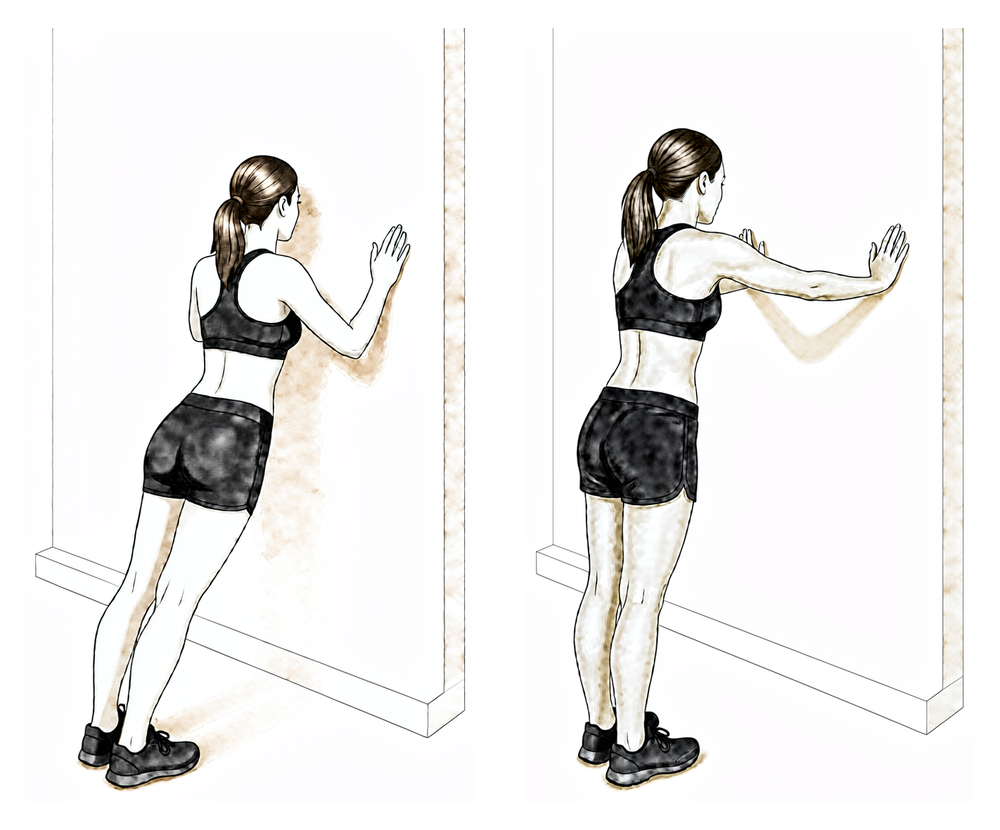
Flexión plus (contra la pared)
A partir de la semana 10 aproximadamente, una vez confirmada la consolidación ósea. Comience haciendo el ejercicio contra una pared (no en el suelo). Realice una flexión lenta; en la posición superior, empuje un poco más de modo que los omóplatos se separen y la parte superior de la espalda se curve ligeramente. Evite que los codos se muevan más atrás que los hombros. Este ejercicio trabaja el músculo anterior (subescapular); realícelo con suavidad y sin causar dolor.
Según las indicaciones de su fisioterapeuta.
Kieran Hirpara 4.0
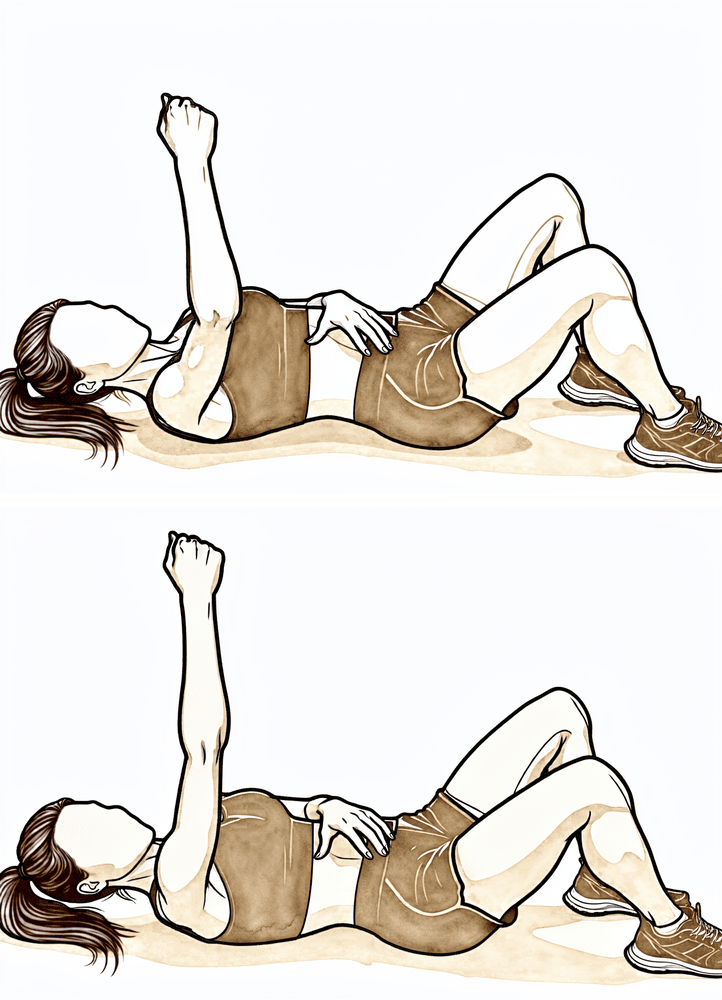
Puñetazo hacia adelante (en decúbito supino)
A partir de la semana 10 aproximadamente, una vez confirmada la consolidación ósea. Acuéstese boca arriba, con el brazo extendido hacia el techo, sosteniendo un peso ligero o sin ninguno. Estire la mano un poco más hacia el techo de modo que el omóplato se levante de la cama, y luego bájelo de forma controlada. Se trata de un ejercicio suave para el subescapular; manténgalo de intensidad leve.
Según las indicaciones de su fisioterapeuta.
Kieran Hirpara 4.0
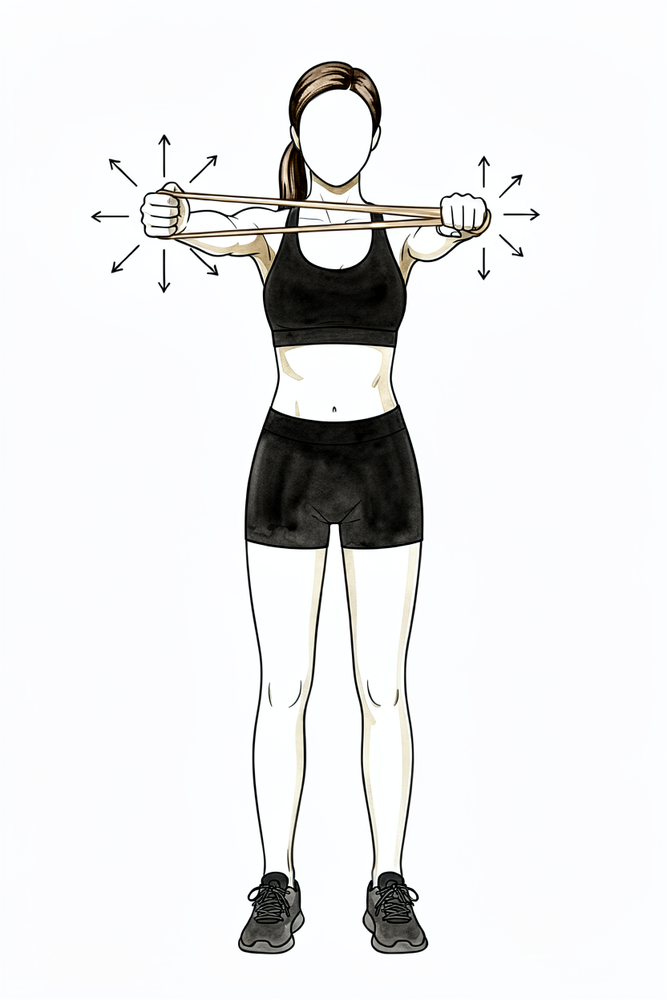
Estabilización rítmica
Con el brazo apoyado delante de usted a una altura aproximada de los hombros, pida a su fisioterapeuta (o a su mano sana) que realice pequeños empujes suaves desde distintas direcciones, mientras usted mantiene el brazo inmóvil y estable; no permita que se mueva. Esto entrena a los músculos estabilizadores del hombro para que reaccionen. Asegúrese de que todos los esfuerzos sean suaves.
Según las indicaciones de su fisioterapeuta.
Una vez que su cirujano haya confirmado que el hueso se ha unido, podrá comenzar a cargar peso sobre el hombro. El fortalecimiento se inicia con bandas elásticas y pesos ligeros: muchas repeticiones y cargas bajas, aumentando progresivamente. La regla de oro es una dirección a la vez: solo se fortalece una dirección cuando ya se cuenta con un rango de movimiento casi completo y cómodo en esa dirección. El fortalecimiento de la rotación interna y del músculo anterior (subescapular) se sigue introduciendo más tarde y con cuidado, ya que ese músculo fue reparado durante la operación.
- Cabestrillo: no se usa; se espera un rango de movimiento casi completo y cómodo antes de comenzar a cargar peso en cualquier dirección.
- Ejercicios: elevación en “lata llena” con un peso ligero que se aumenta gradualmente; flexiones de bíceps con peso ligero; remos con banda elástica; flexión plus contra la pared y puñetazos hacia adelante en decúbito supino para el músculo anterior; rotación interna por la espalda usando un palo (de forma suave, aproximadamente a partir de la semana 12, una vez que el músculo anterior haya sanado). Aumente las cargas poco a poco y deténgase si el hombro duele o se hincha.
Listo para pasar a la siguiente fase cuando: tenga un rango de movimiento activo completo y sin dolor, con buen control del omóplato; no haya dolor ni hinchazón tras las sesiones de fortalecimiento; pueda levantar cargas con resistencia por debajo de la altura del hombro sin dificultad; y su fuerza en rotación externa vaya aumentando y acercándose a la del otro lado.
Fase IV — Movimientos por encima de la cabeza y retorno al deporte (semanas 16–20)
Kieran Hirpara 4.0
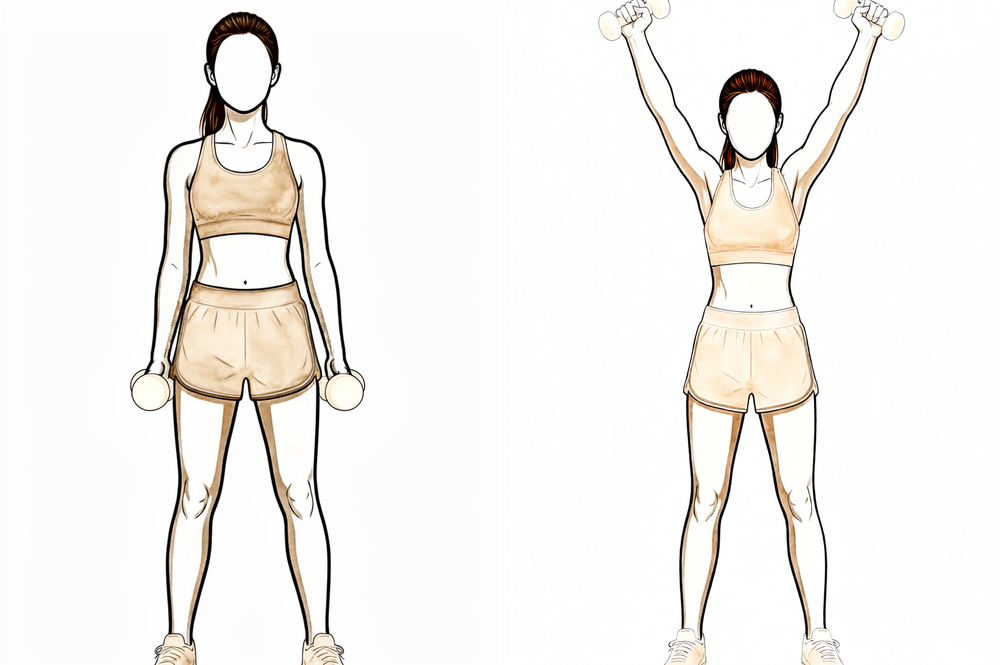
Elevación en “lata llena” por encima de la cabeza
A partir de la semana 16 aproximadamente, una vez que la fuerza en la zona por debajo de la altura del hombro sea adecuada, levante el brazo hacia adelante y ligeramente hacia el costado, manteniendo el PULGAR HACIA ARRIBA. Posteriormente, vaya elevando el brazo por encima de la altura del hombro, utilizando un peso ligero que se incremente gradualmente. Deténgase si siente dolor en el hombro o si este se hincha después del ejercicio.
Según las indicaciones de su fisioterapeuta.
Kieran Hirpara 4.0
Remo progresivo con banda de resistencia
Continúe con el remo con banda; ahora aumente la resistencia y el número de repeticiones como base para entrenamientos más intensos y para el acondicionamiento específico del deporte. Mantenga un buen control de los omóplatos.
Según las indicaciones de su fisioterapeuta.
Esta fase constituye el puente para recuperar un hombro plenamente funcional y para volver gradualmente al deporte y a actividades laborales más exigentes. Se mantiene el rango de movilidad ya logrado y se desarrolla la fuerza, la potencia y la resistencia necesarias para utilizarlo con confianza, incluso en movimientos por encima de la cabeza. El retorno se realiza de forma escalonada, no repentina; en el ámbito deportivo, un programa progresivo que aumente paso a paso el volumen y la intensidad es el método más seguro para volver a la actividad.
- Cabestrillo: no se utiliza.
- Ejercicios: elevaciones en “lata llena” por encima de la cabeza con peso ligero, aumentando progresivamente dicho peso una vez que la fuerza a niveles inferiores a la altura del hombro sea adecuada; ejercicios de remo con bandas elásticas de dificultad creciente; entrenamiento específico para el deporte y el trabajo; y, hacia el final de esta fase, ejercicios controlados a mayor velocidad (tipo pliométricos), según corresponda. También se pueden incorporar flexiones, procurando que los codos no se muevan demasiado hacia atrás.
Listo para el retorno cuando: la fuerza en la rotación externa esté dentro de aproximadamente un 8–10% de la del otro lado y su fuerza de rotación global vaya aumentando de manera uniforme; se cuente con un rango de movimiento completo y sin dolor, sin hinchazón alguna al aplicar cargas mayores; y se superen las pruebas específicas para el deporte o la actividad laboral que se desea retomar. El retorno al deporte suele ocurrir alrededor de la semana 20, mientras que en deportes de contacto o colisión suele retrasarse un poco más (alrededor de 5–6 meses), siempre y cuando se cumplan estos criterios y se cuente con la autorización del Dr. Hirpara y de su fisioterapeuta, no simplemente por el paso del tiempo.
Regreso al deporte y al trabajo
El regreso se basa en criterios específicos: ausencia de dolor, rango de movimiento, fuerza y resistencia adecuados, además de la autorización tanto del Dr. Hirpara como de su fisioterapeuta; no depende únicamente del calendario. Dado que la técnica de Latarjet utiliza hueso sólido, la recuperación suele ser más rápida que en reparaciones de tejidos blandos; sin embargo, cualquier actividad más intensa que movimientos suaves debe esperar hasta que el bloque óseo se haya consolidado (aproximadamente 6–8 semanas, según confirme su cirujano).
- Las actividades ligeras, a nivel del pecho, pueden reanudarse a partir de las 10–15 semanas aproximadamente.
- Las actividades por encima de la cabeza o de lanzamiento se permiten a partir de los 4 meses aproximadamente.
- El regreso al deporte suele ocurrir alrededor de las 20 semanas; para deportes de contacto o con colisiones, el retorno suele ser alrededor de los 5–6 meses, y siempre una vez que se cumplan los requisitos de fuerza y movilidad.
Después de seguir el protocolo
Este protocolo complementa las recomendaciones generales de recuperación de la consulta; consulte control del dolor postoperatorio y cuidado de la herida.
Evidence & references
This is the clinical evidence summary written for health professionals. It is technical, and it lists the research this page was built from. You do not need to read it to understand your treatment or to make a decision about it.
Latarjet (Coracoid Transfer) for Anterior Instability with Bone Loss: Rehabilitation Evidence
Topic: Open Latarjet / Bristow-Latarjet coracoid transfer for anterior glenohumeral instability with glenoid bone loss (>~20% glenoid, or off-track Hill-Sachs / failed soft-tissue repair). Compiled: 2026-06-16. Sources: local RAG Orthopaedic corpus + published fellowship/PT "standard of care" protocols.
How Latarjet rehab DIFFERS from arthroscopic Bankart
- It is a BONY procedure (coracoid autograft screw-fixed to the antero-inferior glenoid). Fixation is rigid -> the structural construct is stronger than soft-tissue suture anchors, so AROM and return to sport are generally FASTER than Bankart (Beletsky 2020: mean RTS ~19.6 wk Latarjet vs ~32.4 wk Bankart, p<0.001).
- BUT two distinct soft-tissue structures must be protected that Bankart does not involve: (1) the subscapularis (split, or taken down and repaired, to pass the graft); (2) the coracoid graft osseous union (~6-8 weeks to unite) plus the conjoint-tendon (biceps short head + coracobrachialis) "dynamic sling" still attached to the graft.
- Graft-protection precautions: avoid aggressive shoulder extension and combined extension + external rotation stretching early (tensions the conjoint origin on the graft). Progress biceps/coracobrachialis strengthening gradually. If subscapularis was taken down & repaired, slow ER progression and avoid aggressive IR strengthening until subscap healed - get an intra-operative "safe-zone" ER from the surgeon.
- Expect a permanent mild ER deficit (Hovelius: mean loss ~7.4 deg in adduction, ~8 deg in abduction) - this is accepted, not a complication.
Consensus phased timeline (BWH Latarjet standard of care)
| Phase | Week window | Sling/brace | ROM allowed & restrictions | AROM / strengthening | RTS |
|---|---|---|---|---|---|
| I - Immediate post-surgical | 0-2 wk | Sling at all times (remove only to shower, arm at side); towel under elbow to prevent hyperextension (graft protection); sleep in sling | No AROM. PROM only, no forcing: flexion/elevation & scaption to tolerance; IR to 45 deg at 30 deg abd; ER 0-25 deg in scapular plane at 30-40 deg abd (open-packed); respect anterior capsule; use intra-op ER measurements | Scapular isometrics, ball squeezes; cryotherapy | None |
| II - Intermediate / ROM | 3-9 wk | Wean from sling beginning wk 3 | Early (wk 3-4): ER to 0-45 deg at 30-40 deg abd, IR 45 deg at 30 deg abd. Late (wk 6): ER to tolerance, progress to multiple abd angles once >=35 deg; IR multi-angle. AAROM from wk 3 -> AROM by ~wk 6 (good mechanics, up to 90-110 deg elevation) | Begin balanced AROM/strengthening late phase II (~wk 6): high-rep/low-load (1-3 lb), full-can scaption to 90 deg, ER/IR tubing at 0 deg abd (towel roll), prone rows, rhythmic stabilisation. Subscap-specific work (upper+lower fibres) | None |
| III - Strengthening | 10-15 wk | None | Continue A/PROM; near-full ROM before loading a plane | Biceps curls light; progressive pec major/minor (avoid anterior-capsule-stress positions); subscap strengthening (push-up plus, cross-body diagonals, IR band 0/45/90, forward punch) | Chest-level functional activities |
| IV - Overhead / return to activity | 16-20 wk | None | Full pain-free ROM | Overhead strengthening once sub-90 strength good; progressive weightlifting (15-25 reps); plyometrics/interval program if cleared; push-ups allowed but elbows not past 90 deg | Throwing/overhead not before 4 months; pre-injury sport when cleared by MD |
Active ROM start: AAROM wk 3, AROM ~wk 6. Strengthening start: scapular isometrics immediately; isotonic/RC strengthening ~wk 6. RTS: chest-level ~10-15 wk; overhead/throwing >=4 months; full/contact sport typically ~5-6 months (RAG cohorts: open Latarjet RTS averages ~6 months; bone-block soft-tissue/graft healing requires the 3-month minimum). ER milestones to advance: PE >=155 deg, ER within 8-10 deg of contralateral at 20 deg abd and >=75 deg at 90 deg abd.
Graft-protection summary (the Latarjet-specific precautions): no aggressive extension or extension+ER stretch early; protect conjoint tendon/biceps origin; protect subscapularis (slower ER + delayed IR strengthening if taken down); no pec flys/wide-grip bench/military press/behind-neck lat pulls; tricep dips avoided; osseous union ~6-8 wk gates heavier loading.
Key controversies & evidence flags
-
Is a sling even necessary after open Latarjet? An RCT (Kourimpetis/PMC9969622, "Is sling immobilization necessary after open Latarjet surgery...") challenges routine immobilisation - because rigid bony fixation may not need the soft-tissue protection a Bankart does. This is the leading edge of "accelerated Latarjet." Evidence: STRONG (single RCT) - emerging, not yet standard.
-
Accelerated Latarjet rehab / faster RTS. Multiple comparative studies (Beletsky 2020; Delgado 2025 matched-pair; Rogowski 2025 JSES) confirm Latarjet RTS is earlier than Bankart and that bony union (~3 months) - not soft-tissue - is the rate limiter. Rogowski (JSES 2025) argues functional dominant/non-dominant testing at 4.5 months predicts successful RTS better than time alone, supporting criteria-based acceleration. Evidence: MODERATE (good cohorts, no large RCT on the rehab pace itself).
-
Contact/collision-sport return & procedure choice. Latarjet is often preferred in collision athletes (rugby) precisely because of bone block + dynamic sling. Tanaka 2022 / Hirose 2026 (Bristow vs Latarjet in rugby) and Gowd 2021 (JSES, RTS after Latarjet) inform RTS rates and timing; subluxation/pain after RTS more frequent in some Latarjet vs Bristow series. Contact RTS still generally ~5-6 months and criteria-based. Evidence: MODERATE cohort-level.
-
Subscapularis split vs takedown-and-repair changes ER progression: takedown demands slower ER and delayed IR strengthening. Protocol explicitly defers to an intra-operative surgeon-defined ER "safe zone." Evidence: consensus / biomechanical rationale.
CITATIONS
Published rehabilitation protocols (URLs)
- Brigham & Women's Hospital, Dept. of Rehabilitation Services - Anterior Stabilization of the Shoulder: Latarjet Protocol (orig. 2009, updated May 2016): https://www.brighamandwomens.org/assets/BWH/patients-and-families/rehabilitation-services/pdfs/shoulder-latarjet.pdf
- Rehabilitation Guidelines for Latarjet/Coracoid Process Transfer (Eichinger, MD): https://www.josefeichingermd.com/pdf/rehab-guideline-for-latarjet.pdf
- Rehabilitation Protocol - Latarjet (Coracoid Transfer/Eden-Hybinette), Lindsay Sports Med (2025): https://www.lindsaysportsmed.com/pdf/laterjet-and-edenhybinette-center-2025.pdf
- Rehabilitation Protocol: Latarjet Coracoid Process Transfer (Utz, MD): https://www.christopherutzmd.com/pdfs/latarjet-protocol.pdf
- Latarjet Procedure overview - Physiopedia: https://www.physio-pedia.com/Latarjet_Procedure
Local RAG corpus (article / journal / year)
- Beletsky A, Cancienne JM, Manderle BJ, et al. A Comparison of Physical Therapy Protocols Between Open Latarjet Coracoid Transfer and Arthroscopic Bankart Repair. Sports Health. 2020. [protocol comparison - Latarjet RTS ~19.6 wk vs Bankart ~32.4 wk, p<0.001; AAROM ~6-8 wk]
- Matache BA, Hurley ET, Wong I, et al. Anterior Shoulder Instability Part III - Revision Surgery, Rehabilitation and Return to Play - An International Consensus Statement. Arthroscopy. 2021;38(2). (Poses the open questions on immobilisation duration after coracoid transfer vs Bankart vs glenoid bone grafting.) [consensus]
- Gowd AK, Liu JN, Polce EM, et al. Return to sport following Latarjet glenoid reconstruction for anterior shoulder instability. Journal of Shoulder and Elbow Surgery. 2021;30(11):2549-2559. [systematic review - RTS]
- Rogowski I, Nove-Josserand L, Godeneche A, et al. Are the dominant-nondominant functional differences at 4.5 months after open Latarjet better predictors for successful RTS at 1 year than operated-nonoperated differences? Journal of Shoulder and Elbow Surgery. 2025;34(10):2338-2349. (3-month delay needed for graft healing; RTS ~6 months; criteria-based prediction.) [prospective cohort]
- Delgado C, Calvo E, Valencia M, et al. Arthroscopic Bankart Repair Versus Arthroscopic Latarjet for Anterior Shoulder Instability: A Matched-Pair Long-Term Follow-up Study. Orthopaedic Journal of Sports Medicine. 2025. [matched-pair comparative]
- Tanaka M, Hanai H, Kotani Y, et al. Open Bristow Versus Open Latarjet for Anterior Shoulder Instability in Rugby Players. Orthopaedic Journal of Sports Medicine. 2022. [comparative - contact athletes]
- Hirose T, Tanaka M, Nakai H, et al. Comparing Bristow and Latarjet procedures for anterior shoulder instability in competitive rugby players. Journal of Shoulder and Elbow Surgery. 2026;35(4). [within-subject comparative]
- Bonnevialle N, Girard M, Dalmas Y, et al. Short-Term Bone Fusion With Arthroscopic Double-Button Latarjet Versus Open-Screw Latarjet. The American Journal of Sports Medicine. 2021. [fixation/union]
- Salem HS, Vasconcellos AL, Sax OC, et al. Intra-articular Versus Extra-articular Coracoid Grafts: A Systematic Review of Capsular Repair Techniques During the Latarjet Procedure. Orthopaedic Journal of Sports Medicine. 2022. (Documents post-Latarjet ER loss ~4.5-6.3 deg.) [systematic review]
Additional online RCT/evidence
- "Is sling immobilization necessary after open Latarjet surgery for anterior shoulder instability? A randomized controlled trial." PMC9969622: https://www.ncbi.nlm.nih.gov/pmc/articles/PMC9969622/ [STRONG - RCT challenging routine immobilisation]
- "Latarjet procedure enables 73% to return to play within 8 months depending on preoperative SIRSI and Rowe scores." PMC8298242: https://www.ncbi.nlm.nih.gov/pmc/articles/PMC8298242/ [cohort - RTS rate/timing]
Overall evidence grade for the phased protocol itself: CONSENSUS / institutional standard-of-care (Level V). The "sling necessary?" question is the only RCT-level datapoint; accelerated/criteria-based RTS rests on good comparative cohorts (Level III).