Patients › Rehabilitation
Artroplastia por hemirresección de la articulación radioulnar distal
Un plan de recuperación tras una artroplastia de hemirresección-interposición de la articulación radioulnar distal, procedimiento mediante el cual se extirpa parcialmente la porción desgastada de la cabeza del cúbito para restaurar una rotación sin dolor del antebrazo. Tras un breve período de protección, la prioridad es iniciar cuanto antes la rotación del antebrazo (girar la palma de la mano hacia arriba y hacia abajo), añadiendo progresivamente cargas más pesadas.
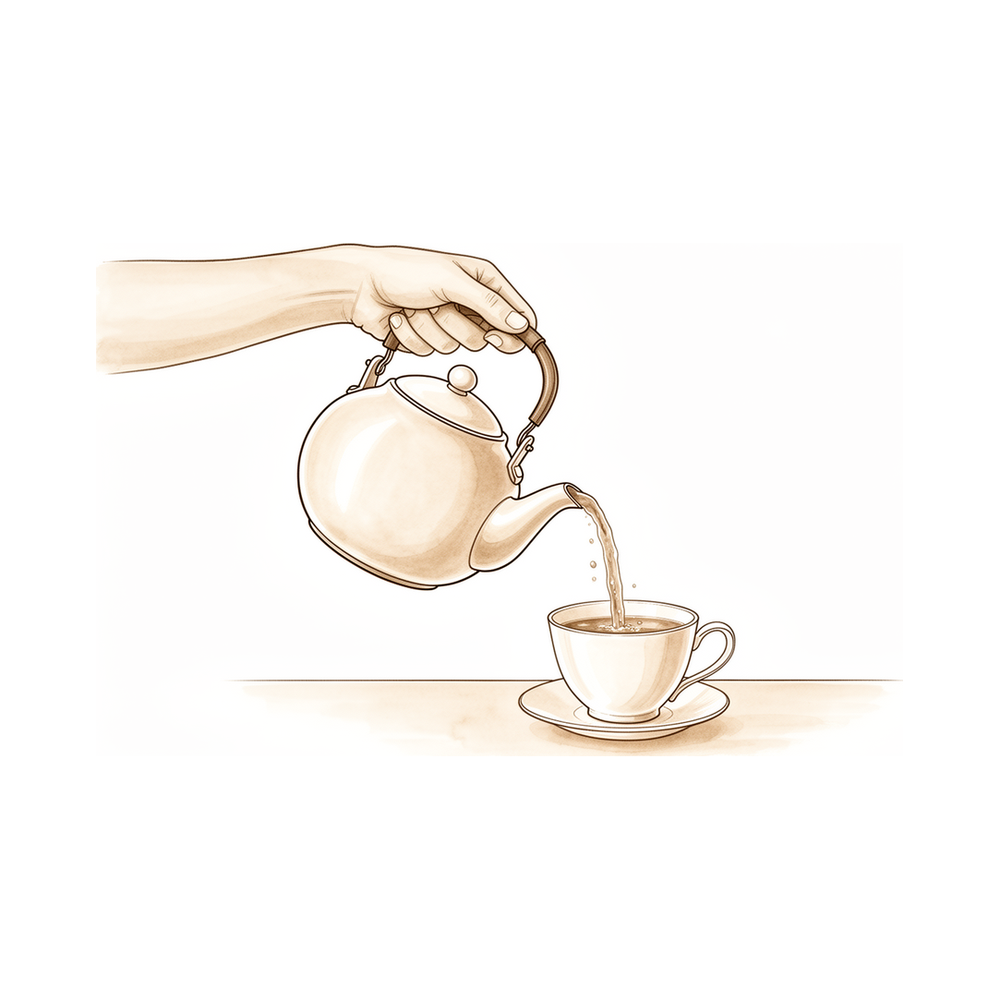
Este protocolo le servirá de guía para su recuperación tras la hemirresección e interposición en artroplastia de la articulación radioulnar distal (DRUJ), una intervención quirúrgica que remodela el extremo desgastado del antebrazo para permitir una rotación cómoda y sin dolor; el procedimiento fue realizado por el Dr. Kieran Hirpara en el Mater Private Hospital Rockhampton. El proceso comienza con un programa de ejercicios para realizar en casa, seguido del protocolo clínico estructurado destinado a su terapeuta de mano; lleve esta página o su versión en PDF a su primera sesión de terapia para garantizar que la rehabilitación se lleve a cabo de manera coordinada. Su terapeuta podrá modificar el plan según el avance de su recuperación.
Si tiene alguna duda respecto a su herida postoperatoria, no dude en ponerse en contacto con el consultorio. A menudo resulta útil tomar una fotografía de la herida y enviarla por correo electrónico para su evaluación.
Qué esperar
La articulación radiocubital distal (ARCD) es la pequeña articulación situada cerca de la muñeca, en el lado del meñique, donde se unen los dos huesos del antebrazo: el radio y el cúbito. Es la articulación que permite girar el antebrazo, colocando la palma hacia arriba (supinación) o hacia abajo (pronación). Cuando esta articulación se desgasta y desarrolla artritis, el movimiento de rotación del antebrazo resulta doloroso.
En una artroplastia de hemiresección, únicamente se elimina la parte desgastada y artrítica de la cabeza del cúbito (una extracción parcial: “hemi” significa mitad); luego se introduce un pequeño trozo de tejido blando propio en el espacio resultante para evitar el roce entre las superficies articulares. Esta intervención preserva las estructuras estabilizadoras clave, entre ellas el TFCC (el manto de cartílago y ligamentos que sostiene la muñeca en ese lado), el estiloide cubital y las inserciones de tejido blando, de modo que el extremo del cúbito permanece bien sujeto. Esto la diferencia de una extirpación total de la cabeza del cúbito (procedimiento de Darrach).
Dado que las superficies articulares se remodelan en lugar de repararse o reconstruirse, no hay tendones ni ligamentos que deban cicatrizar bajo protección durante meses. El objetivo de esta operación es lograr una rotación del antebrazo sin dolor; por ello, la parte más importante de la rehabilitación consiste en iniciar dichos movimientos lo antes posible. Tras un breve período de protección con férula para que el tejido blando se asiente, recuperar la capacidad de girar el antebrazo (palma arriba y palma abajo) se convierte en el eje principal de la recuperación. Posteriormente, se irá aumentando gradualmente la fuerza y la carga soportada.
Precauciones y limitaciones
- Durante las primeras dos o tres semanas aproximadamente, use la férula según las indicaciones; esta limita suavemente la rotación del antebrazo mientras el tejido interpuesto se asienta. Mantenga los dedos y, cuando se permita, la muñeca en movimiento en todo momento.
- Una vez que le retiren la férula, haga de la rotación del antebrazo su prioridad, procurando que sea indolora y sin carga. Al principio, la rotación debe realizarse con la mano vacía, sin oponer resistencia alguna.
- NO someta el antebrazo a cargas rotativas en las primeras fases: no gire tapas de frascos, no retuerza paños, no utilice destornilladores ni lleve bolsas pesadas del mismo lado hasta que se autorice el fortalecimiento muscular (normalmente alrededor de seis a ocho semanas).
- Preste atención a cualquier dolor o sensación de inestabilidad en el lado del meñique de la muñeca al empujar o aplicar carga al antebrazo, pues es precisamente esa zona la intervenida quirúrgicamente. Comuníqueselo a su terapeuta de mano; no insista si siente molestia.
- Desde el inicio, mantenga los dedos, el pulgar, el codo y el hombro en movimiento libre; además, puede utilizar la mano para tareas cotidianas ligeras siempre que le resulten cómodas y no impliquen torsión forzada o carga.
Para el cuidado de la herida, la reducción de la hinchazón y el manejo de las cicatrices, consulte las pautas de cuidado de heridas de nuestra consulta.
Sus ejercicios
Kieran Hirpara 4.0
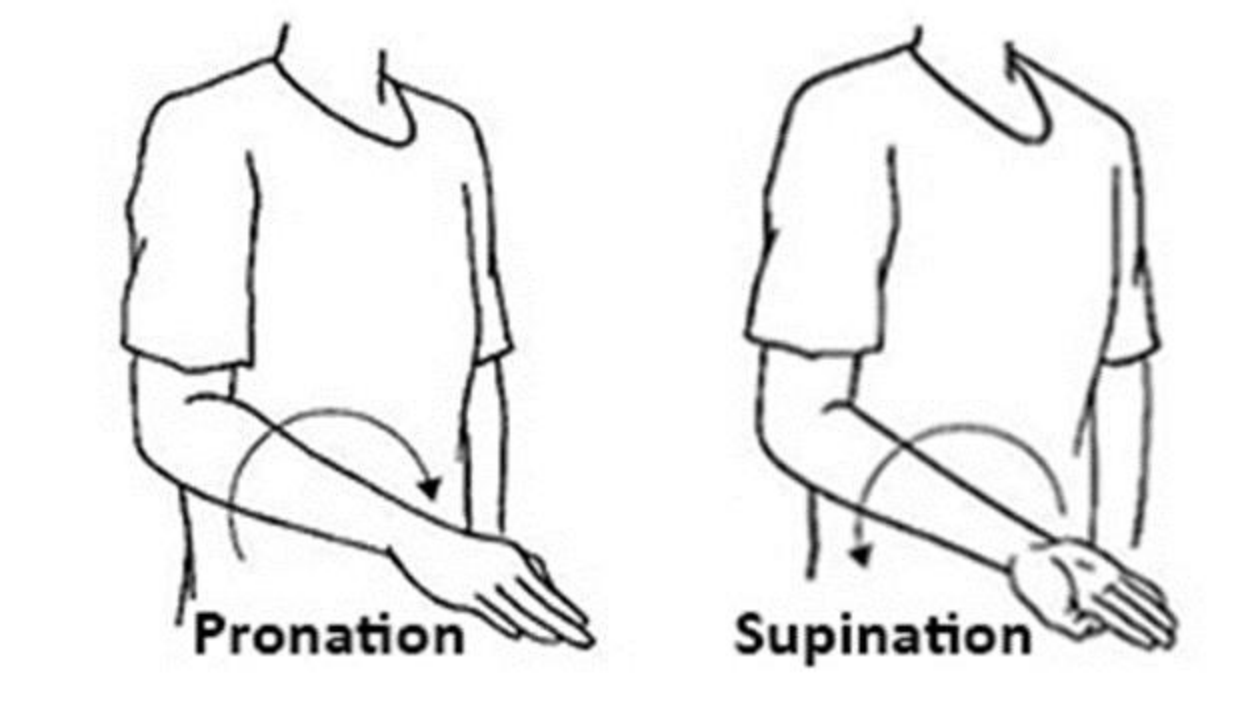
Rotación del antebrazo (palma hacia arriba / palma hacia abajo)
Este es el ejercicio principal: es el movimiento que la operación tiene como objetivo restaurar. Con el codo pegado al costado y doblado en ángulo recto (de modo que el hombro no pueda compensar el movimiento), gire suavemente la palma de la mano hacia el techo y luego, lentamente, hacia el suelo. Realice el movimiento solo hasta donde le resulte cómodo. Comience a hacerlo cuando el Dr. Hirpara y su terapeuta de mano le autoricen a quitarse la férula para hacer los ejercicios; normalmente, esto ocurre a las dos o tres semanas. A partir de ese momento, haga de este ejercicio su prioridad principal.
10 repeticiones en cada dirección, 3-4 veces al día, rango de movimiento sin dolor.
Kieran Hirpara 4.0
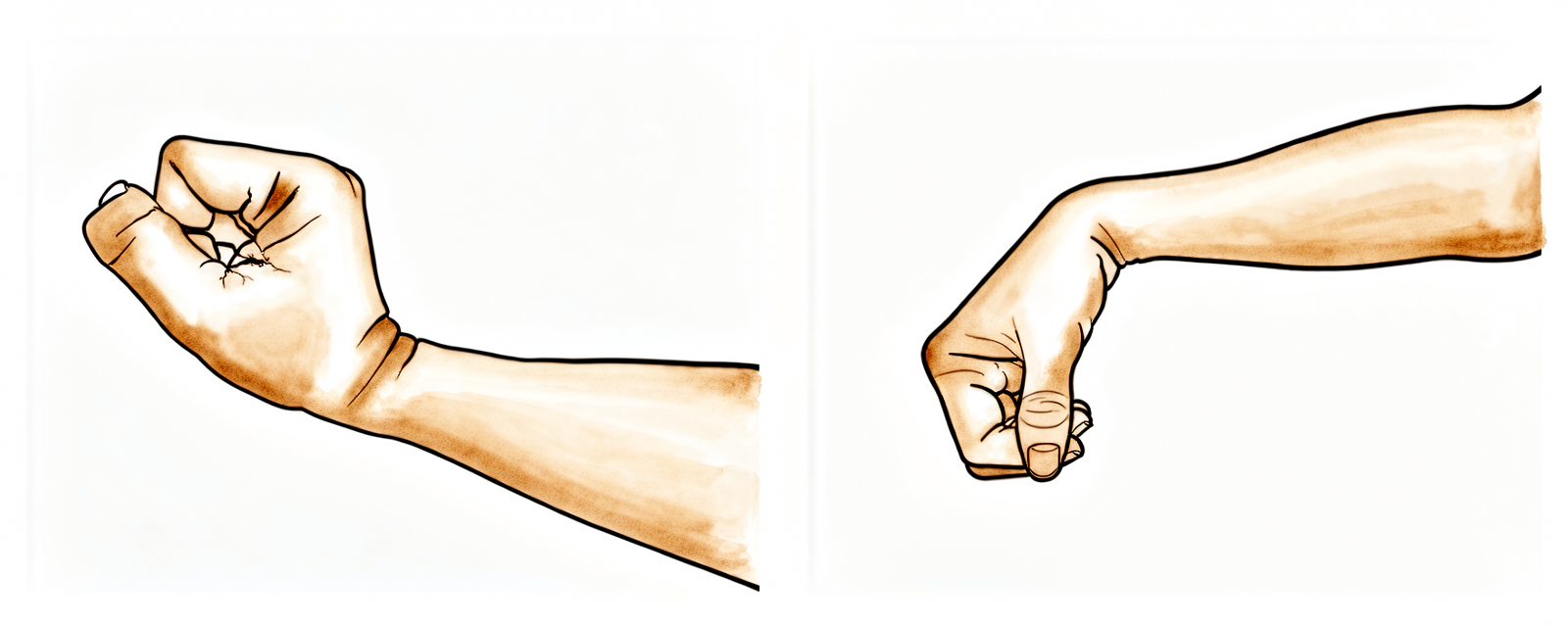
Movimiento de la muñeca (flexión y extensión)
Flexione su muñeca suavemente hacia adelante (con la palma orientada hacia el antebrazo) y hacia atrás (con el dorso de la mano orientado hacia el antebrazo), procurando que el movimiento sea lento y se mantenga dentro de los límites de lo cómodo. Esto evita que la muñeca se vuelva rígida mientras el extremo distal del cúbito se asienta. Al principio, realice los movimientos con suavidad y no fuerce el extremo del rango de movimiento.
10 veces en cada dirección, 2-3 veces al día.
Kieran Hirpara 4.0
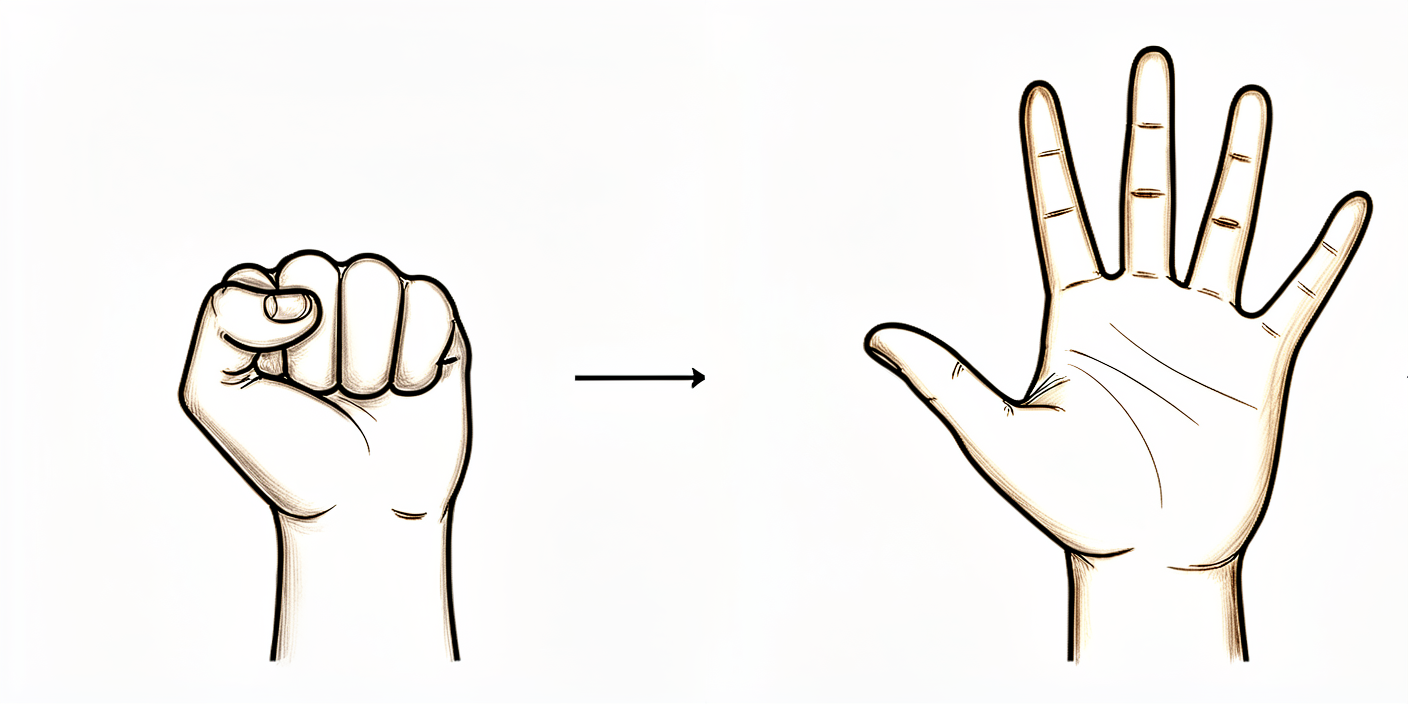
Movimiento de los dedos (cerrar el puño por completo y estirarlos)
Comience a hacerlo desde el primer día. Forme un puño completo y firme, luego abra la mano y estire los dedos en línea recta. Mantener el movimiento de los dedos desde el principio evita la rigidez y favorece la eliminación de cualquier hinchazón. Realícelo con frecuencia durante el día, incluso mientras su antebrazo siga en la férula.
10 veces, cada par de horas mientras se está despierto.
Kieran Hirpara 4.0
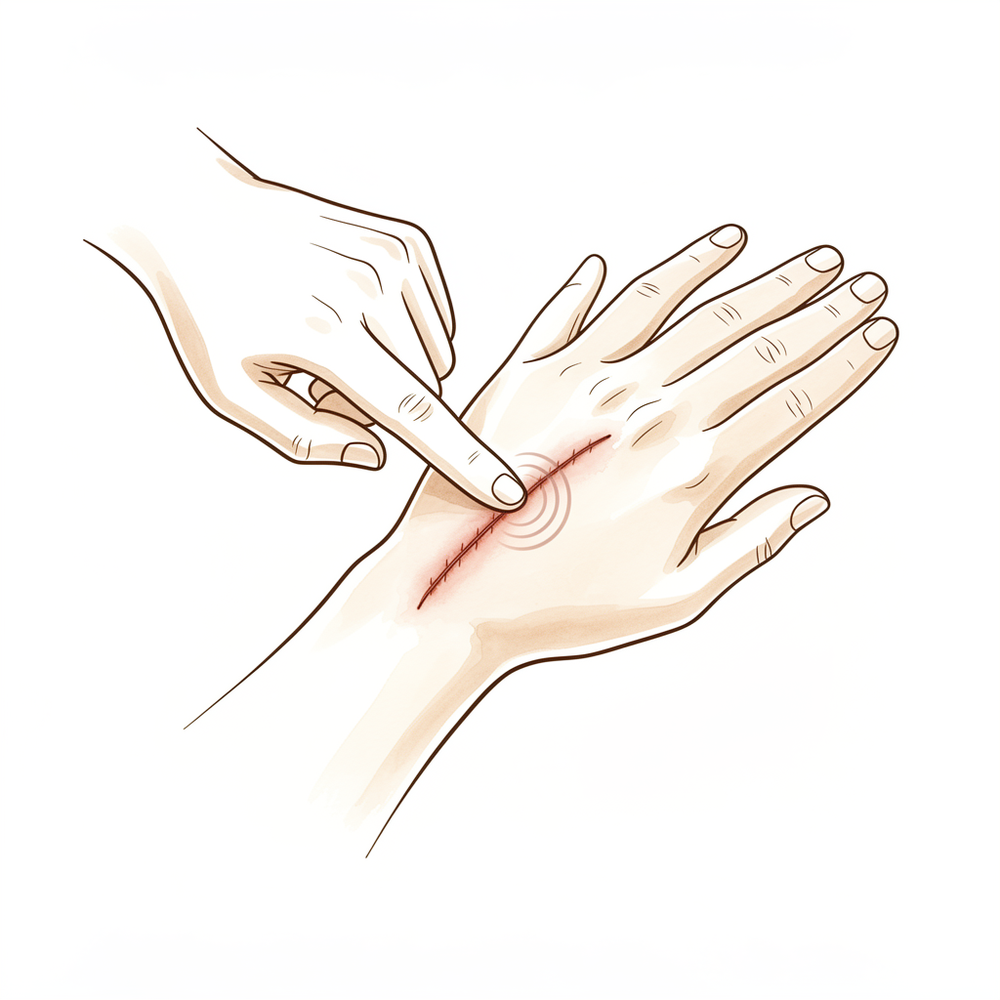
Masaje de cicatrices
Una vez que la herida haya cicatrizado por completo y no queden costras (normalmente después de unas tres o cuatro semanas), aplique una pequeña cantidad de crema hidratante sobre la cicatriz y masajee con movimientos circulares firmes durante unos minutos. Esto ablanda la cicatriz y favorece el movimiento libre de la piel y los tendones sobre la parte distal del cúbito. Interrumpa el procedimiento si la herida aún no está completamente cerrada.
2-3 minutos, dos veces al día, una vez que la herida haya cicatrizado.
Kieran Hirpara 4.0
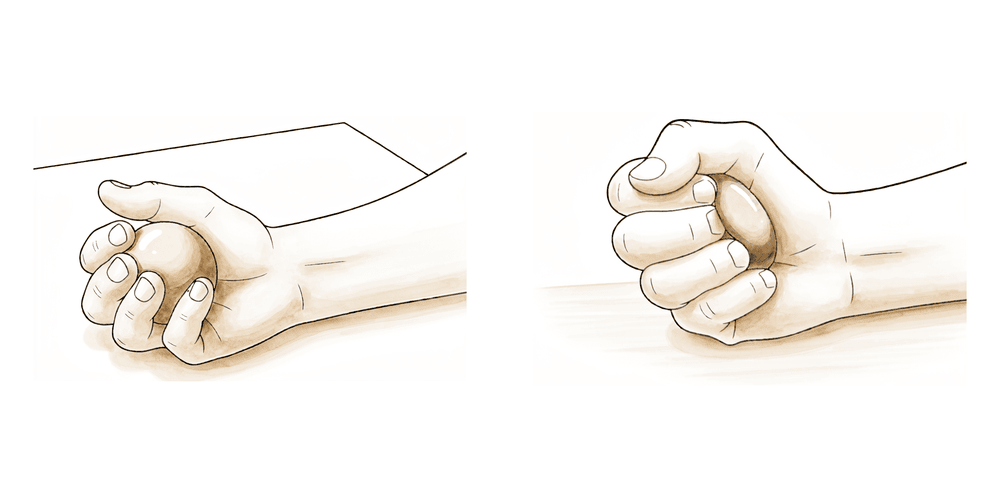
Fortalecimiento de la prensión y la rotación (más adelante)
Un ejercicio posterior: solo cuando el Dr. Hirpara y su terapeuta de mano autoricen el fortalecimiento, generalmente a partir de las seis a ocho semanas. Apriete una pelota blanda o plastilina para recuperar la fuerza de agarre, y gire el antebrazo hacia arriba y hacia abajo contra una resistencia leve (por ejemplo, un peso ligero que se sostenga como si fuera un martillo). Aumente la resistencia poco a poco durante varias semanas. Interrumpa el ejercicio si girar el antebrazo bajo carga provoca dolor en el lado del meñique de la muñeca.
Según las indicaciones de su terapeuta de mano (solo a partir de aproximadamente 6-8 semanas).
Estos son los ejercicios que aparecen en su folleto. Comience a realizarlos únicamente bajo la guía del Dr. Hirpara y de su terapeuta especializado en mano, respetando siempre los rangos y límites que le hayan indicado. El movimiento de los dedos debe iniciarse de inmediato. La rotación del antebrazo (el ejercicio central de toda esta terapia) y el movimiento de la muñeca comienzan una vez que se le retire el yeso, generalmente a las dos o tres semanas; a partir de entonces, la rotación se convierte en su principal objetivo. El masaje de la cicatriz se inicia una vez que la herida haya cicatrizado por completo. El fortalecimiento de la prensión y de la rotación corresponde a una fase posterior y no debe iniciarse hasta que se le dé autorización expresa. Interrumpa cualquier ejercicio que provoque dolor intenso en el lado del meñique de la muñeca.
Su protocolo clínico
El resto de esta página describe el protocolo clínico por etapas para la rehabilitación tras una hemiresección con interposición en artroplastia de la articulación radioulnar distal. Esta sección debe entregarse a su terapeuta de mano; cada fase comienza con una explicación sencilla en lenguaje coloquial sobre lo que ocurre. Se trata de un procedimiento de remodelado articular (artroplastia), no de una reparación: no existe ninguna estructura sometida a tensión que deba protegerse durante meses. La restricción impuesta es breve: un período corto con férula para permitir que la interposición de tejidos blandos y la cápsula articular se asienten; tras ello, la prioridad explícita es restablecer cuanto antes la rotación del antebrazo, pues esa es la función que se busca recuperar con la intervención. La carga principal a respetar en todo momento es la carga rotacional sobre el extremo distal del cúbito, ya que es lo que provoca inestabilidad dolorosa del muñón ulnar y la convergencia radioulnar.
Antes de iniciar el tratamiento, revise el informe operatorio del paciente y su historial médico; además, consulte con el cirujano tratante sobre cualquier procedimiento simultáneo (reparación del CFMT, osteotomía del radio distal, neurectomía del NPI, reconstrucción de tendones extensores), la estabilidad del muñón ulnar evaluada intraoperatoriamente, así como la férula prescrita y el límite de rotación permitido. La realización simultánea de una reparación del CFMT o de una osteotomía del radio distal prolonga el período de protección; en cambio, una hemiresección aislada por artritis degenerativa o postraumática sigue el protocolo más breve que se describe a continuación. El Dr. Hirpara preserva el CFMT, el estilooide ulnar y las inserciones de tejidos blandos del cúbito, por lo que el extremo distal del cúbito sigue contando con soporte; en consecuencia, la rehabilitación puede enfocarse en recuperar la rotación desde las primeras etapas.
Fase I — Adaptación protegida con férula (semanas 0 a 2-3)
Durante las primeras dos o tres semanas, se protege el tejido blando interpuesto y la cápsula, mientras se mantiene la movilidad del resto del miembro. El antebrazo permanece en una férula (generalmente una férula por encima del codo de tipo Muenster o un yeso que limita la rotación del antebrazo); esta solo se retira para fines de higiene y, hacia el final de la fase, para realizar las primeras rotaciones suaves. Los dedos se mueven desde el primer día.
Para su terapeuta de mano:
Educación y precauciones - Inmovilizar con la férula prescrita (tipo por encima del codo/Muenster, o según indicación del cirujano), limitando la rotación del antebrazo; retirarla únicamente para higiene y ejercicios autorizados. - Prohibida toda rotación forzada del antebrazo; no se permite soportar peso ni realizar torsiones con el antebrazo operado. - Asegurar al paciente que la debilidad inicial para agarrar y la hinchazón en el lado cubital son efectos esperados.
Manejo - Herida: aplicar los apósitos quirúrgicos indicados; vigilar posibles signos de infección. - Edema: mantener la extremidad elevada, realizar movimientos de bombeo suaves con la mano y aplicar hielo según sea necesario. - Ejercicios: movilidad activa de dedos, pulgar y, si la férula lo permite, del hombro desde el primer día; movilidad suave del codo según lo permita la férula; introducir rotaciones activas suaves y sin dolor del antebrazo en los últimos días de esta fase, siempre que el cirujano autorice retirar la férula antes de tiempo.
Criterios para avanzar a la siguiente fase - La herida está cicatrizando; el período con férula (aproximadamente 2-3 semanas en casos de hemiresección aislada) ha finalizado; el cirujano ha autorizado la realización de rotaciones activas.
Fase II — rotación temprana del antebrazo (la prioridad) (semanas 2-3 a 6)
Esta es la fase clave. Una vez retirada la férula, la pronación y supinación activas pasan a ser el eje central de la rehabilitación: se deben realizar de forma suave, frecuente, sin dolor y sin carga. También se incorpora el movimiento de la muñeca. Dado que la rotación es la función que se busca restaurar mediante la cirugía, se trabaja activamente en ella mientras se evita cualquier tipo de carga.
Para su terapeuta de mano:
Evaluaciones - Pronación/supinación activa y pasiva del antebrazo (objetivo: alcanzar aproximadamente 80° en cada dirección, según estudios de resultados); amplitud de movimiento de muñeca y dedos; dolor en la zona ulnar de la muñeca; hinchazón; evaluación de la herida y la cicatriz
Educación y precauciones - La rotación del antebrazo es la prioridad: realizar pronación/supinación activa, frecuente, sin dolor y sin carga; mantener el codo pegado al costado para aislar el antebrazo - No realizar rotaciones con resistencia ni carga, ni ejercicios de agarre intenso o tareas que impliquen torsión hasta aproximadamente la semana 6-8 - Algunas férulas limitan aún más la rotación en sus extremos durante unas semanas tras retirar el yeso; respetar cualquier límite indicado
Manejo - Ejercicios: pronación/supinación activa y asistida como foco principal; flexión/extensión activa de la muñeca y desviación radial/ulnar; continuar con ejercicios de amplitud de movimiento de dedos y agarre (sin resistencia aún); iniciar cuidados de la cicatriz una vez que la herida haya cicatrizado por completo - Utilizar modalidades terapéuticas para controlar el edema y la cicatriz según sea necesario
Criterios para avanzar - Rotación activa del antebrazo cómoda, controlada y casi completa, sin dolor; herida totalmente cicatrizada; dolor ≤3/10; ausencia de dolor en la zona ulnar al realizar movimientos de rotación suaves
Fase III — Fortalecimiento y reincorporación (semanas 6-8 en adelante)
Una vez restaurada la rotación y sin dolor, se inicia el fortalecimiento de forma gradual: primero la fuerza de prensión, luego la rotación de antebrazo con carga, vigilando especialmente cualquier inestabilidad dolorosa del muñón cubital o convergencia radioulnar bajo carga. La reincorporación a trabajos más exigentes y a la práctica deportiva se basa en criterios específicos.
Para su terapeuta de mano:
Evaluaciones - Fuerza de prensión comparada con el lado contralateral (los estudios muestran una recuperación hacia aproximadamente 85-90% de la fuerza del lado opuesto); fuerza de rotación de antebrazo y presencia de dolor o inestabilidad durante la rotación con carga; pruebas funcionales y específicas para el trabajo o el deporte, según corresponda.
Instrucciones y precauciones - Iniciar primero con prensión resistida, luego con rotación de antebrazo con carga gradual (por ejemplo, girar un martillo con un peso ligero) a partir de las seis a ocho semanas; aumentar la carga lentamente. - Estar atento a cualquier inestabilidad dolorosa del muñón cubital o convergencia radioulnar bajo carga axial o rotacional: si aparecen síntomas, reducir la carga y consultar al cirujano.
Manejo - Ejercicios: fortalecimiento progresivo mediante prensión y trabajo con plastilina; pronación/supinación resistida de grado gradual (de ligera a moderada); cargas específicas según la actividad; continuar con ejercicios para mantener el rango de movimiento restante. - Considerar el alta terapéutica cuando la rotación y la fuerza de prensión sean funcionales, casi simétricas y se haya logrado una recuperación adecuada de la función. - Derivar nuevamente al médico tratante si la recuperación se estanca, o si persiste dolor en el lado cubital bajo carga, lo cual podría indicar inestabilidad o convergencia del muñón.
Criterios para reincorporarse a actividades con carga o deportivas - Fuerza de prensión y rotación casi simétrica; rotación con carga sin dolor; ausencia de inestabilidad en las pruebas funcionales.
Volver al trabajo y a las actividades cotidianas
Se recomienda realizar desde el principio actividades cotidianas ligeras con la mano (comer, escribir, cuidados personales sencillos), siempre dentro de los límites de la comodidad, siempre que no impliquen torsiones forzadas o con carga del antebrazo. Dado que su antebrazo lleva una férula desde el inicio y debe ser capaz de controlar el volante de forma segura (incluida su rotación), planifique contar con ayuda para el transporte durante las primeras semanas; la conducción podrá reanudarse una vez que se retire la férula y pueda rotar el antebrazo de manera cómoda y segura para maniobrar, según se confirme en su revisión médica.
Las tareas que requieren torsión con carga (abrir frascos difíciles de abrir, retorcer objetos, usar un destornillador, llevar bolsas pesadas con ese lado del cuerpo) deberán esperar hasta que se autorice el fortalecimiento muscular (normalmente alrededor de seis a ocho semanas), y entonces se irán incorporando gradualmente. El regreso a trabajos manuales más exigentes y a la práctica deportiva sigue el mismo criterio de progresión y depende de recuperar una rotación del antebrazo y una fuerza de agarre casi simétricas, sin dolor; esta evaluación la realizarán el Dr. Hirpara y su terapeuta de mano, no únicamente el calendario.
Después de seguir este protocolo
Este protocolo se complementa con las recomendaciones generales de recuperación del consultorio; consulte control del dolor postoperatorio, cuidado de la herida y manejo de las cicatrices. Si su problema en la articulación radioulnar distal se originó tras una fractura de muñeca, el protocolo de fijación de fractura del radio distal le resultará de gran utilidad. El plan por fases descrito anteriormente se basa en las guías de rehabilitación publicadas tras la hemirresección de la articulación radioulnar distal; su recuperación continua será guiada individualmente por el Dr. Hirpara y su terapeuta de mano, según la evolución de su antebrazo.
Evidence & references
This is the clinical evidence summary written for health professionals. It is technical, and it lists the research this page was built from. You do not need to read it to understand your treatment or to make a decision about it.
DRUJ Hemiresection-Interposition Arthroplasty (Bowers) — Procedure Outcomes & Post-operative Rehabilitation
Topic scope: post-operative rehabilitation after hemiresection-interposition arthroplasty (HIT) of the distal radioulnar joint (DRUJ) — the Bowers procedure — for painful DRUJ arthritis (degenerative, post-traumatic, or inflammatory). The arthritic portion of the ulnar head is partially resected and a soft-tissue spacer is interposed, preserving the TFCC, ulnar styloid and ulnar soft-tissue attachments so the distal ulna remains supported. This is a joint-reshaping arthroplasty, not a repair or reconstruction: the rehab is therefore an early-rotation pathway built around a short protected settling phase, then prioritised restoration of forearm pronation/supination, then graded loading — not months of construct protection.
Defining principle of the rehab here: the operation exists to restore pain-free forearm rotation, and nothing is sutured under tension that must heal protected for months. The deliberate restraint is a brief splinted phase (commonly an above-elbow / Muenster-type splint limiting forearm rotation for ~2-3 weeks in the isolated case) to let the soft-tissue interposition and capsule settle. After that, early active pronation/supination is the explicit priority — rotation is the function the operation restores. The single load to respect throughout is rotational/axial loading of the distal ulna, which provokes the characteristic failure mode: painful ulnar-stump instability and radioulnar convergence. The main branch point that lengthens the protected phase is a concurrent procedure (TFCC repair, distal radius osteotomy, extensor reconstruction).
A. PROCEDURE OUTCOMES (hemiresection-interposition arthroplasty)
The Bowers HIT is a long-established, generally reliable salvage for the arthritic DRUJ. The evidence base is level IV (retrospective cohorts and case series, no randomised trials), but it is consistent across decades: most patients gain durable pain relief and improved, stable forearm rotation, with the principal residual concern being ulnar-stump instability / radioulnar convergence under load.
- The original Bowers series established the procedure and its rationale. Bowers' 1985 description (38 patients, mean ~2.5 yr) reported stable, painless rotation in the great majority — in rheumatoid patients ~85% achieved stable painless rotation (pronation ~84°, supination ~77°), and degenerative/post-traumatic patients achieved painless rotation averaging ~80° in each direction. The technique was explicitly designed to preserve the functional ulnocarpal ligament complex [Bowers, J Hand Surg Am 1985]. Level IV (foundational case series).
- Long-term outcomes are durable but with a defined complication rate. A long-term cohort (66 patients, mean follow-up 8.6 years) reported low residual pain (median NRS 1/10), an overall complication rate of ~14% and reoperation ~8%; reported complications included stylocarpal impingement, ulnar subluxation, exostoses and tendon rupture. Inflammatory-arthritis patients had lower pain than post-traumatic patients (median 0 vs 5). The same series found PIN neurectomy associated with improved pain scores [HIT long-term outcome study, Hand (N Y) 2019]. Level IV (cohort).
- Forearm rotation, grip and pain all improve measurably. A capsuloretinacular HIT series (21 wrists, mean ~2 yr 10 mo) reported significant gains: pronation 56.8°→83.0°, supination 60.0°→82.0°, grip 66.0%→87.4% of the contralateral side, VAS pain 62→23 mm, DASH 37.7→25.0, PRWE 48.1→24.4, with no post-operative DRUJ instability reported in that series [HIT capsuloretinacular series, J Wrist Surg 2023]. Level IV (cohort).
- HIT sits within a family of DRUJ salvage options (Darrach distal ulna resection, Sauvé-Kapandji arthrodesis-pseudarthrosis, matched/hemiresection variants, and ulnar-head implant arthroplasty), each with its own instability/convergence profile; HIT's selling point is preservation of the ulnar support structures to reduce stump instability versus a formal Darrach [Bowers 1985; Glowacki, Hand Clin 2005; Chidgey, JAAOS 1995; Rekant, Hand Clin 2012; Murray, Hand Clin 2011]. Mechanistic / narrative-review.
B. REHABILITATION / THERAPY EVIDENCE
There is no trial-level evidence for any specific rehabilitation regimen after DRUJ HIT. Protocols are surgeon- and technique-derived expert consensus, reported as the post-operative methods of the outcome series and operative-technique articles above. The consensus is consistent on its key features.
- A brief protected settling phase, not prolonged immobilisation. In the isolated hemiresection (no distal radius osteotomy, no TFCC repair), a long-arm plaster splint for ~10 days followed by a removable Muenster splint for a further 2-3 weeks is typical; cohort series report an upper-arm cast ~3 weeks then a forearm cast 1-2 weeks. Where a distal radius osteotomy or TFCC repair is added, immobilisation is longer (e.g. a long-arm cast in ~45° supination for ~4 weeks) [Pillukat & van Schoonhoven, Oper Orthop Traumatol 2009; HIT capsuloretinacular series, J Wrist Surg 2023]. Weak / expert consensus.
- Early forearm rotation is the explicit priority once protection ends. The whole point of the operation is rotation, so active pronation/supination is pursued early and frequently. Some protocols further limit end-range rotation by splint for ~4 more weeks after the cast comes off before unrestricted motion and load [Pillukat & van Schoonhoven 2009]. Weak / expert consensus.
- Loading is added last, watching for the characteristic failure mode. Range and load are returned to normal after the rotation-limited window; the specific thing to watch is painful ulnar-stump instability and radioulnar convergence under axial/rotational load, which is the biomechanically demonstrated weak point of distal-ulna procedures [Sauerbier et al., J Hand Surg Br 2002; Douglas et al., J Hand Surg Am 2014; Barret et al., Orthop Traumatol Surg Res 2020]. Mechanistic (biomechanical) + consensus.
- Finger, thumb, elbow and shoulder motion from day one is standard to prevent stiffness, as in any forearm/wrist immobilisation pathway. Consensus.
Recovery trajectory (expected, evidence-anchored)
| Phase | Window | Restraint | Hand use / therapy focus | Strength / load | Notes |
|---|---|---|---|---|---|
| I — Protected settling | Week 0 to 2-3 | Splint limiting forearm rotation (Muenster / above-elbow type) | Active finger/thumb/shoulder ROM from day 1; elbow ROM as splint allows; first gentle pain-free rotation toward end of phase | None through forearm | Longer if concurrent TFCC repair or distal radius osteotomy (cast in supination ~4 wk) |
| II — Early forearm rotation (priority) | Week 2-3 to 6 | Unloaded; some protocols cap end-range rotation a few more weeks | Active pronation/supination as the main focus, elbow tucked; add wrist ROM; finger/grip ROM; scar massage once healed | No resisted/loaded rotation, no heavy grip | Target restoration toward ~80° each direction; pain-free is the rule |
| III — Strengthening & return | Week 6-8+ | Restrictions lifted progressively | Resisted grip first, then graded loaded rotation (hammer turns); task-specific loading | Build load slowly; grip recovers toward ~85-90% contralateral | Watch for ulnar-stump instability / radioulnar convergence under load |
(Phase windows mirror the precautions and phase tables in the patient protocol; they are typical expert-consensus guides, not trial-derived deadlines, and lengthen with concurrent procedures.)
C. KEY CONTROVERSIES / EVIDENCE QUALITY
- HIT vs Darrach. The Darrach (complete distal ulna resection) is simpler but sacrifices the ulnar support structures and is more prone to painful proximal ulnar-stump instability and radioulnar convergence, especially in younger, higher-demand or post-traumatic patients. HIT preserves the TFCC/styloid/attachments to mitigate this — but biomechanical work shows HIT also converges under load, just to a different degree, so convergence is a spectrum, not a HIT-vs-Darrach binary [Sauerbier et al., J Hand Surg Br 2002; Douglas et al., J Hand Surg Am 2014]. Darrach remains reasonable in low-demand/elderly patients. *Moderate (biomechanical
- cohort).*
- HIT vs Sauvé-Kapandji. Sauvé-Kapandji fuses the DRUJ and creates a controlled proximal pseudarthrosis, preserving the ulnar head/buttress for the carpus; it is often favoured where ulnar translation of the carpus is a concern (e.g. rheumatoid), but it too can develop painful proximal-stump instability. Long-term Sauvé-Kapandji and modified-Sauvé-Kapandji series report durable function with that caveat [Reissner et al., J Hand Surg Eur 2021; Zimmermann et al., Arch Orthop Trauma Surg 2003]. Choice is patient- and pathology-specific, not evidence-mandated. Moderate.
- HIT vs ulnar-head (implant) replacement. Implant ulnar-head arthroplasty is an alternative — particularly for failed resection/instability salvage — restoring a load-bearing buttress, but it adds implant-specific complications. Long-term implant series report good outcomes; it is increasingly used to rescue a painful, unstable stump after resection-type procedures [Kakar et al., J Hand Surg Am 2010; Adams, Hand Clin 2010; Watts et al., Hand Clin 2010; Rekant, Hand Clin 2012]. Moderate.
- The rehab regimen itself is consensus, not trial-derived. No RCT compares immobilisation length, rotation timing or loading progression after HIT. The "brief protection → early rotation → graded load" structure is inferred from technique articles and the methods of level-IV outcome series. Exact phase timings are typical, not deadlines, and shift with concurrent procedures. Weak / expert consensus.
- Patient selection drives results. Inflammatory-arthritis patients report lower residual pain than post-traumatic patients in long-term follow-up; adjunct PIN neurectomy is associated with better pain scores. Both point to outcome being substantially a selection/technique matter, not a rehab one [HIT long-term cohort, Hand 2019]. Moderate (within level-IV data).
D. EVIDENCE STRENGTH FLAGS (summary)
- STRONG (RCT / SR): none. There are no randomised trials of DRUJ HIT or of its rehabilitation.
- MODERATE: the biomechanical basis of radioulnar convergence / ulnar-stump instability under load across distal-ulna procedures (cadaveric studies); the comparative trade-offs among HIT / Darrach / Sauvé-Kapandji / ulnar-head replacement (consistent cohort + mechanistic data).
- LEVEL IV (cohort / case series — the outcome evidence): pain relief, grip recovery (~85-90% contralateral), pronation/supination gains (toward ~80° each), ~14% complication and ~8% reoperation rates, durability to ~8-9 years. Consistent but uncontrolled and surgeon-reported.
- WEAK / EXPERT CONSENSUS (the rehab regimen): the specific brief-protection → early-rotation → graded-load programme, the Muenster/above-elbow splint choice, the ~2-3 week protected window, and all exact phase timings — derived from technique articles and the methods sections of level-IV series, lengthened by concurrent procedures. No comparative rehab evidence exists.
CITATIONS
RAG corpus (180,000+ Orthopaedic articles)
- Glowacki KA. Hemiresection arthroplasty of the distal radioulnar joint. Hand Clin. 2005. DOI: 10.1016/j.hcl.2005.08.002
- Sauerbier M, Fujita M, Hahn ME, et al. The dynamic radioulnar convergence of the Darrach procedure and the ulnar head hemiresection interposition arthroplasty: a biomechanical study. J Hand Surg Br. 2002. DOI: 10.1054/jhsb.2002.0763
- Douglas KC, Parks BG, Tsai MA, et al. The biomechanical stability of salvage procedures for distal radioulnar joint arthritis. J Hand Surg Am. 2014. DOI: 10.1016/j.jhsa.2014.03.028
- Barret H, Lazerges C, Chammas P, et al. Modification of matched distal ulnar resection for distal radio-ulnar joint arthropathy: analysis of distal instability and radio-ulnar convergence. Orthop Traumatol Surg Res. 2020. DOI: 10.1016/j.otsr.2020.07.008
- Chidgey LK. The distal radioulnar joint: problems and solutions. J Am Acad Orthop Surg. 1995. DOI: 10.5435/00124635-199503000-00005
- Murray PM. Current concepts in the treatment of rheumatoid arthritis of the distal radioulnar joint. Hand Clin. 2011. DOI: 10.1016/j.hcl.2010.10.002
- Lee SK, Hausman MR. Management of the distal radioulnar joint in rheumatoid arthritis. Hand Clin. 2005. DOI: 10.1016/j.hcl.2005.08.009
- Ozer K. Management of complications of distal radioulnar joint. Hand Clin. 2015. DOI: 10.1016/j.hcl.2014.12.003
- Zimmerman RM, Jupiter JB. Instability of the distal radioulnar joint. J Hand Surg Eur Vol. 2014. DOI: 10.1177/1753193414527052
- Rekant M. Distal ulna arthroplasties. Hand Clin. 2012. DOI: 10.1016/j.hcl.2012.08.016
- Watts AC, Hayton MJ, Stanley JK. Salvage of failed distal radioulnar joint reconstruction. Hand Clin. 2010. DOI: 10.1016/j.hcl.2010.05.004
- Kakar S, Swann R, Perry K, et al. Distal radioulnar joint implant arthroplasty: a long-term outcome analysis. J Hand Surg Am. 2010. DOI: 10.1016/j.jhsa.2010.05.010
- Adams BD. Complications of wrist arthroplasty. Hand Clin. 2010. DOI: 10.1016/j.hcl.2010.01.006
- Reissner L, Schweizer A, Unterfrauner I, et al. Long-term results of the Sauvé-Kapandji procedure. J Hand Surg Eur Vol. 2021. DOI: 10.1177/17531934211004459
- Zimmermann R, Gschwentner M, Arora R, et al. Treatment of distal radioulnar joint disorders with a modified Sauvé-Kapandji procedure: long-term outcome with special attention to the DASH questionnaire. Arch Orthop Trauma Surg. 2003. DOI: 10.1007/s00402-003-0529-5
- Nypaver C, Bozentka DJ. Distal radius fracture and the distal radioulnar joint. Hand Clin. 2021. DOI: 10.1016/j.hcl.2021.02.011
- Pillukat T, van Schoonhoven J. Die Hemiresektions-Interpositionsarthroplastik des distalen Radioulnargelenks nach Bowers [The hemiresection-interposition arthroplasty of the distal radioulnar joint]. Oper Orthop Traumatol. 2009. DOI: 10.1007/s00064-009-1913-2
DRUJ hemiresection literature (URLs)
- Bowers WH. Distal radioulnar joint arthroplasty: the hemiresection-interposition technique. J Hand Surg Am. 1985;10(2):169-178. https://www.jhandsurg.org/article/S0363-5023(85)80100-3/abstract (PMID: 3980927)
- Hemiresection interposition arthroplasty of the distal radioulnar joint: a long-term outcome study. Hand (N Y). 2019. DOI: 10.1177/1558944719873430. https://pmc.ncbi.nlm.nih.gov/articles/PMC8461192/
- Hemiresection capsuloretinacular interposition arthroplasty for distal radioulnar joint osteoarthritis. J Wrist Surg. 2023. DOI: 10.1055/s-0043-1771341. https://pmc.ncbi.nlm.nih.gov/articles/PMC11606672/
- Mid- to long-term functional results after Bowers' hemiresection interposition arthroplasty of the distal radio-ulnar joint. PubMed. https://pubmed.ncbi.nlm.nih.gov/35238965/
- Pillukat T, van Schoonhoven J. The hemiresection-interposition arthroplasty of the distal radioulnar joint (operative technique). Oper Orthop Traumatol. 2009. https://link.springer.com/article/10.1007/s00064-009-1913-2 (PMID: 20058126)
- Ulnar head hemiresection with interposition and extensor reconstruction — surgical technique. OrthOracle. https://www.orthoracle.com/library/ulnar-head-hemiresection-with-interposition-and-extensor-reconstruction/