Patients › Rehabilitation
Reparación del Bankart anterior
Rehabilitation protocol after arthroscopic anterior Bankart (labral) repair for anterior shoulder instability — apprehension-position precautions and staged return to sport.
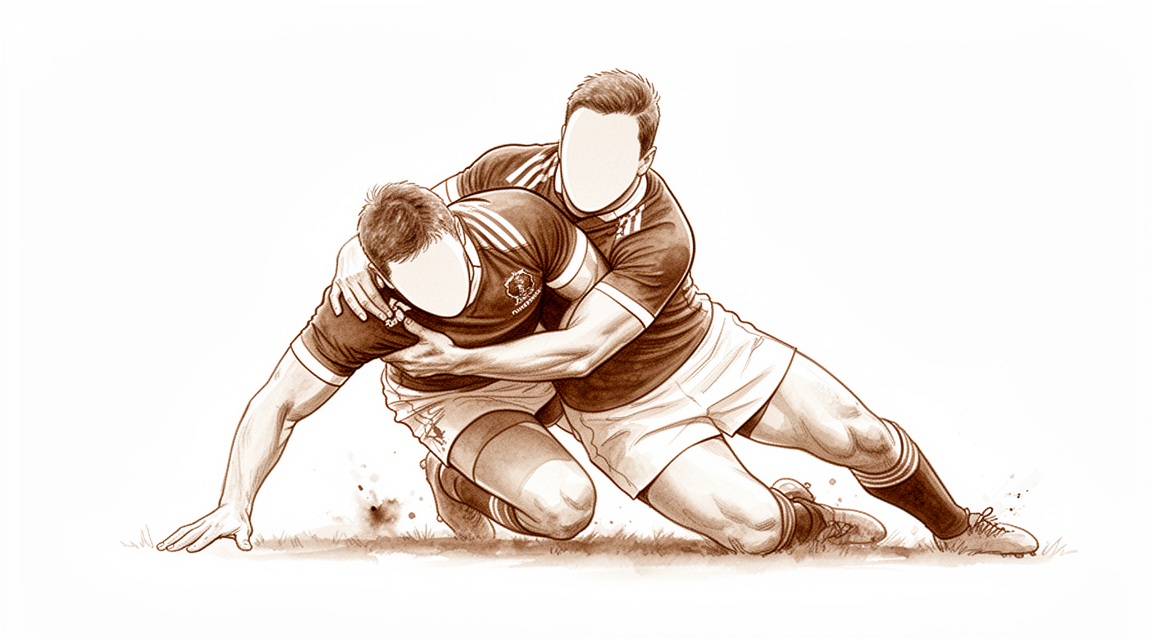
Este protocolo le servirá de guía durante su recuperación tras una reparación artroscópica del ligamento Bankart anterior realizada por el Dr. Kieran Hirpara en el Mater Private Hospital Rockhampton. En él se incluye una explicación sencilla, en lenguaje comprensible, de cada fase del proceso, así como un programa estructurado que podrá compartir con su fisioterapeuta. Lleve esta página o su versión en PDF a su primera consulta para garantizar una rehabilitación coordinada. Su fisioterapeuta podrá modificar el plan según el progreso de su recuperación.
Si tiene alguna duda respecto a su herida postoperatoria, no dude en ponerse en contacto con el consultorio. A menudo resulta útil tomar una fotografía de la herida y enviarla por correo electrónico para su evaluación.
Qué esperar
La reparación de Bankart consiste en volver a fijar el borde desgarrado del cartílago (el labrum) y la cápsula distendida a la parte frontal de la cavidad glenoidea, después de que el hombro se haya dislocado o salido parcialmente de la articulación hacia adelante. Esta reparación afecta a tejidos blandos; al igual que un tendón en proceso de cicatrización, necesita tiempo para adherirse firmemente al hueso: aproximadamente doce semanas para alcanzar una resistencia fiable. Todo el programa de rehabilitación se basa en proteger dicha cicatrización.
La regla más importante es proteger la parte frontal del hombro desde el principio, limitando cuánto puede rotar el brazo hacia afuera. Rotar el brazo hacia afuera (especialmente con el brazo elevado hacia el costado) ejerce una tensión directa sobre la zona reparada. Por eso, al principio se mantiene la rotación externa en un rango reducido, ampliándola solo de forma gradual hasta alcanzar el movimiento completo alrededor de las doce semanas.
La recuperación se produce por etapas, sin prisas. Primero se recupera el movimiento, luego la fuerza, y finalmente se pueden retomar actividades deportivas o trabajos más exigentes. Las reparaciones de labrum en tejidos blandos cicatrizan más lentamente que la intervención ósea de Latarjet; por ello el cronograma es deliberadamente pausado: la mayoría de los pacientes vuelven a practicar deportes de contacto o con lanzamientos por encima de la cabeza a los cuatro o seis meses, una vez cumplidos los objetivos establecidos, no en una fecha fija.
El procedimiento
La reparación de Bankart se realiza mediante artroscopia (cirugía mínimamente invasiva). A través de pequeñas incisiones, el labrum y la cápsula desgarrados en la parte anterior del hombro se vuelven a fijar al borde de la cavidad glenoidea mediante pequeños anclajes y suturas, restaurando así la función de “amortiguador” y la tensión necesaria para mantener la cabeza del húmero centrada en la cavidad. La rehabilitación consiste en proteger dicha fijación mientras cicatriza, y posteriormente recuperar gradualmente el rango completo de movimiento, la fuerza y la confianza en el hombro.
Uso del cabestrillo
Usted usará un cabestrillo simple para el hombro, no un dispositivo ortopédico especial. El Dr. Hirpara emplea un cabestrillo sencillo que mantiene el brazo en rotación neutra (el antebrazo descansa sobre el abdomen); no se requiere ninguna almohada de abducción, cuña ni dispositivo tipo “gunslinger”. La protección proviene del cabestrillo y de mantener el brazo fuera de la posición de riesgo, no de la forma del dispositivo ortopédico.
- Use el cabestrillo durante 6 semanas como soporte diurno, especialmente cuando esté fuera de casa o en presencia de otras personas.
- No duerma con el cabestrillo. Es únicamente un soporte diurno; duerma sin él, con el brazo cómodamente apoyado en una almohada. Mientras duerme, mantenga el brazo delante de usted y pegado al cuerpo: no permita que se desplace hacia un lado ni que gire hacia afuera (la posición se describe a continuación).
- Quíteselo para ducharse y para hacer los ejercicios (una vez que le hayan enseñado cómo hacerlos). Cada vez que no lleve el cabestrillo, mantenga el brazo relajado, delante de usted y junto al cuerpo.
- Aplique hielo si el hombro está hinchado o adolorido, especialmente después de hacer ejercicio.
Preste atención a su postura mientras use el cabestrillo: mantenga las orejas, los hombros y las caderas alineados y evite encorvarse.
Precauciones clave — NO hacer
- NO coloque el brazo en la posición de “brazo levantado” o de lanzamiento (brazo elevado hacia el lateral y rotado hacia afuera, como si estuviera saludando o a punto de lanzar algo). Esta es la posición en la que se disloca el hombro, y ejerce una tensión directa sobre la reparación realizada. Una guía sencilla que algunas personas usan es “mantenga los codos siempre a la vista”: mantenga los brazos delante de usted.
- NO rote activamente el brazo hacia afuera más allá de los límites indicados en las primeras semanas. La rotación externa se va aumentando gradualmente: solo una pequeña cantidad (alrededor de 20°, muy por debajo de la posición frontal) en las primeras semanas, hasta alcanzar el rango completo alrededor de las 12 semanas.
- NO mueva el hombro activamente por sus propios medios hasta aproximadamente las 6 semanas: hasta entonces, deje que el otro brazo sano o un palo realice el movimiento.
- NO intente alcanzar algo detrás de la espalda, abrocharse el sujetador ni meter la mano en el bolsillo trasero en las primeras etapas.
- NO levante, empuje, tire ni apoye peso alguno con el brazo operado durante 6 semanas.
- NO haga flexiones, press de banca, ejercicios de apertura de pecho con agarre ancho, press militar (por encima de la cabeza) ni jalones detrás del cuello hasta una fase avanzada del programa; todos estos ejercicios cargan o estiran la parte frontal del hombro.
- NO fuerce ni estire el hombro hasta una posición que le dé la sensación de que podría dislocarse; el dolor o una sensación de inseguridad son señales para detenerse.
- NO conduzca mientras sea necesario usar el cabestrillo (6 semanas).
Fase I: Protección (semanas 0–6)
Kieran Hirpara 4.0
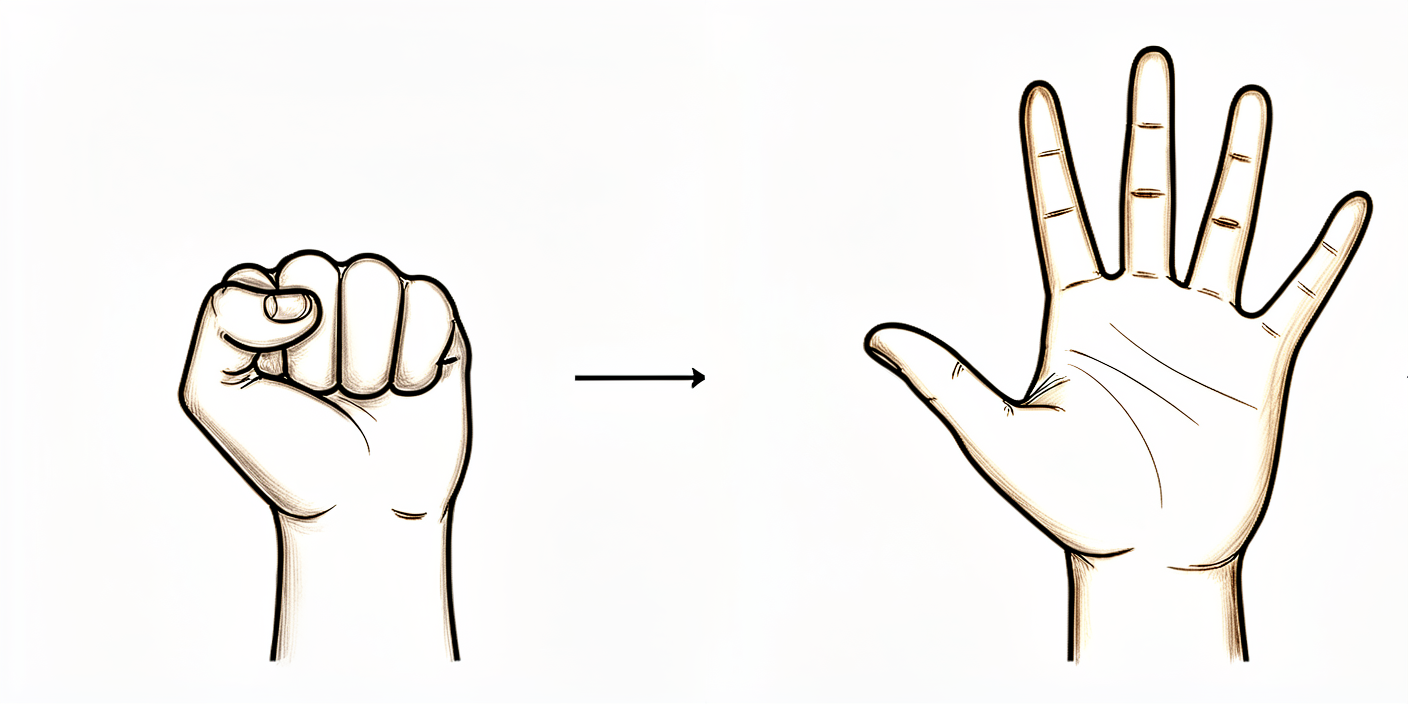
Abrir y cerrar la mano
Haga un puño con la mano y luego ábrala por completo. Esto mantiene la movilidad de la mano y ayuda a prevenir la rigidez y la hinchazón.
10 veces por hora
Kieran Hirpara 4.0
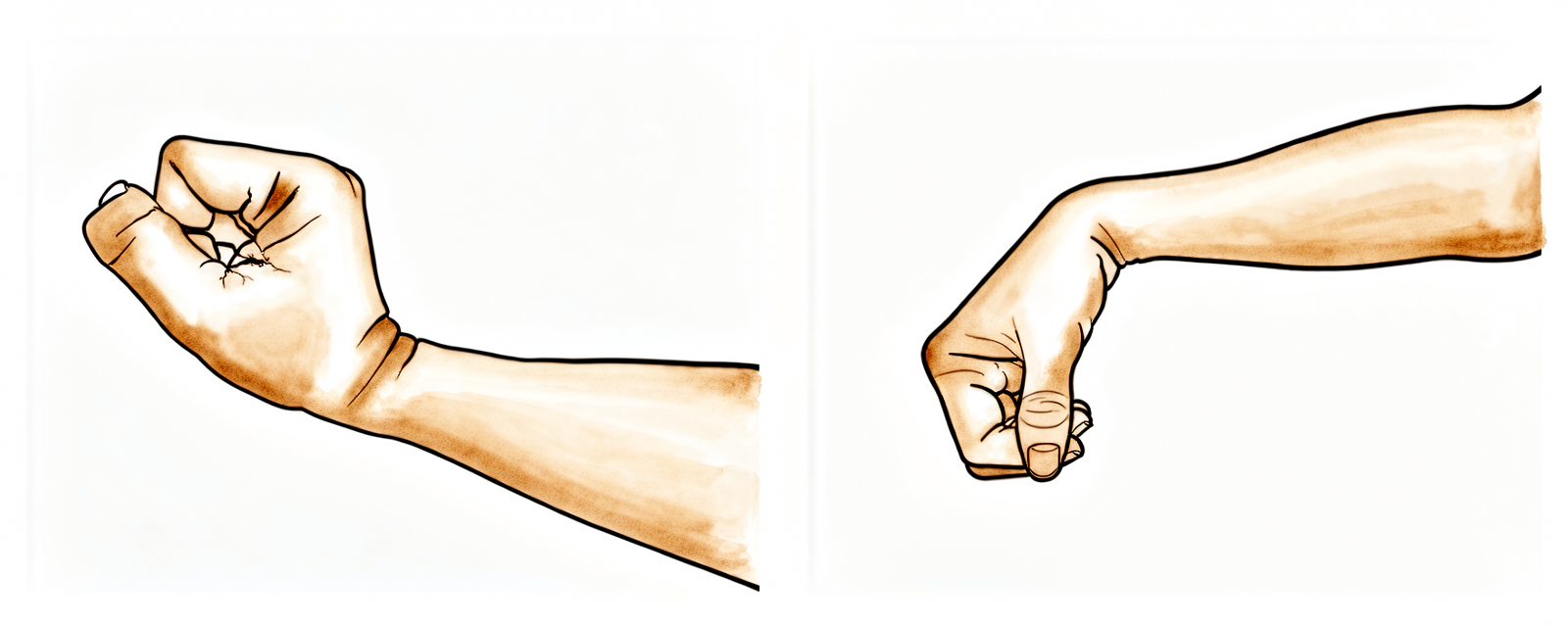
Flexión de la muñeca
Doble su muñeca suavemente hacia adelante y luego hacia atrás, hasta donde le resulte cómodo.
10–15 veces por hora
Kieran Hirpara 4.0
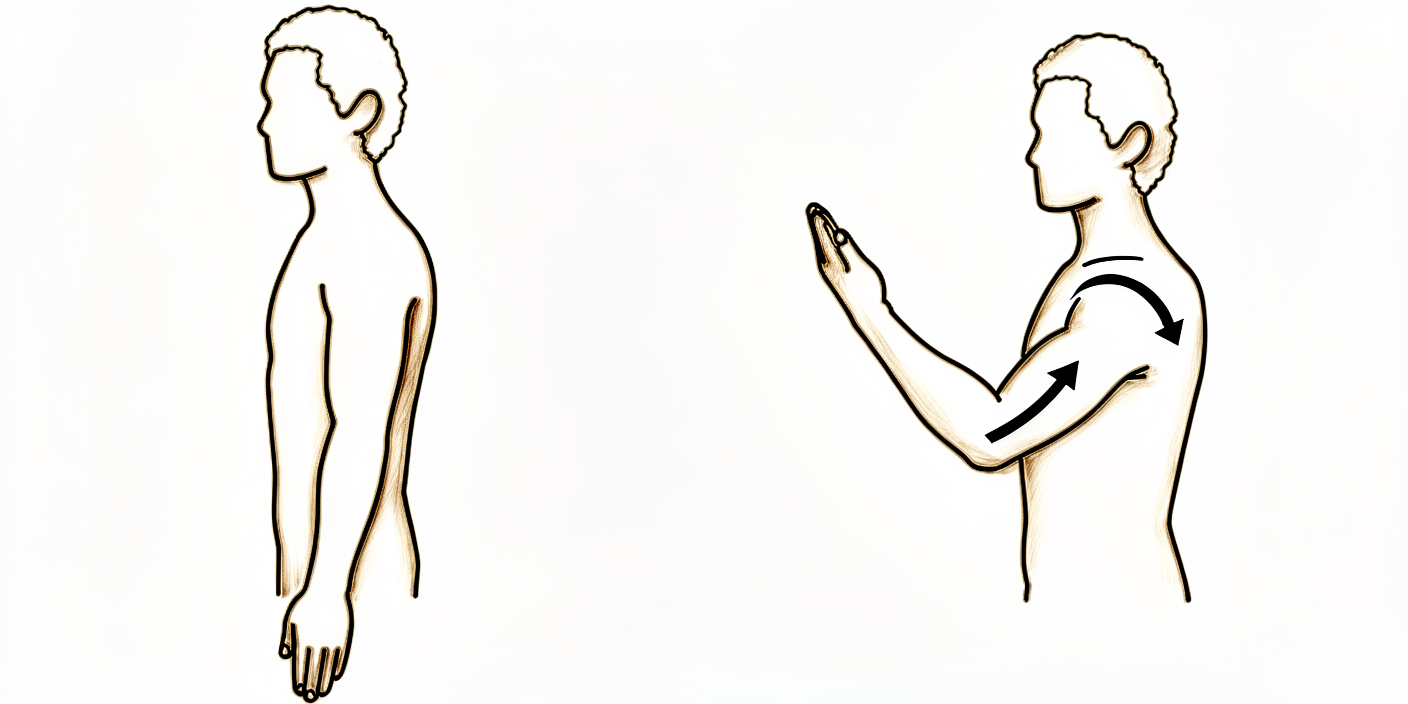
Flexión del codo
Con la palma de la mano hacia arriba, doble su codo suavemente todo lo que pueda y luego estire el brazo de nuevo. Mantenga el brazo superior pegado al costado. No permita que el brazo gire hacia afuera al realizar este movimiento.
10–15 veces, 2–3 veces al día
Kieran Hirpara 4.0
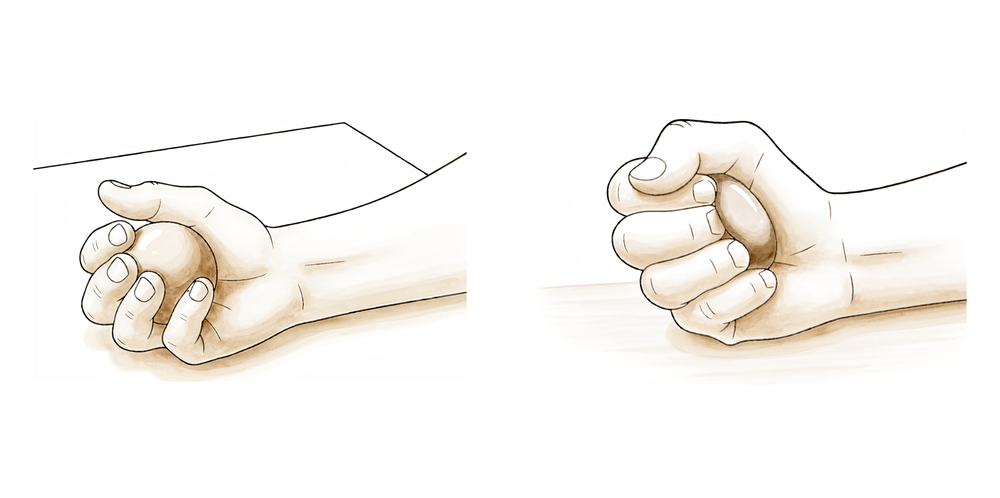
Apriete de pelota
Apriete suavemente una pelota blanda o un calcetín enrollado con la mano, y luego suéltelo. Esto mantiene activas la mano y el antebrazo mientras el hombro descansa.
10–15 veces, unas pocas veces al día
Kieran Hirpara 4.0
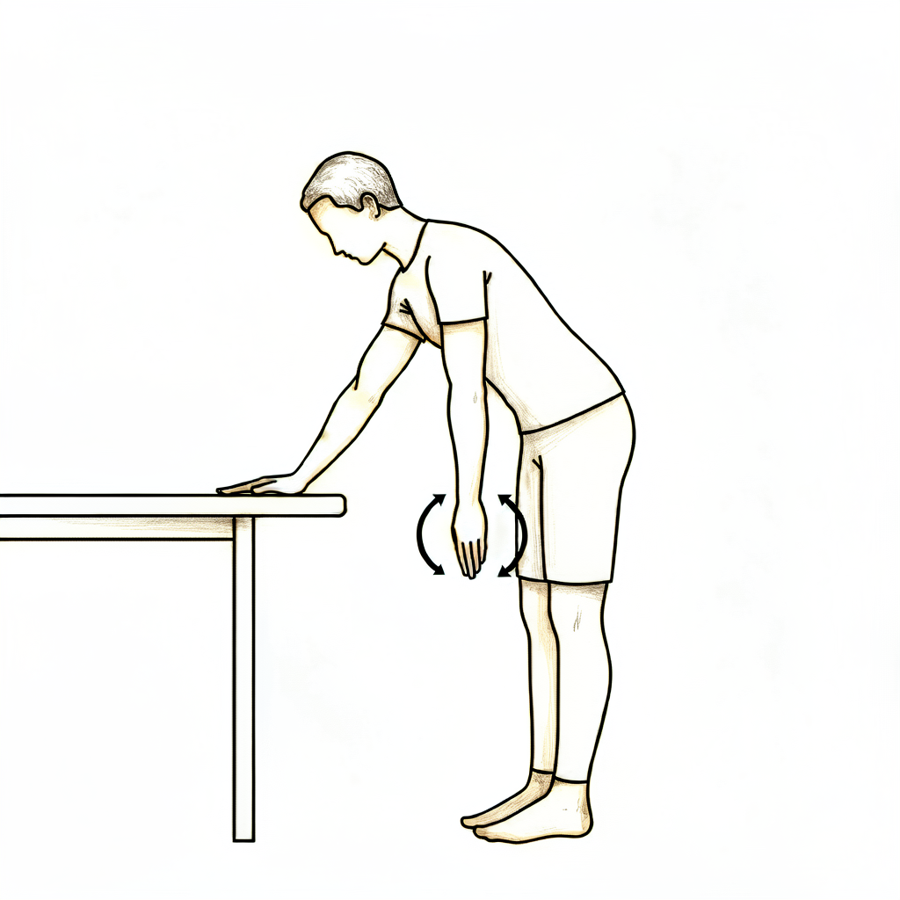
Oscilaciones del péndulo
Incline el cuerpo hacia adelante y deje que el brazo operado cuelgue, totalmente relajado. Realice círculos pequeños: primero en sentido horario y luego al revés, balanceando el cuerpo, pero sin usar los músculos del hombro. Mantenga los círculos de tamaño reducido (menos de 20 cm aproximadamente) y el brazo siempre colgando recto hacia abajo; no lo deje oscilar hacia los lados ni girar hacia afuera. El brazo operado debe permanecer relajado en todo momento.
10 en cada dirección, 2–3 veces al día
Kieran Hirpara 4.0
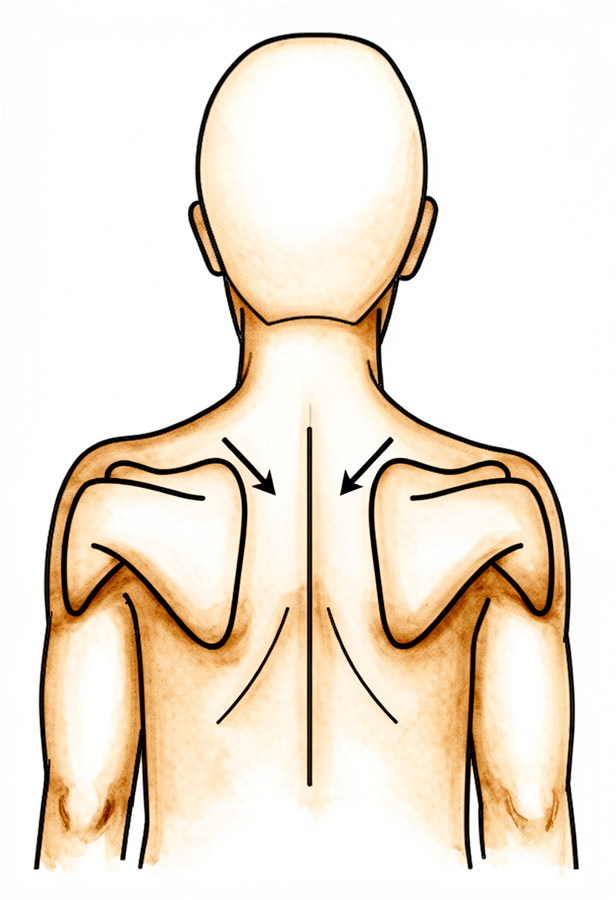
Posicionamiento de la escápula
Apriete suavemente los omóplatos hacia abajo y hacia adentro, mantenga la posición y luego relájese. Este es un ejercicio ligero de activación muscular: el brazo no se mueve y el hombro permanece relajado.
Mantenga la posición durante 5 segundos, 5 veces; 2–3 veces al día.
Kieran Hirpara 4.0
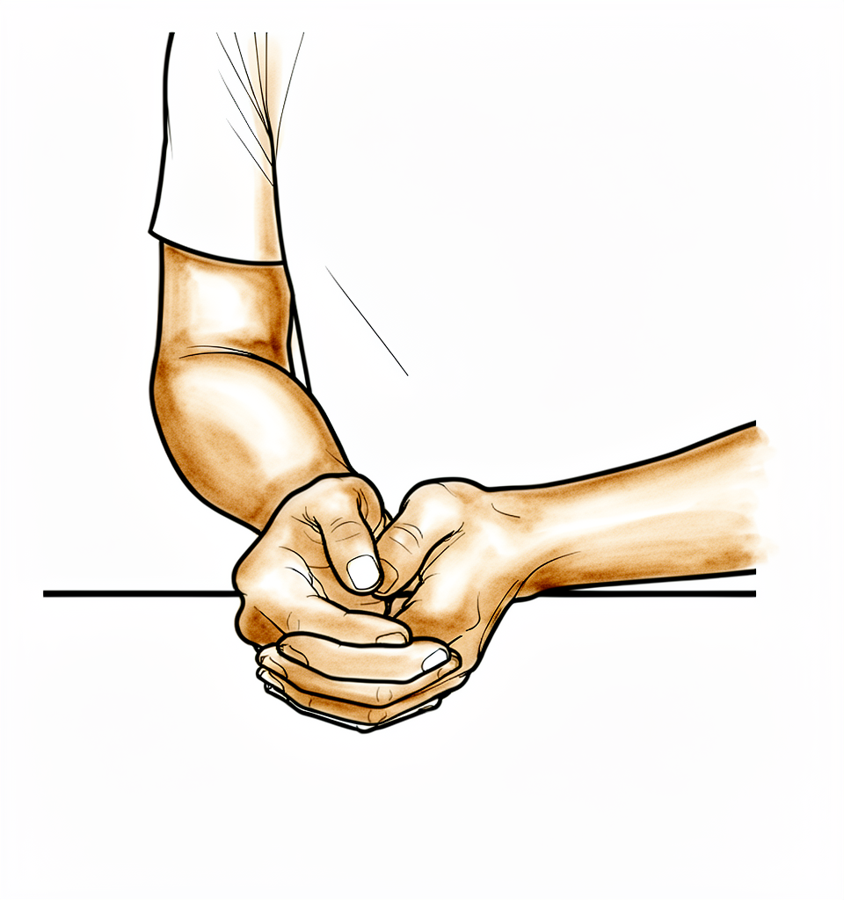
Rotación externa asistida hasta la posición neutra
A partir de la semana 2 aproximadamente, únicamente si así lo indica su fisioterapeuta. Con el codo pegado al costado, doblado a 90°, y la mano apoyada sobre el abdomen, utilice la mano sana para guiar suavemente el antebrazo hacia afuera; pero solo una PEQUEÑA cantidad (aproximadamente un cuarto de vuelta, unos 20°) y nunca más allá de la posición frontal (neutral) durante estas primeras semanas. Respete estrictamente los límites indicados por su fisioterapeuta y no fuerce el movimiento. Este es el movimiento que ejerce mayor tensión sobre la zona reparada, por lo que se mantiene deliberadamente dentro de un rango reducido.
Siguiendo las indicaciones de su fisioterapeuta, dentro del límite establecido.
Las primeras seis semanas giran en torno a un único objetivo: proteger la reparación realizada en la parte frontal del hombro mientras esta se va adhiriendo al hueso. Durante el día, debe usar el cabestrillo sencillo para sostener el brazo; por la noche, debe quitárselo (manteniendo el brazo delante del cuerpo, nunca extendido ni rotado hacia afuera). Utilice hielo para controlar la hinchazón y realice ejercicios suaves que mantengan en movimiento la mano, la muñeca y el codo, sin cargar ni estirar la zona de la reparación. Por el momento, no debe realizar ningún movimiento activo con el hombro por sí mismo; su brazo sano o un palo le ayudarán a moverse, y debe permanecer completamente relajado.
- Cabestrillo: use el cabestrillo sencillo con rotación neutra para sostener el brazo durante el día; quíteselo para dormir, pero mantenga el brazo delante del cuerpo y recogido; retírelo también para realizar ejercicios e higiene.
- Movimientos permitidos: únicamente movimientos asistidos y pasivos (nada que requiera fuerza propia del hombro). A partir de la semana 2, se permiten levantamientos asistidos hacia adelante hasta unos 90° (aproximadamente la mitad del recorrido completo), así como una rotación externa asistida en una pequeña medida (alrededor de 20°, sin llegar a la posición frontal). Mantenga el brazo siempre delante del cuerpo; nunca lo extienda hacia el lateral ni lo gire hacia afuera.
- Ejercicios: oscilaciones pendulares; movimientos suaves de la mano, muñeca y codo; apretar una pelota; ejercicios de ajuste de los omóplatos. A partir de la semana 3, siga las indicaciones de su fisioterapeuta para realizar contracciones musculares suaves y sin dolor (presione suavemente el brazo contra una pared o contra la otra mano y mantenga esa posición, sin rotar el brazo, sin movimientos de abducción ni rotación externa). Asimismo, a partir de la semana 2 y si su fisioterapeuta lo indica, podrá realizar rotaciones externas asistidas en un rango limitado, respetando siempre los límites establecidos.
Estará listo para pasar a la siguiente fase cuando: el dolor haya disminuido y se controle con analgésicos sencillos (nivel de alrededor de 3/10 o menos); haya completado las seis semanas de protección con el cabestrillo; la herida haya cicatrizado sin señales de complicaciones; pueda tolerar los movimientos asistidos dentro de sus límites sin sentir que el hombro pueda desplazarse; y no haya indicios de que la reparación haya sufrido sobrecarga.
Fase II: Restauración del movimiento y de la rotación (semanas 6–12)
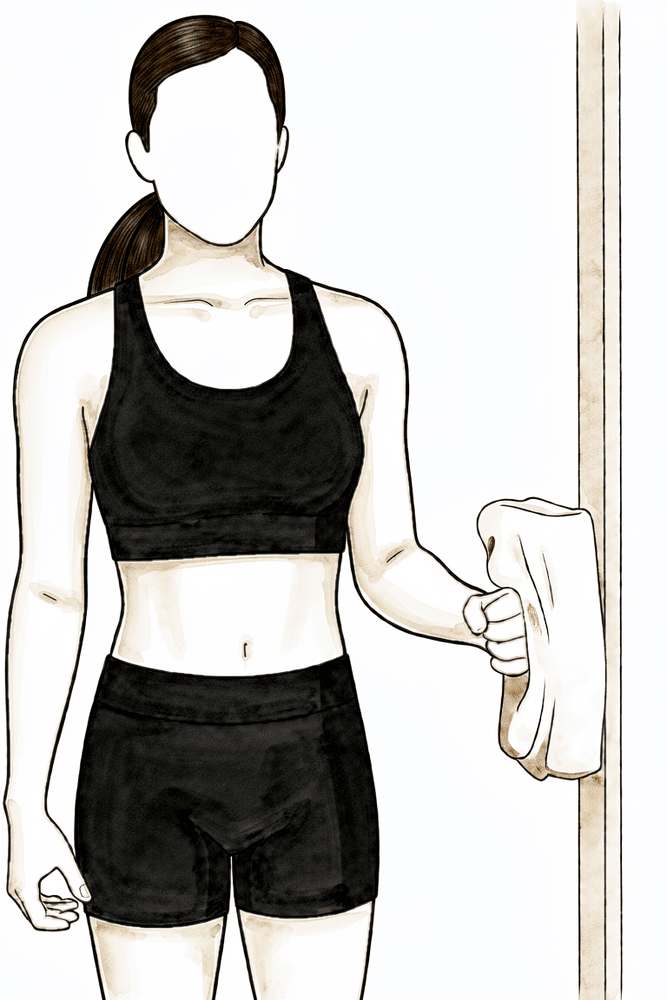
Kieran Hirpara 4.0
Rotación externa isométrica
A partir de la semana 6–8 aproximadamente, una vez que su fisioterapeuta lo autorice. Párese con el codo pegado al costado y doblado a 90°, de modo que el dorso de la mano quede cerca de una pared o marco de puerta. Presione suavemente el dorso de la mano hacia afuera contra esa superficie, SIN mover el brazo; se trata de un esfuerzo suave, aproximadamente un cuarto de su fuerza, y no debe causar dolor. Mantenga la posición y luego relájese. Vaya aumentando gradualmente la intensidad, ya que la rotación externa es la dirección a la que la reparación es más sensible.
Mantenga la posición durante ~5 segundos, con suavidad (~25% de esfuerzo), según las indicaciones de su fisioterapeuta.
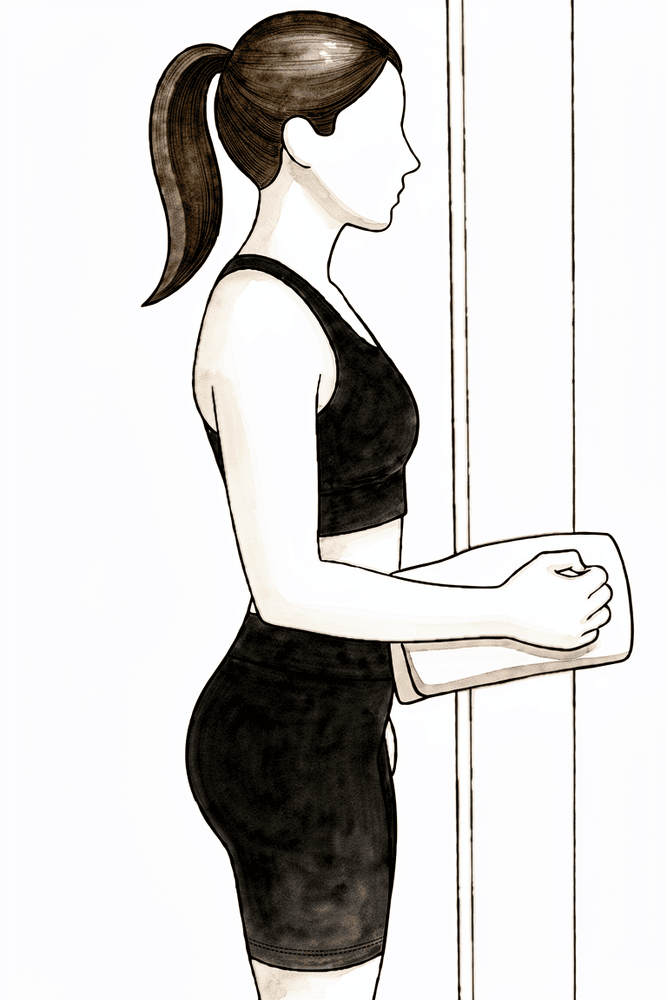
Kieran Hirpara 4.0
Rotación interna isométrica
A partir de la semana 6–8 aproximadamente, una vez que su fisioterapeuta lo autorice. Párese con el codo pegado al costado y la palma de la mano contra una pared. Presione suavemente la palma hacia adentro SIN mover el brazo; use aproximadamente una cuarta parte de su fuerza, sin sentir dolor. Mantenga la presión y luego relájese.
Mantenga la posición durante ~5 segundos, con suavidad (~25% de esfuerzo), según las indicaciones de su fisioterapeuta.
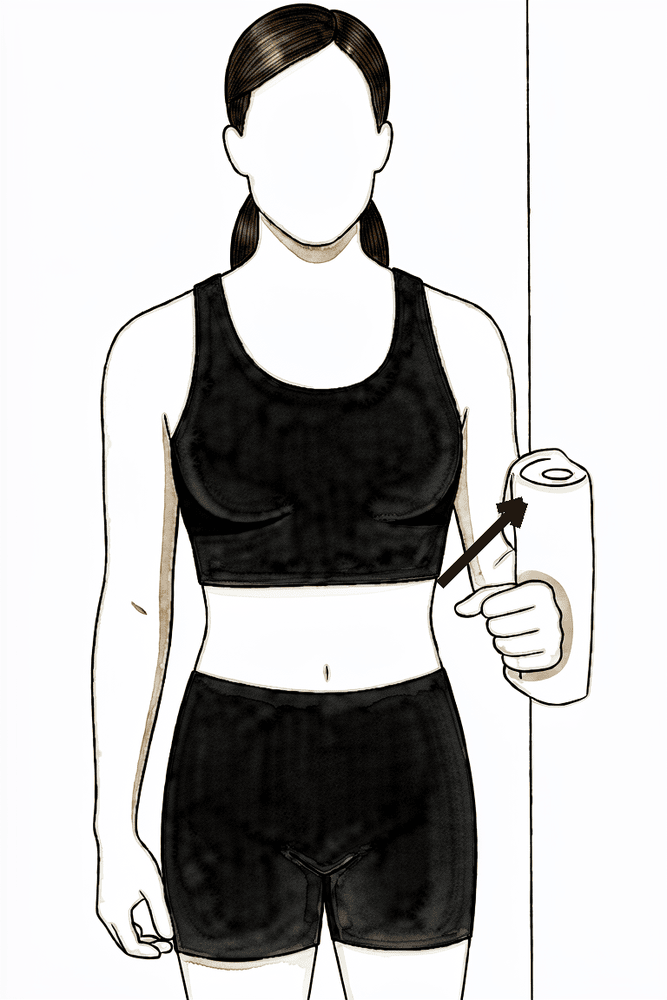
Kieran Hirpara 4.0
Isométrico: brazo extendido hacia el lateral
A partir de la semana 6–8 aproximadamente, una vez que su fisioterapeuta lo autorice. Párese de lado, con la parte externa del brazo cerca de una pared y el codo junto al cuerpo. Presione suavemente el brazo hacia afuera contra la pared SIN permitir que se mueva; use aproximadamente una cuarta parte de su fuerza y sin sentir dolor. Mantenga la posición y luego relájese.
Mantenga la posición durante ~5 segundos, con suavidad (~25% de esfuerzo), según las indicaciones de su fisioterapeuta.
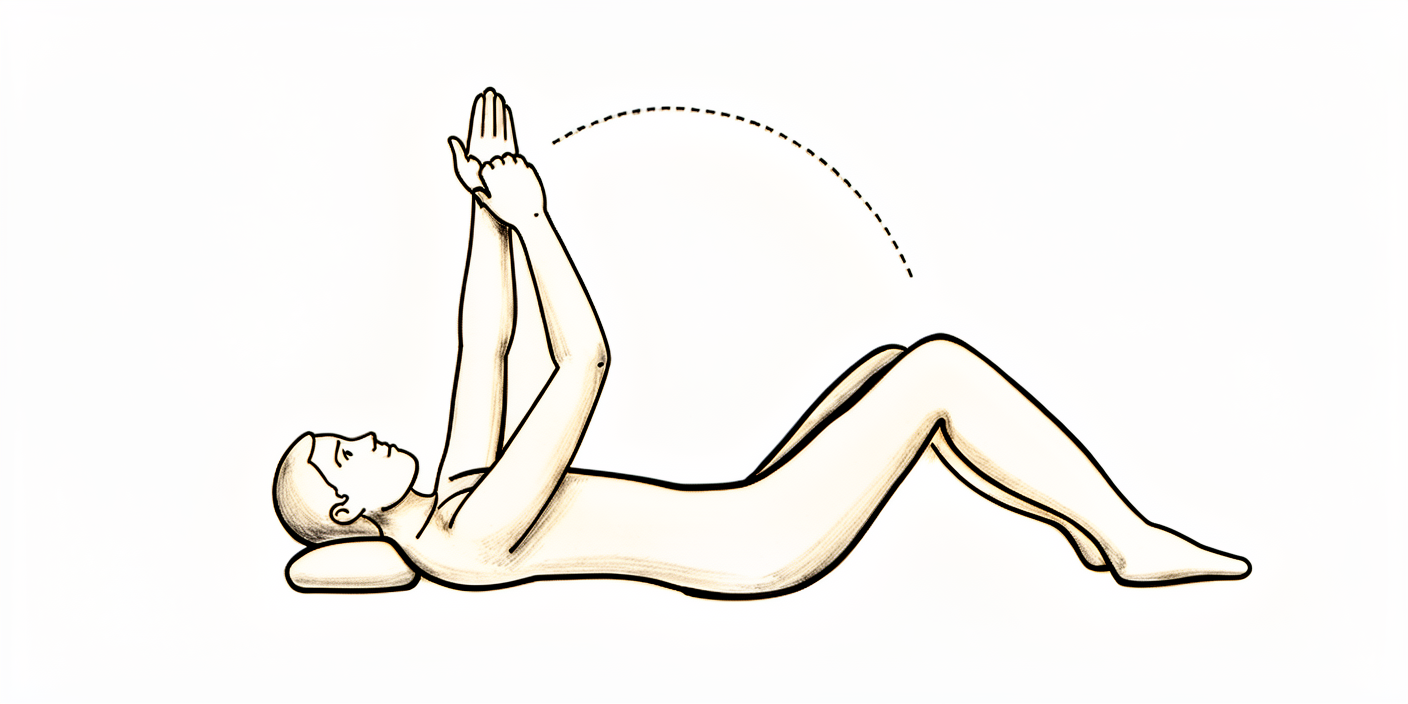
Kieran Hirpara 4.0
Elevación anterior asistida en decúbito
Acuéstese boca arriba, sujete un palo con ambas manos y use el brazo sano para levantar el brazo operado hacia adelante y hacia arriba; el hombro operado debe permanecer relajado. Realice el movimiento de forma suave, sin forzar, y bájelo con control. Aumente gradualmente la altura dentro del rango que le indique su fisioterapeuta.
10 veces, 2–3 veces al día
Kieran Hirpara 4.0
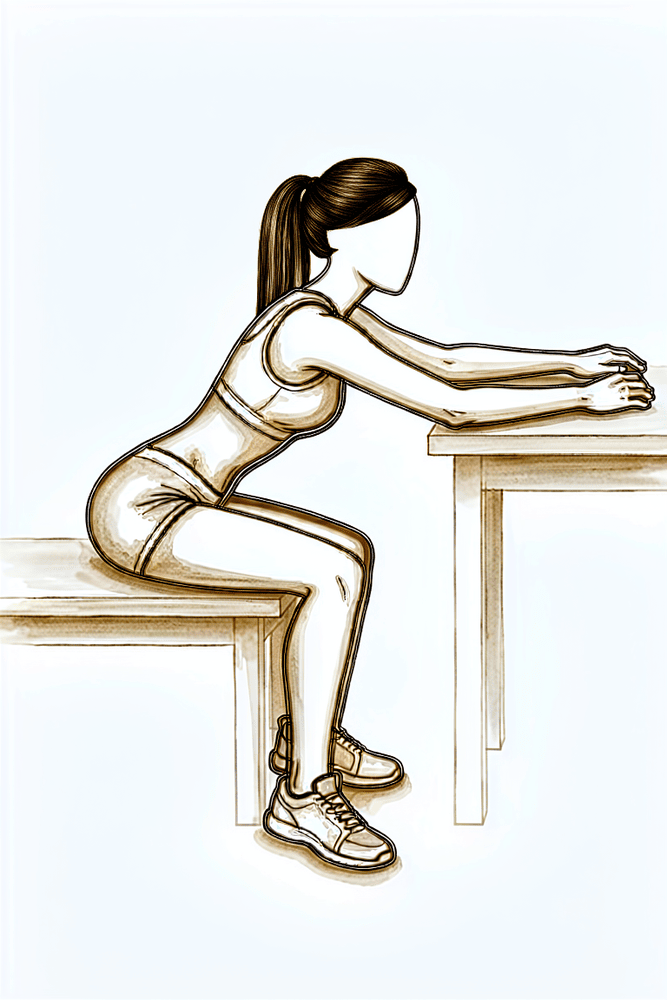
Deslizamiento sobre la mesa en posición sentada
Siéntese a una mesa con la mano operada apoyada sobre una toalla. Deslice la mano hacia adelante a lo largo de la superficie de modo que el brazo se extienda hacia adelante y hacia arriba, permitiendo que la mesa soporte el peso; luego deslícela de nuevo hacia atrás. Mantenga el brazo frente a usted; no lo deslice hacia un lado ni permita que gire hacia afuera.
10 veces, 2–3 veces al día
Kieran Hirpara 4.0
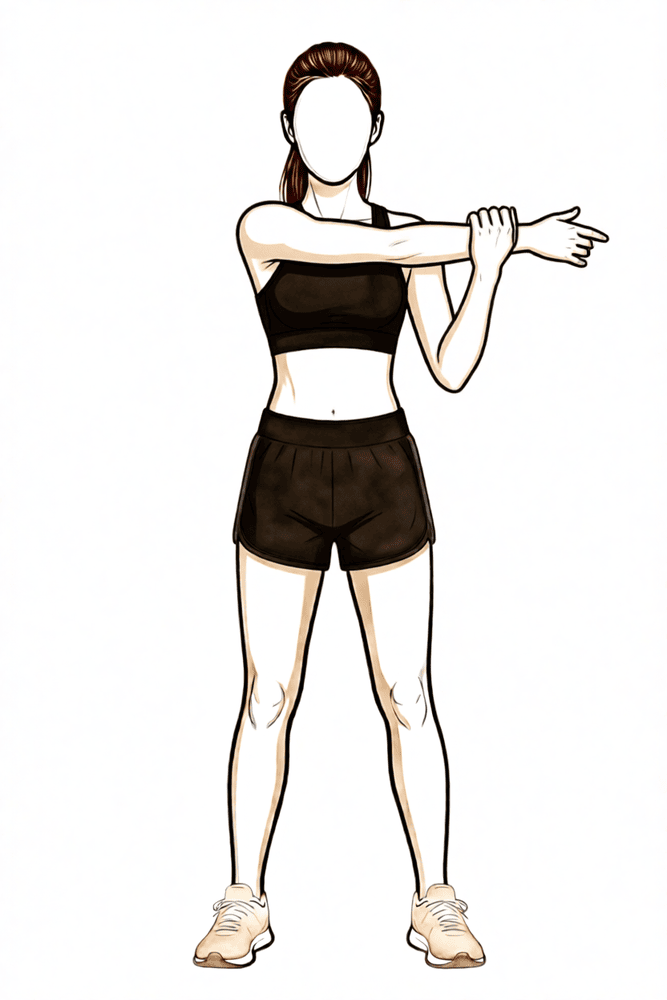
Estiramiento cruzado del cuerpo
A partir de la semana 6–8 aproximadamente, si así lo indica su fisioterapeuta. Utilice la mano sana para llevar suavemente el brazo operado cruzando el pecho, hasta sentir un estiramiento cómodo en la parte posterior del hombro. Haga el movimiento con suavidad; no fuerce. Este ejercicio estira la parte posterior del hombro sin ejercer tensión sobre la reparación de la parte frontal.
Mantenga la posición durante 10–20 segundos, varias veces, según las indicaciones de su fisioterapeuta.
Ya se ha retirado el cabestrillo; ahora el objetivo es restaurar el movimiento, no la fuerza. Se pasa de realizar movimientos asistidos a mover el brazo por propia iniciativa; asimismo, la rotación externa se va recuperando gradualmente: desde unos 30–45° al inicio de esta fase hasta alcanzar el rango completo alrededor de la semana 12. Todo esto se logra en etapas, sin forzar el movimiento, ya que la reparación frontal aún está en proceso de curación. A medida que mejora el movimiento, se incorporan ejercicios leves de activación muscular (isométricos).
- Cabestrillo: retirado.
- Movimientos permitidos: primero movimientos asistidos, luego movimientos por propia iniciativa. El levantamiento hacia adelante avanza hasta alcanzar el rango completo por encima de la cabeza. La rotación externa se mejora paso a paso: aproximadamente 30–45° al inicio de esta fase, para luego alcanzar el rango completo alrededor de la semana 12. El movimiento de llevar el brazo detrás de la espalda se reintroduce de forma gradual y más tarde en esta fase.
- Ejercicios: levantamiento hacia adelante asistido estando acostado; deslizamiento de brazo sobre una mesa en posición sentada; ejercicios isométricos suaves (presión mantenida) de rotación externa, rotación interna y extensión lateral del brazo; estiramiento cruzado del hombro para la parte posterior del hombro.
Está listo para pasar a la siguiente fase cuando: pueda levantar el brazo hacia adelante por propia iniciativa hasta casi la altura máxima con buen control (sin encoger los hombros ni movimientos bruscos); la rotación externa haya alcanzado el rango completo o casi completo y sea cómoda; los ejercicios isométricos suaves se toleren sin desencadenar dolor posterior; y no tenga sensación alguna de que el hombro pueda dislocarse durante las actividades cotidianas.
Fase III: Fortalecimiento (semanas 12–16)
Kieran Hirpara 4.0
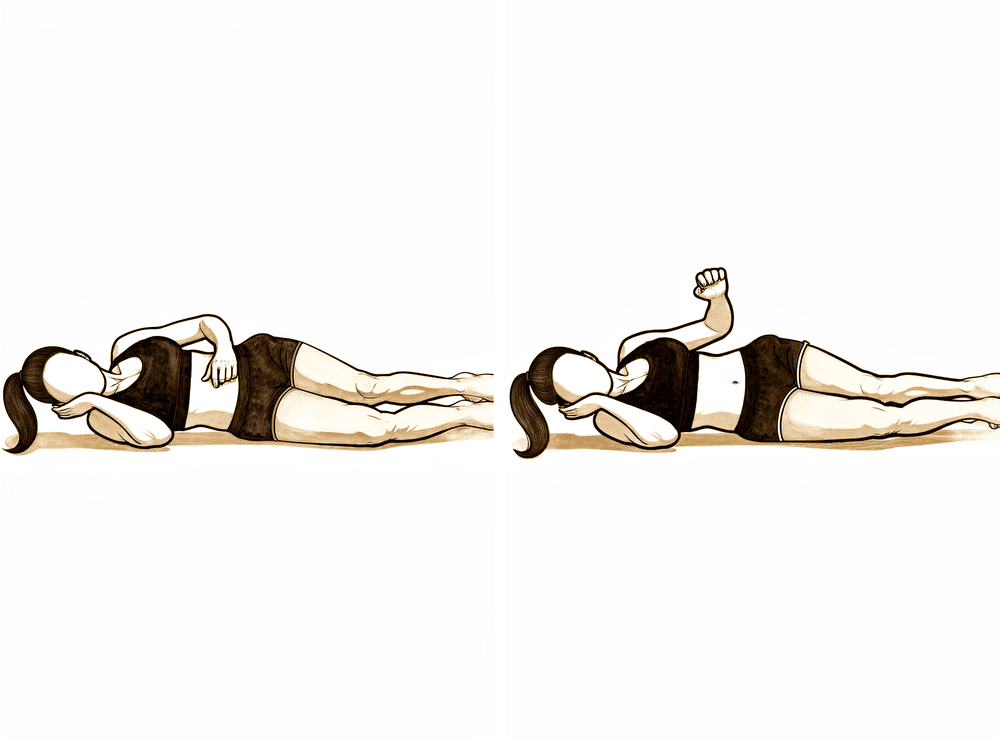
Rotación externa en decúbito lateral
A partir de la semana 12 aproximadamente. Acuéstese sobre el lado sano, con el codo operado pegado a la cintura y flexionado a 90°. Gire el antebrazo operado hacia arriba, en dirección al techo, y luego bájelo de forma controlada. Comience sin carga alguna, manteniéndose dentro del rango que le indique su fisioterapeuta. Este ejercicio fortalece por último la capacidad de rotación externa, ya que es la dirección en la que la reparación requiere mayor protección.
Según las indicaciones de su fisioterapeuta.
Kieran Hirpara 4.0
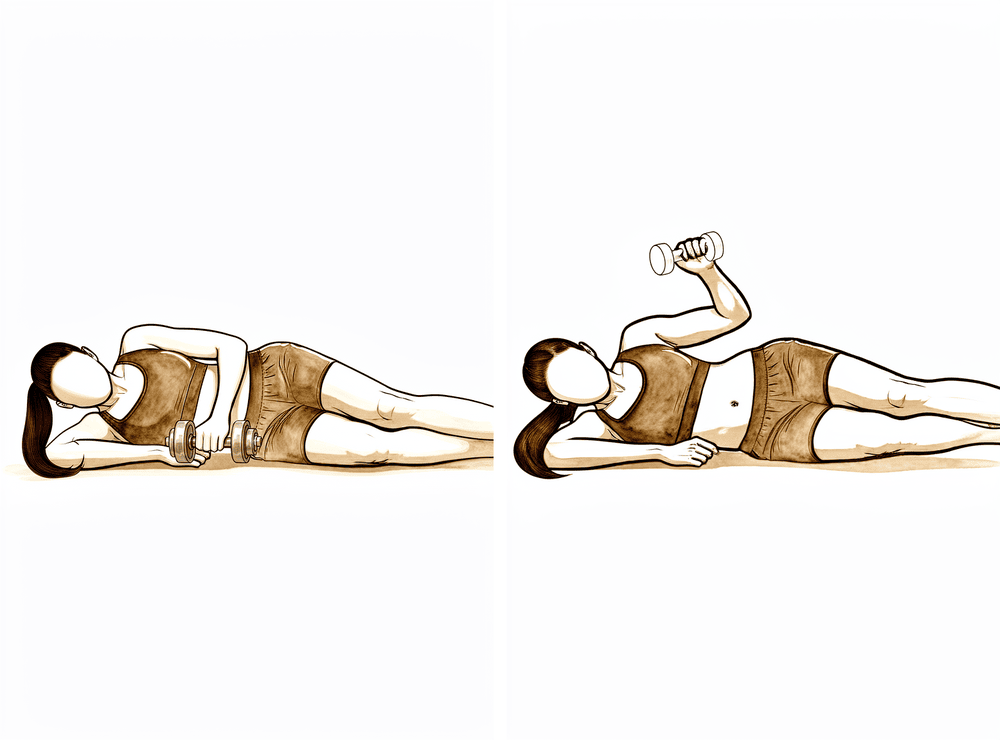
Rotación externa en decúbito lateral con un peso ligero
La rotación externa en decúbito lateral, como antes, ahora con un peso ligero; aumente la carga gradualmente. Mantenga el codo pegado a la cintura. Deténgase si siente dolor en el hombro.
Según las indicaciones de su fisioterapeuta.
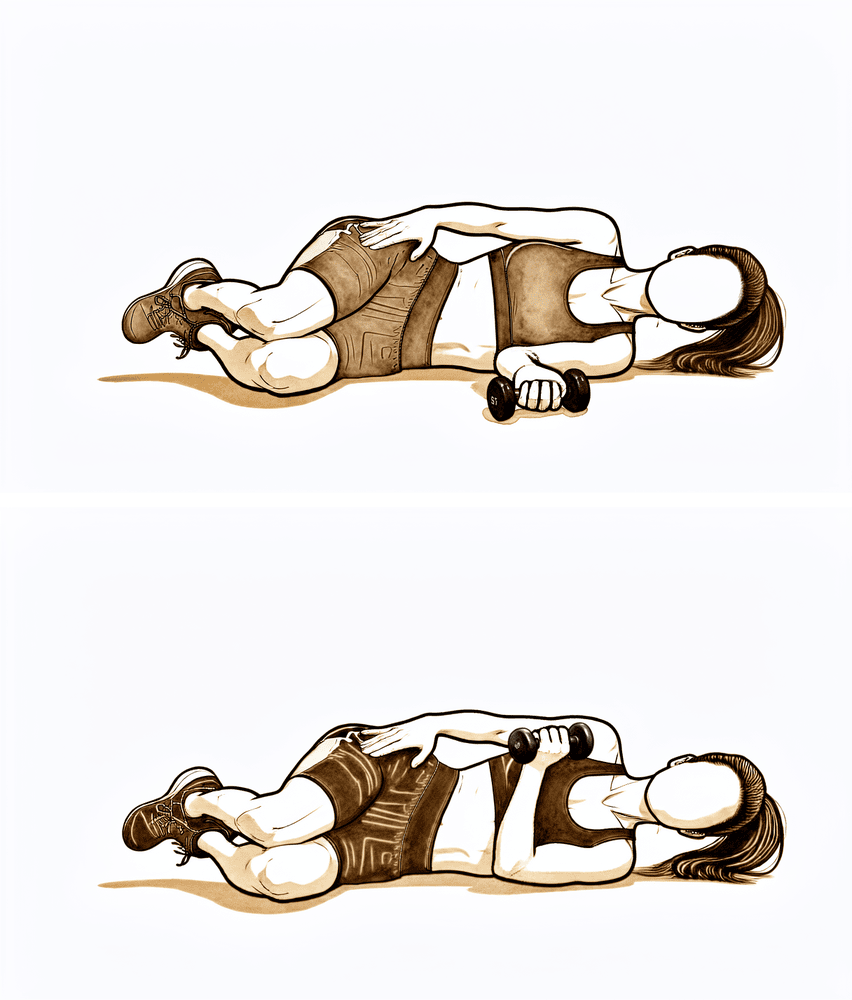
Kieran Hirpara 4.0
Rotación interna en decúbito lateral con un peso ligero
A partir de la semana 12 aproximadamente. Acuéstese sobre el lado operado, con el codo pegado a la cintura y doblado a 90°, sosteniendo un peso ligero. Levante el antebrazo hacia el abdomen y luego bájelo de forma controlada.
Según las indicaciones de su fisioterapeuta.
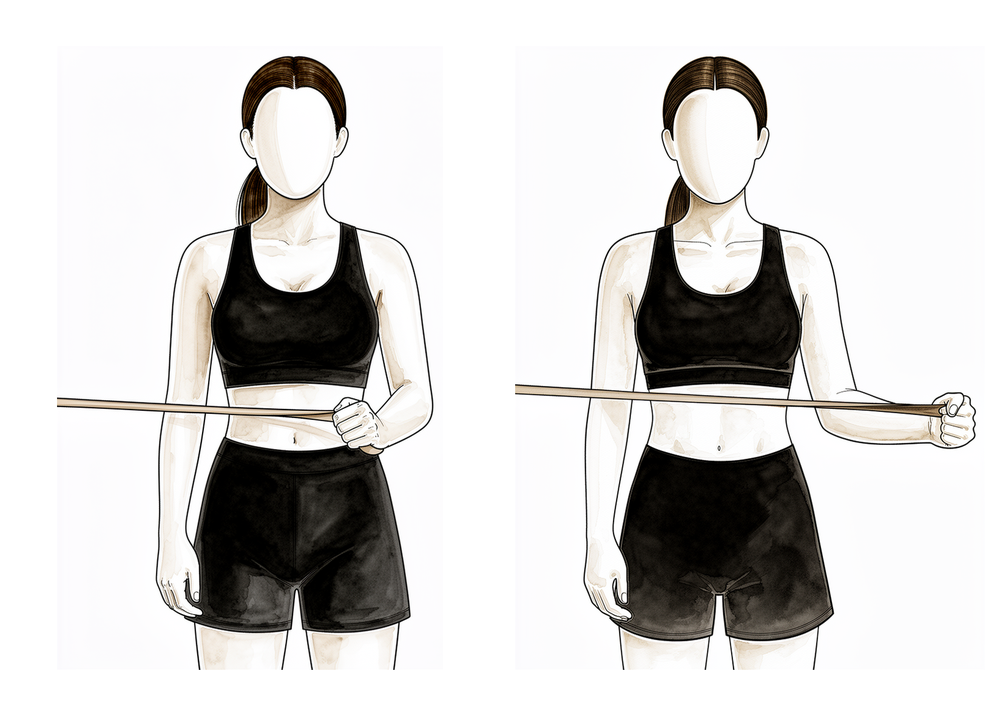
Kieran Hirpara 4.0
Rotación externa con banda elástica
A partir de la semana 12 aproximadamente, una vez que la rotación completa resulte cómoda. Mantenga el codo pegado al costado y flexionado a 90°. Gire el antebrazo hacia afuera contra la resistencia de una banda ligera y luego regrese a la posición inicial de forma controlada. Utilice una banda ligera y realice muchas repeticiones; evite usar una resistencia excesiva.
Según las indicaciones de su fisioterapeuta.
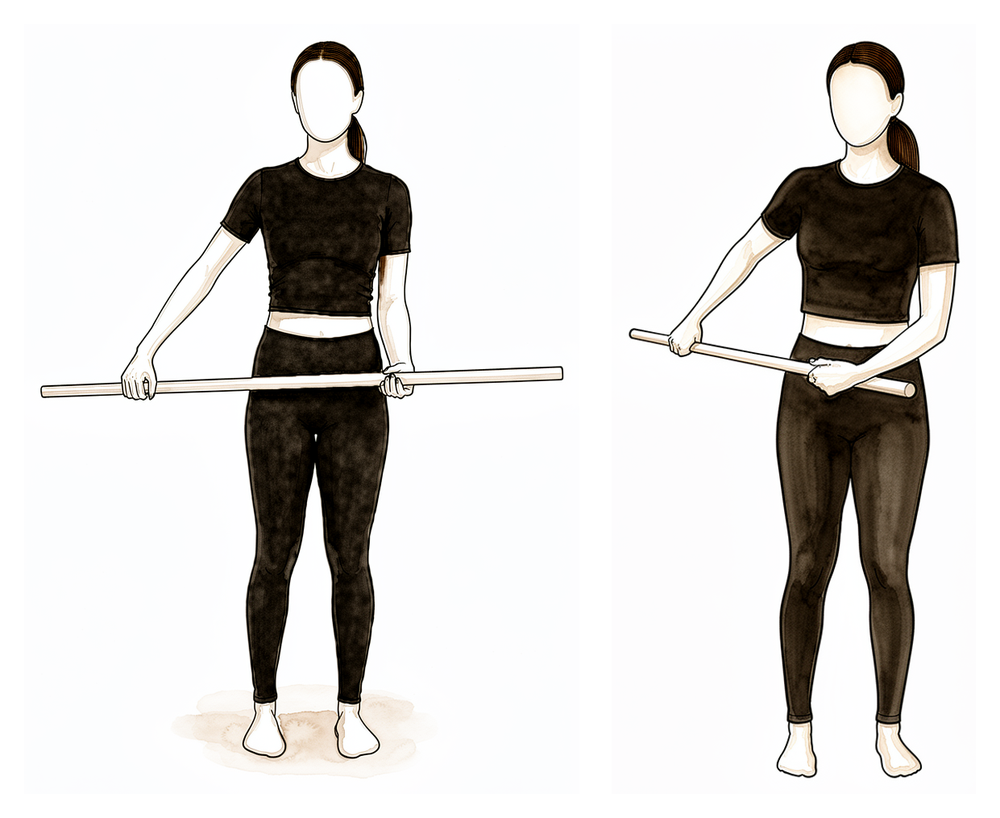
Kieran Hirpara 4.0
Rotación interna mediante un palo
A partir de la semana 12 aproximadamente. Sostenga un palo detrás de la espalda y use la mano sana para levantar suavemente la mano operada por la espalda, y luego bajarla con control. Asegúrese de que sea una postura cómoda y que se mantenga dentro de los límites indicados por su fisioterapeuta.
Según las indicaciones de su fisioterapeuta.
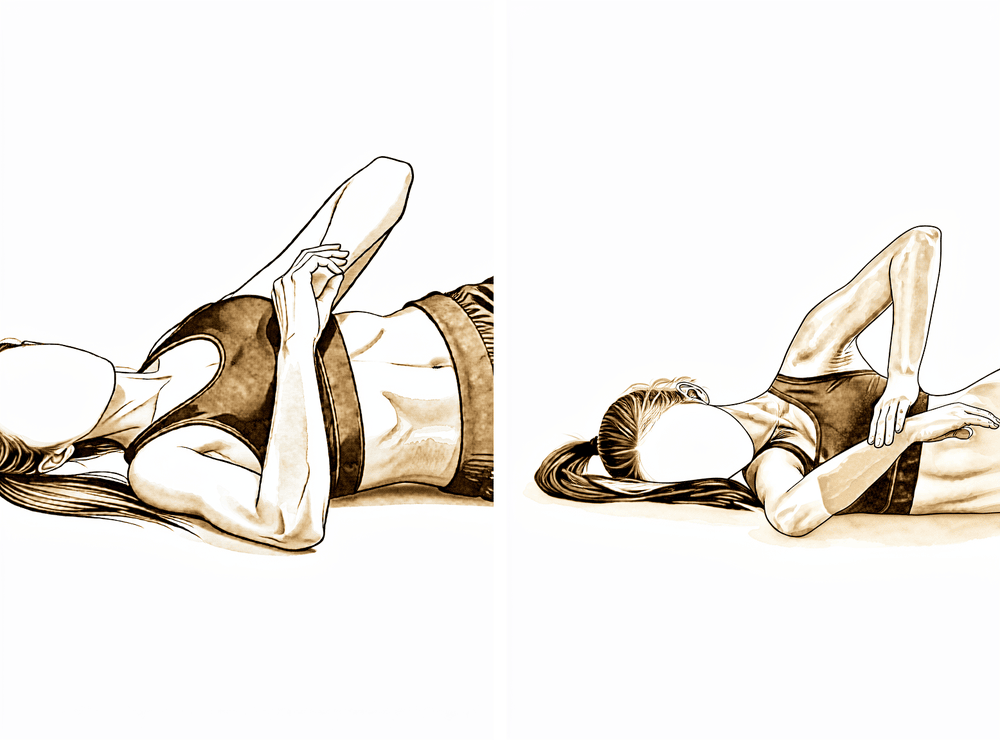
Kieran Hirpara 4.0
Estiramiento de “dormilón”
A partir de la semana 12 aproximadamente, si así lo indica su fisioterapeuta. Acuéstese sobre el lado de la operación, con el brazo extendido hacia adelante y el codo flexionado. Con la mano superior, presione suavemente el antebrazo hacia la cama hasta sentir un estiramiento cómodo en la parte posterior del hombro. Solo con suavidad; no fuerce el movimiento.
Mantenga la posición durante 10–20 segundos, unas cuantas veces, según las indicaciones de su fisioterapeuta.
Kieran Hirpara 4.0
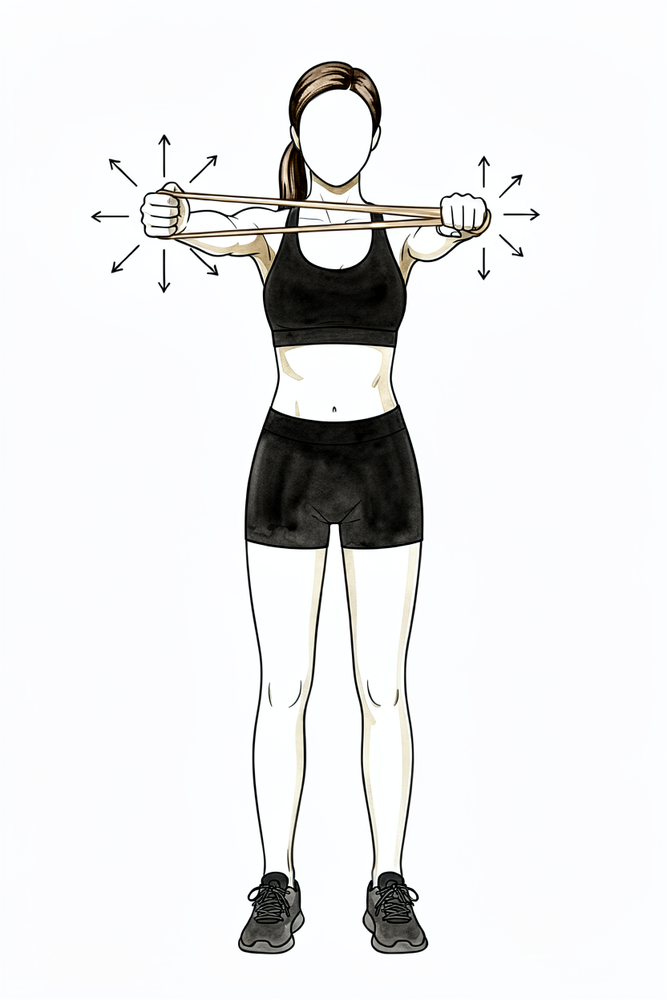
Estabilización rítmica
Con el brazo apoyado delante de usted a una altura aproximada de los hombros, pida a su fisioterapeuta (o a su mano sana) que realice pequeños empujes suaves desde distintas direcciones, mientras usted mantiene el brazo inmóvil y estable; no permita que se mueva. Esto entrena a los músculos estabilizadores del hombro para que reaccionen. Asegúrese de que todos los movimientos sean suaves.
Según las indicaciones de su fisioterapeuta.
A las doce semanas, la reparación ya es lo suficientemente sólida como para iniciar un verdadero fortalecimiento; el enfoque pasa de recuperar el movimiento a reconstruir la fuerza, la resistencia y el control. A partir de ahora se comienza el trabajo de resistencia con bandas elásticas y pesas ligeras: muchas repeticiones y cargas bajas. Se fortalecen los músculos del manguito rotador que estabilizan el hombro en todas las direcciones; la rotación externa se trabaja con especial cuidado, ya que es la dirección en la que la reparación resulta más sensible. Siempre hay que mantener los movimientos controlados y sin dolor.
- Cabestrillo: no se usa; se espera movilidad completa.
- Ejercicios: rotación externa acostado de lado (progresando a usar una pesa ligera); rotación interna acostado de lado con una pesa ligera; rotación externa con banda elástica, con el codo pegado al cuerpo; rotación interna utilizando un palo; estiramiento “sleeper” para la parte posterior del hombro. Su fisioterapeuta también podría incorporar la estabilización rítmica (ejercicios suaves de mantenimiento en los que empuja ligeramente su brazo y usted opone resistencia) para reentrenar el control del hombro. Se trata de una intervención manual sin necesidad de diagramas.
Listo para pasar a la siguiente fase cuando: pueda mover el hombro libremente y sin dolor, incluso controlando la escápula; no presente dolor ni hinchazón tras las sesiones de fortalecimiento; la fuerza en las rotaciones vaya aumentando progresivamente hasta igualarse con el lado opuesto; y no sienta inseguridad ni inestabilidad al realizar tareas cotidianas que requieran carga.
Fase IV: Regreso al deporte y al trabajo (4–6 meses)
Kieran Hirpara 4.0
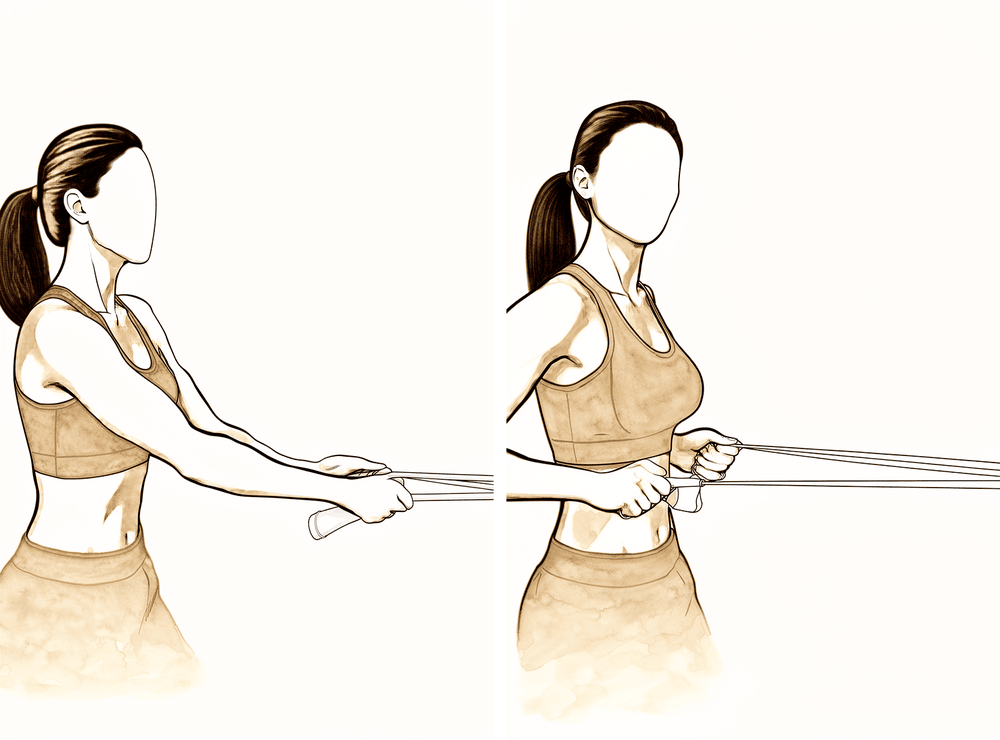
Remo con banda de resistencia
Con una banda anclada delante de usted, tire de las manijas hacia sí, llevando los codos hacia atrás y juntando los omóplatos; luego regrese a la posición inicial de forma controlada. Mantenga los codos cerca del cuerpo y delante de usted; no permita que se desplacen hacia atrás, más allá de la línea del cuerpo. Use una banda ligera y realice muchas repeticiones.
Según las indicaciones de su fisioterapeuta.
Kieran Hirpara 4.0
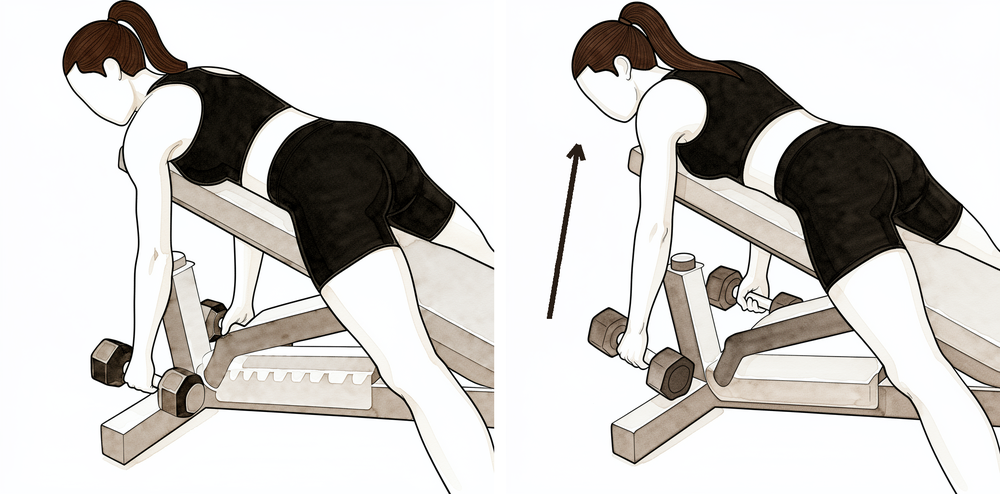
Tracción de la escápula con peso
Acerque los omóplatos hacia atrás y hacia abajo contra un peso ligero o una banda elástica, mantenga la posición brevemente y luego relájese de forma controlada. Esto fortalece los músculos que estabilizan el omóplato y brindan soporte al hombro reparado.
Según las indicaciones de su fisioterapeuta.
Kieran Hirpara 4.0
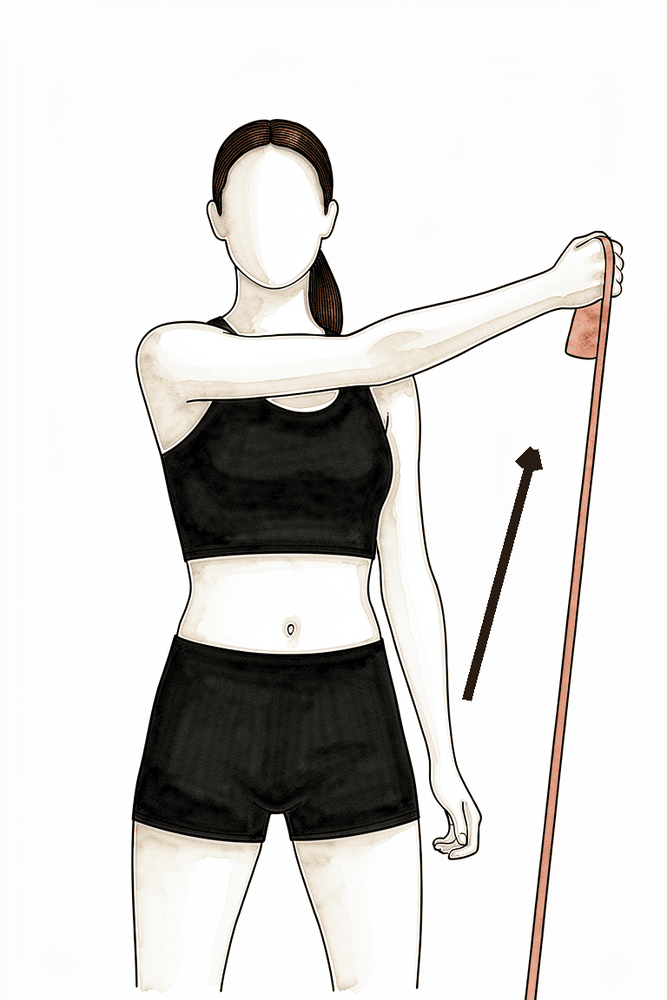
Patrón diagonal con banda (alcanzar hacia abajo y cruzando el cuerpo)
A partir de la semana 12 aproximadamente, una vez que haya recuperado un movimiento total y sin molestias, utilice una banda ligera para mover el brazo en una línea diagonal suave: desde arriba y hacia afuera, luego hacia abajo y cruzando hacia la cadera opuesta, y de nuevo hacia atrás. Esto entrena el hombro para seguir los patrones diagonales naturales que se emplean en las actividades diarias y deportivas. Mantenga el movimiento controlado y sin dolor.
Según las indicaciones de su fisioterapeuta.
Kieran Hirpara 4.0
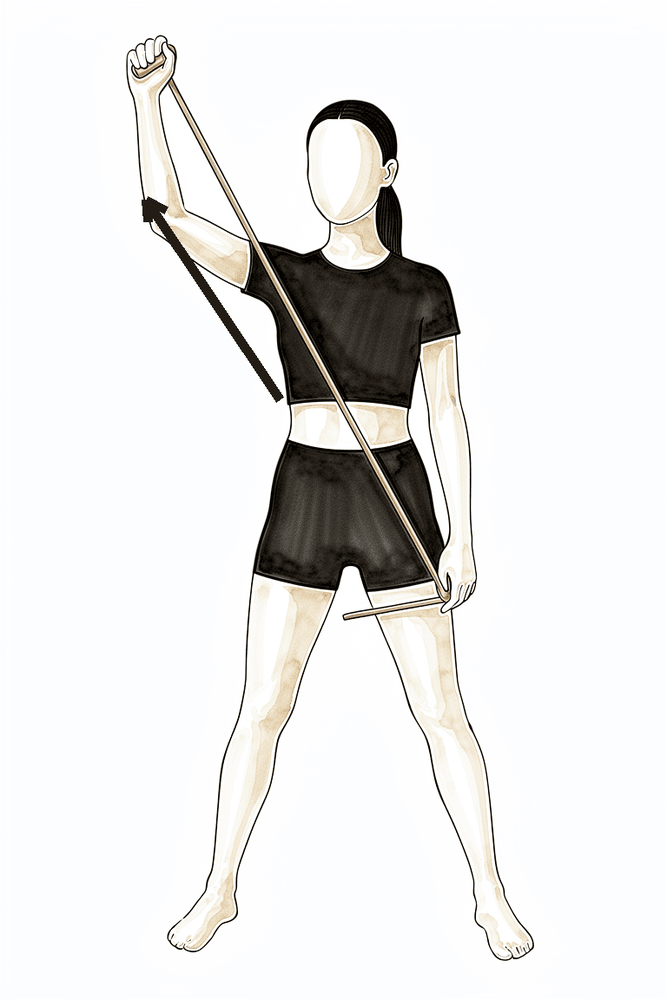
Patrón diagonal con banda (alcanzar hacia arriba y cruzando el cuerpo)
A partir de la fase final de este período, una vez que la rotación externa sea completa y cómoda. Con una banda elástica ligera, mueva el brazo en una línea diagonal suave: desde una posición hacia abajo y cruzando el cuerpo, hasta arriba y hacia afuera por encima de la cabeza, y luego de regreso. Dado que este movimiento lleva al brazo a una posición elevada y con rotación externa, solo debe practicarse cuando su fisioterapeuta considere que está listo. Mantenga el movimiento controlado y sin dolor.
Según las indicaciones de su fisioterapeuta.
Esta fase constituye el puente entre un hombro fuerte y controlado y las exigencias del deporte y del trabajo más intenso. En ella se mantiene el rango de movimiento logrado y se desarrolla la fuerza, la potencia y la resistencia necesarias para utilizarlo con confianza. El regreso se realiza de forma gradual, no repentina; para deportes que requieren movimientos por encima de la cabeza o con contacto físico, el método más seguro es un programa progresivo que aumente paso a paso el volumen y la intensidad del entrenamiento.
- Cabestrillo: no se utiliza.
- Ejercicios: fortalecimiento progresivo del manguito rotador y de los músculos de la escápula (remos con banda elástica, tracciones para la escápula); ejercicios con banda elástica en patrones diagonales que entrenan el hombro siguiendo trayectorias naturales de alcance; el patrón de movimiento por encima de la cabeza y con rotación solo se incorpora cuando la rotación externa es completa y cómoda. Posteriormente, se añaden ejercicios específicos para el deporte o el trabajo, así como entrenamientos de mayor velocidad bajo control.
Listo para regresar cuando: su fuerza haya alcanzado al menos el 85 % de la del lado contralateral y exista un buen equilibrio entre la fuerza de rotación externa e interna; cuando cuente con un rango de movimiento completo, sin dolor ni sensación de inestabilidad bajo carga; y cuando supere las pruebas específicas para su deporte o actividad laboral. El regreso a deportes con contacto o que requieran movimientos por encima de la cabeza suele producirse alrededor de 4–6 meses, siempre que se cumplan estos criterios y cuente con la autorización del Dr. Hirpara y de su fisioterapeuta, no únicamente en función del calendario.
Regreso al deporte y al trabajo
El regreso al deporte y al trabajo se basa en criterios clínicos: ausencia de dolor, rango de movimiento completo, fuerza muscular equilibrada, y la sensación de que el hombro no se va a dislocar; además, requiere la autorización tanto del Dr. Hirpara como de su fisioterapeuta. No depende únicamente del calendario.
- Trabajos ligeros y sedentarios: se pueden retomar en unas pocas semanas, siempre con el brazo protegido.
- Fortalecimiento muscular: se inicia con resistencia ligera a partir de las 12 semanas aproximadamente.
- Deportes que implican lanzamientos o movimientos por encima de la cabeza: no antes de 4 meses, y solo tras un progreso gradual.
- Deportes de contacto o colisión: normalmente 4–6 meses, siempre según los criterios clínicos.
La reparación de lesiones del complejo Bankart en tejidos blandos cicatriza más lentamente que la intervención ósea de Latarjet; por ello, el regreso a las actividades suele ser un poco más tardío. La paciencia en este proceso protege la reparación y reduce el riesgo de nuevas dislocaciones del hombro.
Después de seguir el protocolo
Este protocolo se complementa con las recomendaciones generales de recuperación del consultorio; consulte control del dolor postoperatorio y cuidado de la herida.
Evidence & references
This is the clinical evidence summary written for health professionals. It is technical, and it lists the research this page was built from. You do not need to read it to understand your treatment or to make a decision about it.
Anterior Stabilisation — Arthroscopic Bankart Repair: Rehabilitation Evidence
Topic: Arthroscopic capsulolabral (Bankart) repair for anterior glenohumeral instability. Compiled: 2026-06-16. Sources: local RAG Orthopaedic corpus (154k articles) + published fellowship/PT "standard of care" protocols. Core early precaution: protect the anterior repair -> limit external rotation (ER) (and combined abduction+ER) in the early weeks, because anterior-inferior capsulolabral healing is stressed by ER. This is the mirror image of the posterior protocol.
Consensus phased timeline
The two published academic protocols below are highly concordant. ER limits are given as degrees in the scapular plane / at the side and at 90 deg abduction.
| Phase | Week window | Sling/brace | ROM allowed & restrictions | AROM / strengthening | RTS |
|---|---|---|---|---|---|
| I - Immediate post-surgical / protection | 0-3 wk | Sling at ALL times (neutral rotation, ~30-45 deg abduction per MGH); remove only for shower + elbow/wrist ROM; sleep in sling 6 wk | No shoulder AROM. PROM begins wk 2: flexion <90 deg, ER in scapular plane <20 deg. Avoid abduction+ER (anterior capsule stress); no reaching behind back | Scapular setting, ball squeezes; submaximal isometrics start wk 3 (avoid ER/IR initially) | None |
| II - Protection / PROM | 4-5 wk | Continue sling | PROM progressed: flexion to ~140 deg, ER to 30-45 deg (at side / scapular plane / and at 90 deg abd per MGH), full IR, full abduction in scapular plane | AAROM; submaximal RC isometrics (ER, IR, flexion, abd, ext); periscapular strengthening | None |
| III - Intermediate / AROM | 6-8 wk | Wean / discontinue sling | ER to 50-65 deg scapular plane, ER to ~75 deg at 90 deg abd, flexion to ~160 deg. Begin AROM (gravity-minimised -> resisted). Begin posterior-capsule stretches (cross-arm, sleeper) | Begin isotonic RC + rhythmic stabilisation (closed->open chain). NO push-ups/pec flys (anterior stress) | None |
| IV - Strengthening / transitional | 8-12 (-16) wk | None | Progress ER (BWH: 65 deg at 20 deg abd, 75 deg at 90 deg abd wk 8-10; then all planes to tolerance). Full PROM/AROM by ~12 wk | Progressive RC + periscapular strengthening, PNF diagonals, light resistance until wk 12. Avoid contact sport | None |
| V - Return to activity / strengthening | 12-16 wk | None | Full ROM | Heavier strengthening, Thrower's 10, closed-chain push-up progression. Light golf/tennis (no serve until 4 mo) | Begin sport-specific / interval programs |
| VI - Unrestricted RTS | 4-6 months | None | Full | Throwing/overhead not before 4 months. Plyometrics, interval throwing | Full RTS on criteria + MD clearance |
Active ROM start: ~week 6. Strengthening start: isometrics wk 3; isotonic RC wk 6-8. RTS: sport-specific ~12-16 wk; throwing/overhead >=4 months; full/contact 4-6 months, criterion-based.
RTS criteria (criterion-based, both protocols)
Surgeon clearance; pain-free without instability/apprehension; adequate ROM for task; strength >=85% of uninvolved arm (handheld dynamometry / isokinetic); ER/IR ratio >64%; symmetric scapular mechanics; functional/endurance tests >85% (MGH battery).
Weight-lifting precautions (anterior-specific)
Avoid wide-grip bench press, military press, lat pulls behind the head; "always see your elbows" (avoid the abduction+ER position that re-stresses the anterior repair).
Key controversies & evidence flags
- Immobilisation position - ER vs IR (first-time DISLOCATION, mostly non-operative, but informs surgical positioning debate).
- Basic-science rationale (Itoi): a randomised cadaveric/MRI program showed the anterior labrum is better reduced (less separation/displacement) in external rotation, and that abduction further improves Bankart-lesion reduction (Abd-60ER > Add-ER/Add-IR). Itoi's RCT reported ER immobilisation x3 wk cut recurrence ~46%.
- Meta-analyses split: Hurley et al (JISAKOS 2021) meta-analysis - ER immobilisation reduced recurrence and improved RTP, with higher compliance. Whelan et al (AJSM 2015, meta-analysis of RCTs), Liu et al (Injury 2014) and Vavken et al (JSES 2014) - no significant benefit of ER over IR. Net: genuinely controversial; best-evidence (multiple RCT meta-analyses) does NOT consistently support ER bracing. Most post-Bankart-repair protocols (BWH/MGH above) use a standard neutral-rotation sling, not an ER brace.
-
Evidence strength: STRONG but conflicting (multiple RCTs + >=4 meta-analyses, opposite conclusions).
-
Accelerated vs conservative post-Bankart rehab. An RCT (NCT03347019, "Accelerated Rehabilitation After Arthroscopic Bankart Repair") exists; broader literature (Kim & Saper systematic review, Arthroscopy SM&R 2020; DeFroda et al, Sports Health 2018) finds wide protocol variability and a lack of high-level evidence to define the optimal pace, especially in adolescents/young adults. Evidence: WEAK / consensus-only.
-
Return-to-sport timing & criteria. International consensus (Hurley/Matache, Arthroscopy 2021/2022, Parts I & III) supports criteria-based rather than purely time-based RTS; Ryan (Arthroscopy 2025 editorial) and Kim et al (AJSM 2022 systematic review/meta-analysis) note RTS criteria reduce recurrence but remain hard to validate. Contact/collision athletes: Dickens et al (AJSM 2017, prospective multicentre) - surgical stabilisation gives ~90% successful RTS and far lower recurrence than non-op in contact athletes. Evidence: consensus + good prospective cohort; criteria-based RTS = moderate.
-
Bankart vs Latarjet for the same patient (context). Delgado et al (OJSM 2025, matched-pair long-term) and Beletsky et al (Sports Health 2020, protocol comparison) - Latarjet patients return to sport substantially faster (~19.6 wk vs ~32.4 wk for Bankart, p<0.001 in Beletsky) because bony fixation heals faster than soft-tissue labral repair (which needs ~12 wk). Relevant when choosing procedure in contact athletes / bone loss.
CITATIONS
Published rehabilitation protocols (URLs)
- Brigham & Women's Hospital, Dept. of Rehabilitation Services - Arthroscopic Anterior Stabilization (with or without a Bankart Repair) Protocol (rev. 2016): https://www.brighamandwomens.org/assets/bwh/patients-and-families/rehabilitation-services/pdfs/shoulder-arthroscopic-anterior-stabilization-protocol.pdf
- Massachusetts General Brigham Sports Medicine - Rehabilitation Protocol for Anterior Bankart Repair (rev. 10/2021): https://www.massgeneral.org/assets/MGH/pdf/orthopaedics/sports-medicine/physical-therapy/rehabilitation-protocol-for-anterior-bankart.pdf
- BWH - Open Anterior Stabilization (with or without a Bankart) Protocol: https://www.brighamandwomens.org/assets/bwh/patients-and-families/rehabilitation-services/pdfs/shoulder-open-shoulder-anterior-stabilization-protocol.pdf
Local RAG corpus (article / journal / year)
- Marcaccio SE, Kaarre J, Steuer F, et al. Anterior Glenohumeral Instability. Journal of Bone and Joint Surgery. 2024. (3-phase framework; RTS 4-6 mo; criteria-based testing.) [consensus/review]
- Hurley ET, Matache BA, Wong I, et al. Anterior Shoulder Instability Part I - Diagnosis, Nonoperative Management, and Bankart Repair - An International Consensus Statement. Arthroscopy. 2021;38(2). [consensus]
- Matache BA, Hurley ET, Wong I, et al. Anterior Shoulder Instability Part III - Revision Surgery, Rehabilitation and Return to Play, and Clinical Follow-up - An International Consensus Statement. Arthroscopy. 2021;38(2). [consensus]
- Whelan DB, Kletke SN, Schemitsch G, Chahal J. Immobilization in External Rotation Versus Internal Rotation After Primary Anterior Shoulder Dislocation: A Meta-analysis of Randomized Controlled Trials. The American Journal of Sports Medicine. 2015. [STRONG - meta-analysis of RCTs; no ER benefit]
- Hurley ET, Fried JW, Alaia MJ, et al. Immobilisation in external rotation after first-time traumatic anterior shoulder instability reduces recurrent instability: a meta-analysis. Journal of ISAKOS. 2021;6(1). [STRONG - meta-analysis; favours ER]
- Itoi E, Kitamura T, Hitachi S, et al. Arm Abduction Provides a Better Reduction of the Bankart Lesion During Immobilization in External Rotation After an Initial Shoulder Dislocation. The American Journal of Sports Medicine. 2015. [basic science / imaging]
- Liu A, Xue X, Chen Y, et al. The external rotation immobilisation does not reduce recurrence rates or improve quality of life after primary anterior shoulder dislocation: A systematic review and meta-analysis. Injury. 2014. [STRONG - meta-analysis; no ER benefit]
- Vavken P, Sadoghi P, Quidde J, et al. Immobilization in internal or external rotation does not change recurrence rates after traumatic anterior shoulder dislocation. Journal of Shoulder and Elbow Surgery. 2014;23(1). [STRONG - meta-analysis]
- Kim K, Saper MG. Postoperative Management Following Arthroscopic Bankart Repair in Adolescents and Young Adults: A Systematic Review. Arthroscopy, Sports Medicine, and Rehabilitation. 2020;2(6). [systematic review - notes protocol variability / weak evidence]
- Kim M, Haratian A, Fathi A, et al. Can We Identify Why Athletes Fail to Return to Sports After Arthroscopic Bankart Repair? A Systematic Review and Meta-analysis. The American Journal of Sports Medicine. 2022. [systematic review/meta-analysis]
- Ryan PM. Editorial Commentary: Criteria on the Basis of Return to Sport Evaluation After Arthroscopic Bankart Repair. Arthroscopy. 2025;41(8). [expert editorial]
- Dickens JF, Rue J, Cameron KL, et al. Successful Return to Sport After Arthroscopic Shoulder Stabilization Versus Nonoperative Management in Contact Athletes With Anterior Shoulder Instability: A Prospective Multicenter Study. The American Journal of Sports Medicine. 2017;45(11). [prospective cohort - contact athletes]
- Beletsky A, Cancienne JM, Manderle BJ, et al. A Comparison of Physical Therapy Protocols Between Open Latarjet Coracoid Transfer and Arthroscopic Bankart Repair. Sports Health. 2020. [protocol comparison - Bankart RTS ~32 wk vs Latarjet ~20 wk]
- Bartl C, Schumann K, Paul J, et al. Arthroscopic Capsulolabral Revision Repair for Recurrent Anterior Shoulder Instability. The American Journal of Sports Medicine. 2011;39(3). (ER restricted to 0 deg for 6 wk; flexion/abd limited to 90 deg for 6 wk - example surgical protocol.)
Overall evidence grade for the phased protocol itself: CONSENSUS / institutional standard-of-care (Level V) - no single RCT defines the canonical timeline; the immobilisation-position question is the only part addressed by RCT-level meta-analysis (and is unresolved).