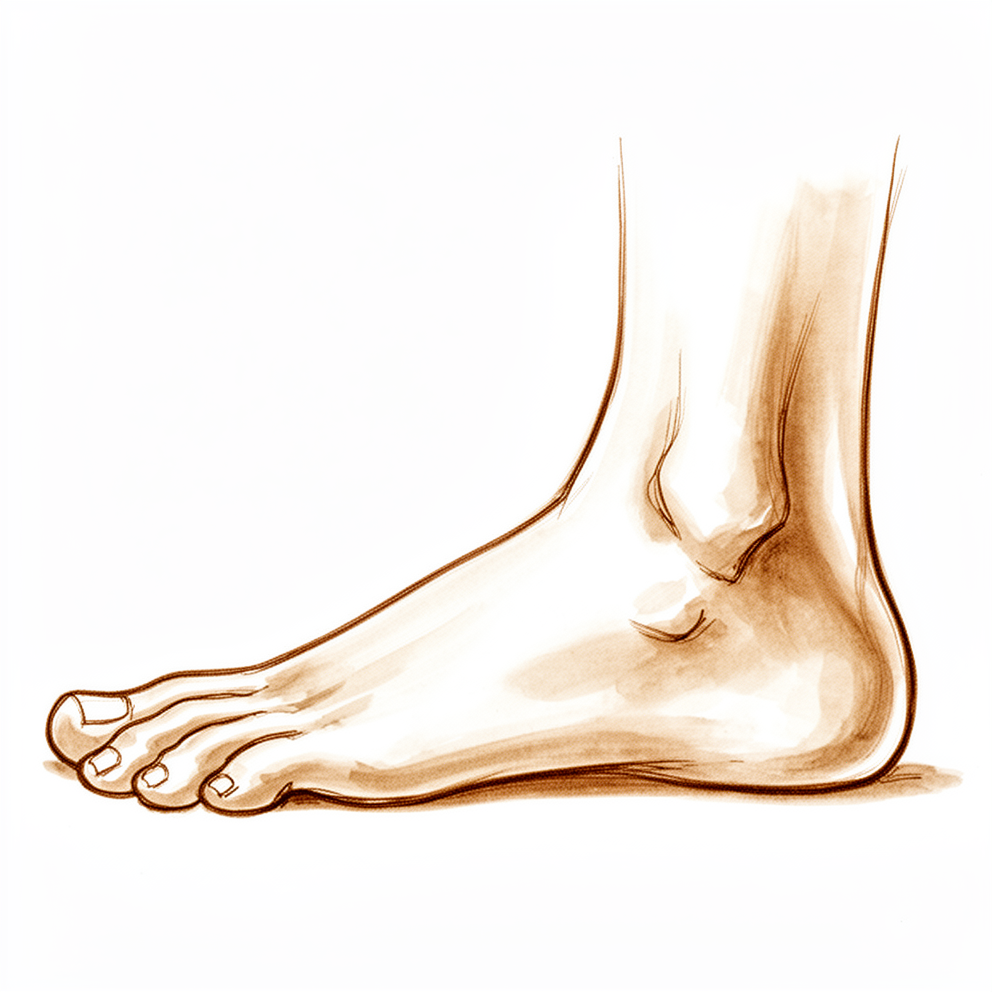
Qué está sintiendo
Una fractura del calcáneo es una rotura en el hueso del talón. El dolor se localiza en la parte posterior del pie, debajo y detrás del tobillo. Por lo general, aparece en el momento mismo de la lesión, y cualquier carga de peso sobre ese pie lo empeora considerablemente. Al principio, incluso permanecer de pie, caminar hasta el buzón o subir dos o tres escalones puede resultar muy difícil.
El talón y la zona alrededor del tobillo se hincharán. Esta hinchazón suele aumentar durante el primer día y puede hacer que el pie parezca hinchado y amoratado. Suele intensificarse después de estar de pie, y a veces duele de forma pulsátil por la noche o al quitarse el zapato. Elevar el pie y descansar lo alivia. Algunas personas notan que el talón se siente rígido y adolorido al levantarse por la mañana, especialmente en la parte posterior del tobillo donde se acumula la hinchazón.
Las tareas cotidianas que requieren el uso del talón se vuelven complicadas. Es posible que necesite muletas o un andador, ya que estar de pie junto a la encimera de la cocina o tender la ropa implica cargar peso sobre la zona lesionada. Conducir, llevar las compras o ir al baño sin ayuda también pueden resultar difíciles. Dado que el talón soporta todo el peso corporal al estar de pie, esta lesión suele limitar más al paciente que otras fracturas del pie.
En algunos casos, el dolor en el talón aparece de forma gradual, sin que haya habido una caída específica. Si el talón le ha dolido durante semanas sin una causa evidente, merece la pena que lo haga revisar un especialista. Una fractura por estrés es una pequeña grieta producida por esfuerzos repetidos; si no se detecta a tiempo, puede derivar en dolor persistente, cicatrización lenta e incluso en la necesidad de cirugía.
La recuperación del talón depende en gran medida de la ubicación exacta de la fractura. Las fracturas que afectan a la articulación situada por encima del talón, donde este se une al resto del pie, suelen causar rigidez y problemas a más largo plazo que aquellas que se producen fuera de dicha articulación. Muchas personas perciben que esta lesión les supone cambios duraderos; es frecuente que el talón se sienta distinto a como era antes.
¿Qué está ocurriendo realmente?
El hueso del talón, el calcáneo, es el hueso más grande en la parte posterior del pie. Se encuentra debajo de la articulación del tobillo y soporta el peso del cuerpo cada vez que uno se pone de pie. Su superficie superior presenta zonas lisas y curvas donde se une al hueso situado encima; estas zonas permiten que el pie gire y se mueva al caminar.
La mayoría de estas fracturas se producen al aterrizar bruscamente sobre los pies, generalmente tras una caída desde cierta altura. La fuerza se transmite a lo largo de la pierna, y el hueso situado por encima del talón empuja hacia abajo contra el calcáneo, como un martillo que golpea un bloque. El calcáneo tiene una estructura interna similar a un panal: es resistente en ciertas direcciones pero más frágil en otras; por eso, un impacto lo suficientemente fuerte puede aplastarlo. La fractura puede acortar y ensanchar el talón, e incluso provocar grietas en la superficie articular donde este se une al resto del pie.
La ubicación de la fractura es muy importante. Algunas fracturas se producen fuera de la articulación y, por lo general, sanan sin mayores complicaciones. Otras, en cambio, afectan la superficie articular y la desalinean, algo similar a romper los azulejos lisos de un suelo. Los azulejos rotos no se deslizan con facilidad, sino que se rozan; por eso estas fracturas suelen provocar rigidez y dolor en la articulación situada por encima del talón. Cuanto más desalineada quede dicha superficie articular, mayor será el impacto en la funcionalidad del pie y en la calidad de vida del paciente a lo largo del tiempo.
El cirujano puede medir mediante una radiografía cuánto se ha aplastado el talón. Un talón sano presenta un ángulo de 25 a 40 grados; un talón fracturado pierde parte de esa altura. Restaurar la forma normal del talón, incluyendo la curvatura del arco plantar y su altura respecto al otro pie, es un objetivo fundamental del tratamiento, pues así se maximizan las posibilidades de que el pie vuelva a funcionar adecuadamente.
¿Qué podemos hacer al respecto?
Las radiografías muestran la fractura, mientras que la tomografía computarizada, que es un estudio detallado del hueso, nos ayuda a decidir si es precisa una intervención quirúrgica.
Dado que una fractura de talón es una lesión aguda, a menudo se recomienda la cirugía de inmediato, en lugar de intentar primero un tratamiento no quirúrgico. Los objetivos son los mismos, sea cual sea el enfoque elegido: alinear la superficie articular donde el talón se une al resto del pie, restaurar su altura, devolver al talón su anchura normal y liberar el espacio por donde discurren dos tendones junto al tobillo. En algunas fracturas que permanecen fuera de la articulación, o en aquellas cuyos fragmentos no se han desplazado, un tratamiento conservador sin cirugía puede ser eficaz: descanso, uso de una bota protectora o yeso, y evitar cargar peso sobre el pie mientras cicatriza. La fisioterapia busca recuperar el movimiento y la fuerza una vez que el hueso se haya estabilizado.
La conveniencia de la cirugía depende tanto de la fractura como de usted. Algunas fracturas afectan la superficie articular y la desplazan; en muchos de estos casos la cirugía resulta beneficiosa, pues permite recolocar los fragmentos y fijarlos. Tenemos en cuenta su edad, su estado de salud general, la calidad de su hueso, su nivel de actividad física y si fuma, ya que el tabaquismo incrementa el riesgo de complicaciones en la cicatrización postquirúrgica. Determinadas condiciones médicas, como la diabetes con pérdida de sensibilidad en el pie o una infección activa, hacen que la cirugía no sea recomendable. Cuando resulta adecuado, empleamos técnicas menos invasivas, que suelen generar menos problemas en la cicatrización que las incisiones más extensas. En los casos más graves, donde la superficie articular queda gravemente aplastada, la cirugía puede tener como fin preparar el hueso para una futura artrodesis, procedimiento mediante el cual se inmoviliza la articulación para aliviar el dolor.
Esta es una decisión compartida. Le explicaremos qué implica cada opción para su pie, y usted decidirá qué aspectos son más importantes para usted.
Qué esperar
Una fractura de talón es una lesión grave; es justo decir que la recuperación es un proceso largo. La mayoría de las personas perciben que esta lesión tiene efectos duraderos en su vida cotidiana; es frecuente que el talón se sienta distinto a como era antes. Las fracturas que afectan la superficie articular, es decir, la zona donde el talón se une al resto del pie, suelen provocar rigidez y dolor persistentes, en comparación con las fracturas que ocurren fuera de la articulación. Estas últimas, que representan aproximadamente una de cada tres fracturas de talón, suelen curarse sin mayores complicaciones.
La recuperación se mide en meses, no en semanas. Al principio, deberá evitar cargar peso sobre el pie y, posteriormente, ir aumentando esa carga de forma gradual. Colocar algo de peso sobre el pie dentro de las primeras seis semanas tras la operación no parece generar los problemas que antes se temían; por ello, su cirujano podría autorizarlo a hacerlo antes de lo esperado. Aun así, es normal experimentar hinchazón, rigidez y una cojera que desaparece lentamente. Muchas personas siguen notando molestias en el talón al final del día; algunas incluso observan que su forma de caminar nunca vuelve a ser la misma.
Los resultados dependen del tratamiento elegido. La cirugía que reubica los fragmentos óseos en su posición correcta suele arrojar mejores resultados a largo plazo, al restaurar la forma del talón; además, se observan buenos resultados en cuanto a funcionalidad y calidad de vida en los meses y años posteriores a la intervención. No obstante, la cirugía conlleva un riesgo real de complicaciones en la cicatrización, y la tasa general de complicaciones es elevada. El tratamiento no quirúrgico, basado en reposo y el uso de una bota o escayola, también puede producir resultados satisfactorios con menos complicaciones. En el caso de fracturas que afectan la articulación, el seguimiento durante quince años ha demostrado que los resultados son similares, independientemente de si se realizó cirugía o no.
Lo que realmente influye es la ubicación de la fractura, su estado de salud general y la experiencia del equipo médico encargado de su tratamiento. Las fracturas de talón son lesiones complejas; lo ideal es que sean atendidas por cirujanos y centros con amplia experiencia en este tipo de casos. Su cirujano le explicará qué indican las evidencias clínicas respecto a su pie en particular, y juntos podrán evaluar las ventajas y desventajas de cada opción de tratamiento.
¿Cuándo consultar a un especialista?
Una fractura de talón suele ser evidente: una caída desde cierta altura, seguida de un dolor tan intenso que impide caminar. Debe ser evaluada el mismo día. Acuda a urgencias si el talón presenta hinchazón y hematomas graves, si el dolor es muy intenso o si no puede apoyar ningún peso en el pie. Solicite una valoración especializada si el talón le ha dolido durante semanas sin que haya habido una lesión clara; una fractura por estrés detectada tarde puede provocar dolor persistente, una cicatrización lenta e, incluso, la necesidad de cirugía. Busque atención urgente si la hinchazón es severa y la piel se siente tensa, o si también se ha lesionado la misma pierna en otra zona, ya que la presencia de varias fracturas en la misma pierna constituye una situación grave.
Evidence & references
This is the clinical evidence summary written for health professionals. It is technical, and it lists the research this page was built from. You do not need to read it to understand your treatment or to make a decision about it.
Anatomy & Pathophysiology
Bony Anatomy
- The calcaneus is the largest tarsal bone in the foot [17].
- The calcaneus is irregularly shaped with six posterior and four anterior facets [17].
- Three of the calcaneal facets articulate with the talus and one articulates with the cuboid [17].
- The posterior facet of the calcaneus is oval and convex along the longitudinal axis, articulating with the underside of the talus [17].
- The middle facet of the calcaneus is concave and oval, articulating with the middle facet on the head of the talus [17].
- The sustentaculum tali projects from the medial side of the calcaneus and forms the lateral boundary of the tarsal tunnel [17].
- The inferior surface of the sustentaculum tali is grooved by the tendon of the flexor hallucis longus [17].
- The sinus tarsi is a depression anterior and distal to the lateral malleolus that marks the lateralmost aspect of the subtalar joint [17].
- The tarsal canal is formed by the sulcus on the inferior surface of the talus and the superior sulcus of the calcaneus [11].
- The tarsal canal runs from posteromedial to anterolateral, where it opens into the tarsal sinus [11].
- The talocalcaneal intraosseous ligament is contained within the tarsal canal [11].
Ligaments and Stability
- Transverse stability of the tarsometatarsal articulation is provided by wedge-shaped metatarsal bases and their corresponding cuneiform-cuboid articulations [6].
- The second metatarsal is recessed between the medial and lateral cuneiforms, acting as a keystone for transverse stability [6].
- The tarsometatarsal joints have little longitudinal stability, which is provided only by strong ligamentous support [6].
- Multiple intermetatarsal ligaments exist at the metatarsal bases, except between the first and second metatarsals [6].
- The Lisfranc ligament runs from the medial cuneiform to the second metatarsal to provide stability in the tarsometatarsal region [6].
Vascular Anatomy
- The head and neck of the talus are richly supplied by superior neck vessels branching from the dorsalis pedis artery and the artery of the sinus tarsi [11].
- Osteonecrosis of the talar head and neck regions is extremely rare [11].
- The artery of the tarsal canal branches off the posterior tibial artery approximately 1 cm proximal to its division into medial and lateral plantar arteries [11].
- The artery of the tarsal canal is the most consistent major supplier of blood to the body of the talus [11].
- Within the tarsal canal, the artery of the tarsal canal sends four to six direct vessels into the body of the talus [11].
- The deltoid artery branches off the artery of the tarsal canal and directly supplies blood to the medial one-fourth to one-half of the talar body [11].
- The artery of the sinus tarsi supplies the lateral one-eighth to one-fourth of the talar body [11].
- The artery of the sinus tarsi is formed by branches of the perforating peroneal artery, the dorsalis pedis artery, or anastomoses between them [11].
- The posterior tubercle of the talus is supplied by direct branches from the posterior tibial artery or the peroneal artery [11].
- A direct branch to the medial talar neck comes from the posterior tibial artery [11].
- In a gadolinium-enhanced MRI cadaver study, the contribution of blood supply to the talus was 16.9% for the peroneal artery, 36.2% for the anterior tibial artery, and 47.0% for the posterior tibial artery [11].
- The anterior tibial artery is the main blood supply to the anteromedial quadrant of the talus [11].
- The posterior tibial artery is the main blood supply to the other three quadrants of the talus [11].
Radiographic Anatomy
- The Bohler angle is formed by a line from the superior point on the posterior articular surface to the superior point of the calcaneal tuberosity and a line drawn from the anterior process to the highest aspect of the posterior articular surface [17].
- The Bohler angle varies from 25 to 40 degrees [17].
- The "crucial angle" of Gissane is formed by a line drawn from the sulcus calcanei to the tip of the anterior process [17].
- The "crucial angle" of Gissane varies between 120 and 145 degrees [17].
- In talocalcaneal coalition, the Harris and Beath radiographic projection shows the joint space replaced by a bony bridge or loss of distinct articular margins [9].
- Normal medial and posterior subtalar joint facets lie in planes at 35 to 45 degrees and 45 to 60 degrees to the long axis of the calcaneus, respectively [9].
Mechanism of Injury
- The mechanism of injury in most calcaneal fractures is an axial load applied to the lower extremity, most often as a result of a fall from a height [17].
- In calcaneal fractures, the force is transmitted through the talus, which is driven down into the calcaneus [17].
- In young children, the height fallen for calcaneal fractures is usually less than 4 feet [17].
- In children older than 10 years, the fall height for calcaneal fractures is usually greater than 14 feet [17].
- In a study of 56 children with calcaneal fractures, 25 (45%) of the fractures were caused by a fall from a height [17].
- Motor vehicle accidents, lawnmower injuries, and direct blows from an object can result in calcaneal fractures in children [17].
- With a calcaneal fracture, the talus compresses onto the crucial angle and produces the primary fracture line in older patients [17].
Investigations
Physical Examination
- Any injury resulting in midfoot tenderness and swelling merits a careful physical and radiographic examination [5].
- Care should be taken with subtle injuries to palpate each articulation for tenderness and swelling, especially the medial cuneiform–first metatarsal joint, which often appears nondisplaced on radiographs [5].
- Careful observation of the plantar aspect of the foot may reveal ecchymosis, indicating a significant injury [5].
- The inability to bear weight on the foot is another sign of potential instability [5].
- Physical examination findings for low-energy tarsometatarsal injuries include pain with pronation and abduction of the forefoot while the hindfoot is stabilized [5].
- Physical examination findings for low-energy tarsometatarsal injuries include pain with compression of the midfoot [5].
- Physical examination findings for low-energy tarsometatarsal injuries include pain with manipulation [5].
- Compartment syndrome, although rare and usually seen only with higher-energy fracture-dislocations, can cause severe, difficult-to-treat clawing of the toes and chronic pain [5].
- We routinely obtain compartment pressures in patients who have severe swelling, but individual compartments can be difficult to assess [5].
- Clinical suspicion alone is difficult to warrant decompression for compartment syndrome [5].
Radiographic Imaging
- Radiographs must be obtained with the patient bearing weight [5].
- If the radiograph reveals no displacement and the patient cannot bear weight, a short leg cast or fracture boot should be used for 2 weeks, and the radiographs should be repeated with weight bearing [5].
- A standing radiograph of both feet on the same cassette allows for comparison and can highlight subtle injuries [5].
- On the anteroposterior view, the medial shaft of the second metatarsal should be aligned with the medial aspect of the middle cuneiform [5].
- On the oblique view, the medial shaft of the fourth metatarsal should be aligned with the medial aspect of the cuboid [5].
- The first metatarsal–cuneiform articulation should have no incongruency [5].
- A “fleck sign” should be sought in the medial cuneiform–second metatarsal space, which represents an avulsion of the Lisfranc ligament [5].
- On the lateral view, loss of the arch and/or loss of alignment between the plantar aspect of the fifth metatarsal and medial cuneiform should be evaluated [5].
- The naviculocuneiform articulation should be evaluated for subluxation [5].
- A compression fracture of the cuboid should be sought [5].
- CT can identify subtle subluxations and occult fractures [5].
- MRI of the Lisfranc ligament can be obtained in the acute setting and if the level of injury cannot be determined by plain radiographs [5].
- Weight-bearing CT scans, where available, are very useful in detection of subtle instability [5].
- The Harris and Beath radiographic projection (posterosuperior oblique projection) passes between the sustentaculum and the neck of the talus [9].
- In a talocalcaneal coalition, the joint space is replaced by a bony bridge or the distinct articular margins are lost, implying a fibrous or cartilaginous bridge [9].
- The Harris and Beath view is taken with the patient standing on the cassette, with the knees flexed enough to remove the calf shadow from the beam and the cone angled 45 degrees to the cassette and directed toward the heel [9].
- Angles of 35 to 40 to 45 degrees to the long axis of the calcaneus are the most common angles showing a coalition [9].
- Jayakumar and Cowell recommended a standing lateral radiograph, from which the angles made by the posterior and medial facets with the floor are determined [9].
- Other helpful radiographic signs include beaking of the head of the talus at the dorsal articular margin [9].
- Other helpful radiographic signs include broadening or rounding of the lateral process of the talus as it impinges on the calcaneal sulcus [9].
- Other helpful radiographic signs include presence of a “true C sign” [9].
- Other helpful radiographic signs include narrowing of the posterior talocalcaneal joint space [9].
- Other helpful radiographic signs include loss of the middle subtalar joint, all seen on the lateral view of the foot [9].
- On the lateral oblique view, the anterior facet of the subtalar joint is asymmetric in talocalcaneal coalition [9].
- CT scans are helpful in characterizing the extent of coalition, especially for operative planning [9].
- Normally, the medial and posterior subtalar joint facets lie in planes at 35 to 45 degrees and 45 to 60 degrees to the long axis of the calcaneus, but this is highly variable [9].
- CT in the coronal plane at 3-mm increments is recommended for diagnosing talocalcaneal coalition [9].
- The primary cuts of the CT should be perpendicular to the posterior and middle facets of the subtalar joint, that is, in the semicoronal plane [9].
- CT sets the standard for diagnosis of talocalcaneal coalitions [9].
- MRI may be helpful in depicting all types of coalitions, including fibrous coalitions [9].
- The importance of obtaining a CT scan after reduction of the subtalar dislocation has been emphasized because patients who have a subtalar dislocation often have additional abnormalities identified on CT scans that are initially missed on plain radiographs [22].
- We routinely use CT for further evaluation of subtalar dislocations and often find fractures that require treatment because of intraarticular displacement or fragments blocking congruent reduction of the subtalar joint [22].
- If a congruent reduction is obtained and verified on CT, and there are no intraarticular fragments or displaced bone fragments requiring repair, we routinely treat subtalar dislocations nonoperatively [22].
- Radiographs may show an avulsion fracture of the proximal phalanx, an impacted fracture of the metatarsal, or a sesamoid fracture in turf toe injuries [10].
- There may be proximal migration of the sesamoids, which is easier to detect when compared with radiographs of the uninjured foot [10].
- Examination of the joint under fluoroscopy may demonstrate lack of migration of the sesamoids when the joint is dorsiflexed, suggestive of plantar plate rupture, especially when compared with the contralateral side [10].
- A cadaver study suggests that when measuring the distance from the distal margin of the sesamoids to the most proximal margin of the proximal phalanx on a lateral dorsiflexion stress view, a 3-mm difference when compared with the contralateral foot may be indicative of injury to three of the four ligaments of the plantar plate complex [10].
- MRI may demonstrate rupture of the plantar plate in turf toe injuries [10].
Classification
- Myerson’s modification of the original classification of Quénu and Küss and Hardcastle et al. is presented because it incorporates more proximal injuries to the medial column of the foot [6].
- Type A injuries involve displacement of all five metatarsals with or without fracture of the base of the second metatarsal [6].
- The usual displacement in Type A injuries is lateral or dorsolateral, and the metatarsals move as a unit [6].
- Type B injuries involve one or more articulations remaining intact [6].
- Type B1 injuries are medially displaced, sometimes involving the intercuneiform or naviculocuneiform joint [6].
- Type B2 injuries are laterally displaced and may involve the first metatarsal-cuneiform joint [6].
- Type C injuries are divergent injuries that can be partial (C1) or complete (C2) [6].
- Type C injuries generally are high-energy injuries, associated with significant swelling, and are prone to complications, especially compartment syndrome [6].
- Classification of tarsometatarsal injury is useful for communication between orthopaedists, and for determining the plane of displacement and magnitude of soft-tissue injury [6].
- The classification is not prognostic for the result [6].
Associated Injuries
- Patients with a subtalar dislocation often have additional abnormalities identified on CT scans that are initially missed on plain radiographs [22].
- Associated injuries in severe open subtalar dislocations included tibial nerve injuries, posterior tibial tendon ruptures, and articular fractures [22].
- Osteonecrosis occurred in the body of the talus in one third of the patients with severe open subtalar dislocations [22].
- Approximately half of the patients with severe open subtalar dislocations eventually had some form of arthrodesis procedure [22].
- Lateral subtalar dislocations frequently are irreducible by closed manipulation, and the most common offending structures blocking reduction are the posterior tibial tendon and osteochondral fracture of the talus [22].
- Medial subtalar dislocations, without marginal fractures of the calcaneus or talus, almost always are reducible by closed means, unless the extensor retinaculum or extensor digitorum brevis becomes interposed and blocks reduction [22].
Treatment
Decision-Making and Goals
- Goals of treatment for calcaneal fractures include restoration of congruity of the posterior facet of the subtalar joint [24].
- Goals of treatment for calcaneal fractures include restoration of the height of the calcaneus (Böhler’s angle) [24].
- Goals of treatment for calcaneal fractures include reduction of the width of the calcaneus [24].
- Goals of treatment for calcaneal fractures include decompression of the subfibular space available for the peroneal tendons [24].
- Goals of treatment for calcaneal fractures include realignment of the tuberosity into a valgus position [24].
- Goals of treatment for calcaneal fractures include reduction of the calcaneocuboid joint if fractured [24].
- Most calcaneal fracture injuries occur in patients younger than the physiologic age of 50 to 55 years [24].
- Operative intervention to restore calcaneal height, alignment, and articular reduction should be strongly considered in young patients [24].
- Nonoperative treatment is advised for older patients with severe osteopenia, limited ambulatory abilities, or significant medical comorbidities [24].
- An insensate limb caused by trauma (sciatic or tibial nerve disruption) or disease (diabetes or other neuropathy) is a strong relative contraindication to open treatment [24].
- Patients with limited ambulation due to other medical conditions should be treated conservatively [24].
- Tobacco use has been shown to increase complication rates with operative intervention [24].
- Some surgeons consider tobacco use only a contraindication to an extensile lateral approach and favor less invasive techniques in this setting [24].
- Sanders types III and IV fractures sustained a significantly higher amount of energy than lesser types [24].
- Sanders type IV is the best predictor of compartment syndrome after a fracture of the calcaneus [24].
- Higher Sanders types III and IV injuries have poorer outcomes than Sanders types I and II injuries with both operative and nonoperative interventions [24].
- Sanders type I or nondisplaced fractures should be treated by a closed method [24].
- Type II and type III fractures can be treated with open reduction in consideration with other patient characteristics [24].
- Type IV fractures can be treated conservatively or operatively [24].
- Long-term studies have shown that type IV injuries are more likely to go on to subtalar arthrodesis in the future [24].
- In type IV fractures, consideration should be given to minimally invasive techniques to restore the calcaneal architecture for later subtalar arthrodesis or primary subtalar arthrodesis in experienced hands [24].
Operative Techniques and Outcomes
- Complications following the extended lateral approach for calcaneal fractures do not influence mid- to longterm outcome [25].
- Operative treatment did not benefit closed, displaced, intra-articular calcaneal fractures compared to nonoperative treatment in a randomized controlled trial [25].
- A randomized multicenter trial compared open reduction and internal fixation with ORIF and primary subtalar arthrodesis for the treatment of Sanders type IV calcaneal fractures [25].
- A prospective, randomized, controlled multicenter trial compared operative versus nonoperative treatment of displaced intra-articular calcaneal fractures [25].
- A cohort study evaluated the percutaneous treatment of displaced intra-articular fractures of the calcaneus [25].
- A prospective computed tomography-based study evaluated a mini-open sinus tarsi approach with percutaneous screw fixation of displaced calcaneal fractures [25].
- A cadaveric radio-anatomical study focused on maximizing safety in screw placement for posterior facet fixation in calcaneus fractures [25].
- A biomechanical evaluation compared a locking and nonlocking reconstruction plate in an osteoporotic calcaneal fracture model [25].
- A study assessed the stability of locking and non-locking plates in an osteoporotic calcaneal fracture model [25].
- A comparative study evaluated percutaneous screw fixation and calcium sulfate cement grafting versus open treatment of displaced intra-articular calcaneal fractures [25].
- A study compared surgical outcomes of intra-articular calcaneal fractures by age [25].
- A study examined the effect of surgeon training, fracture, and patient variables on calcaneal fracture management [25].
- A study evaluated radiographic and postoperative outcomes of plate versus screw constructs and open reduction and internal fixation of calcaneus fractures via the sinus tarsi [25].
- A study reported on plantar medial wounds associated with calcaneal fractures [25].
- A study described a staged treatment plan for the management of type II and type IIIA open calcaneus fractures [25].
- A study evaluated outcomes of high-grade open calcaneus fractures managed with open reduction via the medial wound and percutaneous wire fixation [25].
- A study investigated the displacement of the sustentacular fragment in intra-articular calcaneal fractures [25].
- A study described a limited sinus tarsi approach for intra-articular calcaneus fractures [25].
- A study reported on wound and sural nerve complications of the sinus tarsi approach for calcaneus fractures [25].
- A study described open reduction and internal fixation of OTA C2-C4 fractures of the calcaneus with a triple-plate technique [25].
- A study evaluated fractures of the calcaneal tuberosity treated with suture fixation through bone tunnels [25].
- A study described management of valgus extra-articular calcaneus fracture malunions with a lateral opening wedge osteotomy [25].
- A study compared distraction subtalar arthrodesis for calcaneal malunion using local versus iliac bone graft [25].
- A study described treatment of severe fractures of the calcaneus by reconstruction arthrodesis using the Vira system [25].
- A study investigated whether acute fracture of the anterior process of the calcaneus heralds a more advanced injury to the Chopart joint [25].
- A study identified predictors of compartment syndrome of the foot after fracture of the calcaneus [25].
- A study described a learning curve for open reduction and internal fixation of displaced intra-articular calcaneal fracture by extensile lateral approach using the cumulative summation control chart [25].
- A study described an economic evaluation of operative compared with nonoperative management of displaced intra-articular calcaneal fractures [21].
- A study reported on the functional outcome of displaced intra-articular calcaneal fractures comparing isolated cases and polytrauma patients [21].
- A study reported on open calcaneal fractures and results of operative treatment [21].
- A study described subtalar arthrodesis using interposition iliac crest bone graft after calcaneal fracture [21].
- A study described soft-tissue reconstruction of calcaneal fractures or osteomyelitis [21].
- A study reported on displaced intra-articular calcaneal fractures [21].
- A study reported on long-term outcome of displaced intraarticular calcaneal fractures in women [21].
- A study reported on avulsion fracture of the calcaneal tuberosity [21].
- A study assessed subtalar distraction bone block fusion outcome [21].
- A study described surgical management of extensive intraarticular fractures of the foot, specifically calcaneal fractures [21].
- A study reviewed treatment and outcome of open fractures of the calcaneus [21].
- A study reported on operative treatment of intraarticular calcaneal fractures in 257 cases [21].
- A study evaluated the effect of demineralised bone matrix-calcium sulfate with vancomycin on calcaneal fracture healing and infection rates [21].
- A study described diagnosis, pathology, and treatment of fractures of the os calcis [21].
- A study described lateral decompression for malunited os calcis fractures [21].
- A study described primary subtalar arthrodesis for the treatment of comminuted calcaneal fractures [21].
- A study compared operative with nonoperative treatment of displaced intra-articular calcaneal fractures in a prospective, randomized, controlled multicenter trial [21].
- A study compared open versus closed reduction of intraarticular calcaneal fractures in a matched cohort of workmen [21].
- A study described reduction of calcaneal fractures by the McReynolds medial approach technique and its experimental basis [21].
- A study described open reduction and internal fixation from the medial side for fractures of the calcaneus in a 21-year prospective study [21].
- A study described the mechanism and pathoanatomy of the intraarticular calcaneal fracture [21].
- A study described surgical treatment of the intraarticular calcaneus fracture [21].
- A study described subtalar distraction bone block fusion for late complications of os calcis fractures [21].
- A study described subtalar arthrodesis with interposition tricortical iliac crest graft for late pain and deformity after calcaneus fracture [21].
- A study reported on results of in situ subtalar arthrodesis for late sequelae of calcaneus fractures [21].
- A study reported on intermediate to long-term results of a treatment protocol for calcaneal fracture malunion [21].
- A study described calcaneal fractures in industrial patients [21].
- A study described computerized tomography scanning of acute intraarticular fractures of the calcaneus [21].
- A study reported on intraarticular calcaneal fractures and results of closed treatment [21].
- A study reported on open reduction and internal fixation of type II intraarticular calcaneus fractures [21].
- A study described the history of the calcaneal fracture [21].
- A study identified variables predicting late subtalar fusion in displaced intra-articular calcaneal fractures [21].
- A study described treatment of fracture of the os calcis [21].
- A study described surgical excision for anterior process fractures of the calcaneus [21].
- A study described injury characteristics and surgical technique for reduction of fractures of the sustentaculum tali [21].
- A study described long-term follow-up of fractures of the os calcis using diagnostic peroneal synoviogram [21].
- A study compared operative versus nonoperative treatment for bilateral calcaneal fractures [21].
- A study identified a pitfall of coronal computed tomographic imaging in evaluation of calcaneal fractures [21].
- A study described the sinus tarsi approach with transarticular fixation for displaced intraarticular fractures of the calcaneus [21].
References
[5] Campbell S Operative Orthopaedics 4 Volume Set. PERCUTANEOUS REDUCTION AND FIXATION OF CALCANEAL FRACTURE > EVALUATION AND TREATMENT.
[6] Campbell S Operative Orthopaedics 4 Volume Set. PERCUTANEOUS REDUCTION AND FIXATION OF CALCANEAL FRACTURE > FRACTURE-DISLOCATIONS OF THE TARSOMETATARSAL ARTICULATION (LISFRANC JOINT).
[9] Campbell S Operative Orthopaedics 4 Volume Set. MULTIPLE Z-PLASTY RELEASE OF A CONGENITAL RING > TALOCALCANEAL COALITION > RADIOGRAPHIC FINDINGS.
[10] Campbell S Operative Orthopaedics 4 Volume Set. PERCUTANEOUS REDUCTION AND FIXATION OF CALCANEAL FRACTURE > FIRST METATARSOPHALANGEAL JOINT SPRAIN.
[11] Campbell S Operative Orthopaedics 4 Volume Set. PERCUTANEOUS REDUCTION AND FIXATION OF CALCANEAL FRACTURE > FRACTURES OF THE TALUS.
[17] Tachdjian S Pediatric Orthopaedics From The Texas Scottish Rite Hospital For Children E Book. Pigmented Villonodular Synovitis and Giant Cell Tumor of the Tendon Sheath > Calcaneal Fractures.
[21] Campbell S Operative Orthopaedics 4 Volume Set. PERCUTANEOUS REDUCTION AND FIXATION OF CALCANEAL FRACTURE > SUPPLEMENTAL REFERENCES > CALCANEUS.
[22] Campbell S Operative Orthopaedics 4 Volume Set. PERCUTANEOUS REDUCTION AND FIXATION OF CALCANEAL FRACTURE > SUBTALAR DISLOCATIONS.
[24] Campbell S Operative Orthopaedics 4 Volume Set. COMBINED HAMMER TOE AND MALLET TOE DEFORMITY WITH ASSOCIATED DOUBLE CORNS > DECISION-MAKING IN CALCANEAL FRACTURES.
[25] Campbell S Operative Orthopaedics 4 Volume Set. PERCUTANEOUS REDUCTION AND FIXATION OF CALCANEAL FRACTURE > REFERENCES > CALCANEUS.