Patients › Rehabilitation
Epicondilitis lateral (codo de tenista)
Un programa de rehabilitación basado en la carga para el codo de tenista: primero se controla el dolor y luego se fortalece progresivamente el tendón; abarca tanto el tratamiento no quirúrgico como la recuperación posterior al desbridamiento del tendón ECRB.
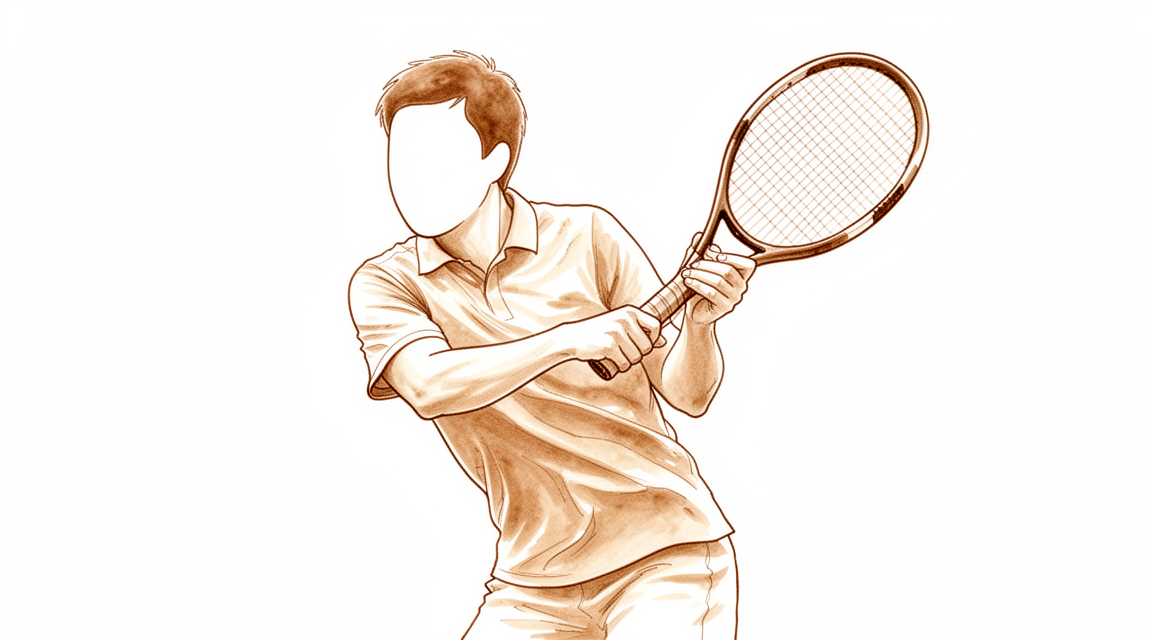
Esta página explica cómo se maneja el codo de tenista y cómo se realiza su rehabilitación, tanto si se trata sin cirugía (que es el caso de casi todos los pacientes) como si se está recuperando tras una operación para limpiar el tendón. La supervisa el Dr. Kieran Hirpara en el Mater Private Hospital Rockhampton. Comienza con su programa de ejercicios en casa, seguido del protocolo clínico estructurado destinado a su fisioterapeuta o terapeuta de mano; lleve esta página o su versión en PDF a sus sesiones de terapia para garantizar que la rehabilitación se realice de manera coordinada. Su terapeuta podrá ajustar el plan según el progreso de su recuperación.
Qué esperar
El codo de tenista (epicondilitis lateral) es un problema que afecta al tendón situado en la parte externa del codo, concretamente al tendón extensor común y, en particular, a un pequeño músculo llamado ECRB. A pesar del sufijo “-itis” en su nombre, no se trata de una inflamación que pueda resolverse con reposo. En realidad, es un cambio degenerativo del tendón (tendinosis), en el que las fibras tendinosas se han desorganizado y no han sanado adecuadamente.
Esto es importante porque modifica por completo el tratamiento. No mejorará el estado del codo simplemente con reposo y protección; de hecho, el reposo prolongado suele debilitar el tendón y retrasar su recuperación. Para mejorar, es necesario someter el tendón a una carga gradual, de modo que se remodele y recupere su capacidad para soportar esfuerzos y agarres. El proceso consiste en: primero controlar el dolor y luego fortalecer progresivamente el tendón, comenzando con ejercicios isométricos suaves y avanzando hacia ejercicios de fortalecimiento controlados y lentos, como el “Tyler twist”.
La buena noticia es que, con un programa de carga adecuado, el codo de tenista suele mejorar por sí solo. Alrededor de 80–90% de los pacientes experimentan mejoría en el transcurso de un año; aunque en algunos casos puede tardar hasta 12–18 meses en resolverse por completo. La cirugía solo se considera cuando, tras al menos seis meses de rehabilitación constante y de calidad, no se observan mejoras; y solo una pequeña minoría (aproximadamente 4–11%) llega a necesitarla.
Precauciones y limitaciones
Se debe hacer:
- Seguir utilizando el brazo: cargue el tendón, no lo deje en reposo.
- Use el dolor como guía: un dolor leve durante y después del ejercicio es normal y esperado; un dolor agudo o en aumento indica que debe reducir la intensidad.
- Levante los objetos con la palma hacia arriba (como si sostuviera un tazón de sopa) para reducir la carga sobre el tendón dolorido.
- Utilice un soporte de contrafuerza sobre el músculo del antebrazo durante tareas de agarre y levantamiento.
No se debe hacer:
- No inmovilice el codo con un yeso o cabestrillo en caso de codo de tenista que se esté tratando sin cirugía; ese no es el tratamiento adecuado para una tendinosis. (Después de la cirugía es diferente: se usa un cabestrillo para mayor comodidad durante la primera semana, como se detalla en la vía postoperatoria más abajo.)
- No realice agarres intensos que provoquen dolor con el codo extendido y la muñeca flexionada (por ejemplo, levantar un objeto pesado con la palma hacia abajo).
- No recurra de inmediato a una inyección de esteroides. La cortisona puede aliviar los síntomas durante unas pocas semanas, pero la evidencia demuestra que a los 6–12 meses produce peores resultados y más recurrencias que la fisioterapia o simplemente esperar. No es un tratamiento de primera línea.
Sus ejercicios
Kieran Hirpara 4.0
Soporte de contrafuerza
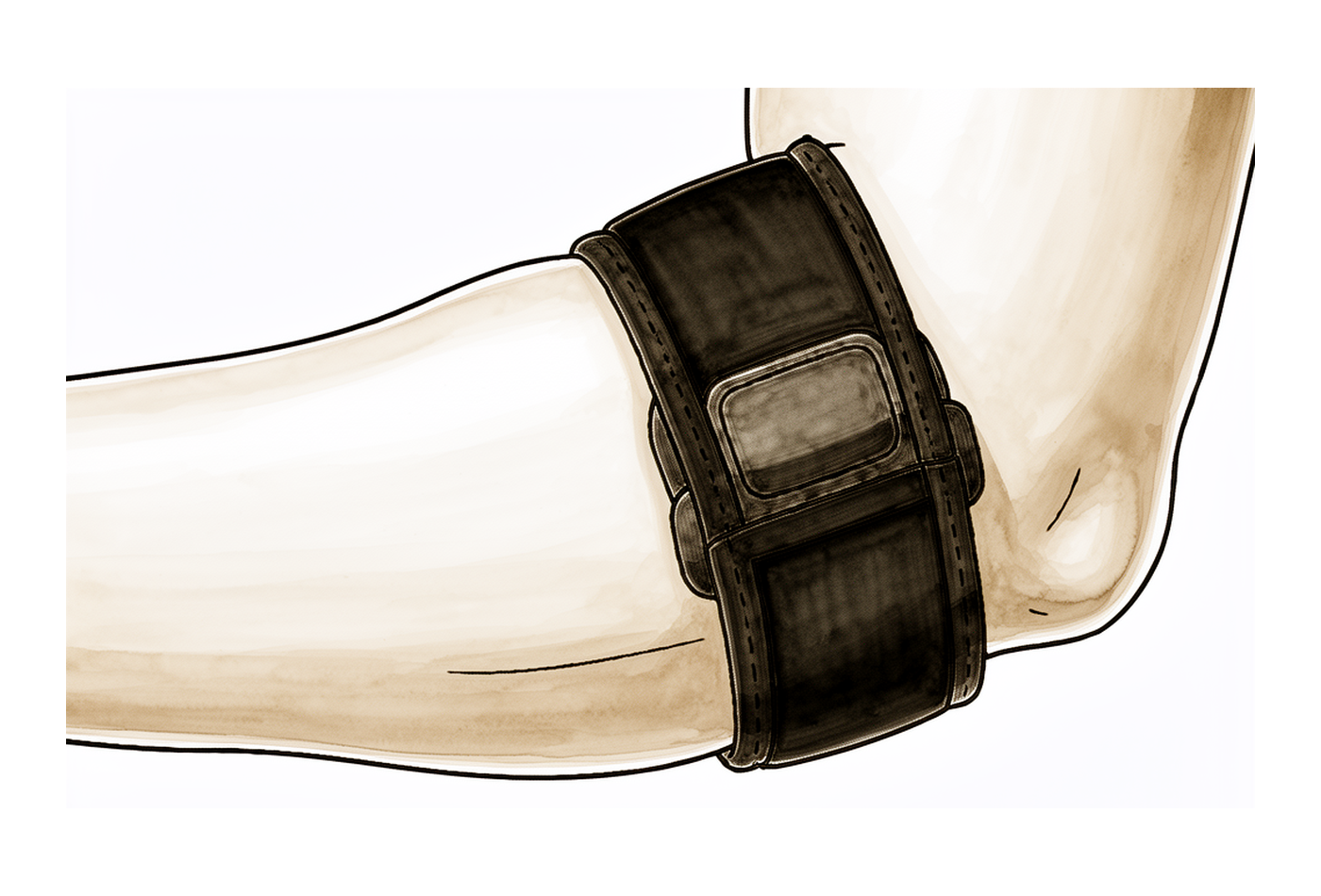
Colóquese la correa de contrafuerza alrededor del antebrazo, un par de dedos por debajo del codo, sobre la mayor parte del músculo (no sobre el punto óseo). Debe quedar firme, pero no tan apretada como para causar hormigueo en la mano. Úsela durante tareas que requieran agarre y levantamiento, para así aliviar la carga sobre el tendón dolorido; no es necesario usarla en reposo o mientras duerme.
Durante las actividades que agravan los síntomas; aflójelo si siente hormigueo en la mano
Kieran Hirpara 4.0
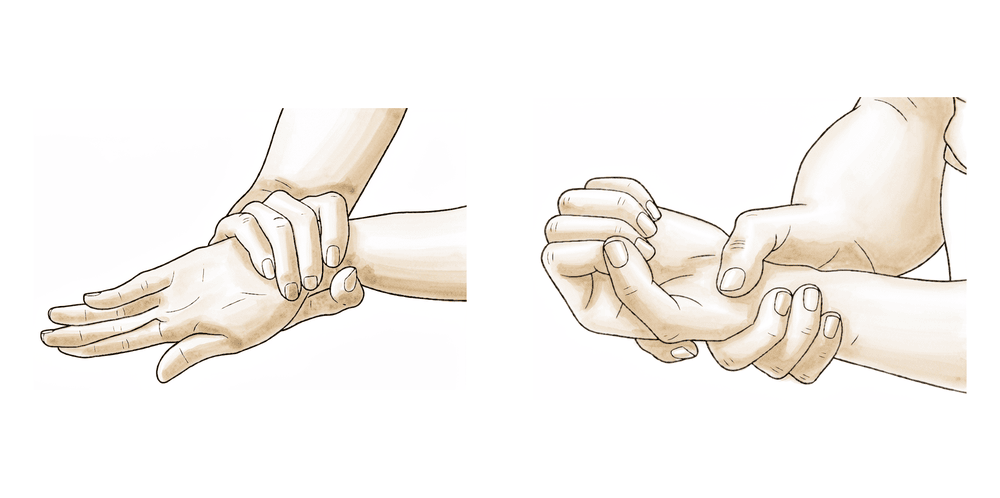
Extensión isométrica de la muñeca
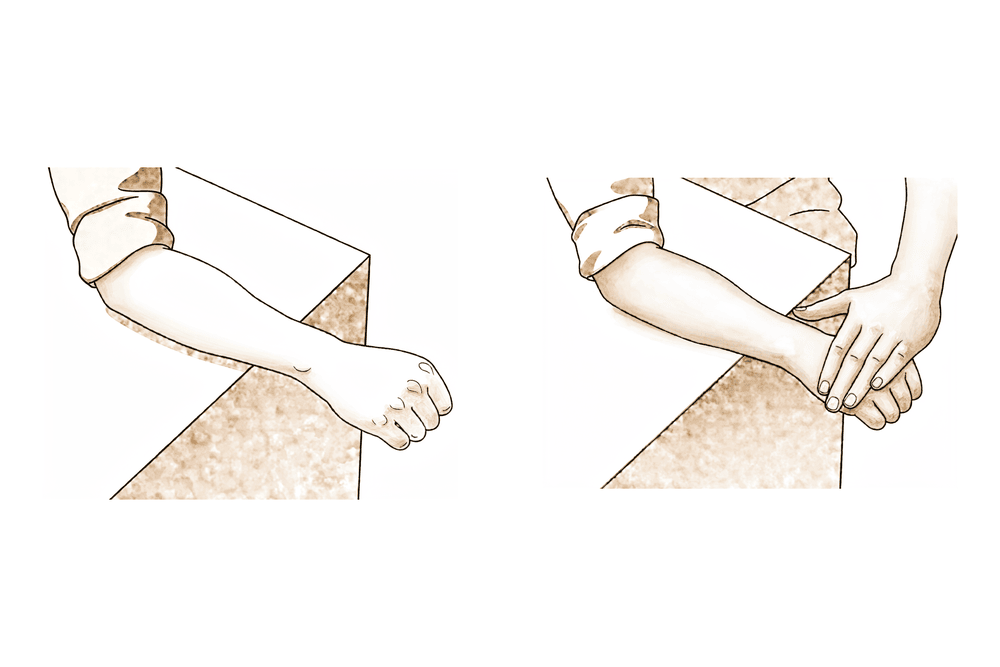
Apoye el antebrazo sobre una mesa, con la palma de la mano hacia abajo y la mano colgando por el borde. Coloque la otra mano sobre el dorso de la mano adolorida. Intente levantar el dorso de la mano hacia el techo mientras la otra mano lo mantiene inmóvil; en realidad nada se moverá: se trata de un ejercicio de empuje contra resistencia. Debe sentir un esfuerzo considerable, pero sin dolor agudo. Mantenga esa posición de empuje y luego relájese.
Mantenga la posición durante 30–45 segundos, 5 veces, 1–2 veces al día.
Kieran Hirpara 4.0
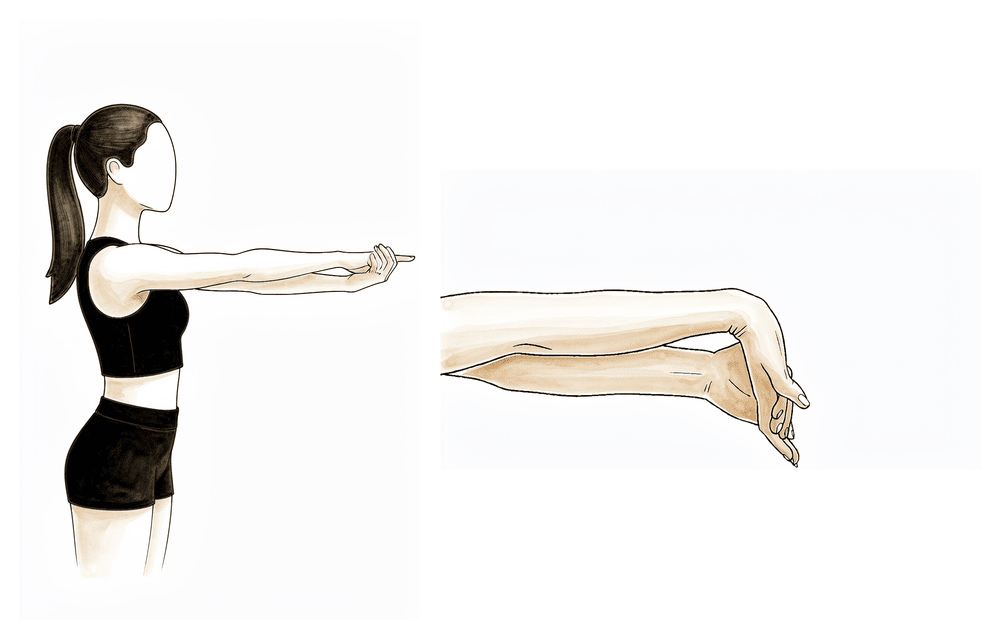
Estiramiento de los extensores de la muñeca
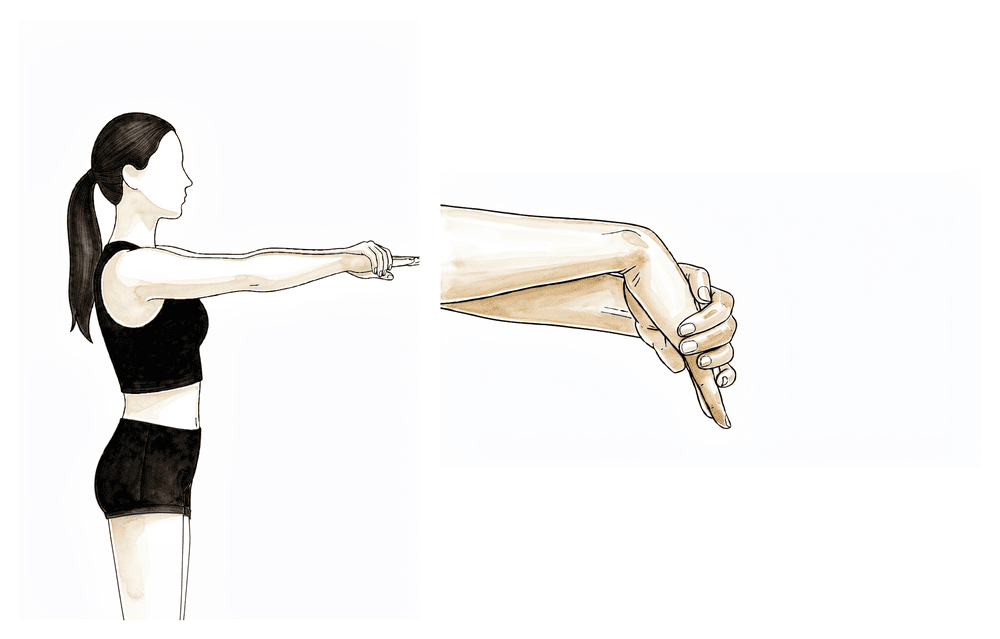
Extienda el brazo dolorido hacia adelante, manteniendo el codo recto y la palma de la mano hacia abajo. Con la otra mano, doble suavemente la muñeca hacia abajo de modo que los dedos apunten al suelo, hasta sentir una tensión cómoda en la parte superior del antebrazo. Mantenga el codo recto. Si estirarlo por completo resulta demasiado incómodo, comience con el codo ligeramente flexionado y, a medida que se sienta más cómodo, vaya estirándolo hasta dejarlo totalmente recto.
Mantener durante 30 segundos, 3 veces; 2–3 veces al día.
Kieran Hirpara 4.0
Estiramiento de los flexores de la muñeca
Extienda el brazo hacia adelante, con el codo recto y la palma de la mano hacia arriba. Con la otra mano, tire suavemente de los dedos y de la muñeca hacia atrás y hacia abajo hasta sentir una tensión cómoda en la parte inferior del antebrazo. Mantenga el codo recto.
Mantener durante 30 segundos, 3 veces; 2–3 veces al día.
Kieran Hirpara 4.0
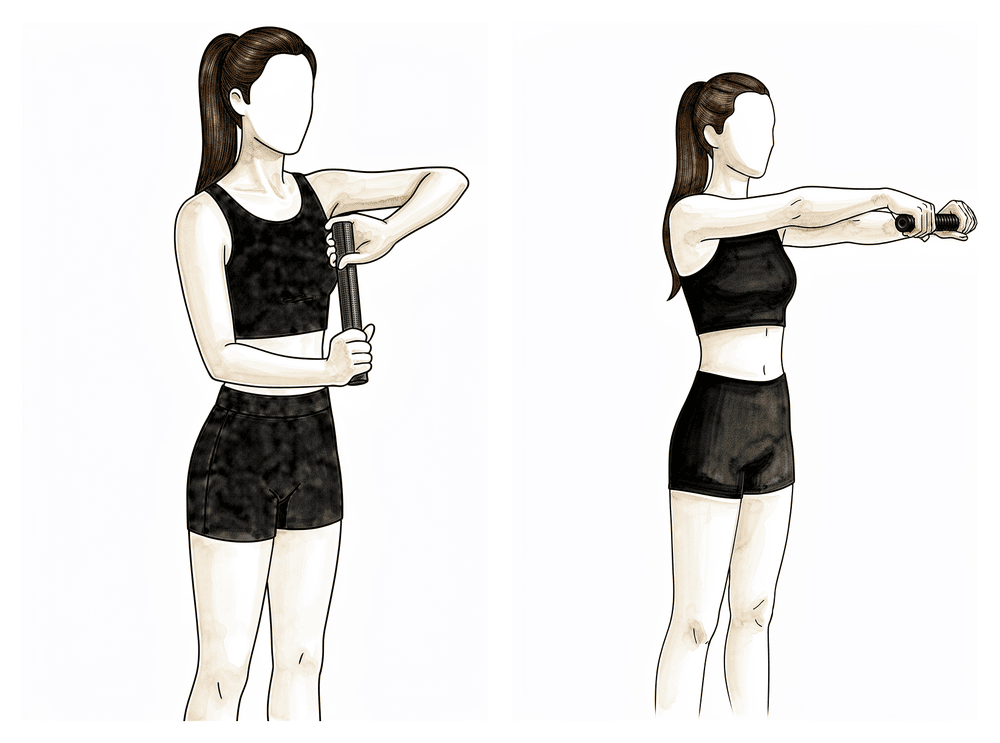
Giro de Tyler (extensión excéntrica de la muñeca)
Sostenga una barra de goma flexible (FlexBar) en posición vertical con la mano afectada, manteniendo la muñeca doblada hacia atrás. Con la otra mano, agarre la parte superior de la barra y gírela. A continuación, lleve la barra hacia adelante, conservando ese giro, y vaya relajando lentamente la muñeca afectada bajo control durante 3–4 segundos; este descenso lento y controlado es lo que fortalece el tendón. Este movimiento de desenrollado debe resultar algo exigente, pero sin provocar dolor agudo. Es normal sentir un ligero malestar durante y después del ejercicio; eso está bien.
3 series de 15 repeticiones, una vez al día (el ejercicio principal para el fortalecimiento).
Kieran Hirpara 4.0
Rotación del antebrazo
Pegue el codo al costado y doble el brazo formando un ángulo recto. Gire lentamente el antebrazo de modo que la palma quede hacia arriba; luego gire nuevamente para que la palma quede hacia abajo, manteniendo el codo pegado al cuerpo. A medida que le resulte más fácil, sostenga un peso ligero, como un martillo o una lata, para aumentar la carga.
10 repeticiones en cada dirección, 2–3 veces al día; añada un peso ligero según pueda.
Kieran Hirpara 4.0
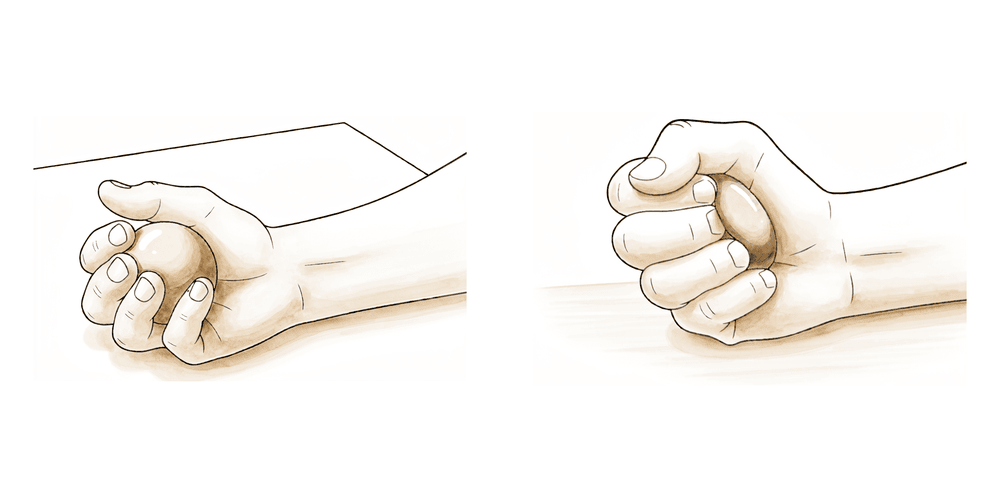
Fortalecimiento de la prensión
Apriete una pelota blanda o plastilina terapéutica con la mano; mantenga la presión por unos instantes y luego relájese. Aumente gradualmente la intensidad del apretón a medida que el tendón vaya tolerando más esfuerzo. Si el agarre sigue causando mucho dolor, comience más tarde y con menos intensidad: los ejercicios de agarre deben realizarse en la fase de fortalecimiento, una vez que haya disminuido la irritación inicial.
10–15 apretones, 2–3 veces al día; aumente la firmeza según lo tolere
Estos son los ejercicios que aparecen en su folleto. Siguen el proceso de recuperación en orden: el soporte de contrafuerza y las contracciones isométricas ayudan a controlar el dolor al principio; los estiramientos mantienen la flexibilidad del antebrazo; y el giro de Tyler, la rotación del antebrazo y los ejercicios de agarre ayudan a fortalecer nuevamente los tendones. Comience a realizarlos según las indicaciones del Dr. Hirpara y su terapeuta; no es necesario hacerlos todos desde el primer día. Su terapeuta le indicará cuáles debe iniciar y cuándo añadir los ejercicios de fortalecimiento.
Su protocolo clínico
El resto de esta página contiene el protocolo de rehabilitación clínica para la epicondilitis lateral (codo de tenista). Esta sección debe entregarse a su fisioterapeuta o terapeuta de la mano; cada fase comienza con una explicación sencilla en lenguaje coloquial sobre lo que está ocurriendo.
El protocolo consta de dos vías: una vía no quirúrgica (tratamiento de primera línea para prácticamente todos los pacientes) y una vía postoperatoria destinada a aquellos pocos pacientes que se someten a desbridamiento del tendón extensor radial corto del carpo tras haber recibido tratamiento conservador de calidad durante seis meses o más sin obtener resultados.
Vía no quirúrgica
El principio fundamental es la carga progresiva del tendón, guiada por el nivel de dolor. El objetivo es acortar la duración de los síntomas y restaurar la tolerancia a la carga, no mantener el tendón en reposo.
Fase I — Aguda / control del dolor (0–2 semanas)
El objetivo aquí es controlar el dolor y restablecer el movimiento sin carga. No se practica inmovilización; se trata de un reposo relativo, no de un vendaje rígido.
Para su fisioterapeuta:
- Objetivos: controlar el dolor; restablecer el rango de movimiento activo completo sin carga (AROM).
- Manejo: modificación de actividades, protección articular y consejos ergonómicos. Opcionalmente, se puede utilizar un soporte de contrafuerza sobre la masa extensora común para disminuir la carga sobre el origen del ECRB durante la prensión; también se puede emplear una férula de muñeca (en posición de extensión) si existe dolor agudo al realizar movimientos de extensión. Para controlar el dolor: hielo, movilización de tejidos blandos mediante técnicas manuales o instrumentales (IASTM), AROM suave y sin dolor; punción seca opcional, deslizamientos nerviosos.
- Criterios para avanzar: AROM completo sin dolor y capacidad para realizar de forma independiente el programa de ejercicios en casa.
Fase II — Subaguda / carga temprana (2–4 semanas)
Se inicia la carga tendinosa de forma gradual, y se trabaja la cadena cinética proximal (omóplato y manguito rotador), ya que la debilidad en la parte superior del brazo provoca sobrecarga en el codo.
Para su fisioterapeuta:
- Objetivos: iniciar la carga tendinosa; trabajar la cadena cinética proximal.
- Ejercicios: carga isométrica de los extensores y flexores de la muñeca (carga ligera; los ejercicios isométricos se toleran bien y tienen efecto analgésico en la tendinopatía reactiva); estiramientos progresivos de los flexores y extensores de la muñeca con el codo a 90°; ejercicios proximales: serrato anterior, trapecio medio/inferior, manguito rotador y estabilizadores del omóplato.
- Criterios para avanzar: se mantiene la amplitud de movimiento completa; el paciente tolera el estiramiento con el codo flexionado a 90°; se alcanza aproximadamente el 70 % de la fuerza/agarre del lado contralateral.
Fase III — Fortalecimiento / retorno (4–6+ semanas; a menudo hasta 12 semanas)
En esta fase se reconstruye el tendón y se restaura la tolerancia a la carga para el trabajo y el deporte. La carga excéntrica-concéntrica constituye el pilar terapéutico principal.
Para su fisioterapeuta:
- Objetivos: restaurar la tolerancia a la carga y la capacidad para el deporte y el trabajo.
- Ejercicios: carga excéntrica-concéntrica de extensión de muñeca y pronación/supinación del antebrazo; el Tyler Twist (FlexBar) es el instrumento excéntrico típico para uso en casa. Se debe progresar hacia el estiramiento con el codo extendido; además, utilizar la movilización con movimiento (Mulligan). También se recomienda el fortalecimiento de la prensión y la carga específica para tareas o deportes; para atletas, se pueden emplear ejercicios pliométricos. Se debe retirar gradualmente el soporte de contrafuerza a medida que el paciente quede asintomático. Para atletas, es necesario modificar el equipamiento (tamaño de la empuñadura, tensión de las cuerdas, técnica).
- Criterios para avanzar (retorno al deporte): aproximadamente el 90 % de la fuerza del lado contralateral, función sin dolor y capacidad de autogestión.
Vía postoperatoria (desbridamiento del ECRB ± liberación)
La cirugía está indicada únicamente para aquellos pacientes (~4–11%) que no responden a al menos 6 meses de tratamiento conservador adecuado. El desbridamiento abierto de tipo Nirschl y el desbridamiento artroscópico del ECRB arrojan resultados similares. El cronograma que se detalla a continuación sigue el Estándar de Atención de Brigham & Women’s para el desbridamiento del epicóndilo lateral.
Fase 1 — Protección (Días 1–7)
Durante la primera semana, el cabestrillo se utiliza únicamente para mayor comodidad.
Para su fisioterapeuta:
- El cabestrillo sirve solo para comodidad; aplicar hielo durante 20 minutos, 2–3 veces al día; usar una almohadilla en el codo sobre la incisión.
- AROM suave y sin dolor de mano, muñeca y codo; rango de movimiento activo del hombro; ejercicios periescapulares.
- Evitar al máximo las actividades de la vida diaria que sobrecarguen el mecanismo extensor (levantar objetos, extender completamente el codo combinado con flexión de muñeca); levantar objetos con la palma hacia arriba para reducir la carga sobre los extensores; si el dolor es intenso, se puede usar una férula de muñeca de forma opcional.
Fase 2 — Movilización temprana (Semanas 2–4)
Para su fisioterapeuta:
- Retire el cabestrillo. Comience con PROM y movilización activa asistida dentro de los límites del dolor tolerable.
- Fortalecimiento suave: movimientos activos e isometría submáxima. Inicie el cuidado de la cicatriz.
Fase 3 — Fortalecimiento (Semanas 5–7)
Para su fisioterapeuta:
- Progresar con el fortalecimiento resistivo (pesas / bandas elásticas Theraband), enfocándose en la resistencia de los extensores de la muñeca (carga ligera, mayor número de repeticiones). Restaurar el rango de movimiento activo y pasivo por completo.
- Introducir el soporte de contrafuerza para el tendón extensor común (acompañadas de instrucciones para evitar la compresión nerviosa); realizar un masaje transversal suave; comenzar la preparación funcional.
Fase 4 — Funcional / retorno a la actividad (Semanas 8–12)
Para su fisioterapeuta:
- Entrenamiento funcional orientado a tareas específicas; retorno a actividades laborales de mayor exigencia y a actividades recreativas.
- Continuar utilizando el soporte de contrafuerza según sea necesario para realizar actividades de la vida diaria sin dolor y para el fortalecimiento muscular.
Volver al trabajo y a las actividades
Si está tratando el codo de tenista sin cirugía, no existe un período fijo de “inactividad laboral”; puede seguir utilizando el brazo, modificando las tareas que requieran mayor fuerza de agarre y levantamiento, y empleando un soporte de contrafuerza para afrontarlas. Lo razonable es esperar que el codo mejore en el transcurso de 6–12 meses; la mayoría de las personas (80–90%) experimentan una mejoría dentro de un año. Se trata de un problema tendinoso de evolución lenta, por lo que los avances se miden a lo largo de semanas y meses, no de días. Mantenerse fiel al programa de carga es lo que permite lograr esa mejoría; los brotes de dolor ocasionales son normales y no representan un retroceso, siempre y cuando el malestar leve desaparezca al día siguiente.
En caso de haberse sometido a cirugía, el cabestrillo se usa únicamente para mayor comodidad durante la primera semana y se retira a medida que el codo se estabiliza. El fortalecimiento progresa durante las semanas 5–7; la mayoría de los pacientes vuelven a desempeñar sus actividades laborales y recreativas alrededor de la semana 8–12. Las exigencias más intensas y específicas del deporte se reintroducen gradualmente en ese periodo, según la tolerancia del tendón a la carga.
El regreso al deporte (en ambos casos) depende de alcanzar aproximadamente el 90 % de la fuerza del otro brazo, además de contar con una función sin dolor y la confianza para autogestionarse; no se basa únicamente en el paso del tiempo.
Después de seguir este protocolo
Este protocolo complementa las recomendaciones generales de recuperación que ofrece la clínica; consulte cómo manejar el dolor postoperatorio y, si se ha sometido a cirugía, cuidados de la herida y conceptos básicos de la terapia de la mano. El plan por fases descrito anteriormente se basa en las mejores evidencias actuales para el codo de tenista (carga progresiva del tendón en lugar de reposo); su recuperación continua será guiada individualmente por su fisioterapeuta o terapeuta de la mano, según la evolución de su codo.
Evidence & references
This is the clinical evidence summary written for health professionals. It is technical, and it lists the research this page was built from. You do not need to read it to understand your treatment or to make a decision about it.
Lateral Epicondylitis (Tennis Elbow) — Non-operative & Post-operative Rehabilitation
Topic scope: (A) the natural history and stepped non-operative management of lateral epicondylitis (relative rest → progressive tendon loading: isometric → eccentric–concentric; counterforce bracing; controversies around corticosteroid and PRP injection), and (B) post-operative rehabilitation after open or arthroscopic ECRB debridement ± release, reserved for the minority who fail ≥6 months of quality conservative care.
Defining principle: despite the "-itis" suffix, lateral epicondylitis is a degenerative tendinopathy (tendinosis) of the extensor carpi radialis brevis (ECRB) origin, not an inflammatory condition. This reframes treatment away from rest and anti-inflammatory measures and toward progressive tendon loading — settle pain with isometrics, then rebuild load tolerance with eccentric–concentric loading (the Tyler twist / FlexBar). KH's stance: load the tendon, do not immobilise it; corticosteroid injection is avoided as first line because it is better short-term but worse at 6–12 months; surgery is a last resort after ≥6 months of genuine conservative care.
A. NATURAL HISTORY & NON-OPERATIVE MANAGEMENT
Natural history (self-limiting in most)
Lateral epicondylitis is self-limiting in the majority: roughly 80–90% resolve within about one year regardless of treatment, with the conservative literature ranging out to 12–18 months [Coonrad & Hooper 1973; Nirschl 1999]. This high spontaneous-resolution rate is the central methodological challenge of the field — any intervention must beat natural history, a high bar most fail to clear. The goal of therapy is therefore to shorten the symptomatic course and restore load tolerance, not to "cure" a condition that largely settles on its own.
Phased non-operative rehabilitation
First-line for essentially all comers. The therapeutic core is progressive tendon loading guided by pain.
Phase I — Acute / pain control (~0–2 weeks). Relative rest, NOT immobilisation — avoid full wrist/elbow casting (Nirschl). Activity modification, joint protection, ergonomics. Optional counterforce brace over the common extensor mass (offloads the ECRB origin during grip) ± a wrist cock-up splint if acutely painful. Adjuncts: ice, soft-tissue/IASTM, pain-free AROM, optional dry needling, nerve glides. Criterion to progress: full unloaded AROM without pain; independent with home program. Consensus / institutional protocol.
Phase II — Sub-acute / early loading (~2–4 weeks). Begin isometric wrist flexor/extensor loading (minimal load; isometrics are well tolerated and analgesic in reactive tendinopathy). Progressive stretching of wrist flexors/extensors with the elbow at 90°. Add proximal kinetic-chain work (serratus anterior, mid/lower trapezius, rotator cuff, scapular stabilisers — proximal deficits drive distal overload). Criteria to progress: full ROM maintained; tolerates stretch at 90° elbow flexion; ~70% contralateral grip/strength. Moderate (strengthening trials) / Consensus (timeline).
Phase III — Late / strengthening & return (~4–6+ weeks, often to 12 weeks). Eccentric–concentric loading of wrist extension and forearm pronation/supination is the core driver; the Tyler twist (FlexBar eccentric wrist-extension) is the prototypical home tool. Progress stretching to the elbow-extended position; add mobilisation-with-movement (Mulligan). Grip strengthening and task-/sport-specific loading; plyometrics for athletes. Gradually wean the counterforce brace as the patient becomes asymptomatic. Return-to-sport criteria: ~90% contralateral strength, pain-free function, self-management competence. Moderate–High (RCT/SR for exercise & loading) / Consensus (phase timings).
B. POST-OPERATIVE REHABILITATION (open or arthroscopic ECRB debridement ± release/repair)
Surgery is reserved for the ~4–11% who fail ≥6 months (commonly 6–12 months) of quality conservative care. Open Nirschl-type debridement and arthroscopic ECRB debridement give comparable complication and reoperation rates (national database, Arthroscopy 2022); arthroscopy additionally allows intra-articular inspection. The phased timeline below is the Brigham & Women's Standard of Care for lateral epicondyle debridement, cross-checked against community ECRB-release protocols.
| Phase | Window | Sling / support | Motion & strengthening | Notes |
|---|---|---|---|---|
| 1 — Protect | Days 1–7 | Sling for comfort; optional wrist splint if painful | Pain-free hand/wrist/elbow AROM; active shoulder ROM; periscapular work | Ice 20 min 2–3×/day; elbow pad over incision; lift palm-up to offload extensors |
| 2 — Early motion | Weeks 2–4 | Discontinue sling | PROM + active-assisted motion within pain tolerance; sub-maximal isometrics | Begin scar management |
| 3 — Strengthening | Weeks 5–7 | Introduce counterforce brace | Advance resistive strengthening (weights/Theraband); wrist-extensor endurance (light load, high rep); restore full A/PROM | Education to avoid nerve compression; cross-fibre massage |
| 4 — Functional / return | Weeks 8–12 | Counterforce brace as needed | Task-specific functional training; return to work/recreation | Functional return wk 8–12 |
Alternative published timelines (community ECRB-release protocols): wrist splint full-time 0–2 wk with no strengthening; full ROM goal by 4–6 wk; strengthening + transition to counterforce brace
6 wk; full activity ~8–10+ wk. Note: one comparative series found post-op bracing/immobilisation delayed symptom resolution versus PRP (mean time to full ROM 96 days surgery vs 42 days PRP) — reinforcing that early controlled motion, not protection, is the goal.
C. KEY CONTROVERSIES / EVIDENCE QUALITY
- Corticosteroid injection: better short-term, WORSE long-term. The Bisset/Smidt body of work (and the BMJ 2006 mobilisation-with-movement RCT) shows steroid gives early relief but higher recurrence and worse 6–12-month outcomes than physiotherapy or wait-and-see. Some authors now call it "always inadvisable" for lateral elbow (Orthop Trauma Surg Res 2019). Prior injection is associated with eventual surgery (a proxy for severity). Strong (Level-1 RCT).
- PRP / autologous blood: contested. Some Level-1 RCTs (Peerbooms 2010; Gosens 2-yr) show PRP superior to corticosteroid with ongoing 2-year benefit; others (Krogh 2013) found PRP ≈ glucocorticoid ≈ saline (no benefit over placebo). Meta-analyses are heterogeneous. Net: a reasonable second-line for refractory cases, but evidence is inconsistent. Conflicting (Level-1).
- Eccentric vs concentric vs isometric. Pure eccentric (Alfredson-style) is effective but not clearly superior; current view favours eccentric–concentric combined loading, with isometrics for early analgesia. Grip/isometric demands of the elbow differ from the Achilles, so blanket extrapolation of eccentric-only protocols is questioned. Moderate.
- Surgical indication/timing & technique. Reserve for failure of ≥6 months conservative care. Open vs arthroscopic debridement: no significant difference in complication or reoperation rates (national database, Arthroscopy 2022); choice is surgeon-/training-dependent. Repair after debridement vs debridement alone remains unsettled. Surgical incidence is declining, attributed to eccentric-exercise protocols and injections. Moderate.
- Self-limiting nature complicates all evidence: ~80–90% resolve within a year regardless of treatment, so any intervention must beat natural history. Strong (natural-history signal).
D. EVIDENCE STRENGTH FLAGS (summary)
- MODERATE–HIGH (RCT / SR): progressive loading (eccentric / eccentric–concentric) and exercise therapy for non-operative lateral epicondylitis; mobilisation-with-movement (BMJ 2006); the natural-history signal (~80–90% resolve within ~1 year).
- MODERATE (cohorts / database): post-operative ECRB debridement outcomes; equivalence of open vs arthroscopic debridement (no difference in complication/reoperation rates).
- CONSENSUS / institutional (Level-5): the phase timelines themselves derive from Standard-of-Care protocols (Brigham & Women's, Mass General Brigham, Campbell's/Nirschl) — broadly concordant across sources but not trial-derived.
- STRONG (against, Level-1): corticosteroid injection as first-line — better short-term, worse at 6–12 months.
CITATIONS
RAG corpus (180,000+ Orthopaedic articles)
- Bisset L et al. Mobilisation with movement and exercise, corticosteroid injection, or wait and see for tennis elbow: randomised trial. BMJ. 2006. DOI: 10.1136/bmj.38961.584653.AE
- Krogh TP et al. Treatment of lateral epicondylitis with platelet-rich plasma, glucocorticoid, or saline: a randomized, double-blind, placebo-controlled trial. Am J Sports Med. 2013. DOI: 10.1177/0363546512472975
- Peerbooms JC et al. Positive effect of an autologous platelet concentrate in lateral epicondylitis in a double-blind randomized controlled trial. Am J Sports Med. 2010. DOI: 10.1177/0363546509355445
- Gosens T et al. Ongoing positive effect of platelet-rich plasma versus corticosteroid injection in lateral epicondylitis: a double-blind randomized controlled trial with 2-year follow-up. Am J Sports Med. 2011. DOI: 10.1177/0363546510397173
- Ortega-Castillo M, Medina-Porqueres I. Effectiveness of the eccentric exercise therapy in physically active adults with symptomatic shoulder impingement or lateral epicondylar tendinopathy: a systematic review. J Sci Med Sport. 2016. DOI: 10.1016/j.jsams.2015.05.010
- Nirschl RP, Ashman ES. Elbow tendinopathy: tennis elbow. Clin Sports Med. 2003. (Current Concepts — Tendinosis of the Elbow, J Bone Joint Surg Am. 1999. DOI: 10.2106/00004623-199902000-00016)
- Coonrad RW, Hooper WR. Tennis elbow: its course, natural history, conservative and surgical management. J Bone Joint Surg Am. 1973. DOI: 10.2106/00004623-197355060-00002
- Lattermann C et al. Arthroscopic debridement of the extensor carpi radialis brevis for recalcitrant lateral epicondylitis. J Shoulder Elbow Surg. 2010. DOI: 10.1016/j.jse.2010.02.008
Lateral epicondylitis literature (URLs)
- Comparative efficacy and safety of nonsurgical treatment options for enthesopathy of the ECRB: a systematic review and meta-analysis of randomized trials. Am J Sports Med. 2018. https://pubmed.ncbi.nlm.nih.gov/29268037/
- Eccentric, eccentric–concentric, and eccentric–concentric + isometric training in lateral elbow tendinopathy. J Hand Ther. 2017. https://pubmed.ncbi.nlm.nih.gov/28732560/
- Role of strengthening during nonoperative treatment of lateral epicondyle tendinopathy. J Hand Ther. 2021. https://pubmed.ncbi.nlm.nih.gov/33041157/
- Chronic lateral elbow tendinopathy managed with a supervised graded exercise protocol. J Hand Ther. 2023. https://pubmed.ncbi.nlm.nih.gov/36127241/
- Management of lateral epicondylitis. Orthop Traumatol Surg Res. 2019. https://pubmed.ncbi.nlm.nih.gov/30414784/
- No difference in complication or reoperation rates between arthroscopic and open debridement for lateral epicondylitis: a national database study. Arthroscopy. 2022. https://pubmed.ncbi.nlm.nih.gov/34838651/
- Wang D et al. Trends in surgical practices for lateral epicondylitis among newly trained orthopaedic surgeons. Orthop J Sports Med. 2017. https://pubmed.ncbi.nlm.nih.gov/28840148/
- Factors associated with failure of nonoperative treatment in lateral epicondylitis. Am J Sports Med. 2015. https://pubmed.ncbi.nlm.nih.gov/26015443/
Published rehab protocols (patient-guidance — basis for the phase structure)
- Brigham & Women's Hospital — Post-Op Protocol for Lateral Epicondyle Debridement. https://www.brighamandwomens.org/assets/bwh/patients-and-families/rehabilitation-services/pdfs/elbow-lateral-epicondyle-debridement-postoperative-bwh.pdf
- Mass General Brigham Sports Medicine — Rehabilitation Protocol for Medial/Lateral Epicondylitis (non-operative), rev. April 2021. https://www.massgeneral.org/assets/MGH/pdf/orthopaedics/sports-medicine/physical-therapy/rehabilitation-protocol-for-medial-lateral-epicondylitis.pdf
- Beacon Orthopaedics — Lateral Epicondylitis ECRB Surgical Release Protocol. https://www.beaconortho.com/wp-content/uploads/Lateral-Epicondylitis-Release.pdf