Skip to content

Patients › General-Health

Gota en la mano, la muñeca y el codo

PDF

Gout in the upper limb — what causes the attacks and lumps (tophi), how flares and high urate are treated, and when surgery is needed.
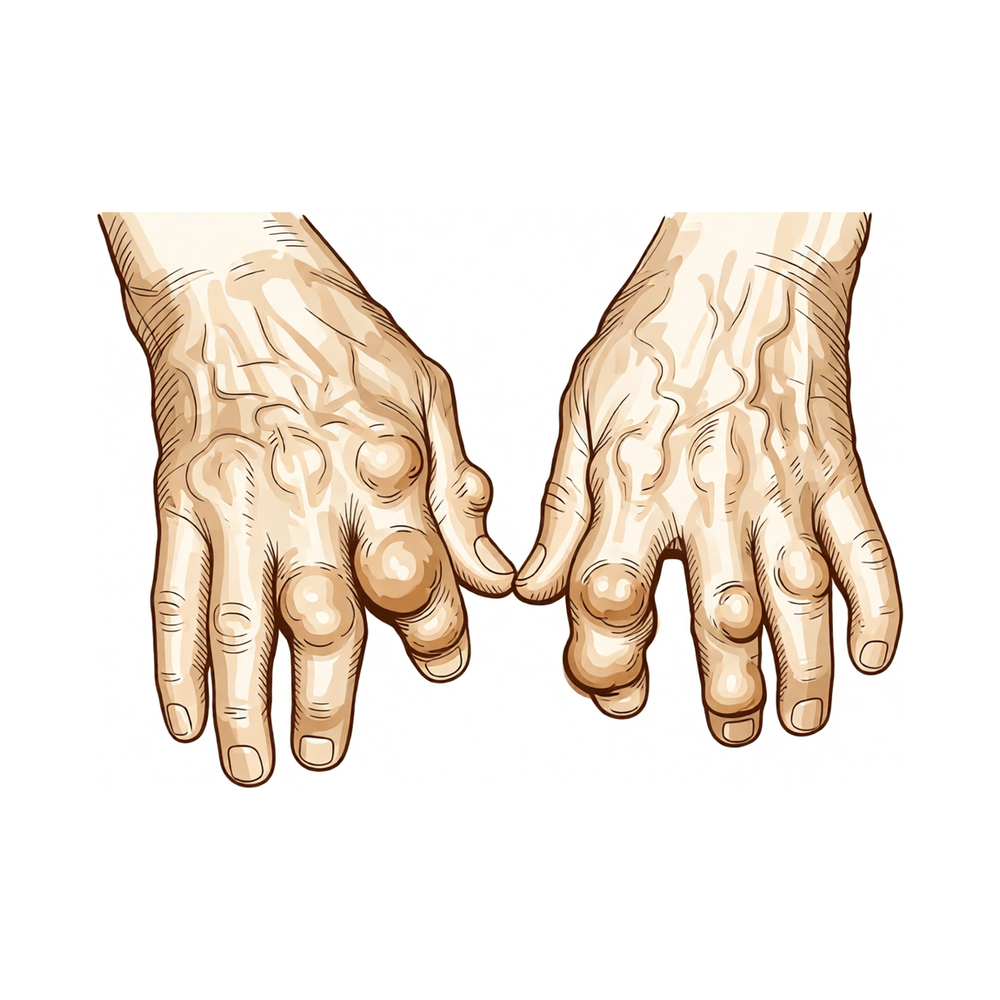
Ilustración de dos manos con bultos duros (tofos) producto de una gota tofácea crónica en varias articulaciones digitales.
La gota crónica puede provocar la aparición de bultos duros denominados tofos alrededor de las articulaciones de los dedos, lo que puede limitar el movimiento y la funcionalidad de la mano. Arthritis Research UK Primary Care Centre / Wikimedia Commons, CC BY 2.0

Esta página se tradujo automáticamente y todavía no la ha revisado un médico. La versión en inglés es la versión oficial.

Qué está sintiendo

La gota suele manifestarse de la noche a la mañana. Una articulación (a veces la base del pulgar, un nudillo, la muñeca o la punta del codo) se vuelve extremadamente dolorosa en cuestión de horas. Se ve caliente, roja e hinchada; es tan sensible que incluso el peso de una sábana resulta insoportable. Esto se conoce como episodio agudo, y el primero suele ocurrir en el pie, aunque la mano y la muñeca también son lugares frecuentes.

Entre un episodio y otro, la articulación puede parecer totalmente normal, por lo que muchas personas no le dan importancia al primer ataque. No obstante, con el paso de los meses y años, la gota puede generar bultos duros bajo la piel, alrededor de las articulaciones de los dedos, los nudillos o sobre el codo. A estos se les llama tofos. Pueden ser de color blanco o calcáreo bajo la piel; a medida que crecen, pueden hacer que la mano se vuelva rígida, debilitar el agarre y dificultar tareas delicadas como abrocharse la camisa. Algunas personas también experimentan entumecimiento o hormigueo en los dedos si un bulto ejerce presión sobre un nervio en la muñeca.

¿Qué está ocurriendo realmente?

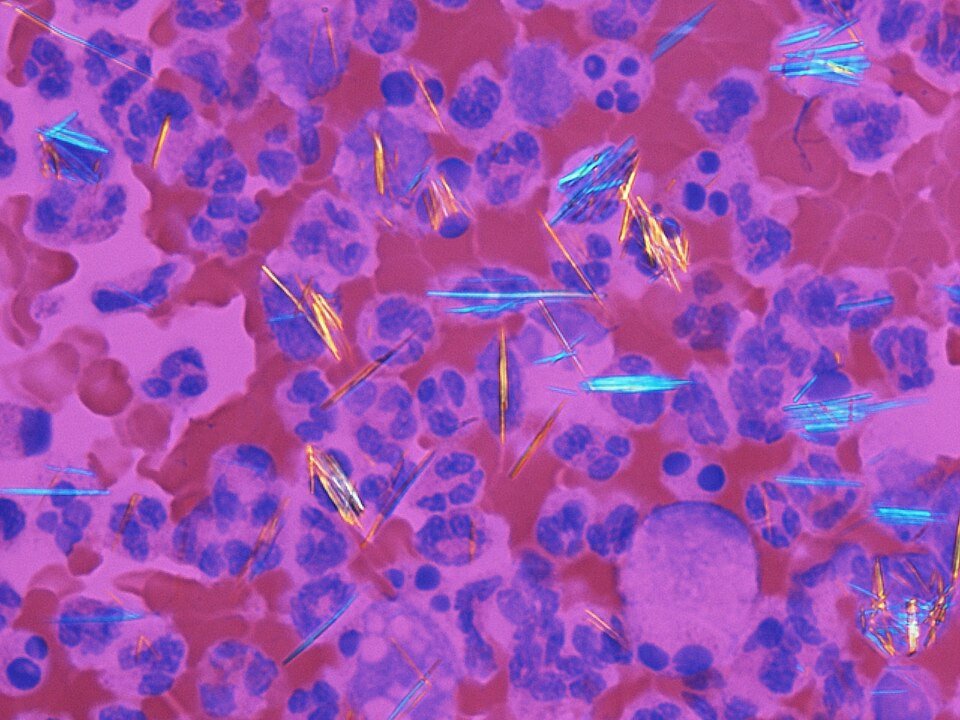
La gota es un problema que afecta todo el cuerpo y se manifiesta en las articulaciones. El organismo produce un producto de desecho llamado ácido úrico (urato). Cuando su concentración en la sangre es excesiva, puede formar pequeños cristales afilados que se depositan en las articulaciones y en los tejidos blandos circundantes, incluyendo la mano y la muñeca.

El sistema inmunitario percibe esos cristales como invasores y los ataca; esa reacción es la inflamación repentina y grave que se experimenta como un brote. Si los niveles elevados de urato no se controlan durante años, los cristales se acumulan formando depósitos duros conocidos como tofos. Con el tiempo, estos depósitos pueden desgastar el hueso, dañar los tendones e incluso comprimir algún nervio. Lo importante es que los brotes y los tofos son dos manifestaciones de la misma causa: un exceso de urato en el cuerpo. Al controlar el nivel de urato, se controla la enfermedad.

Qué podemos hacer al respecto

El tratamiento consta de dos partes distintas; ambas son importantes.

Controlar el ataque. Un brote agudo se calma con medicación antiinflamatoria, generalmente comprimidos antiinflamatorios no esteroideos (AINE), colchicina o un ciclo corto de esteroides. Estos medicamentos funcionan mejor si se administran en las primeras fases del ataque; por eso conviene acordar un plan con su médico antes de que se produzca el siguiente brote.

Reducir los niveles de urato de forma permanente. Esto es lo que, con el tiempo, realmente cura la gota. Un comprimido diario, habitualmente alopurinol, reduce gradualmente el nivel de urato en sangre hasta alcanzar un valor objetivo. Si se mantiene ese nivel durante suficiente tiempo, los cristales se disuelven poco a poco, los brotes cesan y los tofos disminuyen de tamaño. La dieta y el estilo de vida también ayudan (menos cerveza y bebidas alcohólicas, menos bebidas azucaradas, mantener un peso saludable y una buena hidratación); no obstante, para la mayoría de las personas el comprimido diario es el factor determinante.

La cirugía solo se requiere en casos excepcionales: cuando hay un tofo de gran tamaño que atraviesa la piel, interfiere con un tendón o comprime un nervio (por ejemplo, causando síntomas de síndrome del túnel carpiano). Incluso en esos casos, el tratamiento médico para reducir el urato debe continuarse después de la operación.

Qué esperar

La gota es una de las pocas formas de artritis que realmente podemos controlar. Si el nivel de urato se mantiene por debajo del valor objetivo a largo plazo, los brotes se vuelven poco frecuentes e incluso desaparecen, y los bultos existentes se disuelven gradualmente. Este es un proceso lento: puede llevar meses o años. Por lo general, el tratamiento con fármacos para reducir el urato debe seguirse de por vida, ya que interrumpirlo permite que los cristales se vuelvan a formar.

El precio a pagar por esa paciencia es real: cuanto más se acumulan los tofos en la mano, más se limita su funcionalidad. Por eso, mantener el nivel de urato bajo desde el principio protege la fuerza de agarre y la capacidad funcional de la mano. Las personas que siguen el tratamiento obtienen muy buenos resultados.

¿Cuándo consultar a un especialista?

  • Una articulación que se calienta, hincha y duele por primera vez: acuda al médico de inmediato. Una infección articular puede presentarse de forma idéntica a la gota y constituye una emergencia; por eso es necesario diferenciar ambas condiciones.
  • Ataques repetidos, o ataques que se vuelven más frecuentes: esto indica que es momento de iniciar un tratamiento para reducir los niveles de urato.
  • Aparición de bultos alrededor de las articulaciones, o un bulto que atraviesa la piel o segrega material blanquecino.
  • Entumecimiento, hormigueo o debilidad en la mano: un depósito podría estar comprimiendo un nervio, por lo que merece ser evaluado.

En mayor profundidad

Esta sección profundiza más de lo necesario para que usted tome sus propias decisiones de tratamiento. Vale la pena leer más sobre la gota, pues es una de las pocas enfermedades reumatológicas para las que existe una cura real; además, es una de las que peor se tratan, ya que la cura actúa en un plazo de tiempo que parece inadecuado cuando se sufre dolor.

¿Qué es realmente la gota? Los cristales de urato

El ácido úrico es un producto de desecho normal que se genera cuando el cuerpo descompone sustancias llamadas purinas (procedentes de las células y algunos alimentos). Cuando el nivel de urato en la sangre permanece elevado, este deja de estar disuelto y forma diminutos cristales en forma de aguja, denominados cristales de monourato de sodio (MSU), en el interior y alrededor de las articulaciones. Estos cristales se forman con mayor facilidad en zonas más frías; por eso el dedo gordo del pie, que es la articulación más periférica y fría del cuerpo, suele ser el primer lugar afectado.

Se trata de una afección verdaderamente destructiva para dicha articulación, no simplemente una fuente de dolor. En un total de 5,478 pacientes, la artritis aguda de la primera articulación metatarsofalángica es muy frecuente en la gota; además, tiene un impacto considerable en el dolor y la discapacidad, así como efectos comprobados en la estructura y función de la propia articulación [1].

El inflamasoma: ¿por qué un ataque es tan repentino y feroz?

El ataque se inicia cuando las células fagocíticas del sistema inmunitario (macrófagos) engullen los cristales de MSU. Estos cristales activan un complejo de señalización interno denominado inflamasoma NLRP3, el cual activa una enzima (caspasa-1) que libera un potente mensajero inflamatorio: la interleucina-1β (IL-1β). La IL-1β provoca una inflamación masiva en la articulación, dando lugar a enrojecimiento, calor, hinchazón y dolor intensos en cuestión de horas. Con el paso de los días, la respuesta inflamatoria se extingue y el ataque cede por sí solo.

Este mecanismo explica algo de gran importancia clínica: el ataque es la reacción inmunitaria ante los cristales, no los cristales en sí. Controlar el ataque e eliminar los cristales son dos procesos distintos que requieren fármacos diferentes y aplicados en momentos distintos.

El número que lo decide todo

El tratamiento a largo plazo tiene un objetivo medible: lograr que el ácido úrico sérico quede por debajo de la concentración a partir de la cual se forman cristales, y mantenerlo así. La práctica internacional recomienda mantener el ácido úrico sérico por debajo de 0,36 mmol/L (6 mg/dL); en casos donde existen tofos, el objetivo es mantenerlo por debajo de 0,30 mmol/L (5 mg/dL), pues a esos niveles los cristales ya existentes se disuelven, en lugar de simplemente dejar de acumularse.

Lo que respaldan las evidencias es tratar para alcanzar ese objetivo, en lugar de prescribir una dosis fija y cruzar los dedos. En un ensayo controlado aleatorizado con 183 participantes, el aumento gradual de la dosis de alopurinol cada mes hasta alcanzar el objetivo produjo una reducción significativa en la proporción de personas que presentaron brotes y en el tamaño promedio de los tofos durante 24 meses; además, el tratamiento fue bien tolerado [2].

El mismo principio se aplica a nivel de servicios sanitarios: en un ensayo aleatorizado realizado en el Reino Unido, la atención dirigida por enfermeras, basada en la educación del paciente y en una estrategia de tratamiento orientada al objetivo de control del ácido úrico, logró un control mucho mejor de dicho nivel que la atención habitual; además, se observaron menos brotes y una mayor resolución de tofos a los dos años [3].

De esto se desprenden dos conclusiones. Una dosis de alopurinol que nunca se haya ajustado según los resultados de análisis de sangre no constituye realmente un tratamiento; asimismo, afirmar que “mi gota está bajo control” implica referirse a un valor numérico, no a la mera ausencia de ataques este mes.

¿Por qué se abandona el tratamiento en los primeros meses?

Iniciar el tratamiento hipouricemiante puede desencadenar brotes de la enfermedad. A medida que los cristales se disuelven, liberan material al que el inflamasoma reacciona; por eso los primeros meses de tratamiento pueden ser peores de lo que la enfermedad parecía ser. Esta es la razón más frecuente por la que las personas interrumpen el tratamiento y concluyen que no funciona, cuando en realidad el brote es una señal de que sí está surtiendo efecto. Por ello, el tratamiento se inicia con dosis bajas, se aumenta gradualmente y, por lo general, se acompaña de profilaxis antiinflamatoria durante los primeros meses.

Dos aspectos que debe observar un cirujano de extremidad superior

La gota no se limita al pie; en el brazo puede simular una patología quirúrgica. Existen casos documentados de tenosinovitis gotosa en la inserción distal del bíceps, que provoca desgarros parciales del tendón, manifestándose como una ruptura simple del bíceps, siendo la gota la causa subyacente [4]. Es una condición poco frecuente, pero es el tipo de diagnóstico que solo se realiza si el médico lo tiene en cuenta.

Afortunadamente, una preocupación común no se confirma: tras analizar a 684,964 personas, se observó que la gota no se asociaba a un mayor riesgo de fracturas; además, los fármacos hipouricemiantes administrados en fases tempranas no mostraron efectos ni negativos ni beneficiosos sobre dicho riesgo [5].

Referencias

[1] Stewart S, Dalbeth N, Vandal AC, Rome K. La primera articulación metatarsofalángica en la gota: una revisión sistemática y metaanálisis. BMC Musculoskelet Disord. 2016;17(1). https://doi.org/10.1186/s12891-016-0919-9

[2] Stamp LK, Chapman PT, Barclay ML, Horne A, Frampton C, Tan P, et al. Ensayo controlado aleatorizado sobre la eficacia y seguridad de el aumento de la dosis de alopurinol para alcanzar el nivel objetivo de ácido úrico en pacientes con gota. Ann Rheum Dis. 2017;76(9):1522-8. https://doi.org/10.1136/annrheumdis-2016-210872

[3] Doherty M, Jenkins W, Richardson H, Sarmanova A, Abhishek A, Ashton D, et al. Eficacia y rentabilidad de una atención dirigida por enfermeros que incluye educación y participación del paciente, junto con una estrategia de tratamiento dirigida a alcanzar niveles objetivos de ácido úrico, frente a la atención habitual en pacientes con gota: ensayo controlado aleatorizado. Lancet. 2018;392(10156):1403-12. https://doi.org/10.1016/S0140-6736(18)32158-5

[4] Fairhurst RJ, Schwartz AM, Rozmaryn LM. Tenosinovitis gotosa en la inserción distal del tendón bicipital, complicada por una ruptura parcial del tendón. Hand (N Y). 2016;12(1):NP1-NP5. https://doi.org/10.1177/1558944715627639

[5] Liu F, Dong J, Zhou D, Kang Q, Xiong F. La gota no se asocia con un mayor riesgo de fractura: un metaanálisis. J Orthop Surg Res. 2019;14(1). https://doi.org/10.1186/s13018-019-1317-4


Creative Commons BY-NC 4.0

CC Creative Commons licence
BY Attribution — you must credit the source
NC NonCommercial — not for commercial use

Attribution-NonCommercial 4.0 International


Creative Commons Corporation ("Creative Commons") is not a law firm and does not provide legal services or legal advice. Distribution of Creative Commons public licenses does not create a lawyer-client or other relationship. Creative Commons makes its licenses and related information available on an "as-is" basis. Creative Commons gives no warranties regarding its licenses, any material licensed under their terms and conditions, or any related information. Creative Commons disclaims all liability for damages resulting from their use to the fullest extent possible.

Using Creative Commons Public Licenses

Creative Commons public licenses provide a standard set of terms and conditions that creators and other rights holders may use to share original works of authorship and other material subject to copyright and certain other rights specified in the public license below. The following considerations are for informational purposes only, are not exhaustive, and do not form part of our licenses.

Considerations for licensors: Our public licenses are intended for use by those authorized to give the public permission to use material in ways otherwise restricted by copyright and certain other rights. Our licenses are irrevocable. Licensors should read and understand the terms and conditions of the license they choose before applying it. Licensors should also secure all rights necessary before applying our licenses so that the public can reuse the material as expected. Licensors should clearly mark any material not subject to the license. This includes other CC- licensed material, or material used under an exception or limitation to copyright. More considerations for licensors: wiki.creativecommons.org/Considerations_for_licensors

Considerations for the public: By using one of our public licenses, a licensor grants the public permission to use the licensed material under specified terms and conditions. If the licensor's permission is not necessary for any reason--for example, because of any applicable exception or limitation to copyright--then that use is not regulated by the license. Our licenses grant only permissions under copyright and certain other rights that a licensor has authority to grant. Use of the licensed material may still be restricted for other reasons, including because others have copyright or other rights in the material. A licensor may make special requests, such as asking that all changes be marked or described. Although not required by our licenses, you are encouraged to respect those requests where reasonable. More considerations for the public: wiki.creativecommons.org/Considerations_for_licensees


Creative Commons Attribution-NonCommercial 4.0 International Public License

By exercising the Licensed Rights (defined below), You accept and agree to be bound by the terms and conditions of this Creative Commons Attribution-NonCommercial 4.0 International Public License ("Public License"). To the extent this Public License may be interpreted as a contract, You are granted the Licensed Rights in consideration of Your acceptance of these terms and conditions, and the Licensor grants You such rights in consideration of benefits the Licensor receives from making the Licensed Material available under these terms and conditions.

Section 1 -- Definitions.

a. Adapted Material means material subject to Copyright and Similar Rights that is derived from or based upon the Licensed Material and in which the Licensed Material is translated, altered, arranged, transformed, or otherwise modified in a manner requiring permission under the Copyright and Similar Rights held by the Licensor. For purposes of this Public License, where the Licensed Material is a musical work, performance, or sound recording, Adapted Material is always produced where the Licensed Material is synched in timed relation with a moving image.

b. Adapter's License means the license You apply to Your Copyright and Similar Rights in Your contributions to Adapted Material in accordance with the terms and conditions of this Public License.

c. Copyright and Similar Rights means copyright and/or similar rights closely related to copyright including, without limitation, performance, broadcast, sound recording, and Sui Generis Database Rights, without regard to how the rights are labeled or categorized. For purposes of this Public License, the rights specified in Section 2(b)(1)-(2) are not Copyright and Similar Rights.

d. Effective Technological Measures means those measures that, in the absence of proper authority, may not be circumvented under laws fulfilling obligations under Article 11 of the WIPO Copyright Treaty adopted on December 20, 1996, and/or similar international agreements.

e. Exceptions and Limitations means fair use, fair dealing, and/or any other exception or limitation to Copyright and Similar Rights that applies to Your use of the Licensed Material.

f. Licensed Material means the artistic or literary work, database, or other material to which the Licensor applied this Public License.

g. Licensed Rights means the rights granted to You subject to the terms and conditions of this Public License, which are limited to all Copyright and Similar Rights that apply to Your use of the Licensed Material and that the Licensor has authority to license.

h. Licensor means the individual(s) or entity(ies) granting rights under this Public License.

i. NonCommercial means not primarily intended for or directed towards commercial advantage or monetary compensation. For purposes of this Public License, the exchange of the Licensed Material for other material subject to Copyright and Similar Rights by digital file-sharing or similar means is NonCommercial provided there is no payment of monetary compensation in connection with the exchange.

j. Share means to provide material to the public by any means or process that requires permission under the Licensed Rights, such as reproduction, public display, public performance, distribution, dissemination, communication, or importation, and to make material available to the public including in ways that members of the public may access the material from a place and at a time individually chosen by them.

k. Sui Generis Database Rights means rights other than copyright resulting from Directive 96/9/EC of the European Parliament and of the Council of 11 March 1996 on the legal protection of databases, as amended and/or succeeded, as well as other essentially equivalent rights anywhere in the world.

l. You means the individual or entity exercising the Licensed Rights under this Public License. Your has a corresponding meaning.

Section 2 -- Scope.

a. License grant.

1. Subject to the terms and conditions of this Public License, the Licensor hereby grants You a worldwide, royalty-free, non-sublicensable, non-exclusive, irrevocable license to exercise the Licensed Rights in the Licensed Material to:

a. reproduce and Share the Licensed Material, in whole or in part, for NonCommercial purposes only; and

b. produce, reproduce, and Share Adapted Material for NonCommercial purposes only.

2. Exceptions and Limitations. For the avoidance of doubt, where Exceptions and Limitations apply to Your use, this Public License does not apply, and You do not need to comply with its terms and conditions.

3. Term. The term of this Public License is specified in Section 6(a).

4. Media and formats; technical modifications allowed. The Licensor authorizes You to exercise the Licensed Rights in all media and formats whether now known or hereafter created, and to make technical modifications necessary to do so. The Licensor waives and/or agrees not to assert any right or authority to forbid You from making technical modifications necessary to exercise the Licensed Rights, including technical modifications necessary to circumvent Effective Technological Measures. For purposes of this Public License, simply making modifications authorized by this Section 2(a) (4) never produces Adapted Material.

5. Downstream recipients.

a. Offer from the Licensor -- Licensed Material. Every recipient of the Licensed Material automatically receives an offer from the Licensor to exercise the Licensed Rights under the terms and conditions of this Public License.

b. No downstream restrictions. You may not offer or impose any additional or different terms or conditions on, or apply any Effective Technological Measures to, the Licensed Material if doing so restricts exercise of the Licensed Rights by any recipient of the Licensed Material.

6. No endorsement. Nothing in this Public License constitutes or may be construed as permission to assert or imply that You are, or that Your use of the Licensed Material is, connected with, or sponsored, endorsed, or granted official status by, the Licensor or others designated to receive attribution as provided in Section 3(a)(1)(A)(i).

b. Other rights.

1. Moral rights, such as the right of integrity, are not licensed under this Public License, nor are publicity, privacy, and/or other similar personality rights; however, to the extent possible, the Licensor waives and/or agrees not to assert any such rights held by the Licensor to the limited extent necessary to allow You to exercise the Licensed Rights, but not otherwise.

2. Patent and trademark rights are not licensed under this Public License.

3. To the extent possible, the Licensor waives any right to collect royalties from You for the exercise of the Licensed Rights, whether directly or through a collecting society under any voluntary or waivable statutory or compulsory licensing scheme. In all other cases the Licensor expressly reserves any right to collect such royalties, including when the Licensed Material is used other than for NonCommercial purposes.

Section 3 -- License Conditions.

Your exercise of the Licensed Rights is expressly made subject to the following conditions.

a. Attribution.

1. If You Share the Licensed Material (including in modified form), You must:

a. retain the following if it is supplied by the Licensor with the Licensed Material:

i. identification of the creator(s) of the Licensed Material and any others designated to receive attribution, in any reasonable manner requested by the Licensor (including by pseudonym if designated);

ii. a copyright notice;

iii. a notice that refers to this Public License;

iv. a notice that refers to the disclaimer of warranties;

v. a URI or hyperlink to the Licensed Material to the extent reasonably practicable;

b. indicate if You modified the Licensed Material and retain an indication of any previous modifications; and

c. indicate the Licensed Material is licensed under this Public License, and include the text of, or the URI or hyperlink to, this Public License.

2. You may satisfy the conditions in Section 3(a)(1) in any reasonable manner based on the medium, means, and context in which You Share the Licensed Material. For example, it may be reasonable to satisfy the conditions by providing a URI or hyperlink to a resource that includes the required information.

3. If requested by the Licensor, You must remove any of the information required by Section 3(a)(1)(A) to the extent reasonably practicable.

4. If You Share Adapted Material You produce, the Adapter's License You apply must not prevent recipients of the Adapted Material from complying with this Public License.

Section 4 -- Sui Generis Database Rights.

Where the Licensed Rights include Sui Generis Database Rights that apply to Your use of the Licensed Material:

a. for the avoidance of doubt, Section 2(a)(1) grants You the right to extract, reuse, reproduce, and Share all or a substantial portion of the contents of the database for NonCommercial purposes only;

b. if You include all or a substantial portion of the database contents in a database in which You have Sui Generis Database Rights, then the database in which You have Sui Generis Database Rights (but not its individual contents) is Adapted Material; and

c. You must comply with the conditions in Section 3(a) if You Share all or a substantial portion of the contents of the database.

For the avoidance of doubt, this Section 4 supplements and does not replace Your obligations under this Public License where the Licensed Rights include other Copyright and Similar Rights.

Section 5 -- Disclaimer of Warranties and Limitation of Liability.

a. UNLESS OTHERWISE SEPARATELY UNDERTAKEN BY THE LICENSOR, TO THE EXTENT POSSIBLE, THE LICENSOR OFFERS THE LICENSED MATERIAL AS-IS AND AS-AVAILABLE, AND MAKES NO REPRESENTATIONS OR WARRANTIES OF ANY KIND CONCERNING THE LICENSED MATERIAL, WHETHER EXPRESS, IMPLIED, STATUTORY, OR OTHER. THIS INCLUDES, WITHOUT LIMITATION, WARRANTIES OF TITLE, MERCHANTABILITY, FITNESS FOR A PARTICULAR PURPOSE, NON-INFRINGEMENT, ABSENCE OF LATENT OR OTHER DEFECTS, ACCURACY, OR THE PRESENCE OR ABSENCE OF ERRORS, WHETHER OR NOT KNOWN OR DISCOVERABLE. WHERE DISCLAIMERS OF WARRANTIES ARE NOT ALLOWED IN FULL OR IN PART, THIS DISCLAIMER MAY NOT APPLY TO YOU.

b. TO THE EXTENT POSSIBLE, IN NO EVENT WILL THE LICENSOR BE LIABLE TO YOU ON ANY LEGAL THEORY (INCLUDING, WITHOUT LIMITATION, NEGLIGENCE) OR OTHERWISE FOR ANY DIRECT, SPECIAL, INDIRECT, INCIDENTAL, CONSEQUENTIAL, PUNITIVE, EXEMPLARY, OR OTHER LOSSES, COSTS, EXPENSES, OR DAMAGES ARISING OUT OF THIS PUBLIC LICENSE OR USE OF THE LICENSED MATERIAL, EVEN IF THE LICENSOR HAS BEEN ADVISED OF THE POSSIBILITY OF SUCH LOSSES, COSTS, EXPENSES, OR DAMAGES. WHERE A LIMITATION OF LIABILITY IS NOT ALLOWED IN FULL OR IN PART, THIS LIMITATION MAY NOT APPLY TO YOU.

c. The disclaimer of warranties and limitation of liability provided above shall be interpreted in a manner that, to the extent possible, most closely approximates an absolute disclaimer and waiver of all liability.

Section 6 -- Term and Termination.

a. This Public License applies for the term of the Copyright and Similar Rights licensed here. However, if You fail to comply with this Public License, then Your rights under this Public License terminate automatically.

b. Where Your right to use the Licensed Material has terminated under Section 6(a), it reinstates:

1. automatically as of the date the violation is cured, provided it is cured within 30 days of Your discovery of the violation; or

2. upon express reinstatement by the Licensor.

For the avoidance of doubt, this Section 6(b) does not affect any right the Licensor may have to seek remedies for Your violations of this Public License.

c. For the avoidance of doubt, the Licensor may also offer the Licensed Material under separate terms or conditions or stop distributing the Licensed Material at any time; however, doing so will not terminate this Public License.

d. Sections 1, 5, 6, 7, and 8 survive termination of this Public License.

Section 7 -- Other Terms and Conditions.

a. The Licensor shall not be bound by any additional or different terms or conditions communicated by You unless expressly agreed.

b. Any arrangements, understandings, or agreements regarding the Licensed Material not stated herein are separate from and independent of the terms and conditions of this Public License.

Section 8 -- Interpretation.

a. For the avoidance of doubt, this Public License does not, and shall not be interpreted to, reduce, limit, restrict, or impose conditions on any use of the Licensed Material that could lawfully be made without permission under this Public License.

b. To the extent possible, if any provision of this Public License is deemed unenforceable, it shall be automatically reformed to the minimum extent necessary to make it enforceable. If the provision cannot be reformed, it shall be severed from this Public License without affecting the enforceability of the remaining terms and conditions.

c. No term or condition of this Public License will be waived and no failure to comply consented to unless expressly agreed to by the Licensor.

d. Nothing in this Public License constitutes or may be interpreted as a limitation upon, or waiver of, any privileges and immunities that apply to the Licensor or You, including from the legal processes of any jurisdiction or authority.


Creative Commons is not a party to its public licenses. Notwithstanding, Creative Commons may elect to apply one of its public licenses to material it publishes and in those instances will be considered the “Licensor.” The text of the Creative Commons public licenses is dedicated to the public domain under the CC0 Public Domain Dedication. Except for the limited purpose of indicating that material is shared under a Creative Commons public license or as otherwise permitted by the Creative Commons policies published at creativecommons.org/policies, Creative Commons does not authorize the use of the trademark "Creative Commons" or any other trademark or logo of Creative Commons without its prior written consent including, without limitation, in connection with any unauthorized modifications to any of its public licenses or any other arrangements, understandings, or agreements concerning use of licensed material. For the avoidance of doubt, this paragraph does not form part of the public licenses.

Creative Commons may be contacted at creativecommons.org.