Skip to content

Patients › Wrist

Dolor en el lado cubital de la muñeca e impactación cubital

PDF

Pain on the little-finger side of the wrist from the ulna grinding against the wrist bones, and how shortening it relieves the pressure.
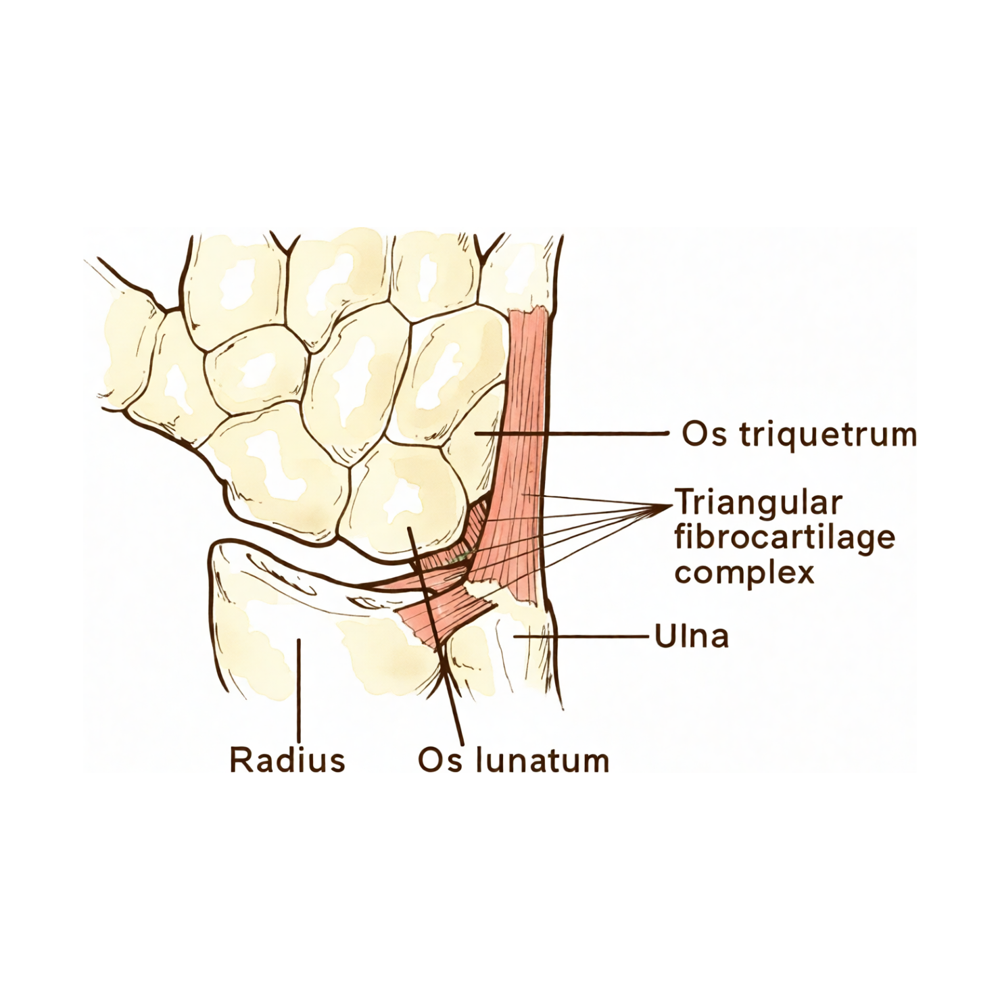
Anatomía del complejo fibrocartilaginoso triangular (TFCC) en el lado del meñique de la muñeca.
El TFCC y el lado cubital (del dedo meñique) de la muñeca: una causa frecuente de dolor en el lado cubital de la muñeca. Elatmani s / Wikimedia Commons, CC BY-SA 3.0

Esta página se tradujo automáticamente y todavía no la ha revisado un médico. La versión en inglés es la versión oficial.

Qué está sintiendo

El dolor en el lado del meñique de la muñeca (el lado cubital) es muy común y puede deberse a varias causas. Esta página trata la causa mecánica más importante: una afección llamada impacto cubital (también conocida como compresión ulnocarpiana).

El dolor suele localizarse en la parte externa de la muñeca, cerca del dorso de la mano. A menudo empeora al ejercer una fuerza de agarre, al girar el antebrazo o al doblar la muñeca hacia el meñique; por eso, actividades cotidianas como abrir un frasco, girar una llave, usar un destornillador, retorcer un paño o apoyarse en la mano para levantarse de una silla pueden desencadenarlo. Muchas personas también perciben un clic o chasquido en la muñeca al realizar ciertos movimientos, y la muñeca puede doler tras un día de uso intenso. Apoyar peso sobre la muñeca (al hacer planchas, flexiones o al empujar una puerta pesada) es un factor que suele agravar los síntomas.

Por lo general, los síntomas aparecen de forma gradual y no se deben a una lesión única; no obstante, pueden surgir después de una fractura de muñeca.

¿Qué está ocurriendo realmente?

Dos huesos del antebrazo llegan hasta la muñeca: el radio (lado del pulgar) y el cúbito (lado del meñique). Para que la muñeca funcione sin problemas, los extremos de estos dos huesos deben quedar aproximadamente al mismo nivel. En la impacción cubital, el cúbito resulta relativamente más largo que el radio; esta condición es denominada por los médicos varianza cubital positiva.

Algunas personas nacen con un cúbito ligeramente más largo. En otras personas, esto se desarrolla posteriormente: con frecuencia, cuando una fractura de muñeca sana dejando el radio un poco más corto de lo normal, el cúbito queda “sobresaliendo” en relación al radio.

Sea cual sea la causa, ese pequeño exceso de longitud hace que el extremo del cúbito presione contra los pequeños huesos de la muñeca que lo rodean (el semilunar y el piramidal) cada vez que se carga peso sobre la muñeca. Entre esos huesos se encuentra un cojín de cartílago llamado TFCC (complejo fibrocartilaginoso triangular), que actúa como amortiguador. El contacto repetido desgasta lentamente este cojín, puede provocar su rotura y, con el tiempo, genera hematomas e incluso pequeños quistes en el hueso subyacente. Este proceso de desgaste es el que produce el dolor, el chasquido articular y la disminución de la comodidad al agarrar y girar objetos. (Tenemos una página aparte sobre lesiones del TFCC, que suelen acompañar a esta condición.)

¿Qué podemos hacer al respecto?

El Dr. Kieran Hirpara dirige nuestro servicio de cirugía de miembro superior en el Mater Private Hospital Rockhampton; allí tratamos el dolor en el lado cubital de la muñeca siguiendo un protocolo claro. Por lo general, los pacientes son derivados a nuestra clínica por su médico de cabecera; si un fisioterapeuta le ha sugerido consultarnos, igualmente necesitará una derivación de su médico de cabecera para poder acceder al reembolso de Medicare. Comenzamos con una evaluación minuciosa para confirmar el diagnóstico; en casos crónicos, siempre intentamos primero el tratamiento no quirúrgico antes de considerar la cirugía.

La buena noticia es que la mayoría de las personas responden favorablemente al tratamiento no quirúrgico, y ese es siempre nuestro punto de partida.

Calmar la inflamación. Los primeros pasos son sencillos: modifique temporalmente las actividades que sobrecarguen el lado cubital de la muñeca (especialmente el agarre fuerte, los movimientos de torsión y el soporte de peso); use una férula de muñeca para mantener la articulación en reposo, y tome medicamentos antiinflamatorios para aliviar el dolor y la hinchazón. En ocasiones, una inyección de esteroides en la articulación ayuda a interrumpir el ciclo inflamatorio.

Confirmar el diagnóstico. Paralelamente al tratamiento, solemos realizar radiografías para medir con precisión cómo se alinean los dos huesos (a veces con una proyección especial que exagera el grado de impacto), y con frecuencia una RM para examinar el cartílago, el TFCC y el hueso subyacente. En algunos casos, se emplea la artroscopia, una técnica mínimamente invasiva, para visualizar el interior de la articulación, confirmar el diagnóstico y tratarla al mismo tiempo.

Si el problema persiste. Cuando el tratamiento no quirúrgico no logra mejorar la situación, el objetivo de la cirugía es reducir la presión sobre el lado cubital de la muñeca. La opción más consolidada es la osteotomía de acortamiento del cúbito: el cirujano extrae una pequeña porción del cúbito para ajustar su longitud y lo fija con una placa pequeña mientras cicatriza. En casos seleccionados, una alternativa menos invasiva es el procedimiento artroscópico conocido como “wafer”, que consiste en desgastar una pequeña porción del extremo del cúbito mediante cirugía mínimamente invasiva. Ambas técnicas evitan que el hueso roce contra la articulación de la muñeca.

Qué esperar

En la mayoría de los pacientes, el impacto cubital es un problema que podemos resolver.
Las medidas no quirúrgicas solucionan una gran proporción de casos, y los síntomas desaparecen una vez que la articulación deja de verse sometida a sobrecargas repetidas.

Cuando es necesaria la cirugía, el acortamiento del cúbito es una intervención fiable;
los estudios que han seguido a los pacientes durante muchos años reportan un alivio del dolor duradero y un alto grado de satisfacción. El hueso necesita tiempo para sanar, por lo que hay un período de recuperación de varias semanas con férula o escayola mientras la osteotomía se une; posteriormente, se reanuda gradualmente la capacidad de agarrar y soportar cargas. Lo principal que se debe tener en cuenta es que, en ocasiones, el hueso tarda más de lo previsto en consolidarse, y que la pequeña placa metálica a veces se puede sentir bajo la piel, por lo que, una vez curado todo, se retira en algunos casos. En general, la gran mayoría de los pacientes vuelven a sus actividades cotidianas sin dolor.

¿Cuándo consultar a un especialista?

  • Dolor en el lado cubital de la muñeca que no mejora tras varias semanas, o que reaparece al agarrar objetos o girar la muñeca; en estos casos merece ser evaluado.
  • Dolor que persiste tras una fractura previa de muñeca, especialmente si desde entonces la muñeca nunca se ha sentido del todo bien.
  • Un chasquido, crujido o sensación de atrapamiento constante en el lado del dedo meñique de la muñeca, sobre todo al soportar peso.
  • Dolor que le impide desempeñar su trabajo o realizar sus actividades diarias. En este punto, vale la pena averiguar cuál es la causa y qué se puede hacer al respecto.

En mayor profundidad

Esta sección profundiza más de lo necesario para que usted tome sus propias decisiones terapéuticas. El dolor en la zona cubital de la muñeca merece una lectura adicional, ya que no se trata de un diagnóstico en sí, sino de una localización; varios problemas distintos comparten esa misma zona reducida. Además, en el caso del más frecuente de ellos, la nueva técnica quirúrgica, más pequeña, presenta ahora cifras de complicaciones mejores que la técnica ya establecida.

¿Por qué esta zona del carpo resulta difícil de evaluar?

En un radio de pocos centímetros se encuentran el menisco triangular del carpo, la articulación radioulnar distal, el tendón del extensor carpi ulnaris y su vaina, la articulación pisotriquetral, el ligamento lunotriquetral, así como el punto donde el cúbito se une a los huesos del carpo. Cada una de estas estructuras puede provocar dolor en el mismo lugar; muchas presentan anomalías en las imágenes diagnósticas en personas asintomáticas, y es frecuente que más de una esté afectada simultáneamente.

Por ello, en esta zona la evaluación requiere una localización precisa y pruebas de provocación más que en otras zonas del carpo. Asimismo, es común que los estudios de imagen indiquen la presencia de múltiples estructuras anómalas, lo cual no resulta de gran utilidad diagnóstica. También es por esta razón que causas menos frecuentes, como la impacción midcarpiana, se describen periódicamente como factores subestimados [1].

Impactación cubital: el problema mecánico y su solución mecánica

La causa estructural más frecuente es la impactación cubital: el cúbito resulta ligeramente más largo que el radio, de modo que los huesos del carpo quedan comprimidos contra su extremo al realizar agarres o al girar el antebrazo con la palma hacia abajo. Con el tiempo, esto desgasta el complejo fibrocartilaginoso triangular de la muñeca (TFCC) y el cartílago de los huesos adyacentes.

El tratamiento consiste en acortar el cúbito, ya sea mediante una incisión y acortamiento del eje óseo, o extrayendo una pequeña lámina ósea de su extremo, procedimiento que puede realizarse de forma artroscópica. En un estudio que incluyó 956 pacientes, tanto la técnica artroscópica como la técnica abierta de extracción de lámina ósea podrían constituir alternativas viables a la osteotomía de acortamiento cubital, más utilizada, aunque en ese momento no se había demostrado su superioridad clínica [2].

Datos más recientes refuerzan esta conclusión. Al comparar la técnica artroscópica de extracción de lámina ósea con la osteotomía de acortamiento cubital en 311 pacientes, ambas demostraron ser eficaces; sin embargo, el grupo sometido a la técnica de lámina presentó menos complicaciones y una tasa de reoperación menor, lo que llevó a los autores a considerarla una alternativa potencialmente superior [3].

¿Por qué la osteotomía genera más complicaciones?

La razón no radica en que la operación se realice mal. Para acortar el eje óseo es necesario cortar el hueso, fijarlo con una placa mientras cicatriza y aceptar que quizás no llegue a unirse. Una revisión conjunta de 1,423 pacientes analizó específicamente los casos de no unión ósea; no se halló diferencia alguna entre las osteotomías transversales y oblicuas, por lo que se concluyó que la elección entre ambas no debe basarse en el riesgo de no unión [4].

El procedimiento de “wafer” evita por completo este tipo de problemas, ya que retira hueso del extremo del hueso en lugar de dividir el eje óseo. No se genera una fractura que deba unirse, y normalmente no es necesario retirar ninguna placa posteriormente; de ahí la diferencia en las tasas de reoperación.

La contrapartida es que el procedimiento de “wafer” permite retirar solo una cantidad limitada de hueso y exige que la articulación radiocubital distal esté sana; por ello, sigue siendo necesario acortar el eje óseo cuando se requiere una corrección mayor o cuando dicha articulación también está afectada.

La consecuencia práctica para el paciente

Dado que varias estructuras pueden ser la causa del problema, un tratamiento dirigido a una estructura incorrecta no surtirá efecto, por muy bien que se aplique. Es en esta zona donde las inyecciones diagnósticas, las pruebas de imagen dirigidas y, en ocasiones, la artroscopia resultan útiles antes de tomar una decisión; también es aquí donde se debe llegar a un diagnóstico específico, y no simplemente a la descripción “dolor en la zona cubital de la muñeca”, antes de planificar una intervención quirúrgica.

Referencias

[1] Kyriacou S, Tahmassebi R. Los síndromes de impactación mediocarpiana como causa poco frecuente de dolor en el lado cubital de la muñeca: una revisión. J Hand Surg Am. 2024;49(10):1027-31. https://doi.org/10.1016/j.jhsa.2024.07.016

[2] Stockton DJ, Pelletier M, Pike JM. Tratamiento quirúrgico del síndrome de impactación cubital: una revisión sistemática. J Hand Surg Eur Vol. 2014;40(5):470-6. https://doi.org/10.1177/1753193414541749

[3] Shi H, Huang Y, Shen Y, Wu K, Zhang Z, Li Q. Procedimiento artroscópico tipo “wafer” frente a osteotomía de acortamiento cubital para el síndrome de impactación cubital: una revisión sistemática y metaanálisis. J Orthop Surg Res. 2024;19(1). https://doi.org/10.1186/s13018-024-04611-4

[4] Owens J, Compton J, Day M, Glass N, Lawler E. Tasas de no unión tras la osteotomía de acortamiento cubital para el síndrome de impactación cubital: una revisión sistemática. J Hand Surg Am. 2019;44(7):612.e1-612.e12. https://doi.org/10.1016/j.jhsa.2018.08.018


Creative Commons BY-NC 4.0

CC Creative Commons licence
BY Attribution — you must credit the source
NC NonCommercial — not for commercial use

Attribution-NonCommercial 4.0 International


Creative Commons Corporation ("Creative Commons") is not a law firm and does not provide legal services or legal advice. Distribution of Creative Commons public licenses does not create a lawyer-client or other relationship. Creative Commons makes its licenses and related information available on an "as-is" basis. Creative Commons gives no warranties regarding its licenses, any material licensed under their terms and conditions, or any related information. Creative Commons disclaims all liability for damages resulting from their use to the fullest extent possible.

Using Creative Commons Public Licenses

Creative Commons public licenses provide a standard set of terms and conditions that creators and other rights holders may use to share original works of authorship and other material subject to copyright and certain other rights specified in the public license below. The following considerations are for informational purposes only, are not exhaustive, and do not form part of our licenses.

Considerations for licensors: Our public licenses are intended for use by those authorized to give the public permission to use material in ways otherwise restricted by copyright and certain other rights. Our licenses are irrevocable. Licensors should read and understand the terms and conditions of the license they choose before applying it. Licensors should also secure all rights necessary before applying our licenses so that the public can reuse the material as expected. Licensors should clearly mark any material not subject to the license. This includes other CC- licensed material, or material used under an exception or limitation to copyright. More considerations for licensors: wiki.creativecommons.org/Considerations_for_licensors

Considerations for the public: By using one of our public licenses, a licensor grants the public permission to use the licensed material under specified terms and conditions. If the licensor's permission is not necessary for any reason--for example, because of any applicable exception or limitation to copyright--then that use is not regulated by the license. Our licenses grant only permissions under copyright and certain other rights that a licensor has authority to grant. Use of the licensed material may still be restricted for other reasons, including because others have copyright or other rights in the material. A licensor may make special requests, such as asking that all changes be marked or described. Although not required by our licenses, you are encouraged to respect those requests where reasonable. More considerations for the public: wiki.creativecommons.org/Considerations_for_licensees


Creative Commons Attribution-NonCommercial 4.0 International Public License

By exercising the Licensed Rights (defined below), You accept and agree to be bound by the terms and conditions of this Creative Commons Attribution-NonCommercial 4.0 International Public License ("Public License"). To the extent this Public License may be interpreted as a contract, You are granted the Licensed Rights in consideration of Your acceptance of these terms and conditions, and the Licensor grants You such rights in consideration of benefits the Licensor receives from making the Licensed Material available under these terms and conditions.

Section 1 -- Definitions.

a. Adapted Material means material subject to Copyright and Similar Rights that is derived from or based upon the Licensed Material and in which the Licensed Material is translated, altered, arranged, transformed, or otherwise modified in a manner requiring permission under the Copyright and Similar Rights held by the Licensor. For purposes of this Public License, where the Licensed Material is a musical work, performance, or sound recording, Adapted Material is always produced where the Licensed Material is synched in timed relation with a moving image.

b. Adapter's License means the license You apply to Your Copyright and Similar Rights in Your contributions to Adapted Material in accordance with the terms and conditions of this Public License.

c. Copyright and Similar Rights means copyright and/or similar rights closely related to copyright including, without limitation, performance, broadcast, sound recording, and Sui Generis Database Rights, without regard to how the rights are labeled or categorized. For purposes of this Public License, the rights specified in Section 2(b)(1)-(2) are not Copyright and Similar Rights.

d. Effective Technological Measures means those measures that, in the absence of proper authority, may not be circumvented under laws fulfilling obligations under Article 11 of the WIPO Copyright Treaty adopted on December 20, 1996, and/or similar international agreements.

e. Exceptions and Limitations means fair use, fair dealing, and/or any other exception or limitation to Copyright and Similar Rights that applies to Your use of the Licensed Material.

f. Licensed Material means the artistic or literary work, database, or other material to which the Licensor applied this Public License.

g. Licensed Rights means the rights granted to You subject to the terms and conditions of this Public License, which are limited to all Copyright and Similar Rights that apply to Your use of the Licensed Material and that the Licensor has authority to license.

h. Licensor means the individual(s) or entity(ies) granting rights under this Public License.

i. NonCommercial means not primarily intended for or directed towards commercial advantage or monetary compensation. For purposes of this Public License, the exchange of the Licensed Material for other material subject to Copyright and Similar Rights by digital file-sharing or similar means is NonCommercial provided there is no payment of monetary compensation in connection with the exchange.

j. Share means to provide material to the public by any means or process that requires permission under the Licensed Rights, such as reproduction, public display, public performance, distribution, dissemination, communication, or importation, and to make material available to the public including in ways that members of the public may access the material from a place and at a time individually chosen by them.

k. Sui Generis Database Rights means rights other than copyright resulting from Directive 96/9/EC of the European Parliament and of the Council of 11 March 1996 on the legal protection of databases, as amended and/or succeeded, as well as other essentially equivalent rights anywhere in the world.

l. You means the individual or entity exercising the Licensed Rights under this Public License. Your has a corresponding meaning.

Section 2 -- Scope.

a. License grant.

1. Subject to the terms and conditions of this Public License, the Licensor hereby grants You a worldwide, royalty-free, non-sublicensable, non-exclusive, irrevocable license to exercise the Licensed Rights in the Licensed Material to:

a. reproduce and Share the Licensed Material, in whole or in part, for NonCommercial purposes only; and

b. produce, reproduce, and Share Adapted Material for NonCommercial purposes only.

2. Exceptions and Limitations. For the avoidance of doubt, where Exceptions and Limitations apply to Your use, this Public License does not apply, and You do not need to comply with its terms and conditions.

3. Term. The term of this Public License is specified in Section 6(a).

4. Media and formats; technical modifications allowed. The Licensor authorizes You to exercise the Licensed Rights in all media and formats whether now known or hereafter created, and to make technical modifications necessary to do so. The Licensor waives and/or agrees not to assert any right or authority to forbid You from making technical modifications necessary to exercise the Licensed Rights, including technical modifications necessary to circumvent Effective Technological Measures. For purposes of this Public License, simply making modifications authorized by this Section 2(a) (4) never produces Adapted Material.

5. Downstream recipients.

a. Offer from the Licensor -- Licensed Material. Every recipient of the Licensed Material automatically receives an offer from the Licensor to exercise the Licensed Rights under the terms and conditions of this Public License.

b. No downstream restrictions. You may not offer or impose any additional or different terms or conditions on, or apply any Effective Technological Measures to, the Licensed Material if doing so restricts exercise of the Licensed Rights by any recipient of the Licensed Material.

6. No endorsement. Nothing in this Public License constitutes or may be construed as permission to assert or imply that You are, or that Your use of the Licensed Material is, connected with, or sponsored, endorsed, or granted official status by, the Licensor or others designated to receive attribution as provided in Section 3(a)(1)(A)(i).

b. Other rights.

1. Moral rights, such as the right of integrity, are not licensed under this Public License, nor are publicity, privacy, and/or other similar personality rights; however, to the extent possible, the Licensor waives and/or agrees not to assert any such rights held by the Licensor to the limited extent necessary to allow You to exercise the Licensed Rights, but not otherwise.

2. Patent and trademark rights are not licensed under this Public License.

3. To the extent possible, the Licensor waives any right to collect royalties from You for the exercise of the Licensed Rights, whether directly or through a collecting society under any voluntary or waivable statutory or compulsory licensing scheme. In all other cases the Licensor expressly reserves any right to collect such royalties, including when the Licensed Material is used other than for NonCommercial purposes.

Section 3 -- License Conditions.

Your exercise of the Licensed Rights is expressly made subject to the following conditions.

a. Attribution.

1. If You Share the Licensed Material (including in modified form), You must:

a. retain the following if it is supplied by the Licensor with the Licensed Material:

i. identification of the creator(s) of the Licensed Material and any others designated to receive attribution, in any reasonable manner requested by the Licensor (including by pseudonym if designated);

ii. a copyright notice;

iii. a notice that refers to this Public License;

iv. a notice that refers to the disclaimer of warranties;

v. a URI or hyperlink to the Licensed Material to the extent reasonably practicable;

b. indicate if You modified the Licensed Material and retain an indication of any previous modifications; and

c. indicate the Licensed Material is licensed under this Public License, and include the text of, or the URI or hyperlink to, this Public License.

2. You may satisfy the conditions in Section 3(a)(1) in any reasonable manner based on the medium, means, and context in which You Share the Licensed Material. For example, it may be reasonable to satisfy the conditions by providing a URI or hyperlink to a resource that includes the required information.

3. If requested by the Licensor, You must remove any of the information required by Section 3(a)(1)(A) to the extent reasonably practicable.

4. If You Share Adapted Material You produce, the Adapter's License You apply must not prevent recipients of the Adapted Material from complying with this Public License.

Section 4 -- Sui Generis Database Rights.

Where the Licensed Rights include Sui Generis Database Rights that apply to Your use of the Licensed Material:

a. for the avoidance of doubt, Section 2(a)(1) grants You the right to extract, reuse, reproduce, and Share all or a substantial portion of the contents of the database for NonCommercial purposes only;

b. if You include all or a substantial portion of the database contents in a database in which You have Sui Generis Database Rights, then the database in which You have Sui Generis Database Rights (but not its individual contents) is Adapted Material; and

c. You must comply with the conditions in Section 3(a) if You Share all or a substantial portion of the contents of the database.

For the avoidance of doubt, this Section 4 supplements and does not replace Your obligations under this Public License where the Licensed Rights include other Copyright and Similar Rights.

Section 5 -- Disclaimer of Warranties and Limitation of Liability.

a. UNLESS OTHERWISE SEPARATELY UNDERTAKEN BY THE LICENSOR, TO THE EXTENT POSSIBLE, THE LICENSOR OFFERS THE LICENSED MATERIAL AS-IS AND AS-AVAILABLE, AND MAKES NO REPRESENTATIONS OR WARRANTIES OF ANY KIND CONCERNING THE LICENSED MATERIAL, WHETHER EXPRESS, IMPLIED, STATUTORY, OR OTHER. THIS INCLUDES, WITHOUT LIMITATION, WARRANTIES OF TITLE, MERCHANTABILITY, FITNESS FOR A PARTICULAR PURPOSE, NON-INFRINGEMENT, ABSENCE OF LATENT OR OTHER DEFECTS, ACCURACY, OR THE PRESENCE OR ABSENCE OF ERRORS, WHETHER OR NOT KNOWN OR DISCOVERABLE. WHERE DISCLAIMERS OF WARRANTIES ARE NOT ALLOWED IN FULL OR IN PART, THIS DISCLAIMER MAY NOT APPLY TO YOU.

b. TO THE EXTENT POSSIBLE, IN NO EVENT WILL THE LICENSOR BE LIABLE TO YOU ON ANY LEGAL THEORY (INCLUDING, WITHOUT LIMITATION, NEGLIGENCE) OR OTHERWISE FOR ANY DIRECT, SPECIAL, INDIRECT, INCIDENTAL, CONSEQUENTIAL, PUNITIVE, EXEMPLARY, OR OTHER LOSSES, COSTS, EXPENSES, OR DAMAGES ARISING OUT OF THIS PUBLIC LICENSE OR USE OF THE LICENSED MATERIAL, EVEN IF THE LICENSOR HAS BEEN ADVISED OF THE POSSIBILITY OF SUCH LOSSES, COSTS, EXPENSES, OR DAMAGES. WHERE A LIMITATION OF LIABILITY IS NOT ALLOWED IN FULL OR IN PART, THIS LIMITATION MAY NOT APPLY TO YOU.

c. The disclaimer of warranties and limitation of liability provided above shall be interpreted in a manner that, to the extent possible, most closely approximates an absolute disclaimer and waiver of all liability.

Section 6 -- Term and Termination.

a. This Public License applies for the term of the Copyright and Similar Rights licensed here. However, if You fail to comply with this Public License, then Your rights under this Public License terminate automatically.

b. Where Your right to use the Licensed Material has terminated under Section 6(a), it reinstates:

1. automatically as of the date the violation is cured, provided it is cured within 30 days of Your discovery of the violation; or

2. upon express reinstatement by the Licensor.

For the avoidance of doubt, this Section 6(b) does not affect any right the Licensor may have to seek remedies for Your violations of this Public License.

c. For the avoidance of doubt, the Licensor may also offer the Licensed Material under separate terms or conditions or stop distributing the Licensed Material at any time; however, doing so will not terminate this Public License.

d. Sections 1, 5, 6, 7, and 8 survive termination of this Public License.

Section 7 -- Other Terms and Conditions.

a. The Licensor shall not be bound by any additional or different terms or conditions communicated by You unless expressly agreed.

b. Any arrangements, understandings, or agreements regarding the Licensed Material not stated herein are separate from and independent of the terms and conditions of this Public License.

Section 8 -- Interpretation.

a. For the avoidance of doubt, this Public License does not, and shall not be interpreted to, reduce, limit, restrict, or impose conditions on any use of the Licensed Material that could lawfully be made without permission under this Public License.

b. To the extent possible, if any provision of this Public License is deemed unenforceable, it shall be automatically reformed to the minimum extent necessary to make it enforceable. If the provision cannot be reformed, it shall be severed from this Public License without affecting the enforceability of the remaining terms and conditions.

c. No term or condition of this Public License will be waived and no failure to comply consented to unless expressly agreed to by the Licensor.

d. Nothing in this Public License constitutes or may be interpreted as a limitation upon, or waiver of, any privileges and immunities that apply to the Licensor or You, including from the legal processes of any jurisdiction or authority.


Creative Commons is not a party to its public licenses. Notwithstanding, Creative Commons may elect to apply one of its public licenses to material it publishes and in those instances will be considered the “Licensor.” The text of the Creative Commons public licenses is dedicated to the public domain under the CC0 Public Domain Dedication. Except for the limited purpose of indicating that material is shared under a Creative Commons public license or as otherwise permitted by the Creative Commons policies published at creativecommons.org/policies, Creative Commons does not authorize the use of the trademark "Creative Commons" or any other trademark or logo of Creative Commons without its prior written consent including, without limitation, in connection with any unauthorized modifications to any of its public licenses or any other arrangements, understandings, or agreements concerning use of licensed material. For the avoidance of doubt, this paragraph does not form part of the public licenses.

Creative Commons may be contacted at creativecommons.org.