Skip to content

Patients › General-Health

¿Cómo funciona el dolor?

PDF

Esta página se tradujo automáticamente y todavía no la ha revisado un médico. La versión en inglés es la versión oficial.

El dolor es el sistema de alerta del cuerpo. Protege al individuo al hacer que se detenga, se retire y descanse mientras algo sana; a corto plazo, es una de las funciones más útiles del sistema nervioso. Sin embargo, el dolor es algo más complejo que un simple “medidor de daño”. Comprenderlo realmente resulta útil, sobre todo cuando el dolor persiste: el propio sistema de alerta puede volverse excesivamente sensible, de modo que el dolor continúa o se percibe de forma desproporcionada respecto a lo que muestran los estudios de imagen, incluso después de que los tejidos hayan sanado. Un mensaje fundamental y basado en evidencia recorre toda esta página: el dolor no siempre indica daño. En ella se explica, en un lenguaje sencillo, qué es el dolor y cómo funciona; luego, para quienes deseen profundizar, se aborda la biología que explica por qué el dolor puede persistir.

¿Qué es el dolor y para qué sirve?

El dolor no se mide mediante un sensor para luego transmitirse al cerebro tal cual, como ocurre con la lectura de un termómetro. Es más bien una respuesta que el cerebro genera tras evaluar múltiples estímulos: señales provenientes del cuerpo, sí, pero también el contexto, las experiencias previas, el estado de ánimo y el grado de amenaza que el cerebro percibe en una situación determinada. Su función es protectora: captar nuestra atención y modificar nuestro comportamiento para que una lesión pueda sanar.

Por eso, la misma lesión puede causar un dolor muy distinto en días diferentes o en personas distintas; y por eso el dolor es completamente real, incluso cuando no coincide con lo que se observa en una radiografía.

Dolor agudo versus dolor crónico

  • El dolor agudo es la señal de alarma normal: aparece tras una lesión, su intensidad suele ser proporcional al daño sufrido y disminuye a medida que se produce la cicatrización. Este tipo de dolor cumple su función.
  • El dolor crónico es aquel que persiste más allá del tiempo esperado para la curación (generalmente, más de tres meses). En este caso, el problema suele ser un sistema de alarma que se ha vuelto excesivamente sensible y no se desactiva. El dolor es real y puede ser intenso, pero ya no constituye una señal fiable de que algún tejido está sufriendo daños.

Esta distinción es de gran importancia, pues requiere enfoques distintos: el dolor agudo se maneja tratando la lesión y proporcionando alivio a corto plazo; el dolor crónico, en cambio, se gestiona calmando y reentrenando gradualmente el sistema nervioso, en lugar de recurrir a analgésicos cada vez más potentes.

Qué ayuda a aliviar el dolor

  • Comprenderlo. Saber que “el dolor no equivale a daño” realmente reduce el dolor crónico y la discapacidad; el miedo y la catastrofización intensifican el dolor.
  • Movimiento y ritmo adecuado. La actividad suave y progresiva ayuda a desensibilizar un sistema nervioso hiperreactivo; el reposo prolongado y el evitar el movimiento suelen empeorar el dolor crónico.
  • Sueño, estado de ánimo y estrés. El sueño deficiente, el mal humor y el estrés aumentan la intensidad del dolor; abordarlos permite disminuirla.
  • Los medicamentos adecuados para cada tipo de dolor. Los cursos cortos de analgésicos simples son útiles para el dolor agudo; el dolor crónico responde mejor a medicamentos dirigidos a los nervios, al ejercicio y a estrategias psicológicas que a los opioides.

En mayor profundidad

Esta sección ofrece una explicación más detallada, dirigida a estudiantes. No es necesaria para controlar su dolor; sin embargo, si le interesa saber cómo se genera el dolor y por qué puede persistir, siga leyendo.

Cómo se transmite una señal de dolor

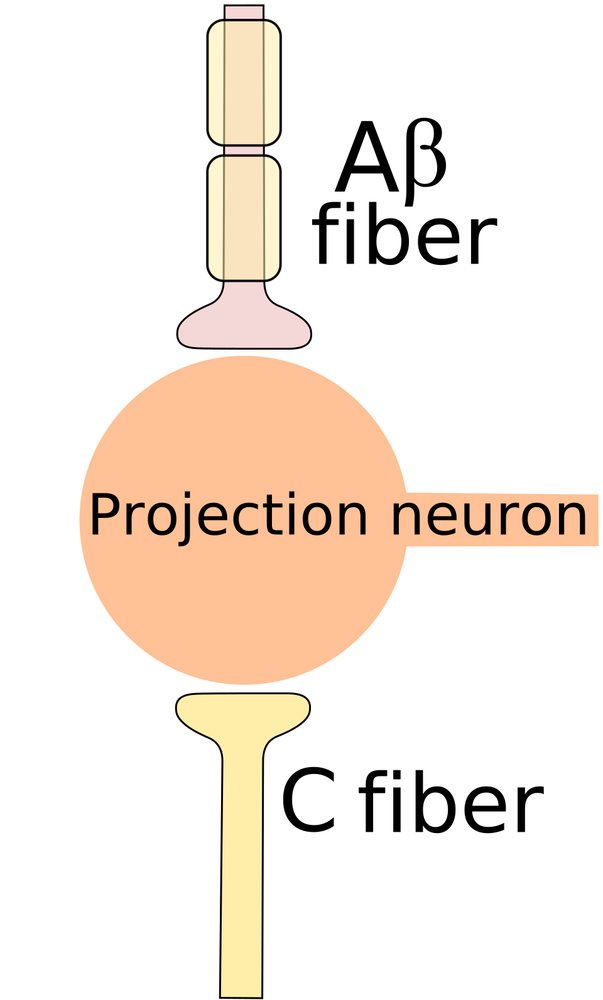
Las terminaciones nerviosas especializadas llamadas nociceptores detectan estímulos potencialmente dañinos: presión extrema, calor o sustancias químicas liberadas por el tejido lesionado. Estas envían señales a través de dos tipos de fibras. Las fibras A-delta, rápidas y aisladas, transmiten ese dolor agudo e inmediato que hace que retires la mano de inmediato; las fibras C, más lentas y sin aislante, transmiten el dolor sordo, persistente y molesto que sigue después. Dichas señales llegan a la médula espinal, donde son retransmitidas (y ya moduladas) antes de ascender al cerebro. No existe un único “centro del dolor”; muchas regiones cerebrales colaboran para determinar si se percibe el dolor y en qué intensidad. Por lo tanto, el dolor se “construye” en el cerebro, no se recibe pasivamente.

La teoría del control de la puerta

La médula espinal funciona como una puerta capaz de aumentar o disminuir la intensidad de las señales de dolor que llegan. Los estímulos no dolorosos pueden “cerrar esa puerta” al dolor; por eso el masaje en una zona golpeada o el uso de un dispositivo TENS ayudan a aliviarlo. El cerebro también envía señales descendentes a la médula espinal para aumentar o reducir el dolor, según la atención, el estado de ánimo y el contexto (modulación descendente). Este es el mecanismo real detrás de observaciones cotidianas: una lesión deportiva que apenas se siente durante el partido, un dolor que empeora cuando uno está ansioso o agotado, y el alivio que brinda la distracción o el consuelo. Esa “puerta” no es una metáfora; es un fenómeno fisiológico.

Sensibilización periférica y central

Tras una lesión, el sistema aumenta deliberadamente su sensibilidad para proteger la zona afectada:

  • Sensibilización periférica: las sustancias químicas liberadas en el lugar de la lesión hacen que los nociceptores locales se vuelvan más excitables, por lo que la zona dolorida duele aún más (por eso la piel quemada por el sol reacciona intensamente ante una ducha tibia).
  • Sensibilización central: la médula espinal y el cerebro también se vuelven más excitables, amplificando toda señal que llega.

Los signos característicos son la hiperalgesia (las cosas que normalmente causan dolor lo causan aún más de lo esperado) y la alodinia (cosas que en condiciones normales no deberían doler, como el tacto ligero o la ropa, se vuelven dolorosas). En lesiones agudas, este mecanismo resulta útil y desaparece con el tiempo. En el caso del dolor crónico, puede persistir y mantenerse por sí solo.

Cuando el dolor persiste más allá de la lesión: dolor crónico y nociplástico

En algunas personas, el sistema nervioso permanece sensibilizado mucho después de que los tejidos hayan sanado; la “alarma” se queda activada. El dolor que surge de este procesamiento alterado, y no de un daño continuo ni de una lesión nerviosa, se denomina dolor nociplástico (la sensibilización central es su mecanismo principal). Este concepto explica un cuadro clínico frecuente y antes difícil de comprender: dolor intenso, real y discapacitante, a pesar de que las imágenes diagnósticas no muestran prácticamente nada anormal. Reconocerlo no equivale a minimizar el dolor calificándolo como “producto de la imaginación”; los cambios que se producen son reales y medibles en el sistema nervioso. Esto modifica el objetivo del tratamiento: en lugar de buscar más daños estructurales que corregir, se trata de reducir la hiperactividad del sistema nervioso. Afecciones como la fibromialgia y gran parte del dolor musculoesquelético crónico se enmarcan en este contexto.

¿Por qué los analgésicos más fuertes no son la solución para el dolor crónico?

Los opioides son útiles para el dolor agudo e intenso de corta duración, pero no son adecuados para el dolor crónico. Con un uso continuado, el cuerpo desarrolla tolerancia (se necesita una dosis mayor para obtener el mismo efecto) y, paradójicamente, hiperalgesia inducida por opioides: estos fármacos pueden hacer que el sistema nervioso se vuelva más sensible al dolor con el tiempo. Dado que el dolor crónico se debe en gran medida a una sensibilización del sistema nervioso, las herramientas eficaces son aquellas que permiten reeducarlo: ejercicio progresivo, buen descanso, estrategias psicológicas y medicamentos dirigidos a los nervios (en lugar de opioides).

Qué ayuda y qué perjudica

  • Actividad gradual y control del ritmo: ayuda a desensibilizar el sistema; en cambio, el evitar la actividad por miedo y el reposo prolongado lo sensibilizan aún más.
  • Sueño, estado de ánimo y control del estrés: reducen la sensibilidad; el sueño deficiente y el malestar emocional la aumentan.
  • La educación y la reducción de la catastrofización disminuyen de forma significativa el dolor y la discapacidad.
  • El medicamento adecuado para cada tipo de dolor: analgésicos simples a corto plazo para el dolor agudo; ejercicio, terapia psicológica y fármacos dirigidos a los nervios (evitando el uso creciente de opioides) para el dolor crónico.

Véase también


Creative Commons BY-NC 4.0

CC Creative Commons licence
BY Attribution — you must credit the source
NC NonCommercial — not for commercial use

Attribution-NonCommercial 4.0 International


Creative Commons Corporation ("Creative Commons") is not a law firm and does not provide legal services or legal advice. Distribution of Creative Commons public licenses does not create a lawyer-client or other relationship. Creative Commons makes its licenses and related information available on an "as-is" basis. Creative Commons gives no warranties regarding its licenses, any material licensed under their terms and conditions, or any related information. Creative Commons disclaims all liability for damages resulting from their use to the fullest extent possible.

Using Creative Commons Public Licenses

Creative Commons public licenses provide a standard set of terms and conditions that creators and other rights holders may use to share original works of authorship and other material subject to copyright and certain other rights specified in the public license below. The following considerations are for informational purposes only, are not exhaustive, and do not form part of our licenses.

Considerations for licensors: Our public licenses are intended for use by those authorized to give the public permission to use material in ways otherwise restricted by copyright and certain other rights. Our licenses are irrevocable. Licensors should read and understand the terms and conditions of the license they choose before applying it. Licensors should also secure all rights necessary before applying our licenses so that the public can reuse the material as expected. Licensors should clearly mark any material not subject to the license. This includes other CC- licensed material, or material used under an exception or limitation to copyright. More considerations for licensors: wiki.creativecommons.org/Considerations_for_licensors

Considerations for the public: By using one of our public licenses, a licensor grants the public permission to use the licensed material under specified terms and conditions. If the licensor's permission is not necessary for any reason--for example, because of any applicable exception or limitation to copyright--then that use is not regulated by the license. Our licenses grant only permissions under copyright and certain other rights that a licensor has authority to grant. Use of the licensed material may still be restricted for other reasons, including because others have copyright or other rights in the material. A licensor may make special requests, such as asking that all changes be marked or described. Although not required by our licenses, you are encouraged to respect those requests where reasonable. More considerations for the public: wiki.creativecommons.org/Considerations_for_licensees


Creative Commons Attribution-NonCommercial 4.0 International Public License

By exercising the Licensed Rights (defined below), You accept and agree to be bound by the terms and conditions of this Creative Commons Attribution-NonCommercial 4.0 International Public License ("Public License"). To the extent this Public License may be interpreted as a contract, You are granted the Licensed Rights in consideration of Your acceptance of these terms and conditions, and the Licensor grants You such rights in consideration of benefits the Licensor receives from making the Licensed Material available under these terms and conditions.

Section 1 -- Definitions.

a. Adapted Material means material subject to Copyright and Similar Rights that is derived from or based upon the Licensed Material and in which the Licensed Material is translated, altered, arranged, transformed, or otherwise modified in a manner requiring permission under the Copyright and Similar Rights held by the Licensor. For purposes of this Public License, where the Licensed Material is a musical work, performance, or sound recording, Adapted Material is always produced where the Licensed Material is synched in timed relation with a moving image.

b. Adapter's License means the license You apply to Your Copyright and Similar Rights in Your contributions to Adapted Material in accordance with the terms and conditions of this Public License.

c. Copyright and Similar Rights means copyright and/or similar rights closely related to copyright including, without limitation, performance, broadcast, sound recording, and Sui Generis Database Rights, without regard to how the rights are labeled or categorized. For purposes of this Public License, the rights specified in Section 2(b)(1)-(2) are not Copyright and Similar Rights.

d. Effective Technological Measures means those measures that, in the absence of proper authority, may not be circumvented under laws fulfilling obligations under Article 11 of the WIPO Copyright Treaty adopted on December 20, 1996, and/or similar international agreements.

e. Exceptions and Limitations means fair use, fair dealing, and/or any other exception or limitation to Copyright and Similar Rights that applies to Your use of the Licensed Material.

f. Licensed Material means the artistic or literary work, database, or other material to which the Licensor applied this Public License.

g. Licensed Rights means the rights granted to You subject to the terms and conditions of this Public License, which are limited to all Copyright and Similar Rights that apply to Your use of the Licensed Material and that the Licensor has authority to license.

h. Licensor means the individual(s) or entity(ies) granting rights under this Public License.

i. NonCommercial means not primarily intended for or directed towards commercial advantage or monetary compensation. For purposes of this Public License, the exchange of the Licensed Material for other material subject to Copyright and Similar Rights by digital file-sharing or similar means is NonCommercial provided there is no payment of monetary compensation in connection with the exchange.

j. Share means to provide material to the public by any means or process that requires permission under the Licensed Rights, such as reproduction, public display, public performance, distribution, dissemination, communication, or importation, and to make material available to the public including in ways that members of the public may access the material from a place and at a time individually chosen by them.

k. Sui Generis Database Rights means rights other than copyright resulting from Directive 96/9/EC of the European Parliament and of the Council of 11 March 1996 on the legal protection of databases, as amended and/or succeeded, as well as other essentially equivalent rights anywhere in the world.

l. You means the individual or entity exercising the Licensed Rights under this Public License. Your has a corresponding meaning.

Section 2 -- Scope.

a. License grant.

1. Subject to the terms and conditions of this Public License, the Licensor hereby grants You a worldwide, royalty-free, non-sublicensable, non-exclusive, irrevocable license to exercise the Licensed Rights in the Licensed Material to:

a. reproduce and Share the Licensed Material, in whole or in part, for NonCommercial purposes only; and

b. produce, reproduce, and Share Adapted Material for NonCommercial purposes only.

2. Exceptions and Limitations. For the avoidance of doubt, where Exceptions and Limitations apply to Your use, this Public License does not apply, and You do not need to comply with its terms and conditions.

3. Term. The term of this Public License is specified in Section 6(a).

4. Media and formats; technical modifications allowed. The Licensor authorizes You to exercise the Licensed Rights in all media and formats whether now known or hereafter created, and to make technical modifications necessary to do so. The Licensor waives and/or agrees not to assert any right or authority to forbid You from making technical modifications necessary to exercise the Licensed Rights, including technical modifications necessary to circumvent Effective Technological Measures. For purposes of this Public License, simply making modifications authorized by this Section 2(a) (4) never produces Adapted Material.

5. Downstream recipients.

a. Offer from the Licensor -- Licensed Material. Every recipient of the Licensed Material automatically receives an offer from the Licensor to exercise the Licensed Rights under the terms and conditions of this Public License.

b. No downstream restrictions. You may not offer or impose any additional or different terms or conditions on, or apply any Effective Technological Measures to, the Licensed Material if doing so restricts exercise of the Licensed Rights by any recipient of the Licensed Material.

6. No endorsement. Nothing in this Public License constitutes or may be construed as permission to assert or imply that You are, or that Your use of the Licensed Material is, connected with, or sponsored, endorsed, or granted official status by, the Licensor or others designated to receive attribution as provided in Section 3(a)(1)(A)(i).

b. Other rights.

1. Moral rights, such as the right of integrity, are not licensed under this Public License, nor are publicity, privacy, and/or other similar personality rights; however, to the extent possible, the Licensor waives and/or agrees not to assert any such rights held by the Licensor to the limited extent necessary to allow You to exercise the Licensed Rights, but not otherwise.

2. Patent and trademark rights are not licensed under this Public License.

3. To the extent possible, the Licensor waives any right to collect royalties from You for the exercise of the Licensed Rights, whether directly or through a collecting society under any voluntary or waivable statutory or compulsory licensing scheme. In all other cases the Licensor expressly reserves any right to collect such royalties, including when the Licensed Material is used other than for NonCommercial purposes.

Section 3 -- License Conditions.

Your exercise of the Licensed Rights is expressly made subject to the following conditions.

a. Attribution.

1. If You Share the Licensed Material (including in modified form), You must:

a. retain the following if it is supplied by the Licensor with the Licensed Material:

i. identification of the creator(s) of the Licensed Material and any others designated to receive attribution, in any reasonable manner requested by the Licensor (including by pseudonym if designated);

ii. a copyright notice;

iii. a notice that refers to this Public License;

iv. a notice that refers to the disclaimer of warranties;

v. a URI or hyperlink to the Licensed Material to the extent reasonably practicable;

b. indicate if You modified the Licensed Material and retain an indication of any previous modifications; and

c. indicate the Licensed Material is licensed under this Public License, and include the text of, or the URI or hyperlink to, this Public License.

2. You may satisfy the conditions in Section 3(a)(1) in any reasonable manner based on the medium, means, and context in which You Share the Licensed Material. For example, it may be reasonable to satisfy the conditions by providing a URI or hyperlink to a resource that includes the required information.

3. If requested by the Licensor, You must remove any of the information required by Section 3(a)(1)(A) to the extent reasonably practicable.

4. If You Share Adapted Material You produce, the Adapter's License You apply must not prevent recipients of the Adapted Material from complying with this Public License.

Section 4 -- Sui Generis Database Rights.

Where the Licensed Rights include Sui Generis Database Rights that apply to Your use of the Licensed Material:

a. for the avoidance of doubt, Section 2(a)(1) grants You the right to extract, reuse, reproduce, and Share all or a substantial portion of the contents of the database for NonCommercial purposes only;

b. if You include all or a substantial portion of the database contents in a database in which You have Sui Generis Database Rights, then the database in which You have Sui Generis Database Rights (but not its individual contents) is Adapted Material; and

c. You must comply with the conditions in Section 3(a) if You Share all or a substantial portion of the contents of the database.

For the avoidance of doubt, this Section 4 supplements and does not replace Your obligations under this Public License where the Licensed Rights include other Copyright and Similar Rights.

Section 5 -- Disclaimer of Warranties and Limitation of Liability.

a. UNLESS OTHERWISE SEPARATELY UNDERTAKEN BY THE LICENSOR, TO THE EXTENT POSSIBLE, THE LICENSOR OFFERS THE LICENSED MATERIAL AS-IS AND AS-AVAILABLE, AND MAKES NO REPRESENTATIONS OR WARRANTIES OF ANY KIND CONCERNING THE LICENSED MATERIAL, WHETHER EXPRESS, IMPLIED, STATUTORY, OR OTHER. THIS INCLUDES, WITHOUT LIMITATION, WARRANTIES OF TITLE, MERCHANTABILITY, FITNESS FOR A PARTICULAR PURPOSE, NON-INFRINGEMENT, ABSENCE OF LATENT OR OTHER DEFECTS, ACCURACY, OR THE PRESENCE OR ABSENCE OF ERRORS, WHETHER OR NOT KNOWN OR DISCOVERABLE. WHERE DISCLAIMERS OF WARRANTIES ARE NOT ALLOWED IN FULL OR IN PART, THIS DISCLAIMER MAY NOT APPLY TO YOU.

b. TO THE EXTENT POSSIBLE, IN NO EVENT WILL THE LICENSOR BE LIABLE TO YOU ON ANY LEGAL THEORY (INCLUDING, WITHOUT LIMITATION, NEGLIGENCE) OR OTHERWISE FOR ANY DIRECT, SPECIAL, INDIRECT, INCIDENTAL, CONSEQUENTIAL, PUNITIVE, EXEMPLARY, OR OTHER LOSSES, COSTS, EXPENSES, OR DAMAGES ARISING OUT OF THIS PUBLIC LICENSE OR USE OF THE LICENSED MATERIAL, EVEN IF THE LICENSOR HAS BEEN ADVISED OF THE POSSIBILITY OF SUCH LOSSES, COSTS, EXPENSES, OR DAMAGES. WHERE A LIMITATION OF LIABILITY IS NOT ALLOWED IN FULL OR IN PART, THIS LIMITATION MAY NOT APPLY TO YOU.

c. The disclaimer of warranties and limitation of liability provided above shall be interpreted in a manner that, to the extent possible, most closely approximates an absolute disclaimer and waiver of all liability.

Section 6 -- Term and Termination.

a. This Public License applies for the term of the Copyright and Similar Rights licensed here. However, if You fail to comply with this Public License, then Your rights under this Public License terminate automatically.

b. Where Your right to use the Licensed Material has terminated under Section 6(a), it reinstates:

1. automatically as of the date the violation is cured, provided it is cured within 30 days of Your discovery of the violation; or

2. upon express reinstatement by the Licensor.

For the avoidance of doubt, this Section 6(b) does not affect any right the Licensor may have to seek remedies for Your violations of this Public License.

c. For the avoidance of doubt, the Licensor may also offer the Licensed Material under separate terms or conditions or stop distributing the Licensed Material at any time; however, doing so will not terminate this Public License.

d. Sections 1, 5, 6, 7, and 8 survive termination of this Public License.

Section 7 -- Other Terms and Conditions.

a. The Licensor shall not be bound by any additional or different terms or conditions communicated by You unless expressly agreed.

b. Any arrangements, understandings, or agreements regarding the Licensed Material not stated herein are separate from and independent of the terms and conditions of this Public License.

Section 8 -- Interpretation.

a. For the avoidance of doubt, this Public License does not, and shall not be interpreted to, reduce, limit, restrict, or impose conditions on any use of the Licensed Material that could lawfully be made without permission under this Public License.

b. To the extent possible, if any provision of this Public License is deemed unenforceable, it shall be automatically reformed to the minimum extent necessary to make it enforceable. If the provision cannot be reformed, it shall be severed from this Public License without affecting the enforceability of the remaining terms and conditions.

c. No term or condition of this Public License will be waived and no failure to comply consented to unless expressly agreed to by the Licensor.

d. Nothing in this Public License constitutes or may be interpreted as a limitation upon, or waiver of, any privileges and immunities that apply to the Licensor or You, including from the legal processes of any jurisdiction or authority.


Creative Commons is not a party to its public licenses. Notwithstanding, Creative Commons may elect to apply one of its public licenses to material it publishes and in those instances will be considered the “Licensor.” The text of the Creative Commons public licenses is dedicated to the public domain under the CC0 Public Domain Dedication. Except for the limited purpose of indicating that material is shared under a Creative Commons public license or as otherwise permitted by the Creative Commons policies published at creativecommons.org/policies, Creative Commons does not authorize the use of the trademark "Creative Commons" or any other trademark or logo of Creative Commons without its prior written consent including, without limitation, in connection with any unauthorized modifications to any of its public licenses or any other arrangements, understandings, or agreements concerning use of licensed material. For the avoidance of doubt, this paragraph does not form part of the public licenses.

Creative Commons may be contacted at creativecommons.org.