Patients › General-Health
Cómo funcionan y se curan los nervios
How nerves carry signals, sense the world, and heal after injury — in plain English, with an in-depth section.

Los nervios son como el sistema de cableado del cuerpo. Transportan diminutas señales eléctricas entre el cerebro y el resto del organismo; indican a los músculos cuándo moverse y transmiten de vuelta lo que sentimos: tacto, temperatura, posición y dolor. Cuando un nervio se irrita, se comprime o se corta, esas señales se interrumpen, y eso se manifiesta como hormigueo, entumecimiento, debilidad o dolor. La buena noticia es que los nervios pueden recuperarse: sanan lentamente y de forma bastante predecible; comprender este proceso ayuda a reducir la ansiedad durante la espera. En esta página se explica, en un lenguaje sencillo, cuál es la función de los nervios y cómo se reparan; además, para quienes deseen profundizar, la última sección aborda aspectos biológicos más detallados.
¿Qué es un nervio y para qué sirve?
Imagine un nervio como un manojo de cables aislados. Cada “cable” corresponde a una única fibra nerviosa; un nervio completo (como el nervio mediano de la muñeca) contiene miles de ellas agrupadas y envueltas en vainas protectoras, similares a las capas que rodean un conjunto de cables.
Las señales se transmiten en dos direcciones, por lo que los nervios desempeñan tres funciones principales:
- Motora: las señales salen desde el cerebro y la médula espinal hacia los músculos, indicándoles cuándo y con qué intensidad deben contraerse. Así es como podemos agarrar, pellizcar y mover los miembros.
- Sensitiva: las señales regresan hacia el cerebro desde la piel, las articulaciones y los tendones, transmitiendo información sobre el tacto, la vibración, la temperatura, el dolor y la posición del miembro en el espacio.
- Autónoma: son señales automáticas y continuas de las que no somos conscientes; regulan procesos como la sudoración y el diámetro de los vasos sanguíneos pequeños (por eso una zona de piel lesionada puede sentirse seca o cambiar de temperatura).
Cada fibra posee un núcleo vivo (el axón) que transporta la señal; además, muchas fibras están recubiertas por una capa grasa de aislamiento llamada mielina. Al igual que el revestimiento plástico de un cable eléctrico, este aislamiento evita que la señal se disipe y permite que viaje mucho más rápido.
¿Qué ocurre cuando se lesiona un nervio?
Los nervios pueden verse afectados de dos formas principales, y los síntomas nos indican cuál de ellas es la causa.
Nervio comprimido o aplastado. Cuando un nervio sufre presión (por ejemplo, el nervio mediano en el síndrome del túnel carpiano, o el nervio cubital en el codo), primero se afecta el revestimiento aislante y el suministro sanguíneo de esa zona. Las señales nerviosas se ralentizan o se bloquean al pasar por el punto comprimido. Esto se percibe como hormigueo, entumecimiento y torpeza motora; estos síntomas suelen empeorar por la noche o en determinadas posturas. Con el tiempo, los músculos inervados por ese nervio pueden debilitarse. Como el propio nervio suele permanecer intacto, al aliviar la presión suele producirse una buena recuperación.
Nervio cortado o desgarrado. Una laceración, un corte profundo o un estiramiento severo pueden dividir las fibras nerviosas. En este caso, la conexión queda físicamente interrumpida: la porción del nervio situada más allá de la lesión queda desconectada del cerebro y la médula espinal, por lo que se pierde la sensibilidad y la capacidad motora en todas las zonas inervadas por ese nervio. Un nervio dividido de forma limpia suele requerir reparación quirúrgica, cosiendo sus extremos para que las fibras puedan volver a crecer.
La razón de que aparezcan síntomas es sencilla: una señal que no puede transmitirse es una señal que no llega. Si se bloquean las fibras motoras, el músculo se debilita; si se bloquean las fibras sensoriales, la piel se entumece u hormiguea; si se irritan las fibras, se produce dolor.
Cómo sanan los nervios
La recuperación nerviosa es realmente lenta; es útil saberlo de antemano para que el ritmo no se perciba como un fracaso.
Cuando las fibras nerviosas se dañan, vuelven a crecer desde el punto de la lesión hacia la piel y los músculos, a una velocidad aproximada de un milímetro al día, es decir, aproximadamente una pulgada al mes. Esta regla general explica muchas cosas:
- Cuanto más lejos esté el objetivo, más tiempo se tardará. Un nervio lesionado en una zona alta (por ejemplo, cerca del codo) debe regenerarse una gran distancia para llegar a las yemas de los dedos, lo cual puede llevar muchos meses. En cambio, un pequeño corte cerca de la punta del dedo se recupera mucho antes.
- La sensibilidad suele volver antes que la fuerza fina. Cuando las fibras llegan a la piel, primero se percibe una sensación vaga; luego aparecen hormigueos (a menudo una sensación de zumbido o electricidad al tocar esa zona, lo cual es un buen indicio de que las fibras están avanzando). Después se recupera la sensibilidad táctil básica y, finalmente, la discriminación táctil fina. La fuerza y la coordinación fina suelen ser lo último en volver.
- La reparación temprana y precisa es clave. Un nervio seccionado tiene mejores posibilidades de recuperación si se repara de inmediato y con precisión, ya que las células de soporte del cuerpo que guían la regeneración funcionan mejor en los meses siguientes a la lesión; con el tiempo, su efectividad disminuye.
Factores que favorecen la recuperación: mantener las articulaciones flexibles y los músculos sanos mediante los ejercicios de terapia de la mano que se le indiquen, proteger la piel insensible de quemaduras y cortes (pues no avisa de daños), no fumar y ser paciente. También es importante reentrenar al cerebro para que interprete correctamente las señales que vuelven, mediante ejercicios sensoriales guiados. Si un nervio no muestra mejoría según lo esperado, merece ser evaluado, pues algunas lesiones requieren cirugía para maximizar las posibilidades de recuperación.
En mayor profundidad
Advanced reading: the deeper science (optional)
Esta sección ofrece una explicación más detallada, dirigida a estudiantes, sobre la biología que subyace a todo lo expuesto anteriormente. No es necesaria para comprender su afección; sin embargo, si le interesa saber cómo funciona realmente este mecanismo, siga leyendo.
La célula nerviosa y su membrana
Al igual que el resto de nuestro cuerpo, el nervio está formado por células, concretamente por neuronas. Una neurona cuenta con un cuerpo celular (que alberga el núcleo, el centro de control de la célula), unas ramificaciones cortas receptoras llamadas dendritas, y un axón largo que transmite la señal, a veces a lo largo de casi un metro.
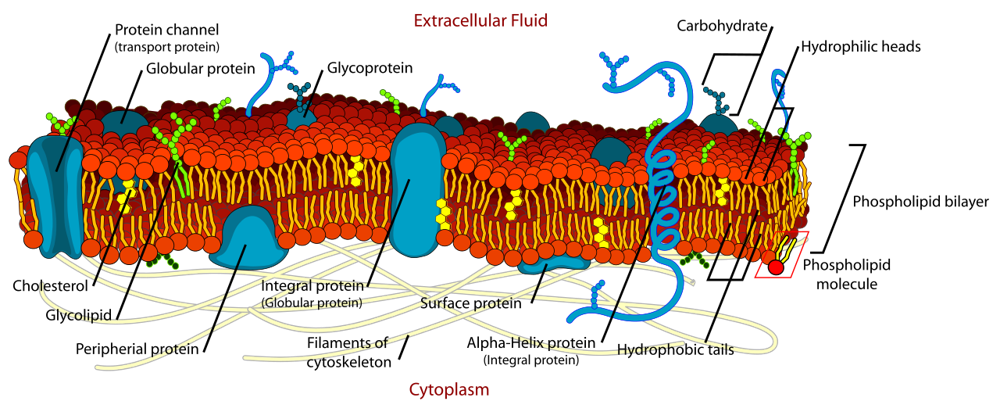
Toda célula, incluida la neurona, está envuelta en una membrana celular, cuya composición resulta crucial para lo que sigue. La membrana es una bicapa fosfolipídica, es decir, dos capas de moléculas grasas. Cada fosfolípido posee una “cabeza” hidrófila y dos “colas” grasas hidrófobas; estas se alinean cola con cola formando dos capas, con las cabezas orientadas hacia el líquido acuoso del interior y exterior de la célula, mientras que las colas grasas quedan en el centro. Esta fina película grasa constituye la barrera que separa el interior del exterior, y puede mantener una carga eléctrica a través de sí misma. Los “canales” y “bombas” que se describen en la siguiente sección no son más que puertas proteicas situadas en dicha membrana grasa.
El cableado: axones, mielina y nodos de Ranvier
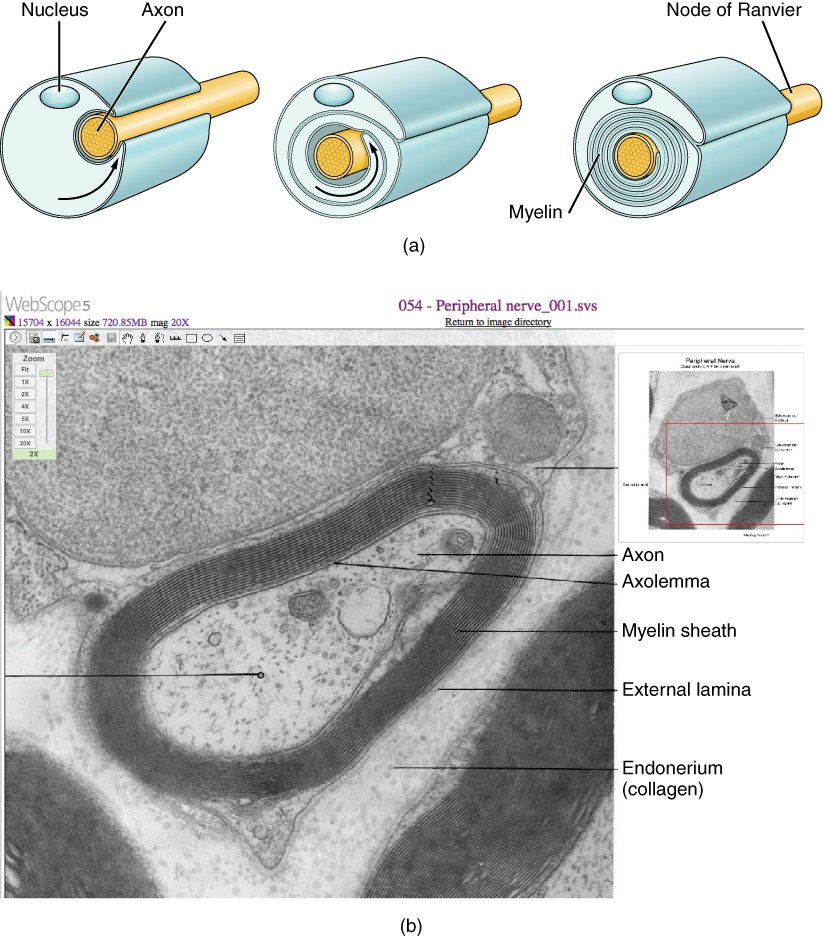
Una única fibra nerviosa se compone de un axón, una prolongación larga y filamentosa de la célula nerviosa que transmite la señal eléctrica. Muchos axones están envueltos en mielina, una cubierta aislante grasa; vale la pena saber qué es exactamente la mielina. Una célula de soporte (una célula de Schwann en los nervios periféricos del brazo) enrolla su propia membrana celular alrededor del axón, una y otra vez, como si se envolviera un lápiz con film transparente docenas de veces. Dado que esa membrana es una bicapa fosfolipídica (básicamente grasa), cada vuelta añade otra capa de grasa; las numerosas capas superpuestas forman un grueso revestimiento graso. Ese revestimiento de membrana enrollada es el aislante: la mielina está compuesta mayormente de grasa porque es, en esencia, capa tras capa de membrana celular. Cuantas más vueltas dé la célula de Schwann, mejor será el aislamiento y mayor la velocidad de la fibra.
No obstante, la cubierta de mielina no es continua; se forma por segmentos, dejando entre ellos pequeños espacios desnudos llamados nodos de Ranvier. La señal eléctrica no puede escapar a través de las zonas aisladas, por lo que prácticamente salta de un nodo al siguiente. Esto se conoce como conducción saltatoria (del latín saltare, “saltar”); es la razón por la cual las fibras mielinizadas son tan rápidas: al saltar de nodo en nodo, la señal puede propagarse a velocidades superiores a 100 metros por segundo, frente a menos de 10 metros por segundo en una fibra desnuda y no mielinizada. También por eso las enfermedades o lesiones que destruyen la mielina ralentizan drásticamente la conducción nerviosa.
Cómo se propaga la señal
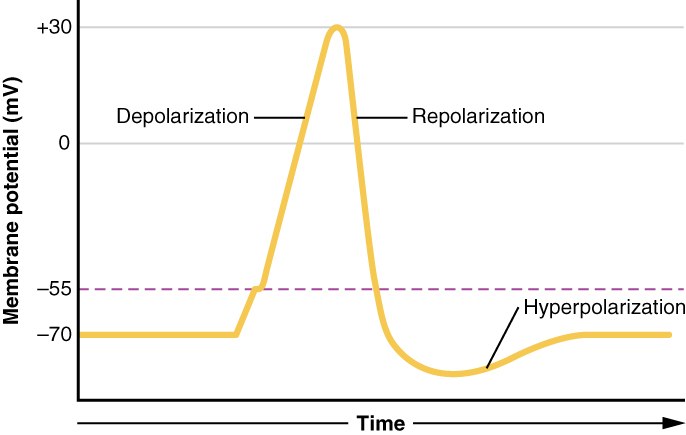
En reposo, el interior de un axón presenta una carga ligeramente negativa en comparación con el exterior: el potencial de membrana en reposo, de aproximadamente −70 milivoltios. Esta carga se mantiene gracias a que los iones de sodio permanecen mayormente fuera de la célula y los iones de potasio, mayormente dentro de ella.
Cuando el nervio se activa, se produce una secuencia precisa:
- Despolarización. Los canales de sodio dependientes del voltaje se abren repentinamente, permitiendo que los iones de sodio entren en masa. El interior del axón se vuelve rápidamente positivo, alcanzando un pico de alrededor de +30 milivoltios; esto constituye el potencial de acción.
- Repolarización. Los canales de sodio se cierran y se abren los canales de potasio dependientes del voltaje, permitiendo que el potasio salga de la célula. El interior vuelve gradualmente a su valor negativo de reposo.
- Período refractario (latente). Inmediatamente después, esa zona de la membrana no puede volver a dispararse, por fuerte que sea el estímulo, mientras los canales se reajustan.
Este período refractario cumple una función crucial: como la porción de membrana situada justo detrás de la señal no puede volver a activarse temporalmente, el potencial de acción solo puede propagarse hacia adelante. Por eso las señales nerviosas se transmiten en una sola dirección a lo largo de la fibra, sin rebotar hacia atrás.
Cruzar la hendidura: sinapsis y placa motora
Una fibra nerviosa no entra en contacto físico con el músculo que controla. En el punto donde el nervio motor se une al músculo existe una unión especializada, la unión neuromuscular, en la que hay un espacio diminuto (la hendidura sináptica) entre la terminación nerviosa y una zona engrosada y plegada de la membrana muscular llamada placa motora.
La señal eléctrica no puede atravesar ese espacio directamente; por eso se convierte en una señal química. Cuando el potencial de acción llega a la terminación nerviosa, provoca la liberación de un neurotransmisor llamado acetilcolina en la hendidura sináptica. La acetilcolina se difunde hasta la placa motora y se une a sus receptores, abriendo canales que permiten la despolarización de la membrana muscular. Si dicha despolarización alcanza el umbral necesario, se genera un potencial de acción que recorre el músculo y provoca su contracción. A continuación, una enzima (la acetilcolinesterasa) descompone rápidamente la acetilcolina, de modo que cada impulso nervioso genera una sola contracción breve en lugar de una contracción prolongada. Este mecanismo de transmisión química es el objetivo de ciertos fármacos anestésicos y de enfermedades como la miastenia gravis.
Percibiendo el mundo: receptores sensoriales
El proceso sensorial funciona a la inversa: terminaciones especializadas convierten un estímulo físico en señales nerviosas. Existen distintos receptores adaptados a diferentes tipos de estímulos:
- Cuerpos de Pacini: se encuentran en las capas profundas de la piel y responden a la presión profunda y a las vibraciones de alta frecuencia. Se adaptan rápidamente, disparando señales en el momento en que algo cambia, pero no de forma continua.
- Cuerpos de Meissner: se ubican justo debajo de la superficie de la piel de las yemas de los dedos y las palmas; detectan el tacto ligero y las vibraciones de baja frecuencia. Son esenciales para el tacto fino y discriminativo que nos permite percibir texturas y manipular objetos pequeños.
- Terminaciones nerviosas libres: son terminaciones desnudas y sin envoltura que detectan el dolor, la temperatura y el tacto ligero. Son las terminaciones más numerosas en la piel.
- Fusos musculares: se encuentran dentro de los propios músculos y detectan el estiramiento y la longitud muscular, enviando información sobre la posición y el movimiento (propiocepción); gracias a ellos el cerebro sabe dónde está la mano sin necesidad de mirarla.
Las distintas sensaciones que percibimos (una punción, el calor, el zumbido de un teléfono, la posición de la muñeca) dependen en gran medida de qué receptores se activan y a qué velocidad lo hacen.
Grados de lesión nerviosa
Los cirujanos clasifican la lesión nerviosa según la profundidad del daño, ya que eso determina cómo y si el nervio se recuperará. Se utilizan conjuntamente dos sistemas de clasificación.
El sistema más antiguo y sencillo, el sistema Seddon, cuenta con tres categorías:
- Neurapraxia: es el grado más leve. Las fibras nerviosas quedan contusionadas o su revestimiento se daña localmente, pero los axones permanecen intactos. La conducción nerviosa se bloquea en ese punto, como si la manguera estuviera doblada, aunque la estructura general se mantiene íntegra. Por lo general, la recuperación es total y relativamente rápida una vez que se elimina la causa del daño.
- Axonotmesis: en este caso los axones se rompen, pero los conductos de tejido conectivo que los rodean permanecen intactos. Las fibras situadas más allá de la lesión degeneran y deben regenerarse; por eso la recuperación es lenta. No obstante, los conductos conservados sirven de guía para el crecimiento de las nuevas fibras, por lo que el pronóstico suele ser favorable.
- Neurotmesis: es el grado más grave. El nervio, incluyendo toda su estructura de soporte, queda completamente seccionado. No se recupera por sí solo; se requiere reparación quirúrgica, y aun así la recuperación es incompleta.
El sistema más detallado, el sistema Sunderland, divide las lesiones en cinco grados, que se corresponden con el sistema Seddon de la siguiente manera:
- Grado 1 = neurapraxia (solo bloqueo de la conducción).
- Grado 2 = axonotmesis en el que el conducto más interno (endoneuro) permanece intacto, lo que ofrece las mejores perspectivas de regeneración.
- Grado 3 = el conducto interno también se daña, por lo que las fibras en regeneración pueden dirigirse erróneamente; la recuperación es parcial.
- Grado 4 = solo queda intacto el revestimiento externo (epineuro); normalmente una cicatriz bloquea la regeneración, por lo que se requiere intervención quirúrgica para lograr una recuperación útil.
- Grado 5 = sección completa de todo el nervio, equivalente a la neurotmesis según el sistema Seddon; también requiere reparación quirúrgica.
En resumen: cuantas más capas del nervio se dañen, más lenta y menos completa será la recuperación espontánea, y mayor será la necesidad de intervención quirúrgica.
Degeneración walleriana y regeneración
Cuando un axón se corta o se rompe, la porción situada más allá de la lesión queda desconectada de la célula que lo mantiene vivo. En los días siguientes, esta porción se descompone mediante un proceso ordenado y programado llamado degeneración de Waller: el axón aislado y su mielina son desmontados y eliminados por las células de Schwann y los macrófagos, que son células inmunitarias reclutadas.
Esto no es simplemente una destrucción; es una preparación. Las células de Schwann que revestían la fibra nerviosa original sobreviven, se multiplican y se alinean formando columnas huecas denominadas bandas de Büngner, siguiendo la trayectoria original del nervio. Estas columnas actúan como verdaderos andamios vivos: liberan factores de crecimiento y guían físicamente a las fibras en regeneración de vuelta hacia sus destinos.
Desde el lugar de la lesión, el extremo superviviente de cada axón emite un cono de crecimiento que avanza a lo largo del tubo formado por las células de Schwann a una velocidad aproximada de un milímetro por día, hasta alcanzar la piel o el músculo y reconectarse (reinnervación). Por eso es tan importante realizar una reparación limpia, temprana y precisa: los tubos seccionados deben alinearse correctamente para que las fibras vuelvan a entrar en los canales adecuados; además, las células de Schwann brindan mayor apoyo durante los meses inmediatamente posteriores a la lesión; en cierto modo, tienen una “fecha de caducidad”. Si se alinean bien los extremos y se actúa a tiempo, muchas más fibras lograrán regresar a su destino.
Véase también
- Pruebas nerviosas y estudios de conducción — cómo medimos si un nervio conduce señales de forma normal
- Síndrome del túnel carpiano y compresión nerviosa — un problema frecuente de compresión nerviosa en la muñeca
- Reparación de tendones y nervios — en qué consiste la cirugía para reparar un nervio o tendón seccionado