Patients › Elbow
Bursitis del olécrano
Olecranon bursitis — causes, symptoms, and when to seek urgent medical attention for infection.
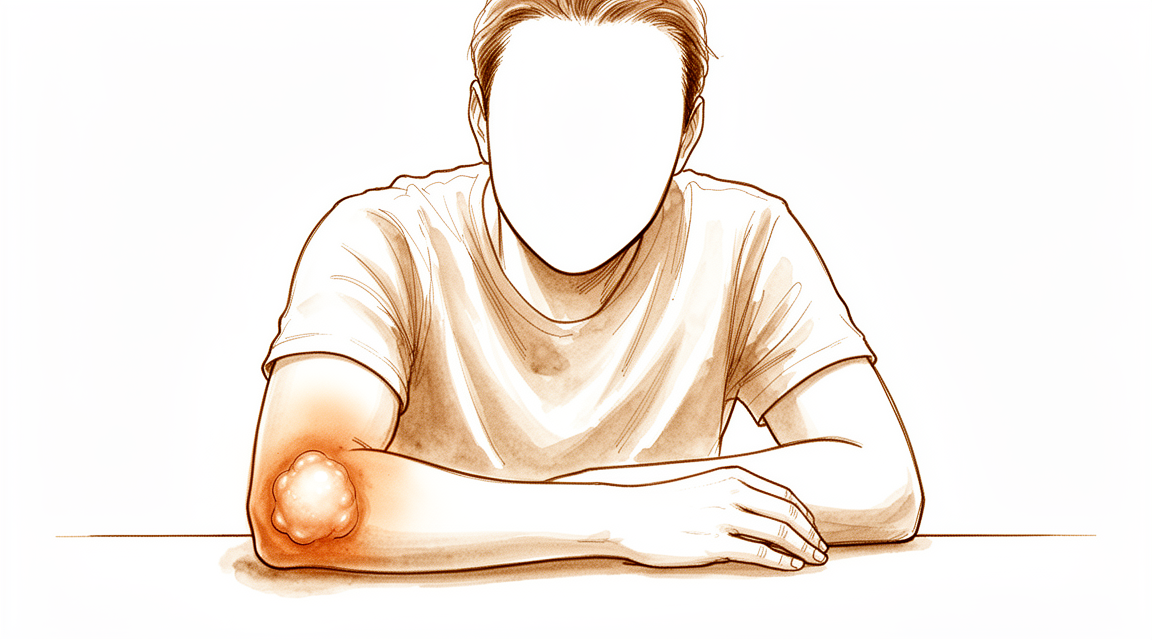
Qué está sintiendo
La bursitis olecraniana significa que la pequeña bolsa amortiguadora situada en la punta del codo se ha inflamado. Esa bolsa, llamada bursa, normalmente permite que la piel se deslice suavemente sobre el hueso. Cuando se inflama, se nota un bulto blando, a veces sensible, justo en la punta del codo.
Por lo general, la hinchazón es lo primero que se observa. Puede aparecer rápidamente en uno o dos días, o de forma gradual a lo largo de varias semanas. Apoyar el codo empeora la situación; por eso, trabajar frente a un escritorio, apoyar el brazo en el brazo de una silla o dormir con el codo doblado pueden agravarla. Muchas personas sienten dolor nocturno, especialmente si duermen sobre ese lado. Estirar el brazo y quitar presión de la punta del codo suele aliviarlo.
Las tareas cotidianas que requieren doblar el codo contra resistencia o ejercer presión sobre su punta resultan incómodas. Levantarse de una silla baja, cargar el lavavajillas, llevar bolsas de la compra apoyándolas en el antebrazo o apoyar el codo en una mesa mientras se lee pueden resultar molestos. Estirar el brazo por encima de la cabeza también puede tirar de la zona inflamada.
La hinchazón no siempre se debe simplemente al desgaste normal. A veces es consecuencia de una infección en la bolsa, que suele hacer que la piel del codo se enrojezca, se caliente y duela más. En otras ocasiones se debe a la presencia de cristales en la articulación, una afección llamada gota; esto ocurre especialmente si ya ha tenido ataques similares o si el otro codo también está afectado. La hinchazón en este lugar también puede estar relacionada con enfermedades articulares inflamatorias como la artritis reumatoide, que suele afectar varias articulaciones en ambos lados del cuerpo al mismo tiempo.
Dado que estas causas pueden presentarse de forma similar, no siempre es fácil distinguirlas a simple vista. Si el codo está caliente, enrojecido o muy doloroso, o si la hinchazón persiste durante semanas sin mejorar, conviene someterse a una evaluación adecuada para iniciar el tratamiento correcto.
¿Qué está ocurriendo realmente?
En la punta del codo hay una pequeña bolsa de líquido llamada bursa. Puedes imaginarla como un cojín delgado, una especie de bolsillo acolchado entre la piel y el hueso. Su función es permitir que la piel se deslice suavemente sobre el hueso cada vez que doblas o estiras el brazo.
En el caso de la bursitis olecraniana, ese “cojín” se inflama y se llena de líquido adicional. Esto suele ocurrir tras pequeños golpes o presión repetida en la punta del codo, como cuando se apoya el brazo sobre superficies duras día tras día. Con el tiempo, la bolsa también puede agrandarse debido a la fricción. El bulto que puedes ver y palpar es precisamente la bolsa inflamada; la sensibilidad al tacto se debe al tejido inflamado que la rodea.
En ocasiones, la hinchazón no es solo resultado de una irritación. La bolsa puede infectarse; por eso una bursa infectada suele estar caliente, enrojecida y más dolorosa que una simplemente inflamada. Los cristales de la gota pueden acumularse en la bolsa, y enfermedades inflamatorias como la artritis reumatoide también provocan hinchazón y pequeños bultos duros en esa zona. Dado que estas causas presentan síntomas muy similares a simple vista, distinguirlas requiere un examen médico adecuado.
El hueso situado en la punta del codo, llamado olécranon, se encuentra justo debajo de la piel con muy poco tejido protector alrededor. Esta posición expuesta explica por qué recibe tantos golpes y por qué la bursa que lo cubre soporta gran parte del desgaste. Ese mismo hueso sirve de anclaje para el tendón del músculo situado en la parte posterior del brazo, el encargado de estirar el codo; por eso los problemas en esta zona pueden afectar tanto la sensibilidad como el movimiento del codo en su conjunto.
Qué podemos hacer al respecto
El Dr. Kieran Hirpara, cirujano de miembro superior en el Mater Private Hospital Rockhampton, comienza con las opciones menos invasivas que se adapten a su condición. Por lo general, los pacientes son derivados a nuestra clínica por su médico de cabecera; si un fisioterapeuta le ha sugerido que nos consulte, igualmente necesitará una derivación de su médico de cabecera para poder acceder al reembolso de Medicare. En su primera visita, tomamos su historia clínica, examinamos su codo y, si es necesario, solicitamos estudios por imagen como ecografías o resonancias magnéticas. La resonancia magnética utiliza imanes para generar imágenes detalladas de los tejidos blandos; es muy útil para determinar cuán inflamado está el saco y cuánto líquido contiene. Los estudios por imagen también pueden detectar otros problemas ocultos detrás de la hinchazón, lo cual es importante, pues distintas causas requieren tratamientos distintos.
En la mayoría de los casos crónicos, iniciamos con un tratamiento de soporte sencillo: aplicación de hielo, compresión mediante vendaje o manga elástica, colocación de almohadillas protectoras sobre la zona del codo y modificación de las actividades que lo irritan. Reducir la presión sobre la punta del codo suele ser el cambio más beneficioso que puede hacerse. La fisioterapia busca calmar la irritación y recuperar un movimiento cómodo sin provocar más hinchazón. Le damos una oportunidad razonable a este enfoque antes de considerar cualquier otra medida, ya que el tratamiento no quirúrgico funciona bien para la mayoría de los pacientes y evita los riesgos asociados a inyecciones o cirugía.
Si el saco está infectado, tratamos directamente dicha infección. En la mayoría de los casos, la infección no complicada de este saco se resuelve únicamente con medicación, sin necesidad de extirparlo. También vigilamos de cerca a los pacientes con artritis reumatoide, pues en ocasiones la articulación del codo se ve afectada al mismo tiempo que el saco bursal, lo cual modifica el tratamiento a seguir.
La cirugía no es nuestra primera opción para esta afección. La mayoría de los cirujanos evitan operar en etapas tempranas, ya que una herida en esa zona ósea tan prominente suele cicatrizar lentamente y, en algunos casos, deja un seno, es decir, un pequeño conducto que sigue drenando líquido. Cuando el tratamiento no quirúrgico no produce mejoría suficiente y la hinchazón persiste, consideramos extirpar el saco inflamado; esta intervención se denomina bursectomía. Cuando resulta adecuado, podemos realizarla mediante unas pocas incisiones pequeñas y el uso de una cámara diminuta, técnica conocida como cirugía endoscópica. Así se evita una cicatriz larga justo sobre la zona sensible del codo. Decidir si la cirugía es la opción adecuada para usted es una decisión que tomamos en conjunto, sopesando lo que usted desea recuperar frente a las implicaciones de cada alternativa.
Qué esperar
En la mayoría de las personas, esta hinchazón disminuye con cuidados sencillos. Al reducir la presión sobre el codo, protegerlo con almohadillas y disminuir las actividades que lo irritan, se le da al saco sinovial la oportunidad de calmarse. En general, el tratamiento no quirúrgico es más eficaz y seguro que la cirugía para esta afección; la mayoría de las personas nunca necesitan operarse. Si el saco está infectado pero la infección es leve, el tratamiento con medicamentos suele ser suficiente, y la hinchazón a menudo se controla sin necesidad de drenarla ni extirpar el saco.
Sin esos cuidados, o si persisten las mismas presiones, la hinchazón tiende a mantenerse o reaparecer. En algunas personas, esta condición se prolonga durante semanas sin mejorar. Si el codo permanece hinchado durante mucho tiempo, merece ser reevaluado, pues una hinchazón persistente puede indicar una causa menos común que requiera tratamiento específico.
Cuando los cuidados no quirúrgicos se han aplicado adecuadamente pero la hinchazón sigue reapareciendo, la cirugía para extirpar el saco inflamado se convierte en una opción. Esta decisión no se toma a la ligera; normalmente se posterga hasta que los métodos más sencillos hayan fracasado. En los casos en que se realiza la cirugía para este tipo de hinchazón persistente, la mayoría de los pacientes experimentan una mejora notable en la sensación y funcionalidad del codo. La extirpación del saco mediante unas pocas incisiones pequeñas y el uso de una cámara diminuta se ha asociado con poco dolor postoperatorio y una recuperación rápida; en los casos reportados no hubo recurrencias ni complicaciones en la cicatrización que exigieran una nueva intervención. No obstante, la cirugía no es infalible: alrededor del 11,5 % de los pacientes a quienes se extirpa el saco necesitan una operación adicional posteriormente. También existe una pequeña probabilidad de que la hinchazón reaparezca incluso tras la cirugía.
La recuperación tras la intervención suele ser sencilla; sin embargo, la cicatrización de una herida en esa zona ósea puede ser lenta, motivo por el cual los cirujanos prefieren evitar operar en etapas tempranas. La mayoría de las personas vuelven a usar el codo con normalidad en cuestión de semanas, no meses. Su cirujano le explicará cómo sería su recuperación en caso de que la cirugía llegara a ser necesaria.
¿Cuándo consultar a un médico?
La mayoría de las hinchazones en la zona del codo mejoran con reposo y cuidados básicos. Consulte a su médico de cabecera si el bulto sigue creciendo, o si no disminuye tras varias semanas de evitar presión sobre el codo.
Algunas causas requieren atención inmediata. Acuda a urgencias si la piel sobre el codo está caliente, roja y muy dolorosa, ya que eso podría indicar una infección del quiste; en tal caso, se requiere evaluación el mismo día. Solicite una valoración especializada si ha tenido ataques de gota previamente, si el otro codo también está hinchado, o si varias articulaciones de ambos lados del cuerpo se ven afectadas; estos síntomas apuntan a gota o a una enfermedad inflamatoria como la artritis reumatoide, en lugar de una simple irritación. Resulta difícil distinguir una infección de un ataque de gota solo por la apariencia externa, por lo que no intente diagnosticarlo usted mismo.
En profundidad
Advanced reading: the deeper science (optional)
Esta sección va más allá de lo necesario para que usted tome sus propias decisiones terapéuticas. La bursitis olecraniana merece una lectura adicional, ya que existen evidencias que desaconsejan dos de las medidas que, por instinto, se suelen tomar: drenar la hinchazón con una aguja e inyectar esteroides en la zona.
El drenaje puede ser precisamente lo que genera el problema
La intuición nos dice: hay líquido, así que hay que extraerlo. Sin embargo, los datos de los estudios indican lo contrario.
En una comparación de estrategias de tratamiento para la bursitis séptica no complicada del olécrano, el tratamiento empírico sin aspiración resultó eficaz; ningún paciente necesitó bursectomía. En cambio, en el grupo que recibió aspiración tradicional, 8 de cada 11 pacientes terminaron precisando la extirpación quirúrgica de la bursa [1].
Se trata de una diferencia notable, aunque se basa en un número reducido de casos; por ello debe interpretarse con cautela. No obstante, el mecanismo no es complicado de entender: la bursa se encuentra justo debajo de una piel delgada, sobre un punto óseo que recibe todo tipo de golpes y presiones al apoyarse en un escritorio. Al introducir una aguja a través de esa piel se crea un canal; y un canal situado en un punto de presión tarda en cerrarse y puede seguir filtrando líquido.
Las revisiones generales coinciden en esta dirección: basándose principalmente en evidencia de nivel IV, el tratamiento no quirúrgico es significativamente más eficaz y seguro que el tratamiento quirúrgico [2].
La inyección de esteroides conlleva riesgos sin mejorar el resultado
Esto se plantea de forma bastante clara en la literatura médica. En el caso de la bursitis aséptica, la inyección de corticoides está asociada a riesgos significativos sin mejorar el resultado [2].
Estos riesgos son específicos del lugar de aplicación: atrofia cutánea y despigmentación sobre una protuberancia ósea subcutánea, así como infecciones que pueden aparecer en una zona difícil de desinfectar. En otras zonas del miembro superior, la inyección de esteroides resulta una medida razonable cuando otros tratamientos más sencillos no surten efecto. No obstante, en este caso la evidencia no respalda su uso; es importante conocer esta diferencia si se plantea como opción terapéutica.
La cirugía es realmente un último recurso, con una tasa de fracaso medible
En los casos en que se realiza una bursectomía, esta no siempre resuelve el problema. La tasa de revisión tras la bursectomía fue del 11,5%, siendo esta más frecuente en pacientes con artritis reumatoide, diabetes, antecedentes de bursitis en cualquiera de los codos y en mujeres [3].
Estos factores de riesgo describen las situaciones en las que es probable que la bursa se vuelva a formar: un factor inflamatorio o metabólico que la cirugía no elimina, o una tendencia demostrada del tejido de ese individuo a generar el problema. En casos recurrentes, la escleroterapia con doxiciclina intrabursal —que consiste en provocar cicatrización del espacio bursal en lugar de extirparlo— se ha descrito como una alternativa en una serie de 45 codos [4].
¿Qué es lo que realmente resuelve el problema?
La respuesta poco glamurosa es la protección y el tiempo. Dado que la bursa se irrita mecánicamente por la presión ejercida sobre la punta del codo, el tratamiento que aborda la causa consiste en eliminar dicha presión: usar almohadillas y modificar el hábito de apoyarse en el codo, durante un período más largo de lo que parece necesario. La mayoría de los casos se resuelven [5]; las intervenciones mencionadas anteriormente son, en gran medida, intentos de acortar un proceso que de todas formas termina por resolverse. Precisamente por eso, cualquier intervención que conlleve sus propios riesgos debe cumplir con requisitos muy estrictos en este contexto.
Referencias
[1] Deal JB, Vaslow AS, Bickley RJ, Verwiebe EG, Ryan PM. Tratamiento empírico de la bursitis séptica no complicada del olécrano sin aspiración. J Hand Surg Am. 2020;45(1):20-5. https://doi.org/10.1016/j.jhsa.2019.06.012
[2] Sayegh ET, Strauch RJ. Tratamiento de la bursitis del olécrano: una revisión sistemática. Arch Orthop Trauma Surg. 2014;134(11):1517-36. https://doi.org/10.1007/s00402-014-2088-3
[3] Germawi L, Westenberg RF, Wang F, Schep NW, Chen NC, Eberlin KR. Factores asociados con la cirugía de revisión por bursitis del olécrano tras bursectomía. J Shoulder Elbow Surg. 2021;30(5):1135-41. https://doi.org/10.1016/j.jse.2020.09.033
[4] McDermott D, Wakefield D, Kowalsky M, Sethi P, Vitale MA, Morrey BF. Escleroterapia con doxiciclina intrabursal para la bursitis recurrente del olécrano. J Hand Surg Glob Online. 2024;6(4):504-9. https://doi.org/10.1016/j.jhsg.2024.03.006
[5] Nchinda NN, Wolf JM. Manejo clínico de la bursitis del olécrano: una revisión. J Hand Surg Am. 2021;46(6):501-6. https://doi.org/10.1016/j.jhsa.2021.02.006
Evidence & references
This is the clinical evidence summary written for health professionals. It is technical, and it lists the research this page was built from. You do not need to read it to understand your treatment or to make a decision about it.
Overview
- Surgical resection of a chronic olecranon bursitis should not be considered lightly [1].
- The revision rate after bursectomy for olecranon bursitis was 11.5% [2].
- The operation appears to give satisfactory results for chronic olecranon bursitis [3].
- Based primarily on level IV evidence, nonsurgical management of olecranon bursitis is significantly more effective and safer than surgical management [4].
- Nontuberculous mycobacterial olecranon bursitis should be considered in any patient with a swollen bursa and protracted course, regardless of immune status [5].
- Patients who underwent endoscopic olecranon bursectomy experienced no recurrences or wound-healing complications necessitating return to the operating room [6].
- Empirical management of uncomplicated septic olecranon bursitis was found to be effective with no patients requiring bursectomy [7].
- In the traditional aspiration group for uncomplicated septic olecranon bursitis, 8 of 11 patients required bursectomy [7].
- Intrabursal doxycycline sclerotherapy may be an effective alternative to surgical bursectomy for patients with recurrent olecranon bursitis refractory to conservative management [8].
- Patients with refractory olecranon bursitis, particularly if aseptic, tend to gain significant physical health benefits from open bursectomy [9].
- Endoscopic bursectomies are a useful treatment option for patients with recalcitrant olecranon bursitis [10].
- Bursal suture repair is a viable alternative to bursectomy in selected patients with chronic traumatic olecranon bursitis [11].
- Bursal suture repair combines functional and cosmetic benefits in selected patients with chronic traumatic olecranon bursitis [11].
- Deferring aspiration in uncomplicated septic olecranon bursitis is a reasonable treatment option [16].
Anatomy & Pathophysiology
Bony Anatomy
- The olecranon and the coronoid process form the greater sigmoid notch, which articulates with the trochlea of the distal humerus [19].
- The intrinsic anatomy of the greater sigmoid notch allows flexion/extension movement of the elbow joint and provides stability for the elbow [19].
- The olecranon serves as the insertion for the triceps tendon, which blends with the periosteum of the proximal ulna [19].
- The exposed position of the olecranon renders it vulnerable to direct trauma and violent muscular contractions from the triceps [19].
- In children, the olecranon is predominantly cartilage, particularly in younger children, which reduces the chance of fracture occurring with a direct blow [20].
- The thick periosteum and relatively thin metaphyseal cortex of the olecranon in children predispose it to minimally displaced greenstick fractures [20].
Pathophysiology
- Olecranon bursitis is a condition where the bursal cavity, superficial to the olecranon, becomes inflamed [13].
- Olecranon bursitis can occur with or without infection [13].
- Olecranon bursitis is often predisposed by repeated minor trauma from external pressure [13].
- The olecranon bursa sometimes becomes enlarged as a result of pressure or friction [27].
- When the olecranon bursa is painful, the cause is more likely to be infection, gout, or rheumatoid arthritis [27].
- Gout is suspected in olecranon bursitis if there is a history of previous attacks, if the condition is bilateral, if there are tophi, or if X-ray shows calcification in the bursa [27].
- Rheumatoid arthritis causes both swelling and nodularity over the olecranon [27].
- In almost all cases of rheumatoid arthritis affecting the olecranon, it is associated with a typical symmetrical polyarthritis [27].
- In the late stages of rheumatoid arthritis, erosion of the elbow joint may cause marked instability [27].
Classification
- Olecranon bursitis has been given pseudonyms relating to the repeated minor trauma from external pressure that often predisposes [13].
- Traumatic lesions of the olecranon bursa are common injuries associated with a high risk of complications [14].
Clinical Presentation
- Olecranon bursitis is a common condition where the bursal cavity, superficial to the olecranon, becomes inflamed [13].
- Olecranon bursitis can occur either with or without infection [13].
- Due to multiple aetiologies, olecranon bursitis can present to any medical specialty with reasonable frequency [13].
- When the olecranon bursa is also painful, the cause is more likely to be infection, gout, or rheumatoid arthritis [27].
- Gout is suspected if there is a history of previous attacks, if the condition is bilateral, if there are tophi, or if X-ray shows calcification in the bursa [27].
- In almost all cases of rheumatoid arthritis-associated olecranon bursitis, the condition is associated with a typical symmetrical polyarthritis [27].
- Pyoderma gangrenosum must be considered in the differential diagnosis whenever a patient presents with ulcerative cutaneous lesions that resemble an infectious process such as olecranon bursitis [38].
Investigations
- MR imaging is probably the method of choice for determining both the development of the bursae and their fluid content [44].
Treatment
Non-Operative Management
- The first treatment line for olecranon bursitis is conservative, including ice, rest, anti-inflammatory and analgesic drugs and, occasionally, bursal fluid aspiration [25].
- More recent literature demonstrates adverse effects of intrabursal injections and surgery compared with noninvasive management for initial treatment of nonseptic olecranon bursitis [18].
- Hydrothermal ablation at temperatures between 50C and 52C is a safe treatment option for recurrent or chronic olecranon bursitis [34].
- Hydrothermal ablation for recurrent or chronic olecranon bursitis has fewer complications than open bursectomy and comparable efficacy [34].
Operative Management
- Open bursectomy appears to give satisfactory results for chronic olecranon bursitis [3].
- Endoscopic olecranon bursectomy provides a satisfactory view with less morbidity than the open method while avoiding a wound over the sensitive point of the olecranon [15].
- Bursal suture repair is a viable alternative to bursectomy in selected patients with chronic traumatic olecranon bursitis, combining functional and cosmetic benefits [11].
- Excision has been curative for all lesions of the olecranon bursa, whereas multiple medications have been tried for cutaneous and systemic infections without clear-cut success [17].
Surgical Complications and Outcomes
- More recent literature demonstrates adverse effects of surgery compared with noninvasive management for initial treatment of nonseptic olecranon bursitis [18].
- Surgeons are reluctant to perform surgical excision as first-line treatment for chronic olecranon bursitis due to the fear of causing a chronic draining sinus or infection [45].
Infection and Atypical Etiologies
Recovery
- Nonsurgical management of olecranon bursitis is significantly more effective and safer than surgical management [4].
- 8 of 11 patients in the traditional aspiration group required bursectomy [7].
- Bursal suture repair combines functional and cosmetic benefits [11].
- The extrabursal endoscopic approach provides a satisfactory view with less morbidity than the open method [15].
- The extrabursal endoscopic approach avoids a wound over the sensitive point of the olecranon [15].
- Excision has been curative for all lesions of the olecranon bursa [17].
- Multiple medications have been tried for cutaneous and systemic infections without clear-cut success [17].
Key Evidence
- [L3] The revision rate after bursectomy for olecranon bursitis was 11.5%. [2] (10.1016/j.jse.2020.09.033)
- [L4] The operation appears to give satisfactory results for chronic olecranon bursitis. [3] (10.1016/s0020-1383(77)80050-8)
- [L4] Based primarily on level IV evidence, nonsurgical management of olecranon bursitis is significantly more effective and safer than surgical management. [4] (10.1007/s00402-014-2088-3)
- [L4] Nontuberculous mycobacterial olecranon bursitis should be considered in any patient with a swollen bursa and protracted course, regardless of immune status. [5] (10.1016/j.jse.2008.07.009)
- [L4] In this population, patients who underwent endoscopic olecranon bursectomy experienced no recurrences or wound-healing complications necessitating return to the operating room. [6] (10.1016/j.asmr.2023.100832)
- [L4] Empirical management of uncomplicated septic olecranon bursitis was found to be effective with no patients requiring bursectomy, whereas 8 of 11 patients in the traditional aspiration group required bursectomy. [7] (10.1016/j.jhsa.2019.06.012)
- [L4] This may be an effective alternative to surgical bursectomy for patients with recurrent olecranon bursitis refractory to conservative management. [8] (10.1016/j.jhsg.2024.03.006)
- [L4] Patients with refractory olecranon bursitis, particularly if aseptic, tend to gain significant physical health benefits from open bursectomy. [9] (10.7759/cureus.43696)
- [L5] Endoscopic bursectomies are a useful treatment option for patients with recalcitrant olecranon bursitis. [10] (10.1016/j.eats.2023.09.004)
- [L5] Bursal suture repair is a viable alternative to bursectomy in selected patients with chronic traumatic olecranon bursitis, combining functional and cosmetic benefits. [11] (10.1016/j.xrrt.2025.100597)
- [L4] [13] (10.1177/1758573214532787)
- [Paper] Traumatic lesions of the olecranon bursa or prepatellar bursa are common injuries associated with a high risk of complications. [14] (10.1007/s00402-017-2690-2)
- [L4] This approach provides a satisfactory view with less morbidity than the open method while avoiding a wound over the sensitive point of the olecranon. [15] (10.1097/bth.0b013e31829c0535)
- [L4] Deferring aspiration in uncomplicated septic olecranon bursitis is a reasonable treatment option. [16] (10.1016/j.jhsa.2018.06.059)
- [Case_report] Excision has been curative for all lesions of the olecranon bursa, whereas multiple medications have been tried for cutaneous and systemic infections without clear-cut success. [17] (10.2106/00004623-198062050-00024)
- [L5] Older studies showed resolution with injections and surgery, but more recent literature demonstrates adverse effects of intrabursal injections and surgery compared with noninvasive management for initial treatment of nonseptic olecranon bursitis. [18] (10.1016/j.jhsa.2021.02.006)
- [L4] The first treatment line for olecranon bursitis is conservative, including ice, rest, anti-inflammatory and analgesic drugs and, occasionally, bursal fluid aspiration. [25] (10.1016/j.surge.2012.02.002)
- [L4] Hydrothermal ablation at temperatures between 50C and 52C is a safe treatment option for recurrent or chronic olecranon bursitis with fewer complications than open bursectomy and a comparable efficacy. [34] (10.1016/j.jse.2024.03.021)
- [Case_report] PG must be considered in the differential diagnosis whenever a patient presents with ulcerative cutaneous lesions that resemble an infectious process such as olecranon bursitis. [38] (10.1016/j.jse.2014.06.032)
- [L4] MR imaging is probably the method of choice for determining both the development of the bursae and their fluid content. [44] (10.1007/s002560050117)
- [L3] [45] (10.1016/j.jhsa.2010.12.030)
References
[1] Complications following resection of the olecranon bursa. Acta Orthopaedica Belgica. 2006.
[2] Factors associated with revision surgery for olecranon bursitis after bursectomy. Journal of Shoulder and Elbow Surgery. 2021. DOI: 10.1016/j.jse.2020.09.033
[3] A useful procedure in the treatment of chronic olecranon bursitis. Injury. 1977. DOI: 10.1016/s0020-1383(77)80050-8
[4] Treatment of olecranon bursitis: a systematic review. Archives of Orthopaedic and Trauma Surgery. 2014. DOI: 10.1007/s00402-014-2088-3
[5] Nontuberculous mycobacterial olecranon bursitis: Case reports and literature review. Journal of Shoulder and Elbow Surgery. 2009. DOI: 10.1016/j.jse.2008.07.009
[6] No Wound Healing Complications or Recurrences Were Seen and a High Level of Satisfaction Was Reported in Patients Who Underwent Endoscopic Olecranon Bursectomy for Recalcitrant Olecranon Bursitis. Arthroscopy, Sports Medicine, and Rehabilitation. 2024. DOI: 10.1016/j.asmr.2023.100832
[7] Empirical Treatment of Uncomplicated Septic Olecranon Bursitis Without Aspiration. The Journal of Hand Surgery. 2020. DOI: 10.1016/j.jhsa.2019.06.012
[8] Intrabursal Doxycycline Sclerotherapy for Recurrent Olecranon Bursitis of the Elbow: A Case Control Study. Journal of Hand Surgery Global Online. 2024. DOI: 10.1016/j.jhsg.2024.03.006
[9] Clinical Outcomes Following Open Olecranon Bursa Excision for Septic and Aseptic Olecranon Bursitis: An Observational Study. Cureus. 2023. DOI: 10.7759/cureus.43696
[10] Endoscopic Olecranon Bursectomy in the Treatment of Recalcitrant Olecranon Bursitis: Patient Selection and Operative Technique. Arthroscopy Techniques. 2023. DOI: 10.1016/j.eats.2023.09.004
[11] Olecranon bursal repair for chronic traumatic bursitis: a surgical technique. JSES Reviews, Reports, and Techniques. 2026. DOI: 10.1016/j.xrrt.2025.100597
[13] Olecranon bursitis: a systematic overview. Shoulder & Elbow. 2014. DOI: 10.1177/1758573214532787
[14] Treatment and outcome with traumatic lesions of the olecranon and prepatellar bursa: a literature review apropos a retrospective analysis including 552 cases. Archives of Orthopaedic and Trauma Surgery. 2017. DOI: 10.1007/s00402-017-2690-2
[15] Olecranon Extrabursal Endoscopic Bursectomy. Techniques in Hand & Upper Extremity Surgery. 2013. DOI: 10.1097/bth.0b013e31829c0535
[16] Empiric Treatment of Uncomplicated Septic Olecranon Bursitis Without Aspiration. The Journal of Hand Surgery. 2018. DOI: 10.1016/j.jhsa.2018.06.059
[17] Protothecal olecranon bursitis. A case report and review of the literature.. The Journal of Bone & Joint Surgery. 1980. DOI: 10.2106/00004623-198062050-00024
[18] Clinical Management of Olecranon Bursitis: A Review. The Journal of Hand Surgery. 2021. DOI: 10.1016/j.jhsa.2021.02.006
[19] Aaos Comprehensive Orthopaedic Review 3. Fractures of the Elbow > II. Olecranon Fractures.
[20] Tachdjian S Pediatric Orthopaedics From The Texas Scottish Rite Hospital For Children E Book. Pigmented Villonodular Synovitis and Giant Cell Tumor of the Tendon Sheath > Olecranon Fractures.
[25] Diagnosis and management of olecranon bursitis. The Surgeon. 2012. DOI: 10.1016/j.surge.2012.02.002
[27] Apley And Solomon S Concise System Of Orthopaedics And Trauma. OLECRANON BURSITIS.
[34] Hydrothermal ablation in recurrent or chronic olecranon bursitis: a prospective study. Journal of Shoulder and Elbow Surgery. 2024. DOI: 10.1016/j.jse.2024.03.021
[38] Case report: misdiagnosed olecranon bursitis: pyoderma gangrenosum. Journal of Shoulder and Elbow Surgery. 2014. DOI: 10.1016/j.jse.2014.06.032
[44] The US,CT and MR findings of cubital bursitis: a report of five cases. Skeletal Radiology. 1996. DOI: 10.1007/s002560050117
[45] Chronic Olecranon Bursitis. The Journal of Hand Surgery. 2011. DOI: 10.1016/j.jhsa.2010.12.030