Patients › Rehabilitation
Fusión parcial de la muñeca
Se trata de un plan de recuperación protegido tras una fusión parcial de la muñeca (fusión capitolunar, generalmente con extirpación del escafoides) en casos de muñeca muy desgastada. La muñeca se mantiene inmovilizada hasta que los huesos se unen, alrededor de seis a ocho semanas; posteriormente se va restaurando progresivamente un rango de movimiento útil, aunque de forma deliberadamente limitada, así como la fuerza de prensión.
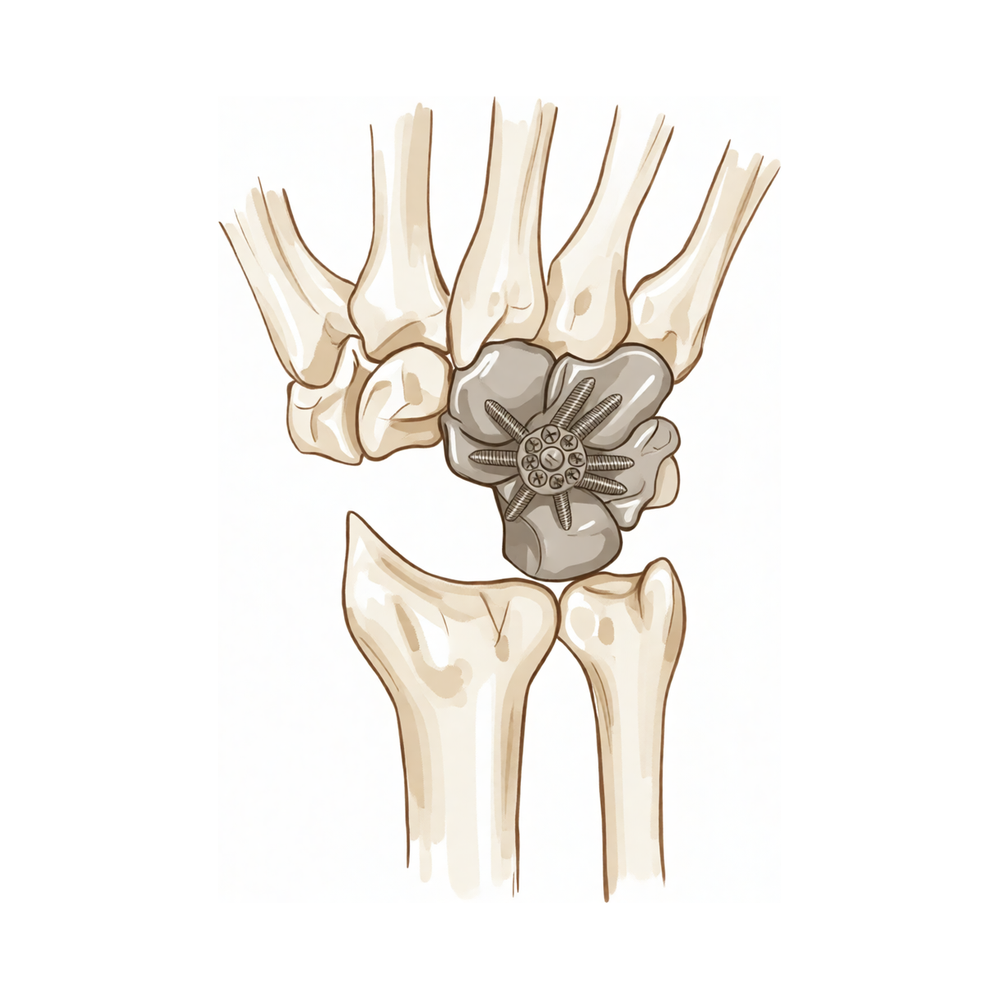
Este protocolo le servirá de guía para su recuperación tras una fusión parcial de la muñeca (una intervención quirúrgica en la que se extirpa el hueso escafoides dañado y se fusionan los pequeños huesos del centro de la muñeca; con frecuencia se realiza la fusión capitolunar, uniendo el hueso capitate con el lunate). El procedimiento fue realizado por el Dr. Kieran Hirpara en el Mater Private Hospital Rockhampton. El proceso comienza con un programa de ejercicios para realizar en casa; posteriormente, se sigue el protocolo clínico estructurado destinado a su terapeuta de mano: lleve esta página o su versión en PDF a su primera sesión de terapia para que la rehabilitación se lleve a cabo de manera coordinada. Su terapeuta de mano podrá modificar el plan según el progreso de su recuperación.
Si tiene alguna duda respecto a la herida quirúrgica, no dude en contactar con el consultorio. A menudo resulta útil tomar una fotografía de la herida y enviarla por correo electrónico para su evaluación.
Qué esperar
La fusión parcial de la muñeca se utiliza para tratar una muñeca desgastada (artritis) que se ha desarrollado a raíz de un problema previo en el escafoides: ya sea una lesión del ligamento escafolunar (muñeca “SLAC”) o una fractura del escafoides que nunca sanó (muñeca “SNAC”). Se extirpa el escafoides dañado y se fusionan los huesos de la zona media de la muñeca para evitar que vuelvan a rozar entre sí. El Dr. Hirpara suele fusionar el capitado con el lunado (fusión capitolunar); en ocasiones incluye también los huesos vecinos. Cuando se fusionan el lunado, el capitado, el triquetal y el ganchoso, se denomina fusión de los cuatro huesos, y sigue los mismos principios de recuperación.
La idea clave de esta intervención es que solo se fusiona una parte de la muñeca, no toda ella. La articulación entre el lunado y el hueso del antebrazo (el radio) se deja intacta a propósito. Esa articulación preservada permite que la muñeca siga moviéndose:
- Al fusionar las superficies desgastadas se elimina el dolor: ese es el objetivo principal, y se consigue de forma fiable.
- Mantener la articulación radio-lunada permite conservar cierto grado de movilidad. El precio a pagar es una reducción del movimiento: la mayoría de los pacientes conservan entre la mitad y dos tercios de su rango de flexión previo, así como un 75 % de la fuerza de prensión en comparación con el otro lado. Este resultado es normal y esperado (no constituye una complicación); para una muñeca dolorosa y desgastada, suele ser un intercambio muy beneficioso.
Los huesos fusionados necesitan tiempo para unirse firmemente, al igual que en una fractura. Durante las primeras seis semanas aproximadamente, la muñeca se mantiene inmóvil mediante un yeso o férula mientras esto ocurre. En ese periodo, los dedos, el pulgar y el antebrazo pueden moverse libremente, pero la muñeca debe permanecer en reposo. Una vez que el cirujano confirma mediante radiografía que los huesos se han unido, se permite progresivamente el movimiento de la muñeca y posteriormente el fortalecimiento muscular. Es fundamental tener expectativas realistas desde el principio: una muñeca cómoda y funcional, aunque no totalmente móvil, forma parte esencial de la recuperación.
Precauciones y limitaciones
- Mantenga la muñeca inmóvil dentro del yeso hasta que su cirujano confirme que la fusión ósea ha cicatrizado (normalmente en unas seis semanas): los huesos deben unirse antes de mover la muñeca.
- Mueva los dedos, el pulgar y el antebrazo desde el primer día, pero NO mueva la muñeca en sí hasta que se le autorice.
- NO haga agarres fuertes, levante pesos, empuje, tire ni cargue peso a través de la muñeca hasta que se confirme que la fusión es estable; esto protege el hueso en proceso de curación y cualquier placa, tornillos o grapas utilizados.
- Debe esperar una reducción en el rango final de movimiento: este es el resultado previsto al fusionar parte de la muñeca, no indica que algo haya salido mal.
- Mantenga el yeso y el vendaje limpios y secos; NO conduzca mientras lleve el yeso o no pueda controlar el volante de forma segura.
Para información sobre el cuidado de la herida, la hinchazón y las cicatrices, consulte las pautas de cuidado de heridas de nuestra consulta.
Sus ejercicios
Kieran Hirpara 4.0
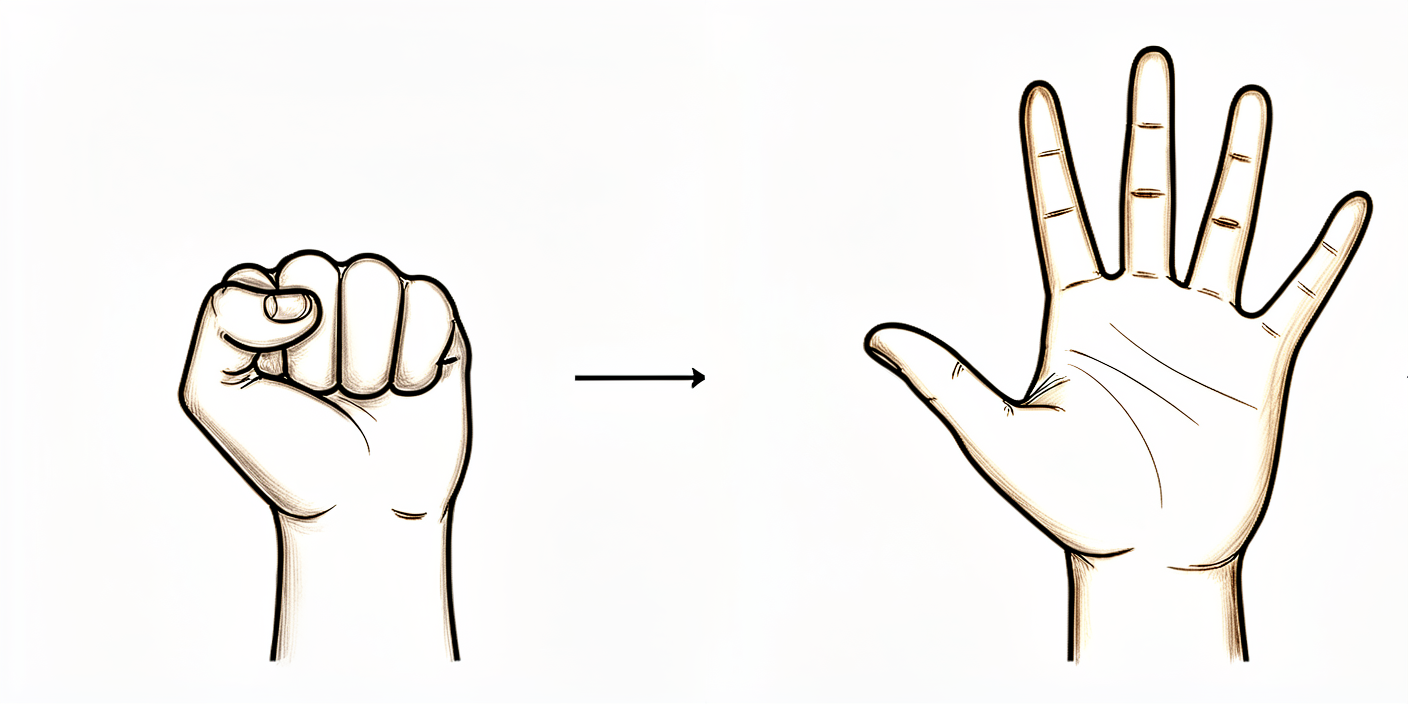
Movimiento de los dedos y del pulgar
Desde el día de la cirugía, mantenga los dedos y el pulgar en movimiento, mientras la muñeca permanece inmóvil dentro del yeso o férula. Estire completamente todos los dedos, luego haga un puño por completo, y a continuación acerque el pulgar a la punta de cada dedo, uno por uno. Esto evita que la mano se vuelva rígida y permite que los tendones se deslicen mientras los huesos de la muñeca se unen. No mueva la muñeca en absoluto.
10 veces cada una, varias veces al día, todos los días desde el inicio.
Kieran Hirpara 4.0
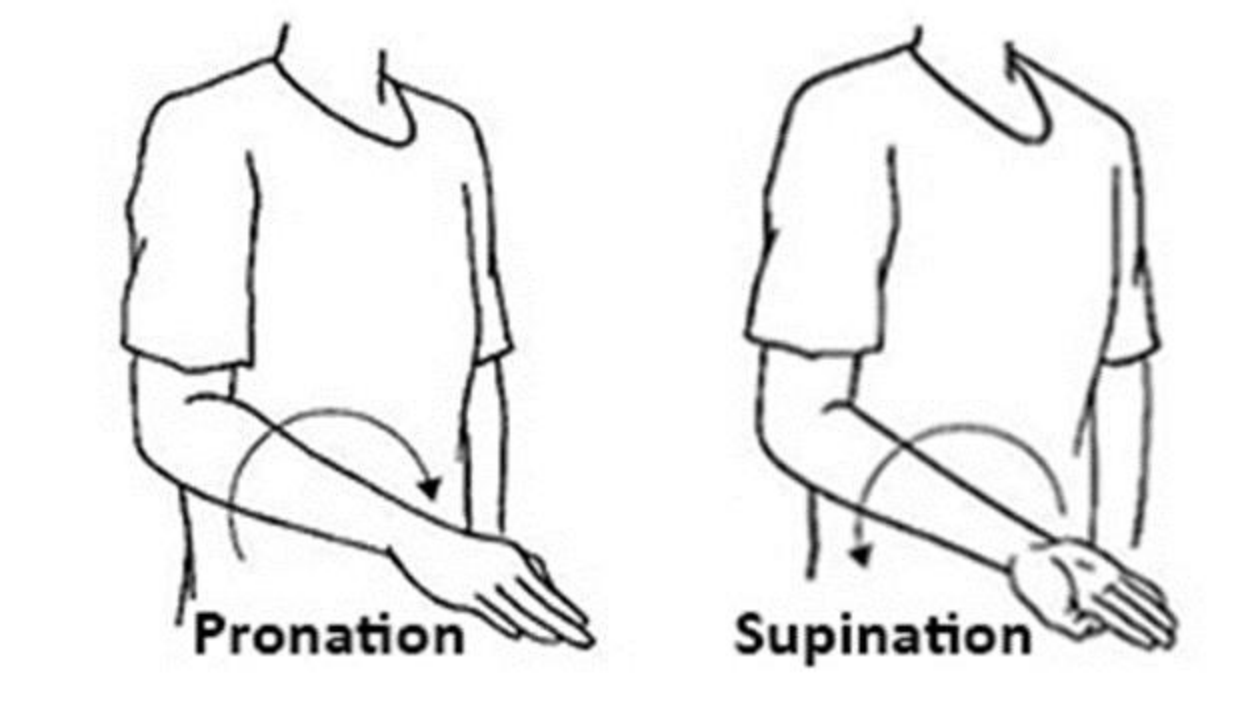
Rotación del antebrazo (palma hacia arriba / palma hacia abajo)
Con el codo pegado al costado y doblado en ángulo recto, gire suavemente la palma de la mano hacia arriba, hasta quedar mirando al techo, y luego hacia abajo, hasta quedar mirando al suelo. Asegúrese de que el movimiento provenga del antebrazo, no de la muñeca. Esto mantiene el antebrazo flexible y no altera la fusión en proceso de consolidación, por lo que este ejercicio puede iniciarse de inmediato.
10 veces en cada dirección, 2–3 veces al día.
Kieran Hirpara 4.0
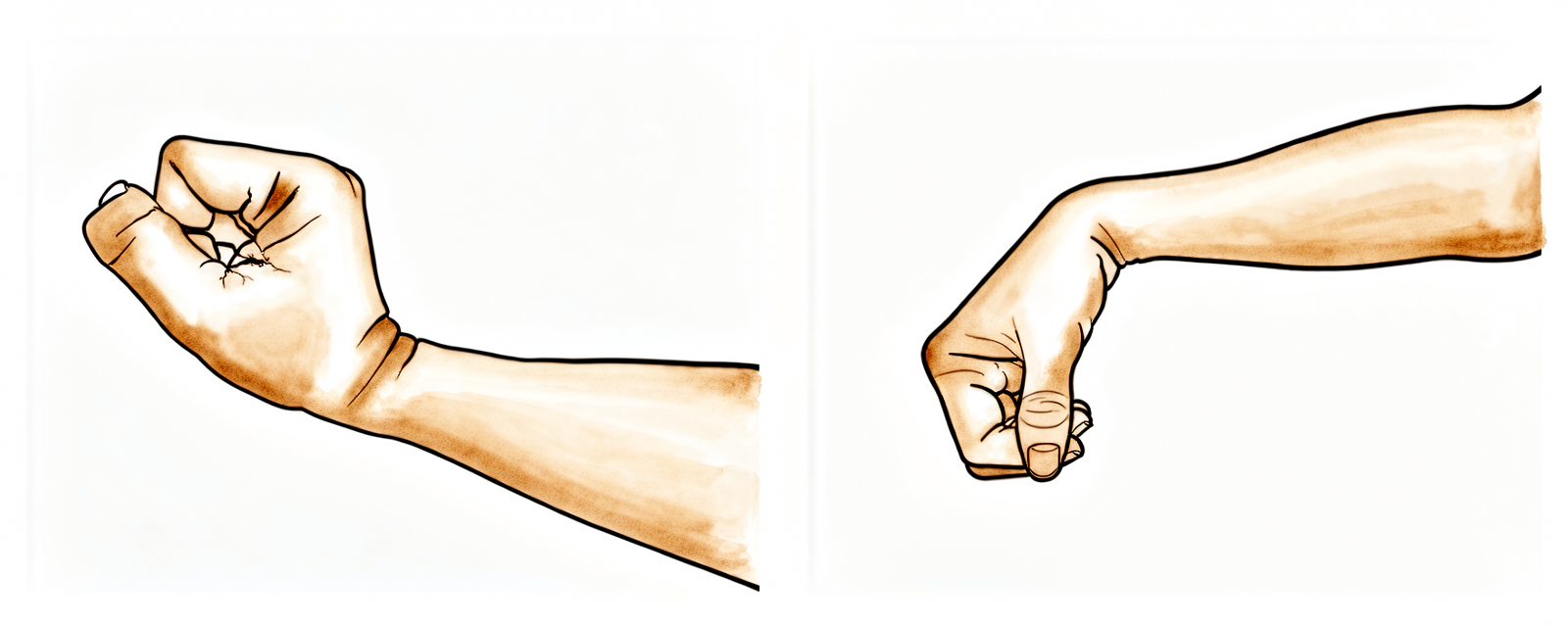
Movimiento de la muñeca (después de la consolidación)
Un ejercicio posterior: únicamente cuando la fusión haya cicatrizado y su cirujano y el terapeuta de mano hayan autorizado el movimiento de la muñeca (normalmente después de unas seis a ocho semanas). Flexione suavemente la muñeca hacia arriba (hacia atrás) y hacia abajo (hacia adelante); luego inclínela hacia el pulgar y hacia el meñique, moviéndola solo hasta donde le resulte cómodo. Recuerde que la parte fusionada de la muñeca no se moverá; lo que está recuperando es el movimiento proveniente de la articulación que se ha conservado; por ello, el rango final de movimiento será menor que antes, y eso es normal.
10 veces en cada dirección, 2–3 veces al día, manteniendo el nivel de confort (después de la consolidación ósea).
Kieran Hirpara 4.0
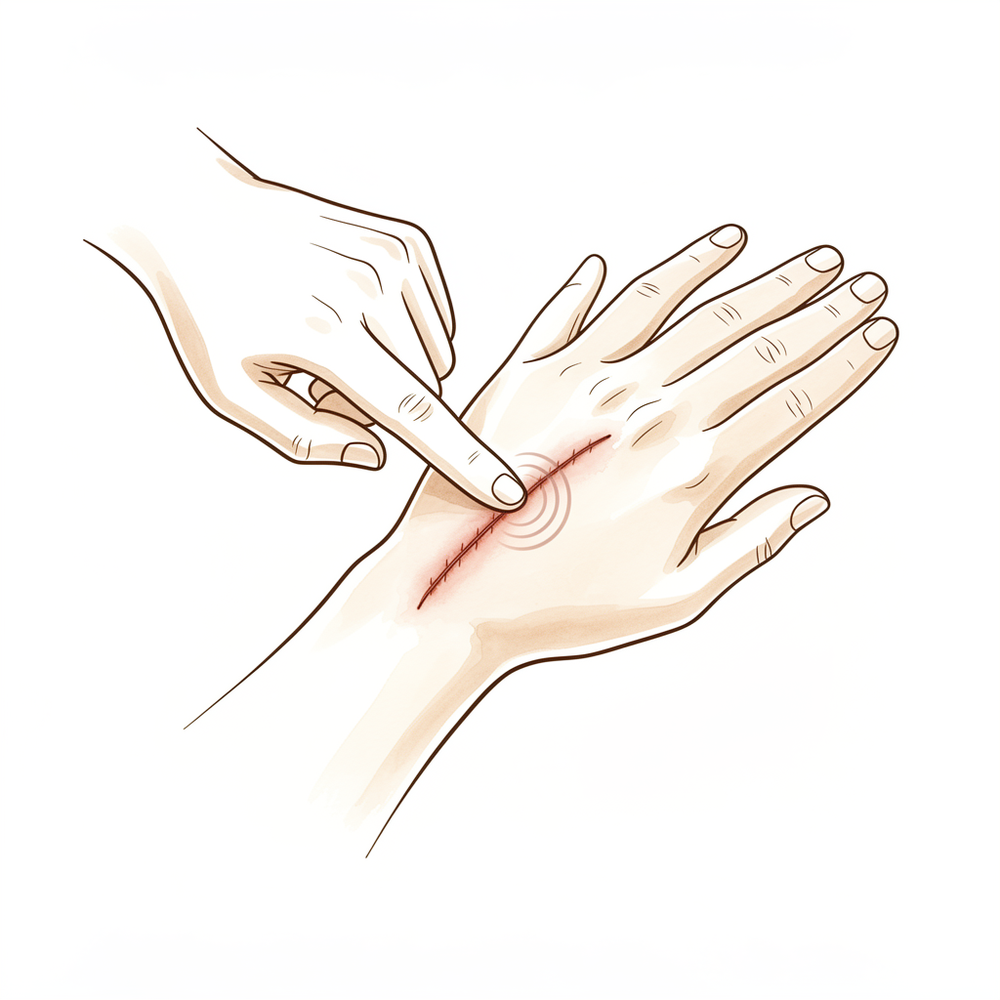
Cuidado de las cicatrices
Una vez que la herida haya cicatrizado por completo y esté seca, masajee la cicatriz con un poco de crema hidratante sin perfume, realizando pequeños círculos firmes con el pulgar de la mano opuesta durante unos minutos. Esto ablanda la cicatriz y reduce su sensibilidad. No comience este masaje hasta que la herida se haya cerrado y su terapeuta lo autorice.
2–3 minutos, dos veces al día, una vez que la herida haya cicatrizado.
Kieran Hirpara 4.0
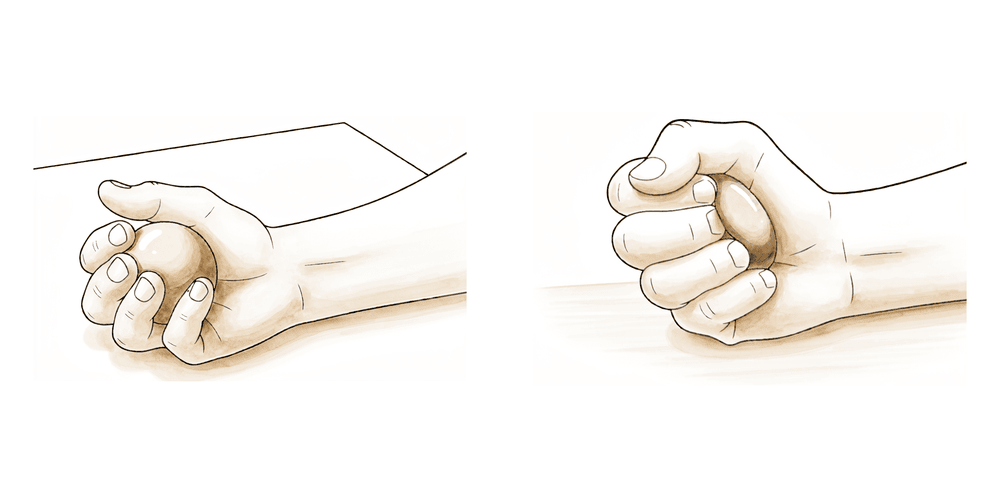
Fortalecimiento de la prensión
Un ejercicio posterior: solo se inicia cuando la fusión esté sólida y se haya autorizado el fortalecimiento (normalmente a partir de las doce semanas aproximadamente). Apriete una pelota blanda o plastilina terapéutica con la palma, mantenga brevemente y luego suelte. Aumente el esfuerzo gradualmente a lo largo de varias semanas. El agarre con fuerza, levantar pesos y apoyar el peso sobre la muñeca se posponen hasta que su cirujano confirme que los huesos están completamente unidos.
10–15 compresiones, 2–3 veces al día, aumentando progresivamente (fase posterior).
Estos son los ejercicios que aparecen en su folleto informativo. Comience a realizarlos únicamente bajo la guía del Dr. Hirpara y de su terapeuta especializado, respetando siempre los rangos y límites que le hayan indicado. Los primeros ejercicios sirven para mantener en movimiento los dedos, el pulgar y el antebrazo, sin afectar la fusión ósea en proceso; la muñeca, en cambio, debe permanecer inmóvil dentro del yeso o férula. El movimiento de la muñeca y el fortalecimiento de la prensión corresponden a fases posteriores y no deben iniciarse hasta que su cirujano confirme que los huesos ya se han unido. Interrumpa cualquier ejercicio que le provoque dolor intenso en la muñeca.
Su protocolo clínico
El resto de esta página describe el protocolo clínico por etapas para la rehabilitación tras una fusión parcial de la muñeca (fusión capitolunar ± excisión del escafoides; los mismos principios se aplican a la fusión de los cuatro huesos carpianos). Esta sección debe entregarse a su terapeuta de mano; cada fase comienza con una explicación sencilla en lenguaje coloquial de lo que está ocurriendo. A diferencia de una reparación tendinosa, en este caso el constructo es óseo, por lo que el avance en la rehabilitación depende de la consolidación ósea comprobada mediante radiografías, no de un calendario fijo. Hasta que el cirujano confirme dicha consolidación, la muñeca permanece inmovilizada y solo se pueden mover los dedos, el pulgar y el antebrazo; posteriormente se recupera el rango de movimiento de la muñeca y, finalmente, la carga, con un límite realista de aproximadamente 50–65% en cuanto a flexión-extensión respecto al lado contralateral y unos 70–80% en fuerza de agarre.
Antes de iniciar el tratamiento, revise el informe operatorio del paciente y confirme el tipo de fijación utilizada (placa circular/dorsal, tornillos de compresión sin cabeza, grapas o agujas K) así como si se realizó la excisión del escafoide. NO inicie movimientos de la muñeca hasta que el cirujano tratante confirme la consolidación ósea mediante radiografías (normalmente a las 6–8 semanas; en algunos casos puede tardar más con fijación mediante tornillos o grapas). Desde la primera consulta, explique al paciente que el objetivo es lograr una muñeca funcional y sin dolor, con un rango de movimiento intencionalmente reducido, y no una movilidad completa.
Fase I — inmovilización protegida hasta la consolidación (semanas 0 a ~6–8)
La fusión ósea evoluciona de forma similar a una fractura; por ello, la muñeca se mantiene inmóvil mientras los huesos se unen. La mano y el antebrazo se mantienen totalmente móviles para evitar rigidez y adherencias tendinosas, pero la muñeca no se mueve.
Para su terapeuta de mano:
Educación y precauciones - La muñeca debe permanecer inmovilizada mediante yeso o férula hasta que el cirujano confirme la consolidación radiográfica (normalmente en 6–8 semanas). - No se permite ningún movimiento activo ni pasivo de la muñeca durante esta fase. - Está prohibido realizar agarres, levantar objetos, empujar, tirar o soportar cargas con la muñeca operada. - Es importante informar desde el principio que el rango de movimiento final será reducido (se preserva la articulación radiolunar; la articulación mediocarpiana queda fusionada).
Manejo clínico - Herida: aplicar vendajes quirúrgicos según indicaciones; mantener un vendaje grueso o férula durante ~10–14 días, luego pasar a un yeso de brazo corto o férula termoplástica; vigilar posibles signos de infección. - Edema: mantener la extremidad elevada por encima del nivel del corazón, realizar movimientos suaves de bombeo con la mano y aplicar hielo según sea necesario. - Ejercicios: movilidad activa completa de dedos, pulgar y articulaciones MCP/IP; pronación y supinación del antebrazo; movilidad suave de hombro y codo; no realizar ningún movimiento de muñeca.
Criterios para avanzar a la fase siguiente - Confirmación radiográfica de consolidación por parte del cirujano (no avanzar únicamente por el transcurso del tiempo); herida cicatrizada; edema bajo control.
Fase II: restauración del movimiento de la muñeca (desde la consolidación, aproximadamente de las semanas 6–8 a la 12)
Una vez que el cirujano confirma que la fusión ósea es estable, se retira el yeso de la muñeca y se inicia un movimiento suave de la misma. El progreso es gradual; se le recuerda al paciente que la zona fusionada no se moverá y que el rango de movimiento alcanzable será menor que antes.
Para su terapeuta de mano:
Evaluaciones - Rango de movimiento activo y pasivo de la muñeca (flexión/extensión, desviación radial/ulnar), rotación del antebrazo, evaluación inicial de la fuerza de agarre, presencia de dolor e hinchazón, revisión de la herida y cicatriz
Educación y precauciones - Iniciar movilización activa y asistida de la muñeca dentro de los límites de confort; posteriormente usar una férula de muñeca desmontable para mayor comodidad y protección entre sesiones - Seguir evitando el agarre fuerte, levantar cargas pesadas y ejercer carga sobre la muñeca hasta obtener autorización para iniciar el fortalecimiento - Reiterar la expectativa de un rango de movimiento reducido (objetivo: aproximadamente 50–65% del rango de flexión-extensión de la muñeca contralateral)
Manejo - Ejercicios: flexión/extensión de la muñeca y desviaciones radial/ulnar de forma activa o asistida; iniciar masaje de la cicatriz y desensibilización una vez que la herida haya cicatrizado por completo; continuar con el rango de movimiento completo de dedos y pulgar, así como la rotación del antebrazo; controlar la hinchazón según sea necesario
Criterios para avanzar - Rango de movimiento de la muñeca controlado y sin molestias, dentro del límite reducido esperado; disminución del dolor; autorización del cirujano para iniciar el fortalecimiento
Fase III: Fortalecimiento y recuperación de la funcionalidad (a partir de las ~12 semanas)
Una vez que la fusión ósea es estable y el rango de movimiento vuelve a alcanzar niveles útiles, se inicia el fortalecimiento muscular y la carga progresiva, que se intensifica a lo largo de varias semanas. El retorno al trabajo manual y a la práctica deportiva se basa en criterios clínicos específicos.
Para su terapeuta de mano:
Evaluaciones - Fuerza de agarre y de pinza en comparación con el lado contralateral; respuesta de dolor e inflamación ante la carga; pruebas funcionales adaptadas a tareas y actividades laborales específicas
Educación y precauciones - Iniciar el fortalecimiento progresivo del agarre y de la muñeca (utilizando plastilina, pelotas y luego resistencia graduada) una vez autorizado. - Introducir tareas con carga y de soporte de peso de forma gradual; aumentar la intensidad a lo largo de varias semanas en lugar de hacerlo de una sola vez. - Objetivo final esperado: recuperación de la fuerza de agarre hasta alcanzar aproximadamente 70–80% respecto al lado contralateral, con un rango de movimiento útil, libre de dolor y reducido.
Manejo - Ejercicios: fortalecimiento progresivo del agarre y de antebrazo/muñeca; simulaciones funcionales y laborales graduales; cuidado continuo de la cicatriz y mantenimiento del rango de movimiento. - Estar atento a posibles signos de alarma: dolor dorsal en la muñeca al extenderla (posible compresión dorsal), sospecha de falta de fusión ósea o estancamiento en la recuperación; en tales casos, derivar al paciente al cirujano. - Considerar el alta terapéutica cuando la fuerza y la funcionalidad sean suficientes para satisfacer las necesidades diarias y laborales del paciente.
Criterios para retomar la carga laboral - Fusión ósea sólida y estable; ausencia de dolor dentro del rango de movimiento recuperado; fuerza de agarre adecuada para las tareas habituales. Las actividades manuales de gran exigencia se retomarán recién a partir de los 4–6 meses, de forma gradual.
Volver al trabajo y a las actividades cotidianas
Se recomienda realizar desde el principio actividades cotidianas ligeras con la mano (comer, escribir, cuidados personales básicos), siempre que se hagan dentro de los límites de la comodidad y sin ejercer carga ni torsión sobre la muñeca. Dado que no debe conducir mientras la muñeca permanezca en yeso o no pueda controlar el volante de forma segura, planifique contar con ayuda para el transporte durante las primeras semanas; podrá volver a conducir una vez que le retiren el yeso y demuestre capacidad para controlar el vehículo, según lo confirmado en su revisión médica.
El agarre, el levantamiento de objetos y la carga de peso a través de la muñeca deberán esperar hasta que se confirme que la fusión ósea es sólida (normalmente tras unas seis a ocho semanas), momento en el cual se irán introduciendo gradualmente. Las personas que realizan trabajos de oficina o actividades ligeras suelen reincorporarse alrededor de los tres meses; en el caso de trabajos manuales más pesados, el retorno suele ocurrir entre los cuatro y seis meses, introduciéndose las tareas de forma progresiva. A lo largo de todo este proceso, recuerde que el objetivo final es obtener una muñeca cómoda y funcional, aunque con un rango de movimiento reducido; este resultado se evaluará según cómo se sienta y funcione la muñeca, bajo la guía del Dr. Hirpara y su terapeuta de mano, quienes determinarán el ritmo adecuado, no el calendario en sí.
Después de seguir este protocolo
Este protocolo complementa las recomendaciones generales de recuperación de la consulta: consulte control del dolor postoperatorio, cuidado de la herida y manejo de las cicatrices. El plan por fases descrito anteriormente se basa en las guías de rehabilitación publicadas tras una fusión parcial de la muñeca; su recuperación continua será supervisada individualmente por el Dr. Hirpara y su terapeuta de mano, según la evolución y curación de su muñeca.
Evidence & references
This is the clinical evidence summary written for health professionals. It is technical, and it lists the research this page was built from. You do not need to read it to understand your treatment or to make a decision about it.
Partial Wrist Fusion — Procedure Outcomes & Post-operative Rehabilitation (Capitolunate / Four-Corner Arthrodesis with Scaphoid Excision)
Topic scope: post-operative rehabilitation after midcarpal partial wrist arthrodesis for scapholunate advanced collapse (SLAC) or scaphoid nonunion advanced collapse (SNAC). The index procedure here is a capitolunate fusion (the capitate fused to the lunate, usually with excision of the worn scaphoid); the closely related four-corner fusion (lunate–capitate– triquetrum–hamate) follows the same rehabilitation principles. This is a bony arthrodesis, so the rehabilitation is a union-gated pathway: the mid-wrist is immobilised until the fusion consolidates, after which a deliberately reduced wrist arc and grip are restored.
Defining principle of the rehab here: a partial wrist fusion is a motion-preserving salvage. The arthritic midcarpal surfaces are fused to abolish pain, while the radiolunate joint is intentionally preserved to retain movement. The construct that needs protecting is healing bone (plate, headless screws, staples or K-wires across the fusion), not a soft-tissue repair — so progression is gated by radiographic union, not a calendar. Counselling the patient that the planned end-point is a pain-free, functional wrist with a reduced arc (~50–65% of normal flexion–extension, ~70–80% grip) is itself part of the treatment: the reduced motion is the intended trade-off, not a failure. The two principal branch points are the fixation method (which sets the immobilisation window and union risk) and whether scaphoid excision was performed (standard in the SLAC/SNAC setting).
A. PROCEDURE OUTCOMES (capitolunate / four-corner fusion for SLAC–SNAC)
Partial wrist fusion is a well-established, durable salvage for the SLAC/SNAC wrist. The dominant debate is which motion-preserving salvage (four-corner / capitolunate fusion vs proximal row carpectomy), not whether to operate; both reliably relieve pain at the cost of some motion.
- Reliable pain relief with a useful but reduced arc. Across series, midcarpal fusion abolishes the painful midcarpal arthritis while preserving radiolunate motion. Typical results are roughly 50–65% of contralateral flexion–extension and ~70–80% of contralateral grip strength, with high rates of pain relief and return to work — the expected, planned trade-off of a partial fusion [Enna Hand Clin 2005; Strauch J Hand Surg Am 2011; Merrell J Hand Surg Am 2008; long-term series J Wrist Surg 2015]. Moderate (cohort/consensus).
- Capitolunate fusion (± scaphoid excision) performs comparably to full four-corner fusion while fusing fewer joints, simplifying the construct. A systematic review of capitolunate arthrodesis and comparative work report comparable motion, grip and union to four-corner fusion, supporting it as a sound index choice [Dunn J Hand Surg Am 2020 (systematic review); lunocapitate series J Hand Surg Eur 2009; J Chin Med Assoc 2017]. Moderate.
- A meta-analysis of two-, three- and four-corner constructs finds the number of fused columns does not materially change motion, grip, union or complications — biomechanically consistent with the radiolunate joint being the motion-determining segment [Hundepool J Hand Surg Am 2025 (SR/meta-analysis); Hernandez-Soria J Hand Surg Am 2016 (capitate-position biomechanics)]. Moderate (SR) + mechanistic.
- Modern fixation is forgiving but union is not guaranteed. Circular dorsal plates, headless compression screws and nitinol staples all achieve consolidation in the great majority, with nonunion and dorsal impingement the characteristic failures to watch for [Merrell J Hand Surg Am 2008 (circular plate); Ahmady J Hand Surg Glob Online 2025 (nitinol staples)]. Moderate.
B. REHABILITATION / THERAPY EVIDENCE
The rehab questions are (1) how long to immobilise, (2) what gates the start of wrist motion, and (3) how to set the patient's expectation of reduced motion. The evidence and published surgeon protocols converge on a union-gated sequence: immobilise the wrist (mobilise the hand and forearm) for ~6–8 weeks, then restore a reduced arc, then strengthen.
- Immobilise until radiographic union, not by the calendar. Because the construct is bony, wrist motion is withheld until the surgeon confirms consolidation — typically 6–8 weeks, longer with some screw/staple fixations. Published institutional protocols use a bulky dressing/splint for ~10–14 days, a short-arm cast to ~4–6 weeks, then a removable splint as motion begins. Moderate (consensus protocols).
- Keep the hand and forearm fully mobile from day one. Immediate active finger, thumb and forearm rotation prevents stiffness and tendon adhesion without disturbing the fusion — the same glide-preserving logic used across hand rehab. Consensus.
- Restore motion gradually after union, against a realistic ceiling. Once united, active and active-assisted wrist ROM is introduced; patients should be counselled that the fused midcarpal segment will not move and the achievable arc is smaller than pre-operatively (the radiolunate joint alone supplies wrist motion). Consensus + mechanistic (capitate-position biomechanics, Hernandez-Soria 2016).
- Strengthen and load only once the fusion is solid. Grip and loaded/weight-bearing work begins after union and is built up gradually; heavy manual demands are deferred to ~4–6 months. Consensus.
Recovery trajectory (expected, evidence-anchored)
| Phase | Window | Restraint | Hand use / therapy focus | Strength / load | Notes |
|---|---|---|---|---|---|
| I — Immobilisation (union) | Week 0 to ~6–8 | Wrist immobilised (cast/splint) | Full active finger, thumb & forearm motion; oedema control, elevation; no wrist motion | None through the wrist | Fusion knits like a fracture; progress is gated by radiographic union, not the calendar |
| II — Restoring wrist motion | From union (~wk 6–8) to 12 | Heavy-load avoidance; removable splint | Begin active/active-assisted wrist flexion/extension & deviation; scar massage once healed | No loaded grip yet | Counsel the reduced-arc expectation (~50–65% of normal flexion–extension) |
| III — Strengthening & return | From ~12 weeks (post-union) | Restrictions lifted progressively | Progressive grip/wrist strengthening; graded job simulation | Grip recovers toward ~70–80% of the other side | Desk work ~3 months; heavy manual ~4–6 months. Watch for dorsal impingement / nonunion |
(Phase windows mirror the precautions in the patient protocol and published surgeon protocols; they are typical guides anchored to union, not trial-derived deadlines.)
C. KEY CONTROVERSIES / EVIDENCE QUALITY
- Capitolunate vs four-corner vs proximal row carpectomy (PRC). All three are accepted motion-preserving salvages for SLAC/SNAC. PRC tends to give a slightly larger arc and avoids fusion-specific complications (nonunion, dorsal impingement, hardware), while fusion may give marginally better grip and is preferred where capitate-head or proximal-capitate cartilage is compromised. Systematic reviews and a meta-analysis find no consistent superiority of one over the other; choice is individualised [Mulford J Hand Surg Eur 2009; J Hand Surg Am 2024 meta-analysis; Strauch J Hand Surg Am 2011]. Moderate (SR/meta-analysis of mostly observational data).
- Capitolunate vs full four-corner construct. Fusing fewer columns (capitolunate) simplifies the construct without clearly compromising motion, grip or union versus four-corner — consistent with the radiolunate joint being the motion-determining segment [Dunn 2020 SR; Hundepool 2025 meta-analysis; Hernandez-Soria 2016]. Moderate.
- When can wrist motion safely start? Union timing varies with fixation, and protocols differ on exact cast duration. The defensible position is surgeon-confirmed radiographic union gates wrist ROM rather than a fixed week number. Weak–moderate (consensus; protocol variation).
- Reduced motion is the plan, not a complication. The preserved radiolunate joint supplies a smaller arc by design; mislabelling the expected ~50–65% range as a poor result drives unnecessary dissatisfaction. Strong mechanistically; cohort-supported.
- Characteristic failures: nonunion and dorsal impingement. Both are recognised, fixation-related complications; persistent dorsal wrist pain on extension or a non-progressing fusion warrants surgical review rather than more therapy [Merrell 2008; Ahmady 2025; long-term series 2015]. Moderate.
D. EVIDENCE STRENGTH FLAGS (summary)
- STRONG (mechanistic / well-supported): the reduced final arc is the planned consequence of preserving the radiolunate joint while fusing the midcarpal segment (capitate-position biomechanics); reliable pain relief from the fusion.
- MODERATE: typical outcome envelope (~50–65% flexion–extension, ~70–80% grip); equivalence of capitolunate and four-corner constructs; no consistent superiority of fusion vs PRC (SR/meta-analysis of largely observational data); modern fixation achieves high union with defined nonunion / dorsal impingement risk.
- WEAK / CONSENSUS: the specific union-gated immobilise → restore-motion → strengthen therapy sequence and exact phase timings (institutional/surgeon protocols, anchored to radiographic union rather than trial-derived).
CITATIONS
RAG corpus (180,000+ Orthopaedic articles)
- Enna M, Hoepfner P, Weiss AC. Scaphoid excision with four-corner fusion. Hand Clin. 2005. DOI: 10.1016/j.hcl.2005.08.012
- Dunn JC, Polmear MM, Scanaliato JP, et al. Capitolunate arthrodesis: a systematic review. J Hand Surg Am. 2020. DOI: 10.1016/j.jhsa.2019.10.007
- Hundepool CA, Duraku LS, Quanjel TJ, et al. Two-, three-, or four-corner arthrodesis for midcarpal osteoarthritis: a systematic review and meta-analysis. J Hand Surg Am. 2025. DOI: 10.1016/j.jhsa.2023.04.018
- Strauch RJ. Scapholunate advanced collapse and scaphoid nonunion advanced collapse arthritis — update on evaluation and treatment. J Hand Surg Am. 2011. DOI: 10.1016/j.jhsa.2011.01.018
- Merrell GA, McDermott EM, Weiss AC. Four-corner arthrodesis using a circular plate and distal radius bone grafting: a consecutive case series. J Hand Surg Am. 2008. DOI: 10.1016/j.jhsa.2008.02.001
- Hernandez-Soria A, Das De S, Model Z, et al. The effect of capitate position on coronal plane wrist motion after simulated 4-corner arthrodesis. J Hand Surg Am. 2016. DOI: 10.1016/j.jhsa.2016.07.101
- Ahmady AA, Zalzaleh M, Riedel BB. Midterm outcomes of four-corner fusion surgery using nitinol staples. J Hand Surg Glob Online. 2025. DOI: 10.1016/j.jhsg.2025.100805
- Mulford JS, Ceulemans LJ, Nam D, Axelrod TS. Proximal row carpectomy vs four corner fusion for scapholunate (SLAC) or scaphoid nonunion advanced collapse (SNAC) wrists: a systematic review of outcomes. J Hand Surg Eur Vol. 2009. DOI: 10.1177/1753193408100954
- Four-corner fusion versus proximal row carpectomy for scapholunate advanced collapse and scaphoid nonunion advanced collapse wrist: a systematic review and meta-analysis. J Hand Surg Am. 2024. DOI: 10.1016/j.jhsa.2024.01.011
- Long-term results of lunocapitate arthrodesis with scaphoid excision for SLAC and SNAC wrists. J Hand Surg Eur Vol. 2009. DOI: 10.1177/1753193409105683
- Lunocapitate fusion with scaphoid excision for the treatment of scaphoid nonunion advanced collapse or scapholunate advanced collapse wrist. J Chin Med Assoc. 2017. DOI: 10.1016/j.jcma.2016.10.001
- The long-term outcome of four-corner fusion. J Wrist Surg. 2015. DOI: 10.1055/s-0035-1549277
Partial wrist fusion rehabilitation literature (protocols & guidance — basis for the union-gated phase structure)
- University of Virginia Department of Orthopaedic Surgery. Wrist Partial Fusion (4-Corner) Rehabilitation Guidelines. https://med.virginia.edu/orthopaedic-surgery/wp-content/uploads/sites/242/2024/09/Wrist-Partial-Fusion-4-corner.pdf
- Oregon Health & Science University (OHSU). Four-Corner Partial Wrist Fusion — Surgery Guide. https://www.ohsu.edu/sites/default/files/2020-12/Four-Corner%20Partial%20Wrist%20Fusion.pdf
- Alaska Orthopedic Specialists. Four-Corner Fusion with Scaphoid Excision — Post-operative Protocol. https://www.akortho.com/wp-content/uploads/Four-Corner-Fusion-with-Scaphoid-Excision-1.pdf
- Twin Cities Orthopedics (Olson). Scaphoid Excision 4-Corner Fusion Post-operative Protocol. https://www.toportho.com/wp-content/uploads/2024/10/olson-_4-Corner-Fusion-Protocol.pdf
- The long-term outcome of four-corner fusion (open-access full text). PMC. https://pmc.ncbi.nlm.nih.gov/articles/PMC4408128/