Skip to content

Patients › Elbow

Osteocondritis disecante del capítulo

PDF

A lateral elbow joint-surface problem in young throwers and gymnasts — how it is found, when it heals with rest, and when surgery is needed.
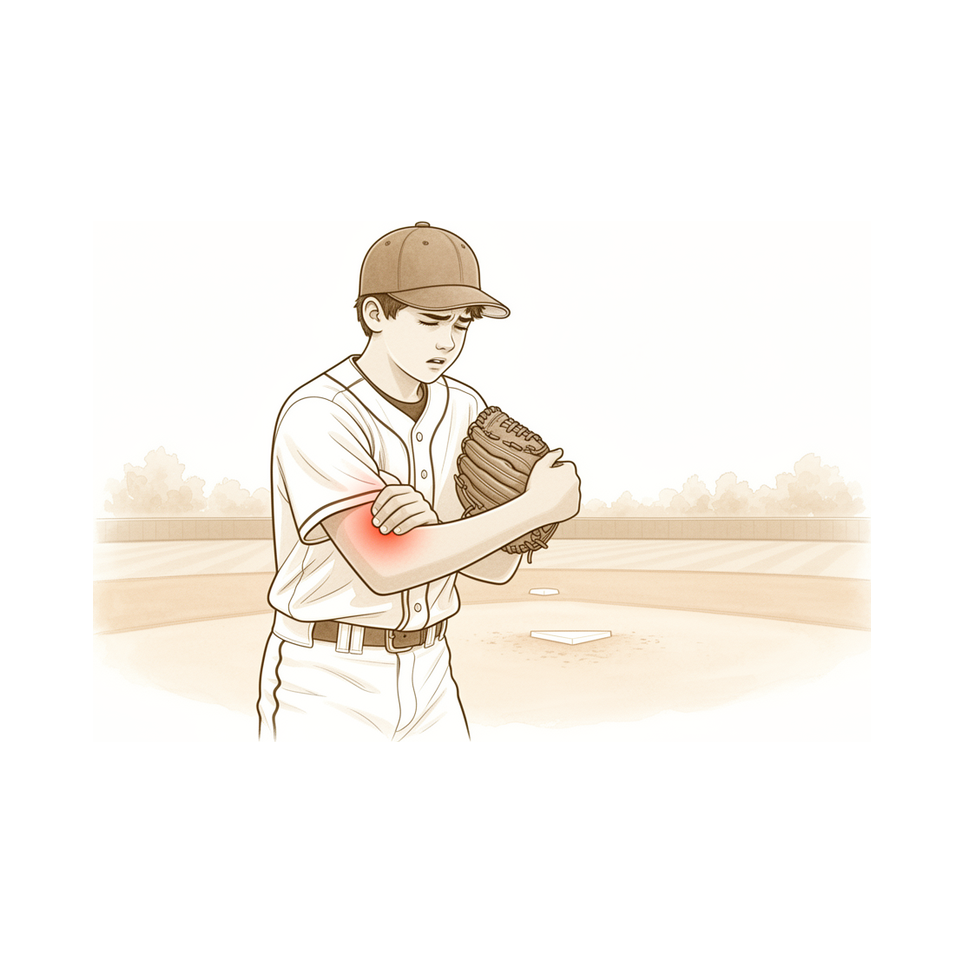
Un joven lanzador de béisbol se aferra al lado externo del codo, sufriendo dolor.
La osteocondritis disecante del capítulo humeral afecta la parte externa del codo en jóvenes lanzadores y gimnastas, como consecuencia de la carga repetitiva sobre la superficie articular. Kieran Hirpara 4.0

Esta página se tradujo automáticamente y todavía no la ha revisado un médico. La versión en inglés es la versión oficial.

Qué está sintiendo

Por lo general, se manifiesta como un dolor sordo y punzante en la parte externa del codo, que a menudo es difícil de localizar con exactitud. Suele empeorar con la actividad, especialmente al lanzar, hacer gimnasia o cualquier movimiento que someta al brazo a esfuerzo; sin embargo, mejora con el reposo. Muchos atletas jóvenes notan que ya no pueden estirar completamente el codo; esa pérdida de los últimos grados de extensión es común y, con frecuencia, aparece antes de que el dolor se convierta en un verdadero problema.

Si un fragmento de la superficie articular comienza a soltarse, el codo puede empezar a “trabarse”, hacer clic o bloquearse; además, puede hincharse tras la actividad física. Un verdadero episodio de bloqueo (cuando el codo se atasca y no se mueve por unos instantes) suele indicar que un pequeño fragmento de cartílago y hueso se ha desprendido y flota dentro de la articulación. Esta afección afecta con mayor frecuencia a adolescentes que lanzan (beisbol, críquet) o practican gimnasia, cuyo codo externo recibe impactos repetidos.

¿Qué está ocurriendo realmente?

La mitad externa del codo está formada por una protuberancia ósea redondeada llamada capítulo, recubierta por cartílago liso. Cuando se somete a cargas intensas y repetidas durante el crecimiento, una pequeña zona ósea situada justo debajo de ese cartílago puede perder su irrigación sanguínea y empezar a ablandarse. Esto se conoce como osteocondritis disecante o OCD. El cartílago que la cubre puede permanecer intacto y curarse por sí solo; sin embargo, esa zona ósea puede agrietarse, levantarse y, finalmente, separarse formando un cuerpo suelto.

Hay que tener cuidado de no confundir esta afección con otra condición infantil más leve y autocorregible llamada enfermedad de Panner, que afecta a niños más pequeños (normalmente menores de 10 años), mejora sola con el reposo y no deja secuelas duraderas. La verdadera OCD se presenta en niños mayores y adolescentes, y puede provocar daños articulares permanentes si un fragmento óseo se desprende.

El estado del cartílago es de suma importancia. Una lesión estable (cartílago aún bien adherido y placas de crecimiento abiertas) tiene buenas posibilidades de curarse únicamente con reposo. En cambio, una lesión inestable (agrietada, levantada o ya suelta) generalmente no se cura por sí sola y suele requerir cirugía.

¿Qué podemos hacer al respecto?

El Dr. Kieran Hirpara dirige nuestro servicio de cirugía de miembro superior en el Mater Private Hospital Rockhampton. Allí, guiamos a los pacientes desde su derivación inicial por parte del médico de cabecera hasta una evaluación detallada de su historial clínico, examen físico e imágenes diagnósticas. En el caso de problemas crónicos en el codo, normalmente iniciamos con tratamiento no quirúrgico y solo recurrimos a la cirugía si el reposo y la rehabilitación no logran aliviar los síntomas.

El primer y más importante paso para una lesión estable es simplemente detener la actividad que la agrava (no lanzar objetos, no soportar peso con el brazo) durante varios meses, reiniciando gradualmente dichas actividades una vez que los estudios por imagen confirmen la consolidación ósea. En atletas jóvenes cuyas placas de crecimiento aún están abiertas, muchas de estas lesiones sanan por completo de esta manera. El reposo no significa “no hacer nada”; es, en sí mismo, el tratamiento.

Cuando una lesión es inestable, ya ha generado un cuerpo suelto o no mejora con el reposo, generalmente se recomienda la cirugía. Esta se realiza casi siempre mediante cirugía artroscópica; la técnica exacta depende de las características de la lesión:

  • Limpieza y estimulación de la cicatrización: se extrae el fragmento dañado y se realizan pequeños orificios en el hueso expuesto (microfractura) para favorecer la formación de tejido nuevo. Este método funciona bien en lesiones de menor tamaño.
  • Fijación del fragmento: si el fragmento suelto es grande y de buena calidad, a veces se puede volver a fijar en su posición original mediante clavos o tornillos.
  • Revestimiento del defecto: en lesiones de gran tamaño, especialmente aquellas situadas en el borde de la articulación, se pueden trasplantar injertos de cartílago y hueso sanos para reconstruir la superfie articular.

Su cirujano decidirá cuál de estos procedimientos aplicar según el tamaño y ubicación de la lesión, así como si el cartílago es recuperable; para ello se utiliza, por lo general, una resonancia magnética.

Qué esperar

En general, el pronóstico es favorable, especialmente cuando el problema se detecta a tiempo y la lesión sigue siendo estable. Muchos pacientes jóvenes con lesiones estables sanan con reposo y pueden volver a practicar deporte. Tras una cirugía para lesiones inestables, la mayoría de los pacientes experimentan un buen alivio del dolor y una recuperación notable de la movilidad; la mayor parte de los atletas logran retomar su actividad deportiva, aunque esto puede llevar varios meses y requerir un programa de rehabilitación estructurado.

No obstante, hay algunas advertencias importantes. Las lesiones más extensas, aquellas que alcanzan el borde externo de la articulación, y los codos en los que las placas de crecimiento ya se han cerrado suelen tener peor evolución y requieren con mayor frecuencia cirugía. Puede quedar cierta pérdida de la extensión completa del codo; a largo plazo, una lesión importante puede aumentar ligeramente el riesgo de desarrollar artritis en el codo en el futuro. Por eso es tan crucial el diagnóstico precoz y la protección de la articulación.

Cuándo consultar a un especialista

  • Dolor persistente en la parte externa del codo en jóvenes lanzadores o gimnastas que no mejora tras una o dos semanas de reposo; es recomendable hacer una evaluación antes de continuar con la actividad.
  • Pérdida de la extensión completa del codo: la imposibilidad de enderezar el codo por completo es una señal de alerta temprana que merece ser evaluada.
  • Sensación de “traba”, chasquidos o bloqueo del codo: esto indica que podría haberse soltado un fragmento óseo y es necesario realizar estudios por imagen.
  • Hinchazón después del ejercicio que reaparece repetidamente.
  • Cualquiera de estos síntomas en atletas con esqueleto aún en desarrollo requiere atención inmediata, pues las lesiones detectadas mientras las placas de crecimiento aún están abiertas tienen mayores posibilidades de sanar sin necesidad de cirugía.

En profundidad

Esta sección va más allá de lo necesario para que usted tome sus propias decisiones terapéuticas. La osteocondritis disecante del capítulo merece una lectura adicional, pues se trata en gran medida de una enfermedad silenciosa del codo en desarrollo: para cuando provoca suficiente dolor como para que un joven lanzador acuda a la consulta, la lesión suele haber avanzado más allá del punto en el que el tratamiento más sencillo resulta eficaz.

Es más común de lo que los síntomas sugieren

Los resultados de los exámenes de detección cuentan una historia distinta a la que se observa en las consultas clínicas. Entre 2,433 adolescentes que practican béisbol, la prevalencia de osteocondritis disecante del olécrano —incluyendo los casos latentes— fue del 3,4%. Los jugadores afectados comenzaron a practicar a edades más tempranas, llevaban más tiempo jugando y habían experimentado mayor dolor en el codo [1].

“Incluyendo los casos latentes” es el matiz clave aquí. Una proporción significativa de estas lesiones se detectaron mediante examen físico, no porque los jugadores lo reportaran; esto implica que el dolor es una señal tardía y poco fiable en este grupo de atletas, quienes, de todas formas, tienden a no manifestar sus molestias.

El retraso determina qué tratamientos son posibles

Las consecuencias se reflejan directamente en las opciones terapéuticas. En 258 adolescentes, se observaron lesiones avanzadas en pacientes con mayor duración de los síntomas; no obstante, una vez que una lesión requería cirugía, eran las características específicas del tratamiento, y no su duración, las que mejor se correlacionaban con el regreso al deporte [2].

Dos hallazgos radiográficos predicen el fracaso del tratamiento no quirúrgico: el agrandamiento de la cabeza radial y una edad esquelética avanzada en el lado de lanzamiento en comparación con el lado no lanzador; ambos se asocian con enfermedad en estadio avanzado en 245 pacientes [3]. Ambos indican que el codo ya ha sufrido remodelación por la carga, lo cual constituye una descripción estructural y no sintomática.

Este es el argumento a favor de realizar estudios por imagen en jóvenes lanzadores con dolor persistente en el codo, en lugar de tratarlo como un problema de tejidos blandos; asimismo, justifica la importancia de considerar cualquier diferencia entre ambos lados.

En el caso de una lesión estable, la intervención menor es suficiente

Cuando el fragmento es estable y el defecto es pequeño, surge el debate entre simplemente limpiar el defecto o, además, perforar el hueso situado debajo para favorecer la reparación mediante fibrocartílago. En un total de 327 pacientes, tanto el desbridamiento como la microfractura generaron mejoras significativas en cuanto al dolor, el rango de movimiento, las puntuaciones de resultado y el retorno al deporte. Dado que se obtuvieron resultados a mediano plazo comparables mediante el desbridamiento solo, este constituye un enfoque razonable para defectos relativamente pequeños [4].

En casos de lesiones grandes o inestables, la situación cambia

Cuando el fragmento se ha desprendido o la lesión es extensa, es necesario reemplazar la superficie afectada en lugar de simplemente repararla, generalmente mediante el trasplante de un fragmento de cartílago y hueso. Este procedimiento resulta eficaz, aunque con una salvedad importante.

En un estudio que incluyó a 492 pacientes, la tasa de retorno al deporte tras el tratamiento quirúrgico fue elevada en general; además, los pacientes tuvieron mayor probabilidad de volver a su nivel deportivo previo al tratamiento tras el trasplante autólogo de injerto osteocondral que tras la desbridación o fijación [5]. No obstante, una revisión realizada en 2024 con 470 pacientes sometidos a este trasplante, si bien confirmó altas tasas de retorno al deporte, señaló que se debe informar a los atletas de que podrían tener que volver a un nivel de rendimiento inferior o cambiar de posición, y que la ubicación lateral de la lesión podría influir negativamente en los resultados [6].

Ambas afirmaciones son ciertas simultáneamente; esta distinción resulta crucial para un atleta joven: es probable que vuelva al deporte, pero no necesariamente a la misma posición. El tamaño y la ubicación de la lesión, y no la elección entre los distintos procedimientos quirúrgicos, son los factores determinantes del pronóstico.

Referencias

[1] Kida Y, Morihara T, Kotoura Y, Hojo T, Tachiiri H, Sukenari T, et al. Prevalencia y características clínicas de la osteocondritis disecante del capítulo humeral en adolescentes jugadores de béisbol. Am J Sports Med. 2014;42(8):1963-71. https://doi.org/10.1177/0363546514536843

[2] Cheng C, Milewski MD, Nepple JJ, Reuman HS, Nissen CW. Papel predictivo de la duración de los síntomas antes de la presentación clínica inicial en adolescentes con osteocondritis disecante del capítulo, respecto a las mediciones preoperatorias y postoperatorias: una revisión sistemática. Orthop J Sports Med. 2019;7(2). https://doi.org/10.1177/2325967118825059

[3] Funakoshi T, Furushima K, Miyamoto A, Kusano H, Horiuchi Y, Itoh Y. Factores predictivos del fracaso del tratamiento no quirúrgico de la osteocondritis disecante del capítulo. Am J Sports Med. 2019;47(11):2691-8. https://doi.org/10.1177/0363546519863349

[4] McLaughlin RJ, Leland DP, Bernard CD, Sanchez-Sotelo J, Morrey ME, O'Driscoll SW, et al. Tanto el desbridamiento como la microfractura arrojan resultados excelentes en lesiones por osteocondritis disecante del capítulo: una revisión sistemática. Arthrosc Sports Med Rehabil. 2021;3(2):e593-e603. https://doi.org/10.1016/j.asmr.2020.10.002

[5] Westermann RW, Hancock KJ, Buckwalter JA, Kopp B, Glass N, Wolf BR. Retorno al deporte tras el tratamiento quirúrgico de la osteocondritis disecante del capítulo: una revisión sistemática y metaanálisis. Orthop J Sports Med. 2016;4(6). https://doi.org/10.1177/2325967116654651

[6] Lane G, Smith MV, Goldfarb CA, Coronado RA, Bowman EN. Resultados y retorno al deporte tras el trasplante autólogo osteocondral para la osteocondritis disecante del capítulo: una revisión sistemática. JSES Rev Rep Tech. 2024;4(3):563-70. https://doi.org/10.1016/j.xrrt.2024.02.011


Creative Commons BY-NC 4.0

CC Creative Commons licence
BY Attribution — you must credit the source
NC NonCommercial — not for commercial use

Attribution-NonCommercial 4.0 International


Creative Commons Corporation ("Creative Commons") is not a law firm and does not provide legal services or legal advice. Distribution of Creative Commons public licenses does not create a lawyer-client or other relationship. Creative Commons makes its licenses and related information available on an "as-is" basis. Creative Commons gives no warranties regarding its licenses, any material licensed under their terms and conditions, or any related information. Creative Commons disclaims all liability for damages resulting from their use to the fullest extent possible.

Using Creative Commons Public Licenses

Creative Commons public licenses provide a standard set of terms and conditions that creators and other rights holders may use to share original works of authorship and other material subject to copyright and certain other rights specified in the public license below. The following considerations are for informational purposes only, are not exhaustive, and do not form part of our licenses.

Considerations for licensors: Our public licenses are intended for use by those authorized to give the public permission to use material in ways otherwise restricted by copyright and certain other rights. Our licenses are irrevocable. Licensors should read and understand the terms and conditions of the license they choose before applying it. Licensors should also secure all rights necessary before applying our licenses so that the public can reuse the material as expected. Licensors should clearly mark any material not subject to the license. This includes other CC- licensed material, or material used under an exception or limitation to copyright. More considerations for licensors: wiki.creativecommons.org/Considerations_for_licensors

Considerations for the public: By using one of our public licenses, a licensor grants the public permission to use the licensed material under specified terms and conditions. If the licensor's permission is not necessary for any reason--for example, because of any applicable exception or limitation to copyright--then that use is not regulated by the license. Our licenses grant only permissions under copyright and certain other rights that a licensor has authority to grant. Use of the licensed material may still be restricted for other reasons, including because others have copyright or other rights in the material. A licensor may make special requests, such as asking that all changes be marked or described. Although not required by our licenses, you are encouraged to respect those requests where reasonable. More considerations for the public: wiki.creativecommons.org/Considerations_for_licensees


Creative Commons Attribution-NonCommercial 4.0 International Public License

By exercising the Licensed Rights (defined below), You accept and agree to be bound by the terms and conditions of this Creative Commons Attribution-NonCommercial 4.0 International Public License ("Public License"). To the extent this Public License may be interpreted as a contract, You are granted the Licensed Rights in consideration of Your acceptance of these terms and conditions, and the Licensor grants You such rights in consideration of benefits the Licensor receives from making the Licensed Material available under these terms and conditions.

Section 1 -- Definitions.

a. Adapted Material means material subject to Copyright and Similar Rights that is derived from or based upon the Licensed Material and in which the Licensed Material is translated, altered, arranged, transformed, or otherwise modified in a manner requiring permission under the Copyright and Similar Rights held by the Licensor. For purposes of this Public License, where the Licensed Material is a musical work, performance, or sound recording, Adapted Material is always produced where the Licensed Material is synched in timed relation with a moving image.

b. Adapter's License means the license You apply to Your Copyright and Similar Rights in Your contributions to Adapted Material in accordance with the terms and conditions of this Public License.

c. Copyright and Similar Rights means copyright and/or similar rights closely related to copyright including, without limitation, performance, broadcast, sound recording, and Sui Generis Database Rights, without regard to how the rights are labeled or categorized. For purposes of this Public License, the rights specified in Section 2(b)(1)-(2) are not Copyright and Similar Rights.

d. Effective Technological Measures means those measures that, in the absence of proper authority, may not be circumvented under laws fulfilling obligations under Article 11 of the WIPO Copyright Treaty adopted on December 20, 1996, and/or similar international agreements.

e. Exceptions and Limitations means fair use, fair dealing, and/or any other exception or limitation to Copyright and Similar Rights that applies to Your use of the Licensed Material.

f. Licensed Material means the artistic or literary work, database, or other material to which the Licensor applied this Public License.

g. Licensed Rights means the rights granted to You subject to the terms and conditions of this Public License, which are limited to all Copyright and Similar Rights that apply to Your use of the Licensed Material and that the Licensor has authority to license.

h. Licensor means the individual(s) or entity(ies) granting rights under this Public License.

i. NonCommercial means not primarily intended for or directed towards commercial advantage or monetary compensation. For purposes of this Public License, the exchange of the Licensed Material for other material subject to Copyright and Similar Rights by digital file-sharing or similar means is NonCommercial provided there is no payment of monetary compensation in connection with the exchange.

j. Share means to provide material to the public by any means or process that requires permission under the Licensed Rights, such as reproduction, public display, public performance, distribution, dissemination, communication, or importation, and to make material available to the public including in ways that members of the public may access the material from a place and at a time individually chosen by them.

k. Sui Generis Database Rights means rights other than copyright resulting from Directive 96/9/EC of the European Parliament and of the Council of 11 March 1996 on the legal protection of databases, as amended and/or succeeded, as well as other essentially equivalent rights anywhere in the world.

l. You means the individual or entity exercising the Licensed Rights under this Public License. Your has a corresponding meaning.

Section 2 -- Scope.

a. License grant.

1. Subject to the terms and conditions of this Public License, the Licensor hereby grants You a worldwide, royalty-free, non-sublicensable, non-exclusive, irrevocable license to exercise the Licensed Rights in the Licensed Material to:

a. reproduce and Share the Licensed Material, in whole or in part, for NonCommercial purposes only; and

b. produce, reproduce, and Share Adapted Material for NonCommercial purposes only.

2. Exceptions and Limitations. For the avoidance of doubt, where Exceptions and Limitations apply to Your use, this Public License does not apply, and You do not need to comply with its terms and conditions.

3. Term. The term of this Public License is specified in Section 6(a).

4. Media and formats; technical modifications allowed. The Licensor authorizes You to exercise the Licensed Rights in all media and formats whether now known or hereafter created, and to make technical modifications necessary to do so. The Licensor waives and/or agrees not to assert any right or authority to forbid You from making technical modifications necessary to exercise the Licensed Rights, including technical modifications necessary to circumvent Effective Technological Measures. For purposes of this Public License, simply making modifications authorized by this Section 2(a) (4) never produces Adapted Material.

5. Downstream recipients.

a. Offer from the Licensor -- Licensed Material. Every recipient of the Licensed Material automatically receives an offer from the Licensor to exercise the Licensed Rights under the terms and conditions of this Public License.

b. No downstream restrictions. You may not offer or impose any additional or different terms or conditions on, or apply any Effective Technological Measures to, the Licensed Material if doing so restricts exercise of the Licensed Rights by any recipient of the Licensed Material.

6. No endorsement. Nothing in this Public License constitutes or may be construed as permission to assert or imply that You are, or that Your use of the Licensed Material is, connected with, or sponsored, endorsed, or granted official status by, the Licensor or others designated to receive attribution as provided in Section 3(a)(1)(A)(i).

b. Other rights.

1. Moral rights, such as the right of integrity, are not licensed under this Public License, nor are publicity, privacy, and/or other similar personality rights; however, to the extent possible, the Licensor waives and/or agrees not to assert any such rights held by the Licensor to the limited extent necessary to allow You to exercise the Licensed Rights, but not otherwise.

2. Patent and trademark rights are not licensed under this Public License.

3. To the extent possible, the Licensor waives any right to collect royalties from You for the exercise of the Licensed Rights, whether directly or through a collecting society under any voluntary or waivable statutory or compulsory licensing scheme. In all other cases the Licensor expressly reserves any right to collect such royalties, including when the Licensed Material is used other than for NonCommercial purposes.

Section 3 -- License Conditions.

Your exercise of the Licensed Rights is expressly made subject to the following conditions.

a. Attribution.

1. If You Share the Licensed Material (including in modified form), You must:

a. retain the following if it is supplied by the Licensor with the Licensed Material:

i. identification of the creator(s) of the Licensed Material and any others designated to receive attribution, in any reasonable manner requested by the Licensor (including by pseudonym if designated);

ii. a copyright notice;

iii. a notice that refers to this Public License;

iv. a notice that refers to the disclaimer of warranties;

v. a URI or hyperlink to the Licensed Material to the extent reasonably practicable;

b. indicate if You modified the Licensed Material and retain an indication of any previous modifications; and

c. indicate the Licensed Material is licensed under this Public License, and include the text of, or the URI or hyperlink to, this Public License.

2. You may satisfy the conditions in Section 3(a)(1) in any reasonable manner based on the medium, means, and context in which You Share the Licensed Material. For example, it may be reasonable to satisfy the conditions by providing a URI or hyperlink to a resource that includes the required information.

3. If requested by the Licensor, You must remove any of the information required by Section 3(a)(1)(A) to the extent reasonably practicable.

4. If You Share Adapted Material You produce, the Adapter's License You apply must not prevent recipients of the Adapted Material from complying with this Public License.

Section 4 -- Sui Generis Database Rights.

Where the Licensed Rights include Sui Generis Database Rights that apply to Your use of the Licensed Material:

a. for the avoidance of doubt, Section 2(a)(1) grants You the right to extract, reuse, reproduce, and Share all or a substantial portion of the contents of the database for NonCommercial purposes only;

b. if You include all or a substantial portion of the database contents in a database in which You have Sui Generis Database Rights, then the database in which You have Sui Generis Database Rights (but not its individual contents) is Adapted Material; and

c. You must comply with the conditions in Section 3(a) if You Share all or a substantial portion of the contents of the database.

For the avoidance of doubt, this Section 4 supplements and does not replace Your obligations under this Public License where the Licensed Rights include other Copyright and Similar Rights.

Section 5 -- Disclaimer of Warranties and Limitation of Liability.

a. UNLESS OTHERWISE SEPARATELY UNDERTAKEN BY THE LICENSOR, TO THE EXTENT POSSIBLE, THE LICENSOR OFFERS THE LICENSED MATERIAL AS-IS AND AS-AVAILABLE, AND MAKES NO REPRESENTATIONS OR WARRANTIES OF ANY KIND CONCERNING THE LICENSED MATERIAL, WHETHER EXPRESS, IMPLIED, STATUTORY, OR OTHER. THIS INCLUDES, WITHOUT LIMITATION, WARRANTIES OF TITLE, MERCHANTABILITY, FITNESS FOR A PARTICULAR PURPOSE, NON-INFRINGEMENT, ABSENCE OF LATENT OR OTHER DEFECTS, ACCURACY, OR THE PRESENCE OR ABSENCE OF ERRORS, WHETHER OR NOT KNOWN OR DISCOVERABLE. WHERE DISCLAIMERS OF WARRANTIES ARE NOT ALLOWED IN FULL OR IN PART, THIS DISCLAIMER MAY NOT APPLY TO YOU.

b. TO THE EXTENT POSSIBLE, IN NO EVENT WILL THE LICENSOR BE LIABLE TO YOU ON ANY LEGAL THEORY (INCLUDING, WITHOUT LIMITATION, NEGLIGENCE) OR OTHERWISE FOR ANY DIRECT, SPECIAL, INDIRECT, INCIDENTAL, CONSEQUENTIAL, PUNITIVE, EXEMPLARY, OR OTHER LOSSES, COSTS, EXPENSES, OR DAMAGES ARISING OUT OF THIS PUBLIC LICENSE OR USE OF THE LICENSED MATERIAL, EVEN IF THE LICENSOR HAS BEEN ADVISED OF THE POSSIBILITY OF SUCH LOSSES, COSTS, EXPENSES, OR DAMAGES. WHERE A LIMITATION OF LIABILITY IS NOT ALLOWED IN FULL OR IN PART, THIS LIMITATION MAY NOT APPLY TO YOU.

c. The disclaimer of warranties and limitation of liability provided above shall be interpreted in a manner that, to the extent possible, most closely approximates an absolute disclaimer and waiver of all liability.

Section 6 -- Term and Termination.

a. This Public License applies for the term of the Copyright and Similar Rights licensed here. However, if You fail to comply with this Public License, then Your rights under this Public License terminate automatically.

b. Where Your right to use the Licensed Material has terminated under Section 6(a), it reinstates:

1. automatically as of the date the violation is cured, provided it is cured within 30 days of Your discovery of the violation; or

2. upon express reinstatement by the Licensor.

For the avoidance of doubt, this Section 6(b) does not affect any right the Licensor may have to seek remedies for Your violations of this Public License.

c. For the avoidance of doubt, the Licensor may also offer the Licensed Material under separate terms or conditions or stop distributing the Licensed Material at any time; however, doing so will not terminate this Public License.

d. Sections 1, 5, 6, 7, and 8 survive termination of this Public License.

Section 7 -- Other Terms and Conditions.

a. The Licensor shall not be bound by any additional or different terms or conditions communicated by You unless expressly agreed.

b. Any arrangements, understandings, or agreements regarding the Licensed Material not stated herein are separate from and independent of the terms and conditions of this Public License.

Section 8 -- Interpretation.

a. For the avoidance of doubt, this Public License does not, and shall not be interpreted to, reduce, limit, restrict, or impose conditions on any use of the Licensed Material that could lawfully be made without permission under this Public License.

b. To the extent possible, if any provision of this Public License is deemed unenforceable, it shall be automatically reformed to the minimum extent necessary to make it enforceable. If the provision cannot be reformed, it shall be severed from this Public License without affecting the enforceability of the remaining terms and conditions.

c. No term or condition of this Public License will be waived and no failure to comply consented to unless expressly agreed to by the Licensor.

d. Nothing in this Public License constitutes or may be interpreted as a limitation upon, or waiver of, any privileges and immunities that apply to the Licensor or You, including from the legal processes of any jurisdiction or authority.


Creative Commons is not a party to its public licenses. Notwithstanding, Creative Commons may elect to apply one of its public licenses to material it publishes and in those instances will be considered the “Licensor.” The text of the Creative Commons public licenses is dedicated to the public domain under the CC0 Public Domain Dedication. Except for the limited purpose of indicating that material is shared under a Creative Commons public license or as otherwise permitted by the Creative Commons policies published at creativecommons.org/policies, Creative Commons does not authorize the use of the trademark "Creative Commons" or any other trademark or logo of Creative Commons without its prior written consent including, without limitation, in connection with any unauthorized modifications to any of its public licenses or any other arrangements, understandings, or agreements concerning use of licensed material. For the avoidance of doubt, this paragraph does not form part of the public licenses.

Creative Commons may be contacted at creativecommons.org.