Skip to content

Patients › Wrist

Síndrome de intersección

PDF

An overuse tendon problem of the back of the forearm, often confused with de Quervain's — its causes, and how rest, splinting or injection settle it.
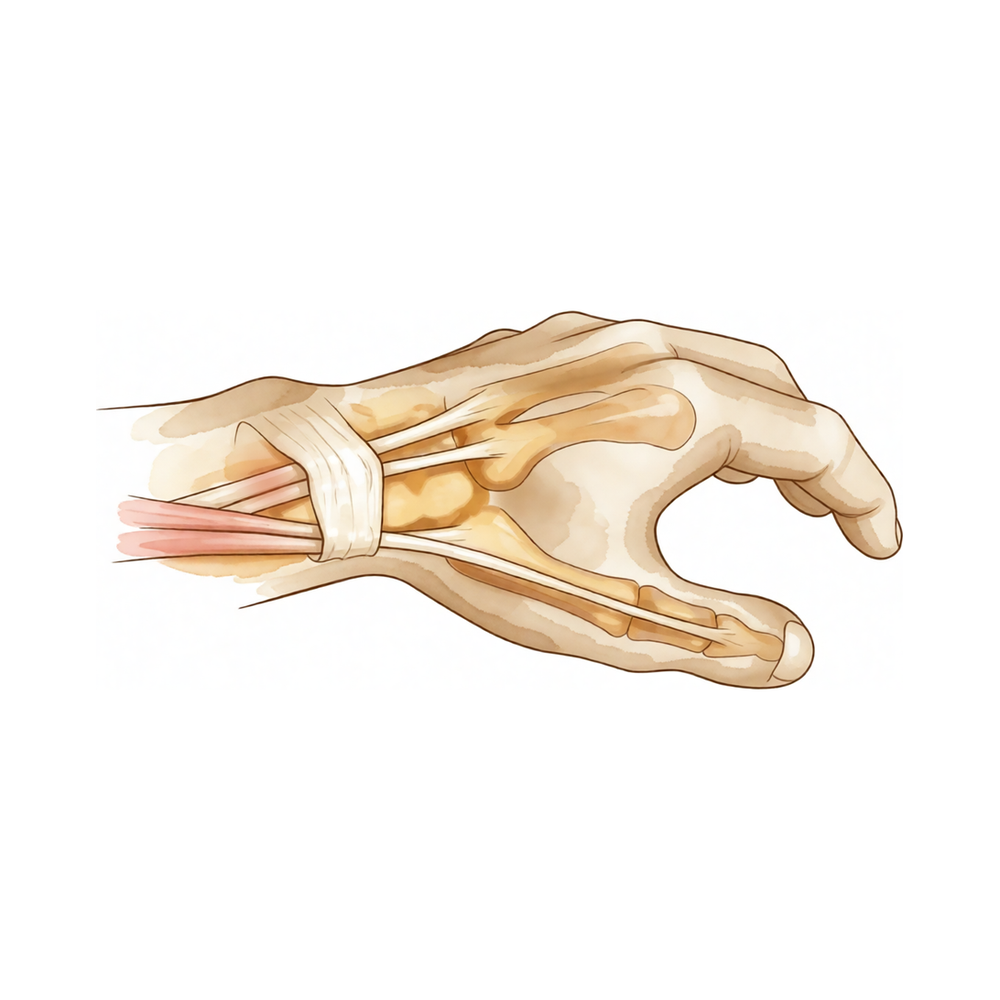
Ilustración de la parte posterior del antebrazo, donde los tendones del pulgar cruzan los tendones extensores de la muñeca; el dolor se señala en el punto de cruce.
Síndrome de intersección: la fricción que se produce cuando los tendones del pulgar cruzan sobre los tendones extensores de la muñeca, a unos pocos centímetros por encima de esta, provoca dolor e hinchazón. Kieran Hirpara 4.0

Esta página se tradujo automáticamente y todavía no la ha revisado un médico. La versión en inglés es la versión oficial.

Qué está sintiendo

El síndrome de intersección provoca dolor e hinchazón en la parte dorsal del antebrazo y en el lado del pulgar, un poco por encima de la muñeca (aproximadamente a la distancia de un ancho de mano desde el bulto óseo en la parte posterior de la muñeca). No se trata de dolor en la articulación de la muñeca en sí, sino más arriba, donde los músculos del antebrazo se cruzan entre sí.

El dolor suele intensificarse al doblar la muñeca hacia atrás o al mover el pulgar, y con frecuencia aparece tras realizar actividades repetitivas: remo, levantamiento de pesas, deportes con raqueta, jardinería, o mucho trabajo que requiera el uso constante del teclado o de la muñeca. Muchas personas observan hinchazón en la zona afectada; algunas sienten o incluso oyen un crujido suave, chirrido o rechinar al mover la muñeca, como si algo se estuviera frotando. Esto a veces se conoce como sonido de “cuero húmedo”.

¿Qué está ocurriendo realmente?

En el dorso del antebrazo, hay dos grupos de músculos que se cruzan entre sí formando una “X”. Un grupo se extiende hasta el pulgar; el otro desciende para mover la muñeca. En el punto donde se cruzan, a unos pocos centímetros por encima de la muñeca, los tendones se deslizan uno frente al otro dentro de sus vainas lisas.

Cuando se realizan muchos movimientos repetitivos de la muñeca, ese punto de cruce se irrita e inflama. El revestimiento de las vainas tendinosas se hincha, aumenta la fricción y los tejidos se vuelven sensibles y edematosos, lo que provoca dolor, hinchazón y crujidos. Se trata de un problema por sobreuso, no de una lesión producida por un único incidente; además, no es lo mismo que el síndrome de De Quervain, un problema tendinoso relacionado que afecta al lado del pulgar y se localiza más abajo, justo en la muñeca. El síndrome de intersección se da en una zona más alta.

La buena noticia es que el tejido irritado mejora considerablemente una vez que cesan los movimientos repetitivos; en la mayoría de las personas, esta afección no provoca daños duraderos.

¿Qué podemos hacer al respecto?

El Dr. Kieran Hirpara orienta nuestro enfoque para el tratamiento de esta afección en nuestra clínica. Comenzamos con tratamientos no quirúrgicos y solo consideramos la cirugía si los síntomas persisten a pesar de estas medidas.

Casi todas las personas mejoran sin necesidad de cirugía. Los tratamientos principales son:

  • Evitar la actividad que agrava los síntomas: este es el paso más importante. Reducir temporalmente el remo, el levantamiento de pesas o cualquier actividad repetitiva durante unas semanas permite que la inflamación disminuya.
  • Usar una férula para la muñeca que mantenga la muñeca ligeramente flexionada hacia atrás. Esto relaja los tendones afectados; suele usarse durante unas pocas semanas.
  • Medicamentos antiinflamatorios en forma de tabletas o geles (AINEs) para aliviar el dolor y la hinchazón.
  • Aplicar hielo sobre la zona dolorida después de realizar actividades físicas.

Si estos tratamientos no logran mejorar los síntomas, una inyección de corticoides dentro del compartimento tendinoso (a menudo guiada por ecografía para mayor precisión) suele reducir la inflamación. En el reducido número de pacientes cuyos síntomas siguen reapareciendo a pesar de todo ello, una pequeña intervención quirúrgica para liberar y limpiar la vaina tendinosa irritada resulta muy eficaz. No obstante, este procedimiento rara vez resulta necesario.

Qué esperar

La mayoría de las personas se recuperan en unas pocas semanas o un par de meses después de reducir la actividad y usar una férula. El pronóstico es excelente: se trata de una afección que realmente mejora, y normalmente no deja debilidad ni rigidez duraderas una vez que se ha resuelto.

Lo que más suele provocar la recaída es volver a realizar la misma actividad intensa o repetitiva demasiado pronto. Volver a la actividad de forma gradual, y, cuando sea aplicable, revisar la técnica o el equipamiento empleado (por ejemplo, la forma de sujetar los remos en los remeros o la forma de agarrar la barra en el gimnasio), ayuda a prevenir su reaparición de forma permanente.

¿Cuándo consultar a un especialista?

  • Dolor e hinchazón en la parte posterior del antebrazo que no mejora tras unas pocas semanas de reposo y el uso de una férula.
  • Un sonido de crujido o chirrido en esa zona, o dolor que se intensifica cada vez que vuelves a practicar deporte o a realizar tu actividad laboral.
  • Síntomas que reaparecen a pesar del reposo; merece ser evaluado, ya que una inyección guiada por ecografía podría ser de ayuda.
  • Cualquier fiebre, piel caliente y enrojecida, o hinchazón que empeore rápidamente: consulta a un médico de inmediato, pues esto indica algo distinto a un simple sobreesfuerzo.

En profundidad

Esta sección va más allá de lo necesario para que usted tome decisiones sobre su propio tratamiento. El síndrome de intersección merece ser leído con mayor detenimiento, principalmente por lo que se confunde con él: se ubica a pocos centímetros de la tenosinovitis de De Quervain, se trata de manera distinta, y la evidencia que los diferencia es realmente escasa.

Ubicación del dolor y por qué eso constituye el diagnóstico

Dos músculos que van hacia el pulgar se cruzan sobre los dos tendones extensores de la muñeca, a unos cuatro a ocho centímetros por encima de la muñeca, en la cara posterior del antebrazo. La fricción en ese punto de cruce genera dolor, hinchazón y, a veces, un crujido audible o palpable al mover la muñeca.

La ubicación del dolor es el propio diagnóstico. En la tenosinovitis de De Quervain, el dolor se siente en la propia muñeca, sobre la protuberancia ósea del lado del pulgar. En el síndrome de intersección, el dolor se percibe claramente más arriba, en el antebrazo. Ambas afecciones se desencadenan con el movimiento del pulgar y de la muñeca, y ambas pueden provocar hinchazón; sin embargo, el punto de máxima sensibilidad al tacto las diferencia, y esta distinción es lo suficientemente fiable como para que, con frecuencia, no sea necesario recurrir a estudios por imagen.

¿Qué diferencia a ambas poblaciones?

La comparación directa se realizó con un número reducido de pacientes, 80, pero resulta informativa. El síndrome de intersección se presentó con mayor frecuencia en hombres y en la mano dominante que la enfermedad de De Quervain, tanto en el conjunto total de pacientes como al excluir a las mujeres en el período periparto; además, los pacientes con síndrome de intersección presentaron una duración de los síntomas mucho más corta [1].

Cada uno de estos hallazgos concuerda con el mecanismo fisiopatológico. El síndrome de intersección es una lesión por fricción derivada de movimientos repetitivos de extensión de la muñeca contra resistencia, como en el remo, el entrenamiento con pesas, los deportes de raqueta o el trabajo manual pesado; por eso afecta con mayor frecuencia al lado dominante y a quienes desarrollan dichas actividades laborales. La corta duración de los síntomas refleja que su aparición suele deberse a un cambio identificable en el nivel de actividad, en lugar de desarrollarse de forma insidiosa con el tiempo.

Por otro lado, la comparación con la enfermedad de De Quervain resulta igualmente reveladora: al excluir a las mujeres en el período periparto, la comparación cambió significativamente, lo cual subraya la fuerte asociación de esta enfermedad con el periodo postnatal; asociación que el síndrome de intersección no presenta.

Tratamiento y una exposición honesta de las evidencias

En la gran mayoría de los casos, el tratamiento es conservador: reposo relativo respecto al movimiento que desencadena los síntomas, el uso de una férula tipo “spica” para el pulgar, medidas antiinflamatorias y corrección de la técnica o de la carga de trabajo que provocó la lesión. Cuando esto no surte efecto, se recurre a la inyección de corticoides en el espacio afectado; la liberación quirúrgica del segundo compartimento se reserva para el reducido número de pacientes que no mejoran.

La base de evidencias que respalda esta secuencia de tratamientos es escasa. La literatura científica está compuesta en su mayoría por series de casos e informes descriptivos; no existen ensayos que comparen las distintas opciones terapéuticas, y el estudio comparativo más amplio disponible es la serie mencionada anteriormente con 80 pacientes [1]. El orden de tratamiento se basa más en el mecanismo fisiopatológico y en la experiencia clínica que en una superioridad demostrada de alguna opción; esto merece ser expresado con claridad, en lugar de dar a entender que existe una base científica más sólida de la que realmente hay.

En la práctica, lo más valioso que se puede ofrecer en este caso es el diagnóstico mismo. Dado que la afección es autolimitada una vez que se elimina la carga que la provoca, identificar correctamente el sitio afectado y, por ende, el movimiento que debe modificarse, constituye el paso más importante del tratamiento.

Referencias

[1] Sato J, Ishii Y, Noguchi H. Características clínicas y ecográficas en pacientes con síndrome de intersección o enfermedad de De Quervain. J Hand Surg Eur Vol. 2015;41(2):220-5. https://doi.org/10.1177/1753193415614267


Creative Commons BY-NC 4.0

CC Creative Commons licence
BY Attribution — you must credit the source
NC NonCommercial — not for commercial use

Attribution-NonCommercial 4.0 International


Creative Commons Corporation ("Creative Commons") is not a law firm and does not provide legal services or legal advice. Distribution of Creative Commons public licenses does not create a lawyer-client or other relationship. Creative Commons makes its licenses and related information available on an "as-is" basis. Creative Commons gives no warranties regarding its licenses, any material licensed under their terms and conditions, or any related information. Creative Commons disclaims all liability for damages resulting from their use to the fullest extent possible.

Using Creative Commons Public Licenses

Creative Commons public licenses provide a standard set of terms and conditions that creators and other rights holders may use to share original works of authorship and other material subject to copyright and certain other rights specified in the public license below. The following considerations are for informational purposes only, are not exhaustive, and do not form part of our licenses.

Considerations for licensors: Our public licenses are intended for use by those authorized to give the public permission to use material in ways otherwise restricted by copyright and certain other rights. Our licenses are irrevocable. Licensors should read and understand the terms and conditions of the license they choose before applying it. Licensors should also secure all rights necessary before applying our licenses so that the public can reuse the material as expected. Licensors should clearly mark any material not subject to the license. This includes other CC- licensed material, or material used under an exception or limitation to copyright. More considerations for licensors: wiki.creativecommons.org/Considerations_for_licensors

Considerations for the public: By using one of our public licenses, a licensor grants the public permission to use the licensed material under specified terms and conditions. If the licensor's permission is not necessary for any reason--for example, because of any applicable exception or limitation to copyright--then that use is not regulated by the license. Our licenses grant only permissions under copyright and certain other rights that a licensor has authority to grant. Use of the licensed material may still be restricted for other reasons, including because others have copyright or other rights in the material. A licensor may make special requests, such as asking that all changes be marked or described. Although not required by our licenses, you are encouraged to respect those requests where reasonable. More considerations for the public: wiki.creativecommons.org/Considerations_for_licensees


Creative Commons Attribution-NonCommercial 4.0 International Public License

By exercising the Licensed Rights (defined below), You accept and agree to be bound by the terms and conditions of this Creative Commons Attribution-NonCommercial 4.0 International Public License ("Public License"). To the extent this Public License may be interpreted as a contract, You are granted the Licensed Rights in consideration of Your acceptance of these terms and conditions, and the Licensor grants You such rights in consideration of benefits the Licensor receives from making the Licensed Material available under these terms and conditions.

Section 1 -- Definitions.

a. Adapted Material means material subject to Copyright and Similar Rights that is derived from or based upon the Licensed Material and in which the Licensed Material is translated, altered, arranged, transformed, or otherwise modified in a manner requiring permission under the Copyright and Similar Rights held by the Licensor. For purposes of this Public License, where the Licensed Material is a musical work, performance, or sound recording, Adapted Material is always produced where the Licensed Material is synched in timed relation with a moving image.

b. Adapter's License means the license You apply to Your Copyright and Similar Rights in Your contributions to Adapted Material in accordance with the terms and conditions of this Public License.

c. Copyright and Similar Rights means copyright and/or similar rights closely related to copyright including, without limitation, performance, broadcast, sound recording, and Sui Generis Database Rights, without regard to how the rights are labeled or categorized. For purposes of this Public License, the rights specified in Section 2(b)(1)-(2) are not Copyright and Similar Rights.

d. Effective Technological Measures means those measures that, in the absence of proper authority, may not be circumvented under laws fulfilling obligations under Article 11 of the WIPO Copyright Treaty adopted on December 20, 1996, and/or similar international agreements.

e. Exceptions and Limitations means fair use, fair dealing, and/or any other exception or limitation to Copyright and Similar Rights that applies to Your use of the Licensed Material.

f. Licensed Material means the artistic or literary work, database, or other material to which the Licensor applied this Public License.

g. Licensed Rights means the rights granted to You subject to the terms and conditions of this Public License, which are limited to all Copyright and Similar Rights that apply to Your use of the Licensed Material and that the Licensor has authority to license.

h. Licensor means the individual(s) or entity(ies) granting rights under this Public License.

i. NonCommercial means not primarily intended for or directed towards commercial advantage or monetary compensation. For purposes of this Public License, the exchange of the Licensed Material for other material subject to Copyright and Similar Rights by digital file-sharing or similar means is NonCommercial provided there is no payment of monetary compensation in connection with the exchange.

j. Share means to provide material to the public by any means or process that requires permission under the Licensed Rights, such as reproduction, public display, public performance, distribution, dissemination, communication, or importation, and to make material available to the public including in ways that members of the public may access the material from a place and at a time individually chosen by them.

k. Sui Generis Database Rights means rights other than copyright resulting from Directive 96/9/EC of the European Parliament and of the Council of 11 March 1996 on the legal protection of databases, as amended and/or succeeded, as well as other essentially equivalent rights anywhere in the world.

l. You means the individual or entity exercising the Licensed Rights under this Public License. Your has a corresponding meaning.

Section 2 -- Scope.

a. License grant.

1. Subject to the terms and conditions of this Public License, the Licensor hereby grants You a worldwide, royalty-free, non-sublicensable, non-exclusive, irrevocable license to exercise the Licensed Rights in the Licensed Material to:

a. reproduce and Share the Licensed Material, in whole or in part, for NonCommercial purposes only; and

b. produce, reproduce, and Share Adapted Material for NonCommercial purposes only.

2. Exceptions and Limitations. For the avoidance of doubt, where Exceptions and Limitations apply to Your use, this Public License does not apply, and You do not need to comply with its terms and conditions.

3. Term. The term of this Public License is specified in Section 6(a).

4. Media and formats; technical modifications allowed. The Licensor authorizes You to exercise the Licensed Rights in all media and formats whether now known or hereafter created, and to make technical modifications necessary to do so. The Licensor waives and/or agrees not to assert any right or authority to forbid You from making technical modifications necessary to exercise the Licensed Rights, including technical modifications necessary to circumvent Effective Technological Measures. For purposes of this Public License, simply making modifications authorized by this Section 2(a) (4) never produces Adapted Material.

5. Downstream recipients.

a. Offer from the Licensor -- Licensed Material. Every recipient of the Licensed Material automatically receives an offer from the Licensor to exercise the Licensed Rights under the terms and conditions of this Public License.

b. No downstream restrictions. You may not offer or impose any additional or different terms or conditions on, or apply any Effective Technological Measures to, the Licensed Material if doing so restricts exercise of the Licensed Rights by any recipient of the Licensed Material.

6. No endorsement. Nothing in this Public License constitutes or may be construed as permission to assert or imply that You are, or that Your use of the Licensed Material is, connected with, or sponsored, endorsed, or granted official status by, the Licensor or others designated to receive attribution as provided in Section 3(a)(1)(A)(i).

b. Other rights.

1. Moral rights, such as the right of integrity, are not licensed under this Public License, nor are publicity, privacy, and/or other similar personality rights; however, to the extent possible, the Licensor waives and/or agrees not to assert any such rights held by the Licensor to the limited extent necessary to allow You to exercise the Licensed Rights, but not otherwise.

2. Patent and trademark rights are not licensed under this Public License.

3. To the extent possible, the Licensor waives any right to collect royalties from You for the exercise of the Licensed Rights, whether directly or through a collecting society under any voluntary or waivable statutory or compulsory licensing scheme. In all other cases the Licensor expressly reserves any right to collect such royalties, including when the Licensed Material is used other than for NonCommercial purposes.

Section 3 -- License Conditions.

Your exercise of the Licensed Rights is expressly made subject to the following conditions.

a. Attribution.

1. If You Share the Licensed Material (including in modified form), You must:

a. retain the following if it is supplied by the Licensor with the Licensed Material:

i. identification of the creator(s) of the Licensed Material and any others designated to receive attribution, in any reasonable manner requested by the Licensor (including by pseudonym if designated);

ii. a copyright notice;

iii. a notice that refers to this Public License;

iv. a notice that refers to the disclaimer of warranties;

v. a URI or hyperlink to the Licensed Material to the extent reasonably practicable;

b. indicate if You modified the Licensed Material and retain an indication of any previous modifications; and

c. indicate the Licensed Material is licensed under this Public License, and include the text of, or the URI or hyperlink to, this Public License.

2. You may satisfy the conditions in Section 3(a)(1) in any reasonable manner based on the medium, means, and context in which You Share the Licensed Material. For example, it may be reasonable to satisfy the conditions by providing a URI or hyperlink to a resource that includes the required information.

3. If requested by the Licensor, You must remove any of the information required by Section 3(a)(1)(A) to the extent reasonably practicable.

4. If You Share Adapted Material You produce, the Adapter's License You apply must not prevent recipients of the Adapted Material from complying with this Public License.

Section 4 -- Sui Generis Database Rights.

Where the Licensed Rights include Sui Generis Database Rights that apply to Your use of the Licensed Material:

a. for the avoidance of doubt, Section 2(a)(1) grants You the right to extract, reuse, reproduce, and Share all or a substantial portion of the contents of the database for NonCommercial purposes only;

b. if You include all or a substantial portion of the database contents in a database in which You have Sui Generis Database Rights, then the database in which You have Sui Generis Database Rights (but not its individual contents) is Adapted Material; and

c. You must comply with the conditions in Section 3(a) if You Share all or a substantial portion of the contents of the database.

For the avoidance of doubt, this Section 4 supplements and does not replace Your obligations under this Public License where the Licensed Rights include other Copyright and Similar Rights.

Section 5 -- Disclaimer of Warranties and Limitation of Liability.

a. UNLESS OTHERWISE SEPARATELY UNDERTAKEN BY THE LICENSOR, TO THE EXTENT POSSIBLE, THE LICENSOR OFFERS THE LICENSED MATERIAL AS-IS AND AS-AVAILABLE, AND MAKES NO REPRESENTATIONS OR WARRANTIES OF ANY KIND CONCERNING THE LICENSED MATERIAL, WHETHER EXPRESS, IMPLIED, STATUTORY, OR OTHER. THIS INCLUDES, WITHOUT LIMITATION, WARRANTIES OF TITLE, MERCHANTABILITY, FITNESS FOR A PARTICULAR PURPOSE, NON-INFRINGEMENT, ABSENCE OF LATENT OR OTHER DEFECTS, ACCURACY, OR THE PRESENCE OR ABSENCE OF ERRORS, WHETHER OR NOT KNOWN OR DISCOVERABLE. WHERE DISCLAIMERS OF WARRANTIES ARE NOT ALLOWED IN FULL OR IN PART, THIS DISCLAIMER MAY NOT APPLY TO YOU.

b. TO THE EXTENT POSSIBLE, IN NO EVENT WILL THE LICENSOR BE LIABLE TO YOU ON ANY LEGAL THEORY (INCLUDING, WITHOUT LIMITATION, NEGLIGENCE) OR OTHERWISE FOR ANY DIRECT, SPECIAL, INDIRECT, INCIDENTAL, CONSEQUENTIAL, PUNITIVE, EXEMPLARY, OR OTHER LOSSES, COSTS, EXPENSES, OR DAMAGES ARISING OUT OF THIS PUBLIC LICENSE OR USE OF THE LICENSED MATERIAL, EVEN IF THE LICENSOR HAS BEEN ADVISED OF THE POSSIBILITY OF SUCH LOSSES, COSTS, EXPENSES, OR DAMAGES. WHERE A LIMITATION OF LIABILITY IS NOT ALLOWED IN FULL OR IN PART, THIS LIMITATION MAY NOT APPLY TO YOU.

c. The disclaimer of warranties and limitation of liability provided above shall be interpreted in a manner that, to the extent possible, most closely approximates an absolute disclaimer and waiver of all liability.

Section 6 -- Term and Termination.

a. This Public License applies for the term of the Copyright and Similar Rights licensed here. However, if You fail to comply with this Public License, then Your rights under this Public License terminate automatically.

b. Where Your right to use the Licensed Material has terminated under Section 6(a), it reinstates:

1. automatically as of the date the violation is cured, provided it is cured within 30 days of Your discovery of the violation; or

2. upon express reinstatement by the Licensor.

For the avoidance of doubt, this Section 6(b) does not affect any right the Licensor may have to seek remedies for Your violations of this Public License.

c. For the avoidance of doubt, the Licensor may also offer the Licensed Material under separate terms or conditions or stop distributing the Licensed Material at any time; however, doing so will not terminate this Public License.

d. Sections 1, 5, 6, 7, and 8 survive termination of this Public License.

Section 7 -- Other Terms and Conditions.

a. The Licensor shall not be bound by any additional or different terms or conditions communicated by You unless expressly agreed.

b. Any arrangements, understandings, or agreements regarding the Licensed Material not stated herein are separate from and independent of the terms and conditions of this Public License.

Section 8 -- Interpretation.

a. For the avoidance of doubt, this Public License does not, and shall not be interpreted to, reduce, limit, restrict, or impose conditions on any use of the Licensed Material that could lawfully be made without permission under this Public License.

b. To the extent possible, if any provision of this Public License is deemed unenforceable, it shall be automatically reformed to the minimum extent necessary to make it enforceable. If the provision cannot be reformed, it shall be severed from this Public License without affecting the enforceability of the remaining terms and conditions.

c. No term or condition of this Public License will be waived and no failure to comply consented to unless expressly agreed to by the Licensor.

d. Nothing in this Public License constitutes or may be interpreted as a limitation upon, or waiver of, any privileges and immunities that apply to the Licensor or You, including from the legal processes of any jurisdiction or authority.


Creative Commons is not a party to its public licenses. Notwithstanding, Creative Commons may elect to apply one of its public licenses to material it publishes and in those instances will be considered the “Licensor.” The text of the Creative Commons public licenses is dedicated to the public domain under the CC0 Public Domain Dedication. Except for the limited purpose of indicating that material is shared under a Creative Commons public license or as otherwise permitted by the Creative Commons policies published at creativecommons.org/policies, Creative Commons does not authorize the use of the trademark "Creative Commons" or any other trademark or logo of Creative Commons without its prior written consent including, without limitation, in connection with any unauthorized modifications to any of its public licenses or any other arrangements, understandings, or agreements concerning use of licensed material. For the avoidance of doubt, this paragraph does not form part of the public licenses.

Creative Commons may be contacted at creativecommons.org.