Patients › Rehabilitation
Dedo en martillo
Un plan de recuperación mediante férula para el dedo en martillo: se mantiene la articulación de la punta del dedo completamente recta y sin interrupción durante unas seis a ocho semanas para que cicatrice el tendón extensor, mientras las demás articulaciones del dedo siguen moviéndose.
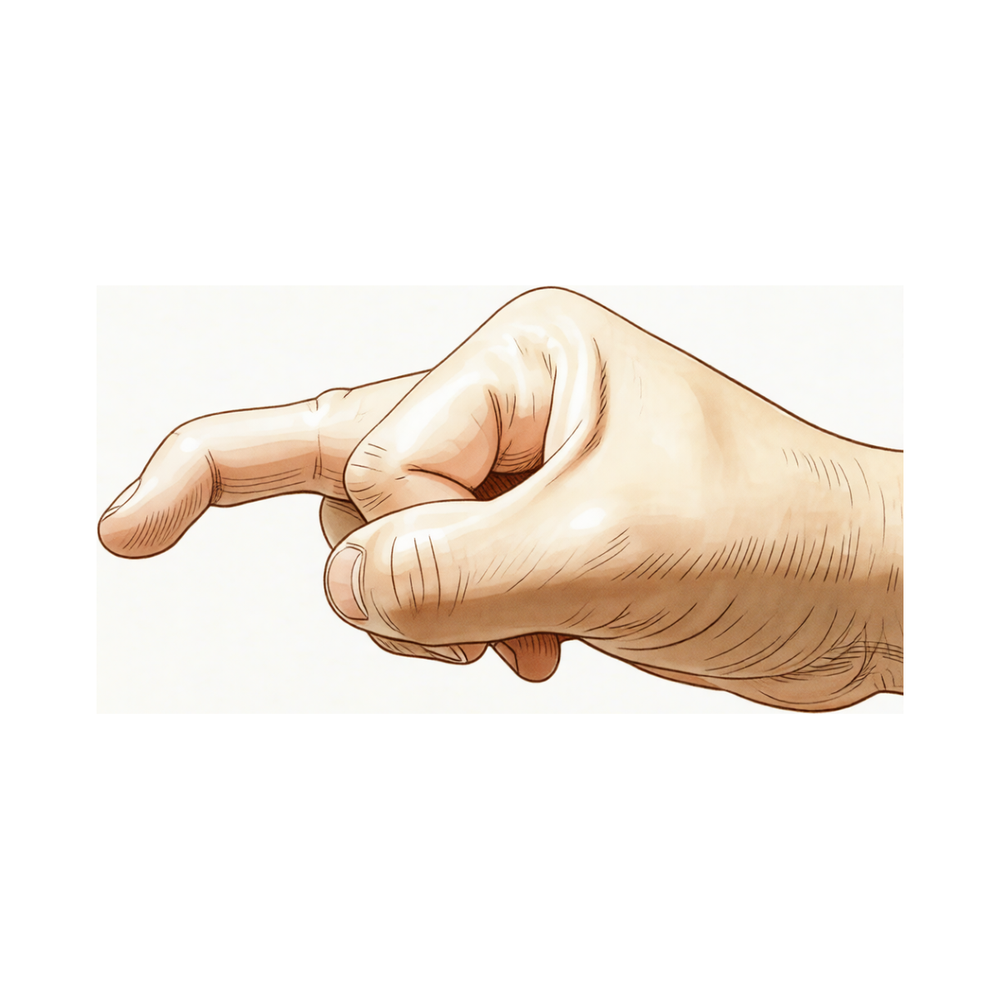
Este protocolo le guiará en su recuperación de un dedo en martillo (una deformidad en la punta del dedo provocada por una lesión en el tendón que endereza la última articulación del dedo), bajo el cuidado del Dr. Kieran Hirpara en el Mater Private Hospital Rockhampton. La mayoría de los casos de dedo en martillo se tratan sin cirugía, mediante el uso de una férula que mantiene la punta del dedo recta mientras cicatriza. El proceso comienza con un programa de ejercicios en casa, seguido del protocolo clínico estructurado que se ha diseñado para su terapeuta de la mano. Lleve esta página o su versión en PDF a su primera sesión de terapia para garantizar que la rehabilitación se realice de manera coordinada. Su terapeuta podría modificar el plan según el progreso de su recuperación.
Si tiene alguna duda respecto al dedo, a la piel bajo la férula o a su evolución, no dude en contactar con el consultorio. A menudo resulta útil tomar una fotografía y enviarla por correo electrónico para su revisión.
Qué esperar
El dedo en martillo se produce cuando el tendón extensor terminal (el tendón delgado encargado de enderezar la última articulación del dedo, la DIP situada junto a la uña) se desprende del hueso. Generalmente ocurre tras una flexión forzada de la punta del dedo, como cuando se golpea con una pelota o se da un golpe que “atrapa” el extremo del dedo. En algunos casos el tendón arranca consigo un pequeño fragmento óseo (dedo en martillo óseo); en otros, el tendón se desgarra por sí solo (dedo en martillo tendinoso). En cualquier caso, el resultado es el mismo: la punta del dedo queda caída y usted no puede enderezarla por sí mismo, aunque el resto del dedo funcione normalmente.
La buena noticia es que esta lesión sana con gran fiabilidad únicamente mediante el uso de una férula; para la mayoría de las personas no se requiere cirugía. Todo el tratamiento se basa en un único principio sencillo:
- La articulación de la punta del dedo debe mantenerse completamente recta, sin interrupción, mientras el tendón sana. La férula mantiene la última articulación recta (o ligeramente en hiperextensión) para que los extremos desgarrados puedan unirse. Esta férula se lleva todo el tiempo (día y noche) durante unas ocho semanas en caso de dedo en martillo tendinoso, o unas seis semanas si se trata de un dedo en martillo óseo.
- Durante este período, la punta del dedo no debe doblarse bajo ninguna circunstancia. Si la punta se dobla aunque sea brevemente (por ejemplo, al cambiar la férula o al lavarse), el proceso de curación se interrumpe y hay que volver a empezar desde cero. Por este motivo, la precisión con la que se mantenga la punta recta es el factor más importante para una buena recuperación del dedo.
- Las demás articulaciones del dedo deben permanecer libres y moverse con normalidad. La articulación intermedia (PIP) y la articulación metacarpofalángica (MCP) quedan fuera de la férula y deben moverse libremente desde el principio; moverlas no interfiere en la curación de la punta.
Una vez transcurrido el período de uso continuo, la férula se va retirando gradualmente (primero solo por la noche o al realizar actividades de riesgo, y luego por completo), mientras se empieza a flexionar poco a poco la punta del dedo. Es normal que quede una ligera caída permanente de unos cinco a diez grados; esto es esperable, normalmente no afecta al funcionamiento del dedo, y la mayoría de las personas quedan muy satisfechas con el resultado.
Precauciones y limitaciones
- NUNCA permita que la punta del dedo se doble durante la fase de inmovilización; ni siquiera por un segundo al lavarse o al cambiar la férula. Si se dobla, el proceso de curación se reinicia y el período de inmovilización vuelve a comenzar.
- Use la férula todo el tiempo (día y noche) durante el período indicado por su terapeuta: aproximadamente 8 semanas para un martillo tendinoso, unas 6 semanas para un martillo óseo.
- Solo retire la férula para limpiar y secar la piel, y únicamente si puede mantener la punta del dedo completamente recta en todo momento (apóyela plana sobre una mesa o sosténgala recta con la otra mano).
- Mantenga la articulación media y el nudillo en movimiento desde el inicio; solo la última articulación debe permanecer inmóvil.
- Revise la piel a diario. Informe a su terapeuta de la mano si la piel sobre la parte superior de la articulación se vuelve pálida, blanca o dolorosa; es posible que la férula esté manteniendo la punta del dedo demasiado hacia atrás y necesite ajustes.
- No comience a doblar la punta del dedo hasta que su terapeuta inicie la fase de retirada progresiva de la férula.
Para el cuidado de heridas, la reducción de la hinchazón y el manejo de la piel, consulte las pautas de cuidado de heridas de nuestra consulta.
Sus ejercicios
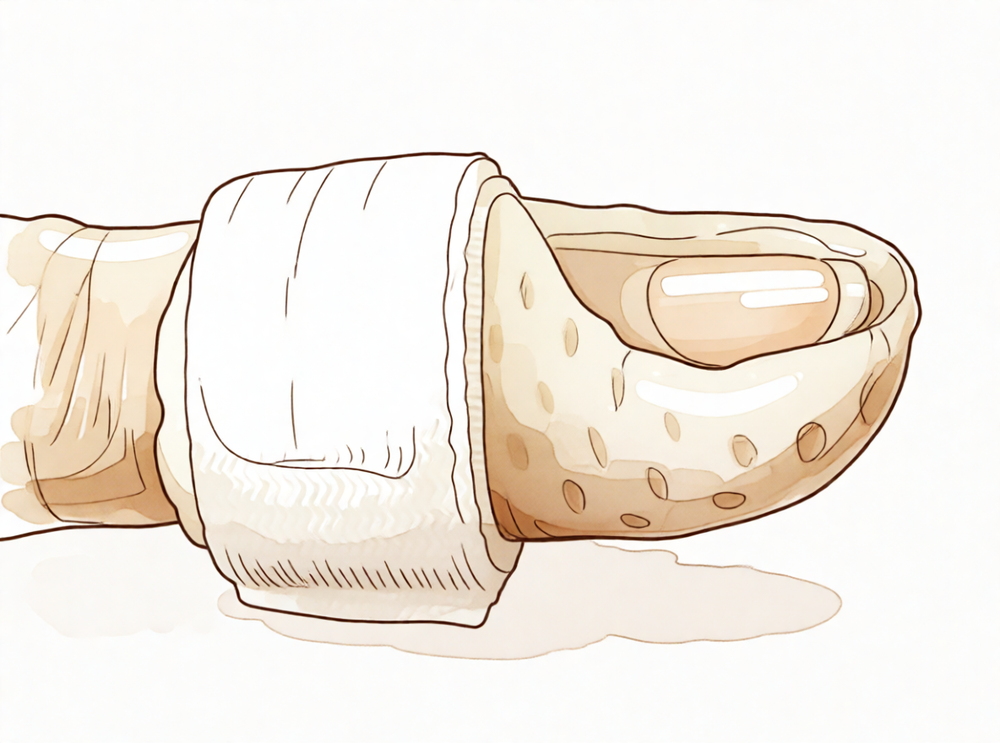
Davplast / Wikimedia Commons, CC BY-SA 4.0
Uso de su férula de extensión de la DIP (la punta del dedo nunca debe doblarse)
Use la férula en la articulación de la punta del dedo en TODO momento: de día y de noche, de modo que la última articulación (la DIP, la que está más cerca de la uña) permanezca completamente recta. Este es el aspecto más importante de su tratamiento. La punta del dedo NO debe doblarse bajo ninguna circunstancia, ni siquiera por un instante: si se dobla en algún momento, la cicatrización comenzará de nuevo desde cero y se reiniciará el tiempo de recuperación. Mantenga la férula puesta al lavarse, al dormir y al trabajar; verifique siempre que la punta del dedo permanezca recta dentro de ella.
Uso continuo: dedo en martillo tendinoso unas 8 semanas, dedo en martillo óseo unas 6 semanas
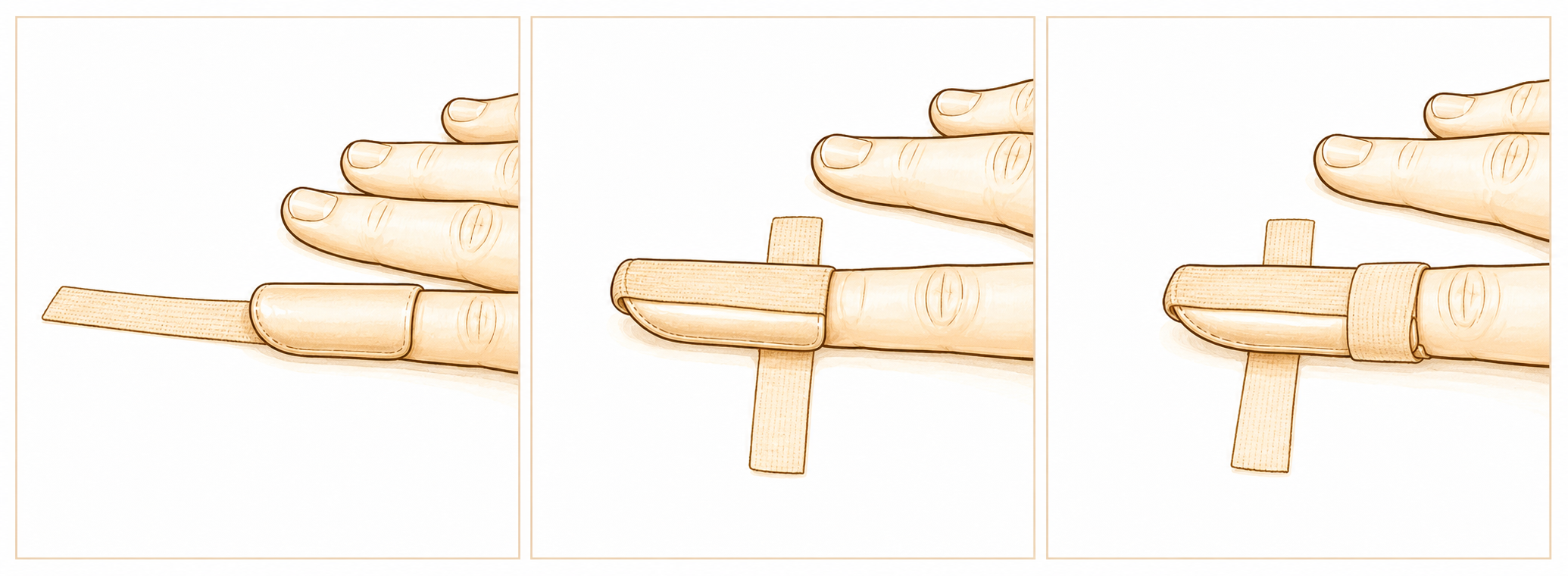
Kieran Hirpara 4.0
Cómo cambiar la férula de forma segura (mantenga la punta del dedo recta)
La férula solo se retira para limpiar y secar la piel, y únicamente si es posible mantener la punta del dedo completamente recta en todo momento. Apoye el dedo plano a lo largo del borde de una mesa para que la punta quede sostenida y no pueda caer, o use la otra mano para mantenerlo recto. Retire la férula vieja deslizándola, limpie y seque, y luego deslice la nueva; todo ello sin permitir en ningún momento que la punta se doble. Si no se siente seguro haciendo esto, deje que lo haga su terapeuta de la mano.
Una vez al día para el cuidado de la piel, únicamente con la punta del dedo mantenida completamente recta
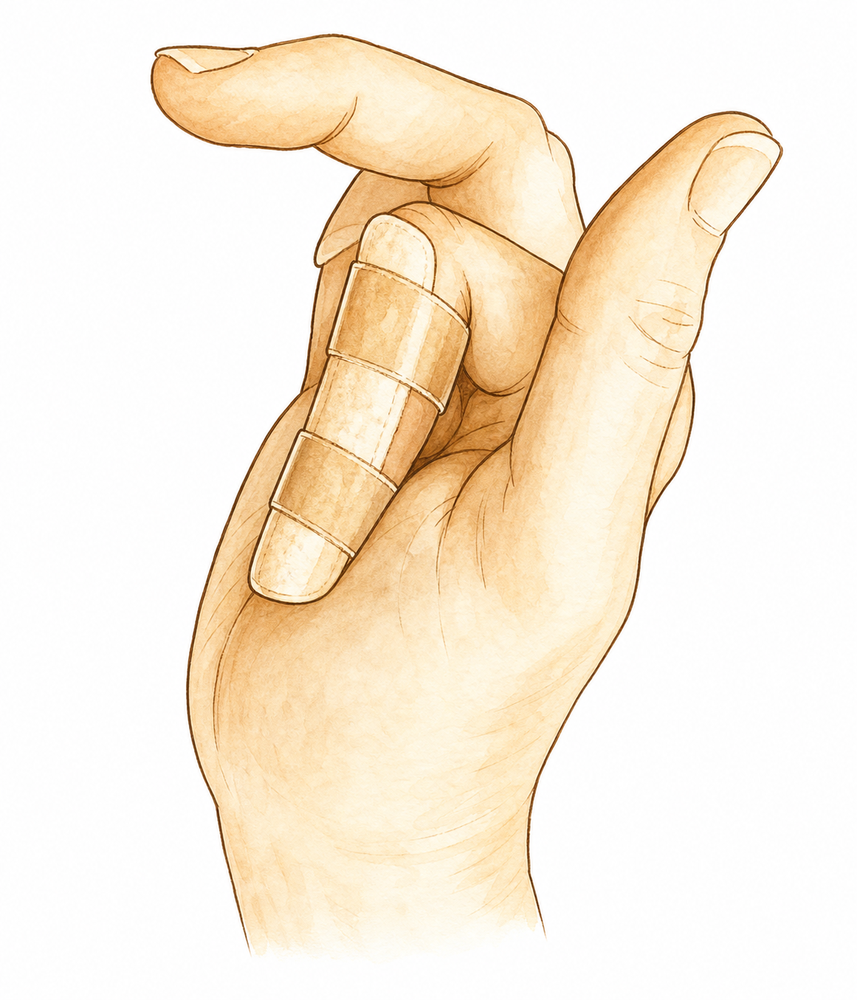
Kieran Hirpara 4.0
Mantenga en movimiento la articulación media y el nudillo (PIP y MCP)
Mientras la punta del dedo permanece recta en la férula, mantenga en movimiento las DEMÁS articulaciones del dedo para que no se pongan rígidas. Doble y estire completamente y con libertad la articulación media (la PIP) y el nudillo (la MCP); estas articulaciones pueden moverse sin riesgo y moverlas no altera la cicatrización del tendón en la punta. Cierre la mano en un puño parcial y vuelva a abrirla, manteniendo en todo momento recta la punta del dedo en la férula.
10 veces en cada articulación, varias veces al día, con la férula puesta
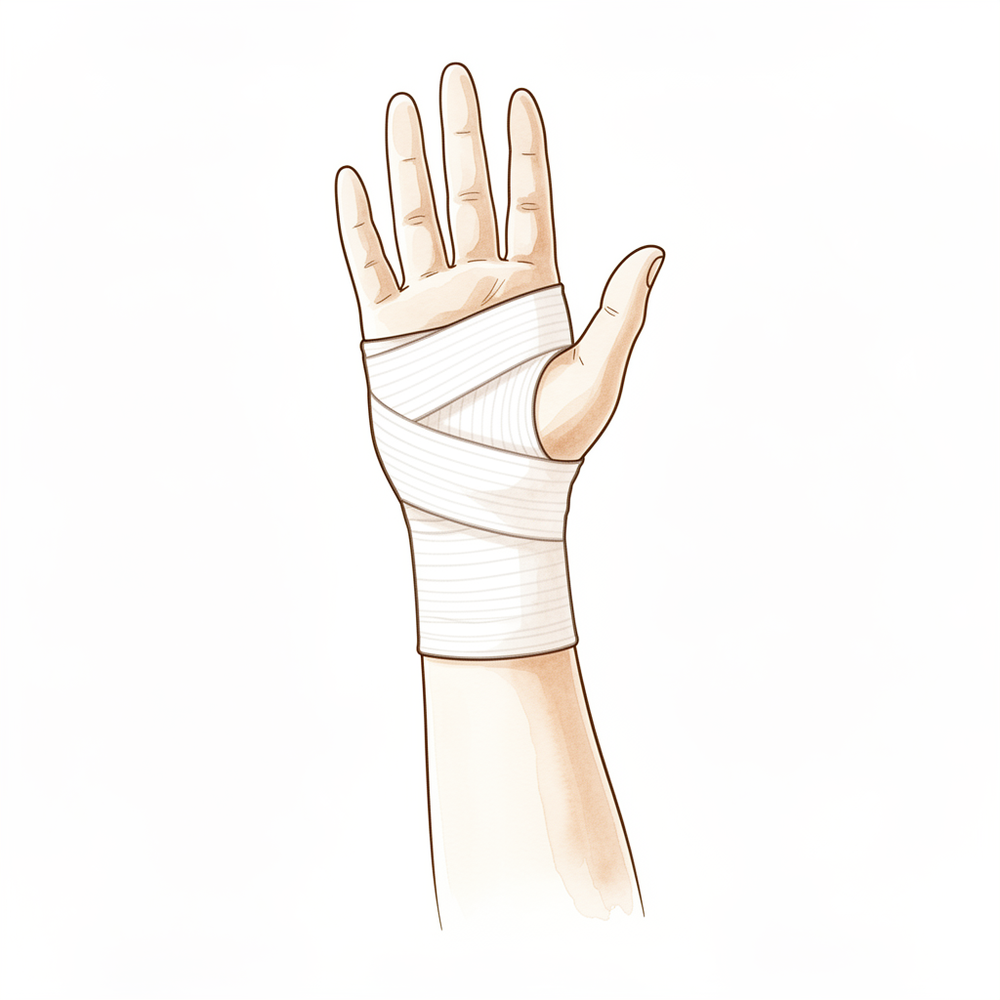
Kieran Hirpara 4.0
Cuidado de la piel y la hinchazón bajo la férula
Cada día, manteniendo la punta del dedo recta, revise la piel, especialmente sobre la parte superior de la articulación y la uña. Un ligero enrojecimiento es normal; sin embargo, si la piel se ve pálida, blanca o dolorida donde presiona la férula, es posible que esta esté manteniendo la punta demasiado hacia atrás; informe a su terapeuta de la mano para que pueda ajustarla. Mantenga el dedo y la férula limpios y secos, y eleve la mano si se hincha.
Revise a diario; informe si observa piel pálida, dolorida o dañada
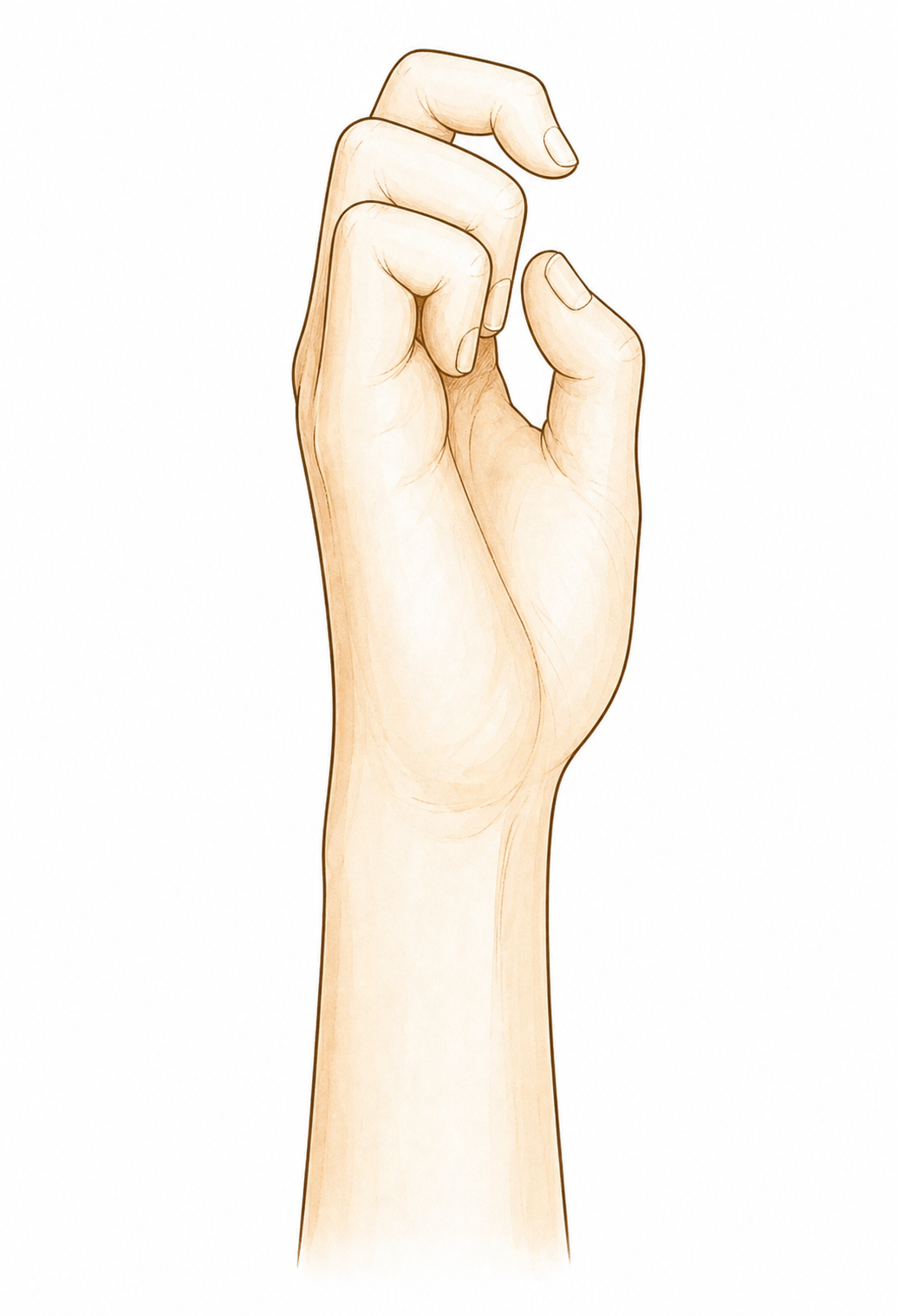
Kieran Hirpara 4.0
Flexión graduada de la punta del dedo (fase de retirada progresiva)
Un ejercicio POSTERIOR: solo cuando su terapeuta de la mano comience la retirada progresiva de la férula (habitualmente a partir de las 6 a 8 semanas) y no haya caída de la punta, o esta sea solo aceptable. Sin la férula, doble suavemente la articulación de la punta del dedo una PEQUEÑA cantidad y luego vuelva a estirarla por completo, siempre dentro de lo cómodo. No la fuerce. Si la punta empieza a caer de nuevo, vuelva a usar la férula a tiempo completo y avise a su terapeuta.
Unas pocas flexiones suaves, solo según se indique en la fase de retirada progresiva
Estos son los ejercicios que aparecen en su folleto informativo. El “ejercicio” más importante de todos es, sencillamente, usar la férula correctamente y mantener la punta del dedo recta en todo momento; todo lo demás se basa en eso. Al principio, su tarea consiste en mantener la férula puesta, conservar la salud de la piel y asegurar que las demás articulaciones de los dedos se muevan libremente. Los ejercicios suaves de flexión de la punta del dedo y de extensión con bloqueo corresponden a la fase posterior de retirada progresiva y no deben iniciarse hasta que su terapeuta de la mano los indique específicamente. Interrumpa cualquier cosa que haga que la punta del dedo caiga y vuelva a usar la férula de forma continua.
Su protocolo clínico
El resto de esta página describe el protocolo clínico por etapas para la rehabilitación mediante férula del dedo en martillo. Esta sección debe entregarse al terapeuta de la mano; cada fase comienza con una explicación sencilla en lenguaje coloquial de lo que ocurre. La cicatrización depende de una extensión continua de la articulación DIP: el tendón terminal (o el fragmento óseo desprendido) solo se une si durante el período de inmovilización la DIP no se flexiona en ningún momento; en cambio, las articulaciones PIP y MCP deben permanecer libres, pues su movimiento no interfiere en la cicatrización del tendón terminal. El cumplimiento del paciente es el factor determinante del resultado.
Antes de iniciar el tratamiento, confirme si el dedo en martillo se debe a una lesión tendinosa o ósea y revise las imágenes diagnósticas. Se emplea una ortesis de extensión para la DIP: de tipo Stack, termoplástica o de espuma de aluminio volar/dorsal; el tipo de férula no influye significativamente en el resultado, por lo que se debe elegir según el ajuste, la tolerancia cutánea y el cumplimiento del paciente. Mantenga la DIP en extensión total o con una ligera hiperextensión, pero EVITE una hiperextensión excesiva (riesgo de palidez o úlceras en la piel dorsal). En casos de dedo en martillo óseo, es preferible mantener la DIP en posición neutra o recta en lugar de hiperextenderla, para evitar la subluxación volar de la falange distal. La articulación PIP siempre debe quedar libre.
Fase I: inmovilización continua mediante férula de extensión a tiempo completo (semanas 0 a 6/8)
La articulación de la punta del dedo se mantiene continuamente en extensión, día y noche, para permitir la cicatrización del tendón o del fragmento óseo. La férula solo se retira para el cuidado de la piel, y siempre manteniendo la articulación DIP en extensión; cualquier episodio aislado de flexión de la DIP reinicia el proceso de cicatrización. Las articulaciones PIP y MCP pueden moverse libremente.
Para su terapeuta de la mano:
Instrucciones y precauciones - Coloque una ortesis de extensión para la DIP (tipo Stack, termoplástica o de espuma de aluminio), asegurándose de que la DIP quede en extensión completa o con una ligera hiperextensión; evite una hiperextensión excesiva (puede causar palidez cutánea o úlceras); en el dedo en martillo óseo → posición recta/neutra, nunca hiperextendida (riesgo de subluxación). - Uso continuo: aproximadamente 8 semanas para lesiones tendinosas y 6 semanas para lesiones óseas; durante este período la DIP no debe flexionarse bajo ninguna circunstancia. - Enseñe al paciente una técnica para cambiar la férula sobre una superficie plana, de modo que la DIP nunca quede en posición de flexión; si el paciente no puede mantener la extensión, el terapeuta realizará el cambio. - Las articulaciones PIP y MCP deben permanecer libres y ser movilizadas activamente desde el primer día.
Manejo clínico - Piel: inspección diaria del dorso de la DIP y del pliegue ungueal; ajuste la ortesis si aparece palidez o presión excesiva; mantenga la zona limpia y seca. - Edema: elevación de la mano; movilización suave de las articulaciones proximales. - Ejercicios: realizar movimientos activos completos de las articulaciones PIP y MCP; no se permite ningún movimiento de la DIP. - Dedo en martillo óseo: mantener vigilancia radiográfica durante el uso de la férula (alineación/subluxación), ya que la inmovilización es no inferior a la fijación con agujas en cuanto al déficit de extensión; sin embargo, es imprescindible monitorizar la posición del fragmento óseo.
Criterios para avanzar a la fase siguiente - Transcurrido el período completo de inmovilización (aproximadamente 8 semanas para lesiones tendinosas / 6 semanas para lesiones óseas), sin déficit de extensión de la DIP por encima de los límites aceptables, y con la piel en buen estado.
Fase II: reducción del uso de la férula y comienzo de movilización controlada de la articulación DIP (semanas 6/8, y luego de 2 a 6 semanas más)
Una vez finalizado el período de uso continuo de la férula y siempre que no exista déficit de extensión, o este sea aceptable, se reduce el uso de la férula a solo por las noches y durante actividades de alto riesgo, mientras se inicia una flexión controlada y suave de la articulación DIP. El uso nocturno de la férula puede considerarse opcional (un estudio de nivel I determinó que no es esencial) y se emplea según sea necesario. Si vuelve a aparecer un déficit de extensión significativo, el paciente debe volver a usar la férula de extensión de forma continua.
Para su terapeuta de la mano:
Evaluaciones - Déficit de extensión activa de la articulación DIP (en grados) y flexión activa; estado de la piel; nivel de confianza del paciente con la punta del dedo fuera de la férula
Instrucciones y precauciones - Reducir el uso de la férula a solo por las noches y durante actividades de alto riesgo durante unas 2 a 6 semanas más; el uso nocturno es opcional según la evidencia actual. - Si reaparece un déficit de extensión >20° tras el periodo de férula, se debe reanudar el uso continuo de la férula de extensión durante unas 4 a 6 semanas.
Manejo - Ejercicios: iniciar una flexión activa de la articulación DIP, suave y progresiva (empezando con un rango pequeño) y una extensión activa controlada de la DIP (estabilizando la articulación PIP mientras se extiende la DIP); aumentar gradualmente el rango de flexión según lo permita el déficit de extensión. - Reducir el uso diurno de la férula una vez que la articulación DIP mantenga la extensión activamente, sin déficit o con un déficit aceptable (≤10–20°). - Continuar con la movilización completa de las articulaciones PIP y MCP; cuidado de la cicatriz y la piel según sea necesario. - Los dedos en martillo crónicos o diagnosticados tardíamente también responden al uso de férulas de extensión; el inicio tardío del tratamiento no constituye una contraindicación.
Criterios para avanzar a la siguiente fase - La articulación DIP mantiene la extensión activamente con un déficit aceptable; se ha recuperado una flexión controlada y sin dolor; la piel permanece intacta.
Fase III — Fortalecimiento y reincorporación (aproximadamente de la semana 8 a la 12)
Una vez que el tendón ha cicatrizado y se ha recuperado el movimiento activo, se retira por completo la férula y se inicia un programa gradual de fortalecimiento y reincorporación a las actividades. Se espera un ligero déficit de extensión permanente (promedio de ~8°), lo cual es compatible con un resultado funcional excelente.
Para su terapeuta de la mano:
Evaluaciones - Déficit de extensión activa y arco de flexión en la articulación DIP; fuerza de agarre; grado de preparación para la carga y la práctica deportiva
Educación y precauciones - Uso diario sin férula; uso de férula protectora durante la práctica de deportes de contacto durante la reincorporación - Informar al paciente de que un déficit de extensión residual de ~5–10° es normal y no afecta su satisfacción con el resultado
Manejo - Ejercicios: fortalecimiento gradual de la fuerza de agarre y pinza; recuperación completa del rango de movimiento de los dedos; progresión adaptada a tareas y deportes específicos - La reincorporación a deportes o trabajos pesados se realiza a partir de las semanas 8 a 12 aproximadamente, según criterios clínicos (con uso de férula protectora en deportes de contacto) - El alta se concede cuando la fuerza y la función son adecuadas y el déficit de extensión se mantiene estable; se remitirá nuevamente al paciente si persiste o reaparece un déficit marcado.
Volver al trabajo y a las actividades cotidianas
El uso ligero de la mano con férula es aceptable desde el principio: la férula se mantiene puesta, la punta del dedo permanece recta y puede utilizar la mano para tareas diarias dentro de esos límites. No debe conducir mientras lleve puesta la férula de la punta del dedo: la conducción debe esperar hasta que se haya retirado la férula y pueda agarrar el volante y controlar el vehículo de forma segura, según lo confirme el Dr. Hirpara en su revisión. La capacidad de agarre y la fuerza se van recuperando a partir de las seis a ocho semanas, a medida que se va retirando la férula. El regreso a deportes y trabajos manuales más exigentes suele ocurrir entre las ocho y doce semanas, evaluándose según la recuperación de un movimiento controlado y no únicamente en función del tiempo transcurrido; durante ese periodo, se debe usar una férula protectora en deportes de contacto. Es normal que la punta del dedo presente una ligera caída permanente de unos cinco a diez grados; esto no afecta el funcionamiento de la mano y la mayoría de las personas apenas lo notan.
Después de seguir este protocolo
Este protocolo se complementa con las recomendaciones generales de recuperación que brinda la clínica; consulte control del dolor postoperatorio, cuidado de la herida y cuidado de las cicatrices. El plan por fases descrito anteriormente se basa en las guías publicadas para el uso de férulas en casos de dedo en martillo; su recuperación continua será supervisada individualmente por el Dr. Hirpara y su terapeuta de la mano, según la evolución de su punta del dedo.
Nota: si su dedo en martillo se corrige mediante cirugía
En la mayoría de los casos, el dedo en martillo no requiere intervención quirúrgica. La cirugía solo se considera en casos de dedo en martillo óseo, cuando la fractura afecta a una gran parte de la superficie articular (más de un tercio aproximadamente) o cuando la última articulación se desplaza de su posición normal (subluxación volar). Cuando se realiza la fijación, lo habitual es utilizar alambres de K tipo bloque de extensión (método Ishiguro); a veces se coloca además un alambre temporal a través de la articulación distal del dedo para mantenerlo recto. Este alambre suele permanecer en su lugar entre cuatro y seis semanas, y se retira hacia las cinco a seis semanas; a partir de entonces se inicia el movimiento activo del dedo, y puede usarse una férula nocturna durante otras cuatro semanas aproximadamente. La evidencia clínica indica que la férula no es inferior a la fijación con agujas en cuanto al grado final de caída; por ello, la cirugía se reserva únicamente para las situaciones mencionadas anteriormente y no se emplea de forma rutinaria.
Evidence & references
This is the clinical evidence summary written for health professionals. It is technical, and it lists the research this page was built from. You do not need to read it to understand your treatment or to make a decision about it.
Mallet Finger — Injury Outcomes & Splint-Led Rehabilitation (Terminal Extensor Tendon, DIP)
Topic scope: non-operative (and, where indicated, post-fixation) management of a mallet finger — disruption of the terminal extensor tendon at the distal interphalangeal (DIP) joint, either purely tendinous or with an avulsion bony fragment (bony mallet). This is a healing injury, not a reconstruction: the entire treatment is uninterrupted DIP extension splinting that holds the tendon (or fragment) in apposition while it unites, with the PIP and MCP left free.
Defining principle of the rehab here: the terminal extensor tendon heals only if the DIP is held in continuous extension and is never allowed to flex during the splinting period. Any single lapse into DIP flexion separates the healing ends and restarts the healing clock, which is why patient compliance is the dominant outcome driver. The PIP is deliberately kept mobile because proximal-joint motion does not disturb terminal-tendon healing. Splint type (Stack, thermoplastic, volar/dorsal alumifoam) does not materially change the outcome — fit, skin tolerance and compliance matter more than the device. The single branch point is the bony mallet with a large articular fragment or DIP volar subluxation, where surgical fixation is considered; even there, splinting is non-inferior to pinning for the final extensor lag, so operation is reserved rather than routine.
A. INJURY OUTCOMES (tendinous vs bony mallet; splinting vs fixation)
Mallet finger is one of the most reliably treated closed tendon injuries in the hand: the great majority heal well with splinting alone, and the principal debate is over the bony mallet — when, if ever, to fix it.
- Continuous extension splinting is the standard of care and works well for both tendinous and bony mallets, including chronic and delayed presentations, which still respond to splinting weeks after injury [Valdes systematic review LoE 1a; Salazar Botero review; Medscape; StatPearls]. Strong (SR + reviews).
- Splint type makes no meaningful outcome difference. A randomised comparison of splint designs found no superiority of one orthosis over another; the determinant is uninterrupted DIP extension and compliance, not the device [Pike RCT]. Strong (RCT).
- Splinting is non-inferior to extension-block pinning for the final extensor lag. A randomised trial comparing conservative extension splinting with operative extension-block K-wiring for bony mallet found no advantage to pinning in the residual lag, supporting non-operative management as the default even for many bony mallets [Thillemann RCT]. Strong (RCT).
- Surgery is reserved for the large bony fragment or subluxating DIP. Operative fixation is
considered when the fracture involves a large part of the articular surface (often cited as
~30%) or there is volar subluxation of the distal phalanx; common techniques are extension-block (Ishiguro) K-wiring with or without a trans-articular DIP pin. Single-K-wire constructs perform less well in non-compliant settings [Aksan; Salazar Botero; Medscape]. Moderate.
- Stack splints can subluxate a bony mallet. Volar-based Stack-type orthoses holding the DIP in hyperextension can displace a bony-mallet fragment / promote subluxation, which is why a straight/neutral DIP is preferred for bony mallets rather than hyperextension [Kaplan]. Moderate (mechanistic/clinical).
- The underlying mechanism is a terminal tendon avulsion at the distal phalanx. Anatomical and injury studies characterise the lesion as avulsion of the terminal extensor at its distal-phalanx insertion, and a very small amount of tendon lengthening translates into a large extensor lag — roughly 1 mm of lengthening ≈ 25° of lag — which is the biomechanical reason apposition must be maintained so strictly [Tuttle; Yeh; PMC current concepts]. Mechanistic.
B. REHABILITATION / THERAPY EVIDENCE
The central rehab questions are (1) how long and how strictly to splint, (2) whether the PIP should be included, and (3) whether night-time and post-splinting splinting are needed. The evidence supports uninterrupted full-time DIP extension splinting (~6–8 weeks) with the PIP free, followed by a weaning phase, and downgrades routine night-splinting to optional.
- Uninterrupted DIP extension is the active ingredient; the PIP must stay free. Splinting holds the DIP in full extension (or slight hyperextension) continuously; the PIP and MCP are mobilised from the outset because proximal-joint motion does not load the terminal tendon. Full-time wear is about 8 weeks for tendinous and 6 weeks for bony mallets [Valdes SR 1a; Salazar Botero; StatPearls; Physiopedia]. Strong (SR + guideline-level reviews).
- Compliance is the dominant outcome driver. Because any DIP flexion restarts healing, outcome tracks adherence to continuous extension more than any device choice; patient education and a safe flat-surface splint-change technique are central [Valdes SR; Cook BAHT survey of therapist practice]. Strong (mechanism + practice consensus).
- Avoid excessive hyperextension. Holding the DIP in marked hyperextension risks dorsal-skin blanching and pressure ulceration over the joint; slight hyperextension or neutral is sufficient, and bony mallets should be held straight/neutral to avoid fragment subluxation [Azad dorsal splinting outcomes; Kaplan]. Moderate.
- Night-time splinting after the full-time phase is non-essential (optional). A Level-I study found that continued night-splinting after the primary full-time period was not essential to the result, so the ~2–6 week post-splinting night/risky-activity phase is framed as optional and pragmatic rather than mandatory [Valdes SR 1a evidence base]. Moderate (Level I within SR).
- Recurrent lag responds to re-splinting. If an extensor lag (>~20°) recurs after the splinting period, a further ~4–6 weeks of full-time extension splinting is appropriate; chronic/delayed mallets likewise still respond [Salazar Botero; Medscape; StatPearls]. Moderate.
- A small residual extensor lag is the expected, satisfactory result. Most patients are left with a slight permanent lag (mean ~8°, typically 5–10°) that does not impair function or satisfaction; this should be counselled as normal rather than as failure [Salazar Botero; PMC current concepts; Physiopedia]. Moderate–strong (natural history).
Recovery trajectory (expected, evidence-anchored)
| Phase | Window | Restraint | Hand use / therapy focus | Strength / load | Notes |
|---|---|---|---|---|---|
| I — Continuous DIP extension splinting | Week 0–6/8 (bony ~6, tendinous ~8) | DIP held continuously extended; never flex the DIP | Full-time extension orthosis (Stack/thermoplastic/alumifoam); flat-surface splint changes only; PIP + MCP moved freely from day 1; daily dorsal-skin checks | No DIP loading; light splinted hand use | Any DIP flexion resets the clock; bony mallet held straight/neutral + radiographic surveillance |
| II — Weaning & controlled DIP motion | +2–6 weeks after full-time phase | Night / high-risk-activity splinting (night wear optional) | Begin gentle graded active DIP flexion + blocked active DIP extension; reduce day wear once lag ≤10–20° | Light functional load | Lag >20° recurring → re-splint full-time ~4–6 wk; chronic mallets still respond |
| III — Strengthening & return | From ~week 8–12 | None (protective splint for contact sport) | Splint-free use; graded grip/pinch strengthening; full ROM; sport-/work-specific progression | Grip/strength built up; driving once able to grip the wheel safely | Expect ~5–10° permanent lag (mean ~8°) — normal, satisfaction preserved |
(Phase windows mirror the precautions in the patient protocol; they are typical guides, not trial-derived deadlines.)
C. KEY CONTROVERSIES / EVIDENCE QUALITY
- Splint type. Stack vs thermoplastic vs volar/dorsal alumifoam — randomised data show no meaningful outcome difference; the determinant is uninterrupted extension and compliance, not the device [Pike RCT]. Strong evidence of equivalence.
- Splinting vs operative fixation for bony mallet. Randomised data show extension splinting is non-inferior to extension-block pinning for the residual lag; surgery is reserved for the large articular fragment (>~30%) or volar DIP subluxation, not used routinely [Thillemann RCT; Aksan; Salazar Botero]. Strong (RCT) for non-inferiority; moderate for the fixation indications.
- Hyperextension vs neutral. Slight hyperextension aids tendinous apposition but excessive hyperextension risks dorsal-skin ischaemia/ulcer, and in bony mallets can subluxate the fragment — hence straight/neutral for bony mallets [Azad; Kaplan]. Moderate.
- Is night-splinting necessary? A Level-I study found continued night-splinting after the full-time phase non-essential; the post-splinting phase is therefore optional/pragmatic rather than mandatory [Valdes SR 1a]. Moderate.
- Residual lag as expected outcome, not failure. A small permanent lag (mean ~8°) is the norm and is compatible with full function and satisfaction; mislabelling it as failure drives unnecessary intervention [Salazar Botero; PMC current concepts]. Strong natural-history data.
D. EVIDENCE STRENGTH FLAGS (summary)
- STRONG (RCT / SR): uninterrupted DIP extension splinting as standard of care (6–8 wk full-time, tendinous ~8 / bony ~6); splint-type equivalence; PIP-free mobilisation; compliance as the key outcome driver; expected ~5–10° residual lag; splinting non-inferior to pinning for bony mallet (with radiographic surveillance during splinting).
- MODERATE: exact length of the weaning/night-splinting phase (night wear non-essential per a Level-I study); strengthening and return-to-sport/work timing (~8–12 weeks, criterion-based); hyperextension-vs-neutral splint positioning and the bony-mallet subluxation caveat; surgical indications (>~30% articular fragment / volar subluxation) and fixation technique.
- WEAK / CONFIRM: driving — a fingertip splint is not usually a contraindication once the wheel can be gripped safely, but this is confirmed clinically rather than evidence-defined.
CITATIONS
RAG corpus (180,000+ Orthopaedic articles)
- A randomized controlled trial comparing splint designs for mallet finger. J Hand Surg Am. 2010. DOI: 10.1016/j.jhsa.2010.01.005
- Conservative management of mallet finger: a systematic review (Level of Evidence 1a). J Hand Ther. 2015. DOI: 10.1016/j.jht.2015.03.001
- Mallet finger: a survey of British Association of Hand Therapists practice. Hand Therapy. 2016. DOI: 10.1177/1758998316664822
- The mallet finger injury: a review (current concepts in diagnosis and management). Arch Plast Surg. 2016. DOI: 10.5999/aps.2016.43.2.134
- Outcomes of dorsal splinting for mallet finger. Hand (N Y). 2022. DOI: 10.1177/15589447221093674
- Conservative splinting versus extension-block K-wiring for bony mallet finger: a randomized controlled trial. J Hand Surg (Eur Vol). 2020. DOI: 10.1177/1753193420917567
- Tendon avulsion fractures of the distal phalanx (terminal extensor avulsion). Clin Orthop Relat Res. 2006. DOI: 10.1097/01.blo.0000205903.51727.62
- Tendon ruptures in the hand. Hand Clin. 2012. DOI: 10.1016/j.hcl.2012.05.040
- Single K-wire fixation of bony mallet finger in non-compliant patients. Arch Orthop Trauma Surg. 2021. DOI: 10.1007/s00402-021-03793-4
- Subluxation of bony mallet fractures with Stack splint immobilisation. J Hand Surg Am. 2013. DOI: 10.1016/j.jhsa.2013.08.111
Mallet-finger management literature (URLs)
- Medscape — Mallet Finger Treatment & Management. https://emedicine.medscape.com/article/1242305-treatment
- StatPearls — Mallet Finger (NCBI Bookshelf). https://www.ncbi.nlm.nih.gov/books/NBK459373/
- Current concepts in the management of mallet finger (PMC; ~1 mm terminal-tendon lengthening ≈ 25° extensor lag). https://pmc.ncbi.nlm.nih.gov/articles/PMC4022957/
- Physiopedia — Mallet Finger. https://www.physio-pedia.com/Mallet_Finger