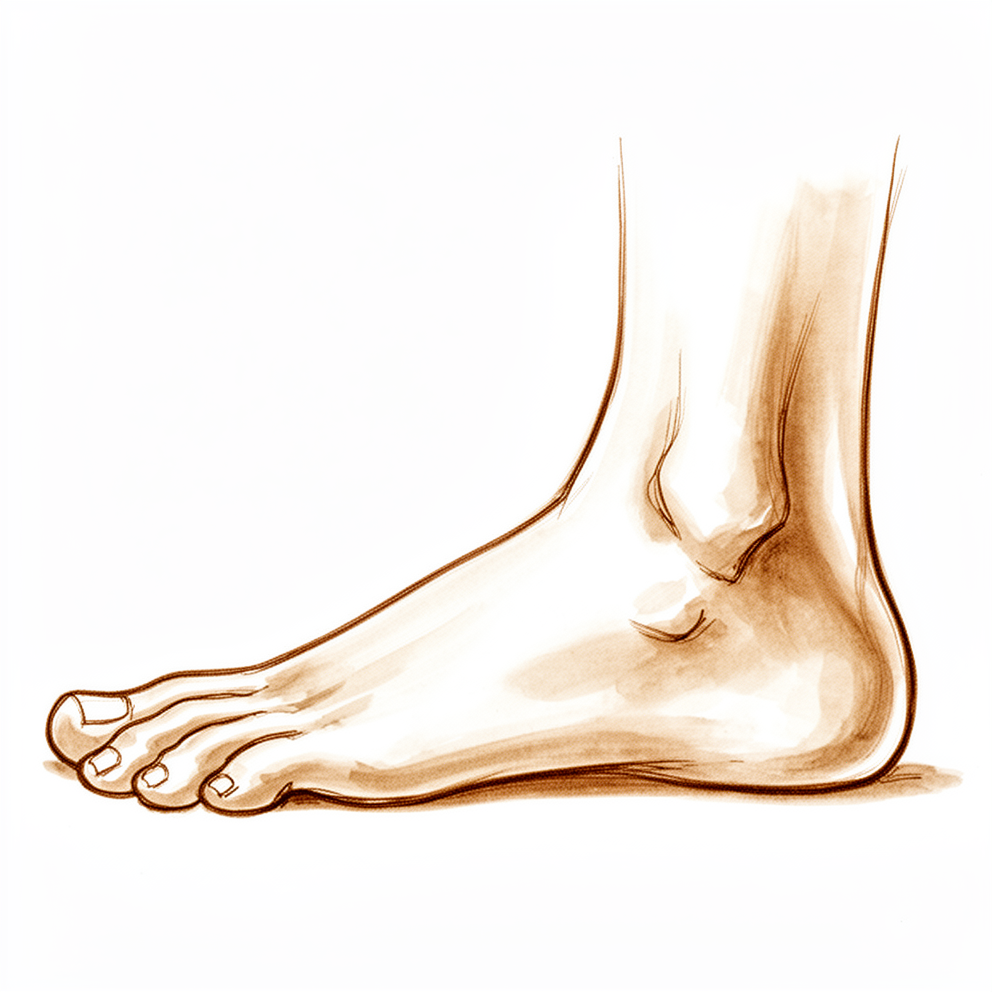
Qué está sintiendo
Una fractura de metatarsiano es una rotura en uno de los huesos largos del pie, situados entre los dedos y la parte media del pie. Esta fractura provoca dolor, hinchazón y hematomas en la zona del hueso lesionado. Apoyar el pie o caminar suele ser doloroso, y resulta difícil desplazarse. El dolor suele intensificarse al empujar contra el suelo para dar un paso, y disminuye cuando se quita el peso del pie.
La ubicación del dolor depende de qué hueso se ha roto. Una fractura en el hueso más externo del pie (el quinto metatarsiano) genera dolor y sensibilidad en el lateral del pie, dificultando la marcha. Un golpe directo en esa zona puede provocar hematomas. Una fractura en el hueso más interno (el primer metatarsiano) o en los huesos intermedios provoca dolor al soportar peso y al mover el pie, dificultando la caminata. Esa zona es muy sensible al tacto, y el hueso roto puede parecer que se mueve ligeramente bajo la piel.
Algunas fracturas se deben a cargas repetidas en lugar de a una lesión única; se denominan fracturas por estrés y se desarrollan a lo largo de varias semanas. El segundo y el tercer metatarsiano son los más afectados. En el caso de una fractura por estrés, se puede notar dolor en la parte superior o lateral del pie que empeora con la actividad durante varias semanas y mejora al descansar. El segundo metatarsiano es una zona frecuente de lesión en bailarines y corredores.
Las tareas cotidianas que implican cargar peso sobre la parte delantera del pie se vuelven complicadas: empujar un carrito de la compra, subir escaleras, permanecer de pie junto a la encimera para cocinar o acercarse al buzón. La hinchazón puede hacer que los zapatos queden ajustados.
Un dato importante: los hematomas en la planta del pie pueden indicar una lesión más grave en las articulaciones de la zona media del pie. Si presenta este tipo de hematomas o si el dolor es intenso, debe acudir a evaluación médica de inmediato.
¿Qué está ocurriendo realmente?
El pie cuenta con cinco huesos largos llamados metatarsianos, que se extienden desde la parte media del pie hasta la base de los dedos. Pueden compararse con las vigas de un puente: cada uno soporta su parte de la carga al estar de pie o al caminar. Cuando una de estas “vigas” se agrieta, ya sea por una torsión, un golpe o una caída, se producen el dolor y la hinchazón descritos anteriormente.
Estos huesos no comparten la carga de manera equitativa. El metatarsiano más interno es más corto y ancho que los demás, y soporta alrededor de un tercio del peso corporal en cada paso. El metatarsiano externo y el interno gozan de mayor movilidad que los tres huesos centrales, que están muy juntos y unidos por ligamentos, esas fuertes bandas que conectan un hueso con otro. Esta disposición compacta protege a los huesos centrales; por eso, una fractura aislada en esa zona rara vez se desplaza, a menos que se rompan varios huesos a la vez.
Las fracturas en estos huesos presentan distintos patrones. Algunas son simples grietas que permanecen alineadas. Otras se desplazan por efecto de la fuerza que las provocó, o por la acción de los tendones, esas estructuras que unen músculo y hueso, tirando de la parte fracturada. El metatarsiano externo constituye un caso especial: un tendón se inserta cerca de su base y puede desplazar el fragmento fracturado. Las fracturas cerca de dicha base se clasifican en tres zonas: desde el punto de inserción del tendón, hasta la articulación con el hueso siguiente, y luego el cuerpo del hueso. La ubicación de la fractura es crucial, pues algunas zonas cuentan con un flujo sanguíneo escaso, es decir, con poca capacidad para transportar las células necesarias para la reparación ósea. Con menos irrigación sanguínea, estas fracturas tardan más en consolidarse y tienen mayor probabilidad de no curarse.
Las fracturas por estrés funcionan de manera distinta. El hueso se renueva constantemente, proceso que dura unas 2 semanas. Si se carga el hueso más rápido de lo que puede renovarse —generalmente por un aumento repentino en la actividad física como correr o bailar— se generan pequeñas grietas. Por eso el dolor aparece gradualmente a lo largo de varias semanas, en lugar de manifestarse de inmediato tras una lesión.
¿Qué podemos hacer al respecto?
Las radiografías tomadas desde tres ángulos muestran la posición del hueso fracturado. En ocasiones se utiliza una tomografía computarizada, que proporciona una imagen más detallada, para fracturas cercanas a la base del hueso; asimismo, la resonancia magnética puede revelar lesiones de tejidos blandos o detectar una fractura por estrés en etapas tempranas.
Muchas fracturas sanan sin necesidad de intervención quirúrgica. Un zapato con suela rígida o una bota ortopédica protegen el pie mientras el paciente carga peso según su tolerancia. Algunas fracturas requieren el uso de un yeso sin que el pie soporte carga durante un período determinado, para luego volver gradualmente a la carga normal. También analizamos las causas de la fractura: la forma del pie, la carga de entrenamiento o los niveles bajos de vitamina D pueden influir; abordar estos factores ayuda a prevenir nuevas fracturas.
La cirugía se considera cuando el hueso fracturado se ha desplazado de su posición, cuando hay múltiples fracturas simultáneas, cuando la fractura afecta a la superficie articular, o cuando una fractura cerca de la base del metatarsiano externo cicatriza lentamente. El objetivo es mantener los fragmentos en la posición correcta mientras sanan, mediante tornillos, una pequeña placa o, en algunos casos, un pin colocado dentro del hueso. En ciertas fracturas próximas a la base del metatarsiano externo, puede recomendarse la cirugía de inmediato en lugar de tras un intento de tratamiento con yeso, ya que estas fracturas tienen un riego sanguíneo deficiente y mayor probabilidad de no consolidarse o de volver a fracturarse. La decisión de operar se toma conjuntamente, evaluando tanto el aspecto de la fractura como sus necesidades laborales y de actividad.
Qué esperar
En la mayoría de las fracturas de metatarsianos, el pronóstico es favorable. Cuando la fractura se evalúa correctamente y se trata adecuadamente, casi todas sanan sin dejar secuelas. El hueso se une tal como lo haría normalmente; las fracturas que no sanan en absoluto son poco frecuentes, con una excepción importante: las fracturas cerca de la base del metatarsiano externo, donde el riego sanguíneo es escaso. En esa zona la consolidación ósea es más lenta y es más probable que surjan complicaciones.
El tiempo necesario para la curación depende del tipo de fractura. Una fractura simple cerca de la base del metatarsiano externo, tratada sin cirugía, suele sanar en un plazo de 8 semanas. Las fracturas por estrés en los huesos intermedios suelen mejorar con reposo o con un yeso que evite que el pie soporte peso durante la cicatrización. Si una fractura por estrés en la base del segundo metatarsiano no sana a pesar de ello, a veces es necesaria una intervención quirúrgica para lograr la unión ósea.
Si la fractura está desplazada y se recurre a la cirugía para colocarla en su posición correcta, el hueso se endereza y los resultados suelen ser buenos. En atletas con fracturas cerca de la base del metatarsiano externo, la cirugía les permite de forma fiable volver a su nivel competitivo previo. Los jugadores de la Major League Soccer con esta lesión regresan a la práctica deportiva en un porcentaje elevado de casos.
No obstante, existen algunas advertencias importantes. Si el hueso fracturado se une en una posición incorrecta, puede provocar discapacidad permanente; por eso es crucial alinear los huesos adecuadamente. Algunas personas sienten un dolor sordo en el lugar donde se colocó un tornillo; los implantes cerca de la base del metatarsiano externo pueden resultar tan molestos que haya que retirarlos posteriormente. Volver al deporte demasiado pronto también conlleva riesgos: si se regresa a la actividad dentro de las 8 semanas posteriores a la cirugía en ese hueso, una cuarta parte de los pacientes presentan aún una fractura no consolidada a los 3 meses, aunque esto rara vez deriva en una falta permanente de cicatrización. Un pequeño número de personas vuelven a sufrir una fractura en el mismo sitio, incluso después de que el hueso haya sanado por completo.
En general, las fracturas de pie en niños sanan bien y se tratan sin necesidad de cirugía.
¿Cuándo consultar a un especialista?
Acuda de inmediato a su médico de cabecera si presenta dolor en el pie acompañado de hinchazón o hematomas tras una torcedura, un golpe o una caída, especialmente si le resulta doloroso apoyar el pie al estar de pie o caminar. Solicite una evaluación por parte de un especialista si el dolor ha ido apareciendo progresivamente durante varias semanas con la actividad y no mejora con el reposo, ya que las radiografías pueden parecer normales durante las primeras 3 semanas y podrían ser necesarias otras pruebas de imagen. Diríjase a urgencias si presenta hematomas en la planta del pie, dolor intenso mucho mayor de lo esperado, o si el pie está pálido, frío o entumecido; estos síntomas pueden indicar una lesión más grave que requiere atención el mismo día.
Evidence & references
This is the clinical evidence summary written for health professionals. It is technical, and it lists the research this page was built from. You do not need to read it to understand your treatment or to make a decision about it.
Anatomy & Pathophysiology
General Metatarsal Anatomy & Biomechanics
- Metatarsal fractures account for 35% of all foot fractures [10].
- The first metatarsal is stronger than the other metatarsals and accounts for approximately 1.5% of all metatarsal fractures [6].
- The first metatarsal bears approximately one-third of body weight [13, 14].
- The first metatarsal bears 40% of the weight of the foot, with half on each sesamoid bone [37].
- The first metatarsal is shorter and wider than the lesser four metatarsals [6].
- The lack of interconnecting ligaments between the first and second metatarsals allows independent motion [6].
- The tibialis anterior inserts on the plantar medial aspect of the first metatarsal base and serves to elevate the first metatarsal [6].
- The peroneus longus attaches onto the plantar lateral base of the first metatarsal and acts to plantarflex the head [6].
- Average peak pressures in MT-1 are the highest or among the highest levels of pressure during most activities [6].
- Fractures of the central metatarsals account for approximately 10% of all metatarsal fractures [8].
- Fractures of the third metatarsal are related to fractures of the second or fourth metatarsal approximately 63% of the time [8].
- The fourth metatarsal is the least commonly injured central metatarsal due to its protected position and flexibility of the lateral rays [8].
- Stability of the midfoot is achieved by the bony architecture and ligamentous attachments at the metatarsal bases and necks (intermetatarsal ligaments) [13, 14].
- Severe displacement of shaft fractures is uncommon unless multiple metatarsals are fractured [13, 14].
- The first and fifth metatarsals are more mobile and susceptible to injury than the central metatarsals [13, 14].
- Fracture of all five metatarsals is predictive of amputation in the setting of mid/hindfoot fractures after high-energy trauma [13, 14].
- The arterial arch, dorsalis pedis artery, and dorsal and plantar metatarsal arteries are particularly susceptible to injury in association with metatarsal fractures [8].
- Compartment syndrome is relatively common with soft tissue trauma in the metatarsal area [6].
Fifth Metatarsal Anatomy & Blood Supply
- Fractures of the fifth metatarsal account for approximately 68% of all metatarsal fractures [23].
- The base of the fifth metatarsal is a complex anatomic site with the insertion of three muscles: peroneus brevis, peroneus tertius, and abductor digiti quinti [23].
- The peroneus brevis attaches on the dorsal aspect of the tubercle of the fifth metatarsal [23].
- The peroneus tertius attaches on the dorsal aspect at the proximal metaphyseal–diaphyseal junction [23].
- A strong attachment of the plantar fascia exists on the plantar aspect of the tubercle of the fifth metatarsal [23].
- The nutrient artery enters the medial cortex at the junction of the proximal and middle third of the diaphysis and supplies the shaft [23].
- Secondary epiphyseal and metaphyseal arteries supply the base and tuberosity of the fifth metatarsal [23].
- The metaphyseal–diaphyseal junction represents a watershed region between the nutrient artery and metaphyseal blood supplies [23].
- The proximal fifth metatarsal is considered a high-risk site for stress fracture due to poor blood supply [15].
- Fractures occurring in zone II (metaphyseal–diaphyseal junction) have the greatest risk for delayed healing due to limited vascularity [15].
- The proximal apophyseal growth center at the base of the fifth metatarsal is usually visible radiographically at age 9 and becomes united to the diaphysis between 12 and 15 years of age [17].
- The os vesalianum is found just proximal to the base of the fifth metatarsal medial to the insertion of the peroneus brevis [23].
- The os peroneum is located within the tendon of the peroneus longus and can be found on the lateral border of the cuboid [23].
Fifth Metatarsal Fracture Zones
- Zone I comprises the cancellous tuberosity, including the insertion of the peroneus brevis tendon and the calcaneometatarsal ligament of the plantar fascia [17].
- Zone I fractures are avulsion types of injuries, usually secondary to an inversion injury to the foot [2].
- Zone II extends from zone I to the metaphyseal/diaphyseal junction and includes the fourth and fifth metatarsal articulation [2].
- Zone II is the area of the true Jones fracture [2].
- The mechanism of injury for Zone II fractures is usually a strong abduction force to the forefoot, causing a bending moment at the metaphyseal-diaphyseal junction [2].
- Zone III is the proximal 1.5 cm of the diaphysis and is the area where stress fractures usually occur [2].
- Zone I represents the tuberosity, Zone II represents the watershed or avascular area at the metaphyseal–diaphyseal junction, and Zone III represents the proximal diaphysis [15].
- The relative frequency of proximal fifth metatarsal fractures in a busy general orthopedic practice was approximately 93% zone 1, 4% zone 2, and 3% zone 3 [23].
Lisfranc (Tarsometatarsal) Joint Anatomy
- The second metatarsal is recessed between the medial and lateral cuneiforms as the keystone of the tarsometatarsal arch [9].
- The base of the second metatarsal fits into a mortise formed by the proximally recessed middle cuneiform (keystone configuration) [33, 34].
- In the coronal plane, the second metatarsal base serves as the cornerstone in a Roman arch configuration [33, 34].
- The Lisfranc ligament runs from the medial cuneiform to the second metatarsal [9].
- The Lisfranc ligament is 8 to 10 mm wide and 5 to 6 mm thick [33, 34].
- There are no direct ligamentous attachments from the first to second metatarsals [33, 34].
- Intermetatarsal ligaments exist between the second and fifth metatarsal bases [33, 34].
- The interosseous ligament is the stiffest and strongest, while the dorsal ligament is the weakest [33, 34].
- The plantar ligament inserts on the bases of the second and third metatarsals [33, 34].
- The medial column consists of the first metatarsal, medial cuneiform, and navicular facet [9].
- The middle column refers to the second and third metatarsals with their corresponding cuneiforms and navicular articulations [9].
- The lateral column refers to the fourth and fifth metatarsals and their cuboid articulations [9].
Pathophysiology of Injury & Stress Fractures
- Metatarsal fractures occur most often in patients between 20 and 50 years of age [10].
- Direct injuries are the most common cause of metatarsal fractures [10].
- High-energy crush injuries are the most common injuries sustained in motorcycle accidents [10].
- Proximal metaphyseal and metatarsal base fractures often stay relatively well aligned because of numerous articulations and soft tissue attachments [10].
- Diaphyseal fractures are often oblique and tend to shortening, angulation, and displacement [10].
- Distal metaphyseal fractures are commonly transverse or oblique with displacement typically occurring plantarly and laterally [10].
- Stress fractures occur commonly in the metatarsals, particularly at the second and third metatarsal necks and at the proximal portion of the shaft of the fifth [10].
- Excessive loading of the second metatarsal can lead to stress fracture injury [13, 14].
- A long second metatarsal is a risk factor for second metatarsal stress fracture [13, 14].
- Hallux rigidus or valgus is a risk factor for second metatarsal stress fracture [13, 14].
- Cavovarus foot posture is commonly noted with proximal fifth metatarsal stress fractures [4].
- A cavovarus foot shape increases the mobility of the first tarsometatarsal joint, increasing stress in the lateral column and predisposing to fifth metatarsal stress fractures [37].
- Hereditary sensorimotor neuropathy and diabetic neuropathy may predispose to type III (diaphyseal) fifth metatarsal fractures by causing inability to sense overloading [37].
- Long, narrow, and straight fifth metatarsals with an adducted forefoot are most at risk for fifth metatarsal fractures [2].
- Metatarsus adductus and a curved fifth metatarsal with a prominent base are associated with higher rates of fifth metatarsal fractures [2].
- The plantar aspect of the fifth metatarsal is the tension side, and a plantar gap of at least 1 mm of fracture margin separation is associated with significantly increased time to bony union [4].
- Radiographs may be normal for 3 weeks in metatarsal stress fractures, and periosteal reaction or callus formation may appear after 3 to 4 weeks [13, 14].
- The second metatarsal stress fracture is the most common and is classically described in amenorrheal ballet dancers [13, 14].
- In female athletes, the triad of anorexia, osteoporosis/stress injuries, and menstrual dysfunction must be considered in the context of stress fractures [13, 14].
Classification
Fifth Metatarsal Fractures
- Fractures of the proximal portion of the fifth metatarsal are associated with potentially poor healing secondary to a watershed area of the blood supply [2].
- Three fracture zones have been described for the proximal fifth metatarsal [2].
- Zone I is the most proximal zone, includes the metatarsocuboid articulation, and is proximal to the fourth and fifth metatarsal articulation [2].
- The Torg classification of stress fractures in Zone III includes Type I, which is an acute fracture [2].
- The Torg classification of stress fractures in Zone III includes Type II, which is a delayed union with some periosteal reaction, widening of the fracture site, and some intramedullary sclerosis [2].
- The Torg classification of stress fractures in Zone III includes Type III, which is a nonunion with intramedullary sclerosis and blunted fracture edges [2].
- One study suggested that no distinction needs to be made between Zone II and Zone III fractures because treatment and outcomes are the same in the two groups [2].
Tarsometatarsal (Lisfranc) Injuries
- The most commonly used classification system of Lisfranc fracture–dislocations was introduced into the literature in 1909 by Quénu and Küss [39].
- The Quénu and Küss classification describes three types of injury patterns: homolateral, isolated, and divergent [39].
- Hardcastle et al. provided a classification system based on radiographic morphology that is a modification of the pathologic–anatomical Quénu–Küss classification [39].
- The Hardcastle classification distinguishes three main groups: complete, partial, and divergent dislocation patterns [39].
- Type A (complete) fracture–dislocations in the Hardcastle classification are characterized by the involvement of all parts of the Lisfranc joint complex with dislocation within one plane [39].
- Type B (partial) fracture–dislocations in the Hardcastle classification are identified by partial incongruity of the joint complex [39].
- In the Hardcastle classification, a medial dislocation pattern involves the first metatarsal or a variable number of metatarsals excluding the fifth [39].
- In the Hardcastle classification, a lateral dislocation pattern involves one or more of the lateral metatarsals being dislocated while the first ray remains stable and intact [39].
- Type C (divergent) fracture–dislocations in the Hardcastle classification show complete and partial injury patterns [39].
- In Type C divergent fracture–dislocations, medialization of the first metatarsal is found in conjunction with lateral translation of a variable number of the lateral four metatarsal bones [39].
- Myerson introduced a classification in 1986 that incorporates osseous injuries of the medial column of the foot and differentiates three types of injury pattern [39].
- Type A injuries in the Myerson classification include complete incongruity of the TMT joint line in any plane or direction [39].
- Type B1 injury in the Myerson classification is determined by partial incongruity involving the first ray, termed partial-medial incongruity [39].
- Type B2 injury pattern in the Myerson classification is characterized by dislocation of one or more of the lateral four metatarsal bones, termed partial-lateral incongruity [39].
- Type C1 (divergent) injury in the Myerson classification has a diverging injury pattern comprised of medialization of the first ray associated with dislocation and partial incongruity of the lateral metatarsals [39].
- Type C2 injury in the Myerson classification has a diverging injury pattern with complete incongruity [39].
- Nunley and Vertullo reported a classification system for nondisplaced and displaced TMT sprains in athletes based on weight-bearing radiographic analyses and scintigraphic findings [39].
- Stage I injuries in the Nunley and Vertullo classification are characterized by no displacement at the Lisfranc complex, constituting a sprain of the Lisfranc ligament without diastasis or loss of medial column height [39].
- Stage I injuries in the Nunley and Vertullo classification are nondisplaced on weight-bearing radiographs but showed increased uptake on bone scintigrams [39].
- Stage II injuries in the Nunley and Vertullo classification show diastasis of 1 to 5 mm at the first/second intermetatarsal space resulting from a rupture of the Lisfranc ligament, but no medial column sag [39].
- Stage III injuries in the Nunley and Vertullo classification present with diastasis of the first/second intermetatarsal space greater than 5 mm and loss of medial column height [39].
- The revised version of the AO/OTA classification system distinguishes Lisfranc fracture-dislocations according to the resulting deformity [39].
- The AO/OTA classification allows both a type of dislocation pattern and an associated fracture pattern of the foot to be described [39].
- Pediatric Lisfranc fracture-dislocations are rare and to date a nongeneric system has not been implemented within trauma [39].
- Current classification systems for Lisfranc injuries lack evidence regarding their impact in the prediction of treatment or clinical and functional outcomes [39].
- Pure ligamentous injuries and nondisplaced Lisfranc injury patterns are not sufficiently represented in the current classification systems [39].
First Metatarsal Fractures
- The OTA classification for metatarsal fractures permits a detailed description of the fracture pattern of each bone but does not offer any insight into overall stability or treatment [40].
- The designation of metatarsal fractures under the OTA system observes the format 87()– ._ in a fashion similar to the metacarpals of the hand [40].
- To denote the first metatarsal in the OTA classification, an identifier should be placed in parentheses beside the major designation [40].
- Extra-articular simple fractures of the first metatarsal are designated A in the OTA classification [40].
- Partial articular involvement or wedge fracture of the shaft of the first metatarsal is designated B in the OTA classification [40].
- Complete articular involvement and or comminuted shaft fractures of the first metatarsal are designated C in the OTA classification [40].
- Further subclassification in the OTA system is given to accurately place the fracture as proximal, central, or distal [40].
- Each of the proximal, central, or distal groups in the OTA classification is further divided by the final description of the fracture [40].
Clinical Presentation
General Metatarsal Fractures
- Patients with metatarsal fractures present with pain, ecchymosis, and swelling [13, 14].
- Weight bearing is often painful and difficult in patients with metatarsal fractures [13, 14].
- Plantar ecchymosis may signify a more significant injury involving the Lisfranc joint complex [13, 14].
- When multiple metatarsals are fractured, a Lisfranc injury must be ruled out [13, 14].
- AP, lateral, and oblique radiographs are usually suitable to detect metatarsal fractures [13, 14].
- Three weight-bearing views (AP, lateral, and oblique) are mandatory to judge shortening, deviation, angulation, and displacement in metatarsal fractures [8].
- Weight-bearing films usually reveal subtle instabilities not seen on non-weight-bearing films [8].
- CT can provide additional information regarding intra-articular fracture lines and fragments in metatarsal fractures [6, 8].
- MRI can provide additional information related to soft tissue injuries and may give a hint toward stress fractures in metatarsal injuries [6, 8].
- Point-of-care ultrasonography may be helpful in diagnosis and follow-up of metatarsal fractures [6, 8].
- Compartment syndrome is relatively common with soft tissue trauma in the metatarsal area, and compartment pressures should be monitored routinely, especially following direct trauma [6, 8].
- The arterial arch and the dorsal and plantar metatarsal arteries are particularly susceptible to injuries in association with metatarsal fractures [6, 8].
First Metatarsal Fractures
- The first metatarsal accounts for approximately 1.5% of all metatarsal fractures [6].
- First metatarsal fractures can result from direct or indirect forces [6].
- Direct injuries to the first metatarsal are more common in industrial settings and occur often as a result of a heavy object falling on the foot [6].
- Indirect injuries to the first metatarsal result from situations often seen in sports, when the forefoot is fixed and the leg or foot is twisted [6].
- Patients with first metatarsal fractures normally describe pain with weight bearing and active motion of the foot and therefore have difficulties with ambulation [6].
- Physical examination of first metatarsal fractures reveals tenderness and swelling [6].
- Crepitation and palpable motion may be present at the fracture site of a first metatarsal fracture and reproduce the patient's symptoms [6].
- Any fracture of the base of the first three metatarsals should raise suspicion of a midtarsal injury [6, 8].
- Small avulsion fractures involving the medial base of the first or second metatarsal suggest disruption of the TMT ligaments [6, 8].
Central Metatarsal Fractures
- The fourth metatarsal is the least commonly injured central metatarsal due to protected position and flexibility of the lateral rays [8].
- Central metatarsal fractures can result from direct or indirect forces [8].
- Direct injuries to central metatarsals are more common in industrial settings and occur often as a result of a heavy object falling on the foot [8].
- Indirect injuries to central metatarsals result from situations often seen in sport, when the forefoot is fixed and the leg or foot is twisted [8].
- Central metatarsal fractures also often occur as stress fractures [8].
- Patients with central metatarsal fractures normally describe pain with weight bearing and active motion of the foot and therefore have difficulties with ambulation [8].
- Physical examination of central metatarsal fractures reveals tenderness and swelling [8].
- Crepitation and palpable motion may be present at the fracture site of a central metatarsal fracture and reproduce the patient's symptoms [8].
- Any displacement or diastasis of more than 2 mm between the base of the first and second metatarsals on an AP radiograph of the foot should raise suspicion of a Lisfranc ligament injury [8].
Fifth Metatarsal Fractures
- Fractures of the fifth metatarsal typically show pain, swelling, and tenderness on the outside of the foot [20].
- Patients with fifth metatarsal fractures usually complain about difficulties with walking [20].
- Bruising may occur following direct trauma to the fifth metatarsal [20].
- The Ottawa Foot Rules have been found to be 100% sensitive and 79% specific for the identification of fifth metatarsal fractures [20].
- Three views (AP, lateral, and oblique) are mandatory to judge shortening, deviation, angulation, and displacement in fifth metatarsal fractures [20].
- If clinical findings are suggestive of a fracture at the base of the fifth metatarsal but radiographs of the foot appear normal, an AP radiograph of the ankle that includes the proximal fifth metatarsal is recommended to rule out a tuberosity avulsion fracture [20].
- Zone 1 fractures of the fifth metatarsal are avulsion types of injuries, usually secondary to an inversion injury to the foot [2].
- Zone 2 fractures of the fifth metatarsal extend from zone I to the metaphyseal/diaphyseal junction and include the fourth and fifth metatarsal articulation [2].
- The mechanism of injury for Zone 2 (Jones) fractures is usually a strong abduction force to the forefoot, causing a bending moment at the metaphyseal-diaphyseal junction [2].
- Zone 3 fractures of the fifth metatarsal are located in the proximal 1.5 cm of the diaphysis and are the area where stress fractures usually occur [2].
- Proximal fifth metatarsal stress fractures present with the insidious onset of lateral foot pain that is worst during and after running or jumping activity [15].
- Pain from proximal fifth metatarsal stress fractures steadily worsens if the causative activity is continued [15].
- An acute fracture of the proximal fifth metatarsal may occur following days to weeks of antecedent pain [15].
- On clinical evaluation of proximal fifth metatarsal stress fractures, point tenderness is elicited at the distal portion of the tuberosity, usually in zone III [15].
- Plain radiographs of proximal fifth metatarsal stress fractures usually show sclerotic change around the fracture site [15].
- Bone scans are only occasionally necessary for diagnosis of proximal fifth metatarsal stress fractures, but bone scan or MRI may be employed if an occult fracture is suspected [15].
- Physical examination of proximal fifth metatarsal stress fractures may reveal point tenderness over the base of the fifth metatarsal as well as pain with passive inversion or resisted eversion of the foot [4].
- A cavovarus foot shape is commonly noted with proximal fifth metatarsal stress fractures [4].
- The fracture of a proximal fifth metatarsal stress injury is often apparent on radiographs and can be classified based on appearance as an acute traumatic fracture, stress-related fracture, delayed union, or nonunion [4].
- In children, the apophysis at the base of the fifth metatarsal can be confused with an avulsion fracture [11].
- The secondary ossification center at the base of the fifth metatarsal appears at approximately 8 years of age and fuses by the age of 12 years in girls and 15 years in boys [11].
Metatarsal Stress Fractures
- Metatarsal stress fractures are common, often secondary to repetitive stress or cavovarus foot posture [13, 14].
- Excessive loading of the second metatarsal can lead to injury, particularly in the presence of a long second metatarsal or hallux rigidus/valgus [13, 14].
- MRI or bone scan aids in the diagnosis of metatarsal stress fractures, as radiographs may be normal for 3 weeks [13, 14].
- Radiographs may demonstrate periosteal reaction or evidence of callus formation near the diaphyseal region of the affected metatarsal after 3 to 4 weeks [13, 14].
- A normal radiograph prior to 3 weeks does not exclude a metatarsal stress fracture [13, 14].
- Second metatarsal stress fracture is the most common metatarsal stress fracture and is classically described in amenorrheal ballet dancers [13, 14].
- In female athletes with metatarsal stress fractures, the triad of anorexia, osteoporosis/stress injuries, and menstrual dysfunction must be considered [13, 14].
- Stress fractures of the metatarsal shaft or neck occur in children and can be produced by chronic repetitive, stressful activity [22].
- MRI may be helpful in the diagnosis of metatarsal stress fractures in children [22].
- Proximal fifth metatarsal stress fractures are most common in athletes who participate in sports such as basketball, football, or soccer [4].
- The blood supply to the fifth metatarsal plays a substantial role in the healing of fifth metatarsal stress fractures [4].
- Perfusion of the fifth metatarsal arises from three sources: the nutrient artery, metaphyseal perforators, and periosteal arteries [4].
- The nutrient artery typically enters the medial aspect of the middle one-third of the metatarsal before dividing into distal and proximal branches [4].
- The proximal branch of the nutrient artery is significantly shorter than the distal branch, creating a watershed proximally in zones 2 and 3 between retrograde blood flow from the nutrient artery and antegrade blood flow from the metaphyseal perforators [4].
- Some experts recommend combining zones 2 and 3 of the fifth metatarsal because they carry a similar risk of nonunion and refracture, and surgical treatment and outcomes are similar in both zones [4].
- Fractures occurring in zone II of the fifth metatarsal have the greatest risk for delayed healing due to the limited vascularity of this site [15].
- The proximal fifth metatarsal is considered a high-risk site for stress fracture because of the poor blood supply to the affected area [15].
- Both stress injuries and traumatic injuries of the proximal fifth metatarsal are prone to nonunion [15].
- A study of 51 elite athletes showed that long, narrow, and straight fifth metatarsals with an adducted forefoot were most at risk for fifth metatarsal fractures [2].
- O'Malley et al. showed in 10 professional NBA players that a unique foot type seemed to be associated with higher rates of fifth metatarsal fractures: metatarsus adductus and a curved fifth metatarsal with a prominent base [2].
- It is important to assess for biomechanical or biological reasons why a fifth metatarsal stress fracture developed, such as cavovarus foot posture or hypovitaminosis D [2].
- Recurrent stress fracture in the presence of a cavovarus foot may require reconstruction of the cavovarus alignment to prevent recurrence [13, 14].
- Evaluation for metabolic bone disease is indicated in patients with metatarsal stress fractures, especially if insidious onset or if there is no distinct causal event [13, 14].
- Assessment of vitamin D level with treatment if needed is part of the evaluation for metatarsal stress fractures [13, 14].
- Adolescents performing repetitive impact activities are at risk for stress fractures [11].
- Callus formation may be seen on radiographs in adolescent stress fractures but not in all cases [11].
- MRI can be useful in diagnosing the occult fracture and help guide treatment in adolescent stress fractures [11].
- Recurrent stress fractures in adolescents should prompt an assessment of bone mineral density and an assessment of metabolic and nutritional factors if abnormal [11].
- Individual foot anatomic variations and the environment of the repeated activity predisposing to the stress fractures should also be evaluated in adolescents [11].
Investigations
General Imaging Principles
- Three views (AP, lateral, and oblique) are mandatory to judge shortening, deviation, angulation, and displacement in metatarsal fractures [6].
- CT provides additional information regarding intra-articular fracture lines and fragments [6].
- MRI can provide additional information related to soft tissue injuries and may give a hint toward stress fractures [6].
- MRI is not usually required in the diagnosis of midfoot fracture-dislocations nor does it usually alter treatment [8].
Fifth Metatarsal Fractures
- The blood supply to the fifth metatarsal arises from three sources: the nutrient artery, metaphyseal perforators, and periosteal arteries [4].
- A watershed exists proximally in zones 2 and 3 between retrograde blood flow from the nutrient artery and antegrade blood flow from the metaphyseal perforators [4].
- The average straight-segment length of the fifth metatarsal is 52 mm, which is 68% of the overall length of the metatarsal from the proximal end [4].
- The medullary canal of the fifth metatarsal is elliptical with an average coronal canal diameter at the isthmus of 5 mm [4].
- In 81% of men, the diameter of the fifth metatarsal medullary canal is greater than 4.5 mm [4].
- A plantar gap of at least 1 mm of fracture margin separation is associated with significantly increased time to bony union in fifth metatarsal fractures [4].
First Metatarsal Fractures
- Stress radiographs are used to determine operative or nonoperative treatment for first metatarsal fractures by assessing for instability [21].
- Manual displacement of the position of the first metatarsal through the joint or fracture site represents an instability that requires fixation [21].
Central Metatarsal Fractures
- A CT scan is helpful when there are fractures involving the base of the metatarsals to identify intra-articular extension and any comminution [8].
Tarsometatarsal (Lisfranc) Injuries
- As many as 20% of Lisfranc injuries are misdiagnosed or overlooked [36].
- Ecchymosis on the plantar aspect of the midfoot implies trauma to the tarsometatarsal ligaments and an injury to that joint [36].
- Dynamic imaging is performed if there is any doubt regarding instability on weight-bearing radiographs for tarsometatarsal injuries [31].
Treatment
Non-Operative Management: Fifth Metatarsal (Zone I)
- Zone I avulsion fractures of the proximal fifth metatarsal are generally treated satisfactorily in a postoperative shoe, walking boot, or short leg walking cast [2].
- In a study of 60 patients with proximal fifth metatarsal fractures, all fractures healed at an average of 44 days, with no fracture taking longer than 65 days to heal [2].
- Patients treated with a compressive soft dressing and allowed to bear weight in a cast boot required significantly shorter recuperation time and had better modified foot scores than patients treated with cast immobilization [2].
- Patients with proximal fifth metatarsal fractures treated nonoperatively missed an average of 22 days of work [2].
- Most patients with proximal fifth metatarsal fractures required 6 months or more to return to preinjury levels of activities [2].
- Nonunions of Zone I fractures may occur but are rarely painful and can be treated with excision of the fragment [2].
- Zone I injuries are traction-type fractures resulting from tension on the peroneus brevis tendon and lateral plantar aponeurosis, with universally good outcomes and full return to activities [17].
- Zone I fractures can be treated in a short-leg cast or fracture boot with weight bearing as tolerated for 3 to 6 weeks [17].
- Radiographic union of Zone I fractures generally lags behind the resolution of symptoms and is not a prerequisite for removing the cast or returning to activities at 3 to 4 weeks [17].
- Nonunion of Zone I fractures is most often associated with displacement greater than 3 mm at the time of injury [17].
- Acute nondisplaced or minimally displaced fractures and avulsion fractures (Zone 1) are indications for nonoperative treatment [3].
- Nonoperatively treated nondisplaced avulsion fractures of the fifth metatarsal tuberosity tend to heal uneventfully within 3 to 12 weeks in nearly all patients with few residual symptoms up to 1 year [3].
- Zone 1 injuries and distal fractures can be treated with a stiff-soled shoe, cast, or fracture boot regardless of the specific treatment method [3].
Non-Operative Management: Fifth Metatarsal (Zone II and III)
- Zone 2 fractures (Jones fractures) are indicated for nonoperative treatment [3].
- Acute Zone 3 fractures are indicated for nonoperative treatment [3].
- Proximal diaphyseal fractures (Zone 2) are best initially treated with a short leg non-weight-bearing cast for 6 weeks [3].
- For acute Zone 2 fractures without prodromal symptoms, weight bearing is allowed to progress as tolerated after 6 weeks in a removable short leg walker [3].
- Return to sporting activities for acute Zone 2 fractures takes up to 10 weeks in most cases [3].
- Fractures presenting with a history of localized pain with activity (stress fractures) are left in a non-weight-bearing cast for an additional 8 weeks beyond the initial period [3].
- Non-weight-bearing casting for stress fractures is usually continued for a full 3 months [3].
- Radiographic signs of active healing in Zone 2/3 fractures include dissolution of sclerotic margins and reconstitution of the medullary canal [3].
- Clinical signs of healing in Zone 2/3 fractures include lack of pain with direct palpation and motion of the distal metatarsal [3].
- Incomplete stress (Jones) fractures have been successfully treated with low-intensity pulsed ultrasound without taking a break from sport practice, though results need confirmation by more studies [3].
- Zone 3 injuries with a short period of localized pain before diagnosis can be treated with non-weight-bearing casting with results comparable to surgery [3].
- Dancer's fractures of the distal shaft of the fifth metatarsal usually heal well with nonoperative cast immobilization [3].
- Nonsurgical management with strict non-weight bearing in a short leg cast for 6 to 8 weeks is an option for Torg type I fractures (acute fracture with sharp margins and no sclerosis) [4].
- A meta-analysis suggests a trend toward operative intervention for Zone 2 fractures, partly due to the mixing of acute and chronic injuries in earlier series [3].
- Displaced fractures, persistent nonunions, and Zone 3 fractures with prodromal symptoms are relative contraindications for nonoperative treatment [3].
Operative Management: Fifth Metatarsal (Zone I)
- Open reduction and fixation can be considered for Zone I fractures with gross displacement or articular involvement in young active patients [2].
- Methods of fixation for Zone I fractures include plating, screw fixation, and a tension-band technique [2].
- Plates in the Zone I area are generally not well tolerated and often require removal [2].
- ORIF for Zone I fractures is rarely necessary and is generally reserved for displaced intraarticular fractures in highly competitive individuals [2].
- Open reduction is required for Zone 1 fractures if the fifth metatarsal-cuboid articular surface is displaced or if the fracture is rotated such that the fractured surface of the proximal fragment no longer faces the distal fragment [13, 14].
- Tenting of the skin is an indication for fixation in Zone 1 fractures [13, 14].
- A lag screw placed obliquely from the base of the fifth metatarsal into the medial cortex is the surgical treatment of choice for Zone 1 fractures [13, 14].
- Chronic pain from a previous avulsion fracture may be addressed with excision of the fragment and reattachment of the peroneus brevis tendon [13, 14].
Operative Management: Fifth Metatarsal (Zone II and III)
- Treatment of Jones fractures and Torg type I diaphyseal fractures depends on the type of fracture and the activity demands of the patient [2].
- An initial non-weight bearing, short leg cast for 6 to 8 weeks followed by a weight-bearing cast until union has a reported healing rate of 75% for Jones fractures [2].
- Jones fractures have a reported nonunion rate of 7% to 28% even with non-weight-bearing immobilization for 6 to 8 weeks [2].
- In competitive athletes, consideration should be given to early ORIF to decrease disability time [2].
- Electrical and pulsed ultrasound bone stimulation may improve healing of Jones fractures but cannot replace internal fixation in a high-performance athlete [2].
- Surgery should be considered for Zone II and III fractures that are not healing clinically at 8 to 12 weeks [2].
- Surgery should be considered for acute fractures in competitive athletes or individuals whose occupational demands do not allow prolonged non-weight bearing immobilization [2].
- Two operative treatments have proved successful for Zone II and III fractures: fixation with an intramedullary screw and corticocancellous inlay bone grafting with clearing of the medullary canal of all sclerotic bone [2].
- Intramedullary screw fixation is the technique currently used by most authors for Zone II and III fractures [2].
- For Torg type II or III fractures (delayed union or nonunion), surgical fixation is generally recognized as the standard of care with selective open débridement and bone grafting [4].
- Fixation for Zone II and III fractures is usually performed with an intramedullary screw and has a good to excellent result [4].
- A 2015 radiographic study of 119 patients found the average straight-segment length of the fifth metatarsal to be 52 mm, which was 68% of the overall length from the proximal end [4].
- In 81% of men, the coronal canal diameter at the isthmus was greater than 4.5 mm [4].
- The use of a solid, partially threaded screw with a 4.5-, 5.5-, or 6.5-mm diameter is recommended for fifth metatarsal fixation [4].
- Partially threaded screws provide compression across the fracture site [4].
- Headed screws are recommended over headless screws due to superior pullout strength and easier removal [4].
- Plate fixation is growing in popularity for nonunion cases as it is technically easier to apply in areas of increased bony sclerosis when the fracture is already exposed for bone grafting [4].
- A study of 10 National Basketball Association players treated with intramedullary screw fixation noted a 100% union rate but a refracture rate of 30% [4].
- In the study of NBA players, autograft bone placed in the fracture site was used in three patients, and none of these patients went on to refracture [4].
- There is no definitive literature to support or refute the routine use of bone graft in the primary setting, but it should be considered in the revision scenario [4].
- A plantar gap of at least 1 mm of fracture margin separation is a prognostic indicator for significantly increased time to bony union, regardless of Torg classification [4].
- Plantarlateral plating of the fracture has been described and shown to increase cycles to failure and ultimate load to failure in Jones fracture fixation [4].
- In high-demand athletes, IM screw fixation with a 4.0- or 4.5-mm cannulated screw permits faster return to play since casting alone has a high failure rate [15].
- If nonunion is not present, bone grafting is usually not necessary at the time of IM fixation [15].
- Weight bearing should be initiated 7 to 14 days postoperatively after IM screw fixation, with training progressing to full unrestricted activity over 9 weeks [15].
- Return to sports activities is expected at approximately 3 to 9 weeks postoperatively in patients with Zone II or III fractures treated with IM screw fixation [15].
- Risk remains for fracture nonunion and fatigue failure of the screw after IM fixation [15].
- Surgical treatment should be considered for acute Jones fractures in high-performance athletes, displaced fractures, and fractures failing an initial trial of nonsurgical management [11].
Non-Operative Management: First Metatarsal
- Isolated first metatarsal fractures with no instability on stress radiographs and minimal displacement are indications for nonoperative treatment [21].
- Complex fractures of the forefoot/midfoot, instability on stress radiographs, plantar displacement of the metatarsal head, and open fractures are relative contraindications for nonoperative treatment of first metatarsal fractures [21].
- Isolated first metatarsal fractures can be treated in a short leg cast with no weight bearing for 3 weeks and then for an additional 3 weeks with weight bearing as tolerated [21].
- Casting for first metatarsal fractures should be performed with the foot in a plantigrade position without placing dorsally directed pressure on the first metatarsal [21].
- Nondisplaced first metatarsal fractures are treated with a boot or hard-soled shoe and weight bearing as tolerated [13, 14].
Operative Management: First Metatarsal
- Displaced first metatarsal fractures require surgical fixation with open reduction and internal fixation (ORIF) using lag screws or plate fixation [13, 14].
- Manual displacement of the first metatarsal through the joint or fracture site on stress radiographs represents an instability that requires fixation [21].
Non-Operative Management: Central Metatarsals (2nd, 3rd, 4th)
- Individual head or neck fractures of the central metatarsals are indications for nonoperative treatment [12].
- Unstable base fracture of the second metatarsal, multiple adjacent metatarsal fractures, comminution, significant displacement, and hyperextended neck fractures are relative contraindications for nonoperative treatment of central metatarsal fractures [12].
- Most isolated individual central metatarsal fractures can be treated nonoperatively [12].
- Isolated midshaft central metatarsal fractures are usually stable with little shortening and can be managed with hard-sole or stiff shoes and progressive weight bearing as tolerated [12].
- The majority of second, third, and fourth metatarsal fractures are minimally displaced and treated with a low-tide walking boot or hard-soled shoe with arch support [13, 14].
- Isolated central metatarsal fractures are stable secondary to intermetatarsal ligaments present at the base and neck [13, 14].
- Metatarsal neck fractures are most treated conservatively in a boot or shoe [13, 14].
- Metatarsal base fractures primarily through metaphyseal bone heal rapidly if stable [13, 14].
- Fractures displaying more than 10 degrees of deviation in the sagittal plane or 3 to 4 mm of translation in any plane should be actively corrected [12].
- Closed reduction for isolated distal central metatarsal fractures is performed using finger trap distraction to restore alignment followed by weight bearing as tolerated in a hard-sole shoe [12].
- Metatarsal fractures may be treated using low-intensity pulsed ultrasound with comparable healing rates to fractures treated by surgical intervention [12].
- Pin fixation after closed reduction is rarely needed with an isolated central metatarsal injury because of the stability provided by surrounding soft tissues [12, 38].
Operative Management: Central Metatarsals (2nd, 3rd, 4th)
- Surgical fixation is indicated for central metatarsal fractures with significant sagittal plane deformity (>10 degrees) or if the three central metatarsals are fractured [13, 14].
- With multiple central metatarsal fractures, the intermetatarsal ligaments cannot provide stability, making the fractures inherently unstable [13, 14].
- ORIF with plate-and-screw fixation or intramedullary antegrade-retrograde pinning technique is used for central metatarsal fractures requiring surgery [13, 14].
- Care must be taken to maintain proper metatarsal length to minimize the risk of transfer metatarsalgia or plantar keratosis [13, 14].
- An unstable base fracture of the second metatarsal requires limited open reduction and intramedullary pinning to maintain proper position if it has a tendency to shift laterally [12, 38].
- There are no stabilizing ligaments between the first and second metatarsals [12, 38].
- If a satisfactory closed reduction cannot be obtained for central metatarsal fractures, open reduction using low-profile screws and plates is recommended [38].
- ORIF should be performed for multiple adjacent metatarsal fractures or significant comminution where closed reduction is usually unstable [38].
- Multiple metatarsal head or neck fractures are difficult to treat by open means due to the risk of devascularization of the head and loss of stability [38].
- Closed reduction with traction and local anesthesia is the preferred method for multiple metatarsal head or neck fractures [38].
- Percutaneous pin fixation can supplement closed reduction for multiple metatarsal head or neck fractures [38].
- The pin used for multiple metatarsal head or neck fractures should incorporate both the metatarsal shaft and the base of the proximal phalanx to ensure stable fixation [38].
- When using a pin for multiple metatarsal head or neck fractures, entering the base of the proximal phalanx or metatarsal head from the lateral aspect and bending the pin down the medial wall of the shaft exerts a medially directed force to balance lateral drift [38].
Pediatric Metatarsal Fractures
- Metatarsal fractures are the most common pediatric foot fracture, accounting for 5% to 7% of all pediatric fractures and up to 60% of all pediatric foot fractures [11].
- Almost all pediatric metatarsal fractures can be managed nonsurgically [11].
- In a review of 337 children with metatarsal fractures, only 10 required surgical treatment [11].
- Surgical treatment is more likely in pediatric patients with multiple metatarsal fractures with increased translation [11].
- In pediatric patients with multiple metatarsal fractures, those with extra-articular fractures and less than 75% displacement of the most displaced metatarsal should still be considered for nonsurgical care [11].
- Clear indications for surgical reduction and fixation in pediatric metatarsal fractures include open fractures and compartment syndrome [11].
- The apophysis at the base of the fifth metatarsal appears at approximately 8 years of age and fuses by age 12 in girls and 15 in boys [11].
- The apophyseal growth center (os vesalianum) can be mistaken for a fracture in children but is differentiated by its sagittal orientation, whereas a true fracture line is oriented transversely [17].
- Treatment for an acute pediatric Jones fracture can include a non-weight-bearing cast for 6 weeks for nondisplaced fractures, advancing weight bearing as radiographic appearance of bone healing appears [11].
- Adolescents performing repetitive impact activities are at risk for stress fractures, and MRI can be useful in diagnosing the occult fracture [11].
- The initial treatment of pediatric stress fractures is rest in a walking boot [11].
- Recurrent pediatric stress fractures should prompt an assessment of bone mineral density and metabolic and nutritional factors if abnormal [11].
Metatarsal Stress Fractures (General)
- Excessive loading of the second metatarsal can lead to injury, particularly in patients with a long second metatarsal or hallux rigidus/valgus [13, 14].
- Radiographs may demonstrate periosteal reaction or evidence of callus formation near the diaphyseal region of the affected metatarsal after 3 to 4 weeks [13
Complications
- Direct force to the metatarsals may be accompanied by severe soft tissue envelope injury and compartment syndrome [10].
- Nonunions of zone I fifth metatarsal fractures may occur but rarely are painful [2].
- Refracture is common in zone III fifth metatarsal fractures with clinical or radiographic evidence of chronic injury [2].
- Plates used for fixation of zone I fifth metatarsal fractures are generally not well tolerated and often require removal [2].
- Intramedullary screw fixation of Jones fractures has been analyzed for failures [1].
- Sural nerve injury is a risk with intramedullary screw fixation of fifth metatarsal fractures [1].
- Stress fracture nonunion can occur at the base of the second metatarsal [1].
- Late results of tarsometatarsal joint injuries have been evaluated [1].
- Subtle injuries of the Lisfranc joint can occur [1].
- Dislocations of the tarsometatarsal joints can result in end outcomes correlated with pathology and treatment [1].
- Compartment syndromes of the foot are a recognized complication [1].
- Stress fractures can occur in patients with rheumatoid arthritis [1].
- Stress fractures can occur in patients with inflammatory arthritides [1].
- Insufficiency stress fractures of the foot and ankle can occur in postmenopausal women [1].
- Plantarflexion injury to the metatarsophalangeal joint ("sand toe") is a described injury pattern [1].
- Traumatic dislocation of lesser toes is a described injury pattern [1].
- Pathomechanics of complex dislocations of the first metatarsophalangeal joint have been described [1].
- Tarsometatarsal joint injuries in the athlete have been evaluated [1].
- Fractures of the central metatarsal have been evaluated [1].
- High-risk stress fractures require specific evaluation and treatment [1].
- Stress fractures in female athletes require specific diagnosis, management, and rehabilitation [1].
- Avulsion fractures of the fifth metatarsal base have been evaluated in a prospective outcome study [1].
- Fractures of the fifth metatarsal have been analyzed in a fracture registry [1].
- Strains in the metatarsals during the stance phase of gait have implications for stress fractures [1].
- Closed treatment of Jones fracture has shown good results in 40 cases after 11-26 years [1].
- Jones fracture surgical versus nonsurgical treatment has been compared [1].
- The Jones' fracture has been revisited in the literature [1].
- Dislocation of the tarsometatarsal joints has been described [1].
- Early screw fixation versus casting in the treatment of acute Jones fracture has been compared [1].
- Fifth metatarsal tuberosity fracture fixation has been studied biomechanically [1].
- The diagnosis and treatment of injuries to the Lisfranc joint complex have been described [1].
- Fractures of the distal shaft of the fifth metatarsal ("dancer's fracture") have been described [1].
- Stress fracture at the base of the metatarsals in ballet dancers has been described [1].
- Intramedullary screw fixation of Jones fractures has been studied biomechanically [1].
- Fifth metatarsal Jones fracture fixation with a 4.5-mm cannulated stainless steel screw has been evaluated clinically and radiographically [1].
- Integrity of the first metatarsophalangeal joint has been analyzed biomechanically [1].
- Fractures of the proximal fifth metatarsal have been described [1].
- Cannulated screw fixation of Jones fractures has been studied clinically and biomechanically [1].
- The treatment of tarsometatarsal injuries has been described [1].
- Treatment strategies for acute fractures and nonunions of the proximal fifth metatarsal have been described [1].
- The Jones fracture has been described in instructional course lectures [1].
- Salvage of Lisfranc's tarsometatarsal joint by arthrodesis has been described [1].
- Intramedullary screw fixation of proximal fifth metatarsal fractures has been studied biomechanically [1].
- Fractures of the base of the fifth metatarsal distal to the tuberosity have been classified with guidelines for non-surgical and surgical management [1].
Recovery
- Closed treatment of Jones fracture yielded good results in 40 cases after 11-26 years of follow-up [1].
- Intramedullary screw fixation of Jones fractures has been analyzed for failures in a clinical study [1].
- Early screw fixation versus casting was compared in the treatment of acute Jones fracture [1].
- Cannulated screw fixation of Jones fractures was evaluated in a clinical and biomechanical study [1].
- Fifth metatarsal Jones fracture fixation with a 4.5-mm cannulated stainless steel screw was evaluated clinically and radiographically in competitive and recreational athletes [1].
- Intramedullary screw fixation of proximal fifth metatarsal fractures was analyzed in a biomechanical study [1].
- Intramedullary screw fixation of Jones fractures was analyzed in a biomechanical study [1].
- Stress fracture nonunion at the base of the second metatarsal occurred in a ballet dancer [1].
- Stress fractures at the base of the metatarsals occur in ballet dancers [1].
- Stress fractures of the second metatarsal base occur in nondancers [1].
- Fractures of the distal shaft of the fifth metatarsal are referred to as "dancer's fracture" [1].
- Avulsion fractures of the fifth metatarsal base were evaluated in a prospective outcome study [1].
- Fractures of the fifth metatarsal were analyzed using a fracture registry [1].
- Risk of sural nerve injury with intramedullary screw fixation of fifth metatarsal fractures was assessed in a cadaver study [1].
- Fifth metatarsal tuberosity fracture fixation was analyzed in a biomechanical study [1].
- Treatment strategies for acute fractures and nonunions of the proximal fifth metatarsal were reviewed [1].
- Fractures of the proximal fifth metatarsal were reviewed in a clinical context [1].
- High-risk stress fractures were evaluated for evaluation and treatment [1].
- Stress fractures in female athletes were reviewed for diagnosis, management, and rehabilitation [1].
- Stress fractures in rheumatoid arthritis were reviewed [1].
- Insufficiency stress fractures of the foot and ankle occur in postmenopausal women [1].
- Stress fractures of the ankle and forefoot occur in patients with inflammatory arthritides [1].
- Compartment syndromes of the foot were reviewed for current concepts [1].
- Plantarflexion injury to the metatarsophalangeal joint is referred to as "sand toe" [1].
- Fractures of the central metatarsal were reviewed [1].
- Tarsometatarsal joint injuries in the athlete were reviewed [1].
- Subtle injuries of the Lisfranc joint were reviewed [1].
- The diagnosis and treatment of injuries to the Lisfranc joint complex were reviewed [1].
- Dislocations of the tarsometatarsal joints were correlated with pathology and treatment in end results [1].
- Salvage of Lisfranc's tarsometatarsal joint by arthrodesis was reviewed [1].
- The treatment of tarsometatarsal injuries was reviewed [1].
- Dislocation of the tarsometatarsal joints was reviewed [1].
- The late results of tarsometatarsal joint injuries were reviewed [1].
- The treatment of tarsometatarsal fracture-dislocations was reviewed [1].
- Pathomechanics of complex dislocations of the first metatarsophalangeal joint were reviewed [1].
- Traumatic dislocation of lesser toes was reviewed [1].
- Integrity of the first metatarsophalangeal joint was analyzed biomechanically [1].
- The Jones' fracture was revisited in a clinical review [1].
- The Jones fracture was reviewed in an instructional course lecture [1].
- Analysis of failed surgical management of fractures of the base of the fifth metatarsal distal to the tuberosity (Jones fracture) was performed [1].
- Fractures of the base of the fifth metatarsal distal to the tuberosity were classified with guidelines for non-surgical and surgical management [1].
References
[1] Campbell S Operative Orthopaedics 4 Volume Set. PERCUTANEOUS REDUCTION AND FIXATION OF CALCANEAL FRACTURE > METATARSALS.
[2] Campbell S Operative Orthopaedics 4 Volume Set. PERCUTANEOUS REDUCTION AND FIXATION OF CALCANEAL FRACTURE > METATARSALS > FRACTURE OF THE PROXIMAL PORTION OF THE FIFTH METATARSAL.
[3] Rockwood And Green S Fractures In Adults. 67: Fractures and Dislocations of the Midfoot and Forefoot > Nonoperative Treatment of Fifth Metatarsal Fractures.
[4] Orthopaedic Knowledge Update Sports Medicine 6. Ankle and Foot Injuries and Other Disorders > Stress Fractures > Fifth Metatarsal Proximal Stress Fracture.
[6] Rockwood And Green S Fractures In Adults. 67: Fractures and Dislocations of the Midfoot and Forefoot > First Metatarsal Fractures.
[8] Rockwood And Green S Fractures In Adults. 67: Fractures and Dislocations of the Midfoot and Forefoot > Central Metatarsal Fractures.
[9] Campbell S Operative Orthopaedics 4 Volume Set. PERCUTANEOUS REDUCTION AND FIXATION OF CALCANEAL FRACTURE > FRACTURE-DISLOCATIONS OF THE TARSOMETATARSAL ARTICULATION (LISFRANC JOINT).
[10] Rockwood And Green S Fractures In Adults. 67: Fractures and Dislocations of the Midfoot and Forefoot > Metatarsal Fractures.
[11] Orthopaedic Knowledge Update. Tibia, Ankle, and Foot Fractures > Foot Fractures > Metatarsal Fractures.
[12] Rockwood And Green S Fractures In Adults. 67: Fractures and Dislocations of the Midfoot and Forefoot > Treatment Options for Central Metatarsal Fractures.
[13] Miller S Review Of Orthopaedics. SECTION 16 PATELLAR TRACKING IN TOTAL KNEE ARTHROPLASTY > METATARSAL FRACTURES.
[14] Miller S Review Of Orthopaedics. METATARSAL FRACTURES.
[15] Rockwood And Green S Fractures In Adults. 21: Psychosocial Aspects of Recovery After Trauma > Fifth Metatarsal.
[17] Tachdjian S Pediatric Orthopaedics From The Texas Scottish Rite Hospital For Children E Book. Pigmented Villonodular Synovitis and Giant Cell Tumor of the Tendon Sheath > Fractures of the Base of the Fifth Metatarsal.
[20] Rockwood And Green S Fractures In Adults. 67: Fractures and Dislocations of the Midfoot and Forefoot > Signs and Symptoms and Imaging of Fifth Metatarsal Fractures.
[21] Rockwood And Green S Fractures In Adults. 67: Fractures and Dislocations of the Midfoot and Forefoot > Treatment Options for First Metatarsal Injuries.
[22] Campbell S Operative Orthopaedics 4 Volume Set. RECONSTRUCTION OF THE PATELLOFEMORAL AND PATELLOTIBIAL LIGAMENTS WITH A SEMITENDINOSUS TENDON GRAFT > METATARSAL AND PHALANGEAL FRACTURES.
[23] Rockwood And Green S Fractures In Adults. 67: Fractures and Dislocations of the Midfoot and Forefoot > Fifth Metatarsal Fractures.
[31] Rockwood And Green S Fractures In Adults. 67: Fractures and Dislocations of the Midfoot and Forefoot > Authors' Preferred Treatment for Tarsometatarsal Injuries (Algorithm 67-4).
[33] Miller S Review Of Orthopaedics. TARSOMETATARSAL FRACTURES AND DISLOCATIONS (LISFRANC INJURY).
[34] Miller S Review Of Orthopaedics. SECTION 16 PATELLAR TRACKING IN TOTAL KNEE ARTHROPLASTY > TARSOMETATARSAL FRACTURES AND DISLOCATIONS (LISFRANC INJURY).
[36] Tachdjian S Pediatric Orthopaedics From The Texas Scottish Rite Hospital For Children E Book. Pigmented Villonodular Synovitis and Giant Cell Tumor of the Tendon Sheath > Tarsometatarsal (Lisfranc) Fractures > Clinical Features.
[37] Aaos Comprehensive Orthopaedic Review 3. Foot Trauma > VI. Metatarsal and Phalangeal Fractures.
[38] Rockwood And Green S Fractures In Adults. 67: Fractures and Dislocations of the Midfoot and Forefoot > Authors' Preferred Treatment of Central Metatarsal Fractures (Algorithm 67-6).
[39] Rockwood And Green S Fractures In Adults. 67: Fractures and Dislocations of the Midfoot and Forefoot > Classification of Tarsometatarsal Injuries.
[40] Rockwood And Green S Fractures In Adults. 67: Fractures and Dislocations of the Midfoot and Forefoot > Classification of First Metatarsal Fractures.