Patients › Rehabilitation
Cirugía de dedos
Post-operative exercises and precautions after finger surgery, including joint blocking and tendon glides.
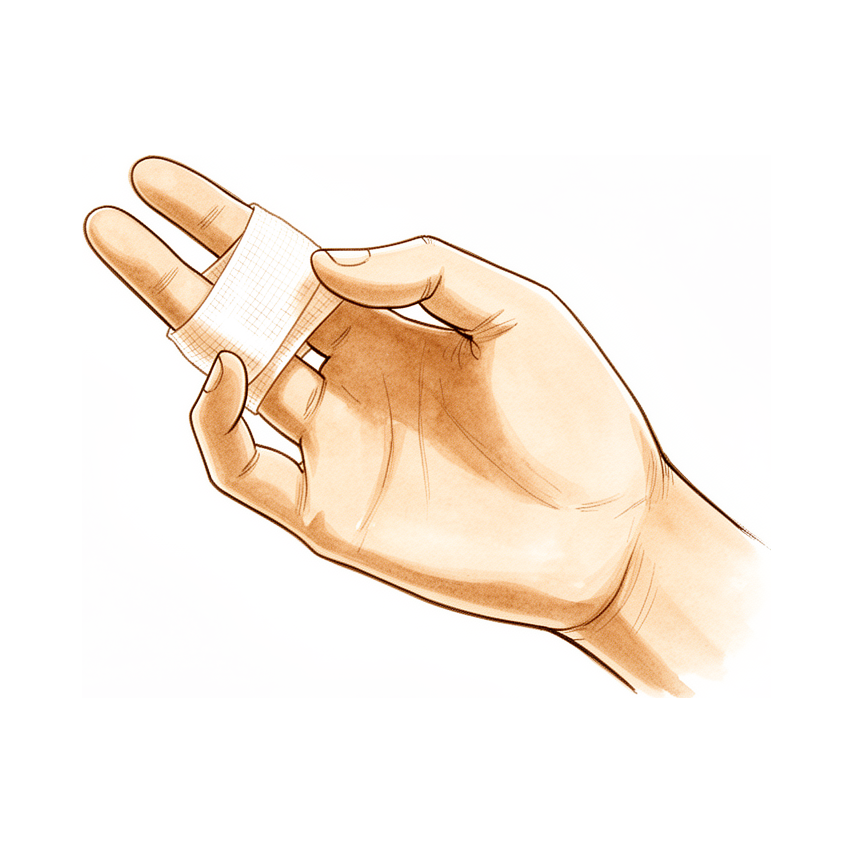
Este protocolo le servirá de guía durante su recuperación tras la cirugía de dedos realizada por el Dr. Kieran Hirpara en el Mater Private Hospital Rockhampton. Explica qué puede esperar en las semanas posteriores a la operación y detalla el programa de ejercicios que le ayudará a recuperar el movimiento y la funcionalidad de su dedo y mano. Lleve esta página o su versión en PDF a su primera sesión de fisioterapia o terapia de mano para que su rehabilitación se lleve a cabo de manera coordinada; su terapeuta podrá ajustar el plan según el tipo de cirugía y el progreso de su recuperación.
Si tiene alguna duda respecto a la herida quirúrgica, no dude en contactar con nuestra consulta. A menudo resulta útil tomar una fotografía de la herida y enviarla por correo electrónico para su evaluación.
Qué esperar
El cuidado de la herida se explica en el folleto de cuidado de heridas de la consulta. Los ejercicios que se detallan a continuación son fundamentales para recuperar el movimiento y la funcionalidad del dedo y la mano.
Una vez que la herida haya cicatrizado, aplique calor a la mano durante 20 minutos antes de realizar estos ejercicios. Después de terminarlos, aplique hielo para reducir cualquier hinchazón o inflamación.
Una vez que la herida esté completamente curada, comience a masajear la cicatriz: realice círculos firmes sobre la incisión. Consulte el folleto de cuidado de heridas para obtener más información sobre el manejo de cicatrices.
Vigile la hinchazón; si tiene alguna preocupación, llame a la consulta o hable con un terapeuta de mano.
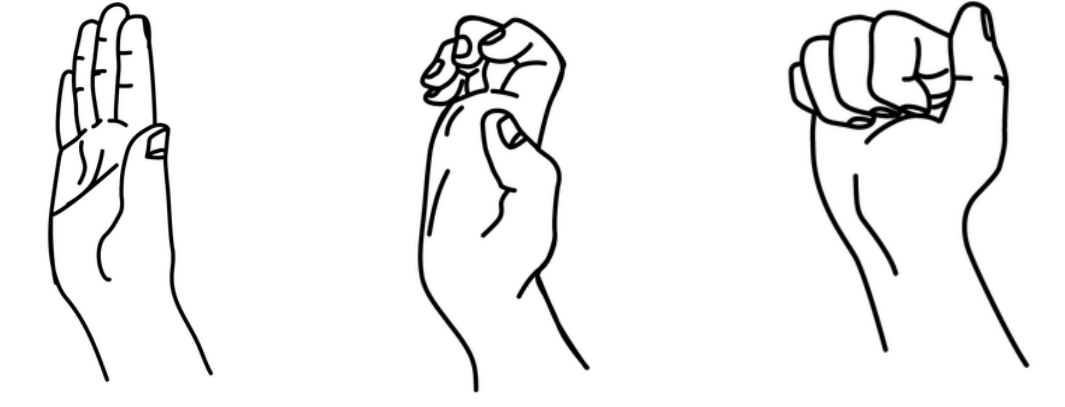
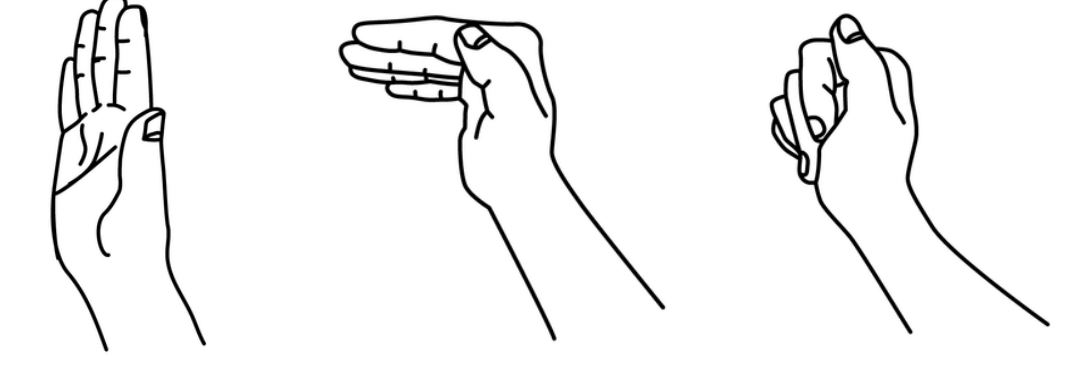
Existen tres principios básicos para la recuperación tras la mayoría de las operaciones en los dedos, y los ejercicios siguientes ponen cada uno de ellos en práctica. El primero es controlar la hinchazón: la hinchazón persistente en la mano endurece los tejidos blandos y limita el movimiento de tendones y articulaciones; por eso, en las primeras semanas es prioritario mantener la mano elevada, realizar movimientos suaves y, cuando sea necesario, realizar masajes retrógrados y compresión [1]. El segundo es realizar movimientos tempranos y suaves: los dedos se vuelven rígidos con rapidez; por ello, moverlos dentro de los límites indicados para su operación específica (tan pronto como la herida y la cirugía lo permitan) mantiene las pequeñas articulaciones flexibles y ayuda a que los tendones se deslicen sin adherirse a los tejidos en proceso de cicatrización. El tercer principio es el deslizamiento de los tendones. Las distintas posiciones de los dedos que se indican en el folleto (extendidos, en gancho, en posición de “mesa” y puño cerrado) no son arbitrarias: cada una provoca un desplazamiento diferente de los tendones profundos y superficiales respecto a la vaina tendinosa, lo cual permite que se deslicen libremente [2]. Los ejercicios de bloqueo de las articulaciones DIP y PIP también buscan lograr ese mismo deslizamiento, articulación por articulación. La regla es practicar poco pero con frecuencia: una práctica constante, suave y frecuente a lo largo del día favorece más la recuperación que esfuerzos intensos pero esporádicos.
Precauciones y limitaciones
Se recomienda un uso funcional moderado de la mano para tareas cotidianas como el aseo personal, la alimentación, vestirse, escribir y teclear (salvo indicación contraria). Por lo general, se le pedirá que evite levantar pesos, realizar agarres, soportar cargas o exponer la mano a impactos durante un máximo de 6 semanas después de la cirugía, según la lesión y el tipo de intervención realizada. En la consulta postoperatoria se le proporcionarán más indicaciones sobre las precauciones y limitaciones a seguir.
Para su fisioterapeuta:
Manejo
- Cuidado de la herida y la cicatriz según las instrucciones del folleto de cuidados de heridas de la clínica; comience el masaje cicatricial (círculos firmes sobre la incisión) una vez que la herida haya cicatrizado por completo.
- Una vez cicatrizada la herida, aplique calor a la mano durante 20 minutos antes de iniciar el programa de ejercicios; utilice hielo después de los ejercicios para reducir la hinchazón e inflamación.
- Controle la hinchazón; si surge alguna preocupación, remita al paciente a la consulta o a un terapeuta de mano.
- El control del edema es prioritario cuando la hinchazón es excesiva o no disminuye: la elevación de la mano y el movimiento activo son las medidas principales; el masaje retrógrado, la compresión y la movilización manual del edema pueden emplearse como complementos junto con el tratamiento estándar [1].
- Siga el programa de ejercicios en casa según las tarjetas siguientes: flexión/extensión de la muñeca; bloqueo de las articulaciones interfalángicas distal (DIP) y proximal (PIP); deslizamientos tendinosos (Serie A y Serie B).
- Las secuencias de deslizamiento tendinoso y bloqueo articular están diseñadas para maximizar el movimiento diferencial de los tendones flexores entre sí y respecto a la vaina tendinosa; varíe las posiciones (mano recta, en gancho, en posición de “mesa”, en puño) en lugar de repetir siempre la misma posición [2].
Precauciones
- Se recomienda un uso funcional moderado de la mano para tareas cotidianas (aseo personal, alimentación, vestirse, escribir, teclear), salvo indicación contraria.
- No se debe levantar, agarrar, soportar cargas ni exponer la mano a impactos durante un máximo de 6 semanas después de la cirugía (según la lesión y el tipo de intervención realizada).
- Las precauciones y limitaciones específicas se confirmarán en la consulta postoperatoria.
- Este es un programa postoperatorio general para los dedos; si la intervención específica implica rangos de movimiento protegidos, límites de movilidad o el uso de férulas (por ejemplo, tras una reparación tendinosa), las instrucciones propias de dicha operación tendrán prioridad.
Estos son los ejercicios descritos en su folleto, que deberá continuar realizando en casa según las indicaciones de su fisioterapeuta o terapeuta de mano.
Sus ejercicios
Kieran Hirpara 4.0
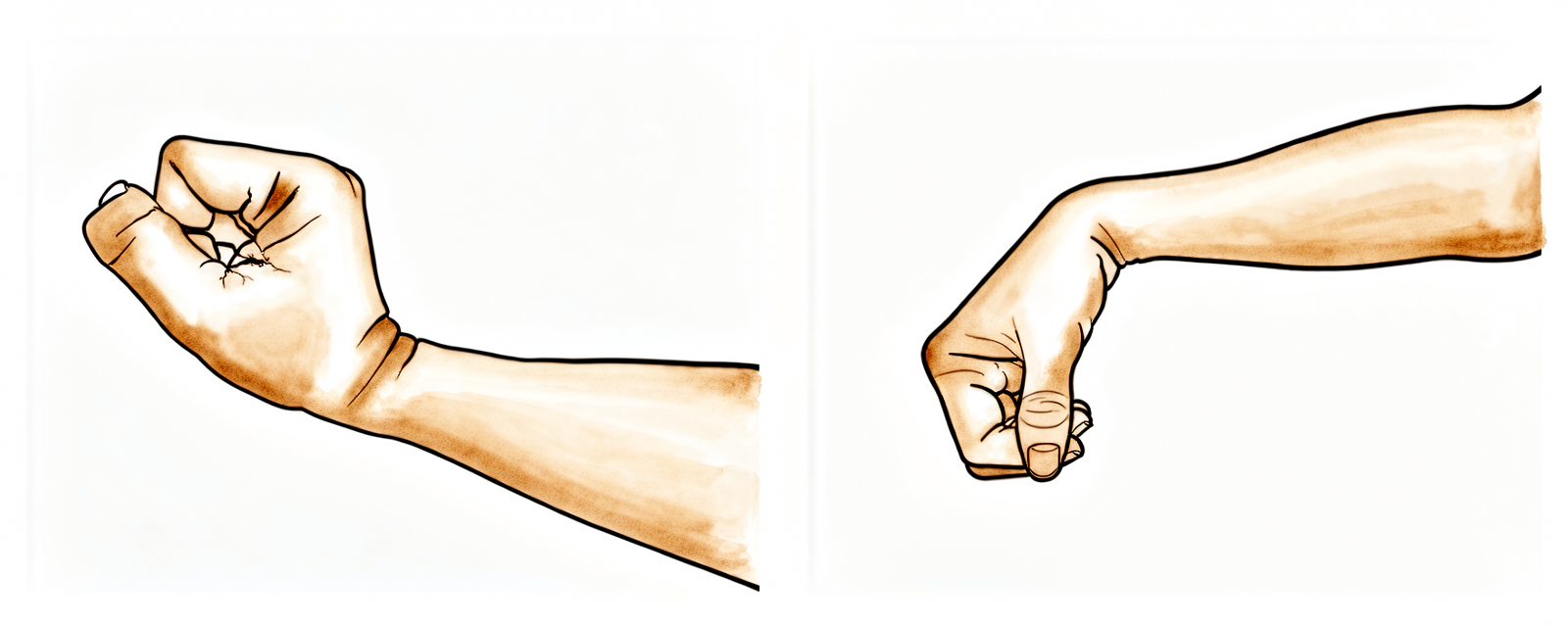
Flexión/extensión de la muñeca
Apoye el codo sobre una mesa y mueva suavemente la muñeca hacia atrás y hacia adelante (o apóyela en el borde de una mesa o sillón, tal como se muestra en la imagen). Cuando se sienta más cómodo, tome la palma con la otra mano y empuje la muñeca hacia atrás, de modo que los dedos apunten al techo; luego haga lo contrario para que apunten al suelo. Mantenga los dedos relajados: se doblarán o estirarán por sí solos. Mantenga cada estiramiento durante 15 segundos; repita 5 veces en cada dirección.
10 repeticiones, 4–5 veces al día
Kieran Hirpara 4.0
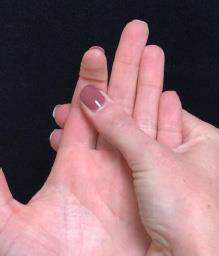
Bloqueo de la articulación interfalángica distal
Comience con la palma hacia arriba; sostenga la mano afectada con la otra mano justo debajo de la articulación distal — la articulación interfalángica distal (AIFD). Flexione y extienda dicha articulación, manteniendo cada posición durante 3–5 segundos. Sostenga la articulación media únicamente lo necesario para evitar que se doble. Es normal que los demás dedos se muevan durante este ejercicio.
10 repeticiones, 4 veces al día, todos los días.
Kieran Hirpara 4.0
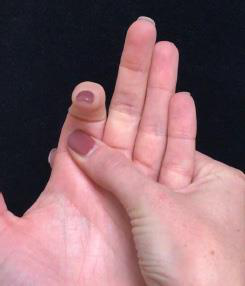
Bloqueo de la articulación PIP
Comience con la palma hacia arriba; sostenga la mano afectada con la otra mano justo debajo de la segunda articulación: la articulación interfalángica proximal (AIP). Flexione y estire el dedo en la articulación media, manteniendo cada posición durante 3–5 segundos. Es normal que los demás dedos también se muevan.
10 repeticiones, 4 veces al día, todos los días.
Kieran Hirpara 4.0
Deslizamiento tendinoso — Serie A
Con la mano frente a usted y la muñeca recta, estire por completo todos los dedos (1). Doble las puntas de los dedos hasta formar una posición en “gancho”, con los nudillos apuntando hacia arriba (2). Cierre el puño firmemente, colocando el pulgar sobre los dedos (3).
5–10 repeticiones, 2–3 veces al día, a diario.
Kieran Hirpara 4.0
Deslizamiento tendinoso — Serie B
Con la mano frente a usted y la muñeca recta, estire por completo todos los dedos (1). Forme una “superficie plana” con los dedos doblando los nudillos de la base y manteniendo los dedos rectos; asegúrese de que la muñeca no se incline hacia adelante (2). Doble los dedos en la articulación media, acercándolos a la palma de la mano (3).
5–10 repeticiones, 2–3 veces al día, a diario.
Comience los ejercicios que se indican a continuación únicamente bajo la guía del Dr. Hirpara y de su terapeuta especializado en mano, respetando siempre los rangos y límites que le hayan indicado. Los ejercicios de bloqueo son específicos: al mantener inmóvil la articulación inferior, se obliga al movimiento a producirse en la articulación que se desea liberar, en lugar de en aquella que ya se mueve con facilidad. La serie de deslizamientos tendinosos ayuda a que los tendones flexores se deslicen sin problemas dentro de su vaina; el estiramiento de la muñeca evita que esta se vuelva rígida mientras se trabaja en los dedos. Es mejor practicar poco pero con frecuencia, en lugar de sesiones largas y poco frecuentes. Interrumpa cualquier ejercicio que le cause dolor intenso.
Después de seguir este protocolo
Este protocolo complementa las recomendaciones generales de recuperación del consultorio; consulte control del dolor postoperatorio, cuidado de la herida y conceptos básicos de la terapia de la mano. Para intervenciones quirúrgicas en las que este programa se utiliza habitualmente, véase liberación del dedo en gatillo y fasciectomía de Dupuytren.
Este programa de ejercicios fue elaborado en colaboración con Sarah Farrell, BOccThy, terapeuta de la mano acreditada.
Referencias
[1] Miller LK, Jerosch-Herold C, Shepstone L. Eficacia de las técnicas de manejo del edema en el edema subagudo de la mano: una revisión sistemática. J Hand Ther. 2017;30(4):432–446. https://pubmed.ncbi.nlm.nih.gov/28807598/ [2] Wehbé MA, Hunter JM. Deslizamiento de los tendones flexores en la mano. Parte II. Deslizamiento diferencial. J Hand Surg Am. 1985;10(4):575–579. https://pubmed.ncbi.nlm.nih.gov/4020073/
Evidence & references
This is the clinical evidence summary written for health professionals. It is technical, and it lists the research this page was built from. You do not need to read it to understand your treatment or to make a decision about it.
Finger Surgery — General Post-operative Hand-Therapy Rehabilitation
Topic scope: This is a general post-operative finger rehabilitation program, not a single-procedure protocol. It applies as the default hand-therapy pathway after common finger operations where the repaired or released structure does not mandate its own protected range — most typically trigger finger (A1 pulley) release and Dupuytren's fasciectomy, and as a baseline mobility/oedema program after finger fracture fixation (proximal/middle phalanx ORIF or K-wire), PIP joint and volar-plate / collateral-ligament procedures, and minor soft-tissue work. The program rests on three levers the patient handout puts into practice — (1) oedema control, (2) early gentle protected movement, and (3) tendon gliding / joint-blocking to preserve differential excursion. It explicitly defers to the operation-specific protocol whenever the surgery carries a defined protected arc, motion limit or splinting regime (most importantly flexor or extensor tendon repair), which this general program does not attempt to reproduce.
Defining principle: fingers stiffen faster than almost any other joint complex in the body. The small interphalangeal joints, the gliding flexor/extensor tendons within their sheaths, and the dense soft-tissue envelope are all exquisitely sensitive to swelling and immobility — adhesions and joint contracture establish within days, not weeks. Rehabilitation is therefore a constant balancing act: protect the repaired structure for exactly the window it needs, and not one day longer, while restoring controlled glide and range early to outrun the stiffness. When in doubt, the default after finger surgery is controlled motion, not rest.
A. WHY EARLY CONTROLLED MOTION (THE CORE RATIONALE)
The unifying problem after any finger operation is the stiff finger: persistent oedema and immobility drive scar between the gliding planes, contract the joint capsule and collateral ligaments, and convert a mechanically sound repair into a functionally poor hand. The hand-surgery literature treats the stiff finger as a largely preventable complication of inadequate early rehabilitation rather than an inevitable consequence of surgery [The Stiff Finger; Stiff Digit, JAAOS].
- Immobilisation has a cost. Reduced range of motion after immobilisation arises from increased swelling, scarring between tendons and surrounding structures, and joint/ligament contracture — the exact mechanisms early motion is designed to defeat (BSSH early-mobilisation guidance).
- Adhesions establish early. The rationale for getting the patient moving — ideally with instructions given pre-operatively — and for a first therapy review at 5–7 days is to begin glide before adhesions become established (BSSH). The synthesis mirrors this: the home program starts as soon as the wound and operation allow, not at an arbitrary late milestone.
- Time to active exercise predicts the end result. In hand-fracture rehabilitation, earlier commencement of active exercise predicts greater total active range of motion at 6 weeks — a direct, measurable dose-response between early motion and outcome [Time to commencement of active exercise predicts TAM, Hand Therapy 2016].
B. EVIDENCE BY PROCEDURE GROUP
Finger fracture fixation (phalangeal ORIF / K-wire)
- The modern standard is stable fixation that permits early protected motion. Wide-awake surgery with early protected movement and pain-guided progression yields better finger ROM than rigid immobilisation (Saint John / pain-guided protocols; "better results with wide-awake surgery and early protected motion"). A systematic review and meta-analysis of mobilisation after ORIF of hand fractures supports earlier mobilisation over prolonged immobilisation for range without compromising union (ScienceDirect 2025 SR).
- Stable construct is the prerequisite. The whole early-motion strategy is contingent on the surgeon's judgement that the fixation will tolerate movement — which is why the synthesis hands the precaution set (load limits, the up-to-6-week no-lift window) back to the post-operative review. Surgeon to confirm per case.
- Minimally invasive fixation techniques are explicitly framed around preserving the soft-tissue envelope to reduce stiffness and allow early motion [Minimally Invasive Finger Fracture Management, Hand Clin].
PIP joint, volar-plate and collateral-ligament injuries
- These are stiffness-prone injuries where the management trade-off (stability vs early motion) is sharpest. The literature on PIP dislocations, fracture-dislocations and volar-plate injuries consistently favours early protected/active motion, often with buddy-strapping or a dorsal blocking approach, over static immobilisation, precisely because the PIP joint contracts so readily [PIP dislocations in athletes, Hand Clin; PIP fracture-dislocations, JBJS Rev; finger joint dislocations, Clin Sports Med].
- Buddy taping — depicted in the handout's hero image — is the canonical low-tech "protected early movement" tool here: it shares load with the neighbouring digit while permitting active glide.
Trigger finger (A1 pulley) release
- Release of the A1 pulley is a high-yield day procedure with reliably good patient-perceived recovery [Patient-Perceived Outcomes of Recovery After Trigger Digit Release, JHS 2023].
- Formal supervised therapy is usually NOT required for an uncomplicated release. A prospective randomised controlled trial found no significant difference in DASH, grip strength, ROM or pain between a structured post-operative occupational-therapy arm and a simple home-advice/ROM arm at final follow-up (RCT, PMC10671987). This validates the synthesis framing this as a home program with therapy escalation reserved for those who are slow to settle, stiff or swollen — not mandated for everyone.
Dupuytren's fasciectomy
- Therapy after fasciectomy centres on oedema and wound management, a home exercise program, and night extension splinting — a typical "brief" protocol runs 4 sessions (days 0-3, 2 wk, 4 wk, 8 wk) with a night extension orthosis to ~3 months (post-fasciectomy rehab trials).
- Routine night-splinting for all is contested. The SCoRD-type trials and subsequent work show static night splinting does not clearly improve ROM over hand therapy alone for unselected patients — splinting is best targeted at those losing extension, not applied universally [SCoRD protocol; Dutch Multidisciplinary Guideline on Dupuytren Disease].
- For established post-fasciectomy or post-fracture flexion stiffness, casting motion to mobilise stiffness (CMMS) is an evidence-supported salvage technique to regain digital flexion [Casting motion to mobilise stiffness, Hand Therapy 2010].
C. OEDEMA, SCAR AND STIFFNESS MANAGEMENT
- Oedema control is first-line and non-negotiable. Persistent hand oedema stiffens the soft tissues and degrades both ROM and function. The best systematic review of subacute hand oedema management concluded that active exercise enabling tendon gliding and muscular contraction acts as a pump to drive oedema away from the periphery, and supports elevation and active movement as first-line, with retrograde massage, compression and manual oedema mobilisation as adjuncts — there is no single superior modality, so the program layers them [Miller, Jerosch-Herold & Shepstone, J Hand Ther 2017]. This is reference [1] in the synthesis.
- Tendon gliding works through differential excursion. The straight / hook / tabletop / full-fist positions are not interchangeable repetitions: each moves the FDP relative to the FDS and relative to the sheath by a different amount, and it is this differential glide that keeps the tendons from scarring to one another and to the sheath [Wehbe & Hunter, J Hand Surg Am 1985 — reference [2] in the synthesis]. Joint-by-joint DIP and PIP blocking isolates the same glide at a single joint.
- Scar management. Once the wound is healed, scar massage and desensitisation reduce adherent scar over the incision — relevant to every open finger procedure and the surgical interval through which the tendons must glide.
- Heat before, ice after the exercise session is a standard hand-therapy adjunct to improve tissue extensibility for movement and settle the post-exercise inflammatory flare (consensus practice).
Phased timeline (maps to the synthesis sections)
| Phase | Window | Protect | Motion / glide | Oedema & scar | Notes |
|---|---|---|---|---|---|
| I — Settle & protect | Week 0-~2 | Protect per the specific operation (buddy tape / splint / load limits as set at review); light functional use for self-care, dressing, writing, typing | Begin gentle active motion within the operation's limits; tendon glides and DIP/PIP blocking as the wound and fixation allow | Elevation + active movement first-line for swelling; wound care per handout | First therapy review ideally 5-7 days to start glide before adhesions set (BSSH). No lifting/gripping/impact |
| II — Restore glide & range | Week ~2-6 | Wean protection as the structure consolidates; precautions confirmed at post-op review | Progress active ROM, full tendon-glide series, joint blocking; buddy strapping for PIP/collateral injuries | Once healed: commence scar massage (firm circles); heat before / ice after exercises; retrograde massage + compression if oedema persists | Most ROM is won in this window — frequent gentle practice beats occasional hard effort |
| III — Strengthen & return | Week ~6-12 | Protection generally off (operation-dependent) | Restore full ROM; introduce grip and functional strengthening | Continue scar work until mature; night extension splint to ~3 mo if losing extension (Dupuytren) | Return to lifting/gripping/impact from ~6 weeks per the operation; escalate persistent stiffness to hand therapy / CMMS |
Phase windows are typical and consensus-based; the operation-specific protocol and the surgeon's post-operative review override any timing here.
D. KEY CONTROVERSIES / EVIDENCE QUALITY
- Universal supervised therapy vs home program. For simple procedures (trigger finger release) an RCT shows no benefit of routine formal therapy over good home advice — supporting a targeted therapy model. For complex/stiffness-prone injuries (PIP, fracture-dislocation, fracture ORIF) early supervised hand therapy is far more clearly beneficial. The synthesis correctly pitches a home program with therapist escalation rather than mandating identical input for every operation. Moderate.
- Night-splinting after Dupuytren's fasciectomy. Routine static night splinting is not supported for unselected patients (SCoRD, Dutch guideline); reserve it for those demonstrably losing extension. Moderate (RCT/guideline).
- How early, and how much, to move a fixed fracture. Early protected motion is favoured, but it is strictly contingent on a stable construct — a judgement only the operating surgeon can make. The "early motion is better" evidence assumes adequate fixation. Moderate (SR), construct-dependent.
- The general protocol itself is a consensus scaffold. A single "finger surgery" rehab program necessarily generalises across heterogeneous operations; its three principles (oedema, early motion, glide) are very well supported, but the exact dosing/timing is expert-consensus, individualised by the treating therapist and surgeon.
E. EVIDENCE STRENGTH FLAGS (summary)
- STRONG: oedema control via elevation + active tendon-gliding exercise as first-line (SR, J Hand Ther 2017); tendon differential-excursion rationale for the varied glide positions (mechanistic, Wehbe & Hunter); early motion reduces stiffness/adhesions after finger surgery (consistent across the stiff-finger and BSSH literature).
- MODERATE (RCT / SR / guideline): early mobilisation > immobilisation after hand-fracture ORIF (SR + meta-analysis, 2025); time-to-active-exercise predicts 6-week TAM; no added benefit of routine formal therapy after simple trigger-finger release (RCT); selective (not universal) night splinting after Dupuytren's fasciectomy (SCoRD/Dutch guideline).
- WEAK / CONSENSUS: the precise phase windows and exercise dosing in this general program (expert hand-therapy consensus, individualised); heat-before/ice-after adjunct; the principle that operation-specific protocols override this general scaffold (sound clinical practice, not trial-derived).
CITATIONS
RAG corpus (180,000+ Orthopaedic articles)
- Time to commencement of active exercise predicts total active range of motion 6 weeks after hand-fracture fixation. Hand Therapy. 2016. DOI: 10.1177/1758998316679386
- Hardy MA. The Stiff Finger. Hand Clinics. 2010. DOI: 10.1016/j.hcl.2010.02.001
- Etiology, Evaluation, and Management Options for the Stiff Digit. JAAOS. DOI: 10.5435/jaaos-d-18-00310
- Phalangeal neck fractures of the proximal phalanx of the fingers in adults. Injury. 2010. DOI: 10.1016/j.injury.2010.06.017
- Minimally Invasive Finger Fracture Management. Hand Clinics. 2013. DOI: 10.1016/j.hcl.2013.08.014
- Management of Proximal Interphalangeal Joint Dislocations in Athletes. Hand Clinics. 2009. DOI: 10.1016/j.hcl.2009.05.008
- Treatment of Proximal Interphalangeal Joint Fracture-Dislocations. JBJS Reviews. DOI: 10.2106/jbjs.rvw.o.00019
- Management of Finger Joint Dislocation and Fracture-Dislocations in Athletes. Clinics in Sports Medicine. 2019. DOI: 10.1016/j.csm.2019.10.006
- Patient-Perceived Outcomes of Recovery After Trigger Digit Release. J Hand Surg Am. 2023. DOI: 10.1016/j.jhsa.2023.03.016
- Comparative Study of A1 Pulley Release and Ulnar Superficialis Slip Resection (trigger digit). J Hand Surg Am. 2022. DOI: 10.1016/j.jhsa.2022.04.021
- Use of casting motion to mobilize stiffness (CMMS) to regain digital flexion. Hand Therapy. 2010. DOI: 10.1258/ht.2010.010008
- Dutch Multidisciplinary Guideline on Dupuytren Disease. J Hand Surg Glob Online. 2022. DOI: 10.1016/j.jhsg.2022.11.008
- Factors affecting functional recovery after surgery and hand therapy in Dupuytren's patients. J Hand Ther. 2014. DOI: 10.1016/j.jht.2014.11.006
- Rehabilitation Regimens Following Surgical Repair of Extensor Tendon Injuries of the hand. DOI: 10.1007/s12593-012-0075-x
Hand-therapy / rehabilitation literature (URLs)
- Miller LK, Jerosch-Herold C, Shepstone L. Effectiveness of edema management techniques for subacute hand edema: a systematic review. J Hand Ther. 2017;30(4):432-446. https://pubmed.ncbi.nlm.nih.gov/28807598/
- Wehbe MA, Hunter JM. Flexor tendon gliding in the hand. Part II. Differential gliding. J Hand Surg Am.
- https://pubmed.ncbi.nlm.nih.gov/4020073/
- Systematic review and meta-analysis of mobilisation following ORIF of hand fractures. ScienceDirect.
- https://www.sciencedirect.com/science/article/pii/S1748681525003109
- Better results of finger fractures with wide-awake surgery and early protected motion. PMC. https://www.ncbi.nlm.nih.gov/pmc/articles/PMC4445035/
- The effectiveness of rehabilitation after open surgical release for trigger finger: a prospective, randomized, controlled study. PMC. https://www.ncbi.nlm.nih.gov/pmc/articles/PMC10671987/
- Splinting after contracture release for Dupuytren's contracture (SCoRD): RCT protocol. PMC. https://www.ncbi.nlm.nih.gov/pmc/articles/PMC2386788/
Published rehab protocols (patient-guidance / society — basis for the phase structure)
- The British Society for Surgery of the Hand (BSSH) — Guidelines. https://www.bssh.ac.uk/professionals/guidelines.aspx
- Pain-Guided Hand Therapy for early protected movement of finger fractures (The Saint John Protocol), ASSH. https://handsurgery.org/multimedia/files/preCourse/Pain%20Guided%20Hand%20Therapy%20for%20early%20protected%20movement%20finger%20fractures.pdf
- Rehabilitative Strategies Following Hand Fractures. Hand Clinics. https://www.hand.theclinics.com/article/S0749-0712(13)00066-8/fulltext
- University of Kentucky HealthCare — Hand Rehabilitation Protocols. https://ukhealthcare.uky.edu/sites/default/files/m21-0609_ortho_protocols-final.pdf