Skip to content

Patients › General-Health

Fibromialgia

PDF

Widespread pain and fatigue from an over-sensitised nervous system — what it is, and why movement, sleep and pacing help most.
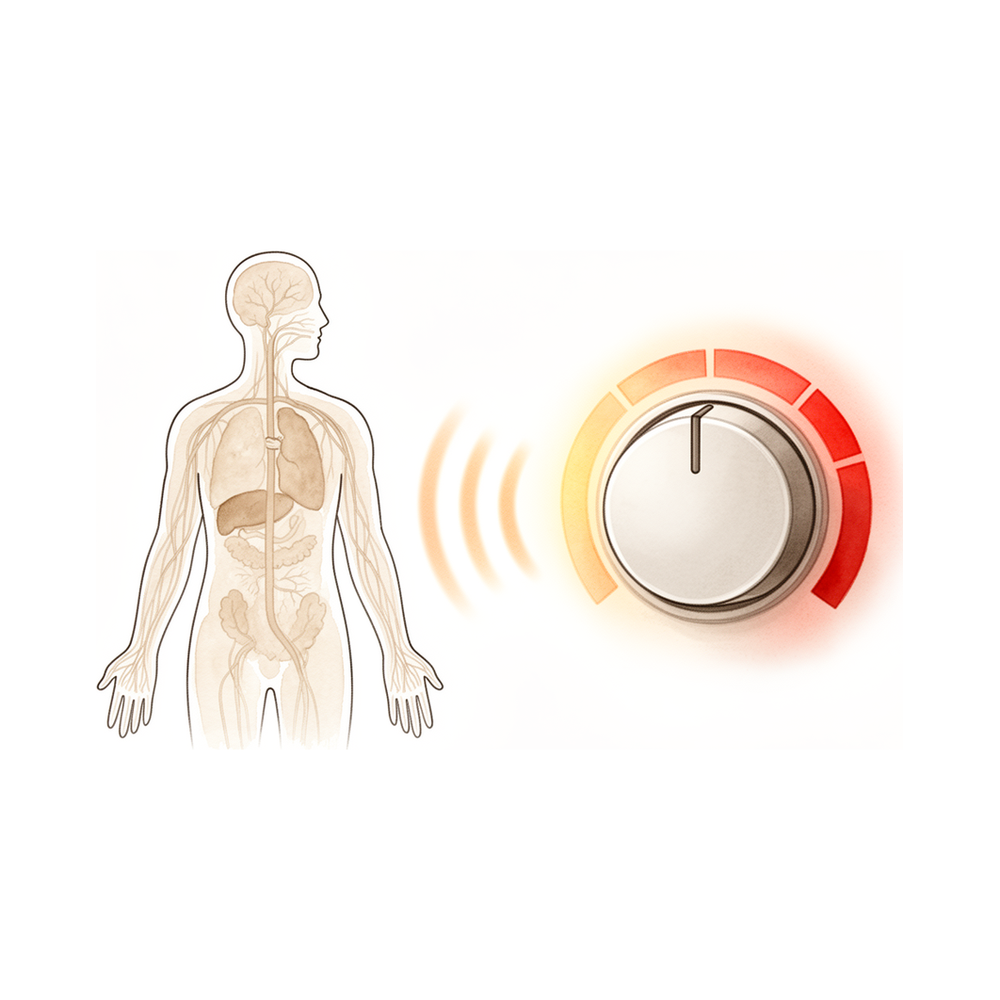
Ilustración de un dolor generalizado y exacerbado: un cuerpo cuyo “control de intensidad del dolor” se ha ajustado hasta el nivel rojo.
En la fibromialgia, el sistema nervioso aumenta el “volumen del dolor”, por lo que este se percibe en diversas partes del cuerpo. Kieran Hirpara 4.0

Esta página se tradujo automáticamente y todavía no la ha revisado un médico. La versión en inglés es la versión oficial.

Qué está sintiendo

La fibromialgia se caracteriza por un dolor generalizado y crónico: una molestia, ardor o sensación de dolor que puede desplazarse por todo el cuerpo y parece sentirse prácticamente en todas partes, en lugar de limitarse a una sola articulación. Junto con el dolor, la mayoría de las personas se sienten extremadamente cansadas; el sueño no les brinda alivio: pueden pasar toda la noche en la cama y, aun así, despertar sin sentirse descansadas, como si en realidad no hubieran dormido.

Muchas personas también notan que su pensamiento se vuelve confuso: les cuesta concentrarse, encontrar las palabras adecuadas o recordar cosas. Esto es tan frecuente que tiene un nombre: “niebla fibromialgica”. Además, el cuerpo suele volverse más sensible en general: el tacto, la presión, la luz, el sonido o la temperatura pueden resultar excesivos; un golpe que a la mayoría no les causaría molestia puede resultar muy doloroso. Es algo agotador, y es fácil sentir que nadie comprende realmente todo lo que uno está soportando.

¿Qué está ocurriendo realmente?

Aquí está lo importante: la fibromialgia no es un daño en las articulaciones ni en los músculos, y no es inflamación. Por eso los escáneres, radiografías y análisis de sangre suelen dar resultados normales. No hay nada que se “pase por alto”, y un resultado normal no significa que el dolor no sea real.

Lo que ocurre es en la forma en que el sistema nervioso procesa el dolor. En la fibromialgia, el sistema encargado de transmitir las señales de dolor se activa en exceso: el “volumen” se sube más de lo debido. Las sensaciones normales se amplifican hasta convertirse en dolor, y el dolor real se percibe con mayor intensidad. Los médicos denominan a esto sensibilización central. Se trata de un cambio físico real en la forma en que los nervios y el cerebro gestionan las señales: no es algo “que está en tu cabeza”, ni es señal de debilidad. La fibromialgia es común, es real y está reconocida como enfermedad.

Además, suele coexistir con otras afecciones (como el síndrome del intestino irritable, dolores de cabeza, estado de ánimo deprimido u otros tipos de dolor crónico), y puede amplificar el dolor después de una operación. Este último punto merece ser comentado con su equipo quirúrgico, pues saber que padece fibromialgia les ayuda a planificar el control del dolor y la recuperación, brindándole una mejor atención.

¿Qué podemos hacer al respecto?

No existe cura, pero la fibromialgia es manejable; muchas personas logran reducir sus síntomas a niveles mucho más tolerables. La ayuda más eficaz y confiable no proviene de ninguna pastilla, sino de ciertos hábitos constantes:

  • Movimiento suave y progresivo. El ejercicio es el tratamiento con mayor respaldo científico. Lo importante es empezar muy poco a poco y aumentar la intensidad gradualmente: caminar, estirarse o hacer ejercicio acuático son buenos puntos de partida. Esforzarse demasiado desde el inicio intensifica el dolor; por eso, la constancia y la lentitud son clave.
  • Un sueño de mejor calidad. Dado que el sueño poco reparador agrava el dolor y la sensación de “niebla mental”, mantener una rutina regular y buenos hábitos de sueño marca una gran diferencia.
  • Pautar las actividades. Distribuir las actividades a lo largo del día y de la semana (en vez de hacerlo todo en los días en que nos sentimos bien y luego agotarnos) ayuda a mantener la estabilidad.
  • Control del estrés y enfoques psicológicos. El estrés incrementa aún más la sensibilidad al dolor. Técnicas como la TCC (terapia cognitivo‑conductual), la relajación y la atención plena contribuyen a calmar un sistema nervioso hiperreactivo.

Los medicamentos pueden ayudar a algunas personas, pero los más útiles no son analgésicos en el sentido tradicional: sirven para calmar el sistema nervioso en lugar de bloquear las señales de dolor. Entre ellos se incluyen amitriptilina, duloxetina y pregabalina; puede leer más en nuestra página sobre medicamentos para el dolor nervioso. En cambio, los antiinflamatorios comunes no surten efecto en la fibromialgia (pues no hay inflamación que tratar), y los opioides no ayudan y pueden ser realmente perjudiciales: tienden a empeorar la situación con el tiempo en lugar de mejorarla. En nuestra página sobre manejo del dolor postoperatorio explicamos por qué evitamos su uso.

Qué esperar

La fibromialgia suele ser una condición crónica que presenta periodos de mejoría y de empeoramiento: brotes que a menudo se desencadenan por el estrés, el sueño deficiente, alguna enfermedad o el exceso de actividad. Esto puede resultar desalentador, pero para la mayoría de las personas que mantienen una rutina de ejercicio, buen descanso y control del ritmo de actividad, el pronóstico es verdaderamente esperanzador. Los síntomas se estabilizan, los brotes se vuelven más fáciles de manejar y la vida vuelve a abrirse paso.

Usted debe tomar la iniciativa, pero no está destinado a hacerlo solo. Un equipo de apoyo (su médico de cabecera, a veces un fisioterapeuta o un servicio especializado en el dolor) puede ayudarle a elaborar un plan, ajustarlo con el tiempo y a mantenerlo en la dirección correcta. La autogestión es sumamente eficaz precisamente porque usted es quien puede ir reduciendo gradualmente la intensidad de los síntomas, día tras día.

Cuándo consultar a un especialista

  • Un síntoma nuevo o un cambio evidente en uno ya existente: no dé por sentado que todo lo nuevo es “simplemente fibromialgia”. El dolor repentino o intenso en un punto concreto, la hinchazón, la fiebre, la pérdida de peso inexplicable, o la aparición de debilidad o entumecimiento merecen una evaluación adecuada, pues podrían indicar otra afección.
  • Estado de ánimo bajo, ansiedad o pérdida de interés por actividades que normalmente disfruta: estos síntomas suelen ir asociados a la fibromialgia, son tratables y su control facilita también el manejo del dolor. Si en algún momento se siente desesperanzado o inseguro, solicite ayuda de inmediato.
  • Síntomas que interfieren con su vida cotidiana a pesar de sus esfuerzos: ese es el momento de consultar a su médico de cabecera para obtener más apoyo, incluida una derivación a un servicio de tratamiento del dolor o reumatología.

En profundidad

Esta sección va más allá de lo que necesita saber para tomar sus propias decisiones de tratamiento. Vale la pena leer más sobre la fibromialgia, porque la idea más útil al respecto es también la menos intuitiva: aunque se manifiesta como un problema muscular y articular, la evidencia no apunta en absoluto a los músculos ni a las articulaciones.

La pista que no tiene nada que ver con las articulaciones

Si la fibromialgia fuera una enfermedad muscular o del tejido conectivo, debería limitarse a dichos tejidos. Pero no es así.

En un estudio poblacional realizado con 44,494 personas, quienes padecían fibromialgia u otros tipos de dolor musculoesquelético mostraron mayor probabilidad de reportar pérdida auditiva. Lo importante es la interpretación de los autores: este hallazgo concuerda con la idea de que la fibromialgia está relacionada con una disfunción general del sistema nervioso central; lo mismo podría aplicarse a otros tipos de dolor musculoesquelético generalizado [1].

La audición no guarda relación mecánica alguna con los dolores en los hombros. Cuando una enfermedad caracterizada por dolor musculoesquelético también se asocia al modo en que el oído y el cerebro procesan las señales, el factor común es el procesamiento sensorial, no el tejido afectado. Este es el modelo de sensibilización central, observado en un contexto inesperado: el “control de volumen” de las señales sensoriales se eleva, y el dolor es la consecuencia más evidente, aunque no la única.

¿Por qué los análisis resultan normales y por qué eso no significa que no haya patología?

Con frecuencia se le dice al paciente que todos los resultados de los exámenes son normales, lo cual genera incredulidad. La investigación explica por qué los resultados son normales sin por ello implicar que el dolor no exista.

Un metaanálisis sobre las citocinas, las moléculas de señalización inflamatoria que serían anómalas en una artritis inflamatoria, incluyó a 1,255 participantes y concluyó que su papel fisiopatológico en la fibromialgia sigue siendo incierto; se requieren estudios más amplios y de mayor calidad [2]. La investigación sobre el microbioma intestinal como posible factor contribuyente llegó a una conclusión similar: se trata de una vía prometedora dentro del emergente eje intestino–sistema musculoesquelético, pero hasta ahora faltan estudios de calidad [3].

Por lo tanto, no existe ningún análisis de sangre que pueda detectar anomalías, ya que la alteración radica en el procesamiento de señales y no en daño tisular o inflamación. Que los análisis inflamatorios y las imágenes diagnósticas sean normales es lo esperado; esto sirve para descartar otras enfermedades, pero no para descartar la fibromialgia.

Qué ha demostrado realmente ser útil

El tratamiento basado en el movimiento cuenta con los datos de respaldo más sólidos; la forma en que se realiza es menos importante que el hecho de hacerlo. Un metaanálisis realizado con 936 pacientes reveló que los ejercicios tradicionales chinos —tai chi, qigong y otras prácticas de baja intensidad que combinan movimiento y respiración— produjeron una mejora significativa en el dolor, la calidad del sueño y los síntomas de ansiedad y depresión [4].

Obsérvese qué aspectos mide dicho estudio: los beneficios se observan tanto en el dolor, el sueño como el estado de ánimo, lo cual es lógico si el objetivo es actuar sobre un sistema nervioso sensibilizado en lugar de sobre una estructura dolorosa. El sueño no es un aspecto secundario aquí; el sueño deficiente disminuye el umbral de tolerancia al dolor, y ambos factores se influyen mutuamente.

La superposición con la menopausia

Los síntomas de la fibromialgia suelen aparecer alrededor de la menopausia, tienden a ser más graves posteriormente y pueden empeorar tras una histerectomía, con o sin extirpación de los ovarios [5]. Las listas de síntomas coinciden en gran medida con el síndrome musculoesquelético de la menopausia.

La conclusión del estudio es que no se debe confundir una condición con la otra: la fibromialgia también se presenta en mujeres que no están en la menopausia y en hombres; por lo tanto, las hormonas sexuales no son el único mecanismo implicado. Ambas condiciones deben reconocerse y tratarse como problemas separados que pueden coexistir [5]. Consulte nuestra página sobre el síndrome musculoesquelético de la menopausia.

Qué significa esto cuando se considera la cirugía

Aquí es donde el modelo de sensibilización central adquiere relevancia práctica. Una operación corrige un problema estructural. No obstante, si parte de su dolor se genera por alteraciones en el procesamiento central, esa parte persistirá después de la intervención, ya que la cirugía no aborda dicho mecanismo.

Esto no constituye un argumento en contra de la cirugía cuando realmente existe un problema estructural que corregir. Más bien, es un argumento para determinar con precisión, de antemano, qué proporción de su dolor se espera que la operación elimine, y para tratar la fibromialgia por separado, en lugar de confiar en que la cirugía solucionará todo. Prepararse para la cirugía manteniendo el sueño, la actividad física y el estado de ánimo bajo control es un paso fundamental para lograr un buen resultado, no una mera medida complementaria.

Referencias

[1] Stranden M, Solvin H, Fors EA, Getz L, Helvik A. ¿Es más probable que las personas con fibromialgia u otros dolores musculoesqueléticos reporten pérdida auditiva? Un estudio HUNT. BMC Musculoskelet Disord. 2016;17(1). https://doi.org/10.1186/s12891-016-1331-1

[2] Üçeyler N, Häuser W, Sommer C. Revisión sistemática con metaanálisis: citoquinas en el síndrome de fibromialgia. BMC Musculoskelet Disord. 2011;12(1). https://doi.org/10.1186/1471-2474-12-245

[3] Erdrich S, Hawrelak JA, Myers SP, Harnett JE. Determinación de la asociación entre la fibromialgia, el microbioma intestinal y sus biomarcadores: una revisión sistemática. BMC Musculoskelet Disord. 2020;21(1). https://doi.org/10.1186/s12891-020-03201-9

[4] Wang X, Luo H. Efectos de la terapia de ejercicio tradicional china en los niveles de dolor, la calidad del sueño y los síntomas de ansiedad y depresión en pacientes con fibromialgia: una revisión sistemática y metaanálisis. BMC Musculoskelet Disord. 2024;25(1). https://doi.org/10.1186/s12891-024-07194-7

[5] Vidal-Neira LF, Neyro JL, Maldonado G, Messina OD, Moreno-Alvarez M, Ríos C. Climaterio y fibromialgia: una revisión. Climacteric. 2024;27(5):458-65. https://doi.org/10.1080/13697137.2024.2376190


Creative Commons BY-NC 4.0

CC Creative Commons licence
BY Attribution — you must credit the source
NC NonCommercial — not for commercial use

Attribution-NonCommercial 4.0 International


Creative Commons Corporation ("Creative Commons") is not a law firm and does not provide legal services or legal advice. Distribution of Creative Commons public licenses does not create a lawyer-client or other relationship. Creative Commons makes its licenses and related information available on an "as-is" basis. Creative Commons gives no warranties regarding its licenses, any material licensed under their terms and conditions, or any related information. Creative Commons disclaims all liability for damages resulting from their use to the fullest extent possible.

Using Creative Commons Public Licenses

Creative Commons public licenses provide a standard set of terms and conditions that creators and other rights holders may use to share original works of authorship and other material subject to copyright and certain other rights specified in the public license below. The following considerations are for informational purposes only, are not exhaustive, and do not form part of our licenses.

Considerations for licensors: Our public licenses are intended for use by those authorized to give the public permission to use material in ways otherwise restricted by copyright and certain other rights. Our licenses are irrevocable. Licensors should read and understand the terms and conditions of the license they choose before applying it. Licensors should also secure all rights necessary before applying our licenses so that the public can reuse the material as expected. Licensors should clearly mark any material not subject to the license. This includes other CC- licensed material, or material used under an exception or limitation to copyright. More considerations for licensors: wiki.creativecommons.org/Considerations_for_licensors

Considerations for the public: By using one of our public licenses, a licensor grants the public permission to use the licensed material under specified terms and conditions. If the licensor's permission is not necessary for any reason--for example, because of any applicable exception or limitation to copyright--then that use is not regulated by the license. Our licenses grant only permissions under copyright and certain other rights that a licensor has authority to grant. Use of the licensed material may still be restricted for other reasons, including because others have copyright or other rights in the material. A licensor may make special requests, such as asking that all changes be marked or described. Although not required by our licenses, you are encouraged to respect those requests where reasonable. More considerations for the public: wiki.creativecommons.org/Considerations_for_licensees


Creative Commons Attribution-NonCommercial 4.0 International Public License

By exercising the Licensed Rights (defined below), You accept and agree to be bound by the terms and conditions of this Creative Commons Attribution-NonCommercial 4.0 International Public License ("Public License"). To the extent this Public License may be interpreted as a contract, You are granted the Licensed Rights in consideration of Your acceptance of these terms and conditions, and the Licensor grants You such rights in consideration of benefits the Licensor receives from making the Licensed Material available under these terms and conditions.

Section 1 -- Definitions.

a. Adapted Material means material subject to Copyright and Similar Rights that is derived from or based upon the Licensed Material and in which the Licensed Material is translated, altered, arranged, transformed, or otherwise modified in a manner requiring permission under the Copyright and Similar Rights held by the Licensor. For purposes of this Public License, where the Licensed Material is a musical work, performance, or sound recording, Adapted Material is always produced where the Licensed Material is synched in timed relation with a moving image.

b. Adapter's License means the license You apply to Your Copyright and Similar Rights in Your contributions to Adapted Material in accordance with the terms and conditions of this Public License.

c. Copyright and Similar Rights means copyright and/or similar rights closely related to copyright including, without limitation, performance, broadcast, sound recording, and Sui Generis Database Rights, without regard to how the rights are labeled or categorized. For purposes of this Public License, the rights specified in Section 2(b)(1)-(2) are not Copyright and Similar Rights.

d. Effective Technological Measures means those measures that, in the absence of proper authority, may not be circumvented under laws fulfilling obligations under Article 11 of the WIPO Copyright Treaty adopted on December 20, 1996, and/or similar international agreements.

e. Exceptions and Limitations means fair use, fair dealing, and/or any other exception or limitation to Copyright and Similar Rights that applies to Your use of the Licensed Material.

f. Licensed Material means the artistic or literary work, database, or other material to which the Licensor applied this Public License.

g. Licensed Rights means the rights granted to You subject to the terms and conditions of this Public License, which are limited to all Copyright and Similar Rights that apply to Your use of the Licensed Material and that the Licensor has authority to license.

h. Licensor means the individual(s) or entity(ies) granting rights under this Public License.

i. NonCommercial means not primarily intended for or directed towards commercial advantage or monetary compensation. For purposes of this Public License, the exchange of the Licensed Material for other material subject to Copyright and Similar Rights by digital file-sharing or similar means is NonCommercial provided there is no payment of monetary compensation in connection with the exchange.

j. Share means to provide material to the public by any means or process that requires permission under the Licensed Rights, such as reproduction, public display, public performance, distribution, dissemination, communication, or importation, and to make material available to the public including in ways that members of the public may access the material from a place and at a time individually chosen by them.

k. Sui Generis Database Rights means rights other than copyright resulting from Directive 96/9/EC of the European Parliament and of the Council of 11 March 1996 on the legal protection of databases, as amended and/or succeeded, as well as other essentially equivalent rights anywhere in the world.

l. You means the individual or entity exercising the Licensed Rights under this Public License. Your has a corresponding meaning.

Section 2 -- Scope.

a. License grant.

1. Subject to the terms and conditions of this Public License, the Licensor hereby grants You a worldwide, royalty-free, non-sublicensable, non-exclusive, irrevocable license to exercise the Licensed Rights in the Licensed Material to:

a. reproduce and Share the Licensed Material, in whole or in part, for NonCommercial purposes only; and

b. produce, reproduce, and Share Adapted Material for NonCommercial purposes only.

2. Exceptions and Limitations. For the avoidance of doubt, where Exceptions and Limitations apply to Your use, this Public License does not apply, and You do not need to comply with its terms and conditions.

3. Term. The term of this Public License is specified in Section 6(a).

4. Media and formats; technical modifications allowed. The Licensor authorizes You to exercise the Licensed Rights in all media and formats whether now known or hereafter created, and to make technical modifications necessary to do so. The Licensor waives and/or agrees not to assert any right or authority to forbid You from making technical modifications necessary to exercise the Licensed Rights, including technical modifications necessary to circumvent Effective Technological Measures. For purposes of this Public License, simply making modifications authorized by this Section 2(a) (4) never produces Adapted Material.

5. Downstream recipients.

a. Offer from the Licensor -- Licensed Material. Every recipient of the Licensed Material automatically receives an offer from the Licensor to exercise the Licensed Rights under the terms and conditions of this Public License.

b. No downstream restrictions. You may not offer or impose any additional or different terms or conditions on, or apply any Effective Technological Measures to, the Licensed Material if doing so restricts exercise of the Licensed Rights by any recipient of the Licensed Material.

6. No endorsement. Nothing in this Public License constitutes or may be construed as permission to assert or imply that You are, or that Your use of the Licensed Material is, connected with, or sponsored, endorsed, or granted official status by, the Licensor or others designated to receive attribution as provided in Section 3(a)(1)(A)(i).

b. Other rights.

1. Moral rights, such as the right of integrity, are not licensed under this Public License, nor are publicity, privacy, and/or other similar personality rights; however, to the extent possible, the Licensor waives and/or agrees not to assert any such rights held by the Licensor to the limited extent necessary to allow You to exercise the Licensed Rights, but not otherwise.

2. Patent and trademark rights are not licensed under this Public License.

3. To the extent possible, the Licensor waives any right to collect royalties from You for the exercise of the Licensed Rights, whether directly or through a collecting society under any voluntary or waivable statutory or compulsory licensing scheme. In all other cases the Licensor expressly reserves any right to collect such royalties, including when the Licensed Material is used other than for NonCommercial purposes.

Section 3 -- License Conditions.

Your exercise of the Licensed Rights is expressly made subject to the following conditions.

a. Attribution.

1. If You Share the Licensed Material (including in modified form), You must:

a. retain the following if it is supplied by the Licensor with the Licensed Material:

i. identification of the creator(s) of the Licensed Material and any others designated to receive attribution, in any reasonable manner requested by the Licensor (including by pseudonym if designated);

ii. a copyright notice;

iii. a notice that refers to this Public License;

iv. a notice that refers to the disclaimer of warranties;

v. a URI or hyperlink to the Licensed Material to the extent reasonably practicable;

b. indicate if You modified the Licensed Material and retain an indication of any previous modifications; and

c. indicate the Licensed Material is licensed under this Public License, and include the text of, or the URI or hyperlink to, this Public License.

2. You may satisfy the conditions in Section 3(a)(1) in any reasonable manner based on the medium, means, and context in which You Share the Licensed Material. For example, it may be reasonable to satisfy the conditions by providing a URI or hyperlink to a resource that includes the required information.

3. If requested by the Licensor, You must remove any of the information required by Section 3(a)(1)(A) to the extent reasonably practicable.

4. If You Share Adapted Material You produce, the Adapter's License You apply must not prevent recipients of the Adapted Material from complying with this Public License.

Section 4 -- Sui Generis Database Rights.

Where the Licensed Rights include Sui Generis Database Rights that apply to Your use of the Licensed Material:

a. for the avoidance of doubt, Section 2(a)(1) grants You the right to extract, reuse, reproduce, and Share all or a substantial portion of the contents of the database for NonCommercial purposes only;

b. if You include all or a substantial portion of the database contents in a database in which You have Sui Generis Database Rights, then the database in which You have Sui Generis Database Rights (but not its individual contents) is Adapted Material; and

c. You must comply with the conditions in Section 3(a) if You Share all or a substantial portion of the contents of the database.

For the avoidance of doubt, this Section 4 supplements and does not replace Your obligations under this Public License where the Licensed Rights include other Copyright and Similar Rights.

Section 5 -- Disclaimer of Warranties and Limitation of Liability.

a. UNLESS OTHERWISE SEPARATELY UNDERTAKEN BY THE LICENSOR, TO THE EXTENT POSSIBLE, THE LICENSOR OFFERS THE LICENSED MATERIAL AS-IS AND AS-AVAILABLE, AND MAKES NO REPRESENTATIONS OR WARRANTIES OF ANY KIND CONCERNING THE LICENSED MATERIAL, WHETHER EXPRESS, IMPLIED, STATUTORY, OR OTHER. THIS INCLUDES, WITHOUT LIMITATION, WARRANTIES OF TITLE, MERCHANTABILITY, FITNESS FOR A PARTICULAR PURPOSE, NON-INFRINGEMENT, ABSENCE OF LATENT OR OTHER DEFECTS, ACCURACY, OR THE PRESENCE OR ABSENCE OF ERRORS, WHETHER OR NOT KNOWN OR DISCOVERABLE. WHERE DISCLAIMERS OF WARRANTIES ARE NOT ALLOWED IN FULL OR IN PART, THIS DISCLAIMER MAY NOT APPLY TO YOU.

b. TO THE EXTENT POSSIBLE, IN NO EVENT WILL THE LICENSOR BE LIABLE TO YOU ON ANY LEGAL THEORY (INCLUDING, WITHOUT LIMITATION, NEGLIGENCE) OR OTHERWISE FOR ANY DIRECT, SPECIAL, INDIRECT, INCIDENTAL, CONSEQUENTIAL, PUNITIVE, EXEMPLARY, OR OTHER LOSSES, COSTS, EXPENSES, OR DAMAGES ARISING OUT OF THIS PUBLIC LICENSE OR USE OF THE LICENSED MATERIAL, EVEN IF THE LICENSOR HAS BEEN ADVISED OF THE POSSIBILITY OF SUCH LOSSES, COSTS, EXPENSES, OR DAMAGES. WHERE A LIMITATION OF LIABILITY IS NOT ALLOWED IN FULL OR IN PART, THIS LIMITATION MAY NOT APPLY TO YOU.

c. The disclaimer of warranties and limitation of liability provided above shall be interpreted in a manner that, to the extent possible, most closely approximates an absolute disclaimer and waiver of all liability.

Section 6 -- Term and Termination.

a. This Public License applies for the term of the Copyright and Similar Rights licensed here. However, if You fail to comply with this Public License, then Your rights under this Public License terminate automatically.

b. Where Your right to use the Licensed Material has terminated under Section 6(a), it reinstates:

1. automatically as of the date the violation is cured, provided it is cured within 30 days of Your discovery of the violation; or

2. upon express reinstatement by the Licensor.

For the avoidance of doubt, this Section 6(b) does not affect any right the Licensor may have to seek remedies for Your violations of this Public License.

c. For the avoidance of doubt, the Licensor may also offer the Licensed Material under separate terms or conditions or stop distributing the Licensed Material at any time; however, doing so will not terminate this Public License.

d. Sections 1, 5, 6, 7, and 8 survive termination of this Public License.

Section 7 -- Other Terms and Conditions.

a. The Licensor shall not be bound by any additional or different terms or conditions communicated by You unless expressly agreed.

b. Any arrangements, understandings, or agreements regarding the Licensed Material not stated herein are separate from and independent of the terms and conditions of this Public License.

Section 8 -- Interpretation.

a. For the avoidance of doubt, this Public License does not, and shall not be interpreted to, reduce, limit, restrict, or impose conditions on any use of the Licensed Material that could lawfully be made without permission under this Public License.

b. To the extent possible, if any provision of this Public License is deemed unenforceable, it shall be automatically reformed to the minimum extent necessary to make it enforceable. If the provision cannot be reformed, it shall be severed from this Public License without affecting the enforceability of the remaining terms and conditions.

c. No term or condition of this Public License will be waived and no failure to comply consented to unless expressly agreed to by the Licensor.

d. Nothing in this Public License constitutes or may be interpreted as a limitation upon, or waiver of, any privileges and immunities that apply to the Licensor or You, including from the legal processes of any jurisdiction or authority.


Creative Commons is not a party to its public licenses. Notwithstanding, Creative Commons may elect to apply one of its public licenses to material it publishes and in those instances will be considered the “Licensor.” The text of the Creative Commons public licenses is dedicated to the public domain under the CC0 Public Domain Dedication. Except for the limited purpose of indicating that material is shared under a Creative Commons public license or as otherwise permitted by the Creative Commons policies published at creativecommons.org/policies, Creative Commons does not authorize the use of the trademark "Creative Commons" or any other trademark or logo of Creative Commons without its prior written consent including, without limitation, in connection with any unauthorized modifications to any of its public licenses or any other arrangements, understandings, or agreements concerning use of licensed material. For the avoidance of doubt, this paragraph does not form part of the public licenses.

Creative Commons may be contacted at creativecommons.org.