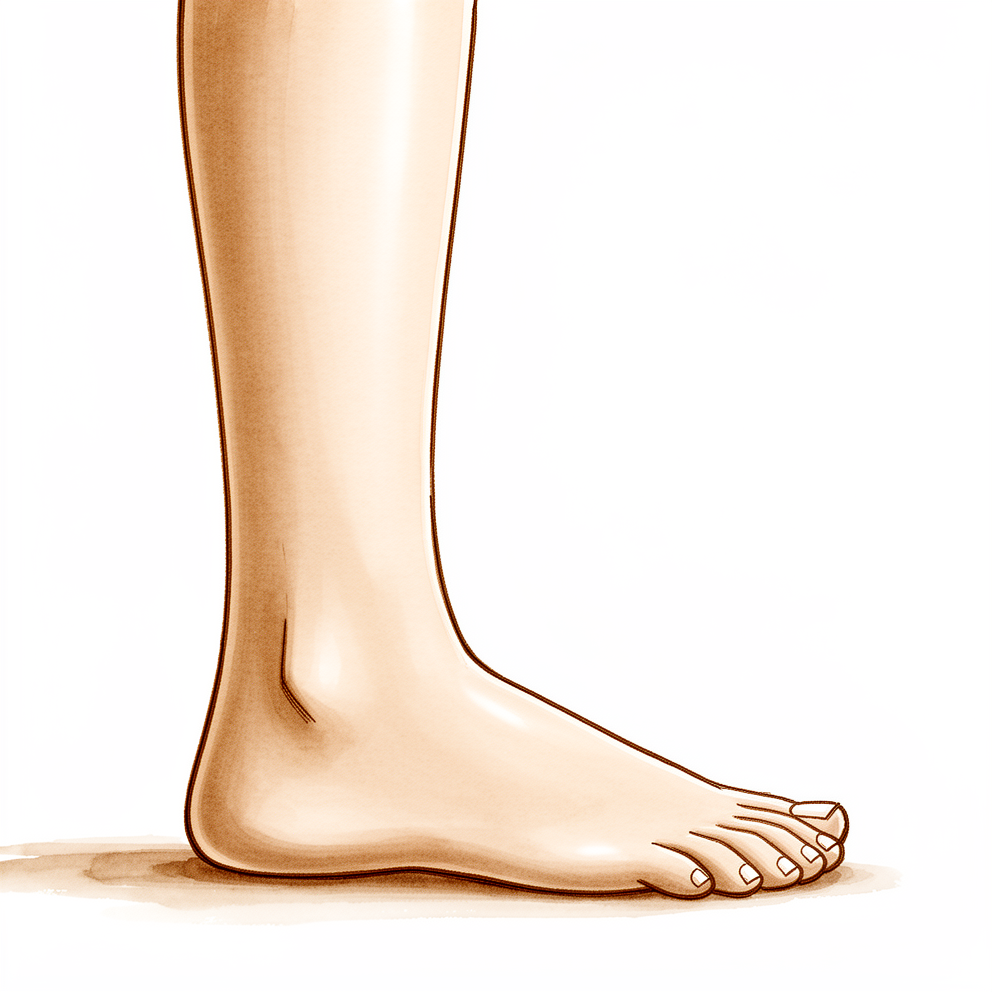
Qué está sintiendo
Una lesión osteocondral del astrágalo consiste en una pequeña zona de cartílago y hueso dañados en la superficie del astrágalo, el hueso que se encuentra debajo de la articulación del tobillo. Este daño puede deberse a un único esguince de tobillo, a esguinces repetidos a lo largo del tiempo, o a una combinación de causas aún no del todo comprendidas. Algunas personas con este tipo de lesión no sienten nada en absoluto; otras, en cambio, experimentan un dolor profundo en el tobillo que reaparece con frecuencia.
El dolor suele localizarse dentro de la articulación del tobillo y tiende a intensificarse con la actividad física; puede disminuir al detenerse y descansar. Es posible que el tobillo se hinche y se vuelva sensible al tacto alrededor de la articulación. Si ya ha sufrido esguinces en el mismo tobillo con anterioridad, ese historial suele coincidir con lo que está ocurriendo ahora.
En la vida cotidiana, este dolor puede dificultar el caminar, permanecer de pie durante largos períodos e impulsarse con el pie, haciendo que estas acciones resulten más complicadas de lo normal. Los terrenos irregulares, las escaleras y los deportes que implican carga sobre el tobillo pueden agravar los síntomas. Algunas personas notan que el tobillo se siente rígido o adolorido al volver a moverse después de estar sentadas o descansando.
Si algo de esto le resulta familiar, merece la pena que le examinen el tobillo adecuadamente. Una exploración por imagen puede mostrar la ubicación, el tamaño y la gravedad de la zona dañada, ya que pequeñas lesiones pueden no ser visibles en una radiografía convencional.
¿Qué está ocurriendo realmente?
El astrágalo es el hueso que se encuentra justo debajo de la articulación del tobillo. Su superficie superior está recubierta por una capa lisa y resbaladiza de cartílago; este material resistente permite que ambos huesos se deslicen uno sobre el otro sin fricción. Puede compararse con la banda de rodadura de un neumático: fuerte, ligeramente elástica y diseñada para soportar cargas cada vez que uno se para o camina.
En esta afección, un pequeño fragmento de ese cartílago, y a veces el hueso subyacente, resulta contusionado, agrietado o se desprende. La fuerza del traumatismo presiona las superficies articulares con tanta intensidad que daña dicha capa superficial. En ocasiones no existe un único traumatismo claro: el daño puede originarse por múltiples golpes leves, por problemas en el riego sanguíneo hacia esa zona ósea o por causas aún no del todo conocidas.
El fragmento dañado en sí no puede sentir dolor, ya que el cartílago carece de nervios. El dolor que se percibe proviene del hueso subyacente. Al caminar, el líquido se ve forzado a atravesar diminutas fisuras en el hueso bajo alta presión; esto irrita la superficie ósea, rica en terminaciones nerviosas, y genera ese dolor profundo y persistente. Con el tiempo, dicha presión también puede dar lugar a la formación de una pequeña cavidad llena de líquido, es decir, un quiste óseo. Si el fragmento dañado se desprende y queda flotando en la articulación, puede trabarse o provocar hinchazón y chasquidos.
En algunos casos, los pequeños fragmentos dañados se estabilizan por sí solos con reposo y el paso del tiempo. No obstante, los fragmentos más grandes o aquellos que ya se han desprendido suelen seguir generando síntomas y pueden ir deteriorando progresivamente la articulación. Por ello, el tamaño, la profundidad y la ubicación del fragmento, que pueden determinarse mediante estudios de imagen, determinan lo que ocurrirá a continuación.
Qué podemos hacer al respecto
Una tomografía computarizada, que genera una imagen detallada de los huesos, permite identificar con exactitud la ubicación del área dañada: en la parte delantera, media o posterior del astrágalo. Una resonancia magnética muestra con detalle el cartílago y el hueso, ayudándonos a determinar el tamaño y la profundidad de dicha zona dañada. Todos estos datos determinan nuestras recomendaciones posteriores.
En el caso de áreas dañadas pequeñas que aún no se han desprendido, normalmente iniciamos con un tratamiento no quirúrgico. Esto implica reposo, modificar la carga que se ejerce sobre el tobillo y realizar fisioterapia. La fisioterapia tiene como objetivo aliviar el dolor, fortalecer los músculos que sostienen el tobillo y estabilizar la articulación, incluso en terrenos irregulares. Le recomendamos probar este tratamiento durante un tiempo razonable antes de considerar la cirugía. El tratamiento no quirúrgico resulta eficaz en aproximadamente el 45 % de los pacientes con esta afección. Si la zona dañada se encuentra en una fase inicial, este suele ser el enfoque adecuado para comenzar. Algunas zonas dañadas más profundas también pueden tratarse inicialmente de esta forma, aunque con frecuencia requieren cirugía si los síntomas persisten.
Si la zona dañada es más extensa, se ha desprendido o el tratamiento no quirúrgico no le ha proporcionado suficiente alivio, le explicaremos en detalle las opciones quirúrgicas. El objetivo es acceder a la zona afectada, eliminar el tejido suelto o dañado y favorecer el crecimiento de nuevo tejido en dicho espacio. Para áreas pequeñas o medianas, normalmente se realiza una cirugía mínimamente invasiva llamada artroscopia, en la que se emplea una cámara delgada y pequeños instrumentos a través de incisiones diminutas. En el caso de zonas más grandes, la cirugía puede requerir el reemplazo de la superficie dañada por cartílago y hueso sano, ya sea extraído de otra zona de su propia rodilla o de tejido donado. Si sus ligamentos del tobillo se han distendido por esguinces repetidos, también podríamos tensarlos durante la intervención para proteger la superficie reparada y garantizar la salud a largo plazo de la articulación. La intervención concreta dependerá del tamaño, la profundidad y la ubicación de la zona dañada; le explicaremos cuál es la más adecuada para usted antes de tomar cualquier decisión conjunta.
Qué esperar
No existe un único curso clínico que siga esta afección. En ocasiones, pequeñas zonas dañadas se recuperan por sí solas con reposo y tiempo. En cambio, las zonas más extensas o aquellas en las que el fragmento dañado se ha desprendido suelen seguir causando síntomas y pueden deteriorar progresivamente la articulación. Por eso, el tamaño, la profundidad y la ubicación de dicha zona determinan lo que ocurrirá a continuación.
Si el tratamiento no quirúrgico le resulta eficaz, el pronóstico es favorable. Las zonas que mejoran tras un período inicial de reposo y modificación de las actividades se asocian con pocos síntomas a largo plazo, una baja tasa de recurrencia del problema y ninguna evolución significativa de la artrosis en el tobillo. Si, en cambio, no hay mejoría, la mayoría de las personas con síntomas persistentes o con fragmentos desprendidos necesitan cirugía.
El objetivo de la cirugía es aliviar el dolor y restablecer la funcionalidad del tobillo. La mayoría de las intervenciones razonables para esta afección arrojan resultados similares y satisfactorios; la elección entre ellas depende principalmente de las características de su lesión y no de que una técnica sea superior a otra. En el caso de zonas pequeñas tratadas mediante cirugía artroscópica, se reportan resultados buenos o excelentes en el 89 % de los pacientes menores de 50 años cuya lesión mide 1,5 cm² o menos. Los resultados son similares independientemente de si el daño se originó por una lesión traumática o no. Algunas intervenciones estimulan al cuerpo a generar nuevo tejido de reparación en el espacio afectado; en la mayoría de los casos, este crecimiento tisular se puede observar mediante estudios de imagen detallados. Otras opciones sustituyen la superficie dañada por cartílago y hueso sanos, y pueden emplearse de forma segura si una intervención previa no ha tenido éxito.
Conviene conocer también los límites de la cirugía. Tras la microfractura artroscópica, procedimiento en el que se realizan pequeños orificios en el hueso para favorecer la reparación, con el tiempo el hueso subyacente puede no recuperar por completo su altura normal; además, en algunos casos pueden agravarse pequeñas cavidades llenas de líquido en el hueso. Algunas personas siguen experimentando síntomas a pesar del tratamiento.
Si sus ligamentos del tobillo se han estirado por esguinces repetidos, reforzarlos al mismo tiempo que se trata la zona dañada puede proteger la superficie reparada y retrasar el deterioro del cartílago. Su cirujano le explicará qué opción se adapta mejor a su lesión y a sus objetivos.
¿Cuándo consultar a un especialista?
Acuda a su médico de cabecera si se ha torcido el mismo tobillo en más de una ocasión, o si siente un dolor profundo en el interior del tobillo que reaparece tras la actividad y mejora con el reposo. Solicite una evaluación por parte de un especialista si el tobillo se hincha y permanece sensible, si le parece inestable o cede al caminar sobre terreno irregular, o si presenta sensación de atrapamiento, chasquidos o bloqueo. Estos síntomas pueden indicar la presencia de un fragmento suelto de cartílago dañado en la articulación. También pregunte sobre sus ligamentos: las torceduras repetidas pueden estirarlos, y esa laxitud puede seguir dañando la superficie articular. Vale la pena actuar a tiempo, pues un ligamento estirado y una zona dañada pueden agravarse mutuamente.
Evidence & references
This is the clinical evidence summary written for health professionals. It is technical, and it lists the research this page was built from. You do not need to read it to understand your treatment or to make a decision about it.
Anatomy & Pathophysiology
Lesion Morphology and Classification
- Osteochondral fragments of the talus are often loose and turned upside down within the crater, with subchondral bone appearing yellowish and hard [1].
- The Pritsch et al. (1986) classification system for osteochondral lesions of the talus includes stages for intact overlying cartilage, soft overlying cartilage, and frayed overlying cartilage [3].
- The Cheng et al. (1995) classification system for osteochondral lesions of the talus includes stages for smooth/intact but soft or ballotable cartilage, rough surface, fibrillation/fissuring, flap present or bone exposed, loose undisplaced fragment, and displaced fragment [3].
- CT scans in the axial plane can show the crater and fragments of an osteochondral lesion [1].
- Coronal CT scans can locate a lesion as anterior, middle, or posterior, which is often difficult to determine on radiograph [1].
- CT with 2-mm cuts in the coronal and axial planes determines whether a lesion is in the anterior third, middle third, or posterior third of the talar dome [3].
- Lesion size measured on MRI does not accurately reflect arthroscopic measurement in talar osteochondral lesions [2].
Anatomical Considerations for Surgical Approach
- The lateral malleolus is posterior to the tibia, allowing lateral lesions in the middle or posterior third to usually be approached anteriorly without osteotomy [3].
- Osteotomy of the medial malleolus is often necessary to expose posterior or posteromedial lesions of the talus [1, 3].
- An anteromedial approach can be used for posteromedial lesions by "grooving" the anteromedial distal tibial articular surface 6 to 8 mm to expose the lesion without osteotomy of the medial malleolus [3].
- A posteromedial arthrotomy through an anteromedial approach can expose posteromedial lesions of the talus and avoid a medial malleolar osteotomy [3].
- An approach to the posteromedial ankle through the posterior portion of the posterior tibial tendon sheath allows exposure of the talar dome and tibial articular surface while protecting posteromedial tendons, neurovascular structures, and deep posterior fibers of the deltoid ligament [3].
- If osteotomy of the medial malleolus is necessary, surgery on the medial side should be delayed until after closure of the physis [1].
Pathophysiology and Healing
- Retrograde percutaneous drilling through the sinus tarsi preserves intact articular cartilage in early lesions [3].
- Bone grafts are used in conjunction with retrograde drilling to prevent articular collapse due to the difficulty of adequately filling the contours of the lesion [3].
- Surgical-grade calcium sulfate in liquid form can be injected into the defect after drilling to promote healing [3].
- Bone-marrow aspirate harvested from the iliac crest, centrifuged to isolate pluripotent cells, and mixed with calcium graft has been used to promote more rapid healing [3].
- Fibrocartilaginous tissue fills in the defect in the subchondral crater during the postoperative period [1].
Classification
Radiographic Classifications
- Berndt and Harty published a four-part radiographic classification of osteochondral lesions of the talus in 1959 [4].
- In the Berndt and Harty classification, Stage I is described as a small subchondral trabecular compression fracture not seen radiographically [4].
- In the Berndt and Harty classification, Stage II is described as an incomplete avulsion or separation of the fragment [4].
- In the Berndt and Harty classification, Stage III is described as complete avulsion without displacement [4].
- In the Berndt and Harty classification, Stage IV is described as a fragment detached and rotated and possibly within the joint [4].
- The Berndt and Harty classification is based on radiographic criteria that may be difficult to interpret [4].
- The Berndt and Harty classification cannot distinguish a stage I lesion [4].
- Several authors modified the Berndt and Harty classification to include associated MRI findings [4].
Arthroscopic Classifications
- Pritsch et al. (1986) classified the cartilage overlying the lesion into three grades based on visual appearance [3].
- In the Pritsch et al. classification, Grade 1 indicates intact overlying cartilage [3].
- In the Pritsch et al. classification, Grade 2 indicates soft overlying cartilage [3].
- In the Pritsch et al. classification, Grade 3 indicates frayed overlying cartilage [3].
- Cheng et al. (1995) classified the lesion into six stages based on arthroscopic appearance [3].
- In the Cheng et al. classification, Stage 1 is smooth, intact but soft or ballotable [3].
- In the Cheng et al. classification, Stage 2 is a rough surface [3].
- In the Cheng et al. classification, Stage 3 is fibrillation/fissuring [3].
- In the Cheng et al. classification, Stage 4 is a flap present or bone exposed [3].
- In the Cheng et al. classification, Stage 5 is a loose, undisplaced fragment [3].
- In the Cheng et al. classification, Stage 6 is a displaced fragment [3].
- Pritsch and colleagues reported poor correlation between the radiographic appearance of the lesion and the state of the overlying cartilage [4].
- Treatment of osteochondral lesions was based on the visual appearance of the cartilage according to Pritsch and colleagues [4].
Imaging Assessment
- MRI allows identification of stage I lesions [4].
- MRI findings in stable osteochondral lesions include decreased signal intensity on T1-weighted images [4].
- MRI findings in stable osteochondral lesions include either low or increased signal on T2-weighted images [4].
- MRI may be most useful in assessment of stage II osteochondral lesions for evaluation of chondral and subchondral discontinuity indicating lesion instability [4].
- MRI may be most useful in assessment of stage II osteochondral lesions for evaluation of the presence of subchondral cysts [4].
- MRI may overestimate stability [4].
- A combination of MRI assessment and arthoscopic examination may be required to determine stability and treatment requirements [4].
- MRI or CT is the preferred imaging for complete evaluation of a suspected lesion [4].
- The continuity of cartilage and subchondral cortex can be assessed by MRI or CT as an indicator of stability [4].
- Lesion depth can be evaluated by MRI or CT [4].
- Subchondral cysts may be evaluated by MRI [4].
- Signal intensity patterns and cyst size may progress or regress over time [4].
- Signal intensity patterns and cyst size may be less reliable indicators of lesion stability than surface continuity [4].
- CT with 2-mm cuts in the coronal and axial planes determines whether the lesion is in the anterior third, middle third, or posterior third of the talar dome [3].
Clinical Presentation
- Osteochondral lesions of the talus are often difficult to determine as anterior, middle, or posterior on radiograph [1].
- Coronal CT scans locate the lesion whether it is anterior, middle, or posterior [1].
- Axial CT scans show the crater and fragments of the osteochondral lesion [1].
- A "floating" fragment in an osteochondral lesion is a loose fragment turned upside down in the crater [1].
- The subchondral bone in an osteochondral lesion is yellowish and hard [1].
- The fragment in an osteochondral lesion is often loose [1].
Investigations
- Coronal CT scans locate talar osteochondral lesions as anterior, middle, or posterior, a distinction that is often difficult to determine on radiograph [1].
- Axial CT scans demonstrate the crater and fragments of talar osteochondral lesions [1].
- The diagnosis of talar osteochondral lesions involves history, physical examination, and arthroscopy [2].
Treatment
Open Surgical Technique
- A longitudinal incision 7 cm long is made over the antero-medial aspect of the ankle, placed far enough medially to allow for medial malleolar osteotomy if necessary [1].
- The foot is plantarflexed as much as possible to visualize the lesion, and an osteotomy is usually necessary if the lesion is posterior [1].
- An osteotomy is made obliquely across the medial malleolus at the ankle joint level perpendicular to a predrilled hole for a cancellous screw [1].
- The medial malleolus is turned distally using a towel clip, and the ankle is everted to expose the medial and posterior aspects of the talar dome [1].
- The central necrotic area is removed with a small curet, and the crater and fragment are removed with copious irrigation [1].
- Four or five holes are made in the subchondral crater with a small drill to promote vascular ingrowth [1].
- The medial malleolar osteotomy is realigned and secured with a cancellous bone screw, with radiographs taken to check for anatomic alignment [1].
- Postoperatively, the patient wears a cast or patellar tendon-bearing brace for 6 to 8 weeks [1].
- The patient remains non-weight bearing for a total of 8 to 12 weeks while fibrocartilaginous tissue fills the defect [1].
Arthroscopic and Percutaneous Techniques
- Percutaneous arthroscopic drilling is recommended as an alternative to surgical excision for early stages, medial lesions, and lesions in children that have not healed [3].
- Arthroscopic drilling for medial osteochondral lesions does not require osteotomy of the medial malleolus or postoperative immobilization [3].
- Arthroscopic drilling allows for early resumption of daily activities and sports [3].
- The procedure is reported to be as effective and useful in young patients, especially those with open physes [3].
- A specific indication for arthroscopic drilling is an early lesion with mild osteosclerosis of the surrounding talar bone, continuity of the cartilaginous surface, and stability of the osteochondral fragment [3].
- Retrograde percutaneous drilling through the sinus tarsi preserves the intact articular cartilage [3].
- Bone grafts are used in conjunction with retrograde drilling to prevent articular collapse due to difficulty in filling the contours of the lesion [3].
- Surgical-grade calcium sulfate in liquid form has been injected into the defect after drilling [3].
- Bone-marrow aspirate harvested from the iliac crest, centrifuged to isolate pluripotent cells, has been mixed with calcium graft to promote more rapid healing [3].
- CT with 2-mm cuts in the coronal and axial planes determines whether the lesion is in the anterior, middle, or posterior third of the talar dome [3].
- Lateral lesions, even when in the middle or posterior third, usually can be approached anteriorly and removed without an osteotomy [3].
- An anteromedial approach for posteromedial lesions involves "grooving" the anteromedial distal tibial articular surface 6 to 8 mm to expose the lesion without osteotomy of the medial malleolus [3].
- A posteromedial arthrotomy through an anteromedial approach can be used to expose posteromedial lesions of the talus and avoid a medial malleolar osteotomy [3].
- An approach to the posteromedial ankle through the posterior portion of the posterior tibial tendon sheath allows exposure of the talar dome and tibial articular surface while protecting posteromedial tendons, neurovascular structures, and deep posterior deltoid ligament fibers [3].
- Patients undergoing medial malleolar osteotomy are immobilized in a walking boot for 6 weeks and then allowed weight bearing in a walking boot until 12 weeks after surgery [3].
- A patellar tendon-bearing brace is sometimes used after surgery to unload the ankle joint [3].
Classification Systems
- The Pritsch et al. (1986) classification includes stages for intact overlying cartilage, soft overlying cartilage, and frayed overlying cartilage [3].
- The Cheng et al. (1995) classification includes stages for smooth/intact but soft or ballotable cartilage, rough surface, fibrillation/fissuring, flap present or bone exposed, loose undisplaced fragment, and displaced fragment [3].
Complications
- Previous bone marrow stimulation may negatively affect clinical outcome in patients undergoing autologous osteochondral transplantation for osteochondral lesions of the talus [2].
- Arthroscopic quantification of syndesmotic instability is possible in a cadaveric model [2].
- The arthroscopic syndesmotic assessment tool can differentiate between stable and unstable ankle syndesmoses [2].
- Chronic tibiofibular syndesmosis injury has diagnostic efficacy with magnetic resonance imaging and comparative operative treatment options [2].
- Arthroscopic suture anchor repair of the lateral ligament ankle complex has been evaluated in a cadaveric study [2].
- Arthroscopic Brostrom repair with Gould augmentation via an accessory anterolateral port is a technique for lateral instability of the ankle [2].
- Arthroscopic anatomic reconstruction of the lateral ligaments of the ankle with gracilis autograft is a described technique [2].
- Arthroscopic-assisted lateral ligamentous reconstruction is used in combined ankle and subtalar instability [2].
- Arthroscopic treatment of chronic ankle instability has been evaluated in a prospective study of 286 patients [2].
- Activity level and function 2 years after anterior talofibular repair can be compared between arthroscopic repair and open repair procedures [2].
- Combination of modified Brostrom procedure with ankle arthroscopy is used for ankle instability accompanied by intra-articular symptoms [2].
- Open and arthroscopic lateral ligament repair for treatment of chronic ankle instability has been subject to a systematic review [2].
- Arthroscopic repair of chronic lateral ankle instability is a described procedure [2].
- Arthroscopic findings and long-term results are documented for chronic lateral instability [2].
References
[1] Campbell S Operative Orthopaedics 4 Volume Set. RECONSTRUCTION OF THE PATELLOFEMORAL AND PATELLOTIBIAL LIGAMENTS WITH A SEMITENDINOSUS TENDON GRAFT > EXCISION OF OSTEOCHONDRAL FRAGMENT OF THE TALUS.
[2] Campbell S Operative Orthopaedics 4 Volume Set. ARTHROSCOPIC EXAMINATION AND DEBRIDEMENT OF THE ANKLE JOINT > OSTEochondral Lesions of the Talus.
[3] Campbell S Operative Orthopaedics 4 Volume Set. REPAIR OF ACUTE RUPTURE OF LATERAL LIGAMENTS > Classification Systems for Osteochondral Lesions of the Talus > ARTHROSCOPY.
[4] Tachdjian S Pediatric Orthopaedics From The Texas Scottish Rite Hospital For Children E Book. Plate 35.2 Scapulocostal Stabilization for Scapular Winging (Ketenjian Technique) > Osteochondral Lesions of the Talus > Classification.