Skip to content

Patients › Elbow

Ruptura distal del tendón del tríceps

PDF

A rare tear of the triceps tendon at the back of the elbow — how to spot it, who is at risk, and why complete tears usually need early repair.
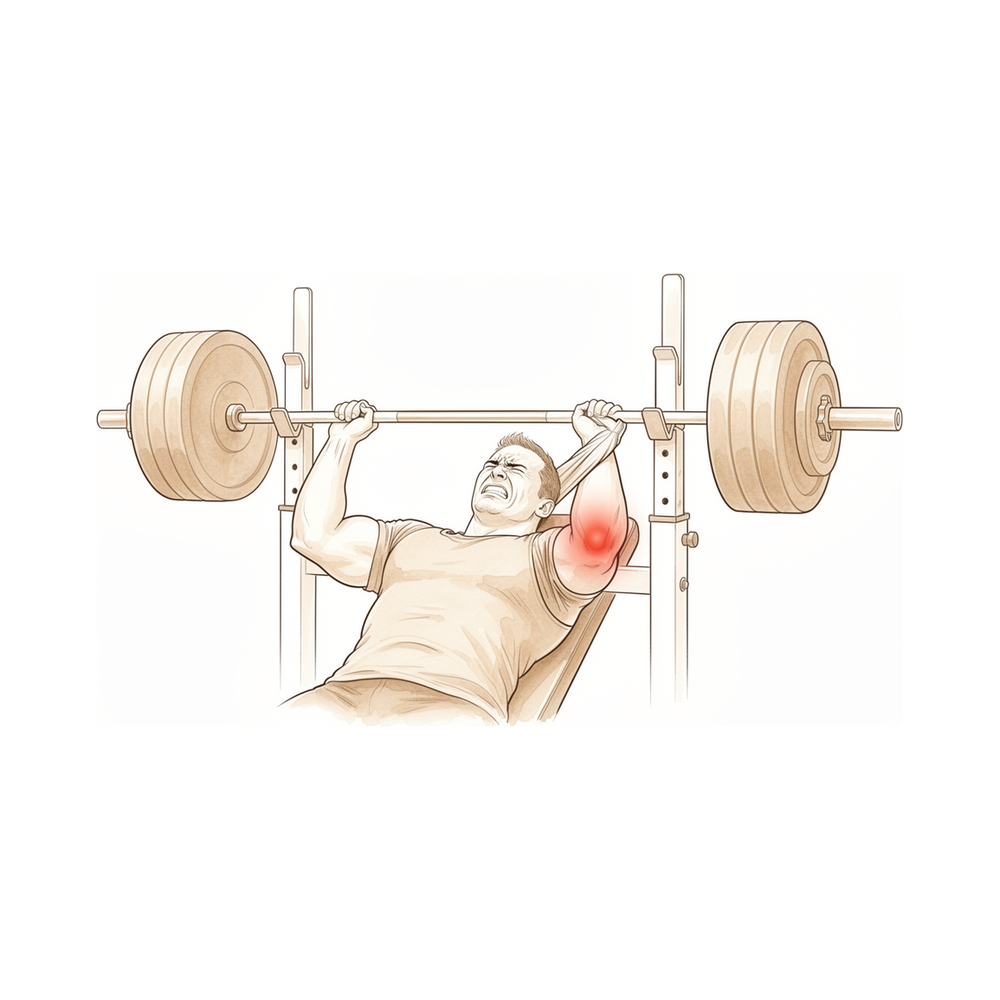
Un levantador de pesas que no logra completar una press de banca con carga pesada; se observa dolor en la parte posterior del codo.
Ruptura distal del tríceps: el tendón del tríceps se desgarra en la parte posterior del codo, generalmente durante una fuerza de empuje intensa o una caída. Kieran Hirpara 4.0

Esta página se tradujo automáticamente y todavía no la ha revisado un médico. La versión en inglés es la versión oficial.

Qué está sintiendo

El tríceps es el músculo grande que se encuentra en la parte posterior del brazo. Su tendón se fija en la punta del codo (el olécrano) y es el encargado de permitir que usted estire el brazo. Cuando ese tendón se desprende del hueso, la lesión suele ocurrir en un solo instante: a menudo al caerse sobre la mano extendida, o al levantar o empujar algo pesado que de repente cede.

En el momento de la lesión, es posible sentir un dolor agudo o un “chasquido” en la parte posterior del codo. Posteriormente, esa zona se hincha y presenta hematomas; además, la zona posterior del codo se vuelve sensible al tacto. El signo más revelador es la debilidad al intentar estirar el brazo contra la gravedad o alguna resistencia: abrir una puerta, levantarse de una silla o realizar levantamientos por encima de la cabeza pueden resultar difíciles o imposibles. En ocasiones, usted (o su médico) puede percibir una especie de hendidura o depresión en el tendón, justo por encima de la punta del codo. Si solo una parte del tendón se ha desgarrado, es posible que aún conserve cierta capacidad para estirar el brazo, aunque seguirá sintiendo dolor y debilidad.

Se trata de una lesión poco frecuente (el tríceps es el tendón del cuerpo que menos se rompe), y eso explica en parte por qué a veces no se detecta en la primera evaluación.

¿Qué está ocurriendo realmente?

El tendón del tríceps se ha desprendido, parcial o totalmente, de su inserción en el olécranon. Un desgarro completo significa que el músculo ya no está firmemente unido al hueso, por lo que la fuerza que genera no puede transmitirse para estirar el codo. Un desgarro parcial deja algunas fibras adheridas, de modo que aún se conserva cierta fuerza.

Estos desgarros ocurren casi siempre cuando el tendón soporta carga mientras el músculo se contrae con fuerza: por ejemplo, cuando el brazo se ve obligado a doblarse justo en el momento en que se intenta estirarlo o mantenerlo recto. Hay varios factores que aumentan la probabilidad de que el tendón se rompa: es mucho más frecuente en hombres, especialmente en quienes levantan pesas; el uso de esteroides anabólicos debilita los tendones y constituye un riesgo reconocido; además, las inyecciones de esteroides alrededor del codo, la bursitis recurrente del olécranon y ciertas enfermedades médicas, como la insuficiencia renal crónica, pueden hacer que el tendón sea más frágil. En ocasiones, un pequeño fragmento óseo se desprende junto con el tendón; esto, de hecho, ayuda a los médicos a confirmar el diagnóstico mediante radiografía.

Qué podemos hacer al respecto

El Dr. Kieran Hirpara es cirujano de miembro superior en el Mater Private Hospital Rockhampton y dirige nuestro enfoque para el tratamiento de esta afección. Por lo general, los pacientes son derivados a nuestra clínica por su médico de cabecera; si un fisioterapeuta le ha sugerido que nos consulte, igualmente necesitará una derivación de su médico de cabecera para poder acceder al reembolso de Medicare. Comenzamos con una evaluación clínica que incluye la historia clínica, el examen físico y, cuando es necesario, estudios por imagen, para establecer el diagnóstico.

El primer paso es confirmar el diagnóstico. Además del examen físico, se realiza una radiografía para buscar esa característica “esquirla” ósea; asimismo, se suele emplear ecografía o resonancia magnética para determinar si el desgarro es parcial o completo y hasta qué punto el tendón se ha retraído.

El tratamiento depende, entonces, de la extensión del desgarro tendinoso y del grado de uso que usted haga del brazo:

  • En el caso de desgarros parciales pequeños (menos de la mitad del tendón) en personas con bajas exigencias físicas, a menudo se puede tratar sin cirugía: se utiliza una férula con el codo ligeramente flexionado durante un tiempo, seguido de una recuperación gradual de la movilidad y el fortalecimiento muscular.
  • Los desgarros completos, los desgarros parciales que provocan debilidad, y aquellos que se presentan en personas activas o con alta demanda física se tratan mejor mediante cirugía para volver a fijar el tendón al hueso. Esto se logra pasando suturas resistentes a través de pequeños túneles óseos o anclando el tendón a su sitio original con implantes especiales. Repararlo a tiempo, antes de que el tendón cicatrice y se acorte, produce los mejores resultados.

Qué esperar

Cuando se repara a tiempo un tendón del tríceps desgarrado, los resultados suelen ser muy buenos: la mayoría de los pacientes recuperan una extensión del codo fuerte y fiable, y pueden volver a su trabajo y a la práctica deportiva. Tras la cirugía, el codo se mantiene protegido durante unas pocas semanas y luego se va movilizando gradualmente; posteriormente se inician los ejercicios de fortalecimiento. Por ello, la vuelta completa a actividades que requieran levantar pesos tarda unos meses en lugar de semanas. Su equipo médico le guiará en el ritmo adecuado.

Como ocurre con cualquier intervención quirúrgica, existen ciertos riesgos que debe conocer. Los principales son la reaparición de la rotura del tendón, motivo por el cual es fundamental la protección temprana y una recuperación progresiva de la carga; también pueden surgir problemas de cicatrización en la piel de la zona del codo, donde el tejido es muy delgado. La rigidez y la debilidad temporal mientras el músculo se regenera son parte normal del proceso de recuperación.

Cuándo consultar a un especialista

  • Dolor súbito o un “chasquido” en la parte posterior del codo tras una caída o al levantar un peso, seguido de hinchazón y moretones. Es necesario realizar una evaluación de inmediato.
  • Dificultad o debilidad para estirar el codo contra la gravedad o resistencia, o la imposibilidad de empujarse hacia arriba desde una silla usando ese brazo.
  • Un espacio blando o hendidura que se puede palpar justo por encima de la articulación del codo.
  • Dolor y debilidad persistentes en la parte posterior del codo que no mejoran, incluso si aún se puede estirar el brazo; una rotura parcial puede manifestarse de esta manera. Una evaluación temprana brinda más opciones de tratamiento y mejores resultados.

En profundidad

Esta sección profundiza más de lo necesario para que usted tome sus propias decisiones terapéuticas. La rotura distal del tríceps merece ser leída con mayor detenimiento por una razón poco común en este sitio: es lo suficientemente rara como para que la base de evidencia científica sea escasa; conocer ese grado de escasez resulta útil a la hora de evaluar la información que se le proporcione.

La evidencia es escasa, y se reporta así de manera honesta

La revisión sistemática más amplia sobre el tratamiento quirúrgico abarca a 560 pacientes [1]. Se determinó que los pacientes sometidos a reparación presentan mejoras en los resultados; sin embargo, se reporta un riesgo moderado de re-ruptura o complicaciones. Además, la heterogeneidad en los patrones de ruptura, los procedimientos quirúrgicos y las medidas de resultado dificulta determinar cuál técnica es superior [1].

En comparación, para las afecciones de hombro y rodilla que se describen en este sitio se han analizado poblaciones combinadas de decenas de miles de pacientes. En este caso, toda la literatura disponible se basa en apenas unos pocos cientos de pacientes con diversos patrones de lesión. Eso no implica que los tratamientos no sean eficaces; simplemente indica que no existen fundamentos sólidos para afirmar que haya pequeñas diferencias entre ellos, por lo que tales afirmaciones deben abordarse con escepticismo.

Los resultados obtenidos con la reparación están bien documentados

Donde la evidencia resulta más consistente es en la pregunta principal. En un total de 318 pacientes —compuestos mayoritariamente por personal militar en servicio activo, atletas y trabajadores de diversas profesiones—, más del 90% volvió a practicar deportes o a desempeñar sus funciones laborales tras someterse a una reparación del tríceps distal [2].

Esta población es relevante para la interpretación de los resultados. Se trata de personas con ocupaciones físicamente exigentes, cuyo regreso a sus actividades puede verificarse objetivamente, en lugar de basarse en declaraciones subjetivas; por ello, esta cifra resulta más significativa que una estadística similar obtenida de la población general.

Una comparación técnica sí arrojó diferencias

A pesar de que, en general, no se pueden distinguir las distintas técnicas, una comparación sí mostró diferencias. En 56 pacientes, los resultados reportados por los propios pacientes fueron favorables tanto para la reparación con anclajes de sutura como para la reparación mediante túnel transóseo; sin embargo, la reparación con anclajes de sutura arrojó resultados significativamente mejores en las pruebas de fuerza isométrica, en las tasas de complicaciones y en las tasas de re-desgarro [3].

El tamaño de la muestra es reducido, por lo que este hallazgo debe interpretarse más como una señal potencial que como una conclusión definitiva; esto es precisamente lo que destaca la revisión más amplia respecto a toda esta literatura.

¿Por qué es importante el diagnóstico precoz en este caso?

El tríceps es el único músculo que permite extender el codo contra resistencia; por ello, una ruptura completa tiene una importancia funcional que no tiene una lesión parcial. Las rupturas completas se tratan de forma óptima mediante reparación quirúrgica, especialmente cuando se realiza de forma inmediata [4].

Dos factores hacen que esta lesión pase desapercibida con facilidad. En primer lugar, a menudo se conserva cierta capacidad de extensión gracias a los restos de inserciones musculares, por lo que el brazo no parece completamente inútil; en segundo lugar, la hinchazón y los hematomas en la parte posterior del codo pueden atribuirse a la propia caída. El examen práctico consiste en intentar la extensión resistiendo la gravedad: el hecho de no poder mantener el brazo estirado al ejercer una presión descendente, y no simplemente sentir dolor, es el hallazgo clave.

Referencias

[1] Alnaji O, Erdogan S, Shanmugaraj A, AlQahtani S, Prada C, Leroux T, et al. Manejo quirúrgico de las rupturas del tendón tricipital distal: una revisión sistemática. J Shoulder Elbow Surg. 2022;31(1):217-24. https://doi.org/10.1016/j.jse.2021.06.019

[2] Johns WL, Miltenberg BH, Baumann AN, Kermanshahi N, Muchintala RR, Cohen SB. Regreso al trabajo, al deporte y a actividades deportivas tras la reparación del tendón tricipital distal: una revisión sistemática. Am J Sports Med. 2025;53(9):2240-7. https://doi.org/10.1177/03635465241283970

[3] Tran DV, Yetter TR, Somerson JS. Reparación quirúrgica de la ruptura del tendón tricipital distal: una revisión sistemática de resultados y complicaciones. JSES Rev Rep Tech. 2022;2(3):332-9. https://doi.org/10.1016/j.xrrt.2022.04.001

[4] Walker CM, Noonan TJ. Lesiones del tendón tricipital distal. Clin Sports Med. 2020;39(3):673-85. https://doi.org/10.1016/j.csm.2020.03.003


Creative Commons BY-NC 4.0

CC Creative Commons licence
BY Attribution — you must credit the source
NC NonCommercial — not for commercial use

Attribution-NonCommercial 4.0 International


Creative Commons Corporation ("Creative Commons") is not a law firm and does not provide legal services or legal advice. Distribution of Creative Commons public licenses does not create a lawyer-client or other relationship. Creative Commons makes its licenses and related information available on an "as-is" basis. Creative Commons gives no warranties regarding its licenses, any material licensed under their terms and conditions, or any related information. Creative Commons disclaims all liability for damages resulting from their use to the fullest extent possible.

Using Creative Commons Public Licenses

Creative Commons public licenses provide a standard set of terms and conditions that creators and other rights holders may use to share original works of authorship and other material subject to copyright and certain other rights specified in the public license below. The following considerations are for informational purposes only, are not exhaustive, and do not form part of our licenses.

Considerations for licensors: Our public licenses are intended for use by those authorized to give the public permission to use material in ways otherwise restricted by copyright and certain other rights. Our licenses are irrevocable. Licensors should read and understand the terms and conditions of the license they choose before applying it. Licensors should also secure all rights necessary before applying our licenses so that the public can reuse the material as expected. Licensors should clearly mark any material not subject to the license. This includes other CC- licensed material, or material used under an exception or limitation to copyright. More considerations for licensors: wiki.creativecommons.org/Considerations_for_licensors

Considerations for the public: By using one of our public licenses, a licensor grants the public permission to use the licensed material under specified terms and conditions. If the licensor's permission is not necessary for any reason--for example, because of any applicable exception or limitation to copyright--then that use is not regulated by the license. Our licenses grant only permissions under copyright and certain other rights that a licensor has authority to grant. Use of the licensed material may still be restricted for other reasons, including because others have copyright or other rights in the material. A licensor may make special requests, such as asking that all changes be marked or described. Although not required by our licenses, you are encouraged to respect those requests where reasonable. More considerations for the public: wiki.creativecommons.org/Considerations_for_licensees


Creative Commons Attribution-NonCommercial 4.0 International Public License

By exercising the Licensed Rights (defined below), You accept and agree to be bound by the terms and conditions of this Creative Commons Attribution-NonCommercial 4.0 International Public License ("Public License"). To the extent this Public License may be interpreted as a contract, You are granted the Licensed Rights in consideration of Your acceptance of these terms and conditions, and the Licensor grants You such rights in consideration of benefits the Licensor receives from making the Licensed Material available under these terms and conditions.

Section 1 -- Definitions.

a. Adapted Material means material subject to Copyright and Similar Rights that is derived from or based upon the Licensed Material and in which the Licensed Material is translated, altered, arranged, transformed, or otherwise modified in a manner requiring permission under the Copyright and Similar Rights held by the Licensor. For purposes of this Public License, where the Licensed Material is a musical work, performance, or sound recording, Adapted Material is always produced where the Licensed Material is synched in timed relation with a moving image.

b. Adapter's License means the license You apply to Your Copyright and Similar Rights in Your contributions to Adapted Material in accordance with the terms and conditions of this Public License.

c. Copyright and Similar Rights means copyright and/or similar rights closely related to copyright including, without limitation, performance, broadcast, sound recording, and Sui Generis Database Rights, without regard to how the rights are labeled or categorized. For purposes of this Public License, the rights specified in Section 2(b)(1)-(2) are not Copyright and Similar Rights.

d. Effective Technological Measures means those measures that, in the absence of proper authority, may not be circumvented under laws fulfilling obligations under Article 11 of the WIPO Copyright Treaty adopted on December 20, 1996, and/or similar international agreements.

e. Exceptions and Limitations means fair use, fair dealing, and/or any other exception or limitation to Copyright and Similar Rights that applies to Your use of the Licensed Material.

f. Licensed Material means the artistic or literary work, database, or other material to which the Licensor applied this Public License.

g. Licensed Rights means the rights granted to You subject to the terms and conditions of this Public License, which are limited to all Copyright and Similar Rights that apply to Your use of the Licensed Material and that the Licensor has authority to license.

h. Licensor means the individual(s) or entity(ies) granting rights under this Public License.

i. NonCommercial means not primarily intended for or directed towards commercial advantage or monetary compensation. For purposes of this Public License, the exchange of the Licensed Material for other material subject to Copyright and Similar Rights by digital file-sharing or similar means is NonCommercial provided there is no payment of monetary compensation in connection with the exchange.

j. Share means to provide material to the public by any means or process that requires permission under the Licensed Rights, such as reproduction, public display, public performance, distribution, dissemination, communication, or importation, and to make material available to the public including in ways that members of the public may access the material from a place and at a time individually chosen by them.

k. Sui Generis Database Rights means rights other than copyright resulting from Directive 96/9/EC of the European Parliament and of the Council of 11 March 1996 on the legal protection of databases, as amended and/or succeeded, as well as other essentially equivalent rights anywhere in the world.

l. You means the individual or entity exercising the Licensed Rights under this Public License. Your has a corresponding meaning.

Section 2 -- Scope.

a. License grant.

1. Subject to the terms and conditions of this Public License, the Licensor hereby grants You a worldwide, royalty-free, non-sublicensable, non-exclusive, irrevocable license to exercise the Licensed Rights in the Licensed Material to:

a. reproduce and Share the Licensed Material, in whole or in part, for NonCommercial purposes only; and

b. produce, reproduce, and Share Adapted Material for NonCommercial purposes only.

2. Exceptions and Limitations. For the avoidance of doubt, where Exceptions and Limitations apply to Your use, this Public License does not apply, and You do not need to comply with its terms and conditions.

3. Term. The term of this Public License is specified in Section 6(a).

4. Media and formats; technical modifications allowed. The Licensor authorizes You to exercise the Licensed Rights in all media and formats whether now known or hereafter created, and to make technical modifications necessary to do so. The Licensor waives and/or agrees not to assert any right or authority to forbid You from making technical modifications necessary to exercise the Licensed Rights, including technical modifications necessary to circumvent Effective Technological Measures. For purposes of this Public License, simply making modifications authorized by this Section 2(a) (4) never produces Adapted Material.

5. Downstream recipients.

a. Offer from the Licensor -- Licensed Material. Every recipient of the Licensed Material automatically receives an offer from the Licensor to exercise the Licensed Rights under the terms and conditions of this Public License.

b. No downstream restrictions. You may not offer or impose any additional or different terms or conditions on, or apply any Effective Technological Measures to, the Licensed Material if doing so restricts exercise of the Licensed Rights by any recipient of the Licensed Material.

6. No endorsement. Nothing in this Public License constitutes or may be construed as permission to assert or imply that You are, or that Your use of the Licensed Material is, connected with, or sponsored, endorsed, or granted official status by, the Licensor or others designated to receive attribution as provided in Section 3(a)(1)(A)(i).

b. Other rights.

1. Moral rights, such as the right of integrity, are not licensed under this Public License, nor are publicity, privacy, and/or other similar personality rights; however, to the extent possible, the Licensor waives and/or agrees not to assert any such rights held by the Licensor to the limited extent necessary to allow You to exercise the Licensed Rights, but not otherwise.

2. Patent and trademark rights are not licensed under this Public License.

3. To the extent possible, the Licensor waives any right to collect royalties from You for the exercise of the Licensed Rights, whether directly or through a collecting society under any voluntary or waivable statutory or compulsory licensing scheme. In all other cases the Licensor expressly reserves any right to collect such royalties, including when the Licensed Material is used other than for NonCommercial purposes.

Section 3 -- License Conditions.

Your exercise of the Licensed Rights is expressly made subject to the following conditions.

a. Attribution.

1. If You Share the Licensed Material (including in modified form), You must:

a. retain the following if it is supplied by the Licensor with the Licensed Material:

i. identification of the creator(s) of the Licensed Material and any others designated to receive attribution, in any reasonable manner requested by the Licensor (including by pseudonym if designated);

ii. a copyright notice;

iii. a notice that refers to this Public License;

iv. a notice that refers to the disclaimer of warranties;

v. a URI or hyperlink to the Licensed Material to the extent reasonably practicable;

b. indicate if You modified the Licensed Material and retain an indication of any previous modifications; and

c. indicate the Licensed Material is licensed under this Public License, and include the text of, or the URI or hyperlink to, this Public License.

2. You may satisfy the conditions in Section 3(a)(1) in any reasonable manner based on the medium, means, and context in which You Share the Licensed Material. For example, it may be reasonable to satisfy the conditions by providing a URI or hyperlink to a resource that includes the required information.

3. If requested by the Licensor, You must remove any of the information required by Section 3(a)(1)(A) to the extent reasonably practicable.

4. If You Share Adapted Material You produce, the Adapter's License You apply must not prevent recipients of the Adapted Material from complying with this Public License.

Section 4 -- Sui Generis Database Rights.

Where the Licensed Rights include Sui Generis Database Rights that apply to Your use of the Licensed Material:

a. for the avoidance of doubt, Section 2(a)(1) grants You the right to extract, reuse, reproduce, and Share all or a substantial portion of the contents of the database for NonCommercial purposes only;

b. if You include all or a substantial portion of the database contents in a database in which You have Sui Generis Database Rights, then the database in which You have Sui Generis Database Rights (but not its individual contents) is Adapted Material; and

c. You must comply with the conditions in Section 3(a) if You Share all or a substantial portion of the contents of the database.

For the avoidance of doubt, this Section 4 supplements and does not replace Your obligations under this Public License where the Licensed Rights include other Copyright and Similar Rights.

Section 5 -- Disclaimer of Warranties and Limitation of Liability.

a. UNLESS OTHERWISE SEPARATELY UNDERTAKEN BY THE LICENSOR, TO THE EXTENT POSSIBLE, THE LICENSOR OFFERS THE LICENSED MATERIAL AS-IS AND AS-AVAILABLE, AND MAKES NO REPRESENTATIONS OR WARRANTIES OF ANY KIND CONCERNING THE LICENSED MATERIAL, WHETHER EXPRESS, IMPLIED, STATUTORY, OR OTHER. THIS INCLUDES, WITHOUT LIMITATION, WARRANTIES OF TITLE, MERCHANTABILITY, FITNESS FOR A PARTICULAR PURPOSE, NON-INFRINGEMENT, ABSENCE OF LATENT OR OTHER DEFECTS, ACCURACY, OR THE PRESENCE OR ABSENCE OF ERRORS, WHETHER OR NOT KNOWN OR DISCOVERABLE. WHERE DISCLAIMERS OF WARRANTIES ARE NOT ALLOWED IN FULL OR IN PART, THIS DISCLAIMER MAY NOT APPLY TO YOU.

b. TO THE EXTENT POSSIBLE, IN NO EVENT WILL THE LICENSOR BE LIABLE TO YOU ON ANY LEGAL THEORY (INCLUDING, WITHOUT LIMITATION, NEGLIGENCE) OR OTHERWISE FOR ANY DIRECT, SPECIAL, INDIRECT, INCIDENTAL, CONSEQUENTIAL, PUNITIVE, EXEMPLARY, OR OTHER LOSSES, COSTS, EXPENSES, OR DAMAGES ARISING OUT OF THIS PUBLIC LICENSE OR USE OF THE LICENSED MATERIAL, EVEN IF THE LICENSOR HAS BEEN ADVISED OF THE POSSIBILITY OF SUCH LOSSES, COSTS, EXPENSES, OR DAMAGES. WHERE A LIMITATION OF LIABILITY IS NOT ALLOWED IN FULL OR IN PART, THIS LIMITATION MAY NOT APPLY TO YOU.

c. The disclaimer of warranties and limitation of liability provided above shall be interpreted in a manner that, to the extent possible, most closely approximates an absolute disclaimer and waiver of all liability.

Section 6 -- Term and Termination.

a. This Public License applies for the term of the Copyright and Similar Rights licensed here. However, if You fail to comply with this Public License, then Your rights under this Public License terminate automatically.

b. Where Your right to use the Licensed Material has terminated under Section 6(a), it reinstates:

1. automatically as of the date the violation is cured, provided it is cured within 30 days of Your discovery of the violation; or

2. upon express reinstatement by the Licensor.

For the avoidance of doubt, this Section 6(b) does not affect any right the Licensor may have to seek remedies for Your violations of this Public License.

c. For the avoidance of doubt, the Licensor may also offer the Licensed Material under separate terms or conditions or stop distributing the Licensed Material at any time; however, doing so will not terminate this Public License.

d. Sections 1, 5, 6, 7, and 8 survive termination of this Public License.

Section 7 -- Other Terms and Conditions.

a. The Licensor shall not be bound by any additional or different terms or conditions communicated by You unless expressly agreed.

b. Any arrangements, understandings, or agreements regarding the Licensed Material not stated herein are separate from and independent of the terms and conditions of this Public License.

Section 8 -- Interpretation.

a. For the avoidance of doubt, this Public License does not, and shall not be interpreted to, reduce, limit, restrict, or impose conditions on any use of the Licensed Material that could lawfully be made without permission under this Public License.

b. To the extent possible, if any provision of this Public License is deemed unenforceable, it shall be automatically reformed to the minimum extent necessary to make it enforceable. If the provision cannot be reformed, it shall be severed from this Public License without affecting the enforceability of the remaining terms and conditions.

c. No term or condition of this Public License will be waived and no failure to comply consented to unless expressly agreed to by the Licensor.

d. Nothing in this Public License constitutes or may be interpreted as a limitation upon, or waiver of, any privileges and immunities that apply to the Licensor or You, including from the legal processes of any jurisdiction or authority.


Creative Commons is not a party to its public licenses. Notwithstanding, Creative Commons may elect to apply one of its public licenses to material it publishes and in those instances will be considered the “Licensor.” The text of the Creative Commons public licenses is dedicated to the public domain under the CC0 Public Domain Dedication. Except for the limited purpose of indicating that material is shared under a Creative Commons public license or as otherwise permitted by the Creative Commons policies published at creativecommons.org/policies, Creative Commons does not authorize the use of the trademark "Creative Commons" or any other trademark or logo of Creative Commons without its prior written consent including, without limitation, in connection with any unauthorized modifications to any of its public licenses or any other arrangements, understandings, or agreements concerning use of licensed material. For the avoidance of doubt, this paragraph does not form part of the public licenses.

Creative Commons may be contacted at creativecommons.org.