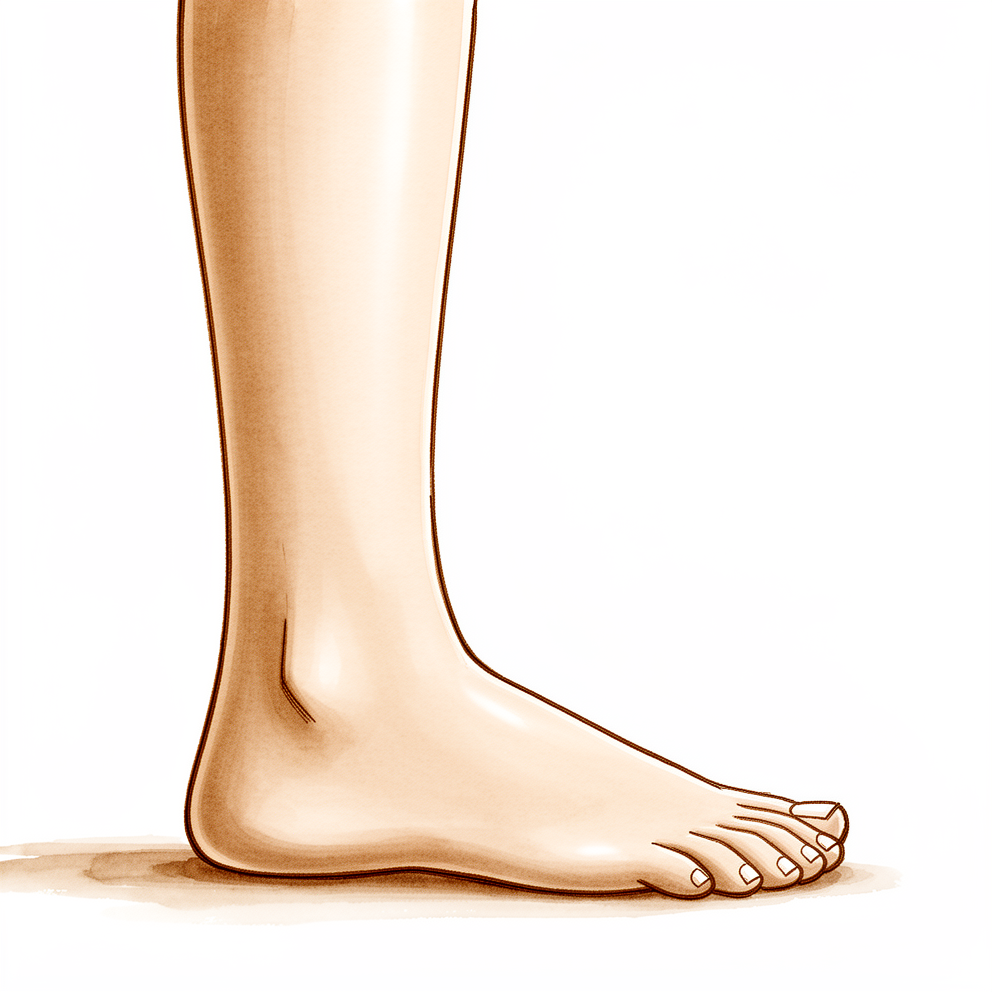
What you're feeling
An osteochondral lesion of the talus is a small patch of damaged cartilage and bone on the surface of the talus, the bone that sits under your ankle joint. The damage can come from a single ankle sprain, from repeated sprains over time, or from a combination of causes that are not fully understood. Some people with this damage feel nothing at all. Others notice a deep ache in the ankle that keeps coming back.
The pain is usually felt inside the ankle joint, and it tends to be worse with activity. It may ease once you stop and rest. Your ankle might also swell and feel tender around the joint. If you have sprained the same ankle before, that history often fits with what is going on now.
Day to day, the ache can make walking, standing for long stretches, and pushing off the foot harder than they should be. Uneven ground, stairs, and sport that loads the ankle can all stir things up. Some people find the ankle feels stiff or sore when they get moving again after sitting or resting.
If any of this sounds familiar, it is worth having the ankle looked at properly. A scan can show the location, size, and severity of the damaged area, because small patches of damage may not show up on a plain X-ray.
What's actually happening
The talus is the bone that sits directly under your ankle joint. Its top surface is covered with a smooth, slippery layer of cartilage, a tough padding that lets the two bones glide over each other without friction. Think of it as the tread on a tyre: strong, slightly springy, and built to take load every time you stand or walk.
With this condition, a small patch of that cartilage, and sometimes the bone beneath it, has been bruised, cracked, or has come loose. The force of the injury presses the joint surfaces together hard enough to damage the surface layer. Sometimes there is no single injury at all: the patch can develop from repeated small knocks, from problems with the blood supply to that spot of bone, or from causes that are not fully understood.
The damaged patch itself cannot feel pain, because cartilage has no nerves. The ache you feel comes from the bone underneath. When you walk, fluid is squeezed through tiny cracks in that bone under high pressure, which irritates the richly supplied bone surface and produces that deep, nagging pain. Over time, the pressure can also cause a small fluid-filled cavity, a cyst, to form in the bone. If the damaged patch breaks free and floats loose in the joint, it can catch or cause swelling and clicking.
Small patches of damage sometimes settle on their own with rest and time. Larger ones, or ones where the patch has come loose, tend to keep causing symptoms and can gradually wear the joint further. That is why the size, depth, and position of the patch, which a scan can show, shape what happens next.
What we can do about it
A CT scan, which builds a detailed picture of bone, can show exactly where the damaged patch sits at the front, middle, or back of the talus. An MRI scan shows cartilage and bone in detail and helps us judge the size and depth of the patch. These details shape what we recommend next.
For small patches that have not come loose, we usually start with non-operative care. That means rest, changing how much you load the ankle, and physiotherapy. Physiotherapy aims to settle the ache, build the muscles that support your ankle, and steady the joint on uneven ground. Give this a fair trial before thinking about surgery. Non-operative treatment works for about 45% of people with this condition. If your patch is in its early stages, this is usually the right place to start. Some deeper patches can still be treated this way first, but they often need surgery if symptoms keep coming back.
If the patch is larger, has come loose, or non-operative care has not given you enough relief, we will talk you through surgery. The aim is to reach the damaged area, clear away loose or unhealthy tissue, and encourage new tissue to grow in the gap. For small to medium patches this is usually done through keyhole surgery, called arthroscopy, using a thin camera and small instruments through tiny cuts. For larger patches, surgery may involve replacing the damaged surface with healthy cartilage and bone, either from another spot in your own knee or from donor tissue. If your ankle ligaments have been stretched by repeated sprains, we may tighten them at the same time to protect the repaired surface and the long-term health of the joint. The specific operation depends on the size, depth, and position of your patch, and we will explain the one that suits you before you decide anything together with us.
What to expect
There is no single course this condition follows. Small patches of damage sometimes settle on their own with rest and time. Larger patches, or ones where the damaged piece has come loose, tend to keep causing symptoms and can gradually wear the joint further. That is why the size, depth, and position of your patch shape what happens next.
If non-operative care works for you, the outlook is steady. Patches that settle with an initial period of rest and changed activity are linked with minimal symptoms in the long term, a low rate of the problem coming back, and no meaningful progression of wear-and-tear arthritis in the ankle. If it does not settle, most people with symptoms that persist or a loose patch need surgery.
Surgery aims to relieve pain and get the ankle working again. Most reasonable operations for this condition lead to similar and satisfactory results, and the choice between them depends mainly on your patch rather than on one technique being better than another. For small patches treated with keyhole surgery, good or excellent outcomes are reported in 89% of people under 50 whose patch is 1.5 cm² or smaller. Results are similar whether the damage came from an injury or not. Some operations encourage your body to grow new repair tissue in the gap, and this tissue growth can be seen on detailed scans in most cases. Other options replace the damaged surface with healthy cartilage and bone, and these can be used safely if an earlier operation has not worked.
It is worth knowing what surgery cannot always fix. After keyhole microfracture, where tiny holes are made in the bone to encourage repair, the bone beneath the surface may not fully return to its normal height over the longer term, and small fluid-filled cavities in the bone can sometimes worsen. Some people continue to notice symptoms despite treatment.
If your ankle ligaments have been stretched by repeated sprains, having them tightened at the same time as the patch is treated may protect the repaired surface and slow further cartilage damage. Your surgeon will talk through the option that fits your patch and your goals.
When to see someone
See your GP if you have sprained the same ankle more than once, or if a deep ache inside the ankle keeps coming back after activity and eases with rest. Ask for a specialist review if the ankle swells and stays tender, if it feels unsteady or gives way on uneven ground, or if it catches, clicks, or locks. These can mean a loose piece of damaged cartilage in the joint. Also ask about your ligaments: repeated sprains can stretch them, and that looseness can keep damaging the joint surface. It is worth acting early, because a stretched ligament and a damaged patch can feed each other.
Evidence & references
This is the clinical evidence summary written for health professionals. It is technical, and it lists the research this page was built from. You do not need to read it to understand your treatment or to make a decision about it.
Anatomy & Pathophysiology
Lesion Morphology and Classification
- Osteochondral fragments of the talus are often loose and turned upside down within the crater, with subchondral bone appearing yellowish and hard [1].
- The Pritsch et al. (1986) classification system for osteochondral lesions of the talus includes stages for intact overlying cartilage, soft overlying cartilage, and frayed overlying cartilage [3].
- The Cheng et al. (1995) classification system for osteochondral lesions of the talus includes stages for smooth/intact but soft or ballotable cartilage, rough surface, fibrillation/fissuring, flap present or bone exposed, loose undisplaced fragment, and displaced fragment [3].
- CT scans in the axial plane can show the crater and fragments of an osteochondral lesion [1].
- Coronal CT scans can locate a lesion as anterior, middle, or posterior, which is often difficult to determine on radiograph [1].
- CT with 2-mm cuts in the coronal and axial planes determines whether a lesion is in the anterior third, middle third, or posterior third of the talar dome [3].
- Lesion size measured on MRI does not accurately reflect arthroscopic measurement in talar osteochondral lesions [2].
Anatomical Considerations for Surgical Approach
- The lateral malleolus is posterior to the tibia, allowing lateral lesions in the middle or posterior third to usually be approached anteriorly without osteotomy [3].
- Osteotomy of the medial malleolus is often necessary to expose posterior or posteromedial lesions of the talus [1, 3].
- An anteromedial approach can be used for posteromedial lesions by "grooving" the anteromedial distal tibial articular surface 6 to 8 mm to expose the lesion without osteotomy of the medial malleolus [3].
- A posteromedial arthrotomy through an anteromedial approach can expose posteromedial lesions of the talus and avoid a medial malleolar osteotomy [3].
- An approach to the posteromedial ankle through the posterior portion of the posterior tibial tendon sheath allows exposure of the talar dome and tibial articular surface while protecting posteromedial tendons, neurovascular structures, and deep posterior fibers of the deltoid ligament [3].
- If osteotomy of the medial malleolus is necessary, surgery on the medial side should be delayed until after closure of the physis [1].
Pathophysiology and Healing
- Retrograde percutaneous drilling through the sinus tarsi preserves intact articular cartilage in early lesions [3].
- Bone grafts are used in conjunction with retrograde drilling to prevent articular collapse due to the difficulty of adequately filling the contours of the lesion [3].
- Surgical-grade calcium sulfate in liquid form can be injected into the defect after drilling to promote healing [3].
- Bone-marrow aspirate harvested from the iliac crest, centrifuged to isolate pluripotent cells, and mixed with calcium graft has been used to promote more rapid healing [3].
- Fibrocartilaginous tissue fills in the defect in the subchondral crater during the postoperative period [1].
Classification
Radiographic Classifications
- Berndt and Harty published a four-part radiographic classification of osteochondral lesions of the talus in 1959 [4].
- In the Berndt and Harty classification, Stage I is described as a small subchondral trabecular compression fracture not seen radiographically [4].
- In the Berndt and Harty classification, Stage II is described as an incomplete avulsion or separation of the fragment [4].
- In the Berndt and Harty classification, Stage III is described as complete avulsion without displacement [4].
- In the Berndt and Harty classification, Stage IV is described as a fragment detached and rotated and possibly within the joint [4].
- The Berndt and Harty classification is based on radiographic criteria that may be difficult to interpret [4].
- The Berndt and Harty classification cannot distinguish a stage I lesion [4].
- Several authors modified the Berndt and Harty classification to include associated MRI findings [4].
Arthroscopic Classifications
- Pritsch et al. (1986) classified the cartilage overlying the lesion into three grades based on visual appearance [3].
- In the Pritsch et al. classification, Grade 1 indicates intact overlying cartilage [3].
- In the Pritsch et al. classification, Grade 2 indicates soft overlying cartilage [3].
- In the Pritsch et al. classification, Grade 3 indicates frayed overlying cartilage [3].
- Cheng et al. (1995) classified the lesion into six stages based on arthroscopic appearance [3].
- In the Cheng et al. classification, Stage 1 is smooth, intact but soft or ballotable [3].
- In the Cheng et al. classification, Stage 2 is a rough surface [3].
- In the Cheng et al. classification, Stage 3 is fibrillation/fissuring [3].
- In the Cheng et al. classification, Stage 4 is a flap present or bone exposed [3].
- In the Cheng et al. classification, Stage 5 is a loose, undisplaced fragment [3].
- In the Cheng et al. classification, Stage 6 is a displaced fragment [3].
- Pritsch and colleagues reported poor correlation between the radiographic appearance of the lesion and the state of the overlying cartilage [4].
- Treatment of osteochondral lesions was based on the visual appearance of the cartilage according to Pritsch and colleagues [4].
Imaging Assessment
- MRI allows identification of stage I lesions [4].
- MRI findings in stable osteochondral lesions include decreased signal intensity on T1-weighted images [4].
- MRI findings in stable osteochondral lesions include either low or increased signal on T2-weighted images [4].
- MRI may be most useful in assessment of stage II osteochondral lesions for evaluation of chondral and subchondral discontinuity indicating lesion instability [4].
- MRI may be most useful in assessment of stage II osteochondral lesions for evaluation of the presence of subchondral cysts [4].
- MRI may overestimate stability [4].
- A combination of MRI assessment and arthoscopic examination may be required to determine stability and treatment requirements [4].
- MRI or CT is the preferred imaging for complete evaluation of a suspected lesion [4].
- The continuity of cartilage and subchondral cortex can be assessed by MRI or CT as an indicator of stability [4].
- Lesion depth can be evaluated by MRI or CT [4].
- Subchondral cysts may be evaluated by MRI [4].
- Signal intensity patterns and cyst size may progress or regress over time [4].
- Signal intensity patterns and cyst size may be less reliable indicators of lesion stability than surface continuity [4].
- CT with 2-mm cuts in the coronal and axial planes determines whether the lesion is in the anterior third, middle third, or posterior third of the talar dome [3].
Clinical Presentation
- Osteochondral lesions of the talus are often difficult to determine as anterior, middle, or posterior on radiograph [1].
- Coronal CT scans locate the lesion whether it is anterior, middle, or posterior [1].
- Axial CT scans show the crater and fragments of the osteochondral lesion [1].
- A "floating" fragment in an osteochondral lesion is a loose fragment turned upside down in the crater [1].
- The subchondral bone in an osteochondral lesion is yellowish and hard [1].
- The fragment in an osteochondral lesion is often loose [1].
Investigations
- Coronal CT scans locate talar osteochondral lesions as anterior, middle, or posterior, a distinction that is often difficult to determine on radiograph [1].
- Axial CT scans demonstrate the crater and fragments of talar osteochondral lesions [1].
- The diagnosis of talar osteochondral lesions involves history, physical examination, and arthroscopy [2].
Treatment
Open Surgical Technique
- A longitudinal incision 7 cm long is made over the antero-medial aspect of the ankle, placed far enough medially to allow for medial malleolar osteotomy if necessary [1].
- The foot is plantarflexed as much as possible to visualize the lesion, and an osteotomy is usually necessary if the lesion is posterior [1].
- An osteotomy is made obliquely across the medial malleolus at the ankle joint level perpendicular to a predrilled hole for a cancellous screw [1].
- The medial malleolus is turned distally using a towel clip, and the ankle is everted to expose the medial and posterior aspects of the talar dome [1].
- The central necrotic area is removed with a small curet, and the crater and fragment are removed with copious irrigation [1].
- Four or five holes are made in the subchondral crater with a small drill to promote vascular ingrowth [1].
- The medial malleolar osteotomy is realigned and secured with a cancellous bone screw, with radiographs taken to check for anatomic alignment [1].
- Postoperatively, the patient wears a cast or patellar tendon-bearing brace for 6 to 8 weeks [1].
- The patient remains non-weight bearing for a total of 8 to 12 weeks while fibrocartilaginous tissue fills the defect [1].
Arthroscopic and Percutaneous Techniques
- Percutaneous arthroscopic drilling is recommended as an alternative to surgical excision for early stages, medial lesions, and lesions in children that have not healed [3].
- Arthroscopic drilling for medial osteochondral lesions does not require osteotomy of the medial malleolus or postoperative immobilization [3].
- Arthroscopic drilling allows for early resumption of daily activities and sports [3].
- The procedure is reported to be as effective and useful in young patients, especially those with open physes [3].
- A specific indication for arthroscopic drilling is an early lesion with mild osteosclerosis of the surrounding talar bone, continuity of the cartilaginous surface, and stability of the osteochondral fragment [3].
- Retrograde percutaneous drilling through the sinus tarsi preserves the intact articular cartilage [3].
- Bone grafts are used in conjunction with retrograde drilling to prevent articular collapse due to difficulty in filling the contours of the lesion [3].
- Surgical-grade calcium sulfate in liquid form has been injected into the defect after drilling [3].
- Bone-marrow aspirate harvested from the iliac crest, centrifuged to isolate pluripotent cells, has been mixed with calcium graft to promote more rapid healing [3].
- CT with 2-mm cuts in the coronal and axial planes determines whether the lesion is in the anterior, middle, or posterior third of the talar dome [3].
- Lateral lesions, even when in the middle or posterior third, usually can be approached anteriorly and removed without an osteotomy [3].
- An anteromedial approach for posteromedial lesions involves "grooving" the anteromedial distal tibial articular surface 6 to 8 mm to expose the lesion without osteotomy of the medial malleolus [3].
- A posteromedial arthrotomy through an anteromedial approach can be used to expose posteromedial lesions of the talus and avoid a medial malleolar osteotomy [3].
- An approach to the posteromedial ankle through the posterior portion of the posterior tibial tendon sheath allows exposure of the talar dome and tibial articular surface while protecting posteromedial tendons, neurovascular structures, and deep posterior deltoid ligament fibers [3].
- Patients undergoing medial malleolar osteotomy are immobilized in a walking boot for 6 weeks and then allowed weight bearing in a walking boot until 12 weeks after surgery [3].
- A patellar tendon-bearing brace is sometimes used after surgery to unload the ankle joint [3].
Classification Systems
- The Pritsch et al. (1986) classification includes stages for intact overlying cartilage, soft overlying cartilage, and frayed overlying cartilage [3].
- The Cheng et al. (1995) classification includes stages for smooth/intact but soft or ballotable cartilage, rough surface, fibrillation/fissuring, flap present or bone exposed, loose undisplaced fragment, and displaced fragment [3].
Complications
- Previous bone marrow stimulation may negatively affect clinical outcome in patients undergoing autologous osteochondral transplantation for osteochondral lesions of the talus [2].
- Arthroscopic quantification of syndesmotic instability is possible in a cadaveric model [2].
- The arthroscopic syndesmotic assessment tool can differentiate between stable and unstable ankle syndesmoses [2].
- Chronic tibiofibular syndesmosis injury has diagnostic efficacy with magnetic resonance imaging and comparative operative treatment options [2].
- Arthroscopic suture anchor repair of the lateral ligament ankle complex has been evaluated in a cadaveric study [2].
- Arthroscopic Brostrom repair with Gould augmentation via an accessory anterolateral port is a technique for lateral instability of the ankle [2].
- Arthroscopic anatomic reconstruction of the lateral ligaments of the ankle with gracilis autograft is a described technique [2].
- Arthroscopic-assisted lateral ligamentous reconstruction is used in combined ankle and subtalar instability [2].
- Arthroscopic treatment of chronic ankle instability has been evaluated in a prospective study of 286 patients [2].
- Activity level and function 2 years after anterior talofibular repair can be compared between arthroscopic repair and open repair procedures [2].
- Combination of modified Brostrom procedure with ankle arthroscopy is used for ankle instability accompanied by intra-articular symptoms [2].
- Open and arthroscopic lateral ligament repair for treatment of chronic ankle instability has been subject to a systematic review [2].
- Arthroscopic repair of chronic lateral ankle instability is a described procedure [2].
- Arthroscopic findings and long-term results are documented for chronic lateral instability [2].
References
[1] Campbell S Operative Orthopaedics 4 Volume Set. RECONSTRUCTION OF THE PATELLOFEMORAL AND PATELLOTIBIAL LIGAMENTS WITH A SEMITENDINOSUS TENDON GRAFT > EXCISION OF OSTEOCHONDRAL FRAGMENT OF THE TALUS.
[2] Campbell S Operative Orthopaedics 4 Volume Set. ARTHROSCOPIC EXAMINATION AND DEBRIDEMENT OF THE ANKLE JOINT > OSTEochondral Lesions of the Talus.
[3] Campbell S Operative Orthopaedics 4 Volume Set. REPAIR OF ACUTE RUPTURE OF LATERAL LIGAMENTS > Classification Systems for Osteochondral Lesions of the Talus > ARTHROSCOPY.
[4] Tachdjian S Pediatric Orthopaedics From The Texas Scottish Rite Hospital For Children E Book. Plate 35.2 Scapulocostal Stabilization for Scapular Winging (Ketenjian Technique) > Osteochondral Lesions of the Talus > Classification.