What you're feeling
A calcaneal fracture is a break in your heel bone. The pain sits deep in the back of your foot, under and behind your ankle. It usually starts the moment you injure it, and putting any weight on that foot makes it much worse. Standing, walking to the letterbox, or climbing even two or three stairs can be too much at first.
Your heel and the area around your ankle will swell. The swelling often builds over the first day and can make your foot look puffy and bruised. It tends to feel worse after you have been on your feet, and it can throb at night or when you take your shoe off. Resting with your foot up eases it. Some people find the heel feels stiff and sore first thing in the morning, especially around the back of the ankle where the swelling sits.
Everyday tasks that need a working heel become hard. You may need crutches or a frame because standing at the kitchen bench or hanging out washing puts weight through the sore side. Driving, carrying shopping, and getting to the bathroom without help can all be a struggle. Because the heel takes your body weight every time you stand, this injury tends to limit you more than many other foot breaks.
Some heel pain builds slowly rather than coming from one fall. If your heel has been aching for weeks without a clear injury, it is worth getting it checked. A stress fracture is a small crack caused by repeated strain, and if it is picked up late it can lead to ongoing pain, slow healing, and sometimes the need for an operation.
How your heel recovers depends a lot on where the break sits. Breaks that involve the joint above the heel, where the heel meets the rest of the foot, tend to cause more lasting stiffness and trouble than breaks that stay outside the joint. Many people find this injury changes things for them over the long term, and it is common for your heel to feel different from before.
What's actually happening
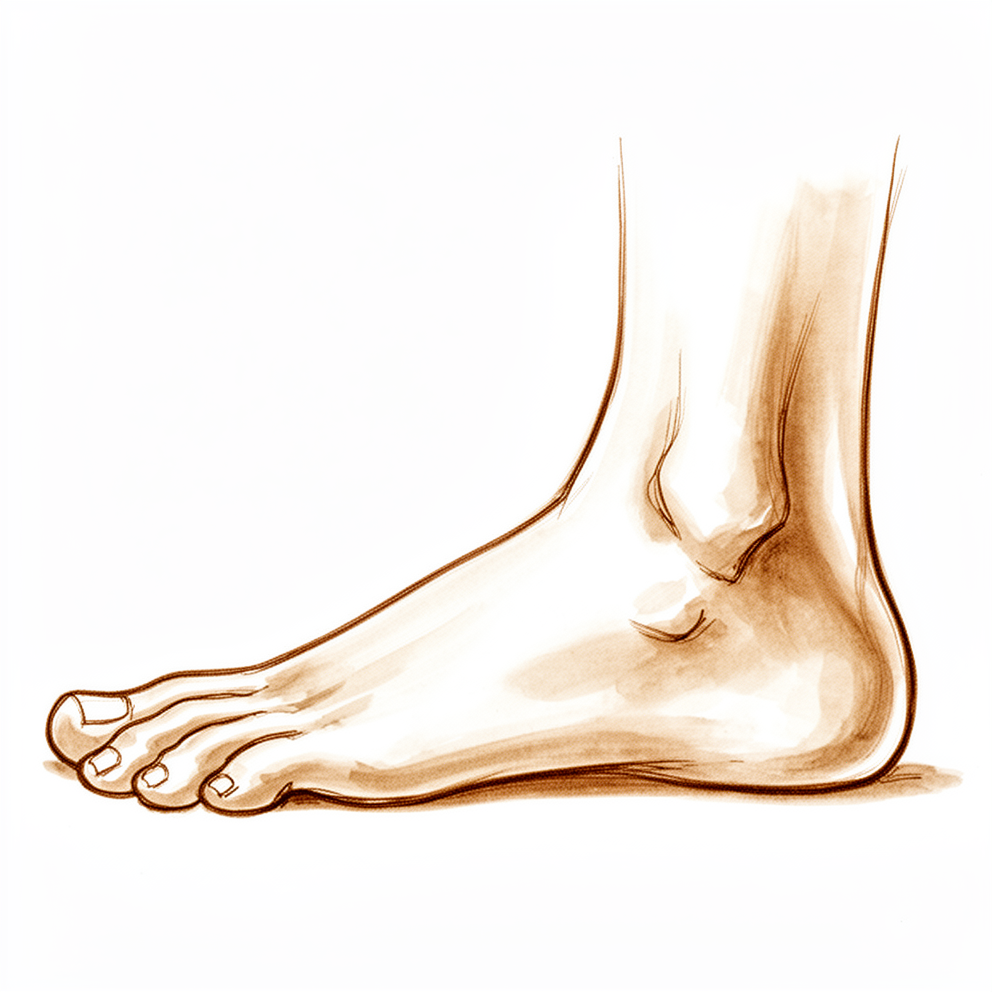
Your heel bone, the calcaneus, is the largest bone in the back of your foot. It sits under your ankle joint and takes your body weight every time you stand. Its top surface has smooth, curved areas where it meets the bone above it, and these let your foot roll and swivel as you walk.
Most of these breaks happen when you land hard on your feet, usually from a fall from a height. The force shoots up through your leg and the bone above your heel is driven down into the heel bone like a hammer hitting a block. The heel bone is built like a honeycomb inside, strong in some directions and thin in others, so a hard enough landing can crush it. The break can squash the heel shorter and wider, and it can crack into the joint surface where the heel meets the rest of your foot.
Where the break sits matters a lot. Some breaks stay outside the joint, and these tend to heal with less trouble. Others crack into the joint surface and knock it out of line, a bit like breaking the smooth tiles on a floor. Rough tiles grind instead of gliding, which is why these breaks often lead to stiffness and aching in the joint above your heel. The more the joint surface is knocked out of place, the more your foot function and quality of life can be affected over time.
Your surgeon can measure on an X-ray how squashed the heel has become. A healthy heel sits at an angle of 25 to 40 degrees, and a crushed heel loses some of that height. Restoring the heel's normal shape, including the curve of your arch and the height of your heel compared with the other side, is a key aim of treatment, because it gives your foot its best chance of working well again.
What we can do about it
X-rays show the break, and a CT scan, which is a detailed scan of the bone, helps us plan if an operation is on the table.
Because a heel break is an acute injury, surgery may be recommended straight away rather than after a trial of non-operative care. The aims are the same whichever path you take: line up the joint surface where your heel meets the rest of your foot, restore the height of your heel, bring the widened heel back to its normal width, and free up the space where two tendons run beside your ankle. For some breaks that stay outside the joint, or breaks where the pieces have not moved, a closed method without surgery can work well. That means rest, a protective boot or cast, and keeping weight off the foot while it heals. Physiotherapy aims to restore movement and strength once the bone is stable enough.
Whether surgery is right for you depends on the break and on you. Some breaks crack into the joint surface and knock it out of place, and many of these do better with an operation that puts the pieces back and holds them steady. We weigh up your age, your general health, the quality of your bone, how much walking you do, and whether you smoke, because smoking raises the chance of wound problems after surgery. Some health conditions, such as diabetes with loss of feeling in the foot, or an active infection, make an operation unwise. We use less invasive techniques where they suit the break, and these can mean fewer wound problems than larger incisions. For the most severe breaks, where the joint surface is badly crushed, surgery may aim to set the bone up well for a later fusion, which is an operation that stiffens the joint on purpose to take away pain.
This is a shared decision. We will explain what each option means for your foot, and you decide what matters most to you.
What to expect
A heel break is a serious injury, and it is honest to say the road back is a long one. Most people find this injury changes things for them over the long term, and it is common for your heel to feel different from before. Breaks that crack into the joint surface, where your heel meets the rest of your foot, tend to cause more lasting stiffness and aching than breaks that stay outside the joint. Those outside-the-joint breaks, about one in three of all heel breaks, usually settle with less trouble.
Recovery is measured in months rather than weeks. You will spend the early period keeping weight off the foot, then build up gradually. Putting some weight through the foot within the first six weeks after an operation does not appear to cause the problems people once feared, so your surgeon may let you start earlier than you expect. Even so, expect swelling, stiffness, and a limp that fades slowly. Many people still notice their heel at the end of the day, and some find their walking pattern never quite returns to what it was.
Outcomes vary with the treatment path. Surgery that puts the broken pieces back in line is linked with better long-term results when it restores the heel's shape, and good results in terms of function and quality of life are seen in the months and years after fixation. But surgery for these breaks carries a real chance of wound problems, and the overall complication rate is high. Non-operative care, with rest and a boot or cast, can also produce satisfactory results with fewer complications. For breaks that crack into the joint, follow-up over fifteen years has shown similar results whether the break was treated with surgery or without it.
What tends to matter is where the break sits, your general health, and the experience of the team treating you. Heel breaks are difficult injuries, and they are best managed by surgeons and centres that see them often. Your surgeon will talk you through what the evidence means for your particular foot, and together you can weigh up what each path offers.
When to see someone
A heel break is usually obvious: a fall from a height, then pain you cannot walk on. Get it checked the same day. Go to an emergency department if your heel is badly swollen and bruised, if the pain is severe, or if you cannot put any weight on the foot at all. Ask for a specialist review if your heel has been aching for weeks without a clear injury, because a stress fracture picked up late can lead to ongoing pain, slow healing, and sometimes an operation. Seek urgent care if the swelling is severe and the skin feels tight, or if you also injure the same leg higher up, as more than one break in the same leg is a serious combination.
Evidence & references
This is the clinical evidence summary written for health professionals. It is technical, and it lists the research this page was built from. You do not need to read it to understand your treatment or to make a decision about it.
Anatomy & Pathophysiology
Bony Anatomy
- The calcaneus is the largest tarsal bone in the foot [17].
- The calcaneus is irregularly shaped with six posterior and four anterior facets [17].
- Three of the calcaneal facets articulate with the talus and one articulates with the cuboid [17].
- The posterior facet of the calcaneus is oval and convex along the longitudinal axis, articulating with the underside of the talus [17].
- The middle facet of the calcaneus is concave and oval, articulating with the middle facet on the head of the talus [17].
- The sustentaculum tali projects from the medial side of the calcaneus and forms the lateral boundary of the tarsal tunnel [17].
- The inferior surface of the sustentaculum tali is grooved by the tendon of the flexor hallucis longus [17].
- The sinus tarsi is a depression anterior and distal to the lateral malleolus that marks the lateralmost aspect of the subtalar joint [17].
- The tarsal canal is formed by the sulcus on the inferior surface of the talus and the superior sulcus of the calcaneus [11].
- The tarsal canal runs from posteromedial to anterolateral, where it opens into the tarsal sinus [11].
- The talocalcaneal intraosseous ligament is contained within the tarsal canal [11].
Ligaments and Stability
- Transverse stability of the tarsometatarsal articulation is provided by wedge-shaped metatarsal bases and their corresponding cuneiform-cuboid articulations [6].
- The second metatarsal is recessed between the medial and lateral cuneiforms, acting as a keystone for transverse stability [6].
- The tarsometatarsal joints have little longitudinal stability, which is provided only by strong ligamentous support [6].
- Multiple intermetatarsal ligaments exist at the metatarsal bases, except between the first and second metatarsals [6].
- The Lisfranc ligament runs from the medial cuneiform to the second metatarsal to provide stability in the tarsometatarsal region [6].
Vascular Anatomy
- The head and neck of the talus are richly supplied by superior neck vessels branching from the dorsalis pedis artery and the artery of the sinus tarsi [11].
- Osteonecrosis of the talar head and neck regions is extremely rare [11].
- The artery of the tarsal canal branches off the posterior tibial artery approximately 1 cm proximal to its division into medial and lateral plantar arteries [11].
- The artery of the tarsal canal is the most consistent major supplier of blood to the body of the talus [11].
- Within the tarsal canal, the artery of the tarsal canal sends four to six direct vessels into the body of the talus [11].
- The deltoid artery branches off the artery of the tarsal canal and directly supplies blood to the medial one-fourth to one-half of the talar body [11].
- The artery of the sinus tarsi supplies the lateral one-eighth to one-fourth of the talar body [11].
- The artery of the sinus tarsi is formed by branches of the perforating peroneal artery, the dorsalis pedis artery, or anastomoses between them [11].
- The posterior tubercle of the talus is supplied by direct branches from the posterior tibial artery or the peroneal artery [11].
- A direct branch to the medial talar neck comes from the posterior tibial artery [11].
- In a gadolinium-enhanced MRI cadaver study, the contribution of blood supply to the talus was 16.9% for the peroneal artery, 36.2% for the anterior tibial artery, and 47.0% for the posterior tibial artery [11].
- The anterior tibial artery is the main blood supply to the anteromedial quadrant of the talus [11].
- The posterior tibial artery is the main blood supply to the other three quadrants of the talus [11].
Radiographic Anatomy
- The Bohler angle is formed by a line from the superior point on the posterior articular surface to the superior point of the calcaneal tuberosity and a line drawn from the anterior process to the highest aspect of the posterior articular surface [17].
- The Bohler angle varies from 25 to 40 degrees [17].
- The "crucial angle" of Gissane is formed by a line drawn from the sulcus calcanei to the tip of the anterior process [17].
- The "crucial angle" of Gissane varies between 120 and 145 degrees [17].
- In talocalcaneal coalition, the Harris and Beath radiographic projection shows the joint space replaced by a bony bridge or loss of distinct articular margins [9].
- Normal medial and posterior subtalar joint facets lie in planes at 35 to 45 degrees and 45 to 60 degrees to the long axis of the calcaneus, respectively [9].
Mechanism of Injury
- The mechanism of injury in most calcaneal fractures is an axial load applied to the lower extremity, most often as a result of a fall from a height [17].
- In calcaneal fractures, the force is transmitted through the talus, which is driven down into the calcaneus [17].
- In young children, the height fallen for calcaneal fractures is usually less than 4 feet [17].
- In children older than 10 years, the fall height for calcaneal fractures is usually greater than 14 feet [17].
- In a study of 56 children with calcaneal fractures, 25 (45%) of the fractures were caused by a fall from a height [17].
- Motor vehicle accidents, lawnmower injuries, and direct blows from an object can result in calcaneal fractures in children [17].
- With a calcaneal fracture, the talus compresses onto the crucial angle and produces the primary fracture line in older patients [17].
Investigations
Physical Examination
- Any injury resulting in midfoot tenderness and swelling merits a careful physical and radiographic examination [5].
- Care should be taken with subtle injuries to palpate each articulation for tenderness and swelling, especially the medial cuneiform–first metatarsal joint, which often appears nondisplaced on radiographs [5].
- Careful observation of the plantar aspect of the foot may reveal ecchymosis, indicating a significant injury [5].
- The inability to bear weight on the foot is another sign of potential instability [5].
- Physical examination findings for low-energy tarsometatarsal injuries include pain with pronation and abduction of the forefoot while the hindfoot is stabilized [5].
- Physical examination findings for low-energy tarsometatarsal injuries include pain with compression of the midfoot [5].
- Physical examination findings for low-energy tarsometatarsal injuries include pain with manipulation [5].
- Compartment syndrome, although rare and usually seen only with higher-energy fracture-dislocations, can cause severe, difficult-to-treat clawing of the toes and chronic pain [5].
- We routinely obtain compartment pressures in patients who have severe swelling, but individual compartments can be difficult to assess [5].
- Clinical suspicion alone is difficult to warrant decompression for compartment syndrome [5].
Radiographic Imaging
- Radiographs must be obtained with the patient bearing weight [5].
- If the radiograph reveals no displacement and the patient cannot bear weight, a short leg cast or fracture boot should be used for 2 weeks, and the radiographs should be repeated with weight bearing [5].
- A standing radiograph of both feet on the same cassette allows for comparison and can highlight subtle injuries [5].
- On the anteroposterior view, the medial shaft of the second metatarsal should be aligned with the medial aspect of the middle cuneiform [5].
- On the oblique view, the medial shaft of the fourth metatarsal should be aligned with the medial aspect of the cuboid [5].
- The first metatarsal–cuneiform articulation should have no incongruency [5].
- A “fleck sign” should be sought in the medial cuneiform–second metatarsal space, which represents an avulsion of the Lisfranc ligament [5].
- On the lateral view, loss of the arch and/or loss of alignment between the plantar aspect of the fifth metatarsal and medial cuneiform should be evaluated [5].
- The naviculocuneiform articulation should be evaluated for subluxation [5].
- A compression fracture of the cuboid should be sought [5].
- CT can identify subtle subluxations and occult fractures [5].
- MRI of the Lisfranc ligament can be obtained in the acute setting and if the level of injury cannot be determined by plain radiographs [5].
- Weight-bearing CT scans, where available, are very useful in detection of subtle instability [5].
- The Harris and Beath radiographic projection (posterosuperior oblique projection) passes between the sustentaculum and the neck of the talus [9].
- In a talocalcaneal coalition, the joint space is replaced by a bony bridge or the distinct articular margins are lost, implying a fibrous or cartilaginous bridge [9].
- The Harris and Beath view is taken with the patient standing on the cassette, with the knees flexed enough to remove the calf shadow from the beam and the cone angled 45 degrees to the cassette and directed toward the heel [9].
- Angles of 35 to 40 to 45 degrees to the long axis of the calcaneus are the most common angles showing a coalition [9].
- Jayakumar and Cowell recommended a standing lateral radiograph, from which the angles made by the posterior and medial facets with the floor are determined [9].
- Other helpful radiographic signs include beaking of the head of the talus at the dorsal articular margin [9].
- Other helpful radiographic signs include broadening or rounding of the lateral process of the talus as it impinges on the calcaneal sulcus [9].
- Other helpful radiographic signs include presence of a “true C sign” [9].
- Other helpful radiographic signs include narrowing of the posterior talocalcaneal joint space [9].
- Other helpful radiographic signs include loss of the middle subtalar joint, all seen on the lateral view of the foot [9].
- On the lateral oblique view, the anterior facet of the subtalar joint is asymmetric in talocalcaneal coalition [9].
- CT scans are helpful in characterizing the extent of coalition, especially for operative planning [9].
- Normally, the medial and posterior subtalar joint facets lie in planes at 35 to 45 degrees and 45 to 60 degrees to the long axis of the calcaneus, but this is highly variable [9].
- CT in the coronal plane at 3-mm increments is recommended for diagnosing talocalcaneal coalition [9].
- The primary cuts of the CT should be perpendicular to the posterior and middle facets of the subtalar joint, that is, in the semicoronal plane [9].
- CT sets the standard for diagnosis of talocalcaneal coalitions [9].
- MRI may be helpful in depicting all types of coalitions, including fibrous coalitions [9].
- The importance of obtaining a CT scan after reduction of the subtalar dislocation has been emphasized because patients who have a subtalar dislocation often have additional abnormalities identified on CT scans that are initially missed on plain radiographs [22].
- We routinely use CT for further evaluation of subtalar dislocations and often find fractures that require treatment because of intraarticular displacement or fragments blocking congruent reduction of the subtalar joint [22].
- If a congruent reduction is obtained and verified on CT, and there are no intraarticular fragments or displaced bone fragments requiring repair, we routinely treat subtalar dislocations nonoperatively [22].
- Radiographs may show an avulsion fracture of the proximal phalanx, an impacted fracture of the metatarsal, or a sesamoid fracture in turf toe injuries [10].
- There may be proximal migration of the sesamoids, which is easier to detect when compared with radiographs of the uninjured foot [10].
- Examination of the joint under fluoroscopy may demonstrate lack of migration of the sesamoids when the joint is dorsiflexed, suggestive of plantar plate rupture, especially when compared with the contralateral side [10].
- A cadaver study suggests that when measuring the distance from the distal margin of the sesamoids to the most proximal margin of the proximal phalanx on a lateral dorsiflexion stress view, a 3-mm difference when compared with the contralateral foot may be indicative of injury to three of the four ligaments of the plantar plate complex [10].
- MRI may demonstrate rupture of the plantar plate in turf toe injuries [10].
Classification
- Myerson’s modification of the original classification of Quénu and Küss and Hardcastle et al. is presented because it incorporates more proximal injuries to the medial column of the foot [6].
- Type A injuries involve displacement of all five metatarsals with or without fracture of the base of the second metatarsal [6].
- The usual displacement in Type A injuries is lateral or dorsolateral, and the metatarsals move as a unit [6].
- Type B injuries involve one or more articulations remaining intact [6].
- Type B1 injuries are medially displaced, sometimes involving the intercuneiform or naviculocuneiform joint [6].
- Type B2 injuries are laterally displaced and may involve the first metatarsal-cuneiform joint [6].
- Type C injuries are divergent injuries that can be partial (C1) or complete (C2) [6].
- Type C injuries generally are high-energy injuries, associated with significant swelling, and are prone to complications, especially compartment syndrome [6].
- Classification of tarsometatarsal injury is useful for communication between orthopaedists, and for determining the plane of displacement and magnitude of soft-tissue injury [6].
- The classification is not prognostic for the result [6].
Associated Injuries
- Patients with a subtalar dislocation often have additional abnormalities identified on CT scans that are initially missed on plain radiographs [22].
- Associated injuries in severe open subtalar dislocations included tibial nerve injuries, posterior tibial tendon ruptures, and articular fractures [22].
- Osteonecrosis occurred in the body of the talus in one third of the patients with severe open subtalar dislocations [22].
- Approximately half of the patients with severe open subtalar dislocations eventually had some form of arthrodesis procedure [22].
- Lateral subtalar dislocations frequently are irreducible by closed manipulation, and the most common offending structures blocking reduction are the posterior tibial tendon and osteochondral fracture of the talus [22].
- Medial subtalar dislocations, without marginal fractures of the calcaneus or talus, almost always are reducible by closed means, unless the extensor retinaculum or extensor digitorum brevis becomes interposed and blocks reduction [22].
Treatment
Decision-Making and Goals
- Goals of treatment for calcaneal fractures include restoration of congruity of the posterior facet of the subtalar joint [24].
- Goals of treatment for calcaneal fractures include restoration of the height of the calcaneus (Böhler’s angle) [24].
- Goals of treatment for calcaneal fractures include reduction of the width of the calcaneus [24].
- Goals of treatment for calcaneal fractures include decompression of the subfibular space available for the peroneal tendons [24].
- Goals of treatment for calcaneal fractures include realignment of the tuberosity into a valgus position [24].
- Goals of treatment for calcaneal fractures include reduction of the calcaneocuboid joint if fractured [24].
- Most calcaneal fracture injuries occur in patients younger than the physiologic age of 50 to 55 years [24].
- Operative intervention to restore calcaneal height, alignment, and articular reduction should be strongly considered in young patients [24].
- Nonoperative treatment is advised for older patients with severe osteopenia, limited ambulatory abilities, or significant medical comorbidities [24].
- An insensate limb caused by trauma (sciatic or tibial nerve disruption) or disease (diabetes or other neuropathy) is a strong relative contraindication to open treatment [24].
- Patients with limited ambulation due to other medical conditions should be treated conservatively [24].
- Tobacco use has been shown to increase complication rates with operative intervention [24].
- Some surgeons consider tobacco use only a contraindication to an extensile lateral approach and favor less invasive techniques in this setting [24].
- Sanders types III and IV fractures sustained a significantly higher amount of energy than lesser types [24].
- Sanders type IV is the best predictor of compartment syndrome after a fracture of the calcaneus [24].
- Higher Sanders types III and IV injuries have poorer outcomes than Sanders types I and II injuries with both operative and nonoperative interventions [24].
- Sanders type I or nondisplaced fractures should be treated by a closed method [24].
- Type II and type III fractures can be treated with open reduction in consideration with other patient characteristics [24].
- Type IV fractures can be treated conservatively or operatively [24].
- Long-term studies have shown that type IV injuries are more likely to go on to subtalar arthrodesis in the future [24].
- In type IV fractures, consideration should be given to minimally invasive techniques to restore the calcaneal architecture for later subtalar arthrodesis or primary subtalar arthrodesis in experienced hands [24].
Operative Techniques and Outcomes
- Complications following the extended lateral approach for calcaneal fractures do not influence mid- to longterm outcome [25].
- Operative treatment did not benefit closed, displaced, intra-articular calcaneal fractures compared to nonoperative treatment in a randomized controlled trial [25].
- A randomized multicenter trial compared open reduction and internal fixation with ORIF and primary subtalar arthrodesis for the treatment of Sanders type IV calcaneal fractures [25].
- A prospective, randomized, controlled multicenter trial compared operative versus nonoperative treatment of displaced intra-articular calcaneal fractures [25].
- A cohort study evaluated the percutaneous treatment of displaced intra-articular fractures of the calcaneus [25].
- A prospective computed tomography-based study evaluated a mini-open sinus tarsi approach with percutaneous screw fixation of displaced calcaneal fractures [25].
- A cadaveric radio-anatomical study focused on maximizing safety in screw placement for posterior facet fixation in calcaneus fractures [25].
- A biomechanical evaluation compared a locking and nonlocking reconstruction plate in an osteoporotic calcaneal fracture model [25].
- A study assessed the stability of locking and non-locking plates in an osteoporotic calcaneal fracture model [25].
- A comparative study evaluated percutaneous screw fixation and calcium sulfate cement grafting versus open treatment of displaced intra-articular calcaneal fractures [25].
- A study compared surgical outcomes of intra-articular calcaneal fractures by age [25].
- A study examined the effect of surgeon training, fracture, and patient variables on calcaneal fracture management [25].
- A study evaluated radiographic and postoperative outcomes of plate versus screw constructs and open reduction and internal fixation of calcaneus fractures via the sinus tarsi [25].
- A study reported on plantar medial wounds associated with calcaneal fractures [25].
- A study described a staged treatment plan for the management of type II and type IIIA open calcaneus fractures [25].
- A study evaluated outcomes of high-grade open calcaneus fractures managed with open reduction via the medial wound and percutaneous wire fixation [25].
- A study investigated the displacement of the sustentacular fragment in intra-articular calcaneal fractures [25].
- A study described a limited sinus tarsi approach for intra-articular calcaneus fractures [25].
- A study reported on wound and sural nerve complications of the sinus tarsi approach for calcaneus fractures [25].
- A study described open reduction and internal fixation of OTA C2-C4 fractures of the calcaneus with a triple-plate technique [25].
- A study evaluated fractures of the calcaneal tuberosity treated with suture fixation through bone tunnels [25].
- A study described management of valgus extra-articular calcaneus fracture malunions with a lateral opening wedge osteotomy [25].
- A study compared distraction subtalar arthrodesis for calcaneal malunion using local versus iliac bone graft [25].
- A study described treatment of severe fractures of the calcaneus by reconstruction arthrodesis using the Vira system [25].
- A study investigated whether acute fracture of the anterior process of the calcaneus heralds a more advanced injury to the Chopart joint [25].
- A study identified predictors of compartment syndrome of the foot after fracture of the calcaneus [25].
- A study described a learning curve for open reduction and internal fixation of displaced intra-articular calcaneal fracture by extensile lateral approach using the cumulative summation control chart [25].
- A study described an economic evaluation of operative compared with nonoperative management of displaced intra-articular calcaneal fractures [21].
- A study reported on the functional outcome of displaced intra-articular calcaneal fractures comparing isolated cases and polytrauma patients [21].
- A study reported on open calcaneal fractures and results of operative treatment [21].
- A study described subtalar arthrodesis using interposition iliac crest bone graft after calcaneal fracture [21].
- A study described soft-tissue reconstruction of calcaneal fractures or osteomyelitis [21].
- A study reported on displaced intra-articular calcaneal fractures [21].
- A study reported on long-term outcome of displaced intraarticular calcaneal fractures in women [21].
- A study reported on avulsion fracture of the calcaneal tuberosity [21].
- A study assessed subtalar distraction bone block fusion outcome [21].
- A study described surgical management of extensive intraarticular fractures of the foot, specifically calcaneal fractures [21].
- A study reviewed treatment and outcome of open fractures of the calcaneus [21].
- A study reported on operative treatment of intraarticular calcaneal fractures in 257 cases [21].
- A study evaluated the effect of demineralised bone matrix-calcium sulfate with vancomycin on calcaneal fracture healing and infection rates [21].
- A study described diagnosis, pathology, and treatment of fractures of the os calcis [21].
- A study described lateral decompression for malunited os calcis fractures [21].
- A study described primary subtalar arthrodesis for the treatment of comminuted calcaneal fractures [21].
- A study compared operative with nonoperative treatment of displaced intra-articular calcaneal fractures in a prospective, randomized, controlled multicenter trial [21].
- A study compared open versus closed reduction of intraarticular calcaneal fractures in a matched cohort of workmen [21].
- A study described reduction of calcaneal fractures by the McReynolds medial approach technique and its experimental basis [21].
- A study described open reduction and internal fixation from the medial side for fractures of the calcaneus in a 21-year prospective study [21].
- A study described the mechanism and pathoanatomy of the intraarticular calcaneal fracture [21].
- A study described surgical treatment of the intraarticular calcaneus fracture [21].
- A study described subtalar distraction bone block fusion for late complications of os calcis fractures [21].
- A study described subtalar arthrodesis with interposition tricortical iliac crest graft for late pain and deformity after calcaneus fracture [21].
- A study reported on results of in situ subtalar arthrodesis for late sequelae of calcaneus fractures [21].
- A study reported on intermediate to long-term results of a treatment protocol for calcaneal fracture malunion [21].
- A study described calcaneal fractures in industrial patients [21].
- A study described computerized tomography scanning of acute intraarticular fractures of the calcaneus [21].
- A study reported on intraarticular calcaneal fractures and results of closed treatment [21].
- A study reported on open reduction and internal fixation of type II intraarticular calcaneus fractures [21].
- A study described the history of the calcaneal fracture [21].
- A study identified variables predicting late subtalar fusion in displaced intra-articular calcaneal fractures [21].
- A study described treatment of fracture of the os calcis [21].
- A study described surgical excision for anterior process fractures of the calcaneus [21].
- A study described injury characteristics and surgical technique for reduction of fractures of the sustentaculum tali [21].
- A study described long-term follow-up of fractures of the os calcis using diagnostic peroneal synoviogram [21].
- A study compared operative versus nonoperative treatment for bilateral calcaneal fractures [21].
- A study identified a pitfall of coronal computed tomographic imaging in evaluation of calcaneal fractures [21].
- A study described the sinus tarsi approach with transarticular fixation for displaced intraarticular fractures of the calcaneus [21].
References
[5] Campbell S Operative Orthopaedics 4 Volume Set. PERCUTANEOUS REDUCTION AND FIXATION OF CALCANEAL FRACTURE > EVALUATION AND TREATMENT.
[6] Campbell S Operative Orthopaedics 4 Volume Set. PERCUTANEOUS REDUCTION AND FIXATION OF CALCANEAL FRACTURE > FRACTURE-DISLOCATIONS OF THE TARSOMETATARSAL ARTICULATION (LISFRANC JOINT).
[9] Campbell S Operative Orthopaedics 4 Volume Set. MULTIPLE Z-PLASTY RELEASE OF A CONGENITAL RING > TALOCALCANEAL COALITION > RADIOGRAPHIC FINDINGS.
[10] Campbell S Operative Orthopaedics 4 Volume Set. PERCUTANEOUS REDUCTION AND FIXATION OF CALCANEAL FRACTURE > FIRST METATARSOPHALANGEAL JOINT SPRAIN.
[11] Campbell S Operative Orthopaedics 4 Volume Set. PERCUTANEOUS REDUCTION AND FIXATION OF CALCANEAL FRACTURE > FRACTURES OF THE TALUS.
[17] Tachdjian S Pediatric Orthopaedics From The Texas Scottish Rite Hospital For Children E Book. Pigmented Villonodular Synovitis and Giant Cell Tumor of the Tendon Sheath > Calcaneal Fractures.
[21] Campbell S Operative Orthopaedics 4 Volume Set. PERCUTANEOUS REDUCTION AND FIXATION OF CALCANEAL FRACTURE > SUPPLEMENTAL REFERENCES > CALCANEUS.
[22] Campbell S Operative Orthopaedics 4 Volume Set. PERCUTANEOUS REDUCTION AND FIXATION OF CALCANEAL FRACTURE > SUBTALAR DISLOCATIONS.
[24] Campbell S Operative Orthopaedics 4 Volume Set. COMBINED HAMMER TOE AND MALLET TOE DEFORMITY WITH ASSOCIATED DOUBLE CORNS > DECISION-MAKING IN CALCANEAL FRACTURES.
[25] Campbell S Operative Orthopaedics 4 Volume Set. PERCUTANEOUS REDUCTION AND FIXATION OF CALCANEAL FRACTURE > REFERENCES > CALCANEUS.