What you're feeling
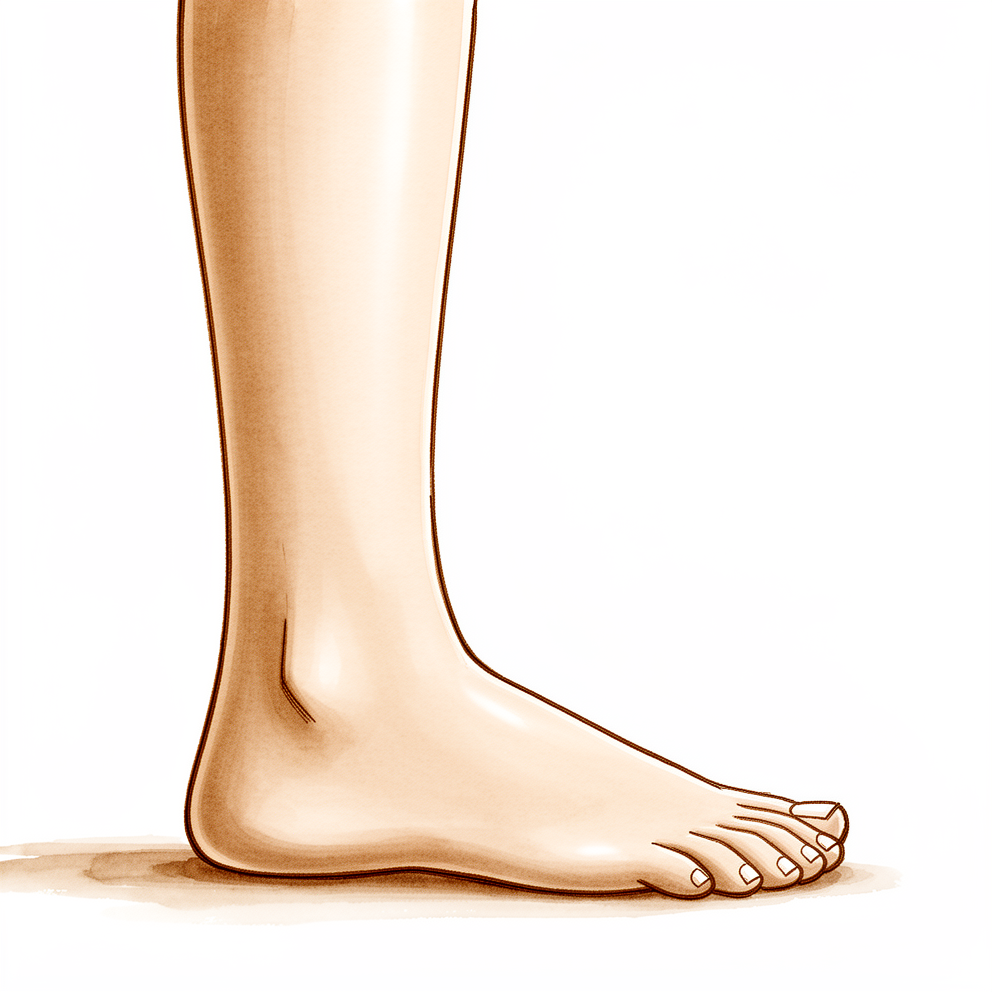
A ruptured Achilles tendon usually announces itself. Most people describe a sudden snap in the back of the ankle, like being kicked or shot in the leg, even though nothing touched them. It typically happens during a push-off movement, such as lunging, jumping or sprinting, when the calf muscle is working hard while the tendon is stretching.
The rupture most often happens in a specific spot on the tendon, about 5 to 6 cm above where it attaches to the heel bone. This area has a poorer blood supply than the rest of the tendon, which helps explain why it gives way there. Some people notice pain or stiffness in that same spot in the days or weeks beforehand, but many feel nothing unusual until the tendon goes.
Afterwards, you may notice:
- A gap you can feel in the tendon, a soft spot where the cord used to be
- Less strength when pushing off that foot, so you may find yourself using your toes to compensate
- The affected ankle resting lower or floppier than the other one
Walking, climbing stairs and standing up from a chair all rely on the calf and Achilles working together, so these become noticeably harder. Pushing a shopping trolley, getting out of the car or stepping off a kerb can catch you out.
If some time has passed since the injury, the picture can be less obvious. The ankle may simply feel weak and unstable rather than painful, which is one reason a rupture is missed in up to 25% of cases. Your surgeon will usually be able to tell what has happened from your story and a physical examination, and scans are only needed in some cases to confirm the injury or plan treatment.
What's actually happening
The Achilles tendon is the thick cord you can feel at the back of your ankle. It is the largest and strongest tendon in your body, about 12 to 15 cm long. It joins the two muscles of your calf to your heel bone, and every time those muscles squeeze, the tendon pulls so you can push off the ground.
Think of it as a rope that has been asked to do a very big job. Because it works so hard, some parts of it get a poorer blood supply than others. The spot about 5 to 6 cm above the heel bone gets the least, and that is exactly where most ruptures happen. As people get older, the blood supply to the tendon fades further and the rope itself becomes stiffer and less springy. Small strains build up faster than the tendon can repair them, until one big push-off is more than it can take. That is the snap you felt.
When the tendon tears, the two ends pull apart and the cord that used to connect your calf to your heel is no longer joined. That is why pushing off feels weak, why you may use your toes to make up for it, and why the ankle sits lower or floppier than the other side. Your body will try to bridge the gap on its own, but the tendon ends need to be held close together while that happens, which is where treatment comes in.
It is worth knowing that recovery is a long game. The calf and ankle keep adapting for years after the injury, and most people are still not back to how the other leg feels two years on, whichever treatment they have. The tendon also tends to end up slightly longer than before, which changes how the ankle works. Knowing this from the start helps you judge your progress against a realistic picture rather than expecting too much too soon.
What we can do about it
For a fresh rupture the diagnosis is usually clear from the examination itself, so imaging is often not needed unless we want to check for other injuries or plan an operation.
Because this is a structural injury, not a slow wearing-out problem, we may recommend treatment straight away rather than starting with a trial of exercises. There are two main paths, and we will talk through both with you. One is non-operative care: the tendon ends are held close together while your body heals them, usually in a boot or cast, and you can put weight on the leg early within that programme. The other is surgery, where the torn ends are stitched back together, sometimes with a supporting band of material to reinforce the repair. Both paths aim for the same thing, a tendon that lets you push off again, and for many people the results at twelve months are similar whichever route they take.
The choice is a shared one, and it depends on you. Your age, your general health, how active you want to be, and how quickly the tendon ends can be brought together all shape the advice we give. Surgery lowers the chance of the tendon tearing again compared with treating it without an operation, though that needs weighing against the risks that come with any operation. If the rupture happened some time ago, or if the skin over the tendon is a problem, we may suggest other steps to make repair possible and protect the healing skin. Whichever way we go, a structured rehabilitation programme with a physiotherapist is part of the plan, because the calf needs rebuilding after the tendon has healed.
What to expect
Recovery from a ruptured Achilles tendon takes time. Most people need at least 12 months to get back full function, whichever treatment they have. Elite soccer players usually take 1 year to reach peak match participation again. The calf and ankle keep adapting for years, and most people are still not quite back to how the other leg feels two years on.
Some changes can stay with you. The calf muscle may remain weaker and tire sooner, and this can still show up 7 years after the injury. The healed tendon is also less springy than it was before, and it tends to end up slightly longer, which changes how your ankle pushes off. Your body often makes up for this without you noticing, with other muscles and joints along the leg picking up some of the work.
Treatment choices shape the risks as well as the outlook. Surgery lowers the chance of the tendon tearing again compared with treating it without an operation, and repairs done with keyhole techniques have shown no repeat tears after at least 24 months. The trade-off is that surgery carries its own risks, mainly wound problems and infection around the back of the ankle. Treating the rupture without surgery avoids those wound risks but has a higher chance of the tendon tearing again. For many people, results at twelve months are similar whichever path they take, as long as the rehabilitation programme is followed properly.
Timing matters too. Having surgery within 48 hours of the injury is linked with fewer problems afterwards than waiting past 72 hours. Even if more than 2 weeks have passed since the rupture, repair can still work well.
One thing worth knowing: a blood clot in the leg during the period in the boot or cast can affect how the ankle works 3 years later, so tell your surgeon promptly about new calf pain or swelling.
When to see someone
A ruptured Achilles tendon needs prompt attention, and the timing matters. Ask for a specialist review within days of the injury, because surgery done within 48 hours is linked with fewer problems afterwards than waiting past 72 hours. Go to an emergency department if you felt the sudden snap described earlier and cannot push off that foot at all, or if the calf becomes hot, red, swollen and painful, which can signal a serious infection needing same-day care. New calf pain or swelling while you are in a boot or cast also needs urgent review, because a blood clot can affect how the ankle works later. See your GP for a referral if you notice a gap in the tendon, weakness pushing off, or an ankle that rests lower than the other side, even if the injury happened weeks ago.
Evidence & references
This is the clinical evidence summary written for health professionals. It is technical, and it lists the research this page was built from. You do not need to read it to understand your treatment or to make a decision about it.
Anatomy & Pathophysiology
Anatomy
- The Achilles tendon is the largest and most powerful tendon in the ankle [6].
- The Achilles tendon is formed from the fibers of two muscle units: the gastrocnemius muscle and the soleus muscle [6].
- The gastrocnemius muscle attaches above the knee to the posterior aspect of the medial and lateral femoral condyles [6].
- The soleus muscle originates from the upper part of the posterior tibia, fibula, and interosseous membrane [6].
- The gastrocnemius muscle is most effective in plantarflexion of the ankle with the knee extended [6].
- The soleus muscle is most effective in plantarflexion of the ankle with the knee flexed [6].
- After coursing through the calf in the superficial posterior compartment, the fibers of the Achilles tendon rotate 90 degrees toward the insertion into the calcaneal tuberosity [6].
- At the insertion point, gastrocnemius fibers lie lateral and soleus fibers lie medial [6].
- The Achilles tendon is innervated by the tibial nerve [9].
- The Achilles tendon is the only musculotendinous unit that crosses two major joints (knee and ankle, as well as subtalar) in the body [9].
- The Achilles tendon undergoes a 90° internal rotation such that the fibers from the medial gastrocnemius muscle lie posteriorly at its insertion on the calcaneus [9].
- The Achilles tendon acts as an inverter of the heel because it runs just medial to the hindfoot axis of rotation [9].
- The Achilles tendon is the major plantar flexor of the ankle joint [9].
- The Achilles tendon acts as a weak knee flexor because of the contribution of the gastrocnemius muscle insertion on the posterior femoral condyles [9].
- The Achilles tendon is surrounded by a paratenon instead of a true tendon sheath [9].
- Lubrication of the Achilles tendon is aided by two bursae, one anterior (retrocalcaneal) and one posterior (superficial) to the tendon [9].
- The lack of a true synovial sheath and the local anatomy result in a vascular watershed region in the tendon 2 to 6 cm above the insertion on the calcaneus [9].
- The sural nerve runs in the midline of the gastrocnemius-soleus muscle to the musculotendinous junction, where it crosses over to the lateral side of the tendon [9].
- The Achilles tendon is formed by a confluence of the gastrocnemius and soleus tendons in the distal calf and inserts at the calcaneal tuberosity [18].
- The Achilles tendon is separated from the underlying bone by the retrocalcaneal bursa [18].
- The Achilles tendon is covered medially, posteriorly, and laterally by a paratenon consisting of loose areolar tissue [18].
- Anteriorly, the Achilles tendon is marginated by Kager fat pad [18].
- On MRI, the normal Achilles tendon may appear as a cord of uniform caliber, measuring 4 to 7 mm in AP dimension [18].
- The plantaris tendon is variably seen as a thin tendon slip coursing from superolateral to inferomedial along the ventral surface of the Achilles tendon [18].
- The plantaris tendon inserts onto either the distal Achilles tendon or the calcaneal tuberosity [18].
Vascularity
- Vascularity is supplied to the tendon through the paratenon on the deep surface of the tendon [6].
- Vascularity is supplied to the tendon through muscular arterial branches within the gastrosoleus complex proximally [6].
- Vascularity is supplied to the tendon through small interosseous vessels at the insertion of the tendon into the calcaneus distally [6].
- There is a zone of relative avascularity 2 to 6 cm proximal to its insertion into the calcaneus [6].
- The major blood supply of the tendon is through its mesotendon, with the richest supply through the anterior mesentery [16].
- With increasing age, the anterior mesenteric supply becomes reduced [16].
Pathophysiology
- Achilles tendon rupture has been related to a relatively hypovascular area of the tendon, shown by angiography to be 2 to 6 cm above the tendon insertion into the calcaneus [16].
- Age-dependent changes in collagen crosslinking result in increased stiffness and loss of viscoelasticity, predisposing to injury [16].
- Repetitive microtrauma to the hypovascular area may make it impossible for the reparative process to keep pace, and a degenerative attrition may be responsible for many Achilles tendon ruptures [16].
- Another theory concerning the cause of Achilles tendon rupture is the failure of inhibiting mechanisms at the musculotendinous unit as a result of fatigue, with resultant eccentric overload [16].
- The cause of Achilles tendon rupture is probably a combination of a relatively hypovascular area and repetitive microtrauma that causes an inflammatory reparative process that is unable to keep up with the stresses because of decreased vascularity [16].
- A mechanical overload completes the rupture [16].
- Most ruptures occur as an indirect loading mechanism during eccentric muscle contracture [2].
- Seventy-five percent of ruptures occur between 5 and 6 cm proximal to the insertion on the calcaneal tuberosity, which correlates to a zone of relative hypovascularity [2].
- A subgroup of patients with an acute rupture have antecedent pain at the Achilles and these tendons frequently show degenerative changes on histopathologic evaluation [2].
- Tendinosis of the Achilles tendon is most commonly due to hypoxia, which has a predisposition for the critical zone because of its relative hypovascularity, resulting in a thickened tendon [18].
- Myxoid degeneration is the second most frequent etiology of Achilles tendinosis, referring to the accumulation of mucoid vacuoles among tendon fibers, which may coalesce to form interstitial tears [18].
- Less common causes of Achilles tendinosis include lipoid and ossific degeneration, which describe the accumulation of fat and ossification within the tendon [18].
- Degenerative ossification of the Achilles tendon occurs proximal to its insertion, in contrast with enthesopathy, which occurs at the insertion [18].
- Tears of the Achilles tendon tend to occur in the critical zone, 2 to 6 cm proximal to the calcaneus [18].
- Tears of the myotendinous junction proximally may occur in athletes [18].
- Insertional tears at the calcaneal tuberosity are associated with Haglund deformity [18].
- Tendon injury is thought to be caused by a failed healing process resulting in altered tendon structure, neovascularization, and nerve ingrowth [7].
- The risk for developing Achilles tendinopathy is likely to be multifactorial and related to an interaction of intrinsic and extrinsic factors that lead to tendon overloading [7].
- Lower extremity impairments that lead to abnormal kinetics and/or kinematics that specifically produce an eccentric overload can result in Achilles tendon injury [7].
- Genes associated with the collagen-production pathway may functionally affect tendon strength and stiffness, leading to an abnormal tendon response during loading [7].
- Those with a family history of tendinopathy have five times the risk of developing Achilles tendinopathy [7].
- The most common mechanisms of Achilles tendon rupture are pushing off with the weight-bearing forefoot while extending the knee, sudden unexpected dorsiflexion of the ankle, and violent dorsiflexion of the plantar flexed foot, as in a fall from a height [19].
- Disruption can also occur from a direct blow to the contracted tendon or from a laceration [19].
- Insertional tendinopathy may be characterized by one or a combination of conditions, including retrocalcaneal bursitis, pretendinous bursitis, or insertional Achilles tendinopathy with or without calcification [17].
- A true Haglund deformity refers to a large exostosis off the posterosuperior aspect of the calcaneal tuberosity located anterior to the Achilles tendon [17].
- The retrocalcaneal bursa lies between the tuberosity and the Achilles tendon just anterior and proximal to the Achilles’ insertional footprint [17].
- Increased or repetitive abrasion of the tendon against the tuberosity creates inflammation of retrocalcaneal bursa (retrocalcaneal bursitis) [17].
- With prolonged inflammation and worsening symptoms, degenerative changes occur and osteophytes form within the tendon [17].
- A superficial bursitis (pretendinous) separates the Achilles tendon from the overlying skin [17].
- With insertional thickening from tendinosis and calcification, the pretendinous bursa becomes inflamed by chronic irritation from a shoe heel counter [17].
- Noninsertional tendinosis typically occurs in the watershed area of the Achilles tendon, 2 to 6 cm proximal to its insertion into the calcaneus [10].
- Noninsertional disorders occur as three main types: peritendinitis without tendinosis, peritendinitis with tendinosis, and tendinosis [10].
- Peritendinitis without tendinosis involves inflammation primarily of the paratenon and peritendinous structures [10].
- Peritendinitis with tendinosis involves inflammation of the paratenon and degenerative changes within the Achilles tendon [10].
- Tendinosis involves thickening and degenerative changes within the Achilles tendon without inflammation of the paratenon [10].
- Acute peritendinitis causes pain and swelling, but chronic tendinosis can be a relatively asymptomatic condition characterized by a bulbous nodularity that moves with passive flexion and extension of the ankle [10].
- Calcification within the tendon may ensue from chronic, degenerative tendinosis [10].
- Tendinitis typically refers to an acute, reversible inflammatory process with healing potential [6].
- Tendinosis refers to a chronic, irreversible process characterized by fibrous degeneration without reparative, inflammatory cells [6].
- Achilles tendon disorders are classified by nodularity, location of pain, and the presence or absence of redness and warmth [9].
- In acute paratenonitis/tendinitis, there is no nodularity, pain is located in the entire tendon with no effect from ROM, and redness and warmth are present [9].
- In paratenonitis/tendinitis with tendinosis, there is nodularity, pain is located in the entire tendon with no effect from ROM, and redness and warmth are present [9].
- In tendinosis, there is nodularity, pain moves with ROM, and redness and warmth are absent [9].
Clinical Presentation
Epidemiology and Mechanism
- Achilles tendon ruptures occur most frequently in recreational male athletes in the third to fifth decades [2].
- Most Achilles tendon ruptures occur as an indirect loading mechanism during eccentric muscle contracture [2].
- Seventy-five percent of Achilles tendon ruptures occur between 5 and 6 cm proximal to the insertion on the calcaneal tuberosity [2].
- The location of rupture 5 to 6 cm proximal to the insertion correlates with a zone of relative hypovascularity [2].
- A subgroup of patients with an acute Achilles tendon rupture have antecedent pain at the Achilles [2].
- Tendons in patients with antecedent pain frequently show degenerative changes on histopathologic evaluation [2].
History and Physical Examination
- The diagnosis of a suspected Achilles tendon rupture is based largely on history and physical examination [2].
- Patients typically report a sensation of being kicked or shot in the leg despite no contact occurring to the tendon [2].
- Physical examination reveals decreased resting tension compared with the contralateral side [2].
- Physical examination reveals plantar flexion weakness with recruitment of toe flexors to substitute for the power of the gastrocnemius-soleus complex [2].
- Physical examination reveals a palpable gap at the site of the rupture [2].
- Thompson testing is positive in Achilles tendon rupture, indicating the absence of passive ankle plantar flexion upon calf squeeze with the patient positioned prone [2].
- Thompson testing is highly sensitive (96%) for a complete acute Achilles rupture [2].
- Thompson testing is highly specific (93%) for a complete acute Achilles rupture [2].
Classification and Imaging
- Achilles tendon ruptures are divided into acute versus chronic, with the distinction most commonly described as 4 to 6 weeks [2].
- Chronic Achilles tendon ruptures are often the result of missed initial diagnosis [2].
- Missed initial diagnosis of Achilles tendon rupture can occur in up to 25% of cases [2].
- Diagnostic imaging is not needed in most cases of Achilles tendon rupture [2].
- Diagnostic imaging can be useful to rule out alternative or additional injuries, confirm the diagnosis, or better define the injury for preoperative planning purposes [2].
- MRI and ultrasonography can be used to confirm an Achilles tendon rupture in the case of ambiguous physical examination findings [2].
- MRI and ultrasonography are not routinely necessary for the diagnosis of Achilles tendon rupture [2].
- MRI and ultrasonography may be helpful to localize the level of an acute rupture [2].
- MRI and ultrasonography may be helpful to identify any underlying tendinosis at the site of the rupture [2].
- MRI and ultrasonography may be helpful to quantify gapping of tendon ends [2].
Investigations
Clinical Examination
- The diagnosis of a suspected Achilles rupture is based largely on history and physical examination [2].
- Physical examination reveals a decreased resting tension compared with the contralateral side [2].
- Thompson testing is positive indicating the absence of passive ankle plantar flexion upon calf squeeze with the patient positioned prone [2].
- Thompson testing is highly sensitive (96%) and specific (93%) for a complete acute Achilles rupture [2].
- The physical examination should include two or more of the following tests to establish the diagnosis of acute Achilles tendon rupture: Clinical Thompson test (Simmonds squeeze test), decreased ankle plantar flexion strength, presence of a palpable gap (defect, loss of contour), or increased passive ankle dorsiflexion with gentle manipulation [13].
Imaging
- Diagnostic imaging is not needed in most cases, but can be useful to rule out alternative or additional injuries, confirm the diagnosis, or better define the injury for preoperative planning purposes, especially in cases of delayed or unclear diagnosis [2].
- MRI and ultrasonography can both be used to confirm an Achilles tendon rupture in the case of ambiguous physical examination findings but are not routinely necessary [2].
- MRI and ultrasonography may be helpful to localize the level of an acute rupture, identify any underlying tendinosis at the site of the rupture, and quantify gapping of tendon ends, which may influence treatment [2].
- The use of routine magnetic resonance imaging, ultrasound, and radiography to confirm the diagnosis of acute Achilles tendon rupture has an inconclusive strength of recommendation [13].
Treatment
Noninsertional Achilles Tendinopathy
- Acute peritendinitis causes pain and swelling [10].
- Chronic tendinosis can be a relatively asymptomatic condition characterized by a bulbous nodularity that moves with passive flexion and extension of the ankle [10].
- MRI is helpful in evaluating the extent of degenerative changes especially in preoperative planning and counseling [10].
- Surgical management for noninsertional Achilles tendinopathy is indicated for patients in whom conservative treatment of at least 6 months has failed [10].
- Surgical treatments for noninsertional Achilles tendinopathy include ventral paratenon stripping, open tendon debridement, and tendon reconstruction procedures with tendon transfers [10].
- In extensive disease, reconstruction procedures have excellent results and remain the gold standard but are accompanied by significant recovery times and potential complications [10].
- Gastrocnemius recession is becoming more popular as an alternative surgical treatment for noninsertional Achilles tendinopathy with less morbidity and good results [10].
- Endoscopic debridement of ventral paratenon adhesions has been reported to yield good results and shortened recovery [10].
- Surgically treated patients with extensive disease (>50% of the tendon volume) may be candidates for tendon transfer augmentation [10].
- Most literature supports the use of flexor hallucis longus tendon transfers for noninsertional Achilles tendinopathy reconstruction [10].
- Similar outcomes have been reported with flexor digitorum longus transfers for noninsertional Achilles tendinopathy reconstruction [10].
- The flexor hallucis longus can be harvested through a single- or double-incision technique [10].
- Martin et al. reported decreased pain in 42 of 44 patients treated with complete excision of the diseased Achilles tendon and transfer of the FHL tendon [10].
- Richardson et al. demonstrated decreased hallux pressure and FHL weakness after a single incision FHL transfer, but minimal patient morbidity was noted [10].
- No differences were noted in the 1st and 2nd metatarsal head pressures when compared with the unaffected foot after single incision FHL transfer [10].
- Schon et al. prospectively reported the results of surgical treatment in 46 patients with insertional or midsustance tendinosis [10].
- After failed conservative treatment, patients were treated with Achilles debridement and FHL transfer [10].
- At 24 months after surgery, significant improvement was recorded in visual analogue scale (VAS) scores, Short Form Health Survey (SF-36) physical scores, Ankle Osteoarthritis Scale, and performance of a single-leg heel rise [10].
Acute Achilles Tendon Rupture
- Bhandari et al. conducted a systematic overview and metaanalysis of the treatment of acute Achilles tendon ruptures [3].
- Khan et al. conducted a meta-analysis of randomized, controlled trials for the treatment of Achilles tendon ruptures [3].
- Grassi et al. reported a meta-analysis showing reduced complications with similar outcomes after minimally invasive surgery compared to open repair for acute Achilles tendon rupture [4].
- Deng et al. conducted a systematic review and meta-analysis of randomized controlled trials comparing surgical treatment versus conservative management for acute Achilles tendon rupture [4].
- Chiodo et al. published the American Academy of Orthopaedic Surgeons clinical practice guideline on treatment of Achilles tendon rupture [4].
- Ahmad et al. investigated the effect of obesity on surgical treatment of Achilles tendon ruptures [4].
- Hillam et al. investigated the effect of obesity on Achilles rupture repair [4].
- Barfod et al. conducted a blinded, randomized controlled trial of nonoperative dynamic treatment of acute Achilles tendon rupture [4].
- Barfod et al. conducted an assessor-blinded, randomised controlled trial on the efficacy of early controlled motion of the ankle compared with immobilization in non-operative treatment of patients with an acute Achilles tendon rupture [4].
- El-Akkawi et al. conducted a meta-analysis on the effect of early versus late weight-bearing in conservatively treated acute Achilles tendon rupture [4].
- Aufwerber et al. reported that early mobilization does not reduce the risk of deep venous thrombosis after Achilles tendon rupture in a randomized controlled trial [4].
- Metz et al. conducted a randomized controlled trial comparing minimally invasive surgery versus nonoperative treatment with immediate full weightbearing for acute Achilles tendon rupture [3].
- Gigante et al. conducted a randomized prospective study comparing open versus percutaneous repair in the treatment of acute Achilles tendon rupture [3].
- Lim et al. conducted a prospective randomized controlled study comparing percutaneous vs. open repair of the ruptured Achilles tendon [3].
- Crennik et al. conducted a comparative study of percutaneous versus open repair of the ruptured Achilles tendon [3].
- Bradley et al. conducted a comparative study of percutaneous and open surgical repairs of Achilles tendon ruptures [3].
- Kangas et al. conducted a prospective, randomized clinical study comparing early functional treatment versus early immobilization in tension of the musculoskeletal unit after Achilles tendon repair [3].
- Calder et al. conducted a prospective study of early, active rehabilitation following mini-open repair of Achilles tendon rupture [3].
- Lansdaal et al. reported the results of 163 Achilles tendon ruptures treated by a minimally invasive surgical technique and functional after treatment [3].
- Jung et al. reported the outcome of Achilles tendon ruptures treated by a limited open technique [3].
- Assal et al. reported findings of a prospective multicenter study on limited open repair of Achilles tendon ruptures [3].
- Clanton et al. conducted a biomechanical comparison of an open repair and 3 minimally invasive percutaneous Achilles tendon repair techniques during a simulated, progressive rehabilitation protocol [4].
- Grieco et al. conducted a biomechanical evaluation of varying the number of loops in a physiological model of Achilles tendon rupture [4].
- Frantz et al. reported patient-reported outcomes of Achilles tendon repair using the modified gift-box technique with nonabsorbable suture loop in a consecutive case series [4].
- Chegini Kord et al. described minimally invasive repair of acute Achilles tendon rupture using gift box technique [4].
- Bisaccia et al. evaluated the validity and reliability of mini-invasive surgery assisted by ultrasound in Achilles tendon rupture [4].
- Giannetti et al. described intraoperative ultrasound assistance for percutaneous repair of the acute Achilles tendon rupture [4].
- Fortis et al. described repair of Achilles tendon rupture under endoscopic control [3].
- Ceccarelli et al. described percutaneous and minimally invasive techniques of Achilles tendon repair [3].
- Gorschewsky et al. described percutaneous repair of acute Achilles tendon rupture [3].
- Ma et al. described percutaneous repair of acute closed ruptured Achilles tendon [3].
- Davies et al. described minimal incision techniques for acute Achilles repair [3].
- Lindholm et al. described a new method of operation in subcutaneous rupture of the Achilles tendon [3].
- Kellam et al. reviewed the operative treatment of Achilles tendon rupture [3].
- Inglis et al. described surgical repair of ruptures of the tendo Achilles [3].
- Beskin et al. described surgical repair of Achilles tendon ruptures [3].
- Levy et al. described a method of repair for Achilles tendon ruptures without cast immobilization [3].
- Mandelbaum et al. described a new method of repair, early range of motion, and functional rehabilitation for Achilles tendon ruptures [3].
- Krackow et al. described a new stitch for ligament-tendon fixation [3].
- Lynn et al. described repair of the torn Achilles tendon using the plantaris tendon as a reinforcing membrane [3].
- Lieberman et al. described repair of Achilles tendon ruptures with Dacron vascular graft [3].
- Bosworth et al. described repair of defects in the tendo Achilles [3].
- Bugg et al. described repair of neglected rupture or laceration of the Achilles tendon [3].
- Abraham et al. described treatment by V-Y tendinous flap for neglected rupture of the Achilles tendon [3].
- Elias et al. described reconstruction for missed or neglected Achilles tendon rupture with V-Y lengthening and flexor hallucis longus tendon transfer through one incision [3].
- Maffulli et al. described management of chronic ruptures of the Achilles tendon [3].
- Leslie et al. described neglected ruptures of the Achilles tendon [3].
- Lin et al. described tendon transfers for Achilles reconstruction [3].
- Alhaug et al. conducted a retrospective study on flexor hallucis longus tendon transfer for chronic Achilles tendon rupture [4].
- Bullock et al. reported that repair of chronic Achilles ruptures has a high incidence of venous thromboembolism [4].
- Cretnik et al. reported the incidence and outcome of operatively treated Achilles tendon rupture in the elderly [4].
- Amendola et al. reported outcomes of open surgery versus nonoperative management of acute Achilles tendon rupture [4].
- Jacobs et al. compared conservative and operative treatment of Achilles tendon rupture [3].
- Inglis et al. conducted an objective assessment of surgical and non-surgical management of ruptures of the tendo Achilles [3].
- Lea et al. described non-surgical treatment of tendo Achilles rupture [3].
- Kocher et al. conducted an expected-value decision analysis of operative versus nonoperative management of acute Achilles tendon rupture [3].
- Holm et al. conducted a systematic review on Achilles tendon rupture treatment and complications [4].
- Brumann et al. developed an evidence-based treatment protocol for accelerated rehabilitation following Achilles tendon repair after acute rupture [4].
- Glazebrook et al. described functional rehabilitation for nonsurgical treatment of acute Achilles tendon rupture [4].
- Grassi et al. reported that 82 percent of male professional football (soccer) players return to play at the previous level two seasons after Achilles tendon rupture treated with surgical repair [4].
- Kaniki et al. conducted a retrospective comparative study with historical control to determine the effectiveness of platelet-rich plasma as part of nonoperative treatment of acute Achilles tendon rupture [4].
- Keene et al. conducted the PATH-2 randomized trial on platelet rich plasma injection for acute Achilles rupture [4].
- Lyras et al. investigated the influence of platelet-rich plasma on angiogenesis during the early phase of tendon healing [3].
- Chen et al. investigated how tendon derived stem cells promote platelet-rich plasma healing in collagenase-induced rage Achilles tendinopathy [4].
- Fildaro et al. described a nonoperative biological treatment approach for partial Achilles tendon lesion [4].
- Claessen et al. identified predictors of primary Achilles tendon ruptures [4].
Open Repair Technique (Lindholm)
- The patient is positioned prone for the Lindholm open repair of Achilles tendon rupture [11].
- A posterior curvilinear incision is made extending from the midcalf to the calcaneus [11].
- The deep fascia is incised in the midline to expose the tendon rupture [11].
- The ragged ends of the tendon are debrided and apposed with a box type of mattress suture of heavy nonabsorbable suture material or wire [11].
- Fine interrupted sutures are also used to appose the tendon ends [11].
- Two flaps are fashioned from the proximal tendon and gastrocnemius aponeurosis, each approximately 1 cm wide and 7 to 8 cm long [11].
- The flaps are left attached at a point 3 cm proximal to the site of rupture [11].
- Each flap is twisted 180 degrees on itself so that its smooth external surface lies next to the subcutaneous tissue as it is turned distally over the rupture [11].
- Each flap is sutured to the distal stump of the tendon and to one another so that they cover the site of rupture completely [11].
- The wound is closed with care taken to approximate the tendon sheath over the site of repair [11].
- In the Lynn technique, the tendon sheath is opened in the midline [11].
- The foot is held in 20 degrees of plantar flexion without excising the irregular edges [11].
- The ends of the Achilles tendon are sewn together with 2-0 absorbable sutures [11].
- If the plantaris tendon is intact, its insertion on the calcaneus is divided [11].
- The plantaris tendon is fanned out to form a membrane using forceps beginning distally [11].
- The plantaris membrane is placed over the repair of the Achilles tendon and sutured in place with interrupted sutures [11].
- When possible, the Achilles tendon is covered for 2.5 cm both proximal and distal to the repair [11].
- If the plantaris tendon is also ruptured, it is dissected free from the Achilles tendon for several centimeters and divided proximally using a tendon stripper [11].
- The ruptured plantaris tendon is pulled distally into the incision, fanned out as a free graft, and used to cover the repair [11].
- The sheath of the Achilles tendon is closed as far distally as possible without tension [11].
- Postoperative care for the Lindholm and Lynn techniques is the same as that used after treatment of acute rupture of the Achilles tendon [11].
References
[2] Orthopaedic Knowledge Update 13 Ebook Without Multimedia. Foot and Ankle Reconstruction > Achilles Tendon Rupture.
[3] Campbell S Operative Orthopaedics 4 Volume Set. ACHILLES TENDON AUGMENTATION OF SUPERIOR PERONEAL RETINACULUM REPAIR > RUPTURE OF MUSCLES AND TENDONS > RUPTURE OF ACHILLES TENDON.
[4] Campbell S Operative Orthopaedics 4 Volume Set. ACHILLES TENDON AUGMENTATION OF SUPERIOR PERONEAL RETINACULUM REPAIR > RUPTURE OF ACHILLES TENDON.
[6] Campbell S Operative Orthopaedics 4 Volume Set. MULTIPLE Z-PLASTY RELEASE OF A CONGENITAL RING > DISORDERS OF THE ACHILLES TENDON.
[7] Orthopaedic Knowledge Update Sports Medicine 6. Foot and Ankle Rehabilitation > Achilles Tendinopathy.
[9] Aaos Comprehensive Orthopaedic Review 3. Tendon Disorders of the Foot and Ankle > I. Achilles Tendon Disorders.
[10] Campbell S Operative Orthopaedics 4 Volume Set. MULTIPLE Z-PLASTY RELEASE OF A CONGENITAL RING > NONINSERTIONAL ACHILLES TENDINOPATHY.
[11] Campbell S Operative Orthopaedics 4 Volume Set. ULNAR COLLATERAL LIGAMENT REPAIR WITH AN INTERNAL BRACE > OPEN REPAIR OF ACHILLES TENDON RUPTURE—LINDHOLM.
[13] Campbell S Operative Orthopaedics 4 Volume Set. ULNAR COLLATERAL LIGAMENT REPAIR WITH AN INTERNAL BRACE > AAOS Recommendations: Achilles Tendon Ruptures.
[16] Campbell S Operative Orthopaedics 4 Volume Set. ULNAR COLLATERAL LIGAMENT REPAIR WITH AN INTERNAL BRACE > RUPTURE OF ACHILLES TENDON > ANATOMY AND PATHOPHYSIOLOGY.
[17] Campbell S Operative Orthopaedics 4 Volume Set. MULTIPLE Z-PLASTY RELEASE OF A CONGENITAL RING > INSERTIONAL ACHILLES TENDINOPATHY.
[18] Orthopaedic Knowledge Update Sports Medicine 6. Imaging of the Foot and Ankle > Achilles Tendon.
[19] Campbell S Operative Orthopaedics 4 Volume Set. ULNAR COLLATERAL LIGAMENT REPAIR WITH AN INTERNAL BRACE > RUPTURE OF ACHILLES TENDON.