Patients › Hand
Medical Conditions That Affect the Hand
How whole-body conditions — diabetes, thyroid, inflammatory arthritis, kidney disease and more — show up in the hand.
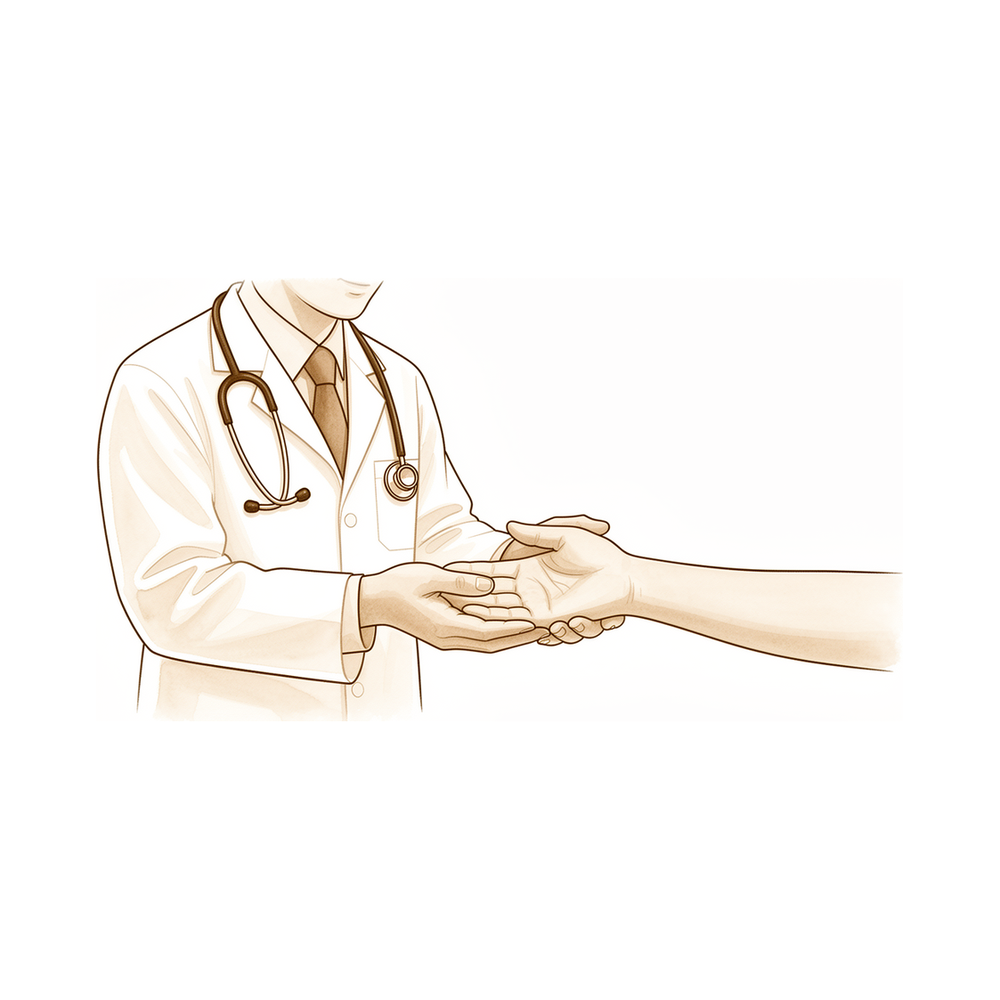
The hand is one of the best windows your body has onto your general health. Because it is packed with small joints, nerves, tendons, fine blood vessels, skin and nails (all close to the surface and easy to examine), a great many whole-body conditions leave their first clues there. Sometimes a hand problem turns out to be a purely local issue. But sometimes the very same symptom (stiffness, tingling, a colour change, a nail that looks different) is the earliest visible sign of something happening elsewhere in the body that is worth knowing about and often very treatable.
This page is a plain-English tour of the main medical conditions that show up in the hand. It isn't a checklist to diagnose yourself with; most aches and stiff fingers are ordinary wear and tear. But it explains why your surgeon may ask about your general health, take a close look at your nails and skin, or suggest a blood test or a referral even when you came in about your hand.
Diabetes — the great impersonator in the hand
Diabetes affects the hand more than almost any other medical condition. High blood sugar over time stiffens the soft tissues (the tendons, their lining and the ligaments), so people with diabetes get several common hand problems far more often than everyone else:
- Trigger finger (a finger that catches, clicks or locks): several times more common in diabetes than in the general population.
- Carpal tunnel syndrome (numbness and tingling in the thumb, index and middle fingers, often worse at night).
- Dupuytren's disease (cords and lumps in the palm that slowly bend the fingers down).
- A stiff, waxy hand (sometimes called diabetic cheiroarthropathy or "limited joint mobility"): the fingers won't fully straighten and the palms press together less easily.
- Frozen shoulder, which is strikingly more common in people with diabetes.
None of these prove you have diabetes, but having more than one of them, or getting them at a younger age, is a recognised reason to check. We've covered this in much more depth on our diabetes and upper-limb conditions page.
Thyroid disease — over-active or under-active
The thyroid gland sets your body's metabolic pace, and when it runs too fast or too slow it can show up in the hand. An under-active thyroid is a classic contributor to carpal tunnel syndrome and to trigger finger, partly through fluid retention and tissue changes around the tendons and nerves. Both an over- and an under-active thyroid are also linked with frozen shoulder. An over-active thyroid can additionally cause a fine tremor, sweaty palms, and nail changes such as the nail lifting away from its bed. Carpal tunnel that appears without an obvious cause is one of the reasons a thyroid blood test is sometimes arranged.
Inflammatory arthritis — when the immune system attacks the joints
A whole family of conditions causes the immune system to inflame the joints, and the hand is very often where they declare themselves, each with its own pattern:
- Rheumatoid arthritis tends to affect the knuckles and the middle finger joints, usually on both hands symmetrically, with morning stiffness and soft, swollen joints. See our inflammatory and rheumatoid arthritis page.
- Psoriatic arthritis can involve the joint closest to the nail, cause a whole finger to swell like a sausage, and often comes with nail pitting or skin patches. See our psoriatic arthritis page.
- Gout causes sudden, intensely painful, red, hot attacks, classically in the big toe, but the finger and wrist joints can be hit too, sometimes with chalky lumps over time. See our gout page.
The reason it matters to tell these apart from ordinary osteoarthritis is that inflammatory arthritis is driven by the immune system and responds to specific medicines that can protect the joints from damage, so early diagnosis changes the outcome.
Kidney disease
Long-standing kidney disease, especially in people on dialysis for many years, can lead to carpal tunnel syndrome through a build-up of a protein called amyloid around the wrist tendons. Kidney problems also disturb the body's calcium, phosphate and bone metabolism, which can weaken bone and occasionally show up as aches or changes seen on hand X-rays. These are reasons a surgeon may take note of your kidney history.
Pregnancy
Pregnancy is a common and reassuring cause of hand symptoms. The extra fluid the body holds in the later months raises the pressure inside the carpal tunnel, so carpal tunnel syndrome (tingling and numbness in the fingers, often worst at night) is frequent in pregnancy. The good news is that it very commonly settles on its own within weeks of delivery, so the first-line approach is usually simple measures like a night splint rather than surgery.
Circulation and connective-tissue conditions
Some conditions affect the small blood vessels and the connective tissue, and the fingers are where you notice them first:
- Raynaud's phenomenon: the fingers turn white, then blue, then red in the cold or with stress, as the small vessels clamp down. On its own it is usually harmless, but it can also be the opening sign of a connective-tissue disease. We cover it fully on our Raynaud's phenomenon page.
- Scleroderma (systemic sclerosis) tightens and thickens the skin of the fingers, can cause Raynaud's, painful fingertip ulcers, and stiffness of the small joints.
- Lupus (systemic lupus erythematosus) can cause joint pain, Raynaud's and skin and nail-fold changes.
A clue we specifically look for is abnormal vessels at the base of the nail (the nail fold): twisted, dilated loops there can point to scleroderma or lupus and are one reason your surgeon may look closely at your nails with a magnifier.
Other clues — the nails, skin and fingertips
The fingertips, nails and skin can hint at conditions well beyond the hand:
- Finger clubbing: the fingertips broaden and the nails curve over the ends, associated with some lung, heart and bowel conditions.
- Spoon-shaped nails can reflect iron deficiency, and pale nail beds can suggest anaemia.
- Nail pitting, lifting or colour changes can accompany psoriasis, thyroid disease or other illnesses.
- Yellow, thickened, brittle nails are common in diabetes and some circulation problems.
- Skin and colour changes: yellowish skin, easy bruising, or unusual redness of the palms can occasionally reflect liver conditions.
Individually these are often minor and very common. They become more meaningful when several appear together, when they affect all the nails at once, or when they come alongside feeling generally unwell.
Why your surgeon asks about your general health
When you come in about a hand or wrist problem, you may be surprised to be asked about your sugar levels, your thyroid, your medications, weight changes or how you've been feeling in yourself, and to have your nails, skin and pulses examined. This isn't padding. It's because the hand so often reflects the rest of the body, and spotting the wider picture can change both the treatment of your hand problem and, occasionally, uncover something treatable elsewhere. Where a general medical condition seems likely, the next step is usually a simple blood test or a referral to your GP or a physician, not surgery.
When to see someone
See your GP or come back to us, rather than waiting, if:
- A hand symptom comes alongside feeling generally unwell: fevers, weight loss, fatigue, or feeling off in yourself.
- Joint pain, swelling or stiffness affects both hands at once, or comes with early-morning stiffness that takes a while to ease.
- You notice colour changes in the fingers (white/blue/red), painful fingertip ulcers, or new tightening of the finger skin.
- The nails on many fingers change together: pitting, lifting, spooning, clubbing or a colour change.
- Carpal tunnel symptoms or trigger fingers appear in several digits, on both sides, or at a younger than expected age.
Most of the time, a hand problem is just a hand problem. But because the hand is such an honest reporter of general health, it's always worth mentioning the bigger picture. Sometimes the hand is the first to know.
In more depth
Advanced reading: the deeper science (optional)
This section goes further than you need for your own treatment decisions. This topic is worth the extra reading because several hand conditions are, in practice, early visible signs of a systemic disease, and the hand often declares the problem before anything else does.
Diabetes changes the hand in several distinct ways
Diabetes is the systemic condition most consistently linked to hand problems, and the mechanism is common to all of them: glucose binds irreversibly to collagen, cross-linking it and making connective tissue stiffer and thicker. Every structure in the hand that depends on tissue gliding is affected.
The result is a recognised cluster, carpal tunnel syndrome, trigger finger, Dupuytren's disease, and limited joint mobility with a characteristic inability to press the palms flat together. Frozen shoulder belongs to the same group.
There is a specific and important corollary in pregnancy: gestational diabetes is a significant risk factor for both carpal tunnel syndrome and de Quervain tenosynovitis, established in a dataset of 715,337 patients [1]. That the effect appears over the months of a pregnancy, rather than the years of established diabetes, indicates these tissue changes develop faster than commonly assumed.
The practical point is not that hand problems in diabetes are untreatable, they respond to the same treatments, but that they cluster, so one should prompt attention to the others, and that glycaemic control is part of the picture rather than a separate concern.
Some hand findings should trigger investigation elsewhere
Several presentations are worth recognising because the hand is the visible end of something systemic.
Multiple trigger digits in a child. The presence of bilateral or multiple trigger digits, or concurrent carpal tunnel syndrome, should raise suspicion of an atypical underlying pathology such as mucopolysaccharidosis [2]. This is the clearest example on this site of a hand sign carrying implications far beyond the hand.
Raynaud's phenomenon with concerning features. Onset after about 30, asymmetry between hands, fingertip ulcers or pitting scars, or abnormal nail fold capillaries suggest a secondary cause — usually an autoimmune connective tissue disease, rather than the benign primary form.
Sudden painful weakness without compression. Anterior interosseous nerve palsy is increasingly thought to be a neuritis that often resolves spontaneously [3], and severe pain preceding weakness points towards neuralgic amyotrophy: an inflammatory condition of the nerves that no decompression addresses.
Inflammatory arthritis behaves differently from wear
Rheumatoid and other inflammatory arthritides affect the hand in a distinct pattern from osteoarthritis: the knuckles and middle joints rather than the fingertip joints, symmetrically, with prolonged morning stiffness and soft boggy swelling rather than hard bony enlargement.
That distinction matters surgically as well as medically. Reconstructions that rely on soft tissue holding a correction tend to stretch out in a hand with active synovitis, which is why disease control ordinarily precedes reconstruction, and why the same operation carries a different prognosis in the two settings.
Why the hand shows things early
The hand is a dense collection of small joints, long tendons in tight sheaths, nerves in non-expandable tunnels, and the most distal circulation in the body, all under thin skin where change is visible. A process that would go unnoticed in a larger structure produces symptoms here quickly, and one that impairs small-vessel flow shows here first.
That sensitivity is why hand findings are worth mentioning to a GP even when they seem trivial relative to the rest of one's health, and why hand surgeons frequently refer patients on to a physician rather than treating what is in front of them.
References for the advanced reading
- Smith GB, Young B, Titan AL, Kenney DE, Ladd AL. Incidence and risk factors for soft tissue hand and wrist conditions in pregnancy. J Hand Surg Glob Online. 2025;7(5):100778.
- Wong AL, Wong MJ, Parker R, Wheelock ME. Presentation and aetiology of paediatric trigger finger: a systematic review. J Hand Surg Eur Vol. 2021;47(2):192-6.
- Rodner CM, Tinsley BA, O'Malley MP. Pronator syndrome and anterior interosseous nerve syndrome. J Am Acad Orthop Surg. 2013;21(5):268-75.