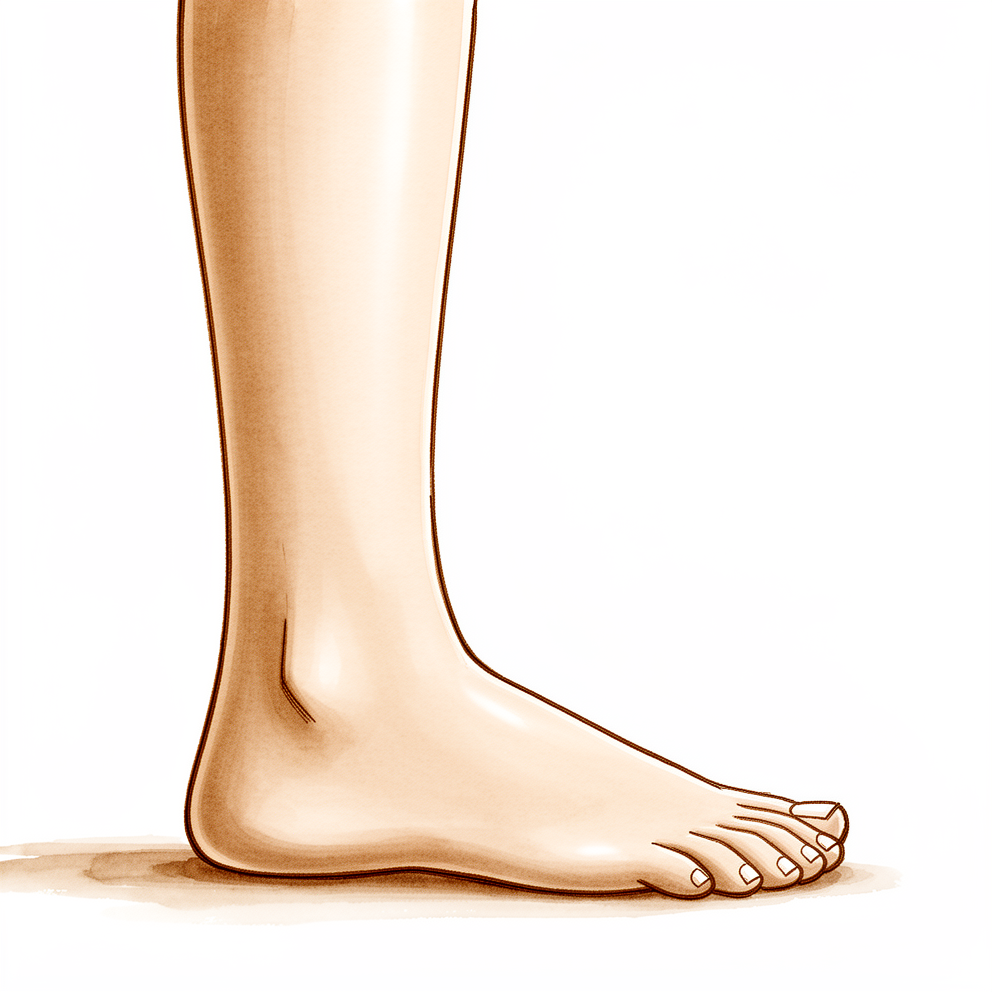
Why this operation has been suggested
This operation rebuilds the ligaments on the outside of your ankle that stop it giving way. It is usually offered to people with chronic ankle instability, which means symptoms lasting at least 6 months, including repeated sprains, pain, and a feeling that the ankle is unsteady during sport. We usually try non-operative care first, such as activity change and physiotherapy, and consider surgery when that has not given enough improvement. Surgery may also be suggested when symptoms continue after 3 to 6 months of these measures. The operation aims to give you a stable ankle, with less pain and better function. Results are good or very good in between 80 and 95% of cases.
Before the operation
In the weeks before surgery we confirm the plan with imaging. This may include an X-ray, an MRI scan (a scan that shows soft tissues such as ligaments), or an ultrasound. These pictures help us plan the operation and check for other problems inside the ankle, such as cartilage damage.
On the day of surgery, stop eating and drinking seven hours beforehand. We ask for seven hours rather than a shorter time so your operation can be brought forward if the theatre list runs early. Your surgeon will tell you which of your usual medicines to stop and when. Bring a written list of everything you take, wear loose, comfortable clothing, and arrange for someone to drive you home afterwards. If you have other medical conditions, you may also need blood tests or a review with the anaesthetist (the specialist who puts you to sleep).
On the day
You arrive at the hospital's surgical admissions unit, where you are checked in and prepared for theatre. You then meet the anaesthetist, the specialist who puts you to sleep. This operation is done under general anaesthetic. A regional nerve block is sometimes added for post-operative pain relief; the anaesthetist will discuss this with you on the day. You are then taken into the operating theatre, where the operation is performed.
When the operation is finished, you wake up in the recovery area. Nurses stay with you while the anaesthetic wears off and check that you are comfortable. Once you are stable, you either move to a ward or go home the same day, depending on the procedure and how your recovery is going. Whoever is driving you home should be ready to collect you when the team says you are ready to leave.
What the operation involves
There are two main ways to rebuild the outside ligaments of your ankle. If your own ligament tissue is still in reasonable condition, your surgeon can tighten and reattach it. This is done through a curved cut over the outside of the ankle, usually angled forward towards the middle of your foot. The torn ligament is stitched back onto the small bone of the outer ankle (the fibula) using small anchors or stitches passed through tiny tunnels in the bone. Nearby tissue can be folded over the repair to reinforce it. Loose fragments of bone or small extra bones that are causing pain are removed at the same time.
If your ligament tissue is too worn or stretched to hold stitches, or if this is a repeat operation, your surgeon may instead rebuild the ligament using a piece of tendon. This tendon graft can come from your own body or from donor tissue. Small tunnels are drilled in the bones of your ankle and the graft is threaded through and fixed in place, copying the path of the original ligament.
Some repairs are done through keyhole surgery instead. The surgeon works through small cuts using a camera (an arthroscope) and can also check and treat damage inside the ankle joint at the same time, without opening the whole area up.
Whichever approach is used, the cut is closed with stitches and covered with a dressing. Your surgeon may also check the tendons that run behind the outer ankle bone and repair them if they are damaged, since problems there can occur alongside ligament injuries.
After the operation
When you wake up, you will be in the recovery area, and nurses will stay with you while the anaesthetic wears off. Your ankle will be wrapped in a dressing, and your team will manage any pain so you stay comfortable. You can usually put weight on your foot soon after surgery, though you may use crutches at first to help you move around safely. Someone should stay with you for the first 24 hours after you get home. Your team will tell you whether you go home the same day or stay one night in hospital. We leave the dressing on for about 10 days; please do not take it off before then unless we tell you to. We change or remove it when we see you.
Recovery
For the first few days your ankle will be sore and swollen. This is normal and settles gradually. Rest, keeping your foot raised, and the pain relief your team prescribes will ease the discomfort. The swelling comes and goes for a while, often worse after you have been on your feet.
You will start moving soon after surgery. Most people can put weight on the foot early, using crutches at first to get around safely. Your physiotherapist will guide you through exercises to restore movement and strength, building them up as your ankle allows. You will wear the dressing for about 10 days, and we will check the wound when we see you. At home, keep the dressing dry, take short walks as advised, and avoid twisting or rolling the ankle.
As the swelling settles and movement returns, everyday tasks become easier. You will progress from crutches to walking in your own time. Driving waits until your own surgeon clears you: there is no driving while a cast, boot or brace is on the operated ankle, or while weight is being kept off it, and you need to be off strong pain medicine and able to move your foot between the pedals and brake hard without hesitating. A boot is not an exemption, and having the cast or boot taken off is not by itself the green light. Which ankle was operated on matters, and so does whether the car is automatic or manual: in an automatic the right foot does the braking, while in a manual the left foot works the clutch. Sport comes back in stages, starting with straight-line activity and building to the twisting and turning your ankle used to do. Your physiotherapist will tell you when each stage is safe.
Everyone heals at a different pace, so your timeline may differ from others. Your surgeon and physiotherapist will guide you at each visit and adjust the plan as you progress.
What can go wrong
Most patients do well, but problems can occasionally happen. Your surgeon and the team monitor you closely to spot any issue early.
Nerves near the outside of the ankle can be irritated during surgery. If this happens, you might notice numbness, tingling, burning or a sharp, electric feeling along the top or outer edge of your foot. Most nerve irritation settles on its own over weeks to months. Tell us at your next review if you notice any of these feelings.
The wound can sometimes cause trouble. Watch for redness that spreads out from the cut, fluid or pus leaking from it, or skin that looks dark or broken down. You might feel a deep, throbbing pain that does not ease with simple painkillers, or notice a fever. If you see any of these signs, call the clinic straight away. Some wound infections need antibiotics or a small procedure to drain them, so early review matters.
The stitches or small anchors used to hold the repair can occasionally rub or press under the skin. This feels like a tender spot, a lump, or a clicking sensation near one of the small scars. It is usually mild, but if it bothers you, bring it up at your next review. A simple procedure under local anaesthetic can remove the irritated part.
The repaired ligament can rarely tear again or stretch out. You would notice the ankle becoming unsteady again, with repeated rolling or spraining, swelling, and pain at the front of the ankle. If your ankle starts giving way again after a period of stability, contact the clinic so we can assess it.
Some people notice stiffness after the operation. This feels like tightness when you bend your ankle up or turn your foot inwards, and it can limit how far the ankle moves. Physiotherapy usually helps. Mention it at your review if movement is not improving.
The complications table on this page lists typical rates if you want the specifics.
When to call us
Call us straight away if you have a fever, or if the skin around your wound becomes more red, swollen or starts leaking fluid. Go to emergency if you have sudden severe pain, swelling in your calf, or shortness of breath. These can be signs of a blood clot. Also go to emergency if you lose feeling in your foot or cannot move it. For numbness, tingling or burning that comes on gradually, call the clinic so we can review you.
Evidence & references
This is the clinical evidence summary written for health professionals. It is technical, and it lists the research this page was built from. You do not need to read it to understand your treatment or to make a decision about it.
Anatomy & Pathophysiology
Ligament Anatomy and Biomechanics
- The anterior talofibular ligament and calcaneofibular ligament are the primary lateral ankle structures identified radiographically [1].
- Sectioning of the deltoid ligament results in a 43% increase in tibiotalar contact area [7].
- Sectioning of the deltoid ligament results in a 30% increase in peak pressures [7].
- Sectioning of the deltoid ligament alone results in valgus tilt of the talus [7].
- Chronic instability resulting from deltoid ligament sectioning may lead to tibiotalar arthrosis [7].
- The deep deltoid ligament consists of short fibers [7].
- The Chrisman-Snook reconstruction resulted in a significantly more stable ankle joint complex than ankles with cut anterior talofibular ligaments [2].
- The Chrisman-Snook reconstruction resulted in ankles with significantly less motion than intact ankles [2].
- Transection and imbrication of the lateral ligaments results in improved mechanical stability in approximately 80% of patients [2].
Pathophysiology of Instability
- Chronic instability of the ankle from an earlier rupture of a ligament should first be treated conservatively if it is symptomatic [2].
- Mechanical instability is characterized by stress radiographs showing 8 to 10 degrees of increased tilt of the talus in the ankle mortise compared with the normal ankle [2].
- Functional instability is defined as the subjective feeling of ankle instability or recurrent ankle sprain caused by neuromuscular or proprioceptive deficits [2].
- Recurrent sprains are associated with a risk of associated injuries to other structures, such as osteochondral lesions [2].
- An acute lateral ankle sprain significantly decreases physical activity across the lifespan [1].
- Chronic medial instability often does not cause severe disability that cannot be treated conservatively [7].
- Patients with chronic medial ankle instability may give a history of a pronation-type injury but more often report having had multiple ankle sprains without clearly remembering the mechanism [7].
- The combination of posterior tibial insufficiency and deltoid incompetence is categorized by Myerson as a stage IV adult-acquired flatfoot [7].
- This combination of posterior tibial insufficiency and deltoid incompetence is most commonly seen in the older population [7].
- A symptomatic anterolateral exostosis at the insertion of the anterior talofibular ligament, described as an excentric lesion, is found by CT scan in patients with chronic ankle pain after an inversion injury [2].
- Physical examination and oblique radiographs were suggestive of the excentric lesion in most cases [2].
- Unsatisfactory results for lateral ligament shortening procedures may occur in patients with generalized joint hypermobility or long-standing ligamentous laxity [2].
- Unsatisfactory results for lateral ligament shortening procedures are frequent in patients with prior ankle surgery [2].
- Better functional results may be obtained with reconstruction of both lateral ligaments than with reconstruction of the anterior talofibular ligament alone, although the literature is inconclusive [2].
- Karlsson et al. recommended combined reconstruction if there is any doubt regarding the involvement of both ligaments [2].
- Primary repair of a chronic deltoid tear, either end-to-end, “vest-over-pants,” or advancement to bone, does not usually work [7].
- Anatomic primary repair of the chronically deficient deltoid ligament is less satisfactory than repair of the lateral ankle ligament due to the short fibers of the deep deltoid and increased tension placed on the medial aspect of the ankle [7].
- Medial ankle ligament reconstruction is indicated after failed conservative treatment in patients with chronic symptomatic mechanical instability [7].
- It is important to assess for incompetence of the medial tendons of the ankle, especially the posterior tibial tendon, in patients with chronic medial instability [7].
Investigations
- With mechanical instability, stress radiographs show 8 to 10 degrees of increased tilt of the talus in the ankle mortise compared with the normal ankle [2].
- If stress radiographs do not show increased talar tilt, other causes for the disability, such as a stress fracture, should be sought [2].
- A symptomatic anterolateral exostosis at the insertion of the anterior talofibular ligament, described as an excentric lesion, can be found by CT scan in patients with chronic ankle pain after an inversion injury [2].
- Bone scans reveal increased uptake in the middle third of the fibula, indicating a stress fracture in patients with chronic, recurrent pain over the distal third of the leg and ankle [2].
- MRI is used for ankle injuries [3].
- Stress views of the ankle mortise are utilized in evaluation [3].
Treatment
- The arthroscopic Broström technique is a described method for lateral ligament repair [1].
- Anatomic ligament repairs are performed for syndesmotic injuries [1].
- Medial ankle instability involves the deltoid ligament [1].
- An evidence-based approach exists for the treatment of acute traumatic syndesmosis (high ankle) sprains [1].
- Gravity stress radiographs are used to assess deltoid ligament integrity and medial clear space measurements [1].
- Subtalar instability is a condition with specific diagnosis and treatment protocols [1].
- Ankle fracture syndesmosis fixation and management is a current practice among orthopedic surgeons [1].
- The Broström procedure has been evaluated for long-term results in chronic lateral ankle instability [1].
- Combined medial and lateral anatomic ligament reconstruction is used for chronic rotational instability of the ankle [1].
- Outcome scales are used to assess lateral ankle ligament reconstruction [1].
- Predictors of peroneal pathology have been identified in Broström-Gould ankle ligament reconstruction for lateral ankle instability [1].
- Acute and chronic lateral ankle instability are conditions affecting athletes [1].
- Lateral ligament augmentation using suture-tape affects functional instability [1].
- A randomized comparison exists between lateral ligaments augmentation using suture-tape and modified Broström repair in young female patients with chronic ankle instability [1].
- A modified Broström procedure can be combined with arthroscopic debridement of medial gutter osteoarthritis in patients with chronic ankle instability [1].
- Ossicle resection is performed during lateral ligament repair for the treatment of chronic lateral ankle instability [1].
- Qualitative and quantitative anatomic investigations of the lateral ankle ligaments inform surgical reconstruction procedures [1].
- Deltoid ligament abnormalities are present in cases of chronic lateral ankle instability [1].
- Magnetic resonance imaging is compared to physical examination for diagnosing syndesmotic injury after lateral ankle sprain [1].
- Interventions for treating chronic ankle instability have been systematically reviewed [1].
- Open mosaicplasty is used for osteochondral lesions of the talus [1].
- Operative management of ankle instability includes reconstruction with open and percutaneous methods [1].
- Radiographic identification is used to identify primary lateral ankle structures [1].
- Acute superficial deltoid complex avulsion is repaired during ankle fracture fixation in National Football League players [1].
- Calcaneofibular ligament injury plays a role in ankle instability with implications for surgical management [1].
- Deltoid ligament repair is compared to syndesmotic fixation in bimalleolar equivalent ankle fractures [1].
- Anatomic reconstruction of the anterior talofibular and calcaneofibular ligaments can be performed using a semitendinosus tendon allograft and interference screws [1].
- Repair of only the anterior talofibular ligament resulted in similar outcomes to repair of both the anterior talofibular and calcaneofibular ligaments [1].
- Simultaneous ossicle resection and lateral ligament repair provide excellent clinical results with an early return to physical activity in pediatric and adolescent patients with chronic lateral ankle instability and os subfibulare [1].
- Morphological characteristics of os subfibulare are related to the failure of conservative treatment of chronic lateral ankle instability [1].
- The modified Broström procedure in patients with chronic ankle instability is superior to conservative treatment in terms of muscle endurance and postural stability [1].
References
[1] Campbell S Operative Orthopaedics 4 Volume Set. REPAIR OF ACUTE RUPTURE OF LATERAL LIGAMENTS > ACUTE ANKLE LIGAMENT INJURIES, CHRONIC ANKLE INSTABILITY.
[2] Campbell S Operative Orthopaedics 4 Volume Set. REPAIR OF ACUTE RUPTURE OF LATERAL LIGAMENTS > CHRONIC INSTABILITY AFTER INJURY.
[3] Campbell S Operative Orthopaedics 4 Volume Set. REPAIR OF ACUTE RUPTURE OF LATERAL LIGAMENTS > Anesthesia (Continued).
[7] Campbell S Operative Orthopaedics 4 Volume Set. REPAIR OF ACUTE RUPTURE OF LATERAL LIGAMENTS > MEDIAL REPAIR OF CHRONIC INSTABILITY.