Skip to content

How Tendons Work and Heal PDF In-depth PDF

Tendons are the body's cables — tough cords that connect muscle to bone and transmit the pull of the muscle into movement. When you bend a finger or lift your arm, it is tendons doing the work of carrying that force across the joint. Tendons are strong, but they heal slowly and in a particular way, and — importantly — not all tendons heal the same way. A cut flexor tendon in the finger and a torn rotator cuff tendon in the shoulder follow quite different healing stories, which is why their surgery and rehabilitation are so different. This page explains, in plain language, what tendons are and how they mend — and then, for the curious, goes deeper into the biology, including why a flexor-tendon repair gets weaker before it gets stronger, and why a rotator cuff heals onto bone the way it does.

What a tendon is and what it does

A tendon is a rope made mostly of collagen — the same tough protein that gives bone its flexibility — packed into tightly-aligned bundles that run along the line of pull. One end blends into muscle; the other anchors into bone. Its job is simple but vital: to transmit the force a muscle generates to the bone, so the joint moves. Some tendons also have to glide — the flexor tendons that bend your fingers slide back and forth through narrow tunnels every time you make a fist.

Tendons are living tissue, but only just: they have relatively few cells and a sparse blood supply compared with muscle or skin. That is a large part of why they heal slowly.

How tendons heal

When a tendon is cut or torn, it heals in three overlapping phases, much like other tissues:

  1. Inflammation (first week). A clot forms and repair cells move in. At this stage the join is held together mostly by the surgeon's stitches — the tendon itself is contributing very little strength.
  2. Repair (weeks). Cells lay down new collagen across the gap, but it is disorganised and weak at first — like a hastily-tied bundle of threads rather than a neat rope.
  3. Remodelling (months). With time and gentle use, that disorganised collagen is gradually replaced and re-aligned along the line of pull, and the tendon regains strength. This continues for many months — often up to a year or more.

A key point: tendon heals largely by forming scar, not by perfectly re-growing the original tissue. The repaired stretch is never quite as pristine as the original — which is why careful rehabilitation, and patience, matter so much.

What helps a tendon heal

  • The right amount of movement. Tendons respond to load. Controlled, graded exercise (guided by a hand or physiotherapist) tells the healing collagen how to organise itself. Too much, too soon, ruptures the repair; too little leads to stiffness and a tendon stuck down by scar.
  • Protecting the repair early. A fresh tendon repair is fragile for weeks even when it feels fine — following your splint and activity limits is what stops it pulling apart.
  • Good general health. Not smoking, controlling diabetes, and avoiding unnecessary steroids all help; smoking in particular impairs tendon healing.
  • Time. Tendon is slow tissue. Real strength takes months, not weeks.
Advanced reading: the deeper science (optional)

This section steps up to a more detailed, student-level explanation of the biology. It isn't needed to understand a tendon injury or its treatment — but if you're curious about how tendons actually work, and why a finger tendon and a shoulder tendon heal so differently, read on.

Tendon as living tissue

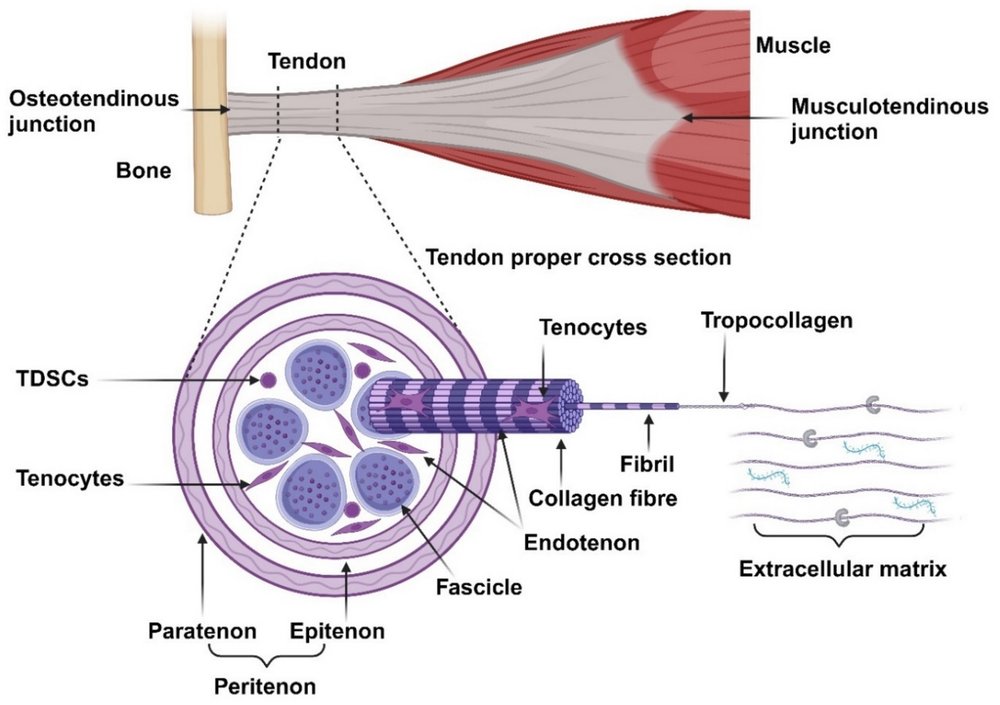
Diagram of tendon structure — a tendon joining muscle to bone, with a cross-section showing the collagen hierarchy (fascicles, fibres, fibrils, tropocollagen) and tenocytes.
A tendon is a rope-within-a-rope — collagen molecules bundle into fibrils, fibres and fascicles, each wrapped in sheaths that carry its sparse blood supply, with tenocytes strung between them. Roets, Abrahamse & Crous, Wikimedia Commons, CC BY 4.0

A tendon is built as a hierarchy of collagen, like a rope made of ever-smaller strands. Collagen molecules bundle into fibrils, fibrils into fibres, fibres into fascicles, and fascicles into the whole tendon — and at each level a thin connective-tissue wrapping (the endotenon, and the epitenon around the whole tendon) carries the small blood vessels and nerves. The collagen is mostly type I, exceptionally strong in tension and laid down almost perfectly parallel to the direction of pull.

At rest the fibres have a wavy, crimped pattern. When you first load a tendon this crimp straightens out, which is why a tendon is slightly stretchy at the very start of a pull before becoming stiff and strong — it has a little built-in give. Tendon is also viscoelastic: it behaves differently depending on how fast it is loaded (stiffer when loaded quickly), and it slowly creeps — lengthens — under a sustained load.

The living cells are tenocytes, sparse spindle-shaped cells strung between the collagen bundles. They maintain and very slowly renew the matrix. Because cells and blood vessels are relatively few — and some regions of certain tendons are genuinely hypovascular ("watershed" zones with a poor blood supply) — tendon healing is slow, and those poorly-supplied zones are exactly where some tendons tend to tear and to heal badly.

How tendons heal — and why it's mostly by scar

The three phases above, in more detail: an inflammatory phase (roughly the first week) clears debris and recruits cells; a proliferative phase (about one to three weeks) in which cells churn out large amounts of disorganised type III collagen — quick to lay down but mechanically weak; and a long remodelling phase (months, up to about 18 months) in which that type III collagen is gradually replaced by strong, aligned type I collagen, cross-linked and oriented along the line of load.

The crucial concept is that this is repair by scar, not regeneration. The body patches the gap rather than recreating the original, beautifully-ordered tendon — and what turns that early weak scar into something strong and aligned is mechanical load. That is the whole rationale behind modern tendon rehabilitation: controlled force, applied at the right time, literally instructs the scar how to become tendon.

Flexor tendon healing: intrinsic vs extrinsic, and the work of flexion

The flexor tendons that bend your fingers are a special case, because they have to glide through a tight tunnel (the flexor sheath, with its pulleys) to work. That creates a tension at the heart of flexor surgery, and two different ways the tendon can heal:

  • Intrinsic healing comes from the tendon's own cells, nourished by the synovial fluid inside the sheath and by tiny blood-vessel folds called the vincula. The flexor tendon is largely fed not by blood vessels but by that synovial fluid, which is actively pumped into the tendon — a process called imbibition — each time the finger bends and straightens; so movement itself feeds the healing tendon. Intrinsic healing knits the tendon back together without sticking it to its surroundings — so it can still glide.
  • Extrinsic healing comes from cells and scar invading from outside, from the sheath and surrounding tissue. It heals the tendon too — but it glues it to its tunnel, forming adhesions that stop it gliding, so the finger won't fully bend or straighten.

Modern repair plus early controlled movement is designed to tip the balance toward intrinsic healing and away from adhesions.

This is where the work of flexion comes in — the force the muscle has to generate to actually flex the finger. It is not just the weight being moved; it is the resistance to the tendon gliding: friction in the sheath, the bulk of the repair itself, post-operative swelling, and tight pulleys all add to it. If the work of flexion (the resistance) climbs higher than the repair can withstand, the repair gaps or ruptures — or the finger simply won't move and adhesions set in. So the surgeon is balancing two competing demands: a repair strong enough to tolerate early movement, yet slim and smooth enough to glide with a low work of flexion. Early motion only works if both are achieved.

Why a flexor repair gets weaker before it gets stronger

Here is the counter-intuitive part that explains the whole, cautious rehabilitation timeline. A tendon repair does not steadily get stronger from day one. It follows a U-shaped curve:

  • In the first days, essentially all the strength comes from the suture — the tendon tissue itself adds almost nothing.
  • Over the first one to three weeks, the cut tendon ends actually soften: the body resorbs and remodels the collagen right at the repair site before the new collagen has matured. So the whole construct reaches its weakest point in the early weeks — often around the end of the first week through the third — even though the wound looks healed and the finger feels fine.
  • Then strength climbs. As disorganised type III collagen is replaced by aligned, cross-linked type I, the repair regains and then exceeds its starting strength, reaching enough for most everyday activity by around 12 weeks and continuing to mature for many months.

That dip is why hand therapy is so carefully staged, and why "it feels fine at three weeks" is a trap: that is often precisely when the repair is most vulnerable. Gentle, controlled motion in the early phase keeps the tendon gliding (favouring intrinsic healing) and aligns the new collagen — without overloading a repair that is, biologically, at its weakest. Tendon ruptures after repair cluster in these vulnerable early weeks for exactly this reason.

Tendon-to-bone healing: the rotator cuff and the enthesis

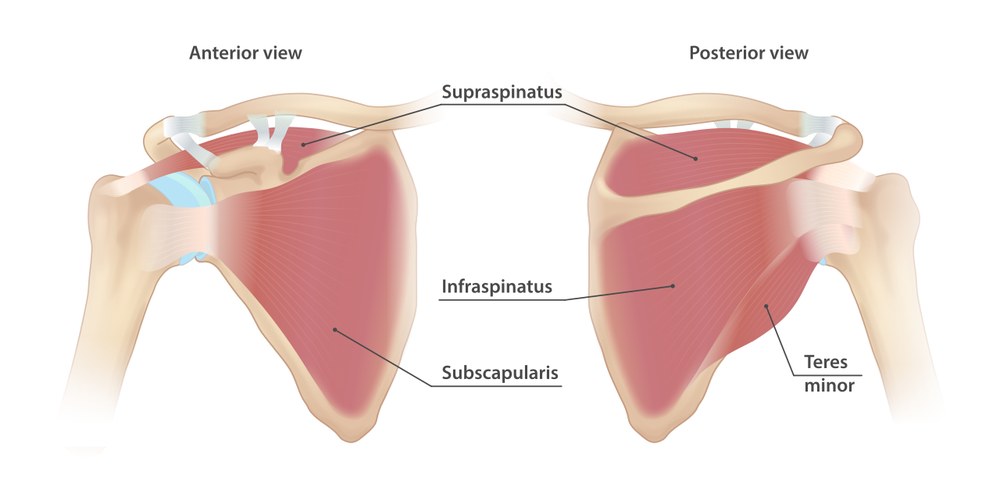
The four rotator cuff muscles (supraspinatus, infraspinatus, subscapularis, teres minor) shown from the front and back of the shoulder.
The rotator cuff — four muscles whose tendons blend into a cuff that inserts onto the top of the arm bone, where the tendon-to-bone enthesis must heal after a repair. InjuryMap, Wikimedia Commons, CC BY-SA 4.0

A rotator cuff tear is a completely different problem, because here the tendon has to heal back onto bone — and the junction between tendon and bone is a remarkable structure called the enthesis.

In healthy tissue the enthesis is a graded transition, built in roughly four zones: tendon → uncalcified fibrocartilage → calcified fibrocartilage → bone. This gentle gradient from soft, flexible tendon to hard, stiff bone spreads out the stress, so the soft tendon isn't simply ripped off the hard bone at a sharp boundary.

The catch is that, once torn, the body cannot rebuild that graded enthesis. A repaired cuff heals by a fibrovascular scar between tendon and bone — mechanically weaker than the original four-zone transition, and one reason rotator cuff repairs can re-tear despite well-done surgery.

It is also important that most cuff tears are degenerate rather than purely traumatic: with age, the tendon — particularly in a relatively poorly-supplied "critical zone" about a centimetre from where the supraspinatus tendon meets the bone — weakens, frays and tears with little or no injury (true cuff tears are rare before about 50). Surgery reattaches the tendon to its bony "footprint", but it is working against ageing, often poor-quality tissue. So cuff healing is fundamentally biology-limited: the operation restores the anatomy, but whether the tendon-to-bone junction truly heals depends on tendon quality, tear size, age, smoking, diabetes and how the repair is protected and loaded. This is the opposite end of the spectrum from a clean flexor laceration in a young hand — same tissue, very different healing problem.

What helps and harms tendon healing

  • Load, correctly dosed. Controlled, progressive loading is the single most powerful tool for building tendon strength and alignment. Too much too soon ruptures the repair; too little causes stiffness and adhesions. The art of rehabilitation is the dose.
  • Blood supply. Well-vascularised tendon heals better; hypovascular "watershed" zones (as in parts of the rotator cuff) heal worse.
  • Smoking, diabetes, steroids and age all impair tendon healing and raise the risk of rupture and re-tear.
  • Time. Tendon is slow tissue — meaningful strength takes months, and full remodelling can run beyond a year.

See also


Creative Commons BY-NC 4.0

CC Creative Commons licence
BY Attribution — you must credit the source
NC NonCommercial — not for commercial use

Attribution-NonCommercial 4.0 International


Creative Commons Corporation ("Creative Commons") is not a law firm and does not provide legal services or legal advice. Distribution of Creative Commons public licenses does not create a lawyer-client or other relationship. Creative Commons makes its licenses and related information available on an "as-is" basis. Creative Commons gives no warranties regarding its licenses, any material licensed under their terms and conditions, or any related information. Creative Commons disclaims all liability for damages resulting from their use to the fullest extent possible.

Using Creative Commons Public Licenses

Creative Commons public licenses provide a standard set of terms and conditions that creators and other rights holders may use to share original works of authorship and other material subject to copyright and certain other rights specified in the public license below. The following considerations are for informational purposes only, are not exhaustive, and do not form part of our licenses.

Considerations for licensors: Our public licenses are intended for use by those authorized to give the public permission to use material in ways otherwise restricted by copyright and certain other rights. Our licenses are irrevocable. Licensors should read and understand the terms and conditions of the license they choose before applying it. Licensors should also secure all rights necessary before applying our licenses so that the public can reuse the material as expected. Licensors should clearly mark any material not subject to the license. This includes other CC- licensed material, or material used under an exception or limitation to copyright. More considerations for licensors: wiki.creativecommons.org/Considerations_for_licensors

Considerations for the public: By using one of our public licenses, a licensor grants the public permission to use the licensed material under specified terms and conditions. If the licensor's permission is not necessary for any reason--for example, because of any applicable exception or limitation to copyright--then that use is not regulated by the license. Our licenses grant only permissions under copyright and certain other rights that a licensor has authority to grant. Use of the licensed material may still be restricted for other reasons, including because others have copyright or other rights in the material. A licensor may make special requests, such as asking that all changes be marked or described. Although not required by our licenses, you are encouraged to respect those requests where reasonable. More considerations for the public: wiki.creativecommons.org/Considerations_for_licensees


Creative Commons Attribution-NonCommercial 4.0 International Public License

By exercising the Licensed Rights (defined below), You accept and agree to be bound by the terms and conditions of this Creative Commons Attribution-NonCommercial 4.0 International Public License ("Public License"). To the extent this Public License may be interpreted as a contract, You are granted the Licensed Rights in consideration of Your acceptance of these terms and conditions, and the Licensor grants You such rights in consideration of benefits the Licensor receives from making the Licensed Material available under these terms and conditions.

Section 1 -- Definitions.

a. Adapted Material means material subject to Copyright and Similar Rights that is derived from or based upon the Licensed Material and in which the Licensed Material is translated, altered, arranged, transformed, or otherwise modified in a manner requiring permission under the Copyright and Similar Rights held by the Licensor. For purposes of this Public License, where the Licensed Material is a musical work, performance, or sound recording, Adapted Material is always produced where the Licensed Material is synched in timed relation with a moving image.

b. Adapter's License means the license You apply to Your Copyright and Similar Rights in Your contributions to Adapted Material in accordance with the terms and conditions of this Public License.

c. Copyright and Similar Rights means copyright and/or similar rights closely related to copyright including, without limitation, performance, broadcast, sound recording, and Sui Generis Database Rights, without regard to how the rights are labeled or categorized. For purposes of this Public License, the rights specified in Section 2(b)(1)-(2) are not Copyright and Similar Rights.

d. Effective Technological Measures means those measures that, in the absence of proper authority, may not be circumvented under laws fulfilling obligations under Article 11 of the WIPO Copyright Treaty adopted on December 20, 1996, and/or similar international agreements.

e. Exceptions and Limitations means fair use, fair dealing, and/or any other exception or limitation to Copyright and Similar Rights that applies to Your use of the Licensed Material.

f. Licensed Material means the artistic or literary work, database, or other material to which the Licensor applied this Public License.

g. Licensed Rights means the rights granted to You subject to the terms and conditions of this Public License, which are limited to all Copyright and Similar Rights that apply to Your use of the Licensed Material and that the Licensor has authority to license.

h. Licensor means the individual(s) or entity(ies) granting rights under this Public License.

i. NonCommercial means not primarily intended for or directed towards commercial advantage or monetary compensation. For purposes of this Public License, the exchange of the Licensed Material for other material subject to Copyright and Similar Rights by digital file-sharing or similar means is NonCommercial provided there is no payment of monetary compensation in connection with the exchange.

j. Share means to provide material to the public by any means or process that requires permission under the Licensed Rights, such as reproduction, public display, public performance, distribution, dissemination, communication, or importation, and to make material available to the public including in ways that members of the public may access the material from a place and at a time individually chosen by them.

k. Sui Generis Database Rights means rights other than copyright resulting from Directive 96/9/EC of the European Parliament and of the Council of 11 March 1996 on the legal protection of databases, as amended and/or succeeded, as well as other essentially equivalent rights anywhere in the world.

l. You means the individual or entity exercising the Licensed Rights under this Public License. Your has a corresponding meaning.

Section 2 -- Scope.

a. License grant.

1. Subject to the terms and conditions of this Public License, the Licensor hereby grants You a worldwide, royalty-free, non-sublicensable, non-exclusive, irrevocable license to exercise the Licensed Rights in the Licensed Material to:

a. reproduce and Share the Licensed Material, in whole or in part, for NonCommercial purposes only; and

b. produce, reproduce, and Share Adapted Material for NonCommercial purposes only.

2. Exceptions and Limitations. For the avoidance of doubt, where Exceptions and Limitations apply to Your use, this Public License does not apply, and You do not need to comply with its terms and conditions.

3. Term. The term of this Public License is specified in Section 6(a).

4. Media and formats; technical modifications allowed. The Licensor authorizes You to exercise the Licensed Rights in all media and formats whether now known or hereafter created, and to make technical modifications necessary to do so. The Licensor waives and/or agrees not to assert any right or authority to forbid You from making technical modifications necessary to exercise the Licensed Rights, including technical modifications necessary to circumvent Effective Technological Measures. For purposes of this Public License, simply making modifications authorized by this Section 2(a) (4) never produces Adapted Material.

5. Downstream recipients.

a. Offer from the Licensor -- Licensed Material. Every recipient of the Licensed Material automatically receives an offer from the Licensor to exercise the Licensed Rights under the terms and conditions of this Public License.

b. No downstream restrictions. You may not offer or impose any additional or different terms or conditions on, or apply any Effective Technological Measures to, the Licensed Material if doing so restricts exercise of the Licensed Rights by any recipient of the Licensed Material.

6. No endorsement. Nothing in this Public License constitutes or may be construed as permission to assert or imply that You are, or that Your use of the Licensed Material is, connected with, or sponsored, endorsed, or granted official status by, the Licensor or others designated to receive attribution as provided in Section 3(a)(1)(A)(i).

b. Other rights.

1. Moral rights, such as the right of integrity, are not licensed under this Public License, nor are publicity, privacy, and/or other similar personality rights; however, to the extent possible, the Licensor waives and/or agrees not to assert any such rights held by the Licensor to the limited extent necessary to allow You to exercise the Licensed Rights, but not otherwise.

2. Patent and trademark rights are not licensed under this Public License.

3. To the extent possible, the Licensor waives any right to collect royalties from You for the exercise of the Licensed Rights, whether directly or through a collecting society under any voluntary or waivable statutory or compulsory licensing scheme. In all other cases the Licensor expressly reserves any right to collect such royalties, including when the Licensed Material is used other than for NonCommercial purposes.

Section 3 -- License Conditions.

Your exercise of the Licensed Rights is expressly made subject to the following conditions.

a. Attribution.

1. If You Share the Licensed Material (including in modified form), You must:

a. retain the following if it is supplied by the Licensor with the Licensed Material:

i. identification of the creator(s) of the Licensed Material and any others designated to receive attribution, in any reasonable manner requested by the Licensor (including by pseudonym if designated);

ii. a copyright notice;

iii. a notice that refers to this Public License;

iv. a notice that refers to the disclaimer of warranties;

v. a URI or hyperlink to the Licensed Material to the extent reasonably practicable;

b. indicate if You modified the Licensed Material and retain an indication of any previous modifications; and

c. indicate the Licensed Material is licensed under this Public License, and include the text of, or the URI or hyperlink to, this Public License.

2. You may satisfy the conditions in Section 3(a)(1) in any reasonable manner based on the medium, means, and context in which You Share the Licensed Material. For example, it may be reasonable to satisfy the conditions by providing a URI or hyperlink to a resource that includes the required information.

3. If requested by the Licensor, You must remove any of the information required by Section 3(a)(1)(A) to the extent reasonably practicable.

4. If You Share Adapted Material You produce, the Adapter's License You apply must not prevent recipients of the Adapted Material from complying with this Public License.

Section 4 -- Sui Generis Database Rights.

Where the Licensed Rights include Sui Generis Database Rights that apply to Your use of the Licensed Material:

a. for the avoidance of doubt, Section 2(a)(1) grants You the right to extract, reuse, reproduce, and Share all or a substantial portion of the contents of the database for NonCommercial purposes only;

b. if You include all or a substantial portion of the database contents in a database in which You have Sui Generis Database Rights, then the database in which You have Sui Generis Database Rights (but not its individual contents) is Adapted Material; and

c. You must comply with the conditions in Section 3(a) if You Share all or a substantial portion of the contents of the database.

For the avoidance of doubt, this Section 4 supplements and does not replace Your obligations under this Public License where the Licensed Rights include other Copyright and Similar Rights.

Section 5 -- Disclaimer of Warranties and Limitation of Liability.

a. UNLESS OTHERWISE SEPARATELY UNDERTAKEN BY THE LICENSOR, TO THE EXTENT POSSIBLE, THE LICENSOR OFFERS THE LICENSED MATERIAL AS-IS AND AS-AVAILABLE, AND MAKES NO REPRESENTATIONS OR WARRANTIES OF ANY KIND CONCERNING THE LICENSED MATERIAL, WHETHER EXPRESS, IMPLIED, STATUTORY, OR OTHER. THIS INCLUDES, WITHOUT LIMITATION, WARRANTIES OF TITLE, MERCHANTABILITY, FITNESS FOR A PARTICULAR PURPOSE, NON-INFRINGEMENT, ABSENCE OF LATENT OR OTHER DEFECTS, ACCURACY, OR THE PRESENCE OR ABSENCE OF ERRORS, WHETHER OR NOT KNOWN OR DISCOVERABLE. WHERE DISCLAIMERS OF WARRANTIES ARE NOT ALLOWED IN FULL OR IN PART, THIS DISCLAIMER MAY NOT APPLY TO YOU.

b. TO THE EXTENT POSSIBLE, IN NO EVENT WILL THE LICENSOR BE LIABLE TO YOU ON ANY LEGAL THEORY (INCLUDING, WITHOUT LIMITATION, NEGLIGENCE) OR OTHERWISE FOR ANY DIRECT, SPECIAL, INDIRECT, INCIDENTAL, CONSEQUENTIAL, PUNITIVE, EXEMPLARY, OR OTHER LOSSES, COSTS, EXPENSES, OR DAMAGES ARISING OUT OF THIS PUBLIC LICENSE OR USE OF THE LICENSED MATERIAL, EVEN IF THE LICENSOR HAS BEEN ADVISED OF THE POSSIBILITY OF SUCH LOSSES, COSTS, EXPENSES, OR DAMAGES. WHERE A LIMITATION OF LIABILITY IS NOT ALLOWED IN FULL OR IN PART, THIS LIMITATION MAY NOT APPLY TO YOU.

c. The disclaimer of warranties and limitation of liability provided above shall be interpreted in a manner that, to the extent possible, most closely approximates an absolute disclaimer and waiver of all liability.

Section 6 -- Term and Termination.

a. This Public License applies for the term of the Copyright and Similar Rights licensed here. However, if You fail to comply with this Public License, then Your rights under this Public License terminate automatically.

b. Where Your right to use the Licensed Material has terminated under Section 6(a), it reinstates:

1. automatically as of the date the violation is cured, provided it is cured within 30 days of Your discovery of the violation; or

2. upon express reinstatement by the Licensor.

For the avoidance of doubt, this Section 6(b) does not affect any right the Licensor may have to seek remedies for Your violations of this Public License.

c. For the avoidance of doubt, the Licensor may also offer the Licensed Material under separate terms or conditions or stop distributing the Licensed Material at any time; however, doing so will not terminate this Public License.

d. Sections 1, 5, 6, 7, and 8 survive termination of this Public License.

Section 7 -- Other Terms and Conditions.

a. The Licensor shall not be bound by any additional or different terms or conditions communicated by You unless expressly agreed.

b. Any arrangements, understandings, or agreements regarding the Licensed Material not stated herein are separate from and independent of the terms and conditions of this Public License.

Section 8 -- Interpretation.

a. For the avoidance of doubt, this Public License does not, and shall not be interpreted to, reduce, limit, restrict, or impose conditions on any use of the Licensed Material that could lawfully be made without permission under this Public License.

b. To the extent possible, if any provision of this Public License is deemed unenforceable, it shall be automatically reformed to the minimum extent necessary to make it enforceable. If the provision cannot be reformed, it shall be severed from this Public License without affecting the enforceability of the remaining terms and conditions.

c. No term or condition of this Public License will be waived and no failure to comply consented to unless expressly agreed to by the Licensor.

d. Nothing in this Public License constitutes or may be interpreted as a limitation upon, or waiver of, any privileges and immunities that apply to the Licensor or You, including from the legal processes of any jurisdiction or authority.


Creative Commons is not a party to its public licenses. Notwithstanding, Creative Commons may elect to apply one of its public licenses to material it publishes and in those instances will be considered the “Licensor.” The text of the Creative Commons public licenses is dedicated to the public domain under the CC0 Public Domain Dedication. Except for the limited purpose of indicating that material is shared under a Creative Commons public license or as otherwise permitted by the Creative Commons policies published at creativecommons.org/policies, Creative Commons does not authorize the use of the trademark "Creative Commons" or any other trademark or logo of Creative Commons without its prior written consent including, without limitation, in connection with any unauthorized modifications to any of its public licenses or any other arrangements, understandings, or agreements concerning use of licensed material. For the avoidance of doubt, this paragraph does not form part of the public licenses.

Creative Commons may be contacted at creativecommons.org.