Patients › Shoulder
Os Acromiale
Patient-facing topic on os acromiale — failed fusion of an acromial ossification centre that may cause shoulder pain and contribute to subacromial impingement.
What you're feeling
Most people with an os acromiale never feel anything from it. It is a small piece of bone at the top of the shoulder that did not fuse to the rest of the shoulder blade during growth. When it does cause trouble, the pain sits at the front and side of the top of your shoulder, right over that unfused piece of bone. The area is often tender to press.
The pain tends to flare when you lift your arm overhead. Reaching for a high shelf, hanging washing, or painting a ceiling can all bring it on. Swimmers and throwing athletes notice it during their sport. The pain comes from the unfused piece of bone moving slightly when you use your shoulder, or from it pressing on nearby tissue as you raise your arm.
Along with the pain, you may find your shoulder feels weak. Lifting your arm in front of you may not go as far as it used to. Some people also notice a catching feeling when they move.
A stable unfused piece of bone can become painful after a knock or fall onto that shoulder.
If rest, changing your activities, or a steroid injection have not settled the pain, the unfused bone piece becomes worth checking for. An X-ray from certain angles can show it, though it is easy to miss on standard views. A scan can also show swelling at the site, which points to it being the source of your pain.
Most unfused bone pieces cause no symptoms and need no treatment at all.
What's actually happening
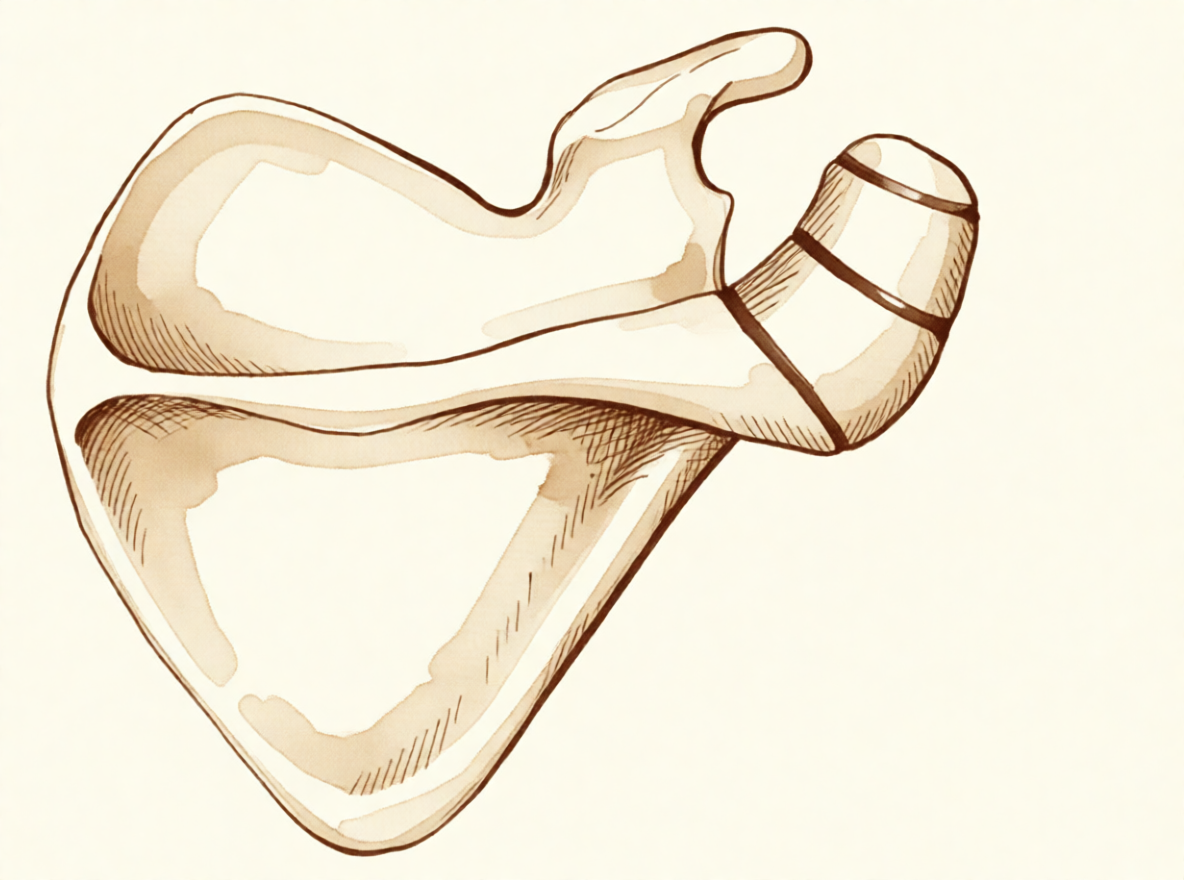
Your shoulder blade has a bony shelf on top called the acromion. It forms a roof over the shoulder joint. While you were growing, this shelf built up from three separate pieces of bone: the base, the middle, and the tip. In most people these pieces join together into one solid bone by adulthood. In some people, one piece never joins up. That unfused piece is an os acromiale.
The gap between the pieces is filled with tough fibrous tissue rather than bone. Think of it like a hinge that was never bolted shut. The piece can move a little when the big shoulder muscles pull on it. Each time you lift your arm, those muscles tug on the loose piece and it flexes slightly. That movement, and the pressure it puts on the tissue underneath, is where your pain comes from.
The roof of your shoulder also matters for what sits beneath it. The rotator cuff, a rope of tendon fibres that holds the joint steady, runs under this roof. If the loose bone piece moves or presses down as you raise your arm, it can crowd the space the tendon needs. That crowding is called impingement. It is the same reason your arm may feel weak or catch when you move.
An unfused piece can also sit still for years and cause nothing. A knock or fall onto that shoulder can stir it up and make a quiet gap suddenly painful.
One more thing worth knowing. Many people carry an os acromiale and a rotator cuff problem at the same time. The two often appear together, but having one does not automatically mean the other is to blame for your pain. That is why your surgeon looks at the whole picture, including where the tenderness sits and what your scans show, before deciding what is actually causing your symptoms.
What we can do about it
Dr Kieran Hirpara, an upper-limb surgeon at Mater Private Hospital Rockhampton, starts with the least invasive options that suit your condition. Patients are generally referred to our clinic by their GP; if a physiotherapist has suggested you see us, you will still need a referral from your GP in order to be eligible for the Medicare rebate. At your first visit we take a history, examine your shoulder, and arrange imaging where it is needed. An X-ray taken from certain angles usually shows the unfused piece of bone. A scan can add detail about the tendons and the tissue around the joint.
For a painful os acromiale, care usually starts without surgery. You can rest the shoulder for a short time and change how you use it, keeping your arm below shoulder height where you can. Physiotherapy aims to settle the pain and build the strength in the muscles that support your shoulder. We usually ask you to give this a fair trial before thinking about anything further.
Pain tablets and anti-inflammatory medicine, the kind that eases swelling, can help you through a flare. Your GP can guide you on what suits you.
If these steps have not given you enough relief, surgery becomes worth discussing. The operation joins the unfused piece of bone to the rest of the shoulder blade so it can no longer move when you lift your arm. We hold it in place while it heals, using a small metal plate or a strip of tissue looped over the bone. The aim is a solid join that lets the muscles pull on a stable shelf again. We will talk through whether this operation suits your shoulder, and the decision is one you make together with us.
What to expect
Most unfused bone pieces never cause trouble and need no treatment at all. If yours has been quiet for years, it can stay that way. A knock or fall onto that shoulder can stir it up, and the pain may then settle again with rest and simple measures.
For a painful os acromiale, care usually starts without surgery. Giving rest, activity changes, and physiotherapy a fair trial settles things for many people. If those steps have not given you enough relief, surgery to join the unfused piece to the rest of the shoulder blade can reduce your symptoms and improve how your shoulder works. The results of that operation are generally dependable when the piece is large or moves too much.
One thing worth knowing if you ever need a reverse total shoulder replacement, a type of joint replacement where the ball and socket positions are swapped. About 1 in 4 people feel local tenderness over the unfused bone piece after that operation. For most of those people, it settles on its own over time. Having an os acromiale does not appear to hold back the results of that surgery either.
Surgery is not for everyone, and it is not always the answer for athletes either. Some shoulders with an unfused piece and a rotator cuff problem do less well after surgery than others, so your surgeon will weigh this up carefully with you before recommending anything.
The honest picture is this. Left alone, a painful unfused piece may keep flaring whenever you lift your arm overhead. Managed well, most people get relief, either from non-surgical care or from surgery where it is needed. Your surgeon will talk you through which path suits your shoulder, your activity, and your goals.
When to see someone
See your GP if you have pain at the front and side of the top of your shoulder that will not settle, especially if it flares when you lift your arm overhead. Ask for a specialist review if the area is tender to press, your shoulder feels weak, or lifting your arm in front of you has become harder. The same applies if rest, changing your activities, or a steroid injection have not helped, or if the pain started after a knock or fall onto that shoulder. Swimmers and throwing athletes with shoulder pain that physiotherapy has not fixed should also ask about this condition. Most unfused bone pieces never cause trouble, so a diagnosis does not mean you need urgent treatment.
In more depth
Advanced reading: the deeper science (optional)
This section goes further than you need for your own treatment decisions. Os acromiale is worth the extra reading because it is a normal anatomical variant in a meaningful minority of people, usually causes nothing, and is frequently blamed for shoulder pain it is not responsible for.
What it is, and how common
The acromion, the bony roof over the shoulder, forms from several separate centres of bone that normally fuse in the late teens or early twenties. In some people one fails to fuse, leaving a permanent fibrous junction. That is an os acromiale, and it is present from adolescence rather than acquired.
Prevalence varies by population. A multicentre study of 6,842 patients found os acromiale is associated with rotator cuff injuries, that prevalence in the Japanese population studied was lower than in non-Asian populations, and that the fragment size tended to be smaller [1].
That association with cuff injury is worth reading carefully. It establishes that the two occur together more often than chance, not that the os causes the tear. The plausible mechanism runs both ways: an unfused fragment moves slightly under deltoid pull, which may irritate the tendon beneath — or the same shoulder mechanics that predispose to cuff disease make an unstable fragment symptomatic.
Whether it is the source of pain is the whole question
Because it is visible, permanent and abnormal-looking on imaging, an os acromiale readily becomes the reported explanation for shoulder pain. Most are silent, and most people who have one never know.
What distinguishes a symptomatic one is localised tenderness directly over the fragment, pain reproduced by pressing on it, and, where a diagnostic injection is used, relief specifically from injecting that junction rather than the subacromial space beneath. In the absence of those, the finding is best treated as incidental.
The subtypes are conventionally classified by which fusion site is involved [2], which matters surgically because the size of the mobile fragment determines whether it can be excised or must be fixed.
Why it complicates other shoulder surgery
The practical importance of an os acromiale is often less about its own symptoms than about what it does to operations planned for something else.
The deltoid attaches to the acromion, so an unfused fragment carries that pull across a mobile junction. Removing bone from the undersurface, as in acromioplasty, thins a fragment that is already unstable, and can convert a symptomless variant into a painful one or produce a nonunion. This is the strongest reason for it to be recognised on pre-operative imaging: not to treat it, but to avoid destabilising it.
Where it does require treatment, the choice is between excising a small fragment and fixing a larger one, and fixation across this junction is known to be difficult, the fragment is thin, the deltoid pulls on it continuously, and nonunion rates are appreciable. That difficulty is itself a reason to be confident the os is genuinely the pain source before operating on it.
References for the advanced reading
- Kozono N, Nishii A, Ishitani E, Mizuki Y, Kimura T, Yamamoto S, et al. Prevalence and factors associated with os acromiale: a multicenter study. JSES Int. 2025;9(5):1541-5.
- Boehm TD, Matzer M, Brazda D, Gohlke FE. Os acromiale associated with tear of the rotator cuff treated operatively. Review of 33 patients. J Bone Joint Surg Br. 2003;85(4):545-9.
Evidence & references
This is the clinical evidence summary written for health professionals. It is technical, and it lists the research this page was built from. You do not need to read it to understand your treatment or to make a decision about it.
Overview
- In Thai patients with shoulder problems who required MRI evaluation, the prevalence of os acromiale was 2.13% [1].
- Os acromiale is associated with rotator cuff injuries [5].
- A multicenter study determined the prevalence of and factors associated with os acromiale in the Japanese population [6].
- Surgical treatment is usually not indicated for os acromiale in the professional tennis player [7].
- The presence of os acromiale does not appear to have a negative impact on the clinical outcomes after surgery, and reverse total shoulder arthroplasty remains a safe and effective treatment option [4].
- The outcome of reverse total shoulder arthroplasty does not seem to be negatively affected by the presence of an os acromiale [9].
- Postoperative local tenderness at the os acromiale can be expected in 1 out of 4 patients but resolves spontaneously over time in the majority of patients [3].
- Ipsilateral os acromiale may be a relative contraindication to the clavicle hook plate [13].
- Operative management of a symptomatic os acromiale that has failed initial nonoperative treatment leads to decreased symptoms and improvement in clinical outcomes [2].
- Surgical options for symptomatic os acromiale include arthroscopic sub-total excision, arthroscopic subacromial decompression of stable fragments, and open reduction and internal fixation of unstable fragments [10].
Anatomy & Pathophysiology
Bony Anatomy
- The acromion has three ossification centers: the metacromion (base), the mesoacromion (middle), and the preacromion (tip) [28].
- Failure of fusion of the acromial ossification centers results in os acromiale [28].
- The unfused segment in os acromiale is most commonly the meso-acromion, a configuration often termed a meso-type os acromiale [14].
- The scapula is attached to the axial skeleton by the clavicle, specifically via the acromioclavicular (AC) and sternoclavicular (SC) joints [27].
- The acromion is a flattened bony process that curves forwards from the scapular spine [27].
- The acromion, coracoacromial ligament, and coracoid process form the coracoacromial arch, a rigid bony-ligamentous structure that imparts stability to the shoulder girdle [25].
- The rotator cuff, subacromial bursa, and subdeltoid bursa pass underneath the coracoacromial arch [25].
Pathophysiology
- Most diagnoses of os acromiale are made incidentally on axillary view radiographs of the shoulder [14].
- Primary shoulder pain is usually unrelated to the unfused os acromiale [14].
- When os acromiale drives symptoms, the two principal causes are motion at the non-union site or an impingement-type syndrome resulting from flexion of the os fragment during deltoid contraction and arm elevation [14].
- Pain from os acromiale via these mechanisms has been reported in a variety of sports, particularly among throwing athletes and swimmers [14].
- Previously stable non-unions can become unstable following an episode of blunt trauma to the region, such as direct impact to the shoulder during American football [14].
- A tear of the rotator cuff may often be associated with os acromiale, likely due to impingement from abnormal motion at the fibrous union site [8].
- Extrinsic impingement occurs when the space available for the rotator cuff is diminished, with examples including subacromial spurring, acromial fracture, or pathologic os acromiale [37].
- The synchondrosis of an os acromiale can be injured following trauma, though rarely [15].
- The presence of os acromiale does not appear to have a negative impact on the clinical outcomes after reverse total shoulder arthroplasty (rTSA) [4].
- The outcome of reverse total shoulder arthroplasty (RTSA) does not seem to be negatively affected by the presence of an os acromiale [9].
- Postoperative local tenderness at the os acromiale can be expected in 1 out of 4 patients following reverse total shoulder arthroplasty but resolves spontaneously over time in the majority of patients [3].
Classification
- Meta–os acromiale is the rarest subtype of os acromiale [18].
- Meso-type os acromiale is a recognized classification variant for which biomechanical evaluation of internal fixation has been performed [23].
Clinical Presentation
- Liberson reviewed 1800 shoulder girdles and identified an incidence of os acromiale of 1.4% [16].
- In Liberson's review of 1800 shoulder girdles, the lesion was bilateral in 62% of patients [16].
- The unfused segment in os acromiale is most commonly the meso-acromion [14].
- Any primary shoulder pain is usually unrelated to the unfused os acromiale [14].
- When os acromiale drives symptoms, one principle cause is motion at the non-union site [14].
- When os acromiale drives symptoms, another principle cause is an impingement-type syndrome resulting from flexion of the os fragment during deltoid contraction and arm elevation [14].
- Pain from os acromiale by the mechanism of impingement has been reported in a variety of sports, particularly among throwing athletes and swimmers [14].
- Previously stable non-unions of os acromiale can become unstable following an episode of blunt trauma to the region [14].
- Multicenter study findings support that os acromiale is associated with rotator cuff injuries [5].
- Awareness of os acromiale in the young athlete, appropriate clinical examination, and image studies are crucial to confirm diagnosis [12].
- Postoperative local tenderness at the os acromiale can be expected in 1 out of 4 patients following reverse total shoulder arthroplasty [3].
- Postoperative local tenderness at the os acromiale resolves spontaneously over time in the majority of patients following reverse total shoulder arthroplasty [3].
- The presence of os acromiale does not appear to have a negative impact on the clinical outcomes after surgery and rTSA remains a safe and effective treatment option [4].
- The outcome of RTSA does not seem to be negatively affected by the presence of an os acromiale [9].
Investigations
- Liberson reviewed 1800 shoulder girdles and identified an incidence of os acromiale of 1.4%, with the lesion being bilateral in 62% of patients [16].
- Awareness of the os acromiale in the young athlete, appropriate clinical examination, and image studies are crucial to confirm diagnosis [12].
- The synchondrosis of an os acromiale can be injured following trauma, though rarely, and emphasizes the need for appropriate radiographic investigation including axillary views [15].
- At least two X-ray views should be obtained: an anteroposterior in the plane of the glenoid and an axillary projection with the arm in abduction to show the relationship of the humeral head to the glenoid [33].
- Magnetic resonance imaging (MRI) is useful to identify labral tears and rotator cuff tears, although the accuracy for these is enhanced by combining the scan with arthrography [33].
- Ultrasound is a simple and accurate test for identifying rotator cuff tears and calcific tendinitis [33].
- The purpose of imaging of the shoulder is to help establish the diagnosis, determine the severity of the pathoanatomy, assist in surgical planning, and enable the surgeon to illustrate the condition of the shoulder to the patient [21].
- Unless a specific research protocol is in place, the temptation to “overimage” should be resisted, obtaining only the scans or reconstructions that are necessary for the care of the patient [21].
- Standardized plain films are almost always sufficient to garner the information needed, and there is information that can be gathered from properly taken plain films that cannot be obtained from CT scans [21].
- The first key view is the anteroposterior (AP) in the plane of the scapula taken so that the x-ray beam passes through the glenohumeral joint [21].
- The second key view is the axillary view taken with the arm in the functional position of elevation in the plane of the scapula and oriented so that both the spinoglenoid notch and the scapular neck are visible [21].
- The axillary view is referred to as the “truth view” because it demonstrates the glenohumeral relationships in the functional position of elevation [21].
- CT scans have the disadvantage of being taken with the arm in the adducted position, whereas the axillary truth view is taken with the arm in elevation [21].
- A robust approach to imaging the shoulder needs to recognize that the shoulder is a three-dimensional structure that cannot be represented by a single planar view [35].
- Critical relationships—such as the degree of centering of the humeral head—change with the position of the arm [35].
- Shoulder pathology may be found in a large number of different bones and soft tissues [35].
- Overlying and superimposed structures as well as metallic implants may complicate imaging the structures of interest [35].
- Surgeons need to develop a judicious approach that yields the information necessary to treat the patient while avoiding the tendency to "over-image" [35].
Treatment
Non-Operative
- Any primary shoulder pain is usually unrelated to the unfused os [14].
- Conservative treatment for symptomatic os acromiale can include physical therapy with ice and infiltration of the os acromial joint with Kenacort and Xylocaine 2% [40].
Operative
- Meta–os acromiale is the rarest subtype of os acromiale, and special consideration must be given to the type of tension-band construct used to achieve adequate compression and fixation [18].
- Arthroscopic fixation of os acromiale with absorbable screws provides promising clinical, cosmetic, and radiologic results with high patient satisfaction [22].
- A symptomatic os acromiale in a competitive female fastball pitcher was treated successfully with open reduction and internal fixation [41].
- For symptomatic os acromiale treated with osteosynthesis, nine screws (2.7- and 3.5-mm) were used in one case, including six anterior angle-stable screws, two posterior cortical screws, and two angle-stable locking screws [40].
- In cases of congenital or primary pseudarthrosis of os acromiale treated with osteosynthesis, an osteotomy of 1 mm was performed on each side of the osseous non-union including the cranial osteophytes [40].
Complications
- Postoperative local tenderness at the os acromiale resolves spontaneously over time in the majority of patients [3].
- Previously stable non-unions of the os acromiale can become unstable following an episode of blunt trauma to the region [14].
Key Evidence
- [L3] In Thai patients with shoulder problems who required MRI evaluation, the prevalence of os acromiale was 2.13%. [1] (10.1177/23259671221078806)
- [L4] Operative management of a symptomatic os acromiale that has failed initial nonoperative treatment leads to decreased symptoms and improvement in clinical outcomes. [2] (10.1016/j.jse.2019.05.047)
- [L3] Postoperative local tenderness at the os acromiale can be expected in 1 out of 4 patients but resolves spontaneously over time in the majority of patients. [3] (10.1177/2325967120965131)
- [L4] The presence of os acromiale does not appear to have a negative impact on the clinical outcomes after surgery and rTSA remains a safe and effective treatment option. [4] (10.1016/j.xrrt.2025.01.002)
- [L3] The study supports previous findings that os acromiale is associated with rotator cuff injuries. [5] (10.1016/j.jseint.2025.05.015)
- [L3] This multicenter study aimed to determine the prevalence of and factors associated with os acromiale in the Japanese population. [6] (10.1016/j.jse.2025.01.008)
- [L4] Surgical treatment is usually not indicated for os acromiale in the professional tennis player. [7] (10.1177/2325967118773723)
- [L4] A tear of the rotator cuff may often be associated with os acromiale, likely due to impingement from abnormal motion at the fibrous union site. [8] (10.2106/00004623-198466080-00029)
- [L4] The outcome of RTSA does not seem to be negatively affected by the presence of an os acromiale. [9] (10.1016/j.jse.2017.02.012)
- [L5] Surgical options for symptomatic os acromiale include arthroscopic sub-total excision, arthroscopic subacromial decompression of stable fragments, and open reduction and internal fixation of unstable fragments. [10] (10.5435/jaaos-d-17-00011)
- [L4] Awareness of the os acromiale in the young athlete, appropriate clinical examination, and image studies are crucial to confirm diagnosis. [12] (10.1016/j.jseint.2020.02.008)
- [L4] Ipsilateral os acromiale may be a relative contraindication to the clavicle hook plate. [13] (10.1186/s12891-021-04841-1)
- [L4] [14] (10.1302/2058-5241.4.180100)
- [L4] This case highlights that the synchondrosis of an os acromiale can be injured following trauma, though rarely, and emphasizes the need for appropriate radiographic investigation including axillary views and a flexible surgical approach. [15] (10.1016/j.jse.2008.02.012)
- [L4] Meta–os acromiale is the rarest subtype of os acromiale, and special consideration must be given to the type of tension-band construct used to achieve adequate compression and fixation. [18] (10.1177/03635465211028238)
- [L4] This new arthroscopic technique of fixation of os acromiale with absorbable screws provides promising clinical, cosmetic, and radiologic results with high patient satisfaction. [22] (10.1016/j.jse.2011.12.011)
- [L5] Surgical repair of a simulated, unstable meso-type os acromiale by a combination of cannulated screws inserted in the A-P direction with a tension band leads to significantly improved repair strength at time zero compared with cannulated screws alone. [23] (10.1016/j.jse.2014.09.040)
- [L4] [40] (10.1186/s40634-017-0111-7)
- [L4] A symptomatic os acromiale in a competitive female fastball pitcher was treated successfully with open reduction and internal fixation. [41] (10.1177/0363546506288305)
References
[1] Prevalence of Os Acromiale in Thai Patients With Shoulder Problems: A Magnetic Resonance Imaging Study. Orthopaedic Journal of Sports Medicine. 2022. DOI: 10.1177/23259671221078806
[2] Os acromiale: systematic review of surgical outcomes. Journal of Shoulder and Elbow Surgery. 2020. DOI: 10.1016/j.jse.2019.05.047
[3] Os Acromiale in Reverse Total Shoulder Arthroplasty: A Cohort Study. Orthopaedic Journal of Sports Medicine. 2020. DOI: 10.1177/2325967120965131
[4] Clinical implications of reverse total shoulder arthroplasty with an os acromiale: a systematic review. JSES Reviews, Reports, and Techniques. 2025. DOI: 10.1016/j.xrrt.2025.01.002
[5] Prevalence and factors associated with os acromiale: a multicenter study. JSES International. 2025. DOI: 10.1016/j.jseint.2025.05.015
[6] The prevalence and associated factors of os acromiale: a multicenter study. Journal of Shoulder and Elbow Surgery. 2025. DOI: 10.1016/j.jse.2025.01.008
[7] Os Acromiale in Professional Tennis Players. Orthopaedic Journal of Sports Medicine. 2018. DOI: 10.1177/2325967118773723
[8] Rotator cuff tears associated with os acromiale.. The Journal of Bone & Joint Surgery. 1984. DOI: 10.2106/00004623-198466080-00029
[9] Reverse shoulder arthroplasty in patients with os acromiale. Journal of Shoulder and Elbow Surgery. 2017. DOI: 10.1016/j.jse.2017.02.012
[10] Symptomatic, Unstable Os Acromiale. Journal of the American Academy of Orthopaedic Surgeons. 2018. DOI: 10.5435/jaaos-d-17-00011
[12] The unstable os acromiale: a cause of pain in the young athlete. JSES International. 2020. DOI: 10.1016/j.jseint.2020.02.008
[13] Os acromiale may be a contraindication of the clavicle hook plate: case reports and literature review. BMC Musculoskeletal Disorders. 2021. DOI: 10.1186/s12891-021-04841-1
[14] Os acromiale: a review of its incidence, pathophysiology, and clinical management. EFORT Open Reviews. 2019. DOI: 10.1302/2058-5241.4.180100
[15] Fracture of an os acromiale with associated rupture of the coracoclavicular ligaments. Journal of Shoulder and Elbow Surgery. 2008. DOI: 10.1016/j.jse.2008.02.012
[16] Types of os acromiale according to Liberson. 2006.
[18] Rare Symptomatic Meta–Os Acromiale in an Athlete. The American Journal of Sports Medicine. 2021. DOI: 10.1177/03635465211028238
[21] Rockwood And Matsen S The Shoulder. Arthroscopic Management of Prearthritic and Arthritic Conditions of the Shoulder and the Postarthroplasty Shoulder > Radiographic Evaluation.
[22] Arthroscopically assisted internal fixation of the symptomatic unstable os acromiale with absorbable screws. Journal of Shoulder and Elbow Surgery. 2012. DOI: 10.1016/j.jse.2011.12.011
[23] Biomechanical evaluation of internal fixation techniques for unstable meso-type os acromiale. Journal of Shoulder and Elbow Surgery. 2015. DOI: 10.1016/j.jse.2014.09.040
[25] Rockwood And Matsen S The Shoulder. Shoulder and Elbow Specialty Clinic Workers’ Survey > ANATOMY.
[27] Rockwood And Green S Fractures In Adults. 29: Principles of Nonunion and Bone Defect Treatment > Applied Anatomy Related to Scapular Fractures.
[28] Aaos Comprehensive Orthopaedic Review 3. Anatomy of the Shoulder, Arm, and Elbow > I. Shoulder.
[33] Apley And Solomon S Concise System Of Orthopaedics And Trauma. INVESTIGATION.
[35] Rockwood And Matsen S The Shoulder. Developmental Anatomy of the Shoulder and Anatomy of the Glenohumeral Joint > SENIOR EDITOR COMMENTARY.
[37] Campbell S Operative Orthopaedics 4 Volume Set. ANTERIOR CRUCIATE LIGAMENT RECONSTRUCTION WITH BONE-PATELLAR TENDON-BONE GRAFT > Developmental Stages of Impingement Syndrome.
[40] Prebending of osteosynthesis plate using 3D printed models to treat symptomatic os acromiale and acromial fracture. Journal of Experimental Orthopaedics. 2017. DOI: 10.1186/s40634-017-0111-7
[41] Surgical Stabilization of Os Acromiale in a Fast-Pitch Softball Pitcher. The American Journal of Sports Medicine. 2006. DOI: 10.1177/0363546506288305