Skip to content

How Bone Heals and Remodels PDF

Bone feels solid and permanent — but it is living tissue, laced with cells and blood vessels, and it is being taken apart and rebuilt every day of your life. That is exactly why a broken bone can knit back together into something as strong as it was before. Healing follows a predictable sequence, and it takes longer than most people expect, so knowing the pattern makes the wait far less worrying. This page explains, in plain language, what bone is and how it mends — and then, for the curious, goes a good deal deeper into the biology, including how bone constantly remodels itself and what happens when that machinery is turned against the bone.

What bone is and what it does

Bone does several jobs at once. It is the body's scaffolding — the frame that holds you up and that muscles pull against to move you. It is armour, protecting the brain, heart and lungs. And it is a storehouse for minerals, especially calcium, which the rest of the body draws on constantly.

To do all that, bone is a composite material — a bit like reinforced concrete. A flexible protein mesh (mostly collagen) gives it the toughness to bend slightly without snapping, and a hard mineral (a calcium-phosphate crystal) packed into that mesh gives it stiffness and compressive strength. Take the mineral away and bone is rubbery; take the collagen away and it is brittle as chalk. You need both.

Crucially, bone is not inert. It is full of living cells and threaded with blood vessels, which is why it bleeds when it breaks, why a good blood supply matters so much for healing, and why bone — unlike a scratched table — can repair itself.

How a broken bone heals

When a bone breaks, it heals in overlapping stages that turn a gap into solid bone again.

  1. The clot (first days). The break tears blood vessels in and around the bone, and the blood forms a clot at the fracture. This is not just a plug — it is the scaffold and the signal centre that summons the repair cells. This is also why the area is swollen, bruised and sore early on.
  2. The soft callus (first weeks). Repair cells move in and lay down a soft, rubbery bridge of cartilage and immature tissue across the gap. The bone is joined now, but only loosely — this is why a fresh fracture needs protecting in a cast, splint or with surgery while the bridge is weak.
  3. The hard callus (weeks to a couple of months). The soft bridge is gradually replaced by hard, mineralised bone, forming a bulky cuff (the callus) around the break. By the end of this stage the bone is usually solid enough for ordinary use.
  4. Remodelling (months to years). The lumpy callus is slowly carved back and reshaped along the lines of stress until the bone looks — and works — much like it did before. In children this reshaping is so good that a slightly crooked break can straighten out over time.

Healing is genuinely slow, and that is normal. As a rough guide many adult fractures take around six to twelve weeks to become solid, and longer to regain full strength; the remodelling that perfects the shape can run on for a year or more. The timeline depends on the bone, the person and the injury — so treat these as guides, not promises.

What helps it heal

A few things make a real difference, and most are in your control:

  • Blood supply and a settled break. Bone heals best when the broken ends have a good blood supply and are held reasonably still — which is the whole point of a cast or an operation. Too much movement, or a poor blood supply, is the commonest reason a break is slow to unite.
  • Not smoking. Smoking and nicotine narrow blood vessels and meaningfully slow bone healing — stopping, even around the time of an injury or operation, helps.
  • Nutrition. Bone is built from protein and mineral, so adequate protein, calcium and vitamin D support healing. Most people don't need megadoses — they need to not be deficient.
  • Sensible loading. Bone responds to use. Following the weight-bearing and exercise advice you're given — not too much, not too little — guides the healing bone to rebuild in the right places.
  • Time and review. Most breaks heal on their own timeline. If one that should be improving isn't, that's worth reviewing — some need a helping hand from surgery.

In more depth

This section steps up to a more detailed, student-level explanation of the biology behind everything above. It isn't needed to understand a fracture or its treatment — but if you're curious about how bone actually works, and how the very same machinery that heals a break can also be turned against the skeleton, read on.

Bone as living tissue

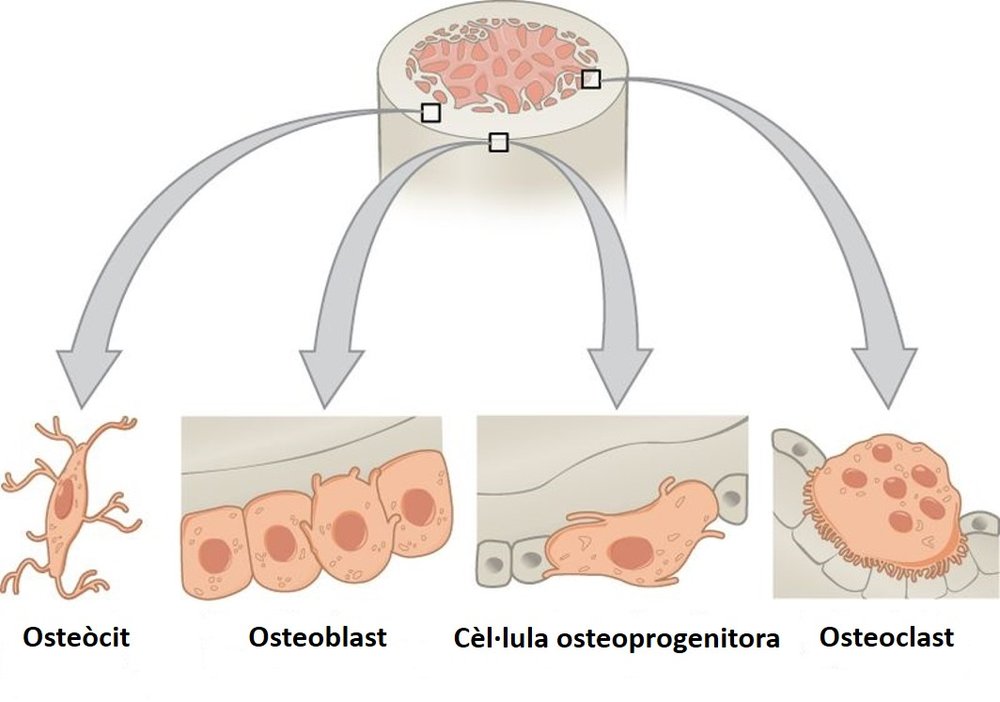
The bone cells — an osteogenic cell, a bone-building osteoblast, a buried osteocyte, and a large multi-nucleated osteoclast at a bone surface.
The cast of characters — bone-building osteoblasts, the osteocytes they become once walled into the bone, and the large bone-dissolving osteoclast. OpenStax, Anatomy & Physiology, CC BY 3.0

Bone is built and maintained by three main cell types, and it helps to meet them by name because almost everything that follows is a story about the balance between them:

  • Osteoblasts are the builders. They lay down new bone — first the soft collagen framework (osteoid), which they then mineralise into hard bone.
  • Osteoclasts are the demolition crew. They are large, multi-nucleated cells that dissolve bone, etching the mineral with acid and digesting the collagen with enzymes.
  • Osteocytes are former osteoblasts that became trapped in the bone they built. They sit in tiny chambers connected by a vast network of channels, wired together like a sensor grid throughout the bone — and, as we'll see, they are the cells that feel mechanical load and direct the other two.

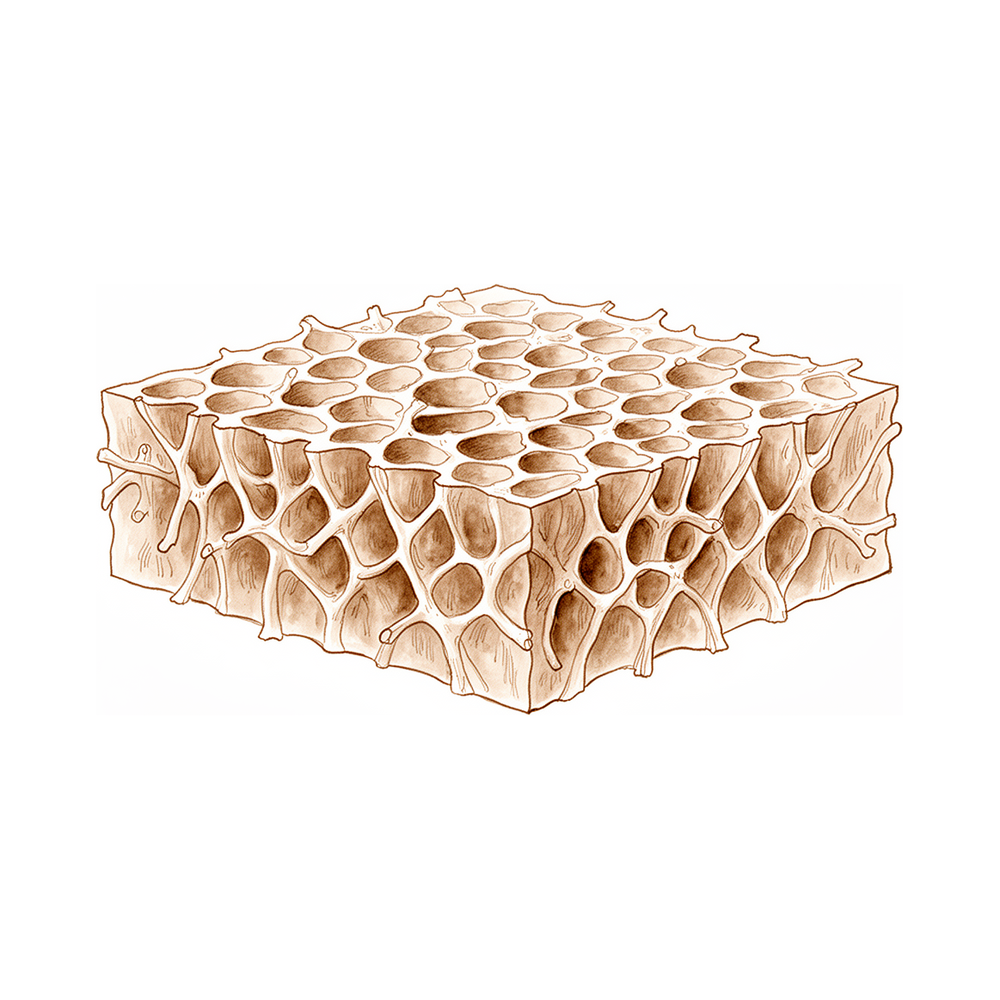
The hard matrix these cells live in is type I collagen stiffened by crystals of hydroxyapatite (a calcium-phosphate mineral). Bone comes in two architectures: dense cortical (compact) bone in the shafts of long bones, and spongy trabecular (cancellous) bone — an open lattice — at the ends of bones and inside the spine.

The healing cascade

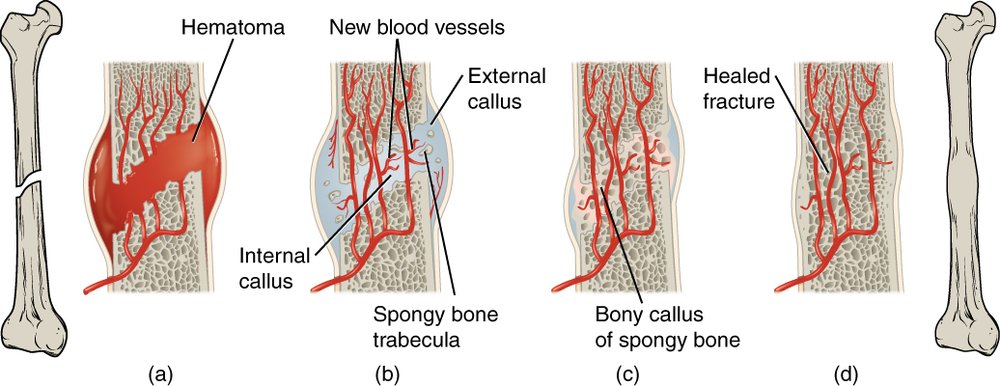
Four stages of fracture repair — fracture haematoma, fibrocartilaginous (soft) callus, bony (hard) callus, and remodelling.
The healing cascade — a fracture haematoma forms, is bridged by a soft (cartilage) callus, replaced by a hard bony callus, and finally remodelled back towards its original shape. OpenStax, Anatomy & Physiology, CC BY 3.0

The four plain-language stages above map onto a precise biological sequence. The fracture haematoma (clot) releases a flood of inflammatory signals and growth factors that recruit stem cells. Those cells first form a soft (cartilaginous) callus — bone is built on a cartilage template in a process called endochondral ossification, the same process by which much of the skeleton grows in childhood. The cartilage is then invaded by blood vessels and replaced by woven bone — the hard callus — which is finally remodelled into mature, organised lamellar bone.

That is secondary (indirect) healing — healing through a callus — and it is what happens when a break has a little movement, as in a cast. There is also primary (direct) healing, which happens only when the bone ends are held rigidly together with no gap and no movement (for example, compressed under a metal plate). Then there is no callus at all: bone simply remodels straight across the join. Neither is "better" — they are the bone's two answers to different mechanical conditions, which is why surgeons choose fixation to suit the fracture.

Remodelling and the cutting cone

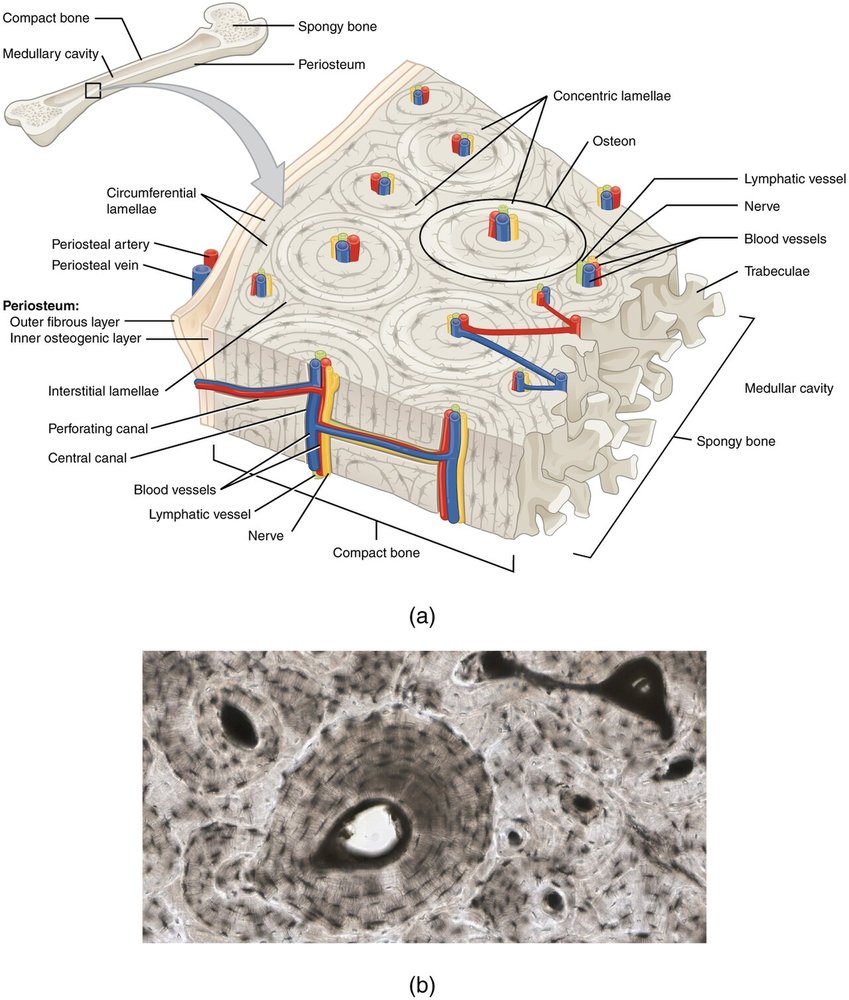
Diagram of compact bone showing osteons (Haversian systems) — concentric rings of bone (lamellae) around a central canal, with osteocytes in lacunae.
Compact bone is built from osteons — concentric rings of bone wrapped around a central blood-vessel canal. Each osteon is the finished work of a cutting cone. OpenStax, Anatomy & Physiology, CC BY 3.0

Even unbroken bone is rebuilt continuously — you replace roughly a tenth of your skeleton every year. This lifelong renewal is remodelling, and it is carried out by teams of cells called Basic Multicellular Units (BMUs).

In dense cortical bone you can watch a BMU at work as a microscopic tunnelling machine. At its leading edge, a pack of osteoclasts bores a tunnel straight through the bone, dissolving it as they advance — this resorbing tip is the cutting cone. Following close behind, in the closing cone, osteoblasts line the fresh tunnel and refill it from the walls inward, laying down concentric rings of new bone around a central channel that carries a blood vessel. The finished cylinder — rings of bone around a central canal — is an osteon, the basic structural unit of compact bone. So remodelling is not random: it is a coordinated convoy of demolition followed by reconstruction, threading new, well-aligned bone through the old.

This is also why healthy bone needs both cell types working in step. The osteoclasts that lead the cutting cone are the very same cells that, dysregulated, drive the bone-loss diseases described below.

The coupling switch: RANK, RANKL and OPG

How does the builder control the demolition crew? Through a molecular switch that is worth knowing because it is the lever behind both normal remodelling and several diseases (and several drugs).

Osteoblast-lineage cells display a signal called RANKL. When RANKL plugs into its receptor, RANK, on the surface of osteoclast precursors, it tells them to mature into active, bone-dissolving osteoclasts. So the builders hold the remote control for the demolition crew. To apply the brake, the same osteoblasts secrete a decoy called OPG (osteoprotegerin), which mops up RANKL before it can reach RANK. The RANKL-to-OPG ratio therefore sets the pace of bone resorption: more RANKL tips the balance toward bone loss, more OPG toward bone preservation.

Almost every signal that affects bone — hormones, inflammation, drugs — ultimately pulls on this lever. It is, for instance, exactly where the osteoporosis drug denosumab acts: it is a man-made antibody that works like OPG, soaking up RANKL to switch off osteoclasts. Hold onto this switch — the next two sections are both stories about RANKL being pushed the wrong way.

Mechanotransduction and Wolff's law

Bone famously adapts to the loads placed on it — "bone is laid down where it is needed and resorbed where it is not." This is Wolff's law, and it is why a tennis player's racket arm has denser bone, why astronauts and bed-bound patients lose bone, and why sensible loading helps a fracture rebuild in the right places.

The cells that sense the load are the osteocytes buried in the bone. As bone is loaded, fluid is squeezed through the tiny channels around them, and the osteocytes feel that flow — a process called mechanotransduction (turning a mechanical signal into a biological one). Loaded osteocytes dial down a braking molecule called sclerostin, which releases the osteoblasts to build; unloaded bone does the reverse, and is given over to resorption. So "use it or lose it" is not just a slogan — it is osteocytes adjusting the RANKL/OPG balance in response to what you do.

When remodelling goes wrong: osteolysis and sonic hedgehog

Osteolysis simply means bone being dissolved away — osteoclasts running unchecked, usually because something is jamming the RANKL switch in the "on" position. It is what makes a tumour eat into bone, what loosens an implant (next section), and what hollows out bone in some inflammatory diseases.

One of the more surprising controllers here is sonic hedgehog (Shh) — a signalling molecule best known for sculpting the body plan of the embryo (it helps lay out the limbs and digits). The same pathway is reused in the adult skeleton, and it cuts both ways. In a healing fracture, Shh signalling actually helps — it supports osteoblasts and bone formation. But in osteolysis it does the opposite: Shh, acting through its downstream messenger Gli, prompts the supporting stromal cells to make more RANKL — and more RANKL means more osteoclasts and more bone dissolved. Tellingly, Shh on its own doesn't resorb bone; it works by amplifying the RANKL pathway, which is exactly why it shows up as an aggravator in conditions like cancer-associated bone destruction. It is a neat illustration of a theme running through this whole page: most bone disease is the normal remodelling machinery — the cutting cone, the RANKL switch — pushed too far in one direction.

Polyethylene wear and implant loosening

This is where the biology becomes very practical, because it explains how joint replacements eventually fail. A hip or knee replacement has a smooth bearing surface, classically a hard ball or metal component moving against a polyethylene (medical-grade plastic) liner. Over years of use, friction sheds astronomically small wear particles of polyethylene — far too small to see, and shed in their billions.

The body treats these particles as intruders. Scavenger immune cells (macrophages) around the implant try to engulf them, but the plastic is indigestible, so the frustrated macrophages instead pour out inflammatory signals. Those signals — predictably — drive RANKL up, recruiting osteoclasts that resorb the bone around the implant. This particle-induced (or wear) osteolysis quietly eats away the bony anchorage, and eventually the implant loosens — a leading cause of joint replacements wearing out and needing revision, often a decade or more after surgery. It is the same final common pathway as everything above: an outside trigger, funnelled through RANKL, ending in osteoclasts dissolving bone. Understanding it is exactly why so much engineering goes into better bearing materials (such as cross-linked polyethylene) that shed fewer, less troublesome particles.

What helps and harms healing

Finally, the practical factors, now with the biology to explain them:

  • Blood supply delivers the cells, oxygen and signals healing needs; a stripped or crushed soft-tissue envelope, or a break in a poorly-supplied bone, heals slowly. This is the single biggest factor.
  • Stability lets the callus mature; excessive movement keeps breaking the fragile early bridge, and is a common road to a non-union (a break that fails to heal).
  • Smoking and nicotine constrict blood vessels and impair the repair cells — a well-established brake on bone healing.
  • Diabetes and some medications (long courses of steroids, and some anti-inflammatories around the time of a fresh fracture) can slow healing.
  • Nutrition — adequate protein, calcium and vitamin D — supplies the raw materials; deficiency, not abundance, is the problem to avoid.
  • Age slows the cellular machinery, but bone retains a remarkable capacity to heal throughout life.

See also


Creative Commons BY-NC 4.0

CC Creative Commons licence
BY Attribution — you must credit the source
NC NonCommercial — not for commercial use

Attribution-NonCommercial 4.0 International


Creative Commons Corporation ("Creative Commons") is not a law firm and does not provide legal services or legal advice. Distribution of Creative Commons public licenses does not create a lawyer-client or other relationship. Creative Commons makes its licenses and related information available on an "as-is" basis. Creative Commons gives no warranties regarding its licenses, any material licensed under their terms and conditions, or any related information. Creative Commons disclaims all liability for damages resulting from their use to the fullest extent possible.

Using Creative Commons Public Licenses

Creative Commons public licenses provide a standard set of terms and conditions that creators and other rights holders may use to share original works of authorship and other material subject to copyright and certain other rights specified in the public license below. The following considerations are for informational purposes only, are not exhaustive, and do not form part of our licenses.

Considerations for licensors: Our public licenses are intended for use by those authorized to give the public permission to use material in ways otherwise restricted by copyright and certain other rights. Our licenses are irrevocable. Licensors should read and understand the terms and conditions of the license they choose before applying it. Licensors should also secure all rights necessary before applying our licenses so that the public can reuse the material as expected. Licensors should clearly mark any material not subject to the license. This includes other CC- licensed material, or material used under an exception or limitation to copyright. More considerations for licensors: wiki.creativecommons.org/Considerations_for_licensors

Considerations for the public: By using one of our public licenses, a licensor grants the public permission to use the licensed material under specified terms and conditions. If the licensor's permission is not necessary for any reason--for example, because of any applicable exception or limitation to copyright--then that use is not regulated by the license. Our licenses grant only permissions under copyright and certain other rights that a licensor has authority to grant. Use of the licensed material may still be restricted for other reasons, including because others have copyright or other rights in the material. A licensor may make special requests, such as asking that all changes be marked or described. Although not required by our licenses, you are encouraged to respect those requests where reasonable. More considerations for the public: wiki.creativecommons.org/Considerations_for_licensees


Creative Commons Attribution-NonCommercial 4.0 International Public License

By exercising the Licensed Rights (defined below), You accept and agree to be bound by the terms and conditions of this Creative Commons Attribution-NonCommercial 4.0 International Public License ("Public License"). To the extent this Public License may be interpreted as a contract, You are granted the Licensed Rights in consideration of Your acceptance of these terms and conditions, and the Licensor grants You such rights in consideration of benefits the Licensor receives from making the Licensed Material available under these terms and conditions.

Section 1 -- Definitions.

a. Adapted Material means material subject to Copyright and Similar Rights that is derived from or based upon the Licensed Material and in which the Licensed Material is translated, altered, arranged, transformed, or otherwise modified in a manner requiring permission under the Copyright and Similar Rights held by the Licensor. For purposes of this Public License, where the Licensed Material is a musical work, performance, or sound recording, Adapted Material is always produced where the Licensed Material is synched in timed relation with a moving image.

b. Adapter's License means the license You apply to Your Copyright and Similar Rights in Your contributions to Adapted Material in accordance with the terms and conditions of this Public License.

c. Copyright and Similar Rights means copyright and/or similar rights closely related to copyright including, without limitation, performance, broadcast, sound recording, and Sui Generis Database Rights, without regard to how the rights are labeled or categorized. For purposes of this Public License, the rights specified in Section 2(b)(1)-(2) are not Copyright and Similar Rights.

d. Effective Technological Measures means those measures that, in the absence of proper authority, may not be circumvented under laws fulfilling obligations under Article 11 of the WIPO Copyright Treaty adopted on December 20, 1996, and/or similar international agreements.

e. Exceptions and Limitations means fair use, fair dealing, and/or any other exception or limitation to Copyright and Similar Rights that applies to Your use of the Licensed Material.

f. Licensed Material means the artistic or literary work, database, or other material to which the Licensor applied this Public License.

g. Licensed Rights means the rights granted to You subject to the terms and conditions of this Public License, which are limited to all Copyright and Similar Rights that apply to Your use of the Licensed Material and that the Licensor has authority to license.

h. Licensor means the individual(s) or entity(ies) granting rights under this Public License.

i. NonCommercial means not primarily intended for or directed towards commercial advantage or monetary compensation. For purposes of this Public License, the exchange of the Licensed Material for other material subject to Copyright and Similar Rights by digital file-sharing or similar means is NonCommercial provided there is no payment of monetary compensation in connection with the exchange.

j. Share means to provide material to the public by any means or process that requires permission under the Licensed Rights, such as reproduction, public display, public performance, distribution, dissemination, communication, or importation, and to make material available to the public including in ways that members of the public may access the material from a place and at a time individually chosen by them.

k. Sui Generis Database Rights means rights other than copyright resulting from Directive 96/9/EC of the European Parliament and of the Council of 11 March 1996 on the legal protection of databases, as amended and/or succeeded, as well as other essentially equivalent rights anywhere in the world.

l. You means the individual or entity exercising the Licensed Rights under this Public License. Your has a corresponding meaning.

Section 2 -- Scope.

a. License grant.

1. Subject to the terms and conditions of this Public License, the Licensor hereby grants You a worldwide, royalty-free, non-sublicensable, non-exclusive, irrevocable license to exercise the Licensed Rights in the Licensed Material to:

a. reproduce and Share the Licensed Material, in whole or in part, for NonCommercial purposes only; and

b. produce, reproduce, and Share Adapted Material for NonCommercial purposes only.

2. Exceptions and Limitations. For the avoidance of doubt, where Exceptions and Limitations apply to Your use, this Public License does not apply, and You do not need to comply with its terms and conditions.

3. Term. The term of this Public License is specified in Section 6(a).

4. Media and formats; technical modifications allowed. The Licensor authorizes You to exercise the Licensed Rights in all media and formats whether now known or hereafter created, and to make technical modifications necessary to do so. The Licensor waives and/or agrees not to assert any right or authority to forbid You from making technical modifications necessary to exercise the Licensed Rights, including technical modifications necessary to circumvent Effective Technological Measures. For purposes of this Public License, simply making modifications authorized by this Section 2(a) (4) never produces Adapted Material.

5. Downstream recipients.

a. Offer from the Licensor -- Licensed Material. Every recipient of the Licensed Material automatically receives an offer from the Licensor to exercise the Licensed Rights under the terms and conditions of this Public License.

b. No downstream restrictions. You may not offer or impose any additional or different terms or conditions on, or apply any Effective Technological Measures to, the Licensed Material if doing so restricts exercise of the Licensed Rights by any recipient of the Licensed Material.

6. No endorsement. Nothing in this Public License constitutes or may be construed as permission to assert or imply that You are, or that Your use of the Licensed Material is, connected with, or sponsored, endorsed, or granted official status by, the Licensor or others designated to receive attribution as provided in Section 3(a)(1)(A)(i).

b. Other rights.

1. Moral rights, such as the right of integrity, are not licensed under this Public License, nor are publicity, privacy, and/or other similar personality rights; however, to the extent possible, the Licensor waives and/or agrees not to assert any such rights held by the Licensor to the limited extent necessary to allow You to exercise the Licensed Rights, but not otherwise.

2. Patent and trademark rights are not licensed under this Public License.

3. To the extent possible, the Licensor waives any right to collect royalties from You for the exercise of the Licensed Rights, whether directly or through a collecting society under any voluntary or waivable statutory or compulsory licensing scheme. In all other cases the Licensor expressly reserves any right to collect such royalties, including when the Licensed Material is used other than for NonCommercial purposes.

Section 3 -- License Conditions.

Your exercise of the Licensed Rights is expressly made subject to the following conditions.

a. Attribution.

1. If You Share the Licensed Material (including in modified form), You must:

a. retain the following if it is supplied by the Licensor with the Licensed Material:

i. identification of the creator(s) of the Licensed Material and any others designated to receive attribution, in any reasonable manner requested by the Licensor (including by pseudonym if designated);

ii. a copyright notice;

iii. a notice that refers to this Public License;

iv. a notice that refers to the disclaimer of warranties;

v. a URI or hyperlink to the Licensed Material to the extent reasonably practicable;

b. indicate if You modified the Licensed Material and retain an indication of any previous modifications; and

c. indicate the Licensed Material is licensed under this Public License, and include the text of, or the URI or hyperlink to, this Public License.

2. You may satisfy the conditions in Section 3(a)(1) in any reasonable manner based on the medium, means, and context in which You Share the Licensed Material. For example, it may be reasonable to satisfy the conditions by providing a URI or hyperlink to a resource that includes the required information.

3. If requested by the Licensor, You must remove any of the information required by Section 3(a)(1)(A) to the extent reasonably practicable.

4. If You Share Adapted Material You produce, the Adapter's License You apply must not prevent recipients of the Adapted Material from complying with this Public License.

Section 4 -- Sui Generis Database Rights.

Where the Licensed Rights include Sui Generis Database Rights that apply to Your use of the Licensed Material:

a. for the avoidance of doubt, Section 2(a)(1) grants You the right to extract, reuse, reproduce, and Share all or a substantial portion of the contents of the database for NonCommercial purposes only;

b. if You include all or a substantial portion of the database contents in a database in which You have Sui Generis Database Rights, then the database in which You have Sui Generis Database Rights (but not its individual contents) is Adapted Material; and

c. You must comply with the conditions in Section 3(a) if You Share all or a substantial portion of the contents of the database.

For the avoidance of doubt, this Section 4 supplements and does not replace Your obligations under this Public License where the Licensed Rights include other Copyright and Similar Rights.

Section 5 -- Disclaimer of Warranties and Limitation of Liability.

a. UNLESS OTHERWISE SEPARATELY UNDERTAKEN BY THE LICENSOR, TO THE EXTENT POSSIBLE, THE LICENSOR OFFERS THE LICENSED MATERIAL AS-IS AND AS-AVAILABLE, AND MAKES NO REPRESENTATIONS OR WARRANTIES OF ANY KIND CONCERNING THE LICENSED MATERIAL, WHETHER EXPRESS, IMPLIED, STATUTORY, OR OTHER. THIS INCLUDES, WITHOUT LIMITATION, WARRANTIES OF TITLE, MERCHANTABILITY, FITNESS FOR A PARTICULAR PURPOSE, NON-INFRINGEMENT, ABSENCE OF LATENT OR OTHER DEFECTS, ACCURACY, OR THE PRESENCE OR ABSENCE OF ERRORS, WHETHER OR NOT KNOWN OR DISCOVERABLE. WHERE DISCLAIMERS OF WARRANTIES ARE NOT ALLOWED IN FULL OR IN PART, THIS DISCLAIMER MAY NOT APPLY TO YOU.

b. TO THE EXTENT POSSIBLE, IN NO EVENT WILL THE LICENSOR BE LIABLE TO YOU ON ANY LEGAL THEORY (INCLUDING, WITHOUT LIMITATION, NEGLIGENCE) OR OTHERWISE FOR ANY DIRECT, SPECIAL, INDIRECT, INCIDENTAL, CONSEQUENTIAL, PUNITIVE, EXEMPLARY, OR OTHER LOSSES, COSTS, EXPENSES, OR DAMAGES ARISING OUT OF THIS PUBLIC LICENSE OR USE OF THE LICENSED MATERIAL, EVEN IF THE LICENSOR HAS BEEN ADVISED OF THE POSSIBILITY OF SUCH LOSSES, COSTS, EXPENSES, OR DAMAGES. WHERE A LIMITATION OF LIABILITY IS NOT ALLOWED IN FULL OR IN PART, THIS LIMITATION MAY NOT APPLY TO YOU.

c. The disclaimer of warranties and limitation of liability provided above shall be interpreted in a manner that, to the extent possible, most closely approximates an absolute disclaimer and waiver of all liability.

Section 6 -- Term and Termination.

a. This Public License applies for the term of the Copyright and Similar Rights licensed here. However, if You fail to comply with this Public License, then Your rights under this Public License terminate automatically.

b. Where Your right to use the Licensed Material has terminated under Section 6(a), it reinstates:

1. automatically as of the date the violation is cured, provided it is cured within 30 days of Your discovery of the violation; or

2. upon express reinstatement by the Licensor.

For the avoidance of doubt, this Section 6(b) does not affect any right the Licensor may have to seek remedies for Your violations of this Public License.

c. For the avoidance of doubt, the Licensor may also offer the Licensed Material under separate terms or conditions or stop distributing the Licensed Material at any time; however, doing so will not terminate this Public License.

d. Sections 1, 5, 6, 7, and 8 survive termination of this Public License.

Section 7 -- Other Terms and Conditions.

a. The Licensor shall not be bound by any additional or different terms or conditions communicated by You unless expressly agreed.

b. Any arrangements, understandings, or agreements regarding the Licensed Material not stated herein are separate from and independent of the terms and conditions of this Public License.

Section 8 -- Interpretation.

a. For the avoidance of doubt, this Public License does not, and shall not be interpreted to, reduce, limit, restrict, or impose conditions on any use of the Licensed Material that could lawfully be made without permission under this Public License.

b. To the extent possible, if any provision of this Public License is deemed unenforceable, it shall be automatically reformed to the minimum extent necessary to make it enforceable. If the provision cannot be reformed, it shall be severed from this Public License without affecting the enforceability of the remaining terms and conditions.

c. No term or condition of this Public License will be waived and no failure to comply consented to unless expressly agreed to by the Licensor.

d. Nothing in this Public License constitutes or may be interpreted as a limitation upon, or waiver of, any privileges and immunities that apply to the Licensor or You, including from the legal processes of any jurisdiction or authority.


Creative Commons is not a party to its public licenses. Notwithstanding, Creative Commons may elect to apply one of its public licenses to material it publishes and in those instances will be considered the “Licensor.” The text of the Creative Commons public licenses is dedicated to the public domain under the CC0 Public Domain Dedication. Except for the limited purpose of indicating that material is shared under a Creative Commons public license or as otherwise permitted by the Creative Commons policies published at creativecommons.org/policies, Creative Commons does not authorize the use of the trademark "Creative Commons" or any other trademark or logo of Creative Commons without its prior written consent including, without limitation, in connection with any unauthorized modifications to any of its public licenses or any other arrangements, understandings, or agreements concerning use of licensed material. For the avoidance of doubt, this paragraph does not form part of the public licenses.

Creative Commons may be contacted at creativecommons.org.