Patients › Elbow
Olecranon Bursa Removal (Bursectomy)
What olecranon bursectomy involves, why it is a last resort, and the honest wound-healing and recurrence picture.
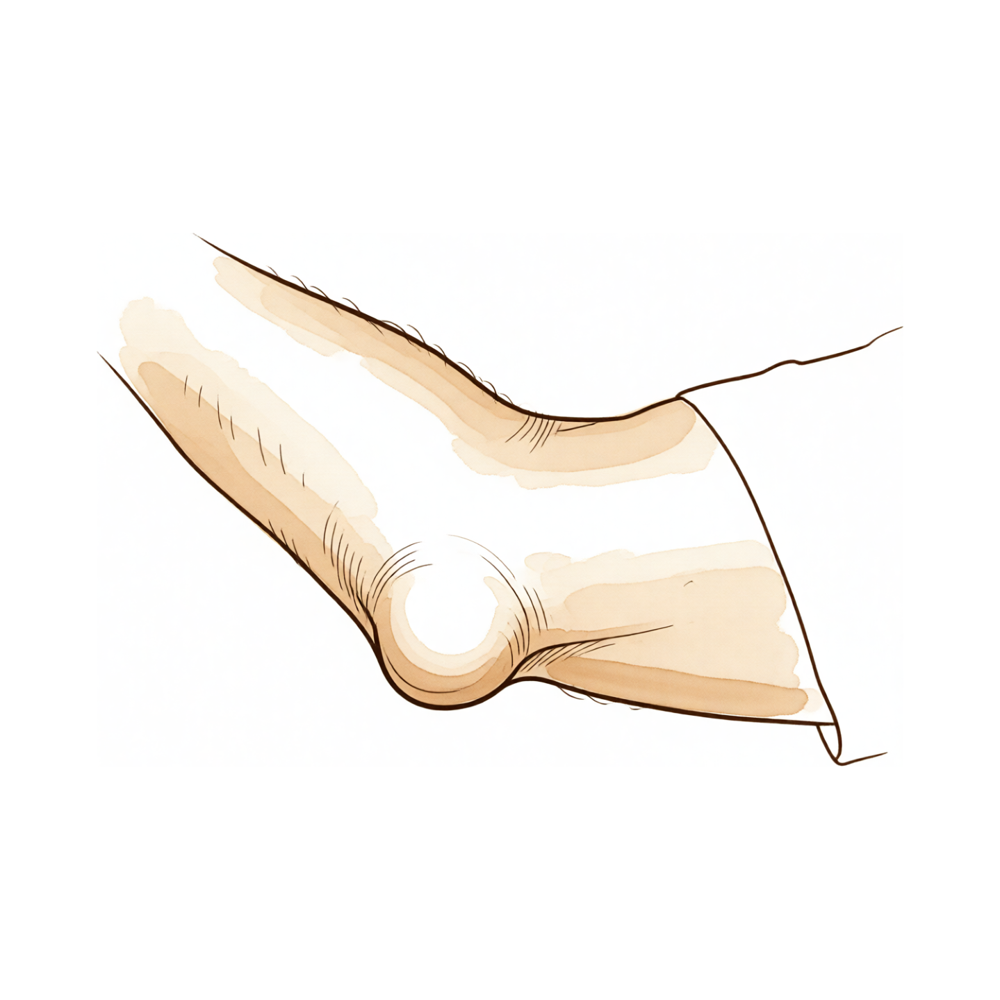
The olecranon bursa is a small, slippery fluid-filled sac that sits right over the bony tip of your elbow. Its job is to let your skin glide smoothly over the bone when you bend and straighten your arm. When it becomes inflamed (from a knock, from years of leaning on the elbow, from gout or rheumatoid arthritis, or from an infection), it can fill with fluid and swell into a tender, sometimes alarming-looking lump at the point of the elbow. This is called olecranon bursitis, and it is very common.
The important thing to know up front is that most bursitis settles on its own or with simple measures, and surgery is genuinely a last resort. We only talk about removing the bursa when the problem has stubbornly refused to go away despite everything else. This page explains what that operation involves, what your recovery looks like, and, most importantly, an honest account of why this particular operation has more healing and recurrence trouble than people expect.
Why remove the bursa?
In our clinic, Dr Kieran Hirpara guides patients through a careful assessment to confirm the diagnosis and explore non-surgical options first. We typically recommend surgery only when conservative treatments have not provided enough relief for long-standing problems.
The first-line treatment for a swollen bursa is almost always non-surgical: resting the elbow, avoiding leaning on it, anti-inflammatory tablets, and sometimes draining the fluid with a needle (aspiration), occasionally followed by a steroid injection. A review of the published evidence found that non-surgical management gives a higher rate of the problem settling and fewer complications than going straight to surgery, which is exactly why we try those routes first.
We only consider removing the bursa (a "bursectomy") when:
- The bursitis is chronic or keeps coming back despite rest, activity changes, aspiration and/or a steroid injection over a reasonable period of months, and it is genuinely bothering you.
- There is recurrent or established infection (a septic bursa) that hasn't cleared with antibiotics and drainage. Even here, surgeons usually try drainage and antibiotics first; studies suggest surgery doesn't reliably give better long-term results for infection, so it is reserved for cases that won't settle, where there is thick pus that can't be drained with a needle, or a pointing abscess [1].
- A bony spur on the tip of the elbow is repeatedly irritating the bursa, in which case the spur may be trimmed at the same time.
In short: this operation is for the minority of bursae that simply won't behave. If your swelling is new, painless, and not infected, surgery is very unlikely to be the right answer.
What the operation involves
This is usually a day case, so you can expect to go home the same day, although occasionally patients stay overnight. It is done as an open operation: a small incision over the tip of the elbow, through which the whole inflamed bursa is carefully removed, and the skin is then closed. If there is a bony spur underneath the bursa, it can be smoothed off at the same time.
The anaesthetic is usually either a general anaesthetic (you are fully asleep) or a regional block (the arm is numbed while you stay awake or lightly sedated), sometimes combined. Your anaesthetist will talk you through the best option for you on the day.
It is a relatively quick operation, but the skill is less in the removal itself and more in handling the delicate skin gently and closing it well; as described below, the skin is the part that gives trouble.
The honest part: healing and recurrence
This is the section to read twice, because it is the main reason we are cautious about this operation.
The skin over the very tip of your elbow is thin, mobile, and has a relatively poor blood supply. It is also a part of the body that takes constant pressure every time you rest your arm on a table, a chair, or a car door. That combination means that wound-healing problems and the bursa coming back (recurrence) are the two things most likely to go wrong, more so than with most operations of this size. It is not that the surgery is difficult; it is that the elbow is an unforgiving place to make a wound.
What does the evidence actually say? It's worth being honest that the published studies are mostly small case series, so the numbers vary [1]. One sizeable review of patients who had a bursectomy reported that around one in nine needed a further (revision) operation, and that people with rheumatoid arthritis, diabetes, or bursitis on both elbows ran a higher risk of needing more surgery. Patients with rheumatoid arthritis in particular were more likely to need a skin flap to get the wound to heal. Studies report a meaningful rate of wound complications such as delayed healing, the wound breaking down, fluid collecting again (a seroma), and infection [2, 3]. The take-home is not a precise percentage; it's the pattern: this operation has a higher-than-usual chance of a slow or troublesome wound, and a real chance the swelling returns.
We do several things to tip the odds in your favour, and your part in this matters as much as ours:
- Gentle handling and careful closure at the time of surgery, and (where it suits the problem) keeping incisions off the very tip of the elbow.
- A firm compression dressing afterwards to discourage fluid from collecting, and sometimes a splint to keep the elbow still while the skin knits.
- Most importantly: no leaning on the elbow. Pressure on a healing elbow is the single biggest driver of both wound breakdown and the bursa coming back. Keeping weight off it for several weeks genuinely changes your result.
None of this is meant to frighten you off. It is meant to make sure that if we do operate, you go in with clear eyes, and that you understand the recovery instructions are not optional fussiness, but the thing that protects the result.
Your recovery
Everyone heals at their own pace, and your surgeon's specific instructions always come first, but here is the general shape of things.
The first week or two. You'll have a firm, padded compression dressing over the elbow, often with a splint. Keep the dressing clean and dry, keep the arm elevated when you can to settle swelling, and take simple pain relief as advised. The single most useful thing you can do in these early weeks is keep the elbow still and keep all pressure off the back of it: no resting your weight on it, no leaning on tables or armrests. Gentle finger, wrist and shoulder movement is usually fine and helps prevent stiffness.
Stitches and dressings. The compression wrap is generally kept on for the first several days, and many surgeons ask you to keep a light compressive (ACE-type) wrap on the elbow for some weeks afterwards to discourage fluid building up again. Stitches are usually removed at around 7 to 10 days in clinic, once the skin has had a chance to seal. We will check the wound carefully at this visit, because the elbow can be slow to heal.
Getting moving again. Once the wound is settled and the stitches are out, you'll gradually return to using the arm. Many people are allowed to resume most normal activities and full use of the elbow over roughly three to six weeks, with full settling of swelling often taking around the six-week mark. Your surgeon may set a temporary limit on heavy lifting early on while the skin matures.
Driving is reasonable once you can move the elbow comfortably, are off strong pain medication, and could safely control the car and perform an emergency stop; for many people this is a couple of weeks, but it depends on which arm and how you're healing, so check with us first.
Work depends entirely on your job. A desk-based job is often manageable within a week or two (taking care not to lean on the elbow). A job involving heavy lifting, kneeling on the elbow, or anything that puts pressure or strain through the elbow usually needs longer (several weeks) and sometimes a phased return. Tell us what your work involves and we'll give you tailored advice.
Throughout, remember the recurring theme: protect the elbow tip. The recovery rules all exist to give that thin, hard-working skin the best chance to heal once and stay healed.
When to seek help
A little swelling, bruising and discomfort is normal after this operation. But please contact your surgeon, your GP, or an after-hours clinic promptly if you notice any signs that the wound is not healing well or is becoming infected, such as:
- Spreading redness, increasing warmth, or worsening pain around the wound after the first few days.
- The wound opening up, leaking fluid or pus, or an offensive smell.
- A fever, feeling generally unwell or shivery.
- The elbow swelling up again significantly: this may mean fluid is re-collecting.
Separately, and as with any operation, blood clots are a rare but serious risk. Go straight to an emergency department (or call emergency services) if you develop a painful, swollen, hot calf, or (more urgently) sudden shortness of breath, chest pain, or coughing up blood. These can be signs of a clot in the leg or lungs and need immediate assessment.
If you are ever unsure whether something is normal, it is always better to ask. We would far rather see a wound early and reassure you than have a small problem become a bigger one, especially over an elbow where early attention to a struggling wound makes a real difference.
Where to read more about the condition
This page is about the operation itself. The condition it treats, including what the evidence shows about when surgery helps and when it does not, is covered in more detail on the Olecranon Bursitis page.
References
- Del Buono A, Franceschi F, Palumbo A, Denaro V, Maffulli N. Diagnosis and management of olecranon bursitis. Surgeon. 2012;10(5):297-300.
- Germawi L, Westenberg RF, Wang F, Schep NW, Chen NC, Eberlin KR. Factors associated with revision surgery for olecranon bursitis after bursectomy. J Shoulder Elbow Surg. 2021;30(5):1135-41.
- Complications following resection of the olecranon bursa. Acta Orthop Belg. 2006.