What you're feeling
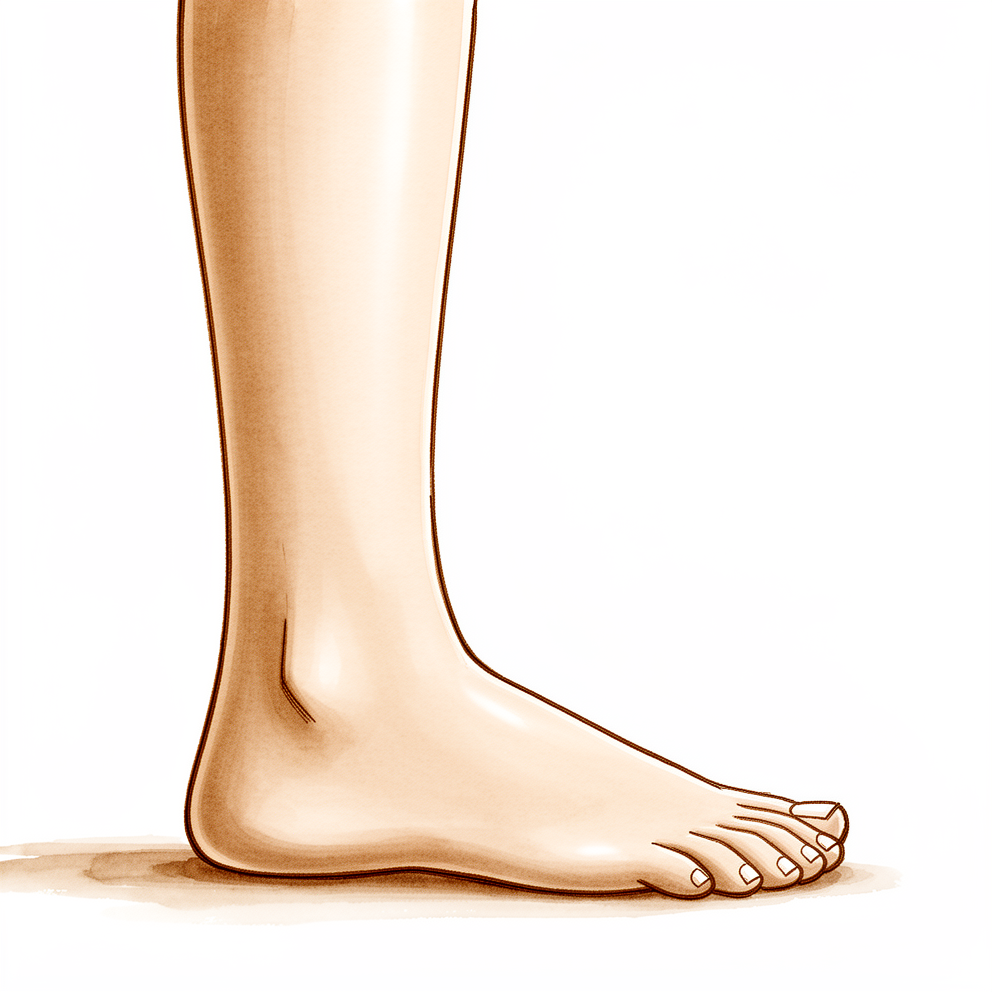
A talus fracture is a break in a small bone deep inside your ankle. The talus sits between your shin bone and your heel bone, and it connects them both. Because it sits between these two bones, the pain is usually felt deep in the ankle and hindfoot rather than on one sharp spot you can point to.
The pain is worse when you put weight on your foot. Walking, standing, pushing off to climb stairs, or twisting the ankle will usually make it flare. Resting with the foot up tends to settle it. The ankle and hindfoot often swell, and the swelling can make shoes feel tight. Many people find the ankle stiff on waking or after sitting still for a while.
Everyday tasks that need a stable, mobile ankle become hard. You may struggle to walk to the letterbox, stand at the kitchen bench, or drive. Pushing a shopping trolley or getting up off the floor can be difficult because your foot cannot take your weight evenly.
Some talus fractures come with other injuries in the same ankle. Cartilage damage on the talus is common when the ankle is broken, and it can keep causing pain even after the bone heals. If your ankle feels like it gives way or keeps swelling after an injury, that can point to a cartilage injury or to loose ligaments on the outside of the ankle. A flake of bone off the outer ankle bone with a swollen hindfoot is a pattern your surgeon will want to check carefully.
These fractures can be easy to miss. Plain X-rays miss about half of cartilage injuries in the ankle, even when combined with an examination. A CT scan shows the broken bone in fine detail but cannot show cartilage. An MRI scan shows both the cartilage and the bone beneath it, and it matches closely with what a surgeon sees looking inside the joint with a camera.
If your pain is deep in the ankle after a twist, a fall from height, or a car accident, do not push through it. Ask for a proper assessment.
What's actually happening
The talus is a small bone that sits in a tight space between your shin bone above and your heel bone below. It has no muscle of its own and is covered in smooth cartilage on most of its surface. Think of it as a hard piece of chalk wedged in a vice: when your foot is forced upwards and the ankle is squeezed, the bone can crack between the two bones pressing on it.
Different breaks come from different forces. A hard landing with the foot bent up and rolled inwards can snap off a small piece of bone on the outer side of the talus. A forceful twist or a foot pushed too far in one direction can break off small pieces at the back of the talus. When the ankle is crushed straight down the middle, the main body of the talus can split, and if the inner ankle bone breaks at the same time, the crack can run through both.
The trouble with these breaks is what they disturb. The talus helps form two working joints, and any piece that breaks off can end up loose inside the joint, sometimes flipped upside down in the crater it came from. Loose pieces and uneven joint surfaces grind rather than glide, which is why the ankle can stay stiff and painful long after the injury. If the break is badly out of place, or the bone slips out of the joint completely, the blood supply to the talus can be disturbed, and part of the bone can die. Damaged cartilage and a joint that no longer lines up smoothly can lead to wear-and-tear arthritis in the ankle over time.
This is also why these fractures are taken seriously even when they seem small. A tiny crack on the outer side of the talus is a known snowboarding injury, and if it is missed or treated late, the joint below the ankle can wear out badly. Getting the pieces back into place early, and putting the joint surfaces back together evenly, gives the ankle its best chance of moving normally without pain.
What we can do about it
X-rays are usually the starting point, and a CT scan or MRI scan gives a closer look at the bone and cartilage when the picture needs to be clearer.
Some talus fractures are stable and stay in place. For these, we may not need to operate at all. The ankle is held still in a cast or a brace so the bone can heal, and you stay off the foot while it does. The length of time in the cast depends on the break. For some stable ankle fractures, three weeks in a cast or brace works as well as six weeks for symptoms and how the ankle feels a year later, so we do not always need the longer stretch. Physiotherapy comes in as the bone settles, to rebuild movement, strength and balance.
If the break has moved the pieces out of place, or the joint surface is no longer smooth, surgery is usually recommended straight away. The goal is to put the bone pieces back together and restore the shape of the talus so the joint surfaces line up again. Because every fracture pattern is different, we plan the operation carefully before we start, and the plan decides how we reach the bone. Some breaks need plates or small wires to hold the pieces while they heal. If a piece of cartilage and bone has come loose in the joint, we can put it back or smooth the surface. When a cartilage injury has not settled with simpler treatment, a small plug of your own bone and cartilage can be moved into the damaged spot.
A few fractures cause trouble later despite good early care. If part of the talus loses its blood supply and dies, or the ankle settles into a painful, worn-out shape, there are still options. These include cleaning out the joint, grafting bone, or fusing bones together so the painful surfaces no longer grind. We talk through all of this with you before anything happens, and the decision is one you make together with us.
What to expect
Most talus fractures heal with treatment, and many people get back to walking and everyday activities. How well your ankle serves you afterwards depends a lot on how badly the bone was damaged and how quickly the pieces were put back in place. Breaks that are put back into position early, with the joint surfaces lined up smoothly, give your ankle its best chance of moving normally without pain.
Some fractures are more serious than others. If the bone was badly out of place, or pushed completely out of the joint, part of the talus can lose its blood supply and die, and the ankle can develop wear-and-tear arthritis over time. Even with good treatment, these problems remain common, and a small group of people with severe injuries are left with ongoing pain and stiffness that limits what they can do. Carrying extra weight also makes a difference: people with obesity tend to have more pain, poorer function and more trouble with everyday life after an ankle fracture is treated.
If the pieces were never put back into place, or treatment was delayed, the outlook is usually worse. A joint that no longer lines up smoothly grinds rather than glides, and the cartilage damage from that grinding can keep causing pain long after the bone itself has healed. Small breaks on the outer or back edges of the talus can be easy to miss, and if they are picked up late or treated inadequately, they can cause lasting disability in the joint below the ankle.
Recovery is gradual rather than quick. You spend time off the foot while the bone heals, then work on movement, strength and balance. The ankle may stay stiff and swollen for months, and it can take a while before you trust it on uneven ground. Some people regain the same level of sport they had before the injury. Others are left with an ankle that aches after long days or cold weather. Your surgeon will talk with you about which of these paths is likely for your particular break, and what can be done along the way if the ankle does not settle as hoped.
When to see someone
Get checked straight away after any heavy landing, twist, fall from height or car accident that leaves deep ankle pain, especially if the hindfoot swells quickly or the ankle feels unstable. Do not wait to see if it settles. Ask for a specialist review if your ankle keeps giving way, keeps swelling, or the pain has not settled with rest, because cartilage damage and loose ligaments on the outside of the ankle are common with these injuries and are easy to miss. Plain X-rays miss about half of cartilage injuries even with an examination, so an MRI scan may be needed. Go to an emergency department if your ankle is grossly swollen and deformed, or you cannot put any weight on it at all, since a badly displaced talus can cut off its own blood supply and needs urgent care.
Evidence & references
This is the clinical evidence summary written for health professionals. It is technical, and it lists the research this page was built from. You do not need to read it to understand your treatment or to make a decision about it.
Anatomy & Pathophysiology
- Osteochondral lesions of the talus are located in the anteromedial dome, as demonstrated by CT scans showing craters and fragments [1].
- The morphology of osteochondral lesions includes both medial and lateral variants [1].
- A "floating" fragment in an osteochondral lesion is actually a loose fragment turned upside down within the crater [1].
- In osteochondral lesions of the talus, the subchondral bone is described as yellowish and hard [1].
- Lesion size measured on MRI does not accurately reflect arthroscopic measurement in talar osteochondral lesions [2].
Investigations
- Coronal CT scan locates talar osteochondral lesions as anterior, middle, or posterior, a distinction that is often difficult to determine on radiograph [1].
- Axial CT scan demonstrates the crater and fragments of talar osteochondral lesions [1].
- Diagnosis of talar osteochondral lesions involves history, physical examination, and arthroscopy [2].
References
[1] Campbell S Operative Orthopaedics 4 Volume Set. RECONSTRUCTION OF THE PATELLOFEMORAL AND PATELLOTIBIAL LIGAMENTS WITH A SEMITENDINOSUS TENDON GRAFT > EXCISION OF OSTEOCHONDRAL FRAGMENT OF THE TALUS.
[2] Campbell S Operative Orthopaedics 4 Volume Set. ARTHROSCOPIC EXAMINATION AND DEBRIDEMENT OF THE ANKLE JOINT > OSTEochondral Lesions of the Talus.