What you're feeling
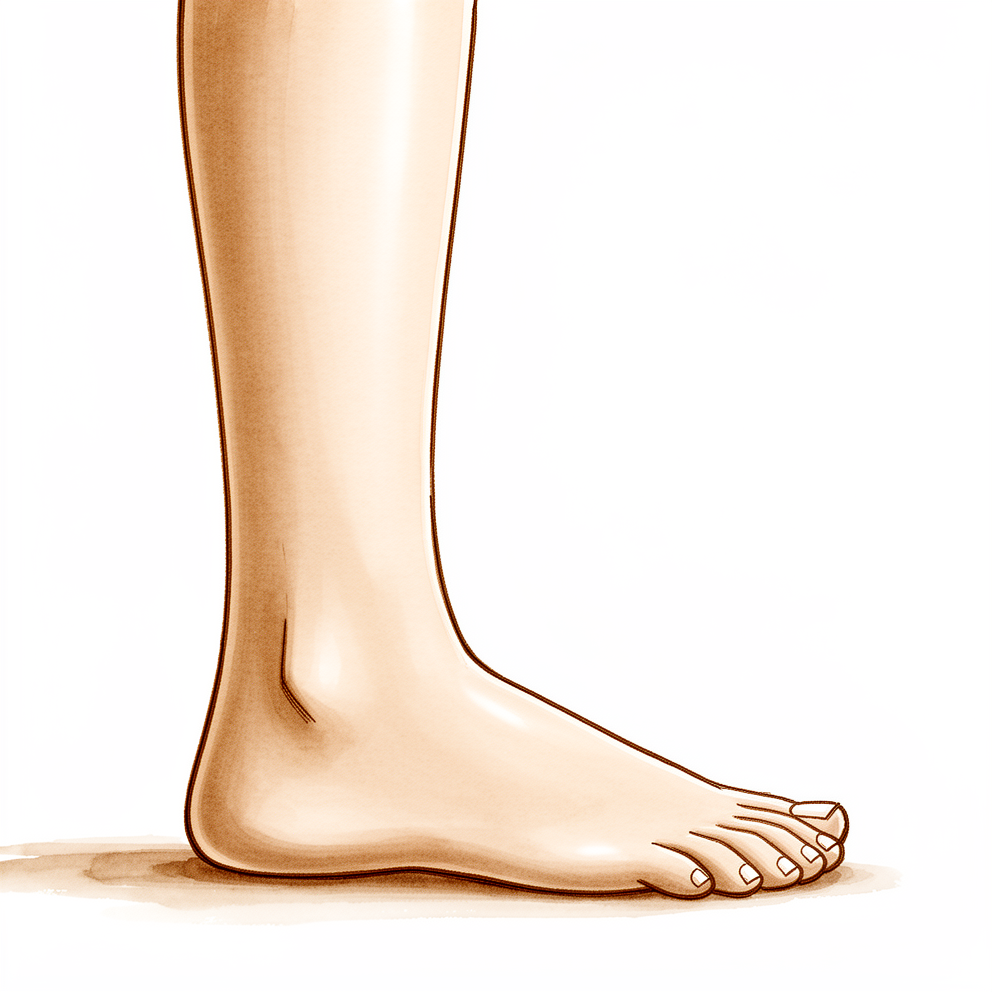
A syndesmotic injury affects the ligaments that hold the two bones of your lower leg together just above your ankle. The pain is usually spread around the ankle rather than in one spot, and it often sits at the front and outer side, just above the outer ankle ligaments. You may also have tenderness near the inner side of the ankle.
Certain movements make it worse. Walking up hills, pivoting or twisting, and rising onto the ball of one foot all commonly cause pain. Turning your foot outward, or bending it up towards your shin, can also bring the pain on. Swelling and bruising are common, and the bruising may extend well up the leg or across the inner ankle. If the ankle is unstable, putting weight on it is usually too painful.
Some flare patterns point towards this injury rather than a simple sprain. Pain that keeps going despite rest is a typical sign. By contrast, a sprain that settles completely between episodes suggests a different problem with the outer ankle ligaments. Swelling and stiffness that linger, weakness when pushing off the foot, and a feeling that the ankle might give way can all continue long after the original injury, even when standard testing seems normal.
Everyday tasks can become difficult. Climbing stairs or hills, getting out of a chair, and standing on one leg to dress may all hurt. You might find you cannot push off properly when walking, so you favour the other leg.
A few early warning signs matter. If you cannot bear weight at all, if swelling comes on quickly and heavily, or if bruising is extensive on the inner or upper part of the leg, the syndesmosis is more likely involved. These injuries are easy to miss, and they are sometimes mistaken for a straightforward sprain at first. If any of this sounds like your ankle, it is worth having it assessed properly rather than waiting for it to settle on its own.
What's actually happening
Your lower leg has two bones, the tibia and the fibula, that sit side by side just above your ankle. They are held together by a bundle of strong ligaments called the syndesmosis. Think of it as a firm strap that keeps the two bones from spreading apart when you walk. It also helps carry your body weight down through the leg, so it does real work every time you stand.
The injury happens when your foot is bent up towards your shin and twisted outward at the same time. That twisting force can pry the two bones apart and tear the strap. If the injury is severe, other structures can be damaged too, such as the ligament on the inner side of the ankle or the fibula bone itself. For the bones to actually separate, several strong ligaments and a tough membrane between them all have to tear.
When the strap is damaged, the ankle joint loses some of its stability. The small bone under your ankle, the talus, can then shift slightly out of place as you move. That shifting is what causes the pain, swelling and giving-way feeling described above. The torn ligament can also become inflamed and scarred, which can pinch tissues at the front of the ankle and keep the pain going.
If the bones stay apart and it is not treated, the joint can wear unevenly over time and develop wear-and-tear arthritis. This is why getting the right diagnosis matters. Some injuries are stable, meaning the strap is strained but still holding the bones in place. These usually settle without surgery, with protected weight bearing. Others are unstable, meaning the bones can drift apart, and these need an operation to hold them together while they heal. Getting this sorted early matters, because delays past six months are linked with worse function later on.
What we can do about it
Because this injury can be missed, we sometimes use scans that show the ligaments clearly before deciding what to do.
If your injury is stable, meaning the strap of ligaments is strained but still holding the bones in place, surgery is not needed. We protect the ankle while it heals and let you put weight on it gradually. Physiotherapy helps you regain movement, strength and confidence in the ankle. Some people find a soft dressing is enough support early on, while others need a cast for up to three weeks. The right amount of rest from weight bearing varies, and we will guide you through it.
If the injury is unstable, meaning the bones can drift apart, surgery is usually recommended. Waiting more than six months makes the result worse, so we aim to sort it out early. The operation holds the two bones together while the ligaments heal. This can be done with a screw, a strong stitch and a small button, or by repairing the torn ligaments directly. We will talk through which option suits your injury and agree on a plan together.
After surgery, physiotherapy helps speed your recovery. Most people return to normal activity, including sport, around four months after the operation.
What to expect
The outlook depends on whether your injury is stable or unstable. A stable injury, where the strap of ligaments still holds the bones in place, usually settles without surgery. You protect the ankle, put weight on it gradually, and rebuild strength with physiotherapy. People treated this way report good function in the long run, and few go on to hurt the ankle again.
An unstable injury needs an operation to hold the bones together while the ligaments heal. When that is done well, with the bones lined up accurately and held firmly, most people get back to normal activity. Around four months after surgery, most people are back to their usual activities, including sport. Many people keep good ankle function decades later, even though scans sometimes show wear-and-tear arthritis in the joint. In one long-term study, everyone who had the ligaments repaired directly said they would do it again if needed.
Recovery is rarely a straight line. Early on, putting weight on the foot is the hard part, and getting the ankle moving again takes steady work with physiotherapy. Starting weight bearing and movement early helps your ankle work better in the first weeks, though it does not necessarily get you back to work sooner. How quickly people return to activity varies a lot from person to person, so try not to measure yourself against anyone else.
If an unstable injury is left alone, the problems tend to persist rather than settle. The bones can drift apart, the joint can wear unevenly, and long-term instability can leave you with ongoing pain and a weaker ankle. Waiting more than six months for surgery is linked with worse function later on, which is why early assessment matters. Sometimes the ligaments heal loosely even after treatment, and a loose or unstable joint is linked with poorer results.
Some injuries also involve damage inside the ankle joint itself. This happens in up to half of unstable injuries, and it needs extra treatment in about one in five cases. Your surgeon will look for this when planning your care.
When to see someone
Get your ankle assessed promptly if you cannot put weight on it at all, if swelling comes on quickly and heavily, or if bruising is extensive on the inner or upper part of the leg. These are the early signs that this injury involves more than a simple sprain. Ask for a specialist review if pain keeps going despite rest, if the ankle feels unstable or gives way, or if swelling and stiffness linger well after the injury. This injury is easy to miss, and it is sometimes mistaken for a straightforward sprain at first. If it is left too long, waiting past six months before surgery is linked with worse function later on. If you have already been told it is a sprain but your ankle is not settling, it is worth asking whether the syndesmosis has been checked.
Evidence & references
This is the clinical evidence summary written for health professionals. It is technical, and it lists the research this page was built from. You do not need to read it to understand your treatment or to make a decision about it.
Anatomy & Pathophysiology
Ligamentous Anatomy
- The ankle syndesmosis is composed of the anterior-inferior tibiofibular ligament, the posteroinferior tibiofibular ligament, and the interosseous membrane [2].
- A separate anterior-inferior tibiofibular ligament fascicle, known as the Bassett ligament, may be present and contribute to syndesmotic impingement [2].
- Approximately 20% of the syndesmotic ligament is intra-articular [2].
- The interosseous membrane is important in weight transmission through the fibula [3].
Pathomechanics
- Syndesmotic injuries result from a combination of dorsiflexion and external rotation forces [1].
- Syndesmotic rupture can occur as a result of a torsional movement of the talus that forces the tibia and fibula apart [3].
- Syndesmotic rupture can occur as a result of a severe abduction force [3].
- Severe syndesmotic injuries are associated with deltoid ligament disruption and fibula fracture [1].
- Syndesmotic instability results in lateral and rotatory displacement of the talus [1].
Radiographic Anatomy & Measurements
- Normal tibiofibular clear space is less than 6 mm on either the AP or mortise ankle view [1].
- Normal tibiofibular overlap is greater than 6 mm on the AP view and greater than 1 mm on the mortise view [1].
- A tibiofibular clear space of greater than 5 mm on the AP view has been suggested to correlate with syndesmotic rupture [3].
- A tibiofibular overlap of less than 5 mm on the AP view or less than 1 mm on the mortise view has been suggested to correlate with syndesmotic rupture [3].
- The mean tibiofibular clear space in the normal population is 3.8 mm in females and 4.6 mm in males [3].
- Some normal individuals have a shallow incisura resulting in no radiographic tibiofibular overlap [3].
- CT studies show wide variation in the shape of the syndesmosis, including deep concave incisurae and limited curves [3].
Pathophysiological Consequences
- Injury to the ankle syndesmosis can result in persistent pain and dysfunction secondary to syndesmotic impingement [2].
- Syndesmotic impingement most often involves the anterior tibiofibular ligament, with resulting synovitis and scarring [2].
- Untreated syndesmotic diastasis may result in persisting instability, pain, and progressive osteoarthritis [3].
- Patients with radiographic evidence of syndesmosis widening demonstrated a poorer overall outcome at 5 years in a study of ankle fracture outcomes [3].
Clinical Presentation
History and Physical Examination
- Acute syndesmotic injuries are typically associated with a twisting mechanism [1].
- Patients with syndesmotic instability usually cannot bear weight [1].
- Physical examination findings include tenderness near the syndesmosis and the deltoid ligament [1].
- Pain is elicited by external rotation of the ankle [1].
- A positive squeeze test is defined as pain at the syndesmosis when compressing the tibia and fibula at midcalf [1].
- Swelling and ecchymosis are present in acute syndesmotic injuries [1].
- Patients with syndesmotic impingement exhibit localized tenderness along the anterior syndesmosis [2].
- Dorsiflexion and external rotation of the ankle increase symptoms in patients with syndesmotic impingement [2].
- Tenderness during the squeeze test may be present in patients with syndesmotic impingement [2].
Imaging
- The AP view of plain radiography shows decreased tibiofibular overlap in syndesmotic injury [1].
- The mortise view of plain radiography shows increased tibiofibular clear space in syndesmotic injury [1].
- Tibial radiographs should be obtained to rule out a proximal fibula fracture (Maisonneuve fracture) [1].
- In subtle cases, the diagnosis is confirmed by weight-bearing radiographs and stress radiographs in eversion and external rotation, with comparison to the opposite side [1].
- CT may help evaluate the syndesmotic space, especially in chronic cases [1].
- MRI may show subtle syndesmotic ligament injury [1].
Investigations
Clinical Evaluation
- Tenderness near the syndesmosis and deltoid ligament is a clinical sign of syndesmotic injury [1].
- Pain with external rotation is a clinical sign of syndesmotic injury [1].
Plain Radiography
- A tibiofibular clear space greater than 5 mm on the AP view has been suggested to correlate with syndesmotic rupture [3].
- A tibiofibular overlap less than 5 mm on the AP view has been suggested to correlate with syndesmotic rupture [3].
- A tibiofibular overlap less than 1 mm on the mortise view has been suggested to correlate with syndesmotic rupture [3].
- The tibiofibular clear space is the most reliable parameter among plain radiographic measurements for syndesmotic rupture [3].
- Cadaveric models have shown that no predictable increase in measurements on plain radiography can be found on sectioning of the syndesmotic ligaments [3].
- An increase in the tibiofibular clear space in comparison to the contralateral ankle may be more accurate than absolute values [3].
Advanced Imaging
- Axial imaging has been shown to demonstrate disruptions not evident on plain radiographs [3].
- CT studies have shown wide variation in the shape of the syndesmosis, including a deep concave incisura in some and a limited curve in others [3].
- MRI provides a more accurate assessment of syndesmotic injury than plain radiography [3].
- MRI assessment of syndesmotic injury correlates well with direct arthroscopic assessment [3].
- MR arthrography may add further accuracy to the assessment of syndesmotic injury [3].
- The integrity of syndesmotic ligaments is rarely visualized on MRI and is surmised from radiographic diastasis [3].
Treatment
- Anatomic ligament repairs are a described surgical technique for syndesmotic injuries [4].
- An evidence-based approach to the treatment of acute traumatic syndesmosis (high ankle) sprains has been outlined [4].
- Syndesmotic fixation and management is a current practice among orthopedic surgeons for ankle fractures [4].
- Deltoid ligament repair is an alternative to syndesmotic fixation in bimalleolar equivalent ankle fractures [4].
- Repair of acute superficial deltoid complex avulsion is performed during ankle fracture fixation in National Football League players [4].
- Magnetic resonance imaging has been compared to physical examination for the diagnosis of syndesmotic injury after lateral ankle sprain [4].
References
[1] Aaos Comprehensive Orthopaedic Review 3. Acute and Chronic Injuries of the Ankle > IV. Syndesmotic Instability.
[2] Aaos Comprehensive Orthopaedic Review 3. Arthroscopy of the Ankle > IV. Syndesmotic Impingement.
[3] Rockwood And Green S Fractures In Adults. 59: Patellar Fractures and Dislocations and Extensor Mechanism Injuries > Syndesmotic Injuries.
[4] Campbell S Operative Orthopaedics 4 Volume Set. REPAIR OF ACUTE RUPTURE OF LATERAL LIGAMENTS > ACUTE ANKLE LIGAMENT INJURIES, CHRONIC ANKLE INSTABILITY.