Clinicians › General-Health
Psoriatic Arthritis
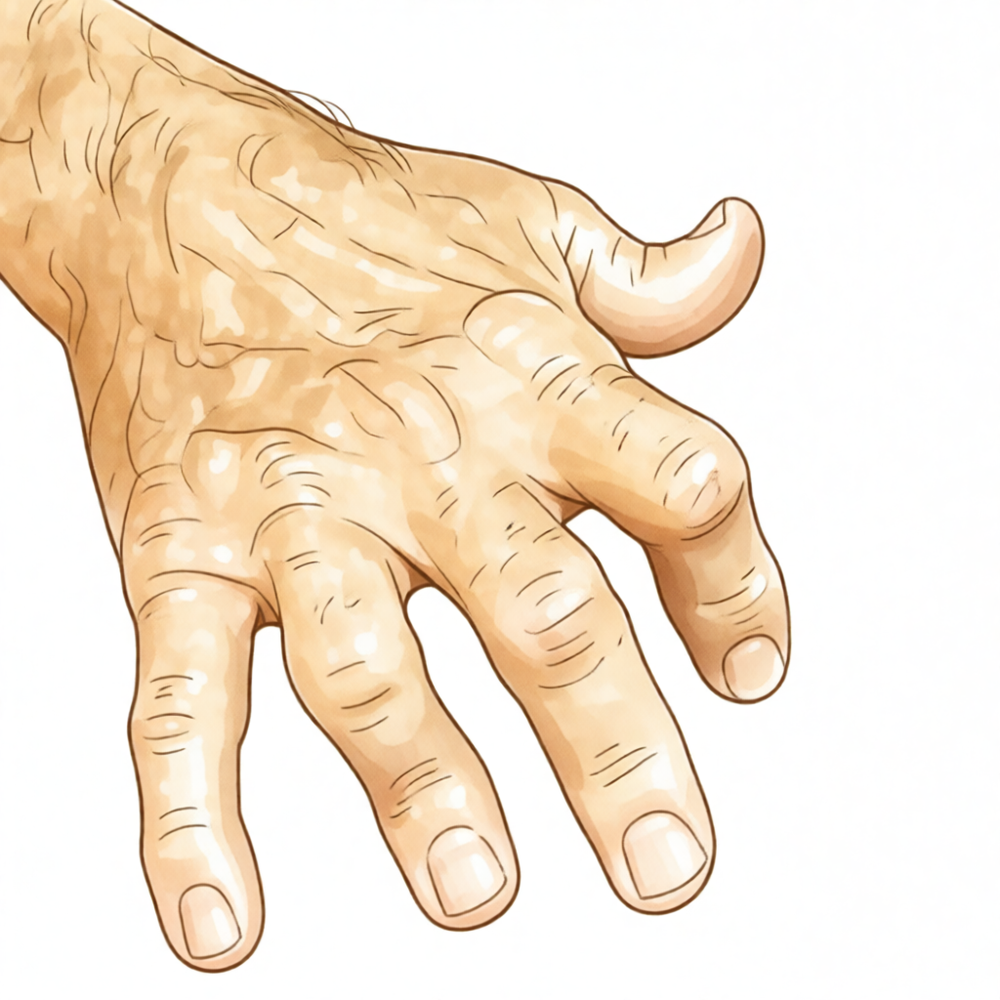
Psoriatic arthritis of the hand for the surgeon (corpus-synthesised).
For patients: a plain-language version of this topic is available. See the patient guide.
Overview
Psoriatic arthritis is a distinct clinical entity and chronic inflammatory arthropathy that typically follows a moderate course [1, 8]. It is a clinically heterogeneous disease spectrum consisting of skin changes and joint involvement, common among patients with psoriasis [4, 5]. The condition is characterized by clinical and roentgenographic findings different from rheumatoid arthritis [1]. Joint involvement is often an asymmetrical polyarthritis [5], with a particular predilection for distal joints [1]. Up to 47% of cases develop into destructive arthritis [8].
The proportion of patients with current inflammatory back pain is substantial in psoriatic arthritis [13]. Health reports in these patients are similar or worse compared to the ankylosing spondylitis group, supporting the severity of inflammatory back pain in non-AS spondyloarthritis groups [13]. In patients with psoriasis and psoriatic arthritis, the severity of fatigue decreased along with the duration of psoriasis [11]. The prevalence of physician-diagnosed psoriasis and psoriatic arthritis confirms other population-based studies after adjustment for misclassification of disease [10].
Both manifestations of cutaneous psoriasis are associated with risks of complications following total hip arthroplasty [12]. The SOLAR score is a suitable instrument for the qualitative and quantitative evaluation of large joint involvement in psoriatic arthritis patients [17]. It also allows for treatment monitoring in psoriatic arthritis patients [17].
Background & Causes
Metabolic syndrome is significantly more prevalent in patients with psoriatic arthritis than in those with ankylosing spondylitis [28]. Genetic factors also influence disease susceptibility; specifically, the T allele of VEGF in +936 may act as a protective allele in the development of psoriatic arthritis [30].
Symptoms & Presentation
Psoriatic arthritis is a distinct clinical entity characterized by specific clinical and roentgenographic findings that differentiate it from rheumatoid arthritis, particularly regarding the involvement of distal joints [1]. It represents a disease spectrum encompassing both cutaneous changes and joint involvement, with the latter frequently manifesting as an asymmetrical polyarthritis [5]. As a chronic inflammatory arthropathy, the condition typically follows a moderate course; however, up to 47% of cases progress to destructive arthritis [8]. Population-based data confirm the prevalence of physician-diagnosed psoriasis and psoriatic arthritis, a finding that remains consistent even after adjustments for disease misclassification [10].
Functional impairment and systemic symptoms are significant components of the presentation. One fifth of patients experience deterioration in physical function over time, with joint damage and baseline physical function serving as key factors associated with poor outcomes [18]. Grip and pinch strength are significantly lower across all subparameters in patients with PsA, demonstrating a moderate association with disease activity [24]. Fatigue is a prevalent symptom, with levels often exceeding 5/10; this fatigue is primarily associated with disease-related factors but also involves patient-related variables, indicating a multifactorial etiology [25]. Notably, the severity of fatigue has been observed to decrease alongside the duration of psoriasis in affected patients [11].
Inflammatory back pain is a substantial feature in PsA populations. The proportion of patients reporting current inflammatory back pain is significant across all three groups studied. Health reports in non-ankylosing spondylitis (non-AS) groups are similar to or worse than those in the AS group, supporting the severity of inflammatory back pain in these non-AS spondyloarthritis groups [13].
Management
General Principles and Disease Characterization
Psoriatic arthritis is a definite clinical entity that requires recognition and treatment according to its specific needs [3].
Pharmacologic Therapy
The 2018 ACR/NPF PsA guideline serves as a tool for health care providers and patients in the selection of appropriate therapy in common clinical scenarios [7]. Biologic agents offer good value for money and are cost-effective for treating patients with active Psoriatic Arthritis compared to traditional treatments, with etanercept identified as the most cost-effective option [9]. Biologics are shown to be cost-effective for treating patients with active PsA compared with the conventional management strategy [14]. A good clinical response for arthritis, skin and nail disease was seen with anti-TNF therapy, but persistent ongoing subclinical inflammation (osteitis, synovitis and enthesopathy) was observed at six months [23]. The GOLMePsA study protocol postulates that very early treatment with golimumab reduces disease activity in PsA compared to conventional therapy [20]. Celastrol was identified as a potential therapeutic drug for PsA via regulating immunity and inflammation [27].
Monitoring and Assessment
MMP-3 and MIA could serve as soluble biomarkers associated with inflammation as well as joint remodelling and destruction and may, together with clinical evaluation and in combination with other biomarkers, assist in distinguishing between effective and ineffective therapy in small, proof-of-principle studies of short duration in PsA [16]. The SOLAR score is a very suitable instrument for the qualitative and quantitative evaluation of large joint involvement in PsA and AS patients and allows for treatment monitoring [17]. In the studied PsA cohort, disease activity was an independent predictor of 10-year probability for a major osteoporotic fracture, and complemented assessment of volumetric and areal BMD assured better efficacy at identifying those with low bone mineral density [21].
Non-Pharmacologic and Supportive Management
In PsA patients with a low to moderate disease activity, there was no clear evidence of objectively measured increased inflammation after high intensity interval training, as evaluated by US and MRI [22]. To meet the foot health needs of people with psoriatic arthritis, reducing diagnostic delay, improving knowledge and awareness about the disease among people with psoriatic arthritis and health professionals, and increasing specialist podiatry service provision may be required [2].
Functional Outcomes and Comorbidities
MetS was significantly more prevalent in PsA than in AS [28]. Both manifestations of psoriasis are associated with risks of complications following THA [12].
Key Considerations
Disease Burden and Fracture Risk: The proportion of patients with current inflammatory back pain is substantial across ankylosing spondylitis, psoriatic arthritis, and other spondyloarthritis groups, with health reports in non-AS groups similar to or worse than those in the AS group [13]. In psoriatic arthritis cohorts, disease activity serves as an independent predictor of the 10-year probability for a major osteoporotic fracture [21]. Complemented assessment of volumetric and areal bone mineral density (BMD) ensures better efficacy at identifying patients with low bone mineral density [21].
Surgical and Pharmacological Management: Both cutaneous psoriasis and psoriatic arthritis are associated with risks of complications following total hip arthroplasty [12]. Biologics are shown to be cost-effective for treating patients with active psoriatic arthritis compared with the conventional management strategy [14]. While the majority of patients receive only one line of anti-TNFα therapy, a subset switches to multiple lines of therapy during the 3-year follow-up period [29]. Anti-TNF therapy yields a good clinical response for arthritis, skin, and nail disease; however, persistent ongoing subclinical inflammation, including osteitis, synovitis, and enthesopathy, remains evident at six months [23].
Prognostic Trials and Biomarkers: The TICOPA trial will provide direct evidence as to whether early and intensive treatment in routine clinical care leads to improved disease activity and reduced radiological joint damage [15]. A study protocol postulates that very early treatment with golimumab reduces disease activity in psoriatic arthritis compared to conventional therapy [20]. MMP-3 and MIA may serve as soluble biomarkers associated with inflammation, joint remodelling, and destruction; together with clinical evaluation and other biomarkers, they may assist in distinguishing between effective and ineffective therapy in small, proof-of-principle studies of short duration [16].
Quality of Life Assessment: The adapted English and Chinese versions of the PsAQoL can be used in clinical studies with psoriatic arthritis patients in Singapore [19].
Key Evidence
- [L4] To meet the foot health needs of people with psoriatic arthritis, reducing diagnostic delay, improving knowledge and awareness about the disease among people with psoriatic arthritis and health professionals, and increasing specialist podiatry service provision may be required. [2] (10.1186/s12891-019-2572-6)
- [L5] Psoriatic arthritis is a definite entity that should be recognized and treated according to its special needs. [3] (10.1016/s0749-0712(21)00346-2)
- [L4] Psoriatic arthritis (PsA) is a clinically heterogeneous inflammatory arthritis that is common among patients with psoriasis. [4] (10.1016/j.rdc.2015.07.001)
- [L5] Psoriatic arthritis is a disease spectrum consisting of skin changes and joint involvement, the latter often being an asymmetrical polyarthritis. [5] (10.1016/s0749-0712(21)00801-5)
- [L1] The 2018 ACR/NPF PsA guideline serves as a tool for health care providers and patients in the selection of appropriate therapy in common clinical scenarios. [7] (10.1002/art.40726)
- [L5] Psoriatic arthritis is a chronic inflammatory arthropathy that typically follows a moderate course, though up to 47% of cases develop into destructive arthritis. [8] (10.5435/jaaos-20-01-028)
- [L1] Biologic agents offer a good value for money and are cost-effective for treating patients with active Psoriatic Arthritis compared to traditional treatments, with etanercept identified as the most cost-effective option. [9] (10.1186/1471-2474-15-25)
- [L3] The prevalence of physician-diagnosed psoriasis and PsA confirms other population-based studies, also after adjustment due to misclassification of disease. [10] (10.1371/journal.pone.0098024)
- [L4] In patients with psoriasis and PsA, severity of fatigue decreased along with the duration of psoriasis. [11] (10.5114/ada.2019.83629)
- [L3] This study showed both manifestations of psoriasis are associated with risks of complications following THA. [12] (10.1016/j.arth.2026.03.054)
- [L3] The proportion of patients with current inflammatory back pain was substantial in all three groups and health reports in the non-AS groups were similar or worse compared to the AS group supporting the severity of IBP in these non-AS SpA groups. [13] (10.1186/s12891-016-0960-8)
- [L1] The economic analysis agrees with the conclusions from the previous models, in that biologics are shown to be cost-effective for treating patients with active PsA compared with the conventional management strategy. [14] (10.1186/1471-2474-15-26)
- [L1] The TICOPA trial will provide direct evidence as to whether the use of early and intensive treatment in PsA in routine clinical care leads to an improvement in patients' disease activity and a reduction in radiological joint damage. [15] (10.1186/1471-2474-14-101)
- [L1] MMP-3 and MIA could serve as soluble biomarkers associated with inflammation as well as joint remodelling and destruction and may, together with clinical evaluation and in combination with other biomarkers, assist in distinguishing between effective and ineffective therapy in small, proof-of-principle studies of short duration in PsA. [16] (10.1371/journal.pone.0012556)
- [L4] The SOLAR score is a very suitable instrument for the qualitative and quantitative evaluation of large joint involvement in PsA and AS patients and allows for treatment monitoring. [17] (10.1186/1471-2474-14-358)
- [L3] One fifth of patients experienced deterioration of physical function over time, with joint damage and baseline physical function being important factors associated with poor physical function. [18] (10.1186/1471-2474-15-284)
- [L4] This study provides evidence that the adapted English and Chinese versions of the PsAQoL can be used in clinical studies with PsA patients in Singapore. [19] (10.1186/s12891-016-1292-4)
- [L2] The study protocol postulates that very early treatment with golimumab reduces disease activity in PsA compared to conventional therapy. [20] (10.1186/s12891-017-1659-1)
- [L3] In the studied PsA cohort, disease activity was an independent predictor of 10-year probability for a major osteoporotic fracture, and complemented assessment of volumetric and areal BMD assured better efficacy at identifying those with low bone mineral density. [21] (10.1186/s12891-021-03952-z)
- [L1] In PsA patients with a low to moderate disease activity, there was no clear evidence of objectively measured increased inflammation after HIIT, as evaluated by US and MRI. [22] (10.1186/s12891-023-06871-3)
- [L4] A good clinical response for arthritis, skin and nail disease was seen with anti-TNF therapy, but the study shows persistent ongoing subclinical inflammation (osteitis, synovitis and enthesopathy) at six months. [23] (10.1186/1471-2474-14-s1-a7)
- [L3] All subparameters of grip and pinch strength were significantly lower in patients with PsA and were moderately associated with disease activity. [24] (10.1111/1756-185x.14241)
- [L4] Fatigue levels were high in these patients and fatigue > 5/10 was mainly associated with disease-related factors but also patient-related variables, indicating that the etiology of fatigue in PsA is multifactorial. [25] (10.1016/j.jbspin.2015.07.017)
- [L5] Celastrol was identified as a potential therapeutic drug for PSA via regulating immunity and inflammation. [27] (10.1186/s13018-023-03843-0)
- [L3] MetS was significantly more prevalent in PsA than in AS. [28] (10.1186/s12891-021-04222-8)
- [L3] While the majority of patients received only one line of anti-TNFα therapy, a subset of patients switched to multiple lines of therapy during the 3-year follow-up period. [29] (10.1186/s12891-016-1102-z)
- [L3] The T allele of VEGF in +936 may act as a protective allele in the development of PsA. [30] (10.1186/1471-2474-8-1)
References
[1] PSORIATIC ARTHRITIS: Observations on the Clinical, Roentgenographic, and Pathological Chances.. The Journal of Bone and Joint Surgery. American Volume. 1952.
[2] Health professional views on the assessment and management of foot problems in people with psoriatic arthritis in Australia and New Zealand: a qualitative investigation. BMC Musculoskeletal Disorders. 2019. DOI: 10.1186/s12891-019-2572-6
[3] SURGERY OF PSORIATIC ARTHRITIS OF THE HAND. Hand Clinics. 1996. DOI: 10.1016/s0749-0712(21)00346-2
[4] The Epidemiology of Psoriatic Arthritis. Rheumatic Disease Clinics of North America. 2015. DOI: 10.1016/j.rdc.2015.07.001
[5] Psoriatic Arthritis in the Hand. Hand Clinics. 1989. DOI: 10.1016/s0749-0712(21)00801-5
[7] 2018 American College of Rheumatology/National Psoriasis Foundation Guideline for the Treatment of Psoriatic Arthritis. Arthritis & Rheumatology. 2018. DOI: 10.1002/art.40726
[8] Psoriatic Arthritis. American Academy of Orthopaedic Surgeon. 2012. DOI: 10.5435/jaaos-20-01-028
[9] Pharmacoeconomic burden in the treatment of psoriatic arthritis: from systematic reviews to real clinical practice studies. BMC Musculoskeletal Disorders. 2014. DOI: 10.1186/1471-2474-15-25
[10] Validity of Diagnostic Codes and Prevalence of Physician-Diagnosed Psoriasis and Psoriatic Arthritis in Southern Sweden – A Population-Based Register Study. PLoS ONE. 2014. DOI: 10.1371/journal.pone.0098024
[11] Prevalence and severity of fatigue in psoriasis and psoriatic arthritis. Advances in Dermatology and Allergology. 2020. DOI: 10.5114/ada.2019.83629
[12] Outcomes Following Total Hip Arthroplasty in Patients with Cutaneous Psoriasis and Psoriatic Arthritis. The Journal of Arthroplasty. 2026. DOI: 10.1016/j.arth.2026.03.054
[13] Back pain and health status in patients with clinically diagnosed ankylosing spondylitis, psoriatic arthritis and other spondyloarthritis: a cross-sectional population-based study. BMC Musculoskeletal Disorders. 2016. DOI: 10.1186/s12891-016-0960-8
[14] Systematic review, network meta-analysis and economic evaluation of biological therapy for the management of active psoriatic arthritis. BMC Musculoskeletal Disorders. 2014. DOI: 10.1186/1471-2474-15-26
[15] The TICOPA protocol (TIght COntrol of Psoriatic Arthritis): a randomised controlled trial to compare intensive management versus standard care in early psoriatic arthritis. BMC Musculoskeletal Disorders. 2013. DOI: 10.1186/1471-2474-14-101
[16] Soluble Biomarkers of Cartilage and Bone Metabolism in Early Proof of Concept Trials in Psoriatic Arthritis: Effects of Adalimumab Versus Placebo. PLoS ONE. 2010. DOI: 10.1371/journal.pone.0012556
[17] Evaluation of the novel ultrasound score for large joints in psoriatic arthritis and ankylosing spondylitis: six month experience in daily clinical practice. BMC Musculoskeletal Disorders. 2013. DOI: 10.1186/1471-2474-14-358
[18] Predictors of functional deterioration in Chinese patients with Psoriatic arthritis: a longitudinal study. BMC Musculoskeletal Disorders. 2014. DOI: 10.1186/1471-2474-15-284
[19] Adaptation of Chinese and English versions of the Psoriatic Arthritis Quality of Life (PsAQoL) scale for use in Singapore. BMC Musculoskeletal Disorders. 2016. DOI: 10.1186/s12891-016-1292-4
[20] The GOLMePsA study protocol: an investigator-initiated, double-blind, parallel-group, randomised, controlled trial of GOLimumab and methotrexate versus methotrexate in early diagnosed psoriatic arthritis using clinical and whole body MRI outcomes. BMC Musculoskeletal Disorders. 2017. DOI: 10.1186/s12891-017-1659-1
[21] Characterization of bone metabolism in hungarian psoriatic arthritis patients: a case–control study. BMC Musculoskeletal Disorders. 2021. DOI: 10.1186/s12891-021-03952-z
[22] Changes of inflammation in patients with psoriatic arthritis after high intensity interval training assessed by ultrasound and MRI, a randomized controlled trial. BMC Musculoskeletal Disorders. 2023. DOI: 10.1186/s12891-023-06871-3
[23] Imaging of psoriatic nail disease pre and post anti-TNF therapy shows persistent subclinical inflammation despite good clinical response. BMC Musculoskeletal Disorders. 2013. DOI: 10.1186/1471-2474-14-s1-a7
[24] Effect of psoriatic arthritis on the strength, proprioception, skill, coordination, and functional condition of the hand. International Journal of Rheumatic Diseases. 2021. DOI: 10.1111/1756-185x.14241
[25] Fatigue in psoriatic arthritis – a cross-sectional study of 246 patients from 13 countries. Joint Bone Spine. 2016. DOI: 10.1016/j.jbspin.2015.07.017
[27] Discovery of CLEC2B as a diagnostic biomarker and screening of celastrol as a candidate drug for psoriatic arthritis through bioinformatics analysis. Journal of Orthopaedic Surgery and Research. 2023. DOI: 10.1186/s13018-023-03843-0
[28] Association between syndesmophyte and metabolic syndrome in patients with psoriatic arthritis or ankylosing spondylitis: a cross-sectional study. BMC Musculoskeletal Disorders. 2021. DOI: 10.1186/s12891-021-04222-8
[29] Treatment patterns and costs for anti-TNFα biologic therapy in patients with psoriatic arthritis. BMC Musculoskeletal Disorders. 2016. DOI: 10.1186/s12891-016-1102-z
[30] VEGF, FGF1, FGF2 and EGF gene polymorphisms and psoriatic arthritis. BMC Musculoskeletal Disorders. 2007. DOI: 10.1186/1471-2474-8-1